Where is the global climate going?
The challenge with writing posts, albeit not so often, about the global environment, especially when I am a non-scientist, is that one relies entirely on the words of others. In the case of a recent article, published by The Conversation, the authors are claimed to be specialists, and I do not doubt their credentials.
The three authors are René van Westen who is a Postdoctoral Researcher in Climate Physics, at Utrecht University, Henk A. Dijkstra who is a Professor of Physics, also at Utrecht University, and Michael Kliphuis, a Climate Model Specialist, again at Utrecht University.
So, here is their article:
ooOOoo
Atlantic Ocean is headed for a tipping point − once melting glaciers shut down the Gulf Stream, we would see extreme climate change within decades, study shows
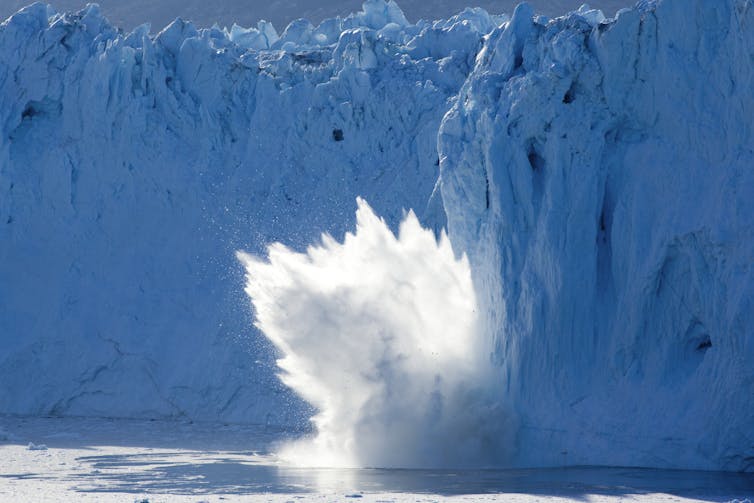
René van Westen, Utrecht University; Henk A. Dijkstra, Utrecht University, and Michael Kliphuis, Utrecht University
Superstorms, abrupt climate shifts and New York City frozen in ice. That’s how the blockbuster Hollywood movie “The Day After Tomorrow” depicted an abrupt shutdown of the Atlantic Ocean’s circulation and the catastrophic consequences.
While Hollywood’s vision was over the top, the 2004 movie raised a serious question: If global warming shuts down the Atlantic Meridional Overturning Circulation, which is crucial for carrying heat from the tropics to the northern latitudes, how abrupt and severe would the climate changes be?
Twenty years after the movie’s release, we know a lot more about the Atlantic Ocean’s circulation. Instruments deployed in the ocean starting in 2004 show that the Atlantic Ocean circulation has observably slowed over the past two decades, possibly to its weakest state in almost a millennium. Studies also suggest that the circulation has reached a dangerous tipping point in the past that sent it into a precipitous, unstoppable decline, and that it could hit that tipping point again as the planet warms and glaciers and ice sheets melt.
In a new study using the latest generation of Earth’s climate models, we simulated the flow of fresh water until the ocean circulation reached that tipping point.
The results showed that the circulation could fully shut down within a century of hitting the tipping point, and that it’s headed in that direction. If that happened, average temperatures would drop by several degrees in North America, parts of Asia and Europe, and people would see severe and cascading consequences around the world.
We also discovered a physics-based early warning signal that can alert the world when the Atlantic Ocean circulation is nearing its tipping point.
The ocean’s conveyor belt
Ocean currents are driven by winds, tides and water density differences.
In the Atlantic Ocean circulation, the relatively warm and salty surface water near the equator flows toward Greenland. During its journey it crosses the Caribbean Sea, loops up into the Gulf of Mexico, and then flows along the U.S. East Coast before crossing the Atlantic.
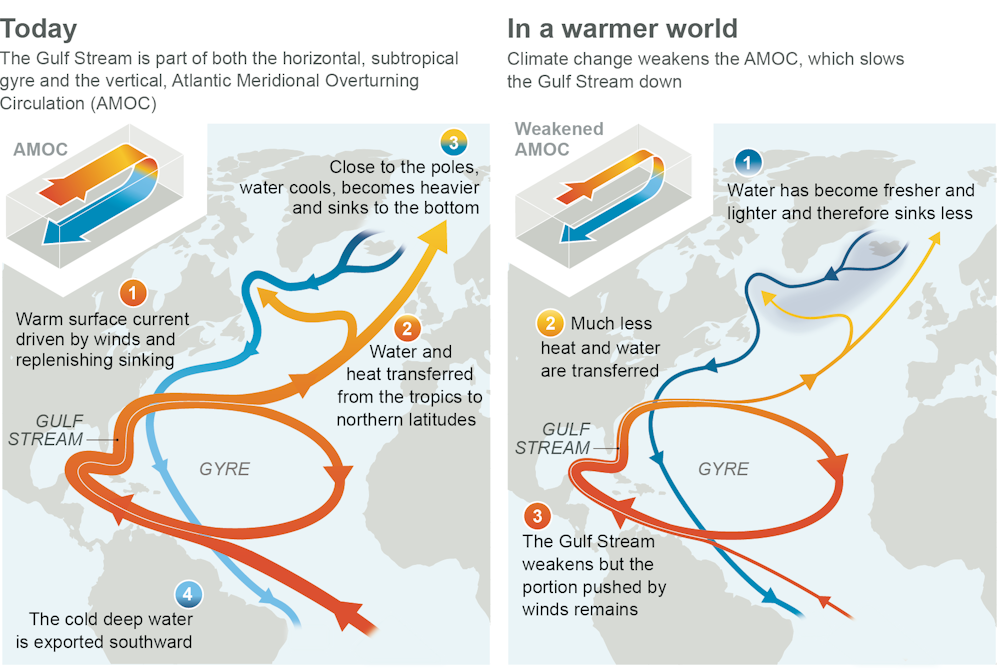
This current, also known as the Gulf Stream, brings heat to Europe. As it flows northward and cools, the water mass becomes heavier. By the time it reaches Greenland, it starts to sink and flow southward. The sinking of water near Greenland pulls water from elsewhere in the Atlantic Ocean and the cycle repeats, like a conveyor belt.
Too much fresh water from melting glaciers and the Greenland ice sheet can dilute the saltiness of the water, preventing it from sinking, and weaken this ocean conveyor belt. A weaker conveyor belt transports less heat northward and also enables less heavy water to reach Greenland, which further weakens the conveyor belt’s strength. Once it reaches the tipping point, it shuts down quickly.
What happens to the climate at the tipping point?
The existence of a tipping point was first noticed in an overly simplified model of the Atlantic Ocean circulation in the early 1960s. Today’s more detailed climate models indicate a continued slowing of the conveyor belt’s strength under climate change. However, an abrupt shutdown of the Atlantic Ocean circulation appeared to be absent in these climate models. https://www.youtube.com/embed/p4pWafuvdrY?wmode=transparent&start=0 How the ocean conveyor belt works.
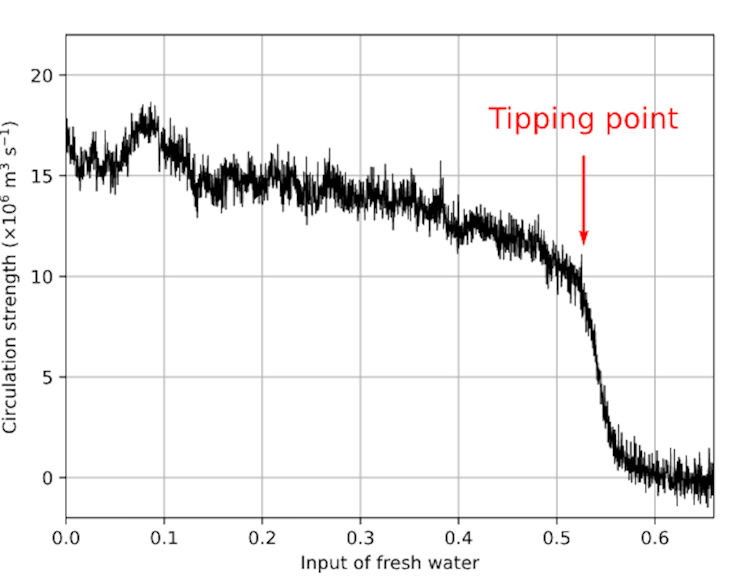
This is where our study comes in. We performed an experiment with a detailed climate model to find the tipping point for an abrupt shutdown by slowly increasing the input of fresh water.
We found that once it reaches the tipping point, the conveyor belt shuts down within 100 years. The heat transport toward the north is strongly reduced, leading to abrupt climate shifts.
The result: Dangerous cold in the North
Regions that are influenced by the Gulf Stream receive substantially less heat when the circulation stops. This cools the North American and European continents by a few degrees.
The European climate is much more influenced by the Gulf Stream than other regions. In our experiment, that meant parts of the continent changed at more than 5 degrees Fahrenheit (3 degrees Celsius) per decade – far faster than today’s global warming of about 0.36 F (0.2 C) per decade. We found that parts of Norway would experience temperature drops of more than 36 F (20 C). On the other hand, regions in the Southern Hemisphere would warm by a few degrees.
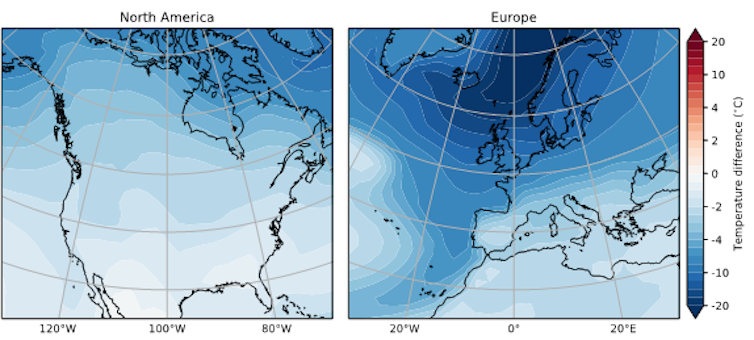
These temperature changes develop over about 100 years. That might seem like a long time, but on typical climate time scales, it is abrupt.
The conveyor belt shutting down would also affect sea level and precipitation patterns, which can push other ecosystems closer to their tipping points. For example, the Amazon rainforest is vulnerable to declining precipitation. If its forest ecosystem turned to grassland, the transition would release carbon to the atmosphere and result in the loss of a valuable carbon sink, further accelerating climate change.
The Atlantic circulation has slowed significantly in the distant past. During glacial periods when ice sheets that covered large parts of the planet were melting, the influx of fresh water slowed the Atlantic circulation, triggering huge climate fluctuations.
So, when will we see this tipping point?
The big question – when will the Atlantic circulation reach a tipping point – remains unanswered. Observations don’t go back far enough to provide a clear result. While a recent study suggested that the conveyor belt is rapidly approaching its tipping point, possibly within a few years, these statistical analyses made several assumptions that give rise to uncertainty.
Instead, we were able to develop a physics-based and observable early warning signal involving the salinity transport at the southern boundary of the Atlantic Ocean. Once a threshold is reached, the tipping point is likely to follow in one to four decades.
The climate impacts from our study underline the severity of such an abrupt conveyor belt collapse. The temperature, sea level and precipitation changes will severely affect society, and the climate shifts are unstoppable on human time scales.
It might seem counterintuitive to worry about extreme cold as the planet warms, but if the main Atlantic Ocean circulation shuts down from too much meltwater pouring in, that’s the risk ahead.
This article was updated to Feb. 11, 2024, to fix a typo: The experiment found temperatures in parts of Europe changed by more than 5 F per decade.
René van Westen, Postdoctoral Researcher in Climate Physics, Utrecht University; Henk A. Dijkstra, Professor of Physics, Utrecht University, and Michael Kliphuis, Climate Model Specialist, Utrecht University
This article is republished from The Conversation under a Creative Commons license. Read the original article.
ooOOoo
I am 79! I like to think that whatever is coming down the wires, so to speak, will be after my death. But that is a cop out for a) I have a son and a daughter who are in their early fifties, b) I have a grandson, my daughter and son-in-law’s young man, who is a teenager, with his birthday next month, and c) I could possibly live for another twenty years.
The challenge is how to bring this imminent catastrophic global change in temperature to the fore. We need a global solution now enforced by a globally respected group of scientists and leaders, and, frankly, I do not see that happening.
All one can do is to hope. Hope that the global community will eschew the present-day extremes of warring behaviour and see the need for change. That is NOW!
So that the Hollywood movie, The Day After Tomorrow, remains a fictional story. And for those that have forgotten the film or who have never seen it, here is a small slice of a Wikipedia report:
The Day After Tomorrow is a 2004 American science fiction disaster film conceived, co-written, directed, co-produced by Roland Emmerich, based on the 1999 book The Coming Global Superstorm by Art Bell and Whitley Strieber, and starring Dennis Quaid, Jake Gyllenhaal, Sela Ward, Emmy Rossum, and Ian Holm. The film depicts catastrophic climatic effects following the disruption of the North Atlantic Ocean circulation, in which a series of extreme weather events usher in climate change and lead to a new ice age.
Wikipedia
And here is a YouTube video:
There we go, folks!
 Learning from Dogs
It makes rather depressing reading, particularly when the reaction to the impending climate catastrophe resembles Hollywood’s ‘Don’t Look Up’.
LikeLiked by 2 people
Jacqueline, thank you for giving your response. I just do not know what to say in that it is my generation that bears the greatest responsibility for this catastrophic situation. Take care!
LikeLiked by 1 person
We’re all culpable – manking has been changing the environment for millennia. The worst of it started with the Industrial Revolution.
LikeLiked by 2 people
Do you have a passion for change, Jacqueline? I sense you do. And what is your response to Colin’s thought that it is the oil companies who want the AMOC to shut down?
LikeLiked by 1 person
I think I have lost my passion for change.
I feel so overwhelmed by the inaction of those who could make a difference but put profits before all else, and are happy to sacrifice their grandchildren’s future on that altar.
LikeLiked by 2 people
Your last sentence sounds like a powerful idea for a non-fiction book! Do you write?
LikeLiked by 1 person
@Jacqueline I know exactly what you mean about feeling overwhelmed. I’ve signed so many petitions that seem to have little impact, have blogged for years offering my tuppences on various issues, but feel so powerless to actually effect any meaningful change. Which is, perhaps, the way Those In Power want us to feel – a thought that makes me feel even more sad. Of late, I’ve devoted most of my energy to litter-picking in my neighbourhood, as that affords me the belief that at least I’m doing something rather than just ranting and wailing.
LikeLiked by 2 people
Let me add to your reply to Jacqueline in that I, too, have a terrible dislike of the litter we see on our streets. The local council do at least have crews that come out every couple of months to tidy it up. Interesting parallels between us!
LikeLiked by 2 people
I do write, Paul. Humorous memoirs about our travels since giving up work, with the occasional political rant that gets me into trouble with reviewers when something (like Brexit and Boris Johnson) cause my tolerance to overspill!
The problem with writing a non fiction book like that is that it would be preaching to the converted and an invitation to the trolls.
I’m not sure it would make any difference to those who are set in their ways, know best, and won’t change their minds. Plus, I’m sure people with greater knowledge than me have already written such books.
LikeLiked by 1 person
Well it is lovely to see your reply and I fully understand that. Last weekend I attended a class on writing a novel, because that was something I wanted to do, and discovered that it was far more complex than I realized! Amazing when one considers the millions of novels out there.
LikeLiked by 1 person
Paul, you may not be a professional scientist. But you’re not ignorant. In my view, the study of science is an attitude, driven on by an inquisitive mind and moderated by critical thinking. And it’s available to any of us. Kudos to you for doing what you can to enlighten others.
My suspicious mind wonders whether the fossil fools who control us all have a vested interest in not helping to spread the word about the possibility of an AMOC tipping point. Most of our civilization exists in the northern hemisphere… and if it were to turn much colder ‘up’ here, then that would mean that more energy would be needed simply to keep us all warm enough to survive. Which, of course, would boost their argument that we must continue to “drill, baby, drill” to keep it all going. The ignorant flock, continuing to believe their lies, would naturally vote for them in their shivering droves.
Your post reminds me of a book I read many years ago. It was called ‘The Last Gasp’, by Trevor Hoyle. It, too, tells of a tipping point caused by the lack of foresight shown by homo fatuus brutus, but one of an even more frightening nature: the rapid depletion of the level of oxygen in the Earth’s atmosphere. Like ‘The Day After Tomorrow, though fiction, it’s based on fact.
If we continue to shit in our pond, we will drown in it.
Speaking of books: is your latest out yet?
LikeLiked by 1 person
Colin, wow, I hadn’t thought of it as a ploy by the oil companies! Because these companies employ some very smart people and they would know the science of the issue. But it is a realistic situation. Oh dear, oh dear!
My book, an autobiography, is not yet out. I have had a couple of people give me feedback and I want to make a few changes as well. Then there is the cover to design and then I am ready to go. Do you want to be a trial reader?
LikeLiked by 1 person
I think your memory may be failing you again, Paul 😉 I previously offered to give you feedback on your draft (and did, for the first one) but my circumstances have changed a great deal in the last few years, and despite my best intentions I’m finding that I’m so busy on other fronts that I have too little time spare. (Hence my absence here on WordPress lately). Though I’d love to say “yes”, I wouldn’t want to let you down.
LikeLiked by 1 person
Colin, I am not surprised at my loss of memory these days, it is terrible! Sorry!
Regarding your own circumstances are you finding what you do as stimulating and rewarding? I hope so.
LikeLike
Non state oil companies control a tiny portion of world oil production.
Let those who never used oil justly protest. The rest are hypocrites, or, even worse, ridiculously ignorant.
We live in a world where celebrities win. It happens in science too.
LikeLike
“Let those who never used oil justly protest.” I think there is a third cause, that of the habitual user from way back, plus also, I cannot afford to change at present. I was born in 1944 long before the changing climate became the issue it is now.
LikeLike
It is empowering to take positive action. We litter pick whenever we park our truck up somewhere or take the pups for a walk.
Our lifestyle as permanent nomads is very minimal, so we do what we can, but the climate crisis needs governments to take notice, and take hasty and positive action. Unfortunately, the will just doesn’t seem to be there while they’re all lining their own pockets.
LikeLiked by 1 person
Yes, the greed shown by some is staggering. In the end one doesn’t understand in the slightest what their plan is.
LikeLiked by 1 person
Scary stuff.
LikeLiked by 1 person
Incredibly so, and thanks for your response!
LikeLike
AMOC is shutting down… Numbers are in. And then what? We are not during the Dryas… The cold storage in the north is probably insufficient to significantly slow down warming in Europe. The on-going warming is stored in the ground on the European continent. Cold storage in Greenland is mostly in the highlands, so the cold water flow won’t do what the celebrity scientist claim to fear it will do. I have studied the AMOC for many decades…
Warming in Western Alps this winter: +10 C. No snow to speak of below 5,000 feet.
Non state oil companies control a tiny portion of world oil production.
Global oil production mostly originates with national oil companies, which are owned and operated by governments. National oil companies often dominate oil production in many oil-rich countries, including major producers like Saudi Arabia, Russia, Brazil (Petrobras), Iran (NIOC), Indonesia and Venezuela.
More exactly:Saudi Aramco (Saudi Arabia)
National Iranian Oil Company (NIOC) (Iran)
China National Petroleum Corporation (CNPC) (China)
Gazprom (Russia)
Petrobras (Brazil)
Petróleos Mexicanos (Pemex) (Mexico)
Kuwait Petroleum Corporation (KPC) (Kuwait)
Abu Dhabi National Oil Company (ADNOC) (United Arab Emirates)
Qatar Petroleum (QP) (Qatar)
Nigerian National Petroleum Corporation (NNPC) (Nigeria)
The nationals control around 80% of world fossil fuel, and thus more or less directly transportation, energy, fertilizers, cements, steel, plastics, chemicals…
But OK, people prefer to hate mysterious “oil companies” Harry Potter style evil powers, rather than their synthetic shoes. After all, their fossil fuel life is all around, including their electric car fuel, and they must not hate their own lives…
Let those who never used oil justly protest. The rest are hypocrites, or, even worse, ridiculously ignorant, preaching non sense to feel good because ranting and raving -hating- feels good.
“Net-zero” is bringing industrial devastation to Europe: it consists into the real plot of deindustrializing and empoverishing the average European, as European capital sends its capital overseas, to make greater profits.
“Net-zero” can’t work with existing tech. So research has to advance. An example: Europe should spend right away ten billion dollars to see if INERTIAL THERMONUCLEAR FUSION can be made to work economically (US experiences at LLL a military lab shows it works, physically speaking).
But what is Europe doing? Passing laws to prevent us to express fear of Islam. Or providing free health care to illegal immigrants, by the millions… while European born citizens can’t get health coverage (my personal case).
If Greta wants to protest oil, she should go around dressed with the skins of animals she killed herself. Each time I see her, she is covered with fossil fuels.
LikeLike
Thank you for your comprehensive reply. I really want to ponder on what you have said and then I will reply, assuming I have the knowledge to make a sensible reply!
LikeLike
Having reflected on your long reply, I wanted to say that in general I do not have the knowledge to add to your comment. I listened to the UK Budget earlier on, being broadcast on BBC Radio 4, and noted the comment about Nuclear power that is going to be a focus over the coming years. But thank you very much for responding so fully.
LikeLike