More information about fasting, not about being female!
In yesterday’s post on Learning from Dogs, I wrote that there are two important aspects of living a longer life. The first one was be a female and the second one was about fasting. I propose to expand a little on that second aspect because of the number of people who found the topic so interesting.

In yesterday’s post there was reference to the work that Professor Valter D. Longo of the University of Southern California (USC) has been undertaking. As the USC web reference explains, Valter Longo is the Director of the Longevity Institute, a Professor of Gerontology and Biological Sciences and the Edna Jones Chair of Biogerontology, so if anyone understands how humans tick, it’s likely to be this man! As his research overview states,
He is interested in understanding the mechanisms of aging in organisms ranging from yeast to humans. The focus is on the conserved nutrient signaling pathways that can be modulated to protect against age-dependent oxidative damage and delay or prevent diseases of aging including cancer, diabetes and neurodegenerative diseases.
(Any questions, ask Prof. Longo not me!)
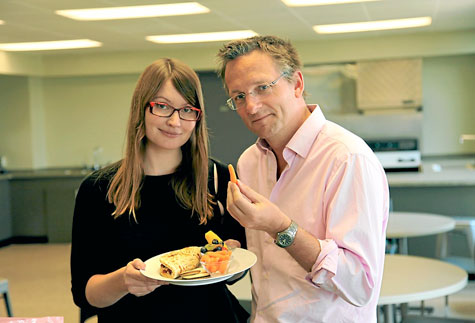
The other learned person referred to in yesterday’s post was Dr. Krista Varady. This is what was written,
Dr Krista Varady of the University of Illinois at Chicago carried out an eight-week trial comparing two groups of overweight patients on ADF. (ADF = Alternative Day Fasting)
Over on the Healthy Fellow blogsite, there’s an interview with Dr. Varady. The web link of that interview is here and crossing over and reading the full interview is much recommended. Here’s a taste, pardon the pun, of that interview:
JP: Can you help explain the distinctions between alternate day fasting and caloric restriction?
Dr. Varady: Caloric restriction is basically daily calorie restriction where an individual would restrict themselves by about 15% to 40% of their energy needs daily. So basically every single day you’re undergoing the same amount of restriction, whereas alternate day fasting involves a fast day wherein the individual would only eat 25% of their energy needs. So about 500 calories or so and that’s alternated with something called a “feed day” where the individual would eat ad libitum – so as much as they want. However in our studies we show that people end up losing weight because they can’t fully make up for the lack of food on the fast day on the feed day.
Let me add a personal perspective on this. On the morning of the first day after our two-day fast, my weight was 162.5 lbs (73.71 kg), on the morning of the second day after our fasting days my weight was 161.8 lbs (73.39 kgs) and on the morning of the third day after our fasting, my weight was 161.6 lbs (73.30 kgs). Ergo even though we were back to eating normally for three days after our two days of fasting, I continued to lose 0.9 lbs (0.4 kgs).
So if you have any concerns over cardiovascular health or want to explore a realistic way of losing excess weight, then do read the interview. Part One of that interview is here and Part two here.
As is said, we are what we eat and I shall close this postscript with a link to an article on the Mother Nature Network website that was published a little over a year ago: 18 foods that fight common ailments – Try healthy eats that help fight diabetes, heart disease, migraines and more.
So may we all live forever!
 Learning from Dogs
LikeLike
We need to add life to our years, not years to our lives.
LikeLike
LikeLike
No it is not. This is the world we have corrupted.
LikeLike
I’m not one of those people who can fast, I’m afraid. I eat breakfast, then start getting shaky at 11 a.m. If I don’t eat by 12 noon, I get spots before the eyes, start sweating and feeling faint etc. I have always eaten a ‘healthy’ breakfast of cereal, toast, fruit and tea until recently, but that no longer holds me till lunch. It used to, but it doesn’t now. I’ve read that if we eat carbohydrates, it provokes the pancreas into working harder so we use up the energy quicker and therefore need more food sooner. It follows therefore that to eat eggs and bacon or something similar, stays longer in the body and produces the energy required slower. So I changed my diet as I got older. I think it’s a shame that eggs and bacon (or similar) has such a bad press. It doesn’t have to be cooked in fat or be greasy. It is just cooked. So what works for me is a little and often and all through the day. I rarely eat anything after 6 pm. I’m a morning person!
I think it’s commendable to be able to fast, but it isn’t for everyone and I think that eventually the body goes back to doing its own thing. People seem to fall into types in that respect.
Interestingly, my partner here often skips breakfast and is still fine at lunchtime, but then he picks all through the day and takes pints of beer in the evenings sometimes.
Good luck with your fasting, detoxing or whatever. Be interesting to see how the longterm effects are.
LikeLike
Your comment is an important one. I say this in the sense that the posts of the last two days are written from the perspective of general interest and not from any position of specialist knowledge.
As the BBC programme made clear, anyone in the slightest doubt about the decision to start a diet should seek medical advice before so doing.
LikeLike