We live just outside Merlin in Southern Oregon. We have 13 acres of which roughly half is wooded. With the year-on-year warming wildfires are never far from our minds during our Summer. Here’s a part of a message from OPB.
What’s happening
High temperatures are in the forecast along the Interstate 5 corridor, the Willamette Valley and in Central and Eastern Oregon. More than a quarter million acres across multiple counties in Eastern Oregon are ablaze with wildfires, and that could mean smoke and haze, especially in Central and northeastern Oregon.
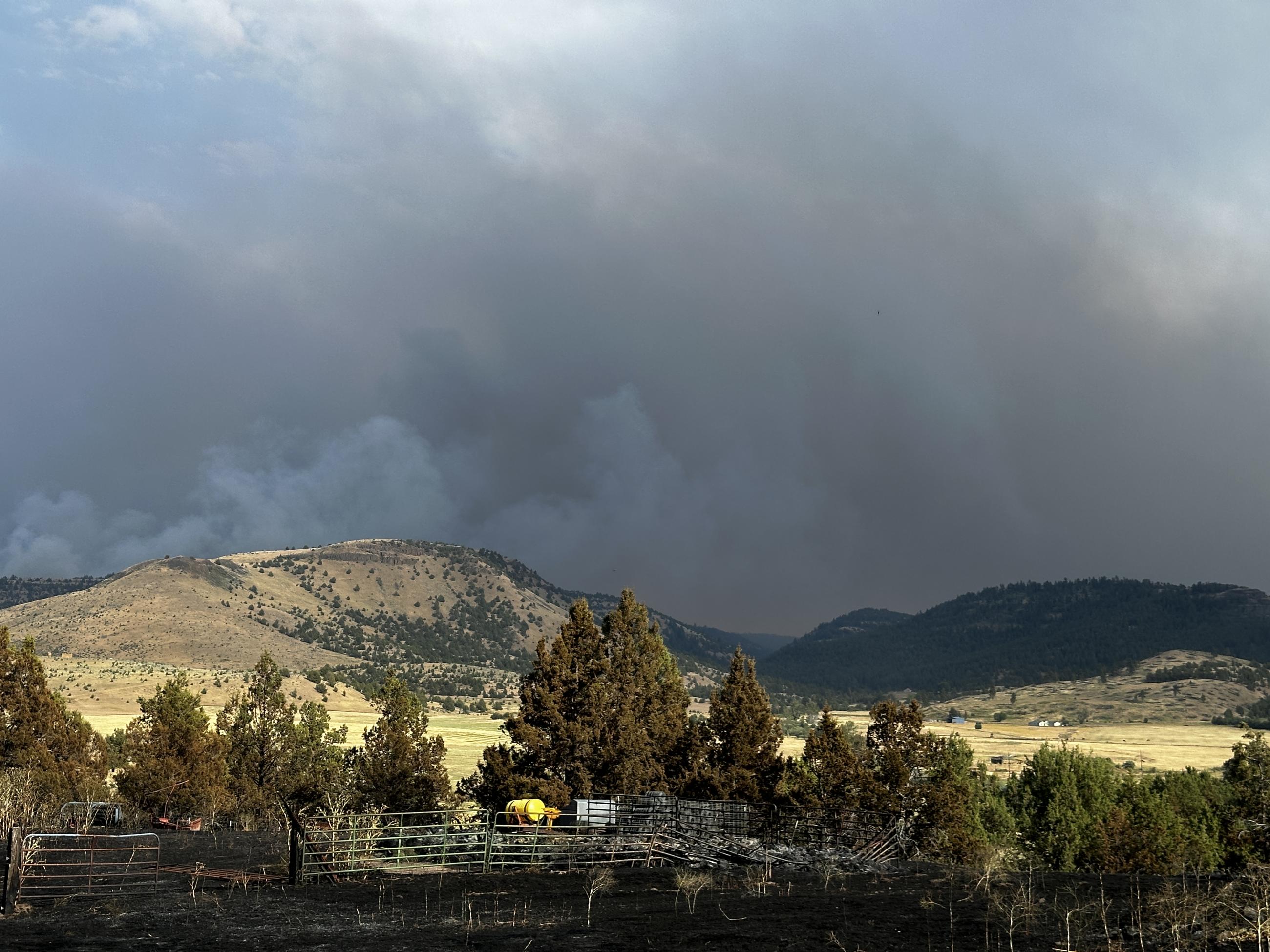
A view of the southern portion of the Lone Rock Fire in north-central Oregon on Wednesday, July 17, 2024.Courtesy InciWeb
Hot weather persists
The National Weather Service is anticipating a hot weekend across much of Oregon and Southwest Washington. The agency on Friday issued a heat advisory along the Interstate 5 corridor from Battle Ground, Washington to Cottage Grove, Oregon from 11 a.m. to 11 p.m. Saturday. Temperatures could reach the mid-90s.
From central Oregon east towards Burns a heat advisory is in place from 11 a.m. Saturday to 11 p.m. Monday. Harney County could see temperatures over 100 degrees over the weekend.
Which neatly serves as an introduction to an article from The Conversation about protecting one’s home.
ooOOoo
How to protect your home from wildfires – here’s what fire prevention experts say is most important
We research wildfire risk to homes and communities. Here’s what decades of research suggest homeowners in high-fire-risk areas can do to protect their properties.
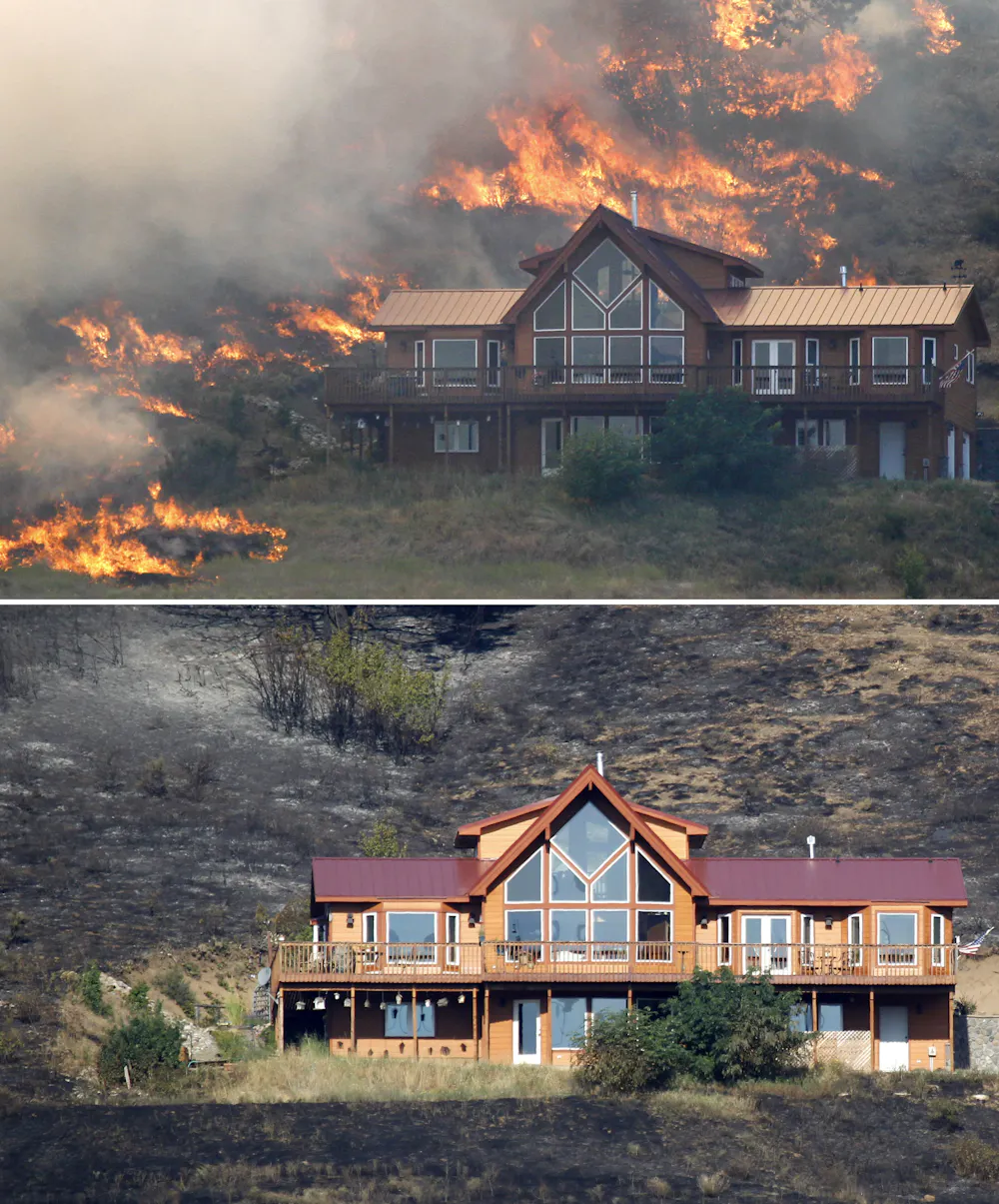
This house near Cle Elum, Wash., survived a 2012 wildfire because of the defensible space around the structure, including a lack of trees and brush close to the house, according to state officials. AP Photo/Elaine Thompson
Small improvements make big differences
A structure’s flammability depends on both the materials that were used to build it and the design of the building. In general, the vulnerability of a house is determined by its weakest point.
The roof, windows, siding and vents are all vulnerable points to pay attention to.
Roof: The roof provides a landing pad where airborne embers can accumulate like snowflakes. Roofs with lots of valleys can collect pine needles and leaves, which can be ignited by flying embers. This is why it’s important for the roof itself to be made of Class A non-flammable material like clay tiles or asphalt shingles, and why roof maintenance, including cleaning gutters, is important. Embers can easily find their way under peeling shingles, through gaps of clay tiles, or into gutters where pine needles and leaves can accumulate.
Windows: If windows are exposed to heat, they can shatter and allow fire inside the home, where curtains can easily ignite. Even double-paned windows can be shattered by the heat of a burning shed 30 feet away, unless the window glass is tempered, making it stronger. Fire-resistant shutters made of metal, if closed before a fire arrives, can offer additional protection. https://www.youtube.com/embed/HjA9yLP1icg?wmode=transparent&start=0 A life-size test with blowing embers at IBHS’s fire lab shows ways homes are at risk form a nearby fire.
Siding: Materials like stucco are non-flammable, while cedar shake siding will burn. Your exterior siding should be non-flammable, but the siding is only as strong as its weakest point. If there are holes in the siding, plug them with caulk to prevent embers from reaching the wooden frame in your walls. Ideally, there will be a 6- to 12-inch concrete foundation between the ground and the bottom of your siding material.
Vents: Reducing risk from vents is easy and affordable and can drastically reduce the flammability of your home. Make sure that one-eighth inch or finer metal mesh is installed over all vents to keep embers out of your attic and your home’s interior.
Controlling your home ignition zone
A home’s vulnerability also depends on the area around it, referred to as the home ignition zone.
The risk in your home ignition zone depends on things such as the slope of your land and the ecosystem surrounding your home. Here are a few guidelines the National Fire Protection Association recommends, both to reduce the chance of flames reaching your home and make it easier for firefighters to defend it.
Zone 1 – Within 5 feet
From the home’s exterior to 5 feet away, you want to prevent flames from coming in contact with windows, siding, vents and eaves. The gold standard is to have only non-flammable material in Zone 1.
The most common risks are having flammable mulch, plants, firewood, lawn furniture, decks and fences. These items have been a primary reason homes burned in many wildfires, including the 2018 Camp Fire that destroyed much of Paradise, California, and the 2012 Waldo Canyon Fire near Colorado Springs, Colorado.
Fire protection guidelines take into consideration the surrounding ecosystem. Here some examples based on the National Fire Protection Association’s guidelines. Bryce Young, CC BY
Replacing mulch with gravel or pavers and having only short, sparse plants that don’t touch the house can help reduce the risk.
Wooden decks and fences can burn even if they are well-maintained. Replacing them with non-flammable materials or installing a thin sheet of metal on the house where the siding touches a wooden deck or fence can help protect the home. Mesh screens can prevent the accumulation of debris and embers under the deck.
Zone 2 – 5 to 30 feet away
In the next ring, between 5 and 30 feet from the home, the lawn should be green and short. This is Zone 2.
Be sure to rake up pine needles and leaves and take care to prune the lowest tree branches at least 6 feet high.
There should be about 18 feet of space between trees on a flat slope, and the spacing should increase with slope because steeper terrain drives faster, more intense fires. Walks, pathways, patios, decks and firewood can be kept in this zone.
Zone 3 – 30 to 100 feet away
Beyond Zone 2 and out to about 100 feet from the home is Zone 3. In this area, be sure to give sheds and propane tanks their own defensible space, just like around the house, and prune all low branches to 6 feet.
You can contact your local emergency management office or community wildfire nonprofit to learn more about grant funding that can offset the costs of pruning and removing trees on a forested property.
Beyond 100 feet may extend past your property boundary, but the adjacent house can still be fuel for a wildfire. That’s why it’s smart to plan with your neighbors as you’re reinforcing your own home. Once one house catches fire, house-to-house fire spread is facilitated by closer distances between buildings.
Where we live is beautiful and earlier this year we had a great deal of rain. But the summers are dry; that is a function of the climate in this part of the world. So for July so far we have had no rain and that is normal. Also no rain in July in 2023.
The three zones, as described earlier in this post, are very helpful.
Thankfully wildfires are not something we would expect on a regular basis but it’s always concerning when they’re shown on the tv and we realise how vast the area is that becomes affected. Stay safe.
Many thanks! I’m trying to reduce the fire hazard in that crucial first zone. We have our roof sprinklers fitted but our water supply ultimately depends on us having electricity. But compared to many others we are very lucky!
The other point is that we do have some plants, some quite large, growing against the walls of the house. I’m going to have to make a decision, one way or another, about what to do rather than pretending I just didn’t notice.

 Learning from Dogs
Thankfully wildfires are not something we would expect on a regular basis but it’s always concerning when they’re shown on the tv and we realise how vast the area is that becomes affected. Stay safe.
LikeLike
Many thanks! I’m trying to reduce the fire hazard in that crucial first zone. We have our roof sprinklers fitted but our water supply ultimately depends on us having electricity. But compared to many others we are very lucky!
LikeLiked by 1 person
All good advice.
LikeLike
Many thanks (and I’m sorry for the delay in my response).
LikeLiked by 1 person
You are prompt in my mind. No problem.
LikeLike
Once again, you are very kind!
LikeLiked by 1 person
The other point is that we do have some plants, some quite large, growing against the walls of the house. I’m going to have to make a decision, one way or another, about what to do rather than pretending I just didn’t notice.
LikeLike