What is the truth?
Today, August 14th, here in Southern Oregon we are expecting 111 degrees Fahrenheit or 43.8 degrees C. That is really hot! (And at home it reached 108 deg. F. at 3pm.)
So it seems pertinent to republish a post from The Conversation that was published on July 21st, 2023.
ooOOoo
Is it really hotter now than any time in 100,000 years?
Professor of Earth and Environmental Sciences, Northern Arizona University
As scorching heat grips large swaths of the Earth, a lot of people are trying to put the extreme temperatures into context and asking: When was it ever this hot before?
Globally, 2023 has seen some of the hottest days in modern measurements, but what about farther back, before weather stations and satellites?
Some news outlets have reported that daily temperatures hit a 100,000-year high.
As a paleoclimate scientist who studies temperatures of the past, I see where this claim comes from, but I cringe at the inexact headlines. While this claim may well be correct, there are no detailed temperature records extending back 100,000 years, so we don’t know for sure.
Here’s what we can confidently say about when Earth was last this hot.
This is a new climate state
Scientists concluded a few years ago that Earth had entered a new climate state not seen in more than 100,000 years. As fellow climate scientist Nick McKay and I recently discussed in a scientific journal article, that conclusion was part of a climate assessment report published by the Intergovernmental Panel on Climate Change (IPCC) in 2021.
Earth was already more than 1 degree Celsius (1.8 Fahrenheit) warmer than preindustrial times, and the levels of greenhouse gases in the atmosphere were high enough to assure temperatures would stay elevated for a long time.
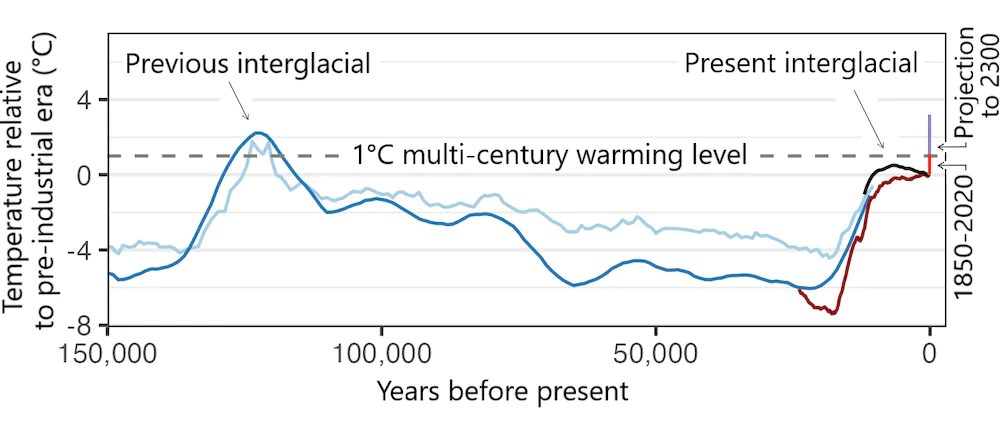
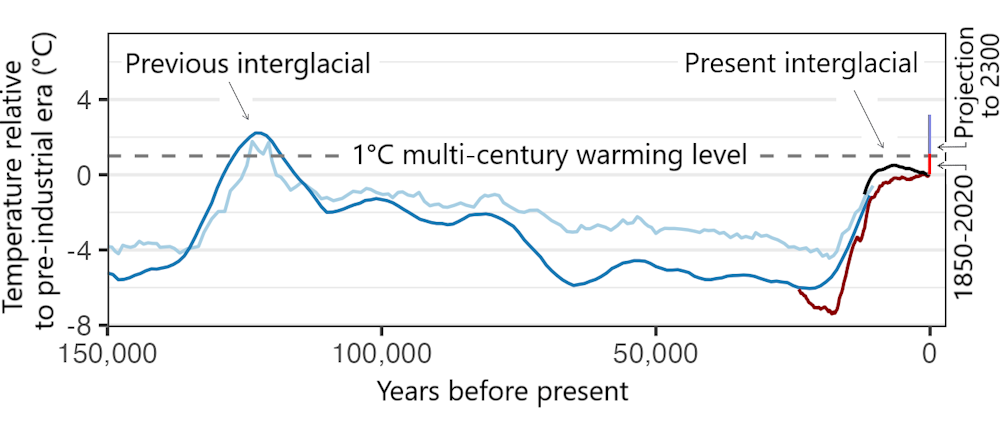
Even under the most optimistic scenarios of the future – in which humans stop burning fossil fuels and reduce other greenhouse gas emissions – average global temperature will very likely remain at least 1 C above preindustrial temperatures, and possibly much higher, for multiple centuries.
This new climate state, characterized by a multi-century global warming level of 1 C and higher, can be reliably compared with temperature reconstructions from the very distant past.
How we estimate past temperature
To reconstruct temperatures from times before thermometers, paleoclimate scientists rely on information stored in a variety of natural archives.
The most widespread archive going back many thousands of years is at the bottom of lakes and oceans, where an assortment of biological, chemical and physical evidence offers clues to the past. These materials build up continuously over time and can be analyzed by extracting a sediment core from the lake bed or ocean floor.
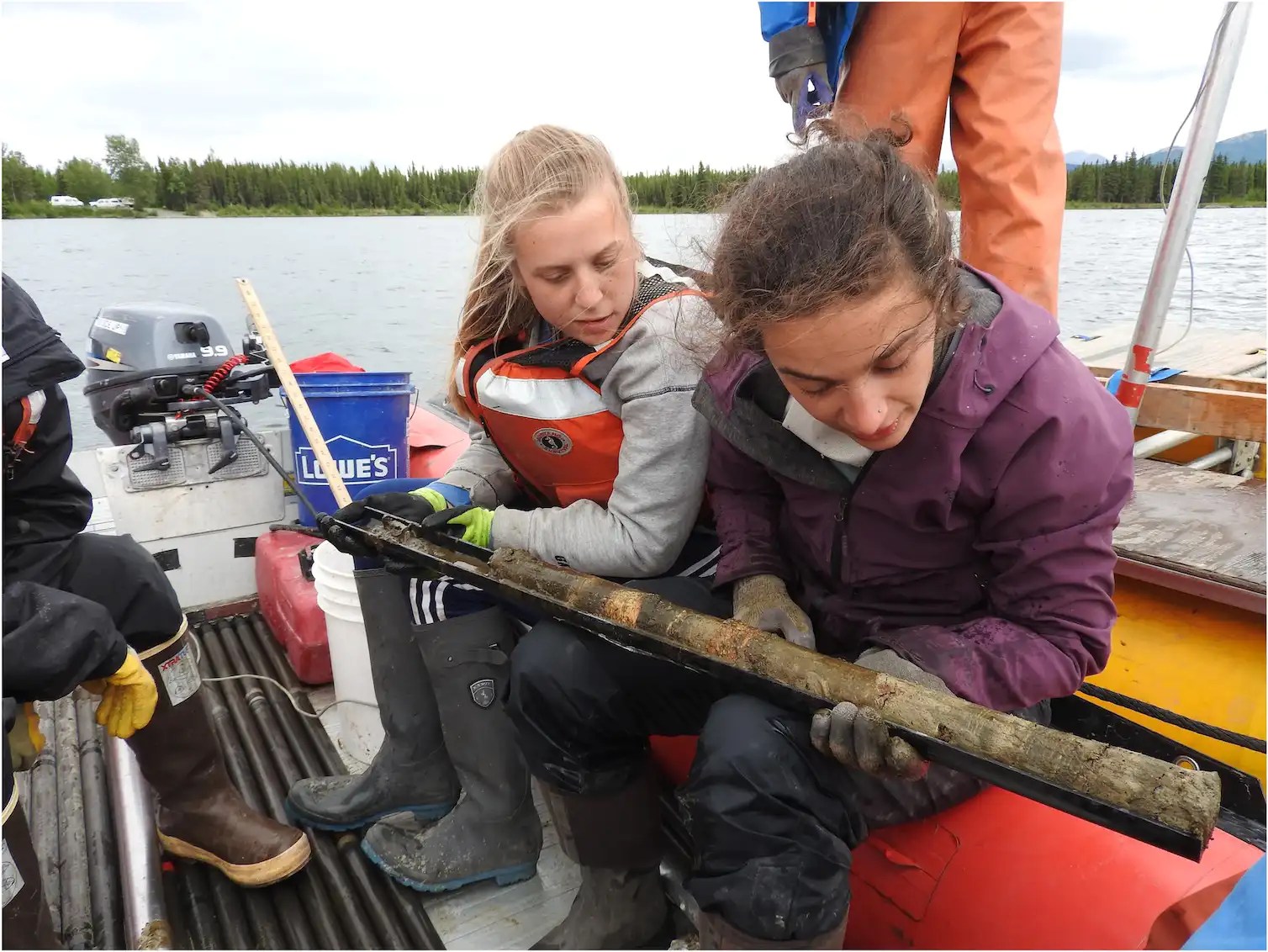
These sediment-based records are rich sources of information that have enabled paleoclimate scientists to reconstruct past global temperatures, but they have important limitations.
For one, bottom currents and burrowing organisms can mix the sediment, blurring any short-term temperature spikes. For another, the timeline for each record is not known precisely, so when multiple records are averaged together to estimate past global temperature, fine-scale fluctuations can be canceled out.
Because of this, paleoclimate scientists are reluctant to compare the long-term record of past temperature with short-term extremes.
Looking back tens of thousands of years
Earth’s average global temperature has fluctuated between glacial and interglacial conditions in cycles lasting around 100,000 years, driven largely by slow and predictable changes in Earth’s orbit with attendant changes in greenhouse gas concentrations in the atmosphere. We are currently in an interglacial period that began around 12,000 years ago as ice sheets retreated and greenhouse gases rose.
Looking at that 12,000-year interglacial period, global temperature averaged over multiple centuries might have peaked roughly around 6,000 years ago, but probably did not exceed the 1 C global warming level at that point, according to the IPCC report. Another study found that global average temperatures continued to increase across the interglacial period. This is a topic of active research.
That means we have to look farther back to find a time that might have been as warm as today.
The last glacial episode lasted nearly 100,000 years. There is no evidence that long-term global temperatures reached the preindustrial baseline anytime during that period.
If we look even farther back, to the previous interglacial period, which peaked around 125,000 years ago, we do find evidence of warmer temperatures. The evidence suggests the long-term average temperature was probably no more than 1.5 C (2.7 F) above preindustrial levels – not much more than the current global warming level.
Now what?
Without rapid and sustained reductions in greenhouse gas emissions, the Earth is currently on course to reach temperatures of roughly 3 C (5.4 F) above preindustrial levels by the end of the century, and possibly quite a bit higher.
At that point, we would need to look back millions of years to find a climate state with temperatures as hot. That would take us back to the previous geologic epoch, the Pliocene, when the Earth’s climate was a distant relative of the one that sustained the rise of agriculture and civilization.
ooOOoo
It is difficult to know what to say other than one hopes that Governments and country leaders recognise the situation and DO SOMETHING!
As Dr. Michael Mann put it in the last issue of The Humanist: “The only obstacles aren’t the laws of physics, but the flaws in our politics.“
I have a son and a daughter in their early 50’s and a grandson who is 12. They, along with millions of other younger people, need action now.
Please!
 Learning from Dogs
That is a very good article. I remember you posting it before but I did not have time to comment then. I think the warmer climate is very obvious in northern Sweden where I am from. On average the snow seasons have been shortened 1-2 months over the last 30 years, and you’ll notice that. Here in Texas we have had an awful summer. 107 degrees (42 Celsius) almost every day it seems. Luckily I have beer. However, we’ve had these kind of summers a few times before in Texas, but they are becoming more common.
The real evidence for our warming world comes straight from NASA, NOAA, the world’s national meteorological institutions, etc., and they are not idiots. The evidence if you take a serious look at it, is conclusive. In addition we know that this warming is mostly our greenhouse gases. The evidence for this is also conclusive. I will never understand people who believe a conspiracy theory laden youTube video over scientists, powerful evidence and organizations such as NASA. I wrote a post about this topic myself. You might like it. It is under “All Posts”, that’s where I put old blog posts. Then under “All Posts” at the bottom I have a headline “Other Than Leonbergers” and it is the post called “The Climate Journeys of Thomas and Larry”.
I recently read a book by William Nordhaus, a Nobel prize winner in economics who took a deep dive into the economics of climate change / global warming. A very interesting book. He says ending up at 2.5C by the end of the century is the most likely based on the fact that we are taking action but maybe a bit slow. That will be bad and costly but not the end of civilization. Much beyond that though, that’s a different matter. I am certainly worried about my kids and future generations. Anyway, thank you for the interesting reading.
LikeLike
Was the book by William Nordhaus called “A Question of Balance: Weighing the Options on Global Warming Policies”?
I shall be 79 in November and while I am fit and healthy I want to live for another 5 years or so. Because if by then governments have not tackled the situation in a serious way then we have almost no hope. Already we are seeing changes to the environment, both at sea and on the land, that are dreadfully worrying.
For most of my life I have been unaffected by the changing climate but we are now in a different epoch and one that is uncertain for life on this planet, and I do not think I voice this in an exaggerated manner.
LikeLiked by 1 person
No, the book by William Nordhaus was called Climate Casino because the calculations are probabilistic, and we are taking risks that are probabilistic. I should say that in the first half of the book it sounds like he is downplaying the problem. For example, he is stating correctly that WHO calculated that an additional 80 million people will die from mosquito borne diseases by 2050 if we allow a 2C warming, but that was using today’s medical technology. Clearly, we would be much better at fighting diseases like malaria by 2050. The same thing with natural disasters. Even though certain types of natural disasters have become physically worse and costlier the casualties have gone down significantly because of better technology and communication. Those improvements are likely to continue. He is also using discounting. To save $100,000.00 in 2050 you should not spend $100,000.00 today to prevent that loss, but only $20,000.00 because today’s money is more valuable. You can invest today’s money and let it grow. He is using a discount rate of 4%. Then he also excluded species extinctions, ocean acidification and a few other things from his calculations, not because they don’t matter, on the contrary, but because it is too hard to estimate the economic value of those things. Likewise, the loss of a poor person’s life does not cost that much, and it will be mostly poor people who die. Also ruined agriculture in the third world countries will be made up for by improved agriculture in the northern countries such as Canada, Russia, and Sweden and there are economic benefits from the disappearing arctic ice, etc.
However, his reasoning is not because he wants to minimize the damage from climate change but to come up with a conservative and unassailable minimum for purely economic loss. Despite all his discounting the conclusion is that we should spend significant money today, preferably via a carbon tax, to mitigate climate change even for purely economic reasons. Luckily, a lot of countries around the world are acting, which seems to avoid the end of the world scenario. However, he stresses that every country needs to do their part.
LikeLike
Thanks Thomas. I have taken a more pessimistic view of things probably because I am more downhearted than I should be. I agree strongly with the need for a carbon tax and maybe the current heatwave that we are going through is not helping keep me positive. Whatever the next few years will bring we will all experience it. That is for sure! I am going to look up that book in the next few minutes.
LikeLiked by 1 person
Nordhaus book has a lot of calculations and graphs and it is very technical from an economic viewpoint. There is another book written by a climate scientist that has a positive and inspirational tone yet it is not unrealistic. It is “Saving Us: A Climate Scientist’s Case for Hope and Healing in a Divided World ” by Katharine Hayhoe.
LikeLike
The challenge is that I already have quite a few books that I have yet to read so, perhaps, I will stall on the Hayhoe book. I will see if she has a website.
LikeLiked by 1 person
And she does!
LikeLiked by 1 person