Ultimately, a message of hope.
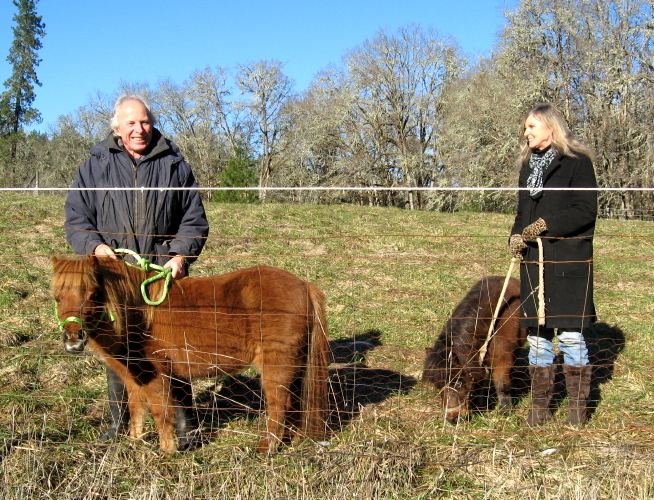
Today’s title came from a recent chat ‘across the garden fence’ with our neighbours, Dordie and Bill. At their request we had walked our two horses over to the fence-line between our two properties so Dordie and Bill could meet and fondle them. The warm afternoon sunshine was beautiful and while the horses munched the newly-found grass, we grown-ups talked about this and that and generally tried to put the world to rights!
We talked about the strangeness of present times. Not just in the USA but across the world. Bill thought 2013 would be the year of separation. I queried what he meant by that.
Bill replied, “I sense that by the end of the year, the vast majority of people will have decided if climate change is or is not a significant issue.” There would be few who remained neither unconcerned nor undecided.
That resonated with me and neatly put the framework to today’s post. Stay with me while I journey to the destination that this year will be the year of hope.
I am one of many who subscribe to the online magazine Grist. They describe themselves, thus:
Laugh now — or the planet gets it.
You know how some people make lemonade out of lemons? At Grist, we’re making lemonade out of looming climate apocalypse.
It’s more fun than it sounds, trust us!
Grist has been dishing out environmental news and commentary with a wry twist since 1999 — which, to be frank, was way before most people cared about such things. Now that green is in every headline and on every store shelf (bamboo hair gel, anyone?), Grist is the one site you can count on to help you make sense of it all.
The weekly Grist digest that arrived in my in-box that same day as when we were chatting with Dordie and Bill included a number of key stories.
Here’s one that smacked me in the eye.
The 32 most alarming charts from the government’s climate change report
By Philip Bump
Just reading about the government’s massive new report outlining what climate change has in store for the U.S. is sobering. In brief: temperature spikes, drought, flooding, less snow, less permafrost. But if you really want to freak out, you should check out the graphs, charts, and maps.
Now I’m not going to republish all 32 charts but will include just these two, because the message is clear.
It’s possible that sea levels could only rise eight inches. It is also possible that they could rise over six-and-a-half feet.
—-
Sea-level rise will affect different areas to different degrees — but note the map at lower right. On the Georgia coast, “hundred year” floods could happen annually.
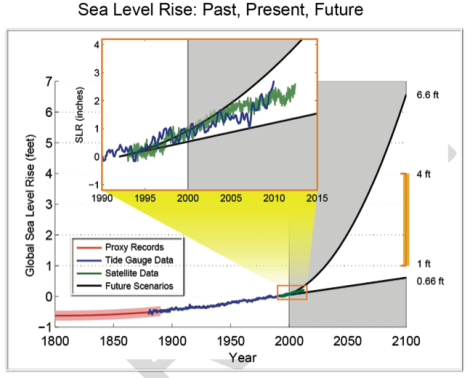

OK, that first chart takes a while to absorb the full implications. The second one doesn’t!
The full range of charts is chilling. While they refer to the USA, the messages apply to the whole world.
Then in that same Grist weekly summary was this story.
If you aren’t alarmed about climate, you aren’t paying attention
There was recently another one of those (numbingly familiar) internet tizzies wherein someone trolls environmentalists for being “alarmist” and environmentalists get mad and the troll says “why are you being so defensive?” and everybody clicks, clicks, clicks.
I have no desire to dance that dismal do-si-do again. But it is worth noting that I find the notion of “alarmism” in regard to climate change almost surreal. I barely know what to make of it. So in the name of getting our bearings, let’s review a few things we know.
We know we’ve raised global average temperatures around 0.8 degrees C so far. We know that 2 degrees C is where most scientists predict catastrophic and irreversible impacts. And we know that we are currently on a trajectory that will push temperatures up 4 degrees or more by the end of the century.
David then works his way through those ‘things we know’ in a powerful manner. Do read the full article, please! This is his conclusion:
All this will add up to “large-scale displacement of populations and have adverse consequences for human security and economic and trade systems.” Given the uncertainties and long-tail risks involved, “there is no certainty that adaptation to a 4°C world is possible.” There’s a small but non-trivial chance of advanced civilization breaking down entirely.
Now ponder the fact that some scenarios show us going up to 6degrees by the end of the century, a level of devastation we have not studied and barely know how to conceive. Ponder the fact that somewhere along the line, though we don’t know exactly where, enough self-reinforcing feedback loops will be running to make climate change unstoppable and irreversible for centuries to come. That would mean handing our grandchildren and their grandchildren not only a burned, chaotic, denuded world, but a world that is inexorably more inhospitable with every passing decade.
Take all that in, sit with it for a while, and then tell me what it could mean to be an “alarmist” in this context. What level of alarm is adequate?
So am I stark staring mad for having hope in my mind? Stay with me for just a little longer. Then form your own judgment.
Recall the post that I published on Tuesday hitting out at the British newspaper The Daily Mail. Towards the end of that post, in discussing the recently released American National Climate Assessment, I wrote this:
That’s why this report is to be encouraged, nay embraced. Of all the nations in the world, the one that should be setting the lead is the United States of America. As the banner on that globalchange.gov website proclaims: Thirteen Agencies, One Vision: Empower the Nation with Global Change Science
So go and read the report. For your sake and all our sakes.
Because the more informed you and I are, the better the chances of real political leadership taking place in this fine nation.
Now with that in mind let’s go to the final Grist article.
A new grand strategy for the U.S., built around sustainability
Let’s just accept it: America’s current political and economic systems are incapable of responding adequately to climate change. As things stand, reducing carbon emissions — or more broadly, shifting to sustainability — is a kind of add-on, a second-tier consideration, bolted onto systems and institutions that were built for other purposes.
A little later, David writes:
So what would a new U.S. grand strategy built around sustainability look like? That’s the question tackled by “A New U.S. Grand Strategy,” a piece in Foreign Policy by Patrick Doherty, director of the Smart Strategy Initiative at the New America Foundation.
It’s a hugely ambitious and wide-ranging piece, far too much to even summarize adequately here. Bookmark it. Instapaper it. Pinterest it to your iCloud, or whatever kids do these days. But let’s take a quick look.
Doherty identifies four central challenges facing the U.S.:
- Economic inclusion: People are swarming out of poverty around the world (especially in China). Over the next 20 years, the global middle class will welcome around 3 billion new members. That’s going to put intense stress on natural, economic, and political systems that are already showing signs of strain.
- Ecosystem depletion: Pretty sure Grist readers are familiar with this one.
- Contained depression: Rather than a recession, the U.S. faces a “constrained depression,” with the full effects of low aggregate demand and high debt being masked by policy. No amount of fiscal or economic stimulus will revive a system that has exhausted itself.
- Resilience deficit: Our industrial supply lines and value chains are efficient, but lack redundancy; they are brittle. Our infrastructure is old and crumbling, $2.2 trillion in the hole, and that’s just for the aging Cold War stuff, never mind building water, power, and transportation systems suited to an era of climate disruption.
“These four challenges,” Doherty says, “are the four horsemen of the coming decades.” And they are inter-dependent. They must be solved together. It’s a rough situation.
With these in mind, Doherty proposes a new grand strategic concept: “The United States must lead the global transition to sustainability.“
What a vision for the United States of America. That this Nation will be the most wonderful example of how man can learn, adapt and change. David Roberts concludes:
Here are Doherty’s main suggestions for how to realign the U.S. economic engine:
- Walkable communities: More and more Americans want to live in dense, walkable areas; get rid of regulations that hamper them and start building them.
- Regenerative agriculture: Farmers can produce “up to three times the profits per acre and 30 percent higher yields during drought” with agricultural techniques that also clean water and restore soils. America must “adopt modern methods that will bring more land into cultivation, keep families on the land, and build regional food systems that keep more money circulating in local economies.”
- Resource productivity: “Energy and resource intensity per person will have to drop dramatically.” That imperative can drive “innovation in material sciences, engineering, advanced manufacturing, and energy production, distribution, and consumption.”
- Excess liquidity: Channel all the corporate cash that’s sitting around in funds into long-term investments in America by taxing waste and creating regional growth strategies.
- Stranded hydrocarbon assets: Figure out how to devalue the immense amount of carbon that’s still sitting underneath the ground without unduly traumatizing the economy.
Obviously the devil is in the details on this stuff, but at a broad level, this is about as eloquent and forward-thinking as it gets. I love the idea of using sustainability in a muscular way, to revive regional economies and nurture the middle class. I recommend reading the whole thing.
I, too, recommend reading “A New U.S. Grand Strategy – Why walkable communities, sustainable economics, and multilateral diplomacy are the future of American power.” (NB: You will have to register with Foreign Policy before access to the report is possible, but it’s free.)
So, the wall-to-wall stream of information that is shouting out how quickly the planet is changing is the fuel that is going to feed the fires of hope.
Let me leave you with the most beautiful words of an ancient philosopher – Aristotle.
 Learning from Dogs
let’s hope we don’t just hope anymore and get to see things moving in the right direction!
LikeLike
But hope inevitably has to lead us to action.
LikeLike
I too met a neighbour yesterday. When the topic of climate change came up, he moved for the door, saying “yes, but that’s not a problem we can resolve here.” I refrained from asking who was going to resolve it, and when. By opting to not get involved in a discussion that might risk fracturing neighbourly friendliness, we were both demonstrating denial of the urgency of the need to address the problems. And so it goes on.
Funny how people are still happy to attribute ‘small’ to this risk. Overpopulation + climate change + peak oil = end of civilisation as we know it. The risk isn’t small, it’s approaching certainty the longer we dither.
LikeLike
Your experience will be playing out every day in the thousands, I don’t doubt. As you imply, not long to wait before it’s clear. Which is what Bill sensed.
LikeLike
Excellent compilation as usual, Paul. Grist is another blog (along with the Met Office) to which I really must subscribe. I feel bound to admit that I agree with Pendantry – Dave Roberts was toning down the alarmism a little more than is probably wise.
LikeLike
Thanks Martin. My emotions are split between agreeing with you and Mr. P and recognising that the power of change in man can be enormous. Paul
LikeLike
Agreed, humans have proved it’s an adaptable species. But along the way we also lost the ability to recognise our limitations. Guy McPherson points out that of the tipping points we have already past, only one (drilling for oil in the arctic) is one that we have the ability to influence — and we as a society are showing few signs of turning back from ‘drill baby drill’. Our ability to persuade the other genies to return to their respective bottles is essentially nil, for all our smarts.
LikeLike
I too sense that this will be a turning point year.
I have come to the conclusion that waiting for ‘higher-ups’, (governments at any level, corporations, etc.) is no longer viable; there are many activities and lifestyle changes we can make right now, and should/must — remember the story of the 100 monkeys? If each of us makes incremental changes towards less but more selective and local consumption, and more self-sufficiency, for example, we set examples not just for the skeptics, but for our children, grandchildren, who are already primed for major changes. Seeing is doing, right?
And, there are already many resources and examples to educate ourselves. Transitions towns are an inspiration, Jeremy Rifkin”s book The Third Industrial Revolution is a great discussion on what is being done and what can be done, integrating environment, economy, energy and so forth. Permaculture and One Straw farming, even on your balcony or a sunny window are positive moves forward, as is a review of the Havana story; people worldwide are giving us great hope that we can make huge changes, even if it means sidestepping governments and authority to do it ourselves — waiting for the politics to settle long enough to actually see change in policy may be our worst option.
(transitionculture.org, permaculturenews.org, thethirdindustrialrevolution.com)
I have no connection to any of the above, just a great hope that we can band together as small and large communities to get things done — definitely a world full of hope, this year being a big turning point for all of us.
LikeLike
I hope you’re not wrong. But I remember feeling a great surge of hope just before Copenhagen three years ago, and we know how that turned out.
LikeLike
Wen, thank you for such a thoughtful comment. I amended those web sites you mention to be WordPress links to make it easier for others to go to them. The Permaculture Research Institute of Australia website is a great resource and often influences what I write here. And love the connection to The Third Industrial Revolution site – will spend some time there.
Once again, appreciate the feedback, Paul
LikeLike
I think there has to be hope… Although I did hear via my hubby who read an article in the paper that the Met office had said that global warming had stopped over 10 yrs ago.. official.. whether thats right or not, I cannot say,,
But we still cannot carry on in the same throw-away societies as we are doing, as we pollute our air and ocean/rivers etc..
But If we keep on doing the same old same old things we are only helping destroy our environment… We have to Change our ways of sustaining our selves, and we have to work together to solve it..
to that end I have Hope that the Mass of Human kind will see we need to change our ways to sustain a future for our Children’s Children..
LikeLike
If your husband was reading the Daily Mail then go and read my post of last Monday.
LikeLike
Im working my way there now 🙂
LikeLike
I noticed! 🙂
LikeLike
Yes he reads the Mail on Sunday, as he walks to get a paper as I do not like News Papers LOL.. 🙂
LikeLike
Oh and PS, Love those new additions of little ponys 🙂
LikeLike
More pictures tomorrow Sue.
LikeLike