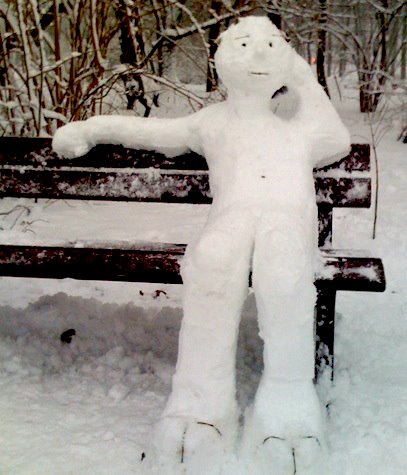
Last Sunday I published a set of pictures from Dan Gomez showing a wonderful collection of clever things you can do with snow. The post closed with a weather warning that Oregon was set to experience some wintery weather before the week was out.
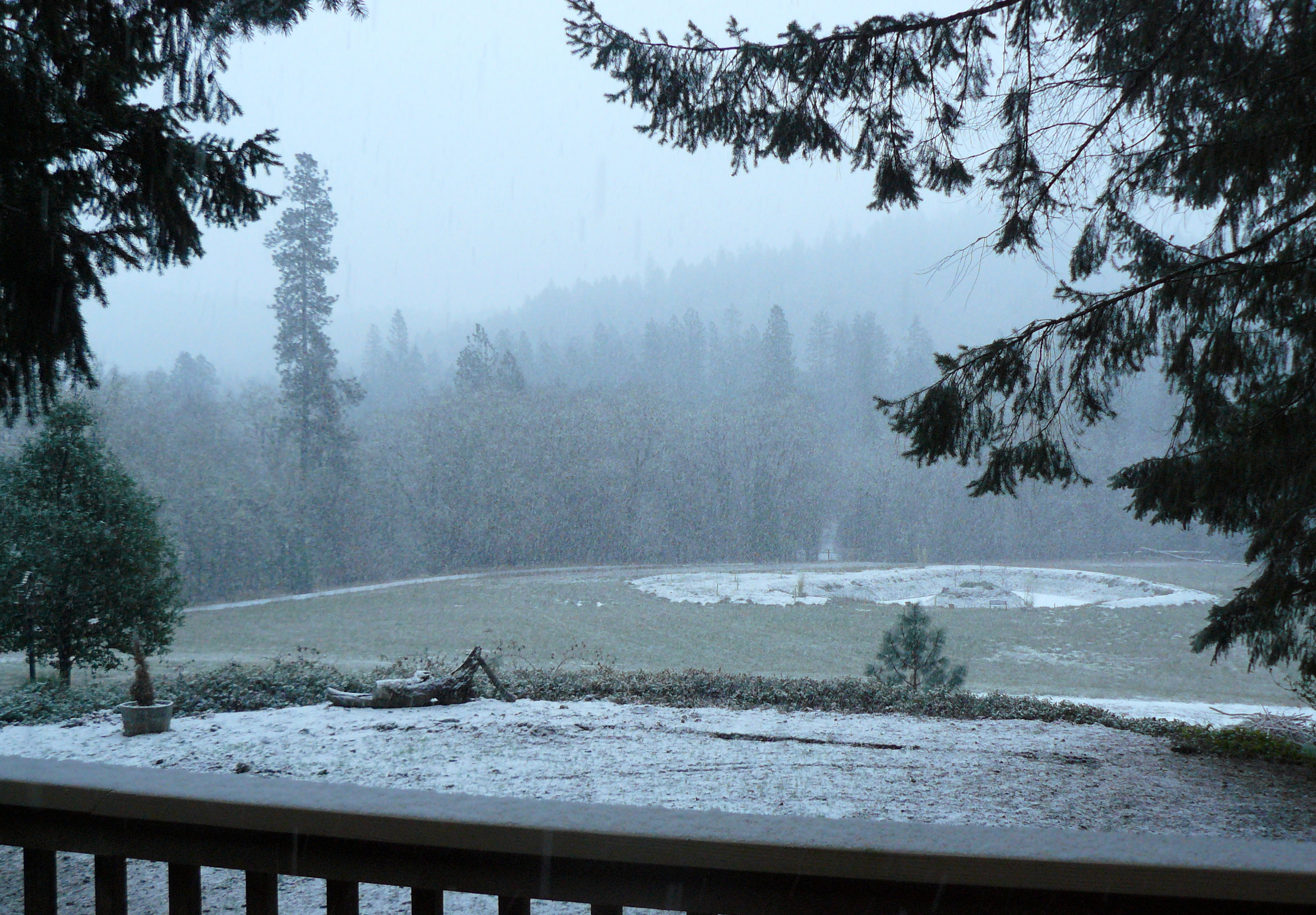
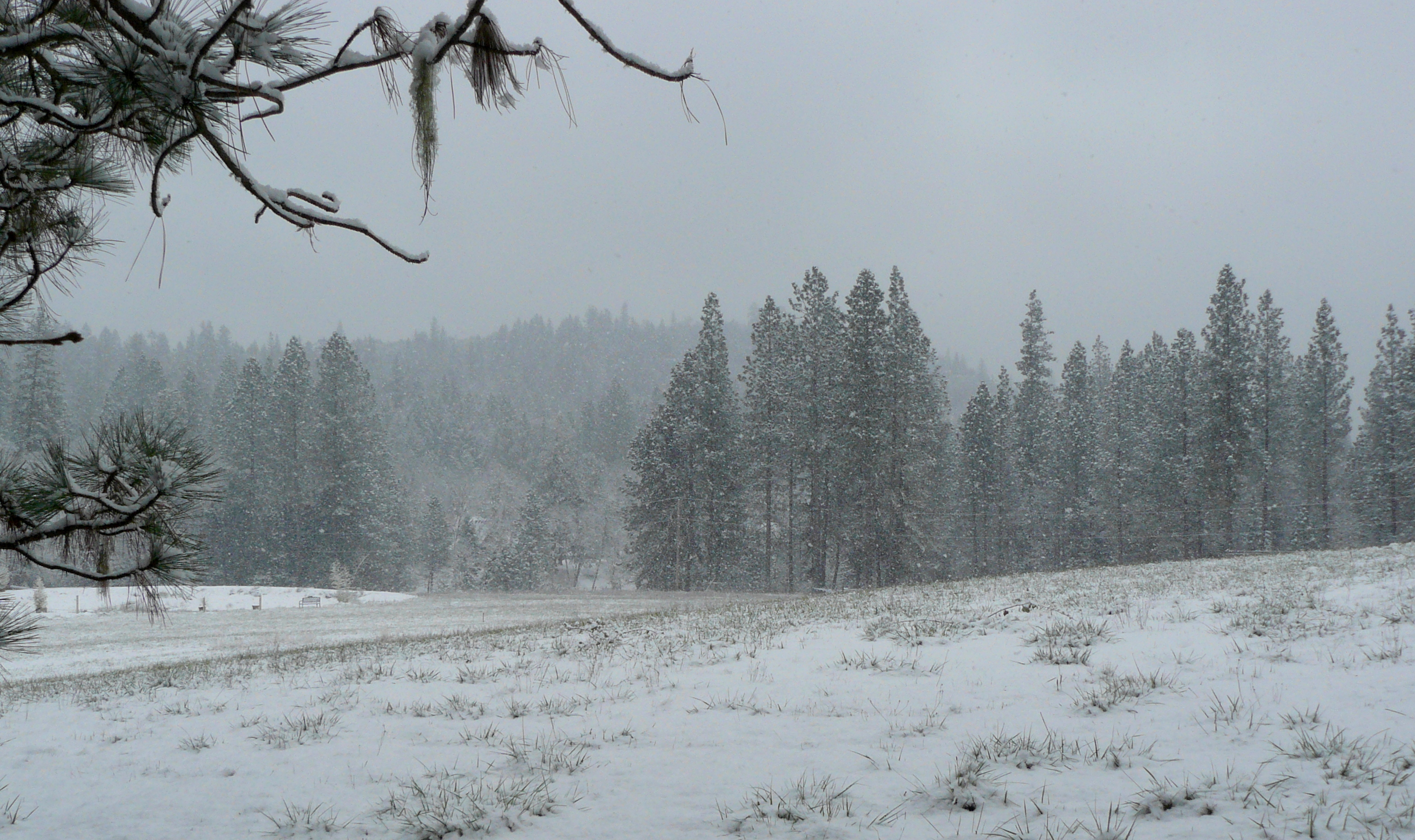
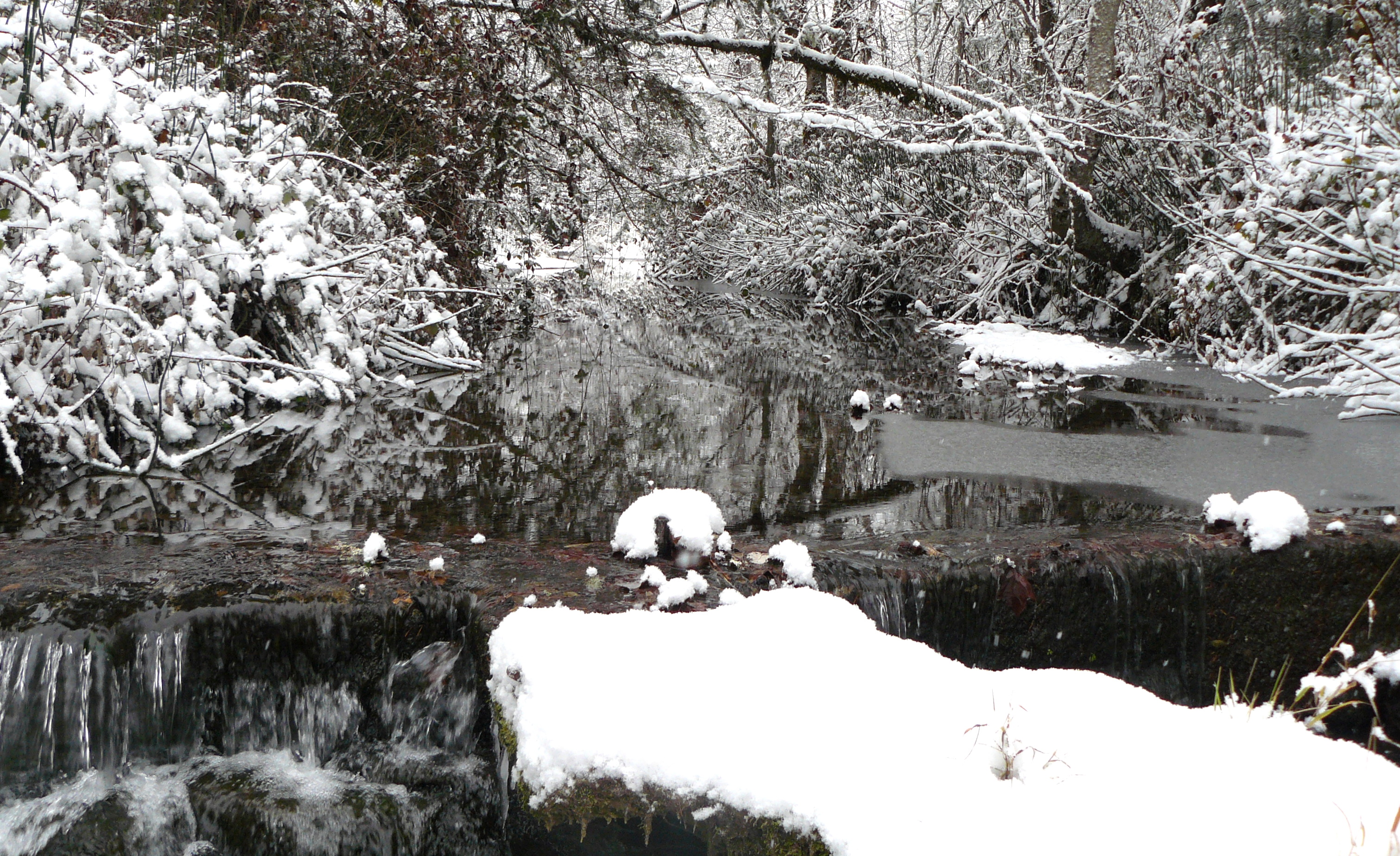
Thus a small collection of photographs taken on our property last Friday afternoon offering proof that the snows did arrive.
Snow just starting. Last Friday around 7am
oooo
Again, taken at 7am.
oooo
Looking down the driveway at 3pm last Friday.
oooo
Looking across to the South-East.
oooo
Nature’s colours.
oooo
Bummer Creek, looking downstream.
oooo
Bummer Creek, looking upstream from just above the flood irrigation dam.
oooo
Water flowing over the edge of the dam.
oooo
Merry Christmas from the BLM.
Finally, the picture above represents a delightful way to find your Christmas Tree, or Noble Fir in tree speak! We discovered that if one goes to the local office of the Bureau of Land Management (BLM) you can purchase a $5 permit allowing one to go into the forests and cut your own Christmas Tree. The red permit can be seen in the above photograph attached near the top of the tree. So last Thursday we took our Jeep filled to the brim with blankets, spades and tow chains and other paraphernalia to allow us to safely drive some miles into the forest and 2 hours later had our tree.
oooo
Wherever you are in the world, you stay warm and dry this Winter.
Just fancied a change from two days of Democratic Deficit. So today’s post is a brief overview of the US State that Jean and I live in, together with our animals, the State of Oregon.
Now it’s easy to look up a Wikipedia reference to Oregon but what really caught my eye was as a result of a recent visit to the local Grants Pass office of the Bureau of Land Management. We had gone there to purchase a $5 permit that allows us to go on to BLM land and harvest our own Christmas Tree!
In the Grants Pass office were a number of brochures of scenic attractions in Oregon and we picked up one describing the Rogue-Umpqua National Scenic Byway. Just a quick browse reminded us of Oregon’s stunning and dramatic scenery. Just wanted to share some images.
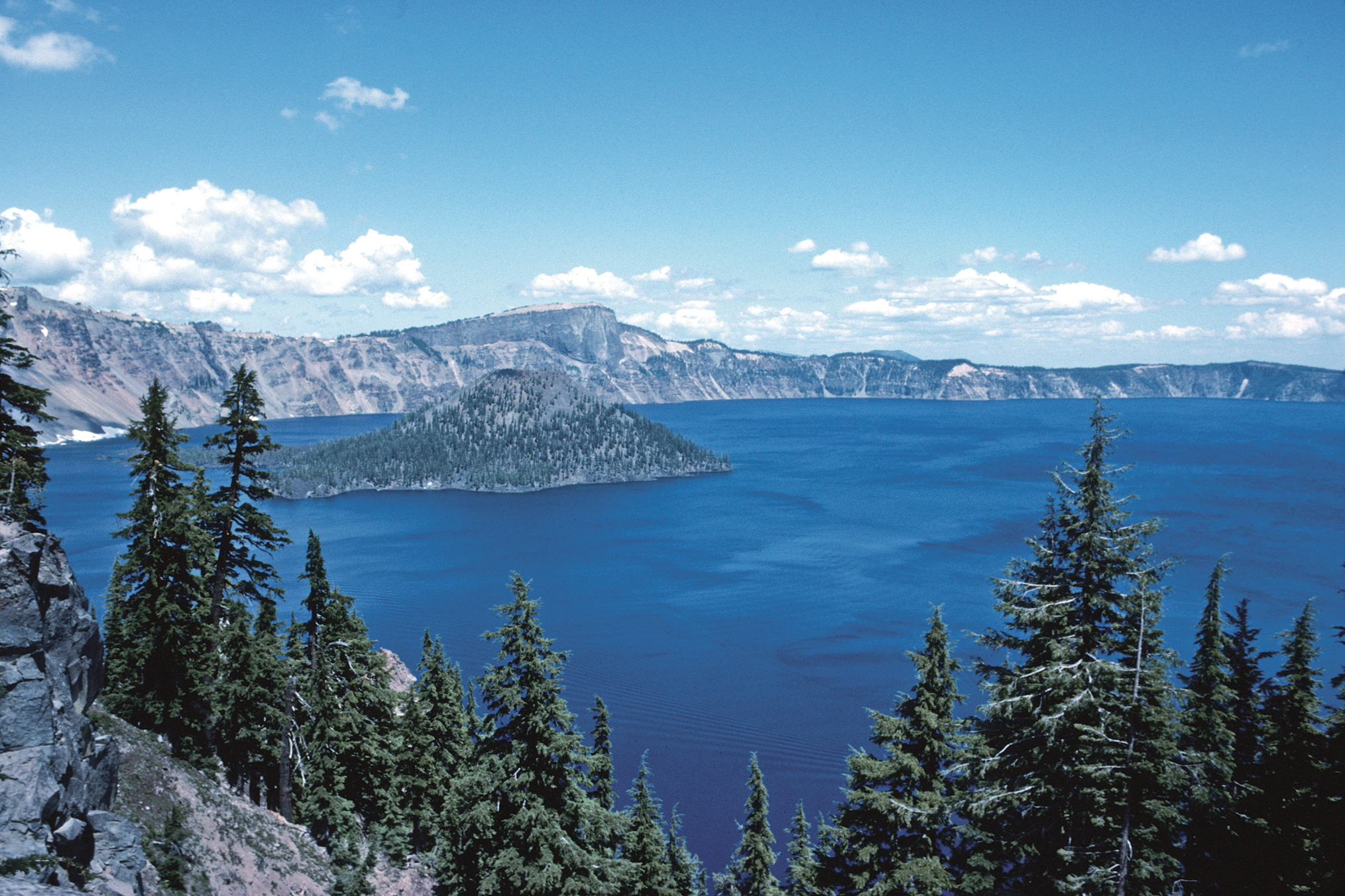
At a depth of 1,932 feet Crater Lake is the deepest lake in the United States. It was formed more than 7,500 years ago when the Mount Mazama volcano erupted and then collapsed back in on itself.
The lake partly fills a nearly 2,148-foot (655 m)-deep caldera[1] that was formed around 7,700 (± 150) years ago[2] by the collapse of the volcano Mount Mazama. Human interaction is traceable back to the indigenousNative Americans witnessing the eruption of Mount Mazama. There are no rivers flowing into or out of the lake; the evaporation is compensated for by rain and snowfall at a rate such that the total amount of water is replaced every 250 years. At 1,943 feet (592 m), the lake is the deepest in the United States, and the seventh[3] or ninth deepest in the world, depending on whether average or maximum depth is measured.[4]
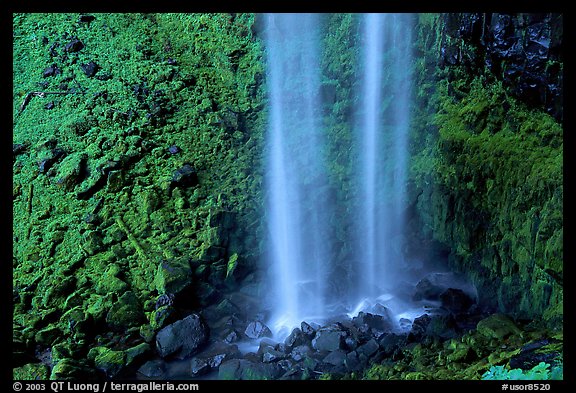
Watson Falls is the third highest waterfall in Oregon at 272 feet. It is the most beautiful waterfall along the North Umpqua River Valley. You will cross a wooden bridge below the falls that will put you right into the lower rapids with an amazing view of the falls as they roar over the basalt lava cliffs ahead.
Someone who goes under the handle of HikingTheWest posted this video on YouTube about 6 weeks ago.
Oregon Caves
These caves are an Oregon National Monument with full details on the US National Park Service’s website. That website explains:
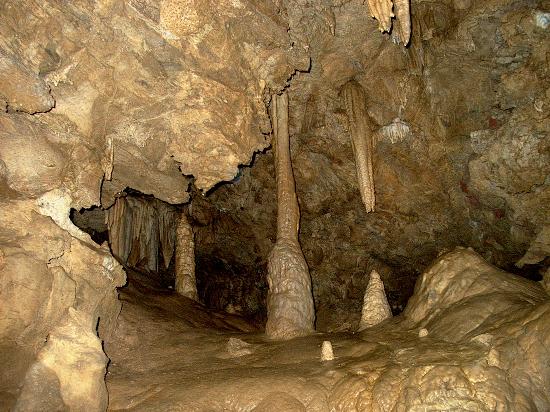
Nestled deep inside the Siskiyou Mountains, the caves formed as rainwater from the ancient forest above dissolved the surrounding marble and created one of the world’s few marble caves. The highly complex geology found on the Monument contributes to the unusual and rare plants and animals found nowhere else but here.
A view of the inside of the caves.
There are many good videos of the Oregon Caves on YouTube so do have a browse if you want to. This one caught my eye, especially as it was filmed in January, 2013..
Rogue River
The Rogue River
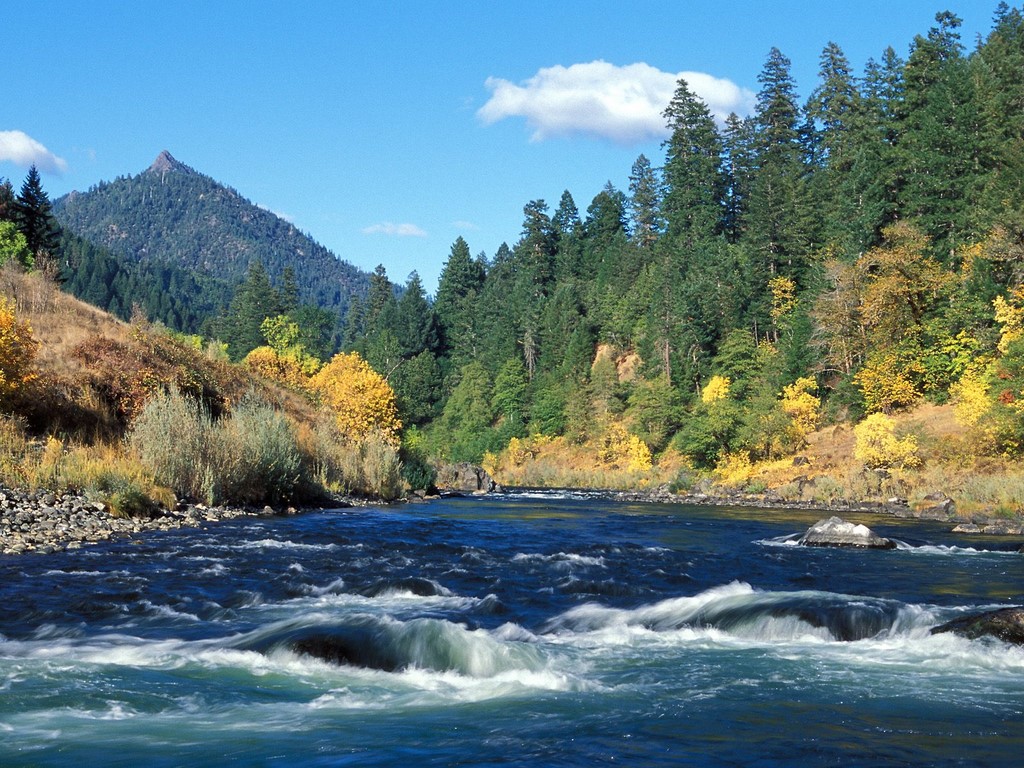
Final sight for today, the Rogue River runs close by Grants Pass, our nearest town to where we live. Again there is a Wikipedia entry from which one learns that, “Although the Rogue Valley near Medford is partly urban, the average population density of the Rogue watershed is only about five people per square mile (12 per km2).”
Just reflecting on that last paragraph, a simple calculation reveals that the State of Oregon has a population of around 3.9 million people with an land area of 98,300 square miles. Thus the population density of Oregon is 39.6 persons per square mile. To put that into perspective, our neighbouring Californians to the South enjoy a population density of 238 persons per square mile!
Jean and I are very lucky to be living in such a beautiful part of Southern Oregon.
Coincidentally, rather timely with what is most definitely not a delightful weather warning for next week. As in the latest Special Weather Statement from the National Weather Service (NWS). Note we are living in Josephine County, just a few miles from Grants Pass:
Special Weather Statement
SPECIAL WEATHER STATEMENT…CORRECTED
NATIONAL WEATHER SERVICE MEDFORD OR
404 PM PST SAT NOV 30 2013
ORZ023>026-020015-
CENTRAL DOUGLAS COUNTY-EASTERN CURRY COUNTY AND JOSEPHINE COUNTY-
EASTERN DOUGLAS COUNTY FOOTHILLS-JACKSON COUNTY-
INCLUDING THE CITIES OF…DRAIN…ELKTON…ROSEBURG…SUTHERLIN…
GREEN…MYRTLE CREEK…CANYONVILLE…GLENDALE…GRANTS PASS…
CAVE JUNCTION…STEAMBOAT…TOKETEE FALLS…MEDFORD…ASHLAND
404 PM PST SAT NOV 30 2013
…VERY COLD WEATHER THIS WEEK WITH LIGHT SNOW POSSIBLE IN THE VALLEYS…
A STRONG COLD FRONT WILL MOVE THROUGH THE REGION ON MONDAY.
PRECIPITATION IS EXPECTED TO BE RAIN IN THE VALLEYS THROUGH MONDAY
AFTERNOON, HOWEVER BY MONDAY NIGHT AND TUESDAY IT WILL BE COLD
ENOUGH THAT SNOW MAY FALL ALL THE WAY TO THE VALLEY FLOORS.
THE AIRMASS WILL THEN DRY OUT AND BECOME VERY COLD TUESDAY NIGHT
THROUGH THE REST OF THE WEEK. LOW TEMPERATURES WILL BE WELL DOWN
INTO THE 20S OVER SOUTHWEST OREGON VALLEYS WITH HIGHS IN THE LOW
TO MID 30S. THURSDAY MORNING IS EXPECTED TO THE BE THE COLDEST
TIME WHEN LOWS IN THE MID TO UPPER TEENS ARE POSSIBLE.
IT IS CERTAIN THAT VERY COLD WEATHER IS COMING TO SOUTHWEST
OREGON THIS WEEK. CONFIDENCE IN SNOWFALL IS LOWER, BUT RESIDENTS
AND TRAVELERS SHOULD ALSO BE PREPARED FOR THE POSSIBILITY OF
LIGHT SNOW EARLY TUESDAY WHICH COULD IMPACT TRAVEL.
STAY TUNED TO THE NATIONAL WEATHER SERVICE FOR UPDATED FORECASTS
AS THIS STORM SYSTEM APPROACHES.
$$
Our local Grants Pass Weather website is predicting a low around 20 for Wednesday Night. (-5 deg C.) B’rrrr!
Yesterday’s post here on Learning from Dogs looked at the utter insanity, the greed, the short-sightedness of extracting oil in greater and more varied ways; as if the future for all of life on this planet just didn’t matter. I guess the truth is that for those who stand to benefit from this wealth, the future of the planet just doesn’t matter.
Revealing the obvious!
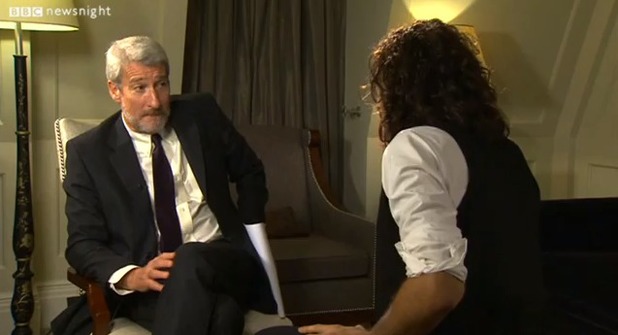
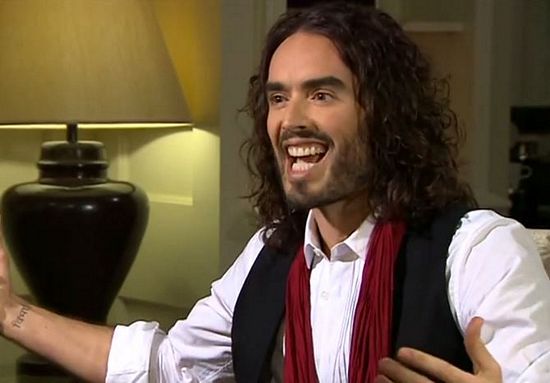
The recent interview on BBC Newsnight by Jeremy Paxman of British comedian Russell Brand has gone viral. At the time of writing this post, YouTube report 7,661,280 viewings! It’s not surprising because what Russell Brand is saying is obvious to millions of people all around the world. What Brand is expressing is as clear as a lone, lighted beacon at midnight on the darkest Winter night one could imagine.
During his Wednesday night interview with Jeremy Paxman on BBC Newsnight, comedian and actor Russell Brand said what no politician or pundit would ever dare say: that without dramatic, fundamental change, the prevailing political and economic system is broken, and hell-bent on planetary-level destruction:
With Dr Ahmed, the author of that Guardian article, concluding:
And in doing so, we might begin to realise that it is precisely the lack of a single, top-down manifesto that is our greatest strength – because, unlike the old, dying, fossil fuel dependent paradigm of endless growth for its own sake for the corporate few, the new, emerging post-carbon paradigm will be co-created by people themselves from the ground up.
That is why Brand’s answer for the way forward is so compelling:
“We shouldn’t destroy the planet. We shouldn’t create massive economic disparity. We shouldn’t ignore the needs of the people.”
If we want our children to inherit a habitable planet, rather than bashing Brand for not having a more coherent solution, we need to start being part of it.
You know what! The incredible response to that Paxman-Brand interview shows the millions of us who are already “part of it.” Yes, it really does feel that the time is now. That time that so very many of us, in a myriad of different ways, are fighting for our beautiful planet from the ground up.
Finally, if you want to read that interview between Paxman and Brand in detail, then over on Corrente there is a full transcript of the exchange between them.
Long may this run!
Passion for speaking the truth about our present times!
It’s really terribly easy – we just have to leave the oil in the ground!
The current issue of The Economist has an article on page 43, under The Americas section, headed Cheap at the price.
It’s a review of the biggest oil auction this year.
A single bid for a vast field shows the weakness of Brazil’s state-led approach to developing its oil reserves
SIX years after discovering giant offshore“pré-sal” oil deposits, so called because they lie beneath a thick layer of salt under the ocean bed, Brazil has finally auctioned the rights to develop some of its deeply buried wealth. On October 21st the Libra field, off Rio de Janeiro’s coast (see map), was sold to a consortium led by Petrobras, Brazil’s state-controlled oil firm, and including France’s Total, Anglo-Dutch Shell and China’s state-owned CNOOC and CNPC. Libra’s estimated 8 billion-12 billion barrels of recoverable oil make it the biggest oil prospect in the world to be auctioned this year. Once it reaches peak production, sometime in the next decade, it should increase Brazil’s output from 2.1m to about 3.5m barrels per day.
The article was critical of the way Brazil managed the auction resulting in just one consortium bidding, against the expectation there would be strong competition for the oil from possibly 40 companies despite the huge costs in extracting it from over 6,000 metres (nearly 20,000 feet) below sea-level. The article didn’t even hint at the madness of even thinking it should be extracted but I guess that’s The Economist for you.
So with that in mind, let me turn to a recent essay from TomDispatch by world-renown climate-change activist Bill McKibben. As regular readers will be aware Tom Engelhardt of the TomDispatch blog has given blanket permission for TD essays to be republished here on Learning from Dogs.
oooOOOooo
Tomgram: Bill McKibben, Can Obama Ever Stand Up to the Oil Industry?
Recently, “good” news about energy has been gushing out of North America, where a cheering crowd of pundits, energy experts, and government officials has been plugging the U.S. as the “Saudi Arabia” of the twenty-first century. You know, all that fracking and those luscious deposits of oil shale and gas shale just waiting to be pounded into shape to fill global gas tanks for an energy-rich future. And then, of course, just to the north there are those fabulous Canadian tar sands deposits whose extraction is reportedly turning parts of Alberta into an environmental desert. And that isn’t all.
From the melting Arctic, where the Russians and others are staking out energy claims, to the southernmost tip of South America, the dream of new energy wealth is being pursued with a fervor and avidity that is hard to take in. In distant Patagonia, an Argentinean government not previously known for its friendliness to foreign investment has just buddied up with Chevron to drill “around the clock in pursuit of a vast shale oil reservoir that might be the world’s next great oil field.” Huzzah and olé!
And can you even blame the Argentinean president for her choice? After all, who wants to be the country left out of the global rush for new energy wealth? Who wants to consider the common good of the planet, when your country’s finances may be at stake? (As with the Keystone XL pipeline protest movement here, so in Argentina, there actually are environmentalists and others who are thinking of the common good, but they’re up against the state, the police, and Chevron — no small thing.) All of this would, of course, be a wondrous story — a planet filled with energy reserves beyond anyone’s wildest dreams — were it not for the fact that such fossil fuel wealth, such good news, is also the nightmarish bad news of our lives, of perhaps the lifetime of humanity.
There is an obvious disconnect between what is widely known about climate change and the recent rush to extract “tough energy” from difficult environments; between the fires — and potential “mega-fire” — burning wildly across parts of overheated Australia and its newly elected government run by a conservative prime minister, essentially a climate denier, intent on getting rid of that country’s carbon tax. There is a disconnect between hailing the U.S. as the new Saudi Arabia and the recent report of the prestigious Intergovernmental Panel on Climate Change warning that fossil fuel reserves must be kept in the ground — or else. There is a disconnect between what our president says about climate change and the basic energy policies of his administration. There is a disconnect between what the burning of fossil fuels will do to our environment and the urge of just about every country on this planet to exploit whatever energy reserves are potentially available to it, no matter how “dirty,” no matter how environmentally destructive to extract.
Somewhere in that disconnect, the remarkable Bill McKibben, whose new book, Oil and Honey: The Education of an Unlikely Activist, is at the top of my personal reading list, has burrowed in and helped to create a global climate change movement. In this country, it’s significantly focused on the Keystone XL pipeline slated, if built, to bring tar sands oil from Canada to the Gulf Coast. For the last several years at TomDispatch, McKibben has kept us abreast of the most recent developments in that movement. Here is his latest report from the tar sands front. Tom
X-Ray of a Flagging Presidency Will Obama Block the Keystone Pipeline or Just Keep Bending?
By Bill McKibben
As the battle over the Keystone XL pipeline has worn on — and it’s now well over two years old — it’s illuminated the Obama presidency like no other issue. It offers the president not just a choice of policies, but a choice of friends, worldviews, styles. It’s become an X-ray for a flagging presidency. The stakes are sky-high, and not just for Obama. I’m writing these words from Pittsburgh, amid 7,000 enthusiastic and committed young people gathering to fight global warming, and my guess is that his choice will do much to determine how they see politics in this country.
Let us stipulate at the start that whether or not to build the pipeline is a decision with profound physical consequences. If he approves its construction, far more of the dirtiest oil on Earth will flow out of the tar sands of Alberta, Canada, and reach the U.S. Gulf Coast. Not just right away or for a brief period, but far into the future, since the Keystone XL guarantees a steady flow of profits to oil barons who have their hearts set on tripling production in the far north.
The history of oil spills and accidents offers a virtual guarantee that some of that oil will surely make its way into the fields and aquifers of the Great Plains as those tar sands flow south. The greater and more daunting assurance is this, however: everything that reaches the refineries on the Gulf Coast will, sooner or later, spill into the atmosphere in the form of carbon, driving climate change to new heights.
In June, President Obama said that the building of the full pipeline — on which he alone has the ultimate thumbs up or thumbs down — would be approved only if “it doesn’t significantly exacerbate the problem of carbon pollution.” By that standard, it’s as close to a no-brainer as you can get.
These days, however, as no one will be surprised to hear, brainless things happen in Washington more often than not, and there’s the usual parade of the usual suspects demanding that Keystone get built. In mid-October, a coalition that included Exxon, Chevron, ConocoPhillips, and Royal Dutch Shell, not to mention the U.S. Chamber of Commerce, the National Association of Manufacturers, and the Business Roundtable, sent Obama a letter demanding that he approve Keystone in order to “maintain investor confidence,” a phrase almost guaranteed to accompany bad ideas. A report last week showed that the Koch brothers stood to earn as much as $100 billion in profits if the pipeline gets built (which would come in handy in helping fund their endless assault on unions, poor people, and democracy).
But don’t think it’s just Republican bigwigs and oil execs rushing to lend the pipeline a hand. Transcanada, the pipeline’s prospective builder, is at work as well, and Obama’s former communications director Anita Dunn is now on the Transcanada dime, producing TV ads in support of the pipeline. It’s a classic example of the kind of influence peddling that knows no partisan bounds. As the activists at Credo put it: “It’s a betrayal of the commitments that so many of us worked so hard for, and that Dunn herself played a huge role in shaping as top strategist on the 2008 campaign and communications director in the White House.”
Credo’s Elijah Zarlin, who worked with Dunn back in 2008, wrote that attack on her. He was the guy who wrote all those emails that got so many of us coughing up money and volunteering time during Obama’s first run for the presidency, and he perfectly exemplifies those of us on the other side of this divide — the ones who actually believed Dunn in 2008, the ones who thought Obama was going to try to be a different kind of president.
On energy there’s been precious little sign of that. Yes, the Environmental Protection Agency has put in place some new power plant regulations, and cars are getting better mileage. But the president has also boasted again and again about his “all of the above” energy policy for “increasing domestic oil production and reducing our dependence on foreign oil.” It has, in fact, worked so well that the United States will overtake Russia this year as the biggest combined oil and natural gas producer on the planet and is expected to pass Saudi Arabia as the number one oil producer by 2017.
His administration has okayed oil drilling in the dangerous waters of the Arctic and has emerged as the biggest backer of fracking. Even though he boasts about marginal U.S. cuts in carbon emissions, his green light to fracking means that he’s probably given more of a boost to releases of methane— another dangerous greenhouse gas — than any man in history. And it’s not just the environment. At this point, given what we know about everything from drone warfare to NSA surveillance, the dream of a progressive Obama has, like so many dreams, faded away.
The president has a handy excuse, of course: a truly terrible Congress. And too often — with the noble exception of those who have been fighting for gay rights and immigration reform — he’s had little challenge from progressives. But in the case of Keystone, neither of those caveats apply: he gets to make the decision all by himself with no need to ask John Boehner for a thing, and people across the country have made a sustained din about it. Americans have sent record numbers of emails to senators and a record number of comments to the State Department officials who oversee a “review” of the pipeline’s environmental feasibility; more have gone to jail over this issue than any in decades. Yet month after month, there’s no presidential decision.
There are days, in fact, when it’s hard to muster much fire for the fight (though whenever I find my enthusiasm flagging, I think of the indigenous communities that have to live amid the Mordor that is now northern Alberta). The president, after all, has already allowed the construction of the southern half of the Keystone pipeline, letting Transcanada take land across Texas and Oklahoma for its project, and setting up the beleaguered communities of Port Arthur, Texas, for yet more fumes from refineries.
Stopping the northern half of that pipeline from being built certainly won’t halt global warming by itself. It will, however, slow the expansion of the extraction of tar sands, though the Koch brothers et al. are busy trying to find other pipeline routes and rail lines that would get the dirtiest of dirty energy out of Canada and into the U.S. via destinations from Michigan to Maine. These pipelines and rail corridors will need to be fought as well — indeed the fights are underway, though sometimes obscured by the focus on Keystone. And there are equally crucial battles over coal and gas from the Appalachians to the Pacific coast. You can argue that the president’s people have successfully diverted attention from their other environmental sins by keeping this argument alive long past the moment at which it should have been settled and a decision should have been made.
At this point, in fact, only the thought of those 900,000 extra barrels a day of especially nasty oil coming out of the ground and, via that pipeline, into refineries still makes the fight worthwhile. Oh, and the possibility that, in deciding to block Keystone, the president would finally signal a shift in policy that matters, finally acknowledge that we have to keep most of the carbon that’s still in the ground in that ground if we want our children and grandchildren to live on a planet worth inhabiting.
If the president were to become the first world leader to block a big energy project on the grounds of its effects on climate, it might help dramatically reset the international negotiations that he allowed to go aground at Copenhagen in 2009 — the biggest foreign policy failure of his first term.
But that cascade of “ifs” depends on Obama showing that he can actually stand up to the oil industry. To an increasingly disillusioned environmental movement, Keystone looks like a last chance.
President Obama turned 52-years-old on August 4th this year. Michelle, his wife, will be 50-years-old next January, 17th. Their children, Malia and Sasha, are aged 15 and 12 respectively.
Thus this family of four are all sufficiently young to be alive when the consequences of burning all this oil will be very painfully obvious, when all the power and money in the world will come to naught.
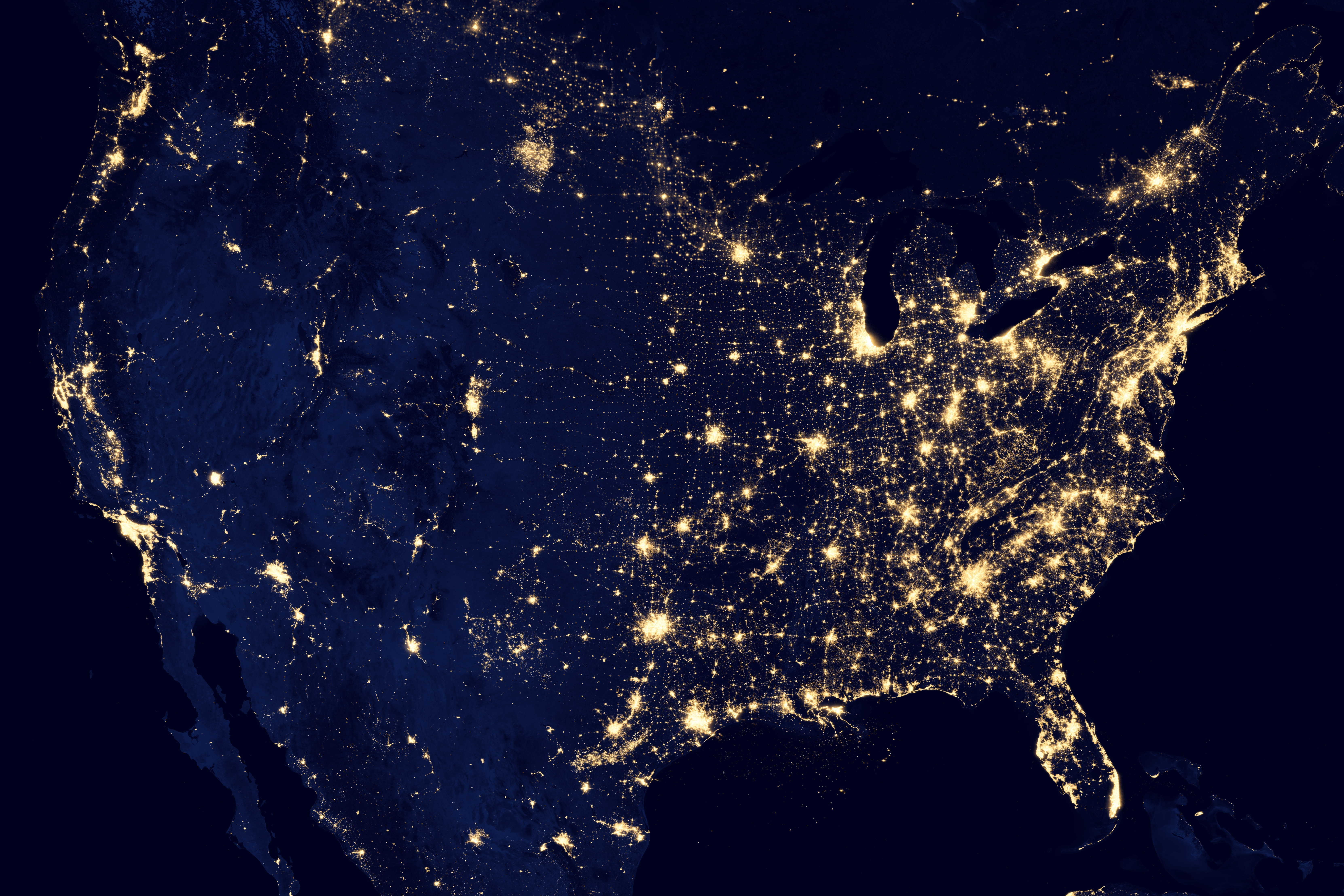
So it strikes me that young Malia and Sasha should be shown where Planet Earth’s master circuit-breaker is located. Would be such a shame to leave the lights on when there’s no-one at home.
North America burning bright – an image from NASA.
Today is our first anniversary of living in Oregon.
In many ways, it’s difficult to comprehend that we have now lived in our house a few miles from Merlin, OR, for a full year.
There are so many different, wonderful emotions associated with our move from Arizona to Oregon, of moving into a property quite unlike anything that Jean and I have ever lived in before, of seeing our dogs so happy with their surroundings, of being immersed in Nature, and so much more.
But rather than waffle on about everything in general and nothing in particular, I just want to write about the several acres of grassland that slope down from our house towards Bummer Creek, flowing North-South through the Eastern part of the property.
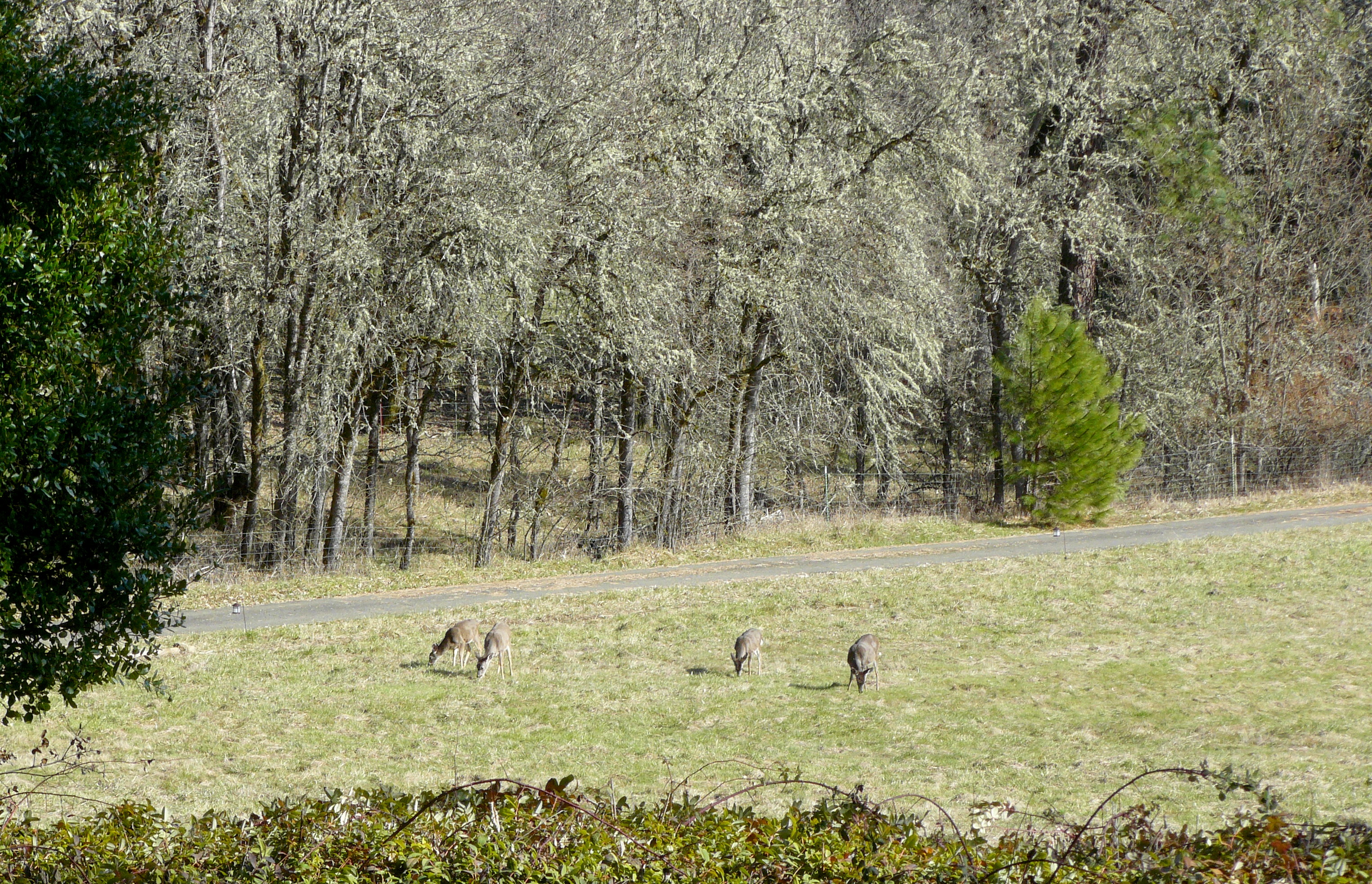
Wild deer feeding in the North-West corner of about 5 acres of our grassland.
Having mown the grassland a number of times in the Spring musing that there must be better ways to spend your time, a few weeks ago we came across an article about not mowing lawns. It was on the Mother Nature Network website and here’s how the article started.
Get off your grass and create an edible lawn
What would happen if you stopped watering, fertilizing, pesticiding and mowing your lawn?
Americans currently spend more than $30 billion, millions of gallons of gasoline, and countless hours to maintain the dream of the well-kept 31 million acres of lawns. An estimated 67 million pounds of herbicides, fungicides and insecticides are applied around homes and gardens yearly. Commercial areas such as parks, schools, playing fields, cemeteries, industrial, commercial and government landscapes, apply another 165 million pounds.
Lawn grasses are not native to the North American continent. A century ago, people would actually pull the grass out of their lawns to make room for the more useful weeds that were often incorporated into the family salad or herbal tea. It was the British aristocracy in the 1860s and ’70s, to show off their affluence, that encouraged the trend of weed-free lawns, indicating one had no need of the more common, yet useful plants. Homeowners were encouraged to cultivate lawns that would serve as examples to passers-by. These types of lawns also lent themselves to the popular lawn sports, croquet and lawn tennis. From the 1880s through 1920s in America, front lawns ceased to produce fodder for animals, and garden space was less cultivated, promoting canned food as the “wholesome choice.” Cars replaced the family horse and chemical fertilizers replaced manure.
It has been estimated that about 30 percent of our nation’s water supply goes to water lawns. In Dallas, Texas, watering lawns in the summer uses as much as 60 percent of the city water’s supply.
Next, a newsletter from The Xerces Society mentioned bee feed wildflower seed mixes from a company called Sunmark Seeds in Portland, OR. A call to them quickly produced the answer about what we could sow to help our local bees.
Hi Paul:
Upon further searching I did find 2 mixes that might fit what you are looking for. They are attached. The Bee Feed Mixture would be $36 per lb. The Honey Bee Flower Mixture would be $38 per lb. The price is a little higher but you would need a lot less. It is suggested 6-12 lbs per acre. You can still add the clover at $5 per lb and you should add 1 oz per lb of wildflower seed. There is still the option of the Knee High Low Profile mix which would be a little less at $30 per lb but the seeding rate is higher at 8-16 lbs per acre.
I have attached a spec sheet on all three mixes. Please let me know if you have any further questions.
Decision made. Three pounds of Bee Feed Mix to sow on a half-acre area as a test before we do all five acres next Spring.
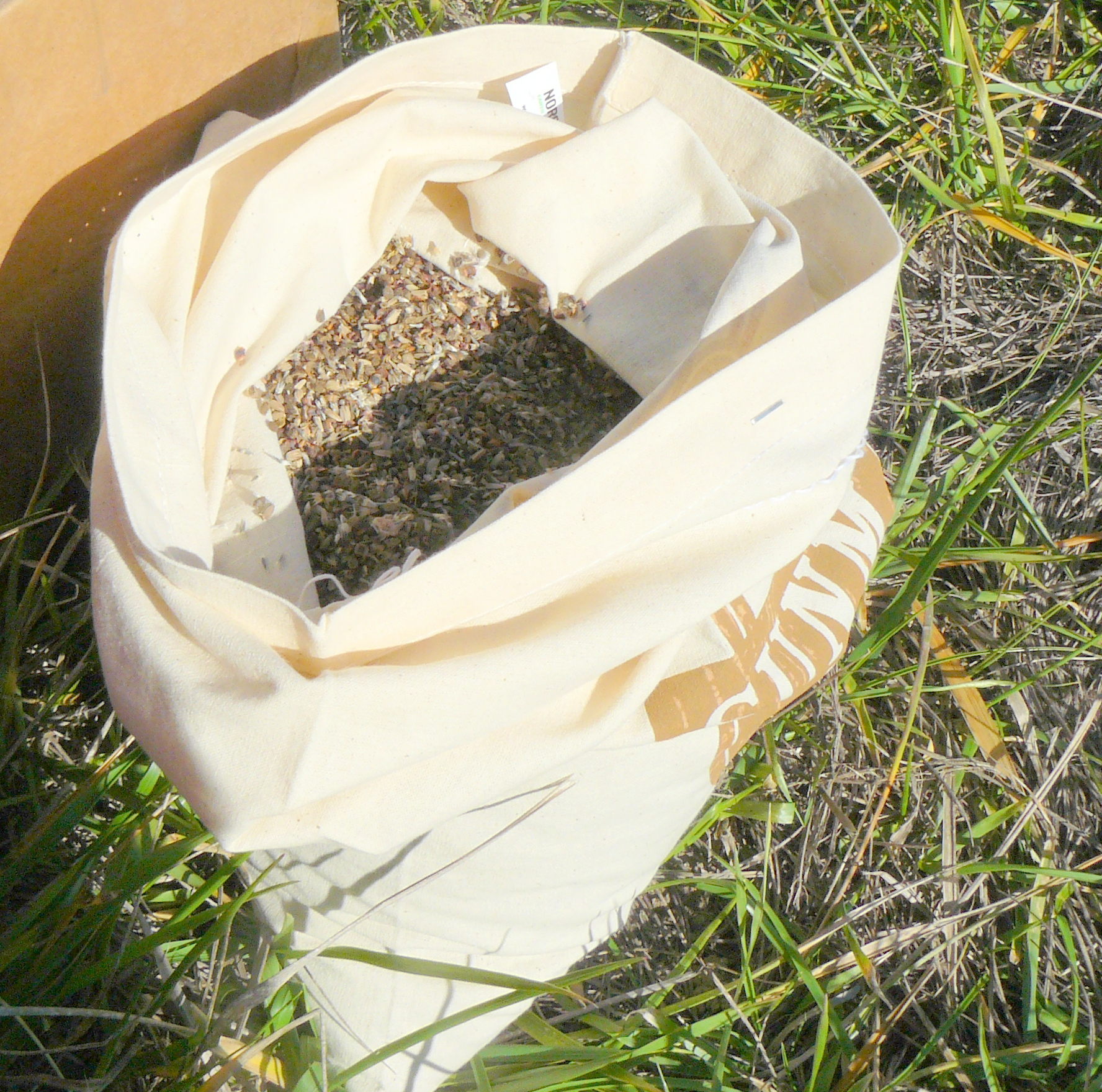
Thus not so much later a box arrived with our Bee Feed Mix and the next afternoon saw Jean and me marking out the test area and scattering the seed.
3 lbs of wild flower seed for next Spring’s bees!
oooo
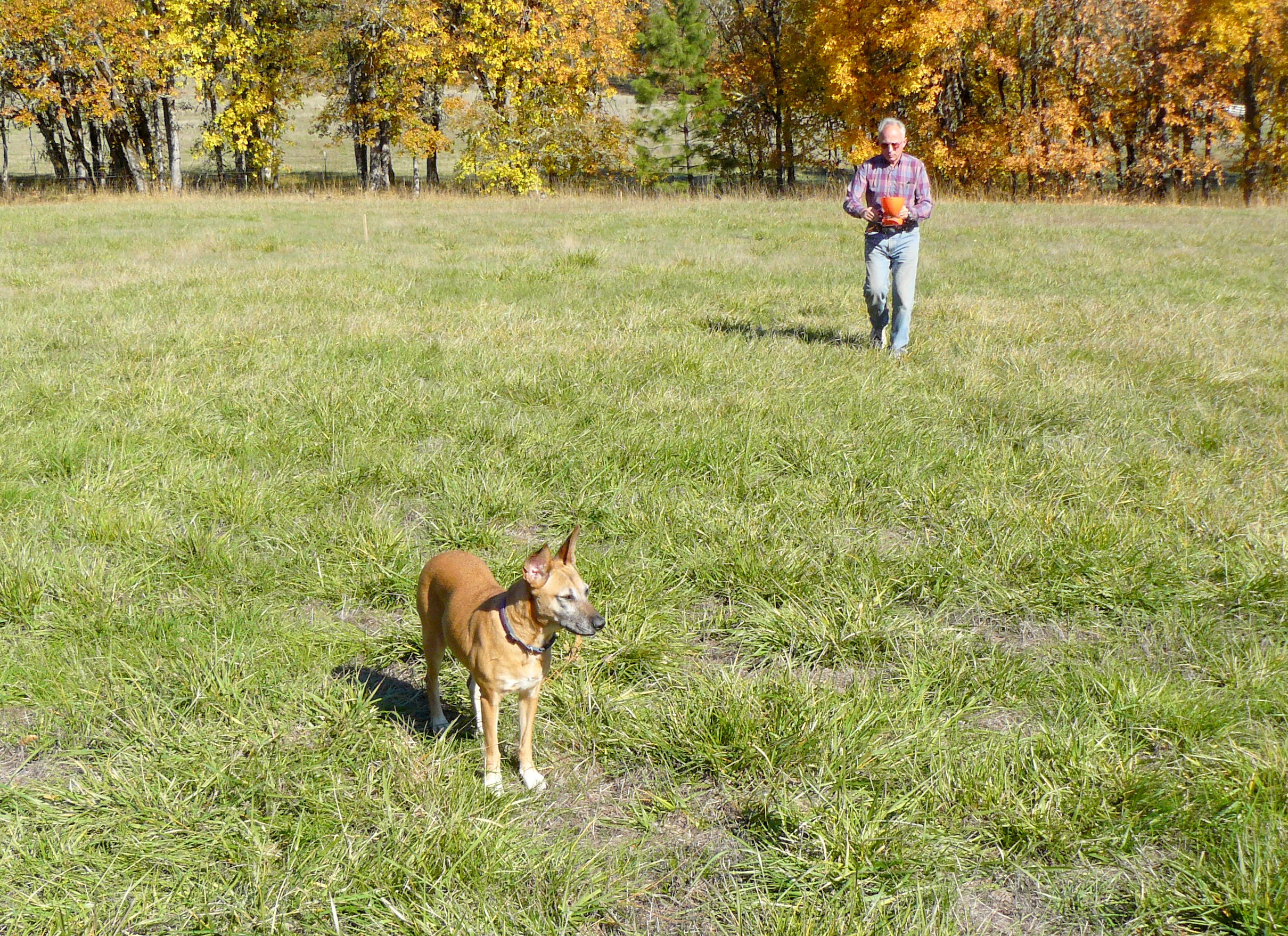
Hand-scattering the seeds with Dhalia keeping an eye on things.
oooo
It’s been an amazing year with plenty of challenges as we learnt to be rural people; yet another thing the dogs were able to teach us! However, the joy of living in such beautiful surroundings will last for ever. And more or less picking up on the theme for the week, the sharing, caring community of neighbours around us doubles that joy.
Jean and I consider ourselves two very lucky people. And no more mowing grassland! 🙂
“Minds together do not just bind together, they find together.”
My post last Monday, The lure of patterns, appears to have resonated far and wide. In the sense of many echoes reinforcing the perilous nature of our present times and the desperately uncertain decades ahead. Tomorrow I shall be writing specifically about those echoes.
Today, I wanted to spend a little time reflecting on dogs and communities! After all this blog is called Learning from Dogs!
In Monday’s post I opined that the future may well see a return to people re-evaluating and re-energising the benefits of local communities. Now when it comes to communities, there are no better examples than dogs and, so many thousands of years before dogs, grey wolves. These species have an incredibly strong social structure. I mean, of course, the pack. It’s a shame that the expression ‘pack of wolves’ or ‘pack of dogs’ has such misplaced negative connotations.
Before dogs were domesticated, as in when they first evolved from the grey wolf, they shared with wolves a natural pack size of around 50 animals. There was a very strong social cohesiveness within that pack yet a very ‘light’ status differential between those dogs having pack status and the mass of the pack group. Ditto with wolves.
In fact there were (still are) just three status roles: Mentor/Monitor/Nanny. Or has been described previously on this blog: Alpha/Beta/Omega roles. Even within the domesticated dog, thousands upon thousands of years later, those social instincts are alive and well. Many followers of Learning from Dogs will know that Pharaoh, him of the Home Page, now an elderly German Shepherd is a Monitor or Beta dog. I could write about this aspect of dogs for hours!
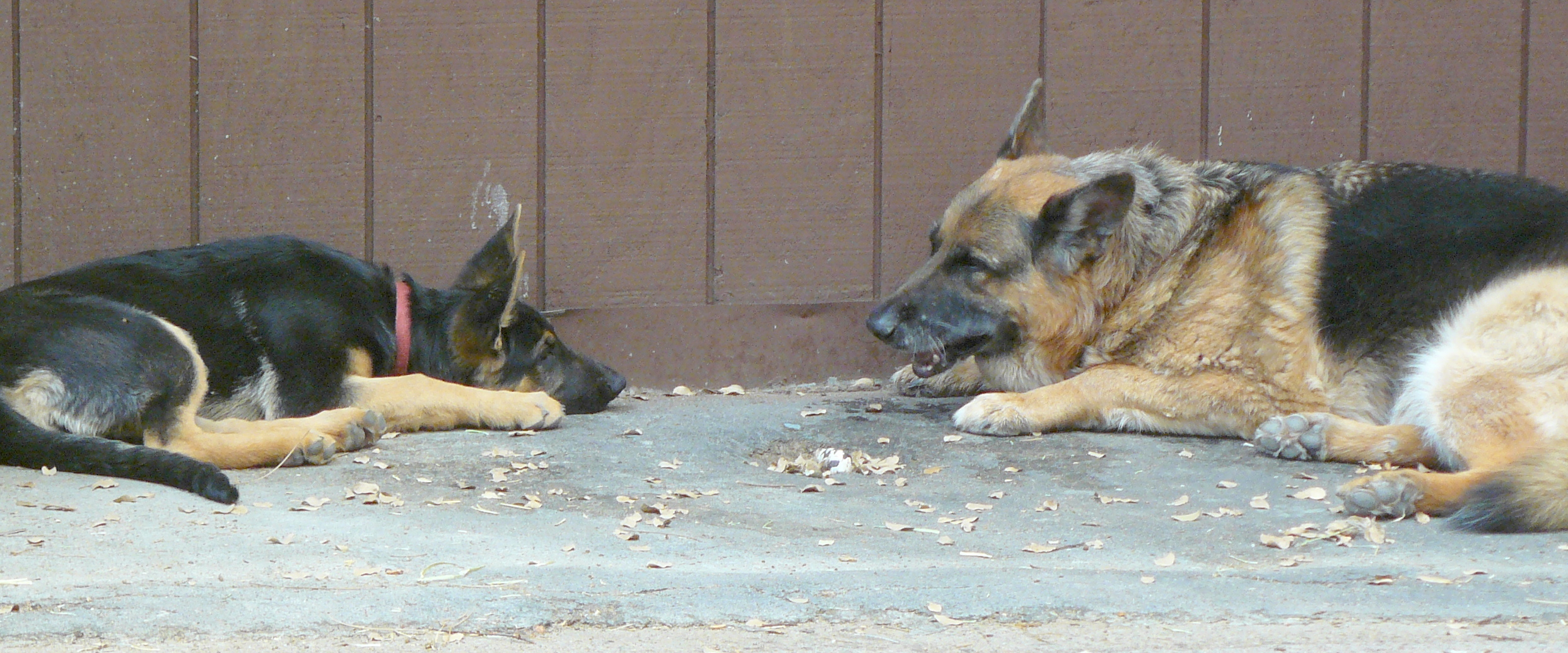
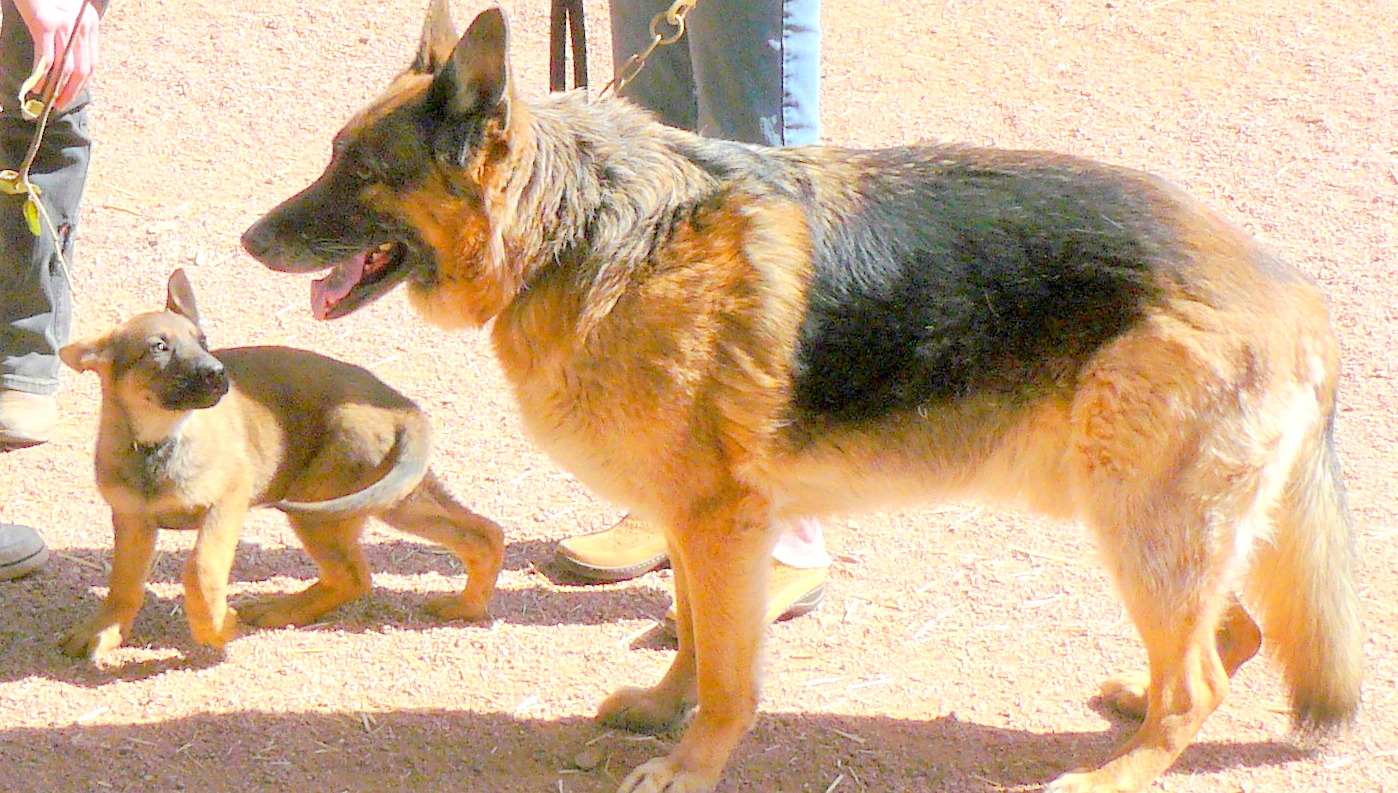
Pharaoh being a monitor for young Cleo.
So back to us funny old humans.
I closed last Monday’s post off with three predictions:
That the power of internet communications will allow more people, more quickly, to find their soul-mates wherever they are on this planet.
That the realisation of how dysfunctional many Governments are, of how truly poorly they serve the majorities of their citizens, will lead to mass rejections of these so-called Governments’ policies. Such rejections predominantly peaceful, as in taking the horse to water but being unable to make it drink.
That there will be a new form of localism. At two levels. Literally, people geographically close to each other creating 21st C. versions of local communities. Virtually, those local communities linking to other like-minded communities right across the world resulting in highly effective and innovative learning, accelerated common-sense, (call it wisdom if you wish), and extraordinarily efficient and sustainable ways of living on this planet.
Dear Paul: I like your predictions. They will play some role. But maybe somewhere in the bushes only. I think predictions of the future beyond the next 12 months are obsolete.
Jeremy remarked: (and do click the link and read some of Jeremy’s fantastic poetry)
I am hoping for a new localism. I see signs of this in the local food movement and a growing concern about factory farming, for one thing. I think people are really scrutinizing where their food comes from, where their medicines are made, and I think there also is a dawning awareness of how we are living on the backs of exploited third world workers (and poorly paid service workers here at home). I do see signs of these things permeating the consciousness of many people and leading them to want to become more “local.”
Your predictions are good, and I liked the one of communities from different parts of the world working with each other… that was creatively brilliant.
(Click on their names to see three wonderful blog sites, by the way.)
So my idea of a return to an era of localism, but a 21st C. version reflecting the way so many millions of us are connected electronically, wasn’t immediately rejected.
Patrice recently published a post called Devils In The Details. I mentioned in a comment to that post that I would be referring to it in this place. Patrice replied [my italics]:
Very good, Paul! No doubt you will bring more common sense to one more of these interesting collaborations you bring together! Internet debates! A long way from the paleolithique cave!… But still the same idea. Minds together do not just bind together, they find together.
I found that last sentence so powerful that it was used as the sub-heading to today’s post. Then Alexi Helligar commented:
The word consciousness, breaks down to con+scious+ness, which literally means together knowing or shared knowledge.
Adding in a subsequent comment:
In other words: Without society there is no consciousness. The sages of old knew this. Why has it been forgotten?
So right before my eyes (and yours!) we are seeing the power of ‘finding together‘.
Finally, just on the spur of the moment, I did a web search under an entry of ‘early caveman social structure’. Guess what! One of the top search returns was an essay by an Erik D. Kennedy under the title of On the Social Lives of Cavemen. From which jumped off the screen:
Human beings are no strangers to group living. Call it a family trait. Our closest animal relatives spend a good bulk of their time eating bugs off of their friends’ back. While I’m overjoyed we’re not social in that manner, I’m less pleased that we’re not social more to that degree. In study after study, having and spending time with close friends is consistently correlated with happiness and well-being. And yet, the last few decades in America have seen a remarkable decline in many things associated with being in a tight-knit social circle—things like family and household size, club participation, and number of close friends. Conversely, we’ve seen an increase in things associated with being alone—TV, commutes, and the internet, for example.
This trend is quite unhealthy. It’s no surprise that humans are social animals—but it may be surprising that we’re such social animals that merely joining a club halves your chance of death in the next year—or that living in a close-knit town of three-generation homes can almost singlehandedly keep you safe from heart disease.
My goodness me, this sharing idea may be core to a healthy society in ways that we need to return to. Erik’s essay goes on thus:
That particular case—of Roseto, Pennsylvania—is mentioned by Malcolm Gladwell in his book Outliers. In 1950’s Roseto, the incidence of heart disease in men over sixty-five was half the national average (and suicide, alcoholism, drug addiction, and serious crime were also basically unheard of[ii]). Bewildered doctors searched for solutions in genetics, diet, exercise, and geography, but finding nothing, reached the conclusion that it was the close-knit social life of the community that kept its residents so healthy. Dinners with grandma, friendly chats between neighbors, and a precocious level of civic involvement were the driving factors in the health of a town that nothing but old age could kill.
The happiness and health I’m describing are not, however, ingredients to a long-lost elixir of well-being. This sort of paleo social life occurs in cultures large and small all over the globe. America just happens to be an enormous exception (and the one that I live in). The whole reason Roseto was an outlier is because it was a town whose inhabitants more or less collectively moved from rural Italy to the middle of Pennsylvania over a few decades. This was basically an Italian village in the American countryside, and it stood out because Italy’s social culture was remarkable compared to America’s—and that was in the 1950’s. America’s social culture has only deteriorated even further since then. We’ve lost a lot, but my thesis is a positive one; we have as much to gain as ever.
So if wolves and dogs naturally settle into packs of 50 animals, what’s the optimum ‘pack’ size for humans? Dear Erik even offers that answer:
Along with that urban emigration came a shrink in residents per household and a widespread decline in community and organization engagement. This isolation has been taxing on our physical and mental health, and the reason has been clear from the beginning: it’s not good for man to be alone.
So we’ll spend more time with other people. Fine. But who should we spend our time with? What kind of groups should we hang out in? And how big of groups? The simple answer is: as long as you’re pretty close to the people you’re with, it hardly matters. Piles of research back up what is essentially obvious from everyday experience: that the more time you spend with people you trust, the better off you are. That’s not to discourage actively meeting new people, but seeing as though close friends push us towards health and happiness better than strangers, there does appear to be a limit on the number of people you can have in your “tribe”.
And that number is about 150, says anthropologist Robin Dunbar, who achieved anthropologist fame by drawing a graph plotting primates’ social group size as a function of their brain sizes. He inputted the average human brain size into his model, and lo and behold, the number 150 has been making a whirlwind tour of popular non-fiction books ever since. Beyond being the upper bound for both hunter-gatherer tribes and Paleolithic farming villages, it appears that everything from startup employee counts to online social networks show this number as a fairly consistent maximum for number of close social ties.
You really must read Erik’s essay in full; it really ‘spoke’ to me and maybe it will do the same for you.
So no other way to close than to say that of all the things we can learn from dogs, the power of sharing, of living a local community life, may just possibly be the difference between failure and survival of us humans.
Dogs and man should never be alone.
oooo
I’ll say it again! Dogs, and man, should never be alone!
The ride of Paul Revere is a famous poem by Longfellow, as in Henry Wadsworth Longfellow. It commemorates the American patriot Paul Revere who on the 18th April, 1775 rode furiously across Middlesex County, Massachusetts spreading the alarm that the British were approaching.
Spreading the alarm throughout Middlesex County, Massachusetts.
In 1774 and the Spring of 1775 Paul Revere was employed by the Boston Committee of Correspondence and the Massachusetts Committee of Safety as an express rider to carry news, messages, and copies of resolutions as far away as New York and Philadelphia.
On the evening of April 18, 1775, Paul Revere was sent for by Dr. Joseph Warren and instructed to ride to Lexington, Massachusetts, to warn Samuel Adams and John Hancock that British troops were marching to arrest them. After being rowed across the Charles River to Charlestown by two associates, Paul Revere borrowed a horse from his friend Deacon John Larkin. While in Charlestown, he verified that the local “Sons of Liberty” committee had seen his pre-arranged signals. (Two lanterns had been hung briefly in the bell-tower of Christ Church in Boston, indicating that troops would row “by sea” across the Charles River to Cambridge, rather than marching “by land” out Boston Neck. Revere had arranged for these signals the previous weekend, as he was afraid that he might be prevented from leaving Boston).
On the way to Lexington, Revere “alarmed” the country-side, stopping at each house, and arrived in Lexington about midnight. As he approached the house where Adams and Hancock were staying, a sentry asked that he not make so much noise. “Noise!” cried Revere, “You’ll have noise enough before long. The regulars are coming out!” After delivering his message, Revere was joined by a second rider, William Dawes, who had been sent on the same errand by a different route. Deciding on their own to continue on to Concord, Massachusetts, where weapons and supplies were hidden, Revere and Dawes were joined by a third rider, Dr. Samuel Prescott. Soon after, all three were arrested by a British patrol. Prescott escaped almost immediately, and Dawes soon after. Revere was held for some time and then released. Left without a horse, Revere returned to Lexington in time to witness part of the battle on the Lexington Green.
I mention all this simply because when John Hurlburt recently sent me a guest post his email opened with these words: “Thanks for the call. Hopefully, we are beginning to turn a global corner. Here’s a slightly modified version of “the Midnight Ride of Paul Revere”.”
So with no further ado, here is John’s essay.
oooOOOooo
Random Thoughts
The United States is a two hundred-year-old modern experiment in Democracy. Democracy is an inclusive government by a majority of equal citizens. Oligarchy and plutocracy are forms of government by the few rich people. Both have historically ended in chaos. Our hearts and our souls are deeply saddened by the ignorance and lack of compassion of a technologically enhanced corporate struggle against the earth and humanity.
Dualism is divisive. We’re butting heads over false equivalencies which have very little if anything to do with the true nature of a global environmental, cultural and economic melt-down. People who believe that money makes the world go round either don’t know much or don’t care at all about the realities of physics.
Sooner or later, fundamentalism self-destructs as a result of a failure to adapt to change. The longer we continue to push Nature’s envelope, the longer it’s going to take the earth to recover. Our hope is that we won’t destroy human culture and the sustaining crust of mother earth in the process of regaining our balance.
Most animals live primarily by instinct. Humans have added discernment. Today is the tomorrow we dreamed of yesterday. Who knows if we’ll get another opportunity to do what we are still capable of doing as a species today? Unfortunately, the last thing that many Americans truly cared about was when the “Twinkie” factories temporarily shut down.
It is far better to live into solutions then it is to live with problems.The spiritual energy of life is as warm and welcoming as the sun. The first step is to accept that Nature requires life to adapt. We need to see the integral vision beyond ourselves and live into that vision.
What we can’t accomplish alone we can accomplish together.
Ne cede malis!
an old lamplighter
oooOOOooo
Fabulous words, as I’m sure you’ll agree. Oh, and if you like me didn’t understand that Latin expression ‘Ne cede malis’, it means yield not to misfortunes.
Let me close with that Longfellow poem.
Paul Revere’s Ride
Henry Wadsworth Longfellow
Listen my children and you shall hear
Of the midnight ride of Paul Revere,
On the eighteenth of April, in Seventy-five;
Hardly a man is now alive
Who remembers that famous day and year.
He said to his friend, “If the British march
By land or sea from the town to-night,
Hang a lantern aloft in the belfry arch
Of the North Church tower as a signal light,–
One if by land, and two if by sea;
And I on the opposite shore will be,
Ready to ride and spread the alarm
Through every Middlesex village and farm,
For the country folk to be up and to arm.”
Then he said “Good-night!” and with muffled oar
Silently rowed to the Charlestown shore,
Just as the moon rose over the bay,
Where swinging wide at her moorings lay
The Somerset, British man-of-war;
A phantom ship, with each mast and spar
Across the moon like a prison bar,
And a huge black hulk, that was magnified
By its own reflection in the tide.
Meanwhile, his friend through alley and street
Wanders and watches, with eager ears,
Till in the silence around him he hears
The muster of men at the barrack door,
The sound of arms, and the tramp of feet,
And the measured tread of the grenadiers,
Marching down to their boats on the shore.
Then he climbed the tower of the Old North Church,
By the wooden stairs, with stealthy tread,
To the belfry chamber overhead,
And startled the pigeons from their perch
On the sombre rafters, that round him made
Masses and moving shapes of shade,–
By the trembling ladder, steep and tall,
To the highest window in the wall,
Where he paused to listen and look down
A moment on the roofs of the town
And the moonlight flowing over all.
Beneath, in the churchyard, lay the dead,
In their night encampment on the hill,
Wrapped in silence so deep and still
That he could hear, like a sentinel’s tread,
The watchful night-wind, as it went
Creeping along from tent to tent,
And seeming to whisper, “All is well!”
A moment only he feels the spell
Of the place and the hour, and the secret dread
Of the lonely belfry and the dead;
For suddenly all his thoughts are bent
On a shadowy something far away,
Where the river widens to meet the bay,–
A line of black that bends and floats
On the rising tide like a bridge of boats.
Meanwhile, impatient to mount and ride,
Booted and spurred, with a heavy stride
On the opposite shore walked Paul Revere.
Now he patted his horse’s side,
Now he gazed at the landscape far and near,
Then, impetuous, stamped the earth,
And turned and tightened his saddle girth;
But mostly he watched with eager search
The belfry tower of the Old North Church,
As it rose above the graves on the hill,
Lonely and spectral and sombre and still.
And lo! as he looks, on the belfry’s height
A glimmer, and then a gleam of light!
He springs to the saddle, the bridle he turns,
But lingers and gazes, till full on his sight
A second lamp in the belfry burns.
A hurry of hoofs in a village street,
A shape in the moonlight, a bulk in the dark,
And beneath, from the pebbles, in passing, a spark
Struck out by a steed flying fearless and fleet;
That was all! And yet, through the gloom and the light,
The fate of a nation was riding that night;
And the spark struck out by that steed, in his flight,
Kindled the land into flame with its heat.
He has left the village and mounted the steep,
And beneath him, tranquil and broad and deep,
Is the Mystic, meeting the ocean tides;
And under the alders that skirt its edge,
Now soft on the sand, now loud on the ledge,
Is heard the tramp of his steed as he rides.
It was twelve by the village clock
When he crossed the bridge into Medford town.
He heard the crowing of the cock,
And the barking of the farmer’s dog,
And felt the damp of the river fog,
That rises after the sun goes down.
It was one by the village clock,
When he galloped into Lexington.
He saw the gilded weathercock
Swim in the moonlight as he passed,
And the meeting-house windows, black and bare,
Gaze at him with a spectral glare,
As if they already stood aghast
At the bloody work they would look upon.
It was two by the village clock,
When he came to the bridge in Concord town.
He heard the bleating of the flock,
And the twitter of birds among the trees,
And felt the breath of the morning breeze
Blowing over the meadow brown.
And one was safe and asleep in his bed
Who at the bridge would be first to fall,
Who that day would be lying dead,
Pierced by a British musket ball.
You know the rest. In the books you have read
How the British Regulars fired and fled,—
How the farmers gave them ball for ball,
From behind each fence and farmyard wall,
Chasing the redcoats down the lane,
Then crossing the fields to emerge again
Under the trees at the turn of the road,
And only pausing to fire and load.
So through the night rode Paul Revere;
And so through the night went his cry of alarm
To every Middlesex village and farm,—
A cry of defiance, and not of fear,
A voice in the darkness, a knock at the door,
And a word that shall echo for evermore!
For, borne on the night-wind of the Past,
Through all our history, to the last,
In the hour of darkness and peril and need,
The people will waken and listen to hear
The hurrying hoof-beats of that steed,
And the midnight message of Paul Revere.
There’s been a couple of posts that I want to refer to because they underline the fact that humans are so prone to forgetting that we are of the wild, from the wild and connected to the wild.
The first of those posts was a recent essay by Patrice Ayme under the title of Rewilding Us and is republished on Learning from Dogs with the kind permission of Patrice.
oooOOOooo
Rewilding Us.
REALITY IS WILD & FEROCIOUS. IGNORING IT IS INHUMAN.
And Presents A Civilizational Risk.
Princeton is freaking out. Flesh devouring aliens are lurking out in the woods, threatening academia’s fragile thoughts. Krugman:
A growing population of coyotes in the wooded area bordering the Institute for Advanced Study has motivated the Princeton Animal Control Advisory Committee to recommend that sharpshooters be hired to help handle the problem. “There is a big pack over at the Institute Woods,” officer Johnson said this week. “I’m having a lot of complaints that they follow people around.”‘
You Can’t Always Eat Who You Want
The “Mountain Lion”, is a relative of the Cheetah (erroneously put in the cat family, felis, until last year or so). It has 40 names, in English alone, and is found from the American Arctic to Patagonia, from the sea shore to the high mountains. The weight above is that of the female. Males are heavier (typically up to 100 kilograms). The heaviest puma shot in Arizona was 300 pounds (136 kilos).
The lion/cougar/puma is capable of jumping up twenty feet from a standstill (yes, 6 meters; horizontally, 14 meters). It is capable of killing a grizzly (pumas and ‘golden bears’ were famous for their naturally occurring furious fights to death in California). The feline’s crafty method consisted into jumping on top of the bear, and blinding him with furious pawing. Top speed: 50 mph, 80 km/h. (By the way, there used to be pure cheetahs in North America, recently exterminated by man. I propose to re-install the Asian cheetah in the USA, in a sort of cheetah diplomacy with Iran.)
The philosophical question here is: what is this world all about? Is it about living on our knees, or ruling among animals and wilderness?
Why would Princeton panic about small canids? Because they don’t obey the established order?
Coyotes are totally clever, and not at all dangerous (being so clever). They have very varied voices, when in packs. Going out and shooting them is really primitive, and misses the main point of having nature around. That is: to teach humility, and teach the richness of our planet, visit hearts with emotional diversity, and minds with complexity.
Bears and Mountain Lions are a completely different matter. They are both extremely clever too, but can be very dangerous.
Running and hiking in the Sierra, I got charged by scary bears several times. I view this dangerosity as a plus, but it never loses my mind, and I got scared nearly out my wits more than once.
Once, in a national Park on the coast, I literally ran into two large lions in 30 minutes! Then I got charged by a large elk before he realized I was not a lion. Other high notes were finding a bear cub on the trail in the near vertical mountain side, on the way down, as dusk was coming.
Another high point was the large bear by the trail, who was lying like a bear rug, at 9pm, in an apparent ruse to let me approach until he could jump at his prey, as he did, before realizing that I was not a deer, something that obviously infuriated him. He was torn between making the human into dinner, and the instinct that this would turn badly for him.
In Alaska I was charged by a moose with her progeny… although I did not go as fast as an experienced mountain biker who happened to be there too, the anti-grizzly cannister in my hand emboldened me to succeed in a circuitous move to proceed towards my distant destination, something facilitated by the calf’s crash into some obstacle, drawing his mother’s concern. Mountain running often requires to proceed, no matter the obstacles in the way, when one is too far to turn around.
Bears know rocks, they have been hurt by them, and so they fear airborn rocks (throw the rock on something noisy, to impress; I had to hit, with a very large rock, a charging bear directly, once; it fled; it was killed by rangers later after he caused a flesh wound to somebody else; some will find all this very violent; well, it is, that’s part of the whole point).
Mountain Lions are better charged and/or, roared or barked at. They fear insane behavior.
In general making lots of noise helps, with bears and lions. I don’t have clever tricks to suggest for bathing safely in the murky icy Pacific. Although I assume that the presence of sea lions bobbing on the surface placidly is indicative of the absence of an obvious white shark prowling… In any case the pacific is so cold, you will probably die of cardiac arrest before you are devoured.
In Africa, there are about 500,000 elephants. 25,000 to 30,000 are killed, a year, to send the ivory to east Asia (China, Vietnam). So African elephants may disappear. This is beyond tragic, it’s irreplaceable. Elephants understand people’s gestures, without any learning (they apparently learn to use trunk gestures among themselves). One is talking about extremely intelligent animals here. (In contrast, chimpanzees have great difficulties understanding human gestures.)
Intelligence and culture are dominant among apex mammals. That’s what makes them so superior. Washington State had the smart idea to shoot full grown adult male mountain lions. Thus mountain lion society and culture collapsed, uneducated teenagers took over, and incidents with humans exploded (something about the quiet macho society!).
A Japanese specialist of chimpanzee intelligence who happens to have a bear in his lab, found that the bear did not underperform chimpanzees on mental tasks (that’s actually a problem with bears; being so clever, they can be unpredictable, one can never know what they have up their sleeve, like the one who mimicked a bear rug, above, or one who drove a car in Tahoe). A number of social mentally advanced animals (sea mammals, parrots) use advanced languages.
So what are my recommendations? The Princeton Institute for Advanced Studies ought to realize that, if it wants to become really brainy, it ought to give our fellow species a chance. They are part of what make our minds, in full.
Elephants and rhinoceroses used to be all over Europe and North America. They ought to be re-introduced right away, using Indian and African species (rare camels too; later, thanks to genetic engineering, part of those could be replaced by re-engineered ancient species, such as the Mammoth). Lions and leopard like species ought to be reintroduced too.
It can work: in the San Francisco Bay Area, there is an impressive population of mountain lions. I had many close calls (in the most recent incident, a few weeks ago, a lion peed an enormous and dreadfully smelling amount on a trail I was making a loop on, obviously to show me he owned the territory, a total wilderness reserve a few miles from Silicon Valley… especially at dusk).
However, the lions are extremely good at avoiding people (although one got killed by police in downtown Berkeley in the wee hours of the morning). They will all be collared in the next ten years, to find out what is going on. With modern technology (collars!) and sophisticated human-animal culture, there is no reason why extremely dangerous, but clever species could not live in reasonable intelligence with humans.
So rewilding is possible. It’s also necessary. Why? So we humans can recover our hearts, and our minds.
Whether we like it or not, we are made for this wild planet. By forgetting how wild it is, by shooting it into submission, we lose track of the fact human life, and civilization itself, are much more fragile than they look.
And thus, by turning our back to the wilds, we lose track of what reality really is. Worse: we never discover all what our minds can be, and how thrilling the universe is. We are actually bad students who refuse to attend the most important school, that taught by reality itself.
Rewilding is necessary, not just to instill a mood conducive to saving the planet, but also to remake us in all we are supposed to be.
Expect Evil, And Don’t Submit.
These are the times when, once again, the plutocratic phenomenon is trying to take over. That’s when the few use the methods of Pluto to terrorize and subjugate the many (to constitute what is variously named an elite, oligarchy, or “nomenklatura“, or aristocracy, that is, a plutocracy).
And how is that possible? because the many have been made into a blind, stupid, meek herd (I refer to Nietzsche for the condemnation of the herd mentality).
How do we prevent that? Nietzsche advocated the mentality of the “blonde beast“. That meant the lion (and not what the Nazis claimed it was; few were as anti-Nazi as Nietzsche). Why lion? Because lions are domineering. I learned in Africa that one could go a long way with wild lions, as long as one gave them respect, and time to get out of the way. However, disrespecting a lion means death.
Lions don’t accept to live on their knees. When abominable forces from the giant Persian theocratic plutocracy put the tiny Athenian democracy in desperate military situations, Athenians fought like lions. And democracy won.
Yet, 150 years later, when fascist, plutocratic, but apparently not as abominable, Macedonian forces put Athens in a difficult situation, Athenians surrendered. They did not fight like lions. Democracy would not come back to Athens for 23 centuries (and only thanks to the European Union).
We will not defeat plutocracy if we do not rewild ourselves. First. Let there be lions.
***
Patrice Ayme
oooOOOooo
What I read in Patrice’s essay is this. Man is, by definition, part of nature. Yet man, uniquely of all the natural species on this planet, has contrived to ‘evolve’ a set of beliefs that run counter to the core integrity of nature. Perhaps more accurately put: sections of modern man have evolved this way.
I have a background piece on Learning from Dogs called Dogs and integrity. Here’s an extract:
value and cherish the ‘present’ in a way that humans can only dream of achieving
are, by eons of time, a more successful species than man.
And have poetry written for them:
Inner Peace
If you can start the day without caffeine,
If you can always be cheerful, ignoring aches and pains,
If you can resist complaining and boring people with your troubles,
If you can eat the same food every day and be grateful for it,
If you can understand when your loved ones are too busy to give you any time,
If you can take criticism and blame without resentment,
If you can conquer tension without medical help,
If you can relax without liquor,
If you can sleep without the aid of drugs,
You are probably the family dog!
Those words apply equally to all the animals on this planet; all of Nature’s animals. In other words, integrity must be and has to be the one and only framework within which we live.
I occasionally read sad stories in my local media of senseless cruelty against wildlife around my town of Colchester: the smashing of barn owl eggs; people suffocated badgers by closing their den up. People have no opportunity to expose themselves to nature, and thus connect with nature, some experts call “Nature Deficit Disorder.”
Technology, far from liberating, enslaves the individual to a relentless need for entertainment and personal validation, backed by demands of television, homework, cellphones and money earning. Many view nature as a health and safety risk, so that it is either managed or avoided. The situation is best illustrated in a satirical YouTube video called“The discovery of the last child in the woods.”
The solution is simple: expose yourself to nature.
The indigenous Native American expresses a connection to nature in this video:
Here is that video. Watch it without interruption. In less that 3 minutes it spells out everything that we humans have to relearn about the world we live in; the world we are part of. The integrous world we must fight for. Fight for as lions!
When all the trees have been cut down,
when all the animals have been hunted,
when all the waters are polluted,
when all the air is unsafe to breathe,
only then will you discover you cannot eat money. ~ Cree Prophecy ~