The Book! Part Five: Adaptability.

Thanks to the wonders of the modern dictionary, I am able to understand that about two-hundred years ago, sometime around 1790 to 1800, the word ‘able’ that I just used was added to the word ‘adapt’ to make the word ‘adaptable’. I read that the word is an adjective and that from that comes a related word, a noun: adaptability. That same dictionary informs me that the meaning of adaptability is: “capable of being adapted” or “able to adjust oneself readily to different conditions: an adaptable person.

Now I would be the first to accept that the history of man, the long history of man, reveals a species, namely us, that is incredibly adaptable. Yet, (and you knew there was a ‘yet’ coming!) my sense of how adaptable any one person might be is inextricably wound up with change, and change is often a bitter fruit to taste.

You may recall that I closed the chapter on The process of change, in Part Four, with a snippet quotation from the film Interstellar: “We all want to protect the world, but we don’t want to change.”

That sentiment could be applied to so many aspects of our lives, especially to any form of change that heralded perceived uncertainty, or potential vulnerability; indeed anything that might be regarded as taking us outside our ‘comfort zone’. Granted not everyone, all of the time, yet not no-one at any one time.

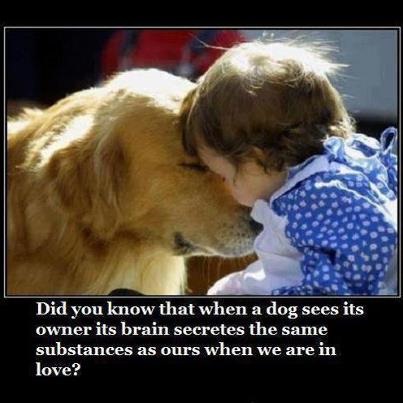
Dogs, just like us humans, love routines. However, what strikes me from having lived for a number of years with a great many dogs in the home, variously from sixteen to the nine we have at present[1], is how amazingly easily a dog will adapt to new circumstances, both temporary and long-term changed circumstances.

Somewhere in my research, and I regret not being able to quote the reference, I came across a review of the author Jean Donaldson[2], in connection with her book Culture Clash. This book has shaped modern thinking about the behaviour of dogs and the relationship between dogs and humans.

The reviewer, in discussing the adaptability of dogs, proposes, “Maybe it’s the simple way they view their world. Each thing in their lives seems to fall neatly into its place in their world view. Things to seek out, things to avoid, things to keep, and things to leave behind.

Then a couple of sentences later, the reviewer adding: “I would guess that scavengers need that kind of mind set. Take it as it comes, deal with it, and move on. Dogs seem to have developed a sense of adaptation. They see what needs to be done and simply find a way to do it no matter what the impediments might be.

That last sentence describes an attitude towards adaptability that, in my opinion, would be very rare to find in a person.

I am going to devote the balance of this chapter to a true story. The true story about an Akita breed of dog that lived with its owner in Tokyo back in the first quarter of the 20th century. I included this account, despite the main theme of the story being about the extreme loyalty of the dog, because the dog’s ability to adapt is equally as impressive.

In 1924, Hidesaburō Ueno, a professor in the agriculture department at the University of Tokyo took in an Akita breed of dog as a pet and named him Hachikō. During his owner’s life, Hachikō not only saw Professor Ueno come out from the front door each morning but quickly learned to greet him at the end of the day by going to the nearby Shibuya Station. Hachikō continued this daily routine of going to the station until a day in May 1925, when that evening Professor Ueno did not return on his usual train. The reason being that the professor had suffered a cerebral haemorrhage at the university that day, had died and, therefore, never returned to the train station where his doggy friend was waiting.

Kind persons found Hachikō another home after his master’s death but he routinely escaped, showing up again and again at his old home. Eventually, Hachikō in some doggie manner realised that his master, Professor Ueno, clearly no longer lived at the house. So Hachikō went to look for his master at the train station, where he had accompanied him so many times before. Each day, Hachikō waited for Professor Ueno to return. And each day he did not see his friend among the commuters leaving the station.

Now almost a permanent fixture at the train station, Hachikō inevitably attracted the attention of other commuters. Many of the people who frequented the Shibuya train station had seen Hachikō and Professor Ueno together each day. They now brought Hachikō treats and food to nourish him during his long wait – Hachikō waiting at the train station at the end of every single day.

That same year, it happened that another of Ueno’s faithful students, who had become something of an expert on the Akita breed, saw the dog at the station and followed him when he went back to the home of the former gardener of Professor Ueno: Kikuzaboro Kobayashi. There the student learned the history of Hachikō’s life. Shortly after this meeting with Kikuzaboro, the former student published a documented census of Akitas in Japan. His research found only 30 purebred Akitas remaining, including Hachikō from Shibuya Station.

Professor Ueno’s former student returned frequently to visit the dog and over the years published several articles about Hachikō’s remarkable loyalty. In 1932, one of these articles, published in Tokyo’s largest newspaper, threw the dog into the national spotlight. Hachikō became a national sensation. His faithfulness to the memory of his master impressed the people of Japan as a spirit of family loyalty that all should strive to achieve. Teachers and parents used Hachikō’s vigil as an example for children to follow. A well-known Japanese artist rendered a sculpture of the dog, and throughout the country a new awareness of the Akita breed grew.

Hachikō was so loyal that every day for the next nine years he waited, sitting there amongst the town’s folk, appearing precisely when the train was due at the station.

Hachikō died on March 8, 1935. He was found on a street in Shibuya. His heart was infected with filarial worms and 3-4 yakitori sticks were found in his stomach. His stuffed and mounted remains are kept at the National Science Museum of Japan in Ueno, Tokyo. Hachiko’s legendary faithfulness became a national symbol of loyalty. There is a memorial statue of Hachikō in front of Shibuya Station.

This tale of Hachikō is an astounding tribute to the adaptability of the dog.

1,123 words. Copyright © 2014 Paul Handover

[1] December, 2014
[2] http://www.jeandonaldson.com

We are in and of nature itself!

Yet another powerful essay from George Monbiot.

I wonder at times why the most obvious things about us humans can be so easily overlooked. I have in mind that we humans are a product of a natural world, that we cannot survive without nature; however we examine our lives.

Take, for example, this picture of a city spread, in this case Chicago, where one might expect the natural world to be practically out of sight, reduced to a single point, metaphorically speaking. Yet nature is still hanging on, albeit courtesy of some local gardeners, I don’t doubt.

Chicago_cityscape_(5253757001)

All of which is my introduction to yet another powerful essay from George Monbiot, republished here with his very kind permission.

ooOOoo

Civilisation is Boring

December 9, 2014

We are pre-tuned to the natural world; wired to respond to nature.

By George Monbiot, published on BBC Earth, 8th December 2014

This is the first of BBC Earth’s longform essays about our relationship with the natural world.

One of the penalties of an ecological education is that one lives alone in a world of wounds,” the pioneering conservationist Aldo Leopold wrote. “An ecologist must either harden his shell and make believe that the consequences of science are none of his business, or he must be the doctor who sees the marks of death in a community that believes itself well and does not want to be told otherwise.”(1)

I remembered that when I read the news that the world has lost 52% of its vertebrate wildlife over the past 40 years(2). It’s a figure from which I’m still reeling. To love the natural world is to suffer a series of griefs, each compounding the last. It is to be overtaken by disbelief that we could treat it in this fashion. And, in the darkest moments, it is to succumb to helplessness, to the conviction that we will keep eroding our world of wonders until almost nothing of it remains. There is hope – real hope – as I will explain later, but at times like this it seems remote.

These wounds are inflicted not only on the world’s wildlife but also on ourselves. Civilisation is but a flimsy dust sheet that we have thrown over a psyche rich in emotion and instinct, shaped by the living planet. The hominims from whom we evolved inhabited a fascinating, terrifying world, in which survival depended on constant observation and interpretation. They contended not only with lions and leopards, but with sabretooths and false sabretooths, giant hyaenas and bear dogs (monstrous creatures with a huge bite radius).

As the work of Professor Blaire van Valkenburgh at UCLA suggests, predators in the pre-human past lived at much greater densities than they do today(3). The wear and breakage of their teeth show that competition was so intense that they were forced to consume the entire carcasses of the animals they killed, bones and all, rather than just the prime cuts, as top carnivores tend to do today. In other words, the animals with which we evolved were not just bigger than today’s predators; they were also hungrier.

Navigating this world required astonishing skills. Our ancestors, in the boom-and-bust savannahs, had to travel great distances to find food, through a landscape shimmering with surprise and hazard. Their survival depended upon reacting to the barest signals: the flicker of a tail in the grass, the scent of honey, a change in humidity, tracks in the dust. We still possess these capacities. We carry with us a ghost psyche, adapted to a world we no longer inhabit, which contains – though it remains locked down for much of the time – a boundless capacity for fear and wonder, curiousity and enchantment. We are pre-tuned to the natural world; wired to respond to nature.

In computer games and fantasy novels, we still grapple the monsters of the mind. In the film of Lord of the Rings: the Two Towers, the orcs rode on giant hyaenas(4). In the first Hunger Games film, bear dogs were released into the forest to prey on the contestants(5). I don’t believe these re-creations were accidental: the directors appear to have known enough of our evolutionary history to revive the ancestral terror these animals provoke. The heroic tales that have survived – tales of Ulysses, Sinbad, Sigurd, Beowulf, Cú Chulainn, St George, Arjuna, Lạc Long Quân and Glooskap – are those that resonate with the genetic memories lodged in our minds. I suspect that their essential form has remained unchanged for hundreds of thousands of years; that the encounters with monsters recorded in writing were a consolidation of stories we have been telling since we acquired the capacity to use the past tense.

You can see how such tales might have originated in a remarkable sequence in the BBC’s Human Planet series(6). Three men in southern Kenya, described by the programme as Dorobo people (though this is not a designation many ethnographers accept) stalk to within about 50 metres of a lion kill. Fifteen lions, blood dripping from their jaws, are eating the carcass of a wildebeest. The men suddenly stand and walk towards the pride. Rattled by their astonishing confidence, the lions flee. They watch from the bushes, puzzled and indecisive, as the three men walk up to the carcass, hack off one of the hind legs, then saunter away. That night, the adventurers roast the meat in their cave. “We really robbed those lions”, one of them boasts. “How many do you think there were?”, another asks. “Fifteen, but there might have been more.”

This, surely, is how sagas begin. Those men, led by a veteran of such ruses, are heroes of the old stamp. They outwitted a party of monsters, using guile and audacity, much as Ulysses did. A few hours later, they tell the first version of a story that might echo down the generations, every time with new flourishes and embellishments. Now imagine that, thousand of years hence, lions are long extinct, and the descendants of the Dorobo have only the haziest notion of what they were. They have become monsters even bigger and more dangerous than they were in life, and the feat becomes even more outrageous and unlikely. The saga remains true to its core, but the details have changed. We are those people, still telling the old stories, of encounters with the beasts that shaped us.

The world lives within us, we live within the world. By damaging the living planet we have diminished our existence.

We have been able to do this partly as a result of our ability to compartmentalise. This is another remarkable capacity we have developed, which perhaps reflects the demands of survival in the ever more complex human world we have created. By carving up the world in our minds we have learnt to shut ourselves out of it.

One of the tasks that parents set themselves is to train their children in linearity. Very young children don’t do linearity. Their inner life is discursive, contingent, impulsive. They don’t want to walk in a straight line down the pavement, but to wander off in the direction of whatever attracts their attention. They don’t begin a task with a view to its conclusion. They throw themselves into it, engage for as long as it’s exciting, then suddenly divert to something else.

This is how all animals except adult humans behave. Optimal foraging, the term biologists use to describe the way animals lock onto the best food supply, involves pursuing a task only for as long as it remains rewarding. Our own hunting and gathering would have followed a similar pattern, though it was complicated by our ability to plan and coordinate and to speculate about imagined outcomes. Broadly speaking, ours was a rambling and responsive existence, in which, by comparison to the way we live today, we had little capacity or inclination to impose our will on the world, to lay out a course of action and to follow it without deviation or distraction.

Only with the development of farming did we have to discipline ourselves to think linearly: following a plan from one point to another across weeks or months. Before long we were ploughing in straight lines, making hedges and ditches and tracks in straight lines, building houses and then towns in straight lines. Now almost every aspect of our lives is lived within grids, either concrete or abstract. Linearity, control and management dominate our lives. We fetishise progress: a continuous movement in the same direction. We impose our lines on the messy, contradictory and meandering realities of the human world, because otherwise we would be completely lost in it. We make compartments simple enough, amid the labyrinths we have created, to navigate and understand.

Thus we box ourselves out of the natural world. We become resistant to the experiences that nature has to offer; its spontaneity and serendipity, its unscripted delights, its capacity to shake us out of the frustrations and humiliations which are an inevitable product of the controlled and ordered world we have sought to create. We bully the living world into the grids we impose on ourselves. Even the areas we claim to have set aside for nature are often subjected to rigid management plans, in which the type and the height of the vegetation is precisely ordained and, through grazing or cutting or burning, nature is kept in a state of arrested development to favour an arbitrary assemblage of life over other possible outcomes. Nothing is allowed to change, to enter or leave. We preserve these places as if they were jars of pickles.

The language we use to describe them is also rigid and compartmentalised. In the UK we protect “sites of special scientific interest”, as if the wildlife they contain is of interest only to scientists. The few parts of the seabed which are not ripped up by industrial trawling are described as “reference areas”, as if their only value is as a baseline with which to compare destruction elsewhere. And is there a more alienating term than “reserve”? When we talk about reserve in people, we mean that they seem cold and remote. It reminds me of the old Native American joke: “we used to like the white man, but now we have our reservations.” Even “the environment” is an austere and technical term, which creates no pictures in the mind.

It’s not that we have banished our vestigial psychological equipment from our minds, or lost our instinct for engagement with wildlife. The tremendous popularity of nature programmes testifies to its persistence. I remember sitting in a café listening to a group of bus drivers talking, with great excitement and knowledge, about the spiders they had seen on television the night before, and thinking that, for all our technological sophistication, for all the clever means by which we shield ourselves from our emotions, we remain the people we have always been.

But we have suppressed these traits, and see the world through our fingers, shutting out anything that might spoil the view. We eat meat without even remembering that it has come from an animal, let alone picturing the conditions of its rearing and slaughter. We make no connection in our compartmentalised minds between the beef on our plates and the destruction of rainforests to grow the soya that fed the cattle; between the miles we drive and the oil wells drilled in rare and precious places, and the spills that then pollute them.

In our minds we have sanitised the world. WH Auden’s poem Et in Arcadia Ego describes how “Her jungle growths / Are abated, Her exorbitant monsters abashed, / Her soil mumbled,” while “the autobahn / Thwarts the landscape / In godless Roman arrogance”(7). But the old gods, the old fears, the old knowledge, have not departed. We simply choose not to see. “The farmer’s children / Tiptoe past the shed / Where the gelding knife is kept.”

Civilisation is boring. It has many virtues, but it leaves large parts of our minds unstimulated. It uses just a fraction of our mental and physical capacities. To know what comes next has been perhaps the dominant aim of materially-complex societies. Yet, having achieved it, or almost achieved it, we have been rewarded with a new collection of unmet needs. Many of us, I believe, need something that our planned and ordered lives don’t offer.

I found that something once in Cardigan Bay, on the west coast of Wales. I had stupidly launched my kayak into a ten-foot swell to fish a couple of miles from the shore. As I returned to land, I saw that the tide had risen, and ugly, jumbled breakers were smashing on the seawall. From where I sat, two hundred metres from the shore, I could see that the waves were stained brown by the shingle they flung up. I could hear them cracking and soughing against the wall. It was terrifying.

Behind me I heard a monstrous hiss: a freak wave was about to break over my head. I ducked and braced the paddle against the water. But nothing happened. Then a hooked grey fin, scarred and pitted, rose and skimmed just under the shaft of my paddle. I knew what it was, but the shock of it enhanced my rising fear. I glanced around, almost believing that I was under attack.

Then, from the stern, I heard a different sound: a crash and a rush of water. A gigantic bull dolphin soared into the air and almost over my head. As he flew past, he fixed his eye on mine. I stared at the sea into which he had disappeared, willing him to emerge again, filled with a wild exaltation, and a yearning of the kind that used to afflict me when I woke from that perennial pre-adolescent dream of floating down the stairs, my feet a few inches above the carpet. I realised at that moment that I had been suffering from a drought of sensation which I had come to accept as a condition of middle age, like the loss of the upper reaches of hearing.

I found that missing element again in the Białowieża Forest in eastern Poland. I was walking down a sandy path between oak and lime trees that rose for perhaps one hundred feet without branching. Around them the forest floor frothed with ramsons, celandines, spring peas and May lilies. I had seen boar with their piglets, red squirrels, hazel grouse, a huge bird that might have been an eagle owl, a black woodpecker. As I walked, every nerve seemed stretched, tuned like a string to the forest I was exploring. I rounded a curve in the path and found myself face to face with an animal that looked more like a Christian depiction of the Devil than any other creature I have seen.

I was close enough to see the mucus in her tear ducts. She had small, hooked black horns, heavy brows and eyes so dark that I could not distinguish the irises from the pupils. She wore a neat brown beard and an oddly human fringe between her horns. Her back rose to a crest then tapered away to a narrow rump, from which a black tail, slim as a whip, now twitched. She flared her nostrils and raised her chin. I fancied I could smell her sweet, beery breath. We watched each other for several minutes. I stayed so still that I could feel the blood pounding in my neck. Eventually the bison tossed her head, danced a couple of steps then turned, trotted back down the path then cantered away through the trees.

Experiences like these are the benchmarks of my life, moments in which dormant emotions were rekindled, in which my world was re-enchanted. But such unexpected encounters have been far too rare. Most of the lands in which I walk and the seas in which I swim or paddle my kayak are devoid of almost all large wildlife. I see deer, the occasional fox or badger, seals, but little else. It does not have to be like this. We can recharge the world with wonder, reverse much of the terrible harm we have done to it.

Over the past centuries, farming has expanded onto ever less suitable land. Even places of extremely low fertility have been cultivated or grazed, and the result has been a great disproportion between damage and productivity: the production of a tiny amount of food destroys the vegetation, the wild animals, the soil and the watersheds of entire mountain ranges. In the face of global trade, farming in such areas is becoming ever less viable: it cannot compete with production in fertile parts of the world. This has caused a loss of cultural diversity, which is another source of sadness.

But at the same time it means that the devastated land could be restored. In Europe, according to one forecast, 30 million hectares – an area the size of Poland – will be vacated by farmers by 2030(8). In the United States, two thirds of those parts of the land which were once forested, then cleared, have become forested again(9), as farming and logging have retreated, especially from the eastern half of the country. Rewilding, the mass restoration of ecosystems, which involves pulling down the redundant fences, blocking the drainage ditches, planting trees where necessary, re-establishing missing wildlife and then leaving the land to find its own way, could reverse much of the damage done to these areas. Already, animals like lynx, wolves, bears and moose, on both continents, are moving back into their former ranges.

There are also possibilities of restoring large parts of the sea. Public disgust at a fishing industry that has trashed almost every square metre of seabed on the continental shelves is now generating worldwide demands for marine parks. These are places in which commercial extraction is forbidden and the wildlife of the seas can recover. Even fishing companies can be persuaded to support them, when they discover that the fish migrating out of these places greatly boost their overall catches, a phenomenon known as the spillover effect. Such underwater parks are quickly recolonised by sessile life forms. Fish and crustacea proliferate, breeding freely and growing to great sizes once more. Dolphins, sharks and whales move in.

In these places we can leave our linearity and confinement behind, surrender to the unplanned and emergent world of nature, be surprised once more by joy, as surprise encounters with great beasts (almost all of which, despite our fears, are harmless to us) become possible again. We can rediscover those buried emotions that otherwise remain unexercised. Why should we not have such places on our doorsteps, to escape into when we feel the need?

Rewilding offers something else, even rarer than lynx and wolves and dolphins and whales. Hope. It offers the possibility that our silent spring could be followed by a raucous summer. In seeking to persuade people to honour and protect the living planet, an ounce of hope is worth a ton of despair. We could, perhaps, begin to heal some of the great wounds we have inflicted on the world and on ourselves.

George Monbiot is the author of Feral: rewilding the land, sea and human life. There’s an archive of his articles at http://www.monbiot.com

References:

1. Aldo Leopold, 1949. A Sand County Almanac. Oxford University Press.

2. http://www.theguardian.com/environment/2014/sep/29/earth-lost-50-wildlife-in-40-years-wwf

3. http://www.eci.ox.ac.uk/news/events/2014/megafauna/valkenburgh.pdf

4. https://www.youtube.com/watch?v=F3GFYKIwJ9Y

5. http://www.imdb.com/title/tt1392170/

6. http://vimeo.com/22616099

7. http://www.nybooks.com/articles/archives/1965/jun/03/et-in-arcadia-ego/

8. http://www.rewildingeurope.com/assets/uploads/Downloads/Rewilding-Europe-Brochure-2012.pdf

9. http://articles.chicagotribune.com/2012-11-16/features/ct-prj-1118-book-of-the-month-20121116_1_wild-animals-wildlife-wild-game-meat/2

ooOOoo

I’m sure that you will agree with me that this is a wonderful essay from Mr. Monbiot, an essay that speaks to us in ways that we all intuitively know makes huge sense.

There is hope for us!

 

The book! Part Five: Acceptance.

When I was pondering this part of the book, namely Part Five and the qualities we can learn from dogs, and before I started into the writing, when I was building the list of qualities of dogs that we humans need to learn, I was unsure if this chapter on acceptance, together with the previous one on openness, and the one coming up on adaptability, weren’t all too close to the same idea. But after having thought about it some more, I decided that these three qualities are sufficiently different to warrant them being three qualities that we should learn!

For openness is all about offering to others, whereas acceptance is, in a sense, the reverse current, allowing the outside world to flow in to one without too many mental and emotional ‘filters’ corrupting that inward flow and, finally, adaptability is all about change.

Let us start with what our dogs offer us when it comes to acceptance. Almost immediately comes the answer: dogs accept the humans around them and the human world, accept their life as a pet, and accept their world as a domesticated animal; accept it all as it is for what it is.

Just think for a moment of the vast range of life experiences that our dogs are embedded within. From the tiniest poodle who rarely is separated from its owner, to the sheepdog that ‘works’ the land and spends its nights outside in the barn, all the way to the German Shepherd guard dog that is hardly a pet. Dogs are authentic; in the full meaning of the term. They respond, react may be a better word, to their environment and to their natural instincts but totally within the human world in which each particular dog has been cast.

That is a level of acceptance that we humans can only dream about.

Nevertheless, even if that level of acceptance of the world outside us is most likely beyond reach for us humans, there is still an important lesson to be learnt.

Let me elaborate.

The quality of the relationships that we have with others revolves entirely around how we view those other people. And nowhere is that more important than how we view those close to us; our family and our spouses and partners.

If we use the wonderful way in which dogs accept the outside world and, most notably, the way they accept other dogs, as a model for that being the way we accept our partner, there is much research to underpin the fact that we will enjoy wonderful relationships.

If we quietly admit to ourselves that we do not accept our partners as fully as we should, then learning fully to accept them will transform our relationship miraculously.

For the acceptance of the person you share your life with is the biggest gift of respect you can give them. It underlines how much you love them and how much you respect them. It demonstrates that you know that the decisions your partner makes, from small ones to large ones, are based on what they believe is right. It doesn’t at all deny you offering support and guidance, of course not, but what it does guarantee is that you don’t stray into criticism of them, especially the genre of criticism that has its roots in your (false) belief that the other person is not thinking like you, not seeing something as you see it. For one very obvious reason: they aren’t you!

There is no question at all that acceptance is the greatest gift you can offer someone, especially someone emotionally close, because it is the greatest sign of respect. And respect is the cousin of trust and without trust there is no relationship. It applies equally to humans and dogs! Just because we accept our dog unconditionally, that our dog is completely authentic, because we know that it is a dog, and never expect them to be anything other than a dog, doesn’t in any way mean that the same approach, the same unconditional acceptance of a person in our lives, should not be our way of living with that other person.

691 words Copyright © 2014 Paul Handover

Would you?

Over the years, I have collected well over a hundred ‘draft’ posts.  In the main, these are simply things that have caught my eye that could perhaps be a blog post sometime in the future.

Recently, I have been wandering through these drafts, throwing away those topics that were clearly dated, and endeavouring to find the gems that really do need to be shared with you.

This post most definitely falls into the ‘must share’ category.

It is just a photograph. A photograph that I regret I can no longer recall it’s source.

But trust me, this is one of those photographs that …….

Continue reading “Would you?”

The book! Part Five: Openness

I searched around for some meaning, some idea of what openness was really about. It’s such a quick word to run off the tongue, seemingly so easy to grab at the meaning of the word, that it isn’t until one pauses and asks oneself do I really, truly know what the word openness means, what it really conveys, that the doubt creeps in.

The dictionary didn’t help that much. Openness noun 1. The condition of being laid open to something undesirable or injurious. 2. Ready acceptance of often new suggestions, ideas, influences, or opinions.

No, that still didn’t offer a clear meaning of the sense of openness that I see in dogs, especially our dogs.

Then my eye wandered up the dictionary page to the entry immediately above openness; to open-mindedness: noun Ready acceptance of often new suggestions, ideas, influences, or opinions : openness, receptiveness, receptivity, responsiveness.

Bingo! Responsiveness, receptiveness! Those terms did speak to me. That’s how I saw the openness in our dogs.

Dogs don’t appear to engage in introspection, they don’t seem to worry about who they are. Their emotions are clear to us! One might say that dogs wear their emotions on their paws. They engage with the human world about them regardless of our human moods and more-or-less impartial to our situations or our choices. We call them and expect them to come. Perhaps, ask them to go to a part of the house if we are going out, or to stay in a place until we tell them they can move. Dogs appear simply to be there for us, as if only on our terms. As much as each day is unique and different, dogs offer a constancy, a reliability, that feels unmatched by us humans.
We depend on our dogs, as do the vast majority of people who have dogs in their lives. They calm us down in times of trouble; give us a better perspective of life’s ‘big picture’. We can so openly share a sense of joy with our dogs. Dogs give us permission to be silly with them, to hug them, to rub their tummies, to roll around on the floor with them. It is possible, easily so, to learn something from a dog every single day simply from observing sufficiently close these beautiful animals. Dogs ask only in return for food, water and affection.

The openness of dogs has been celebrated in many ways, in song and verse, for centuries. It is still to be celebrated today, for today that wonderful quality of openness is still vibrant in our dogs. It seems so much more than just the product of some evolution of nature. Reflect on the incredible range of species, on all that selective breeding, on the many differences in the environments in which dogs live out their lives. So many dogs and yet every one of them coming to us, to meet us, to be with us, just as they are, with no apologies and no covert agendas. As the author Susan Kennedy[1] once said, “Dogs are miracles with paws.

I have had a dog in my life, my beloved Pharaoh, since 2003. I have had a great number of dogs in my life since meeting Jean in 2007. As many as sixteen and regrettably now down to nine at the time of writing[2] these words. I can’t imagine my life without our dogs. They truly provide unconditional love and they do so without hesitation. It is a simple yet immensely beautiful relationship. That love that we receive from our dogs comes from their openness. A dog’s openness is a gift. A precious, remarkable gift.

Now how on earth can one translate that across to the quality that we humans have to learn; to learn from our dogs? Are there any practical benefits for us in trying to practice the openness we see in dogs? By using the word ‘trying’ I’m admitting some degree of doubt about answering that question in the affirmative. Not doubting that there are benefits, just unclear about how to describe them. Unclear how we humans could ever match the openness of dogs.

So what I am going to do is to try flipping the issue on its head. Just stay with me a little longer.

I have referred to Jon Lavin many previous times in this book. In his world, his world of counselling and therapy, Jon speaks like this. Namely, that in the world of solutions focussed therapy, the area that Jon practices in professionally, the way forward with the person who has come to see Jon is always to focus “on what is working“. Jon explains that while one would initially allow the problems to be voiced, this negativity would always be a tiny piece of the overall process, say less than 5% of the session. That even if a client’s whole world seemed to be failing, there would always be something that was alright, always a 1% that was working, and that would be the place to start.

No better endorsed by the website of the organisation Good Therapy[3]. I quote [my emphasis]:

Solution focused brief therapy (SFBT[4]) targets the desired outcome of therapy as a solution rather than focusing on the symptoms or issues that brought someone to therapy. This technique only gives attention to the present and the future desires of the client, rather than focusing on the past experiences. The therapist encourages the client to imagine their future as they want it to be and then the therapist and client collaborate on a series of steps to achieve that goal.

Returning to the example of openness that we see in our dogs, maybe rather than wringing our hands because we will never be as open as those wonderful dogs around us, perhaps we should flip the idea on its head. Ergo, not strive to be the same as our dogs, just to follow their lead.

In other words, just be more mindful of the need for openness, to practice openness as a conscious idea, and to develop the habits of openness. Holding our dogs up as a marvellous pillar, as a wonderful example, of the goal of greater openness that we all seek.

1,039 words Copyright © 2014 Paul Handover

[1] I am indebted to Susan Kennedy’s writings for inspiring many of the ideas in this chapter.
[2] November, 2014
[3] http://www.goodtherapy.org
[4] Solution focused therapy was developed by Steve De Shazer, Insoo Kim Berg, and their team at the Brief Family Therapy Family Center in Milwaukee, USA.

Nothing to do with dogs!

Unless you can imagine them howling to the storm!

Among my subscription feeds is one to EarthSky News. Thus it was courtesy of yesterday’s update that I saw the link to the following video. It was promoted as follows: “High plains storms. The opening is brilliant … the end is awesome. (You’ll like the rest too.) By Nicolaus Wegner.” Nicolaus Wegner’s own website was easily found here; on which the following photograph was seen. (This actual image was taken from a web search – the full size, breathtaking version, may be seen here.)

storm

So back to the video. (Just note that when I watched it, it seemed unable to spool past the 8-second mark. If this happens to you, just manually drag the progress bar along to 10 seconds, or just past that. It’s worth it!)

High plains storms are some of the most beautiful and wild in the world. I spent May – September 2014 photographing all types of severe weather in Wyoming, Montana, South Dakota, Nebraska, and Colorado. This time lapse project is a result of that effort. From rainbows to tornadoes, there is a little bit of everything in here.

Calm winds wherever you are in the world!

The book! Part Five: Forgiveness.

Dogs offer a multitude of examples of forgiveness that many of us probably don’t see. Well, do not see that quality of forgiveness of dogs in such a clear, specific way. Yet think of dogs that are treated cruelly, often over months or years, and then find a new, loving home. Think of dogs that have spent weeks and months in confinement at the local humane centre. Or more terrible to comprehend are those dogs that have simply been abandoned; just thrown away by a so-called human.

We take it totally for granted, when dogs find that new loving home, that they will adjust quickly and easily. For example, one of the dogs that we have here at home is Casey. He was found in the local dog rescue unit down in Payson, Arizona, when we were living in that part of America. Casey had been confined in the dog rescue unit for coming up to a year, and probably hadn’t found a new home because he was a Pit Bull mix, and looked it. Two weeks before he was due to be ‘put down’, classified as being unadoptable, Jean brought him home.

The speed at which he settled in to his new home including, not too much later, a house move from Payson to Southern Oregon, was just wonderful. Casey never for a moment displayed any cautiousness or nervousness towards Jean and me, or, even more importantly, didn’t reveal any anti-social inclinations towards visitors who came to the house. Casey has a wonderful temperament and is a happy, lively, affectionate dog. Clearly, Casey harbours no grudges from past experiences. His forgiveness of the way his life had been dominated by the actions of humans is flawless.

With Payson in mind, there’s another example of how a dog so quickly puts past experiences behind them and embraces their new life.

For in Payson we knew the author, Trish Iles, who has the blog Contemplating Happiness[1]. Here is a lovely story from Trish, in her own words:

What the dog knew!

I was pondering the eternal question: why does two weeks of relaxing vacation seem like so much more time than two weeks of working like my pants are on fire, here at my desk? My sweet husband and I talked about it a little bit, but came to no definitive answer. I chatted with friends about it. No insights. Google had no opinion, either.

Chloe came to us from a rescue organization. I think sometimes about what her experiences have been in her young life. She started out as an abandoned puppy on a reservation in New Mexico and was soon in the pound where she was on the euthanasia list. A kind woman rescued her and took care of her until she found us: just when Chloe was becoming at home with the rescue lady, she was uprooted again and sent home with two new people. What must she have been thinking?

Chloe didn’t close her heart to us, though. She watched for a few days. When she decided we weren’t going to make dinner out of her and that she was really staying with us, she threw her whole being into becoming one of the family. She let herself trust us.

I’m not sure I would have had the courage to trust a new set of people again. I’m doubly not sure that I give a rat’s patootie what those new people thought of or wanted from me. Chloe was willing not only to trust us, but to love us. She forgave us immediately for ripping her from the home she knew, and she adopted us right back.

Chloe was born knowing. She knows about joy. She knows about living a life in balance. She knows about forgiveness, trust, exuberance, a passion for learning and the power of a good nap. I think that when I grow up, I want to be just like her.

Chloe knows about forgiveness.

Moving on. Much too late to make me realise the inadequacies of my own parenting skills, I learnt an important lesson when training Pharaoh, a German Shepherd, who came into my life as a puppy back in 2003; the first dog I had ever had. What I learnt was that putting more emphasis into praise and reward for getting it right ‘trains’ the dog much more quickly than telling it off. The classic example being scolding a dog for running off when instead there should be lots of hugs and praise for the dog returning home. The scolding simply teaches the dog that returning home isn’t pleasant whereas praise reinforces the belief in the dog that home is the place to be. Summed up by a phrase that I read somewhere: “Catch them in the act of doing right!

Like so many things in life, so very obvious once understood! There is no doubt in my mind that this approach, this philosophy, works with youngsters in just the same positive way.

Let’s focus now on the nature of forgiveness in people; in us humans.

There are, essentially, two options that we can choose to act out when we are hurt by someone. We can hang on to those feelings of anger and resentment, and possibly have thoughts of revenge, or respond with forgiveness. The first leads to wounds of anger, bitterness and resentment. The second leads to healing, to the rewards of peace, hope, gratitude and joy.

H’mm – deciding upon the best option could be tough decision! Apologies, I couldn’t avoid that flippancy!

The powerfully positive outcome from acting with forgiveness is that the act that caused the hurt loses, or is denied, any real emotional force upon one. You quickly put it behind you and focus on other, more positive parts of your life. That’s not to say that a significant act of hurt is forgotten, possibly not so for some time, it’s just that it lessens its grip on us, often significantly so. Indeed, quite often, forgiveness can give birth to feelings of understanding, empathy and compassion for the one who hurt us.

Moreover, forgiveness doesn’t mean that you are blind to, or deny, the other person’s responsibility for causing you to be hurt, nor does it minimise, let alone justify, the wrongness of the act. The person can be forgiven, without excusing the act. Forgiveness brings a kind of peace that helps you and I get on with our lives.

Actually, the benefits of forgiveness are even more tangible than the subjective meaning of peace.

There is real evidence to show that the letting go of grudges and bitterness, of offering forgiveness can lead to:

◦ Healthier relationships
◦ Greater spiritual and psychological well-being
◦ Less anxiety, stress and hostility
◦ Lower blood pressure
◦ Fewer symptoms of depression
◦ Stronger immune system
◦ Improved heart health
◦ Higher self-esteem

Beats a few bottles of pills in spades!

Now, as I read back over those last few sentences it struck me as having the slight tone of a Sunday sermon. That what needs to be added to those stirring ideas is how does one learn to forgive, learn to forgive in a practical manner.

Psychotherapists, and others from similar backgrounds, say that forgiveness is the result of change; or more accurately put, a commitment to a process of change.

To put some flesh on the bones of that last idea, that forgiveness is the commitment to a process of change, what now follows are five recommendations. Resist the temptation to read on without pause, indeed just say to yourself that after you have read each of the five recommendations coming up, you will reflect for sufficient time for your head to embrace the meaning of each recommendation, and still remaining paused, give your heart time to engage with your head. I hope that’s clear.

Bring up in your mind an episode where someone else caused you hurt. It can be a recent episode or one from long ago that still has the potential to hurt you. Dwell on it for a while.

So to the first recommendation: Consider the values of forgiveness to you, not at a theoretical level, but to you in terms of where you are at this point in your life, and by implication, how important those values of forgiveness are to you at this given time.

Stop! Look away from the page! Reflect on what that means. Think it with your head, feel it with your heart.

So to number two: Reflect on the situation, the real facts of what happened, how it came about, how you reacted, and to what degree the situation has affected your life, health and well-being; or has the potential to so do.

Stop! Look away from the page! Reflect on what that means. Think it with your head, feel it with your heart.

Here is the third recommendation: Actively choose to forgive the person who hurt you. Possibly by re-reading this chapter down to this point. Actively chose to forgive that person now!

Stop! Look away from the page! Reflect on what that means. Think it with your head, feel it with your heart.

Number four, the penultimate recommendation: Stop seeing yourself as a victim of the hurtful event. Understand that by continuing to feel victimised, you are unable to release the control and power that the offending person, and/or the situation, has over you.

Stop! Look away from the page! Reflect on what that means. Think it with your head, feel it with your heart.

The final recommendation; number five: As you let go of the pain, of the hurt, of your grudges, your life is now no longer defined by how you have been hurt. Better than that, the letting go opens your heart to finding compassion and understanding for the other person.

Think it with your head, feel it with your heart.

There is no question that forgiveness can be challenging at times, especially if the person who’s hurt you doesn’t admit wrong or doesn’t ever speak of his or her sorrow. But never allow yourself to become stuck. Reflect on the times when you have hurt others and when those others have forgiven you. Share your burden of finding forgiveness, such as writing in a journal, or through pray or guided meditation; even better open up to someone you’ve found to be wise and compassionate, such as a spiritual leader, a mental health provider, or an impartial loved one or friend. Nearly forgot: share your burden with your dog! They are such great listeners!

Never forget that finding forgiveness is a process and even small hurts may need to be forgiven over and over again.

In the vast majority of cases, forgiveness can lead to reconciliation. Especially so when the hurtful event involved someone whose relationship you really value; for example someone emotionally close to you. However, there is one case where reconciliation is impossible. That is the case where the person who hurt you has died. However, even if reconciliation isn’t possible, forgiveness always is.

A quick afterthought tells me that there is a second case where reconciliation is impossible: when the person who hurt you refuses to communicate with you. As they say, it takes two to tango, and you always have the choice to walk away, to move on, to reflect that someone who hurts you and then stands in the way of reconciliation may possibly be better off disconnected from you; temporarily or permanently.

Never forget to respect yourself, to keep an open heart and mind and do what seems best for you in the specific situation.

The final thought for this chapter on forgiveness is not to think that it is about the other person needing to change; that isn’t the point of forgiveness. Forgiveness is about us, how it can change our lives through bringing peace, happiness, and emotional and spiritual healing. It also helps, enormously so, in allowing us to recognise our own faults, our own mistakes, and the times when we have hurt others, so that we can offer our apologies in an open and honest manner.

Forgiveness is one of the many precious qualities that we can learn from dogs.

2,036 words Copyright © 2014 Paul Handover

[1] http://contemplatinghappiness.blogspot.com/p/my-books.html

The smell of the North

The things science unearths!

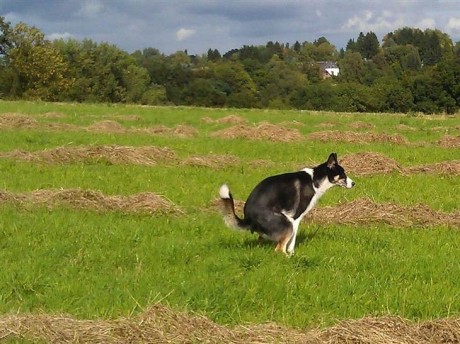
Having nine dogs here at home and quite a few acres of land, you can easily imagine that one needs to keep a good lookout for the numerous ‘land mines’.

But as much as they are a common and familiar sight, especially around the house, never in a thousand years would I have noticed a magnetic alignment!

All brought to my awareness by a wonderful article over on the ZME Science website.

Are you a dog lover? Did you know this?

ooOOoo

Dogs can sense Earth’s magnetic field… while pooping

Jenny Ricken / Univ. of Duisberg-Essen via AFP – Getty Images

Every dog owner can attest that canines are remarkable navigators, like some sort of living, breathing compasses. For some time, researchers have suspected that they can sense Earth’s magnetic field and use it in turn for navigation. A recent study confirmed this as a fact, however the findings came after studying the dogs in one of their most intimate poses – while pooping. Apparently, in stable conditions, dogs always relieve themselves while facing either north or south.

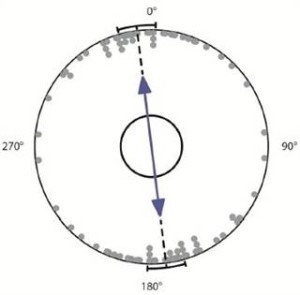
Led by zoologist Hynek Burda of Germany’s University of Duisburg-Essen, the researchers closely followed 70 dogs of 37 breeds for two years. Initially, the dogs didn’t seem to follow any particular pattern while going on with their business. After taking in account, however, things like the time of the day, the position of the sun, wind direction and, of course, the slight daily variation in the Earth’s magnetic field a whole new level of appreciation was revealed.

“The emerging picture of the analysis of the categorized data is as clear as [it is] astounding: Dogs prefer alignment along the magnetic north-south axis, but only in periods of calm magnetic field conditions,” said Burda.

Alignment of a sampling of dogs while defecating during stable geomagnetic conditions. Photo: Hart et al. / Frontiers in Zoology

Poop compass

So, dogs will always poop or pee facing north or south during stable conditions. The study not only proves that dogs can sense the Earth’s magnetic field, but also exhibit specific behavior in response to natural magnetic field variations. To our current knowledge, they’re the only mammals that do this. Previously it was shown that cattle, deer, foxes and other types of mammals sometimes line up preferentially along Earth’s magnetic field lines.

To some, dogs’ “sixth sense” might not come as a surprise, while others may view the present study as a complete waste of grant money. While it’s still unclear how dogs use this skill, it may be too early to dismiss the practical applications of the findings. If anything, however, this research proves yet again that dogs are extraordinary animals.

“To many dog owners who know about the good navigation abilities of their protégés, the findings might not come as a surprise, but rather as an explanation for the ‘supernatural’ abilities—although it is not clear to the researchers what the dogs might use their magnetic sense for,” Burda said.

Next, the researchers plan on studying how dogs use this ability and how magnetic storms affect their ability to orient themselves. Findings were reported in the journal Frontiers in Zoology.

ooOOoo

To say that I’m just a tiny bit sceptical wouldn’t be a lie.  But, trust me, I shall be outside tomorrow morning with my compass and camera and will report the results!

Picture parade seventy-four

The second set of wonderful pictures from Tricia.

(If you missed last week’s set they are here.)

Trish6

 oooo

Trish7

oooo

Trish9

oooo

Trish10

oooo

Trish11

oooo

Trish12

oooo

Trish13

oooo

What incredible, wonderful, loving animals they are!

Rivers in the sky!

California’s recent rain storm.

The recent rain storm that has affected much of the Western seaboard of the USA; albeit primarily California.  The BBC News reported online that:

Storm pounds northern California

Streets were heavily flooded in the town of Healdsburg, California.

More than 220,000 people are without power after heavy rains and high winds slammed northern California.

The storm brought rainfall of more than an inch an hour in San Francisco and winds gusts of 140mph (225km/h) in the Sierra Nevada mountains.

Flooding has already closed two major motorways in the area, delayed public transport, cancelled 240 flights and shut ferry services.

The rain is much needed in the drought-hit state but mudslides are a concern.

Power cuts were widespread, from the suburban area south of San Francisco to Humboldt, near the Oregon border.

Thus the morning afterwards, it was wonderful to receive an email from Dan Gomez that put not only this last storm into context but also a long history of very significant deluges.  Bet you will be as surprised as I was when you read it!

ooOOoo

What Is This “Atmospheric River” That Is Flooding California?

By Mark Fischetti | December 11, 2014

The views expressed are those of the author and are not necessarily those of Scientific American.

——————-

SA1The San Francisco Bay Area is getting flooded with relentless rain and strong winds, just like it did a week ago, and fears of rising water are now becoming very serious. Major news stations, weather channels, Web outlets and social media are all suddenly talking about the “atmospheric river” that is bringing deluge after deluge to California, as well as the coast of Washington. What is this thing? How rare is it? And how big of a threat could it be? Here are some answers. And see our graphics, below, taken from a brilliant and prescient feature article written by Michael Dettinger and Lynn Ingram in Scientific Americanin January 2013.

Not interested? In 1861 an atmospheric river that brought storms for 43 days turned California’s Central Valley into an inland sea 300 miles long and 20 miles wide. Thousands of people died, 800,000 cattle drowned and the state went bankrupt. A similar disaster today would be much more devastating, because the region is much more populated and it is the single largest food producer in the U.S.

So maybe 1861 was an oddity. Not really. Geologic core samples show that extreme floods like the one in 1861 have happened in California about every 200 years, since the year 200 A.D. So the next disaster could be coming around the bend. The West Coast has actually been slowly constructing large, specialized, meteorological observatories that can sense atmospheric rivers as they develop, so forecasters can give early warnings.

An atmospheric river is a conveyor belt of vapor that extends thousands of miles from out at sea, carrying as much water as 15 Mississippi Rivers. It strikes as a series of storms that arrive for days or weeks on end. Each storm can dump inches of rain or feet of snow. Meteorologists sometimes call small occurrences “pineapple expresses,” because they tend to flow in a straight line from around Hawaii toward the U.S. West Coast. The graphic below explains the details.

SA2

Several regions of central California have been frequent targets in the past two millennia. Here’s the record from core samples showing that every 200 years or so a catastrophic atmospheric river many times greater than any pineapple express occurs.

SA3

The flow pattern of the atmospheric river now battering the West Coast is classic. The University of Wisconsin at Madison maintains a terrific Web site that shows the flows in real time, updated every five minutes. A snapshot from last night is below. The dark red swath across the equator is the tropical rain band that is usually present; the atmospheric river is the sweeping jet of water vapor (blue in the image) that shoots off towards the U.S.

SA4

If you want to know more about these monster storms, check out the feature articleby Dettinger and Ingram. Dettinger will also be speaking at the American Geophysical Union annual conference in San Francisco next week. I’ll be there, too—with 22,000 scientists, right in the thick of the storms, should they continue.

Top image courtesy of the University of Wisconsin at Madison

ooOOoo

Maybe those fluffy white clouds aren’t quite as innocent looking as one might imagine! Oh, and a cubic metre of water is one tonne! A 1,000 kgs! (Just a little short of a ton in old money.)

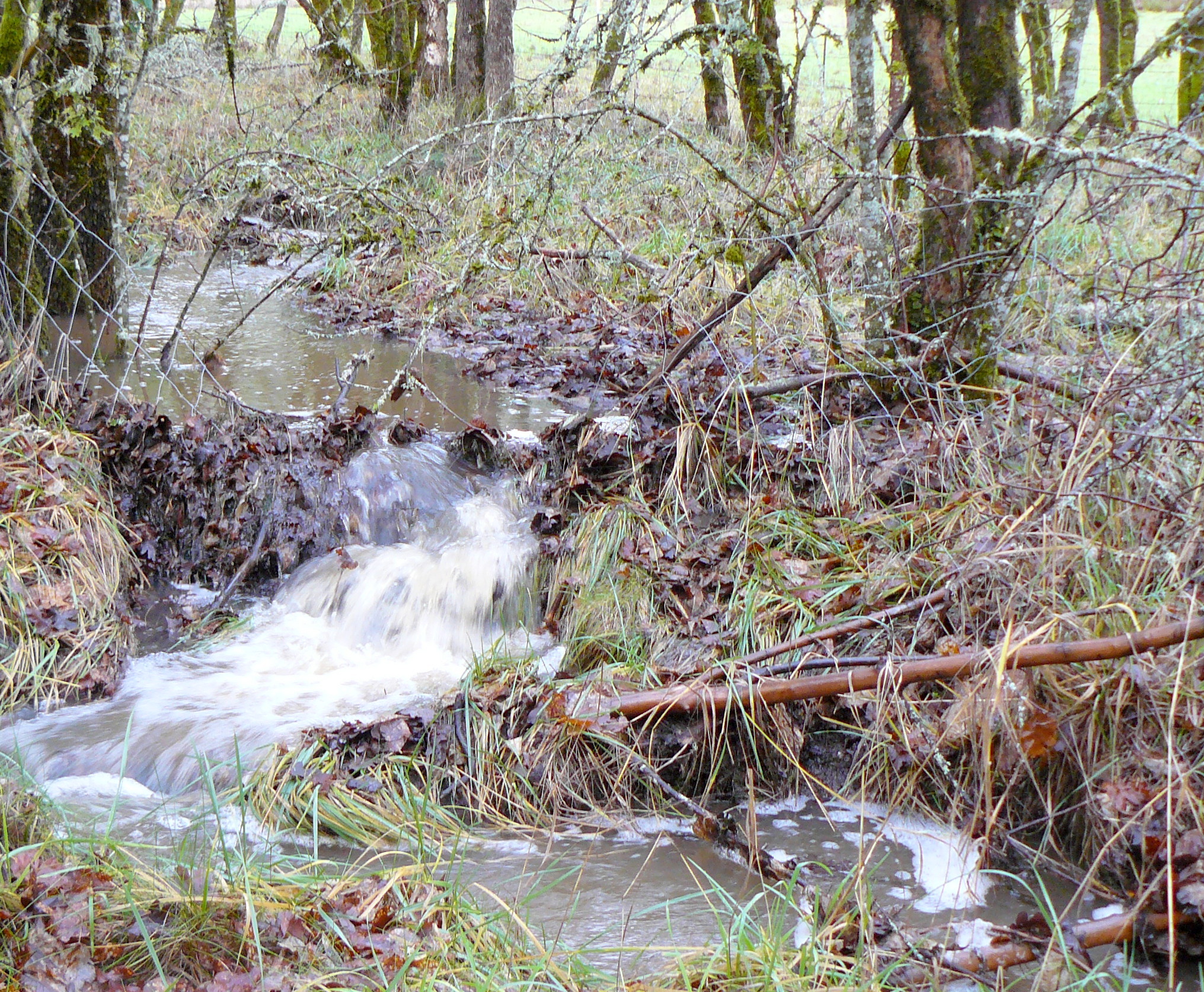
Finally, here in rural Southern Oregon, we received 1.70 inches of rain on Thursday and were grateful that it wasn’t more.  Nonetheless, it had the creek levels raised, as the following pictures reveal.

A small creek that only flows during periods of heavy rain. The creek is on the boundary between our property and our neighbour's to the North.
A small creek that only flows during periods of heavy rain. The creek is on the boundary between our property and our neighbour’s to the North.

oooo

This the raised water flowing over the irrigation dam on Bummer Creek, that flows North-South through the woods on the Eastern part of our land.
The raised water flowing over the irrigation dam on Bummer Creek, that flows North-South through the woods on the Eastern part of our land. Bummer Creek flows year-round.