Category: Water

The Sound of Sadness!

Why is is that some things so profoundly affect one?

In working my way through magazines and other stuff that I wanted to read following being away for nearly three weeks, I came across a report published by the University of Exeter, back in England, about the effect of climate change on the Great Barrier Reef.

Deteriorating Great Barrier Reef hushed: young fish no longer hear their way home

Degraded coral reefs are far quieter than five years ago, and no longer sound like a suitable habitat to young fish searching for a place to live and breed, according to research published today in Proceedings of the National Academy of Sciences USA.

Baby fish looking for a home can use noisy coral reef sounds including snapping shrimp clicks, damselfish chirps, and clownfish chattering to locate and select suitable habitat. But that “coral reef orchestra” has been quietened following recent cyclone and coral-bleaching damage on the Great Barrier Reef, raising fears that young fish may no longer hear their way home.

An international team of scientists, led by the University of Exeter, carried out field experiments on the Northern Great Barrier Reef and found that reefs sound much quieter and less acoustically diverse than they did before three years of cyclones and coral bleaching.

The soundscapes of these recently-degraded reefs are less attractive to juvenile fishes attracting 40% fewer fish compared to the sound of previous healthy reefs.

Lead author Tim Gordon, a marine biologist at the University of Exeter, said: “It’s heart-breaking to hear. The usual pops, chirps, snaps and chatters of countless fish and invertebrates have disappeared. The symphony of the sea is being silenced.”

This loss of attractiveness of reef sounds to fish in the sea could have devastating consequences for reefs.

I know I am far from being alone in feeling great sadness at this aspect of our changing planet.

So before I republish the rest of that University of Exeter paper take a few minutes and watch this YouTube video about the Australian Barrier Reef

Then listen to this mp3 file that is a recording of the sounds of a healthy reef.

This is the balance of that news item published by the University.

Fish communities are instrumental to maintaining healthy reefs by removing algae, facilitating coral growth, contributing to nutrient cycles and keeping food webs in balance. Damaged reefs with healthy fish populations recover faster than reefs that have lost their fish.

Harry Harding, co-author from the University of Bristol, explains: “If fish aren’t hearing their way home anymore, that could be bad news for the recovery prospects of reefs. Fish play critical roles on coral reefs, grazing away harmful algae and allowing coral to grow. A reef without fish is a reef that’s in trouble.”

Coral reef animals produce a dazzling array of sounds to communicate with each other while hunting, to warn each other about the approach of predators and to impress each other during courtship. Together, these sounds combine to form a soundscape that can be heard for miles around. This soundscape provides a valuable cue for young fish to locate and select habitat after a period of early development in the open ocean.

Gordon said: “Being able to hear the difference really drives home the fact that our coral reefs are being decimated. Some of the most beautiful places on Earth are dying due to human activity, and it is up to us to fix it.”

The scientists from the University of Exeter, University of Bristol, Cefas (Centre for Environment, Fisheries and Aquaculture Science), Duke University (USA), the Australian Institute of Marine Science and James Cook University (Australia) built experimental reefs from coral rubble on sand flats, then used underwater loudspeakers to broadcast healthy coral reef sounds or degraded coral reef sounds, to see which sounds attracted more young fish.

Senior author Steve Simpson, Associate Professor in Marine Biology & Global Change at the University of Exeter, said: “Over the last 15 years my research group have discovered how important sound can be for fish to locate and select specific reefs. We have marvelled at the remarkable diversity and complexity of coral reef soundscapes. But in the last few years the reefs we know and love have died before our eyes. And the deserted and crumbling rubble fields have turned eerily quiet.”

Professor Simpson added: “If the reefs have gone quiet, then the chances of the next generation of fish recolonising the reefs are much reduced. Without fish, the reefs can’t recover.”

Warming seas increase the frequency and severity of coral bleaching events worldwide, as higher temperatures cause a breakdown in the relationship between corals and the zooxanthellae that they host in their tissue, providing their energy through photosynthesis.

This bleaching recently killed up to 80% of corals in some areas of the Great Barrier Reef, and bleaching events of this nature are happening worldwide four times more frequently than they used to.

Reductions in carbon emissions are needed to reduce this damage, as Gordon explains: “The damage we’ve done to reefs worldwide is horrific, but the fight isn’t over yet. If we can fulfil our international commitments to dramatically reduce carbon emissions, it’s still possible to protect some of the reefs that are left. The time for action is now.”

Date: 30 April 2018

Dear people, the time for action is now!
Picture Parade Two Hundred and Thirty-Seven

Part Two of a pictorial account of our recent trip to Klamath Falls and Crater Lake.

Covering Sunday, 18th March, when we travelled from Klamath Falls up to Crater Lake and then Monday, 19th March, when we returned back from Klamath Falls to Merlin, OR.

Part One of this pictorial account is here.

To Crater Lake – What would the day bring??

oooo

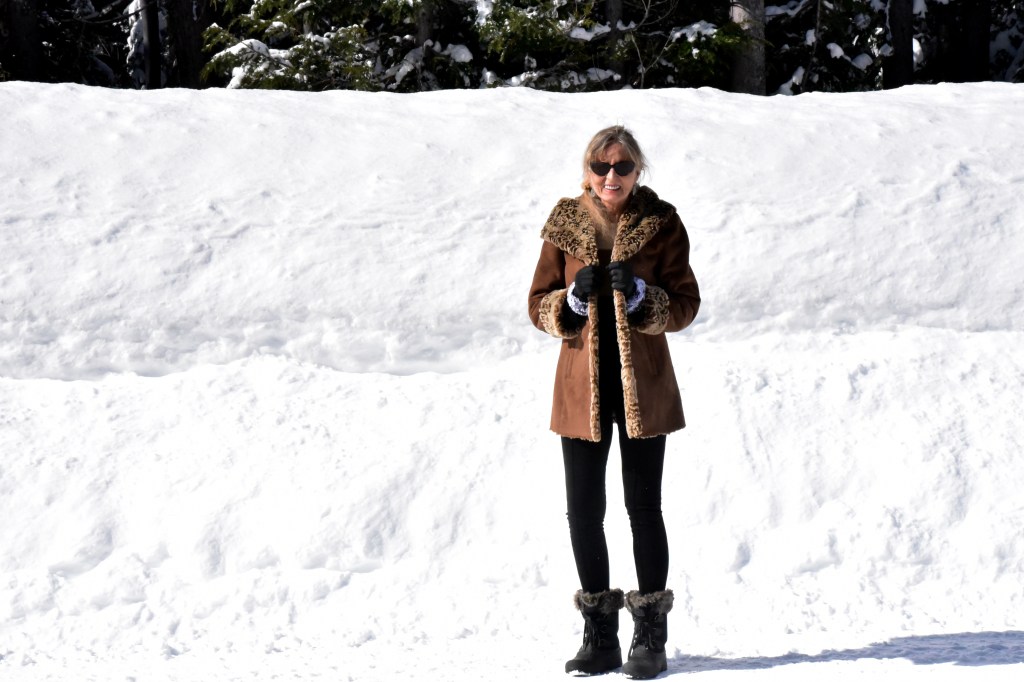
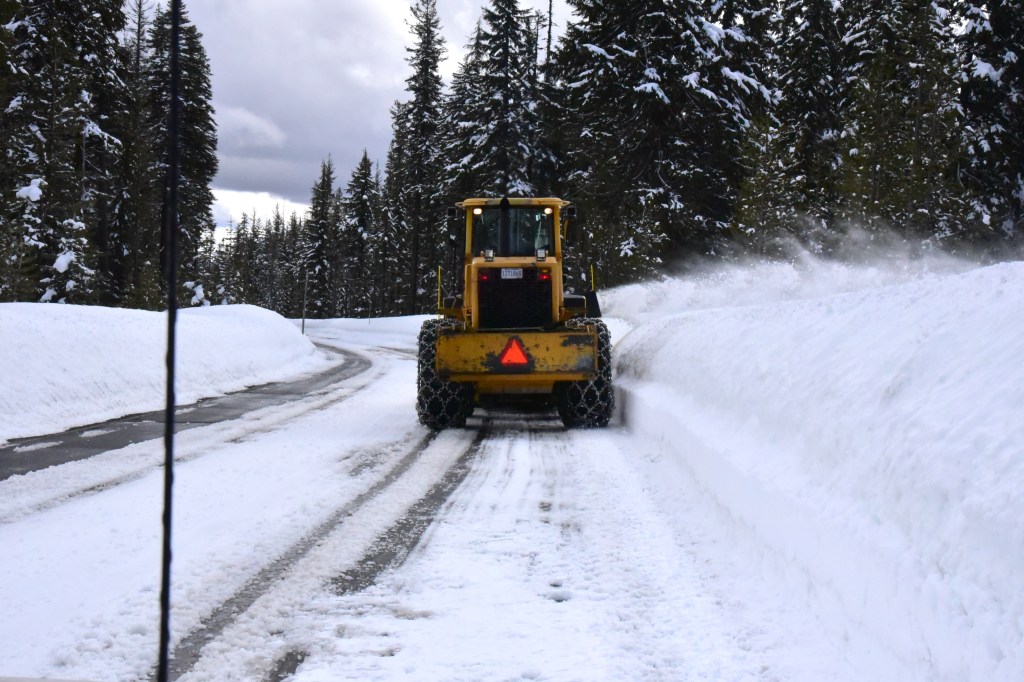
Certainly much snow. In fairness, much of this was from the snow blowers! But still ….

oooo

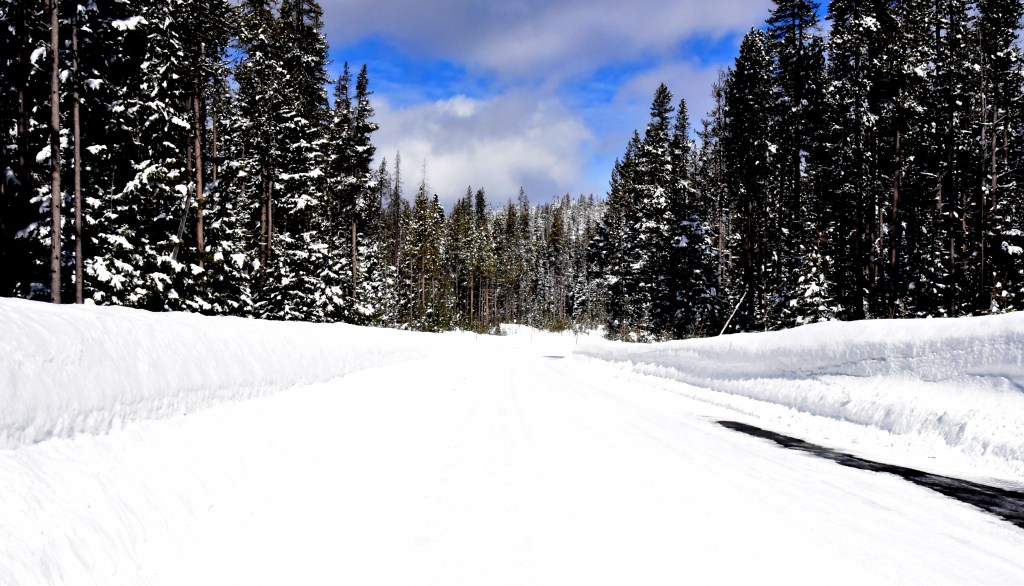
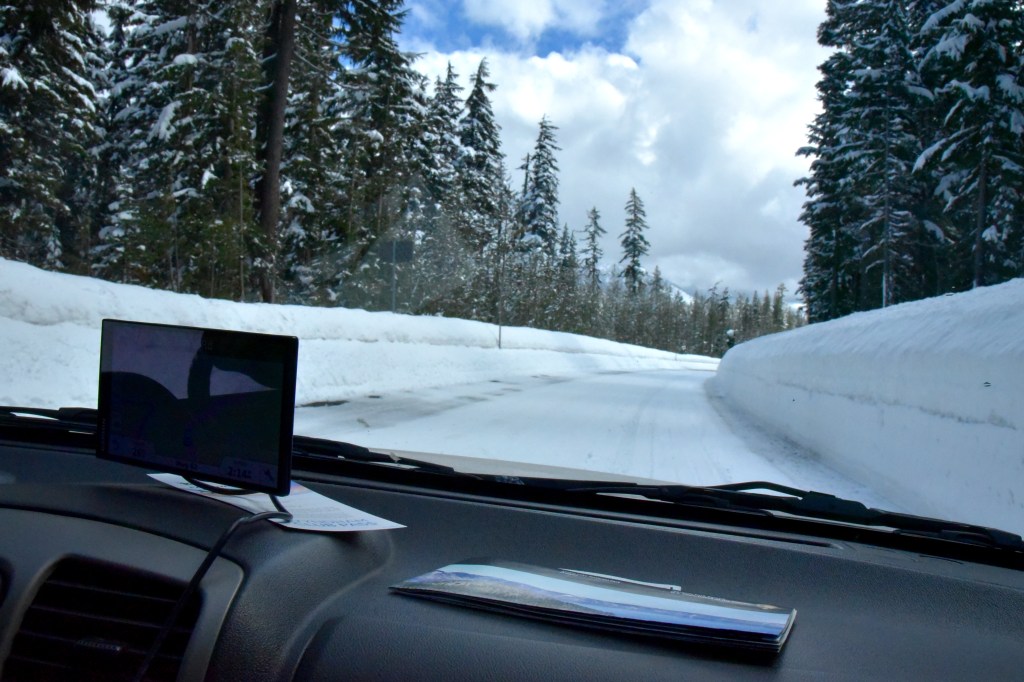
Roads on the approaches to Crater Lake were ‘interesting’!

oooo

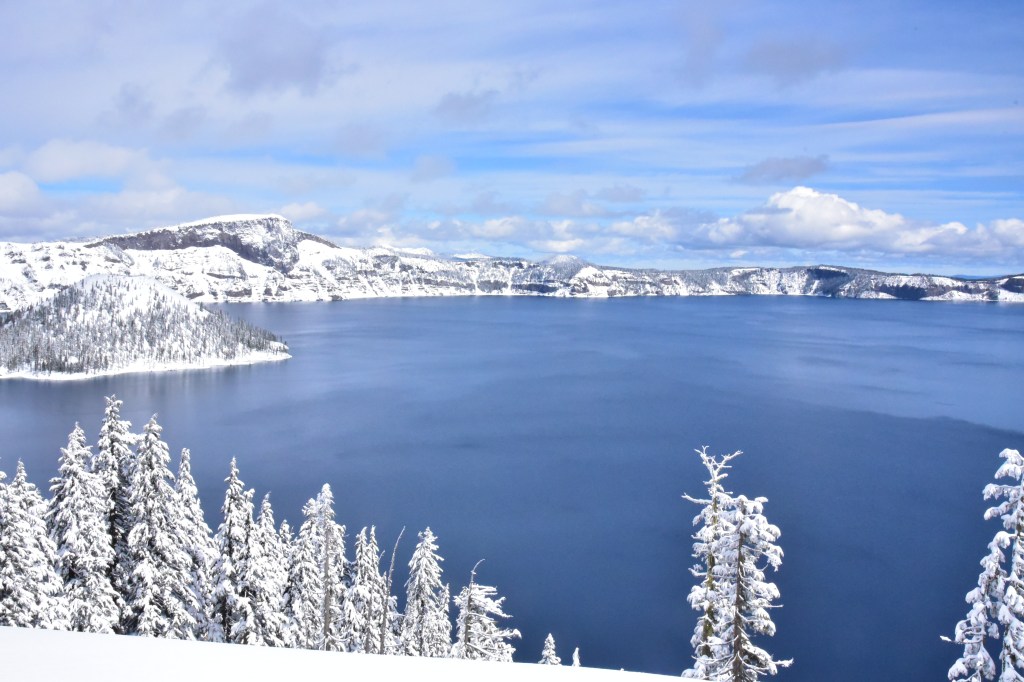
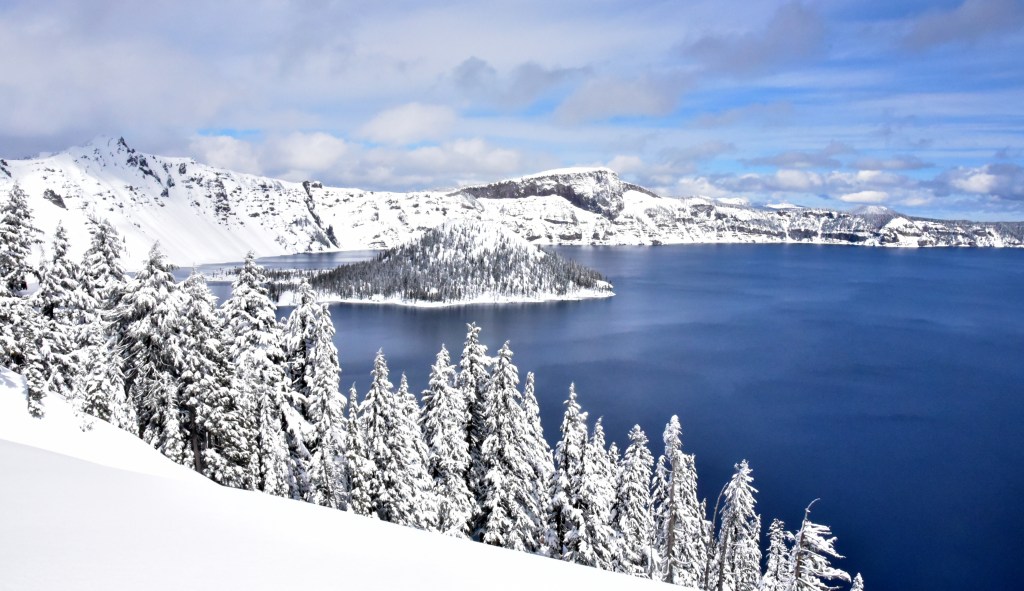
And there is was! Crater Lake in all it’s glory!

oooo

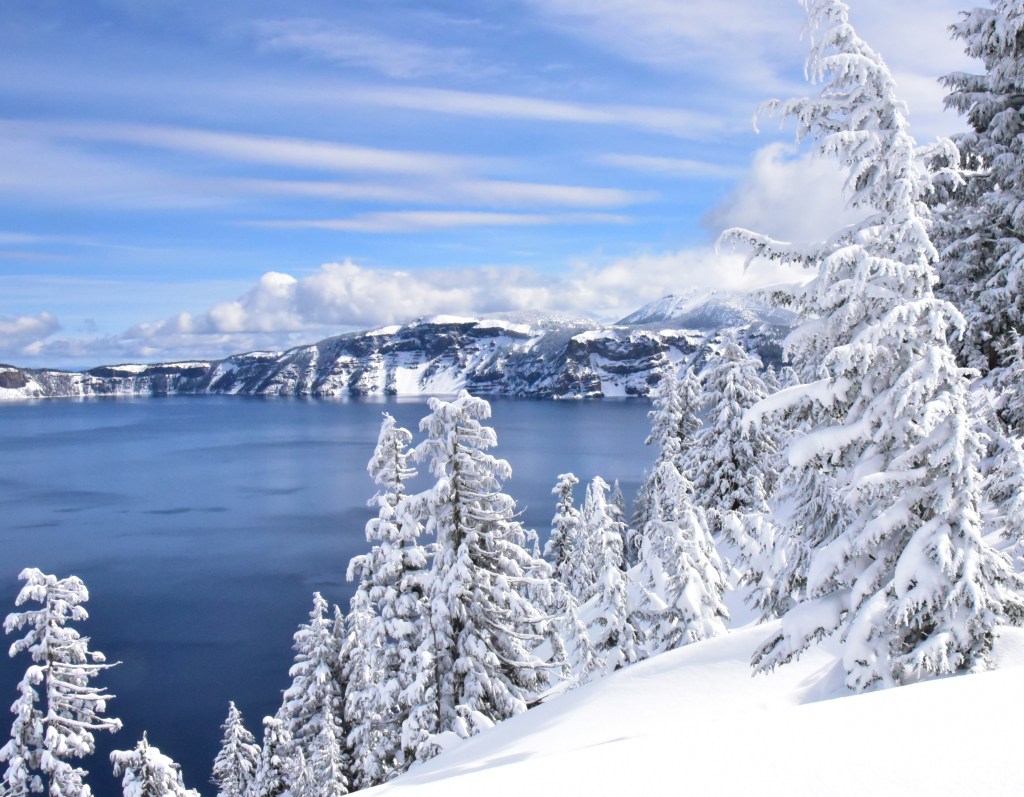
Anyone for a White Christmas – in March!!

oooo

Probably best not to go too close to the edge!

oooo

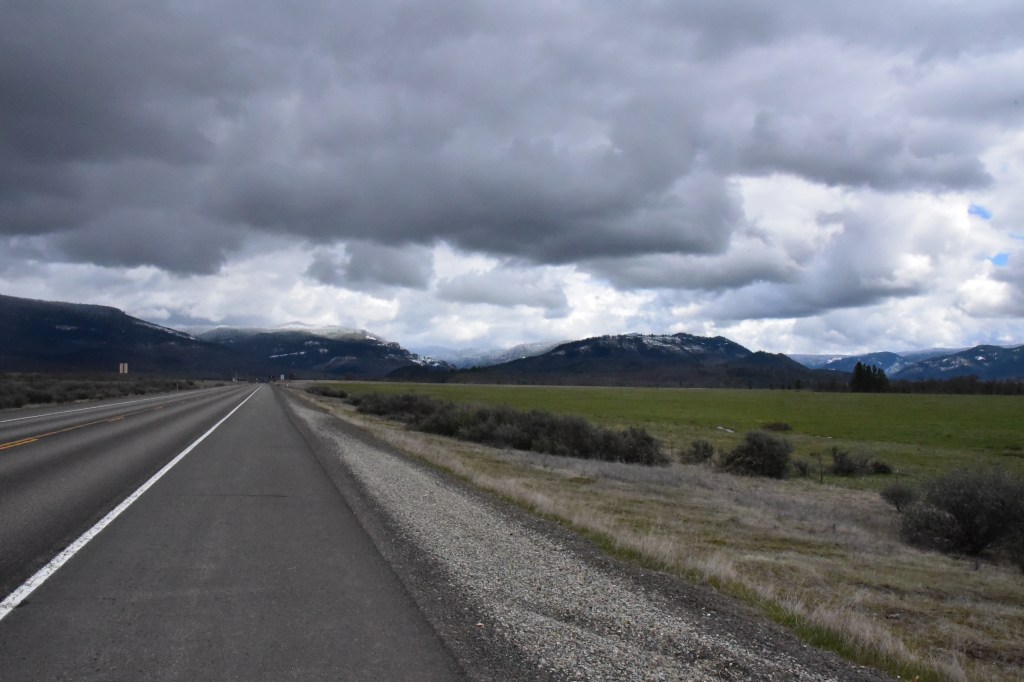
Then in the blink of an eye it was Monday and the day when we returned home!

Time to go home. Goodbye High Country!

oooo

Who was it that mentioned snow blowers!!

oooo

Back to the familiar and very beautiful sights of home!

oooo

Back to rural tranquility!

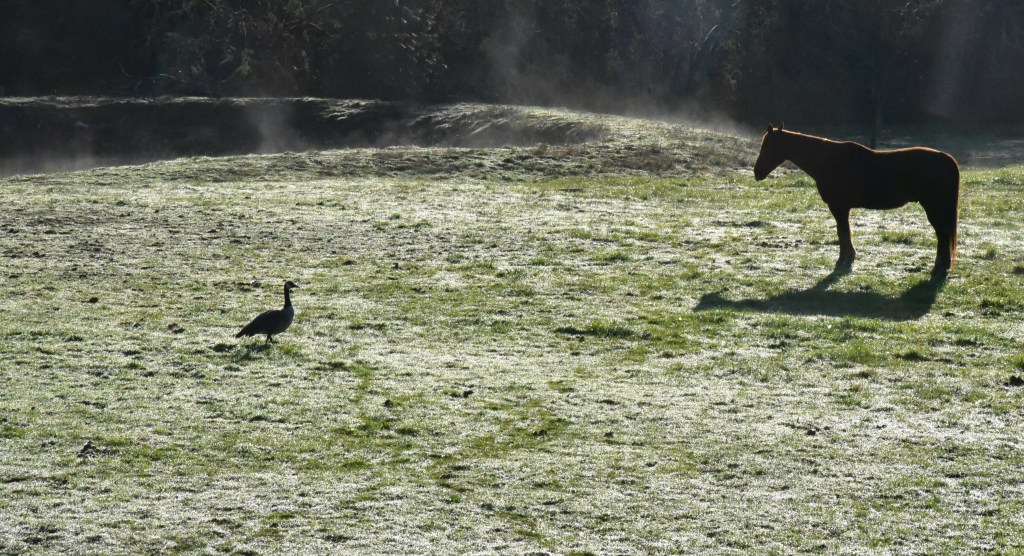
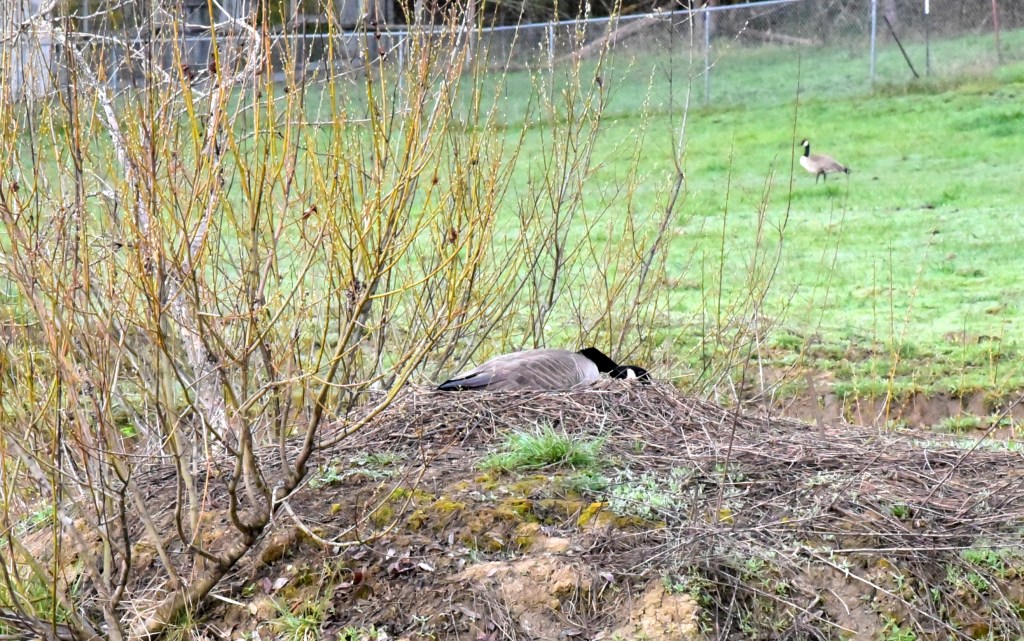
The photograph above shows a returning Canadian goose nursing her unborn chicks in their eggs with ‘Dad’ keeping an eye on things close by.

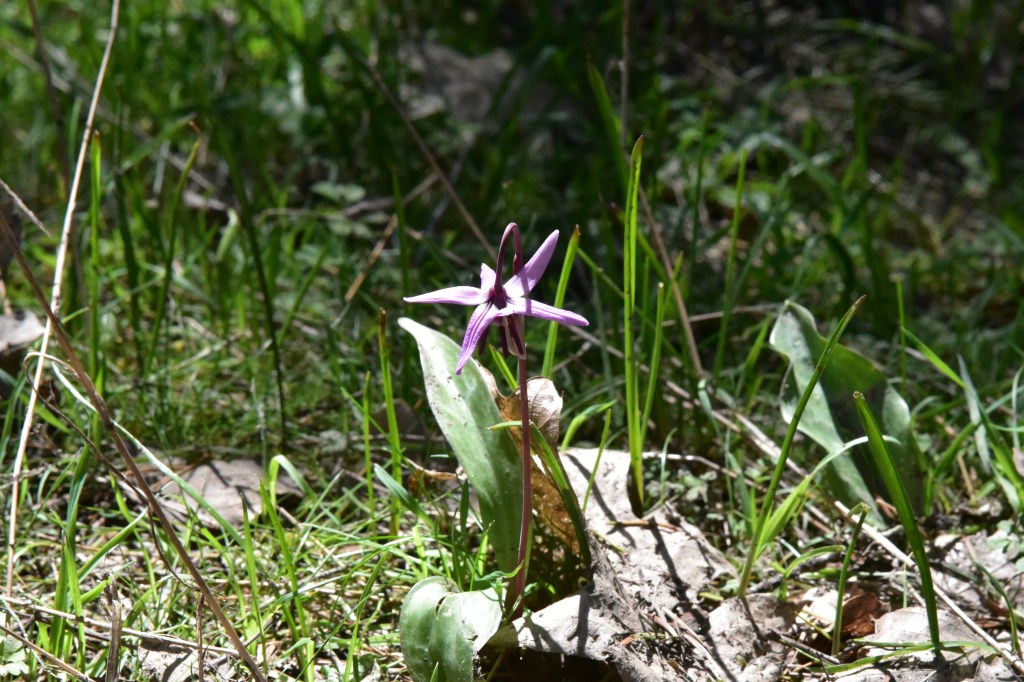
Our beautiful home. A wild flower close to our stable block.

oooo

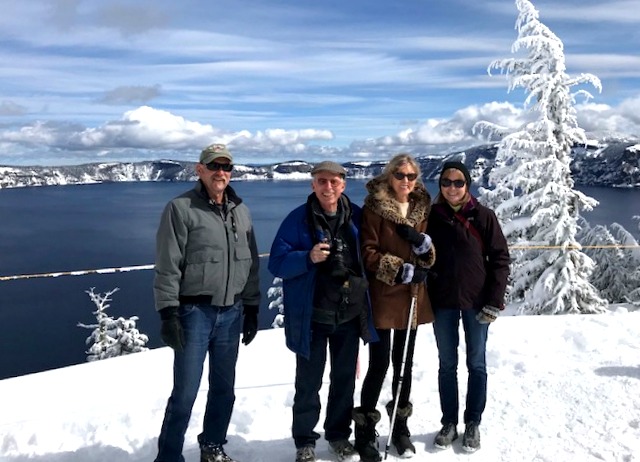
Andy, me, Jeannie and Trish.

Thanks Trish and Andy for inviting us! Big hugs from Jeannie and me!

Picture Parade Two Hundred and Thirty-Six

A pictorial account of our recent trip to Klamath Falls and Crater Lake.

Last Satuday, the day we drove from home up to Klamath Falls to meet up with Andy and Trish.

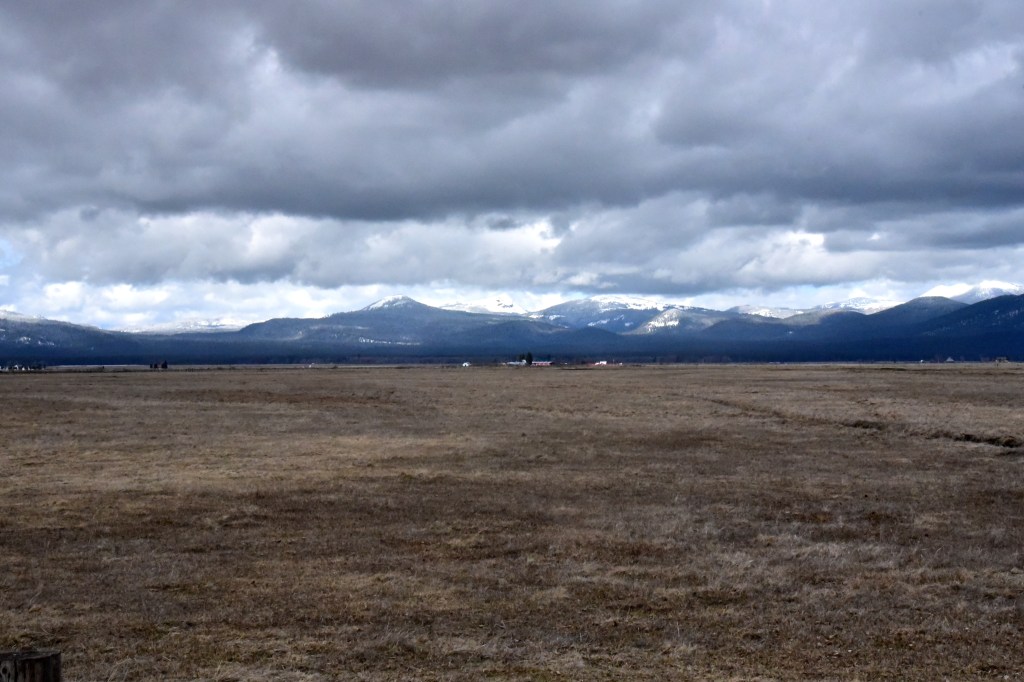
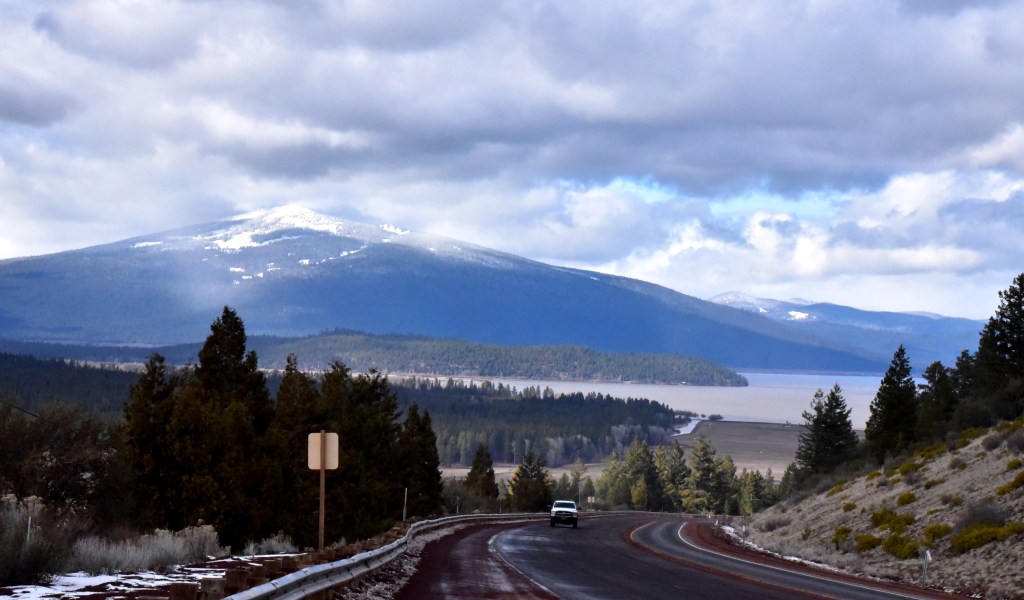
On the road to the high country.

oooo

Reading a little about the geology of the area.

oooo

Looking dowm on Upper Klamath Lake

oooo

Then ten minutes later alongside Upper Klamath Lake itself.

oooo

To the South-East of the lake lay the city of Klamath Falls.

oooo

Blast! Didn’t bring any food for the wild deer!

oooo

We decided to eat in the first night. Jeannie and Trish doing the honours!

oooo

Andy looking on while Jean and Trish chit-chat.

oooo

Outside the trees spoke about the weather we would be experiencing tomorrow.

Our trip to Crater Lake would be tomorrow’s event; as in last Sunday. More photographs for you in a week’s time!

What glorious country!

Revelling in the beauty of Crater Lake!

Over the weekend Jean and I went up to Klamath Falls to spend two nights in the company of good friends, Trish and Andy, who live in Tucson, Az.

Last Sunday we all jumped into our car, a GMC Canyon with 4WD, and drove the 60-odd miles from Klamath Falls to the Rim Village Visitor Center.

Talk about impressive!

Here are three photographs that I took that are presented untouched, as in no post processing, that I wanted to share with you.

More details coming along, plus more photos for the next Picture Parade.

The first was taken during Saturday afternoon when Jean and I were on our way to Klamath Falls.

On the road to the high country!

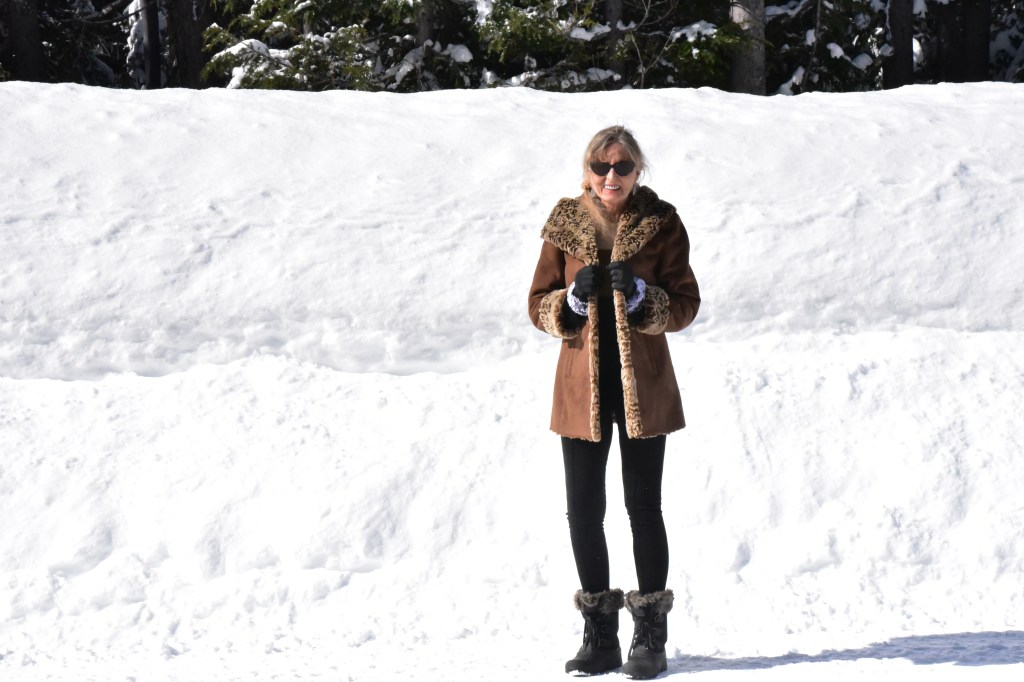
The next photograph was taken when we stopped in one of the many ‘turnouts’ along the highway going up to Crater Lake. In fairness, the high snow bank was more a result of the snow blowers than falling snow … but still!

Rumour has it that it had snowed in these parts!

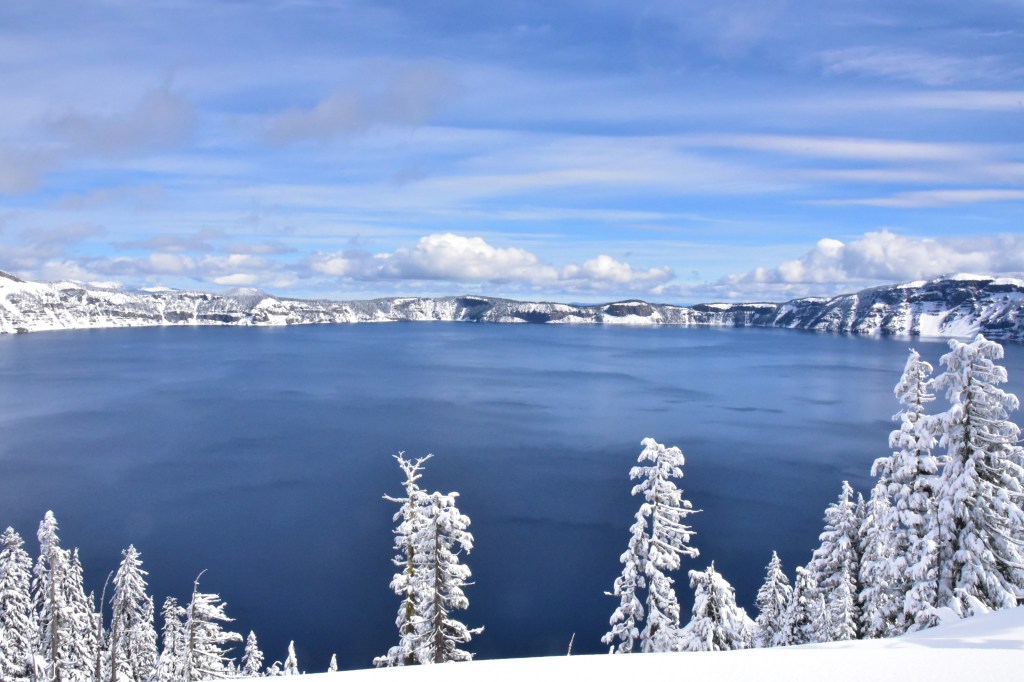
This last photograph, for today anyway, is the sight of Crater Lake!

What an incredible landscape!

P.S. Happy Birthday, dear Morten!

Picture Parade Two Hundred and Thirty-Three

Closer to home!

In a reply to a post response left by fellow blogger Tails Around the Ranch I wrote:

Came up to Oregon for the rain, found a property that had been empty for years, Bank owned, put in a silly offer that was accepted, sold our Payson home and moved here, with 12 dogs and 6 cats, in October, 2012! Love the place. Will share some pictures of here next Sunday!

So today I am sharing a few pictures with you all. (All of them taken very recently.)

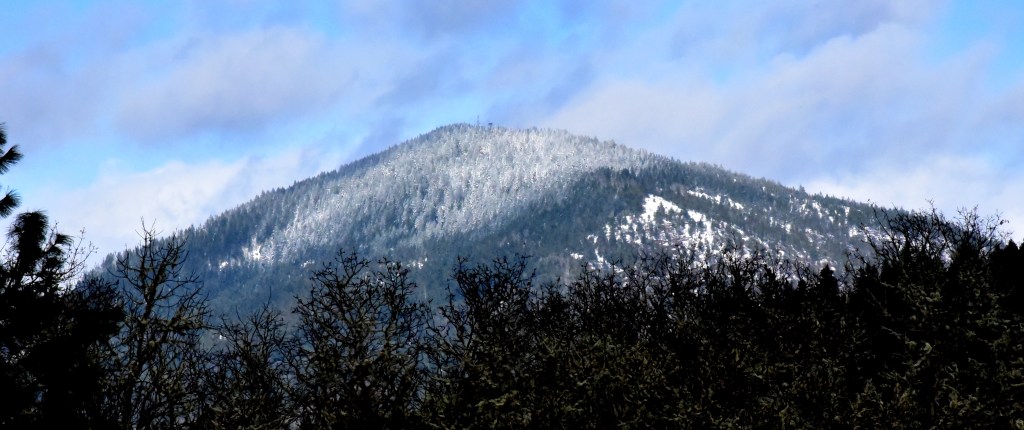
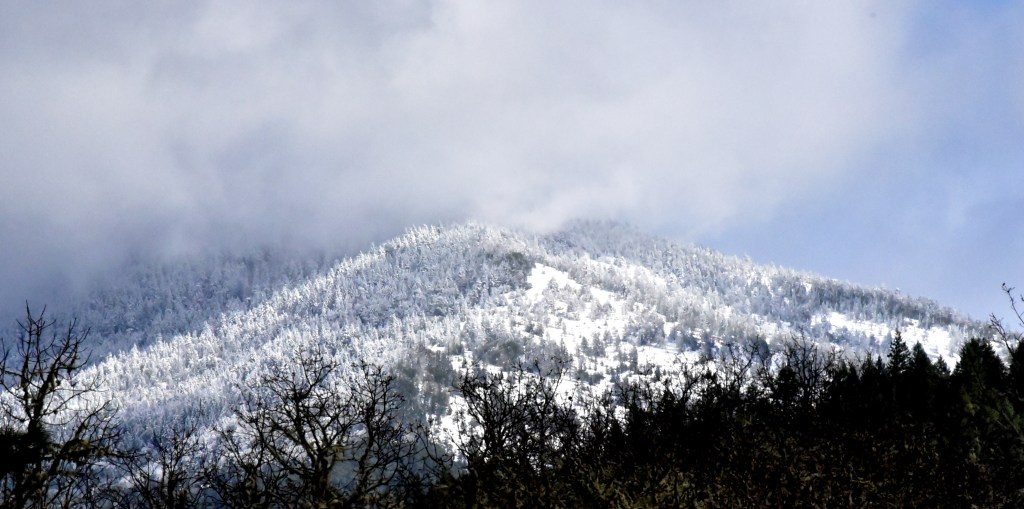
Mount Sexton just to the North-East of us. Take Feb. 24th.

oooo

Another, more starker, Mt. Sexton taken two days later.

oooo

Smoke from our neighbour’s wood fire mingles in the damp air of the trees in the corner of our property. Taken March 1st.

oooo

Rain-laden clouds almost mask Mt. Sexton. Taken March 1st.

oooo

The deer that we feed each morning have made their own trail. March 1st.

oooo

The deer trail to the area by the stables where the food is put out each morning. March 1st.

oooo

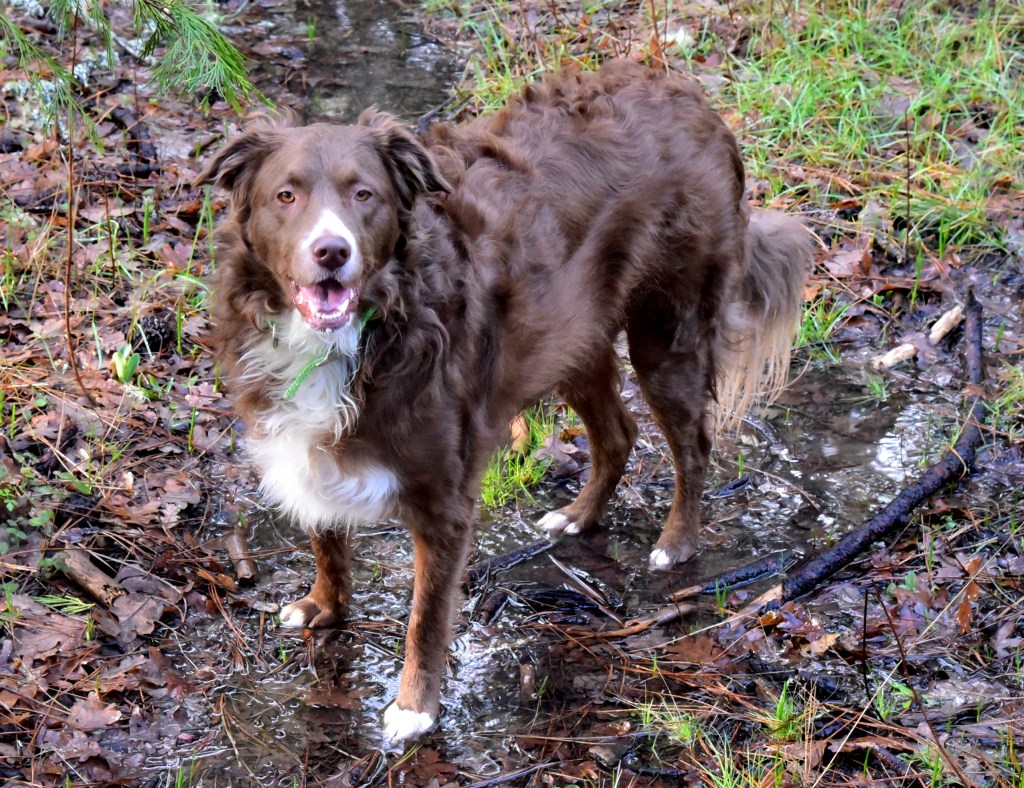
Young, dear Oliver playing in that deer trail. March 1st.

oooo

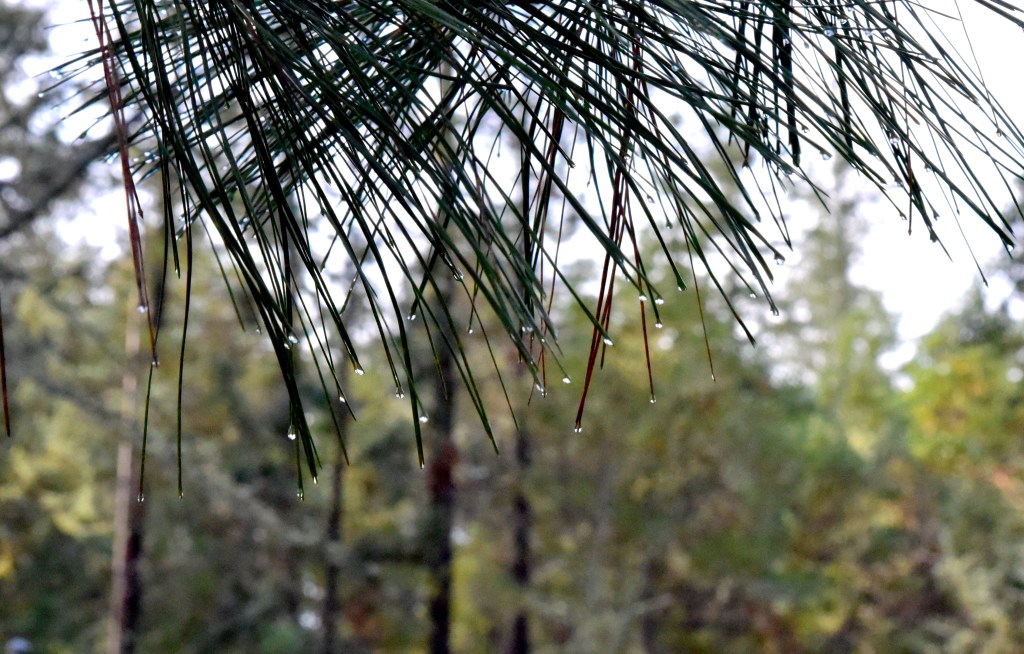
The rain drops on these pine needles caught my eye. March 1st.

oooo

Not just deer that coming feeding on our property. March 1st.

oooo

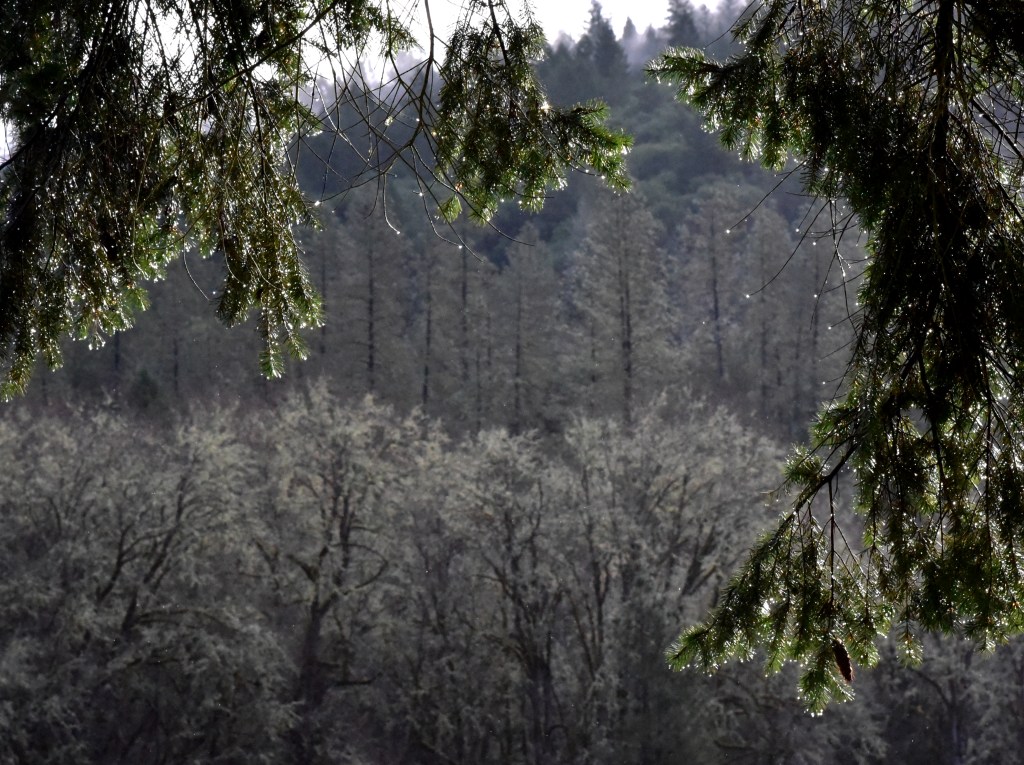
Another scene that caught my eye. March 1st.

oooo

Final picture showed how the storm deteriorated during that first day of March. Taken at 2pm.

So this is why Jeannie and me and all our dogs, not to mention the horses, love living here.

Ghosts

Here’s that article I wanted to share with you.

But then I got sucked back to memories of sailing!!

Oregon’s lighthouses as recently published over on Mother Nature Network!

ooOOoo

The tallest lighthouse in Oregon has a haunted history

Yet there is more to Yaquina Head Lighthouse in Newport than these ghostly stories.


JAYMI HEIMBUCH   February 16, 2018

The Yaquina Head Lighthouse in Newport, Oregon has a long history, which of course means rumors of ghosts and hauntings. (Photo: P Meybruck/Shutterstock)

On a scenic basalt rock headland that juts almost a mile into the Pacific Ocean stands a beautiful white lighthouse. At 93 feet tall, the Yaquina Head Lighthouse, located in Newport, Oregon, is the state’s tallest lighthouse. It’s been guiding ships for 145 years.

First lit on August 20, 1873, the lighthouse has gained quite the storied history. And that includes two ghost stories.

The Yaquina Head Lighthouse is one of two in Newport, Oregon. (Photo: Dee Browning/Shutterstock)

One tale tells of a construction worker helping to build the tower who fell to his death. His body lodged between the double walls, never to be retrieved. He — and his ghost — have been sealed in ever since.

The second story is that in the 1920s, Keeper Smith went into town and left Keeper Higgins in charge. But Higgins fell sick and asked Keeper Story to take over. When Smith saw from Newport that the lighthouse beacon wasn’t lit, he rushed back to find Higgins dead and Story drunk. Story, overtaken with guilt, feared the ghost of Higgins and from then on would take his bulldog up the tower with him.

A view from the northern side of the Yaquina Head Lighthouse. (Photo: Jeremy Klager/Shutterstock)

As with most ghost stories, the authenticity of these is highly doubted. The first story is unauthenticated, and the second story is impossible. As Lighthouse Friends clarifies:

A great tale, but unfortunately not supported by the facts that Story and Higgins didn’t serve at the same time at Yaquina Head and Higgins didn’t meet his demise in the tower. Rather, Higgins left the Lighthouse Service before 1920 and returned to live with his mother in Portland. Second Assistant Keeper did die of a heart attack in the watchroom atop the tower in March 1921, but he too served before the arrival of Frank Story.

aquina Head Lighthouse stands tall under big cloudy skies. (Photo: haveseen/Shutterstock)

Fortunately, much more than ghosts can be seen at Yaquina Head Lighthouse. The lighthouse stands on what is now the Yaquina Head Outstanding Natural Area, one of the most spectacular

spots on the coast for viewing ocean wildlife such as sea birds and harbor seals at close range, as well as traipsing through tide pools at low tide. An interpretive center highlights information about these wild inhabitants and features exhibits on the historical details of the lighthouse.

Yaquina Head lighthouse by the Oregon Coast during a beautiful sunset. (Photo: RuthChoi/Shutterstock)

The original oil-powered light has given way to an automated first-order Fresnel lens and a 1,000-watt globe. It flashes with its own specific pattern: two seconds on, two off, two on, and 14 off. The pattern is repeated around the clock.

May the lighthouse stand tall for generations to come. (Photo: Tomas Nevesely/Shutterstock)

While a little illumination causes the ghost stories to fade, visitors can still see a lot with a visit to Yaquina Head. Whether it’s grey whales at close range during their migration, or the sun setting over the ocean and silhouetting the tall structure, visitors are always happy they stopped to take in both the scene and the history of this special place.

ooOOoo

I really hope that despite the advance of digital GPS navigation systems it will still be a very long time before these magnificent lighthouses are turned off!

The mists of the mind

Those inner voices inside our heads!

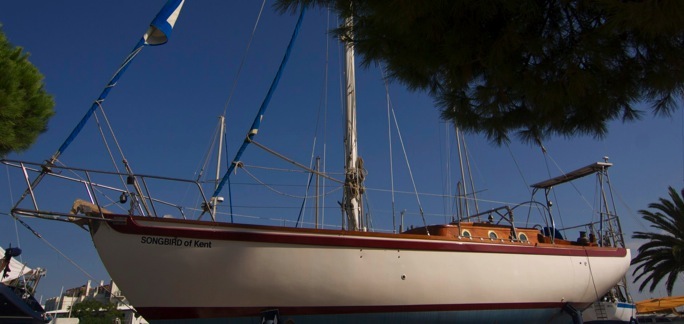
The photograph below is the yacht that I lived on for 5 years, from 1987 though to 1992. My base was Larnaca Marina in the Greek ‘sector’ of the Island of Cyprus although I cruised over much of the Mediterranean during the warm summer months. (Long-term readers, you poor souls, will realise that this isn’t the first time I have spoken of sailing and Tradewinds…)

Songbird of Kent
Tradewind 33 – Songbird of Kent

As I explain over on my ‘author’s’ blog:

During this period Paul became much more aware of the importance of marketing strategy, becoming a Chartered Member of the British Institute of Marketing, and the raft of competencies that deliver entrepreneurial success. In 1986, Paul accepted an offer to sell the Dataview group of companies. (Regrettably, this period also saw the failure of Paul’s marriage to Britta and their subsequent divorce.)

Again, chance intervened in that an Autumn vacation in 1986 to Larnaca in Cyprus resulted in Paul meeting a couple who wanted to sell their yacht, a Tradewind 33, and return to England. Thus very early in 1987, Paul left Essex and became a full-time ‘yachtie’ living on that Tradewind Songbird of Kent in Larnaca marina. Paul was then exposed to the life of an ocean-going sailor returning to Plymouth, Devon via The Azores onboard Songbird of Kent in 1992.

I purchased this Tradewind 33, designed by Englishman John Rock by the way, because somewhere in my soul was a dream to do some solo ocean sailing. Probably inspired by reading too many books written by famous British solo yacht-persons. Such as Robin Knox-Johnston, Chay Blyth, Naomi James, Ellen MacArthur, Pete Goss and the king of them all: Sir Francis Chichester who was the first person ever to sail around the world single-handed.

But it remained a dream for almost all those 5 years. Reason? Because at the start of the summer cruising period each year I slipped out of Larnaca and sailed along the southern coast of Cyprus, up the Western coast and then the open sea crossing to a nearby Turkish harbour, such as Anamur or Alanya. At the end of the summer I would repeat the solo trip in reverse. But I still haven’t said what the core reason was for not being braver and planning a solo ocean voyage.

Because that sailing voyage twice a year, that took me about four days to accomplish, and was undertaken alone, really scared me. I mean scared with a capital ‘S’! For it was impossible to accomplish without many hours of solo sailing at night!

Fast forward a number of years and one day, when I was living on Songbird at Larnaca Marina into the vacant berth next to me came a new visitor to Cyprus. His name was Les Powells and he very quickly explained that he was on his way back to England on his third solo circumnavigation of the world!

imagesInevitably Les and I got chatting over a couple of beers during our evenings together and Les asked me about my sailing ambitions noting that I lived on a yacht that most people purchased for ocean sailing purposes.

I explained my miserable experiences each year going to and fro between Cyprus and Turkey.

Les heard me out and then threw his head back and roared with laughter.

“Paul, what you are experiencing is the adjustment from a land-based life, as in living here in Larnaca, to a water-based life.

I suffer just the same adjustment stress as you have detailed.”

My face conveyed both my amazement and my yearning to learn more.

“Yes, Paul, every time I go to sea solo the first three or four days are hell! I hate them! I only stick with it because there is always a point, (Les really emphasised the word always) usually under a glorious night sky, when I truly become attuned to the life of a solo yachtsman far out from the nearest land and wouldn’t swap it for anything”

“You have to trust this and set out on a solo voyage of more than, preferably much more than, four days sailing.”

Thus in time that’s what happened.

In the Autumn of 1972 I returned to Plymouth in England, via the Azores, sailing solo on Songbird of Kent. Indeed, I was going to republish an article about lighthouses in Oregon but I’m changing tack in mid-stream; so to speak!

I am going to close today’s post by republishing an experience of being alone on the Atlantic Ocean that first graced these blog pages in October 2015. Lighthouses will have to wait.

ooOOoo

There is a place in my mind to which I can so easily travel; a memory of a dark night out in the Atlantic. But first let me set the scene from almost fifty years ago.

The call of the open ocean

Those first few hours were utterly absorbing as I went through the whole business of clearing the yacht harbour at Gibraltar and heading out to the South-West hugging this unfamiliar coastline of Southern Spain. It was tempting to move out to deeper waters but the almost constant flow of large ships through the Straights of Gibraltar soon quashed that idea. Thankfully, the coastal winds were favourable for me and my single-masted sailing yacht.

After such a long time sailing in the relatively confined waters of the Mediterranean, it was difficult for me to imagine that in a few hours time the southern-most point of Spain would pass me by and the vastness of the Atlantic ocean would be my home for the next few weeks.

Soon the city of Tarifa was past my starboard beam and the Spanish coastline was rapidly disappearing away to the North-West. The horizon ahead of me was already approaching 180 degrees of raw, open ocean.  There was just a flicker of a thought that whispered across my mind: “Oh Paul, what have you gone and done” as slowly but persistently the coastlines of Spain to the North and of Africa to the South became more and more distant and fuzzy.  It was at 15:30 that I made an entry in my yacht’s log: “No land in sight in any direction!

Now was the time to make sure that my bunk was made up, flashlights to hand, and my alarm clock ready and set. Alarm clock? Set to go off every twenty minutes during the night! For this was the only way to protect me and my yacht from being hit by one of those gigantic container ships that seemed to be everywhere. It took at least twenty minutes from the moment a ship’s steaming lights appeared above the horizon to crossing one’s path!

It was in the early hours of my first morning alone at sea, when once again the alarm clock had woken me and I was looking around an ocean without a single ship’s light to be seen that more of Les’ words came to me. I remembered asking Les: “What’s the ­appeal of sailing?” Les replied without a moment’s hesitation: “It’s the solitude. When you’re out at sea on your own, there’s no government or bankers to worry about. You’re not ­responsible to anyone but yourself.

Yes, I could sense the solitude that was all around me but it was an intellectual sense not an emotional one. That would come later. Inside, I was still afraid of what I had let myself in for.

Remarkably quickly however, the pattern of solo life aboard a thirty-three-foot yacht became my world. Frankly, it staggered me as to how busy were my days. Feeding myself, navigating, trying to forecast the winds, staying in touch with other yachties via the short-wave radio, keeping the boat tidy and a zillion other tasks meant the first few days and nights just slipped by.

But it was a sight on my fourth night at sea that created the memory that would turn out to remain with me for all my life. The memory that I can go to anytime in my mind.

That fourth night I was already well into the routine of waking to the alarm clock, clipping on my harness as I climbed up the three steps that took me from my cabin into the cockpit, scanning the horizon with my eyes, checking that the self-steering had the boat at the correct angle to the wind and then, if no ships’ lights had been seen, slipping back down into my bunk and sleeping for another twenty minutes. Remarkably, I was not suffering from any long-term tiredness during the day.

It was a little after 3am that fourth night when the alarm clock had me back up in the cockpit once again. Then it struck me.

Songbird was sailing beautifully. There was a steady wind of around ten knots from the south-east, almost a swell-free ocean, and everything set perfectly.  Not a sign of any ship in any direction.

Then I lifted my eyes upwards. There was not a cloud in the night sky, not a single wisp of mist to dim a single one of the million or more stars that were above my head. For on this dark, moonless night, so far removed from any shore-based light pollution, the vastness, yet closeness of the heavens above was simply breath-taking. I was transfixed. Utterly unable to make any rational sense of this night splendour that glittered in every direction in which I gazed. This dome that represented a vastness beyond any meaning other than a reminder of the magic of the universe.

This magic of the heavens above me that came down to touch the horizon in all directions. Such a rare sight to see the twinkling of stars almost touching the starkness of the ocean’s horizon at night. A total marriage of this one planet with the vastness of outer space.

I heard the alarm clock go off again and again next to my bunk down below. But I remained transfixed until there was a very soft lightening of the skyline to the east that announced that another dawn was on its way.

I would never again look up at the stars in a night sky without being transported back to that wonderful night and the memory of a lonely sea and sky.

ooOOoo

Dear, dear Les is still alive and still living on his yacht Solitaire in an English marina. A very close mutual friend, Bob Derham, arranges to visit Les on a very regular basis and take him out for shopping trips and a leisurely pub lunch.

Bob follows this blog and I hope will have the chance to read out today’s post to Les. For my closing sentence is directed to Les, and Les alone: “Dear Les, thank you from the bottom of my heart for the gift you gave me. For it is a rare night when here in rural Oregon when I go outside at the end of the evening and above my head is a clear, black night sky, full of stars, that I am not transported back to that night alone in the Atlantic ocean. I am still rendered speechless in awe of such night skies.”

The deep, dark, wonderful mists of the mind!

Our life-savers – literally

I am speaking of the dogs that saved a Canadian woman from certain death.

This story has been widely reported.

I first saw it as a prominent news item on the BBC News website:

ooOOoo

Three dogs help injured woman survive Canadian wilderness

24 November 2017

The search for Annette Poitras and her dogs lasted three days. COURTESY COQUITLAM RCMP

A Canadian dog walker could not have survived over two days in the wilderness without the help of her border collie, a boxer and a puggle.

Annette Poitras, 56, was walking the three dogs on Monday in the British Columbia backcountry when she fell, injured herself and lost her phone.

She was rescued on Wednesday afternoon after a long hunt by Coquitlam search and rescue.

Her husband says the three dogs helped Poitras stay alive during the ordeal.

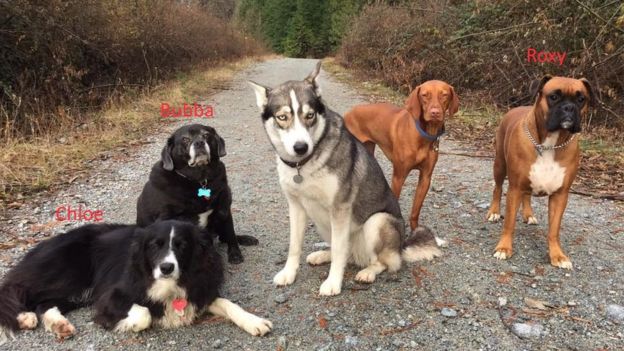
Marcel Poitras told Global News that his wife and the dogs – a collie called Chloe, a boxer named Roxy, and Bubba, a pug-beagle mix – took care of each other over two days and two nights, with no supplies and periods of “torrential” rain.

ooOOoo

Newsweek also carried the story on November 25th.

(Continuing on from where I left the BBC report.)

ooOOoo

Her husband, Marcel Poitras told Global News that her three dogs—a collie called Chloe, a boxer named Roxy, and Bubba, a pug-beagle mix—helped her stay alive during the ordeal, during which Poitras had no supplies and endured torrential rain.

He said that she saw one of the dogs dig a hole underground to stay warm, and did the same.

“One of them was cuddling [her] and one of them was on guard and the other one was looking for food,” he said.

She also helped the dogs, covering the short haired boxer with her coat after she noticed it shivering during heavy rainfall on their second night.

He said the dogs did not leave her side.

Poitras was rescued after a two day search by the RCMP, which used helicopters and 100 volunteers to scour the countryside near Eagle Mountain for traces of her.

Some rescuers finally heard faint cries for help and loud barking and tracked down Poitras and the dogs to an area described by the Mounties as “well outside the normal trail system”, according to The Surrey Now Leader.

The rescue team said she was “alive and in good condition” in an area off trail, in dense bush and swamp.

CBC reported Friday that two of the dogs visited her hospital bedside Friday.

Poitras is expected to be released from hospital later in the week. Marcel said that after his wife is released from hospital they are hoping things will get back to normal.

ooOOoo

Back to the BBC item or more specifically two more photographs included by the BBC in their report of the incident.

Chloe, Bubba and Roxy stayed with Annette Poitras for the two days. Courtesy COQUITLAM SAR HANDOUT

oooo

Chloe, Roxy and Bubba being rescued from the bush. COURTESY NORTH SHORE RESCUE

In the words of Mr. Poitras, the husband of the rescued woman, “He says they are looking forward to “quiet, peace, walking dogs, visiting family” now the ordeal is over.”

Dear wonderful Chloe, Roxy and Bubba – life-savers all three of them!

Lucky Mr. & Mrs. Poitras.

What would we do without our dear dogs!

Don’t try this at home!

All it takes is a moment’s inattention.

The reason I am posting this is simply because it might help someone else out there.

I go bike riding three times a week; weather permitting. Usually with a group from close by: Jim; Richie; Pam; Dordie; Ken.

Two days ago there was a break in the wet weather and Jim rang round seeing who was up for a ride. It turned out that four of us could go riding: Jim, Richie, Dordie and myself.

We decided to ride down Hugo Road, turn left onto the Merlin-Galice Road, follow that right to the end of Galice Road, very close to Junction 61 on Highway I-5, then turn left along Monument Drive, left again down past Grants Pass airport then back on to the Galice Road this time heading west back through Merlin to meet up with the foot of Hugo Road and then home.

All had gone very well for all four of us and it was a great ride and already we had some 14 miles under our belts.

Coming back into Merlin there is a railway track that crosses Galice Road. It has quite a wide shoulder to stop us cyclists having to mix it with the road traffic. But the tracks across that shoulder are not the smoothest of rides for a cyclist.

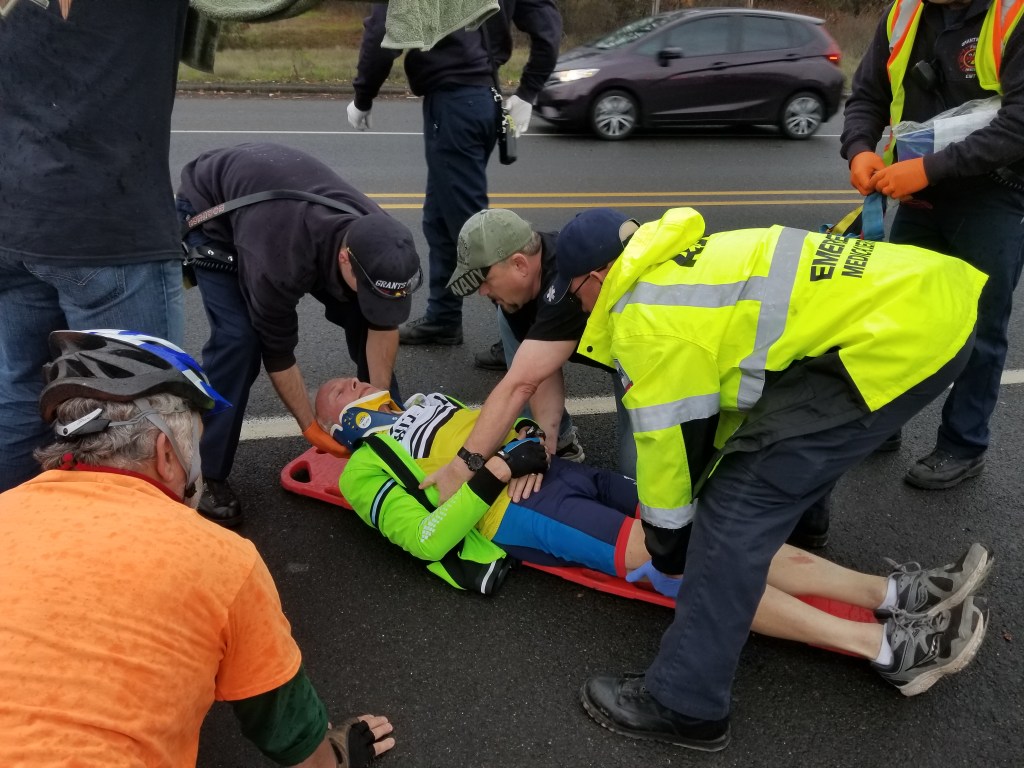
I did my best to cross the tracks square on but didn’t manage it. My front tyre slipped on the wet, metal rail and in that instant I lost my balance. Tried to recover but just a few yards later went down falling heavily on my left side and knocking myself out.

Luckily I was not riding on my own (Lesson Number One) and Jim and the others were quick to check me out. Jim said later that many drivers stopped including an off-duty medic who quickly summoned the ambulance.

But I was still out!

Dordie had the presence of mind to capture what was going on and it is her photographs that are in today’s post.

I continued being unconscious and later Jim said that I was out for eight minutes.

I was placed in a gurney with a neck brace because the medics were concerned that I might have damaged my neck.

Then carried across to the ambulance.

 I only properly regained consciousness when the ambulance was speeding its way to Three Rivers Hospital in nearby Grants Pass.

The attendant caring for me in the ambulance remarked how lucky I was to have been wearing a safety helmet, for had I not been: “We wouldn’t be taking you to the accident ward!”

Plus, I realised that the other stroke of fortune is that I was riding with a group of friends. Had I been riding alone, something I have been doing, I might not have been helped in such a prompt and timely way.

So that’s my lesson for today! If you ride a bicycle don’t go out alone and never, ever ride without a safety helmet!

Oh, nearly forgot! Lesson Number Two: Don’t ride across wet railway tracks – Get off and walk!

UPDATE 14:20 Friday, 24th

In view of the many helpful ideas and suggestions I thought it would be good to present the follow information.

When I was discharged from the Emergency Department at our local Three Rivers Medical Center, I was given 4 pages of guidance and information. Page 3 of those notes included:

WHEN SHOULD I SEEK IMMEDIATE MEDICAL CARE?

You should get help right away if:

  • You have confusion or drowsiness.
  • You feel sick to your stomach (nauseous) or have continued, forceful vomiting.
  • You have dizziness or unsteadiness that is getting worse.
  • You have severe, continued headaches not relieved by medicine. Only take over-the-counter or prescription medicines for pain, fever, or discomfort as directed by your health care provider.
  • You do not have normal function of the arms or legs or are unable to walk.
  • You notice changes in the black spots in the center of the colored part of your enemy (pupil).
  • You have a clear or bloody fluid coming from your nose or ears.
  • You have a loss of vision.

Thought it might be useful including those.

Plus when I saw the pharmacist at our local RiteAid, he took a look at the wounds on my left knee and recommended a transparent dressing; namely a product called Tegaderm. It is a product made by 3M and more details may be read about it here.

Thanks everyone for you caring responses!

Our beautiful planet.

It is the only lovely planet that we all have.

That ‘we’ being all the animals, plants, insects and humans there are.

I’m not saying anything new and not making this plea for the first time in this place.

But just take a few minutes out of your busy day to reflect that for you, for me, for everyone wherever they are in the world, physically and culturally, doing nothing is not an option.

More of that in a minute.

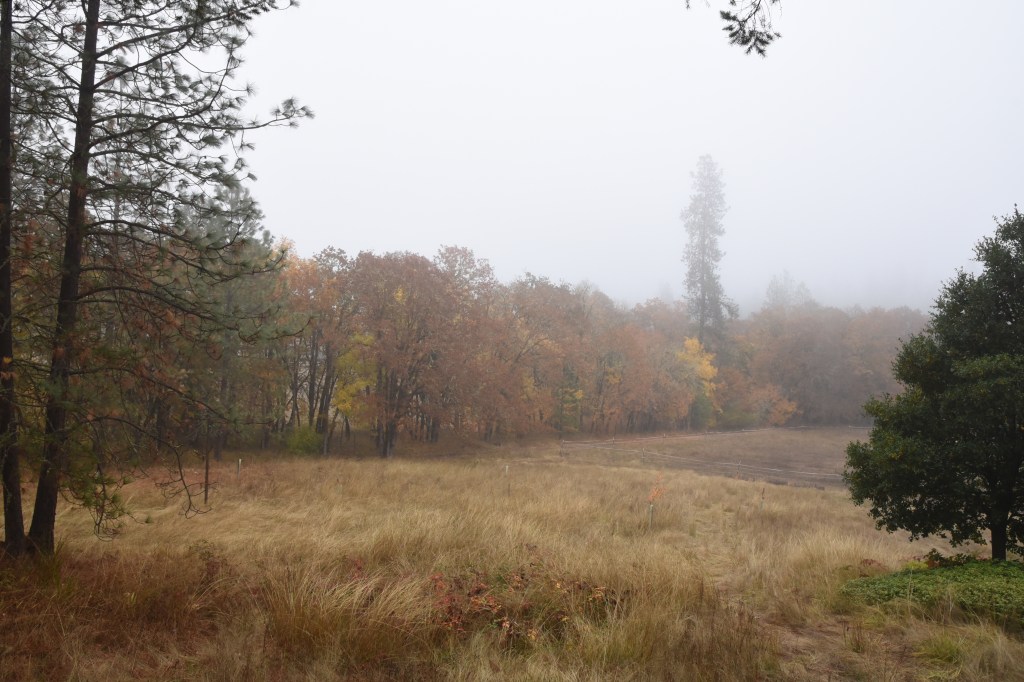
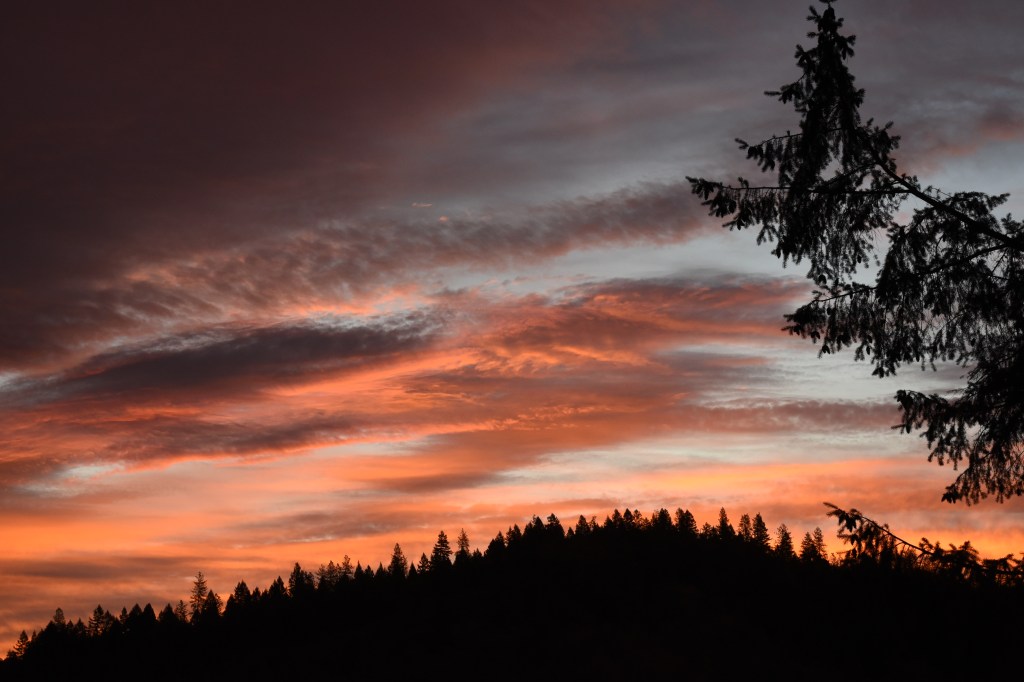
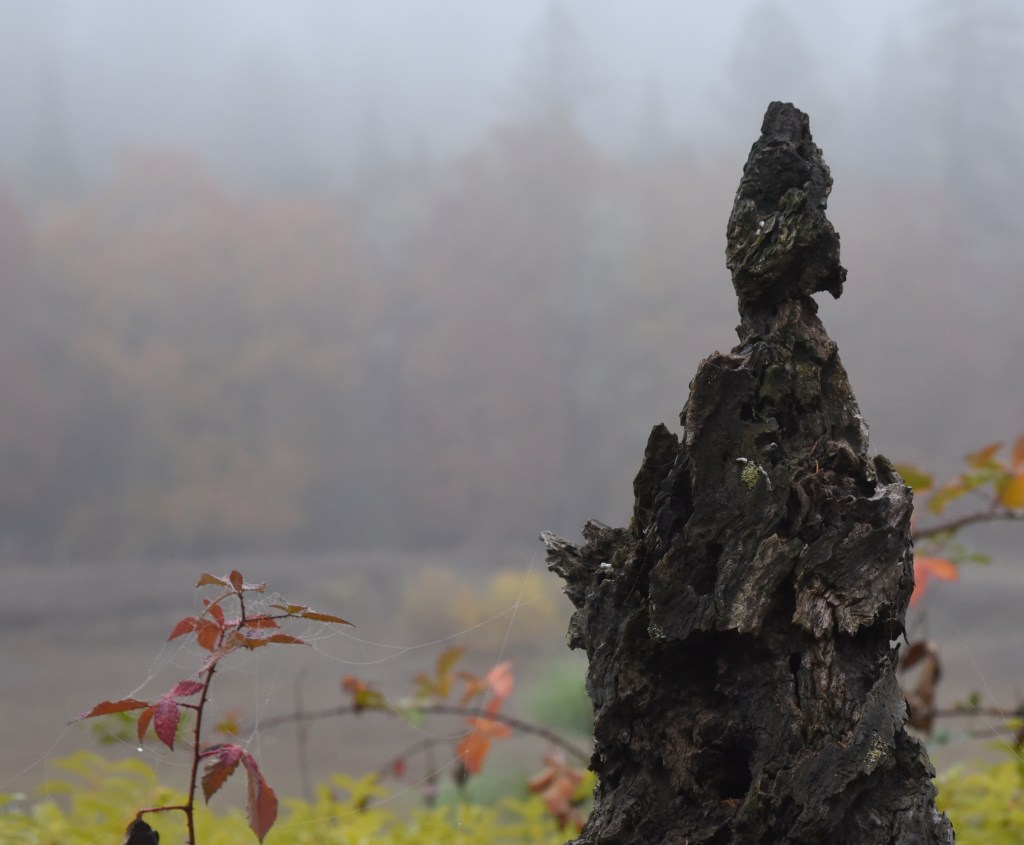
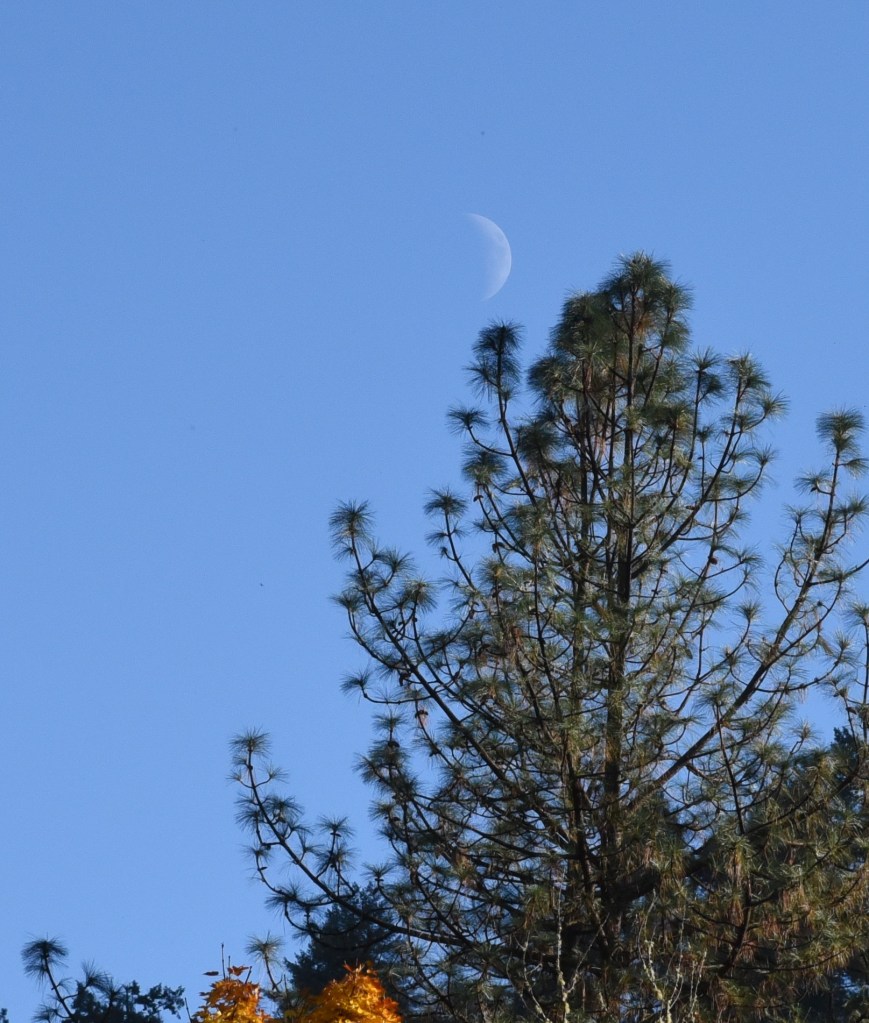
First I want to share with you a few autumnal photographs of our home here in Oregon.

Below was taken at 9am on October 24th showing the  mountain mist right down to the tops of our trees that mark the edge of our driveway from the house to our Hugo Road entrance.

Next, a sunrise photograph with the camera pointing to the East. The tree line follows the ridge of some hills the other side of Hugo Road. The picture taken on the 19th October at 07:20.
Now a close-up of the remains of a very old tree trunk with the trees that border Bummer Creek, that runs through our land, just showing through the morning mist. Taken on the 24th October at 09:05.

Final photograph I wanted to share with you is this beautiful sight of the moon taken from our property at 16:05 on the 25th. October.

Regular readers will know that Jean and I are not believers in any religion; we are atheists. But to my way of thinking that puts even more pressure on me and Jean to try to make a difference. We do all that we can but there’s no doubt that we can do more.

Yesterday, I referred to Bill Ripple, or to give him his full signature: William J. Ripple, Distinguished Professor of Ecology, Department of Forest Ecosystems and Society, Oregon State University, Corvallis, Oregon.

I sent Bill an email:

Dear Bill (and forgive the over familiarity if that offends),
I am a Brit, just turned 73, living with my beautiful wife, Jean, London-born as I was, down in Merlin, Oregon.

We live on 13 wonderful acres of rural property with 6 dogs (down from 12 when we moved here 5 years ago) and 4 horses, the majority of whom are ex-rescues.

I am the author of the blog Learning from Dogs and want to publish a post highlighting that viewpoint article. Because I believe with every neuron left in my ageing brain that the political changes that this world so urgently needs can only come when 99.9% of the public are screaming out “enough is enough”!

But there’s another saying that comes to mind, the one about being the change you want to see or something like that.

Is there information anywhere online that spells out, almost in words of one syllable, what lifestyle changes each of us can and need to commit to today? Changes that are as appropriate for elderly authors living in the country as young people seeking their first job or those up to their necks in working and raising families?

For that is what I want to publish on my blog!

If it would be easier for me to make an appointment to call you and take notes over the phone then I am just as happy to do that.

Sincerely,

Paul Handover
Hugo Road, Merlin,

Bill promptly replied:

Hi Paul, how long of a list of lifestyle changes do you want to make? Would three or four be enough? Bill

then followed that up with another email:

Paul, Consider suggesting that if people want to help, they could have fewer children, reduce energy consumption such as driving autos and flying, avoid meat and eat mostly plant-based foods and avoid wasting food. Below are quotes from our paper. Bill

“It is also time to re-examine and change our individual behaviors, including limiting our own reproduction (ideally to replacement level at most) and drastically diminishing our per capita consumption of fossil fuels, meat, and other resources ….

… reducing food waste through education and better infrastructure; promoting dietary shifts towards mostly plant-based foods

Now watch this video

I will close this post by listing out all the things that you and I can do now!

  • Set a target for reducing your car mileage next year compared to 2017,
  • If you are a regular aircraft passenger, then set a target for flying fewer hours in 2018 compared to 2017,
  • reduce or stop eating meat,
  • do not waste food,
  • reduce the use of heating and cooling in your home/s for next year,
  • commit to a dietary change away from meats and processed foods to a plant-based diet.

Then for younger couples who want a family around them, limit the number of children to a “replacement level” at most. Adopt??