A cap cloud at sunrise over Mount Rainier, spotted from Seattle, Washington, US, by Elaine Thompson (Member 41974).
“Though outwardly a gloomy shroud,
The inner half of every cloud
Is bright and shining:
I therefore turn my clouds about,
And always wear them inside out
To show the lining.”
[From ‘The Wisdom of Folly’ by Ellen Thorneycroft Fowler in Verses, Wise or Otherwise (1895)]
Then to the amazing!
It’s hard to comprehend the sheer size of objects in space, but take 2 minutes and give it a try!
This video is from the European Southern Observatory (ESO) comparing the sizes of Earth, our sun and stars.
Sorry, folks but still a few days away from being back to normal service.
We awoke yesterday morning with Casey sufficiently unwell that Jim Goodbrod recommended taking him to Southern Oregon Veterinary Services (SOVC) down in Medford. There SOVC said that it does look as though Casey has a failure in one of the spinal discs in his neck. First, we have been advised to up the pain medicine before embarking on an MRI and then, possibly, surgery.
In the middle of all this the tube from my catheter into my drainage bag became blocked, evidenced by pee running down my leg!!
SOVC offered me their very comfortable bathroom where I then unblocked the tube using a syringe and sterile water; luckily all brought with me.
Then it was up to Grants Pass to find a solution to my ‘leaking’ catheter only to find that Southern Oregon Medical Equipment, who we thought were in Grants Pass, had moved a year ago from Grants Pass to …… guess?? ……. yes: Medford!
Plus it was raining for most of the day!
Yes, it was one of those days!!
One of those days where one needs a head for the heights that life can throw at one.
No better demonstrated by the following video sent to me by my loving son: Alex!
So will just close by saying that until my catheter is taken out next Tuesday (fingers crossed) I may be ‘distracted’ from Learning from Dogs at times!
The most incredibly relationship we humans have ever had with an animal.
Tomorrow, I am going to repeat a post that first appeared on Learning from Dogs seven years ago. A beautiful documentary explaining in clear, scientific ways how important has been the relationship between the dog and humans.
But for today, as a ‘warm up’ to tomorrow’s post, I wanted to share an essay that appeared on The Conversation blogsite a little over a week ago and is republished within the terms of The Conversation site.
ooOOoo
How man’s best friend is helping cancer treatment
By Nicole Ehrhart Professor of Veterinary Medicine, Colorado State University
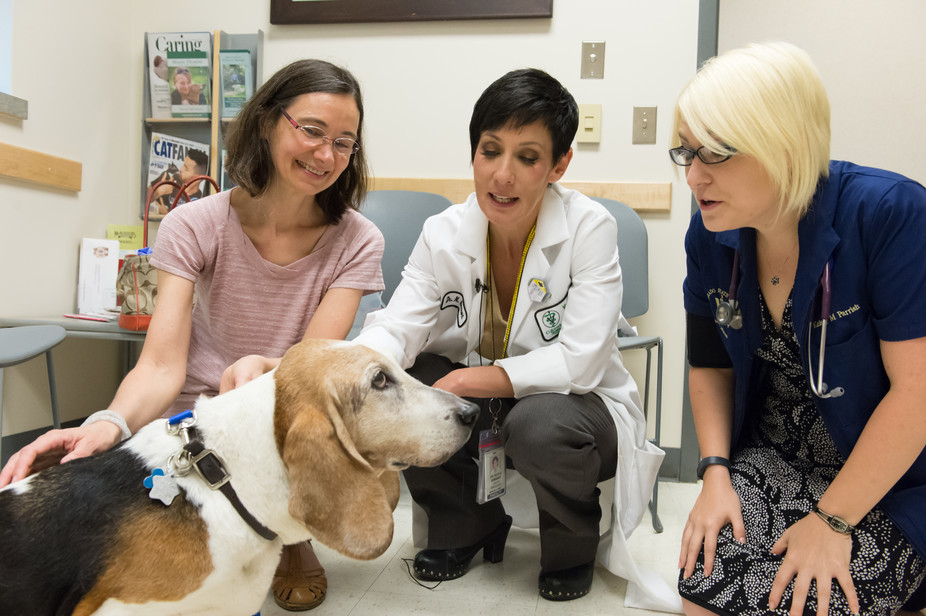
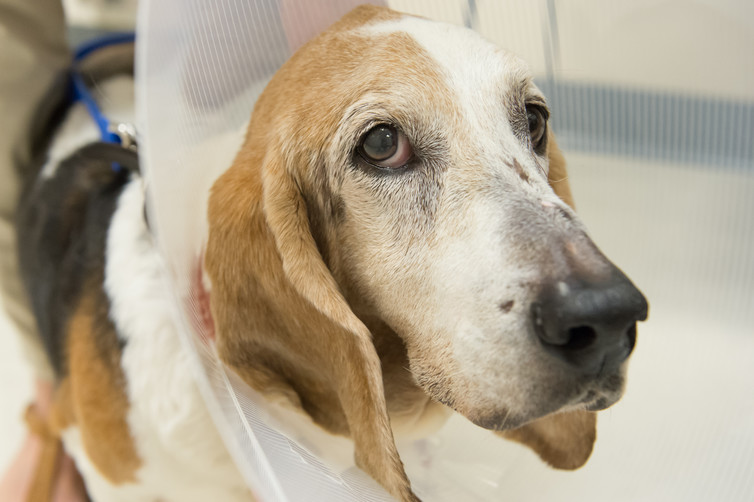
February 2, 2017The author, center, and Dr. Anna Conti, left, and student Kelsey Parrish with Conti’s Basset hound, Picasso, who had surgery for cancer. Via Colorado State University. William Cotton/CSU Photography, Author provided
“A person can learn a lot from a dog, even a loopy one like ours. Marley taught me about living each day with unbridled exuberance and joy, about seizing the moment and following your heart… Mostly, he taught me about friendship and selflessness and, above all else, unwavering loyalty.”
Isn’t it true? We learn so much from our dogs. But beyond what man’s best friend can teach us about enjoying life, they share something else with us. Cancer diagnoses in dogs are on the rise, as are cancer diagnoses in people. In fact, canine cancer is the leading cause of death in pets over the age of 10 years.
This confluence, it turns out, can be beneficial to cancer research. A field of study known as “comparative oncology” has recently emerged as a promising means to help cure cancer. Comparative oncology researchers study the similarities between naturally occurring cancers in pets and cancers in people in order to provide clues to treat cancer more effectively.
In fact, phase 1 and 2 clinical trials in comparative oncology are underway at 22 sites across the country, including Colorado State University, where I conduct research and am a surgical oncologist for animals.
Research in this field, involving veterinarians, physicians, cancer specialists and basic scientists, is leading to improved human health and more rapid access to effective cancer treatment than has been previously possible through traditional cancer research approaches.
As a species, dogs have strong physiologic and genetic similarities to people, much more so than mice, who do not typically live long enough for us to know whether they naturally get cancer. We do know that some rodent species, such as pet rats, can get cancer, but predators typically end a field mouse’s life while it is still young. The laboratory mice typically used by scientists are injected with cancer rather than it occurring naturally in their bodies.
Just as scientists officially mapped the human genome, or the complete set of genetic instructions, in 2003, scientists decoded the canine genome. They discovered that dogs have greater than 80 percent genetic similarity to humans, versus only 67 percent for mice.
In addition, cancers such as bone cancer, lymphoma and bladder cancer that spontaneously arise in pet dogs are microscopically and molecularly identical to cancers in people. Many of the genetic mutations that drive cells to become cancerous in people are the same mutations that cause cancer in dogs. In fact, when viewed under a microscope, it is impossible to distinguish between a tumor from a human and a dog.
In addition, dogs provide a large and varied population to study, important in the study of medicine. Individual dogs who develop cancer are as different from one another as are humans. Whereas laboratory mice are essentially identical twins to each other and live in a highly regulated environment, the variation among different dog breeds, home environments, diet and overall lifestyle translate into a population diversity very similar to that in humans.
Today, most pet dogs receive high-quality health care into old age and dog owners are highly motivated to seek out improved options for the management of cancer in their companions, and are also motivated to minimize side effects.
Similarities in response to treatment, too
Picasso at the James L. Voss Veterinary Teaching Hospital, Colorado State University. Author provided., Author provided.
This genetic diversity and sharing of similar DNA, physiology, microscopic structure and molecular features between dogs and humans has presented cancer researchers with a key opportunity. Dogs not only develop similar types of cancers as humans, but their cancer responds to treatments in similar ways.
This means that new cancer treatments first shown to be effective in canine cancers can frequently be predicted to have a similar benefit in human cancer patients. As a result, researchers now recognize that new drug trials in dogs with cancer will result in therapeutic discoveries that are highly “translatable”; that is, more likely to predict “real-life” medical responses in human cancer patients.
By studying how cancer responds in dogs, scientists are gaining a better understanding of how new cancer drugs not only treat the cancer but also influence the patient’s overall quality of life during treatment. This benefits dog owners, by providing access to promising new cancer treatments for their pets with cancer, and benefits human cancer patients by providing a rapid way to collect crucial data needed for FDA approval.
Dogs with cancer are helping kids
For example, a bone cancer known as osteosarcoma is so similar between dogs and people that
The author performing surgery on a dog. Author provided. Colorado State University., Author provided.
intensive research in canine osteosarcoma has led to several breakthroughs in treating osteosarcoma in children. Limb-saving surgical techniques for safe and effective reconstruction following bone tumor surgery in dogs are now the standard of care in children following bone tumor surgery.
More recently, a form of immunotherapy was shown to drastically improve survival in dogs with bone cancer by delaying or altogether preventing spread of the cancer to the lungs. As a result of the success in dogs, the FDA granted fast-track status to the same treatment for use in humans last April.
Fast-tracking was developed by the FDA to support accelerated approval for promising treatments, especially for serious and life-threatening conditions. A clinical trial in children with osteosarcoma is scheduled to begin this year at multiple pediatric cancer centers throughout the United States.
These types of discoveries demonstrate that our furry companions have a crucial role in teaching us new ways to help all victims in the war against cancer – with two legs or four.
ooOOoo
As I said in my introduction, more on this theme tomorrow.
We have a rather run-down ‘home’ for our chickens close to the house. It was run-down before the snow fell and almost brought down the surrounding wire fence.
But, hopefully, this coming Thursday sees a new walk-in run being constructed for our birds so they are better protected.
It’s time we started paying attention to chickens, one of the most misunderstood and ignored species on Earth.
There was a time when chickens were viewed as exotic, fascinating birds. Descendants of exotic Asian jungle fowl, they were revered for their ferocity and intelligence, and domesticated around 8,000 years ago, more for cockfighting than eating. But then, we humans began eating them in ever-larger quantities, until we reached the point where we are now, with 20 billion (mostly white) chickens living in dirty, crowded barns, awaiting slaughter.
Chickens have been a part of human lives for millennia, and yet they are one of the most misunderstood, if not ignored, species on Earth. Lori Marino, an American neuroscientist and animal intelligence researcher, wants to change this. She is intrigued by the fact that chickens are so rarely recognized for their cognitive abilities and frustrated that studies about birds almost always focus on other, less-domesticated species, like crows and parrots.
“Arguably even the scientific community has been influenced by public perceptions of chickens as cognitively simple… This asymmetry in the literature is likely a reflection of, as well as a contributor to, the disconnect scientists and the public have between chickens as commodities and who they actually are as individuals.”
Chickens deserve more attention, and here are some quirky, interesting facts to get you thinking about chickens less as food and more as fascinating co-inhabitants of our world. These come via Marino’s recent paper, “Thinking Chickens,” published online in Animal Cognition in January 2017.
1. Chickens are a sub-species of the red jungle fowl that hails from southeast Asia.
The red jungle fowl (galls gallus) inhabit the edges of fields, scrubland, and groves. Domestication was well established 8,000 years ago, but some records suggest it could have started as much as 58,000 years ago.
2. Domestic chickens are similar to their wild counterparts.
Despite the intense breeding and genetic manipulation of recent years, chickens have not been cognitively or behaviorally affected by domestication. This stands in contrast to dogs and wolves, for example, which have diverged significantly due to domestication. Nor have chickens become less aggressive toward predators through domestication, which is a common outcome; in fact, some chickens are more aggressive even than red jungle fowl.
3. A chicken’s beak is highly sensitive to touch.
The beak, with numerous nerve endings, is used to explore, detect, drink, preen, and defend. This also means that when a bird is de-beaked, as often happens in industrial farming, it experiences great pain, sometimes for months, which changes its behavior. Marino writes, “At the end of the beak is a specialized cluster of highly sensitive mechanoreceptors, called the bill tip organ, which allows chickens to make fine tactile discriminations.”
4. Chickens have finely tuned senses.
They can see long distance and close-up at the same time in different parts of their vision. They can see a broader range of colors than humans. They can hear at low and high frequencies at a variety of pressure levels. They possess well-developed senses of taste and smell. They can orient to magnetic fields, like many other birds.
5. Chickens are surprisingly good at math.
Three-day-old chicks are able to perform basic arithmetic and discriminate quantities, always opting to explore a set of balls with the greater number, even when an object was visibly transferred from one set to another. Five-day-old chicks have been found to track up to five objects.
“When they were presented with two sets of objects of different quantities disappearing behind two screens, they were able to successfully track which screen hid the larger number by apparently performing simple addition and subtraction.”
6. Chickens can exercise self-control.
In an experimental setting, chickens have been given the choice between 2-second delay with 6 seconds of access to food, versus a 6-second delay with 22-seconds of access to food. The hens waited for the longer reward, “demonstrating rational discrimination between different future outcomes while employing self-control to optimize those outcomes.” Self-control usually doesn’t appear in humans until four years of age.
These are just a few of the remarkable discoveries described in Marino’s study, a highly readable, entertaining paper. It’s an important reminder that chickens, arguably the most ubiquitous animals in our world, deserve far more respect than they currently receive. Hopefully this will lead to more people questioning the horrific conditions in which most of them are kept.
It’s easy to fall into the trap of looking for a humourous way to close today’s post. But a more responsible approach would be to repeat the words from the start of the article to serve as a reminder of trying, wherever possible, to think about the food we eat, especially when animals and birds have to be slaughtered to provide us with that food.
…. we reached the point where we are now, with 20 billion (mostly white) chickens living in dirty, crowded barns, awaiting slaughter.
But please don’t leave this page until you have watched the following video.
Published on Dec 3, 2014
After 22 years of raising chickens for Perdue, one brave factory farmer Craig Watts was at his breaking point and did something no one has done before. He invited us, as farm animal welfare advocates, to his farm to film and tell his story. Ask your supermarket for Better Chicken at http://better-chicken.org.
A vet has left behind her home in England to care for Sri Lanka’s street dogs.
Janey Lowes from Barnard Castle, County Durham, has spent the past two years caring for the neglected animals.
There are about three million street dogs on the island – about 60% of puppies born on the street do not survive to adulthood.
The 28-year-old set up charity WECare Worldwide to raise money to buy the equipment needed to treat the animals and to set up her own clinic in Talalla.
I am pleased that the video clip that was included in the BBC News story has found its way to YouTube.
Inevitably the charity WECare Worldwide has its own website: the home page is here. Then you can read on the charity’s ‘About’ page: (Note: CNVR is the acronym standing for catch-neuter-vaccinate-release.)
CNVR
CNVR is carried out as it is the most humane way to reduce roaming dog populations and reduce the number of unwanted puppies that are dumped on the streets at a very young age. It also allows the females that would inevitably spend their whole lives pregnant to only have to worry about number one when thinking about limited food resources and shelter options, which transforms their lives.
Vaccinating the dog population against Rabies is the most effective way to eliminate the disease in the human population. As an island nation, eradication of Rabies in the near future is a very real possibility and will change the future of both animals and humans here, allowing improved relationships between the two.
CNVR is the backbone of everything we are trying to achieve in Sri Lanka.
But that’s only one part of what they do. Again, as the website sets out:
We focus on 3 main areas here in Sri Lanka.
CNVR (catch-neuter-vaccinate-release)
Treatment of sick and injured animals
Education and training
I shall be making contact with the charity very soon .
Not only to pass on our respect and admiration for what she has accomplished but to see if there are other ways we can help them in what they are doing. I use the word ‘we’ to cover not only Jean and me but also all of you who are close to this blog and who, so frequently, show how much love you have for dogs!
WECare Worldwide will help by providing free veterinary treatment, alongside love, compassion and respectful care of the Ceylon dogs, who make up such a huge part of Sri Lankan heritage and culture, both in the past and the current day.
For both humans and, in consequence, for those dogs close to us.
Effectively, the whole of the New Year has been a tad challenging here in Merlin, OR. For even before the snows arrived early on in January, leading to power outages and frozen pipes, the local weather service was warning of unusually severe storms. Indeed, more than once we have heard locals speaking of this looking like a one-hundred-year-storm.
So it was inevitable that there were some anxious periods. Plus the challenging weather may not be not fully behind us. For this is the current (Sunday 18:00 PST) weather warning:
HYDROLOGIC OUTLOOK
NATIONAL WEATHER SERVICE MEDFORD, OR
134 PM PST SUN JAN 15 2017
…Flood Potential Outlook for main stem river flooding, snow melt flooding, and quick rises on rivers and streams in the following counties…in California…Siskiyou…and in Oregon…Coos… Curry…Douglas…Jackson…Josephine…
A strong atmospheric river event is expected to arrive in Southern Oregon and Northern California by Wednesday. While models have trended towards a faster progression of the front, and therefore lesser rainfall amounts, this event may still produce high snow levels, periods of heavy rain, and significant melting of lower level snow-pack Wednesday and into Thursday. With the extensive snow-pack, saturated soils and high river levels, there is a potential for flooding and rapid rises along main stem rivers and small creeks and streams. Urban areas may also experience high water from blocked culverts and runoff.
Continue to monitor forecasts for any updates as this potentially hazardous situation develops.
Anyone who has a dog (or several) in their lives will know how our anxiety is so quickly picked up by our dogs. Ergo, looking after our dogs, as in keeping them relaxed, is really important.
Now read this article that was published over on the Care2 site. I am republishing here for all you good people.
Does your dog suffer from anxiety? A lot of rescued dogs do, and often we don’t know the exact cause for their nervousness. Abuse, neglect or even a single bad experience before you adopted your dog could cause mild to debilitating anxiety. These natural remedies for dog anxiety have worked wonders for my very anxious dog.
We adopted my dog, Jenna, two years ago. Jenna was three years old when we rescued her, and her story still breaks my heart. Lifeline Animal Project rescued Jenna from an animal hoarder when she was six months old. For those first six months, she lived in a crate 24/7. They didn’t even take her out to pee and poop, they just changed the newspaper or laid new paper down. Jenna lived in Lifeline’s no-kill shelter for two and a half years before she was socialized enough to be adoptable.
Even after those years of care, Jenna was still incredibly fearful when we got her home. For the first 36 hours that we had her, she didn’t pee or poop at all. She basically sat on her bed, shaking. By the end of second day we could get her to eat and use the bathroom, but it took weeks for her to finally trust us.
We’ve had Jenna for two years now, and she is a completely different dog. She is still wary of strangers and has her nervous moments, but she loves to run and play. She’s even warmed up to family and friends who visit us often. Jenna is always going to have a high base level of anxiety, but thanks to the natural remedies I’m going to get into below, she also can relax and behave like a normal dog the vast majority of the time.
Look at this mellow, happy gal!
Natural Remedies for Dog Anxiety
Every dog’s situation is different, so what worked for Jenna may not work for your dog. If one of these natural remedies isn’t doing it for your nervous dog, try another one! This is a laundry list of everything that’s worked and one thing that didn’t work for us but does for too many other dog owners to leave out of the list. Pick and choose natural remedies as you find out what helps with your dog’s anxiety.
1. Obedience Training
I can’t recommend a good trainer enough. Training gives your anxious dog confidence, and a good trainer can help you with commands that are especially important. I’ve been taking Jenna to training on and off the entire time that we’ve had her, and it has been a miracle for us. It took a few months for us to start seeing results, so don’t expect a quick fix from this. The long-term benefits for you and your dog are well worth it.
2. Exercise
Getting exercise with your dog is a bonding experience, and it also helps her work off some of that nervous energy. Jenna and I run 9-15 miles a week together, when I can swing it, and she loves to run more than anything else. We had to stop running towards the end of my pregnancy, and on that first run back, she had a huge puppy grin on the whole time we were out.
Running is just one way to get your dog exercise. You can go for walks, play catch, or play training games like “touch.” Whatever you choose to do, talk to your vet first. Some breeds of dog are great runners, but others (like pugs) can overheat easily and need lower-key exercise.
3. Essential Oils
One fear that Jenna is definitely not over is thunderstorms. She shuts down during storms, which can be rough during spring and summer when it storms frequently here in Atlanta. Essential oils combined with Rescue Remedy (more on that below) have helped her out a lot. Choose a calming scent like lavender, and just put a couple of drops onto the dog’s collar. Putting it on the collar is key, because then your dog can smell the soothing oil but can’t eat it.
4. Rescue Remedy
Rescue Remedy is a blend of flower extracts, and they make blends for pets and for humans. We use the liquid for pets and feed it to her in a lump of peanut butter. (**** See my Footnote below) It calms her down considerably. Though, to be honest, I do wonder if getting her favorite treat (peanut butter) has something to do with it. You can find Rescue Remedy at natural food stores or online.
5. Focus Toys
Redirecting your dog’s attention when she’s feeling anxious can be a big help. You can try using commands that you learned in training class, or you can give your dog a focus toy. There are all varieties of these. You can go with a rawhide bone or one of those puzzle toys that dispenses treats when the dog gets it right. Jenna’s favorite toy is a Nylabone. She’s a 50 pound lab mix, so she tears through a rawhide in minutes. She’s had the same Nylabone for months, and it’s still pretty much intact.
6. Watching Your Tone
When your dog is scared, how do you react? Do you say, “It’s OK, sweetie!” in a higher-pitched voice than usual? This is a normal reaction, but it’s actually not the best one when your dog is scared. If your dog sees you as the alpha in the pack, she’s going to take her cues from you, and that kind of attention rewards your dog’s fear, reinforcing it.
Next time your dog is scared, try to react as if everything is normal. You can put a hand on her back, so she knows that you’re there, but try not to make a big deal out of the situation. Don’t say “It’s OK.” Instead, show her that everything is OK with your body language.
7. Crate Training
We were lucky that Jenna was crate trained when we adopted her. For an anxious dog, the crate can be a “safe place” they can retreat to. When there’s a thunderstorm or our neighbors decide to shoot off fireworks, Jenna often curls up in her crate. Dogs like a small, cozy space. If you’re not into crate training, I’d suggest setting up a dog bed in a quiet corner or even under an end table, so your dog has a cozy place that’s hers where she can go when she is scared.
8. The Thunder Shirt
This is the one natural remedy on this list that has not worked for us at all. Jenna is more afraid of the Thunder Shirt than she is of thunder! We are definitely outliers here, though. Every dog owner I know that has an anxious dog recommends the Thunder Shirt to me when I mention Jenna’s fear of storms. This is a great example of how different natural remedies work for some dogs and not others. The Thunder Shirt is definitely worth a shot! If it doesn’t work for you, you can pass it on to a fellow dog owner or donate it to your local shelter.
ooOOoo
Footnote!
Regarding feeding dogs peanut butter, do not, repeat not, do this until you are sure that the brand of peanut butter you are considering is free of the ingredient xylitol.
I wrote of the dangers of xylitol in a post last December 8th. It is being republished in an hour’s time just to make sure the widest number of readers of this place are aware of the danger.
Anyway, this seemed like a very useful article. Plus there’s another benefit of having one’s loved dogs in a relaxed state. It helps the people around those dogs remain relaxed as well!
Brandy and Jean enjoying mutual relaxation!
Chill out everyone! Both the two-legged and the four-legged ones!
Rakesh runs a charity called The Voice of Stray Dogs (VoSD).The WikiPedia entry is a bit light on details but the UK arm of The Huffington Post makes up for that. Here’s an extract from the news item:
VoSD was founded by Mr Rakesh Shukla, affectionately known as the “Dog Father”. It was set up single-handedly after he felt obliged to do something about the plight of stray dogs in India. Well known for keeping dogs in his home [ the VoSD Sanctuary] and in his office, Rakesh has worked tirelessly to raise funds for the care of stray dogs [ with greater than 90% contributed by himself]. One visitor said ““Rakesh’s growing family of rescued dogs is a sight to behold. It is amazing how so many dogs together get on so well“.
He operates a system that has rescued more than 3000 dogs in 2 years with 400+ permanent dogs under his care. VoSD offers the highest standard of service and is equipped with the latest technology so that stray dogs get the best possible care.
Back to the BBC item that I am taking the liberty of republishing in full.
ooOOoo
The man who looks after 735 dogs
19 December 2016, India
Rakesh Shukla is a software engineer who’s found his life’s calling in looking after dogs that no-one wants, writes the BBC’s Geeta Pandey in Bangalore.
The car pulled up outside a dusty farmhouse near the capital of the southern Indian state of Karnataka and suddenly dogs were everywhere, yelping and barking, jumping with joy.
Within seconds, they were all over Rakesh Shukla, nuzzling him and licking him, and Mr Shukla was as delighted to see them. He spoke to them, patted some, scratched one behind the ears, and lofted another onto his shoulder.
Then he gave me a tour of his three and a half acre farm. At last count, Mr Shukla had 735 dogs.
There are Labradors on the farm, there are Golden Retrievers, Great Danes, Beagles, Dachshunds, Rottweilers, Saint Bernards and even a pug. There are hundreds of mongrels too.
Most of the dogs are strays, the others have been abandoned by their owners. The latest arrivals was a group of 22 pedigreed dogs whose owner, a city businessman, was shot dead recently by criminals.
“I’m the last stop for these dogs. They are no longer cute and cuddly. Many are sick and no longer wanted,” said Mr Shukla, 45.
Affectionately known as the “Dog Father”, he calls the dogs his babies and him their “papa”.
Mr Shukla, who founded a software company along with his wife 10 years ago, spends three to four days every week on the farm, taking care of his canines.
“I had worked in Delhi, in the United States and then set up my own company in Bangalore,” he said. “Life was all about buying big cars and expensive watches and living a fancy life. I had travelled and seen the world many times over, but then I was not happy.”
Then Kavya came into his life: a beautiful 45-day-old Golden Retriever that he fell hopelessly in love with. It was in June 2009, and Mr Shukla remembers clearly the day he brought her home.
“When we got home, she went and hid in a corner. I got down to her level on the floor and I was calling out to her. She was looking at me, she was scared, but I could see she wanted to trust me,” he said.
“And that’s when the moment happened – it was a physical feeling, my hair was tingling, I could feel a warm glow. And I’ve never needed to ask myself that question – ‘why am I here?’ – again after that.”
Mr Shukla’s second dog, Lucky, came to him three months later when he rescued her from the streets. “It had been raining for 12-13 days, she was wet and miserable, so I brought her home too,” he said.
Over the coming days and weeks, whenever he met a stray or abandoned dog, he brought it home. Initially he kept them there but when his wife protested, he moved some of them to the office, where the top floor was turned into a home for dogs.
In 2012, as the pack grew, Mr Shukla bought land in Doddballapur town and set up the farm – a haven for dogs that are old, ailing or simply unwanted.
The farm is designed for its canine residents, with lots of open spaces for them to run around and ponds to swim in, and there’s double fencing to keep them safe.
Every time we entered an enclosure, a cacophony of barks greeted us.
The farm employs about 10 people, including trained veterinary assistants, to look after the dogs, cook for them and feed them. The dogs are fed 200kg of chicken and another 200kg of rice daily and many of the sick ones need regular medicines and attention.
The daily cost of running the centre is 45,000 to 50,000 rupees ($663; £532 to $737; £592), according to Mr Shukla, who said he provided 93% of the funds.
In the past year though, he has run into problems with some animal activists, who have demanded that they be allowed onto the farm. He has also faced complaints that he is creating public unrest by keeping so many dogs. There have also been demands that he shut down the farm.
He has refused to concede.
“I’ve made a pact with my dogs,” he said. “We will part only when one of us kicks the bucket.”
ooOOoo
You know that there are many who are desperately worried about 2017 and beyond. The next few years, ten at most, will see the results of this great experiment that humanity is conducting.
Now, I’m happy to put my hand up as someone who does worry at what my generation is leaving for our grandchildren.
Then one comes across people like Rakesh and, somehow, the future doesn’t seem quite so grim.
What a wonderful man.
Published on Oct 8, 2014
Rakesh Shukla is the go-to guy for dog rescue in Bangalore. His privately-funded venture, ‘The Voice of Stray Dogs’ champions the cause of India’s stray/ street dogs with research, publication, litigation, veterinary and healthcare services for stray dogs.
See you all on the other side of Christmas!
But promise me one thing: Never turn your back on a dog in need.
Four household products that could be making you sick.
In yesterday’s post I republished an email sent by fellow author Judi Holdeman warning about some brands of peanut butter in terms of potential harm to our gorgeous dogs. Or to be more precise about the dangers of xylitol that is an ingredient in those named brands.
Today, I am delighted to publish a guest post from Charlotte Meier. Charlotte explained to me that she “Operates Home Safety Hub, a site which provides resources on preventing injury and property loss. Her mission is the same as Home Safety Hub’s, which is to help people keep their homes safe. ” Yes, keeping our homes safe includes keeping our dogs safe.
Here is that guest post.
ooOOoo
Four household products that could be making you sick.
We tend to believe that household products such as cleaners or kitchen utensils are good for us. Keeping your house bacteria-free surely can’t have a negative effect on your well-being, right? Unfortunately, as the world becomes more eco-friendly, studies are now showing that your favorite household products could be damaging both you and the planet.
It is critical that you do the research necessary to identify healthy and eco-friendly products. However, that may be easier said than done. Here are a few common household products that could be harmful to your health or the environment.
Nonstick Cookware
Nonstick cookware (such as pots, pans, and baking dishes) was initially celebrated and sought-after, seeming to make cooking simpler and cleanup easy. However, we now know that the nonstick surface is created using Teflon which releases toxic gasses. When you use this cookware at a high temperature, you are essentially poisoning yourself and placing yourself at risk for organ failure, cancer, and other health concerns.
A few healthy alternatives are cast iron, stainless steel, and ceramic coated cookware. Just be certain you do your research on the proper way to care for each type of cookware. For example, cast iron cannot be washed with soap and should be dried immediately after rinsing to avoid rust.
Air Fresheners
Keeping your home smelling fresh with wall plug-ins or sprays is very common. However, many of these products can have a detrimental impact on your health. Furthermore, aerosols are very bad for the environment.
If you want your home to smell wonderful, there are a number of ways you can do so in an eco-friendly and beneficial way. Scented soy candles can be highly effective as can boiling aromatic spices. Recipes for seasonal home scent blends can be found for essential oil diffusers as well.
Garden Insecticides
If you are using insecticides in your garden or on your landscaping, lawn, or potted plants, you are endangering your health and the well-being of the planet. Insecticides are extraordinarily harmful, affecting the nervous system and respiratory system in humans while carrying toxins to water supplies and culling bee populations.
If you have a pest problem, you need to either seek out a home remedy such as vinegar or purchase a genuinely eco-friendly insect control.
Anti-Bacterial Cleaners
Exposure to bacteria is how our immune systems learn and grow. In order do that, you must embrace bacteria in your home. Anti-bacterial products keep your home sterile, leaving your immune system to drop its guard and increase the likelihood of getting sick. When you clean your home, you certainly want to keep it clean, but you do not want it entirely sterile. Anti-bacterial products may do more harm than good.
If you want an eco-friendly cleaner, try utilizing the app ThinkDirty, which rates the safety of household products in terms of their impact on people and the planet. Seventh Generation is one of the best lines of household goods for those seeking eco-friendly options.
Knowing how to best keep yourself and the planet well can be very difficult. False or misleading advertising can trick you into using unhealthy products and knowing what is truthful is no easy feat. However, with a little time, effort, and research, you can make the right decisions with your household products.
There you are good people; another Friday come and gone.
But I do hope that you found value in what Charlotte wrote about. Indeed, I have no doubt that many of you did.
Let me close by sharing the email that Charlotte sent me a couple of weeks ago.
Hi!
Our homes are our safe havens. In fact, the term “homesick” refers to a longing for the comfort and love that we associate with home when we’re away from it.
But many Americans, today, are homesick in a different way. They (and often their pets as well) are suffering from respiratory illnesses, skin irritations, allergies, and in some cases, even cancer, due to factors found in their homes.
As part of my research for my new site, HomeSafetyHub.org, I’ve been studying ways our homes make us sick and what we can do about them. I’d love to share what I’ve learned with your readers in the form of a guest article.
The article will offer tips and advice on what factors to test for, suggestions for easy, environmentally-friendly DIY repairs to eliminate problems, what products or building materials to avoid, and more.
If you’re interested in receiving a guest article, please let me know. No payment necessary, of course, I’d just love the opportunity to share my original content on a great site.
Hope to hear from you soon!
All the best,
Charlotte
And there’s another special moment regarding the moon coming up in a week’s time! (You’ll have to be patient for I’m not saying anything more just now!)
At 9pm last night water running down the cable from the wireless internet antenna outside came into the house and caused the ‘power adapter’ unit to fail.
Amazingly between me and our supplier, Outreach Internet, service was resumed about an hour ago.
However, until the Outreach engineer can come to our property and do a proper clean-up job there’s no guarantee that we might not lose service again.
Just wanted all you good people to be aware of that.
(And as at this time of writing we are up to 4 in of rain since yesterday morning!)