Category: Technology

The Month of May!

For all my life this has felt like a very special month.

And, dear friends, at the risk of repeating myself to many of you, this is why the month of May is special for me.

Simply that I was born in London during the closing months of the Second World War. Inevitably, I was unaware of the number of German bombs that were falling on London during those last few months. But there were thousands.

On May 8th. 1945, the day that WWII ended and six months to the day from when I was born, my mother looked down at me and said aloud to me: “You are going to live”. Despite the fact that I don’t recall my mother saying that, it was verified many times later when I was growing up.

Now here we are approaching May 8th. 2017 and in a very real sense it seems that we are in another war.

A war of consequence.

A war that we have been engaged in for many, many years.

A war where we are inadvertently fighting on a global battlefield.

A war where 99.99% of us don’t consciously identify the weapons we are using. Weapons that are incredibly effective. So much so that we are in sight of winning the last battle; winning the war.

Yet a war where winning is no win at all. Indeed, where winning this war, this global war, spells the end. The end of life for 99.99% of us humans (and much else besides).

Now what on earth has got me so fired up?

Two things have:

The first is that I am living in my 73rd year of life. I have no idea of when my life comes to an end. But that death is a guarantee. Indeed, if one takes note of the average life expectancy of a male today in the USA (75.6 years) , it may not be that far away.

The second thing is that before my death I truly want to know that humankind has laid down its weapons of war against our planet and that there really is an unstoppable mission, a united wave of passion, to live in peace on this planet. Perhaps better put to live in peace with this planet.

Or in the words of an organization that I now want to introduce:

A mission which will require the hard work and dedication of each and every one of us as we do everything in our power as individuals, but also as we galvanize businesses, entrepreneurs, innovators, city planners, communities, people and politicians—all those who share our purpose.

OK! Thank you if you are still reading this! (Someone give Fred in that soft arm-chair over there a nudge; I can hear his snores from here!)

In the last Smithsonian electronic newsletter that I was reading yesterday morning there was a reference to an organization that I hadn’t previously come across. Here is the link to that item on The Smithsonian website. I am republishing it in full in this place. As you read it you will understand why I am republishing it.

ooOOoo

Using a New Roadmap to Democratize Climate Change

A new tool aims to bypass governments and put the power of climate action in the people’s hands

By Anne Glusker    Smithsonian.com     April 28, 2017

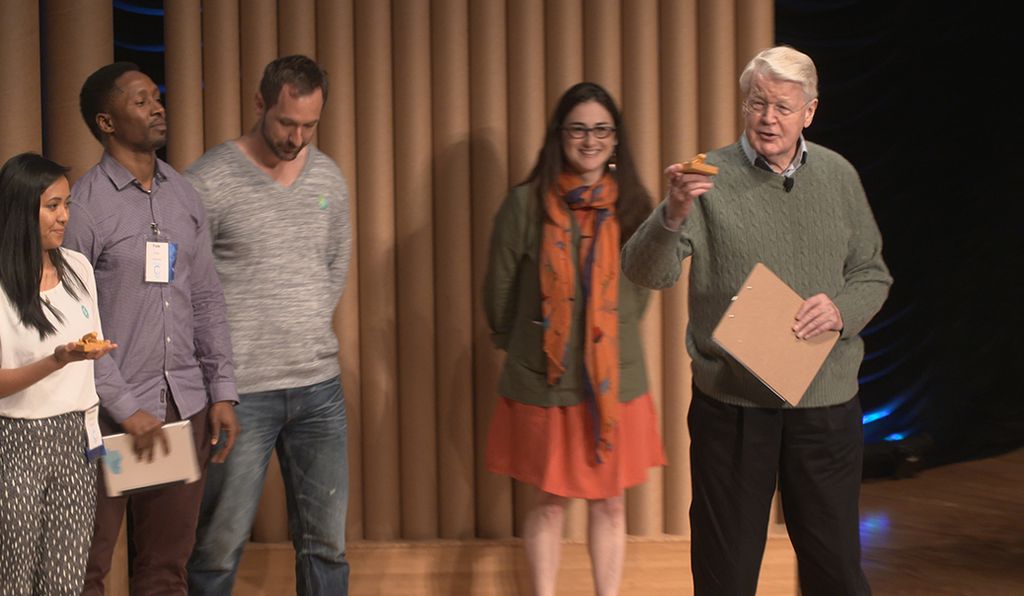
Olafur Grimsson, who was president of Iceland from 1996 to 2016 and saw his country through the worst economic crisis in its history, making headlines all over the world as banks collapsed and the country fell into a depression, is the very picture of an urbane statesman. Collected and poised, with a striking full head of white hair, as comfortable in English as in his native Icelandic, he seems an unlikely revolutionary, not the sort of person you’d look at and immediately find yourself thinking: “Power to the People.”

 But Grimsson is one of the primary architects of a quietly radical new idea whose aim is to facilitate action on climate change without any of the usual suspects—governments, countries, international bodies, negotiating parties.

He and several other veterans of the historic 2015 Paris Agreement on climate change were in Washington, D.C., last year, just before COP22, the climate meeting held in Marrakesh in 2016. They were pondering next steps when the conversation took a new and interesting turn, Grimsson says, addressing the question: “Was it possible to have the success of Paris without governments necessarily being in the leading role?”

The group included movers and shakers such as Peter Seligmann, the chairman of Conservation International; Laurene Powell Jobs, president of the philanthropic organization the Emerson Collective; and Andy Karsner, an assistant energy secretary during the administration of George W. Bush. Galvanized by their own query, they decided to try to answer it—to set about creating a new tool to aid in achieving the goals of the Paris accord.

At the Smithsonian’s Earth Optimism Summit, a gathering this past weekend of conservation-minded citizens, scientists and activists, Grimsson explained: “You get governments that are opposed or even hostile to climate action. We decided to bring together in Marrakesh a gathering of thinkers and scientists and innovators and policymakers from different countries in order to discuss a new model of securing the success of the future of the climate movement.”

At the Smithsonian’s Earth Optimism Summit, the former president of Iceland Olafur Grimsson encouraged new solutions to climate change, awarding cash prizes to the winners of the “Make for the Planet” challenge. (The Roadmap)

Grimsson’s group felt that due to changes in information technology and social transformations, the large organizations and structures that used to be necessary to effect change were now not needed. And thus was born Roadmap, a new crowdsourcing tool for anyone and everyone interested in climate action. Still in its very early stages, Roadmap’s founders envision it as a platform for those working on climate issues—from scientist and policymaker to farmer and fisherman—to facilitate the sharing of knowledge and ideas, methods and techniques.

“A new political model is possible—where everyone can be a doer, where you no longer need big government or big enterprises to bring about success,” Grimsson says.

This new model for social change that skips the usual cumbersome channels and processes has been seen everywhere from public health, where the Bill & Melinda Gates Foundation has redefined the sector, to the hospitality industry, which is working to combat the human trafficking that plagues its businesses, to perhaps most famously the Arab Spring, where the role of social media in bringing about political change is still being debated today.

And this new model is complemented by technological changes. “The innovation in energy technology is such that we no longer have to wait for the big energy breakthrough,” Grimsson says. “We already have the available technologies. Every individual, home, village, community, town and region can execute change. The good news from the climate point of view is that, in addition to the information technology revolution, there has now also taken place an energy revolution. A house can be a power station: If the people who live in that house have extra energy, they can sell their energy through the smart grid. The notion that every house can be a power station is as revolutionary as saying that every mobile phone can be a media company.”

Grimsson admits that it may seem odd for someone in his position to be advocating that ordinary citizens take action apart from the conventional corridors of governmental power.

“For me to say that these traditional political organizations and positions are somewhat outdated is perhaps a strange statement: I was a professor of political science, I’ve been a member of parliament, I’ve been a minister of finance, I was president for 20 years,” he says.

It was during Iceland’s financial meltdown that he first experienced this new kind of social change: “I saw this very strongly through the financial crisis in my own country, which led to a big social economic uprising. All those activities were engineered by unknown people, people who were not part of a big organization, who used Facebook and the information media to bring thousands of people together in one day.”

Right now, Roadmap consists of a website and a lofty manifesto that speaks of raising the value of “moral currency” and creating a “best practices warehouse.” Visitors to the site can fill out a form if they want to become part of its community of “doers.” The practical part of the manifesto speaks of identifying the best methodologies and models; implementing a “real-time system of measurement” and a way to “gauge and understand what is working, what is not, and exactly what is being achieved.” As the platform develops, it will be interesting to see exactly what form these gauges, measurement systems, and warehouses take.

After the Paris Agreement, Grimsson says of himself and his Roadmap co-founders, “We were all optimistic, but we are all also realists.” It is his belief that if you “give people the tools, they can execute the transformation and the change—without governmental leadership.” Perhaps Roadmap will be one of those tools.

 ooOOoo

Here’s a video that spells it out in ways that I find impossible to ignore. (And, yes, I signed up, as in joining, yesterday afternoon.)

Because in hundreds of years time I want others to look at the following picture of Troutbeck Valley in England and know how precious is this one and only planet we live on.

Or in the words of Sue Dreamwalker that I read yesterday evening:

We are witnessing more storms, more unseasonal weather patterns, and I just hope that we wake up soon to the damage we are doing to our beloved Mother that has held us in her eternal arms for so long..

Photo credit: Getty Images

Enjoy the month of May wherever you are in the world!

Closing by repeating a key pronouncement in that RoadMap video above:

Why We? Who Else!

Dogs are saving our lives!

Literally, not just emotionally!

Over on my website, under My Writings, I mention my recently published booklet, The Amazing World of Dogs.

Here’s an extract from pages 17-18 of that booklet.

Finally, Dr. Morten Kringelbach of the Department of Psychiatry at Oxford University1 explains that the need to nurture is very deep in us humans and that dogs produce an instinctive parental response in us that is very similar to our nurturing instinct for our children.

If the magic of having dogs in our lives for such a long time ended there it would still be breathtakingly wonderful. But dogs could now be offering us humans the capacity to understand many human diseases. Literally, our dogs could be saving our lives!

The challenge in understanding human diseases is that within our ‘breed’ there is a great variability of genes. Not surprising when one considers the incredible diversity and variation within us humans.

But when we turn to dogs then we have a bonus. For despite there being, as mentioned earlier, 400 or more different breeds of dog, within each breed dogs are very similar to each other. In other words, that narrow gene pool within a specific dog breed makes if far easier to pinpoint genetic mutations than it is in humans.

Elinor Karlsson is the director of the Vertebrate Genomics Group at the Broad Institute of MIT and Harvard.2 As a geneticist, Dr. Karlsson has identified, “hundreds of diseases common to dogs and humans”. In 2005, the dog’s genome was fully mapped; all 2.4 billion letters of the dog’s genome

Among those common diseases between us humans and our wonderful dogs are diabetes, cardiac diseases, epilepsy, many cancers especially bone cancers, and breast cancer and even brain tumours.

So it was an obvious thing to do to republish the following article that appeared on the Care2 site a few days ago.

ooOOoo

 Could a Dog Vaccine Help Save Kids With Brain Cancer?

By: Laura Goldman April 17, 2017

About Laura Follow Laura at @lauragoldman

The statistics are grim: About 60 to 70 percent of children who have glioblastoma, a form of brain cancer, do not survive more than two years. This fast-growing cancer is resistant to traditional treatments like radiation and chemotherapy.

For dogs, cancer statistics are also grim. More than 6 million dogs are diagnosed with cancer every year, and one out of four dogs will get cancer during their lifetime. It’s the leading cause of death for dogs after the age of two.

But there could be hope for both dogs and kids. A vaccine being developed that destroys cancer cells in dogs could also be successful in fighting glioblastoma in children.

Researchers at Children’s Mercy Hospital in Kansas City, Mo., have started a partnership with ELIAS Animal Health, a company that’s testing treatments for osteosarcoma (bone cancer) and B cell lymphoma in dogs.

“If we take advantage of the resources we have in this region and get behind those collaborations, this could be a mecca for advanced, exciting, innovative therapies for cancer and lots of other diseases,” Dr. Doug Myers, an oncologist at Children’s Mercy, told the Kansas City Star.

ELIAS Cancer Immunotherapy (ECI) uses the dog’s own immune system to destroy the cancer. “Research has shown that ex vivo activated T cells have the machinery to effectively kill cancer cells, including cancer stem cells,” according to the company’s website. “ELIAS Cancer Immunotherapy utilizes adoptive cell therapy to deliver an army of activated T cells.”

The dog is vaccinated with his own cancer cells to produce an immune response, then the generated white blood cells destroy the cancer cells.

“Personalized T cells are then safely obtained from the patient through apheresis [the removal of blood] and then ‘super charged’ to produce a large population of killer T cells that are reinfused into the patient to kill the cancer,” the company explains.

ELIAS Animal Health is currently conducting clinical trials of ECI at Kansas State University, the University of Missouri-Columbia and a few animal hospitals across the country. The success rates of using ECI along with surgery on dogs with cancer are being compared with those of patients that are treated with surgery alone.

“Early clinical study results already show positive outcomes,” Tammie Wahaus, CEO of ELIAS Animal Health, said in November 2016.

Among the ECI success stories is that of Dakota, a German shorthaired pointer who continues to survive a year after she was diagnosed with osteosarcoma. This is twice as long as her original prognosis. X-rays taken during a follow-up examination showed no signs of the cancer spreading.

Could ECI also successfully treat children with glioblastoma? Dr. Kevin Ginn, a pediatric oncologist at Children’s Mercy, and other researchers are currently developing protocols for trials. They’re planning to apply for a Phase II clinical trial with the U.S. Food and Drug Administration, using the results of ECI’s studies on safety and effectiveness as far as dogs are concerned. The Phase II trial would give ECI to a large group of children to see if it’s effective and further evaluate its safety.

Animal health trials are regulated by the U.S. Department of Agriculture. They are less expensive and proceed faster than FDA-regulated human trials, the Kansas City Star reports, “but successful human health treatments often bring a larger return on investment.”

In this case, a larger return on investment could be a win-win for children as well as dogs with cancer.

Photo credit: cgordon8527

ooOOoo

My booklet closes thus:

Many would extend that proficiency of dogs to include their sense of loyalty and forgiveness, to and of us humans, but that all pales into insignificance when compared to what our understanding of dogs is giving us.

No less than the capacity to help cure many of our diseases, to deeply understand the workings of the human mind, and above all else, to offer insight into our very existence.

That’s quite a relationship!

Quite a relationship indeed!

No place for amateurs!

Offering up a tribute to the work of a professional.

Many, many years ago when I was in business on my own account (1978-1986) I had the pleasure of getting to know Frank Tijou. He was running his own very successful business. But more important than that, Frank had this wonderful ability to explain what he had learned over his years of being an entrepreneur. One such learning was stick to what you really know and don’t try and do things that are best left to other professionals. In other words, don’t be an amateur when it comes to important matters.

Thus when some weeks ago I was strongly recommended by some local authors to have an author website, I looked around for a professional. I quickly came to find Christy Kiltz of Design! by Kiltz Internet Solutions.

Talk about finding a true professional.

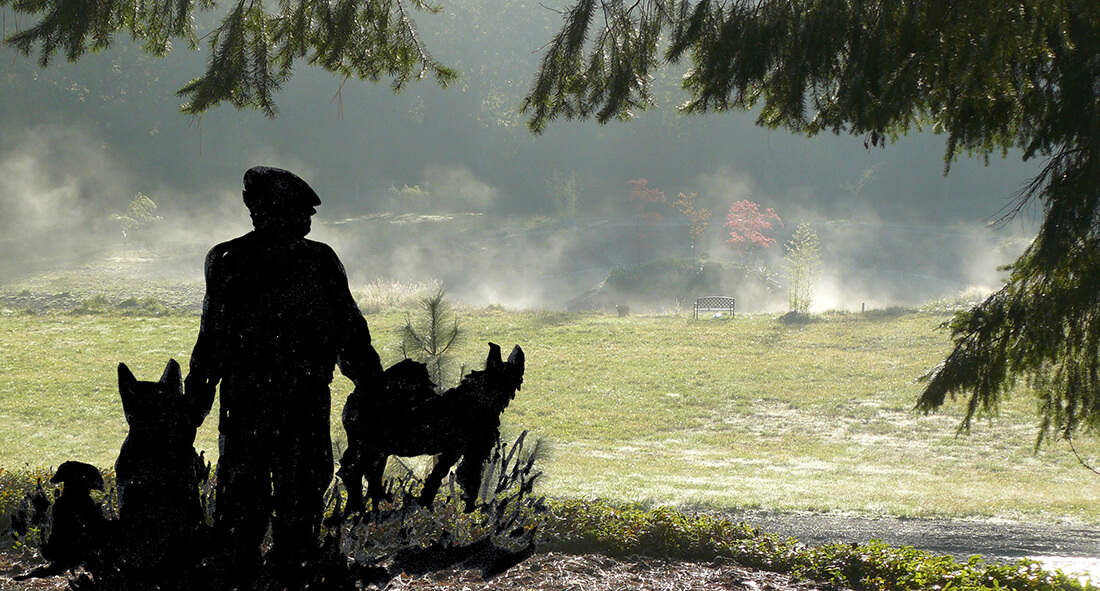
Forgive me, I’m not coming at this in terms of an ego trip. I just want to promote what a wonderful job Christy did. (And not forgetting Emily’s grand design work.) (And most certainly not forgetting my darling Jeannie who did the image of the man in a flat cap with the dogs!)

Please go across to my new website: Paul Handover – Life Traveller.

The home page banner image from my website.

So in the words of American playwright Garson Kanin:

“Amateurs hope, professionals work.”

Thank you, Christy!

Thinking anew.

Humanity’s safe and viable future depends on seeing things very differently.

Next Tuesday is the 62nd anniversary of the death of Albert Einstein, the famous German theoretical physicist who died on the 18th April, 1955. He delivered many innovative ways of seeing our world way beyond his theory of relativity, one of the two pillars of modern physics (alongside quantum mechanics) (Ref: Wikipedia)

Why do I introduce today’s post with that reference to Mr. Einstein?

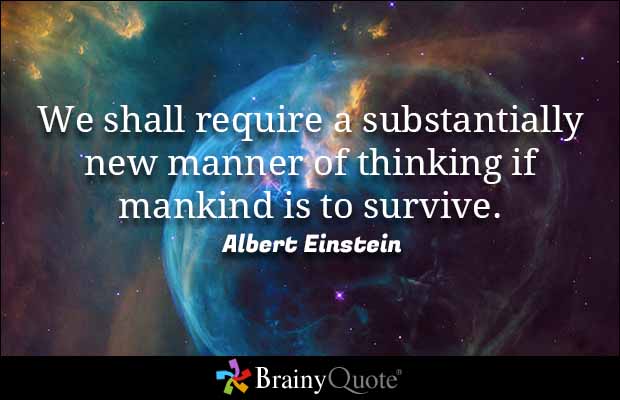
Because I wanted to share with you a recent essay from George Monbiot and an Einstein quotation seemed so apt an introduction.

We shall require a substantially new manner of thinking if mankind is to survive.

That essay from George Monbiot was published yesterday and is shared with you all with Mr. Monbiot’s full permission.

It is an essay that deserves being read slowly and carefully. Please take time aside to so do because it really does offer a new manner of thinking.

ooOOoo

Circle of Life

By reframing the economy, Kate Raworth’s Doughnut Economics changes our view of who we are and where we stand.

By George Monbiot, published in the Guardian 12th April 2017

So what are we going to do about it? This is the only question worth asking. But the answers appear elusive. Faced with a multifaceted crisis  – the capture of governments by billionaires and their lobbyists, extreme inequality, the rise of demagogues, above all the collapse of the living world – those to whom we look for leadership appear stunned, voiceless, clueless. Even if they had the courage to act, they have no idea what to do.

The most they tend to offer is more economic growth: the fairy dust supposed to make all the bad stuff disappear. Never mind that it drives ecological destruction, that it has failed to relieve structural unemployment or soaring inequality, that, in some recent years, almost all the increment in incomes has been harvested by the top 1%. As values, principles and moral purpose are lost, the promise of growth is all that’s left.

You can see the effects in a leaked memo from the UK’s foreign office: “Trade and growth are now priorities for all posts … work like climate change and illegal wildlife trade will be scaled down.” All that counts is the rate at which we turn natural wealth into cash. If this destroys our prosperity and the wonders that surround us, who cares?

We cannot hope to address our predicament without a new worldview. We cannot use the models that caused our crises to solve them. We need to reframe the problem. This is what the most inspiring book published so far this year has done.

In Doughnut Economics: seven ways to think like a 21st-century economist, Kate Raworth reminds us that economic growth was not, at first, intended as a measurement of well-being. Simon Kuznets, who standardised the measurement of growth, warned: “the welfare of a nation can scarcely be inferred from a measure of national income.” Economic growth, he pointed out, measures only annual flow, rather than stocks of wealth and their distribution.

Raworth points out that economics in the 20th Century “lost the desire to articulate its goals.” It aspired to be a science of human behaviour: a science based on a deeply flawed portrait of humanity. The dominant model – “rational economic man”, self-interested, isolated, calculating – says more about the nature of economists than it does about other humans. The loss of an explicit objective allowed the discipline to be captured by a proxy goal: endless growth.

The aim of economic activity, she argues, should be “meeting the needs of all within the means of the planet.” Instead of economies that need to grow, whether or not they make us thrive, we need economies that “make us thrive, whether or not they grow.” This means changing our picture of what the economy is and how it works.

The central image in mainstream economics is the circular flow diagram. It depicts a closed flow of income cycling between households, businesses, banks, government and trade, operating in a social and ecological vacuum. Energy, materials, the natural world, human society, power, the wealth we hold in common: all are missing from the model. The unpaid work of carers – principally women – is ignored, though no economy could function without them. Like rational economic man, this representation of economic activity bears little relationship to reality.

So Raworth begins by redrawing the economy. She embeds it in the Earth’s systems and in society, showing how it depends on the flow of materials and energy, and reminding us that we are more than just workers, consumers and owners of capital.

The Embedded Economy. Graphic by Kate Raworth and Marcia Mihotich

This recognition of inconvenient realities then leads to her breakthrough: a graphic representation of the world we want to create. Like all the best ideas, her Doughnut model seems so simple and obvious that you wonder why you didn’t think of it yourself. But achieving this clarity and concision requires years of thought: a great decluttering of the myths and misrepresentations in which we have been schooled.

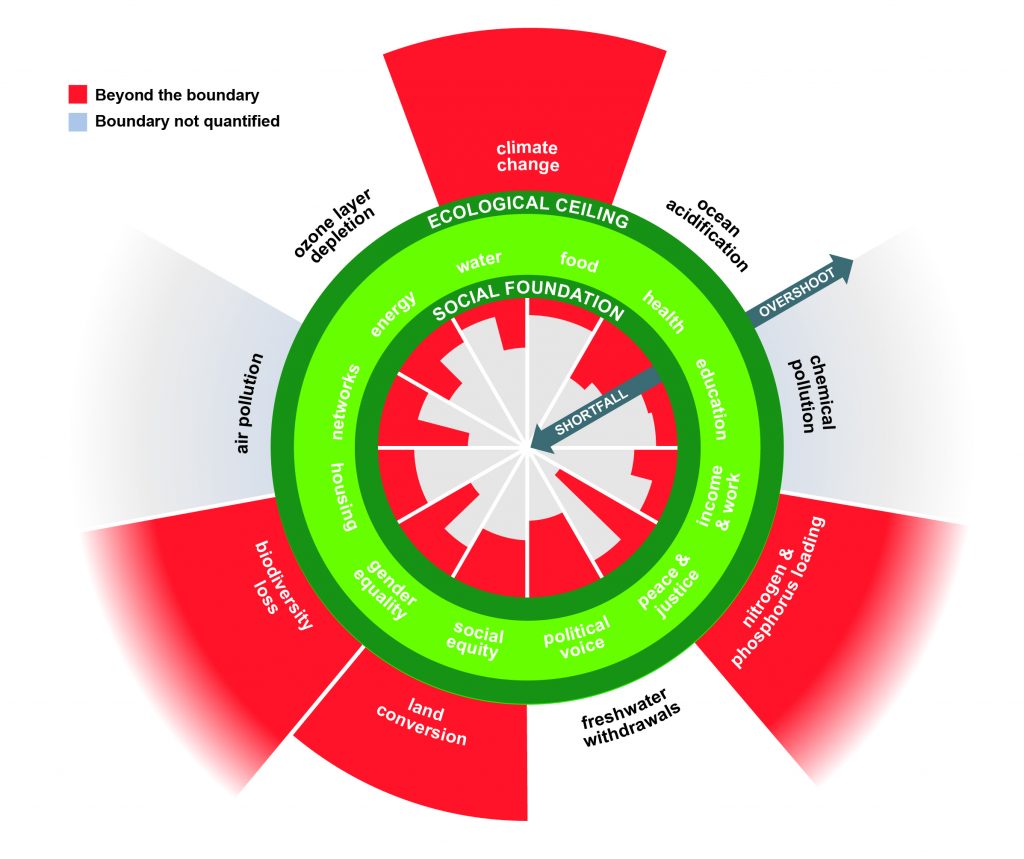
The diagram consists of two rings. The inner ring of the doughnut represents a sufficiency of the resources we need to lead a good life: food, clean water, housing, sanitation, energy, education, healthcare, democracy … . Anyone living below that line, in the hole in the middle of the doughnut, is in a state of deprivation.

The Doughnut. Graphic by Kate Raworth and Christian Guthier/The Lancet Planetary Health

The outer ring of the doughnut consists of the Earth’s environmental limits, beyond which we inflict dangerous levels of climate change, ozone depletion, water pollution, loss of species and other assaults on the living world. The area between the two rings – the doughnut – is the “ecologically safe and socially just space” in which humanity should strive to live. The purpose of economics should be to help us enter that space and stay there.

As well as describing a better world, the doughnut model allows us to see, in immediate and comprehensible terms, the state in which we now find ourselves. At the moment we transgress both lines. Billions of people still live in the hole in the middle. We have breached the outer boundary in several places.

Where we are now. Graphic by Kate Raworth and Christian Guthier/The Lancet Planetary Health

An economics that helps us to live within the doughnut would seek to reduce inequalities in wealth and income. Wealth arising from the gifts of nature would be widely shared. Money, markets, taxation and public investment would be designed to conserve and regenerate resources rather than squander them. State-owned banks would invest in projects that transform our relationship with the living world, such as zero-carbon public transport and community energy schemes. New metrics would measure genuine prosperity, rather than the speed with which we degrade our long-term prospects.

Such proposals are familiar, but without a new framework of thought, piecemeal solutions are unlikely to succeed. By rethinking economics from first principles, Raworth allows us to integrate our specific propositions into a coherent programme, and then to measure the extent to which it is realised. I see her as the John Maynard Keynes of the 21st-Century: by reframing the economy, she allows us to change our view of who we are, where we stand, and what we want to be.

Now we need to turn her ideas into policy. Read her book, then demand that those who wield power start working towards its objectives: human prosperity within a thriving living world.

www.monbiot.com

ooOOoo

 Please, wherever you are and whatever your plans are for this long weekend, do take great care of yourself and all your loved ones!

Out of this world!

Forgive my indulgence!

I wish I understood where my fascination with the night sky came from. Not that I am anything other than an amateur gazer (of the night sky, I should hasten to add!). I have never taken the trouble to gain any real knowledge.

Yet, some of the most serene moments of my life have been when I have been alone at sea under a night sky.

OK, that’s enough wallowing for anyone!

The last week has been an important one for those that take an interest in the planets in our solar system, or to be specific, take an interest in Jupiter.

For as EarthSky reported on the 8th April:

Today – April 8, 2017 – the planet Jupiter is closest to Earth for this year.

Yet yesterday was Jupiter’s opposition, when Earth flew between Jupiter and the sun, placing Jupiter opposite the sun in our sky. You’d think Jupiter was closest to Earth for 2017 yesterday as well … and yet it wasn’t. It’s closest to Earth for 2017 today, April 8, coming to within 414 million miles (666 million km).

EarthSky also included this image:

Jupiter at its April 7, 2017 opposition with the Great Red Spot and moons Io, Europa, and Ganymede (L to R). Photo by Rob Pettengill in Austin, Texas.

Then, Mother Nature Network yesterday presented more information:

Jupiter strikes a pose for Hubble portrait

April 12, 2017

During the month of April, Jupiter will be in opposition, meaning the planet is at its closest point to Earth. Thanks to the sun, it’s during this window that astronomers can enjoy a particularly close-up photo session that can help reveal how the planet’s atmosphere has changed over time by comparing it with previous such photos of the gas giant.

This photo of Jupiter was taken on April 3 by the Hubble Space Telescope when the enormous planet was 670 million kilometers (or about 416 million miles) from Earth. The photo shows the Great Red Spot, but it also shows something new: a weather feature called the Great Cold Spot, which is almost as large as its more well-known cousin.

“The Great Cold Spot is much more volatile than the slowly changing Great Red Spot, changing dramatically in shape and size over only a few days and weeks, but it has reappeared for as long as we have data to search for it, for over 15 years,” Tom Stallard, a planetary astronomer at the University of Leicester in the U.K. and lead author of the study, said in a statement.

The cold spot is nearly 15,000 miles by about 7,500 miles in size, and it’s dubbed the “cold” spot because it’s 200 degrees Kelvin (about 400 degrees Fahrenheit) cooler than the surrounding atmosphere.

The article included this stunning image of Jupiter.

Photo: A. Simon (GSFC)/NASA, ESA

Jaymi went on to write:

Here’s what some of the other details in the image mean:
The NASA/ESA Hubble Space Telescope reveals the intricate, detailed beauty of Jupiter’s clouds as arranged into bands of different latitudes. These bands are produced by air flowing in different directions at various latitudes. Lighter coloured areas, called zones, are high-pressure where the atmosphere rises. Darker low-pressure regions where air falls are called belts. Constantly stormy weather occurs where these opposing east-to-west and west-to-east flows interact. The planet’s trademark, the Great Red Spot, is a long-lived storm roughly the diameter of Earth. Much smaller storms appear as white or brown-coloured ovals. Such storms can last as little as a few hours or stretch on for centuries.

The Great Red Spot is an anticyclonic storm that is so large that Earth would fit inside it. That stormy spot — which is actually shrinking, though astronomers don’t know why — gives us a great perspective for understanding just how huge Jupiter is compared to our own blue dot in the solar system.

Finally, I’m taking the liberty of republishing in full an item that appeared on The Smithsonian site on April 7th.

ooOOoo

Hubble Snags Splendid Snapshot of Jupiter

The perfect photographic conditions make for a grand view of the gas giant

This snapshot shows Jupiter’s swirling, banded atmosphere and signature vortices. (NASA, ESA, and A. Simon (GSFC))
smithsonian.com
April 7, 2017

It’s been 27 years since the Hubble Space Telescope went into orbit, and the geriatric observatory is still going strong. When the telescope recently trained its sights on the solar system’s largest planet, the results were spectacular—proof that for the stellar spectator, age is but a number.

The image above is the latest picture of Jupiter. The snapshot was taken by Hubble on April 3 with the help of the telescope’s Wide Field Camera 3, a high-res instrument that lets the telescope observe using different wavelengths. It combines light on the visible, ultraviolet, and infrared spectrum to create an image of a massive planet in constant atmospheric flux.

In a press release, the European Space Agency, which co-runs Hubble with NASA, said that Hubble was able to take advantage of the planet’s current opposition with Earth to take the close-up. At the moment, Jupiter is lined up perfectly with the sun, and Earth is lined up with both the sun and Jupiter. Think of it as a truly heavenly photographic opportunity—a chance to look at the planet head-on. Better yet, Jupiter’s position relative to the sun means that it’s brighter than at any other time of year, which lets telescopes trained on the gigantic planet see even more detail than usual.

As The Washington Post’s Amy B. Wang notes, there were no new discoveries in the picture per se, but that doesn’t mean there’s nothing to look at. As ESA explains, scientists will compare the photo to previous views of the planet to hopefully learn more about the atmosphere. And for the rest of us, there’s a strangely soothing view of Jupiter’s layered cloud bands and impressive vortices.

The gas giant is thought to have sucked up most of the space debris left over after the sun formed, grabbing dust and gas with gravity. Scientists think it has two times as much debris as all of the other bodies in the solar system combined—and all of that material swirls through cloud layers in its quickly-rotating atmosphere.

Since Jupiter doesn’t exactly have a surface, it has nothing to slow the spots and vortices that appear in its atmosphere. The most famous, the Great Red Spot, is thought to have been swirling around for more than 150 years, and even though it’s unclear which gases give it that red hue, it’s the planet’s most recognizable feature. As NASA writes, the cloudiness of Jupiter’s atmosphere makes it hard to understand what might be contributing to it. But that doesn’t decrease its allure.

Want to delve even further into the mesmerizing bands of a huge planet’s atmosphere? A high-res version of the snapshot is available online. And if you prefer seeing things live, it’s a great time to check out Jupiter through in the night sky. You can find Jupiter in the east right after the sun goes down—a massive mystery that’s brighter than any star.

Read more: http://www.smithsonianmag.com/smart-news/hubble-snags-splendid-snapshot-jupiter-180962832/#2QLP7buDDb5PJaGK.99
Give the gift of Smithsonian magazine for only $12! http://bit.ly/1cGUiGv
Follow us: @SmithsonianMag on Twitter

ooOOoo

Let me finish up with another incredible fact.

Namely, that the universe came into existence some 13.82 billion years ago. The power of natural evolution that came with that event eventually brought along homo sapiens some 200,000 years ago. 200,000 is 0.0000145 of 13.82 billion.

Or to put it another way, we humans have only been a part of this universe for 1/10th of 1% of the life of said universe! (Oh, and dogs came along 100,000 years ago!)

Another life-saving dog!

There’s no end to how dogs protect us!

Last Tuesday, I published a guest post that had been sent to me by my sister, Eleanor, who lives in Johannesburg in South Africa.

Then a day later I read on the Care2 site about a therapy dog that alerted a group of schoolchildren to potentially very unsafe drinking water.  I must share that with you as well.

ooOOoo

Therapy Dog Helps Alert School District to Lead in Water

A therapy dog belonging to a San Diego elementary school teacher proved to be a potential lifesaver – but not for what you might think.

When the teacher filled his bowl with water from the classroom sink on Jan. 26, the dog refused to drink it. The teacher took a good look at the water in his bowl and noticed a sheen on its surface. Concerned, she notified school officials.

After testing samples from around Emerson-Bandini Elementary and the San Diego Co-Operative Charter School 2, which share a campus, results showed the water was contaminated with lead, exceeding the allowable level in the state of California.

School officials contacted the City of San Diego Public Utilities Department, which supplies the water. Because that therapy dog that refused to drink it, the city is now testing the water at each of the school district’s 187 campuses.

The tests, however, won’t begin until April 4, San Diego Unified Chief Operations Officer Drew Rowlands announced last week. In the meantime, students are getting bottled drinking water.

A notice sent to the schools’ staff and parents said the water is safe for handwashing. Since cafeteria meals aren’t prepared on campus, they’re not affected by the contaminants in the water, according to the notice.

The testing of the water, which is expected to be completed by the end of the school year in June, will take place early in the morning, before school starts. At each campus, up to five samples will be taken from water fountains and cafeterias where food is prepared. The test results will be posted online.

If excessive lead is discovered, the contamination source will be determined and school district staff will take “appropriate action on a case-by-case basis,” said San Diego Unified Chief Operations Officer Drew Rowlands. Those appropriate actions could include replacing plumbing fixtures and making repairs.

Making Drinking Water Safe for Schoolchildren

Coincidentally, just one month before the therapy dog refused to drink the San Diego school’s water, the State Water Resources Control Board (SWRCB) Division of Drinking Water launched a program that requires water providers to test for lead in the drinking water at all K-12 schools in California.

“Recent events in the United States have shown that lead in drinking water remains an ongoing public health concern, particularly for children,” the SWRCB stated on its website.

How does lead end up in school water fountains? Although lead rarely occurs naturally in California’s drinking water sources, it can contaminate water that flows through old plumbing fixtures or the solder connecting them. It’s less likely that the water came from a contaminated source, as was the case in Flint, Mich.

Children younger than six are especially susceptible to the effects of lead poisoning. According to the Centers for Disease Control (CDC), about half a million children between the ages of one and five have blood lead levels above 5 micrograms per deciliter, the level at which the CDC recommends the initiation of public health actions – although no “safe” blood lead level in children has been identified.

A problem with lead poisoning is that there are no obvious symptoms. By the time children show the signs, such as weight loss, irritability and lack of appetite, dangerous amounts of lead may have accumulated in their bodies.

This is a compelling reason for more states to follow California’s lead and require water to be tested in schools. Thanks to a teacher’s therapy dog, students at two San Diego schools got a jump start on having safer water available.

Photo credit: Irisdepiris

ooOOoo

 There is no end to the way that dogs love us, protect us and make us better persons!

The Scent Angels

The endless miracles of having dogs in our lives.

I have two sisters: Elizabeth and Eleanor. Elizabeth lives in Tokyo, Japan and Eleanor lives in Johannesburg, South Africa. They are both dear sisters and we all love each other as brothers and sisters should!

Anyway, Eleanor’s husband, Warwick, has a brother and this story is about Warwick’s brother’s step-daughter, Stacey Maguire.

It was Eleanor who sent this story to me to be published in this place.

ooOOoo

My dog saves my life every day

Stacey Maguire’s life is always in danger.

A severe Type 1 Diabetic, her body doesn’t produce the insulin it needs to control her blood sugar, leaving her vulnerable to catastrophic changes in sugar levels. But as long as her dog, Gretchen, is around she has nothing to fear. For Gretchen is a trained Diabetic Assist Dog (DAD).

Gretchen is a Swiss Shepherd who saves her owner’s life on a daily basis by warning her whenever her blood sugar is at a dangerous level. Incredibly, Gretchen does this by smell.

Stacey’s chronic condition is so severe that she’s on the best monitoring technology in South Africa. But before Gretchen came into her life, and even with that monitoring technology, Stacey still experienced hypoglycemic episodes and seizures at least once a week when changes in her blood sugar levels weren’t detected in time.

Thus when Gretchen arrived from America her sole objective was sniffing out the problem as fast as possible. And Gretchen does that – a full hour ahead of that best available technology!

Her method? An urgent paw to the knee, followed by a bark. Gretchen takes no nonsense, delivering the testing kit to Stacey’s hand if her response is sluggish. If anything goes wrong Gretchen, as a trained service animal is taught to so do, sounds an alarm or alerts the nearest person to the danger. Stacey couldn’t ask for better care.

Stacey is the first South African to benefit from a Diabetic Assist Dog. Stacey Maguire’s dream is to start a facility to train more dogs to help diabetics like her. That’s something South Africa can get behind.

ooOOoo

Eleanor also added the following by way of background:

We found a phenomenal lady called Diane Marquette in Minnesota who agreed to train a dog for export – her first time for such an undertaking.

A three-year-old white Swiss Alsatian called Gretchen made the grade for the initial training after which Di started the diabetic training. In preparation, whenever Stacey felt unwell she spat into cotton-wool and put these samples into the freezer. When Stacey had collected a bundle she sent them via courier to Di who then trained Gretchen on Stacey’s scent.

This process took ten months. Then Stacey  flew to Minnesota to meet Gretchen, to be bonded with Gretchen, to be trained and, finally, to sit and pass a very stringent exam before being allowed to bring Gretchen back home. Ten days later we met them at Cape Town International, after twenty-one hours of flying for Stacey with Gretchen at her feet in the aeroplane. SA’s first DAD had landed!

In an email to me, Eleanor included:

Stacey and Gretchen have now been together for several years with their bond just strengthening and strengthening! Gretchen alerts Stacey continuously and in recent times has started alerting at night too. Thus even accounting for the fact that, as with all dogs, Gretchen sleeps at night coinciding, unfortunately, with when Stacey is most vulnerable to shocking lows, this fabulous dog maintains awareness of Stacey’s body scents during the night hours.

Stacey’s wish is to bring trainer Di of Scent Angels to Cape Town to train trainers, and then to roll this life-saving program out to fellow diabetics.

Diane Marquette

Eleanor also included the link to the website for Scent Angels. I shall pass on the link to this post to Diane Marquette with the request that she might allow me to share some more stories of these incredible dogs with you all.

In the land of the blind!

On the Problem of Good: A book review.

As is the way of the Internet and Blogging it is inevitable that connections are made in all four corners of the globe. Some connections are transient, others become long-term. The connection between author John Zande and this blog fits the latter description.

If, dear reader, you have read my posts of the last two days, then that connection between John and me will be clear.

So on to John’s latest book: On the Problem of Good.

Now despite the fact that I awarded the book five stars on Amazon I can’t tell you that it is an easy read. Nor, to that fact, is it a comfortable read.

For John’s book played around with my head in so many ways that I am still far from returning to a settled mind. Indeed, I have a sneaky suspicion that On the Problem of Good represents another one of those turnstiles in life where once through the ‘gate’ there is no returning to the past way of seeing things.

It played with my mind in the sense of forcing me, albeit with a very small ‘f’, to truly comprehend the consequences of unanticipated outcomes. You know that old saying: “Never underestimate the power of unanticipated consequences“.

Here’s an example.

In 1889 a total of 26 road deaths were recorded in the United States. By 2013 that number had exploded to approximately 35,500. Globally, the number stands at 1.24 million and the World Health Organisation  predicts the body of carnage will grow to 1.9 million by 2020. (p.44)

That is just one of the many examples that John uses to support his premise that “good simply does not exist”.

But it goes deeper than that. For John reveals the incalculable, unstoppable force of evolution. Going right back to the very origins of matter. How hydrogen fused into the more complex helium that, in turn, fused into the still heavier and more complex carbon, then along came the fusing of helium and carbon to make oxygen. Then the journey of evolution of atoms. From single atoms to simple compounds, binding to produce double compounds and on to molecules. Then the marriage between molecules to produce amino acids, and on and on to proteins and enzymes and … well, you get the idea!

That continuum from simple to complex organisms and on and on to air-breathing animals (including wolves and then dogs!) and all the way to the likes of yours truly sitting in front of a modern computer writing the review of another person’s book.

All the time, since 13.82 billion years ago, the evolutionary force being a one-way street. A one-way street where John, with some degree of persuasiveness, demonstrates that everything that might, at that time, be seen as a good is not fundamentally a good because it is inextricably connected to a resulting evil.

The Problem of Good is a word problem. It is a lexical glitch, a squabble in temporal, fleshy definitions, and nothing more.

There is no disagreement or antipathy because there is no problem.

Good does not exist. (p.29)

See what I mean about this not being a comfortable book to read!

Nevertheless, you are waiting to hear from me as to whether or not you should read this book?

In answer, here’s a part of what I wrote for my review of the book on Amazon:

If you ever pause for a moment and wonder about the meaning of life, better written as The Meaning of LIFE, then this book is for you. More than that. For if you never ponder about the meaning of life then this really, really is the book for you.

Because for most of us, for most of the time, we live in the land of the blind.

So, thank goodness, that from time to time along comes a person who is the one-eyed King.

Thank you, John Zande.

On cruelty to our beloved animals.

One just cannot ignore such cruelty as this!

I am really sorry folks but both today and tomorrow I am adding my tiny shoulder to a very large and heavy wheel. Endeavouring to make a very small difference before I leave this land of the living.

But before going on to share something that was sent to me by Scott Beckstead, the Senior Oregon and Rural Outreach Director of The Humane Society, I want to repeat something that I wrote in response to a comment left to yesterday’s Picture Parade. Because it may be seen as utterly irrelevant to today’s complex world but, nonetheless, it does explain where my love of this planet comes from.

In yesterday’s post, Yvonne of the blog Pets, People and Life left the following comment:

Those beautiful dog’s spirit lives on in the air you breathe, the green of the trees, the beating wings of a hummingbird, the house where they lived and where ever they ran and played. I hope you and Jean feel their presence when things are rough and in the quiet of the night.

I was so moved by those words that almost without any further thought I replied, thus:

Wow! Wow! And Wow!

There is something wondrous about the nature of the human consciousness that still escapes science. Neither me nor Jean are believers in a ‘God’ or subscribe to religious ‘factions’ for so much pain, war and suffering may be laid at the feet of religions (excuse my rant!), but ….

But there is something magical in “the air you breathe, the green of the trees, the beating wings of a hummingbird,” that defies definition. I like to think of it as a deep, connection with the planet that is our womb and sustains us.

This really smacked into me in back in the early 90’s; something that forever changed me. That something I experienced roughly about 4 days out in a solo sailing passage from the Azores to Plymouth. I came up on deck, clipped on, and looked around me. Primarily on the lookout for steaming lights that might indicate a ship in the same patch of ocean. It was after midnight. Having checked there wasn’t a ship in sight, I looked up at what was a totally cloud-free night sky.

What I saw were stars in that night sky that were visible 360 degrees around me. Not only visible in every single direction but visible right down to the edge of that black, ocean horizon. A huge celestial dome centered over this tiny me on my tiny boat. (A Tradewind 33: Songbird of Kent.)

It put into perspective, emotionally, visibly, intellectually and spiritually, how irrelevant one human being is and yet, how each of us is, or should be, the custodian of something immeasurably precious and beautiful: Planet Earth.

(Whoops! Sorry about that! Rather wandered off topic!)

OK, here’s what Scott sent me:

In the past two weeks, USDA Wildlife Services has:

1. Killed an Idaho family’s beloved pet dog;

2. Sent the family’s 14 year-old to the hospital with suspected cyanide poisoning;

3. Killed a Wyoming family’s two beloved pet dogs; and

4. Killed a protected Oregon wolf.

All of these incidents were caused by the M-44, a device used by Wildlife Services that fires a cyanide pellet into an animal’s mouth, causing a slow and agonizing death.

Wildlife Services’ greatest regret in all of these incidents is that they brought the agency more negative press – and given their history, they will probably use all of the incidents as “teaching moments” to instruct their agents to “shoot, shovel, and shut up.”

PLEASE CONTACT YOUR SENATORS AND U.S. REP AND URGE THEM TO ELIMINATE FUNDING FOR USDA WILDLIFE SERVICES.

Scott then included a link to an article that was recently published in The Oregonian. I am taking the liberty of republishing it in full.

ooOOoo

Labrador killed by cyanide device in Idaho, boy knocked to the ground.

A federal M-44 cyanide device exploded Thursday, March 16, 2017, killing a dog in Pocatello Idaho. (Bannock County Sheriff’s Office)

By Andrew Theen | The Oregonian/OregonLive
March 18, 2017 at 7:30 AM, updated March 18, 2017 at 2:20 PM

A three-year-old Labrador retriever died and a 14-year boy was knocked to the ground when a cyanide device deployed by the federal government exploded in Pocatello, Idaho.

The Idaho State Journal reported the boy, who had been on a walk with his dog Thursday on a ridge near their home, watched his dog die. According to the Bannock County Sheriff’s Office, the boy was also “covered in an unknown substance” when the device known as an M-44 detonated. He was evaluated at a hospital and released.

“That little boy is lucky,” Sheriff Lorin Nielsen told the Pocatello newspaper. “His guardian angel was protecting him.”

The Idaho incident comes a few weeks after a gray wolf was accidentally killed by an M-44 on private land in Oregon’s Wallowa County. The controversial type of trap is used by the U.S. Department of Agriculture’s Wildlife Services crews around the country primarily to kill coyotes and other predators.

U.S. Rep. Peter DeFazio, D-Ore., introduced legislation as recently as 2012 to ban the trap.

DeFazio has said he would reintroduce a similar bill in Congress.

The wolf death was the first documented “incidental take” of its kind in Oregon involving the protected animal and the M-44, fish and wildlife officials said.

Federal Wildlife Services officials said there were 96 M-44 devices dispersed across Oregon as of last week and the agency was looking to remove devices that were near known wolf habitat. Oregon fish and wildlife officials have said the devices were not allowed in areas of known wolf activity.

Oregon has long paid Wildlife Services to kill invasive species and specific predators. But Gov. Kate Brown’s’ recommended budget doesn’t include $460,000 typically set aside to pay the federal agency to kill animals in Oregon.

Bannock County officials described the device as “extremely dangerous to animals and humans.”

The department circulated photos of the trap. “If a device such as this is ever located please do not touch or go near the device and contact your local law enforcement agency,” officials said.

Government officials have said the number of deaths of domestic animals and non-target animals each year is low, and officials say they are conducting an “internal review” of the wolf death.

Wildlife Services killed 121 coyotes in Oregon in 2016 with M-44 devices, along with three red foxes, according to the government’s figures. No gray wolf was killed in the U.S. last year with the cyanide capsules, according to the government.

A Eugene nonprofit says the government isn’t being truthful about the number of pets and non-target animals – such as wolves – killed each year.

“Yesterday’s Idaho poisoning of a dog and the near poisoning of a child is yet another example of what we’ve been saying for decades:  M-44s are really nothing more than land mines waiting to go off, no matter if it’s a child, a dog, or a wolf,” Brooks Fahy, executive director of Predator Defense, said in a statement.

“It’s time to ban these notoriously dangerous devices on all lands across the United States.”

— Andrew Theen
atheen@oregonian.com
503-294-4026
@andrewtheen

ooOOoo

I will be writing about another terrible example of cruelty to animals tomorrow. One where you have the opportunity to add your name to a petition trying to have this cruel ‘tradition’ stopped.

Because as Anna Sewell (1820-1878), the English author who was the author of many books including Black Beauty is recorded as saying:

My doctrine is this, that if we see cruelty or wrong that we have the power to stop, and do nothing, we make ourselves sharers in the guilt.

We cannot do nothing!

Smoke and Mirrors

Let me start with a quotation:

I’m not a pessimist, even though I do think awful things are going to happen.

James Lovelock

The author of that quote is fellow Englishman, albeit a tad older than yours truly, Mr. James Lovelock. WikiPedia describes him, thus (in part):

James Ephraim Lovelock CHCBEFRS[2] (born 26 July 1919) is an independent scientist, environmentalist and futurist who lives in Devon, England. He is best known for proposing the Gaia hypothesis, which postulates that the Earth functions as a self-regulating system.[5]

Moving on.

These times in this fine country, The United States of America, are troubling as Rebecca Gordon set out so compellingly in yesterday’s post.

But what is so terrible about these times is the failure to put integrity at the heart of every pronouncement that comes from a Government. And it would be grossly unfair to pick on the present US Government as the only example of this failure.

Because just a few mouse clicks can inform millions of us as to the real issues. Such as the effect that Climate Change is having on our health, as this recent Grist article so aptly put it in the opening paragraphs:

Here are 4 ways climate change is messing with our brains — for the worse.

We might think of climate change as purely physical: wildfires blazing through forests, rising seas lapping at the doors of coastal homes.

But those brutal conditions also affect our mental health, changing how we think and act. Mental health professionals are paying attention to the link between climate change and emotional health — and health insurance companies are, too.

Or take the issue of the state of America’s water. Recently the subject of an important essay just presented by Naked Capitalism:

America’s Hidden Water Affordability Crisis

Yves here. Grist has been doing an admirable job of keeping on top of this important yet oddly still-under-the-radar story. In the US, the big driver of rising water costs is the need to invest in aging, neglected water works. But water is going to become an issue in many places for differing reasons. As we have been saying for years, the natural resource that is projected to come under pressure first is potable water. And please don’t push desalination as a magic bullet. That costs money (both the plants and new transportation infrastructure, uses energy, plus has the not-trivial problem of how to dispose of the salt residues.

By Ciara O’Rourke, a freelance writer and 2015-16 Ted Scripps Fellow in Environmental Journalism at the University of Colorado Boulder. Originally published by Fusion and reproduced at Grist as part of the Climate Desk collaboration

When Elizabeth Mack wondered about a future in which Americans wouldn’t be able to pay for water, a couple of colleagues waved her off. “Don’t be ridiculous,” they said. But the idea niggled at Mack, an assistant professor at the Department of Geography, Environment, and Spatial Sciences at Michigan State University. And in January, in an article published in the science journal PLOS ONE, she asked a new question: Is there a burgeoning water affordability crisis in the United States?

Mack, along with research assistant Sarah Wrase, determined that if water rates increase at projected amounts over the next five years, the percentage of households that can’t pay their water bills could triple from 11.9 percent to more than a third. Nearly 14 million households nationwide already struggle to afford water services. An additional 27.18 million — or 8.5 percent of the country’s population — could soon face the same challenges.

Yes, integrity in politics is more, so much more, than a nice idea from this silly old Brit now living in Oregon. Here’s a post I published some four years ago that says it as clearly as it needs to be said.

ooOOoo

Reflections on Integrity.

Going back to basics.

Many will know the origins of this blog; a chance comment by Jon Lavin back in England in early 2007 that dogs were integrous, (a score of 210 as defined by Dr David Hawkins).

Way back in 2009, I wrote this:

“There is nothing to fear except the persistent refusal to find out the truth, the persistent refusal to analyse the causes of happenings.” Dorothy Thompson.

When I started Learning from Dogs I was initially rather vague but knew that the Blog should reflect the growing need for greater integrity and mindfulness in our planetary civilisation. Here are some early musings,

Show that integrity delivers better results … integrity doesn’t require force … networking power of a group … demonstrate the power of intention … cut through the power of propaganda and media distortion …

Promulgate the idea that integrity is the glue that holds a just society together … urgent need as society under huge pressures …. want a decent world for my grandchildren … for all our grandchildren …. feels like the 11th hour….

But as the initial, rather hesitant, start to the Blog settled into a reliable, daily posting, and as the minuscule number of readers steadily grew to the present level of many hundreds each day, the clarity of the purpose of Learning from Dogs also improved.

Because, while it may sound a tad grandiose and pompous, if society doesn’t eschew the games, half-truths and selfish attitudes of the last, say, 30 years or more, then civilisation, as we know it, could be under threat.

Or, possibly, it’s more accurate to say that our civilisation is under threat and the time left to change our ways, to embrace those qualities of integrity, truth and consciousness for the very planet we all live on, is running out.

Time left to change our ways is running out.

So what’s rattled my cage, so to speak, that prompted today’s reflection? I’ll tell you! (You knew I was going to anyway, didn’t you!)

I’m drafting these thoughts around noon Pacific Standard Time on Sunday, 17th. At the same time, tens of thousands of ordinary good folk (40,000 plus at the latest estimate) are gathering by the Washington Monument ready to march past the White House demanding that President Obama block the Keystone XL pipeline and move forward toward climate action.

Do I trust the US Government to take this action? On balance, no! That hurts me terribly to write that. I really want to trust and believe what the President of my new home country says.

State of the Union speech 2013. AP photo.

Here’s a snippet of what the President did say in his State of the Union speech on February 12th.

Now, it’s true that no single event makes a trend. But the fact is, the 12 hottest years on record have all come in the last 15. Heat waves, droughts, wildfires, floods, all are now more frequent and more intense.

We can choose to believe that Superstorm Sandy, and the most severe drought in decades, and the worst wildfires some states have ever seen were all just a freak coincidence. Or we can choose to believe in the overwhelming judgment of science and act before it’s too late.

A frank admission that the climate is changing in dramatic ways; the overwhelming judgment of science – fantastic!

The evidence that burning carbon-based fuels (coal, oil, gas) is the primary cause of today’s high CO2 levels is overwhelming. As a recent BBC radio programme reveals (being featured tomorrow) huge climate changes going back millions of years are a natural part of Earth’s history. However, as one of the scientists explains at the end of that radio programme, the present CO2 level, 395.55 ppm as of January, is now way above the safe, stable limit for the majority of life species on the planet.

But say you are reading this and are not yet convinced?

Let me borrow an old pilot’s saying from the world of aviation: If there’s any doubt, there’s no doubt!

That embracing, cautious attitude is part of the reason why commercial air transport is among the most safest forms of transport. If you had the slightest doubt about the safety of a flight, you wouldn’t board the aircraft.

If you had the slightest doubt about the future for civilisation on this planet likewise you would do something! Remember, that dry word civilisation means family, children, grandchildren, friends and loved ones. The last thing you would do is to carry on as before!

Which is where my lack of trust of leaders comes from!

Back to that State of the Union speech. Just 210 words after the spoken words “act before it’s too late” (I counted them!) Pres. Obama says, “That’s why my administration will keep cutting red tape and speeding up new oil and gas permits.

Here’s the relevant section:

I will direct my cabinet to come up with executive actions we can take, now and in the future, to reduce pollution, prepare our communities for the consequences of climate change, and speed the transition to more sustainable sources of energy.

Now, four years ago, other countries dominated the clean-energy market and the jobs that came with it. And we’ve begun to change that. Last year, wind energy added nearly half of all new power capacity in America. So let’s generate even more. Solar energy gets cheaper by the year. Let’s drive down costs even further. As long as countries like China keep going all-in on clean energy, so must we.

Now, in the meantime, the natural gas boom has led to cleaner power and greater energy independence. We need to encourage that. That’s why my administration will keep cutting red tape and speeding up new oil and gas permits.

We don’t require any more oil to be used. We are already using a staggering amount of it. Let me refer you to an essay on Nature Bats Last called Math. The scary kind, not the fuzzy kind. Prof. McPherson wrote:

I performed a little rudimentary math last week. A little because even a little pushes my limit for math, these days. And rudimentary for the same reason. The outcome was staggering: We’re using oil at the rate of 5,500 cubic feet per second (cfs).

5,500 cubic feet per second” Don’t know about you but I have some trouble in visualising that flow rate. Try this from later in the essay:

Here’s another shot of perspective: We burn a cubic mile of crude oil every year. The Empire State Building, the world’s ninth-tallest building, towers above New York at 1,250 feet. The world’s tallest building, Taipei 101, is 1,667 feet from ground to tip.

Put those buildings together, end to end, and you have one side of a cube. Do it again, and you have the second side. Once more, but this time straight up, and you have one big cube. Filling that cube with oil takes nearly 200 billion gallons … which is about one-sixth the size of the cube of oil we’re burning every year.

Burning a cubic mile every year! Yes, Mr. President, more oil permits is a wonderful way of taking action before it’s too late!

cubic mile
Image taken from http://www.flashevap.com/bigthings.htm

So let’s see what transpires? Let’s see if integrity is given the highest political focus. As in “adherence to moral and ethical principles; soundness of moral character; honesty.” Because if there’s ever been a time when all of us, from every spectrum of society need honesty about what we are doing to the planet, it’s now!

As the tag on the home page of this blog says, “Dogs are integrous animals. We have much to learn from them.

ooOOoo

Going to close with two more quotations from Mr. Lovelock.

The first:

You never know with politicians what they are really saying. And I don’t say that in a negative way-they have an appalling job.

And the second one to close today’s post:

If you start any large theory, such as quantum mechanics, plate tectonics, evolution, it takes about 40 years for mainstream science to come around. Gaia has been going for only 30 years or so.