Category: Science

Our best friend is really here to help

The most incredibly relationship we humans have ever had with an animal.

Tomorrow, I am going to repeat a post that first appeared on Learning from Dogs seven years ago. A beautiful documentary explaining in clear, scientific ways how important has been the relationship between the dog and humans.

But for today, as a ‘warm up’ to tomorrow’s post, I wanted to share an essay that appeared on The Conversation blogsite a little over a week ago and is republished within the terms of The Conversation site.

ooOOoo

How man’s best friend is helping cancer treatment

By    Professor of Veterinary Medicine, Colorado State University

February 2, 2017
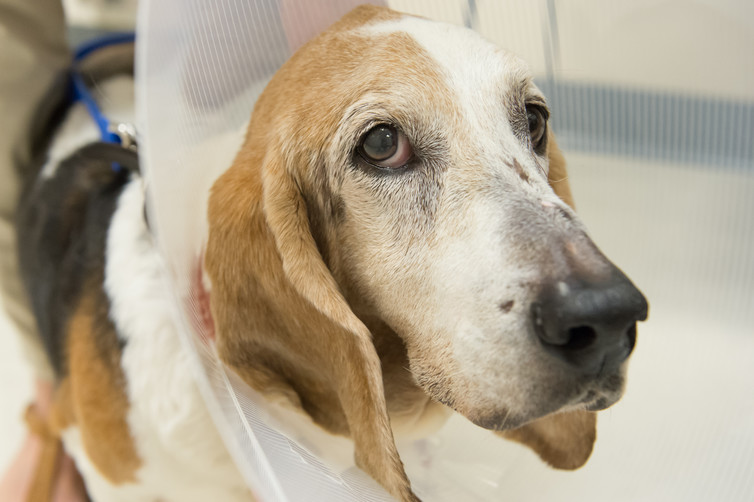
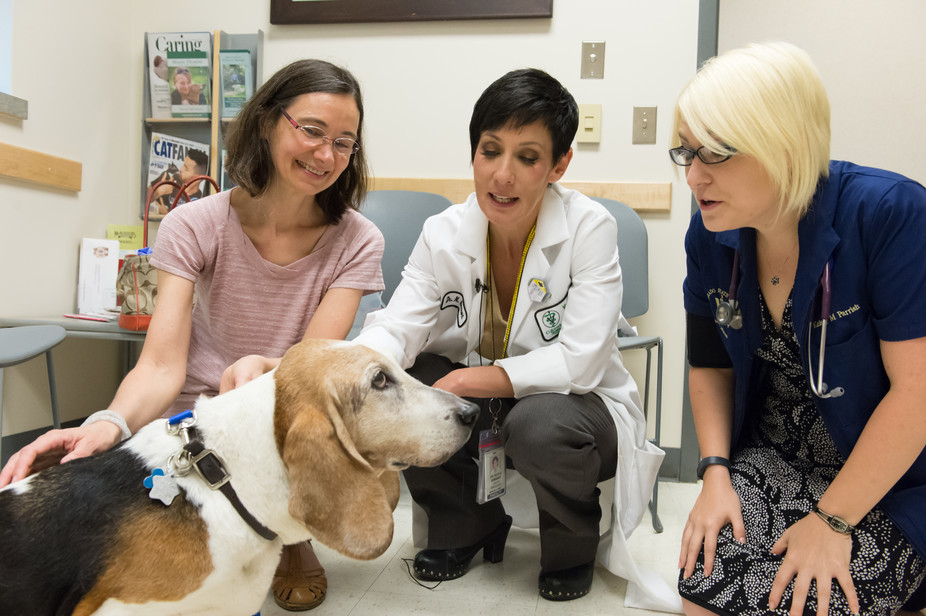
The author, center, and Dr. Anna Conti, left, and student Kelsey Parrish with Conti’s Basset hound, Picasso, who had surgery for cancer. Via Colorado State University. William Cotton/CSU Photography, Author provided

“A person can learn a lot from a dog, even a loopy one like ours. Marley taught me about living each day with unbridled exuberance and joy, about seizing the moment and following your heart… Mostly, he taught me about friendship and selflessness and, above all else, unwavering loyalty.”

John Grogan, “Marley and Me: Life and Love With the World’s Worst Dog.”

Isn’t it true? We learn so much from our dogs. But beyond what man’s best friend can teach us about enjoying life, they share something else with us. Cancer diagnoses in dogs are on the rise, as are cancer diagnoses in people. In fact, canine cancer is the leading cause of death in pets over the age of 10 years.

This confluence, it turns out, can be beneficial to cancer research. A field of study known as “comparative oncology” has recently emerged as a promising means to help cure cancer. Comparative oncology researchers study the similarities between naturally occurring cancers in pets and cancers in people in order to provide clues to treat cancer more effectively.

In fact, phase 1 and 2 clinical trials in comparative oncology are underway at 22 sites across the country, including Colorado State University, where I conduct research and am a surgical oncologist for animals.

Research in this field, involving veterinarians, physicians, cancer specialists and basic scientists, is leading to improved human health and more rapid access to effective cancer treatment than has been previously possible through traditional cancer research approaches.

More like your dog than you know

 Man and his best friend. From www.shutterstock.com
Man and his best friend. From http://www.shutterstock.com

As a species, dogs have strong physiologic and genetic similarities to people, much more so than mice, who do not typically live long enough for us to know whether they naturally get cancer. We do know that some rodent species, such as pet rats, can get cancer, but predators typically end a field mouse’s life while it is still young. The laboratory mice typically used by scientists are injected with cancer rather than it occurring naturally in their bodies.

Just as scientists officially mapped the human genome, or the complete set of genetic instructions, in 2003, scientists decoded the canine genome. They discovered that dogs have greater than 80 percent genetic similarity to humans, versus only 67 percent for mice.

In addition, cancers such as bone cancer, lymphoma and bladder cancer that spontaneously arise in pet dogs are microscopically and molecularly identical to cancers in people. Many of the genetic mutations that drive cells to become cancerous in people are the same mutations that cause cancer in dogs. In fact, when viewed under a microscope, it is impossible to distinguish between a tumor from a human and a dog.

In addition, dogs provide a large and varied population to study, important in the study of medicine. Individual dogs who develop cancer are as different from one another as are humans. Whereas laboratory mice are essentially identical twins to each other and live in a highly regulated environment, the variation among different dog breeds, home environments, diet and overall lifestyle translate into a population diversity very similar to that in humans.

Today, most pet dogs receive high-quality health care into old age and dog owners are highly motivated to seek out improved options for the management of cancer in their companions, and are also motivated to minimize side effects.

Similarities in response to treatment, too

 Picasso at the James L. Voss Veterinary Teaching Hospital, Colorado State University. Author provided., Author provided
Picasso at the James L. Voss Veterinary Teaching Hospital, Colorado State University. Author provided., Author provided.

This genetic diversity and sharing of similar DNA, physiology, microscopic structure and molecular features between dogs and humans has presented cancer researchers with a key opportunity. Dogs not only develop similar types of cancers as humans, but their cancer responds to treatments in similar ways.

This means that new cancer treatments first shown to be effective in canine cancers can frequently be predicted to have a similar benefit in human cancer patients. As a result, researchers now recognize that new drug trials in dogs with cancer will result in therapeutic discoveries that are highly “translatable”; that is, more likely to predict “real-life” medical responses in human cancer patients.

By studying how cancer responds in dogs, scientists are gaining a better understanding of how new cancer drugs not only treat the cancer but also influence the patient’s overall quality of life during treatment. This benefits dog owners, by providing access to promising new cancer treatments for their pets with cancer, and benefits human cancer patients by providing a rapid way to collect crucial data needed for FDA approval.

Dogs with cancer are helping kids

For example, a bone cancer known as osteosarcoma is so similar between dogs and people that

 The author performing surgery on a dog. Author provided. Colorado State University., Author provided.
The author performing surgery on a dog. Author provided. Colorado State University., Author provided.

intensive research in canine osteosarcoma has led to several breakthroughs in treating osteosarcoma in children. Limb-saving surgical techniques for safe and effective reconstruction following bone tumor surgery in dogs are now the standard of care in children following bone tumor surgery.

More recently, a form of immunotherapy was shown to drastically improve survival in dogs with bone cancer by delaying or altogether preventing spread of the cancer to the lungs. As a result of the success in dogs, the FDA granted fast-track status to the same treatment for use in humans last April.

Fast-tracking was developed by the FDA to support accelerated approval for promising treatments, especially for serious and life-threatening conditions. A clinical trial in children with osteosarcoma is scheduled to begin this year at multiple pediatric cancer centers throughout the United States.

These types of discoveries demonstrate that our furry companions have a crucial role in teaching us new ways to help all victims in the war against cancer – with two legs or four.

ooOOoo

As I said in my introduction, more on this theme tomorrow.

What a fabulous relationship!

Evanger’s Dog Food Recall Alert

This came in late yesterday afternoon, Pacific Time.

This was the email that was sent out.

Evanger’s Dog and Cat Food Company of Wheeling, Illinois, has announced it is voluntarily recalling specific lots of its pet food due to its potential to be contaminated with pentobarbital.

To learn which products are affected, please visit the following link:

Evanger’s Dog Food Recall of February 2016

Please be sure to share the news of this alert with other pet owners.

Mike Sagman, Editor
The Dog Food Advisor

P.S. Not already on our dog food recall notification list yet? Sign up to get critical dog food recall alerts sent to you by email. There’s no cost for this service.

If one goes to that Evanger’s Recall Link then this is what you will read. It is republished in full.

ooOOoo

Evanger’s Dog Food Recall of February 2017

February 3, 2017 — Evanger’s Dog and Cat Food Company, Inc. of Wheeling, Illinois, is voluntarily recalling specific lots of its Hunk of Beef product due to potential contamination with the deadly drug, pentobarbital.

Pentobarbital can affect animals that ingest it, and possibly cause side effects such as drowsiness, dizziness, excitement, loss of balance or nausea — or in extreme cases, death.

evangers-hunk-of-beef-recall-canWhat’s Being Recalled?

Although pentobarbital was detected in a single lot, the company is recalling all related Hunk of Beef products manufactured the week of June 6 through June 13, 2016.

The affected lots numbers that start with 1816E03HB, 1816E04HB, 1816E06HB, 1816E07HB, and 1816E13HB, and have an expiration date of June 2020.

The second half of the barcode reads 20109, which can be found on the back of the product label.

Where Was the Product Sold?

The affected products were sold both online and also distributed to retail locations only in the following states:

  • California
  • Florida
  • Georgia
  • Illinois
  • Indiana
  • Maryland
  • Massachusetts
  • Michigan
  • Minnesota
  • New York
  • Ohio
  • Pennsylvania
  • South Carolina
  • Washington
  • Wisconsin

About the Recall

The recall affects 5 lots of food that were produced from its supplier’s lot of beef, which is specifically used for the Hunk of Beef product and no other products.

To date, five dogs reportedly became ill. And one of the five dogs died after consuming the product with lot number 1816E06HB13. [Ed: My emphasis]

Evanger’s is proactively issuing a recall so as not to risk potential exposure to pentobarbital in the product.

According to Evanger’s, all suppliers of meat products are USDA approved.

The insists the beef supplier provides the company with beef chunks from cows that are slaughtered in a USDA facility.

Evanger’s continues to investigate how the contaminant entered its raw material supply.

Because it sources its meat products from suppliers that are USDA approved and since no other products have reported any problems, the company is not extending the recall to other supplier lots.

According to Evanger’s, this is the first recall event for the company in its 82 years of manufacturing.

What to Do?

Although it has been verified that little or no product remains on store shelves, consumers are asked to return recalled product to the place of purchase for a full refund.

Consumers with questions may contact the company at 847-537-0102 between 10 AM and 5 PM Central Time, Monday through Friday.

U.S. citizens can report complaints about FDA-regulated pet food products by calling the consumer complaint coordinator in your area.

Or go to http://www.fda.gov/petfoodcomplaints.

Canadians can report any health or safety incidents related to the use of this product by filling out the Consumer Product Incident Report Form.

Get Dog Food Recall Alerts by Email

Get free dog food recall alerts sent to you by email. Subscribe to The Dog Food Advisor’s emergency recall notification system.

ooOOoo

I will, of course, continue to publish every dog food alert that comes into my in-box. But don’t let that stop you from signing up for recall alerts on your own account.

Finally, if any of you are users of Evanger’s Hunk of Beef dog food and want to share your experiences then I shall be very happy to publish them here for the wider benefit of every single person who loves dogs!

The conscious, mathematical brain!

A new week!

As I have frequently mentioned, I so enjoy having guest posts being sent to me.

They give you, dear reader, a break from yours truly and so very often they offer a new and interesting perspective on dogs, on us, and on the world.

This week there are three guest posts, in various guises, lined up and, who knows, there may be a couple more heading in.

But to the first of those guest posts.

Well, technically, more of a reposting today than a pure guest post. That reposting is of a most fascinating post published by Patrice Ayme on the 25th. January. It was called WE ARE MATHEMATICS. But there were parts of Patrice’s post that I struggled with so I am offering it to you with a rather long introduction.

I hope you enjoy it.

ooOOoo

Smack!

The sound of  an object falling to the floor of the shower, suddenly and without warning, nearly caused me to jump out of my skin.

I was washing my hair and had my eyelids tightly closed lest the shampoo suds got into my eyes. Inadvertently, I had felt my right elbow dislodge something from the top of the small corner shelf that held the bar of soap and the bottle of hair shampoo.

I let the flowing warm shower water rinse the suds from my face, opened my eyes and looked down. The object that had made such a sudden, loud noise was a plastic brush maybe three or four inches long. It had fallen to the wet shower floor some five feet below the corner shelf where the brush normally lived.

As I stared down at the brush, the warm water cascading comfortably down my body, I reflected that in the space of a fraction of a second my mind had computed the distance that the unknown object had fallen and offered me a sense of the speed it must have been traveling when it hit the floor.

Now don’t get me wrong! I didn’t come up with a precise answer to that question of how fast the brush was going but in that moment of thought I sensed both the distance the brush had fallen, five feet; plus or minus, and the effect of gravity in accelerating that brush even over such a small distance. (Later I calculated the brush hit the shower base going at around 10 fps.)

Now it would have never occurred to me that my brain was capable of almost instantaneous calculations, as in mathematical calculations, if I hadn’t read in the previous twenty-four hours a recent essay from Patrice Ayme. An essay that convinced me completely that, in Patrice’s words:

The world is not as astonishingly understandable, as Einstein would have it. Neuronal grid cell studies show that we are the world. Understanding the world is understanding ourselves.

The world is not just written in mathematical language, as Galileo found out. We are made mathematically. We think mathematically, because we are made of math. We are mathematics.

Patrice had opened my eyes, more accurately opened my mind, to something that was then immediately clear to me and will be to you, dear reader: Our brains have an intuitive and instinctive sense of space. Not space in some abstract sense of the term but space in the sense of spatial awareness.

Think how easily, how quickly, you understand distance. Whether it is a measure of distance in your own home or assessing how far away that bird is flying towards and setting down on a high branch of a tall pine tree.

Think how even with our eyes closed we can navigate around a familiar part of our lives. Think how the sailors of ancient times (and trust me not so ancient times) used ‘Dead Reckoning’ (DR) to navigate safely and securely across vast oceans.

Our brains could only do this if they were computing these spatial assessments mathematically.

OK, that’s enough from me. Here’s that essay from Patrice.

ooOOoo

WE ARE MATHEMATICS

Mathematically Built Brain: The Example of Grid Cells, Incarnating Algebraic Geometry.

Understanding how the cognitive functions of the brain arise from its basic physiological components has been the final frontier in logic and rational science for thousands of years. (As I tried to explain yesterday, the superstitious religious fanatics tried their best to bury all of science, and the scientific mindset, the essence of humanity; they nearly succeeded!)

The 2014 Nobel was given to John O’Keefe (a “half”!), the rest jointly to May-Britt Moser and Edvard I. Moser “for their discoveries of cells that constitute a positioning system in the brain.” I will develop here the philosophical viewpoint, which is broader (O’Keefe’s career was steered by the influence of Hebb, the famous psychologist, who got the idea of the outside patterns imprinting the neurocircuitry of the brain).

Here is Hebb: “Let us assume that the persistence or repetition of a reverberatory activity (or “trace”) tends to induce lasting cellular changes that add to its stability.[…] When an axon of cell A is near enough to excite a cell B and repeatedly or persistently takes part in firing it, some growth process or metabolic change takes place in one or both cells such that A’s efficiency, as one of the cells firing B, is increased.”

Well it turns out that evolution has had even more imagination than that. I will even propose Patrice’s Neural Theory, a vast generalization.

Galileo famously said the language of nature was written in mathematics. It turns out that it is much more than that. Our brain is mathematically organized. What Descartes consciously discovered, a coordinate frame in which to set-up calculus, is automatically generated in the brain. This is the meaning of grid cells.

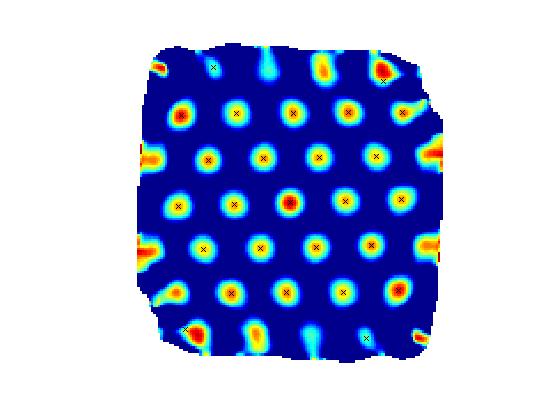
Grid cells are neurons that fire when an animal moving of its own free will traverses a set of small regions (firing fields) which are roughly equal in size and arranged in a periodic triangular array that covers all of the available environment. They were discovered in 2005 by a couple (literally) of Norwegian researchers, the Mosers, and rewarded by the Nobel Prize in 2014 (shared with O’Keefe, from London, who invented the basic experimental technique, and discovered “place cells)

Once set, navigation can be done in the dark, blinded. Scientists’ discovery that rodents, bats and nonhuman primates have a system in the brain for so-called “dead reckoning navigation”… “Dead reckoning” refers to the ability to navigate without external cues. The term comes from ship navigation. A crew will “take a sighting” via cues such as the stars or landmarks to determine where the ship is on a map. Then, when the ship moves, ‘dead reckons’ to update location on the map paying attention to speed and direction. The Greco-Romans already had such systems, with little paddled wheels counting the distance covered over the sea. It turns out that ‘dead reckoning’ is enabled by the grid cell system, inside the brain.

Recording Of Grid Cells Activity Inside Rat Brain (Jeffery Lab and others.)

Kate Jeffery, a professor of behavioural neuroscience at University College London puts it this way:

“The importance of grid cells lies in the apparently minor detail that the patches of firing (called ‘firing fields’) produced by the cells are evenly spaced. That this makes a pretty pattern is nice, but not so important in itself – what is startling is that the cell somehow ‘knows’ how far (say) 30 cm is – it must do, or it wouldn’t be able to fire in correctly spaced places. This even spacing of firing fields is something that couldn’t possibly have arisen from building up a web of stimulus associations over the life of the animal, because 30 cm (or whatever) isn’t an intrinsic property of most environments, and therefore can’t come through the senses – it must come from inside the rat, through some distance-measuring capability such as counting footsteps, or measuring the speed with which the world flows past the senses. In other words, metric information is inherent in the brain, wired into the grid cells as it were, regardless of its prior experience. This was a surprising and dramatic discovery. Studies of other animals, including humans, have revealed place, head direction and grid cells in these species too, so this seems to be a general (and thus important) phenomenon and not just a strange quirk of the lab rat.”

We should have looked for Plato’s cave. It turned out that this cave has been built, is being built inside our heads all along! This cave is built-in two ways: automatically (grid cells) and as a response to the environment, by.us, from the outside, from the environment, in.

(So it matters what our brain experienced before to mold afterwards what comes in anew from the outside! No experience is a neutral experience!)

That cave is both a topology (what’s near and what’s not, the logic of place), and a basic geometry (the grid and its grid cells). To have a grid built automatically is the equivalent of having a reference frame in mathematics. It makes sense if one wants to make mathematics!

And not just mathematics, but even Infinitesimal Calculus! It is indeed clear that animals such as dogs have a mastery of calculus: experiences have shown this, and anybody with a dog throwing a stick sideways in water will see the dog running along the shore a bit, and then jump in the water, so as to minimize the time to reach the stick, a typical calculus problem. Dogs can do calculus, because they can make algebraic geometry in their brains, having a reference frame made of these grid cells! (If they had no grid cells, they would not be able to do calculus.)

Thus Descartes rediscovered, consciously, something which had been found, evolved and calculated by evolution half a billion years ago (or more!). The reference frame, also known now as the neuronal grid cell system, is basic to all of mechanics, even Poincare’-Lorentz Relativity.  (An open question: Quantum Physics uses even more general reference systems, Hilbert spaces; I will therefore predict that the brain has also that sort of organization!)

The world is not as astonishingly understandable, as Einstein would have it. Neuronal grid cell studies show that we are the world. Understanding the world is understanding ourselves.

The world is not just written in mathematical language, as Galileo found out. We are made mathematically. We think mathematically, because we are made of math. We are mathematics.

We are not just looking at shadows in a cave, as Plato would have it. And the cave was not given to us by the gods, as Socrates had it. We are the cave, we, and our personal history, built it.

Any new experience, idea or emotion, taught or experienced, is another brick in that wall of perception and analysis, we better consider it carefully, before indulging in it. Call that the Principle of Mental Precaution But that Principle extends also to what we chose NOT to experience, which can be just as bad, if not worse.

You are not just what you think. You mentally are what you were submitted to, and what you decided to submit to. Fate is written in mathematical patterns, one theorem made out of neurons, their axons, dendrites and supporting glial cells, at a time.

Such theorems are written with the physics of minds, just as sturdy as the physics of stars. Just as hopeful, just as ominous.

Plato thought mathematics were “forms”, out there, outside of the physical world. This is not what science is finding. There are not “forms” out there, and physics, nature, somewhere else. Our minds are literally made of math.

So here is my theory:

Whatever exists in mathematics exists in the brain. And reciprocally.”

Patrice Ayme’

ooOOoo

I do so hope that this essay from Patrice fires you up as it did me. If it leaves you with questions, then offer them to me as a comment to this post and I will take it upon myself to have Patrice answer them.

Finally, did you pick up on the fact that it isn’t just our human brains that are mathematical organs, it applies to the brains of dogs as well!

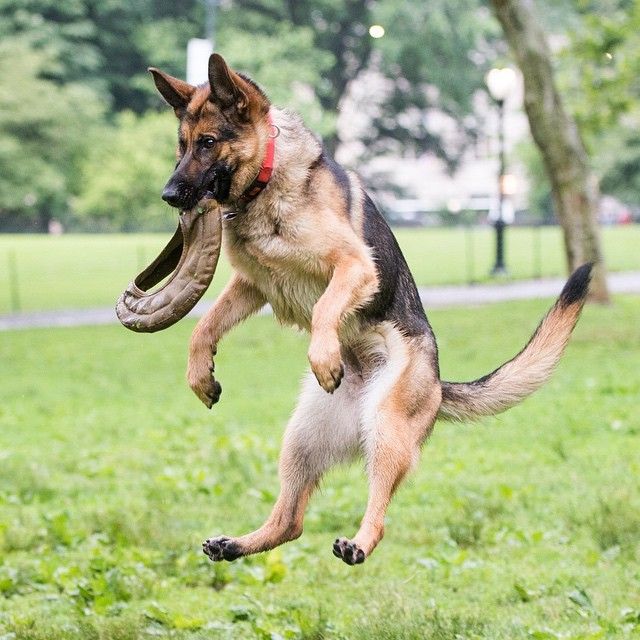
Mathematics in action. (Photo courtesy of Pinterest)

Dogs and Learning

In thanks to Yvonne over at Pets, People and Life for prompting me to write this.

In yesterday’s post Yvonne Daniel, the author of the blog Pets, People and Life, said in a comment (my highlights):

Interesting article. When training any of my dogs to learn something ( I should write when TRYING to train my dogs something) I use a high pitched happy voice. I read about the voice thing many years ago and have no idea what book or article that was in. The motive is: to get the dog to understand that you sound happy and enthused. I’m not sure why the high pitched voice is needed, in fact I don’t use it all the time. Maybe I’m not consistent enough. Being able to train a dog is an art. I’m not good at it but my dogs come when I call and generally behave. I’ve taught a few tricks but I wish that I were really good at it.

That motivated me to blow the dust off a couple of blog posts from many years back. Firstly, this one coming up now and then in an hour’s time I will publish a further post about Cleo.

So here’s the first one that goes back to November 2014, when I wrote a post, Understanding the Dog’s World, that included this:

In 2012, the American Veterinary Medical Association reported that there were over 43 million [ 43,346,000] dog-owning households in the USA. That translated to over 36% of the total households in America. With an average of 1.6 dogs per household that came to the astonishing total of 62,926,000 dogs. In just one country!

It is therefore beyond doubt that millions and millions of people, of all ages, all around the world, understand what it is like to have a dog close to them. Likewise, those millions of dogs know what us humans are capable of. But of those millions of humans who have dogs in their lives, how many understand, really understand, the world of the dog?

In my book, in the next chapter after my Prologue, the Puppyhood chapter, I speak of the circumstances that brought me into contact with Angela Stockdale of The Dog Partnership in Devon and how from that association I became aware of the three roles that dogs could be born with: mentor, monitor and nanny.

How, generally speaking, out of every fifty dogs born there were just three born, on average, with those roles and that the bulk of dogs born were straightforward pack members all of equal status.

Irrespective of the fact that we don’t normally own anything like the number that would constitute a natural pack of dogs in the wild, around fifty animals, that doesn’t alter the fact that when a puppy is born it’s social place, from a pack perspective, is ‘hard-wired’ into that puppy.

I am indebted to Angela Stockdale for granting me permission to republish her descriptions of the mentor, monitor and nanny that are available on her website. In terms of man understanding the world of the dog, these descriptions are invaluable.

Here they are:

ooOOoo

What is a Teaching Dog?

A Teaching Dog is a dog who has an instinctive desire to guide and support dogs in their learning canine communication.

A Teaching Dog helps other dogs develop their canine communication skills by displaying different body language to convey different messages. Such as lowering their heads and curving on approach as a polite way to introduce themselves. These essential etiquette skills are invaluable in preventing social issues.

A Teaching Dog teaches dogs canine etiquette to other dogs so they develop their communication skills as they go through the natural ageing process i.e. the transition from puppyhood to adolescence and from adolescence to adulthood. At these essential times, their pupils develop their skills in canine communication to a high level, hence again preventing social issues.

A Teaching Dog has an instinctive desire to guide and support dogs who find communicating difficult. If a dog has an established social issue, a Teaching Dog will actively incite interaction with them in order to teach them how to relax and communicate with them. They will assess how the other dog feels and react accordingly. Keeping their distance if the dog is concerned and approaching thoughtfully when the dog relaxes. I say thoughtfully because that is really important to understand; they think about how to work with a dog.

When a Teaching Dog works, whilst there are some elements of instinctive body language, in the main they will consciously use appropriate body language for the specific situation. They will always maintain control of an interaction but will change their posture from assertive to more inviting in accordance to the other dog’s behaviour.

On sighting the dog they are working with, they will first watch and assess them. This can be done from quite a distance with an experienced Teaching Dog. Eye contact is made but the eyes are averted intermittently whilst the Teaching Dog decides how assertive they need to be, or not as the case may be, with that particular dog. What follows from thereon is purely dependent on the other dog and that particular Teaching Dog’s way of working.

Do all Teaching Dogs teach in the same way?

No. Different Teaching Dogs have different teaching skills and different preferred roles. It is essential to recognise the role each particular Teaching Dog prefers to take. There are three primary Teaching Dog roles – Mentor, Minder and Nanny.

Mentor

A Mentor is normally quietly assertive by nature. They rarely play unless flirting with the opposite sex. However, they generally build the strongest bonds with high ranking dogs of the same sex.

As a Teaching Dog they are passively dominant. They always meet a dog with assertiveness but never hostility. They tend not to use body language to relax a dog as such but often just their presence has a calming effect on most dogs anyway.

If working in a group, they watch from the sidelines and only become involved if absolutely necessary. Mentors can be quite lazy! They will support other Teaching Dogs where needed, showing by example what to do in difficult situations if the other Teaching Dog is not coping.

Other dogs reaction to Mentors vary. Some dogs take great confidence in a Mentor and whilst not necessarily submissive towards them, they are very respectful. Some dogs find a Mentor intimidating and will avoid making contact with them.

Minder

A Minder is totally different to a Mentor in their interaction with dogs they are teaching. When a Minder meets another dog, they actively approach with the intent of interacting with them. A Minder is also naturally assertive but not as strong as a Mentor. When they meet another dog, in the Teaching Situation, they assess the new dog as they approach and use appropriate body language in accordance to the other dog’s reaction to them.

They are more generally more demonstrative than a Mentor and will actively seek interaction within a few minutes of meeting a new dog. This does not necessarily mean that they invite play. If they feel the dog is not ready for that level of interaction, they will converse with them in a more subtle manner.

If the other dog is worried but shows signs of being ready to rush at them, the Minder will stand firmly with their head side on to the dog. Eye contact is made intermittently as the Minder ascertains whether the other dog is calming down or intending to rush at them.

They can stand firm and openly display assertiveness if they need to. Once ‘control’ of the situation has been achieved, a Minder will generally incite status based activities from the other dog. These can be by marking then walking away allowing them to investigate their scent. Or they may invite the other dog into a status game, often instigating a chase.

If the other dog shows signs at trying to drive them away, the Minder will turn their head towards them and eye contact becomes stronger. They do not reposition the rest of their body. If the other dog shows signs of moving away, the Minder will totally drop their body language and move away. They will then reassess the other dog from a distance, before approaching again.

In a group situation, a Minder will monitor the group closely and interrupt any unsociable or unruly behaviour. They interrupt unacceptable behaviour by physically placing themselves between the dogs and will remain there until the tension has reduced. When the dogs in question have calmed down, the Minder will usually walk away and monitor them from a distance. They tend not to interact with the other dogs after harmony has been restored. In effect, they police a group.

Other dog’s reaction to a Minder is either respectful or challenging. Most dogs recognise a Minder as a strong dog and usually respect them. Sometimes polite status games may be played when they first meet.

As the Minder does not naturally command respect in the way a Mentor does, some dogs who have limited canine communication skills and/or adolescents can challenge them. Once the dogs have learned how to ascertain status in a polite manner from the Minder, they will usually then settle and look to the Minder for guidance in future situations.

Nanny

The Nanny is the most amazing of all the Teaching Dogs. Although not their preferred choice, a strong Nanny can take the role of a Minder or Mentor if they need to. They are unique.

They are extremely generous dogs and are at their happiest when everyone else is happy, including other Teaching Dogs. They work very differently to a Mentor and a Minder.

They not only relax a dog who is uncomfortable or anti-social but they also help relax any Mentor or Minder in a group. Few Mentors get overly stressed in a teaching situation but Minders tend to take their job quite seriously, unless really experienced and so can become tense when working.

If they see another Teaching Dog, usually a Minder, showing stress they will also consciously use body language to reduce their tension as well.

Being happier working on a one to one basis or in a group is down to each dog’s personal preference. Although, of all the Teaching Dogs they are more likely to be equally happy in either situation.

When meeting a new dog, they will observe from a distance before making a thoughtful approach. Thoughtful being the operative word as everything a Nanny does is done with thought. The Nanny tends to assess a dog in more depth than the other Teaching Dogs. This means they often take longer in their approach. They rarely communicate with instinctive responses but with conscious body movements, using the eyes in particular, when conversing with another dog.

If a dog is confrontational with them, they will remain strong in their attitude but will incite play, in particular chase games. The game of chase can be a challenge, like the ‘Chase me Charlie’ game children play. Or a game of chase can be used to loosen up a dog who is so stressed they feel unable to move.

The Nanny knows exactly what distance to keep between them and the other dog. If they feel the other dog is too close for comfort or who is becoming too unsociable, they will stop and face the dog and take control again. Once they see the other dog is more relaxed, they will stop running and attempt to converse with them again. They repeat this routine until the other dog stays relaxed and sociable with them.

In a group situation, initially they will monitor from the edge of the group and then actively walk up to each dog individually and check they’re comfortable. This also gives the other dogs confidence as they know the Nanny is there for support should they need it.

Once they have seen every group member, including any other Teaching Dogs, they will then focus on the dogs that feel the most uncomfortable, this is not necessarily the dog who shows outwardly unsociable behaviour.

It could be a dog who becomes withdrawn because they are so stressed. Sometimes they will simply follow and walk alongside a dog who is not comfortable and other times they may invite play. It totally depends on the other dog and how, at that moment, they are feeling. The Nanny may walk alongside another dog and then invite play.

The Nanny will resolve conflict by approaching in a calmer manner than a Minder usually to interrupt the unsociable behaviour. Not necessarily by physically splitting the dogs. They may bark and then play bow and/or literally pat them on the shoulder to attract their attention. A strong confident Nanny will split if they need to but prefer to resolve any conflict by mediation.

When other dogs meet a Nanny, if they have a good command of the canine language they will greet them in friendly, but not submissive manner. A Nanny’s first response to a dog displaying aggression, is to increase the distance between them. But they do not turn their back on the other dog. This would show vulnerability.

They will move away at an angle and stand sideways on to the other dog. This indicates to the other dog that whilst they are not offended and are not going to retaliate, they are also not intimidated. Initially, this can be most confusing for the other dog.

A Nanny excels at being able to recognise signals of stress in other dogs. They will only advance towards the dog to the level the other dog can cope with. As the dog learns that the Nanny will not be coming close enough to pose a threat to them, they begin to relax. In time, the other dog will take confidence from the Nanny and will look to them for guidance in difficult situations.

Is a Teaching Dog the same as the Alpha, Beta and Omega in a wild dog pack?

No. The Teaching Dog is unique to the dog world. Whilst a Mentor is usually a dog of natural Alpha status, an Alpha is not necessarily a Mentor. In fact, many dogs of natural Alpha status can not or do not want to teach. They can not be compared to wolves or any other wild dogs. Teaching Dogs working together are not a pack. They can not be compared to dogs living in a group at home. Some Teaching Dogs do not want to work together with their own group but enjoy working with dogs they know from another family. All Teaching Dogs have equally important roles. There are situations where a Mentor is better able to resolve a conflict and another time a Nanny may be the better dog to the resolve the situation.

How can I find out more about these amazing dogs?

It may sound that it is impossible for dogs to consciously work in this way, particularly the Nanny. Seeing is believing and even then it is almost unbelievable. I run a four-day introductory course on the world of the Teaching Dog. On these courses, participants can bring along their own dog for assessment. But it is important to understand and to recognise that this is not whether your dog can teach but do they want to.

You will see experienced Teaching Dogs in practice. And also those who are at the beginning of their career. I can not, of course, guarantee how they will work as I have not met their pupils yet! You will learn about the Teaching Dog as an individual, see experienced and apprentice Teaching Dogs working on video as well where you can study their conscious body language in different teaching situations.

At this first level, we will cover identifying Teaching Dogs and offering them the right learning ground to develop their natural skills. You can not train a Teaching Dog. A Teaching Dog is born a Teaching Dog. It is dependent on their life’s experiences and living environment as to whether they develop to their full potential. Many allegedly aggressive dogs are actually true Teaching Dogs. In domestic society such dogs have not been able to do what they were born to do; help other dogs without the interference of people trying to tell them how to speak their own language. Their life of frustration has resulted in aggression. Once given the time and freedom to develop their natural teaching skills, any aggressive behaviour disappears.

Time to stop talking and start listening to the real teachers – The dogs themselves

Copyright © 2005 Angela Stockdale

ooOOoo

Thus one of the key learning aspects that Angela offers us humans is that dogs (and horses) learn most effectively when being taught by other dogs (and horses). This was observed countless times by me when Pharaoh was working as a minder teaching dog and using his natural pack instinct to teach puppy dogs their social skills and breaking up squabbles between dogs.

Some closing words from Angela.

I consider myself so lucky for dogs alone to have been my teachers. I learnt from watching how my own dogs responded to another dog’s body language and vice versa their language. Watching, learning and working with Teaching Dogs was the only way I knew. Seeing how these special dogs change the lives of less fortunate dogs, who never had the opportunity to really understand how to communicate with their own species.

I was and always will be in awe of a Teaching Dog’s ability consciously to adapt their body language in accordance to how the other dog was feeling. The result being that they could relax nervous dogs but at the same time maintain control of a problem situation. Remember, dogs talk dog far better than we do.

It came as quite a shock to me when I learnt about other approaches. It seemed foreign for people to have so much input in resolving what were described as ‘ behavioural’ issues. For me, working with these dogs was far more than resolving a behavioural issue. It was about improving the quality of lives of dogs who were not coping with everyday life. If they found dogs or people worrying, sometimes this was shown in displays of aggression. It is important to understand, these dogs were not aggressive, they simply displayed aggressive behaviour.

How on earth to follow that, you might be wondering?

Very simply! By recognising that as much as we have had dogs in our lives, for thousands of years, we do not understand their world, how they truly think, what they feel, and we probably never will.

My second post that was published a while ago follows in an hour’s time.
 

Back to puppies!

Actually, some recent very interesting research on how puppies relate to the sounds of people around them.

A recent mailing under the SmartNews banner used by The Smithsonian Magazine seemed too good not to share with all you dog lovers.

Plus, our internet connection is not good at the moment so not going to dilly dally but go straight to the article that may be seen on the Smithsonian website here.

ooOOoo

Why Puppies Love Baby Talk

New research shows puppies respond strongly to high-pitched chatter, but most adult dogs could care less.

istock-511313058-jpg__800x600_q85_crop_subject_location-1501569By Jason Daley
smithsonian.com
January 11, 2017

Anyone who has lived with a dog will find themselves occasionally cooing to their pup in slow-paced, high-pitched baby talk (OK, maybe most of the time). And a new study suggests that our canines respond to such dulcet tones—well, puppies do at least.

The study, published this week in the Proceedings of Royal Society Bshows that the baby-talk, also known as dog-directed speech, gets a big response from puppies. Older dogs, however, aren’t super impressed, reports Virginia Morell at Science.

The study’s researchers had 30 female volunteers look at photographs of dogs while reading standard dog-directed phrases, like “Who’s a good boy?” and “Hello cutie!” (they didn’t use real dogs to minimize the speakers going off script). The volunteers also read the doggie praise to a human. The researchers found that women used the higher-pitched, sing-song baby-talk tone when reading the passages to the photos, making their voices 21 percent higher when reading to the puppy images. With the human, they spoke in their normal voice.

That was more or less expected. But when the researchers played recordings of the women’s voices to ten puppies and ten adult dogs at a New York animal shelter, there was a stark difference. The puppies went wild when they heard the dog-directed voices. Morell reports they barked and ran toward the loudspeaker, crouching down in a pose used to start a round of horseplay. When researchers played the same phrases using the women’s normal tone of voice, the puppies weren’t nearly as enthused.

The adult dogs, however, were a different story. “They didn’t care at all,” Nicolas Mathevon, a bioacoustician at the University of Lyon in Saint-Étienne, France, and co-author of the study tells Morell. “They had a quick look at the speaker, and then ignored it.”

There’s no clear reason why the puppies reacted so strongly to the baby talk and the mature animals didn’t. It’s possible the higher-pitched tones stimulate a special response in the puppies. Mathevon tells Helen Briggs at the BBC that it may be related to a theory called the baby schema. In that hypothesis, humans evolved to find big eyes, big heads and round cheeks irresistibly cute. That helps parents bond with children, convincing them to spend the endless hours required to feed and tend to infants. Many of those cues are also found in baby animals.

But there may be more to the response.  “One of the hypotheses was that we humans use this dog-directed speech because we are sensitive to the baby cues that come from the face of a small baby [animal] as we are sensitive to the faces of our babies,” he tells Briggs. “But actually our study demonstrates that we use pet-directed speech or infant-directed speech not only because of that but maybe we use this kind of speech pattern when we want to engage and interact with a non-speaking listener. Maybe this speaking strategy is used in any context when we feel that the listener may not fully master the language or has difficulty to understand us.”

Over time humans have bred dogs to be more baby-like, which only makes humans bond with them more, Evan Maclean, an evolutionary anthropologist at the University of Arizona not involved in the study tells Nicola Davis at The Guardian. “As a result of selection for juvenile traits, dogs emit a lot of signals that scream ‘baby’ to humans, which can facilitate special kinds of interactions with dogs that are normally reserved for children,” he says. “The question we don’t have a great answer to is whether there are long term functional consequences of interacting with dogs in this way (e.g. effects on word learning), or if this is just a byproduct of the baby-like cues that dogs inundate us with.”

So why did the older dogs just keep chewing their bones when they heard the strangers’ voices coming from the speaker? “[M]aybe older dogs do not react that way because they are just more choosy and they want only to react with a familiar person,” Mathevon tells Briggs.

ooOOoo

I think there’s more to this than the slightly light-hearted tone that came across in the article (well to my ears anyway!).

If you want to study the published proceedings from The Royal Society, referred to by Jason Daley in the second paragraph, then the paper is here:

Dog-directed speech: why do we use it and do dogs pay attention to it?

Tobey Ben-Aderet, Mario Gallego-Abenza, David Reby, Nicolas Mathevon
Only one way to finish today’s post!

P.S. Don’t run the video in front of a roomful of dogs! (As we did last night!)

Economic marginalisation.

For those looking for answers to the crisis in liberal democracy, this may well be it.

In yesterday’s post Tensions abound in many societies I offered a viewpoint that the ‘left’ arguing with the ‘right’ in politics was utterly inappropriate. Simply for we, as in the people who live on this planet, have to start working together if we wish to have a future for mankind on Planet Earth.

Yesterday’s post also referred to Inductive and Deductive Reasoning with me proposing that the future had to be built on a universally acknowledged relationship between ’cause’ and ‘effect’. A relationship that was built on a clear axiom, or theorem; as we see all around us in both the physical and natural worlds.

This idea does take a little time to filter through and I would be the first to say that I had to spend quite a while reflecting on the idea to fully understand the difference, the power, of deductive reasoning. Plus how something that was a behaviourial ‘law’ could be seen as much as an axiom as is, for example, the calculation of the speed of light, or the relationship of gravity to mass.

So returning to economics.

Quite recently there was an essay published on The Conversation blogsite written by Professor Andrew Cumbers of the University of Glasgow.

His thesis is that there is a direct relationship between “… about how well dispersed economic decision-making power is and how much control and financial security people have over their lives.

That relationship is the core message of his essay.

In other words, as I see it, there is an axiom, a theorem, that governs the relationship between the leadership process of a country and the degree to which that country’s society could be classed as a democratic society.

Here is Professor Cumbers’s essay as published by The Conversation blogsite and republished here within the terms of The Conversation.

ooOOoo

New index of economic marginalisation helps explain Trump, Brexit and alt.right

January 12, 2017 10.03am EST

Author:
image-20170111-4585-12s1o8d
“My fellow disenfranchised Americans …” EPA

If 2016 brought Brexit, Donald Trump and a backlash against cosmopolitan visions of globalisation and society, the great fear for 2017 is further shocks from right-wing populists like Geert Wilders in Holland and Marine Le Pen in France. A new mood of intolerance, xenophobia and protectionist economics seems to be in the air.

In a world of zero-hour contracts, Uber, Deliveroo and the gig economy, access to decent work and a sustainable family income remains the main fault line between the winners and losers from globalisation. Drill into the voter data behind Brexit and Trump and they have much to do with economically marginalised voters in old industrial areas, from South Wales to Nord-Pas-de-Calais, from Tyneside to Ohio and Michigan.

These voters’ economic concerns about industrial closures, immigrants and businesses decamping to low-wage countries seemed ignored by a liberal elite espousing free trade, flexible labour and deregulation. They turned instead to populist “outsiders” with simplistic yet ultimately flawed political and economic narratives.

Much has been said about the crisis of liberal political democracy, but these trends look inextricably linked with what is sometimes referred to as economic democracy. This is about how well dispersed economic decision-making power is and how much control and financial security people have over their lives. I’ve been involved in a project to look at how this compares between different countries. The results say much about the point we have reached, and where we might be heading in future.

The index

Our economic democracy index looked at 32 countries in the OECD (omitting Turkey and Mexico, which had too much missing data). While economic democracy tends to focus on levels of trade union influence and the extent of cooperative ownership in a country, we wanted to take in other relevant factors.

We added three additional indicators: “workplace and employment rights”; “distribution of economic decision-making powers”, including everything from the strength of the financial sector to the extent to which tax powers are centralised; and “transparency and democratic engagement in macroeconomic decision-making”, which takes in corruption, accountability, central bank transparency and different social partners’ involvement in shaping policy.

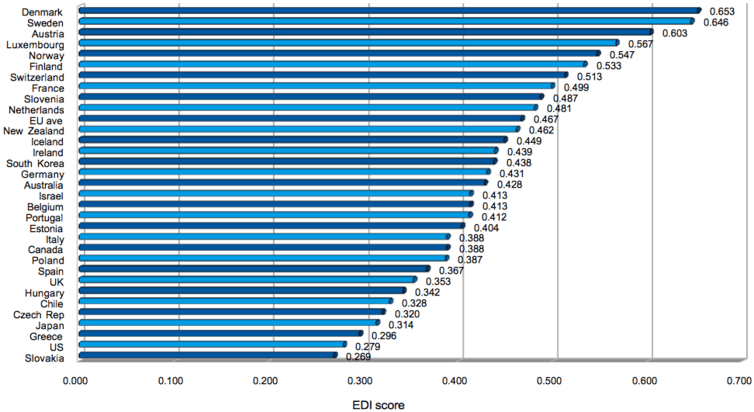
What is striking is the basic difference between a more “social” model of northern European capitalism and the more market-driven Anglo-American model. Hence the Scandinavian countries score among the best, with their higher levels of social protection, employment rights and democratic participation in economic decision-making. The reverse is true of the more deregulated, concentrated and less democratic economies of the English-speaking world. The US ranks particularly low, with only Slovakia below it. The UK too is only 25th out of 32.

 Economic Democracy Index, figures from 2013. Andrew Cumbers
Economic Democracy Index, figures from 2013. Andrew Cumbers

Interestingly, France ranks relatively highly. This reflects its strong levels of job protection and employee involvement in corporate decision-making – the fact that the far right has been strong in France for a number of years indicates its popularity stems from race at least as much as economics.

Yet leading mainstream presidential candidates François Fillon and Emmanuel Macron are committed to reducing France’s protections. These are often blamed – without much real evidence – for the country’s sluggish job creation record. There is a clear danger both here and in the Netherlands that a continuing commitment to such neoliberal labour market policies might push working class voters further towards Le Pen and Wilders.

One other notable disparity in the index is between the scores of Austria and Germany, despite their relatively similar economic governance. Germany’s lower ranking reflects the growth of labour market insecurity and lower levels of job protection, particularly for part-time workers as part of the Hartz IV labour market reforms in the 1990s that followed reunification.

The index also highlights the comparatively poor levels of economic democracy in the “transition” economies of eastern Europe. The one very interesting exception is Slovenia, which merits further study. It might reflect both its relatively stable transition from communism and the civil war in the former Yugoslavia, and the continuing presence of active civil society elements in the trade union and cooperative movements. Southern European economies also tend to rank below northern European countries, as does Japan.

Poverty and inequality

The index provides strong evidence that xenophobic politics may be linked to changing levels of economic participation and empowerment – notwithstanding the French data. We found that the greater the poverty and inequality in a country, the lower the rates of economic democracy.

These findings suggest, for example, that the Anglo-American-led attack on trade unions and flexible labour policies may actually drive up poverty and inequality by cutting welfare benefits and driving up individual employment insecurity. While the OECD itself advocated these policies until recently, countries with high levels of economic democracy such as Norway, Denmark and Iceland have much lower levels of poverty than countries such as the US and UK.

 Far right activists in Budapest, Hungary, February 2016. EPA
Far right activists in Budapest, Hungary, February 2016. EPA

Far-right populism is on the march everywhere, including the Nordic countries. But Brexit, Trump and the more serious shift to the far right in Eastern Europe have been accompanied by diminishing economic security and rights at work, disenfranchised trade unions and cooperatives, and economic decision-making concentrated among financial, political and corporate elites.

We will monitor these scores in future to see what happens over time. It will be interesting to see how the correlations between economic democracy, poverty and voting patterns develop in the coming years. For those looking for answers to the crisis in liberal democracy, this may well be it.

ooOOoo

 I shall be writing to Professor Cumbers asking if my analysis of that relationship is supported by his research.

For if it is then we do have a very clear axiom that few would disagree with. That is the political consensus this world needs now.

Oh, and we will be back to dogs tomorrow! 😉

Blue Ridge Pet Food Recall

As released by Dog Food Advisor at 07:45 PST today.

Blue Ridge Beef of Eatonton, Georgia, has announced it is voluntarily recalling one lot of its raw frozen pet food due to its potential to be contaminated with Listeria monocytogenes bacteria.

To learn which products are affected, please visit the following link:

Blue Ridge Beef Pet Food Recall of January 2016

When one goes to that Blue Ridge web link this is what you will read:

ooOOoo

January 17, 2017 — Blue Ridge Beef of Eatonton, Georgia, has announced it is voluntarily recalling one lot of its Turkey with Bone raw frozen product due to its potential to be contaminated with Listeria monocytogenes.

What’s Being Recalled?

blue-ridge-beef-turkey-with-bone-recall-jan-2017The affected product is sold in 2 pound chubs and can be identified with the following manufacturing codes:

  • Blue Ridge Beef Turkey with Bone
  • Size: 2 pound chubs
  • UPC Code 854298001887
  • Lot #103 mfdga12716

About Listeria

Listeria can affect animals eating the product.

And there is a risk to humans from handling contaminated pet products, especially if they have not thoroughly washed their hands after having contact with the products or any surface exposed to these products.

Healthy people infected with Listeria monocytogenes should monitor themselves for some or all of the following symptoms: nausea, vomiting, diarrhea or bloody diarrhea, abdominal cramping and fever.

Consumers exhibiting these signs after having contact with this product should contact their healthcare provider.

Where Was It Distributed?

The affected products were distributed to retail stores in the following states:

  • Florida
  • Georgia
  • North Carolina
  • South Carolina

What Caused the Recall?

This recall was initiated as a result of an FDA inspection and sampling of the product. This recall is being made with the knowledge of the US Food and Drug Administration.

What to Do?

Consumers who have purchased the above lot of Blue Ridge Beef Turkey with Bone raw frozen product are urged to stop feeding the product and return it to the place of purchase for a full refund.

Or dispose of the affected product immediately.

Those with questions can email the company at blueridgebeefga@yahoo.com

U.S. citizens can report complaints about FDA-regulated pet food products by calling the consumer complaint coordinator in your area.

Or go to http://www.fda.gov/petfoodcomplaints.

Canadians can report any health or safety incidents related to the use of this product by filling out the Consumer Product Incident Report Form.

Get Dog Food Recall Alerts by Email

Get free dog food recall alerts sent to you by email. Subscribe to The Dog Food Advisor’s emergency recall notification system.

ooOOoo

As the email alert that came to me said; in closing:

Please be sure to share the news of this alert with other pet owners.

Mike Sagman, Editor
The Dog Food Advisor

Best wishes to you all.

Tensions abound in many societies.

Reader alert: This has nothing to do with dogs!

Then as soon as I started to write today’s post (as of yesterday afternoon) I realised the error in my sub-title. For one might argue that this does have a connection with how our dogs behave as a cohesive group. But I’m going to be ‘an arse’ (‘ass’ in American speak) and ask you to hold out until the end of today’s post to read the ‘doggie’ connection. (Note that today’s post is Part One. Part Two continues tomorrow.)

american-gridlock_0I am in the middle of reading American Gridlock written by H. Woody Brock and published in 2012. Here’s an extract of what the book is about, courtesy of Amazon:

A sensible solution to getting our economy back on track

Pessimism is ubiquitous throughout the Western World as the pressing issues of massive debt, high unemployment, and anemic economic growth divide the populace into warring political camps. Right-and Left-wing ideologues talk past each other, with neither side admitting the other has any good ideas. In American Gridlock, leading economist and political theorist H. Woody Brock bridges the Left/Right divide, illuminating a clear path out of our economic quagmire.

Arguing from first principles and with rigorous logic, Brock demonstrates that the choice before us is not between free market capitalism and a government-driven economy. Rather, the solution to our problems will require enactment of constructive policies that allow “true” capitalism to flourish even as they incorporate social policies that help those who truly need it.

Brock demonstrates how deductive logic (as opposed to ideologically driven data analysis) can transform the way we think about these problems and lead us to new and different solutions that cross the ideological divide. Drawing on new theories such as game theory and the economics of uncertainty that are based upon deductive logic, Brock reveals fresh ideas for tackling issues central to the 2012 U.S, Presidential election and to the nation’s long-run future:

It greatly influenced me and I sat down and wrote an essay. Mainly to clarify my own thinking ahead of a meeting last Saturday of our local Freethinkers Group where the topic was “Ideas for Improving our Democratic Processes”. The “our” being the US democratic process but just as valid for many other countries.

I first set out to see if there was a clear, unambiguous definition of what a democratic society is. Surprise, surprise there isn’t one. Very quickly I came up with three:

The first:

A democracy by definition is government through elected representatives. It is a form of society which favours equal rights, freedom of speech and a fair trial and tolerates the views of minorities. Civics and Citizenship website

The second:

A DEMOCRACY IS a society in which all adults have easily accessible, meaningful, and effective ways:

(a) to participate in the decision-making processes of every organization that makes decisions or takes actions that affect them, and;

(b) to hold other individuals, and those in these organizations who are responsible for making decisions and taking actions, fully accountable if their decisions or actions violate fundamental human rights, or are dishonest, unethical, unfair, secretive, inefficient, unrepresentative, unresponsive or irresponsible;

(c) so that all organizations in the society are citizen-owned, citizen-controlled, and citizen-driven, and all individuals and organizations are held accountable for wrongdoing. Democracy Watch website

And the third:

Better democracy, everywhere.

The Democratic Society (Demsoc) works for more and better democracy, where people and institutions have the desire, opportunity and confidence to participate together.

We work to create opportunities for people to become involved in the decisions that affect their lives and for them to have the skills to do this effectively. We support governments, parliaments and any organisation that wants to involve citizens in decision making to be transparent, open and welcoming of participation. We actively support spaces, places and processes to make this happen. Democratic Society website.

I went on to say in my essay:

Yes, there is some harmony between all three definitions but there are also significant differences in tone and language.

I am sure many of you are familiar with the book by H. Woody Brock American Gridlock. I started reading it a few days ago and cannot now put it down.

For the core message of the book is that we, as in society, must distinguish between inductive and deductive reasoning. Let me use the definitions as found on the Live Science website.

Deductive reasoning

Deductive reasoning is a basic form of valid reasoning. Deductive reasoning, or deduction, starts out with a general statement, or hypothesis, and examines the possibilities to reach a specific, logical conclusion, according to the University of California. The scientific method uses deduction to test hypotheses and theories. “In deductive inference, we hold a theory and based on it we make a prediction of its consequences. That is, we predict what the observations should be if the theory were correct. We go from the general — the theory — to the specific — the observations,” said Dr. Sylvia Wassertheil-Smoller, a researcher and professor emerita at Albert Einstein College of Medicine.

In deductive reasoning, if something is true of a class of things in general, it is also true for all members of that class. For example, “All men are mortal. Harold is a man. Therefore, Harold is mortal.” For deductive reasoning to be sound, the hypothesis must be correct. It is assumed that the premises, “All men are mortal” and “Harold is a man” are true. Therefore, the conclusion is logical and true.

That is, we predict what the observations should be if the theory were correct.

Let that really work it’s way through your consciousness. It’s an idea that is rooted in the great scientists and philosophers of many thousands of years ago. Think of Euclid, the Greek Socratic philosopher who founded the Megarian school of philosophy. He was a pupil of Socrates in the late 5th century BCE, and was present at his death. (I cheated and looked it up.)

It was Euclid who through Euclidian geometry came to understand the principles of angles and straight lines; as in the shortest distance between two points.

Moving on:

Inductive reasoning

Inductive reasoning is the opposite of deductive reasoning. Inductive reasoning makes broad generalizations from specific observations. “In inductive inference, we go from the specific to the general. We make many observations, discern a pattern, make a generalization, and infer an explanation or a theory,” Wassertheil-Smoller told Live Science. “In science there is a constant interplay between inductive inference (based on observations) and deductive inference (based on theory), until we get closer and closer to the ‘truth,’ which we can only approach but not ascertain with complete certainty.”

Even if all of the premises are true in a statement, inductive reasoning allows for the conclusion to be false. Here’s an example: “Harold is a grandfather. Harold is bald. Therefore, all grandfathers are bald.” The conclusion does not follow logically from the statements.

Inductive reasoning has its place in the scientific method. Scientists use it to form hypotheses and theories. Deductive reasoning allows them to apply the theories to specific situations.

Now for some of you this side trip into reasoning may have seen more like a complete departure. But the point is that, as American Gridlock makes so powerfully: There are two main problems to be solved if this nation is to get back on track. First, win-win policy solutions must be identified for the five real-world problems addressed in Chapters 2 through 6. Second, the Dialogue of the Deaf must come to an end, policy gridlock with it, and these solutions must be implemented. (Pages 7-8)

I closed my essay by setting out the following proposition:

Until we have a clear, universally acknowledged definition of what a democratic society is then it is impossible and utterly futile to debate the various processes including what is the best process for American society.

Is this relevant to the world outside the USA? You bet it is. For better or for worse, what the USA does today the rest of the world does soon thereafter.

And as you will see in Part Two that comes tomorrow democratising the economy is key.

For when we look at the way that dogs, and wolves, operate as a pack in the wild there are only three animals with status:

  • The alpha female who has first choice of the male dogs for mating purposes and makes the decision, as and when necessary, to move her pack to a new territory,
  • The beta dog, always a male, whose role is to keep the pack running smoothly as a cohesive group and not letting squabbles get out of hand, and,
  • The omega dog, that can be of either gender, whose role is to keep the pack happy.

All the other animals in the pack of around fifty are of equal status and work for the benefit of the pack. Now that is something we should learn from dogs!

The dangers of certain brands of peanut butter.

Please read this and share.

(This was first posted on December 8th, 2016. It is being republished because of the mention of peanut butter in the article presented in my post that came out an hour ago.)

ooOOoo

Keep peanut butter away from your dogs!

Because it could kill your beloved companion.

Fellow author Judi Holdeman sent me an email that contained a warning that had been in a recent health newsletter from Jeff Reagan. Here’s the essence of that warning (and my emphasis in parts):

If your dog is anything like my dog, they probably love a good scoop of peanut butter.

As I’m writing this, my pup Ellie is actually snuggled up next to my leg and going to town on her peanut butter filled Kong. She’s in heaven…

But I want to warn you about a NEW problem with dogs and peanut butter.

There’s been a number of reports lately of dogs who are winding up dead because of their beloved peanut butter.

How is this happening?

It has to do with a new ingredient being used in certain peanut butters.

That ingredient is xylitol.

Xylitol is an artificial sweetener that you’ll recognize from things like gum and candy.

And while it’s generally “safe” for humans to eat, it can be deadly for dogs. Just a small amount of it can cause severe liver damage and can even kill your dog.

From my research, I’ve found 5 brands of peanut butter that have recently added xylitol to their ingredients. I’m listing these brands below…

– Go Nuts Co

– Hank’s Protein Plus Peanut Butter

– Krush Nutrition

– Nuts N More

– P28

Now luckily most of these are NOT the most popular brands.

These brands are usually sold at specialty shops or health food stores.

But I still wanted to alert you to this…

Because if your dog is anything like mine, they probably love peanut butter.

So make sure you’re staying away from the brands I listed above.

And double-check the label on your peanut butter to make sure it doesn’t have xylitol in it.

Feel free to forward this email on to your friends or family that have dogs so they are aware of this…

– Jeff Reagan. Editor, Patriot Health Alliance

Please, good people, do share this as far and wide as possible.

When tensions rise.

For both humans and, in consequence, for those dogs close to us.

Effectively, the whole of the New Year has been a tad challenging here in Merlin, OR. For even before the snows arrived early on in January, leading to power outages and frozen pipes, the local weather service was warning of unusually severe storms. Indeed, more than once we have heard locals speaking of this looking like a one-hundred-year-storm.

So it was inevitable that there were some anxious periods. Plus the challenging weather may not be not fully behind us. For this is the current (Sunday 18:00 PST) weather warning:

HYDROLOGIC OUTLOOK
NATIONAL WEATHER SERVICE MEDFORD, OR
134 PM PST SUN JAN 15 2017

…Flood Potential Outlook for main stem river flooding, snow melt flooding, and quick rises on rivers and streams in the following counties…in California…Siskiyou…and in Oregon…Coos… Curry…Douglas…Jackson…Josephine…

A strong atmospheric river event is expected to arrive in Southern Oregon and Northern California by Wednesday. While models have trended towards a faster progression of the front, and therefore lesser rainfall amounts, this event may still produce high snow levels, periods of heavy rain, and significant melting of lower level snow-pack Wednesday and into Thursday. With the extensive snow-pack, saturated soils and high river levels, there is a potential for flooding and rapid rises along main stem rivers and small creeks and streams. Urban areas may also experience high water from blocked culverts and runoff.

Continue to monitor forecasts for any updates as this potentially hazardous situation develops.

Anyone who has a dog (or several) in their lives will know how our anxiety is so quickly picked up by our dogs. Ergo, looking after our dogs, as in keeping them relaxed, is really important.

Now read this article that was published over on the Care2 site. I am republishing here for all you good people.

ooOOoo

Eight Natural Remedies for Dog Anxiety

1279022-largeA Care2 favorite by Becky Striepe    About Becky