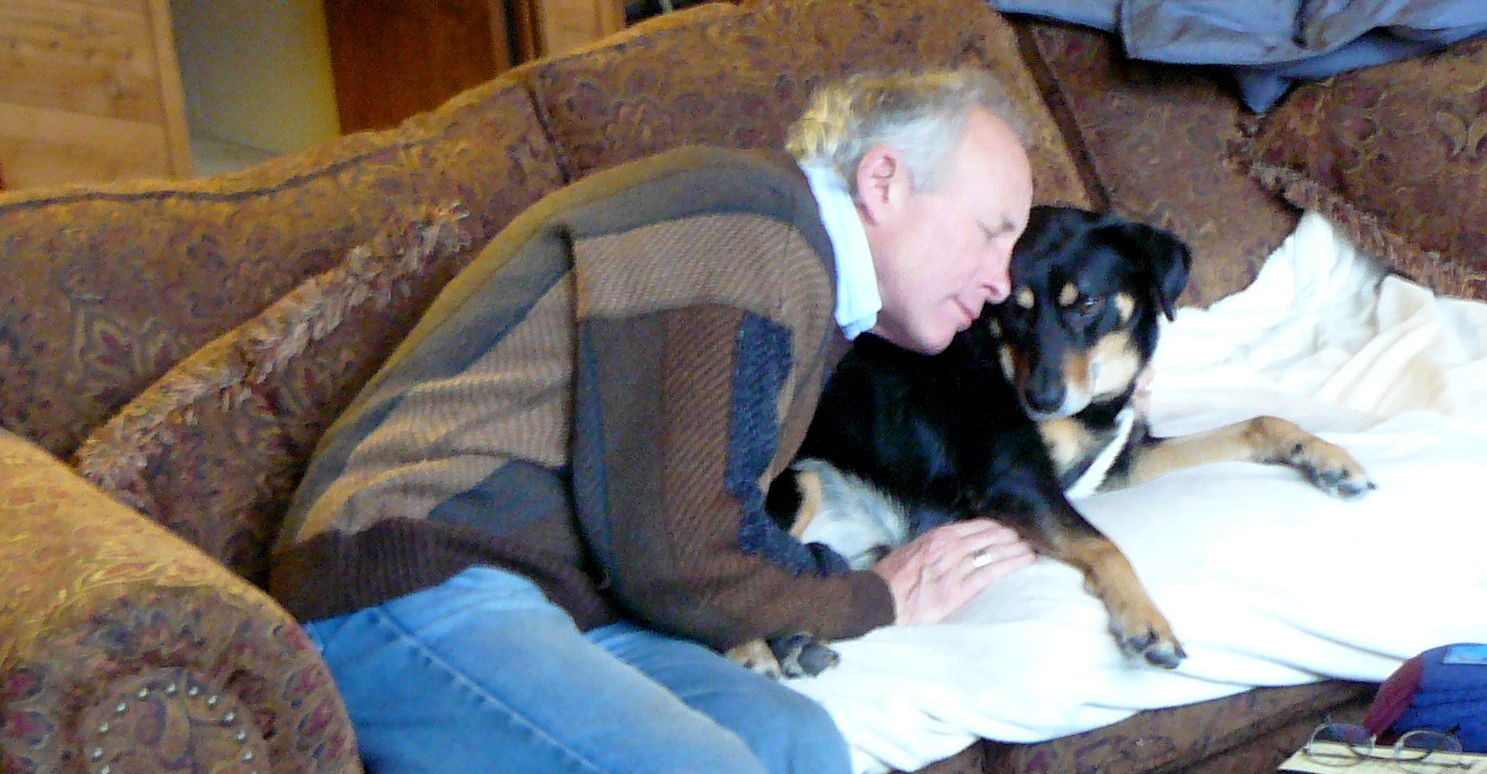
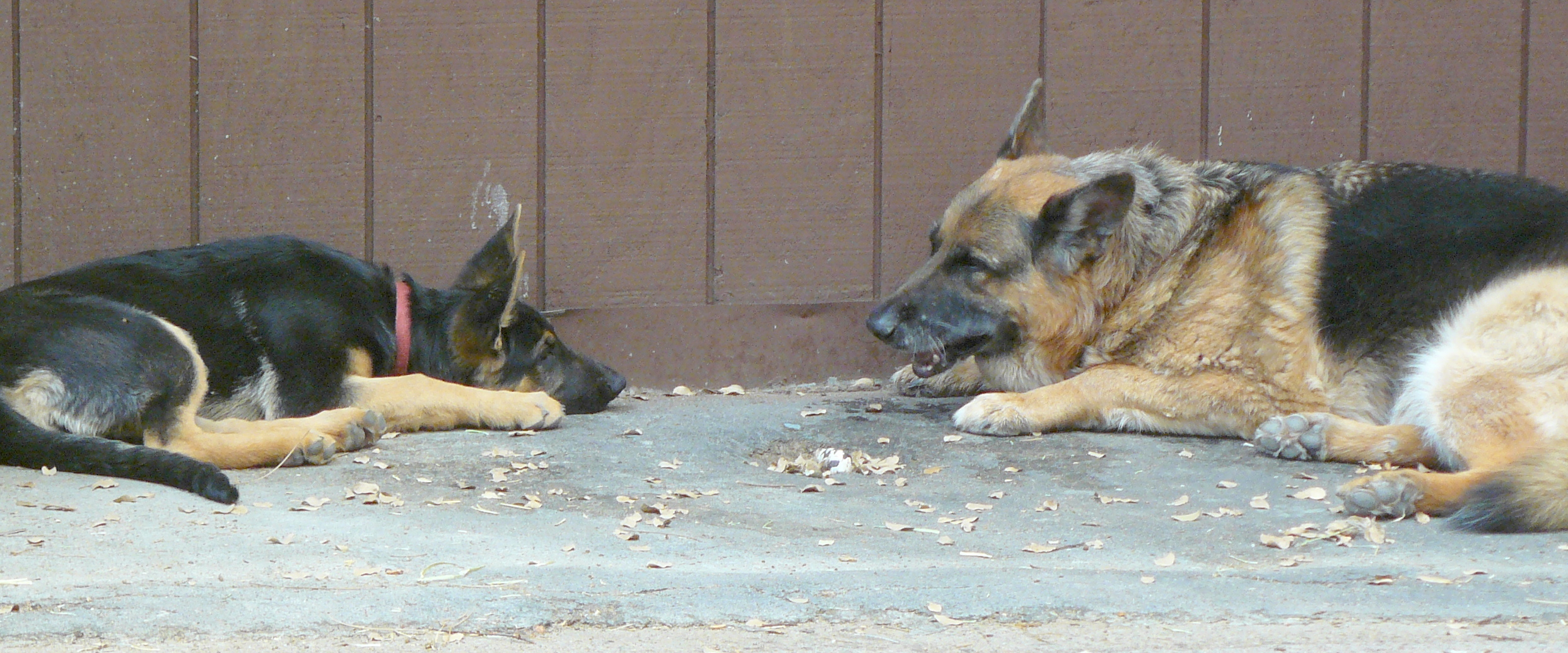
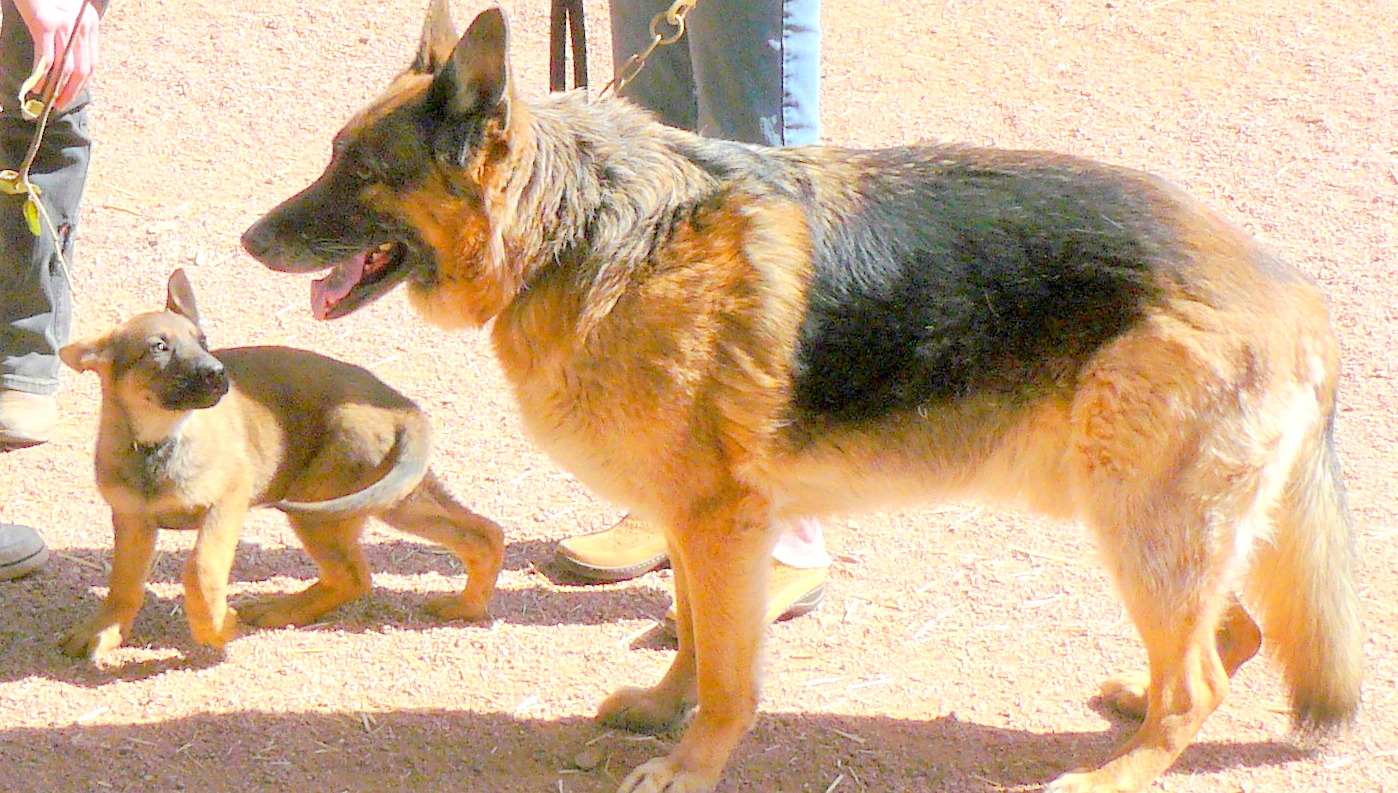
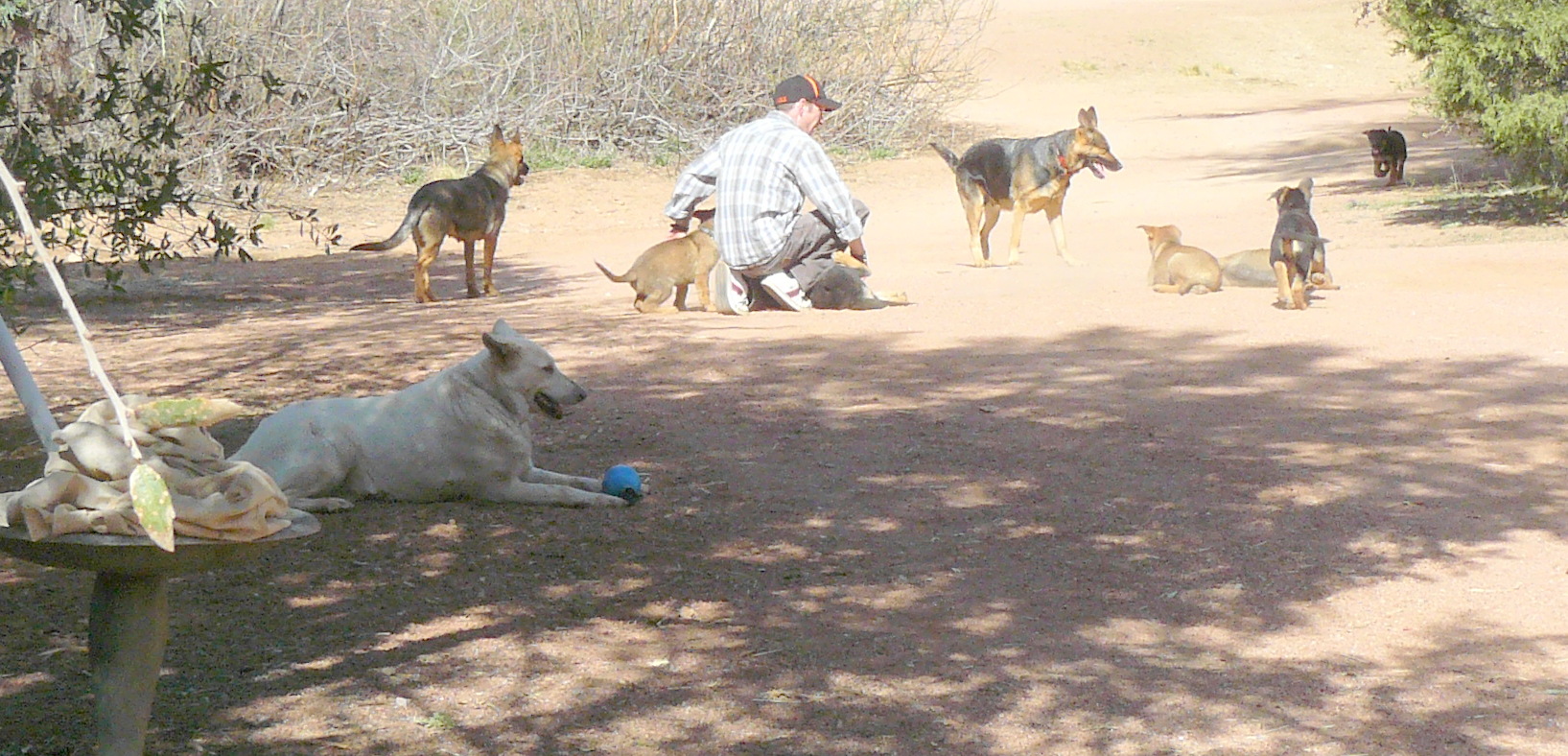
Today is our first anniversary of living in Oregon.
In many ways, it’s difficult to comprehend that we have now lived in our house a few miles from Merlin, OR, for a full year.
There are so many different, wonderful emotions associated with our move from Arizona to Oregon, of moving into a property quite unlike anything that Jean and I have ever lived in before, of seeing our dogs so happy with their surroundings, of being immersed in Nature, and so much more.
But rather than waffle on about everything in general and nothing in particular, I just want to write about the several acres of grassland that slope down from our house towards Bummer Creek, flowing North-South through the Eastern part of the property.
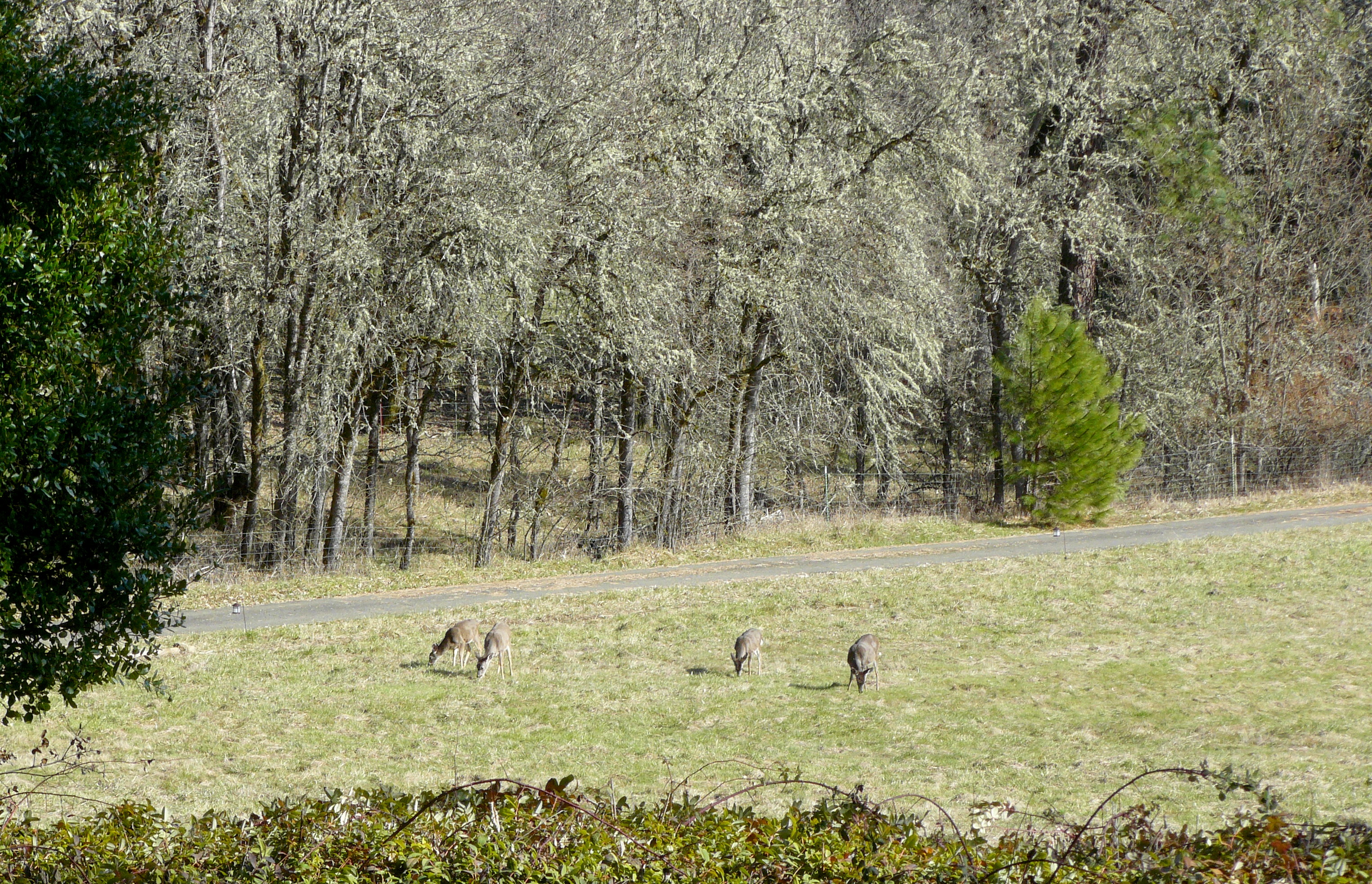
Wild deer feeding in the North-West corner of about 5 acres of our grassland.
Having mown the grassland a number of times in the Spring musing that there must be better ways to spend your time, a few weeks ago we came across an article about not mowing lawns. It was on the Mother Nature Network website and here’s how the article started.
Get off your grass and create an edible lawn
What would happen if you stopped watering, fertilizing, pesticiding and mowing your lawn?
Americans currently spend more than $30 billion, millions of gallons of gasoline, and countless hours to maintain the dream of the well-kept 31 million acres of lawns. An estimated 67 million pounds of herbicides, fungicides and insecticides are applied around homes and gardens yearly. Commercial areas such as parks, schools, playing fields, cemeteries, industrial, commercial and government landscapes, apply another 165 million pounds.
Lawn grasses are not native to the North American continent. A century ago, people would actually pull the grass out of their lawns to make room for the more useful weeds that were often incorporated into the family salad or herbal tea. It was the British aristocracy in the 1860s and ’70s, to show off their affluence, that encouraged the trend of weed-free lawns, indicating one had no need of the more common, yet useful plants. Homeowners were encouraged to cultivate lawns that would serve as examples to passers-by. These types of lawns also lent themselves to the popular lawn sports, croquet and lawn tennis. From the 1880s through 1920s in America, front lawns ceased to produce fodder for animals, and garden space was less cultivated, promoting canned food as the “wholesome choice.” Cars replaced the family horse and chemical fertilizers replaced manure.
It has been estimated that about 30 percent of our nation’s water supply goes to water lawns. In Dallas, Texas, watering lawns in the summer uses as much as 60 percent of the city water’s supply.
Next, a newsletter from The Xerces Society mentioned bee feed wildflower seed mixes from a company called Sunmark Seeds in Portland, OR. A call to them quickly produced the answer about what we could sow to help our local bees.
Hi Paul:
Upon further searching I did find 2 mixes that might fit what you are looking for. They are attached. The Bee Feed Mixture would be $36 per lb. The Honey Bee Flower Mixture would be $38 per lb. The price is a little higher but you would need a lot less. It is suggested 6-12 lbs per acre. You can still add the clover at $5 per lb and you should add 1 oz per lb of wildflower seed. There is still the option of the Knee High Low Profile mix which would be a little less at $30 per lb but the seeding rate is higher at 8-16 lbs per acre.
I have attached a spec sheet on all three mixes. Please let me know if you have any further questions.
Decision made. Three pounds of Bee Feed Mix to sow on a half-acre area as a test before we do all five acres next Spring.
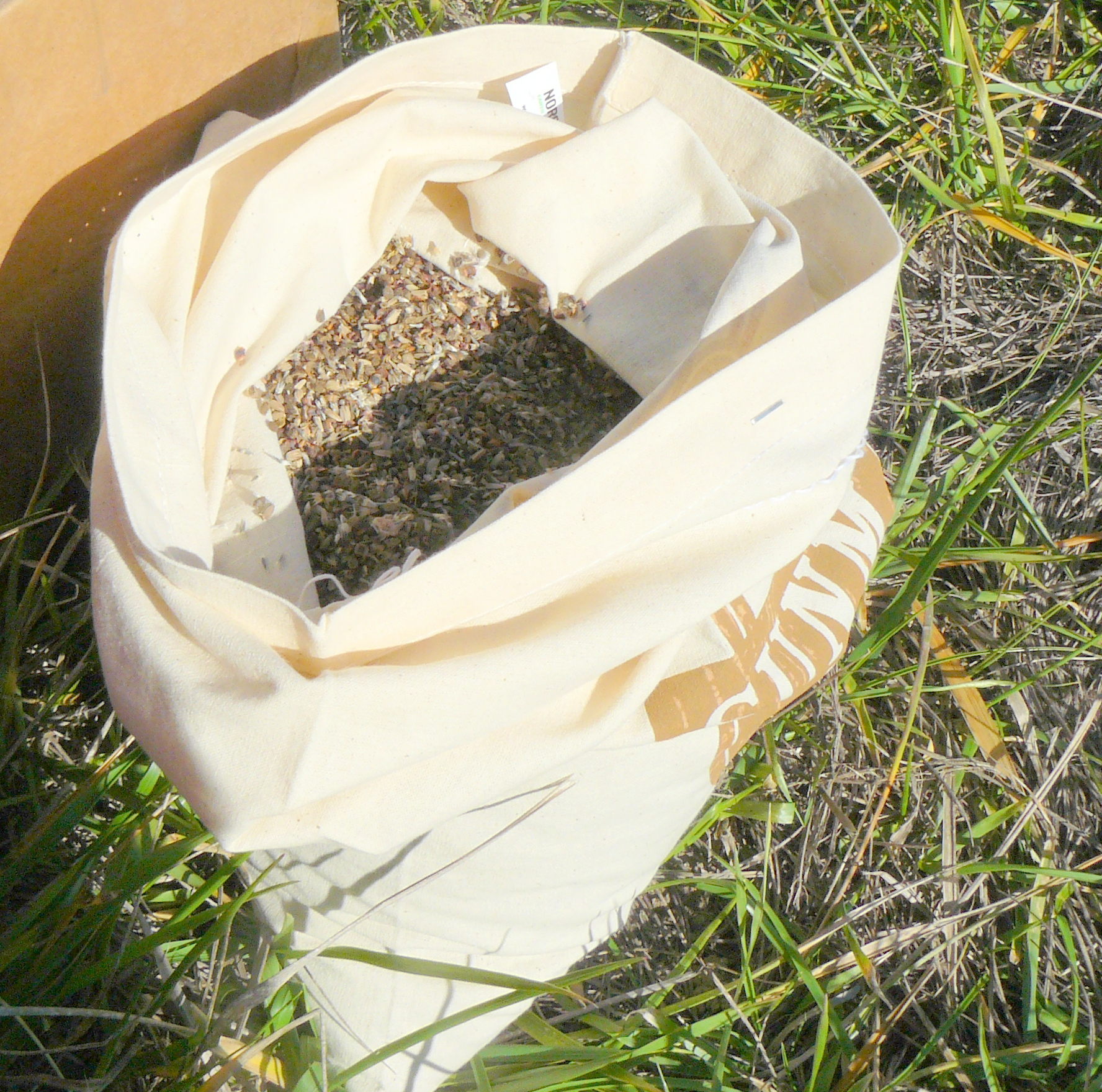
Thus not so much later a box arrived with our Bee Feed Mix and the next afternoon saw Jean and me marking out the test area and scattering the seed.
3 lbs of wild flower seed for next Spring’s bees!
oooo
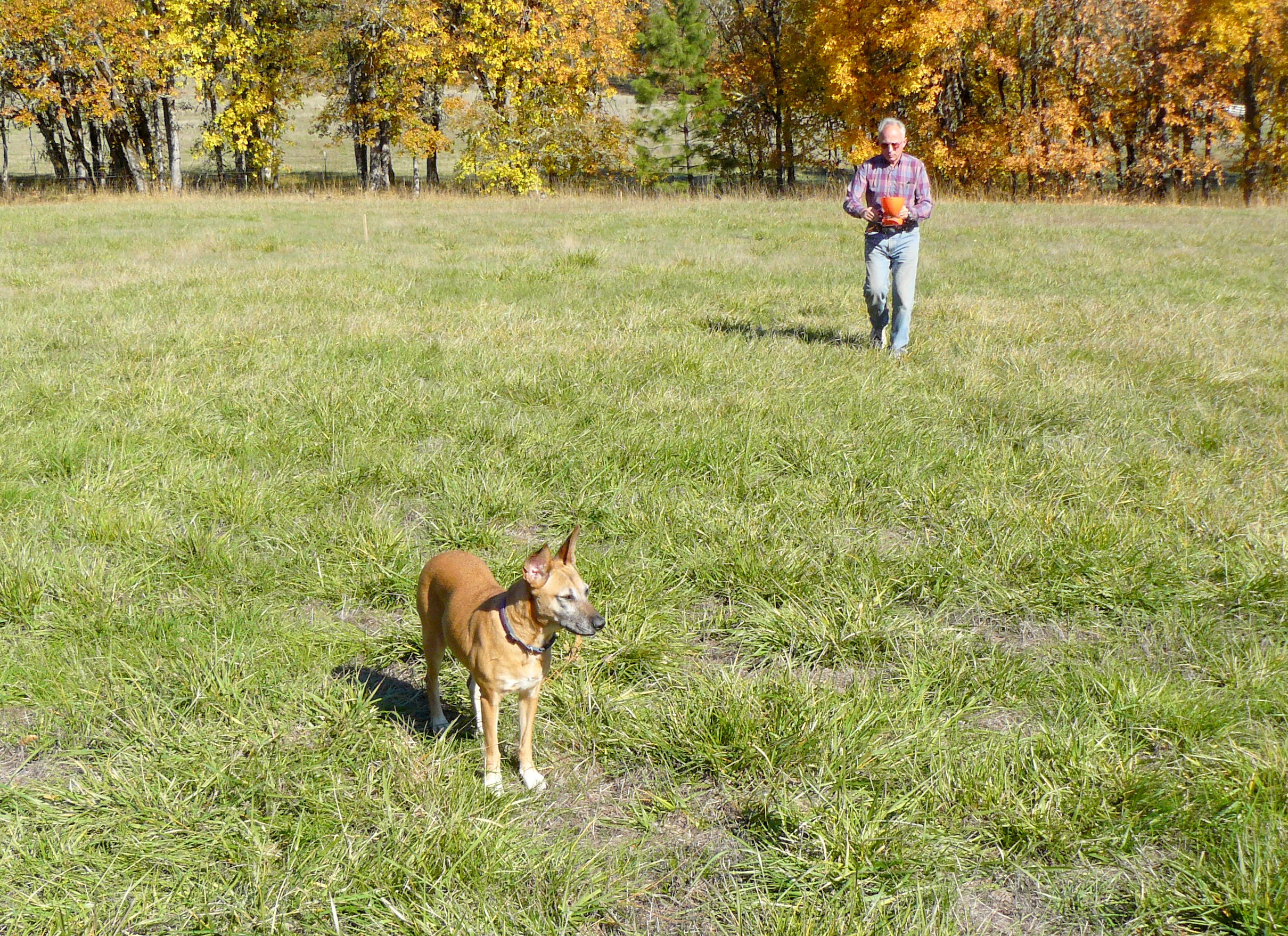
Hand-scattering the seeds with Dhalia keeping an eye on things.
oooo
It’s been an amazing year with plenty of challenges as we learnt to be rural people; yet another thing the dogs were able to teach us! However, the joy of living in such beautiful surroundings will last for ever. And more or less picking up on the theme for the week, the sharing, caring community of neighbours around us doubles that joy.
Jean and I consider ourselves two very lucky people. And no more mowing grassland! 🙂
My post last Monday, The lure of patterns, appears to have resonated far and wide. In the sense of many echoes reinforcing the perilous nature of our present times and the desperately uncertain decades ahead. Tomorrow I shall be writing specifically about those echoes.
Those echoes, as I chose to call them, were kicked off by a recent item on the blog Economic Populist. The item was called Maps of Economic Disaster and had some sickening information. Such as:
Today 15% of Americans live in poverty. Below is a county map showing the previous year’s poverty rate and we see once again the South has high concentrations.
People are living on the edge. People living in liquid asset poverty is a whopping 43.9%. This means 132.1 million people lack the savings to cover basic expenses for three months if they lose their job, have a medical emergency or some other sort of crisis. The below map** breaks down that percentage state by state. Pretty much half the country is living on the edge, paycheck to paycheck.
** I’ve not included that map but it may be seen here. However, I did want to republish the closing map.
Finally, the next map shows how income inequality has grown in United States over time. The gini index is a measure of income inequality, the higher then index gets, the worse income inequality is. If there is ever a map which shows the the destruction of the U.S. middle class, it is this one.
[N.B.The following map is an automated GIF so just left-click on it to see the sequence. That sequence is essentially a coloured graphical image of each year, from 1977 through to 2012. Don’t struggle with it. All you have to note are the changing colours. More colours towards the green end of the spectrum indicate a worsening gini index, i.e. a worsening measure of income inequality. ]
America is clearly in dire straights and the above maps it all out. Why then has this government, this Congress not put wages and jobs as jobs #1 is a good question. Why America hasn’t outright revolted, demanding this government do so is a better one.
oooo
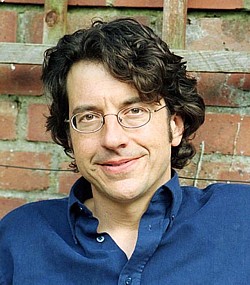
George Monbiot.
Let me now turn to George Monbiot, a British writer known for his environmental and political activism. WikiPedia describes Mr. Monbiot, in part, as:
Here are some of the things I love: my family and friends, salt marshes, arguments, chalk streams, Russian literature, kayaking among dolphins, diversity of all kinds, rockpools, heritage apples, woods, fishing, swimming in the sea, gazpacho, ponds and ditches, growing vegetables, insects, pruning, forgotten corners, fossils, goldfinches, etymology, Bill Hicks, ruins, Shakespeare, landscape history, palaeoecology, Gavin and Stacey and Father Ted.
Here are some of the things I try to fight: undemocratic power, corruption, deception of the public, environmental destruction, injustice, inequality and the misallocation of resources, waste, denial, the libertarianism which grants freedom to the powerful at the expense of the powerless, undisclosed interests, complacency.
Here is what I fear: other people’s cowardice.
There was a recent essay concerning the UK’s energy strategy posted by George Monbiot published in the Guardian on the 22nd October. It is also on his website.
The essay opens, thus [my emphasis]:
Fiscal Meltdown
The government is betting the farm on a nuclear technology that might soon look as hip as the traction engine.
Seven years ago, I collected all the available cost estimates for nuclear power. The US Nuclear Energy Institute suggested a penny a kilowatt hour. The Royal Academy of Engineering confidently predicted 2.3p. The British government announced that in 2020 the price would be between 3 and 4p. The New Economics Foundation guessed that it could be anywhere between 3.4 and 8.3p. 8.3 pence was so far beyond what anyone else forecast that I treated it as scarcely credible. It falls a penny short of the price now agreed by the British government.
Mr. Monbiot’s essay concludes:
An estimate endorsed by the chief scientific adviser at the government’s energy department suggests that, if integral fast reactors were deployed, the UK’s stockpile of nuclear waste could be used to generate enough low-carbon energy to meet all UK demand for 500 years. These reactors would keep recycling the waste until hardly any remained: solving three huge problems – energy supply, nuclear waste and climate change – at once. Thorium reactors use an element that’s already extracted in large quantities as an unwanted by-product of other mining industries. They recycle their own waste, leaving almost nothing behind.
To build a plant at Hinkley Point which will still require uranium mining and still produce nuclear waste in 2063 is to commit to 20th-Century technologies through most of the 21st. In 2011 GE Hitachi offered to build a fast reactor to start generating electricity from waste plutonium and (unlike the Hinkley developers) to carry the cost if the project failed. I phoned the government on Monday morning to ask what happened to this proposal. I’m still waiting for an answer.
That global race the prime minister keeps talking about? He plainly intends to lose.
NB. I edited out the links to a comprehensive set of references to make the essay easier to read off the screen. But all the facts reported by Mr. Monbiot may be seen here.
oooo
Just two more or less random pieces of writing that have graced my ‘in-box’. Nothing scientific about my selection; just the sense that they are representative of the reams and reams of articles, essays and reports coming in on an almost daily basis from right across the world showing an ever-increasing credibility gap between the peoples of many nations and those who purport to serve those peoples in their respective Governments.
Frankly, I can’t even imagine how or when we will ‘transition’ out of this present period. But one thing I am sure about. This schism between us, the people, and those who govern us is unsustainable!
“Minds together do not just bind together, they find together.”
My post last Monday, The lure of patterns, appears to have resonated far and wide. In the sense of many echoes reinforcing the perilous nature of our present times and the desperately uncertain decades ahead. Tomorrow I shall be writing specifically about those echoes.
Today, I wanted to spend a little time reflecting on dogs and communities! After all this blog is called Learning from Dogs!
In Monday’s post I opined that the future may well see a return to people re-evaluating and re-energising the benefits of local communities. Now when it comes to communities, there are no better examples than dogs and, so many thousands of years before dogs, grey wolves. These species have an incredibly strong social structure. I mean, of course, the pack. It’s a shame that the expression ‘pack of wolves’ or ‘pack of dogs’ has such misplaced negative connotations.
Before dogs were domesticated, as in when they first evolved from the grey wolf, they shared with wolves a natural pack size of around 50 animals. There was a very strong social cohesiveness within that pack yet a very ‘light’ status differential between those dogs having pack status and the mass of the pack group. Ditto with wolves.
In fact there were (still are) just three status roles: Mentor/Monitor/Nanny. Or has been described previously on this blog: Alpha/Beta/Omega roles. Even within the domesticated dog, thousands upon thousands of years later, those social instincts are alive and well. Many followers of Learning from Dogs will know that Pharaoh, him of the Home Page, now an elderly German Shepherd is a Monitor or Beta dog. I could write about this aspect of dogs for hours!
Pharaoh being a monitor for young Cleo.
So back to us funny old humans.
I closed last Monday’s post off with three predictions:
That the power of internet communications will allow more people, more quickly, to find their soul-mates wherever they are on this planet.
That the realisation of how dysfunctional many Governments are, of how truly poorly they serve the majorities of their citizens, will lead to mass rejections of these so-called Governments’ policies. Such rejections predominantly peaceful, as in taking the horse to water but being unable to make it drink.
That there will be a new form of localism. At two levels. Literally, people geographically close to each other creating 21st C. versions of local communities. Virtually, those local communities linking to other like-minded communities right across the world resulting in highly effective and innovative learning, accelerated common-sense, (call it wisdom if you wish), and extraordinarily efficient and sustainable ways of living on this planet.
Dear Paul: I like your predictions. They will play some role. But maybe somewhere in the bushes only. I think predictions of the future beyond the next 12 months are obsolete.
Jeremy remarked: (and do click the link and read some of Jeremy’s fantastic poetry)
I am hoping for a new localism. I see signs of this in the local food movement and a growing concern about factory farming, for one thing. I think people are really scrutinizing where their food comes from, where their medicines are made, and I think there also is a dawning awareness of how we are living on the backs of exploited third world workers (and poorly paid service workers here at home). I do see signs of these things permeating the consciousness of many people and leading them to want to become more “local.”
Your predictions are good, and I liked the one of communities from different parts of the world working with each other… that was creatively brilliant.
(Click on their names to see three wonderful blog sites, by the way.)
So my idea of a return to an era of localism, but a 21st C. version reflecting the way so many millions of us are connected electronically, wasn’t immediately rejected.
Patrice recently published a post called Devils In The Details. I mentioned in a comment to that post that I would be referring to it in this place. Patrice replied [my italics]:
Very good, Paul! No doubt you will bring more common sense to one more of these interesting collaborations you bring together! Internet debates! A long way from the paleolithique cave!… But still the same idea. Minds together do not just bind together, they find together.
I found that last sentence so powerful that it was used as the sub-heading to today’s post. Then Alexi Helligar commented:
The word consciousness, breaks down to con+scious+ness, which literally means together knowing or shared knowledge.
Adding in a subsequent comment:
In other words: Without society there is no consciousness. The sages of old knew this. Why has it been forgotten?
So right before my eyes (and yours!) we are seeing the power of ‘finding together‘.
Finally, just on the spur of the moment, I did a web search under an entry of ‘early caveman social structure’. Guess what! One of the top search returns was an essay by an Erik D. Kennedy under the title of On the Social Lives of Cavemen. From which jumped off the screen:
Human beings are no strangers to group living. Call it a family trait. Our closest animal relatives spend a good bulk of their time eating bugs off of their friends’ back. While I’m overjoyed we’re not social in that manner, I’m less pleased that we’re not social more to that degree. In study after study, having and spending time with close friends is consistently correlated with happiness and well-being. And yet, the last few decades in America have seen a remarkable decline in many things associated with being in a tight-knit social circle—things like family and household size, club participation, and number of close friends. Conversely, we’ve seen an increase in things associated with being alone—TV, commutes, and the internet, for example.
This trend is quite unhealthy. It’s no surprise that humans are social animals—but it may be surprising that we’re such social animals that merely joining a club halves your chance of death in the next year—or that living in a close-knit town of three-generation homes can almost singlehandedly keep you safe from heart disease.
My goodness me, this sharing idea may be core to a healthy society in ways that we need to return to. Erik’s essay goes on thus:
That particular case—of Roseto, Pennsylvania—is mentioned by Malcolm Gladwell in his book Outliers. In 1950’s Roseto, the incidence of heart disease in men over sixty-five was half the national average (and suicide, alcoholism, drug addiction, and serious crime were also basically unheard of[ii]). Bewildered doctors searched for solutions in genetics, diet, exercise, and geography, but finding nothing, reached the conclusion that it was the close-knit social life of the community that kept its residents so healthy. Dinners with grandma, friendly chats between neighbors, and a precocious level of civic involvement were the driving factors in the health of a town that nothing but old age could kill.
The happiness and health I’m describing are not, however, ingredients to a long-lost elixir of well-being. This sort of paleo social life occurs in cultures large and small all over the globe. America just happens to be an enormous exception (and the one that I live in). The whole reason Roseto was an outlier is because it was a town whose inhabitants more or less collectively moved from rural Italy to the middle of Pennsylvania over a few decades. This was basically an Italian village in the American countryside, and it stood out because Italy’s social culture was remarkable compared to America’s—and that was in the 1950’s. America’s social culture has only deteriorated even further since then. We’ve lost a lot, but my thesis is a positive one; we have as much to gain as ever.
So if wolves and dogs naturally settle into packs of 50 animals, what’s the optimum ‘pack’ size for humans? Dear Erik even offers that answer:
Along with that urban emigration came a shrink in residents per household and a widespread decline in community and organization engagement. This isolation has been taxing on our physical and mental health, and the reason has been clear from the beginning: it’s not good for man to be alone.
So we’ll spend more time with other people. Fine. But who should we spend our time with? What kind of groups should we hang out in? And how big of groups? The simple answer is: as long as you’re pretty close to the people you’re with, it hardly matters. Piles of research back up what is essentially obvious from everyday experience: that the more time you spend with people you trust, the better off you are. That’s not to discourage actively meeting new people, but seeing as though close friends push us towards health and happiness better than strangers, there does appear to be a limit on the number of people you can have in your “tribe”.
And that number is about 150, says anthropologist Robin Dunbar, who achieved anthropologist fame by drawing a graph plotting primates’ social group size as a function of their brain sizes. He inputted the average human brain size into his model, and lo and behold, the number 150 has been making a whirlwind tour of popular non-fiction books ever since. Beyond being the upper bound for both hunter-gatherer tribes and Paleolithic farming villages, it appears that everything from startup employee counts to online social networks show this number as a fairly consistent maximum for number of close social ties.
You really must read Erik’s essay in full; it really ‘spoke’ to me and maybe it will do the same for you.
So no other way to close than to say that of all the things we can learn from dogs, the power of sharing, of living a local community life, may just possibly be the difference between failure and survival of us humans.
Dogs and man should never be alone.
oooo
I’ll say it again! Dogs, and man, should never be alone!
Literally, as a long-case clock is tickled back to life.
We are experiencing a period of foggy mornings giving way to brilliantly clear and sunny afternoons.
Yesterday was no exception.
Looking out to the North-East with Mt. Sexton behind the mists.
oooo
Having walked some of the dogs around 9am it seemed a good idea to find a task indoors for the morning. How about sorting out the ‘grandfather’ clock, or long-case clock in proper speak!
Every since we came up from Arizona to settle here in Southern Oregon, now almost a year ago, that clock had not been running well. It’s nothing special in terms of its lineage but over many years of collecting and repairing clocks in my earlier days in Devon, UK, I’ve always had a soft spot for the long-case clock.
The project!
oooo
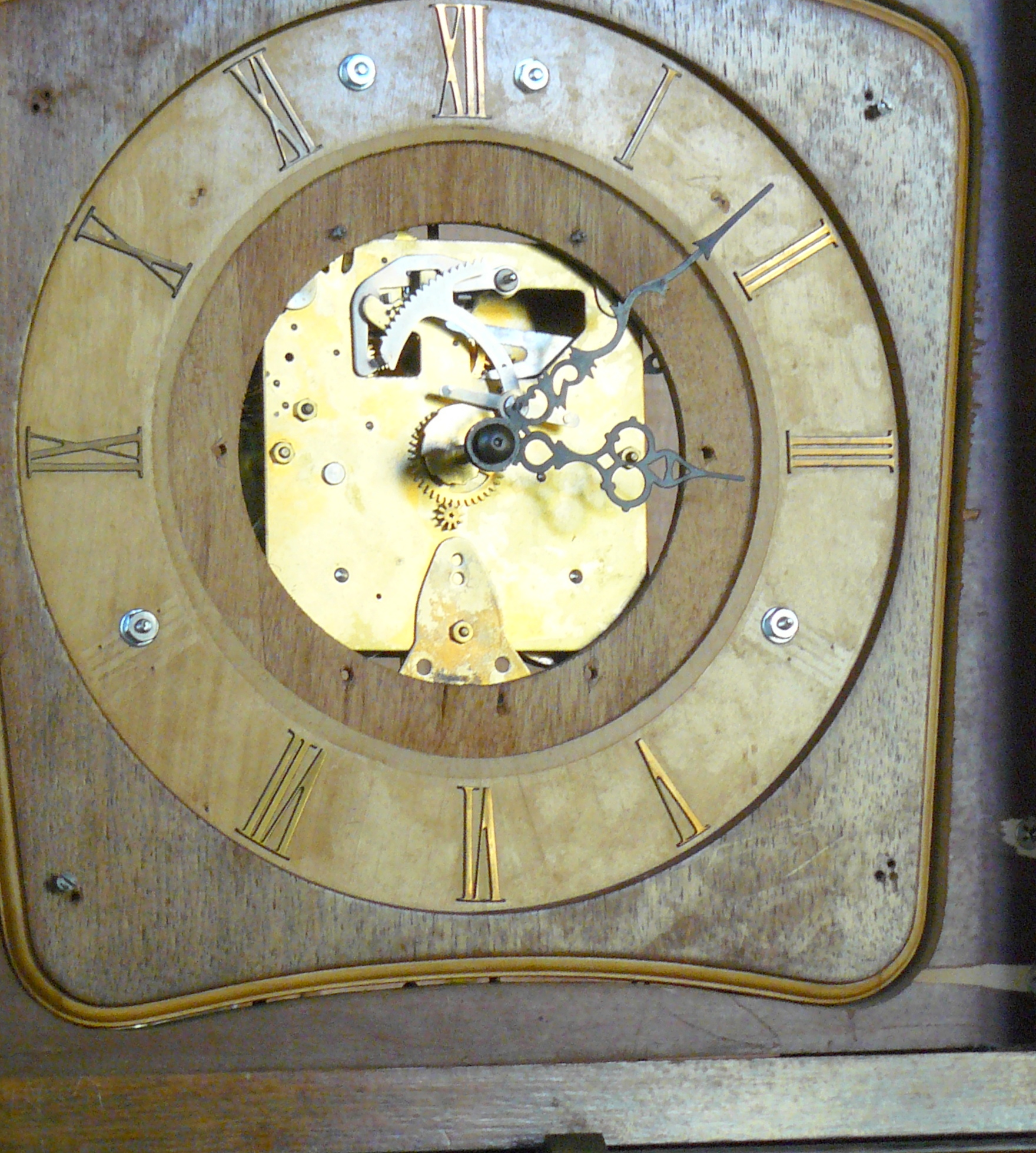
This particular clock, as seen in the above picture, is a real hotch-potch. The original face is nothing special and somewhere along the line a previous owner came across a more ‘antiquey’ face and screwed it over the original.
Possibly the original face?
oooo
Old over new!
oooo
Anyway, the first task was to even up the movement, again a real mess.
A long way from how this clock was originally built!
oooo
All this a long-winded way of saying that by the time the clock seemed to be running in a settled fashion it was coming up to 4pm and my creative juices for blog writing, such as they are, had evaporated.
Hence the clock story!
And in answer to those who might wonder why so much time and effort went into such a dreadful jumble of a clock, the one thing I adore about mechanical clocks is the sound of the ‘tick’ and the chimes.
There is no better sound than the steady tick of a long-case clock and those haunting chimes on the half-hour and on the hour.
The video below is a wonderful example of a real vintage clock!
This is a client’s beautiful longcase clock that I serviced not long ago. The clock is by J. Woolfenden – Royton and it dates to roughly 1785 (based on some research that was done on it).
In this video, you hear the clock striking 11 o’ clock on a nice original bell. The clock was running during testing, but it was not in beat (I had to fix the leveling later).
Somewhere in my aged brain cells is the memory of having heard that humans are great lovers of patterns. In other words, patterns are deemed to be very important for the progress and evolution of homo sapiens. Of course, it is not just humans who learn from patterns; I’m sure most of the animals who live around us are great pattern matchers. To support that proposition, anyone who has owned a dog or cat will have spotted how quickly they learn patterns. (As an aside, some months ago our puppy German Shepherd, Cleo, work me at around 4am because she needed to go outside for a ‘call of nature’. I now get woken every single night variously between 2am and 5am for Cleo’s benefit!)
The British mathematician G. H. Hardy who lived from the last quarter of the 19th Century well into the 20th Century, reputedly said (and I cheated and looked it up!):
A mathematician, like a painter or poet, is a maker of patterns. If his patterns are more permanent than theirs, it is because they are made with ideas.
So why has this post opened with the theme of patterns? Because, call it coincidence or what, within the last couple of weeks there have been three articles, each from very a different source, predicting that the present levels of inequality in society are both unsustainable and the beginning of the end.
Global wealth inequality: top 1% own 41%; top 10% own 86%; bottom half own just 1%
—–
Just 8.4% of all the 5bn adults in the world own 83.4% of all household wealth (that’s property and financial assets, like stocks, shares and cash in the bank). About 393 million people have net worth (that’s wealth after all debt is accounted for) of over $100,000, that’s 10% own 86% of all household wealth! But $100,000 may not seem that much, if you own a house in any G7 country without any mortgage. So many millions in the UK or the US are in the top 10% of global wealth holders. This shows just how little two-thirds of adults in the world have – under $10,000 of net wealth each and billions have nothing at all.
This is not annual income but just wealth – in other words, 3.2bn adults own virtually nothing at all. At the other end of the spectrum, just 32m people own $98trn in wealth or 41% of all household wealth or more than $1m each. And just 98,700 people with ‘ultra-high net worth’ have more than $50 million each and of these 33,900 are worth over $100 million each. Half of these super-rich live in the US.
Michael Robert’s essay closes:
All class societies have generated extremes of inequality in wealth and income. That is the point of a rich elite (whether feudal landlords, Asiatic warlords, Incan and Egyptian religious castes, Roman slave owners, etc) usurping control of the surplus produced by labour. But past class societies considered that normal and ‘god-given’. Capitalism on the other hand talks about free markets, equal exchange and equality of opportunity. But the reality is no different from previous class societies.
The uprisings in the Middle East, the unrest that is tearing apart nations such as the Ivory Coast, the bubbling discontent in Greece, Ireland and Britain and the labor disputes in states such as Wisconsin and Ohio presage the collapse of globalization. They presage a world where vital resources, including food and water, jobs and security, are becoming scarcer and harder to obtain. They presage growing misery for hundreds of millions of people who find themselves trapped in failed states, suffering escalating violence and crippling poverty. They presage increasingly draconian controls and force—take a look at what is being done to Pfc. Bradley Manning—used to protect the corporate elite who are orchestrating our demise.
We must embrace, and embrace rapidly, a radical new ethic of simplicity and rigorous protection of our ecosystem—especially the climate—or we will all be holding on to life by our fingertips. We must rebuild radical socialist movements that demand that the resources of the state and the nation provide for the welfare of all citizens and the heavy hand of state power be employed to prohibit the plunder by the corporate power elite. We must view the corporate capitalists who have seized control of our money, our food, our energy, our education, our press, our health care system and our governance as mortal enemies to be vanquished.
The PRI editor’s preamble to the Chris Hedges essay included a couple of videos that he recommended watching. One was a talk by Robert Reich: How Unequal Can America Get Before We Snap?
The other one was a recent TED Talk by Richard Wilkinson (his profile is here).
Mr. Wilkinson explains that for the majority of people there is an instinctive feeling that societies with huge income gaps and corresponding high levels of social inequality are somehow going wrong. He charts the hard data on such economic inequality and shows what gets worse when rich and poor are too far apart: ergo, the very real effects on health, lifespan, and even such basic values as trust.
Just 16 minutes long, it’s a very revealing talk. Do watch it.
oooo
The final, third piece of the pattern was me coming across an essay on the blog DeflationLand, not a blog I had come across before, on the same day that I saw the PRI article. This essay, published just two days before the PRI article, was about patterns; the patterns of the centuries. More specifically, how the characteristics of a century generally evolve to a new culture within the first 10 to 15 years of the following century. It was a most interesting proposition and, to my delight, I was given permission to republish that essay here on Learning from Dogs. So here it is.
oooOOOooo
Why I stopped worrying and learned to love the currency collapse
For the past 300 years, the historical pattern has been for the era marked by a century to continue into the following century by fourteen or fifteen years. Let me explain. Everyone knows that the 19th Century, its uprightness, its optimism and sense of purpose, the halcyon days of British Empire, came to an end with World War I, starting in 1914 and building to a nasty crescendo by 1916. The 20th Century had arrived, and it had some real horrors in store for us.
Germans before Kraftwerk
But if we return back another hundred years, we notice that the 18th Century ends in 1815 with the final defeat of Napoleon, that final project of the Enlightenment and of the French Revolution. With the Congress of Vienna in 1814-1815, we have a new Europe along the lines of Metternich’s plan, and the 19th Century at last is here.
“Sorry, guys. My bad.”
In 1713 and 1714, we have the Treaties of Utrecht, Baden, and Rastatt, bringing an end to the era of Spain as a major power, and the rise of the Habsburgs. Louis XIV dies in 1715, after reigning for 72 years. The Baroque period is over, and we are now firmly in the 18th Century.
War of Spanish Succession
We still live in the 20th Century. Nothing much significant has changed in our lives in the past twenty years. Symptoms of a deeper rot are appearing here and there, foreshadowing a larger crisis, but the crisis itself has not arrived yet. We still live in an era of Pax Americana, the old republic very much a strained and tired Empire now, with the U.S. Dollar as the world’s reserve currency.
That is going to change.
The next task for History is to dismantle the untenable structures and institutions put in place by late Modernity, which have been extended now as far as they can go. Our debt-based monetary system will collapse, our unbacked fiats will be worthless. The debts and unmeetable obligations will all default.
There are ironies and great contradictions as the former home and hope of Liberty becomes viciously unfree and increasingly despotic. Our leaders no longer govern, but try instead to rule us — they are less legitimate with each passing day, their laws corrupt or worse. They are nearly finished, and will be swept away with the tide.
Just as in 1914, the internationalist system will break down, dashing the hopes of the would-be first-world nations. We will probably have a pretty good war as well, or many local ones worldwide. These transitions tend to involve war.
Deflation first — it clears the way for the complete loss of faith and hyperinflation that will follow. The next big wave down in the financial markets is the battering ram. The U.S. national debt is about faith, so is quantitative easing, and so is the very idea of magical coins that could ever be “worth” a trillion dollars. When this faith breaks, in concert with loss of faith in perpetual growth and unlimited cheap energy, then things will move very, very quickly.
There is nothing any of us can do at this point, except navigate the rapids as well as possible, and to stay out of the way of a dying empire, which is still very dangerous in its death throes. We are actually very privileged to be alive and witnessing this next transition, to what we do not know just yet. But what an honor to live at this time, not in ignorance but with an existential resolve to come out of it alive and much the wiser.
Ass Americana.
oooOOOooo
** Chris Hedges is a Pulitzer Prize–winning author and former international correspondent for the New York Times. His latest book is The World As It Is: Dispatches on the Myth of Human Progress.
I am neither a scientist nor a historian; just someone who has lived in and observed the world for coming on for 60 years.
So you have to understand that my prediction is hardly worth the ‘paper I write upon’ (which certainly dates me!). But, undaunted, here are my predictions for the 21st Century:
That the power of internet communications will allow more people, more quickly, to find their soul-mates wherever they are on this planet.
That the realisation of how dysfunctional many Governments are, of how truly poorly they serve the majorities of their citizens, will lead to mass rejections of these so-called Governments’ policies. Such rejections predominantly peaceful, as in taking the horse to water but being unable to make it drink.
That there will be a new form of localism. At two levels. Literally, people geographically close to each other creating 21st C. versions of local communities. Virtually, those local communities linking to other like-minded communities right across the world resulting in highly effective and innovative learning, accelerated common-sense, (call it wisdom if you wish), and extraordinarily efficient and sustainable ways of living on this planet.
There’s been a couple of posts that I want to refer to because they underline the fact that humans are so prone to forgetting that we are of the wild, from the wild and connected to the wild.
The first of those posts was a recent essay by Patrice Ayme under the title of Rewilding Us and is republished on Learning from Dogs with the kind permission of Patrice.
oooOOOooo
Rewilding Us.
REALITY IS WILD & FEROCIOUS. IGNORING IT IS INHUMAN.
And Presents A Civilizational Risk.
Princeton is freaking out. Flesh devouring aliens are lurking out in the woods, threatening academia’s fragile thoughts. Krugman:
A growing population of coyotes in the wooded area bordering the Institute for Advanced Study has motivated the Princeton Animal Control Advisory Committee to recommend that sharpshooters be hired to help handle the problem. “There is a big pack over at the Institute Woods,” officer Johnson said this week. “I’m having a lot of complaints that they follow people around.”‘
You Can’t Always Eat Who You Want
The “Mountain Lion”, is a relative of the Cheetah (erroneously put in the cat family, felis, until last year or so). It has 40 names, in English alone, and is found from the American Arctic to Patagonia, from the sea shore to the high mountains. The weight above is that of the female. Males are heavier (typically up to 100 kilograms). The heaviest puma shot in Arizona was 300 pounds (136 kilos).
The lion/cougar/puma is capable of jumping up twenty feet from a standstill (yes, 6 meters; horizontally, 14 meters). It is capable of killing a grizzly (pumas and ‘golden bears’ were famous for their naturally occurring furious fights to death in California). The feline’s crafty method consisted into jumping on top of the bear, and blinding him with furious pawing. Top speed: 50 mph, 80 km/h. (By the way, there used to be pure cheetahs in North America, recently exterminated by man. I propose to re-install the Asian cheetah in the USA, in a sort of cheetah diplomacy with Iran.)
The philosophical question here is: what is this world all about? Is it about living on our knees, or ruling among animals and wilderness?
Why would Princeton panic about small canids? Because they don’t obey the established order?
Coyotes are totally clever, and not at all dangerous (being so clever). They have very varied voices, when in packs. Going out and shooting them is really primitive, and misses the main point of having nature around. That is: to teach humility, and teach the richness of our planet, visit hearts with emotional diversity, and minds with complexity.
Bears and Mountain Lions are a completely different matter. They are both extremely clever too, but can be very dangerous.
Running and hiking in the Sierra, I got charged by scary bears several times. I view this dangerosity as a plus, but it never loses my mind, and I got scared nearly out my wits more than once.
Once, in a national Park on the coast, I literally ran into two large lions in 30 minutes! Then I got charged by a large elk before he realized I was not a lion. Other high notes were finding a bear cub on the trail in the near vertical mountain side, on the way down, as dusk was coming.
Another high point was the large bear by the trail, who was lying like a bear rug, at 9pm, in an apparent ruse to let me approach until he could jump at his prey, as he did, before realizing that I was not a deer, something that obviously infuriated him. He was torn between making the human into dinner, and the instinct that this would turn badly for him.
In Alaska I was charged by a moose with her progeny… although I did not go as fast as an experienced mountain biker who happened to be there too, the anti-grizzly cannister in my hand emboldened me to succeed in a circuitous move to proceed towards my distant destination, something facilitated by the calf’s crash into some obstacle, drawing his mother’s concern. Mountain running often requires to proceed, no matter the obstacles in the way, when one is too far to turn around.
Bears know rocks, they have been hurt by them, and so they fear airborn rocks (throw the rock on something noisy, to impress; I had to hit, with a very large rock, a charging bear directly, once; it fled; it was killed by rangers later after he caused a flesh wound to somebody else; some will find all this very violent; well, it is, that’s part of the whole point).
Mountain Lions are better charged and/or, roared or barked at. They fear insane behavior.
In general making lots of noise helps, with bears and lions. I don’t have clever tricks to suggest for bathing safely in the murky icy Pacific. Although I assume that the presence of sea lions bobbing on the surface placidly is indicative of the absence of an obvious white shark prowling… In any case the pacific is so cold, you will probably die of cardiac arrest before you are devoured.
In Africa, there are about 500,000 elephants. 25,000 to 30,000 are killed, a year, to send the ivory to east Asia (China, Vietnam). So African elephants may disappear. This is beyond tragic, it’s irreplaceable. Elephants understand people’s gestures, without any learning (they apparently learn to use trunk gestures among themselves). One is talking about extremely intelligent animals here. (In contrast, chimpanzees have great difficulties understanding human gestures.)
Intelligence and culture are dominant among apex mammals. That’s what makes them so superior. Washington State had the smart idea to shoot full grown adult male mountain lions. Thus mountain lion society and culture collapsed, uneducated teenagers took over, and incidents with humans exploded (something about the quiet macho society!).
A Japanese specialist of chimpanzee intelligence who happens to have a bear in his lab, found that the bear did not underperform chimpanzees on mental tasks (that’s actually a problem with bears; being so clever, they can be unpredictable, one can never know what they have up their sleeve, like the one who mimicked a bear rug, above, or one who drove a car in Tahoe). A number of social mentally advanced animals (sea mammals, parrots) use advanced languages.
So what are my recommendations? The Princeton Institute for Advanced Studies ought to realize that, if it wants to become really brainy, it ought to give our fellow species a chance. They are part of what make our minds, in full.
Elephants and rhinoceroses used to be all over Europe and North America. They ought to be re-introduced right away, using Indian and African species (rare camels too; later, thanks to genetic engineering, part of those could be replaced by re-engineered ancient species, such as the Mammoth). Lions and leopard like species ought to be reintroduced too.
It can work: in the San Francisco Bay Area, there is an impressive population of mountain lions. I had many close calls (in the most recent incident, a few weeks ago, a lion peed an enormous and dreadfully smelling amount on a trail I was making a loop on, obviously to show me he owned the territory, a total wilderness reserve a few miles from Silicon Valley… especially at dusk).
However, the lions are extremely good at avoiding people (although one got killed by police in downtown Berkeley in the wee hours of the morning). They will all be collared in the next ten years, to find out what is going on. With modern technology (collars!) and sophisticated human-animal culture, there is no reason why extremely dangerous, but clever species could not live in reasonable intelligence with humans.
So rewilding is possible. It’s also necessary. Why? So we humans can recover our hearts, and our minds.
Whether we like it or not, we are made for this wild planet. By forgetting how wild it is, by shooting it into submission, we lose track of the fact human life, and civilization itself, are much more fragile than they look.
And thus, by turning our back to the wilds, we lose track of what reality really is. Worse: we never discover all what our minds can be, and how thrilling the universe is. We are actually bad students who refuse to attend the most important school, that taught by reality itself.
Rewilding is necessary, not just to instill a mood conducive to saving the planet, but also to remake us in all we are supposed to be.
Expect Evil, And Don’t Submit.
These are the times when, once again, the plutocratic phenomenon is trying to take over. That’s when the few use the methods of Pluto to terrorize and subjugate the many (to constitute what is variously named an elite, oligarchy, or “nomenklatura“, or aristocracy, that is, a plutocracy).
And how is that possible? because the many have been made into a blind, stupid, meek herd (I refer to Nietzsche for the condemnation of the herd mentality).
How do we prevent that? Nietzsche advocated the mentality of the “blonde beast“. That meant the lion (and not what the Nazis claimed it was; few were as anti-Nazi as Nietzsche). Why lion? Because lions are domineering. I learned in Africa that one could go a long way with wild lions, as long as one gave them respect, and time to get out of the way. However, disrespecting a lion means death.
Lions don’t accept to live on their knees. When abominable forces from the giant Persian theocratic plutocracy put the tiny Athenian democracy in desperate military situations, Athenians fought like lions. And democracy won.
Yet, 150 years later, when fascist, plutocratic, but apparently not as abominable, Macedonian forces put Athens in a difficult situation, Athenians surrendered. They did not fight like lions. Democracy would not come back to Athens for 23 centuries (and only thanks to the European Union).
We will not defeat plutocracy if we do not rewild ourselves. First. Let there be lions.
***
Patrice Ayme
oooOOOooo
What I read in Patrice’s essay is this. Man is, by definition, part of nature. Yet man, uniquely of all the natural species on this planet, has contrived to ‘evolve’ a set of beliefs that run counter to the core integrity of nature. Perhaps more accurately put: sections of modern man have evolved this way.
I have a background piece on Learning from Dogs called Dogs and integrity. Here’s an extract:
value and cherish the ‘present’ in a way that humans can only dream of achieving
are, by eons of time, a more successful species than man.
And have poetry written for them:
Inner Peace
If you can start the day without caffeine,
If you can always be cheerful, ignoring aches and pains,
If you can resist complaining and boring people with your troubles,
If you can eat the same food every day and be grateful for it,
If you can understand when your loved ones are too busy to give you any time,
If you can take criticism and blame without resentment,
If you can conquer tension without medical help,
If you can relax without liquor,
If you can sleep without the aid of drugs,
You are probably the family dog!
Those words apply equally to all the animals on this planet; all of Nature’s animals. In other words, integrity must be and has to be the one and only framework within which we live.
I occasionally read sad stories in my local media of senseless cruelty against wildlife around my town of Colchester: the smashing of barn owl eggs; people suffocated badgers by closing their den up. People have no opportunity to expose themselves to nature, and thus connect with nature, some experts call “Nature Deficit Disorder.”
Technology, far from liberating, enslaves the individual to a relentless need for entertainment and personal validation, backed by demands of television, homework, cellphones and money earning. Many view nature as a health and safety risk, so that it is either managed or avoided. The situation is best illustrated in a satirical YouTube video called“The discovery of the last child in the woods.”
The solution is simple: expose yourself to nature.
The indigenous Native American expresses a connection to nature in this video:
Here is that video. Watch it without interruption. In less that 3 minutes it spells out everything that we humans have to relearn about the world we live in; the world we are part of. The integrous world we must fight for. Fight for as lions!
When all the trees have been cut down,
when all the animals have been hunted,
when all the waters are polluted,
when all the air is unsafe to breathe,
only then will you discover you cannot eat money. ~ Cree Prophecy ~
The sub-heading is the first line of the poem To Autumn by John Keats. The full poem closes today’s post.
Old habits from England die hard. My way of explaining my reticence to adopt a whole panoply of American words including Fall. Of course, it’s the perfect word to describe this time of the year but, nonetheless, Autumn feels like its ‘hard-wired’ into my personal vocabulary.
With the Summer heat behind us, the task-list for jobs to be done outside can no longer be fudged by “it’s too hot to work outside just now” excuse!
Frankly, the weather at the moment is so beautiful that it’s a privelege to be out in the open; to be enveloped by Nature.
Autumn colours on the trees along our Northern boundary. Mt. Sexton in the distance.
One job that we have been engaged in is installing a couple of raised vegetable beds on the flat area that used to be a tennis court. We had the asphalt base torn up a few months back. Yesterday, saw the first of the two beds filled ready for a crop of Winter vegetables to be planted in the coming weeks.
Anticipating eating our own vegetables for next year.
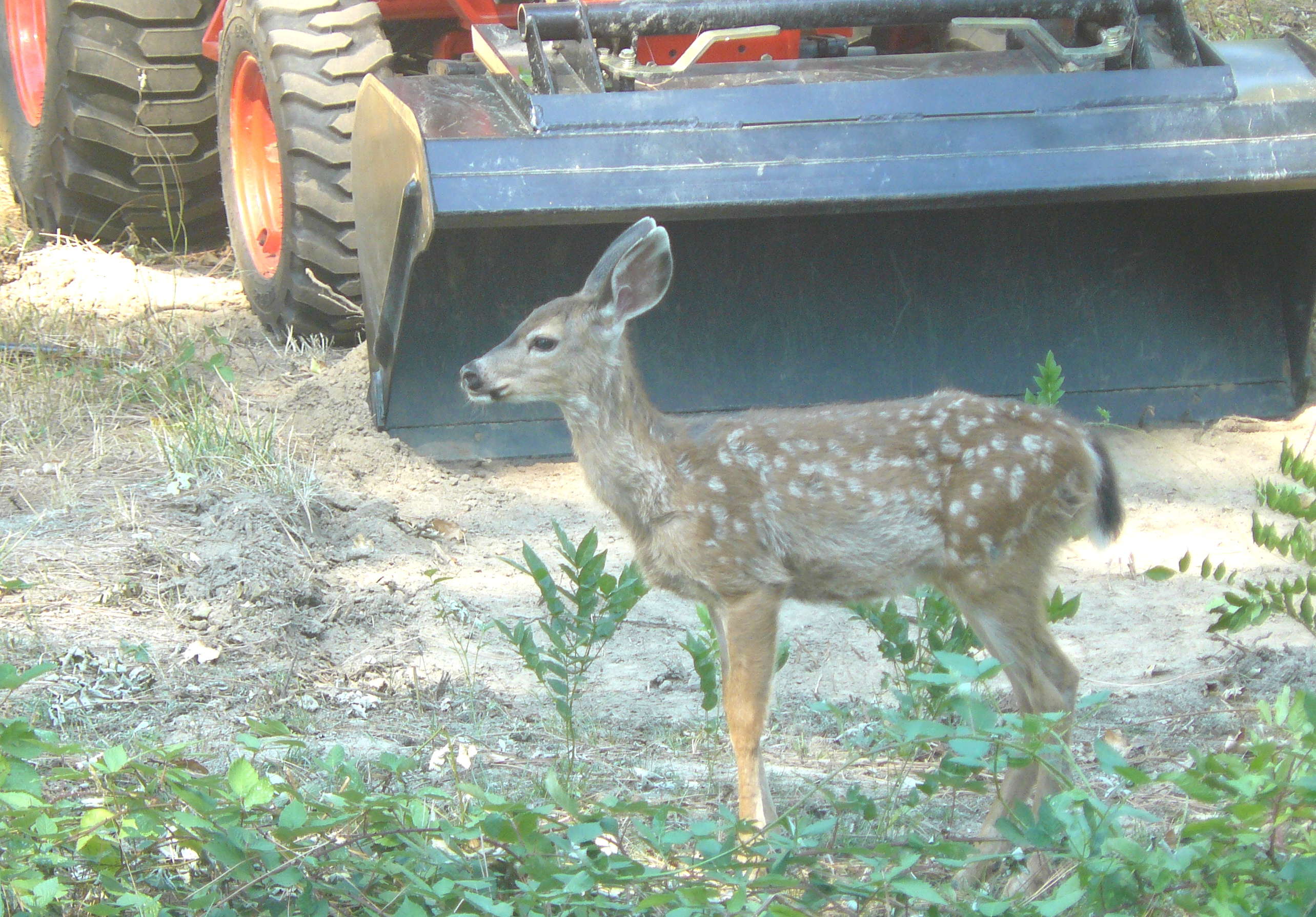
So many wild creatures, large and small, are storing up their body reserves for the long Winter months. Our neighbours, Dordie and Bill, regularly feed the wild deer and we have joined in as well. It’s fascinating to see how quickly they work out that we are not going to harm them. The picture below shows a young deer that allowed me to jump off the tractor, go indoors to find my camera, and return to snap the gorgeous, pretty creature.
Trusting little soul.
There’s been a couple of posts that I want to refer to because they underline the fact that humans are so prone to forgetting that we are of the wild, from the wild and connected to the wild. That’s for tomorrow.
Thus will close today with a recent Autumnal picture of the early-morning mists across our open grass area.
Misty Autumnal mornings
So to that John Keats poem:
To Autumn
John Keats (1820)
Season of mists and mellow fruitfulness,
Close bosom-friend of the maturing sun;
Conspiring with him how to load and bless
With fruit the vines that round the thatch-eves run;
To bend with apples the moss’d cottage-trees,
And fill all fruit with ripeness to the core;
To swell the gourd, and plump the hazel shells
With a sweet kernel; to set budding more,
And still more, later flowers for the bees,
Until they think warm days will never cease,
For Summer has o’er-brimm’d their clammy cells.
Who hath not seen thee oft amid thy store?
Sometimes whoever seeks abroad may find
Thee sitting careless on a granary floor,
Thy hair soft-lifted by the winnowing wind;
Or on a half-reap’d furrow sound asleep,
Drows’d with the fume of poppies, while thy hook
Spares the next swath and all its twined flowers:
And sometimes like a gleaner thou dost keep
Steady thy laden head across a brook;
Or by a cyder-press, with patient look,
Thou watchest the last oozings hours by hours.
Where are the songs of Spring? Ay, where are they?
Think not of them, thou hast thy music too,—
While barred clouds bloom the soft-dying day,
And touch the stubble-plains with rosy hue;
Then in a wailful choir the small gnats mourn
Among the river sallows, borne aloft
Or sinking as the light wind lives or dies;
And full-grown lambs loud bleat from hilly bourn;
Hedge-crickets sing; and now with treble soft
The red-breast whistles from a garden-croft;
And gathering swallows twitter in the skies.
Note:We have a flooring contractor in the house all week and it’s making it a little tricky to spend the couple of hours a day that is my usual pattern for writing posts for LfD. So apologies if this week’s posts are more dependent on the thoughts of others than is usual.
Alain de Botton
Alain de Botton is a familiar face on British television. WikiPedia’s entry describes him, thus:
Alain de Botton, FRSL (born 20 December 1969) is a Swiss/British writer, philosopher, television presenter and entrepreneur, resident in the United Kingdom. His books and television programmes discuss various contemporary subjects and themes, emphasizing philosophy’s relevance to everyday life.
He has been the presenter of a BBC Six-part series called Philosophy: A Guide To Happiness. And who wouldn’t be turned on by that!
Luckily, all six episodes are available on YouTube, at this overall link.
But I wanted to share the first episode because despite the title being Socrates on Self-Confidence it really speaks to our lives in this year of 2013.
Moving on.
A recent item on Big Think, again about philosophy, jumped off the page at me. It specifically looked at making our life, as in mental health, easier in these demanding times. It was by Daniel Dennett and was called The Philosopher’s Self-Help Book.
Daniel Dennett
oooo
The Philosopher’s Self-Help Book (with Daniel Dennett)
While Silicon Valley and Silicon Alley busy themselves making every aspect of our lives more efficient (except, perhaps, for the process of discovering these new technologies, learning them, and integrating them into our lives), Daniel Dennett sits up at Tufts University in Massachusetts, philosophizing. His latest book, Intuition Pumps and Other Tools for Thinking is an attempt to make transparent some of the tricks of the philosopher’s trade. In an accelerating age, it’s a self-help book designed to slow the reader down and improve our ability to think things through.
The kinds of things Mr. Dennett likes to think about include the nature of consciousness, evolution, and religious belief. But the mind-training his new book offers is applicable to any problem you want to consider thoroughly. In an age of quick fixes and corner-cutting, we’re in constant danger of bad decision making – of overreliance on what cognitive psychologist Daniel Kahneman calls “system 1”, and what most of us call intuition. This rapid decision making channel of the brain is helpful when we are in mortal danger, or pressed for a quick decision within our areas of expertise. But for most decisions, the slower, more deliberate channel (system 2) is much more reliable. What Dennett offers, then, in Intuition Pumps, is a workout for system 2 – a series of thought experiments you can apply to puzzles real and imagined to bulk up the slower, wiser parts of your consciousness.
Some of the tools Dennett offers in the book are more familiar than others. Reductio ad absurdum arguments, for example, in which we test the validity of a claim by taking it to its most outrageous illogical extreme (a: “all living things have a right to liberty.” b: “so let me get this straight – a blade of grass has a right to liberty? What does that even mean?”). But the true delights of the book are the far-out exercises Dennett and his colleagues have dreamed up in the course of their work, such as “Swampman Meets A Cow-Shark”, from Donald Davidson, which begins:
Suppose lightning strikes a dead tree in a swamp; I am standing nearby. My body is reduced to its elements, while entirely by coincidence (and out of different molecules) the tree is turned into my physical replica. My replica, The Swampman, moves exactly as I did; according to its nature it departs the swamp, encounters and seems to recognize my friends, and appears to return their greetings in English.
Walking us through Davidson’s considerations about whether and to what extent the Swampman is anything like Davidson, and related ones about a cow that gives birth to something that looks exactly like a shark (yet has cow DNA in all of its cells), Dennett teaches us a surprising lesson about the utility of wild philosophical speculation.
Cloaked in the breezy, familiar trappings of a self-help book, Intuition Pumps is in actuality a dark mirror of that genre – a field of rabbit holes designed to leave the reader with more questions than answers, and wiser for the long and indirect journey.
Watch for Daniel Dennett’s Tools For Better Thinking – a Big Think Mentor workshop coming soon.
oooOOOooo
I’m tempted to put the book on my own reading list. If you want to drop into the appropriate Amazon page there is an audio link plus the option to read an extract. Amazon describe the book, as follows:
One of the world’s leading philosophers offers aspiring thinkers his personal trove of mind-stretching thought experiments.
Over a storied career, Daniel C. Dennett has engaged questions about science and the workings of the mind. His answers have combined rigorous argument with strong empirical grounding. And a lot of fun.
Intuition Pumps and Other Tools for Thinking offers seventy-seven of Dennett’s most successful “imagination-extenders and focus-holders” meant to guide you through some of life’s most treacherous subject matter: evolution, meaning, mind, and free will. With patience and wit, Dennett deftly deploys his thinking tools to gain traction on these thorny issues while offering readers insight into how and why each tool was built.
Alongside well-known favorites like Occam’s Razor and reductio ad absurdum lie thrilling descriptions of Dennett’s own creations: Trapped in the Robot Control Room, Beware of the Prime Mammal, and The Wandering Two-Bitser. Ranging across disciplines as diverse as psychology, biology, computer science, and physics, Dennett’s tools embrace in equal measure light-heartedness and accessibility as they welcome uninitiated and seasoned readers alike. As always, his goal remains to teach you how to “think reliably and even gracefully about really hard questions.”
A sweeping work of intellectual seriousness that’s also studded with impish delights, Intuition Pumps offers intrepid thinkers—in all walks of life—delicious opportunities to explore their pet ideas with new powers.
Speaking of ‘pet ideas with new powers’ prompts one to reflect on the amount of time that dogs spend thinking! As the following picture confirms!
It’s easy to underestimate just how powerful the brain can be.
Last Friday’s post was called Instinctive behaviours and explored the notion of instinct, coming to the conclusion that almost everything the brain does is a result of learning rather than genetics. Yet acknowledging the vast amount of brain activity that runs in ‘background’ mode or subconsciously.
That was brought home to me in spades as a result of being introduced to the flying of gliders, or sailplanes in American speak. The year was 1981 and working near to me in my offices in Colchester, Essex was a gentlemen running his own company, like yours truly. His name was Roger Davis and we were sharing a beer one day when the subject of flying came up. It piqued my interest so, as my logbook declares, on the 7th June, 1981 I had the first of two flights in a glider with Roger at the controls. The place was Rattlesden Airfield, an old wartime airfield near Felsham, Bury St. Edmunds in Suffolk. The gliding club was Rattlesden Gliding Club.
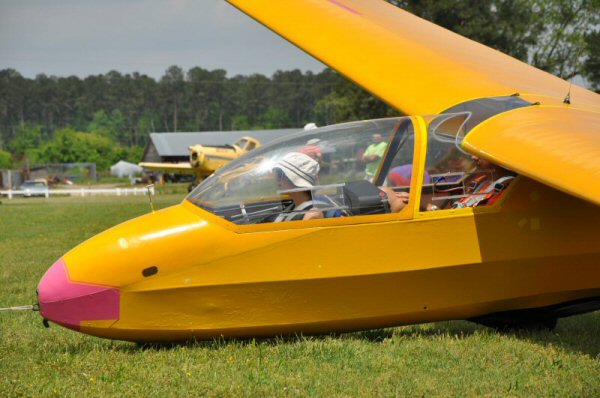
The glider we were in was known as a K-7, a high-wing, two-seater (naturally!) glider with the instructor sitting behind the student.
A K-7 typical of the glider I first flew in at Rattlesden GC.
Anyway, some 43 flights later, I was signed off to conduct my first solo flight in the K-7. The date was 5th September, 1981 and my flight time was just 4 minutes! I was hooked.
In over 10 years of flying amounting to more than 1,400 flights I had the great fortune to experience much of the magic of flying relying on nothing more than the currents of air.
Ahh! Memories! Over 10 years of glider flying, amounting to more than 200 hours of flight-time, 17 different types of glider. Longest flight was 5 hours, 16 minutes including a climb to over 6000 feet above sea-level on the 7th July, 1985 in a single-seater LS4 glider type.
So what’s this got to do with subconscious thinking? Simply this.
One quickly learnt that once the decision had been made to land, most frequently because one was unable to find further, or any, rising air currents the brain had a major computing task in hand. As the aircraft descends, the air currents change and the direction and velocity of the wind changes. There is no engine to allow one to abort the landing; to do a ‘go round’!
One of the key visual judgments was determining the point of touchdown: not too early that might risk a ground contact before the start of the runway, and not too late which might risk running out of landing space.
Thus the brain was operating clearly in two modes. Consciously, computing second by second where the touch-down point was going to be and, subconsciously, the flying of the glider as in operating the joystick and rudder pedals in support of the touch-down ‘computations’.
Moving on.
In last Friday’s post, I also wrote this: “Plus something that could just possibly be the key to mankind having a long-term sustainable future on this planet: The Power of Thinking.”
That ‘something’ was me reflecting on an article in the October 7th edition of FORTUNE magazine. Not something I read on a normal basis but just happened to come across that edition – and glad I did. Because there was an article about IBM’s new supercomputer Watson. The link to the summary is here, from which I republish this:
Dr. Mark Kris is among the top lung cancer specialists in the world. As chief of thoracic oncology at Memorial Sloan-Kettering (MSK) Cancer Center in New York City, he has been diagnosing and treating patients for more than 30 years. But even he is overwhelmed by the massive amount of information that goes into figuring out which drugs to give his patients — and the relatively crude tools he has to decipher that data. “This is the standard for treatment today,” he says, passing me a well-worn printout of the 2013 treatment guidelines in his office. We choose a cancer type. A paragraph of instructions says to pair two drugs from a list of 16. “Do the math,” he says. It means more than 100 possible combinations. “How do you figure out which ones are the best?”
It’s a huge problem. More than 230,000 Americans will be diagnosed with lung cancer this year. Almost all of them will receive chemotherapy. As crude as the existing guidelines are, says Kris, they won’t be followed more than half the time. If we bumped up adherence by just 10% to 20%, he says, as many as 30,000 people might live longer. Never mind curing cancer — shouldn’t we be able to get the best available combinations of medications to sick people now?
That’s the question that led Kris to IBM. He saw that more information was not the answer. What doctors needed was a better brain — one that could instantly vacuum up facts, draw deeper connections between data points, and remember everything. They needed Watson.
Just read that last paragraph again. That it’s not about information, it’s about offering humanity computing power that can see things that humans might not easily see.
Thus, I mused that when mankind gets to the point where there is total and complete commitment to finding a non-carbon-burning way ahead for every living thing on this planet we won’t have the luxury of countless years working out the new journey directions. Maybe, just maybe, computing power a la Watson might just be our saving grace.
Curious to learn more about IBM Watson? Then here’s the relevant website.
We see instinct as common across all species including man, so why is so little known about it.
There was an item seen on the BBC Capital website. It was an article about intuition:
Trusting your gut: Smart management or a fool’s errand?
by Eric Barton*
Photographer Mindy Véissid woke up one winter morning in 2010 with a simple idea: dogs running in the snow.
“That’s all I had,” she recalled.
The Manhattan resident followed her gut and went across town to Central Park. There, Véissid found three dogs jumping around in a couple of inches of new snow covering the famed park’s Great Lawn. She plopped down in the field and waited. That’s when the dogs headed right for her. She snapped off a shot just before they barrelled over her.
The picture she took that morning, of happy-looking pups charging through a cloud of snow with the New York City skyline behind them, has become one of Véissid’s calling cards, maybe her most recognisable shot. It’s a photo she would have missed if she had not trusted her gut.
“What I realised is that if I follow my heart, if I follow my feelings, I get good photographs,” Véissid said. “We try to control everything in our lives, and sometimes you have to let go.”
It wasn’t long ago that decision-by-intuition would have been regarded as little more than magical thinking or a try at luck. But research has changed that and intuition has been embraced as a key component to business decision making.
There is, however, an inherent danger to it, and blindly following your gut can be worse than ignoring it altogether. For managers, that means learning how to trust your own instincts and encouraging employees to do the same. But it also means learning to recognise when careful planning trumps sudden inspiration.
Perhaps the thing that most changed the way businesses think about inspiration was a 2008 study co-authored by Gerard Hodgkinson, professor at Leeds University Business School in the United Kingdom. Hodgkinson found that intuition can be beneficial in specific circumstances. First, it’s best to rely on a gut feeling when you need to make a quick decision. Second, and this is the important part, trust your intuition only when you have extensive knowledge on the subject. In other words, the best intuition is pulled from a well of deep knowledge and expertise.
“A lot of people think intuition is general purpose, but intuition is actually domain specific,” said Massimo Pigliucci, a philosophy professor at City University of New York, and author of Answers for Aristotle: How Science and Philosophy Can Lead Us to A More Meaningful Life. “Intuition is the result of your subconscious brain picking up on clues and hints and calculating the situation for you, and that’s based solely on experience.”
Wrong to republish the whole piece, however I do want to republish the closing paragraphs as they are so relevant to today’s post.
Western cultures began to embrace intuition only recently, Pigliucci said, while research suggests Southeast Asian countries have long given credit to gut feelings being a good guide to decision making. Eastern managers, for instance, are more likely to rely on hunches and give them credit for successes afterward.
After photographer Véissid learned to rely on her gut feelings, she wanted to teach others how to do it. Her class, the Art of Intuitive Photography, teaches the photography basics, but her instruction is more about following hunches.
“You can get a good photograph and it will be technically correct,” she said. “But if you follow your heart, you can take photos that can be wonderful.”
Follow BBC Capital on Twitter @BBC_Capital or follow us and join the conversation about this or any other Capital story on Facebook: BBC Capital on Facebook.
—-
* Eric is a freelance journalist who lives in Fort Lauderdale, Florida. He is formerly a writer and editor at New Times in Fort Lauderdale and The Pitch in Kansas City, Missouri. His work has been featured by the Florida Center for Investigative Reporting.
To my mind, what Eric Barton has written about is not instinctive. That is if one believes that instinct is something that is ‘hard-wired’, so to speak, into our psyche at birth, a function of our genetic heritage.
When one reflects on the start of life, ergo for all warm-blooded species that are the result of a successful copulation between the two genders of that species, then one realises that there is little functioning at birth beyond those bodily functions vital to that new life.
But if we mean by instinctive those behaviours that are subconsciously acted out while the mind is engaged on other mental processes, then that’s different.
Read that last opening paragraph again [my emphasis]:
“A lot of people think intuition is general purpose, but intuition is actually domain specific,” said Massimo Pigliucci, a philosophy professor at City University of New York, and author of Answers for Aristotle: How Science and Philosophy Can Lead Us to A More Meaningful Life. “Intuition is the result of your subconscious brain picking up on clues and hints and calculating the situation for you, and that’s based solely on experience.”
Think of when we drive a car how much of what we are doing in the ‘hand-eye’ department is being managed by our subconscious brain. Think about the way we use a language, especially the language of our birth country. One will immediately recognise that the brain is on auto-pilot. Yet we were born unable to speak, or to drive a car!
Abstract: “Innate Knowledge” is a stupid idea. The truth is the exact opposite: KNOWLEDGE IS EVERYWHERE, OUT THERE.Knowledge is the opposite of innate. This insight has tremendous consequences on our entire prehension of the world.
(It will not escape the cognoscenti that Socrates, Plato, and Aristotle, were partisans of innateness. And that believing in the superiority of inheritance is a necessary condition for racism, fascism, slavery, and hereditary plutocracy as fairness. That makes the likes of Chomsky and Dawkins self contradictory)
Subjective time slows down in smaller brains.
Fastest Wings, Fastest Brains. Anna Hummingbird California
Those wings go at 100 Hertz, four time the human perception limit.
Thus time is relative; just as light-clock time slows down in a fast reference frame, or in a heavy gravitational field, neurological timeslows down in a small neurology.
(Interestingly, the deepest reason for the slowing of time… boils down to the same in the Relativity case as in the Neurological one! It’s all about energy.)
A lot of ideas on instinct came from studying insects: insects seem to know all, without having studied anything. However, if insect time flows slowly, insects actually have time to learn.
And that’s rendered easier by having brains adapted to their environment. If they have only a few tricks to learn, and what looks like ten seconds for us is an hour for them, no wonder they learn lots. Thus slow in small explains how “instinct” works.
Hence behaviors one describes as “instinctive” are just fast studies. A lot of the silliness about “genes” is thus dispelled, and the mind comes on top.
It’s an essay that deserves the full reading. This is how it closes:
Conclusion:
Instinct As Fast Learning solves the nature-nurture problem. It also shows something else, even more important. It shows that the force of nature makes not just the force, but even the very geometry, of our minds.
(The construction of neuromorphology itself being forced by feedback from nature.)
The minds of sentient species, from bees to hummingbirds, are exquisitely tuned to be programmed by the (part of) nature they are made to respond to, all the way to the speed of time they need.
If we kill the environment, we kill out instruction set. The usual reason given to save the environment is that we would not want our descendants to live in a bad world. But what we see now is that a poor world gives poor minds, and that even time may go askew. Another, deeper than ever, reason to be a fanatical ecologist. Nature is not just our temple. Nature is where, and how, time itself is built, one neurological impulse at a time.
***
Patrice Ayme
On Monday, I have a sequel to this post. It’s an insight into the conscious and unconscious skills that come from flying a glider, or sailplane in American speak! Plus something that could just possibly be the key to mankind having a long-term sustainable future on this planet: The Power of Thinking.
But back to today.
You will recall that the item from the BBC website opened with photographer Mindy Véissid waking up one winter morning in 2010 with a simple idea: dogs running in the snow. Too good not to miss for a blog called Learning from Dogs.
Mindy’s website is here and do go across there and browse. You will quickly discover, for example:
we teach small sized group and private digital photography classes and workshops in fun locations throughout nyc, focusing on how to use your camera, how intuition can help guide you to images, and compositional improvement
So having given Mindy that small, but well-deserved, plug, I don’t feel too bad closing today with Mindy’s picture of those dogs running in the snow.