Just wanted to share some good news with you. Well, regarding Oregon’s wolves!
My so-called book has rather ground to a halt. Sturdy followers of this blog will recall that in November last year, I sat down and wrote the first draft of a book, under the umbrella of NaNoWriMo = write a minimum of a 50,000-word novel in the month of November. That I did write in excess of 50,000 words (53,704) in under thirty days felt a wonderful achievement.
But then reality set in!
I subscribed to a NaNoWriMo webinar on editing hosted by David Henry Sterry and Arielle Eckstut of The Book Doctors. To my horror, half-way through the webinar came the realisation that what I had written wasn’t even a fictional novel: It was a personal story on the theme of what dogs have taught me over a life of approaching 70 years.
So those 53,000 words had to be rewritten as non-fiction book!
The next boulder to cause me to fall was the issue of tense. The book had been written in the 3rd-person, as you can see from the draft of Chapter Twenty-Three. But the more that I thought about the story the more that it felt that it should be in the 1st-person; namely this first person! Reinforced by feedback from Jeannie and from reading Melinda Roth’s latest book Mestengo clearly written in the first-person.
Mestengo book cover.
Chapter One
I first smelled the smoke as I stood in the driveway of the farmhouse on the top of a hill in McHenry County in Northern Illinois that was, according to the man who leased it to me one month before, the highest point in all of Northern Illinois.
Damn, damn, damn! Now the rewrite not only has to go from fiction to non-fiction, it also has to change the tense from ‘Philip’ to ‘Paul’; from him to me! The words from The Book Doctors seminar rang louder and louder, “You write the first draft for yourself; you edit it for your readers!” (Smart arses!)
Then along came hope in the form of Kami Garcia, the author. It was a NaNoWriMo pep talk.
So you made it through NaNoWriMo, and you have 50,000 words… Now what? It’s the same question a lot of writers face when they finish a first draft. The good news is you finished the hard part: you have a draft.
I can hear some of you cursing me now: “But Kami, my first draft is totally crappy and worthless. It’s terrible. I wasted an entire month of my life, and all I have 50,000 terrible words to show for it.”
My answer: It doesn’t matter if you wrote the crappiest first draft in the history of all first drafts. You have something to work with, which means you can fix it, mold it, and bang it into whatever shape you want. Here are a few tips to get started:
Read Your First Draft (and Possibly Cry a Little)
After you put away the pint of ice cream and the tissues, take an objective look at your draft. What are the strongest points? The parts that kept you reading? Whether you print out your draft to make notes or use software (I love Scrivener), mark the best bits—circle, highlight, whatever works for you. These are the parts you’ll re-read whenever you start to lose hope (which will be often).
All of which is a long-winded way of me saying that I shouldn’t be spending time writing blog posts but have my head down in the big edit.
But, hey, already come this far so going to leave you with this wonderful news.
ooOOoo
Hello Paul,
Good news: For the first time since 2009, the Oregon Department of Fish & Wildlife has confirmed wolves south of the Eagle Cap Wilderness!
Based on recent evidence, it’s clear that at least five wolves are frequenting an area in Northern Baker County. It may not be a story as epic as Journey’s, but it’s another good sign wolves are continuing to retake their rightful place on the Oregon landscape.
Those of you who have been tracking wolf issues for a long time, may remember the iconic photo of a scraggly Oregon wolf in sagebrush. The young wolf and his partner frequented an area near the Keating Valley in Baker County.
Sadly, the “Keating Wolves”, as they came to be known, were killed in 2009. Despite some tantalizing reports, since that time, only one Oregon wolf is known south of the Wallowas.
Later today, we’ll revisit the story of the Keating Wolves on the Oregon Wild Blog and post it on the Oregon Wolves Facebook page. Wolf recovery still has a long ways to go. But today’s news is significant.
Since 2009 – with your help – we’ve stopped round after round of wolf kill bills in Salem. We’ve stood up for wolves in court. We’ve worked with responsible ranchers. We’ve educated the public, highlighted the positive impacts of having wolves back on the landscape, and shared news – good and bad – of wolf recovery.
Things are far from perfect. Old prejudices die hard and wolves continue to be at the center of a campaign of misinformation and fear. The Obama administration is stubbornly pushing a scheme to strip wolves of important protections, and the state can still kill wolves on behalf of the livestock industry.
But today’s news is a sign that we’re headed in the right direction here in Oregon. And there should be more on the horizon. Wolves are mating, pups should be on their way, and Oregon will announce an updated wolf population estimate soon. That’s more news we look forward to sharing.
For wolves and wildlife, Rob Klavins Wildlife Advocate, Oregon Wild
Everyday, at the same time, this dog waits outside the cat’s house. When the cat comes out, they go for their daily walk together.
Their respective owners are neither neighbours nor friends. But somehow, in a manner unknown to us humans, these two creatures connected with each other and now enjoy their shared walk everyday.
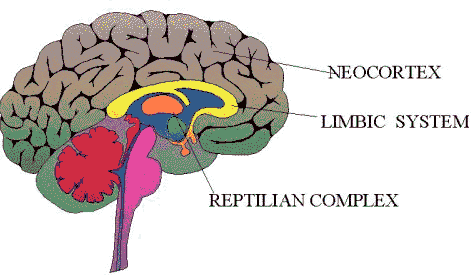
Now of all the things I am not, I am neither a biologist nor a scientist of any description. However, general knowledge told me years ago that the human brain is composed of three areas, as the following diagram shows.
The first time you observe the anatomy of the human brain, its many folds and overlapping structures can seem very confusing, and you may wonder what they all mean. But just like the anatomy of any other organ or organism, the anatomy of the brain becomes much clearer and more meaningful when you examine it in light of the evolutionary processes that created it.
The most efficient model for understanding the brain in terms of its evolutionary history is the famous triune brain theory developed by Paul MacLean. According to this theory, the following three distinct brains emerged successively in the course of evolution and now co-inhabit the human skull:
The reptilian brain, the oldest of the three, controls the body’s vital functions such as heart rate, breathing, body temperature and balance. Our reptilian brain includes the main structures found in a reptile’s brain: the brainstem and the cerebellum. The reptilian brain is reliable but tends to be somewhat rigid and compulsive.
The limbic brain emerged in the first mammals. It can record memories of behaviours that produced agreeable and disagreeable experiences, so it is responsible for what are called emotions in human beings. The main structures of the limbic brain are the hippocampus, the amygdala, and the hypothalamus. The limbic brain is the seat of the value judgments that we make, often unconsciously, that exert such a strong influence on our behaviour.
The neocortex first assumed importance in primates and culminated in the human brain with its two large cerebral hemispheres that play such a dominant role. These hemispheres have been responsible for the development of human language, abstract thought, imagination, and consciousness. The neocortex is flexible and has almost infinite learning abilities. The neocortex is also what has enabled human cultures to develop.
These three parts of the brain do not operate independently of one another. They have established numerous interconnections through which they influence one another. The neural pathways from the limbic system to the cortex, for example, are especially well developed.
I’m well into reading the book Waking The Tiger: Healing Trauma authored by Peter A. Levine. As early as Chapter One, Peter Levine explains [my emphasis]:
The involuntary and instinctual portions of the human brain and nervous system are virtually identical to those of mammals and even reptiles. Our brain, often called the ‘triune brain,’ consists of three integral systems. The three parts are commonly known as the ‘reptilian brain’ (instinctual), the ‘mammalian or limbic brain (emotional), and the ‘human brain or neo-cortex’ (rational). Since the parts of the brain that are activated by a perceived life threatening situation are the parts we share with animals, much can be learned by studying how certain animals, like the impala, avoid traumatization. To take this one step further, I believe that the key to healing traumatic symptoms in humans lies in our being able to mirror the fluid adaptation of wild animals as they ‘shake out’ and pass through the immobility response and become fully mobile and functional.
Unlike wild animals, when threatened, we humans have never found it easy to resolve the dilemma of whether to fight or flee. This dilemma stems, at least in part, from the fact that our species has played the role of both predator and prey. Prehistoric peoples, though many were hunters, spent long hours each day huddled together in cold caves with the certain knowledge that they could be snatched up at any moment and torn to shreds.
Anyway, to get back to what triggered today’s post.
If you read yesterday’s post you will recall me chatting with Jon Lavin and Jon reminding me that humans are drawn to positive messages. But in stark contrast, the news media industry excels in promoting ‘doom and gloom’. Why is this? Why are we so fascinated by danger?
Well here’s my theory.
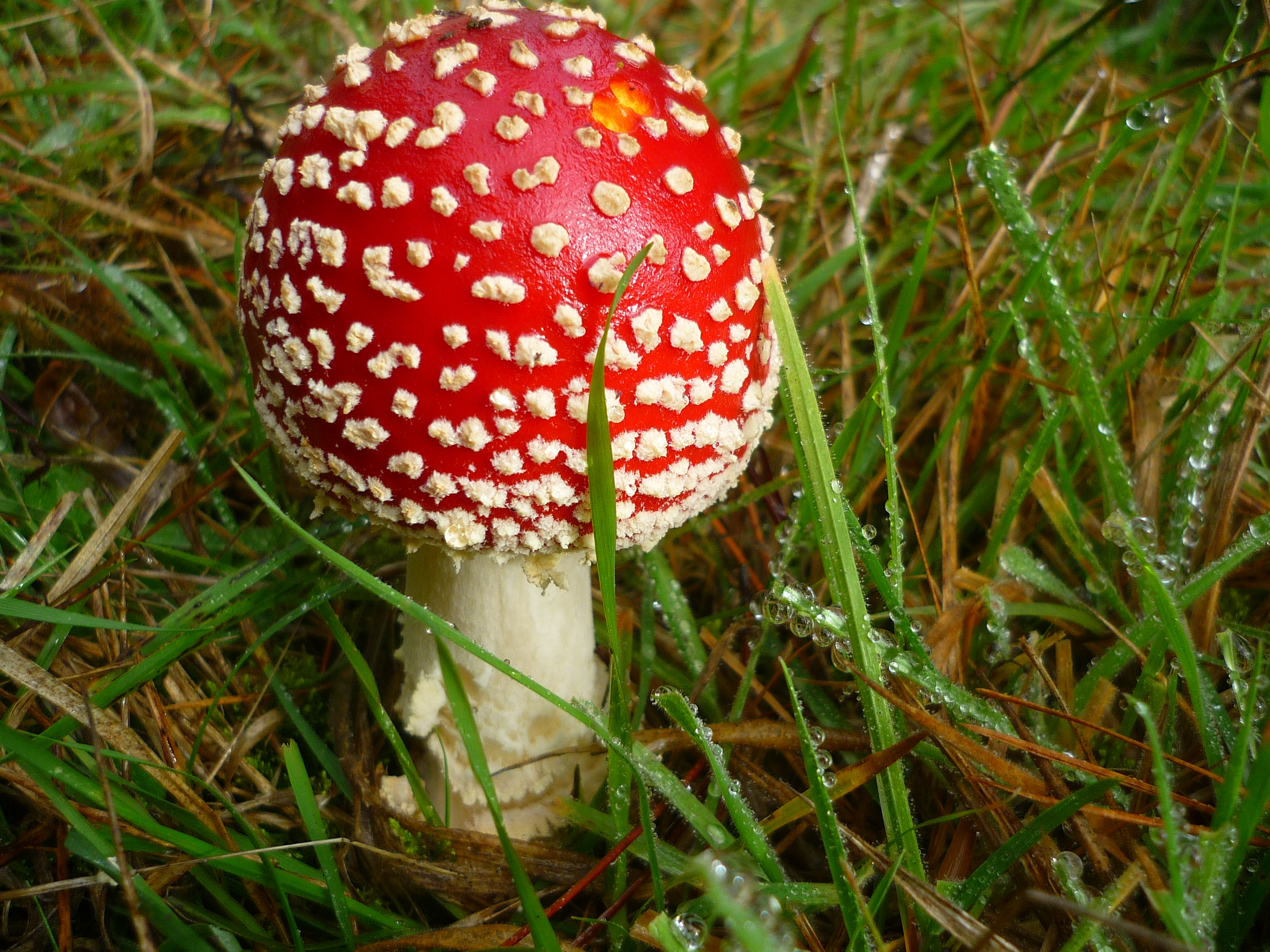
That is our evolution would not have succeeded if early man didn’t become pretty smart at identifying animal behaviours and plants and fruits that had the capacity to harm or even kill. For example, what parent hasn’t made it a priority to teach their children the difference between harmful fungi and edible mushrooms. Indeed to the extent that most of us would think long and hard before eating any fungi found in the wild unless we were 150% certain it was edible. Look at the following picture. Your instinct tells you if it’s safe to eat or not – it’s not!
So early man became over-sensitised to dangers to his health for his own good and continued existence. While modern man functions in ways almost unrecognisable from early man, that good old reptilian brain still is doing it’s best to protect us (flight, fight or freeze). Think how we all respond to a sudden alarming sound, such as a gun shot or a scream, to know that the old reptilian brain is still alive and well.
Thus while all of us hate negativity we all seem to have this fascination with doom and gloom – just in case it helps us and our loved ones survive.
Back to Jon Lavin. He makes it very clear that anything more than a small amount of ‘doom and gloom’ speaking to our consciousness increases the odds of depression and introversion.
Thus the message is that we humans should allow our Neocortex to tell our Reptilian ‘neighbour’ to go easy on the bad news, go and open a beer and watch the world go by! Whoops! Watch the world go by with a smile!
There are things that are beyond rational explanation.
Warning – this post is rather more ‘touchy-feely’ than you are used to seeing on Learning from Dogs. So if it wanders about in ways that you struggle to follow then just stifle your yawn and come back tomorrow!
It goes back to an earlier plan that I had in terms for a couple of posts. Both focussing on the myriad of examples of the appalling decline in our world. I had been collecting a number of essays to support the proposition that if we don’t learn from dogs the qualities of integrity and unconditional love then our world was doomed. I had collected the essay from Ellen Cantaro over on TomDispatch about the incredible stupidity of fracking. Or the one from Tom’s own pen in an essay about climate change being the new ‘Anti-News’. I had saved the recent essay from George Monbiot discussing the madness of the so-called dredging practices in the UK’s Somerset Levels. I had fumed at another George Monbiot essay Bring It On that included this incredible statement:
It is hard to think of a more serious allegation. For six months an undercover officer working for the Metropolitan Police was instrumental in planning a major demonstration, which ended up causing injuries and serious damage to property. Yet the police appear to have failed to pass this intelligence to the City of London force, leaving the target of the protest unprotected.
I had many more examples but you get the message!
So what stopped me?
I was chatting to Jon Lavin on Monday about a variety of things. Jon asked how the book was coming along. I replied by saying that a recent NaNoWriMo webinar had persuaded me that the book wasn’t a novel and should be re-written as a non-fiction story. Going on to add that I might include some of the appalling examples of what was going wrong in our society to strengthen the argument that we truly have much to learn from dogs.
Jon, who had read the first, very rough draft of the book that appeared on this blog, cautioned me against doing that. He went on to say that in the world of solutions focussed therapy, the area that Jon practices in professionally, the way forward was always to focus “on what’s working“. Jon continued by saying that while one would initially allow the problems to be voiced, this negativity would always be a tiny piece of the overall process, say less than 5% of the session. That even if a client’s whole world seemed to be failing, there would always be something that was alright, always a 1% that was working, and that would be the place to start. A quick web search endorsed that as the website of Good Therapy revealed, from where I read:
Solution focused brief therapy (SFBT) targets the desired outcome of therapy as a solution rather than focusing on the symptoms or issues that brought someone to therapy. This technique only gives attention to the present and the future desires of the client, rather than focusing on the past experiences. The therapist encourages the client to imagine their future as they want it to be and then the therapist and client collaborate on a series of steps to achieve that goal. This form of therapy involves reviewing and dissecting the client’s vision, and determining what skills, resources, and abilities the client will develop and use to attain his desired outcome. Solution focused therapy was developed by Steve De Shazer, Insoo Kim Berg, and their team at the Brief Family Therapy Family Center in Milwaukee, USA.
Thus coming back to the book rewrite, Jon said that people wanted to read ‘good news’ not negativity. It was a key reminder for me and an incredibly inspiring call that in these challenging times, whether on this blog or in a potential book, I need to write about all the powerfully, positive lessons that dogs, and all warm-blooded creatures, offer mankind. The lessons of integrity, love, trust, balance, loyalty, faithfulness, affection, forgiveness and more.
OK, moving on.
On the evening of February 7th Jean and I settled down to watch a YouTube video. It had been featured in a post from LadyBlueRose that had been published on the 6th. The post was called His Name is Spirit and it was the story of a woman, Anna Breytenbach, who has dedicated her life to what she calls interspecies communication.
We had reached the six-minute point in the film, already captivated by it, when the telephone rang. I paused the film and answered the phone. It was neighbour Dordie from next door ringing to say that when she had seen us earlier in the day she had forgotten to mention that there was this incredible film that we really had to watch …… yes, you guessed it! The film that Jean and I were watching at that moment.
Here is that film.
Now here is Anna’s website Animal Spirit where one learns:
ENHANCING THE RELATIONSHIP BETWEEN HUMANS, OTHER ANIMALS AND THE NATURAL WORLD
Welcome to an exploration of interspecies communication – a journey of discovering ways to restore a deep relationship with all of life.
Human and animal communication creates a valuable bridge between human and non-human animals. By connecting with our intuition, we can engage in meaningful dialogue and remember how to hear the subtle messages from those whose space we share in our lives and our natural environment. Coming from a place of respect and reverence for all life, we can learn to understand our wilder relatives, honour their truths and live in greater harmony.
and where one also can watch the short introductory film that is on her home page; as below.
A web search then came across a fascinating interview with Anna.
So where does this all end up?
Simply, that in a world dominated by media of all types that favour ‘doom and gloom’ it can be incredibly difficult to hang on to the message offered by Jon and by Anna, and by many others no doubt, the message that our individual health, and by implication the health of this planet, is afforded through staying positive.
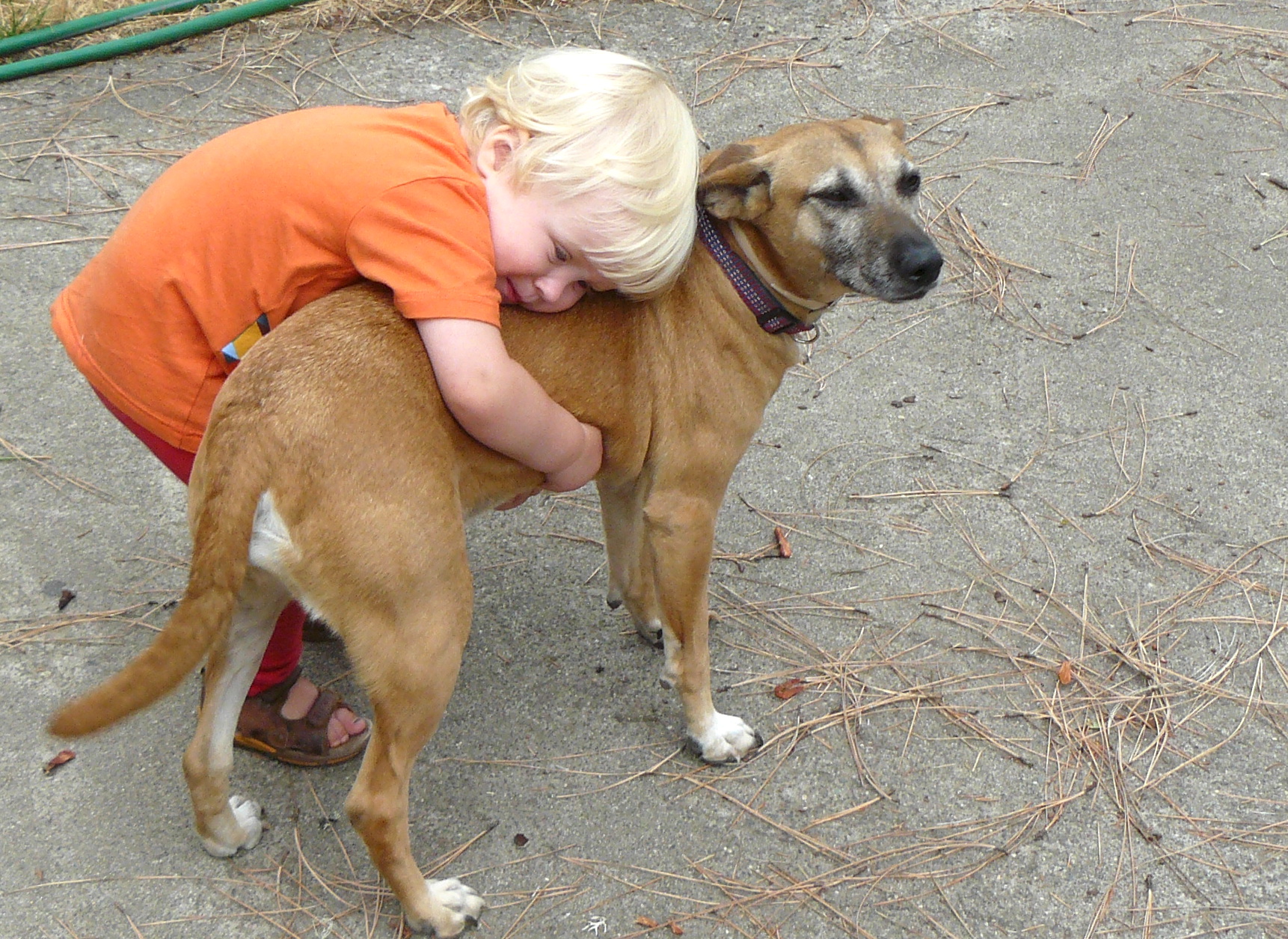
Or put more basically, if you are feeling low go and hug a dog! So I can do no better than to close with the same picture that closed Tuesday’s post Meet the dogs – Dhalia.
The first of the New Year and dedicated to Sue of Sue Dreamwalker.
A week ago, Sue left a nice comment about our ‘backyard’ here in Oregon. Specifically with regard to the two photographs of deer feeding in front of the house. I replied by saying that today I would offer a selection of views of our property.
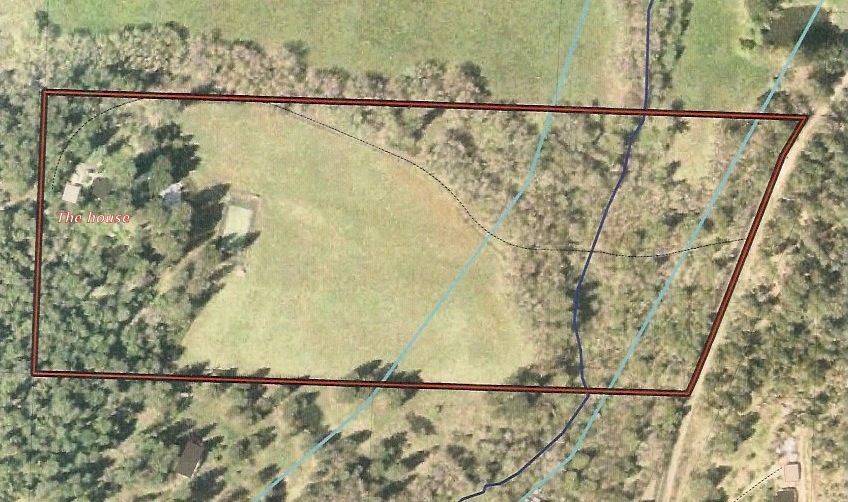
First off, an aerial view with the property boundary line overlaid, taken from the sale particulars. The right-hand, Eastern boundary follows the edge of Hugo Road. We are some four miles from Merlin in Southern Oregon.
Thirteen acres orientated West-East.
The solid blue line is the course of Bummer Creek that flows from top to bottom of the image. The thin, dotted blue line is the driveway that runs from Hugo Road up to the house, a distance of a 1/4 mile. The house is close to the Western boundary almost hidden from sight in this picture by the trees. There is a faint label ‘The House’ just below the building.
From left to right: Pharaoh, Sweeny, Cleo and Hazel.
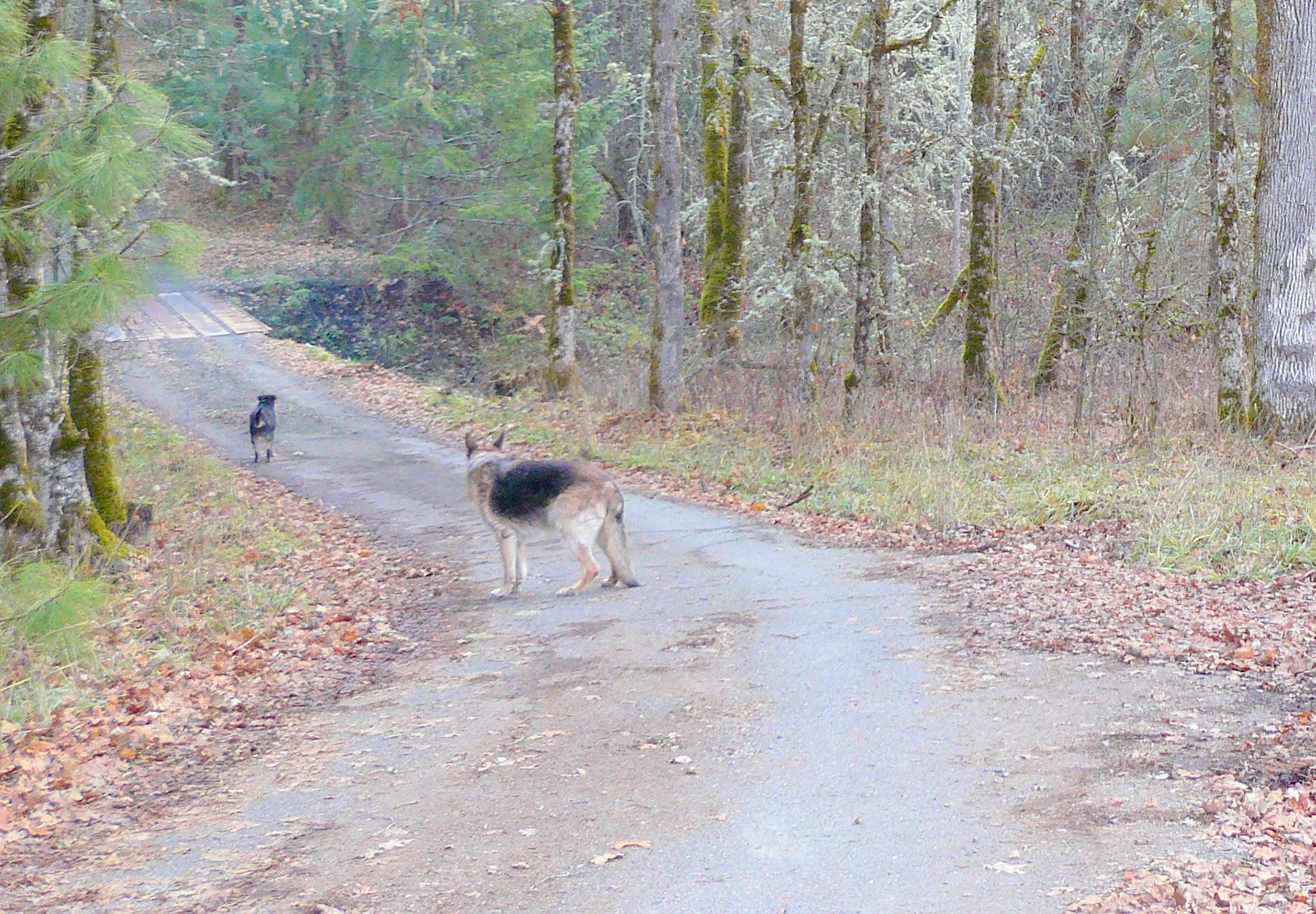
The above photograph was taken from a point about half-way along the driveway, the house being behind the camera. Ahead, the driveway dips down to cross the bridge over the Creek, as the following picture reveals. Luckily the boundary fence is dog-proof!
oooo
Dogs and water!
Pharaoh in Bummer Creek just downstream of the bridge.
Looking further downstream from the bridge.
oooo
Looking upstream from the bridge.
The barrier across the Creek seen in the upper half of the photograph is a flood irrigation dam installed many years ago, presumably for agricultural purposes before the plot was sold for house building prior to 1977. One installs an iron pole on a centre bolt embedded in the dam and then places a stout plank across the flow on top of the dam. The plank can just be seen to the right of the dam, resting on the bank. Never tried the dam but going to some day!
Looking to the West up towards the house.
The above picture was taken close to where the previous one was shot. Simply by swinging around to the left and looking back up. The house is barely visible in the background behind the metal gate and wooden fence posts in the middle of the photograph.
Corinne’s field visible through the trees and undergrowth.
Again, the picture above is taken not far removed from where the previous two were taken. If one looks at the aerial view of the property in the first picture, in the top-right corner there is a small area of grassland; what would have been an offshoot of our neighbour’s grassland in previous times. After my sister, Corinne, died in the Summer of 2013 we named that area of grassland Corinne’s field.
A general view down over the main area of grass.
So now we are back standing just outside the Eastern side of the house looking South-East out over the main area where the dogs are walked twice a day. The picture was taken a little before noon and shows the low mist that has been with us for about two weeks.
Nature’s beauty.
Above, another photograph picking up on the mist that has been with us for some days. Until yesterday!
This is what I call a Winter day!
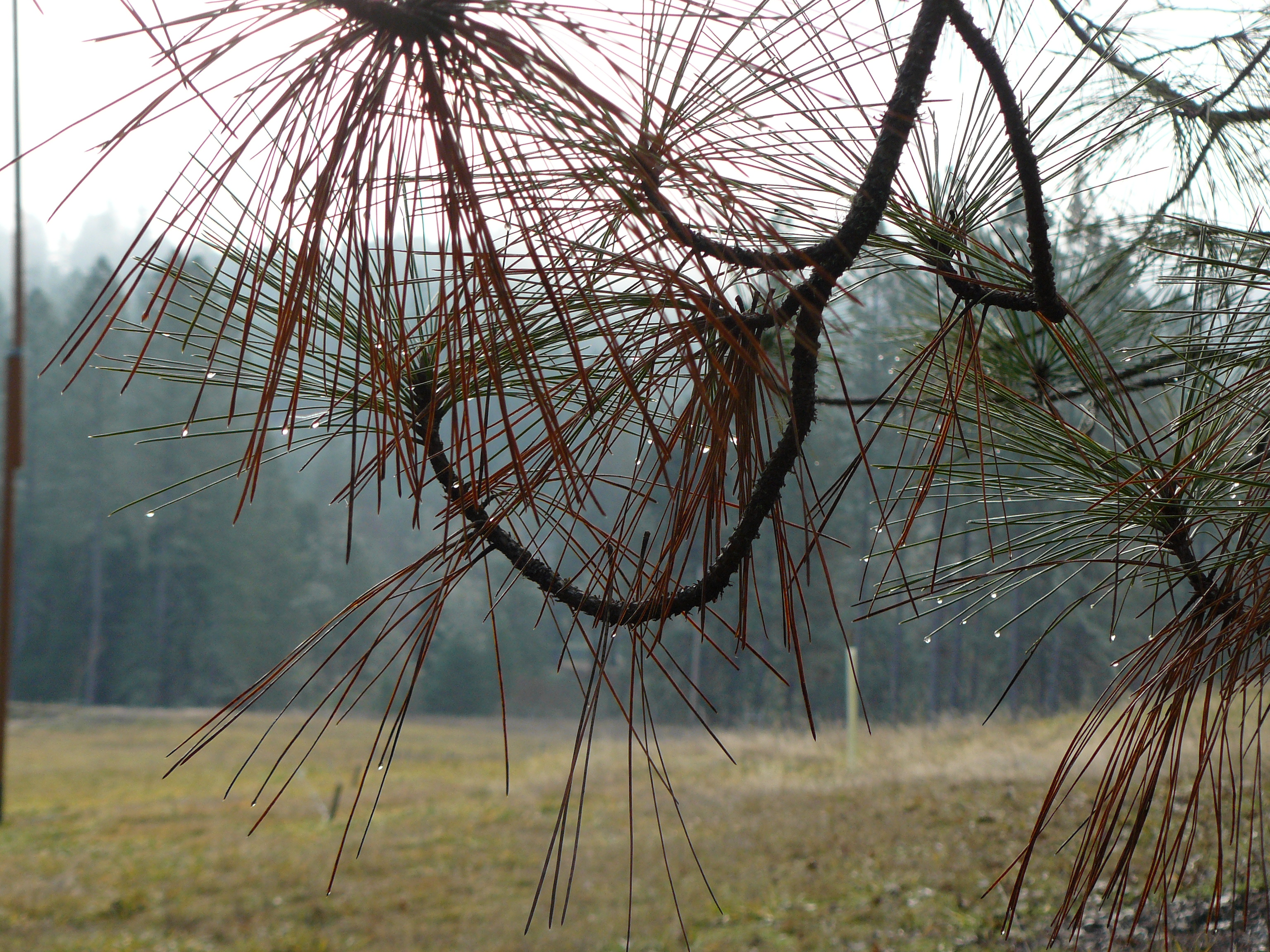
Yesterday dawned cold, clear and frosty. As this picture of one of our tall pine trees so vividly demonstrates. (The tree edges our driveway, about half-way to the house.)
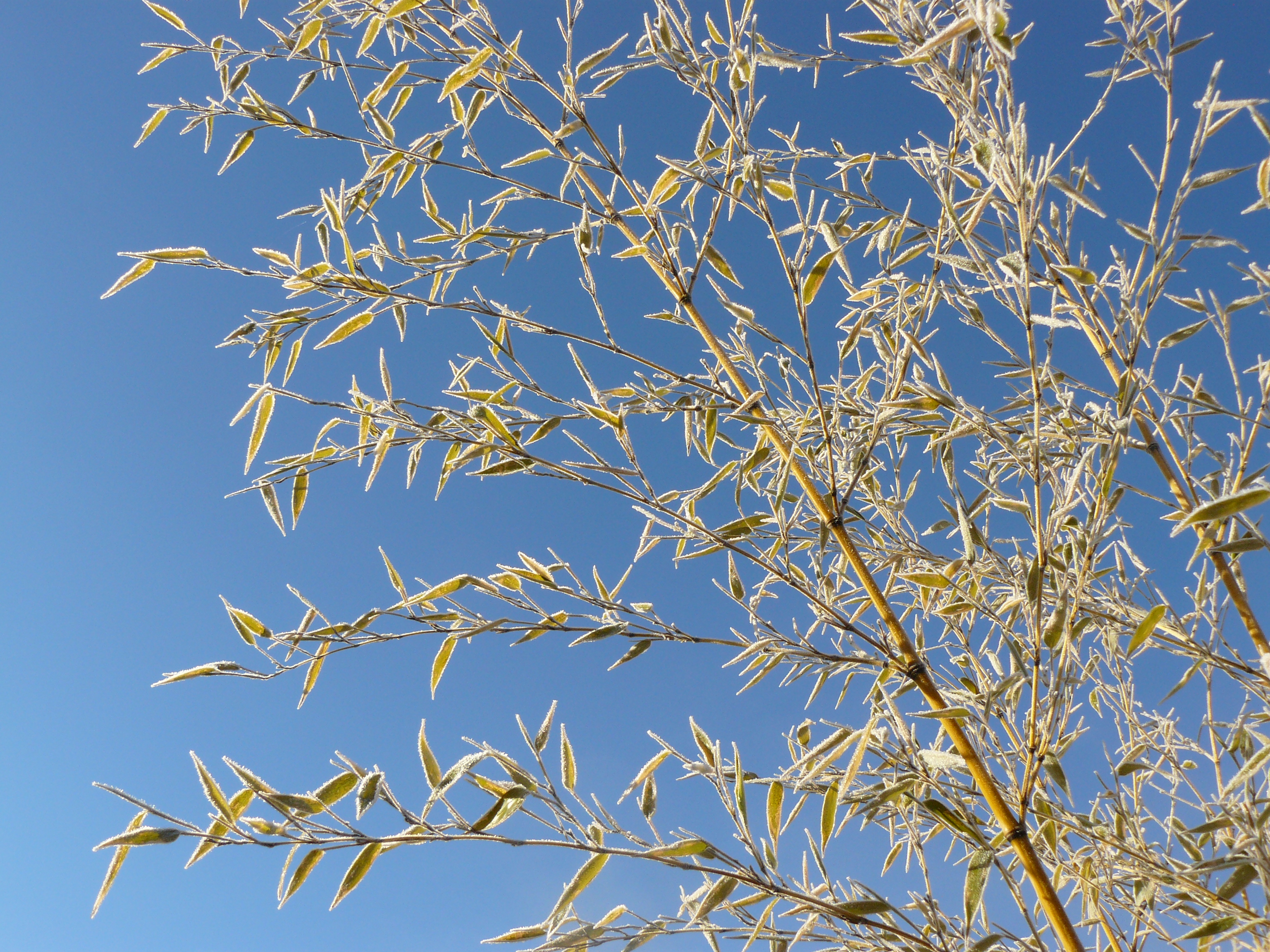
So will close today’s post with three more pictures of a frosty Saturday morning in Merlin, Oregon, USA.
A frosty yet sunny morning.
oooo
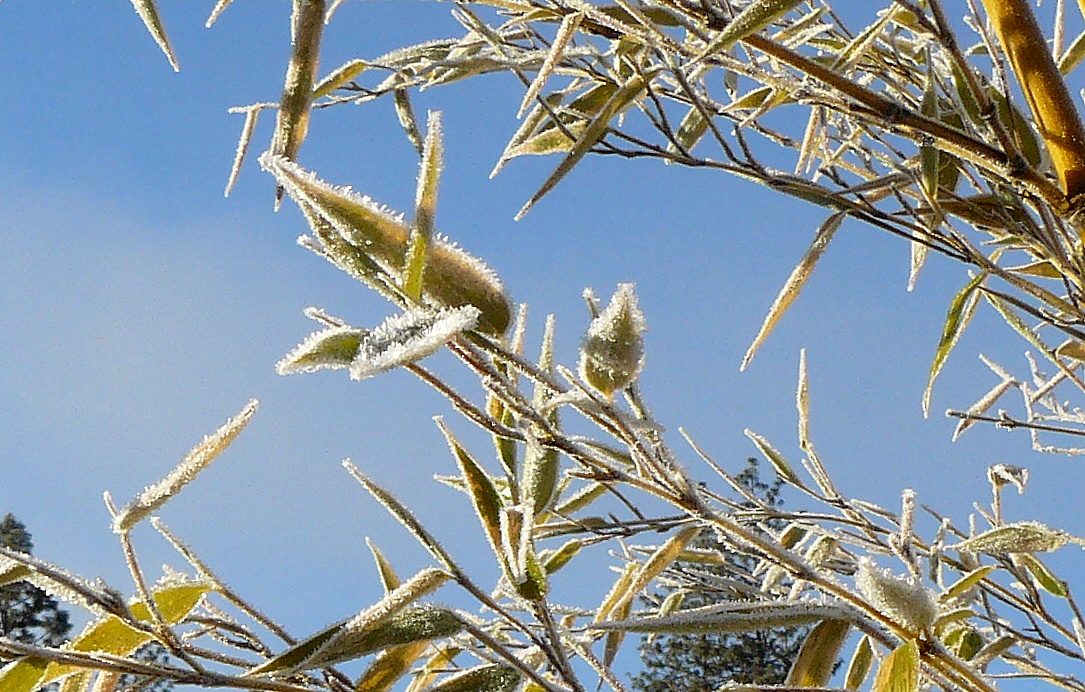
Frost on a bamboo tree.
oooo
It really is a beautiful world at times.
oooo
So there you are, Sue!
Needless to say, Jean and I are reminded almost daily how lucky we and all our animals are at finding such a beautiful place to live. I can’t ever imagine taking it for granted.
Depending on just where in the world you are, the New Year of 2014 is anything from a few to twenty-four hours away. How that year turns out will, to a very great extent, depend on millions and millions of behaviours. In other words, the behavioural choices each of us makes. Because, as millions of us already understand, our world on this, our only, Planet is facing changes potentially beyond our imagination. Caring for our Planet and all of life upon it is meaningless without those behavioural choices being the right ones for our Planet.
A couple of days ago, I read the following on Facebook. It seemed an appropriate tale for the start of 2014.
ooOOoo
Now what?
One day a farmer’s donkey fell down into a well. The animal cried piteously for hours as the farmer tried to figure out what to do. Finally, he decided the animal was old and the well needed to be covered up anyway; it just wasn’t worth it to retrieve the donkey.
He invited all his neighbors to come over and help him. They all grabbed a shovel and began to shovel dirt into the well. At first, the donkey realized what was happening and cried horribly. Then, to everyone’s amazement he quieted down.
A few shovel loads later, the farmer finally looked down the well. He was astonished at what he saw. With each shovel of dirt that hit his back, the donkey was doing something amazing. He would shake it off and take a step up.
As the farmer’s neighbors continued to shovel dirt on top of the animal, he would shake it off and take a step up. Pretty soon, everyone was amazed as the donkey stepped up over the edge of the well and happily trotted off!
MORAL :
Life is going to shovel dirt on you, all kinds of dirt. The trick to getting out of the well is to shake it off and take a step up. Each of our troubles is a steppingstone. We can get out of the deepest wells just by not stopping, never giving up! Shake it off and take a step up.
Remember the five simple rules to be happy:
Free your heart from hatred – Forgive.
Free your mind from worries – Most never happens.
Live simply and appreciate what you have.
Give more.
Expect less from people but more from yourself.
You have two choices … smile and close this page, or pass this along to someone else to share the lesson.
Shakespeare wrote The Winter’s Tale in 1623. The title came to my mind following another tale written slightly more recently; just five days ago to be exact.
It’s a story published by George Monbiot that has a wonderful shape. When I read it on Christmas Eve it seemed yet another story that Learning from Dogs readers would enjoy. So, as ever, grateful for Mr. Monbiot’s permission to republish it. His story is called Unearthed.
ooOOoo
Unearthed
December 23, 2013
A winter’s tale of guns, gold and greed.
By George Monbiot, published in the Guardian 24th December 2013.
Perhaps I should have been more careful. Last year I decided that every Christmas I would tell a winter’s tale or two(1). Through a long history of doing stupid things, I’ve accumulated a stock of ripping yarns. But I failed to explain myself. Some people interpreted the tale I told last Christmas as making a political point about Travellers I had no intention of suggesting; a point that is in fact the opposite of what I believe(2). So please read what follows as a story and no more: true to the best of my knowledge and memory but without a polemical purpose.
I was told this tale by a gold prospector in the garimpos of Roraima: the illegal mines exacavated among the river gravels in the forests of northern Brazil. He and his friends swore it was true. Though parts of the story must have been filled in later, in the light of what I had seen I found it easy to believe.
To say that the mines were lawless is not quite correct. They stood outside the laws of the state, but had established their own codes, which were informed by power and honour and greed and lust. Every week, thieves were taken into the forest to be shot. Duels were fought on the airstrips, in which men took ten paces, turned and fired: the miners circulated Wild West comics and acted out scenes that might once have been mythical, but there became horribly real.
To illustrate the point, before we get to the tale itself: one evening João, a remarkable man from the north-east of Brazil, who, after leaving home at 14 then spending ten years crossing and recrossing the Amazon on foot, had found work as a minder for two prostitutes, took me and his charges to a bar at the end of the airstrip village in which I was staying. The bar and the strip of dirt were owned by Zé, a man who spent some of his vast earnings on causing trouble: roaming around with his band of pistoleiros, starting fights and roughing people up. Zé, in whose house I was staying (by his choice, not mine) was said to have killed five men, starting with his business partner: by this means he had acquired control of the airstrip, and the extortionate fees for landing and leaving.
The bar was a flimsy shack in which a ghetto blaster was turned up so high that you could scarcely hear the music. Ragged men swayed and lurched and sprawled across the more sober prostitutes. On every table there was a bottle or two of white rum and a revolver. The men who had stayed in their seats drummed their fingers nervously on the tabletops, halfway between their drinks and their guns. The door was shoved open, and Zé and his thugs walked in.
His was at all times an arresting presence: charming, mercurial and terrifying. A machete scar ran from one cheek, over his nose and across the other cheek. He wore a sawn-off denim jacket and two revolvers on his belt. He opened his arms and announced, in a voice loud enough to carry above the music, that he would buy drinks for everyone. Zé moved through the bar, slapping backs and shaking hands, flashing his gold teeth. João’s eyes darted around, watching people’s hands. Bottles of cachaça were passed down from the bar.
Suddenly João shoved me so hard that I almost fell off my chair. He grabbed my arm, managing at the same time to seize the two prostitutes, and propelled us towards the door. As we hurtled out of the bar it erupted in gunfire. Amazingly, only one man was killed: he was dragged onto the airstrip with a hole the size of an apple in his chest. He was one of an estimated 1,700 people murdered, in a community of 40,000, in just six months.
So here’s the story. Two men established a small stake in the mines, in a remote valley some distance from the nearest airstrip. They cut down the trees and began to excavate. They found the digging and hosing and sifting of the gravel exceedingly hard and, though they had discovered very little, they decided to hire two other men to do it for them. They agreed to split any findings equally with the workers. The two hired men dug for four months without success: with high pressure hoses they scoured great pits into which the trees collapsed; they turned the clear waters of the forest stream they excavated red with clay and tailings; they winnowed the gravel through meshed boxes; they dissolved the residues in mercury and burnt it off; but they produced almost nothing. Then they hit one of the richest deposits ever discovered in Roraima: in one day they extracted four kilos.
If you find a lot of gold in the garimpos you keep quiet – very quiet. A single shout of triumph can amount to suicide. You gather it up, hide it in your bag and explain to anyone who asks on your way out that months of work have brought you nothing but disease and misery. But first it must be divided.
The two men who owned the stake began to comprehend, for the first time, the implications of the deal they had done. “We risked our lives to establish this stake. We spent every cent we had – and plenty we didn’t – travelling here, buying the equipment and the diesel, hacking out a clearing in the forest, hiring these men. And now we have to split the gold equally with people who are no more than manual labourers, who would normally be paid a few dollars a day.” They told the two workers that they wanted a special meal that night, and sent them to the nearest airstrip to buy the ingredients.
As the two workers walked they began to ruminate. “We’ve nearly killed ourselves in that pit. We’ve been up before dawn every day and have worked until dusk. We’ve had malaria, foot rot, screw worm, sunstroke, while those two bastards have done nothing but lie in their hammocks shouting instructions. Now we’re expected to give them an equal share of the gold that we and we alone found.” When they reached the store, they bought cachaça, rice, beans, a packet of seasoning and a box of rat poison. They mixed the poison into the seasoning and set off back to the camp. Before they reached it, they were ambushed by the two owners and shot. The owners then picked up the bags and went back to the camp to celebrate over the first hot dinner they had had in weeks.
Some time later a party of men moving through the forest to look for new stakes walked into the camp. They found two skeletons over which vines were already beginning to creep. And four kilos of gold.
Lovely item from Bob Derham who, as an airline Captain of many years, is clearly qualified to present this.
Health & Safety and Equality Considerations for Christmas Songs
Jingle Bells
Dashing through the snow
In a one horse open sleigh
O’er the fields we go
Laughing all the way
A risk assessment must be submitted before an open sleigh is considered safe for members of the public to travel on. The risk assessment must also consider whether it is appropriate to use only one horse for such a venture, particularly if passengers are of larger proportions. Please note, permission must be gained from landowners before entering their fields. To avoid offending those not participating in celebrations, we would request that laughter is moderate only and not loud enough to be considered a noise nuisance.
While Shepherds Watched
While shepherds watched
Their flocks by night
All seated on the ground
The angel of the Lord came down
And glory shone around
The union of Shepherds has complained that it breaches health and safety regulations to insist that shepherds watch their flocks without appropriate seating arrangements being provided, therefore benches, stools and orthopaedic chairs are now available. Shepherds have also requested that due to the inclement weather conditions at this time of year that they should watch their flocks via CCTV cameras from centrally heated shepherd observation huts.
Please note, the angel of the lord is reminded that before shining his / her glory all around she / he must ascertain that all shepherds have been issued with glasses capable of filtering out the harmful effects of UVA, UVB and Glory.
Rudolph the red nosed reindeer
Rudolph, the red-nosed reindeer
had a very shiny nose.
And if you ever saw him,
you would even say it glows.
You are advised that under the Equal Opportunities for All policy, it is inappropriate for persons to make comment with regard to the ruddiness of any part of Mr. R. Reindeer. Further to this, exclusion of Mr R Reindeer from the Reindeer Games will be considered discriminatory and disciplinary action will be taken against those found guilty of this offence. A full investigation will be implemented and sanctions – including suspension on full pay – will be considered whilst this investigation takes place.
Little Donkey
Little donkey, little donkey on the dusty road
Got to keep on plodding onwards with your precious load
The RSPCA have issued strict guidelines with regard to how heavy a load that a donkey of small stature is permitted to carry, also included in the guidelines is guidance regarding how often to feed the donkey and how many rest breaks are required over a four hour plodding period. Please note that due to the increased risk of pollution from the dusty road, Mary and Joseph are required to wear face masks to prevent inhalation of any airborne particles. The donkey has expressed his discomfort at being labelled “little” and would prefer just to be simply referred to as Mr. Donkey. To comment upon his height or lack thereof may be considered an infringement of his equine rights.
We Three Kings
We three kings of Orient are
Bearing gifts we traverse afar
Field and fountain, moor and mountain
Following yonder star
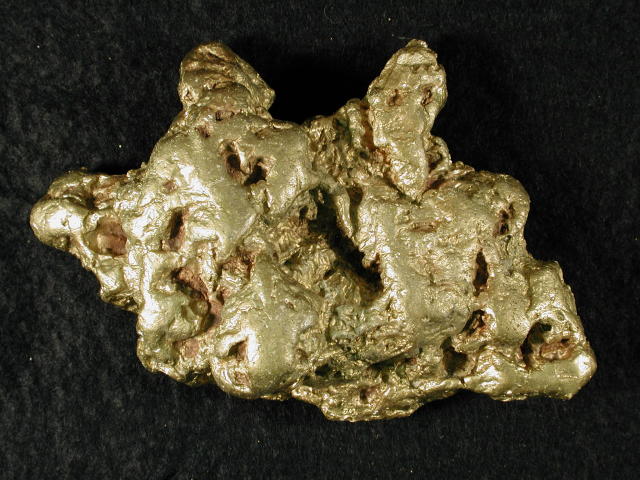
Whilst the gift of gold is still considered acceptable – as it may be redeemed at a later date through such organisations as ‘cash for gold’ etc, gifts of frankincense and myrrh are not appropriate due to the potential risk of oils and fragrances causing allergic reactions. A suggested gift alternative would be to make a donation to a worthy cause in the recipients name or perhaps give a gift voucher.
We would not advise that the traversing kings rely on navigation by stars in order to reach their destinations and suggest the use of RAC route finder or satellite navigation, which will provide the quickest route and advice regarding fuel consumption. Please note as per the guidelines from the RSPCA for Mr Donkey, the camels carrying the three kings of Orient will require regular food and rest breaks. Face masks for the three kings are also advisable due to the likelihood of dust from the camels hooves.
The Rocking Song
Little Jesus, sweetly sleep, do not stir;
We will lend a coat of fur,
We will rock you, rock you, rock you,
We will rock you, rock you, rock you:
Fur is no longer appropriate wear for small infants, both due to risk of allergy to animal fur, and for ethical reasons. Therefore faux fur, a nice cellular blanket or perhaps micro-fleece material should be considered a suitable alternative.
Please note, only persons who have been subject to a Criminal Records Bureau check and have enhanced clearance will be permitted to rock baby Jesus. Persons must carry their CRB disclosure with them at all times and be prepared to provide three forms of identification before rocking commences.
I am indebted to Per Kurowski who yesterday sent me an email about the atrocious recent act in North Korea. Per writes the blog A view from the Radical Middle and has been a good friend of Learning from Dogs.
Per’s email read:
Lowly opinions on dogs
Paul
With respect to the execution of Jang Song Thaek the North Korea government issued a statement calling him “Despicable human scum who was worse than a dog”… and I just felt you could have a real serious issue with that.
Merry Christmas
Per
My reply to Per included, “I did hear about the statement and your thought also crossed my mind, then something came along and I forgot to do anything about it. Will be corrected in a post coming out tomorrow.”
Per’s email included a link to a Financial Times article that is not visible unless one registers with the FT. However the relevant section reads thus:
Jang’s summary execution – reported by state media on Friday – marked a spectacular demise for a man seen until recently as the most powerful adviser to Kim Jong Un. It also raised questions about the potential for further instability in the court of the world’s youngest national leader.
Describing him as “despicable human scum”, state media said Jang had been put to death immediately after his conviction for treason by a military tribunal, where he confessed to having plotted a coup against Mr Kim.
It is an elementary obligation of a human being to repay trust with sense of obligation and benevolence with loyalty.
However, despicable human scum Jang, who was worse than a dog, perpetrated thrice-cursed acts of treachery in betrayal of such profound trust and warmest paternal love shown by the party and the leader for him.
Frankly, if one cogitates about just a few of the qualities of dogs: integrity, loyalty, unconditional love, trust, openness, forgiveness, affection – then this world would be one hell of a better place to live for all humans if only we learnt to live like dogs.
But on this Saturday in November it really is a fish story, or so I thought.
Earlier in the month, I received an e-mail from Dan Gomez. It told of this tale from Grand Lake St. Marys:
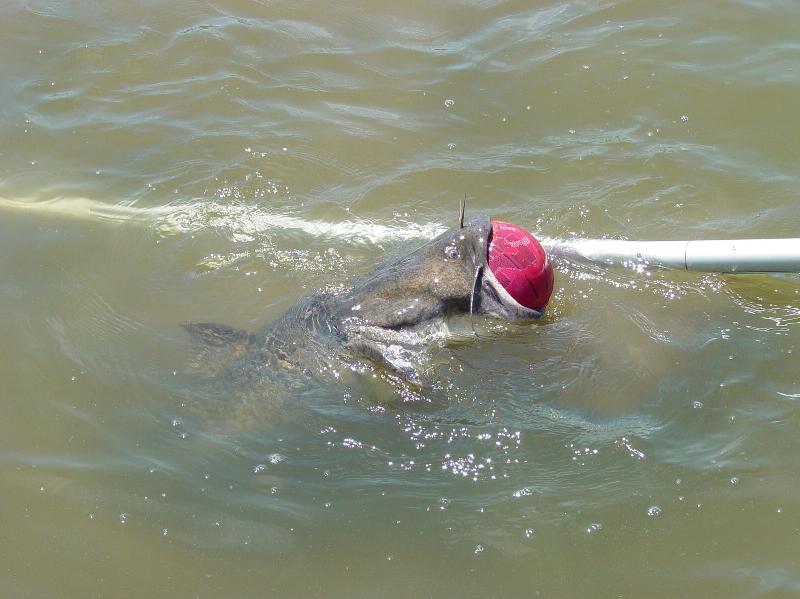
A guy who lives at Lake Saint Mary’s (60 miles north of Dayton, OH ) saw a ball bouncing around kind of strange in the lake and went to investigate.
It turned out to be a flathead catfish that had apparently tried to swallow a basketball which became stuck in its mouth!!
The fish was totally exhausted from trying to dive, but unable to, because the ball would always bring him back up to the surface.
The guy tried numerous times to get the ball out, but was unsuccessful. He finally had his wife cut the ball in order to deflate it and release the hungry catfish.
You probably wouldn’t have believed this, if you hadn’t seen the following pictures:
oooo
oooo
oooo
oooo
oooo
Be kinder than necessary because everyone bites off more than they can chew sometime in life…
oooOOOooo
I loved the story but then wanted to know: was it true?
Sadly, the story is true but the location is false. Snopes.com researched this back in 2005. Hoax-Slayer.com wrote about it in 2007 after it “went viral”.
The true story originated in the Whichita (Kansas) Eagle on May 30, 2004. The man in the photo turns out to be Bill Driver, a fisherman at Sandalwood Lake who discovered the catfish with a taste for hardwood glory.
Two wonderful lessons to be learned from both the story and the story behind the story!
Don’t believe everything you read on the Internet and there’s always something fishy about a fisherman’s tale.

.jpg) Those of you who have been tracking wolf issues for a long time, may remember the iconic photo of a scraggly Oregon wolf in sagebrush. The young wolf and his partner frequented an area near the Keating Valley in Baker County.
Those of you who have been tracking wolf issues for a long time, may remember the iconic photo of a scraggly Oregon wolf in sagebrush. The young wolf and his partner frequented an area near the Keating Valley in Baker County. Since 2009 – with your help – we’ve stopped round after round of wolf kill bills in Salem. We’ve stood up for wolves in court. We’ve worked with responsible ranchers. We’ve educated the public, highlighted the positive impacts of having wolves back on the landscape, and shared news – good and bad – of wolf recovery.
 For wolves and wildlife,