Category: Morality

Thinking anew.

Humanity’s safe and viable future depends on seeing things very differently.

Next Tuesday is the 62nd anniversary of the death of Albert Einstein, the famous German theoretical physicist who died on the 18th April, 1955. He delivered many innovative ways of seeing our world way beyond his theory of relativity, one of the two pillars of modern physics (alongside quantum mechanics) (Ref: Wikipedia)

Why do I introduce today’s post with that reference to Mr. Einstein?

Because I wanted to share with you a recent essay from George Monbiot and an Einstein quotation seemed so apt an introduction.

We shall require a substantially new manner of thinking if mankind is to survive.

That essay from George Monbiot was published yesterday and is shared with you all with Mr. Monbiot’s full permission.

It is an essay that deserves being read slowly and carefully. Please take time aside to so do because it really does offer a new manner of thinking.

ooOOoo

Circle of Life

By reframing the economy, Kate Raworth’s Doughnut Economics changes our view of who we are and where we stand.

By George Monbiot, published in the Guardian 12th April 2017

So what are we going to do about it? This is the only question worth asking. But the answers appear elusive. Faced with a multifaceted crisis  – the capture of governments by billionaires and their lobbyists, extreme inequality, the rise of demagogues, above all the collapse of the living world – those to whom we look for leadership appear stunned, voiceless, clueless. Even if they had the courage to act, they have no idea what to do.

The most they tend to offer is more economic growth: the fairy dust supposed to make all the bad stuff disappear. Never mind that it drives ecological destruction, that it has failed to relieve structural unemployment or soaring inequality, that, in some recent years, almost all the increment in incomes has been harvested by the top 1%. As values, principles and moral purpose are lost, the promise of growth is all that’s left.

You can see the effects in a leaked memo from the UK’s foreign office: “Trade and growth are now priorities for all posts … work like climate change and illegal wildlife trade will be scaled down.” All that counts is the rate at which we turn natural wealth into cash. If this destroys our prosperity and the wonders that surround us, who cares?

We cannot hope to address our predicament without a new worldview. We cannot use the models that caused our crises to solve them. We need to reframe the problem. This is what the most inspiring book published so far this year has done.

In Doughnut Economics: seven ways to think like a 21st-century economist, Kate Raworth reminds us that economic growth was not, at first, intended as a measurement of well-being. Simon Kuznets, who standardised the measurement of growth, warned: “the welfare of a nation can scarcely be inferred from a measure of national income.” Economic growth, he pointed out, measures only annual flow, rather than stocks of wealth and their distribution.

Raworth points out that economics in the 20th Century “lost the desire to articulate its goals.” It aspired to be a science of human behaviour: a science based on a deeply flawed portrait of humanity. The dominant model – “rational economic man”, self-interested, isolated, calculating – says more about the nature of economists than it does about other humans. The loss of an explicit objective allowed the discipline to be captured by a proxy goal: endless growth.

The aim of economic activity, she argues, should be “meeting the needs of all within the means of the planet.” Instead of economies that need to grow, whether or not they make us thrive, we need economies that “make us thrive, whether or not they grow.” This means changing our picture of what the economy is and how it works.

The central image in mainstream economics is the circular flow diagram. It depicts a closed flow of income cycling between households, businesses, banks, government and trade, operating in a social and ecological vacuum. Energy, materials, the natural world, human society, power, the wealth we hold in common: all are missing from the model. The unpaid work of carers – principally women – is ignored, though no economy could function without them. Like rational economic man, this representation of economic activity bears little relationship to reality.

So Raworth begins by redrawing the economy. She embeds it in the Earth’s systems and in society, showing how it depends on the flow of materials and energy, and reminding us that we are more than just workers, consumers and owners of capital.

The Embedded Economy. Graphic by Kate Raworth and Marcia Mihotich

This recognition of inconvenient realities then leads to her breakthrough: a graphic representation of the world we want to create. Like all the best ideas, her Doughnut model seems so simple and obvious that you wonder why you didn’t think of it yourself. But achieving this clarity and concision requires years of thought: a great decluttering of the myths and misrepresentations in which we have been schooled.

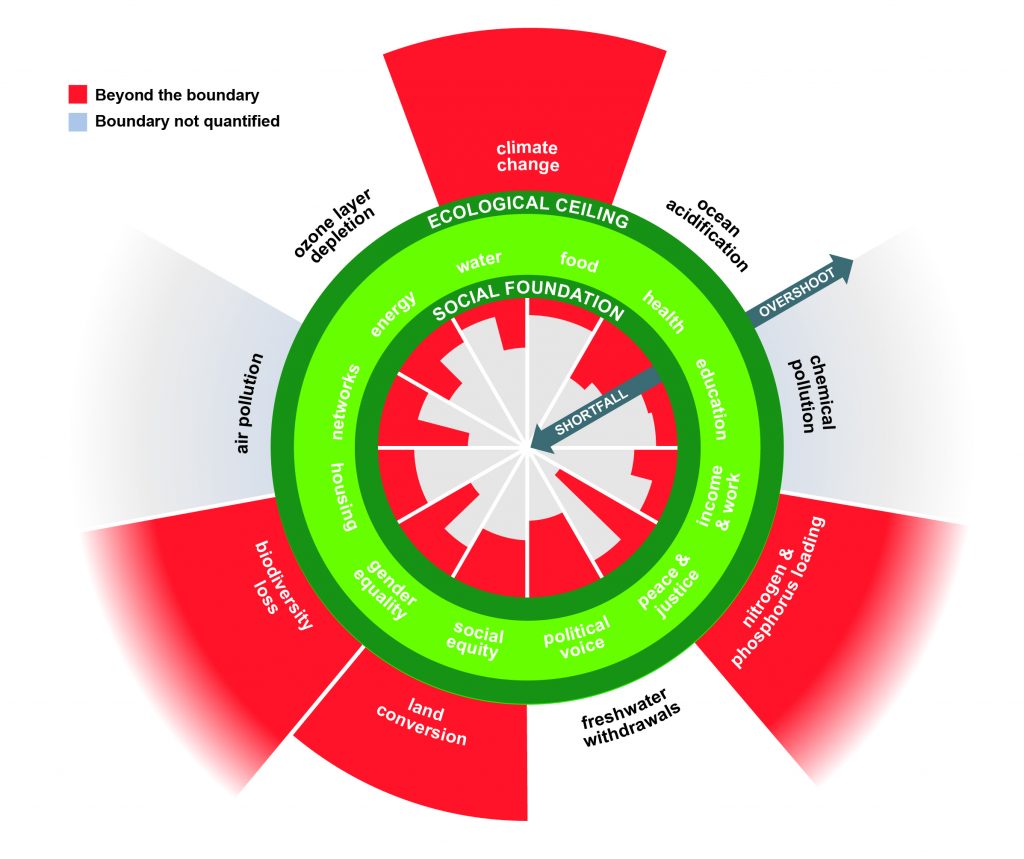
The diagram consists of two rings. The inner ring of the doughnut represents a sufficiency of the resources we need to lead a good life: food, clean water, housing, sanitation, energy, education, healthcare, democracy … . Anyone living below that line, in the hole in the middle of the doughnut, is in a state of deprivation.

The Doughnut. Graphic by Kate Raworth and Christian Guthier/The Lancet Planetary Health

The outer ring of the doughnut consists of the Earth’s environmental limits, beyond which we inflict dangerous levels of climate change, ozone depletion, water pollution, loss of species and other assaults on the living world. The area between the two rings – the doughnut – is the “ecologically safe and socially just space” in which humanity should strive to live. The purpose of economics should be to help us enter that space and stay there.

As well as describing a better world, the doughnut model allows us to see, in immediate and comprehensible terms, the state in which we now find ourselves. At the moment we transgress both lines. Billions of people still live in the hole in the middle. We have breached the outer boundary in several places.

Where we are now. Graphic by Kate Raworth and Christian Guthier/The Lancet Planetary Health

An economics that helps us to live within the doughnut would seek to reduce inequalities in wealth and income. Wealth arising from the gifts of nature would be widely shared. Money, markets, taxation and public investment would be designed to conserve and regenerate resources rather than squander them. State-owned banks would invest in projects that transform our relationship with the living world, such as zero-carbon public transport and community energy schemes. New metrics would measure genuine prosperity, rather than the speed with which we degrade our long-term prospects.

Such proposals are familiar, but without a new framework of thought, piecemeal solutions are unlikely to succeed. By rethinking economics from first principles, Raworth allows us to integrate our specific propositions into a coherent programme, and then to measure the extent to which it is realised. I see her as the John Maynard Keynes of the 21st-Century: by reframing the economy, she allows us to change our view of who we are, where we stand, and what we want to be.

Now we need to turn her ideas into policy. Read her book, then demand that those who wield power start working towards its objectives: human prosperity within a thriving living world.

www.monbiot.com

ooOOoo

 Please, wherever you are and whatever your plans are for this long weekend, do take great care of yourself and all your loved ones!

Keep saving those dogs!

Yet another wonderful saving of a dog from a frozen lake!

One of the ‘generalist’ blogs that I follow is Mother Nature Network (MNN) and yesterday MNN published the account of a dog in Canada being rescued from icy cold water.

So another wonderful story to share with you all!

ooOOoo

Man jumps into icy lake to save beloved pup

Noel Kirkpatrick April 10, 2017.

Winter hasn’t let go of some parts of North America just yet, including St. Albert, Alberta, in Canada. Cold temperatures keep the lakes frigid and icy, as a local man and his dog discovered recently.

A French bulldog named Cosmo plunged into a lake in a park in St. Albert — it was a leash-free area of the park — and was struggling to pull himself out of the thin ice that covered the lake. Cosmo’s owner, Duncan McIver, jumped in to save his pup.

McIver was able to push Cosmo onto the ice and then, while carrying Cosmo, slowly walked across the ice, but not without plunging into the freezing cold water once more.

In a bit of serendipity, a CTV news crew was already at the park, filming a report on ice safety, and caught the whole episode on camera.

“As soon as the ice broke, I just went right in,” McIver told CTV Edmonton, “I think most people would do the same for their dog.”

The saying goes that a dog is man’s best friend, but we think moments like this prove the feeling is mutual.

ooOOoo

Yes, picking up on that remark by Duncan McIver, most people really would do what Duncan did!

Thank goodness for that!

Another Firefighters’ Dog Rescue

Stories like this make my toes curl with pleasure!

Less than two weeks ago I shared an item that I had read about the firefighters of Santa Monica, CA, saving the life of a ten-year-old dog.

When Santa Monica firefighters were called to a burning apartment, they found the lifeless body of a tiny dog overcome by the heat and smoke on the floor of a bedroom. They pulled out the dog, named Nalu, but he wasn’t breathing and didn’t have a pulse.

Then two days ago, courtesy of the Care2 Causes blogsite, along comes another fabulous example of the care, love and generosity shown by firefighters.

ooOOoo

Firefighters Rescue Golden Retriever From Icy Pond

By: Laura S. April 9, 2017

About Laura

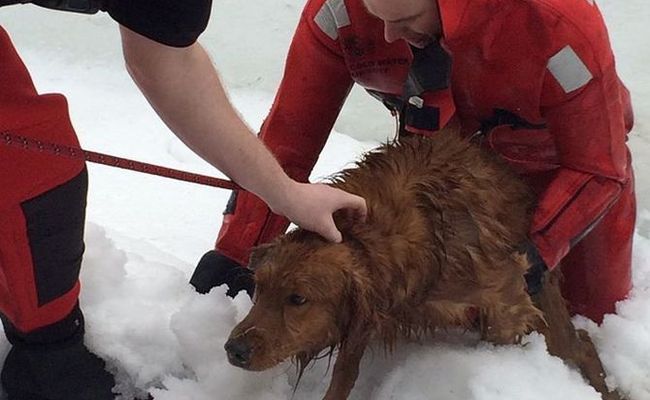
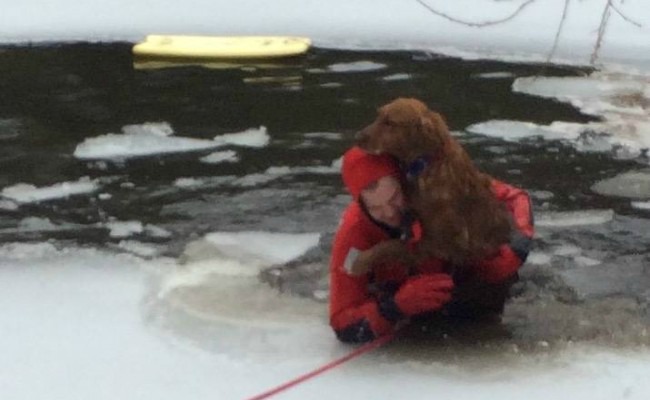
With perhaps just seconds to spare, North Hampton firefighter Will Taber barreled toward a dog who was barely clinging to thin ice last week in New Hampshire.

Photo Credit: North Hampton Professional Fire Fighters

Three-year-old Emmett ran out onto his family’s frozen backyard pond, suddenly falling through the ice. Although homeowner Kacey Eddinger started into the pond to rescue him, she had to turn back when she realized the water was simply too cold. Eddinger and her toddler son waited anxiously for help to arrive.

Photo Credit: North Hampton Professional Fire Fighters

The family isn’t certain exactly how long their golden retriever was in the water before they realized he’d fallen through, but by the time firefighters arrived, Emmett was exhausted and close to drowning.

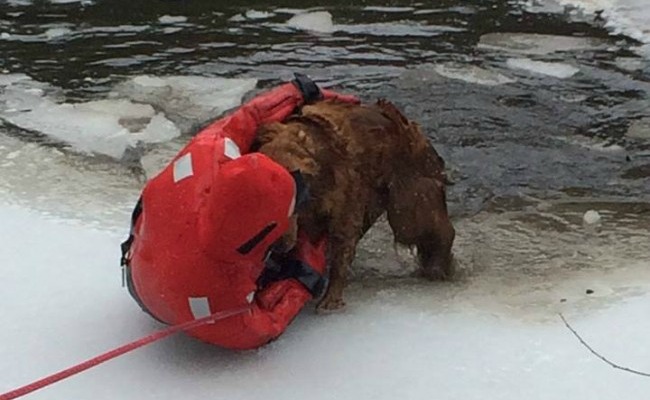
In thermal ice rescue gear, firefighter Taber held a tethered line as he crossed the ice and entered the water. Once he reached Emmett, the other firefighters pulled the pair back to shore.

Photo Credit: North Hampton Professional Fire Fighters

“The canine was exhausted and scared and minutes from going completely under water and carried by the current under the ice,” the Fire Department posted on Facebook. “The rescue was made just in time where he was then immediately warmed, carried to a police cruiser and transported to North Hampton Animal Hospital.”

Though spring has officially arrived, ice rescues have escalated due to the thin ice that remains on some bodies of water.

Photo Credit: North Hampton Professional Fire Fighters

ooOOoo

Again and again, I find myself rating actions such as these from the North Hampton Fire Fighters (and not forgetting the Santa Monica Fighters) so gloriously uplifting. Again and again, they serve as a reminder that real people all around the world are so very often wonderful, generous and loving real people!

This is the dog!

Perhaps the loss of a loved dog explains so much!

The posts for the last two days have carried separate and very different stories of terrible cruelty to dogs, the second one involving terrible cruelty to a dog and a bull! As a tradition! Ouch!!

Readers of this place know what they feel about dogs. It is felt deep within their hearts. Those feelings are poured out when, either from me or someone else, there’s a post lamenting the loss of their dog.

Just as a tiny example of that love we all have for our dogs, here’s a response from Marina Kanavaki and, trust me, Marina is far from being alone in this regard.

Oh, no, Paul!!! I’m so sorry my friend! It is hard to believe and not so long ago, Casey. I know words can’t take away the pain but you have my thoughts and I’m sending you both my love and hugs.

So a recent essay published on The Conversation site is a must to share with you today. As usual, it is republished within the terms of The Conversation.

ooOOoo

Why losing a dog can be harder than losing a relative or friend

March 9, 2017
Frank T. McAndrew,   Cornelia H. Dudley Professor of Psychology, Knox College.

Recently, my wife and I went through one of the more excruciating experiences of our lives – the euthanasia of our beloved dog, Murphy. I remember making eye contact with Murphy moments before she took her last breath – she flashed me a look that was an endearing blend of confusion and the reassurance that everyone was ok because we were both by her side.

When people who have never had a dog see their dog-owning friends mourn the loss of a pet, they probably think it’s all a bit of an overreaction; after all, it’s “just a dog.”

However, those who have loved a dog know the truth: Your own pet is never “just a dog.”

Many times, I’ve had friends guiltily confide to me that they grieved more over the loss of a dog than over the loss of friends or relatives. Research has confirmed that for most people, the loss of a dog is, in almost every way, comparable to the loss of a human loved one. Unfortunately, there’s little in our cultural playbook – no grief rituals, no obituary in the local newspaper, no religious service – to help us get through the loss of a pet, which can make us feel more than a bit embarrassed to show too much public grief over our dead dogs.

Perhaps if people realized just how strong and intense the bond is between people and their dogs, such grief would become more widely accepted. This would greatly help dog owners to integrate the death into their lives and help them move forward.

An interspecies bond like no other

What is it about dogs, exactly, that make humans bond so closely with them?

For starters, dogs have had to adapt to living with humans over the past 10,000 years. And they’ve done it very well: They’re the only animal to have evolved specifically to be our companions and friends. Anthropologist Brian Hare has developed the “Domestication Hypothesis” to explain how dogs morphed from their grey wolf ancestors into the socially skilled animals that we now interact with in very much the same way as we interact with other people.

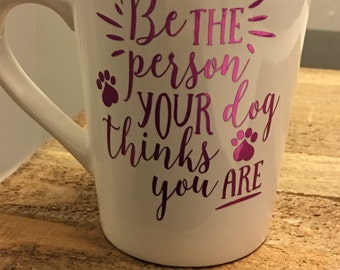
Perhaps one reason our relationships with dogs can be even more satisfying than our human relationships is that dogs provide us with such unconditional, uncritical positive feedback. (As the old saying goes, “May I become the kind of person that my dog thinks I already am.”)

This is no accident. They have been selectively bred through generations to pay attention to people, and MRI scans show that dog brains respond to praise from their owners just as strongly as they do to food (and for some dogs, praise is an even more effective incentive than food). Dogs recognize people and can learn to interpret human emotional states from facial expression alone. Scientific studies also indicate that dogs can understand human intentions, try to help their owners and even avoid people who don’t cooperate with their owners or treat them well.

Not surprisingly, humans respond positively to such unrequited affection, assistance and loyalty. Just looking at dogs can make people smile. Dog owners score higher on measures of well-being and they are happier, on average, than people who own cats or no pets at all.

Like a member of the family

Our strong attachment to dogs was subtly revealed in a recent study of “misnaming.” Misnaming happens when you call someone by the wrong name, like when parents mistakenly calls one of their kids by a sibling’s name. It turns out that the name of the family dog also gets confused with human family members, indicating that the dog’s name is being pulled from the same cognitive pool that contains other members of the family. (Curiously, the same thing rarely happens with cat names.)

It’s no wonder dog owners miss them so much when they’re gone.

Psychologist Julie Axelrod has pointed out that the loss of a dog is so painful because owners aren’t just losing the pet. It could mean the loss of a source of unconditional love, a primary companion who provides security and comfort, and maybe even a protégé that’s been mentored like a child.

The loss of a dog can also seriously disrupt an owner’s daily routine more profoundly than the loss of most friends and relatives. For owners, their daily schedules – even their vacation plans – can revolve around the needs of their pets. Changes in lifestyle and routine are some of the primary sources of stress.

According to a recent survey, many bereaved pet owners will even mistakenly interpret ambiguous sights and sounds as the movements, pants and whimpers of the deceased pet. This is most likely to happen shortly after the death of the pet, especially among owners who had very high levels of attachment to their pets.

While the death of a dog is horrible, dog owners have become so accustomed to the reassuring and nonjudgmental presence of their canine companions that, more often than not, they’ll eventually get a new one.

So yes, I miss my dog. But I’m sure that I’ll be putting myself through this ordeal again in the years to come.

ooOOoo

Just let the messages of this essay reverberate around your heart. I’ll say no more!

This must be stopped!

And Now!!

Please, good people, this is going to be a very tough read, especially coming immediately after yesterday’s example of terrible cruelty.

But these instances of such disgusting behavior have to be shared.  For without sharing them then there will be no end to them.

I am indebted to Change.org for carrying this.

ooOOoo

Sign: Stop Tying Dogs to Bulls in Horrific Bullfight ‘Punishment’

Lady Freethinker

The village of Chalhuani in Peru has a horrific annual tradition where a dog is tied to the back of a bull at a bullfight as punishment for “bad” behavior. Both of the animals are then painfully killed during the fight.

Video posted by the Mirror exposed this cruel Virgen de la Asuncion tradition in action, sparking global outrage. The video shows a dog being forced onto the back of a bull while it yelps and barks in fear. The terrified dog is tied spread-eagle to the bull, with the ropes so tight it cannot move.

The bull then enters the ring, where it is viciously killed. All the while, the dog is trapped on the bull’s back, unable to save itself from an excruciating death.

One villager tried to justify the cruelty in an interview with a local news station:

“We pick a dog that was disobedient over the past 12 months and has caused trouble,” the villager said. “As a community we see this as a fitting punishment for the dog’s bad behavior.”

But “bad” behavior is no excuse for animal cruelty. No dog deserves this horror.

These bullfights are barbaric and must be stopped. Sign this petition to urge the Peruvian ambassador to the United States to end this terrible practice, so no more animals suffer this horrific fate.

This petition will be delivered to: Ambassador Miguel Castilla

ooOOoo

Good people!

This is the letter to be delivered to the Ambassador:

Letter to Ambassador Miguel Castilla
Stop Tying Dogs to Bulls’ Backs in Cruel Bullfighting ‘Punishment’
The village of Chalhuani in Peru has a horrific annual tradition where a dog is tied to the back of a bull at a bullfight as punishment for “bad” behavior. Both of the animals are then painfully killed during the fight.
These bullfights are barbaric and must be stopped. Not only is animal cruelty an unacceptable form of punishment for dogs, but bulls do not deserve to be forced into fights, where they are tortured and killed for entertainment.
I urge the Peruvian government to ban this horrific practice at once, so no more animals must suffer for this cruel “tradition.”

Please not only sign this petition yourself but share it as far and wide as you can.

On cruelty to our beloved animals.

One just cannot ignore such cruelty as this!

I am really sorry folks but both today and tomorrow I am adding my tiny shoulder to a very large and heavy wheel. Endeavouring to make a very small difference before I leave this land of the living.

But before going on to share something that was sent to me by Scott Beckstead, the Senior Oregon and Rural Outreach Director of The Humane Society, I want to repeat something that I wrote in response to a comment left to yesterday’s Picture Parade. Because it may be seen as utterly irrelevant to today’s complex world but, nonetheless, it does explain where my love of this planet comes from.

In yesterday’s post, Yvonne of the blog Pets, People and Life left the following comment:

Those beautiful dog’s spirit lives on in the air you breathe, the green of the trees, the beating wings of a hummingbird, the house where they lived and where ever they ran and played. I hope you and Jean feel their presence when things are rough and in the quiet of the night.

I was so moved by those words that almost without any further thought I replied, thus:

Wow! Wow! And Wow!

There is something wondrous about the nature of the human consciousness that still escapes science. Neither me nor Jean are believers in a ‘God’ or subscribe to religious ‘factions’ for so much pain, war and suffering may be laid at the feet of religions (excuse my rant!), but ….

But there is something magical in “the air you breathe, the green of the trees, the beating wings of a hummingbird,” that defies definition. I like to think of it as a deep, connection with the planet that is our womb and sustains us.

This really smacked into me in back in the early 90’s; something that forever changed me. That something I experienced roughly about 4 days out in a solo sailing passage from the Azores to Plymouth. I came up on deck, clipped on, and looked around me. Primarily on the lookout for steaming lights that might indicate a ship in the same patch of ocean. It was after midnight. Having checked there wasn’t a ship in sight, I looked up at what was a totally cloud-free night sky.

What I saw were stars in that night sky that were visible 360 degrees around me. Not only visible in every single direction but visible right down to the edge of that black, ocean horizon. A huge celestial dome centered over this tiny me on my tiny boat. (A Tradewind 33: Songbird of Kent.)

It put into perspective, emotionally, visibly, intellectually and spiritually, how irrelevant one human being is and yet, how each of us is, or should be, the custodian of something immeasurably precious and beautiful: Planet Earth.

(Whoops! Sorry about that! Rather wandered off topic!)

OK, here’s what Scott sent me:

In the past two weeks, USDA Wildlife Services has:

1. Killed an Idaho family’s beloved pet dog;

2. Sent the family’s 14 year-old to the hospital with suspected cyanide poisoning;

3. Killed a Wyoming family’s two beloved pet dogs; and

4. Killed a protected Oregon wolf.

All of these incidents were caused by the M-44, a device used by Wildlife Services that fires a cyanide pellet into an animal’s mouth, causing a slow and agonizing death.

Wildlife Services’ greatest regret in all of these incidents is that they brought the agency more negative press – and given their history, they will probably use all of the incidents as “teaching moments” to instruct their agents to “shoot, shovel, and shut up.”

PLEASE CONTACT YOUR SENATORS AND U.S. REP AND URGE THEM TO ELIMINATE FUNDING FOR USDA WILDLIFE SERVICES.

Scott then included a link to an article that was recently published in The Oregonian. I am taking the liberty of republishing it in full.

ooOOoo

Labrador killed by cyanide device in Idaho, boy knocked to the ground.

A federal M-44 cyanide device exploded Thursday, March 16, 2017, killing a dog in Pocatello Idaho. (Bannock County Sheriff’s Office)

By Andrew Theen | The Oregonian/OregonLive
March 18, 2017 at 7:30 AM, updated March 18, 2017 at 2:20 PM

A three-year-old Labrador retriever died and a 14-year boy was knocked to the ground when a cyanide device deployed by the federal government exploded in Pocatello, Idaho.

The Idaho State Journal reported the boy, who had been on a walk with his dog Thursday on a ridge near their home, watched his dog die. According to the Bannock County Sheriff’s Office, the boy was also “covered in an unknown substance” when the device known as an M-44 detonated. He was evaluated at a hospital and released.

“That little boy is lucky,” Sheriff Lorin Nielsen told the Pocatello newspaper. “His guardian angel was protecting him.”

The Idaho incident comes a few weeks after a gray wolf was accidentally killed by an M-44 on private land in Oregon’s Wallowa County. The controversial type of trap is used by the U.S. Department of Agriculture’s Wildlife Services crews around the country primarily to kill coyotes and other predators.

U.S. Rep. Peter DeFazio, D-Ore., introduced legislation as recently as 2012 to ban the trap.

DeFazio has said he would reintroduce a similar bill in Congress.

The wolf death was the first documented “incidental take” of its kind in Oregon involving the protected animal and the M-44, fish and wildlife officials said.

Federal Wildlife Services officials said there were 96 M-44 devices dispersed across Oregon as of last week and the agency was looking to remove devices that were near known wolf habitat. Oregon fish and wildlife officials have said the devices were not allowed in areas of known wolf activity.

Oregon has long paid Wildlife Services to kill invasive species and specific predators. But Gov. Kate Brown’s’ recommended budget doesn’t include $460,000 typically set aside to pay the federal agency to kill animals in Oregon.

Bannock County officials described the device as “extremely dangerous to animals and humans.”

The department circulated photos of the trap. “If a device such as this is ever located please do not touch or go near the device and contact your local law enforcement agency,” officials said.

Government officials have said the number of deaths of domestic animals and non-target animals each year is low, and officials say they are conducting an “internal review” of the wolf death.

Wildlife Services killed 121 coyotes in Oregon in 2016 with M-44 devices, along with three red foxes, according to the government’s figures. No gray wolf was killed in the U.S. last year with the cyanide capsules, according to the government.

A Eugene nonprofit says the government isn’t being truthful about the number of pets and non-target animals – such as wolves – killed each year.

“Yesterday’s Idaho poisoning of a dog and the near poisoning of a child is yet another example of what we’ve been saying for decades:  M-44s are really nothing more than land mines waiting to go off, no matter if it’s a child, a dog, or a wolf,” Brooks Fahy, executive director of Predator Defense, said in a statement.

“It’s time to ban these notoriously dangerous devices on all lands across the United States.”

— Andrew Theen
atheen@oregonian.com
503-294-4026
@andrewtheen

ooOOoo

I will be writing about another terrible example of cruelty to animals tomorrow. One where you have the opportunity to add your name to a petition trying to have this cruel ‘tradition’ stopped.

Because as Anna Sewell (1820-1878), the English author who was the author of many books including Black Beauty is recorded as saying:

My doctrine is this, that if we see cruelty or wrong that we have the power to stop, and do nothing, we make ourselves sharers in the guilt.

We cannot do nothing!

For They Bring Out The Best In Us!

A wonderful follow-on to yesterday’s post.

As many of you will know, yesterday I published a post under the heading of Dogs: Aren’t They Incredible. It was the first of three essays that have been published by The Smithsonian about the wonderful ways of the dog.

So when I was wondering just what to share with you today and was browsing ‘stuff’ this story over on the Care2 site struck me as a perfect companion to yesterday’s post.

ooOOoo

Man Hears Barking From Under Pavement and Rescues Buried-Alive Dog

Editor’s note: This post is a Care2 favorite, back by popular demand. It was originally published on October 4, 2015. Enjoy!

A pregnant dog buried alive under paving stones for two days was rescued by local hero Rustam Vadim who heard a soft barking sound as he walked home with family in the Russian city of Voronezh.

Concerned about the dog’s survival, Rustam immediately went to the public utilities office to ask for help in rescuing her but was told that that department had not made the repair to a long-standing large hole in the street and they could not help.

Apparently, workers from a different government agency had made the repair and were unaware of the dog hiding in the hole as they sealed it over with paving stones.

[Ed: This video has a Russian commentary but you don’t need words to understand it!]

“My husband started to hammer to pull out the cobblestone and to hand dig out the sand because he did not have a shovel,” Rustam’s wife explains. “There was a gap that laid between the large cobblestones. My husband removed one stone and saw the face of a dog. He started to slowly pull out the dog as she is pregnant. After rescuing the dog, we recovered the hole so there is no threat to people.”

The dog was reportedly taken to a shelter and is being cared for. How many of you would like a man like Rustam as your friend or neighbor?

Photo Credit: YouTube

ooOOoo

How many, indeed, would like Rustam as a friend.

In fact, it underlines the truth that despite all the gloom and doom we read about on a daily basis most of the people out there are nice people!

Finally, I was curious as to where Voronezh was in Russia. Thanks to ‘Google’ that question was quickly answered:

Voronezh is a city and the administrative center of Voronezh Oblast, Russia, straddling the Voronezh River and located 12 kilometers from where it flows into the Don. Wikipedia
It appears to be about an eight-hour drive South-south-east of Moscow and here’s a picture of the city.
Voronezh.

The State of the World!

Reality warning dear people!

As you all know, my world is dominated by love. My love for my Jeannie and all the wonderful creatures that inhabit this home and these few acres here in Southern Oregon. Time and time again I share with you stories and articles that I come across that underpin that loving umbrella. Time and time again I am deeply moved by your interest in my scribbles. As I said, my world is dominated by love, and your friendship across this blogging world added to Jean’s love for and attachment to me, has created a little paradise for me.

But! (And you may have sensed there was a ‘But’ coming up.)

But that doesn’t mean that I am immune to being deeply affected by other, more worldly issues, that are as far away from love as one could imagine; more accurately, as far away from love for this wonderful planet as one could imagine.

So for today and the next two days I am going to share with you the pain and angst that I do feel, and feel all too easily, at what we, as in the collective global ‘we’, are up to. Madness doesn’t even seem to touch it!

Today, I am going to republish a recent TomDispatch essay, with Tom’s very kind permission. Tomorrow, I am going to contrast what fellow Brit James Lovelock has been predicting for years with where we really are heading in terms of the future of Planet Earth. Then on Friday, I will finish up with an essay by Professor Ronald Pies regarding the “twisted relationships to truth”.

So don’t say you haven’t been warned!

ooOOoo

 Tomgram: Rebecca Gordon, War Without End

No shortage of love and caring.

For that most treasured pet companion: The Dog

What with one thing and another this has been a bit of a week.

So when recently I came across a wonderful story on the Care2 site of how a Fire Department put so much energy into saving a dog’s life it seemed an automatic action to share it with all you good people out there.

ooOOoo

How Rescuers Freed This Dog From a Tire Truck Rim

3201628-largeBy: Laura S.   March 1, 2017

About Laura

Any fire chief will tell you that a fire department’s role is not just fighting fires, but sometimes helping community members out of a tight spot. And for the McDowell County Rescue Squad in North Carolina, that form of service required a delicate touch last week when they were called upon to free a dog named Sadie from the grips of a truck tire rim.

Sadie’s family told rescuers that they believe she may have been chasing another animal when she got wedged inside the Ford F-350 tire rim.

Credit: Kristi Sisk/ Facebook

Sadie was taken to the Animal Hospital of Marion where she showed everyone her new necklace with her characteristic charm. But for her own safety, Sadie would have to be sedated.

credit: Kristi Sisk/ Facebook
Credit: Kristi Sisk/ Facebook

“The tire rim probably weighed 20 or 30 pounds so she couldn’t even lift her head up when she came in,” hospital staffer Kristi Sisk said.

“We used hydraulic cutters as well as a couple of other power tools,”  McDowell County Rescue Squad Captain Jordan Harrell told Fredericksburg.com. “It was a lot of trial and error. It was very big, it was a tough metal, and not the text book type extrication.”

Credit: Kristi Sisk/ Facebook

“Thank you so much McDowell rescue squad and volunteers that showed up, took their time, and put the animals safety first getting this tire rim off!” Sisk said. “Happy to say miss Sadie had a happy ending. Went home tail wagging. I love my job!”

Credit: McDowell County Rescue Squad/ Facebook

ooOOoo

Time and time again, we see how dogs bring out so much good in us!

Feeding the correct wolf!

A very heart-touching guest post

Yesterday I used as a sub-heading “I will never, ever tire of the wonderful connections made by this blog!

I wrote that before Sydney sent in a guest post which reached out to me, to Jeannie and, undoubtedly, will reach out to many others. Sydney further validated the power of the wonderful connections that blogging brings.

Here’s how it came about.

Not that long ago, there was a new follower to this place. As is so frequently the case that new follower was also a blogger. Their blog is called very beautifully: Recovery For All Of My Heart. As I always try to do, I went across to leave a ‘thank you’ note. I also read the About page that I want to republish here by way of my introduction to Sydney.

Hello, I am in recovery from an eating disorder, depression and anxiety. The way I got to the best place in my mind is by changing my perspective.

In this blog, I use my new open-mindedness to show the world the beauty I see in hopes that others will then see the beauty in themselves. For me, all it took was to see the beauty in myself, but I needed someone to help me see it first. My hope is to be that person for others.

There is a way to see the good in every piece of you. You can get your mindset to see what others love about you. The proof of everyone’s beauty lies in changing your perspective and this blog hopes to put into light the beauty in everyone that ever existed.

So now to Sydney’s post. (And if you want to understand why I chose the title to this post, then please read right down to the end.)

ooOOoo

Mindfulness and a dog named Bailey

By Sydney R. February 23rd., 2017

Bailey
Bailey

When I was 21 years old, I got a hound boxer puppy named Bailey. Previously, I had a dog my mom and I raised when I was seven; she was named Rachel.

I only speak of Bailey in this post because of a certain situation I want to talk about, but I also wanted to mention how amazing Rachel was too.

Anyway, I raised Bailey to be the sweet almost two-year-old he is today. He is not a normal dog to me. This is because I believe him to be extraordinary (so original for dog owners, I know), and also because I have struggled with my mental health.

I have struggled with depression and he has changed my life for the better. One day last year I was having a very hard time with my depression. I wanted to just lay in bed and quit my job and begin isolating again. I wanted to just sleep and not fight the thoughts and just let them rattle on inside of my mind while I lay there.

I grabbed my dog as he was lying next to me and held onto him ready to remain in my negative thoughts for all eternity. Then something changed: I felt his fur. I felt my cheek against his fur. I heard his sweet little breathing that used to put me to sleep when he laid on my chest when he was a puppy. I was being mindful without even realizing it.

I was aware of everything I was feeling when holding this thing that is so dear to my heart.

Suddenly, all the pain went away. I was reminded of this feeling I can have while holding my dog. I can fight this depression and I can have a wonderful life. If you ever are feeling extremely sad or have any type of negative urges, and this can be about anything, grab your furry little one and just stay in the moment until they pass.

And why is this?

Research has shown that if you look into your dogs eyes, the hormonal response is activated just like the one that is activated when you look at infants. Scientists took blood samples of dogs and their owners before and during time spent petting. The results were that the levels of oxytocin went up in humans during a petting session of a dog and it was at very similar levels of new mothers and their infants.

Even more amazing, dogs had the same levels in their blood as well, showing how happy they are around their owners. During my depression that night, holding onto my dog was not just helping me overcome my sadness, he was having a nice time as well.

Now what I am guessing is that if you are sitting down, petting your dog, but not really paying much attention, your dog will be happy, but your oxytocin levels will not be as high as they could be. When you are mindful and staying in the moment whilst petting your dog, you could be seriously happy, to the point where your oxytocin levels from your dog stops you from ruminating on your negative thoughts.

Don’t just pet your dog when you are upset…make sure you are completely in the moment.

Notice your body and notice what your hands and arms are feeling as you wrap your arms around your dog. Let your hands and all of your arms feel the fur. Use all of your senses. Make sure you hear your dog and do not let your thoughts block out being in the moment. Regular petting of the dog is enjoyable. Mindful petting of a dog could change your life, like it did mine.

Now I will always know that I have something to go to when I feel depressed. This is extremely important because one huge part of depression is hopelessness. This is the feeling that you will always feel depressed.

With a dog, you have hope to get out of those feelings. I know that I have my dog to go to and I will never fear being sad forever again. I always have the mindful petting of Bailey or Rachel that will make the negative thoughts drain away.

ooOOoo

Good people, I am genuinely humbled by both Sydney’s desire to share this with you, and by the magic of having a dog in our life.

So let me close like this.

BBC Television in the UK currently have on their iPlayer site a drama series called Death in Paradise: The programme website is here.

Detective drama series set on a Caribbean island.

In a recent episode there was this profoundly wise observation made by the detective, Jack Mooney, played by Ardal O’Hanlon.

Detective Jack Mooney

There are always two wolves deep inside us.

One is a hateful, angry, selfish wolf that doesn’t hesitate to try and do you harm.

The other wolf is a soft, gentle creature that responds to love and always wants to love you back.

So which wolf is in charge?

The wolf we feed!

Footnote:

This came to my ‘inbox’ a short time ago (as of 09:30 Sunday morning):

unnamed2