Category: Environment

A sailing memory, part one.

This is for Pendantry!

There was a remark left on my post on Tuesday by Pendantry. This is what he said, “Still waiting to hear the story of that dangerous trip you took (once?) that you dropped a teaser about years ago….

Well not only am I including the excerpt from the book Letter to a Grandson, as yet unpublished, but I am extending it to two posts, simply because I think it’s too long for one.

So this is part one.
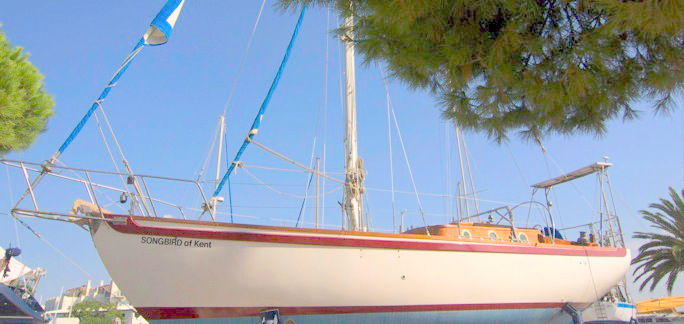
Tradewind 33 – Songbird of Kent. My home for five years.


ooOOoo

Songbird Of Kent

I decided to sell Dataview and worry about the taxation later. Now it is easy to write that all these years later knowing how it turned out; I never paid the tax!
For that same year, 1986, I went to Cyprus on holiday. Or rather I should say I went to the Greek half of Cyprus, to Larnaca, for a well-deserved holiday.

In wandering around the marina one day I saw a boat for sale. It was a Tradewind 33, a heavy-displacement cutter, called Songbird of Kent. The owners, Michael and Betty Hughes, were selling after many years of living on board and they returning to their native Wales. It had been extensively cruised in the Mediterranean with the base being Larnaca Marina.


It was a lovely boat and I could afford it. Plus, it offered an answer to my prayers. If I bought Songbird of Kent and left the UK before April 15th 1987 and stayed away for four tax years there would be no tax to pay. Nothing; Nada!
So that’s exactly what I did!


I bought Songbird, flew back to Devon and made preparations for leaving the United Kingdom for good. It was a busy period. One that had me saying cheerio to my son and daughter, but insisting that, so long as they came out to see me, it would not be four or five years before I saw them again. Plus loads of packing up, disposing of my house and eventually boarding that aircraft with a one-way ticket: London Stansted to Larnaca, Cyprus.


I settled in to living on board Songbird of Kent. I bought myself a small motorbike and in time, believe it or not, discovered there was a gliding club on the Island, at Kingsfield just to the East of Larnaca. The airfield was built for the Army Air Corps, possibly around 1960, but I can’t remember whether or not it was still in military hands. I don’t think it was!

But, I am able to look up my flying log and see that I flew a T21 from Kingsfield on the 28th October, 1990. It became a regular habit; quite quickly, as on the 17th November, 1990, I completed my instructor flight test and was signed off to instruct.
I also took an Advanced Open Water Diver course run by instructor Ian Murray. Ian was a PADI diving instructor. PADI stood for Professional Association of Diving Instructors.

My life was pretty good.


Each summer I would sail solo to Turkey, usually West along the South coast, the Greek side of Cyprus, then turn North and make it to Alanya or Antalya. There I would wait for guests to come from England including, most importantly, for Maija and Alex to visit.
Then we would gently cruise from harbour to harbour westwards, sometimes entering Greece much further West.

One day in Larnaca Marina a boat came quietly in and moored in the vacant berth next to me. I hopped off Songbird and went to help the sailor on board. It looked as though he was sailing solo.
After he had been securely moored, I asked him where he had come from. He was English; his name was Les Powells. He unassumingly said he was on his way home after a solo circumnavigation. Indeed, I later learned that it was his third solo circumnavigation!

The mind absolutely boggles! I mean I have just an idea, from reading books written by Francis Chichester and others, what a single solo circumnavigation would be like. But three!!
Over the coming days, we chatted about a whole range of stuff. When the subject of glider flying came up, Les said that was something he had always wanted to do.

I immediately offered to teach him to fly gliders. For a few weeks thereafter, we drove across to Kingsfield, when the Club was operating, and I taught Les up to the point where he went solo.
In the time we spent together, Les inspired me to undertake more longer sailing trips than just going across at the start of the season from Cyprus to Turkey and, of course, returning at the end of the season. Maybe, even try a transatlantic.

The idea of crossing the Atlantic kept nudging away at me. Especially since Dave Lisson, a Canadian friend from Larnaca Marina, was very much in favour of coming with me. Dave and I chatted about it and we agreed; we would give it a go! It was 1992 and a little late in the year to be starting off but we reckoned on it being alright. We left Larnaca Marina on the 10th September, 1992.


The idea was to head for Malta bypassing Crete. The weather soon became less than idyllic and by late on 13th September I made an entry in the sailing log: Conditions deteriorating. Then a further entry in the log at 11:00 on the 14th: Giant seas 3-4 metres.

Eventually on the 20th September we entered Valletta Harbour. We set off again on the 24th September. Our next port of call was Sidi Bou Said marina in Tunisia, which we entered on the 26th September.

The plan was to sail directly from Sidi Bou Said to Gibraltar but, once again, the weather got in the way. Thus on the 3rd October we entered Algiers harbour to take on fuel and to have a rest from the inclement conditions. We left Algiers on the 7th October heading for Gibraltar.


I must say that sailing in a smallish yacht had an almost unreal quality to it. The routine of sailing soon enveloped us. We slept frequently but lightly. At night, every twenty minutes or so, the one on watch would come on deck to take a look round. There was a simplicity in sailing, using a self-steering gear to helm the boat, and I remember one night coming on deck, there wasn’t a moon, and all around me, literally 360 degrees of vision, the stars came right down to the horizon. I was transfixed. We were far enough from land not to have any light pollution. It was magical. Indeed, it was a memory that has never left me.


However, getting to Gibraltar was not without its challenge for we suffered a knockdown and this scared us both to the core.

ooOOoo

Part Two tomorrow.

Returning to a theme – May!

The years click by!

We are coming up to the month of May!

Then in a very short time it will be May 8th. Not only my half-birthday but considerably of more note the anniversary of the end of World War II.

I am certain that I am the only one who puts meaning into these dates. I can do no better than to re-post something that I published on May 1st, 2017.

ooOOoo

For all my life this has felt like a very special month.

And, dear friends, at the risk of repeating myself to many of you, this is why the month of May is special for me.

Simply that I was born in London during the closing months of the Second World War. Inevitably, I was unaware of the number of German bombs that were falling on London during those last few months. But there were thousands.

On May 8th. 1945, the day that WWII ended and six months to the day from when I was born, my mother looked down at me and said aloud to me: “You are going to live”. Despite the fact that I don’t recall my mother saying that, it was verified many times later when I was growing up.

Now here we are approaching May 8th. 2017 (now May, 2020) and in a very real sense it seems that we are in another war.

A war of consequence.

A war that we have been engaged in for many, many years.

A war where we are inadvertently fighting on a global battlefield.

A war where 99.99% of us don’t consciously identify the weapons we are using. Weapons that are incredibly effective. So much so that we are in sight of winning the last battle; winning the war.

Yet a war where winning is no win at all. Indeed, where winning this war, this global war, spells the end. The end of life for 99.99% of us humans (and much else besides).

Now what on earth has got me so fired up?

Two things have:

The first is that I am living in my 73rd year of life. (Now 75th.) I have no idea of when my life comes to an end. But that death is a guarantee. Indeed, if one takes note of the average life expectancy of a male today in the USA (75.6 years) , it may not be that far away.

The second thing is that before my death I truly want to know that humankind has laid down its weapons of war against our planet and that there really is an unstoppable mission, a united wave of passion, to live in peace on this planet. Perhaps better put to live in peace with this planet.

Or in the words of an organization that I now want to introduce:

A mission which will require the hard work and dedication of each and every one of us as we do everything in our power as individuals, but also as we galvanize businesses, entrepreneurs, innovators, city planners, communities, people and politicians—all those who share our purpose.

OK! Thank you if you are still reading this! (Someone give Fred in that soft arm-chair over there a nudge; I can hear his snores from here!)

In the last Smithsonian electronic newsletter that I was reading yesterday morning there was a reference to an organization that I hadn’t previously come across. Here is the link to that item on The Smithsonian website. I am republishing it in full in this place. As you read it you will understand why I am republishing it.

ooOOoo

Using a New Roadmap to Democratize Climate Change

A new tool aims to bypass governments and put the power of climate action in the people’s hands

By Anne Glusker Smithsonian.com April 28, 2017

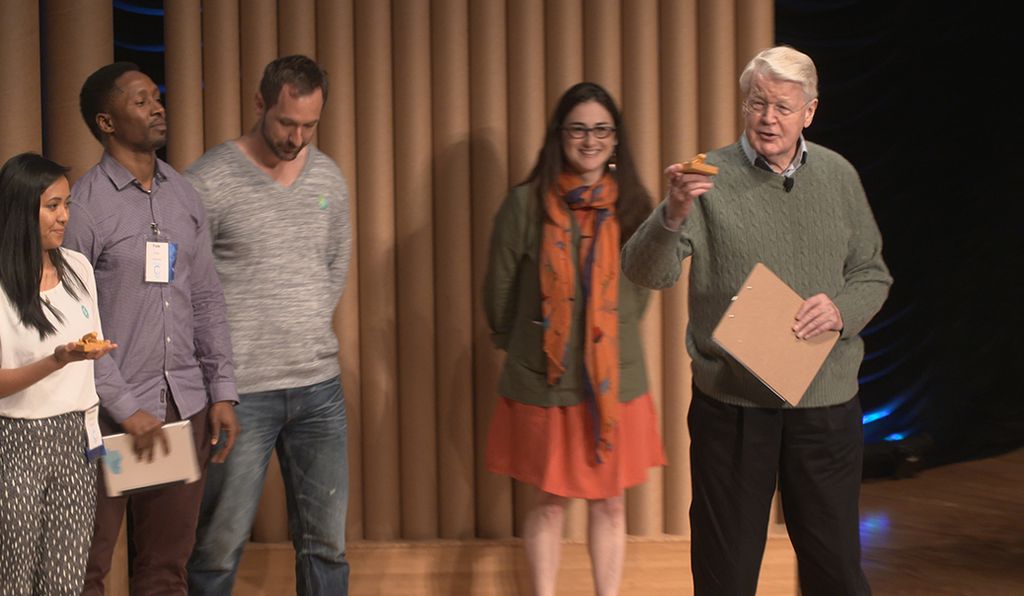
Olafur Grimsson, who was president of Iceland from 1996 to 2016 and saw his country through the worst economic crisis in its history, making headlines all over the world as banks collapsed and the country fell into a depression, is the very picture of an urbane statesman. Collected and poised, with a striking full head of white hair, as comfortable in English as in his native Icelandic, he seems an unlikely revolutionary, not the sort of person you’d look at and immediately find yourself thinking: “Power to the People.”

But Grimsson is one of the primary architects of a quietly radical new idea whose aim is to facilitate action on climate change without any of the usual suspects—governments, countries, international bodies, negotiating parties.

He and several other veterans of the historic 2015 Paris Agreement on climate change were in Washington, D.C., last year, just before COP22, the climate meeting held in Marrakesh in 2016. They were pondering next steps when the conversation took a new and interesting turn, Grimsson says, addressing the question: “Was it possible to have the success of Paris without governments necessarily being in the leading role?”

The group included movers and shakers such as Peter Seligmann, the chairman of Conservation International; Laurene Powell Jobs, president of the philanthropic organization the Emerson Collective; and Andy Karsner, an assistant energy secretary during the administration of George W. Bush. Galvanized by their own query, they decided to try to answer it—to set about creating a new tool to aid in achieving the goals of the Paris accord.

At the Smithsonian’s Earth Optimism Summit, a gathering this past weekend of conservation-minded citizens, scientists and activists, Grimsson explained: “You get governments that are opposed or even hostile to climate action. We decided to bring together in Marrakesh a gathering of thinkers and scientists and innovators and policymakers from different countries in order to discuss a new model of securing the success of the future of the climate movement.”

At the Smithsonian’s Earth Optimism Summit, the former president of Iceland Olafur Grimsson encouraged new solutions to climate change, awarding cash prizes to the winners of the “Make for the Planet” challenge. (The Roadmap)

Grimsson’s group felt that due to changes in information technology and social transformations, the large organizations and structures that used to be necessary to effect change were now not needed. And thus was born Roadmap, a new crowdsourcing tool for anyone and everyone interested in climate action. Still in its very early stages, Roadmap’s founders envision it as a platform for those working on climate issues—from scientist and policymaker to farmer and fisherman—to facilitate the sharing of knowledge and ideas, methods and techniques.

“A new political model is possible—where everyone can be a doer, where you no longer need big government or big enterprises to bring about success,” Grimsson says.

This new model for social change that skips the usual cumbersome channels and processes has been seen everywhere from public health, where the Bill & Melinda Gates Foundation has redefined the sector, to the hospitality industry, which is working to combat the human trafficking that plagues its businesses, to perhaps most famously the Arab Spring, where the role of social media in bringing about political change is still being debated today.

And this new model is complemented by technological changes. “The innovation in energy technology is such that we no longer have to wait for the big energy breakthrough,” Grimsson says. “We already have the available technologies. Every individual, home, village, community, town and region can execute change. The good news from the climate point of view is that, in addition to the information technology revolution, there has now also taken place an energy revolution. A house can be a power station: If the people who live in that house have extra energy, they can sell their energy through the smart grid. The notion that every house can be a power station is as revolutionary as saying that every mobile phone can be a media company.”

Grimsson admits that it may seem odd for someone in his position to be advocating that ordinary citizens take action apart from the conventional corridors of governmental power.

“For me to say that these traditional political organizations and positions are somewhat outdated is perhaps a strange statement: I was a professor of political science, I’ve been a member of parliament, I’ve been a minister of finance, I was president for 20 years,” he says.

It was during Iceland’s financial meltdown that he first experienced this new kind of social change: “I saw this very strongly through the financial crisis in my own country, which led to a big social economic uprising. All those activities were engineered by unknown people, people who were not part of a big organization, who used Facebook and the information media to bring thousands of people together in one day.”

Right now, Roadmap consists of a website and a lofty manifesto that speaks of raising the value of “moral currency” and creating a “best practices warehouse.” Visitors to the site can fill out a form if they want to become part of its community of “doers.” The practical part of the manifesto speaks of identifying the best methodologies and models; implementing a “real-time system of measurement” and a way to “gauge and understand what is working, what is not, and exactly what is being achieved.” As the platform develops, it will be interesting to see exactly what form these gauges, measurement systems, and warehouses take.

After the Paris Agreement, Grimsson says of himself and his Roadmap co-founders, “We were all optimistic, but we are all also realists.” It is his belief that if you “give people the tools, they can execute the transformation and the change—without governmental leadership.” Perhaps Roadmap will be one of those tools.

ooOOoo

Here’s a video that spells it out in ways that I find impossible to ignore.

Because in hundreds of years time I want others to look at the following picture of Troutbeck Valley in England and know how precious is this one and only planet we live on.

Or in the words of Sue Dreamwalker that I read yesterday evening:

We are witnessing more storms, more unseasonal weather patterns, and I just hope that we wake up soon to the damage we are doing to our beloved Mother that has held us in her eternal arms for so long..

Photo credit: Getty Images

Enjoy the month of May wherever you are in the world!

Closing by repeating a key pronouncement in that RoadMap video above:

Why We?

Who Else!

Earth Day!

I simply forgot it was Earth Day yesterday!

I wanted to let the post on Tuesday run for a couple of days because it really made the point about dogs, in particular, being animals who love to love!

But I then forgot, until I woke up on the 22nd, that yesterday was Earth Day.

So what to publish?

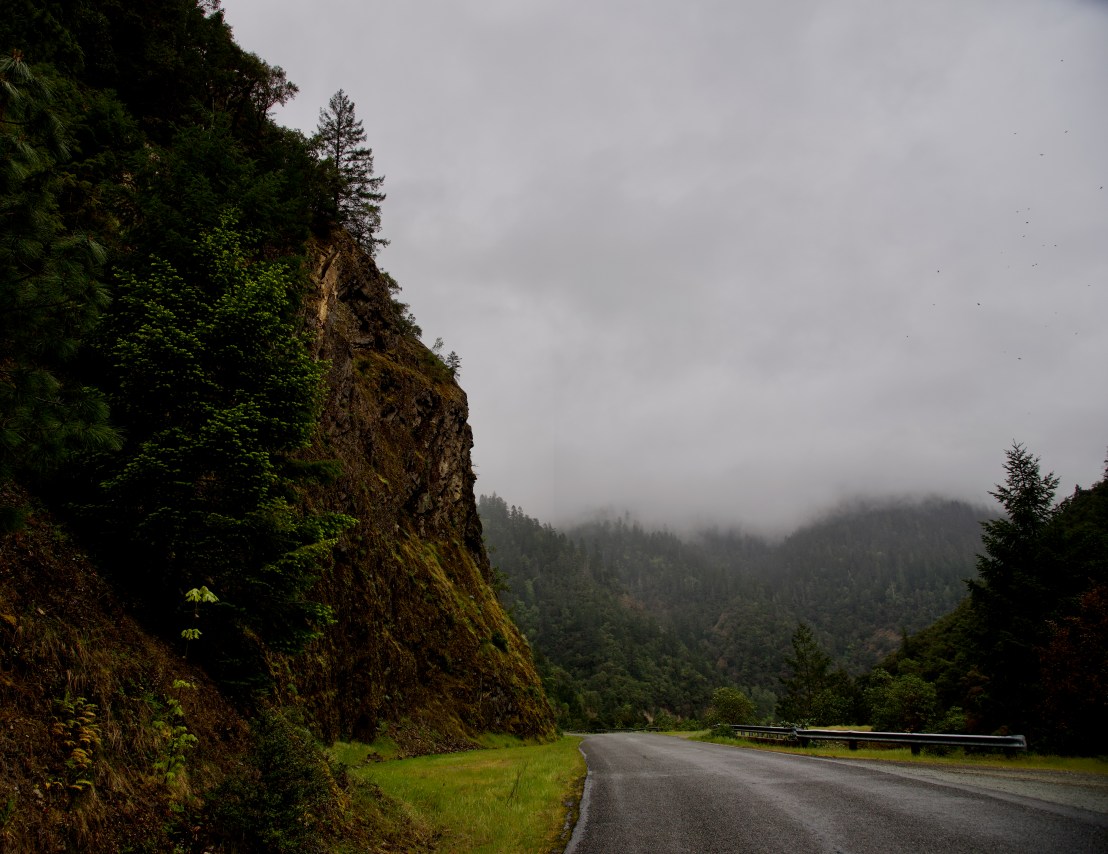
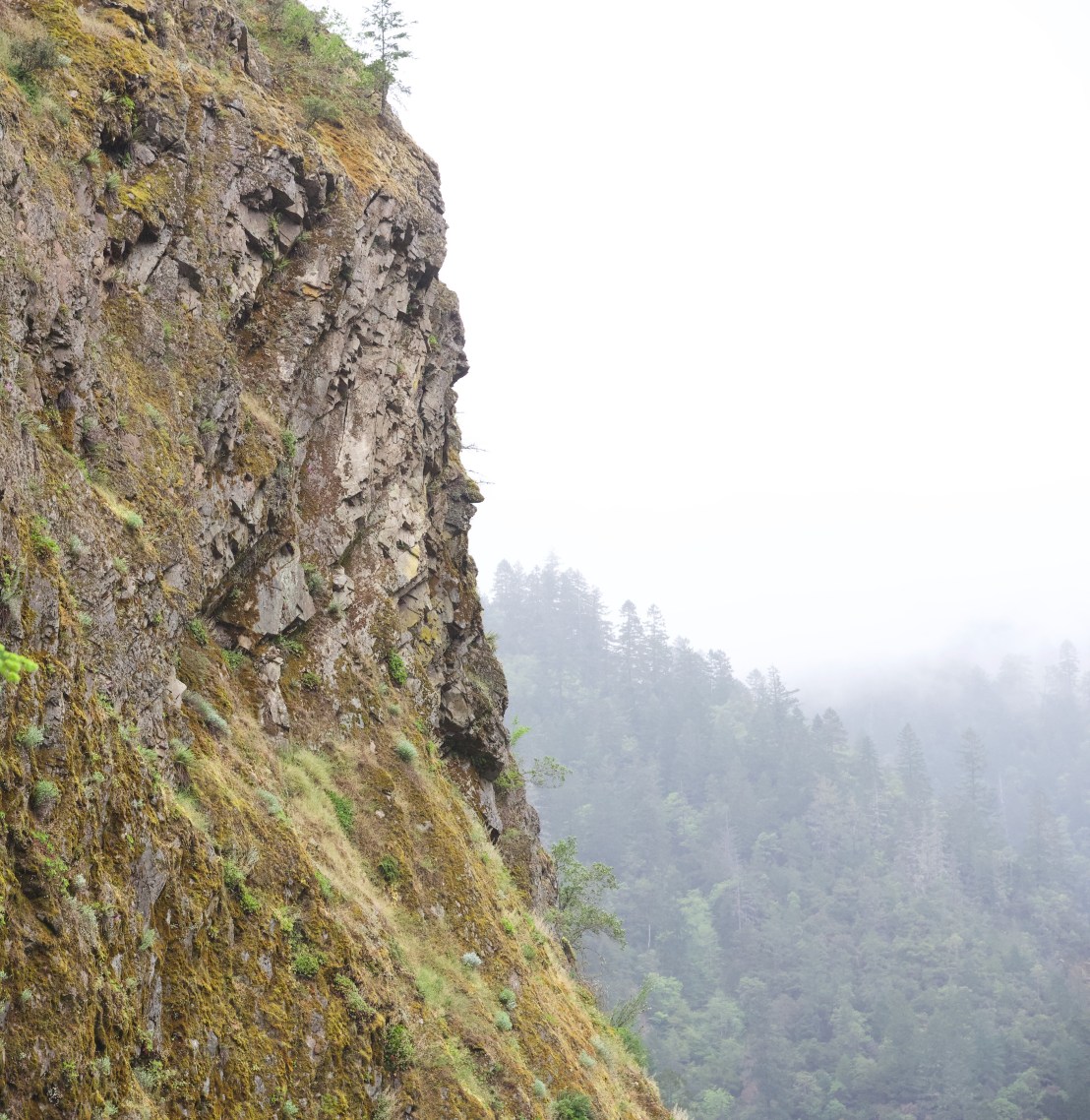
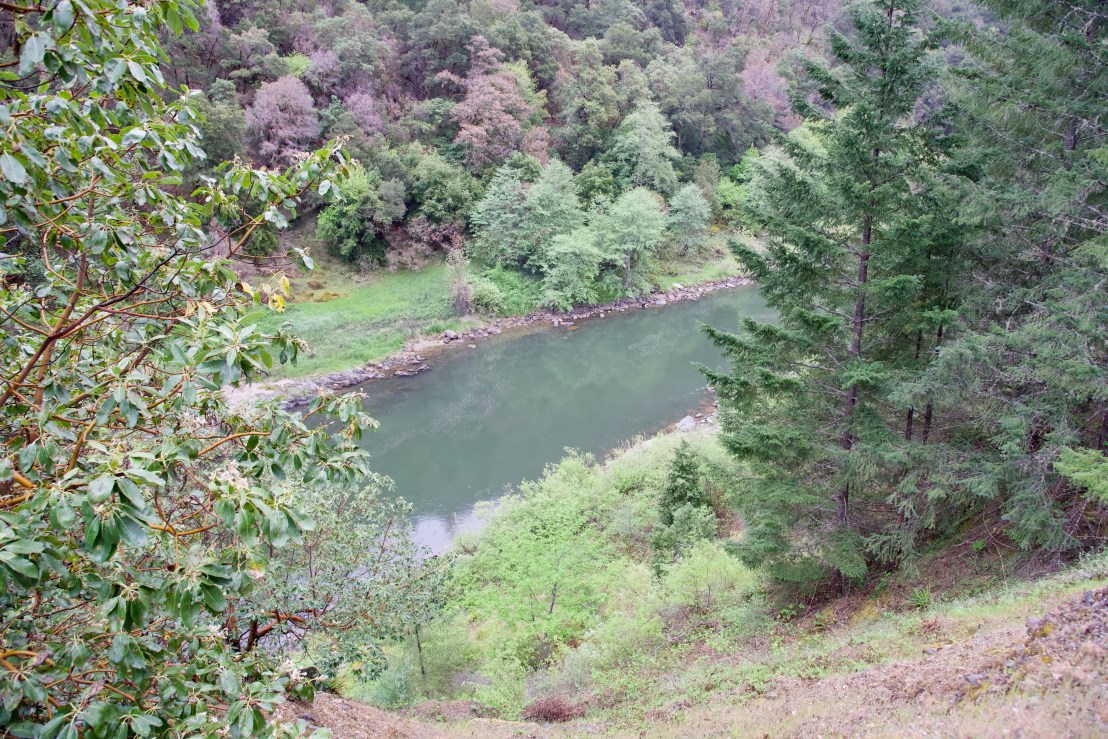
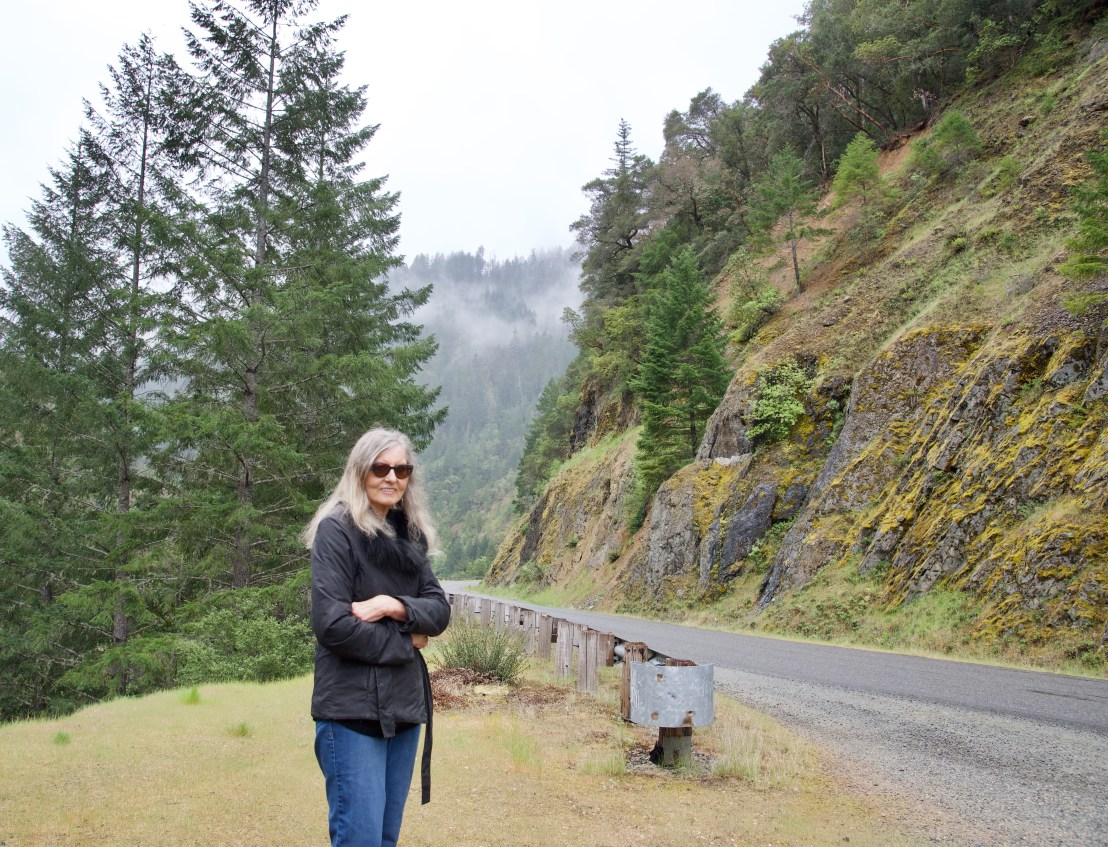
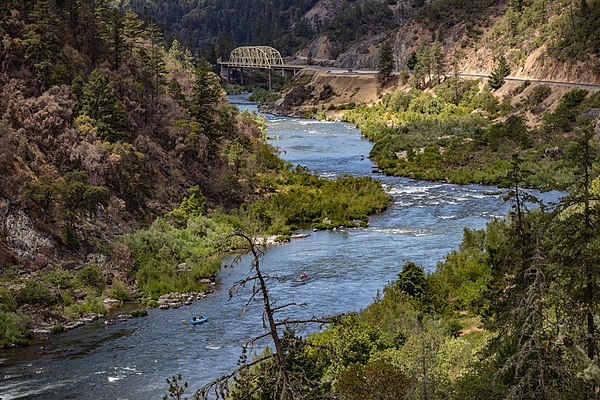
Yesterday in Merlin was a damp day with a steady rain coming down in the morning. About 10am I volunteered the idea that we should drive the shortish distance to Galice; just 10 miles from where we live. Galice is a very small settlement on the Western bank of the Rogue River. Then we drove on for a few more miles. It was incredible scenery. The misty, damp forest and the river running below in the gorge.

I had my camera with me and the following are some of the photographs that were taken.

Just for a change! All within 15 miles of home!

oooo

oooo

oooo

oooo

oooo

oooo

For those interested in learning more, I am publishing the WikiPedia account of the Rogue River.

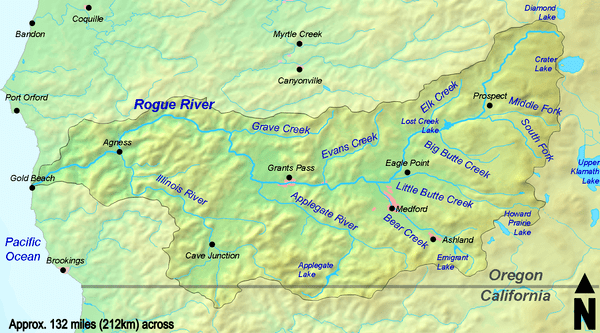
The Rogue River (Tolowa: yan-shuu-chit’ taa-ghii~-li~’,[7] Takelma: tak-elam[8]) in southwestern Oregon in the United States flows about 215 miles (346 km) in a generally westward direction from the Cascade Range to the Pacific Ocean. Known for its salmon runs, whitewater rafting, and rugged scenery, it was one of the original eight rivers named in the Wild and Scenic Rivers Act of 1968. Beginning near Crater Lake, which occupies the caldera left by the explosive volcanic eruption of Mount Mazama, the river flows through the geologically young High Cascades and the older Western Cascades, another volcanic province. Further west, the river passes through multiple exotic terranes of the more ancient Klamath Mountains. In the Kalmiopsis Wilderness section of the Rogue basin are some of the world’s best examples of rocks that form the Earth’s mantle. Near the mouth of the river, the only dinosaur fragments ever discovered in Oregon were found in the Otter Point Formation, along the coast of Curry County.

People have lived along the Rogue River and its tributaries for at least 8,500 years. European explorers made first contact with Native Americans (Indians) toward the end of the 18th century and began beaver trapping and other activities in the region. Clashes, sometimes deadly, occurred between the natives and the trappers and later between the natives and European-American miners and settlers. These struggles culminated with the Rogue River Wars of 1855–56 and removal of most of the natives to reservations outside the basin. After the war, settlers expanded into remote areas of the watershed and established small farms along the river between Grave Creek and the mouth of the Illinois River. They were relatively isolated from the outside world until 1895, when the Post Office Department added mail-boat service along the lower Rogue. As of 2010, the Rogue has one of the two remaining rural mail-boat routes in the United States.

Dam building and removal along the Rogue has generated controversy for more than a century; an early fish-blocking dam (Ament) was dynamited by vigilantes, mostly disgruntled salmon fishermen. By 2009, all but one of the main-stem dams downstream of a huge flood-control structure 157 miles (253 km) from the river mouth had been removed. Aside from dams, threats to salmon include high water temperatures. Although sometimes too warm for salmonids, the main stem Rogue is relatively clean, ranking between 85 and 97 (on a scale of 0 to 100) on the Oregon Water Quality Index (OWQI).

Although the Rogue Valley near Medford is partly urban, the average population density of the Rogue watershed is only about 32 people per square mile (12 per km2). Several historic bridges cross the river near the more populated areas. Many public parks, hiking trails, and campgrounds are near the river, which flows largely through forests, including national forests. Biodiversity in many parts of the basin is high; the Klamath-Siskiyou temperate coniferous forests, which extend into the southwestern Rogue basin, are among the four most diverse of this kind in the world.

Rogue River from Hellgate Canyon
Map of the Rogue River watershed
Location of the mouth of the Rogue River in Oregon

Just to reflect on the fact that people have lived along the Rogue River and its tributaries for 8,500 years!

Hats off to this savior!

Yet another article I want to share from Mother Nature Network.

I really don’t know how Mother Nature Network (MNN) do it! For they have a great deal of stories about dogs and a great many of them deserve sharing with you all.

Take this one. A nine-year-old Pit Bull had about as much chance of being given a loving home as I have of winning the lottery (and I don’t even enter for it!).

But that wasn’t to reckon on Michael Levitt of California. Absolutely wonderful Mr. Levitt. You are a savior!

Christian Cotroneo has the full story.

ooOOoo

Removed because of an alleged copyright infringement.

ooOOoo

I can do no better than to close this post with a repeat of Michael Levitt’s words: “We’re helping Toretto, but Toretto is helping us. Having this beautiful, sentient being in our home — and having to think about somebody besides ourselves — has really helped us get through the scariness of what we’re all dealing with.

Beautiful, sentient beings – our dogs!

Perfect!

It is a very beautiful story.

Being alone!

A repeat of an essay from the 12th October, 2019.

We were truly alone when we went to Utah. (September, 2019.)

But then again, one of the privileges of being on 13 acres, 13 very rural acres, here in Southern Oregon is that being alone is not that far away!

I don’t want to underplay the importance of this posting, republished from The Conversation website (with permission), because we live in so busy times.

Written by three professors, it’s a very wise and profound article.

ooOOoo

Spending time alone in nature is good for your mental and emotional health

June 4th, 2018

By , Professor of Outdoor Education, Montreat College
, Associate Professor and Program Director of Parks and Recreation Management, Western Carolina University

, Associate Professor of Outdoor Education, Montreat College
Today Americans live in a world that thrives on being busy, productive and overscheduled. Further, they have developed the technological means to be constantly connected to others and to vast options for information and entertainment through social media. For many, smartphones demand their attention day and night with constant notifications.

As a result, naturally occurring periods of solitude and silence that were once commonplace have been squeezed out of their lives. Music, reality TV shows, YouTube, video games, tweeting and texting are displacing quiet and solitary spaces. Silence and solitude are increasingly viewed as “dead” or “unproductive” time, and being alone makes many Americans uncomfortable and anxious.

But while some equate solitude with loneliness, there is a big difference between being lonely and being alone. The latter is essential for mental health and effective leadership.

We study and teach outdoor education and related fields at several colleges and organizations in North Carolina, through and with other scholars at 2nd Nature TREC, LLC, a training, research, education and consulting firm. We became interested in the broader implications of alone time after studying intentionally designed solitude experiences during wilderness programs, such as those run by Outward Bound. Our findings reveal that time alone in nature is beneficial for many participants in a variety of ways, and is something they wish they had more of in their daily life.

On an average day in 2015, individuals aged 15 and over spent more than half of their leisure time watching TV. Bureau of Labor Statistics, Americans Time Use Survey

Reflection and challenge

We have conducted research for almost two decades on Outward Bound and undergraduate wilderness programs at Montreat College in North Carolina and Wheaton College in Illinois. For each program, we studied participants’ experiences using multiple methods, including written surveys, focus group interviews, one-on-one interviews and field notes. In some cases, we asked subjects years later to look back and reflect on how the programs had affected them. Among other questions, our research looked at participant perceptions of the value of solo time outdoors.

Our studies showed that people who took part in these programs benefited both from the outdoor settings and from the experience of being alone. These findings build on previous research that has clearly demonstrated the value of spending time in nature.

Scholars in fields including wilderness therapy and environmental psychology have shown that time outdoors benefits our lives in many ways. It has a therapeutic effect, relieves stress and restores attention. Alone time in nature can have a calming effect on the mind because it occurs in beautiful, natural and inspirational settings.

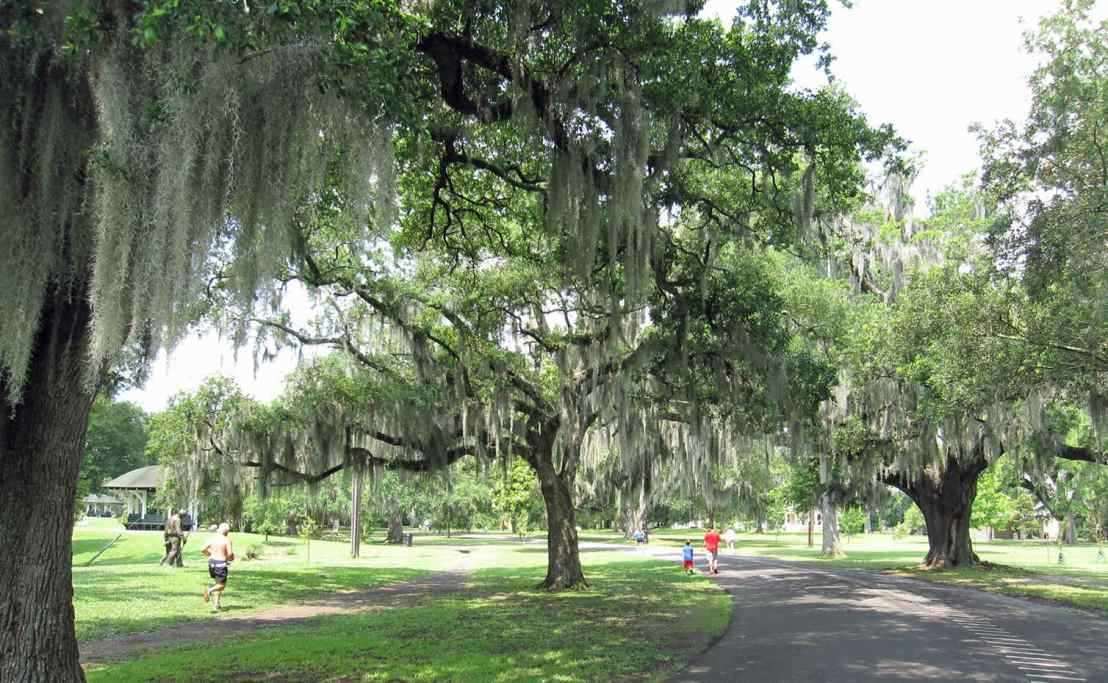
Spending time in city parks like Audubon Park in New Orleans provides some of the same benefits as time in wilderness areas, including reduced stress levels and increased energy levels. InSapphoWeTrust, CC BY-SA

Nature also provides challenges that spur individuals to creative problem-solving and increased self-confidence. For example, some find that being alone in the outdoors, particularly at night, is a challenging situation. Mental, physical and emotional challenges in moderation encourage personal growth that is manifested in an increased comfort with one’s self in the absence of others.

Being alone also can have great value. It can allow issues to surface that people spend energy holding at bay, and offer an opportunity to clarify thoughts, hopes, dreams and desires. It provides time and space for people to step back, evaluate their lives and learn from their experiences. Spending time this way prepares them to re-engage with their community relationships and full work schedules.

Putting it together: The outdoor solo

Participants in programmed wilderness expeditions often experience a component known as “Solo,” a time of intentional solitude lasting approximately 24-72 hours. Extensive research has been conducted on solitude in the outdoors because many wilderness education programs have embraced the educational value of solitude and silence.

Solo often emerges as one of the most significant parts of wilderness programs, for a variety of reasons. Alone time creates a contrasting experience to normal living that enriches people mentally, physically and emotionally. As they examine themselves in relation to nature, others, and in some cases, God, people become more attuned to the important matters in their lives and in the world of which they are part.

Solo, an integral part of Outward Bound wilderness trips, can last from a few hours to 72 hours. The experience is designed to give participants an opportunity to reflect on their own thoughts and critically analyze their actions and decisions.

Solitary reflection enhances recognition and appreciation of key personal relationships, encourages reorganization of life priorities, and increases appreciation for alone time, silence, and reflection. People learn lessons they want to transfer to their daily living, because they have had the opportunity to clarify, evaluate and redirect themselves by setting goals for the future.

For some participants, time alone outdoors provides opportunity to consider the spiritual and/or religious dimension of life. Reflective time, especially in nature, often enhances spiritual awareness and makes people feel closer to God. Further, it encourages their increased faith and trust in God. This often occurs through providing ample opportunities for prayer, meditation, fasting, Scripture-reading, journaling and reflection time.

Retreating to lead

As Thomas Carlyle has written, “In (solitary) silence, great things fashion themselves together.” Whether these escapes are called alone time, solitude or Solo, it seems clear that humans experience many benefits when they retreat from the “rat race” to a place apart and gather their thoughts in quietness.

In order to live and lead effectively, it is important to be intentional about taking the time for solitary reflection. Otherwise, gaps in schedules will always fill up, and even people with the best intentions may never fully realize the life-giving value of being alone.

ooOOoo

I would modify that advice from Thomas Carlyle and that is to include a dog.

For in my experience when one is in the mood for a bit of solitary reflection your dog seems to sense it as well.

Picture Parade Three Hundred and Thirty.

A young, talented photographer.

My grandson, Morten, who had his birthday yesterday, he is now nine, took some photographs recently. They are fabulous and are republished here with Morten’s permission. Completely untouched by yours truly!

oooo

oooo

oooo

oooo

oooo

oooo

oooo

I think these are fabulous. Morten used the following camera.

A Lumix DMC-TZ10


What on earth are we going to do?

A very powerful essay from George Monbiot.

Today and tomorrow I am posting essays that have nothing to do with dogs! Today, I am sharing George’s gloom about the future, tomorrow I am sharing our human capacity for incredible ingenuity and technology.

Because I sense we are a species of two extremes; the very mad and the very clever!

I don’t have an answer but I can share these two essays.

Today, I give you George Monbiot’s essay Suing For Survival.

ooOOoo

Suing For Survival

Our legal action against the government aims to shut down fossil fuels

By George Monbiot, published in the Guardian 4th March 2020

Our survival is not an afterthought. The defence of the living planet cannot be tacked retrospectively onto business as usual. Yet this is how almost all governments operate. They slap the word “sustainable” on damaging projects they have already approved, then insist this means they’ve gone green. If we are to survive and prosper, everything must change. Every decision should begin with the question of what the planet can withstand.

This means that any discussion about new infrastructure should begin with ecological constraints. The figures are stark. A paper published in Nature last year showed that existing energy infrastructure, if it is allowed to run to the end of its natural life, will produce around 660 gigatonnes of CO2. Yet, to stand a reasonable chance of preventing more than 1.5°C of global heating, we can afford to release, in total, no more than 580 gigatonnes. In other words, far from building new fossil power plants, the survival of a habitable planet means retiring the damaging projects that have already been built. Electricity plants burning coal and gas and oil will not secure our prosperity. They will destroy it.

But everywhere special interests dominate. Construction projects are driven, above all, by the lobbying of the construction industry, consultancies and financiers. Gigantic and destructive schemes, such as the Oxford-Cambridge Expressway, are invented by lobbyists for the purpose of generating contracts. Political support is drummed up, the project achieves its own momentum, then, belatedly, a feeble attempt is made to demonstrate that it can somehow become compatible with environmental promises. This is what destroys civilisations: a mismatch between the greed of economic elites and the needs of society.

But last week, something momentous happened. The decision to build a scheme with vast financial backing and terrible environmental impacts was struck down by the Court of Appeal. The judges decided that government policy, on which planning permission for a third runway at Heathrow was based, had failed to take account of the UK’s climate commitments, and was therefore unlawful. This is – or should be – the end of business as usual.

The Heathrow decision stands as a massive and crucial precedent. Now we must use it to insist that governments everywhere put our survival first, and the demands of corporate lobbyists last. To this end, with the Good Law Project and Dale Vince, the founder of Ecotricity, I’m pursuing a similar claim. In this case, we are challenging the UK government’s policy for approving new energy projects.

On Tuesday, we delivered a “letter before action” to the Treasury solicitor. We’ve given the government 21 days to accept our case and change its policy to reflect the climate commitments agreed by Parliament. If it fails to do so, we shall issue proceedings in the High Court to have the policy declared unlawful. We’ll need money, so we’ve launched a crowdfunding appeal to finance the action.

It’s hard to see how the government could resist our case. The Heathrow judgement hung on the government’s national policy statement on airports. This, the judges found, had not been updated to take account of the Paris climate agreement. New fossil fuel plants, such as the gas burners at Drax in Yorkshire the government approved last October, are enabled by something very similar: the national policy statements on energy infrastructure. These have not been updated since they were published in 2011. As a result, they take no account of the Paris agreement, of the government’s new climate target (net zero by 2050, as opposed to an 80% cut) or of Parliament’s declaration of a climate emergency. The main policy statement says that the European Emissions Trading System “forms the cornerstone of UK action to reduce greenhouse gas emissions from the power sector”. As we have left the EU, this, obviously, no longer holds. The planning act obliges the government to review its national policy statements when circumstances change. It has failed to do so. It is disregarding its own laws.

These outdated policy statements create a presumption in favour of new fossil fuel plants. Once a national policy statement has been published, there is little objectors can do to prevent damaging projects from going ahead. In approving the Drax plant, the secretary of state for business and energy at the time (Andrea Leadsom) insisted that the policy statement came first, regardless of the climate impacts. Catastrophic decisions like this will continue to be made until the statements change. They are incompatible with either the government’s new climate commitments or a habitable planet.

While we are challenging the government’s energy policies, another group – the Transport Action Network – is about to challenge its road building schemes on the same basis. It points out that the national policy statement on road networks is also outdated and incompatible with the UK’s climate commitments. The policy statement, astonishingly, insists that “any increase in carbon emissions is not a reason to refuse development consent“, unless the increase is so great that the road would prevent the government from meeting its national targets. No single road project can be disqualified on these grounds. But the cumulative effect of new road building ensures that the UK will inevitably bust its carbon targets. While carbon emissions are officially disregarded, minuscule time savings are used to justify massive and damaging projects.

Transport emissions have been rising for the past five years, partly because of road building. The government tries to justify its schemes by claiming that cars will use less fossil fuel. But because they are becoming bigger and heavier, new cars sold in the UK now produce more carbon dioxide per kilometre than older models.

The perverse and outdated national policy statement locks into place such damaging projects as the A303 works around Stonehenge, the A27 Arundel scheme, the Lower Thames crossing, the Port of Liverpool access road, the Silvertown tunnel in London and the Wensum Link road in Norfolk. A government seeking to protect the lives of current and future generations would immediately strike down the policy that supports these projects, and replace it with one that emphasised walking, cycling and public transport.

A third action has been launched by Chris Packham and the law firm Leigh Day, challenging HS2 on similar grounds. Its carbon emissions were not properly taken into account, and its environmental impacts were assessed before the government signed the Paris agreement.

Already, the Heathrow decision is resonating around the world. Now we need to drive its implications home, by suing for survival. If we can oblige governments to resist the demands of corporate lobbyists and put life before profit, humanity might just stand a chance.

http://www.monbiot.com

ooOOoo

Now this essay is about the situation in the U.K. but only a fool would think that it’s not relevant to the rest of the planet.

I beseech you to read it!

“Life before profit.” Now there’s a thought!

Days Nine and Ten of Tom and Chica’s walk.

This is becoming compelling!

Susan said in response to yesterday’s post: “It feels as if we are joining them on their adventure.

I said I truly felt the same way.

This walk of Tom and his dogs is so wonderfully described, and written up by Gilliwolfe, that it does feel that we are sharing the adventure; albeit in spirit only.

The photographs are to die for as well.

Here’s the next chapter.

ooOOoo

Days 9 and 10 Bonacoaz to Indiana via Montejaque 34k

By Tom and Chica, 29th January, 2020.

Written by Tom’s wife.

Another glorious day but it took us quite a while to get organised. Tom was determined not to forget anything vital for the first overnighter so it was 10.30 by the time we left. Making our way back to Benacoaz through Ubrique, where Los Alcornacales gives way to the Sierra de Grazalema, the landscape looked stunning in the sunshine.

Setting off all together, we climbed out of the village between fields dotted with wild iris onto the ridge above where I left the intrepid pair for their two-day trek. Tom had done this walk before a few years ago and had loved it so was keen to revisit.

Grazalema Natural Park was designated a Unesco Biosphere reserve in 1977 and the Sierra de Grazalema was declared the first natural park in Andalucia in 1984. It is one of Spain’s most ecologically outstanding areas. The 51,695 hectare park is famous for its spectacularly rugged limestone landscape of cliffs, gullies, caves and gorges.

The region is well known for being the rainiest place in Spain, with an annual rainfall of 2,200mm, which means that the 1,300 Mediterranean plant species that have been registered here, many of them endemic and some of them unique to the Sierra, flourish.

The town of Grazalema, which nestles between two rugged peaks is well worth a visit, not only because of its spectacular setting, but because there is a bakery selling the best cakes I’ve ever tried. Sadly for Tom, this wasn’t on today’s route.

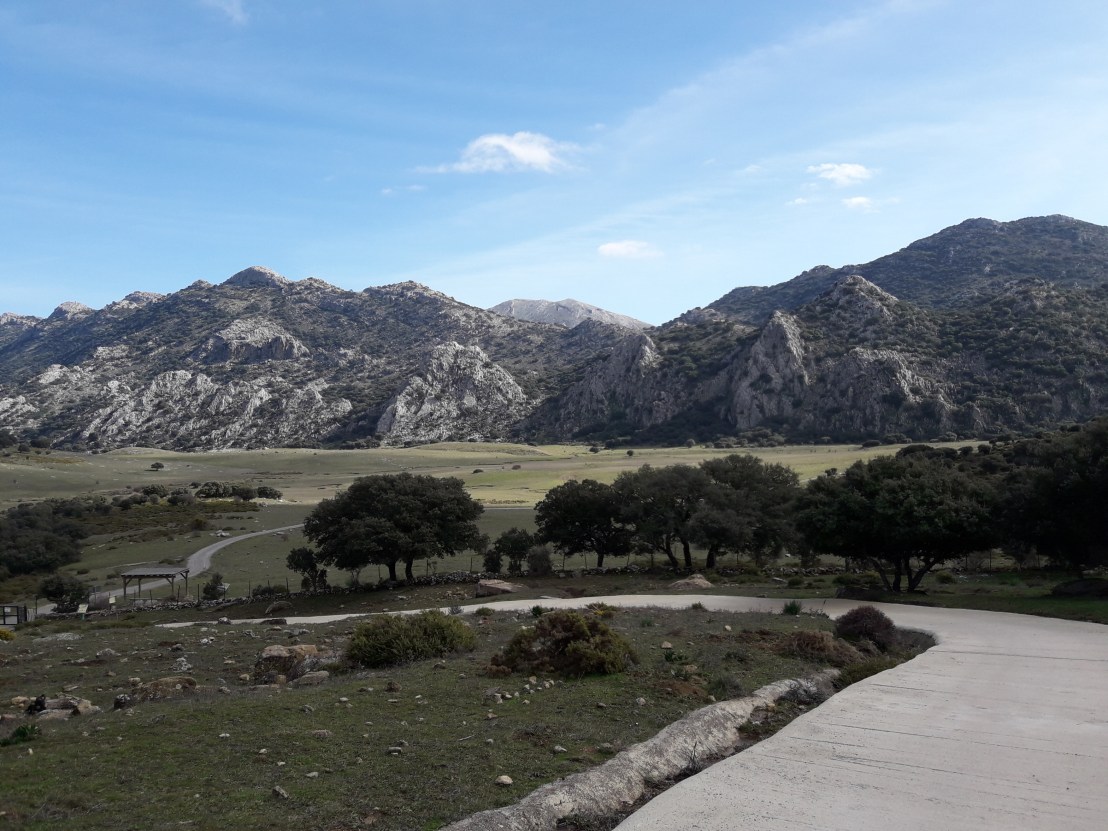
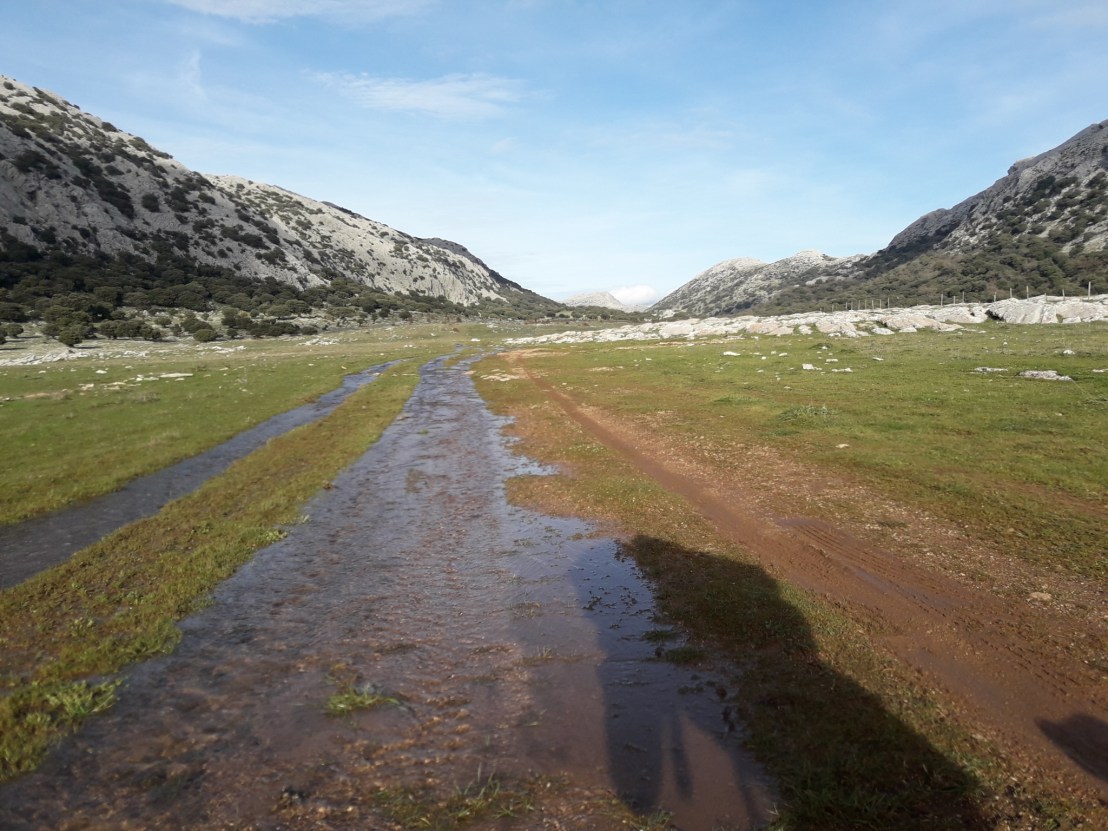
With large birds of prey cruising on the thermals above, the pair headed down the concrete track – easy on the feet – through the forest with views to the Montes Grupo de Libar (Libar mountain range) beyond. The path then climbed up a rocky staircase between peaks before descending through scrubland to the vast flat-bottomed Libar valley. This is really a high plain and the lush grass provides grazing for the local cattle, giving the area the appearance of a prairie in a Western.

They headed west on an undefined path until reaching a large stone hut which offers shelter to hikers in summer but was closed up, presumably not anticipating mad Englishmen and their dogs arriving in mid-winter. However, it provided a good spot to strike camp, with water and a table for cooking and eating. Once she’d been fed and watered, Chica wanted to go to bed. She sat in her night jacket demanding entry to the tent but had to wait while Tom ate his freeze-dried hot pot!

Sleep was a little disturbed as Chica growled at the various grunts and howls in the night. At one point, Tom got up to investigate, concerned that there may be a hoard of marauding wild boar in the vicinity. There wasn’t, but the clear night sky was beautiful so far from civilisation.

In the morning, it was cold as the surrounding peaks screened the sun. Out of the early mist, a herd of small deer, probably roe, crossed the valley and a fox passed close by, alerting a sleepy Chica who opened one eye and then went back to sleep.

By 10, breakfasted and packed, they continued to the end of the high plain. From here the track gradually descended towards the pueblo blanco (white village) of Montejaque. Here they relaxed in a café for a while before continuing over the next range of hills to meet me on the road a few miles outside Ronda. Chica looked very pleased to see us!

“Was it as good as you remembered?” I asked.

“Absolutely, and more.”

“And the camping? Everyone here thought you’d freeze to death”

“Ha – as if! It was great!”

ooOOoo

Wonderful! Just take, for example, that last photograph. What colours, what intense contrast, what a beautiful scene.

That isn’t the only one by far!

I don’t want this walk to end and I’m sure you echo my thoughts.

Day Eight, again, of Tom and Chica’s walk.

Yours truly can’t count!

For my previous post was entitled Day Eight etc. and this one is also called Day Eight.

Ah well, it’s the content that counts!

Which is to say that the next three days are, again, devoted to Tom’s walk along GR7.

ooOOoo

Day 8: Cerra de la Fantasia to Benacoaz 16k

By Tom and Chica, 27th January, 2020.

Written by Tom’s wife.

Authors note: Because we have had such a long weather delay, I have decided to number only the days that Tom and Chica actually walk otherwise it is going to give a very unrealistic idea of how long it takes. That is why today is Day 8 and the last walking day was originally Day 10 (but is now Day 7). I have updated all the blog references to correspond.

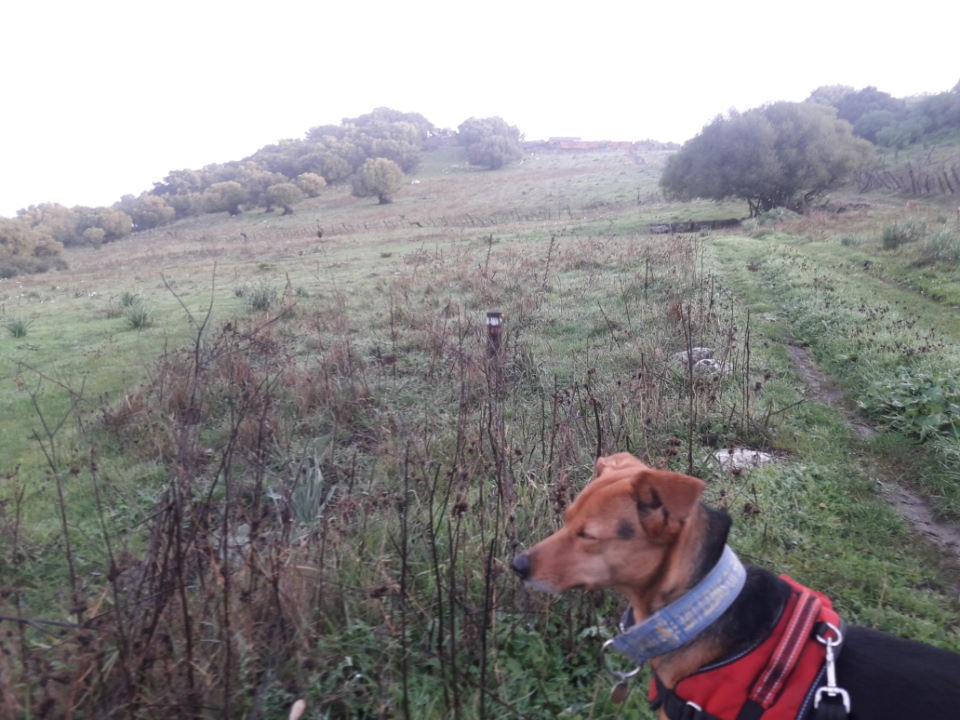
We were up with the lark this morning. Earlier in fact, as it was still dark but we were keen after such a long rain delay. We left the village in fog and went in and out of the sun and mist all the way up to the start point miles into the forest. It was still murky there too and we didn’t hang around as there was a gathering of hunters. Their dogs were in trailers, barking with excitement as this is probably the only time they ever get let out of their cages. But what happens to them after the end of the season next week? I can’t bear to think about it. But that’s why we’re doing this – so onwards and upwards my faithful duo!

After coming out of the forest onto the road, the trees gave way to scrub and the track roughly followed the same route as the road. The mist made it hard to get a feel for the surrounding landscape at first but then as the mist became patchy there were glimpses of the majestic valley and surrounding mountains – a truly spectacular view but impossible to capture on a phone camera.

The track crossed the road and descended to the river – Rio de Ubrique – which heads towards the town of the same name. After a bit of a clamber up a steep, wet, rocky and rather unsavoury path between agricultural outbuildings, we popped out right next to the town sign.

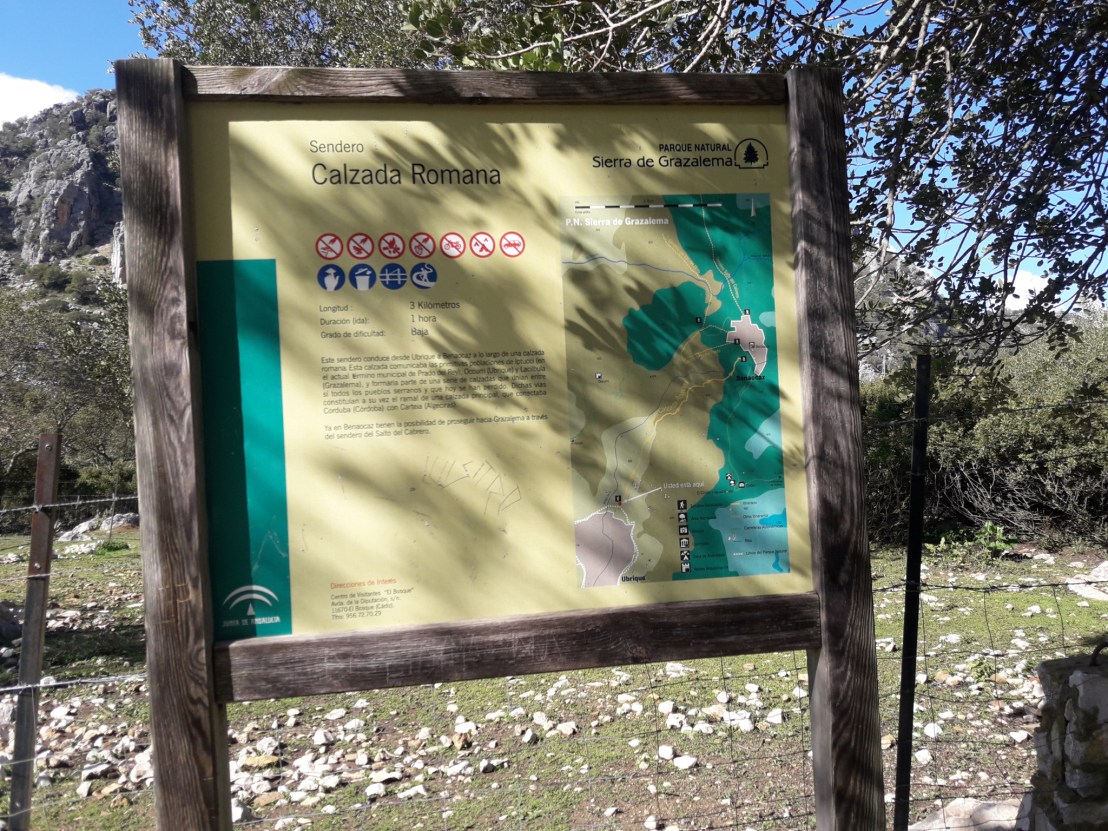
It was a pleasant stroll through the comparatively large and bustling town centre. The sun was now properly out and so Tom stopped in a plaza outside the Town Hall and had a coffee while Chica scrounged titbits by breathing in and contriving to look half starved! Carrying on up through the narrow streets, they arrived at the Convento de Capuchinos where a sign to Benacoaz pointed up a cobbled road: the Calzada Romana (Roman Road).

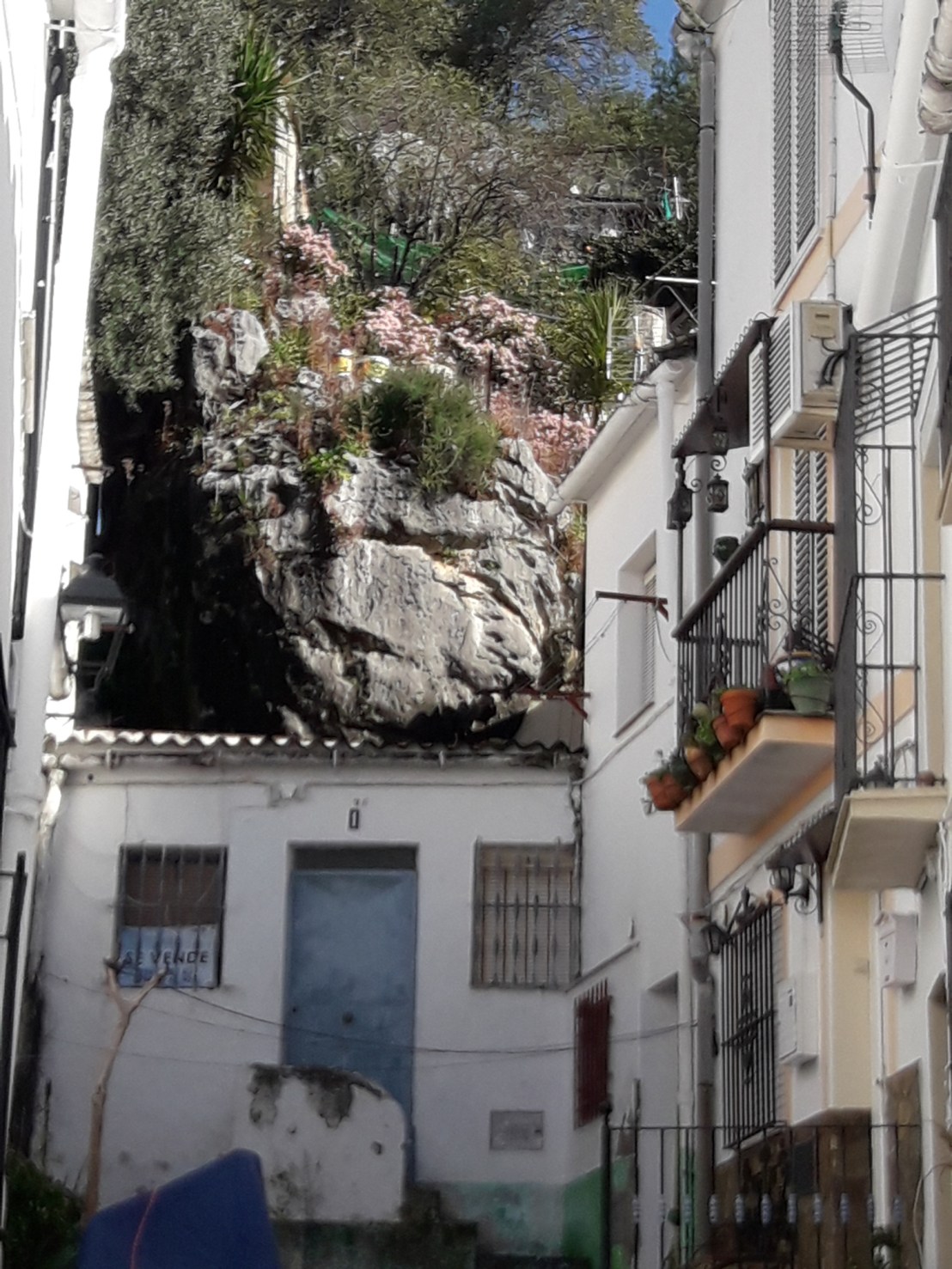
This proved quite tough on the feet as the cobbles were uneven and scattered but after 3.5k it emerged into the village of Bonacoaz, perched on the side of the mountain with vast panoramic views south –  stunning end to today’s beautiful walk.

ooOOoo

I know I have said it before, and undoubtedly I will say it again, but this account of Tom’s walk with his two dogs is astounding! They have been walking for over a week and they are experiencing countryside and more that must be unique to Spain.

Keep it coming!

(And thank you, Gilliwolfe, for penning it.)

Day Eight of Tom and Chica’s walk

Now it gets very interesting!

This is a longer post and with great interest.

For it covers the Park at Los Alcornacales as well as the Spanish cork industry.

As always, the post is a republication of the original and is gratefully offered to my readers.

ooOOoo

Los Alcornacales – cork and pork and much, much more.

By Tom and Chica, 24th January, 2020

Written by Tom’s wife.

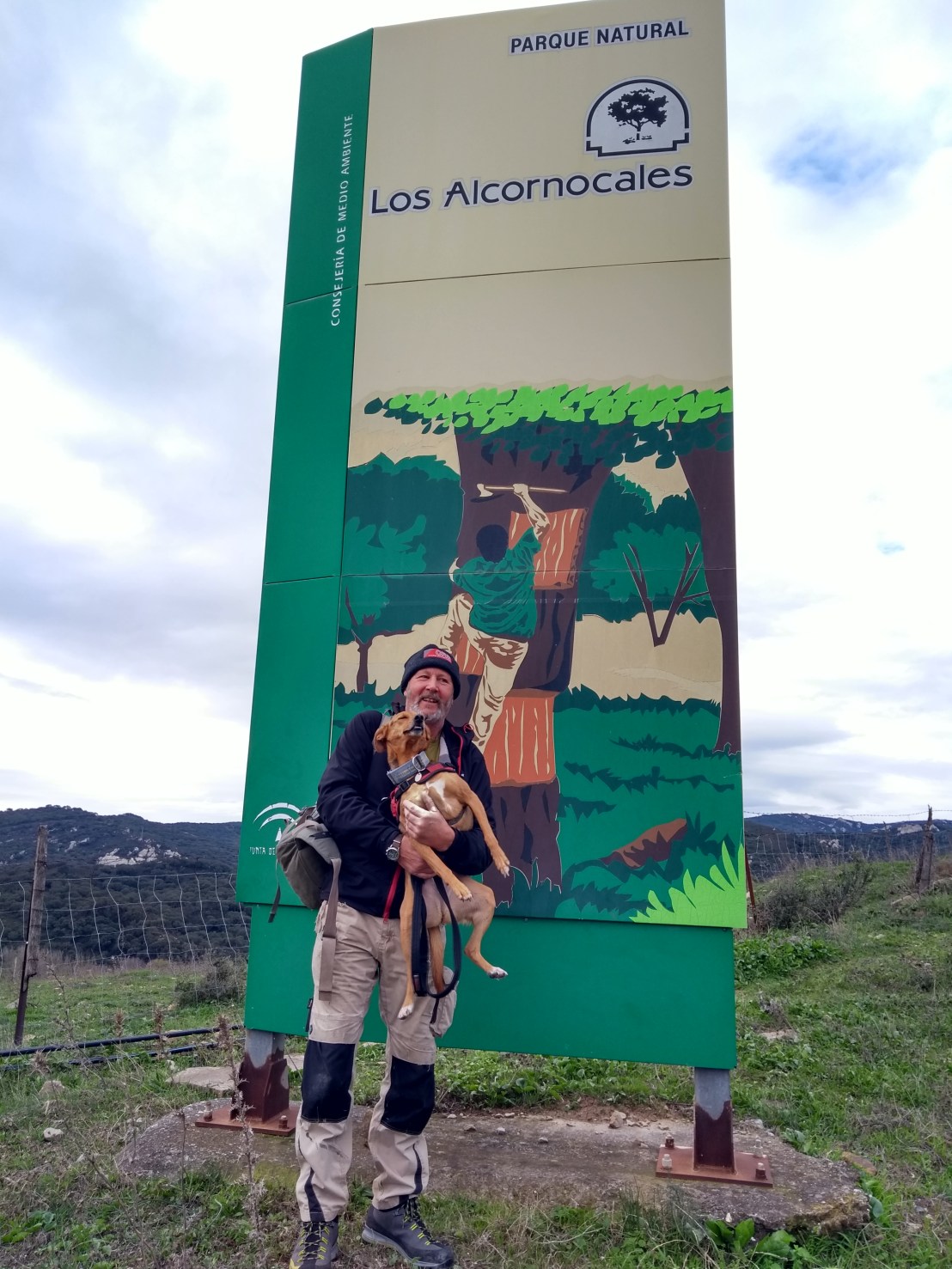
So far, during this part of the walk, Tom and Chica have been travelling through the unique habitat of Los Alcornacales. We fell in love with this beautiful area the first time we visited back in 2013. As we are rained off at the moment, I thought I’d take the opportunity to research more about the area, especially the amazing cork oaks which comprise large areas of the forest.

 Granted natural park status in 1989, Natural Park Los Alcornacales occupies a protected area of 170,025 hectares in Andalusia. Soil, moisture and traditional uses have been the main factors in the conservation of the largest productive area of cork trees anywhere on the Iberian Peninsula. Located in the province of Cadiz and part of Malaga (mainly in the municipality of Jimena de la Frontera, where we have just been walking), it runs from the mountains down to the recently created Estrecho Nature Park on the coast and is home to a variety of landscapes, flora, fauna, history and folklore.

This rich diversity is mainly due to the many rivers, streams and reservoirs but also the moisture that comes from the coast. This latter accumulates to form banks of mist in the deep, narrow gorges known as ‘canutos’. In these conditions, the ancient laurel forest flora has flourished. Characterised by smooth, bright leaves, it can make the most of the moisture and limited light that penetrates the alders growing on the edge of the gorges. So, amidst the scent of laurel and the beauty of flowering rhododendrons, you can walk through this dense forest accompanied by the sound of dippers, kingfishers, blackcaps and finches.

Egyptian mongoose
Griffon vulture

In the more clay-rich areas lower down you can see the wild olive tree, cleared from time immemorial to make way for pasture for the region’s most typical livestock, the brown Retinta cow. On the valley sides, the Mediterranean scrub of rockrose, heather, lavender, daphne and hawthorn is perfect for Andalusian deer, as well as buck, roe deer and carnivores such as genets, badgers and also the Egyptian mongoose – the largest population anywhere on the Iberian Peninsula.
Cork production

Los Alcornacales and the surrounding areas are home to the Iberian cork industry. As well as its most well-recognised use as bottle-stoppers, cork is also found in many products from car construction to aeroplane insulation.

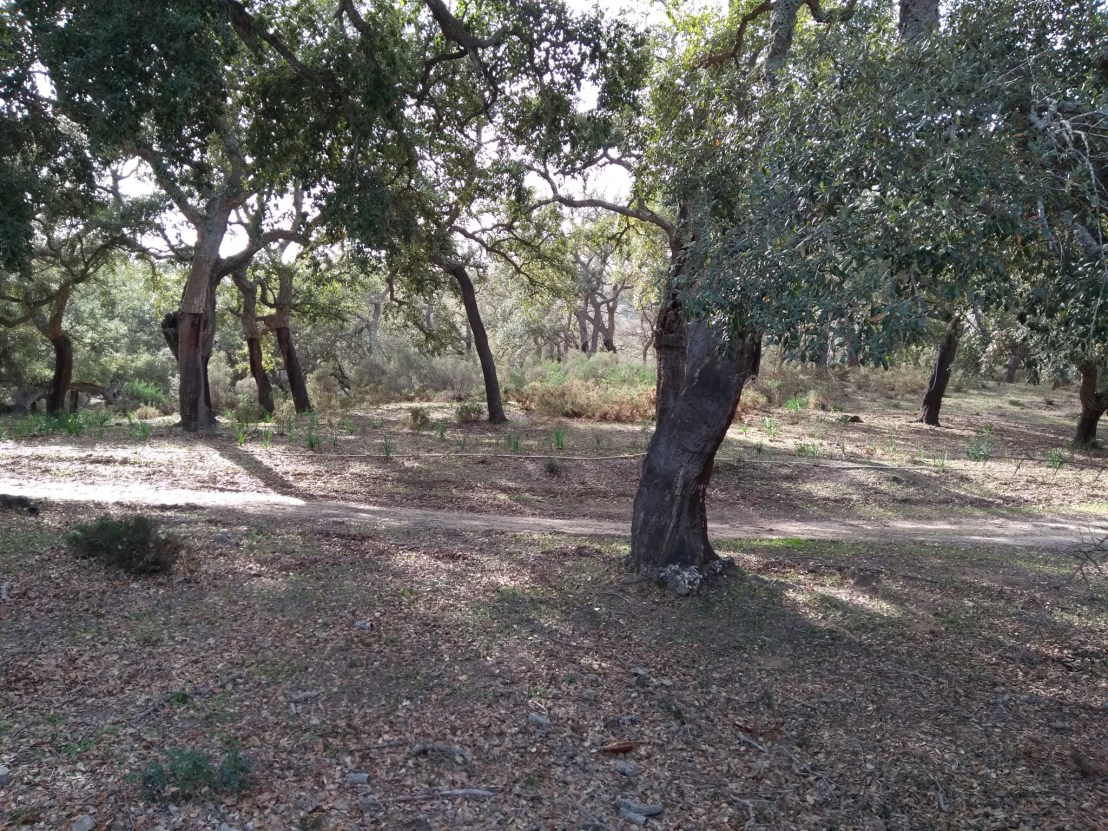
The cork oak, quercus suber, is a native of both the northern and southern shores of the Mediterranean. Its age is unknown, but quercus suber or its ancestors have been around for at least 147 million years. It is a prophyte, ie a species adapted to survive fire. While other species rely on seed propagation to survive fires, the cork layer protects the stem of the tree so it only has to regenerate branches. This makes it very well adapted to the fire-prone forest of southern Spain.

Archaeologists have found evidence of tribes actively working with cork oak in northern Africa before 6,000 BC. Early man would have used the various species of oak for fire wood, tools, weapons; and for building as the hunter-gatherers began to settle. Similar evidence has been found in Andalucía and other parts of southern Spain dating back 4,000 years BC or more.

However, it would take a few thousands more years before the special sealant qualities of cork would be utilised. This property is due solely to the presence of one particular constituent: suberin. Suberin is a fatty substance found in the cells of the denser forms of cork which stops the passage of air or liquid.

Cork was probably first used as a sealant in containers by the Greeks and Phoenicians, for wines and other liquids in pottery containers but it would take the invention of the glass bottle, a fairly recent innovation in historical terms, for cork to finally meet glass. Legend claims that Friar Perignon, a French monk, discovered this use for cork on a slender glass bottle neck in the seventeenth century. As news of its efficacy spread, so a new industry appeared.

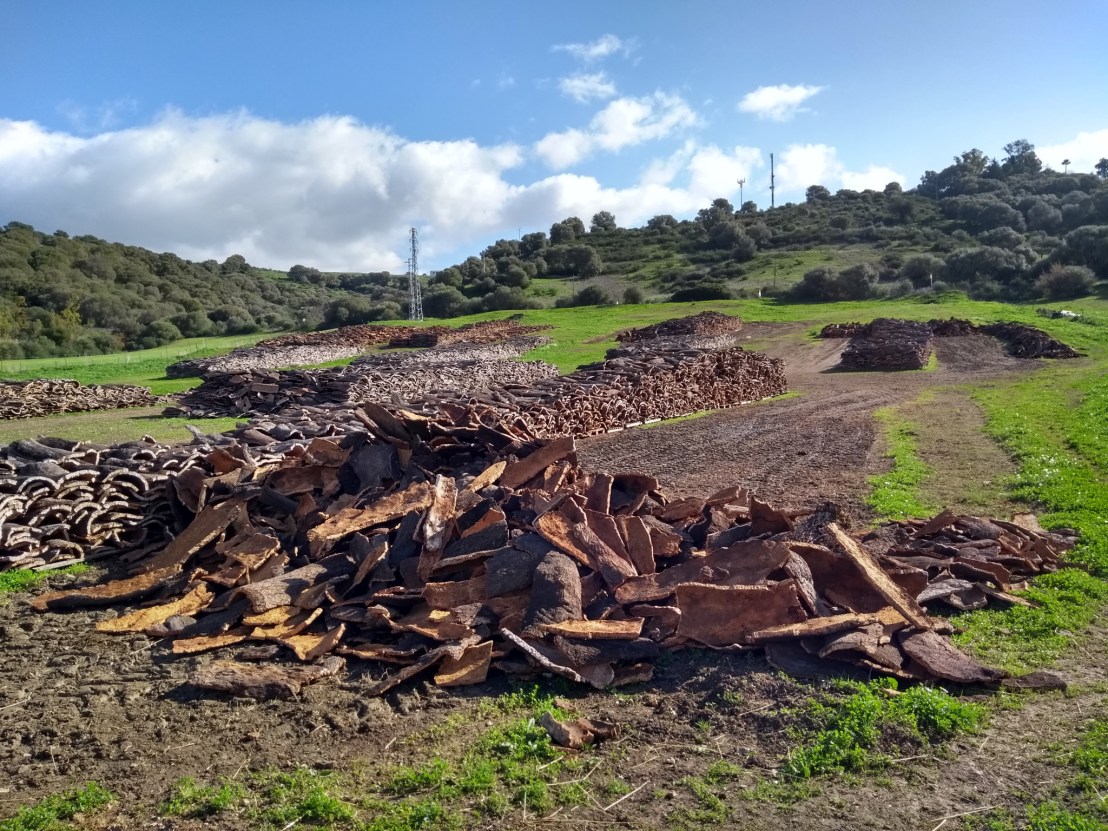
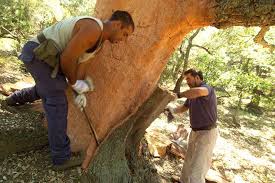
Cutting the cork is a highly skilled task and requires two years training. It is unusual for a tree to survive ring barking (the bark being removed around the complete circumference) and it needs to be done with care and at the right time. The cutters’ experience tells them how far to cut up the tree to avoid harming it.  Cutting is only legally permitted between 15 June and 15 August which is when gangs roam the oak forests, each of the usually five members having a specific role, from chief cutter to lowly carrier.

These gangs traverse the forest in a nine-year cycle, allowing the trees they cut to regenerate the cork in the intervening period. Their mules roam free in the forest except for the two month harvest period when they trek back and forth between harvest site and cork factory. So expert is their knowledge of the routes that, once loaded, a tap on the back will send them off unaccompanied. The town of Cortes de la Frontera actually holds burro-loading contests at its annual summer feria, with a prize for the most ingenious loading of a burro.

What we see lying curled on the ground is still many stages away from fitting into the neck of a bottle. At the factory the cork is boiled in a vast, deep pool of water, which renders it malleable for flattening and then processing by machine. The cork then goes through several levels of compression, depending on its destination. It emerges as very thin sheets of varying sizes, perhaps thinner than a child’s little finger. It is then checked for quality – the oak trade has five levels, from excellent to poor – and the oak is assigned to an appropriate use.

Most interestingly, however, is how it does reach the bottles we uncork. Bottle corks are stamped out by machines at different widths for wine, champagne and cognac (Spanish cork is treasured by French brandy producers). When they pile up in the dumpers beneath the pressing machines, they look like big wooden pennies. These are graded by quality, and then carefully fed into further compressing machines. Cork makers reckon that it would be a waste of good cork to use it throughout a wine or champagne cork, so lower quality cork is placed in the middle, highest quality at either end, where the cork meets both wine and outside air. These layers are then compressed so tightly we do not even notice that a cork we pull is not one single unit but a compression of up to eight layers crushed together. The finished corks are then dispatched to bottling plants across Europe and beyond.

There have, of course, been concerns about the rise of the plastic cork. Its proponents say that it prevents a bottle being ‘corked’, ie, spoiled, by air penetrating the old-fashioned cork. Its detractors argue that, beyond the aesthetics of levering a wad of white plastic out of your favourite wine, it doesn’t allow the alcohol to breathe naturally. (French brandies breathe so profusely that the distilleries are wreathed in fumes which promote fungi on the roofs and keep nearby cattle happily sozzled year-round.) Yet with even the British supermarket buyer seemingly moving upmarket in their choice of corked drinks, and the Spanish and French keeping their noses in the air over plastic stoppers, it seems the Iberian peninsula can hold on to its two billion euro cork industry yet.

Other uses for cork include flooring. We have some of this in our bathroom at home. A long way from the basic dull cork tiles of old, now it comes in stunning patterns and looks beautiful. It is also sustainable, provides excellent insulation and is lovely and warm to walk on. If I could, I’d floor the whole house with this.
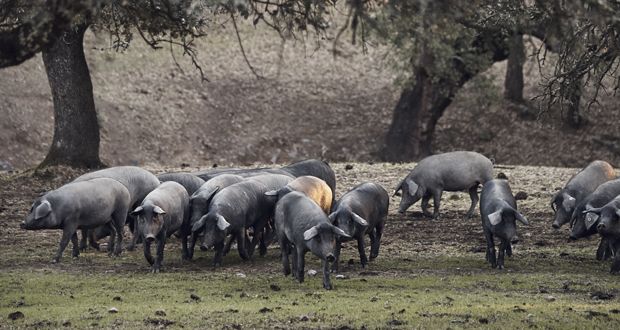
Iberian pigs

The Iberian pig is a traditional breed of the domestic pig (Sus scrofa domesticus) that is native to the Iberian Peninsula and is currently found in herds clustered in the central and southern part of Portugal and Spain. Its origins can probably be traced back to the Neolithic, when animal domestication started.

The most commonly accepted theory is that the first pigs were brought to here by the Phoenicians from the Eastern Mediterranean coast, probably along the old droving tracks one of which our route, the GR7, roughly follows. They interbred with wild boar and this cross gave rise to the ancestors of what are today’s Iberian pigs.

Prized Iberico ham

The production of Iberian pork is deeply rooted to the Mediterranean ecosystem. It is a rare example in world pig farming where the pig contributes so decisively to the preservation of the ecosystem. The Iberian breed is currently one of the few examples of a domesticated breed which has adapted to a pastoral setting where the land is particularly rich in natural resources, in this case acorns from the holm oak, gall oak and cork oak.

The numbers of the Iberian breed had been drastically reduced since 1960 due to several factors such as the outbreak of African swine fever and the lowered popularity of animal fats. In the past few years, however, the production of pigs of the Iberian type has increased to satisfy a renewed demand for top-quality meat and cured products. Now, though, there is controversy over the providence of the highly prized Iberico ham as breeders cash in on the market and produce a similar but much less sustainable product more cheaply, thus threatening this ancient livelihood.

The Iberian pig can be either red or black or in between. In traditional management, animals ranged freely in sparse oak forest (dehesa in Spain, montado in Portugal).  They are constantly on the move and therefore burn more calories than confined pigs. This, in turn, produces the fine bones typical of this kind of jamón ibérico. At least a hectare of healthy dehesa is needed to raise a single pig. True dehesa is a richly diverse habitat with four different types of oak that are crucial in the production of prime-quality ham. The bulk of the acorn harvest comes from the holm oak (Quercus ilex) but also the Pyrenean oak (Quercus pyrenaica) and Portuguese or gall oak (Quercus lusitanica) and the late cork oak season, which extends the acorn-production period from September almost to April.

Some recent research from Cordoba university concluded {the translation isn’t perfect but you get the idea}:

‘The couple Iberian pig and dehesa has proved to be very effective; so much [so] the Iberian pig is called the dehesa jewel, but the first needs this agro-ecosystem to reach its highest quality properties (organoleptic and nutritional ones); and the second needs a clear commercial differentiation for Iberian pork and cured products in order to receive a high price to maintain and conserve the dehesa. Spanish authorities should be responsible for protecting this traditional system from fraud and unfair competition. In this way, farmers economy could be enough to conserve this unique ecosystem and its values for the whole society.’*

Whether you eat pork or not you may still believe as I do, that this traditional and sustainable way of producing it is better for the ecosystem and the pigs than intensive farming on a huge scale. And we love seeing the black pigs snuffling through the forest. I hope it can be protected along with the rest of this remarkable and stunningly beautiful area.

ooOOoo

Well I must say that this is a tremendous post and a privilege to be able to republish it.

Gilliwolfe did an incredible job in composing the post and inserting all the photographs. Well done!

Well done!