Category: Education

Our Pyrenean Mastiff

Now we understand who our Brandy is!

Back on the 11th April, I published a post A loving welcome to Brandy. I explained, with regard to a garage sale that Jean and friends had gone to that Saturday morning:

It turned out to be a couple and their daughter that were selling off stuff in advance of having to move to a much smaller house including needing to re-home their dog.

There in the garage was the dog, a beautiful tan coloured Great Pyrenees, as they are known in North America.

At that time, when Jean had been speaking to the mother of the house, Jean thought she heard the dog being described as: “He’s a Pyrenean with some Mastiff in him.” In other words, a Great Pyrenees crossed with a Mastiff.

Having never before come across either a Great Pyranees or a Pyrenean Mastiff, when I first laid eyes on Brandy a couple of hours later it never occured to me to query his breed. To the extent that just last Thursday I published a post where the sub-title explained: Looking into the history of the Great Pyrenees dog.

Then, quite by chance, we came across some photographs of other Great Pyrenees.

Such as this one:

great-pyreneesand this one:

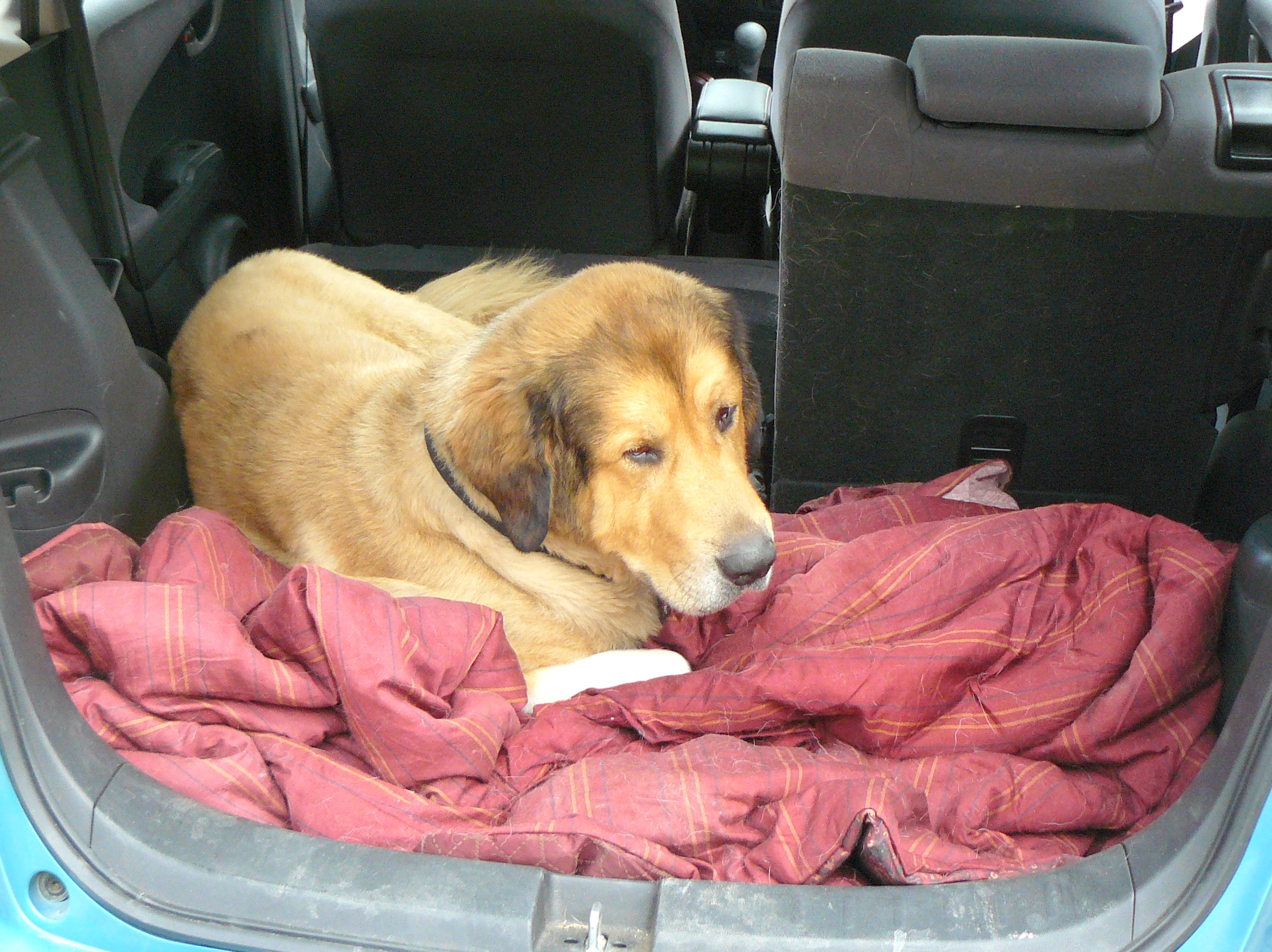
GreatPyrenees_heroThen the penny dropped! Our Brandy didn’t even come close to looking like these dogs so he can’t be a Great Pyrenees (Pyrenean Mountain Dog in UK ‘speak’.).

P1150956
No question about it: Brandy is not a Great Pyrenees.

It then didn’t take us long to realise that most likely the woman had described Brandy as a Pyrenean Mastiff but hadn’t spoken sufficiently clearly for Jean to hear that.

So here are some pictures of the Pyrenean Mastiff from the web.

pyrenean-mastiff-02oooo

pyrenean-mastiff-pyrenean-mountain-dog-breedThe resemblance of our Brandy with these ‘web’ pictures is spot on: our Brandy is a Pyrenean Mastiff. Plus there is only one breeder in the USA located in Southern California. We will be speaking with them today (Monday).

Our Brandy is a Pyrenean Mastiff!

Further research on this breed has turned up some very interesting information. Come back tomorrow to read that and what we discovered when we spoke to the breeder.

Hazel’s sonogram.

Nothing life-threatening found!

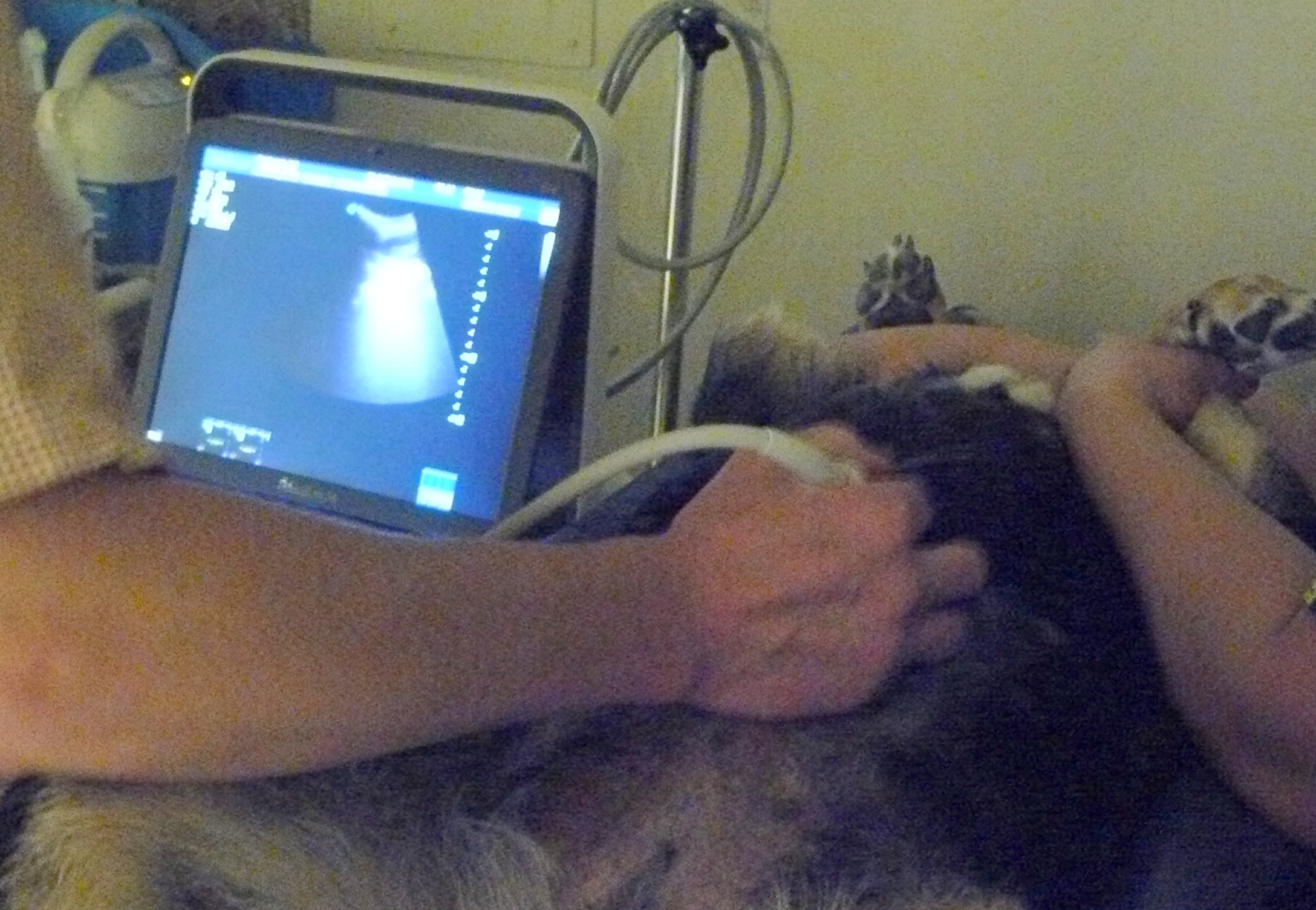
I’m writing this post at 5pm yesterday (Tuesday) shortly after we returned home from collecting Hazel from Lincoln Road Vet Clinic following her earlier examination by Dr. Parker using his mobile sonogram.

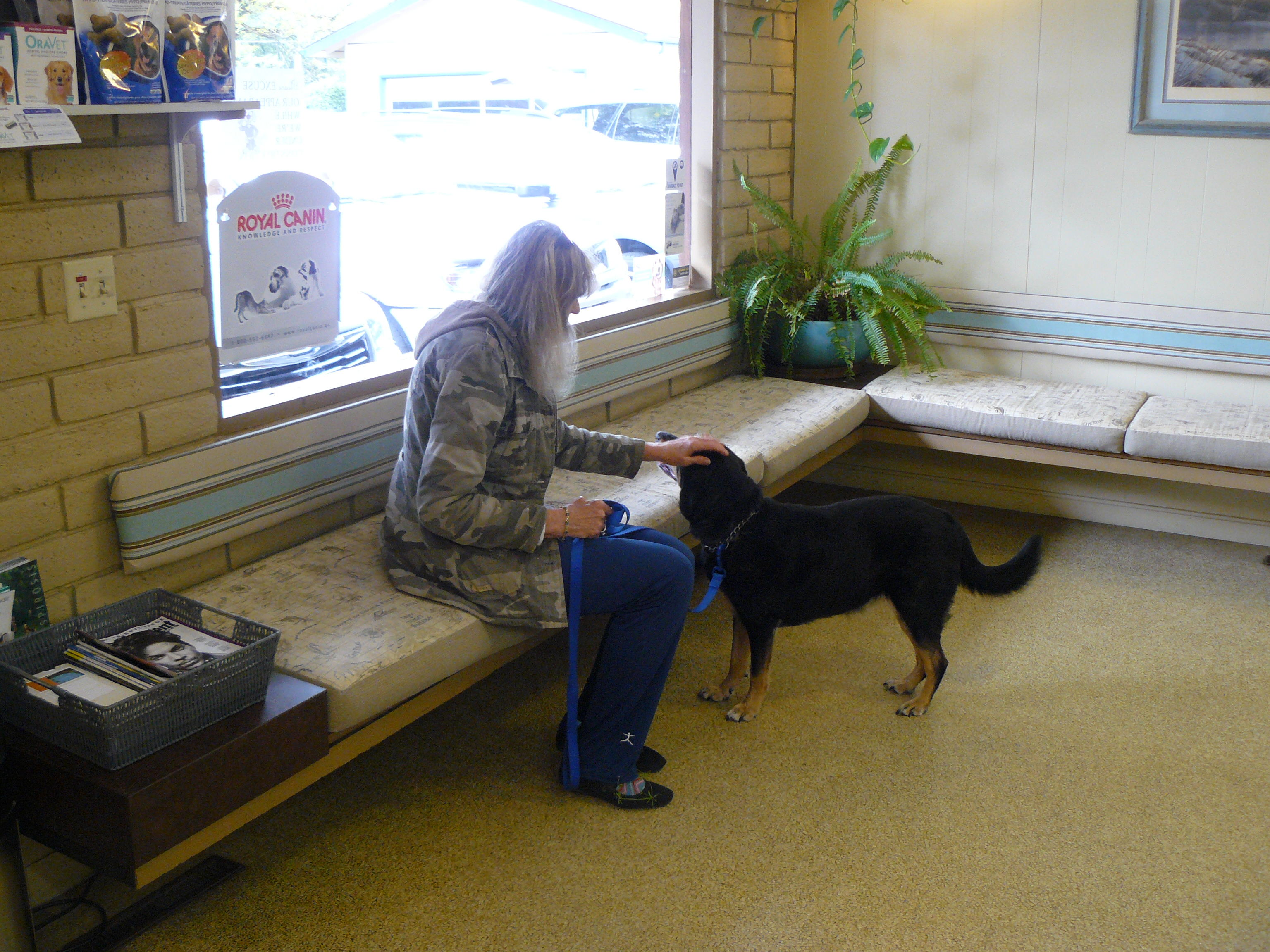
Hazel at the clinic shortly before she was taken in by the staff.

The good news is that Dr. Parker did not find any sign of trauma or life-threatening illnesses in Hazel’s body especially focusing on her abdomen.

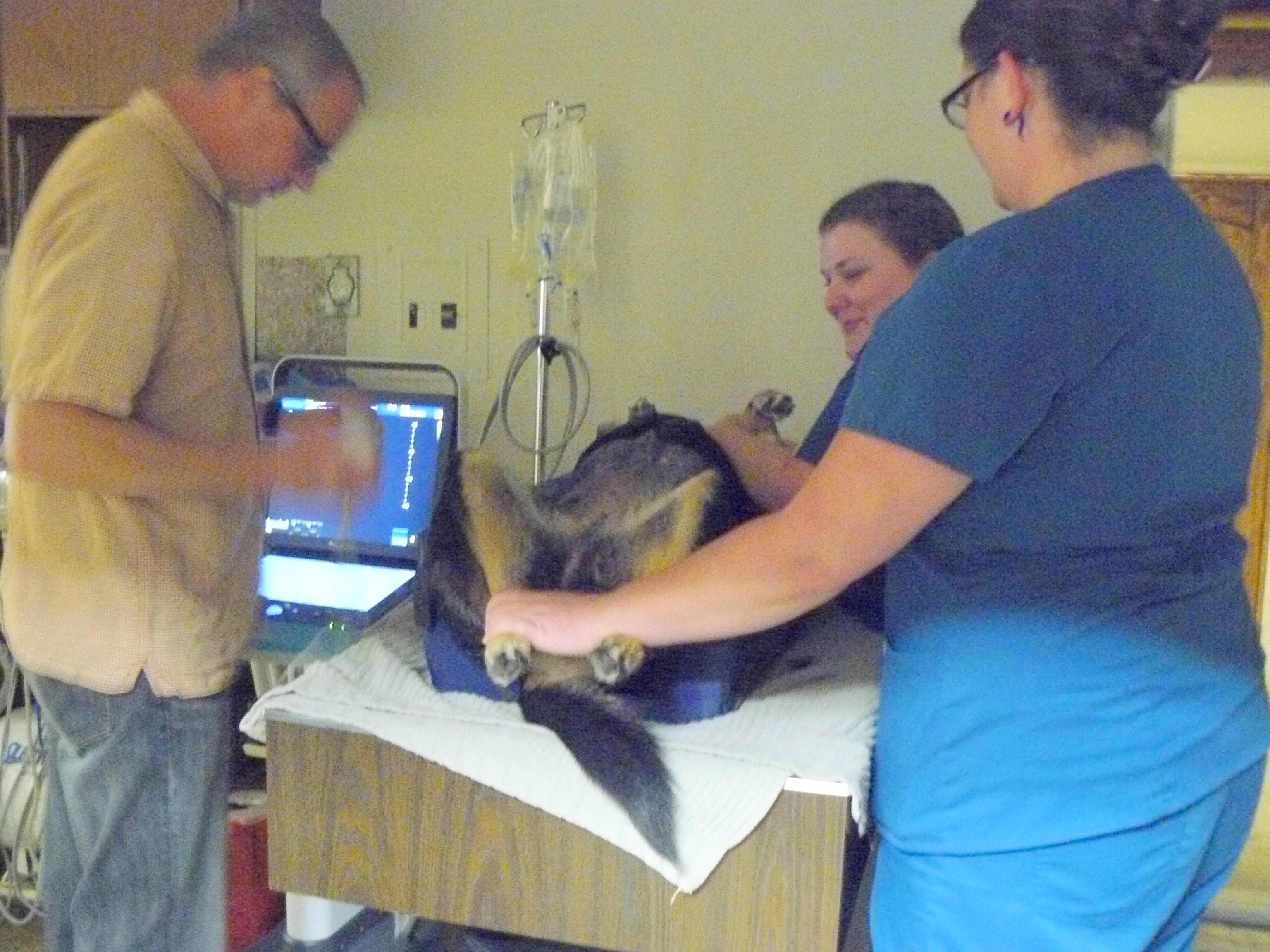
Dr. Parker to the left being assisted by clinic staff as he examines Hazel ultra-sonically.

(I should be quick to say that I left my camera with one of the technicians and wasn’t present. Indeed, Jean and I did not get to meet Dr. Parker.)

Dr. Parker, who is a board-certified veterinarian doctor, came to the conclusion that the most likely cause of Hazel’s illness was the fungal lung infection, as Dr. Codd and the radiologist supposed.

Nothing frightening seen!

To try and narrow down the exact fungal infection a further blood sample was taken and the lab results should be known in three or four days time.

Dr. Codd, in his briefing to Jean and me when we collected Hazel late afternoon, said that his recommendation based on the lack of any notable findings from the scan could be summarised as follows:

  • Regard treating the fungal infection as the number one priority,
  • Hold off from treating the tick fever in the interim,
  • Dose Hazel with 100mg of Fluconazole twice a day even if she is eating hardly anything,
  • The measure is whether Hazel, with a very small food intake, can take that dosage without vomiting,
  • Add a B12 tonic to her diet with immediate effect,
  • Give Hazel appetite stimulant medicine,
  • Consider the hemp oil (as queried by me) if the proper dosage can be determined.

(Petspeopleandlife: Hazel’s current weight is 53 lbs (24 kg). Any advice?)

Back home again albeit still feeling a little drowsy!

Thus while we have not yet got to the bottom of what precisely is the nature of Hazel’s infection at least we know there isn’t anything else silently killing her.

Thank you so much, dear readers, for taking so much interest in Hazel and for sending your love and caring wishes – it’s working! 🙂

Hazel – Change of tack

Still a long way from getting to the bottom of what is ailing Hazel.

In my last post about Hazel I opened by saying:

In the last post on Hazel’s condition, back last Thursday, I passed on Dr. Codd’s observation, “… that by not having Hazel on her meds we were, of course, letting the fungal infection continue its damage.”

Dr. Codd also recommended reducing the dosage of the Fluconazole to lower its side effect of suppressing appetite.

So since then, with outstanding care and patience, Jean has been coaxing Hazel to eat just sufficient food for Hazel to be able to take the Fluconazole, for her fungal infection in her lungs, and Doxycycline, for her tick infection. (Mind you, Hazel is still a long way from eating reliably.)

That was a week ago and while, at best, Hazel is just eating sufficient to take her meds she is far from improving to any noticeable degree. But she is not eating enough food to stabilise her weight and yesterday morning Jean was worried we might lose her if we didn’t rethink what was going on.

Jean is attempting to get Hazel to eat many times each day.

A Sunday morning call to Dr. Jim Goodbrod brought us the advice to re-think the evidence.

  • The titre results were negative but because there are so many variants of fungal infection that was discounted.
  • The film of Hazel’s lungs show what the radiologist described as a clear case of fungal infection.
  • However, if that infection had been in the past, before Hazel was taken in by us down in Mexico, and that infection had ceased, that film could be showing scarring in the lungs.
  • The positive result for Tick Fever showed evidence of antibodies not antigens. That might be interpreted as a previous incident.

Jim liaised with Dr. Codd and it was agreed that further examinations needed to be conducted to obtain a clear, unambiguous diagnosis and that in the interim we stop giving Hazel any medications and offer her body systems a bit of a rest.

One option being discussed is to call in a mobile sonogram or ultra-sonic scanner. There is a very expert doctor in the area who uses such a mobile device and scans can be taken of Hazel’s abdomen and lungs here at home.

Because we will do everything to try and return Hazel to good health.

P1160083More information will be passed to you just as soon as it is to hand.

Hazel is pulling through!

The powerful combination of good medicine and unconditional love.

In the last post on Hazel’s condition, back last Thursday, I passed on Dr. Codd’s observation, “… that by not having Hazel on her meds we were, of course, letting the fungal infection continue its damage.”

Dr. Codd also recommended reducing the dosage of the Fluconazole to lower its side effect of suppressing appetite.

So since then, with outstanding care and patience, Jean has been coaxing Hazel to eat just sufficient food for Hazel to be able to take the Fluconazole, for her fungal infection in her lungs, and Doxycycline, for her tick infection. (Mind you, Hazel is still a long way from eating reliably.)

Yesterday, (Saturday) Hazel was showing clear signs of feeling better but still having to be hand-fed by Jean.

Then this morning (Sunday) she really was perky and readily came out for a walk with the other dogs.

First time in recent days when Hazel has shown an interest in the world around her.

oooo

A return of a gesture unique to Hazel that we haven't seen in ages! :-)
A return of a head gesture unique to Hazel that we haven’t seen in ages! 🙂

More generally, Dr. Jim was trying to track down supporting details to the observation made by Dr. Russ:

Namely, that there was evidence that fungal infections can lay dormat for quite long periods of time.

Jim sent me the following email:

Paul  …
The following article is the one and only reference I have found so far that refers to the possible dormancy of this fungal infection.  In paragraph 2 (Clinical Disease) I have highlighted it in red.  I have to admit, I was skeptical.
Jim

The article was:

Coccidioidomycosis (Zoonotic)
Last updated on 2/4/2011.

Contributors:
Rhea V. Morgan DVM, DACVIM, DACVO

Synonyms:
San Joaquin Valley Fever
Valley Fever

This is that domancy aspect from that paper that Jim highlighted (in red):

The incubation period in the dog is 1 to 3 weeks.1,2 The organism can remain dormant, with exposure preceding the onset of clinical signs by 3 years or more.1,3 Although people may acquire the disease from the same sources as domestic animals and the mycelial forms are highly infectious, with one exception the disease has not been transmitted from animals to people. One published report exists of transmission to a veterinary assistant via the bite of an infected cat.15

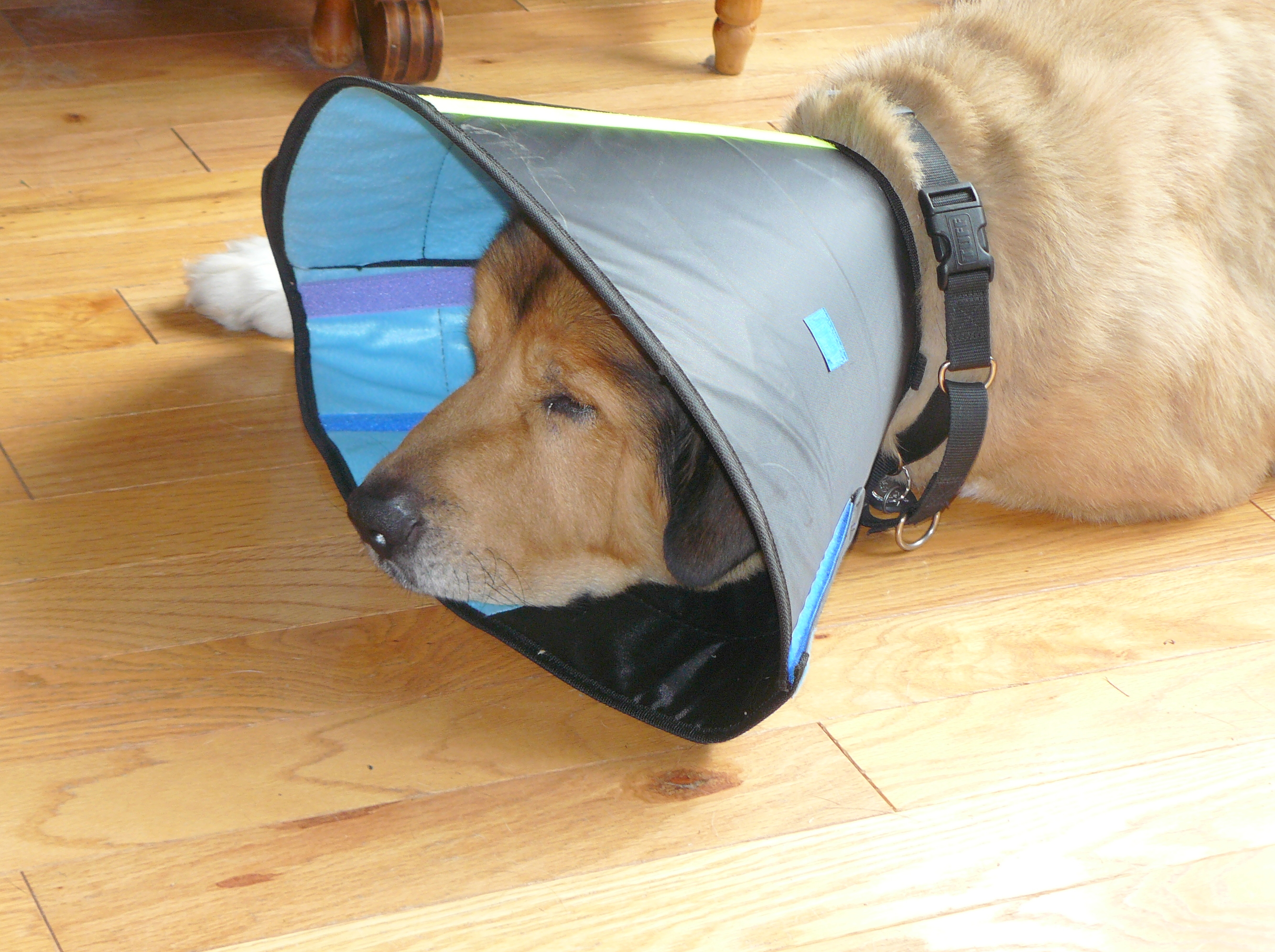
Meanwhile, over in Brandy’s corner, he has very quickly healed after his neutering operation last Thursday. It was fair to say that he was not a happy chappy when he arrived home that day.

Didn't like that!
Didn’t like that!

oooo

And I can't even lick my balls!
And I can’t even lick my balls!

But his cone was off by Saturday and he is back to the wonderful, bouncing dog we all love so much. (Can’t believe that last Saturday was only the second week that Brandy had been with us; he has so quickly woven his way into all our hearts.)

Checking out the stables yesterday (Sunday) morning.

oooo

Behind that placid expression is the most docile, loving brain and heart one could ever wish for!

Returning to Hazel we are still some way from knowing that she has returned to a fully fit dog but the love and caring sent her way by all of you out there has been precious beyond imagination.

Thank You All!

Inner Thinking: Of dogs and humans.

We are what we think about most.

Today’s post was inspired by something yesterday I read, not for the first time, over on The People Workshop site. (As an aside, I know that many regulars of this place are familiar with the history of my friendship with Jon.) On the page that explains more of Jon Lavin’s approach to his work with clients, he writes:

“We can’t solve problems by using the same kind of thinking we used when we created them.”

Thus said Albert Einstein (1879-1955).

Intuitively, it strikes one as correct. However, reflect for a few moments on how you think and very quickly it becomes clear that how you think is based on deep-seated experiences and the learnings that flow from those experiences.

As it is for all of us.

Just as relevantly, perhaps more so, is that how we behave is based on those same deep-seated experiences and subsequent learnings. This offers a clue as to why bringing about lasting, behavioural change can often feel like pushing water uphill!

That prompted me to look up a previous time when I had written a post about feelings. It was last December when in a post called Feelings – Of Both Humans and Animals, I wrote this:

There couldn’t have been a better answer to that ponder than a recent video that was presented by TED Talks. It was a talk by Carl Safina about what is going on inside the brains of animals: What are animals thinking and feeling? Or in the fuller words of that TED Talk page:

What’s going on inside the brains of animals? Can we know what, or if, they’re thinking and feeling? Carl Safina thinks we can. Using discoveries and anecdotes that span ecology, biology and behavioral science, he weaves together stories of whales, wolves, elephants and albatrosses to argue that just as we think, feel, use tools and express emotions, so too do the other creatures – and minds – that share the Earth with us.

So back to what inspired today’s post. It was the challenge of really knowing why we behave the way we do, both humans and dogs. With dogs, however, we accept they cannot speak to us clearly. Or as Esme put it in a recent reply to an update on Hazel: “Well you’re getting there, half the battle is diagnosis with dogs because they can’t actually tell us how they feel.” (My emphasis.)

Back to humans. When Jon wrote on his site, “…. how you think  …… is based on deep-seated experiences ….”, what I heard is that for us humans there are many times when we cannot actually tell ourselves what we are feeling. That is why we need the counselling of someone who has the professional training and experience to expose those deep emotional and psychological drivers within us; those drivers that are normally out of sight from us.

In my own case, how my father’s death was managed by my mother back in December, 1956 left an emotional wound that was totally out of sight from my conscious mind for 50 years.  The emotional crisis that I went through back then was discovered by Jon to have its roots back in December, 1956. By a massive stroke of fortune Jon gave me the insight into that mental place of old and a year later I met Jean down in Mexico.

In other words, to return to Albert Einstein:

We can’t solve problems by using the same kind of thinking we used when we created them.

The challenge is having sufficient self-awareness to know when an aspect of our behaviour requires the support of the Jon Lavins of this world.

So what would we require from a counsellor, from a therapist, who was working with us to uncover those hidden aspects? In other words, in terms of assessing that therapist what’s the difference that would make the difference?

Naturally, I don’t have the skills to answer that question in any direct, professional manner. But if I look down at our dogs then a form of answer does ‘speak’ to me. Dogs are creatures of integrity, openness and trust. They relate to us humans and other known dogs around them through friendship and love; frequently unconditional love.

A therapist who embraces those values; nay, lives those values, would display that very quickly after meeting with the ‘client’. Any person seeing that in a therapist would be seeing the difference that makes the difference.

Good people, I’m not asking any of you who read this to divulge any personal stuff but, nonetheless, I would love to hear your thoughts on what I have written today!


Reflections on the internet.

An interesting item that recently crossed my ‘screen’.

I make no apologies for cutting corners for today’s post. Because the last few days of looking after, and worrying about, Hazel have soaked up so much of our time and energy that I just couldn’t find the creative impulse to do much more than ‘copy and paste’.

That’s not to downplay the great interest of this article that appeared over on The Conversation blogsite a few days ago.

ooOOoo

Why the Internet isn’t making us smarter – and how to fight back

April 15, 2016 5.58am EDT

Professor of Psychology, University of Michigan

Disclosure statement: David Dunning has received funding from the National Science Foundation, the National Institutes of Health, and the Templeton Foundation in the past.

In the hours since I first sat down to write this piece, my laptop tells me the National Basketball Association has had to deny that it threatened to cancel its 2017 All-Star Game over a new anti-LGBT law in North Carolina – a story repeated by many news sources including the Associated Press. The authenticity of that viral video of a bear chasing a female snowboarder in Japan has been called into question. And, no, Ted Cruz is not married to his third cousin. It’s just one among an onslaught of half-truths and even pants-on-fire lies coming as we rev up for the 2016 American election season.

The longer I study human psychology, the more impressed I am with the rich tapestry of knowledge each of us owns. We each have a brainy weave of facts, figures, rules and stories that allows us to address an astonishing range of everyday challenges. Contemporary research celebrates just how vast, organized, interconnected and durable that knowledge base is.

That’s the good news. The bad news is that our brains overdo it. Not only do they store helpful and essential information, they are also receptive to false belief and misinformation.

Just in biology alone, many people believe that spinach is a good source of iron (sorry, Popeye), that we use less than 10 percent of our brains (no, it’s too energy-guzzling to allow that), and that some people suffer hypersensitivity to electromagnetic radiation (for which there is no scientific evidence).

But here’s the more concerning news. Our access to information, both good and bad, has only increased as our fingertips have gotten into the act. With computer keyboards and smartphones, we now have access to an Internet containing a vast store of information much bigger than any individual brain can carry – and that’s not always a good thing.

Better access doesn’t mean better information

This access to the Internet’s far reaches should permit us to be smarter and better informed. People certainly assume it. A recent Yale study showed that Internet access causes people to hold inflated, illusory impressions of just how smart and well-informed they are.

But there’s a twofold problem with the Internet that compromises its limitless promise.

First, just like our brains, it is receptive to misinformation. In fact, the World Economic Forum lists “massive digital misinformation” as a main threat to society. A survey of 50 “weight loss” websites found that only three provided sound diet advice. Another of roughly 150 YouTube videos about vaccination found that only half explicitly supported the procedure.

Rumor-mongers, politicians, vested interests, a sensationalizing media and people with intellectual axes to grind all inject false information into the Internet.

So do a lot of well-intentioned but misinformed people. In fact, a study published in the January 2016 Proceedings of National Academy of Science documented just how quickly dubious conspiracy theories spread across the Internet. Specifically, the researchers compared how quickly these rumors spread across Facebook relative to stories on scientific discoveries. Both conspiracy theories and scientific news spread quickly, with the majority of diffusion via Facebook for both types of stories happening within a day.

Making matters worse, misinformation is hard to distinguish from accurate fact. It often has the exact look and feel as the truth. In a series of studies Elanor Williams, Justin Kruger and I published in the Journal of Personality and Social Psychology in 2013, we asked students to solve problems in intuitive physics, logic and finance. Those who consistently relied on false facts or principles – and thus gave the exact same wrong answer to every problem – expressed just as much confidence in their conclusions as those who answered every single problem right.

For example, those who always thought a ball would continue to follow a curved path after rolling out of a bent tube (not true) were virtually as certain as people who knew the right answer (the ball follows a straight path).

Defend yourself

So, how so we separate Internet truth from the false?

First, don’t assume misinformation is obviously distinguishable from true information. Be careful. If the matter is important, perhaps you can start your search with the Internet; just don’t end there. Consult and consider other sources of authority. There is a reason why your doctor suffered medical school, why your financial advisor studied to gain that license.

Second, don’t do what conspiracy theorists did in the Facebook study. They readily spread stories that already fit their worldview. As such, they practiced confirmation bias, giving credence to evidence supporting what they already believed. As a consequence, the conspiracy theories they endorsed burrowed themselves into like-minded Facebook communities who rarely questioned their authenticity.

Instead, be a skeptic. Psychological research shows that groups designating one or two of its members to play devil’s advocates – questioning whatever conclusion the group is leaning toward – make for better-reasoned decisions of greater quality.

If no one else is around, it pays to be your own devil’s advocate. Don’t just believe what the Internet has to say; question it. Practice a disconfirmation bias. If you’re looking up medical information about a health problem, don’t stop at the first diagnosis that looks right. Search for alternative possibilities.

Seeking evidence to the contrary

In addition, look for ways in which that diagnosis might be wrong. Research shows that “considering the opposite” – actively asking how a conclusion might be wrong – is a valuable exercise for reducing unwarranted faith in a conclusion.

After all, you should listen to Mark Twain, who, according to a dozen different websites, warned us, “Be careful about reading health books. You may die of a misprint.”

Wise words, except a little more investigation reveals more detailed and researched sources with evidence that it wasn’t Mark Twain, but German physician Markus Herz who said them. I’m not surprised; in my Internet experience, I’ve learned to be wary of Twain quotes (Will Rogers, too). He was a brilliant wit, but he gets much too much credit for quotable quips.

Misinformation and true information often look awfully alike. The key to an informed life may not require gathering information as much as it does challenging the ideas you already have or have recently encountered. This may be an unpleasant task, and an unending one, but it is the best way to ensure that your brainy intellectual tapestry sports only true colors.

ooOOoo

The way the world now communicates, for good and bad, using the internet is staggering. As the website Internet Live Stats reveals: (as of this moment today)

3,352,197,085 Internet Users in the world

1,016,623,500 Total number of Websites

2,060,120 Blog posts written today

So with that last figure in mind, I’ll send this for posting without delay! 😉

Of art, and science.

The learning and healing journey continues with Hazel.

The title to today’s post came from Dr. Jim Goodbrod, DVM. When he and I were taking a walk yesterday Jim mentioned that diagnosing exactly what an animal is suffering from is as much an art as it is a science.

Jim and Janet are close friends and neighbours who live a couple of roads away. Jim also attends the Lincoln Road Vet Clinic on a part-time basis. Off his own volition he has been speaking with Dr. Codd (Russ) about the situation with Hazel and the pair of them are showing incredible devotion to getting to the bottom of what is happening.

So, like yesterday’s post, today is being offered to you in the spirit of information. Forgive me if I repeat the caution from yesterday. (This is being written at 4pm on April 19th, 2016.)

CAUTION: The following is offered by way of information reaching out to other loving dog owners. Please do not assume I have any specialist veterinarian knowledge and please do not take the following as a replacement for seeing your own vet.

Late on Sunday afternoon Hazel was becoming so weak and lethargic that Jean and I feared that she wouldn’t make it through the night. So it was wonderful to see that she was alive and still connected to the world at 6am yesterday; Monday. Nonetheless, Hazel had not eaten since Saturday afternoon and was only drinking very small amounts of water. We made the decision to ring the Clinic as soon as they opened on Monday at 8am. They recommended that Hazel be brought in to go on to an IV drip to boost her anti-fungal intake and also to receive an anti-nausea intake to help her regain an appetite. But there was the question hanging over everyone that if this was a fungal infection, as in Coccidioidomycosis, that is not present in the Oregonian soil but is found in the drier parts of the USA and Mexico then why had it been such a long time before it brought Hazel down?

Jean also had this suspicion that Hazel might be suffering from a form of ‘Tick Fever’ that is very common in Mexico.

So off we went to the Clinic again. There were discussions about the whole situation.

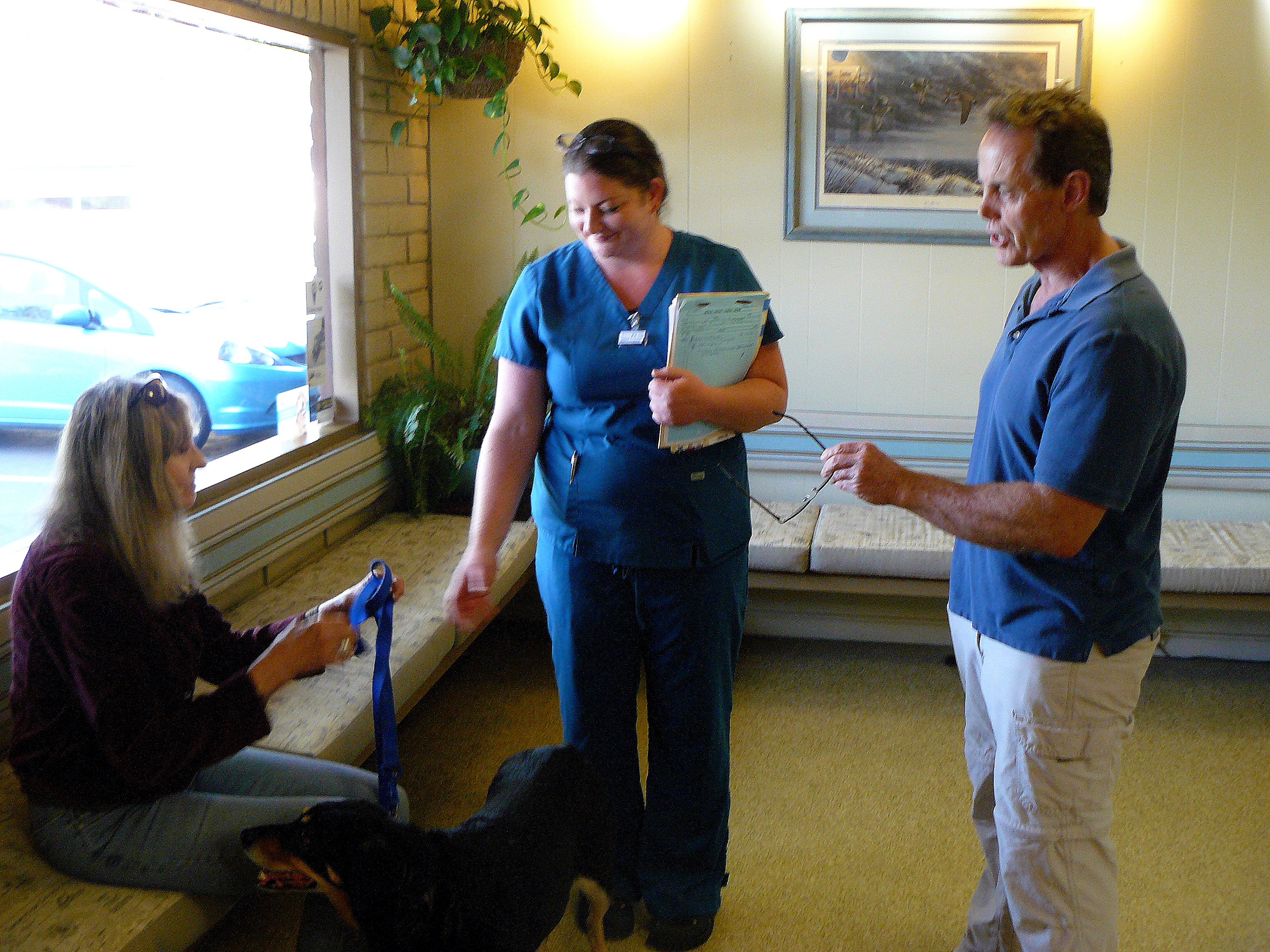
Dr. Codd (RHS) speaking with Jean at the Clinic.

Dr. Codd took a quick blood test and, bingo, it revealed that Hazel was showing that she had, or had had in the past, an Ehrlichia Infection; a tick-borne infection.

The lower of the left-hand spots is the indicator of a past or present Ehrlichia Infection.

The cure for that was a course of Doxycycline.

So now we are looking at battling two separate diseases.

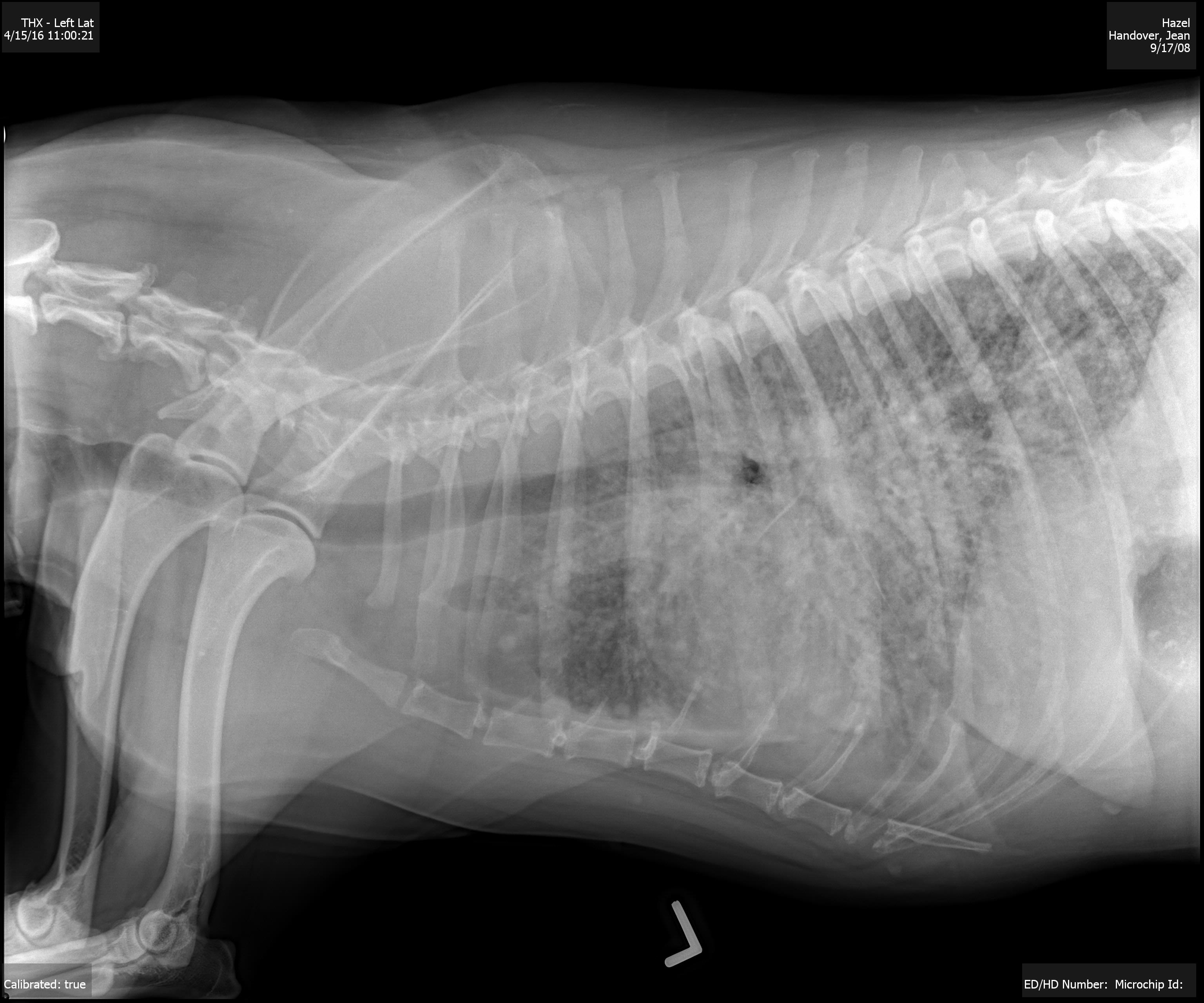
The blood that was taken from Hazel last Friday, when she also had radiographs taken of her lungs, had been sent for a ‘titre’ that would confirm one way or another if her lungs were suffering from a fungal infection. Those results will be available on Wednesday or Thursday of this week.

One of the radiographs taken of Hazel.

Back to Hazel’s lack of appetite. One of the side-effects of Fluconazole is that it depresses appetite. Getting Hazel eating again was becoming a priority. It seemed to make sense that until we had confirmation of whether or not Hazel had a lung fungal infection, for which taking Fluconazole would be an excellent course of action, we should pause in her dose until the results were in. To speed up the return of an appetite Dr. Jim prescribed a short course of Mirtazipine.

So that’s about it for the time being. Except for Jean and me to say how much we appreciate the art and the science that is being so skillfully offered by the Clinic. (As of 19:00 PDT yesterday Hazel was eating again! 🙂 )

Great team effort!
Great team effort!

Their “Special Love of Animals” comes over in spades!

Please keep Hazel in your thoughts.

Hazel has recently become rather ill.

CAUTION: The following is offered by way of information reaching out to other loving dog owners. Please do not assume I have any specialist veterinarian knowledge and please do not take the following as a replacement for seeing your own vet.

Hazel

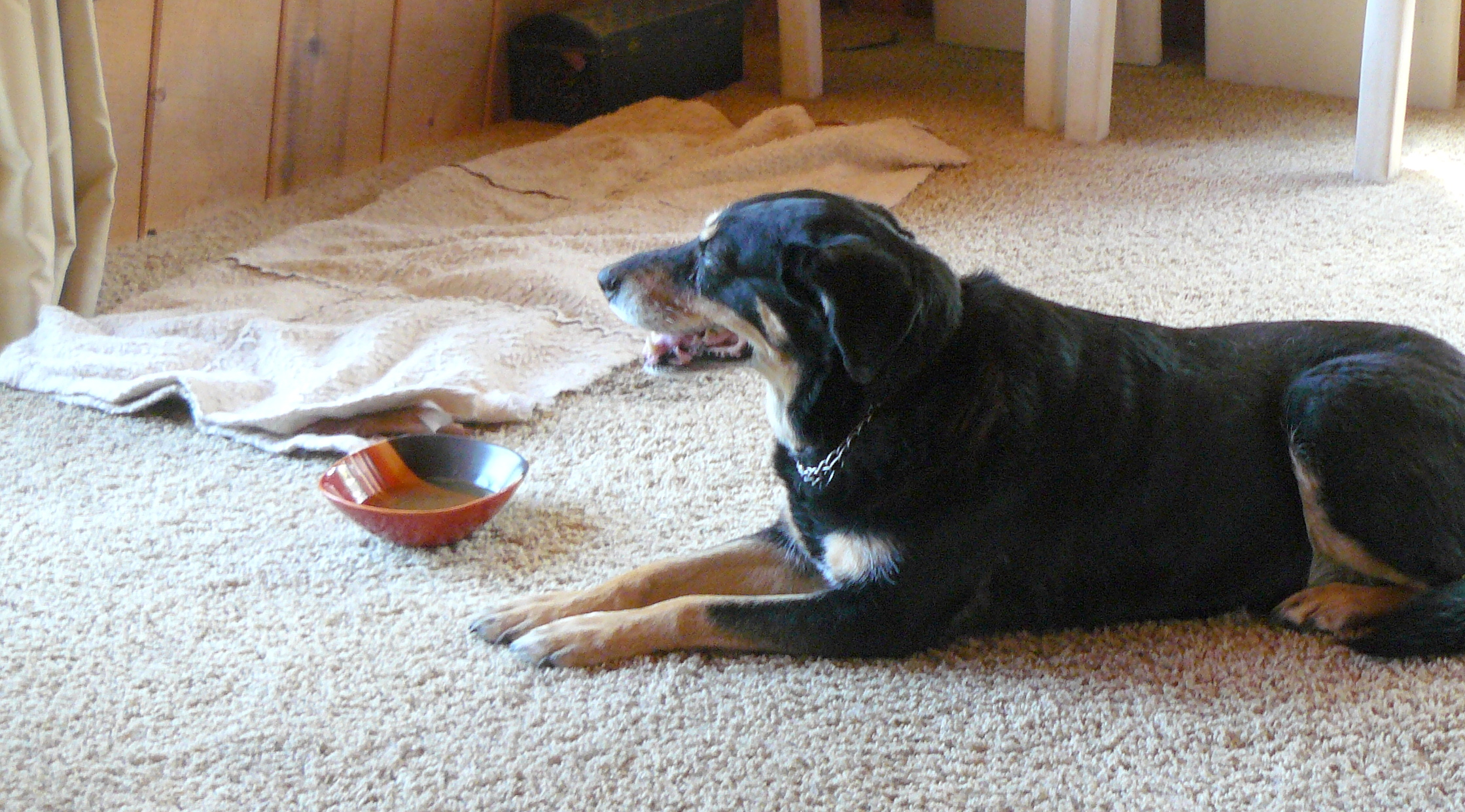
Picture of Hazel taken in the last twenty-four hours.
Picture of Hazel taken in March, 2014.

The story of how this wonderful dog came into our lives was published over two years ago.

About three or four weeks ago we noticed that Hazel’s bark was changing, almost as though she had a sore throat. In every other way she continued being the happy, lively dog that she is.

Then very suddenly last Thursday she started sicking up white, foamy bile and went off her food. Hazel rapidly became lethargic and lacking any vigour. Last Friday we took Hazel to our local Lincoln Road Vet Clinic and she was seen by Dr. Russ Codd, DVM. He took xrays that showed that Hazel’s lungs were far from being as clear as they should be. Potentially, Dr. Codd said that we could be looking at one of three things:

  1. Some form of bronchial pnemonia,
  2. A fungal infection of the lungs,
  3. Cancer.

In view of the fact that Hazel hadn’t been coughing that ruled out 1.

Dr. Codd forwarded the xray pictures to a specialist. Later came the information that the spherules in her lungs, as seen on the xray pictures, were not as would be expected with a cancer diagnosis. Dr. Codd concluded that Hazel was indicating a fungal lung infection. Especially as this is commonly found in hot, drier parts of the USA and Mexico. Hazel was an ex-rescue from Mexico and for a couple of years we lived in Payson, Arizona.

The medical term for the disease is Coccidioidomycosis and I republish a little of what may be read over on the Pet MD website:

Coccidioidomycosis in Dogs

Mycosis is the medical term for any disorder caused by a fungus. Coccidioidomycosis comes from inhalation of a soil-borne fungus which normally affects the dog’s respiratory system. However, it is known (even likely) to spread out into other body systems.

The fungus spores begin in the lungs as round spherules, and live in a parasitic stage in the lungs until they grow large enough to rupture, releasing hundreds of endospores, which then begin a parasitic stage in the tissues, growing and rupturing, spreading out (disseminating) into the body perpetually. Endospores can also take a faster route through the body by way of the lymphatic and blood vessel systems, resulting in systemic infection — meaning the entire body will be affected. Coccidioidomycosis sets in from 7 to 20 days after exposure, though some dogs can develop immunity and never show any symptoms, especially younger dogs.

Dogs that are susceptible to the infection can become ill from only a small amount of the Coccidioides fungus, and fewer than 10 fungus spores are needed to cause the disorder. And though uncommon, Coccidioidomycosis is a deadly disease that originates mainly in the arid, hot regions of the western and southwestern regions of the U.S., and in several Central and South American countries. Coccidioidomycosis affects many different types of mammals, but tends to occur more commonly in dogs than cats. This infection is also known as valley fever, California fever, Cocci, and desert fever.

The condition or disease described in this medical article can affect both dogs and cats. If you would like to learn more about how this disease affects cats, please visit this page in the PetMD health library.

Dr. Codd recommended getting Hazel on a course of antibiotics with Fluconazole being his first choice. That commenced on Friday afternoon.

Early today (Monday) Dr. Codd will be seeking to narrow down the diagnosis with further analysis of Hazel’s blood being undertaken because while he was confident that it is a fungal infection he wanted to confirm precisely the nature of the infection.

I will publish more information as it comes to hand and close with these photographs taken yesterday afternoon.

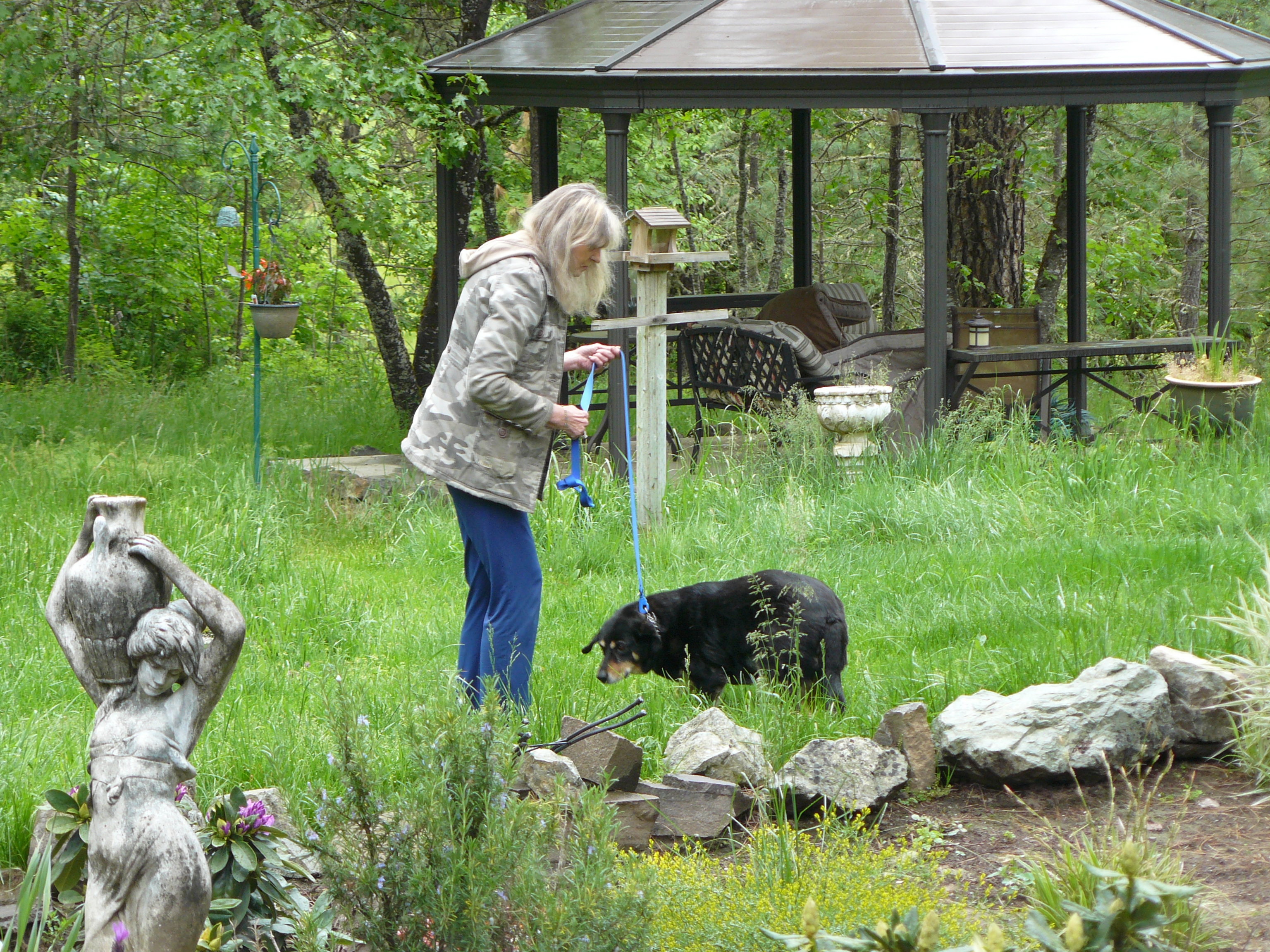
Hazel taking a very slow walk outside.

oooo

But most of the time she just wanted to be left on her own in our bedroom.

We are holding Hazel very close to our hearts just now.

Time – Like the flick of a finger.

Five years has just gone by in a flash.

A few weeks ago I was speaking to Larry, one of our lovely neighbours who, as with me, is the wrong side of 65 (as with me, by quite a lump) and he was bemoaning how more quickly time seems to pass by the older one gets. It had never previously crossed my mind but in that instant I knew exactly what Larry meant.

For today I have been a Permanent Resident (aka Green Card holder) for precisely five years. And in seven months time I will be 72 years old. Where did it all go!

So it seemed very appropriate for others who are staring at their ‘senior’ years to republish an item that recently appeared on the Dr. Sinatra website. It is all about the amazing benefits of regular exercise.

ooOOoo

To Live a Longer Life, Even Moderate Exercise Gives You Big Benefits

by Dr. Stephen Sinatra
Filed Under: Heart Health, General Health
Last Reviewed 02/29/2016

As you know, exercise is essential for your heart and overall health. Now, a new study published in the journal Medicine & Science in Sports & Exercise has quantified the powerful impact exercise can have on the length of your life.

For this study, researchers looked at data collected in the National Health and Nutrition Examination Study which included 3,000 participants ages 50-79. All of the study participants wore highly sensitive activity trackers, called accelerometers, for seven days. Then, they compared the participants’ activity levels with recorded deaths during the following eight years. What they found is that the participants who had the lowest level of activity were five times more likely to have died during the follow-up period than those participants who had the highest activity level. Those with the lowest level of activity were also three times more likely to have died than those who had moderate activity levels.

There’s no question that inactivity is a prominent risk factor for many health problems, and even minimal amounts of regular activity can have immediate benefits. Plus, for seniors the benefits of exercise go far beyond good cardiovascular health, increasing strength and flexibility so you can stay independent in your senior years.

What Type of Exercise Should You Do?

My answer is always the one that you will enjoy and stick with for the long-term—whether it’s walking, tennis, dancing, swimming or another activity you enjoy. My personal favorites are pilates and yoga, which are good for range of motion, flexibility, and strength.

But regardless of the type of activity you choose, here are some tips to get you started:

  • If you haven’t exercised in a long time and you have a medical condition such as osteoarthritis or cardiovascular disease, talk to your doctor about what kind of limits you may need to abide by. You don’t want to take on more than your body can handle. Also, consider having your feet checked for irregularities that require shoe inserts.
  • Start slowly and pace yourself. Should you experience shortness of breath or pain in your chest or arms, see your doctor as soon as possible. If you feel ill, stop. If symptoms persist after 3–5 minutes of rest, seek medical attention immediately. Symptoms may occur up to an hour after exercising, so be mindful of how you feel as you cool down and resume your regular activities.
  • The joints, ligaments, tendons, and muscles aren’t as forgiving as they were when we were younger, and they require an appropriate level of training. If you train with weights—even light ones—you must use correct form to avoid microtrauma and aggravation to joints. A personal trainer who is experienced in working with middle-agers and seniors can help with this. Long term, strengthening the muscles around ailing joints can help reduce pain.
  • Warning signs that you may be doing too much exercise include light-headedness or dizziness, palpitations, jaw pain, tingling or numbness in the arms, a tight feeling in the lungs, and shortness of breath (being unable to carry on a conversation).

Now it’s your turn: What are your exercise goals?

You May Also Be Interested In:

ooOOoo

 And to close this post with nothing at all to do with exercise but everything to do with loving a dog, here’s a picture of Brandy taken on Tuesday morning.

Very good exercise for the heart! :-)
Very good exercise for the heart! 🙂

The certainty of uncertainty

Just wanted to share this with you.

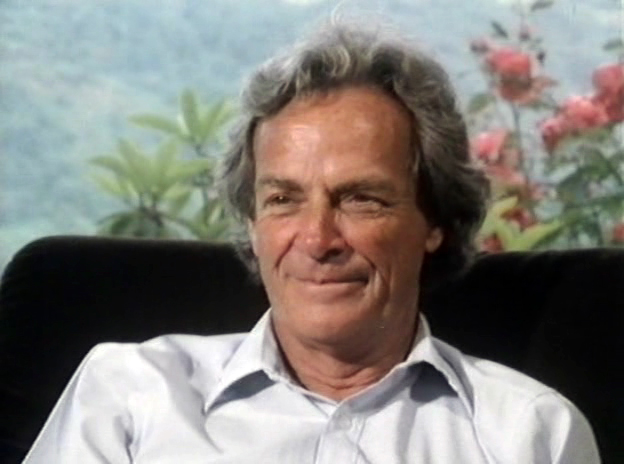
There seems to be so much going on in the world that creates uncertainty. In browsing the web looking for some inspiration for today’s blog post, I came across this short video of the late Richard Feynman and just wanted to share it with you.

The Richard Feyman website explains:

This web site is dedicated to Richard P. Feynman (1918-1988), scientist, teacher, raconteur, and musician.  He assisted in the development of the atomic bomb, expanded the understanding of quantum electrodynamics, translated Mayan hieroglyphics, and cut to the heart of the Challenger disaster.  But beyond all of that, Richard Feynman was a unique and multi-faceted individual.

Find out about Feynman, what he was and why he remains one of the most celebrated and revered scientists of modern times.

Richard Feynman
Richard Feynman

Now to the video. The Uncertainty of Knowledge

“If you expected science to give all the answers to the wonderful questions about what we are, where we are going what the meaning of the universe is and so on then I think you can easily become disillusioned and then look for some mystic answer to these problems. How a scientist can take a mystic answer I don’t know because the whole spirit is to unders…well never mind that, anyway I don’t understand that…but anyhow…if you think of it though…I..the way i think of what we are doing is, we are exploring, we are trying to find out as much as we can about the world.

People say to me, “Are you looking for the ultimate laws of physics?” No I am not. I am just looking to find out more about the world. And if it turns out there is a simple ultimate law that explains everything so be it. That would be very nice discovery. If it turns out it’s like an onion with millions of layers and we just sick and tired of looking at the layers then that’s the way it is! But whatever way it comes out it’s nature, it’s there, and she’s going to come out the way she is. And therefore when we go to investigate we shouldn’t pre-decide what it is we are trying to do except to find out more about it. If you said…but..the problem is why we do you find out more about it, if you thought that you are trying to find out more about it because you are going to get an answer to some deep philosophical question you may be wrong and may be that you can’t get an answer to that particular question by finding out more about the character of the nature.

Hope you find this inspiring!

If you want to find out more about this amazing person then do go across to that website.