Tag: University of Michigan

Not having a father

Prompted to write this after reading an article in The Conversation.

I turned 12 in November, 1956. My father died on December, 20th, 1956.

My mother eventually remarried and my step-father quickly became a wonderful Dad to me. But the shock of my father’s death never left me, and the fact that I am writing this some 70 years later shows that the episode is still with me, albeit in a much reduced way.

Thus this article in The Conversation hits the mark.

ooOOoo

What we misunderstand about absent fathers

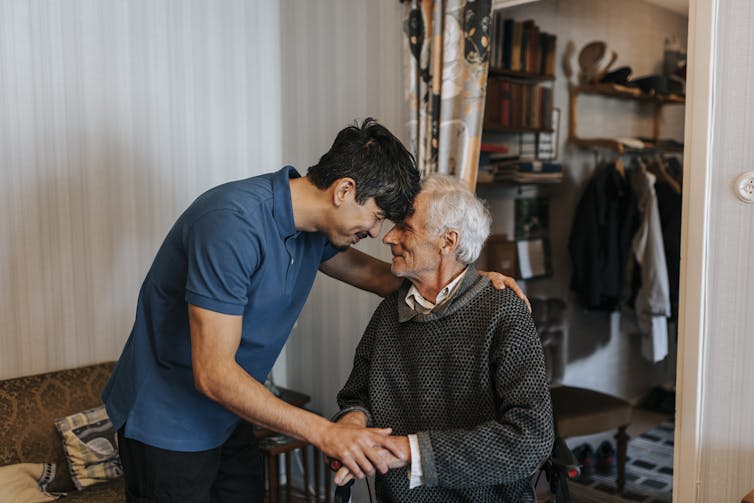
Dads aren’t always in the picture. Motortion/iStock via Getty Images

Matthew Alemu, University of Michigan; Northeastern University

“What do dads do on Tuesdays?”

This wasn’t a rhetorical question when I posed it to my wife as our daughter’s birth approached. Before my daughter was born, I had seen my father just once in the past 27 years. That’s over 1,400 Tuesdays. In fact, as a kid I hardly saw fathering any day of the week, save for on TV sitcoms; absent dads were prevalent within my family and among my peers.

My daughter was born on a Saturday. My first Tuesday as a father came and went in a blur of exhaustion. I’d always loved playing and working with kids. I felt generally competent in what to do with my newborn daughter. Yet as I held her, insecurity from my father’s absence kept me questioning: Will I be better than my absent father?

Absence assumes different forms

Years before my daughter’s birth, I was a first-year Ph.D. student intending to study Black men and how their memories of childhood affected them as adults.

My pivot toward focusing on fatherhood began while I was conducting interviews for a larger study on men of all races and unemployment. After completing these interviews, I was surprised to see that 85% of my respondents grew up with absent fathers. The nature of the absences – how they occurred and how they felt – struck me as a more compelling area of study.

Historically, scholars and policymakers looked at whether fathers lived with their kids as the sole criterion when designating them as “present” or “absent.” Yet, my respondents’ stories revealed distinctions that “nonresident” alone did not capture. Specifically, my analysis identified four unique patterns of absence: “consistent,” “inconsistent,” “extended” and “absolute.”

Consistent absence includes regular interactions, like every Tuesday after school or every weekend.

Inconsistent absence involves irregular and unpredictable interactions – a dad who promises to show up on Tuesday but doesn’t appear until Friday, or disappears for weeks at a time.

Extended absence occurs when years pass between interactions: meeting your father for the first time at 9 years old, and then having no interaction with him until he shows up at your high school graduation, for instance.

Finally, absolute absence means interactions never occurred or they can no longer occur, such as a father who died or disappeared, with his whereabouts unknown. Some people in this category didn’t even know their fathers’ names.

These categories complicate what can otherwise be oversimplified.

For example, the fathers of Presidents Bill Clinton and Barack Obama were both absent, but in distinctly different ways.

Clinton’s biological father died in a car accident before he was born – an absolute absence. Obama’s father left the family when Barack was 2 years old and reappeared only once, years later – a relationship characterized by extended absence.

In contrast, other famous people saw their absent fathers more regularly.

The parents of the rapper Ye, formerly known as Kanye West, divorced when he was 3 years old, but he grew up spending summers with his father, putting the absence in the “consistent” category. Similarly, Maroon 5 singer Adam Levine regularly saw his dad on weekends after his parents divorced, which I also classify as a consistent form of absence.

Better than my father, or better than his absence?

Ironically, I became a father as I began my dissertation research on absent fathers. Using the four categories of paternal absence I developed, my dissertation examined how men’s experiences with absence shaped their own aspirations for fatherhood and romantic relationships.

I wanted to showcase the complexity and range of experiences of growing up with an absent father, while also exposing the disparity in how people remembered their absent fathers. Specifically, some people knew their fathers, while others knew only that their father was absent. This memory gap makes it harder for some new dads to envision what it means to be better than their own fathers.

Like me, the men I interviewed for my research relayed anxieties about navigating fatherhood. Like me, they wanted to be better than their fathers.

But we all differed in how prepared we felt for the task. Some had vivid memories to guide them: One respondent, who experienced inconsistent absence, hated that his father never showed curiosity in getting to know him. So when he became a parent, he made sure to ask his daughter questions so she would know he cared about her life.

Yet those with little to no memories of their father may aspire to be, as another respondent put it, “a father like my mother.”

Doing this work, I’ve been able to reimagine my own experience with absence.

I used to assume that the pattern of absence I experienced with my own dad reflected a standard. My parents divorced when I was 3 years old. I saw my father regularly until moving away at 6 – a form of consistent absence. But the rest of my childhood passed without seeing my father, shifting me to extended absence. I used to wrongly dismiss less extreme patterns of absence, such as seeing one’s father weekly or monthly, as “not absence.”

My unique experience of absence has also distinctly shaped how I remember my father. My memories mainly come from 6 years old and earlier. Many are unfavorable, like his smoking in the car, knowing I had asthma. Some fond ones exist, like the two of us walking on the beach or feeding ducks at a local pond.

Still, what I recall most is my fear of my father. The origins of this fear escape me. I’ve been told he abused my mother, but I don’t remember witnessing it.

These scant memories presented a paradox as I entered fatherhood: I didn’t want to be feared like my father, but I didn’t know exactly what made me afraid of my father. This uncertainty loomed throughout my early years of parenting: When my daughter cried in my arms or preferred my wife over me, was it simply a sign of normal fussiness? Or had I unknowingly become a scary figure, like my father?

From abandoned son to present father

I last met my father 20 years ago. I was full of hate when that meeting began, but this hatred soon dissipated. First, I realized I wasn’t angry at my father, because I barely knew my father. I was angry at his absence. Second, I learned that his father was absent, too.

They say “hurt people hurt people.” Before my dad was an absent father, he was missing his dad, too. This doesn’t excuse his absence or his treatment of my mother. But it did make it harder to hate someone who was probably hurting like me.

As I continue to explore the impact of absent fathers as an academic, I continue to reconcile my transition from abandoned son to a present father. Lacking inspiration or guidance from my own father, I’m practicing fatherhood on my terms.

For me, that’s meant building traditions. From the outset, we’ve created routines around music, dancing, bath time, reading and talking about “big emotions.” Our most meaningful tradition has been our weekly daddy-daughter breakfast, which I started when she was 18 months old. She’s now 8.

Sometimes we go on Tuesdays. But any day of the week is fair game.

Matthew Alemu, Special Advisor, Poverty Solutions, University of Michigan; Northeastern University

This article is republished from The Conversation under a Creative Commons license. Read the original article.

ooOOoo

Now Matthew Alema was much more furtunate than me. At least he saw his father from time to time.

I often reflect how my life would have been different had my father lived for much longer, say until he was in his 70’s or 80’s. There’s no question it would have been significant. I would have had a profession, possibly in the designing of buildings. I would have gone to university, And so on …

I have a son and a daughter, both in their 50’s, and a grandson by my daughter and her husband. I am so grateful to be able to speak to them on a regular basis. They all live in England.

Death – it comes to all of us!

Irrespective of our believe.

There are only two days in our lives when we live for less than twenty-four hours: the day we are born and the day when we die!

I was born in November, 1944 and that makes me eighty-one. I was born as a result of an affair between my mother and my father. The family genes favour girls over boys, as in seven girls for every boy, and the son is normally the first born. My mother lost her first child, it was a boy. Then my mother had a second baby. Surprise, surprise, it was another son – me!!

I say this as an introduction to a post on The Conversation.

ooOOoo

Americans are unprepared for the expensive and complex process of aging – a geriatrician explains how they can start planning

It’s important for older adults to plan for their care as they age. Maskot/Maskot via Getty Images

Kahli Zietlow, University of Michigan

Hollywood legend Gene Hackman and his wife, Betsy Arakawa, were found dead in their home in February 2025. Hackman had been living with Alzheimer’s and depended on Arakawa as his full-time caregiver.

Disturbingly, postmortem data suggests that Arakawa died of complications from pulmonary Hantavirus several days before her husband passed. The discordant times of death point to a grim scenario: Hackman was left alone and helpless, trapped in his home after his wife’s death.

The couple’s story, while shocking, is not unique. It serves as a warning for our rapidly aging society. The U.S. population is aging, but most Americans are not adequately planning to meet the needs of older adulthood.

As a geriatric physician and medical educator, I care for older adults in both inpatient and outpatient settings. My research and clinical work focus on dementia and surrogate decision-making.

In my experience, regardless of race, education or socioeconomic status, there are some universal challenges that all people face with aging and there are steps everyone can take to prepare.

Aging is inevitable but unpredictable

Aging is an unpredictable, highly individualized process that varies depending on a person’s genetics, medical history, cognitive status and socioeconomic factors.

The majority of older Americans report a strong sense of purpose and self-worth. Many maintain a positive view of their overall health well into their 70s and 80s.

But at some point, the body starts to slow down. Older adults experience gradual sensory impairment, loss of muscle mass and changes in their memory. Chronic diseases are more likely with advancing age.

According to the U.S. Census Bureau, 46% of adults over age 75 live with at least one physical disability, and this proportion grows with age. Even those without major health issues may find that routine tasks like yard work, housekeeping and home repairs become insurmountable as they enter their 80s and 90s.

Some may find that subtle changes in memory make it difficult to manage household finances or keep track of their medications. Others may find that vision loss and slowed reaction time make it harder to safely drive. Still others may struggle with basic activities needed to live independently, such as bathing or using a toilet. All of these changes threaten older adults’ ability to remain independent.

The costs of aging

Nearly 70% of older Americans will require long-term care in their lifetime, whether through paid, in-home help or residence in an assisted living facility or nursing home.

But long-term care is expensive. In 2021, the Federal Long Term Care Insurance Program reported that the average hourly rate for in-home care was US$27. An assisted living apartment averaged $4,800 per month, and a nursing home bed cost nearly double that, at a rate of $276 per day.

Many Americans may be shocked to discover that these costs are not covered by Medicare or other traditional medical insurance. Long-term care insurance covers the cost of long-term care, such as in-home care or nursing home placement. However, what is covered varies from plan to plan. Currently, only a small minority of Americans have long-term care insurance due to high premiums and complex activation rules.

I am not aware of any high-quality, peer-reviewed studies that have demonstrated the cost effectiveness of long-term care insurance. Yet, for many Americans, paying for care out of pocket is simply not an option.

Medicaid can provide financial support for long-term care but only for older adults with very low income and minimal assets – criteria most Americans don’t meet until they have nearly exhausted their savings.

Those receiving Medicaid to cover the costs of long-term care have essentially no funds for anything other than medical care, room and board. And proposed federal financial cuts may further erode the limited support services available. In Michigan, for example, Medicaid-covered nursing home residents keep only $60 per month for personal needs. If individuals receive monthly income greater than $60 – for instance, from Social Security or a pension – the extra money would go toward the cost of nursing home care.

Those who don’t qualify for Medicaid or cannot afford private care often rely on family and friends for unpaid assistance, but not everyone has such support systems.

A nurse helps an older man shave.
Older adults may end up needing help with day-to-day personal care. Klaus Vedfelt/DigitalVision via Getty Images

Planning for the care you want

Beyond financial planning, older adults can make an advance directive. This is a set of legal documents that outlines preferences for medical care and asset management if a person becomes incapacitated. However, only about 25% of Americans over 50 have completed such documentation.

Without medical and financial powers of attorney in place, state laws determine who makes critical decisions, which may or may not align with a person’s wishes. For instance, an estranged child may have more legal authority over an incapacitated parent than their long-term but unmarried partner. Seniors without clear advocates risk being placed under court-appointed guardianship – a restrictive and often irreversible process.

In addition to completing advance directives, it is important that older adults talk about their wishes with their loved ones. Conversations about disability, serious illness and loss of independence can be difficult, but these discussions allow your loved ones to advocate for you in the event of a health crisis.

Who’s going to care for you?

Finding a caregiver is an important step in making arrangements for aging. If you are planning to rely on family or friends for some care, it helps to discuss this with them ahead of time and to have contingency plans in place. As the Hackman case demonstrates, if a caregiver is suddenly incapacitated, the older adult may be left in immediate danger.

Caregivers experience higher rates of stress, depression and physical illness compared with their peers. This is often exacerbated by financial strain and a lack of support. It helps if the people you will be relying on have expectations in place about their role.

For instance, some people may prefer placement in a facility rather than relying on a loved one if they can no longer use the bathroom independently. Others may wish to remain in their homes as long as this is a feasible option.

Connecting with available resources

There are local and federal initiatives designed to help aging adults find and get the help they need. The Centers for Medicare & Medicaid Services recently launched the GUIDE Model to improve care and quality of life for both those suffering from dementia and their caregivers.

This program connects caregivers with local resources and provides a 24-hour support line for crises. While GUIDE, which stands for Guiding an Improved Dementia Experience, is currently in the pilot stage, it is slowly expanding, and I am hopeful that it will eventually expand to provide enhanced coverage for those suffering from dementia nationwide.

The Program for All-Inclusive Care of the Elderly helps dual-eligible Medicare and Medicaid recipients remain at home as they age. This program provides comprehensive services including medical care, a day center and home health services.

Area agencies on aging are regionally located and can connect older adults with local resources, based on availability and income, such as meals, transportation and home modifications that help maintain independence.

Unfortunately, all of these programs and others that support older adults are threatened by recent federal budget cuts. The tax breaks and spending cuts bill, which was signed into law in July 2025, will result in progressive reductions to Medicaid funding over the next 10 years. These cuts will decrease the number of individuals eligible for Medicaid and negatively affect how nursing homes are reimbursed.

The government funding bill passed on Nov. 13 extends current Medicare funding through Jan. 30, 2026, at which point Medicare funding may be reduced.

Even as the future of these programs remains uncertain, it’s important for older adults and their caregivers to be intentional in making plans and to familiarize themselves with the resources available to them.

Kahli Zietlow, Physician and Clinical Associate Professor of Geriatrics & Internal Medicine, University of Michigan

This article is republished from The Conversation under a Creative Commons license. Read the original article.

ooOOoo

This article is a wakeup call for me, because I have no plan in place.

While I think about death more frequently than I used to, the fact that I don’t have plan is naive: I must get myself to a stage where I have a plan, and soon! I guess I am not the only person in their 80s without a plan!

Reflections on the internet.

An interesting item that recently crossed my ‘screen’.

I make no apologies for cutting corners for today’s post. Because the last few days of looking after, and worrying about, Hazel have soaked up so much of our time and energy that I just couldn’t find the creative impulse to do much more than ‘copy and paste’.

That’s not to downplay the great interest of this article that appeared over on The Conversation blogsite a few days ago.

ooOOoo

Why the Internet isn’t making us smarter – and how to fight back

April 15, 2016 5.58am EDT

Professor of Psychology, University of Michigan

Disclosure statement: David Dunning has received funding from the National Science Foundation, the National Institutes of Health, and the Templeton Foundation in the past.

In the hours since I first sat down to write this piece, my laptop tells me the National Basketball Association has had to deny that it threatened to cancel its 2017 All-Star Game over a new anti-LGBT law in North Carolina – a story repeated by many news sources including the Associated Press. The authenticity of that viral video of a bear chasing a female snowboarder in Japan has been called into question. And, no, Ted Cruz is not married to his third cousin. It’s just one among an onslaught of half-truths and even pants-on-fire lies coming as we rev up for the 2016 American election season.

The longer I study human psychology, the more impressed I am with the rich tapestry of knowledge each of us owns. We each have a brainy weave of facts, figures, rules and stories that allows us to address an astonishing range of everyday challenges. Contemporary research celebrates just how vast, organized, interconnected and durable that knowledge base is.

That’s the good news. The bad news is that our brains overdo it. Not only do they store helpful and essential information, they are also receptive to false belief and misinformation.

Just in biology alone, many people believe that spinach is a good source of iron (sorry, Popeye), that we use less than 10 percent of our brains (no, it’s too energy-guzzling to allow that), and that some people suffer hypersensitivity to electromagnetic radiation (for which there is no scientific evidence).

But here’s the more concerning news. Our access to information, both good and bad, has only increased as our fingertips have gotten into the act. With computer keyboards and smartphones, we now have access to an Internet containing a vast store of information much bigger than any individual brain can carry – and that’s not always a good thing.

Better access doesn’t mean better information

This access to the Internet’s far reaches should permit us to be smarter and better informed. People certainly assume it. A recent Yale study showed that Internet access causes people to hold inflated, illusory impressions of just how smart and well-informed they are.

But there’s a twofold problem with the Internet that compromises its limitless promise.

First, just like our brains, it is receptive to misinformation. In fact, the World Economic Forum lists “massive digital misinformation” as a main threat to society. A survey of 50 “weight loss” websites found that only three provided sound diet advice. Another of roughly 150 YouTube videos about vaccination found that only half explicitly supported the procedure.

Rumor-mongers, politicians, vested interests, a sensationalizing media and people with intellectual axes to grind all inject false information into the Internet.

So do a lot of well-intentioned but misinformed people. In fact, a study published in the January 2016 Proceedings of National Academy of Science documented just how quickly dubious conspiracy theories spread across the Internet. Specifically, the researchers compared how quickly these rumors spread across Facebook relative to stories on scientific discoveries. Both conspiracy theories and scientific news spread quickly, with the majority of diffusion via Facebook for both types of stories happening within a day.

Making matters worse, misinformation is hard to distinguish from accurate fact. It often has the exact look and feel as the truth. In a series of studies Elanor Williams, Justin Kruger and I published in the Journal of Personality and Social Psychology in 2013, we asked students to solve problems in intuitive physics, logic and finance. Those who consistently relied on false facts or principles – and thus gave the exact same wrong answer to every problem – expressed just as much confidence in their conclusions as those who answered every single problem right.

For example, those who always thought a ball would continue to follow a curved path after rolling out of a bent tube (not true) were virtually as certain as people who knew the right answer (the ball follows a straight path).

Defend yourself

So, how so we separate Internet truth from the false?

First, don’t assume misinformation is obviously distinguishable from true information. Be careful. If the matter is important, perhaps you can start your search with the Internet; just don’t end there. Consult and consider other sources of authority. There is a reason why your doctor suffered medical school, why your financial advisor studied to gain that license.

Second, don’t do what conspiracy theorists did in the Facebook study. They readily spread stories that already fit their worldview. As such, they practiced confirmation bias, giving credence to evidence supporting what they already believed. As a consequence, the conspiracy theories they endorsed burrowed themselves into like-minded Facebook communities who rarely questioned their authenticity.

Instead, be a skeptic. Psychological research shows that groups designating one or two of its members to play devil’s advocates – questioning whatever conclusion the group is leaning toward – make for better-reasoned decisions of greater quality.

If no one else is around, it pays to be your own devil’s advocate. Don’t just believe what the Internet has to say; question it. Practice a disconfirmation bias. If you’re looking up medical information about a health problem, don’t stop at the first diagnosis that looks right. Search for alternative possibilities.

Seeking evidence to the contrary

In addition, look for ways in which that diagnosis might be wrong. Research shows that “considering the opposite” – actively asking how a conclusion might be wrong – is a valuable exercise for reducing unwarranted faith in a conclusion.

After all, you should listen to Mark Twain, who, according to a dozen different websites, warned us, “Be careful about reading health books. You may die of a misprint.”

Wise words, except a little more investigation reveals more detailed and researched sources with evidence that it wasn’t Mark Twain, but German physician Markus Herz who said them. I’m not surprised; in my Internet experience, I’ve learned to be wary of Twain quotes (Will Rogers, too). He was a brilliant wit, but he gets much too much credit for quotable quips.

Misinformation and true information often look awfully alike. The key to an informed life may not require gathering information as much as it does challenging the ideas you already have or have recently encountered. This may be an unpleasant task, and an unending one, but it is the best way to ensure that your brainy intellectual tapestry sports only true colors.

ooOOoo

The way the world now communicates, for good and bad, using the internet is staggering. As the website Internet Live Stats reveals: (as of this moment today)

3,352,197,085 Internet Users in the world

1,016,623,500 Total number of Websites

2,060,120 Blog posts written today

So with that last figure in mind, I’ll send this for posting without delay! 😉

The sounds of life.

Bernie Krause: The voice of the natural world

Not going to do anything other than ask you to watch, or more pertinently listen, to this 14-minute video.

Published on Jul 15, 2013

Bernie Krause has been recording wild soundscapes — the wind in the trees, the chirping of birds, the subtle sounds of insect larvae — for 45 years. In that time, he has seen many environments radically altered by humans, sometimes even by practices thought to be environmentally safe. A surprising look at what we can learn through nature’s symphonies, from the grunting of a sea anemone to the sad calls of a beaver in mourning.

The Wikipedia entry explains that:

Bernie Krause was born in 1938. Somewhat of a musical prodigy, by age 3-1/2 he studied violin and by age 4 classical composition. He performed on a variety of stringed instruments (cello, bass, viola, harp) but fell in love with the guitar. He was disappointed when in 1955 not a single music school to which he applied would accept him with guitar as his primary instrument. Krause went on to work as a studio guitarist on jazz sessions and, occasionally, on early Motown sessions. He also worked as a recording engineer and producer in Ann Arbor while an undergraduate at the University of Michigan. He joined The Weavers in 1963, occupying the position created by co-founder Pete Seeger and stayed with them until they disbanded a year later.

More details here.

Do go across to Bernie Krause’s website Wild Sanctuary if only to listen to the sounds of birds on the ‘home page’!


The power of shine!

A delightful presentation by Terry Hershey.

Regular followers of Learning from Dogs will recall that in March we had the pleasure of a visit to St Paul’s Episcopal Church, here in Payson, of the well-known Terry Hershey.  He is a great inspirational speaker, based on deep and sound personal values.  Terry’s website is here.

Well it seemed like a nice idea to offer some more of TH.  Here is his presentation on World Communion Day, October 4th 2009, at the First Community Church, Columbus, Ohio.  Letting the light that is in each one of us shine out.

Part One

Part Two