Misa Minnie being promoted as the world’s smartest puppy.
After getting up at 3am to let Dhalia out for a pee and then waking to find that George had died, I wasn’t really in the mood for a deep and meaningful post for today.
So I have used an item emailed to me by our neighbours, Dordie and Bill, that seemed fun to share with you.
We’ve seen dogs doing tricks you wouldn’t believe — but we’ve never seen a dog look this cute while doing them.
Misa Minnie is a 1-year-old Yorkie pup who has been trained by her owner. At just 18 weeks old, she began performing a wide array of tricks and has now racked up more than 15,000 YouTube fans.
A video from last June resurfaced on Yahoo! this week showing Misa at 31 weeks mastering over two dozen commands.
Misa could easily get by on her looks alone — but with her talent, this little Yorkie really is the whole package.
But being careful about what our dogs eat is another story!
This is not the first time that I have used this title for a blog post. The previous time was almost eighteen months ago when I highlighted a fascinating talk about the green revolution by Raj Patel, the award-winning writer, activist, and academic.
However, today is a first in that it looks at what our dogs eat. It was inspired by a recent article by Brady Dennis in the Washington Post. Here’s how that article opened:
Mystery of pet deaths related to jerky treats made in China continues to stump FDA
By Brady Dennis, Published: March 28
Andy lost his appetite. Then came the vomiting, the unquenchable thirst, the constant need to urinate. Over several days last year, the spunky 4-year-old West Highland white terrier grew lethargic and lost more than 10 percent of his weight.
“It got bad,” said Andy’s owner, Alfredo Gude, a retiree in Cape Coral, Fla. “I knew that he was in trouble.”
Gude and his wife rushed Andy to their veterinarian, who referred him to a clinic 15 miles away. Doctors there sent a urine sample to a specialized metabolic lab at the University of Pennsylvania. Days later, test results confirmed the diagnosis: Fanconi syndrome, a rare, often fatal illness that affects the kidneys. The suspected cause: chicken jerky pet treats manufactured in China.
The incident is part of a troubling mystery lasting more than seven years, with reports of at least 600 dogs dying and thousands of others sickened. It has outraged unsuspecting pet owners, confounded the Food and Drug Administration and put the pet food industry’s manufacturing practices under a microscope.
A little later on in the article, Brady Dennis writes:
Bernadette Dunham, director of the FDA’s Center for Veterinary Medicine, has called it “one of the most elusive and mysterious outbreaks we’ve encountered,” a sentiment echoed by others at the agency.
“We are frustrated,” said Martine Hartogensis, who oversees the FDA’s ongoing investigation. “It’s been a long, winding, twisting road . . . [But] we haven’t given up.”
The FDA says it has tested more than 1,200 jerky treats in recent years, looking for salmonella, mold, pesticides, toxic metals, outlawed antibiotics, nephrotoxins and other contaminants. Federal officials have inspected factories in China that manufacture chicken jerky products for U.S. companies and sought input from academics, state and university research labs, foreign governments and the pet food industry. The agency even made its own jerky treats to try to duplicate the commercial process.
This is not some minor issue reinforced by the huge increase in dog food imports into the USA from China. Back to Brady:
The long-running investigation has paralleled a striking increase in the amount of pet food China exports to the United States. That volume increased from barely 1 million pounds in 2003 to an estimated 86 million pounds by 2011, according to the FDA.
Pet treats, including the jerky treats at the heart of the current investigation, have made up a fast-growing sliver of the pet food market. Part of the reason many U.S. companies have looked to China to produce chicken jerky treats, industry officials say, is that unlike in America, people in China overwhelmingly prefer dark meat. That leaves a larger supply of the white meat used in pet treats available for exporting.
Then a few paragraphs later, he adds:
“It’s maddening that it has gone on this long,” said Susan Thixton, who runs the Web site TruthAboutPetFood.com, which has repeatedly demanded that the agency do more. “If this were humans dying, and they couldn’t figure out a cause for seven years, members of Congress would be screaming at them.”
The home page of her site displays a clock tracking how long jerky treats from China have been killing and sickening pets. It asks: “When will FDA make this clock stop?” As of Friday, the count stood at 2,643 days.
“My job is to point out that they aren’t doing their job,” Thixton said. “I have a lot of respect for what they have to accomplish. They have huge responsibilities, but this is one of them.”
When I read out the article to Jean what then jumped ‘off the page’ was this paragraph [my emphasis]:
Angry pet owners also have heaped criticism on U.S. companies that continue to manufacture jerky treats with ingredients from China. The backlash includes everything from skepticism over the industry’s assurances that the treats have never posed health risks to lawsuits alleging harm.
As Susan Thixton was reported earlier: “If this were humans dying, and they couldn’t figure out a cause for seven years, members of Congress would be screaming at them.” Quite so!
Luckily, owners are responding as Brady highlights in these paragraphs:
Nina Leigh Krueger, head of the Waggin’ Train brand, said most retailers and customers have welcomed the treats back. “Thousands of consumers have been calling and asking us for Waggin’ Train treats to be back on the market,” she said.
Terry Safranek is not one of them.
“It’s a kick in the gut to see them back on the shelf,” said Safranek, whose 9-year-old fox terrier, Sampson, who had eaten jerky treats, died of kidney failure in 2012. Since then, Safranek has become a plaintiff in a class-action lawsuit against Nestlé Purina and retailers including Target and Wal-Mart. She helped create Animal Parents Against Pet Treats and Food Made in China, a group that has petitioned the FDA to do better in alerting people about the potential dangers of jerky treats produced in Chinese factories.
The link in the last paragraph takes the reader to the Facebook page for that group. Do go there and ‘Like’ the page.
I will close by recommending you read the Washington Post article in full and then spend some time perusing the website Truth about Pet Food. This is not just about ‘Made in America’ but fighting to ensure that animal treats made in the USA are also using ingredients from the USA!
Remember how Brady opened his article? With Alfredo Gude learning that their dog, Andy, had been diagnosed with Fanconi syndrome, a rare and often fatal illness that affects the kidneys of dogs.
Well last words left with Brady Dennis:
For now, on Florida’s west coast, Andy the terrier has returned to normal after months of treatments — about $3,500 worth — to restore his kidney function. “We feel very lucky,” said Gude, who has taken the advice of many vets around the country to steer clear of pet jerky treats altogether. “It could have gone another way.”
Our dogs (and cats) have a right to be fed to the same standards as us humans!
Almost two months ago, January 30th to be exact, the first of this ‘Meet the dogs‘ series was published. It came out of an idea from Jean and that January 30th post introduced Paloma to you, dear reader. Since then we have told you about Lilly, Dhalia, Ruby, Casey, Hazel, Sweeny, and Cleo.
So today’s post is the last of the Meet the dogs stories; it is about Pharaoh. I’m going to indulge myself and tell you the story of this most wonderful of dogs over today and tomorrow.
ooOOoo
Pharaoh
Photograph taken on the 12th August, 2003, the first day I saw Pharaoh.
This is Sandra Tucker, owner of Jutone Kennels in Devon, England, where Pharaoh was born on June 3rd, 2003. Here’s something written elsewhere that conveys my feelings that first day that I met this puppy.
oooo
In no time at all I was turning into the farm driveway, noticing the painted sign for Jutone & Felsental German Shepherds alongside the open, wooden gate.
I turned off the engine and was about to swing my legs out of the open driver’s door when I saw a woman coming towards me.
“Hi, you must be Paul, I’m Sandra. Did you have any trouble finding us?”
I shook hands with her.
“Not at all. I did as you recommended when we spoke on the phone and went in to the local store and got final directions.”
Sandra smiled, her glasses almost slipping off the end of her nose.
“Dear Beth. She’s been running that local store since God was a boy.”
She continued with a chortle in her voice, “Some say that Beth was at the store before our local pub, The Palk Arms, opened for business. And the pub’s been in the village for well over four-hundred years.” Sandra’s laugh was infectious and I caught myself already taking a liking to her. The sense of a strong, confident person struck me immediately. Indeed, a working woman evidenced by her brown slacks, revealing plenty of dog hairs, topped off with a blue T-shirt under an unbuttoned cotton blouse.
“Anyway, enough of me, Paul, you’ve come to get yourself a German Shepherd puppy.”
She turned towards a collection of grey, galvanised-sheeted barns and continued chatting as I fell into step alongside her.
“After we discussed your circumstances over the phone; where you live down there in Harberton, why you specifically wanted a German Shepherd dog, I thought about the last set of puppies that were born, just a few weeks ago.”
Sandra paused and turned towards me.
“While, of course, you can select whatever puppy you feel drawn to, my advice is to go for a male. Listening to your experiences of befriending a male German Shepherd when you were a young boy, I have no doubt that a male dog would result in you and the dog building a very strong bond. Indeed, I have a young male puppy that I want to bring out to you. Is that OK?”
Sandra turned and walked out of sight around the corner of the first barn leaving me standing there, my response presumably being taken for granted.
Something in her words struck me in a manner that I hadn’t anticipated; not in the slightest. That was her use of the word bond. I was suddenly aware of the tiniest emotional wobble inside me from Sandra’s use of that word. Somewhere deep inside me was the hint that my decision to have a dog in my life was being driven by deeper and more ancient feelings.
My introspection came to an immediate halt as Sandra re-appeared. She came up to me, a beige-black puppy cradled under her left arm, her left hand holding the pup across its mid-riff behind his front legs, her right arm across her waist supporting the rear of the tiny animal.
I stood very still, just aware of feelings that I couldn’t voice, could hardly even sense, as I looked down at this tiny black, furry face, outsized beige ears flopping down either side of his small head.
It was unusually warm this August day and I had previously unbuttoned my cuffs and folded the shirt sleeves of my blue-white, checked cotton shirt back above both elbows leaving my forearms bare.
Sandra offered me the young, fragile creature. As tenderly as I could, I took the pup into my arms and cradled the gorgeous animal against my chest. The pup’s warm body seemed to glow through its soft fur and as my bare arms embraced the flanks of this quiet, little dog I realised the magic, the pure magic, of the moment. Something was registering in me in ways utterly beyond words but, nonetheless, as real as a rainbow might be across the green, Devon hills.
“How old is he, Sandra?”
“This little lad was born on June 3rd. So what are we today? August 12th. So he is ten weeks old as of today.”
June 3rd, 2003. I knew that this date had now entered my life in just the same way as had the birth-dates of my son and daughter; Alex and Maija.
The power of this first meeting was beyond anything I had expected, or even imagined. I thought that it was going to be a fairly pleasant but, nonetheless, unsurprising process of choosing a puppy. How wrong could I have been! What was captivating me was the pure and simple bodily contact between this young dog and me. No more than that. I was sensing in some unspoken manner that this was equally as captivating for this precious puppy-dog. For even at the tender age of ten weeks, the tiny dog appeared to understand that me holding him so longingly was bridging a divide of many, many years.
Sandra motioned with her arm, pointing out a bench-seat a few yards away alongside a green, well-manicured, lawn.
I very carefully sat down on the wooden-slatted bench and rested the beautiful animal in my lap. The puppy was adorable. Those large, over-sized ears flopping across the top of his golden black-brown furry head. His golden-brown fur morphing into black fur across his shoulders and then on down to the predominantly beige-cream colour of his soft, gangling, front legs. That creamy fur continuing along the little creature’s underbelly.
The puppy seemed almost to purr with contentment, its deep brown eyes gazing so very intently into mine. I was entranced. I was spellbound.
Never before had I felt so close to an animal. In a life-time of nearly sixty years including having cats at home when I was a young boy growing up in North-West London, and much later the family owning a pet cat when Alex and Maija were youngsters, I had never, ever sensed the stirrings of such a loving bond as I was sensing now. As this young puppy was clearly sensing as well. This was to be my dog. Of that I was in no doubt.
oooo
Early days at home in South Devon.
Let me leave you with a couple of other photographs taken from his early days.
Pharaoh, nine months old, taken in my Devon home in 2004.
oooo
First birthday: June 3rd 2004. Again, picture taken in Devon.
Never in my wildest dreams did I imagine that in the year 2014 I would be writing about Pharaoh from a home-office desk in Southern Oregon sharing a happy life with a wonderful London lady, Jean, and more gorgeous animals than one could throw a stick at.
More on that shared journey with Pharaoh tomorrow!
So today, I write about Cleo and then next week it will be the final ‘meet the dogs’, the dog that started this blog: Pharaoh.
ooOOoo
Cleo
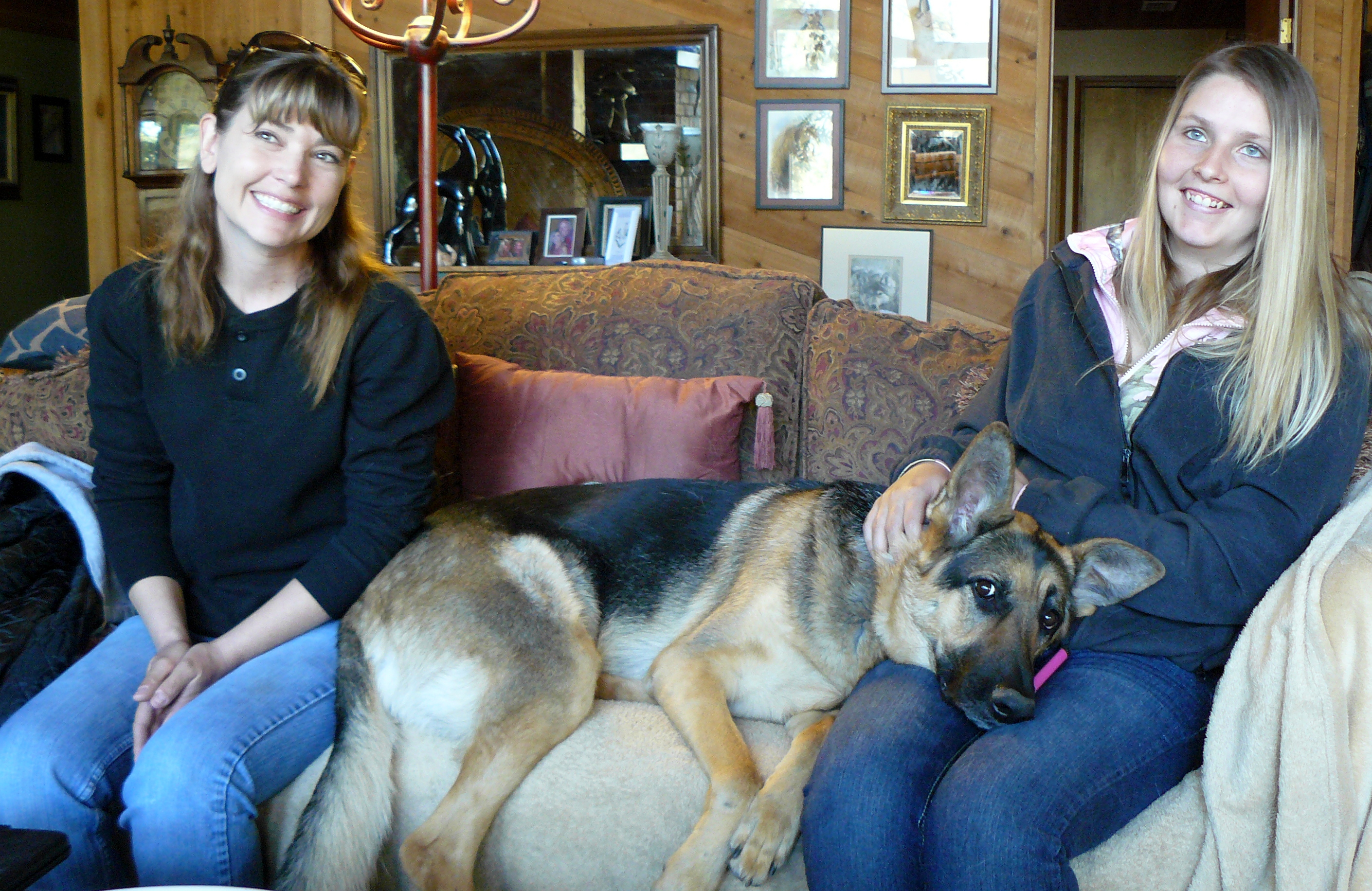
Cleo between guests Darla and Cody- picture taken yesterday.
(Come back tomorrow to learn why Darla and Cody were with us yesterday!)
Where to start? I guess by going back to the days I was living in Devon, England. That means going back to 2003, the year when it seemed the right time for me to get a dog. There was always only one breed to be considered; the German Shepherd dog. Thus that desire for a German Shepherd led me to Sandra Tucker not too many miles away who owned the GSD breeders Jutone. It was at Jutone’s where I saw the wonderful puppy dog who became my Pharaoh.
But Sandra did better than breed the dog that has meant more to me than words can ever describe, she gave me some fantastic advice. That being that when Pharaoh was getting on in life, then bring in a German Shepherd puppy. There were two solid reasons why this made sense. The first was that Pharaoh would teach the new puppy many of the skills and disciplines that Pharaoh had learnt as a young dog and, secondly, the puppy would keep Pharaoh active.
That puppy was Cleo.
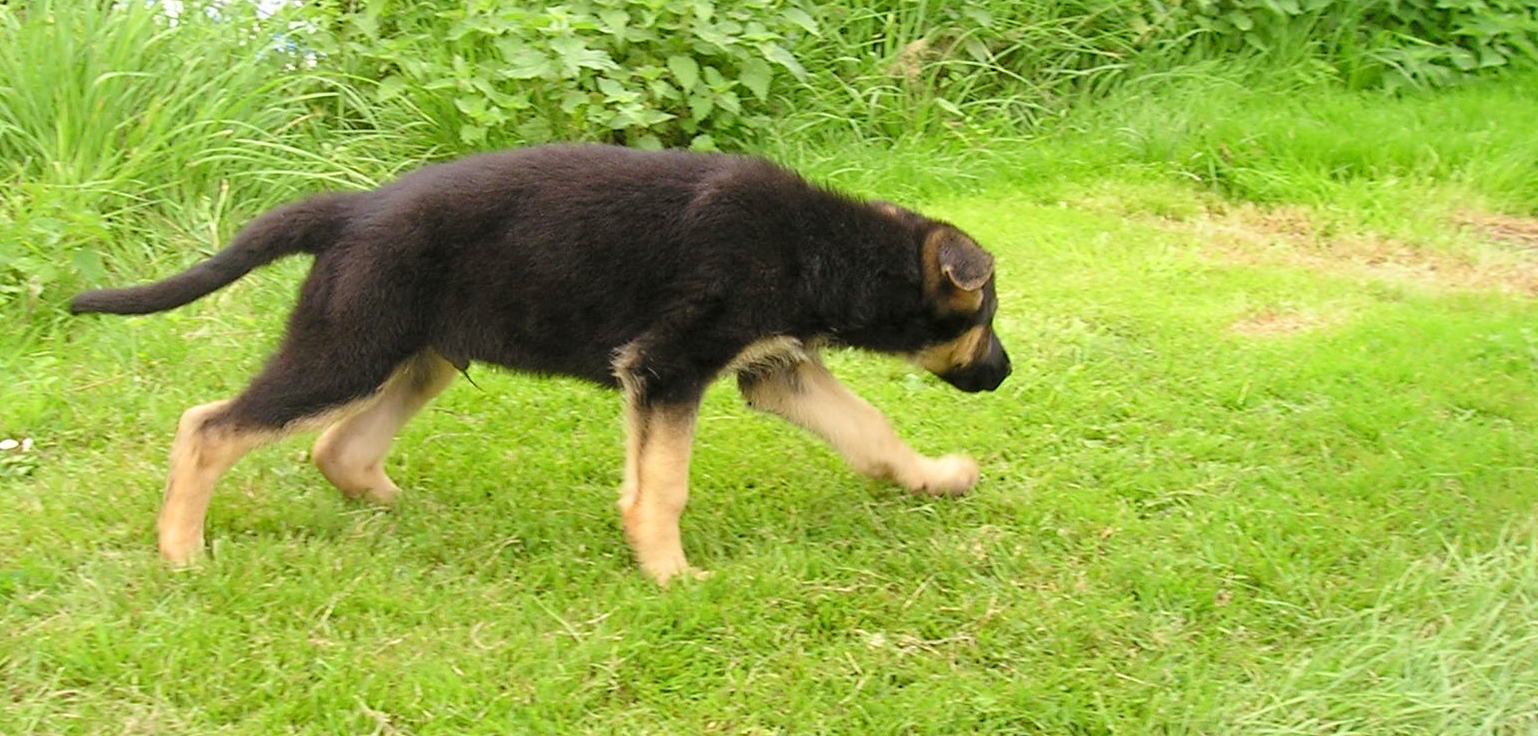
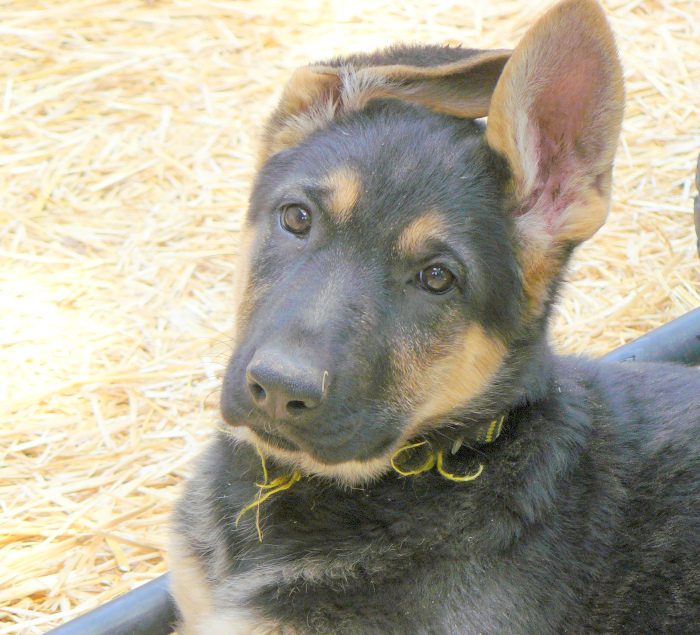
First picture of what was to be our puppy – 4th April, 2012, just two days before we brought her home.
oooo
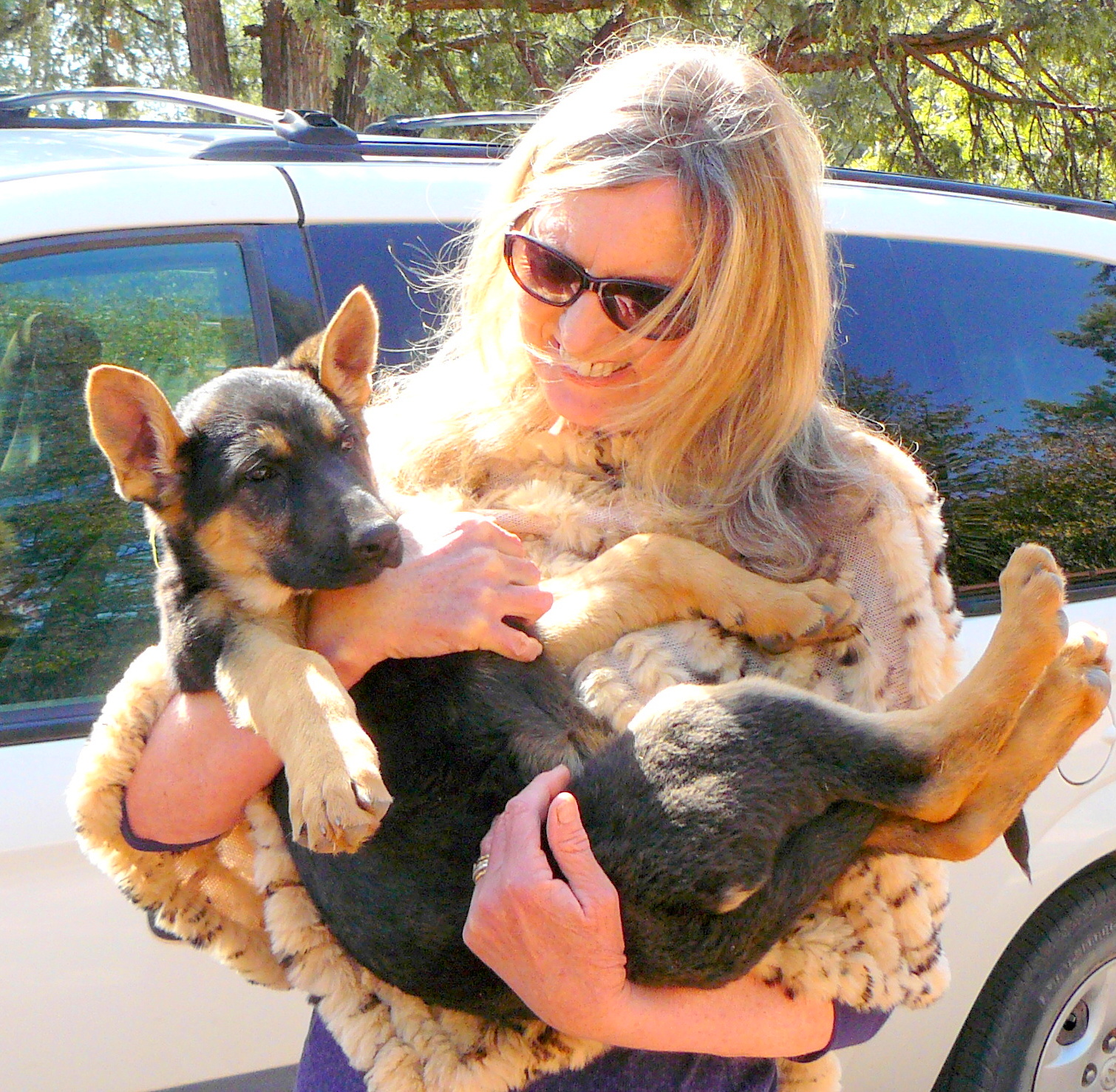
Puppy Cleo coming home – April 6th, 2012
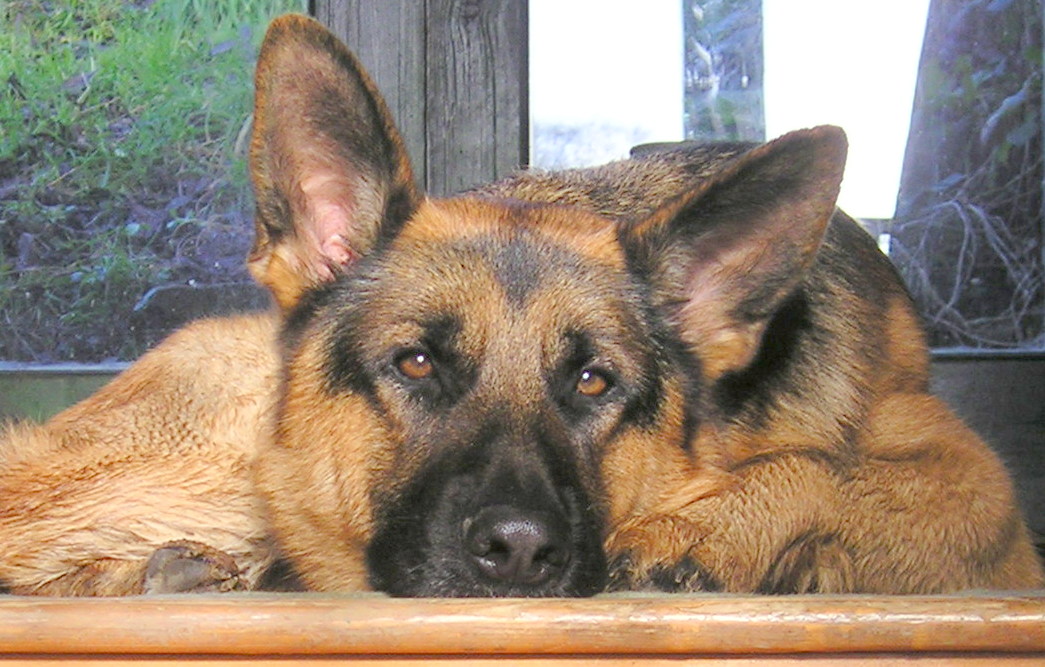
Cleo was born on the 23rd January, 2012. At that time we were still living down in Payson, Arizona. Right from the start she was, and still is, the most joyful, loving dog one could imagine. That top photograph shows in her eyes the openness of her heart and soul.
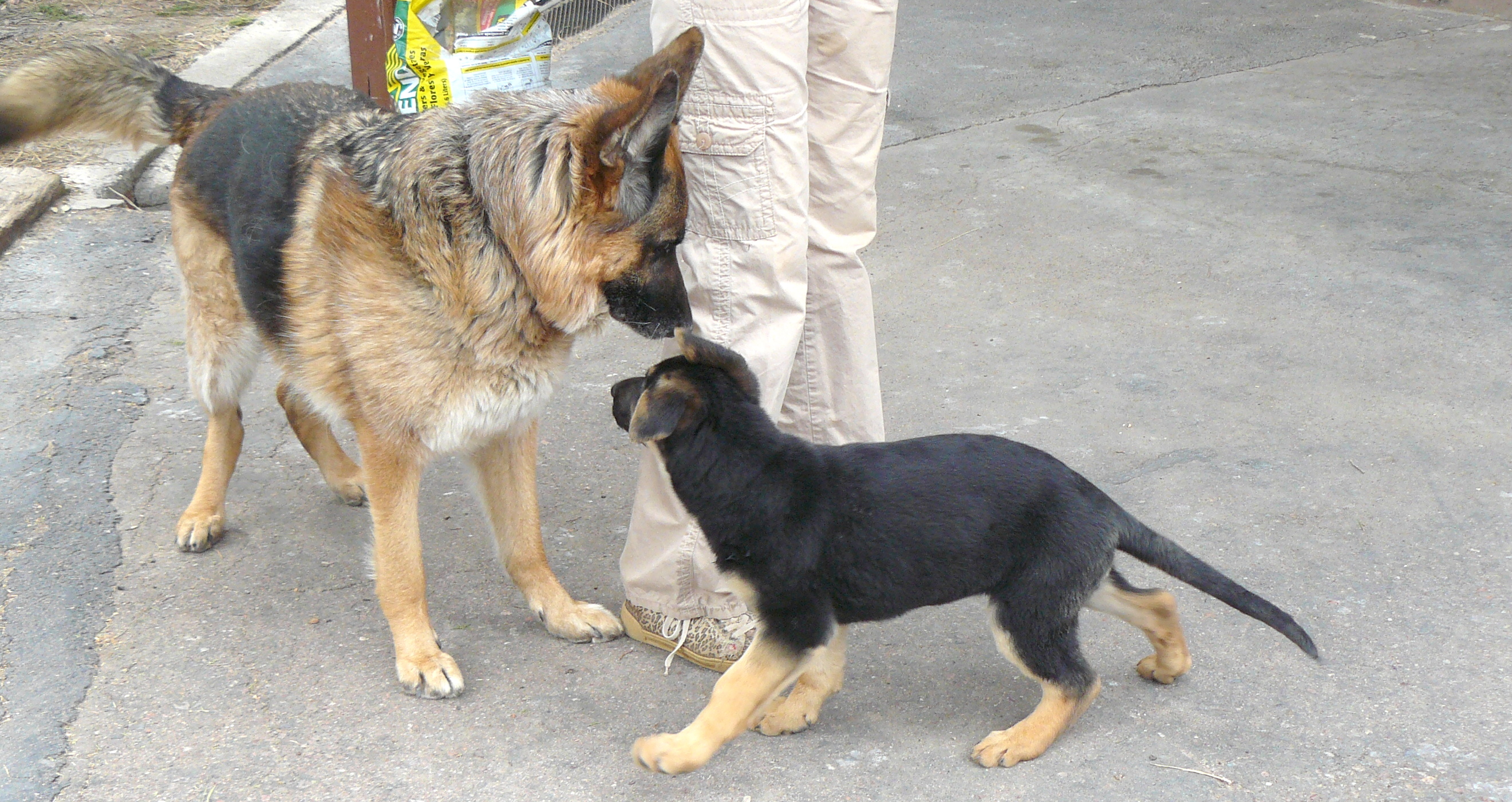
First meeting between Pharaoh and Cleo; April 7th, 2012.
So here we are coming rapidly up to the two-year anniversary of when Cleo entered our lives.
Cleo continues to be the most loving, gentle, sweet German Shepherd. As Sandra so correctly predicted, Pharaoh has ‘taught’ Cleo a number of commands such as Sit, Stay, Lie Down, Come, and more. Not a minute’s training of Cleo has come from Jean and me. Cleo is very fond of Pharaoh and it’s obvious that Pharaoh gets a huge amount from having Cleo around him.
Tried to find more background information but the best I could do was from here:
This is Sqwark the Australian Magpie, and Whiskey and the dog and they are the best of friends! Sqwark is Whiskey’s friend, not a chew toy. It may look rough, but they are just playing like they do all the time and having fun.
In addition, there was a comment on the YouTube page:
The “grey back” is an indication that it’s a juvenile. When it’s an adult, the grey bit will be snowy white.
Wherever you are in the world, have a peaceful and fun-loving day!
Last Saturday, I posted an item that included a great video about the Air-Cam sports aircraft. I succumbed to a bout of nostalgia in that I dipped into both my old gliding and flying log-books. As I wrote:
My last (powered) flight was in a Piper Super Cub, registration R-151, a flight of 1 hr 40 mins from Kemble returning to Watchford Farm, where the Cub was based.
I ‘warned’ readers that today’s post would offer some more about that wonderful aircraft; Piper Super Cub R-151.
ooOOoo
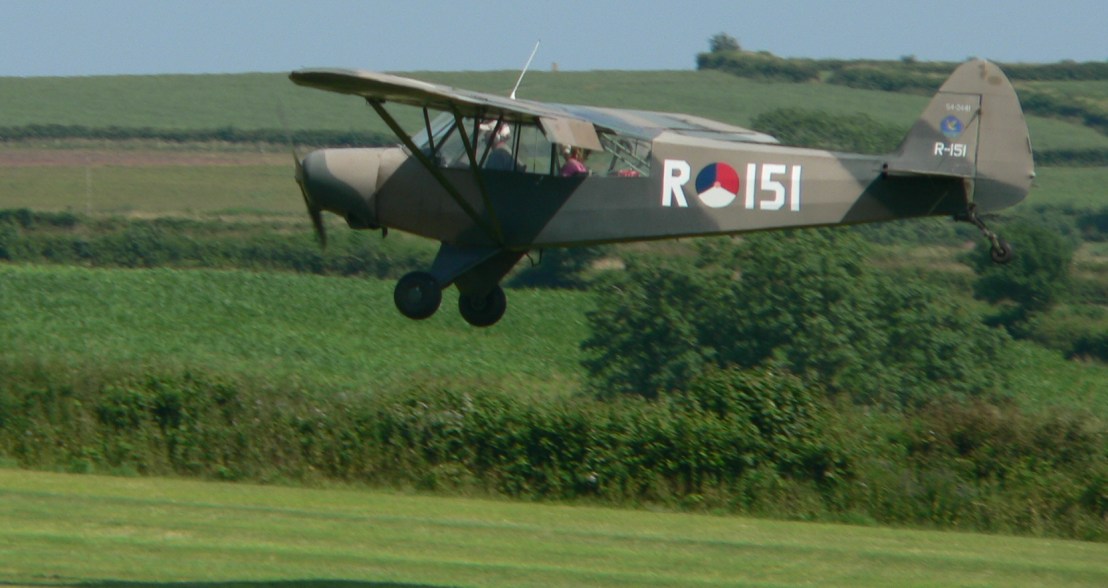
Approaching home airfield in South Devon, England
Piper Super Cub, L-21B, R-151
A/C Construction No. 18-3841, Frame No. 18-3843
Original Engine, Lycoming 135 Type 0-290-D2, 54/2441
R-151 was one of a batch of 298 L-21’s delivered in 1954. There were 584 L-21B’s produced by Piper for military use, the ‘L’ standing for Liaison. The L-21B’s were PA-18-135’s with civil Lycoming 0-290-D2 engines, glasswork as most L-21A’s and L-18’s and a gross weight of 1760 lbs.
This aircraft was delivered to Koninklijke Luchtmacht, Dutch Air Force, on the 1st July, 1954 and registered R-151. After various homes, R-151 transferred to the Dutch civil register as PH-GER, on the 1st April 1976 with 4,458 hours. Shortly thereafter the aircraft was registered to Vliegclub Hoogeveen, Certificate Number 2380. Amazingly, the club is still in existence as their website shows.
On the 27th March, 1981 the aircraft was delivered to the UK with a total time of 5,043 hours and in September, 1981 became G-BIYR. In April, 1983 G-BIYR was the first of type to be given a Public Transport CofA (Certificate of Airworthiness) and was used for training at Tollerton; Nottingham. G-BIYR reverted to a Private CofA in January, 1984 when purchased by Mike and Barbara Fairclough from Devon at 5,120 hours.
In 1992, the aircraft was re-engined with a Lycoming 150HP, 0320-A2B No. L49809-27A (zero hours). Finally on the 2nd June, 1995 the aircraft was repainted in original Dutch insignia and given CAA (UK Civil Aviation Authority) permission to use the original call-sign, Romeo 151.
The aircraft is based in South Devon, England and owned by the five members of the Delta Foxtrot Flying Group.
More pictures.
Flying in the French Alps, Mt Blanc in sight
oooo
9,300 ft up in the French Alps
oooo
This last photograph was taken shortly after Pharaoh decided to jump into the passenger’s seat. The year was 2006 when Pharaoh was 3 years old. As much as I was tempted, I resisted the urge of taxying him around the airfield!
If you are new to this series then Ruby’s story of last week will link you to all the dogs written about so far. Today, here is Jean’s account of how Casey became part of the family.
ooOOoo
Casey
Casey, at home; picture taken a month ago.
Every Friday, the Payson Roundup newspaper would devote a full page to the Humane Society, displaying some of the cats and dogs they had for adoption. I would read about each animal and quietly wish I could bring them all home.
I was particularly taken with one dog that had appeared several times in this Friday page. His name was Casey and he was a six-year-old Pit Bull mix. Unfortunately, at home (we were then living in Payson, AZ) we were ‘maxed out’ with a total of 14 dogs in three different sections of our house. We just couldn’t take Casey.
I had volunteered to be a dog-walker at the Humane Society dog shelter. But after two sessions walking dogs, I just couldn’t look at these sad little faces without breaking down in tears. I switched my efforts to working at the Society’s Thrift Store. That was great fun and, at least, it felt as though I was still helping the animals. Nonetheless, I was very impressed with the animal shelter. They did their utmost to re-home the animals in their care.
Ruby’s ‘pack’ here at home included Phoebe and Tess, rescue dogs from Mexico. Recently, Phoebe had died with leukaemia and Tess with bone cancer leaving Ruby on her own. Ruby was a dog that didn’t mix at all well with the other dogs, as was explained in last week’s post.
The next Friday, the Payson Roundup showed the Society’s ‘lonely hearts club’, highlighting animals that had been in care for a long time. The first dog shown was Casey. I telephone Chandra, the lady responsible for adoptions, and asked if Paul and I could bring Ruby to the shelter to find a companion for her. When we were at the shelter, Chandra asked us if we had anything against Pit Bulls. Of course we didn’t. Ruby was introduced to Casey and, as they say, the rest was history. Casey and Ruby right from the start were just wonderful together.
Ruby behind Casey.
Subsequently, I learned from Chandra that Casey had been in care for over a year and, had we not taken him home, his days were numbered at the shelter. There were many cheers and tears when I signed the adoption paper for Casey.
Casey now lives in the kitchen group here in Oregon: Paloma, Ruby, Lilly and Casey. As with all our dogs, Casey is so happy to have our 14 acres to play in. He is also the sweetest natured of dogs and will try to climb on to your lap at the first opportunity. I have always been a great advocate of Pit Bulls and Pit Bull mixes and have never come across a mean one.
Thus, if you are in the position to adopt a dog, please consider Pit Bulls and Pit Bull mixes for the Pit Bull is a much-maligned breed.
Thank you hugely for the response to last week’s first set of photographs sent to me from Australia by Amanda. So without further ado, here is the next set.
oooo
oooo
oooo
oooo
oooo
oooo
oooo
oooo
Come back in a week’s time for the final set of nine photographs on the theme of why we have pets.
Yesterday, I published a post and called it Dogs and wolves – fascinating research. Then blow me down in yesterday’s online BBC News, there was an article headlined: Dogs’ brain scans reveal vocal responses This is how it opened.
Dogs’ brain scans reveal vocal responses
By Rebecca Morelle, Science reporter, BBC World Service
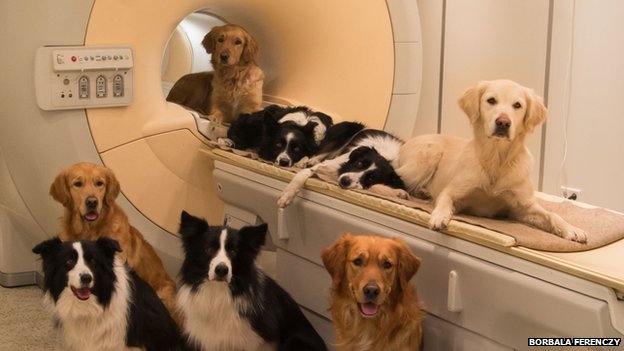
Pet dogs took part in the MRI scanning study.
Devoted dog owners often claim that their pets understand them. A new study suggests they could be right.
By placing dogs in an MRI scanner, researchers from Hungary found that the canine brain reacts to voices in the same way that the human brain does.
Emotionally charged sounds, such as crying or laughter, also prompted similar responses, perhaps explaining why dogs are attuned to human emotions.
Lead author Attila Andics, from the Hungarian Academy of Science’s Eotvos Lorand University in Budapest, said: “We think dogs and humans have a very similar mechanism to process emotional information.”
Eleven pet dogs took part in the study; training them took some time.
During the approximately 18–32 thousand years of domestication [1], dogs and humans have shared a similar social environment [2]. Dog and human vocalizations are thus familiar and relevant to both species [3], although they belong to evolutionarily distant taxa, as their lineages split approximately 90–100 million years ago [4]. In this first comparative neuroimaging study of a nonprimate and a primate species, we made use of this special combination of shared environment and evolutionary distance. We presented dogs and humans with the same set of vocal and nonvocal stimuli to search for functionally analogous voice-sensitive cortical regions. We demonstrate that voice areas exist in dogs and that they show a similar pattern to anterior temporal voice areas in humans. Our findings also reveal that sensitivity to vocal emotional valence cues engages similarly located nonprimary auditory regions in dogs and humans. Although parallel evolution cannot be excluded, our findings suggest that voice areas may have a more ancient evolutionary origin than previously known.
The canine brain reacted to voices in the same way that the human brain does.
“There were 12 sessions of preparatory training, then seven sessions in the scanner room, then these dogs were able to lie motionless for as long as eight minutes. Once they were trained, they were so happy, I wouldn’t have believed it if I didn’t see it.”
For comparison, the team looked at the brains of 22 human volunteers in the same MRI scanners.
The scientists played the people and pooches 200 different sounds, ranging from environmental noises, such as car sounds and whistles, to human sounds (but not words) and dog vocalisations.
The researchers found that a similar region – the temporal pole, which is the most anterior part of the temporal lobe – was activated when both the animals and people heard human voices.
“We do know there are voice areas in humans, areas that respond more strongly to human sounds that any other types of sounds,” Dr Andics explained.
“The location (of the activity) in the dog brain is very similar to where we found it in the human brain. The fact that we found these areas exist at all in the dog brain at all is a surprise – it is the first time we have seen this in a non-primate.”
Emotional sounds, such as crying and laughter also had a similar pattern of activity, with an area near the primary auditory cortex lighting up in dogs and humans.
Likewise, emotionally charged dog vocalisations – such as whimpering or angry barking – also caused a similar reaction in all volunteers,
Dr Andics said: “We know very well that dogs are very good at tuning into the feelings of their owners, and we know a good dog owner can detect emotional changes in his dog – but we now begin to understand why this can be.”
However, while the dogs responded to the human voice, their reactions were far stronger when it came to canine sounds.
They also seemed less able to distinguish between environmental sounds and vocal noises compared with humans.
About half of the whole auditory cortex lit up in dogs when listening to these noises, compared with 3% of the same area in humans.
Commenting on the research, Prof Sophie Scott, from the Institute of Cognitive Neuroscience at University College London, said: “Finding something like this in a primate brain isn’t too surprising – but it is quite something to demonstrate it in dogs.
“Dogs are a very interesting animal to look at – we have selected for a lot of traits in dogs that have made them very amenable to humans. Some studies have show they understand a lot of words and they understand intentionality – pointing.”
But she added: “It would be interesting to see the animal’s response to words rather than just sounds. When we cry and laugh, they are much more like animal calls and this might be causing this response.
For the full report, as it was posted on the BBC website, click here.
Plus, do watch this five-minute video abstract.
Published on Feb 20, 2014
The video presents the first study to compare brain function between humans and any non-primate animal. Scientists at MTA-ELTE Comparative Ethology Research Group in Hungary found that dogs and humans use similar neural mechanisms to process social information in voices. The fact that dogs can be trained to lie motionless during fMRI tests opens up the space for a new branch of comparative neuroscience.
The first study to compare brain function between humans and any non-primate animal shows that dogs have dedicated voice areas in their brains just as people do. Dog brains, like those of people, are also sensitive to acoustic cues of emotion, according to a study in the Cell Press journal Current Biology.
The findings suggest that voice areas evolved at least 100 million years ago, the age of the last common ancestor of humans and dogs, the researchers say. It also offers new insight into humans’ unique connection with our best friends in the animal kingdom, perhaps explaining how our two species have lived and worked together so effectively for tens of thousands of years.
“Our findings suggest that dogs and humans not only share a similar social environment, but they also use similar brain mechanisms to process social information,” said Atilla Andics of MTA-ELTE Comparative Ethology Research Group in Hungary. “This may help the successfulness of vocal communication between the two species.”
Andics and his colleagues trained eleven dogs to lay motionless in an fMRI brain scanner. That made it possible to run the very same neuroimaging experiment on dog and human participants — something that had never been done before. They captured both dogs’ and humans’ brain activities while they listened to dog and human sounds, ranging from whining or crying to playful barking or laughing.
The images show that dog and human brains include voice areas in similar locations. Not surprisingly, the voice area of dogs responds more strongly to other dogs, while that of humans responds more strongly to other humans. The researchers also noted striking similarities in the ways the dog and human brain processes emotionally loaded sounds. In both species, an area near the primary auditory cortex lit up more with happy sounds than unhappy ones. Andics said they were most struck by the common response to emotion across species.
There were some differences too: in dogs, 48 percent of all sound-sensitive brain regions respond more strongly to sounds other than voices. That’s in contrast to humans, in which only three percent of sound-sensitive brain regions show greater response to non-vocal versus vocal sounds.
The study is the first step to understanding how it is that dogs can be so remarkably good at tuning into the feelings of their human owners. “This method offers a totally new way of looking at neural processing in dogs,” Andics said. “At last we begin to understand how our best friend is looking at us and navigating in our social environment.”








 Learning from Dogs