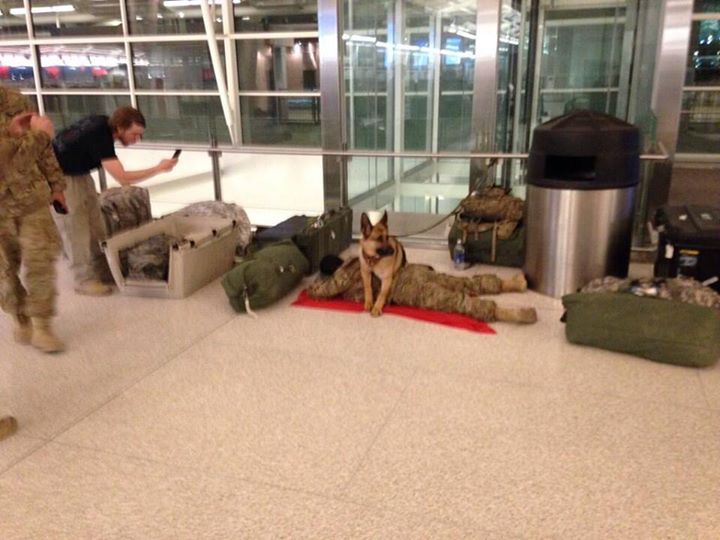
The following photograph was sent to me by Suzann who in turn received it from Joyce. Thanks to you both. Included with the photograph is the background to the picture.
Indianapolis International Airport
“One of our photographers returning to the Indianapolis International Airport took this photo of a soldier getting special guard duty from man’s best friend as she catches a nap in the terminal. About 10 soldiers and two dogs were in a group at the airport tonight. It wasn’t clear if they were coming home or heading out, but we thank them (and the dogs!) for their service!” – WTHR-TV
I’m going to skip the many comments that have been attached to the photograph, however smart and witty they are, and focus on the fundamental lesson that dogs, and many other creatures, offer mankind. It is this.
Our society only functions in a civilised manner when there is a predominance of trust about us. When we trust the socio-politico foundations of our society. When we trust the legal processes. When we trust that while greed and unfairness are never absent, they are kept well under control.
Having trust in the world around us is an intimate partner to having faith in our world.
At a time when inequality is making frequent headlines and Russia is sabre-rattling over Ukraine let us never lose sight of the primary importance of trust.
For without trust there can be no faith and without trust there can be no love.
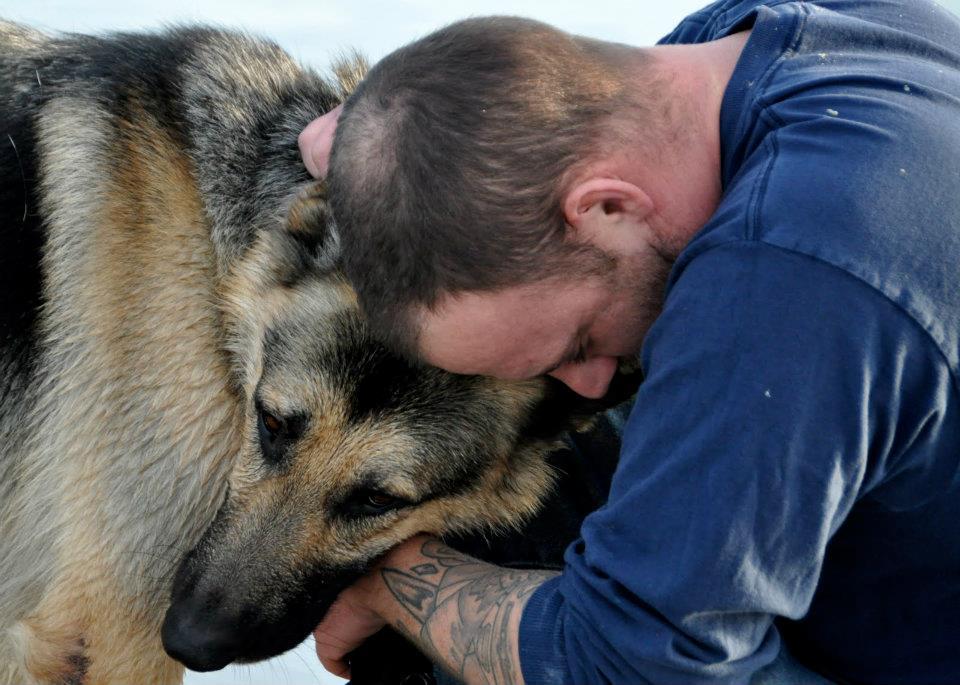
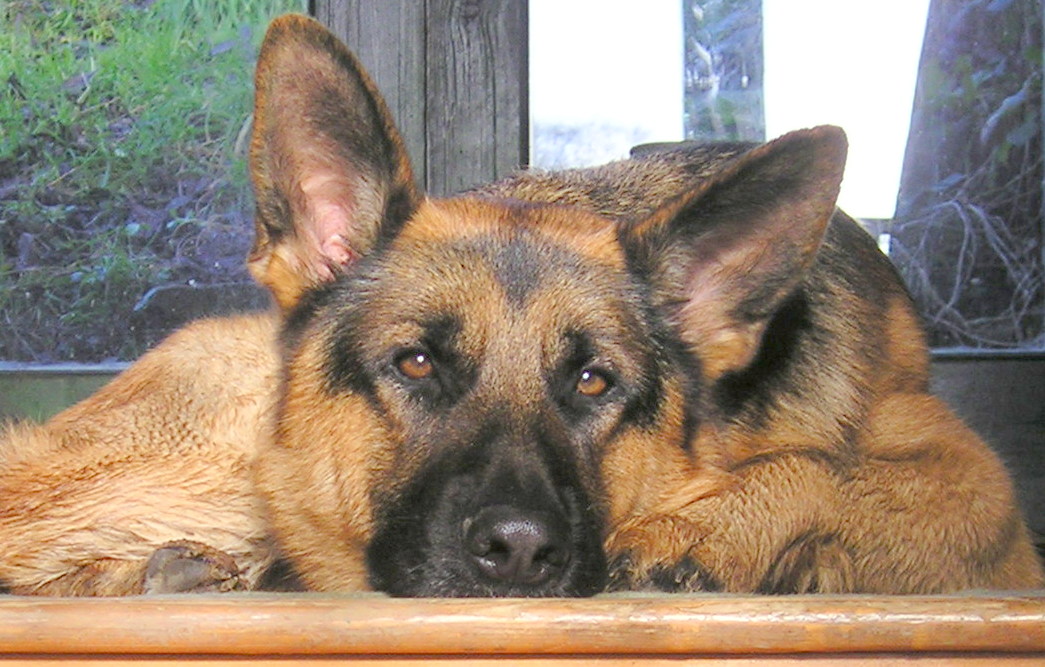
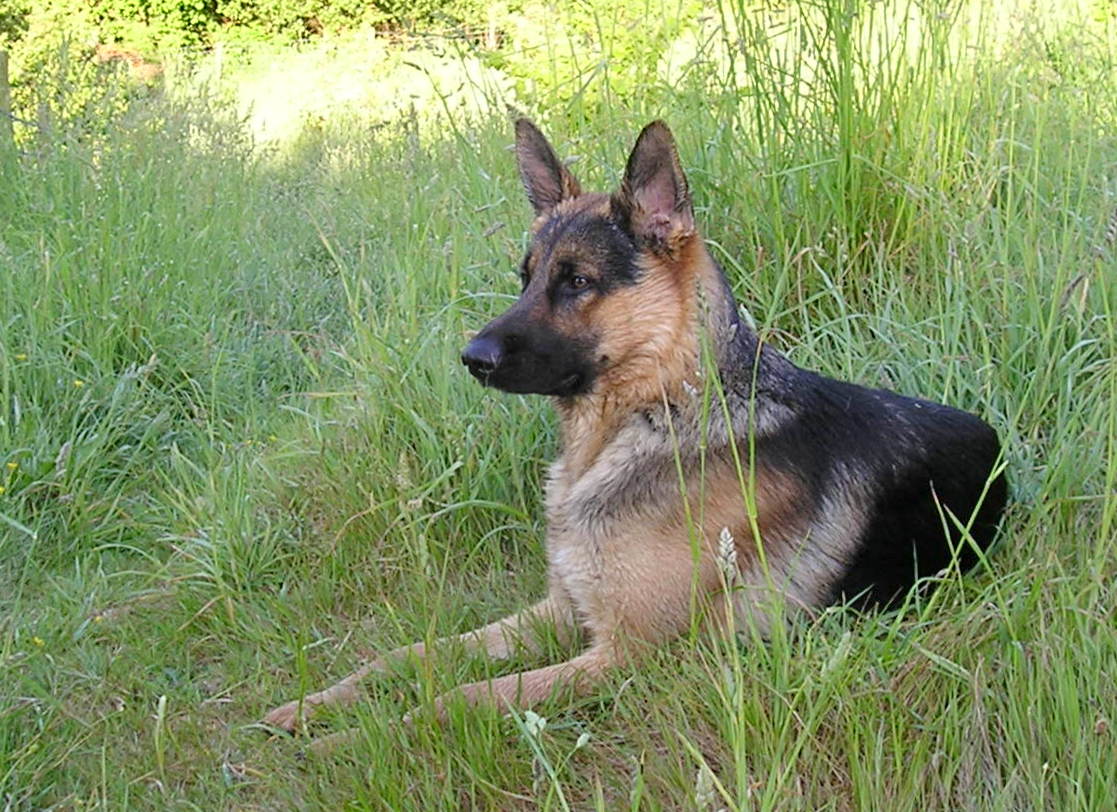
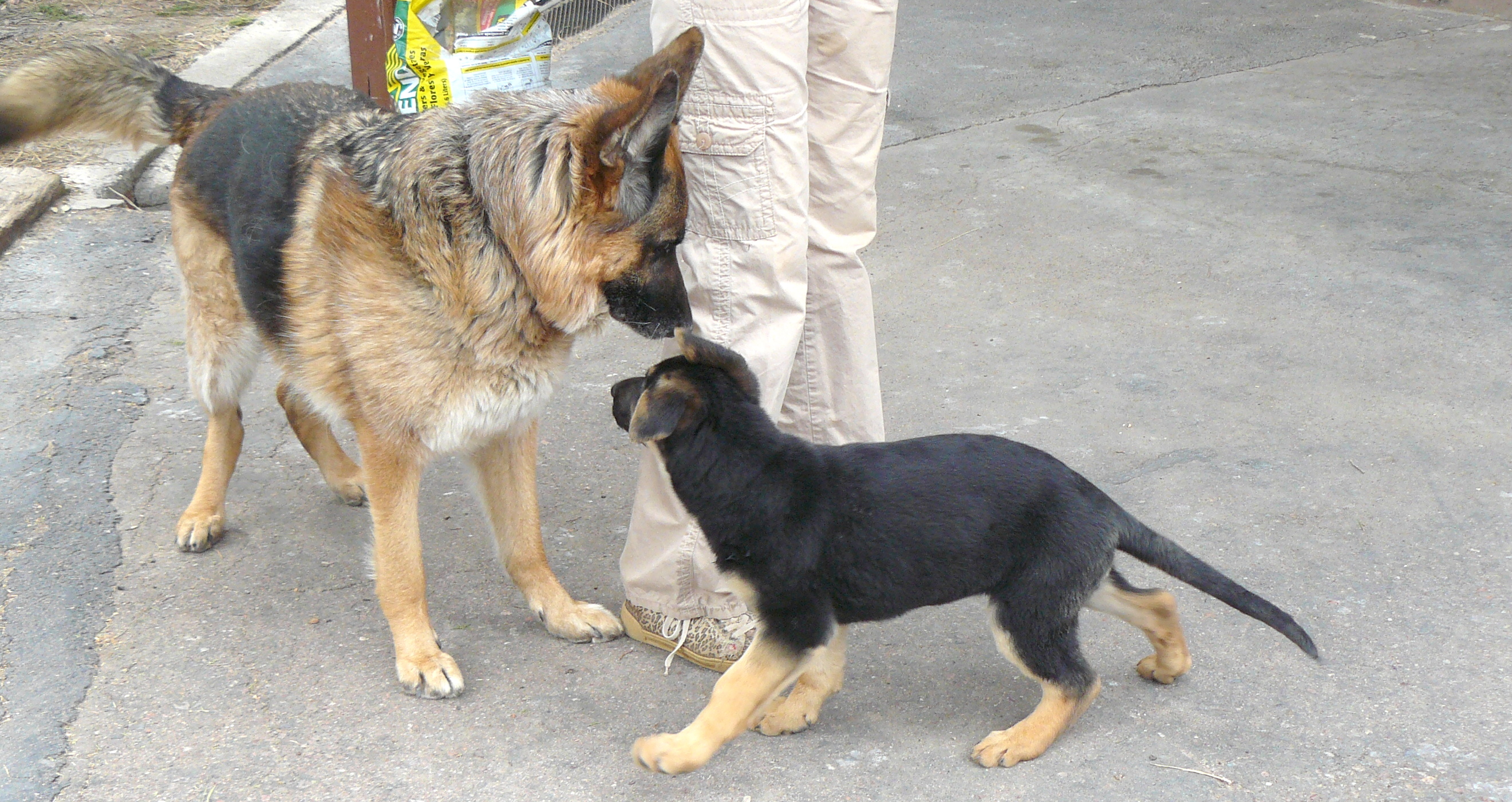
Here’s another photograph of the greatest ‘dog-teacher’ of them all; the German Shepherd dog.
Dhalia, as with so many other dogs, offered lasting lessons.
Inevitably, as Jean and I went around our ‘stuff’ yesterday after burying Dhalia in the morning, there were moments of quiet contemplation and gentle discussion. Interludes over a hot drink where we reflected on the special dog that she was.
Much has already been written in this place but there can’t be too many reminders for us quirky humans of how valuable are the qualities of trust and love given to us by our dogs.
We need reminding how dogs are so intuitive and can reach out to a stranger without a moment of hesitation. As Jean described when recalling how she first came across Dhalia.
Dhalia – domesticated but still the wild dog shows through.
It was a Sunday around the middle of the month of September in the year 2005. My friend, Gwen, and I had set off for La Manga, a small fishing village three miles from San Carlos, Mexico. As the trip would take us through areas of desolate desert and the day was forecast to be a sizzler, we left early. The purpose of the journey was to feed a pack of dogs that were living on the outskirts of La Manga. These wild dogs were gradually getting used to our presence and with the aid of a humane trap we had previously caught two of them, a small puppy and her mother. Those two dogs were at my home and were gradually becoming tame so that good homes could be found for them.
Half-way to our destination, we saw two dogs running by the side of the road. It wasn’t unusual to see strays searching for road-kill. I stopped the car and prepared food and water for them. One dog took off almost immediately but the other just stood perfectly still looking intently at me. She was rail-thin and full of mange. Her ears and chest were scabbed with blood, and I could see that previously she had had pups. Tentatively, I pushed the food towards her. She took a bite and sat on her haunches; her eyes never leaving mine. Then she lifted a paw and reached out to me. Immediately, I burst into tears and scooped her into my arms. I carried her back to the car where she lay quietly in my lap whilst we went on to do our feeding. She was bloody and very smelly. However, I didn’t care.
Dhalia was always a gentle dog. One that would mix with any of the other dogs. A dog that loved people, of all types and ages.
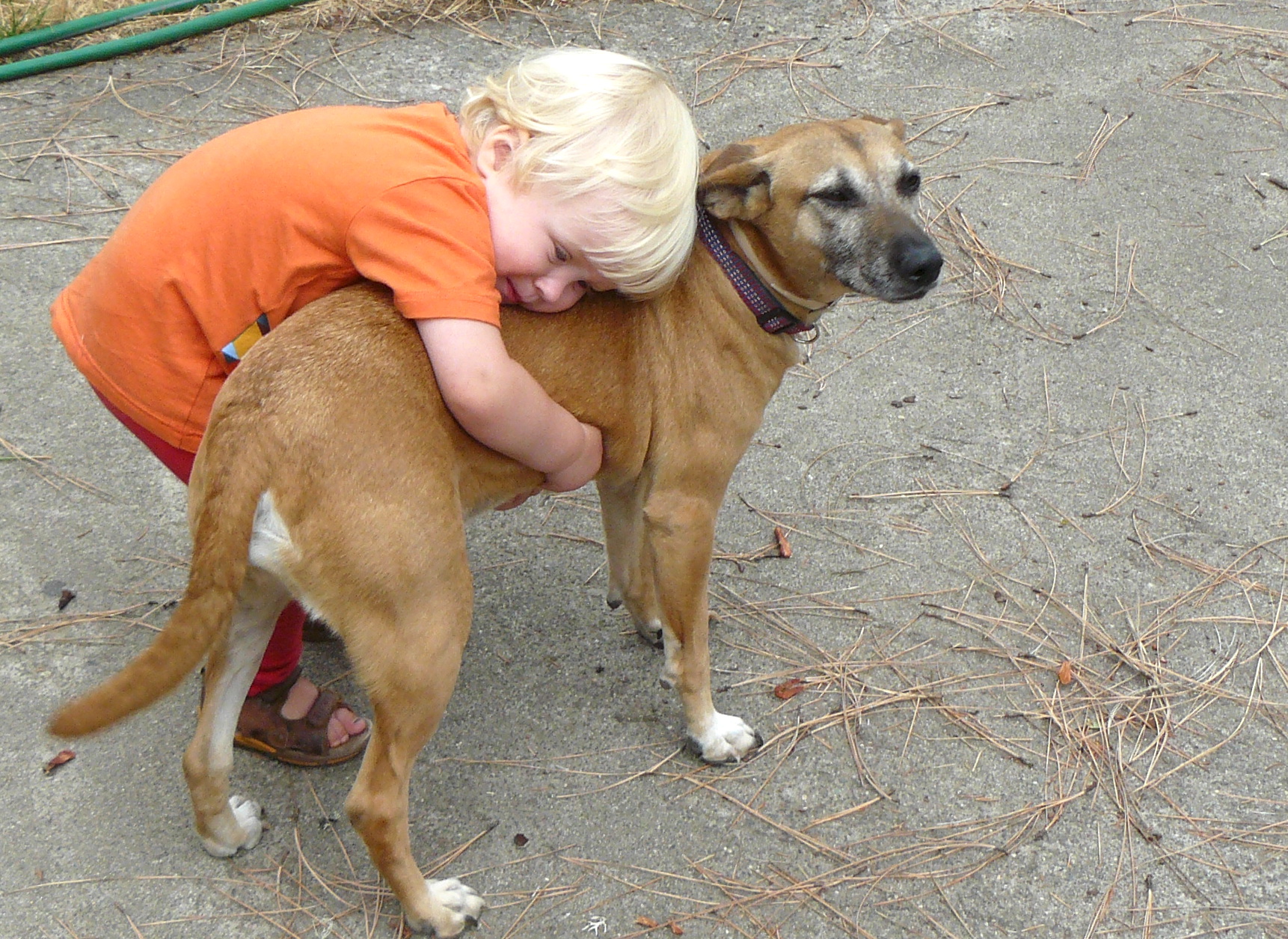
Love and Trust – Grandson Morten hugging Dhalia, September 2013.
It was Dhalia who inspired me to write a short story a couple of years ago: Messages from the Night.
So to the last couple of weeks. Back just a couple of weeks to when the vet’s assessment of Dhalia was that she had bone cancer that, in turn, inspired me to write the post Life, and mortality. So little time to say goodbye to Dhalia. (Dr. Codd’s assessment when we went to him with Dhalia yesterday morning was that the cancer must have been well-established for it to have metastasised so quickly; the normal interval between diagnosis of cancer and death would be six to eight weeks.)
That Dhalia reached out to the other dogs in our ‘bedroom’ pack was evident these past six or seven nights. For it has been in the last week that Dhalia was unable to go through the night without needing to pee.
The first night that this happened, I was awakened by Cleo coming to my side of the bed and running her head past my arm. It was 3am. Cleo repeated that for the next few nights and each time I was able to take Dhalia outside so she could relieve herself. Then as Dhalia’s internal organs started to fail it was Pharaoh who in the middle of the night uttered a couple of tiny barks; just sufficient to wake me and allow me and Jean to look after Dhalia’s needs.
When the bedroom door was opened to allow Dhalia to go through the house and, thence, to the front gardens, all the rest of the dogs remained still in the bedroom. They sensed the nature of what was going on.
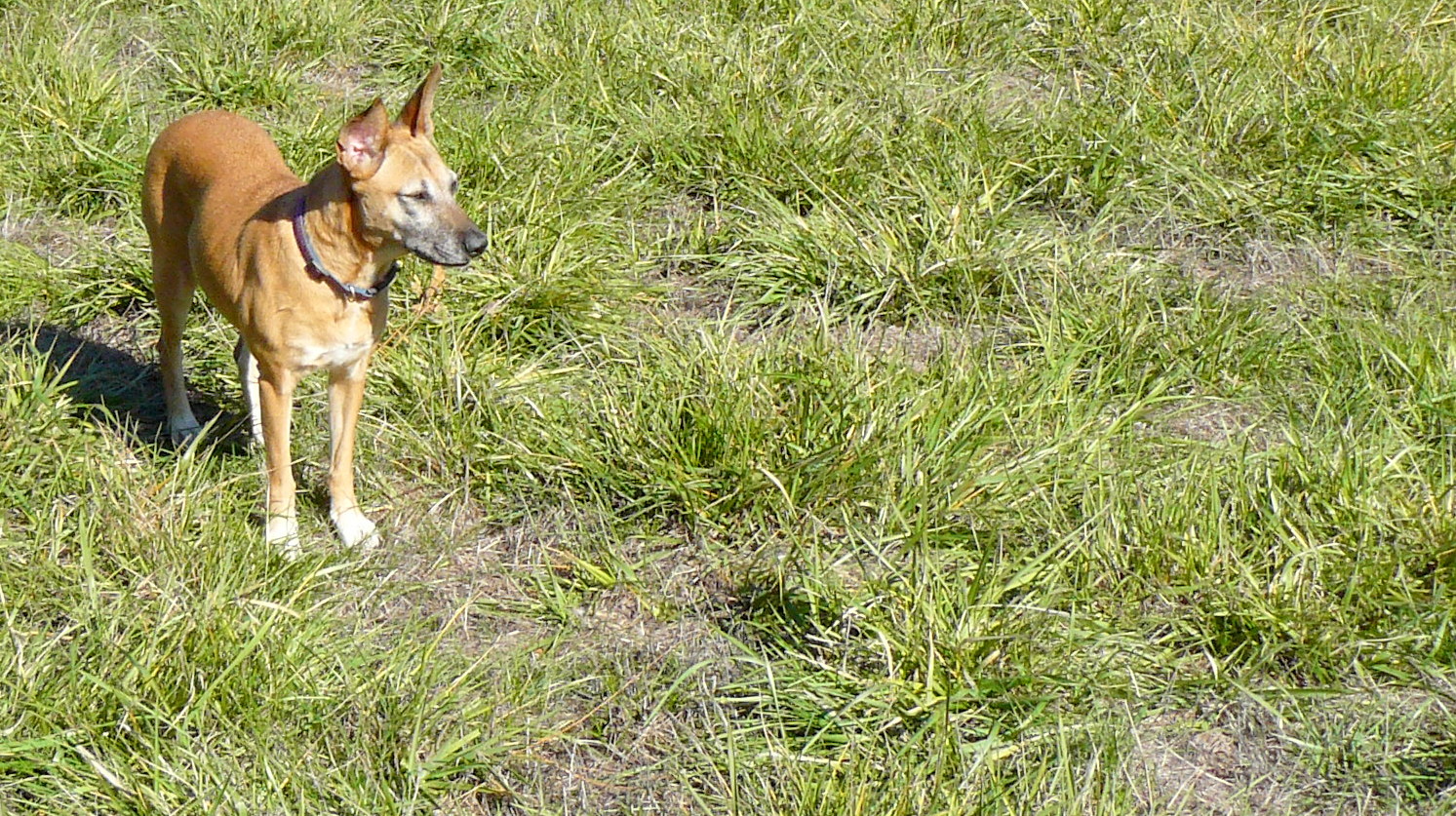
So to the last photograph. Taken last October here at home in Oregon showing Dhalia in typical independent spirits.
Dhalia was clearly close to death when Jean and I took her to our vet, Dr. Codd, earlier this morning.
Indeed, she was probably dead when Dr. Codd administered the euthanasia injection. It was 8:45 am.
While there is more I want to write about Dhalia, you’ll appreciate it if that is left for tomorrow’s post and I close this with a couple of photographs.
oooo
oooo
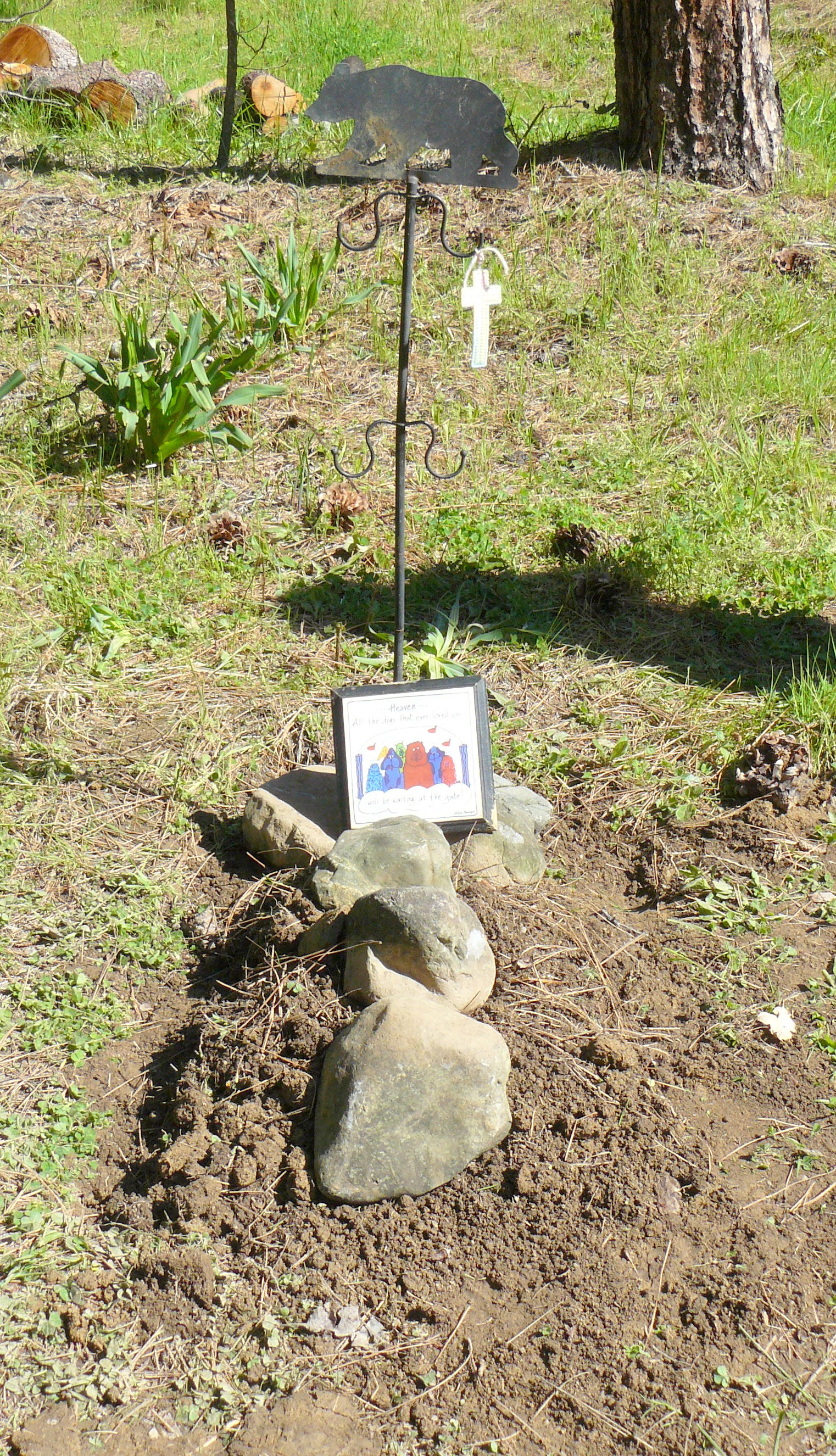
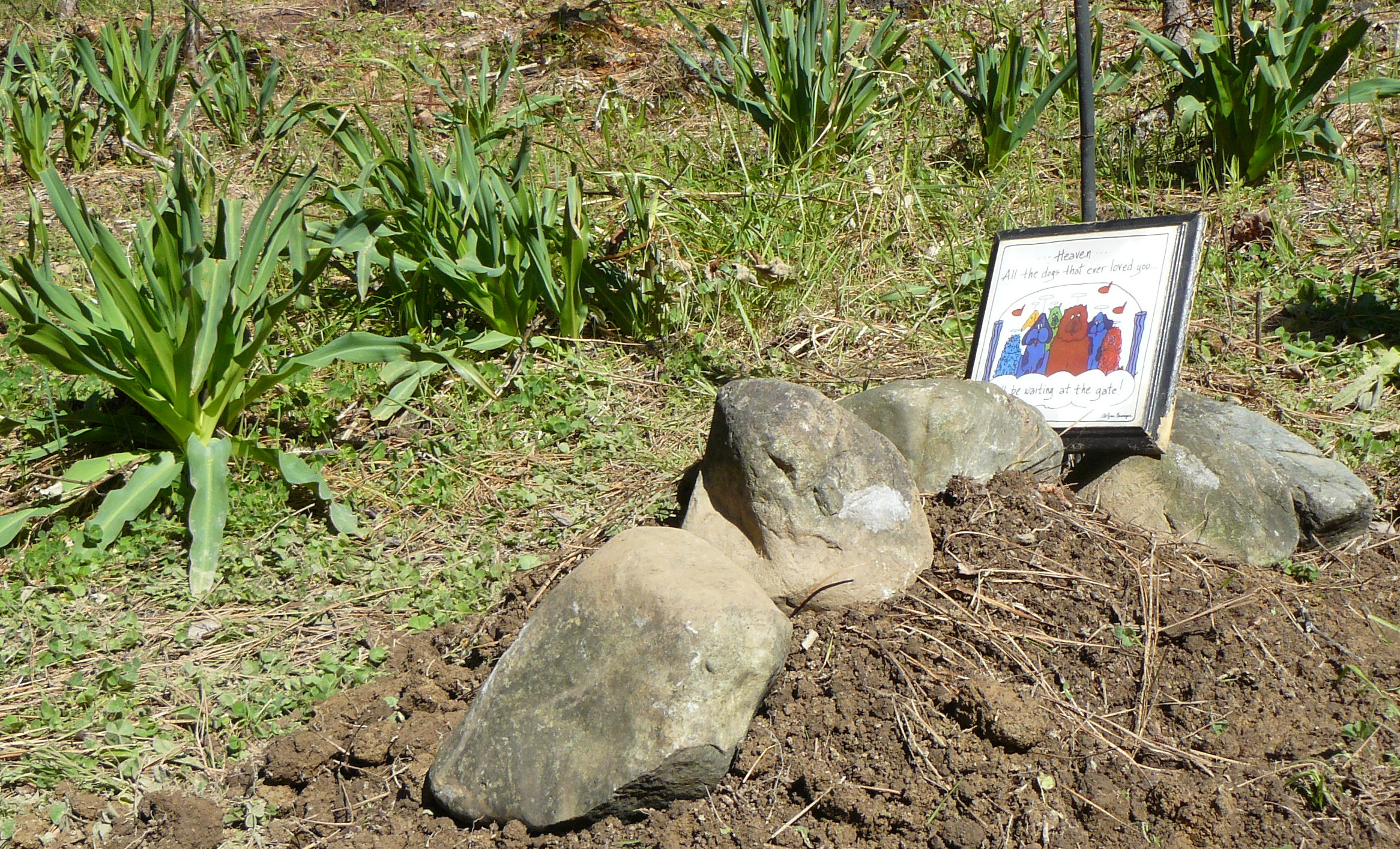
For those that can’t read the plaque it says, “Heaven. All the dogs that ever loved you will be waiting at the gate.“
It’s almost incomprehensible to realise that less than two weeks ago, the 27th March to be exact, I wrote a post under the title of Life, and mortality. These few paragraphs will give you a feel for that post:
Possibly the most important lesson we can learn from dogs!
I was aware when writing the concluding part of Meet the dogs – Pharaoh that the next day I would be faced with writing about a subject that is a whole degree more difficult. Death!
It must have been in my mind when I wrote “of the need to smell the flowers in this short life of ours.“
What has prompted today’s post?
Simply that Dhalia developed a limp in her front, right-hand, leg. That was a few weeks ago. Naturally, we took her to our local vet, Dr. Codd, who diagnosed a strained elbow joint probably as a result of arthritis; Dhalia is believed to be ten-years-old. With the recommended medication, the limp came to an end.
Then about two weeks ago, the elbow weakness appeared in her left-hand, front leg.
On Monday, we returned to Dr. Codd who took further X-rays and sought a second opinion. That second opinion came back with the probability that it was a “osteoproliferative neoplastic lesion” or bone cancer to you and me! It’s not one-hundred-per-cent certain but likely.
The reason it feels so painful is that today (Sunday) it’s very clear to Jean and me that Dhalia’s life forces are ebbing away and that tomorrow morning (i.e. your today, dear reader) we will be taking Dhalia back to Dr. Codd, undoubtedly for him to put her to sleep.
I had in mind writing this week a series of posts on Truth, Trust and Community. For obvious reasons those posts are on hold for a couple of days.
Please keep Dhalia in your thoughts.
Dhalia, just two weeks ago. She was already barely using her right front-leg.
Misa Minnie being promoted as the world’s smartest puppy.
After getting up at 3am to let Dhalia out for a pee and then waking to find that George had died, I wasn’t really in the mood for a deep and meaningful post for today.
So I have used an item emailed to me by our neighbours, Dordie and Bill, that seemed fun to share with you.
We’ve seen dogs doing tricks you wouldn’t believe — but we’ve never seen a dog look this cute while doing them.
Misa Minnie is a 1-year-old Yorkie pup who has been trained by her owner. At just 18 weeks old, she began performing a wide array of tricks and has now racked up more than 15,000 YouTube fans.
A video from last June resurfaced on Yahoo! this week showing Misa at 31 weeks mastering over two dozen commands.
Misa could easily get by on her looks alone — but with her talent, this little Yorkie really is the whole package.
But being careful about what our dogs eat is another story!
This is not the first time that I have used this title for a blog post. The previous time was almost eighteen months ago when I highlighted a fascinating talk about the green revolution by Raj Patel, the award-winning writer, activist, and academic.
However, today is a first in that it looks at what our dogs eat. It was inspired by a recent article by Brady Dennis in the Washington Post. Here’s how that article opened:
Mystery of pet deaths related to jerky treats made in China continues to stump FDA
By Brady Dennis, Published: March 28
Andy lost his appetite. Then came the vomiting, the unquenchable thirst, the constant need to urinate. Over several days last year, the spunky 4-year-old West Highland white terrier grew lethargic and lost more than 10 percent of his weight.
“It got bad,” said Andy’s owner, Alfredo Gude, a retiree in Cape Coral, Fla. “I knew that he was in trouble.”
Gude and his wife rushed Andy to their veterinarian, who referred him to a clinic 15 miles away. Doctors there sent a urine sample to a specialized metabolic lab at the University of Pennsylvania. Days later, test results confirmed the diagnosis: Fanconi syndrome, a rare, often fatal illness that affects the kidneys. The suspected cause: chicken jerky pet treats manufactured in China.
The incident is part of a troubling mystery lasting more than seven years, with reports of at least 600 dogs dying and thousands of others sickened. It has outraged unsuspecting pet owners, confounded the Food and Drug Administration and put the pet food industry’s manufacturing practices under a microscope.
A little later on in the article, Brady Dennis writes:
Bernadette Dunham, director of the FDA’s Center for Veterinary Medicine, has called it “one of the most elusive and mysterious outbreaks we’ve encountered,” a sentiment echoed by others at the agency.
“We are frustrated,” said Martine Hartogensis, who oversees the FDA’s ongoing investigation. “It’s been a long, winding, twisting road . . . [But] we haven’t given up.”
The FDA says it has tested more than 1,200 jerky treats in recent years, looking for salmonella, mold, pesticides, toxic metals, outlawed antibiotics, nephrotoxins and other contaminants. Federal officials have inspected factories in China that manufacture chicken jerky products for U.S. companies and sought input from academics, state and university research labs, foreign governments and the pet food industry. The agency even made its own jerky treats to try to duplicate the commercial process.
This is not some minor issue reinforced by the huge increase in dog food imports into the USA from China. Back to Brady:
The long-running investigation has paralleled a striking increase in the amount of pet food China exports to the United States. That volume increased from barely 1 million pounds in 2003 to an estimated 86 million pounds by 2011, according to the FDA.
Pet treats, including the jerky treats at the heart of the current investigation, have made up a fast-growing sliver of the pet food market. Part of the reason many U.S. companies have looked to China to produce chicken jerky treats, industry officials say, is that unlike in America, people in China overwhelmingly prefer dark meat. That leaves a larger supply of the white meat used in pet treats available for exporting.
Then a few paragraphs later, he adds:
“It’s maddening that it has gone on this long,” said Susan Thixton, who runs the Web site TruthAboutPetFood.com, which has repeatedly demanded that the agency do more. “If this were humans dying, and they couldn’t figure out a cause for seven years, members of Congress would be screaming at them.”
The home page of her site displays a clock tracking how long jerky treats from China have been killing and sickening pets. It asks: “When will FDA make this clock stop?” As of Friday, the count stood at 2,643 days.
“My job is to point out that they aren’t doing their job,” Thixton said. “I have a lot of respect for what they have to accomplish. They have huge responsibilities, but this is one of them.”
When I read out the article to Jean what then jumped ‘off the page’ was this paragraph [my emphasis]:
Angry pet owners also have heaped criticism on U.S. companies that continue to manufacture jerky treats with ingredients from China. The backlash includes everything from skepticism over the industry’s assurances that the treats have never posed health risks to lawsuits alleging harm.
As Susan Thixton was reported earlier: “If this were humans dying, and they couldn’t figure out a cause for seven years, members of Congress would be screaming at them.” Quite so!
Luckily, owners are responding as Brady highlights in these paragraphs:
Nina Leigh Krueger, head of the Waggin’ Train brand, said most retailers and customers have welcomed the treats back. “Thousands of consumers have been calling and asking us for Waggin’ Train treats to be back on the market,” she said.
Terry Safranek is not one of them.
“It’s a kick in the gut to see them back on the shelf,” said Safranek, whose 9-year-old fox terrier, Sampson, who had eaten jerky treats, died of kidney failure in 2012. Since then, Safranek has become a plaintiff in a class-action lawsuit against Nestlé Purina and retailers including Target and Wal-Mart. She helped create Animal Parents Against Pet Treats and Food Made in China, a group that has petitioned the FDA to do better in alerting people about the potential dangers of jerky treats produced in Chinese factories.
The link in the last paragraph takes the reader to the Facebook page for that group. Do go there and ‘Like’ the page.
I will close by recommending you read the Washington Post article in full and then spend some time perusing the website Truth about Pet Food. This is not just about ‘Made in America’ but fighting to ensure that animal treats made in the USA are also using ingredients from the USA!
Remember how Brady opened his article? With Alfredo Gude learning that their dog, Andy, had been diagnosed with Fanconi syndrome, a rare and often fatal illness that affects the kidneys of dogs.
Well last words left with Brady Dennis:
For now, on Florida’s west coast, Andy the terrier has returned to normal after months of treatments — about $3,500 worth — to restore his kidney function. “We feel very lucky,” said Gude, who has taken the advice of many vets around the country to steer clear of pet jerky treats altogether. “It could have gone another way.”
Our dogs (and cats) have a right to be fed to the same standards as us humans!
Almost two months ago, January 30th to be exact, the first of this ‘Meet the dogs‘ series was published. It came out of an idea from Jean and that January 30th post introduced Paloma to you, dear reader. Since then we have told you about Lilly, Dhalia, Ruby, Casey, Hazel, Sweeny, and Cleo.
So today’s post is the last of the Meet the dogs stories; it is about Pharaoh. I’m going to indulge myself and tell you the story of this most wonderful of dogs over today and tomorrow.
ooOOoo
Pharaoh
Photograph taken on the 12th August, 2003, the first day I saw Pharaoh.
This is Sandra Tucker, owner of Jutone Kennels in Devon, England, where Pharaoh was born on June 3rd, 2003. Here’s something written elsewhere that conveys my feelings that first day that I met this puppy.
oooo
In no time at all I was turning into the farm driveway, noticing the painted sign for Jutone & Felsental German Shepherds alongside the open, wooden gate.
I turned off the engine and was about to swing my legs out of the open driver’s door when I saw a woman coming towards me.
“Hi, you must be Paul, I’m Sandra. Did you have any trouble finding us?”
I shook hands with her.
“Not at all. I did as you recommended when we spoke on the phone and went in to the local store and got final directions.”
Sandra smiled, her glasses almost slipping off the end of her nose.
“Dear Beth. She’s been running that local store since God was a boy.”
She continued with a chortle in her voice, “Some say that Beth was at the store before our local pub, The Palk Arms, opened for business. And the pub’s been in the village for well over four-hundred years.” Sandra’s laugh was infectious and I caught myself already taking a liking to her. The sense of a strong, confident person struck me immediately. Indeed, a working woman evidenced by her brown slacks, revealing plenty of dog hairs, topped off with a blue T-shirt under an unbuttoned cotton blouse.
“Anyway, enough of me, Paul, you’ve come to get yourself a German Shepherd puppy.”
She turned towards a collection of grey, galvanised-sheeted barns and continued chatting as I fell into step alongside her.
“After we discussed your circumstances over the phone; where you live down there in Harberton, why you specifically wanted a German Shepherd dog, I thought about the last set of puppies that were born, just a few weeks ago.”
Sandra paused and turned towards me.
“While, of course, you can select whatever puppy you feel drawn to, my advice is to go for a male. Listening to your experiences of befriending a male German Shepherd when you were a young boy, I have no doubt that a male dog would result in you and the dog building a very strong bond. Indeed, I have a young male puppy that I want to bring out to you. Is that OK?”
Sandra turned and walked out of sight around the corner of the first barn leaving me standing there, my response presumably being taken for granted.
Something in her words struck me in a manner that I hadn’t anticipated; not in the slightest. That was her use of the word bond. I was suddenly aware of the tiniest emotional wobble inside me from Sandra’s use of that word. Somewhere deep inside me was the hint that my decision to have a dog in my life was being driven by deeper and more ancient feelings.
My introspection came to an immediate halt as Sandra re-appeared. She came up to me, a beige-black puppy cradled under her left arm, her left hand holding the pup across its mid-riff behind his front legs, her right arm across her waist supporting the rear of the tiny animal.
I stood very still, just aware of feelings that I couldn’t voice, could hardly even sense, as I looked down at this tiny black, furry face, outsized beige ears flopping down either side of his small head.
It was unusually warm this August day and I had previously unbuttoned my cuffs and folded the shirt sleeves of my blue-white, checked cotton shirt back above both elbows leaving my forearms bare.
Sandra offered me the young, fragile creature. As tenderly as I could, I took the pup into my arms and cradled the gorgeous animal against my chest. The pup’s warm body seemed to glow through its soft fur and as my bare arms embraced the flanks of this quiet, little dog I realised the magic, the pure magic, of the moment. Something was registering in me in ways utterly beyond words but, nonetheless, as real as a rainbow might be across the green, Devon hills.
“How old is he, Sandra?”
“This little lad was born on June 3rd. So what are we today? August 12th. So he is ten weeks old as of today.”
June 3rd, 2003. I knew that this date had now entered my life in just the same way as had the birth-dates of my son and daughter; Alex and Maija.
The power of this first meeting was beyond anything I had expected, or even imagined. I thought that it was going to be a fairly pleasant but, nonetheless, unsurprising process of choosing a puppy. How wrong could I have been! What was captivating me was the pure and simple bodily contact between this young dog and me. No more than that. I was sensing in some unspoken manner that this was equally as captivating for this precious puppy-dog. For even at the tender age of ten weeks, the tiny dog appeared to understand that me holding him so longingly was bridging a divide of many, many years.
Sandra motioned with her arm, pointing out a bench-seat a few yards away alongside a green, well-manicured, lawn.
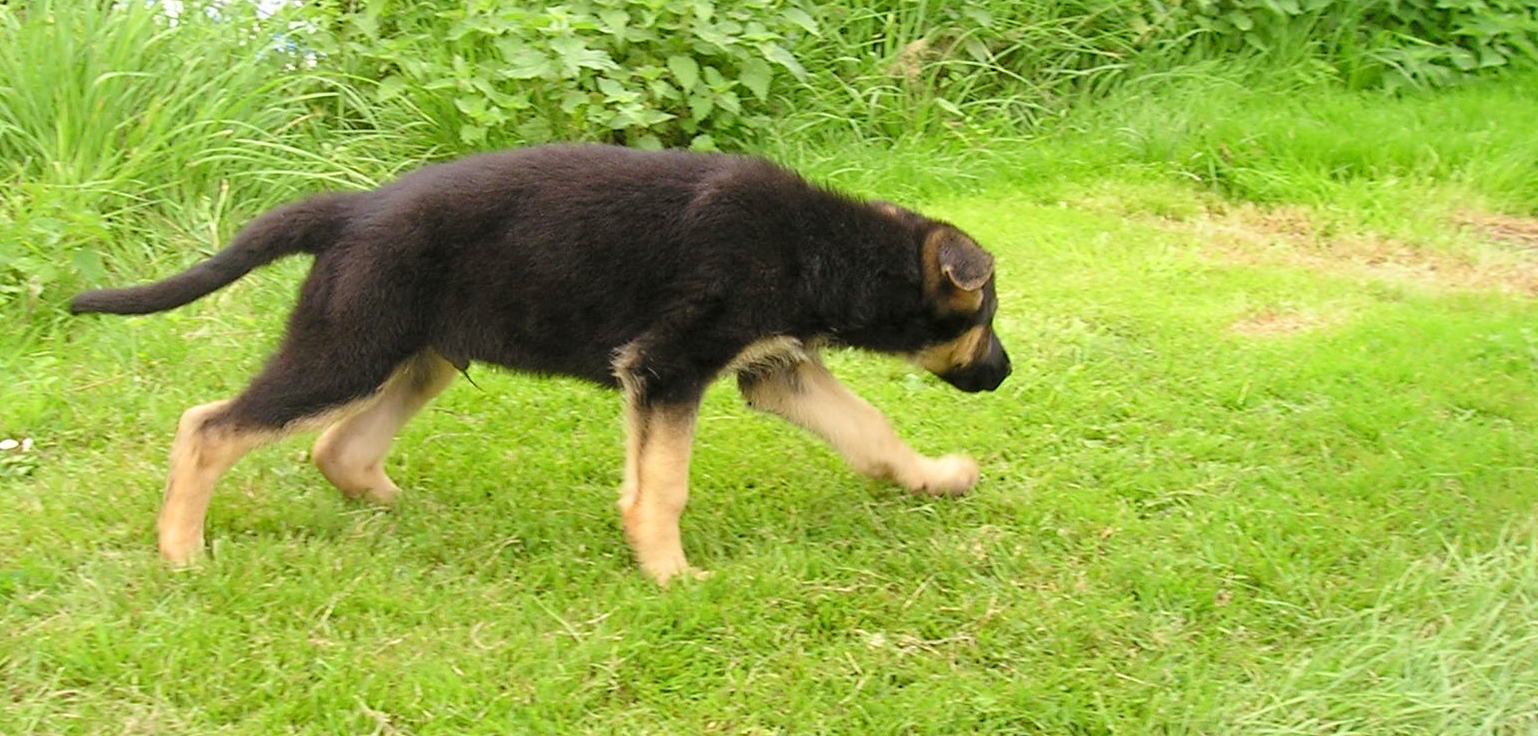
I very carefully sat down on the wooden-slatted bench and rested the beautiful animal in my lap. The puppy was adorable. Those large, over-sized ears flopping across the top of his golden black-brown furry head. His golden-brown fur morphing into black fur across his shoulders and then on down to the predominantly beige-cream colour of his soft, gangling, front legs. That creamy fur continuing along the little creature’s underbelly.
The puppy seemed almost to purr with contentment, its deep brown eyes gazing so very intently into mine. I was entranced. I was spellbound.
Never before had I felt so close to an animal. In a life-time of nearly sixty years including having cats at home when I was a young boy growing up in North-West London, and much later the family owning a pet cat when Alex and Maija were youngsters, I had never, ever sensed the stirrings of such a loving bond as I was sensing now. As this young puppy was clearly sensing as well. This was to be my dog. Of that I was in no doubt.
oooo
Early days at home in South Devon.
Let me leave you with a couple of other photographs taken from his early days.
Pharaoh, nine months old, taken in my Devon home in 2004.
oooo
First birthday: June 3rd 2004. Again, picture taken in Devon.
Never in my wildest dreams did I imagine that in the year 2014 I would be writing about Pharaoh from a home-office desk in Southern Oregon sharing a happy life with a wonderful London lady, Jean, and more gorgeous animals than one could throw a stick at.
More on that shared journey with Pharaoh tomorrow!
So today, I write about Cleo and then next week it will be the final ‘meet the dogs’, the dog that started this blog: Pharaoh.
ooOOoo
Cleo
Cleo between guests Darla and Cody- picture taken yesterday.
(Come back tomorrow to learn why Darla and Cody were with us yesterday!)
Where to start? I guess by going back to the days I was living in Devon, England. That means going back to 2003, the year when it seemed the right time for me to get a dog. There was always only one breed to be considered; the German Shepherd dog. Thus that desire for a German Shepherd led me to Sandra Tucker not too many miles away who owned the GSD breeders Jutone. It was at Jutone’s where I saw the wonderful puppy dog who became my Pharaoh.
But Sandra did better than breed the dog that has meant more to me than words can ever describe, she gave me some fantastic advice. That being that when Pharaoh was getting on in life, then bring in a German Shepherd puppy. There were two solid reasons why this made sense. The first was that Pharaoh would teach the new puppy many of the skills and disciplines that Pharaoh had learnt as a young dog and, secondly, the puppy would keep Pharaoh active.
That puppy was Cleo.
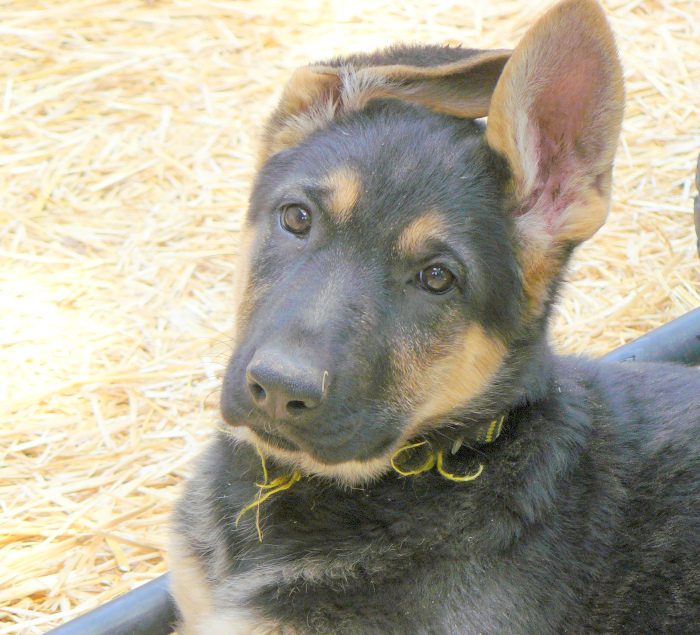
First picture of what was to be our puppy – 4th April, 2012, just two days before we brought her home.
oooo
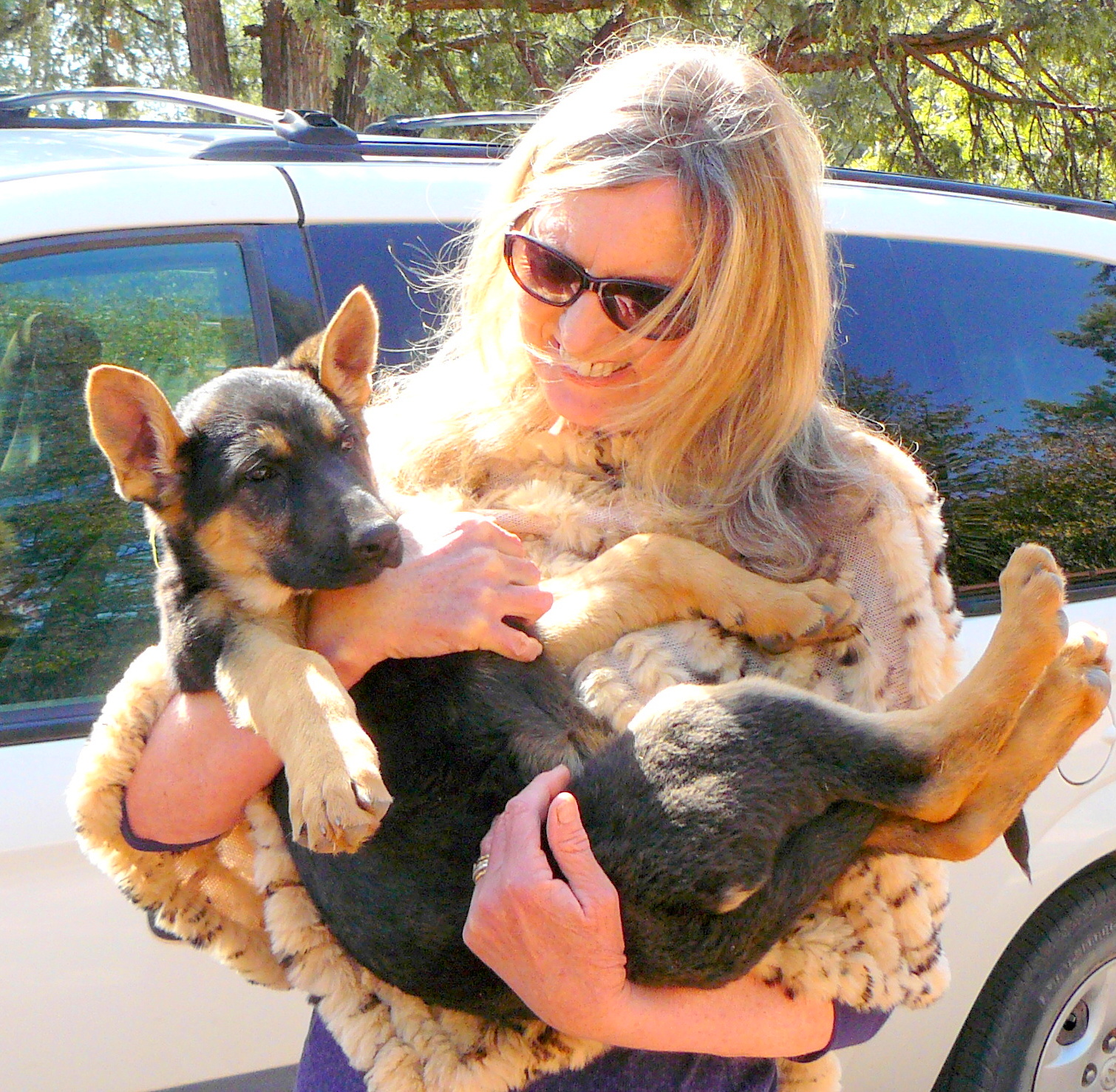
Puppy Cleo coming home – April 6th, 2012
Cleo was born on the 23rd January, 2012. At that time we were still living down in Payson, Arizona. Right from the start she was, and still is, the most joyful, loving dog one could imagine. That top photograph shows in her eyes the openness of her heart and soul.
First meeting between Pharaoh and Cleo; April 7th, 2012.
So here we are coming rapidly up to the two-year anniversary of when Cleo entered our lives.
Cleo continues to be the most loving, gentle, sweet German Shepherd. As Sandra so correctly predicted, Pharaoh has ‘taught’ Cleo a number of commands such as Sit, Stay, Lie Down, Come, and more. Not a minute’s training of Cleo has come from Jean and me. Cleo is very fond of Pharaoh and it’s obvious that Pharaoh gets a huge amount from having Cleo around him.
Tried to find more background information but the best I could do was from here:
This is Sqwark the Australian Magpie, and Whiskey and the dog and they are the best of friends! Sqwark is Whiskey’s friend, not a chew toy. It may look rough, but they are just playing like they do all the time and having fun.
In addition, there was a comment on the YouTube page:
The “grey back” is an indication that it’s a juvenile. When it’s an adult, the grey bit will be snowy white.
Wherever you are in the world, have a peaceful and fun-loving day!