I wasn’t planning to publish a post for today. But then a recent post from Patrice Ayme spurred me to so do.
Let me explain.
Our nearest town, Grants Pass, has the wonderful Rogue River flowing through it and alongside it there is Riverside Park. To quote:
Riverside Park in Grants Pass was set aside by our founders for the enjoyment of our citizens and guests.
People come from all over to Riverside Park to watch the majestic Rogue River as it courses its’ way through our city.
As you can see it is a popular place for ducks and geese.
Last Tuesday, we had a contractor completing some new guttering for the house. Terry, the owner of TC Gutters, ran out of the coated aluminium he was folding into the correct shape using a rather cute machine!
Terry apologised and said that he would need to run back into Grants Pass to pick up some more of the sheeting.
He returned a little later and I went over to chit-chat with him.
He was unexpectedly downcast.
“Terry, is there a problem?”
“Paul, when I was in town, down at the bottom of 6th Street near the bridge, there was a flock of ducks crossing the road.”
Terry paused for quite a while; I stood there next to him with not a clue as to what was coming.
He sighed, and continued: “Instinctively, I slowed down along with a number of other drivers. But what really upset me was the fact that a few drivers were clearly gleefully driving into the ducks and killing them!”
It hurt me to hear that; very much so!
Is it too strong for me to regard those drivers who thought it great fun to drive into those ducks as being evil?
I haven’t had the time yet to contact them to see if they can provide material of general interest to you.
But I did find the following video on YouTube that seemed to be interesting. (But note that I have no knowledge good or bad about the company and there are many other companies offering aversion training.)
Those poor souls who keep on calling in to this place will most likely be aware of my very long-term friend Dan Gomez.
For all of the nearly forty years that I have know Dan he has always had a dog in his life.
Just a few days ago, Dan sent me an email with some pictures of Lexi, a young dog that he has had since she was a puppy.
Lexi! (Photograph taken at the Sante Fe ski basin.)
Or in Dan’s words:
Lexi has been a magnificent example of an adventurous Flat-Coated Retriever.
She’s a wonderful hiker, swimmer, hunter and a great greeter on the trail. She’s happiest when she has her leash clenched in her teeth, parading around from person to person before continuing on her way.
What a great breed these dogs are!
Lexi came from the Brazilian breeder Keli: “Keli is the breeder, a fantastic Brazilian living in a wonderful estate in the hills of San Jose.“; to use Dan’s words.
Apparently, Keli plans for pups that year were taken out of her hands. For the reason that Lexi’s parents, Schmee and Party, decided to creep off into the bushes one day, and:
Schmee and Party are the popular names for the sire and dam and they were free from the kennel one day when Keli was off on a trip and they mated. So, the pups were “accidents”. But, most assuredly, great accidents!
While this repeat of our G litter was not planned … We welcomed these ten pups with open arms after seeing the success of the 3 intact G puppies and the stories from owners of other G pups who just adore their dogs. Not surprising at all, based on Schmee and Party being complete mushballs who just want to hold on to you, be with you and be loved by you. This litter has surprised and delighted us already with three pointed puppies … Juice, Callie & Popper in their first year of showing. I cannot wait to see what 2017 holds for them.
She will be three in October and her health and performance has been great. She had Rattlesnake aversion training last year in Palm Springs and did very well. She ran a gauntlet of four snakes to learn sound, site and smell.
She’s had two rattler encounters. On one hike, she encountered a rattler, approached it but stopped on a dime when it rattled loudly. I was someway behind, heard the rattle and whistled to her and she backed away, came immediately to me.
Nature vs. training worked perfectly.
We are still hiking two times daily between 3 and 7 miles total all over the West. Addicted.
Schmee and Party were a great “accident”!
Garden of Gods, Colorado
oooo
Sheridan, Wyoming.
Again and again, our lives are so incredibly enriched by having a dog (or six) in our lives!
The fourth selection of these wonderful photographs and the story behind each one.
ooOOoo
Second Place, Portrait
‘Waiting Beauty’ featuring Thalia, a Nova Scotia Duck Tolling Retriever. (Photo: Katarzyna Siminiak)
“This photo was taken during session around Old Market Square in Poznań. I’m still amazed how Thalia was calm and focus despite the city noise,” said Katarzyna Siminiak.
Second Place, Puppies
‘Sticking Together’ featuring Beagle mix puppies. (Photo: Charlie Nunn)
“Since early last year, my partner Raymond Janis and I have had the honour of supporting the Vanderpump Dogs Foundation in Los Angeles by photographing their adoptable dogs. In July 2017, we met these adorable beagle mix puppies,” said Charlie Nunn. “As Raymond tried to wrangle them, something magical happened and I was able to capture a perfect moment of a puppy family sticking together.”
Second Place, Rescue Dogs and Dog Charities
‘Happy Girl Rescued’ featuring Magda, a rescue dog cross breed (Hungarian Vizsla and Labrador Retriever). (Photo: Leslie Plesser)
“This particular image is of my own rescue dog, Magda. She was a bit hesitant and shy when my husband and I came home with our baby, but when the baby went off to nursery school, she would curl up on his rocking chair and roll her fur all over, settling in for a nice nap,” said Leslie Plesser.
Second Place, Young Pup Photographer
‘Dinner?’ featuring Dallas, a Whippet. (Photo: Sienna Millward)
“My name is Sienna Wemyss, I’m 10 years old and I’m from England, UK. When I grow up, I want to be a fashion photographer and designer. I have loved dogs since I first encountered one! There are so many different kinds of dogs and they are all so unique,” said Wemyss. “My dream came true in January this year when I became the proud owner of Dallas, a pedigree Whippet puppy. I was overjoyed!”
“I was relaxing on the sofa one day when Dallas crawled beside me. I put my arms out, expecting him to come and cuddle me. Instead, he gazed at the kitchen dreamily! If he could speak then, I bet he would have said, ‘Dinner?’ He looked very curious, so I grabbed my mum’s phone and captured the moment.”
Third Place, Assistance Dogs and Dog Charities
‘A Veterans Best Friend’ featuring Delta, a White Swiss Shepherd. (Photo: Craig Turner-Bullock)
“I am an ambassador for the Kotuku Foundation for Assistance Animals Aotearoa, who source, train and place dogs with people who have any diagnosed condition that dogs are known to be capable of assisting with. This includes diabetes, head injuries, depression and PTSI and many more,” said Craig Turner-Bullock. “Dion is a veteran who fought, and was injured, at the battle of Baghak in 2012. He experienced PTSI and says that ever since Delta came into his life she has made a huge difference. Dogs assisting veterans are now common around the world, but Delta is the first of her kind here in New Zealand.”
Third Place, Dogs at Play
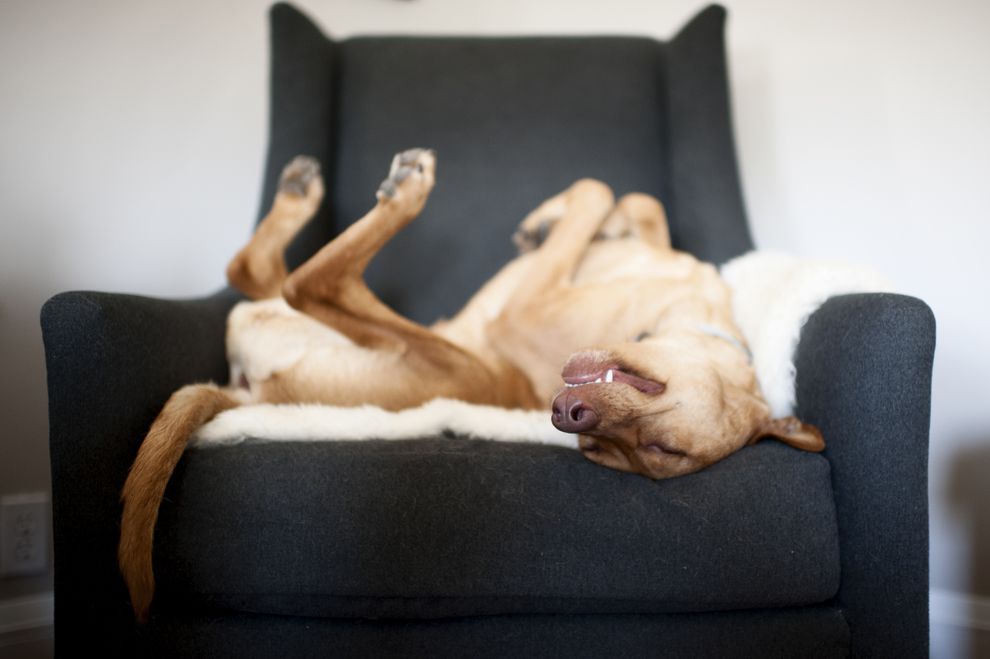
‘Snowy Shenanigans’ featuring Daffy, Taz, and Wile E., Nova Scotia Duck Tolling Retrievers. (Photo: Sarah Beeson)
“We had just moved from one of the snowiest cities (Erie, PA) to the middle of nowhere USA (yes, I love you dear Indiana). I didn’t expect much snow, but come on! It was nearly mid-February and not a flake! My boys were used to lots of snow having lived in Erie but Daffy hadn’t a clue,” said Sarah Beeson. “And then, it happened: Old man winter arrived. Shame on him, while I was at work, no less! By the time 5 pm rolled around, I was in our backyard – Frisbee soaring and camera in hand. Meet Daffy, Taz, and Wile E. We LOVE frisbee!”
Third Place, Dogs at Work
‘I’ve got your back’ featuring Nyx, a German Shepherd Dog. (Photo: Ian Squire)
“For me, the title sums up the image perfectly from both sides. This is a young trainee Police Dog undergoing some initial training. Taken on a miserable, damp day, it shows elements of the bond, trust and relationship that is vital for the partnership between Police Dog and handler,” said Ian Squire.
ooOOoo
Just one more Sunday’s worth to come. Don’t know about you but I shall miss these. They are going to be a hard act to follow!
Back in April, Mother Nature Networkcarried a wonderful item about the amazing fractals that can be found in nature.
Nothing to do with dogs but all to do with loving and caring for our planet!
I am not going to republish the full article with all the wonderful photographs so if the following piques your curiosity then go here to read the full piece.
ooOOoo
14 amazing fractals found in nature
Take a tour through the magical world of natural fractals and discover the joy of simple complexity.
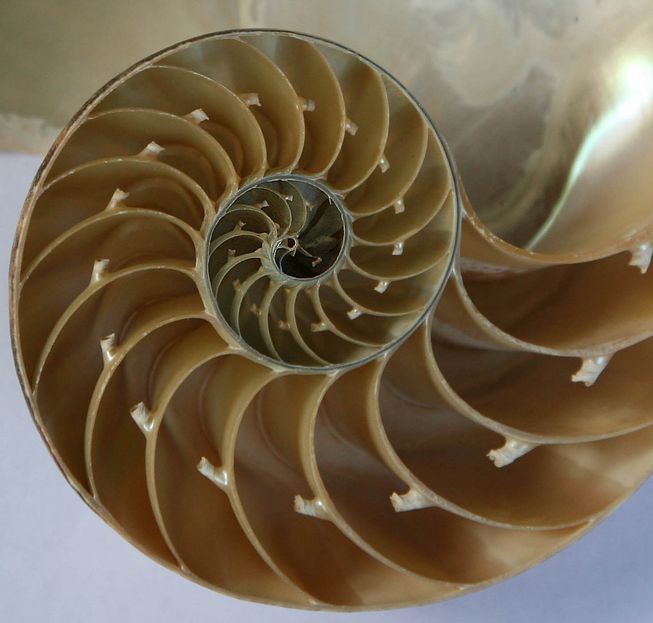
A chambered nautilus shell is an example of a fractal found in nature. (Photo: Jitze Couperus/flickr)
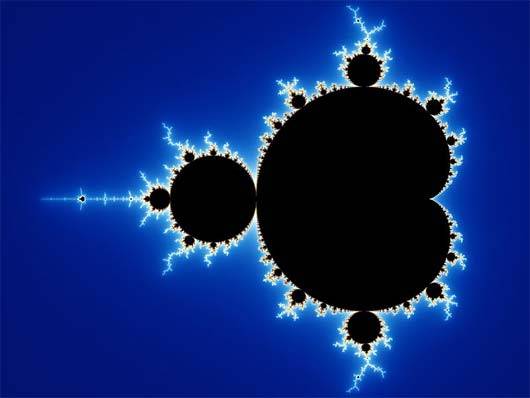
When you think of fractals, you might think of Grateful Dead posters and T-shirts, all pulsating with rainbow colors and swirling similarity. Fractals, first named by mathematician Benoit Mandelbrot in 1975, are special mathematical sets of numbers that display similarity through the full range of scale — i.e., they look the same no matter how big or how small they are. Another characteristic of fractals is that they exhibit great complexity driven by simplicity — some of the most complicated and beautiful fractals can be created with an equation populated with just a handful of terms. (More on that later.)
(Photo: Wikimedia Commons)
One of the things that attracted me to fractals is their ubiquity in nature. The laws that govern the creation of fractals seem to be found throughout the natural world. Pineapples grow according to fractal laws and ice crystals form in fractal shapes, the same ones that show up in river deltas and the veins of your body. It’s often been said that Mother Nature is a hell of a good designer, and fractals can be thought of as the design principles she follows when putting things together. Fractals are hyper-efficient and allow plants to maximize their exposure to sunlight and cardiovascular systems to most efficiently transport oxygen to all parts of the body. Fractals are beautiful wherever they pop up, so there’s plenty of examples to share.
This was received yesterday afternoon regarding G and C Raw Dog and Cat Food Recall
ooOOoo
G and C Raw Dog and Cat Food Recall
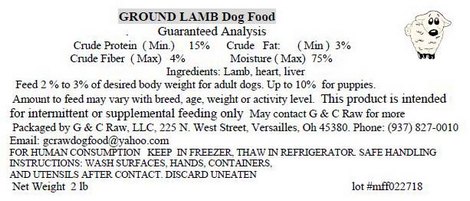
August 3, 2018 — G & C Raw of Versailles, OH is recalling 30 1–pound containers of Pat’s Cat Turkey Cat Food and 40 2-pound containers of Ground Lamb Dog Food because they have the potential to be contaminated with Listeria monocytogenes.
About Listeria Infections
Listeria monocytogenes can cause serious and sometimes fatal infections in animals eating the products.
Furthermore, there is risk to humans from handling contaminated pet products, especially if they have not thoroughly washed their hands after having contact with the products or any surfaces exposed to these products.
Healthy people infected with Listeria monocytogenes should monitor themselves for some or all of the following symptoms: nausea, vomiting, aches, fever, and diarrhea.
Listeria monocytogenes infections can also spread through the bloodstream to the nervous system (including the brain), resulting in meningitis and other potentially fatal problems.
Pregnant women are especially susceptible to Listeria infection, which can result in abortion.
The young, the elderly, and people with weakened immune systems also are more vulnerable.
Consumers exhibiting these signs after having contact with this product should contact their healthcare providers.
Pets with Listeria monocytogenes infections are rare, and pets may display symptoms such as mild to severe diarrhea, anorexia, fever, nervous, muscular and respiratory signs, abortion, depression, shock, and death.
In addition to the possibility of becoming sick, such infected animals can shed Listeria monocytogenes through their feces onto their coats and into the home environment and thus serve as sources of infection to humans and other animals in the household.
If your pet has consumed the recalled product and has these symptoms, please contact your veterinarian.
Where Was the Product Sold?
Pat’s Cat Turkey and Ground Lamb Dog Food products were distributed in OH, MI, IN, PAN, KY, NC, and GA.
They were also distributed by direct delivery by G & C Raw, LLC.
What’s Being Recalled?
The Pat’s Cat Turkey is sold in 1-pound clear plastic containers with the Lot number WWPKTF051618.
The Ground Lamb product is sold in a 2-pound plastic container with the Lot number MFF022718.
The Lot number codes are listed on the bottom right corner of the label.
No illnesses have been reported to date.
About the Recall
The recall was as the result of a routine sampling program by the Ohio Department of Agriculture which revealed that the finished products contained the bacteria
The company has ceased the production and distribution of the product as the company continues its investigation as to what caused the problem.
What to Do?
Consumers who have purchased Pat’s Cat Turkey Cat Food with the lot number, WWPKTF051618, OR Ground Lamb Dog Food with the lot number MFF022718 are urged to return it to G & C Raw, 225 N. West Street, Versailles, OH, for a full refund.
Consumers with questions may contact: G & C Raw, LLC at 937-827-0010 ET, or by email at gcrawdogfood@yahoo.com.
U.S. citizens can report complaints about FDA-regulated pet food products by calling the consumer complaint coordinator in your area.
From Lassie to Balto, pop culture loves stories of a dog coming to a person’s rescue. Anecdotally, people experience their dogs coming to their aid every day, like when one of us found herself “trapped” by her children under a pile of pillows only to be “rescued” by her noble collie, Athos.
But is there any scientific evidence behind these sorts of tales?
We recruited 34 pet dogs and therapy dogs – that is, those who visit people in hospitals and nursing homes – to take part in our study. Dogs included a variety of breeds and ages, from an elderly golden retriever therapy dog to an adolescent spaniel mix.
When they got to the lab, each owner filled out a survey about the dog’s training and behaviors while we attached a heart rate monitor to the dog’s chest to measure its stress responses.
In the experimental setup, dogs could see and hear their owners.
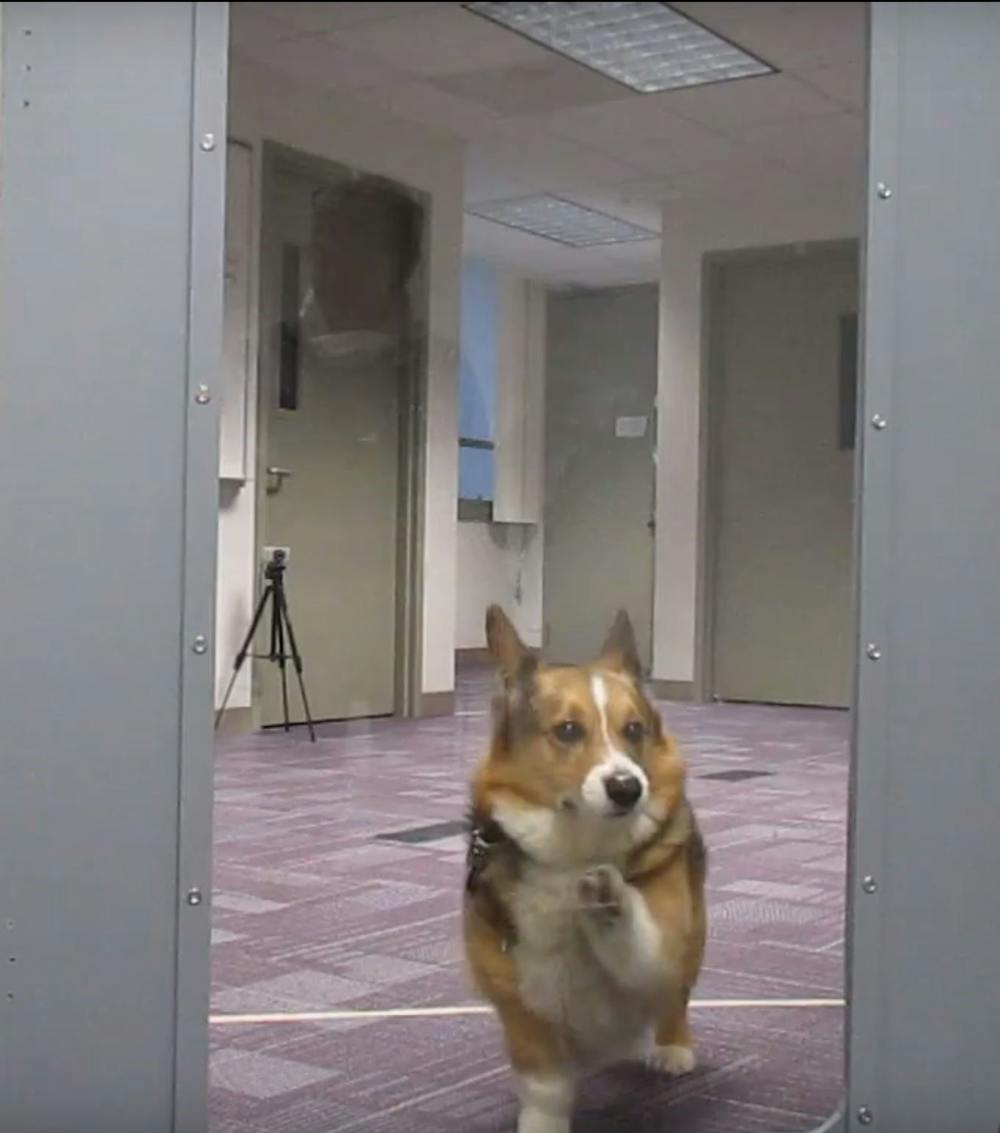
Next, we instructed the owner on how to behave during the experiment. Each owner sat in a chair behind a clear door that was magnetized shut – there as a barrier separating the dog from its owner – that the dog could easily push open. We assigned half the people to cry loudly and say “Help” in a distressed voice every 15 seconds. The other half of our volunteers we assigned to hum “Twinkle, Twinkle, Little Star” and say “Help” in a calm voice every 15 seconds. We ran the test until the dog opened the door or, if it didn’t, until five minutes elapsed.
Past research seemed to indicate that dogs would not help their human companions in distress, but it’s possible that the tasks to demonstrate “help” were too difficult for a dog to understand. So we adapted this straightforward task from previous researchin rats. It seemed like dogs would be capable of nudging open a door to access their owners.
Lassie, Timmy’s crying in the other room
We expected to find that dogs would open the door more often if their owner was crying than if they were humming. Surprisingly, that isn’t what we found: About half the dogs opened the door, regardless of which condition they were in, which tells us that dogs in both conditions wanted to be near their owners.
I’m on my way! Emily Sanford and Julia Meyers-Manor, CC BY-ND
When we looked at how quickly the dogs who opened the door did so, we found a stark difference: In the crying condition, dogs took an average of 23 seconds to open the door, while in the control condition, they took more than a minute and a half. The humans’ crying seemed to affect the dogs’ behaviors, taking just a quarter as long to push open the door and get to their human if they seemed distressed. We did not find any differences between therapy dogs and other pet dogs.
Other interesting results came when we looked into how the dogs were behaving in each condition. In the crying condition, we found the dogs that opened the door showed fewer signs of stress – and were reported by their owners to be less anxious – than dogs that did not open it. We also found that dogs that opened the door more quickly were less stressed than dogs that took longer to open it.
In contrast, dogs in the humming condition showed a slight tendency to open more quickly if they were reported to be more anxious. This may mean that dogs who opened in the humming condition were seeking their owners for their own comfort.
Helping requires more than just empathy
Because both humans and animals tend to be more empathetic toward individuals with whom they are more familiar or close, we thought that the strength of a dog’s bond with its owner might explain some of the differences we saw in dogs’ empathetic responses.
As soon as the test was over, we let the dog and owner reunite and cuddle for a few minutes to make sure everyone was calm before the next part of the experiment. Next, we turned to a test called the Impossible Task to learn a bit more about each dog’s emotional bondwith its person.
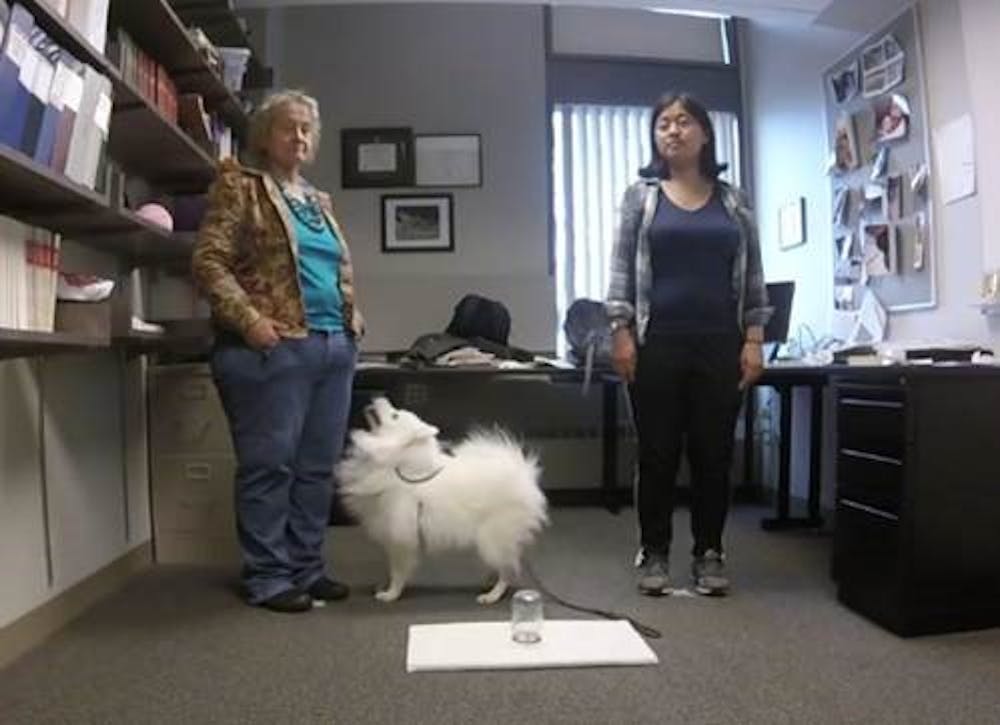
Hey, a little help down here for your furry friend? Julia Meyers-Manor and Emily Sanford, CC BY-ND
In this task, the dog learns to tip over a jar to get to a treat; then we lock the jar onto a board with a treat inside and record whether the dog gazes at its owner or a stranger. There have been some mixed results with this test, but the idea is that a dog who spends more time looking at their owner during this task may have a stronger bond with their owner than a dog that doesn’t spend much time looking at their owner.
We found that dogs who opened the door in the crying condition did gaze at their owner more during the Impossible Task than non-openers. On the other hand, it was the dogs who didn’t open the door in the humming condition that gazed at their owners more than those who opened it. This suggests that openers in the crying condition and non-openers in the humming condition had the strongest relationships with their owners.
Taken together, we interpreted these results as evidence that dogs were behaving empathetically in response to their crying owners. To behave empathetically toward another individual, you must not only be aware of the distress of another person, but also suppress your own stress enough to help out. If you are overwhelmingly stressed, you might either be incapacitated or try to leave the situation entirely. This pattern has been seen in children, where the most empathetic kids are the ones who are skilled at regulating their own emotional states enough to give help.
It appears to be the case with these dogs as well. Dogs with weaker emotional bonds to their owners, and those that perceived their owners’ distress but were unable to suppress their own stress response, may have been too overwhelmed by the situation to provide any help.
While everyone hopes their dog would help them if they ever were in trouble, we found that many of the dogs did not. People involved in our experiment, particularly those with dogs that didn’t open the door, told us many stories of their dogs coming to their aid in the past. Our study suggests that in some cases if your dog doesn’t help you, it’s not a sign he doesn’t love you; Fido might just love you too much.
It was the fickle finger of fate that led me to the arms, metaphorically speaking, of a core process psychotherapist back in Devon in the first half of 2007. That counselling relationship that revealed a deeply hidden aspect of my consciousness: a fear of rejection that I had had since December, 1956. That finger of fate that took me to Mexico for Christmas 2007 and me meeting Jean and all her dogs. That finger of fate that pointed me to the happiest years of my life and a love between Jeannie and me that I could previously never ever have imagined.
Here’s the full account. (But this is quite a long post and has the potential to cause some pain. Of course, I don’t intend that. But it’s best to mention that now.)
First we need to go back to that evening of December 19th, 1956. I had turned 12 on November, 8th and had just completed my first term at a nearby Grammar School. Then the family, as in Mum, Dad, me and my younger sister Elizabeth, were living comfortably in a detached house in Toley Avenue, a road off the main street that comprises Preston Road.
Preston Road is one of the outer suburbs of London to the North-West, sandwiched between Wembley, closer in to London, and Harrow, a little further out.
Anyway, on that evening of the 19th my mother came into my bedroom, located at the front of the house and next to Mum and Dad’s bedroom, at the usual time to say ‘Good night’ to me.
But while it was the usual time for Mum to be saying goodnight to me, clearly something was different this particular evening.
Mum sat down on the edge of my bed, just where my knees were, looked at me, and said, with pain in her voice: “Paul, you do know your father isn’t very well. He may not live for much longer.”
To be honest, all these many years later, I have no recollection as to whether or not I was aware that my father wasn’t very well.
Mum then leaned over to me, gave me my goodnight kiss, got up, and went out of my bedroom switching off the room light as she closed the door. As she always did and no different to any other evening.
Likewise, as with any other evening, I went off to sleep within a few minutes.
However, when I awoke the following morning, the morning of December 20th, it was clear that something terrible had happened during the night. Let me explain that my father had had two daughters with his first wife, prior to meeting Mum, and I loved them both and saw them as elder sisters. The eldest was Rhona and she was a registered nurse (SRN). (My other ‘sister’ was Corinne.) Of course, Rhona was helping Mum care for Dad.
I got up and went downstairs. There was Rhona in the kitchen. Rhona came up to me and held me very tightly and then quietly told me that our father had died during the night. Rhona went on to add that Mum had thought it best not to wake me and Elizabeth and somehow arranged not only for the doctor to come in to certify Dad’s death but also for our father’s body to be removed from the home. Elizabeth and I had slept through it all!
I don’t recall having any emotional reaction to Rhona’s news; not even crying. It was if it was all just too unreal to take in.
A few days later, Mum, very clearly in her own mind doing her best to protect me and Elizabeth from pain, subsequently thought it wise that we didn’t go to our father’s funeral and cremation.
Now I have not the slightest doubt that many, if not all, of you will have cringed on reading the above.
Once back at school for the first term of 1957, I soon became aware of being the target of a degree of bullying, presumably because I was showing my grief through my behaviour and attitude, that my academic performance rapidly fell apart leading on to me leaving school before I went on to the Sixth Form.
The other thing that I was aware of in 1957, and for every December 20th thereafter, that this day was always a tough one. A day when I remembered with a degree of sadness and emotional pain that fateful night and morning in 1956.
Nevertheless, my adult life really was (is!) a wonderful journey for me. It included a period working as a freelance journalist out in Australia in the late 1960s, becoming an Office Products salesman for IBM UK after returning from Australia to England and then in 1978 starting my own company, Dataview Ltd., in the early days of the personal computer revolution. Then after eight whirlwind years with Dataview growing in leaps and bounds each year, being approached in 1986 by a group of investors who wished to buy me out: I said “Yes”. That resulted in me going to live on a yacht, Songbird of Kent, a Tradewind 33, out in Cyprus (Larnaca Marina).
Tradewind 33 – Songbird of Kent. My home for five years.
While in Cyprus I got to know really well the wonderful, inspiring Les Powells, a three-times solo circumnavigator on his yacht Solitaire, and that thanks directly to Les offering me some very good advice, me experiencing the beauty, and the fear, of solo sailing out in The Atlantic and returning to Plymouth, in Devon, England, via Horta in The Azores, on the 16th June, 1994.
But! But! But!
But there was another part of my adult life that wasn’t such a wonderful journey. My relationships with the opposite sex! Culminating in my third wife, Julie, announcing on the day of the 50th anniversary of my father’s death, as in December 20th, 2006, that she was leaving me. (The reality of what she did to me was not pretty but I will spare you the details.)
Let me explain a little more.
After I had returned to England, sailing into Plymouth, in 1994, I subsequently sold Songbird of Kent and purchased a small house in the little village of Harberton, just a few miles out of Totnes, in South Devon. An easy decision to stay in South Devon because both Rhona and Corinne had their family homes close to Totnes.
Upper Barn, My home in Harberton.
I quickly became involved in the local business community undertaking a variety of coaching roles under the umbrella of Sales and Marketing; I was then a Chartered Member of the Institute of Marketing. In turn, Julie and I met each other and we became married.
In the Autumn of 2006, a Core Process Psychotherapist came to me seeking some business advice. ‘J’ had had many years of coaching individuals one-to-one but had the idea, the good idea to my mind, of coaching the directors of companies in the whole process of listening to their employees and offering advice and guidance whenever there was the potential of conflict. If the employees worked more effectively together then ‘J’ believed the company as a whole would be more effective in reaching their goals.
‘J’ had no idea how companies worked, for want of a better term, and my role was teach ‘J’ the fundamentals of operating the sort of company that was common to South Devon.
That’s what I was doing up to that fateful day of December 20th, 2006.
Because upon hearing the news that my then wife was leaving me, I simply blew apart emotionally. In the most terrible manner that I had never experienced before.
Very early on in January, 2007 I felt that I was descending into some bottomless pit of despair. In desperation I rang ‘J’ and explained what had happened on the 20th. ‘J’ listened and then said, quite properly, that he couldn’t see me as his client because we already had a working relationship. I pleaded and pleaded with ‘J’ to allow me to be his psychotherapy client. Finally, ‘J’ agreed but on the very strict condition that if he thought the counselling relationship wasn’t working then we would terminate it. He asked, and received, my understanding and agreement to that condition.
It wasn’t long thereafter before ‘J’ was asking me a little of my early experiences and I recounted that night of December 19th-20th and how I had not been able to say ‘Goodbye’ to my father.
‘J’ was quiet for a few minutes and then said:
“Paul, you have a son don’t you?”
I silently nodded.
“How do you think Alex would react if your death was handled for him in the same manner as your mother handled it for you?”
I gasped, conscious of how much I loved Alex, and Maija my daughter, and could hardly get the words out of my mouth: “He, he, … he would think he had been emotionally rejected ….”, continuing, “Oh my goodness! Oh! Oh! Oh! Oh, my sainted aunt! That’s it! I interpreted what happened back then when father died as rejection. That I wasn’t important to my father. So that’s what I have been experiencing all my adult life – a fear of rejection! But until now that fear has been completely submerged in my subconscious! Wow!”
That is the reason why, not to sound too immodest, I have been successful in all matters to do with my working life: I did everything to be accepted by my customers, my managers, my associates, and so on.
But it was also the reason why I had been so unsuccessful in my many, many relationships with women. Why I was unfaithful to my first wife. Why I could never say “No” to an emotional relationship with a woman, whether or not that woman had the potential to be a good long-term companion. Because I behaved in ways that minimised the chances of that woman rejecting me. That was why my last wife, Julie, before I met Jean, so gravely affected me when she chose, quite deliberately, to tell me she was leaving me on the 50th anniversary of my father’s death.
So that’s how ‘J’ held my hand, metaphorically speaking, and walked me into the light of how the past had affected me.
Dear, dear reader of Learning from Dogs, I do hope this makes sense and possibly in some small way this post holds out a hand to you.
I will close with this. Heard on a film that Jean and I recently watched.
Unless you understand yourself, can you be truthful to yourself?
The journey inwards is the most important and rewarding journey we can take!











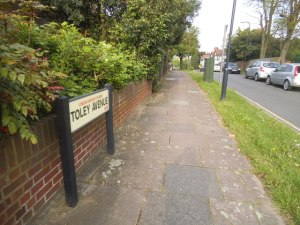 Toley Avenue, a road off the main street that comprises Preston Road.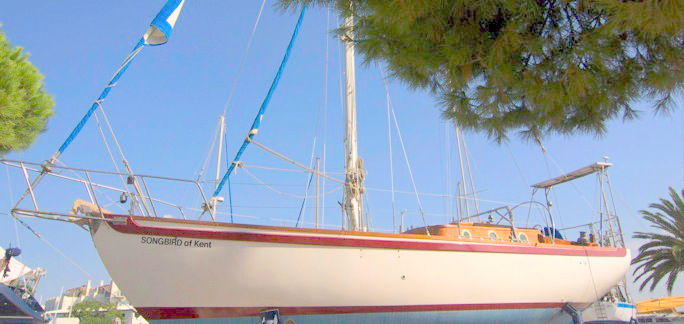

 Learning from Dogs