Here is one explanation.
There is no question the world’s weather systems are changing. However, for folk who are not trained in this science it is all a bit mysterious. So thank goodness that The Conversation have not only got a scientist who does know what he is talking about but also they are very happy for it to be republished.
ooOOoo
Atmospheric rivers are shifting poleward, reshaping global weather patterns

Zhe Li, University Corporation for Atmospheric Research
Atmospheric rivers – those long, narrow bands of water vapor in the sky that bring heavy rain and storms to the U.S. West Coast and many other regions – are shifting toward higher latitudes, and that’s changing weather patterns around the world.
The shift is worsening droughts in some regions, intensifying flooding in others, and putting water resources that many communities rely on at risk. When atmospheric rivers reach far northward into the Arctic, they can also melt sea ice, affecting the global climate.
In a new study published in Science Advances, University of California, Santa Barbara, climate scientist Qinghua Ding and I show that atmospheric rivers have shifted about 6 to 10 degrees toward the two poles over the past four decades.
Atmospheric rivers on the move
Atmospheric rivers aren’t just a U.S West Coast thing. They form in many parts of the world and provide over half of the mean annual runoff in these regions, including the U.S. Southeast coasts and West Coast, Southeast Asia, New Zealand, northern Spain, Portugal, the United Kingdom and south-central Chile.
California relies on atmospheric rivers for up to 50% of its yearly rainfall. A series of winter atmospheric rivers there can bring enough rain and snow to end a drought, as parts of the region saw in 2023.
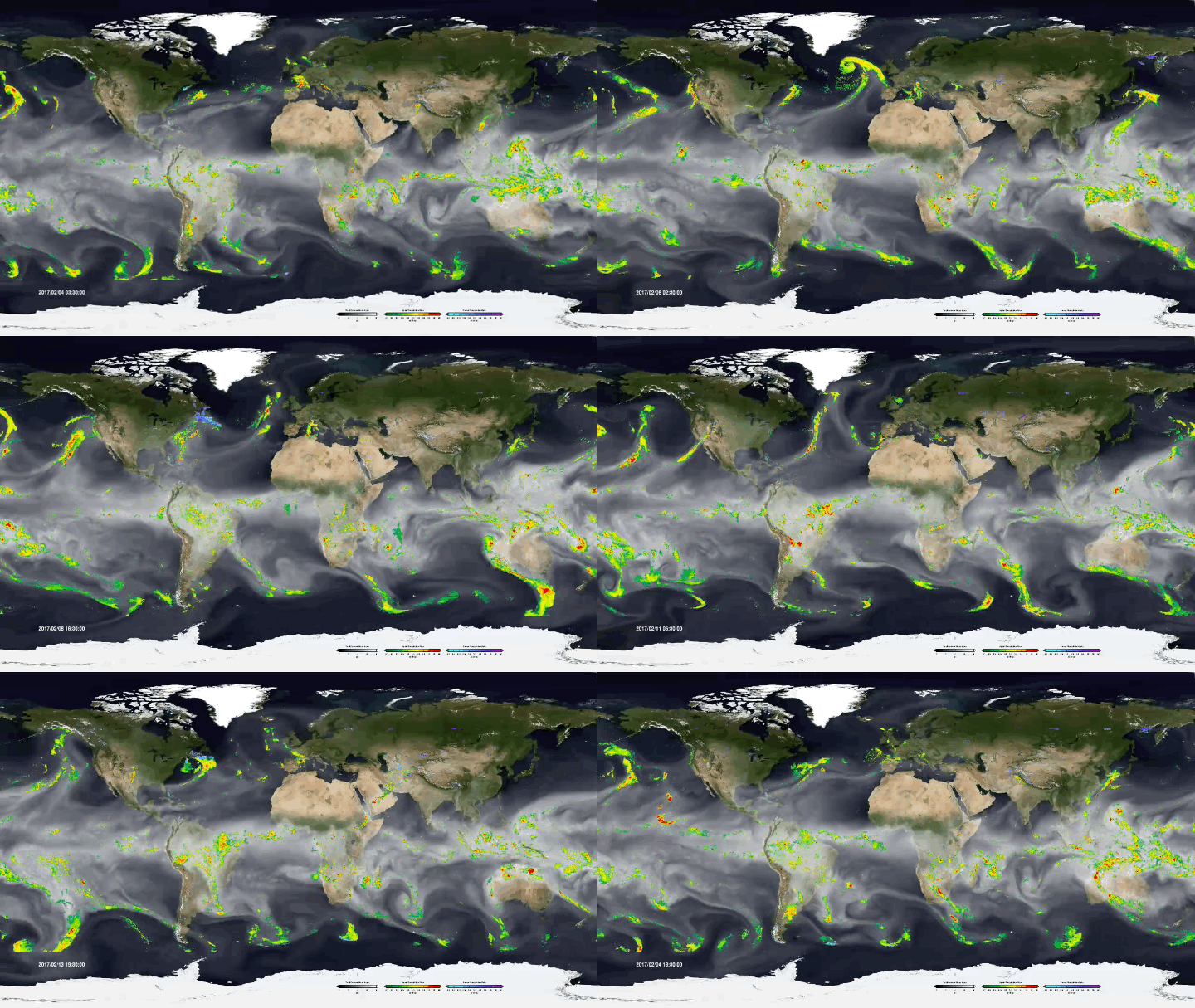
While atmospheric rivers share a similar origin – moisture supply from the tropics – atmospheric instability of the jet stream allows them to curve poleward in different ways. No two atmospheric rivers are exactly alike.
What particularly interests climate scientists, including us, is the collective behavior of atmospheric rivers. Atmospheric rivers are commonly seen in the extratropics, a region between the latitudes of 30 and 50 degrees in both hemispheres that includes most of the continental U.S., southern Australia and Chile.
Our study shows that atmospheric rivers have been shifting poleward over the past four decades. In both hemispheres, activity has increased along 50 degrees north and 50 degrees south, while it has decreased along 30 degrees north and 30 degrees south since 1979. In North America, that means more atmospheric rivers drenching British Columbia and Alaska.
A global chain reaction
One main reason for this shift is changes in sea surface temperatures in the eastern tropical Pacific. Since 2000, waters in the eastern tropical Pacific have had a cooling tendency, which affects atmospheric circulation worldwide. This cooling, often associated with La Niña conditions, pushes atmospheric rivers toward the poles.
The poleward movement of atmospheric rivers can be explained as a chain of interconnected processes.
During La Niña conditions, when sea surface temperatures cool in the eastern tropical Pacific, the Walker circulation – giant loops of air that affect precipitation as they rise and fall over different parts of the tropics – strengthens over the western Pacific. This stronger circulation causes the tropical rainfall belt to expand. The expanded tropical rainfall, combined with changes in atmospheric eddy patterns, results in high-pressure anomalies and wind patterns that steer atmospheric rivers farther poleward.
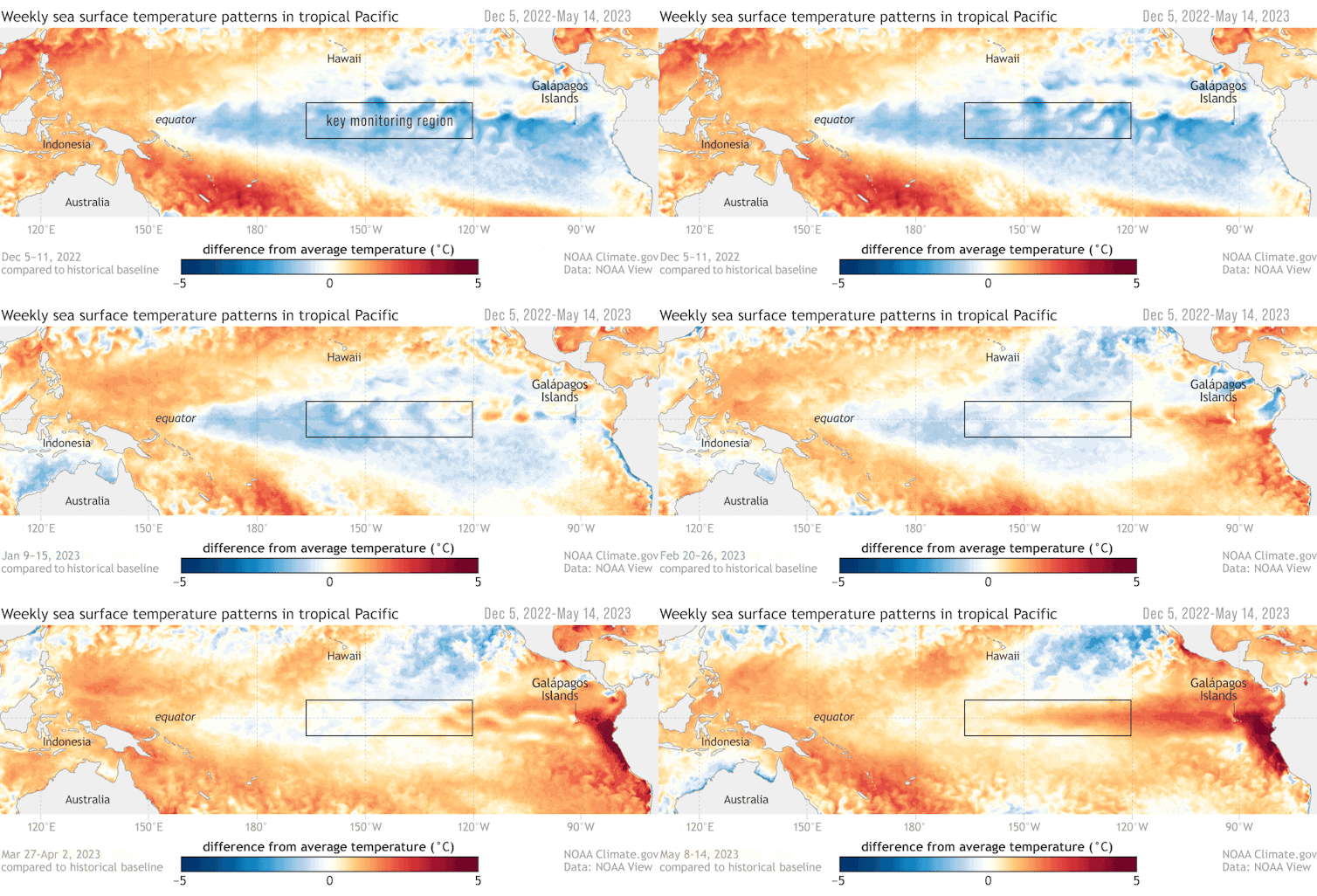
Conversely, during El Niño conditions, with warmer sea surface temperatures, the mechanism operates in the opposite direction, shifting atmospheric rivers so they don’t travel as far from the equator.
The shifts raise important questions about how climate models predict future changes in atmospheric rivers. Current models might underestimate natural variability, such as changes in the tropical Pacific, which can significantly affect atmospheric rivers. Understanding this connection can help forecasters make better predictions about future rainfall patterns and water availability.
Why does this poleward shift matter?
A shift in atmospheric rivers can have big effects on local climates.
In the subtropics, where atmospheric rivers are becoming less common, the result could be longer droughts and less water. Many areas, such as California and southern Brazil, depend on atmospheric rivers for rainfall to fill reservoirs and support farming. Without this moisture, these areas could face more water shortages, putting stress on communities, farms and ecosystems.
In higher latitudes, atmospheric rivers moving poleward could lead to more extreme rainfall, flooding and landslides in places such as the U.S. Pacific Northwest, Europe, and even in polar regions.
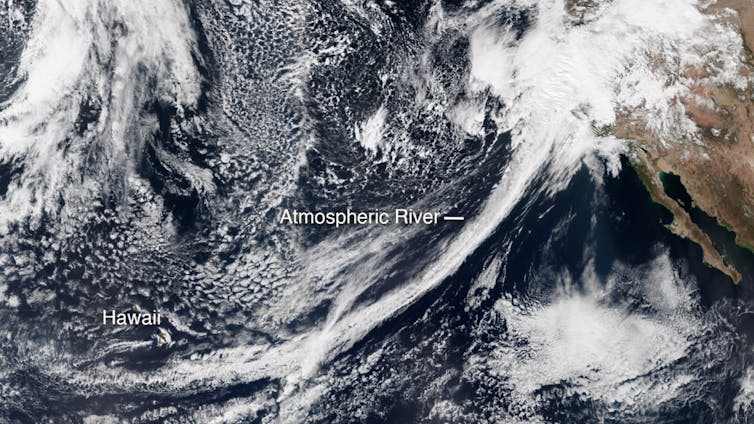
In the Arctic, more atmospheric rivers could speed up sea ice melting, adding to global warming and affecting animals that rely on the ice. An earlier study I was involved in found that the trend in summertime atmospheric river activity may contribute 36% of the increasing trend in summer moisture over the entire Arctic since 1979.
What it means for the future
So far, the shifts we have seen still mainly reflect changes due to natural processes, but human-induced global warming also plays a role. Global warming is expected to increase the overall frequency and intensity of atmospheric rivers because a warmer atmosphere can hold more moisture.
How that might change as the planet continues to warm is less clear. Predicting future changes remains uncertain due largely to the difficulty in predicting the natural swings between El Niño and La Niña, which play an important role in atmospheric river shifts.
As the world gets warmer, atmospheric rivers – and the critical rains they bring – will keep changing course. We need to understand and adapt to these changes so communities can keep thriving in a changing climate.
Zhe Li, Postdoctoral Researcher in Earth System Science, University Corporation for Atmospheric Research
This article is republished from The Conversation under a Creative Commons license. Read the original article.
ooOOoo
Those last two paragraphs of the above article show the difficulty in coming up with clear predictions of the future. As was said: ‘How that might change as the planet continues to warm is less clear. Predicting future changes remains uncertain due largely to the difficulty in predicting the natural swings between El Niño and La Niña, which play an important role in atmospheric river shifts.‘
 Learning from Dogs
The most basic fact about climate science has been mentioned… more than 16 years ago by yours truly: any augmentation of energy is distributed equally. That’s called the Equipartition of Energy Theorem. EET. That says new energy getting into the atmosphere from the greenhouse gas Forcing will only show up as heat for…one third. The rest will be dynamical and potential (pressure). The displacement northward of the atmospheric rivers, the greatest meteorological phenomena on Earth, is explained by the EET.
Earth’s atmosphere is dominated by three types of large convection cells which transfer heat energy from the surface (which is relatively warm) and the stratosphere (which is generally much colder than the surface).
The largest cells extend from the equator to between 30 and 40 degrees north and south, and are named Hadley cells, after English meteorologist George Hadley.
Within the Hadley cells, the trade winds blow towards the equator, deviated westward by Earth’s rotation (“Coriolis force”), and then give rise to rotating storm systems which often become hurricanes. The warm, wet air, energized by the hot equatorial surface then ascends near the equator as a broken line of towering thunderstorms, which forms the Inter-Tropical-Convergence Zone (ITCZ). From the tops of these storms, the air flows towards higher latitudes, where, once cooled, it sinks from its greater density, to produce high-pressure regions over the subtropical oceans and the world’s hot deserts, such as the Sahara desert in North Africa. As the zone of greatest heat shifts northward or southward, the maximum ascending energy belt follows, and this is called the monsoon.
As ever more energy is acquired by Earth’s surface as the GreenHouse Heating proceeds, one may expect the monsoon to shift ever more northward and southward, and to bring more moisture. This is exactly what is observed. It rained extensively in the Sahara in 2024.
The Ferrel cells are the convection of the temperate zone. They move in the opposite direction to the two other cells (Hadley cell and Polar cell) and act like ball bearings. The important point is that the equatorial-tropical cells, the Hadley cells, are getting increasingly energized and push the other two types towards the poles.
According to the EET, the surface of the ocean will get warmer and more energetic (bigger waves), transferring in particular more water from the sea into the atmosphere. However, water vapor is Earth’s dominant GreenHouse Gas (GHG). So one must expect a nonlinear effect: the more heating the more GHG, and then a further acceleration of GHG heating: this is characteristic of an exponential, a phenomenon which accelerates its growth proportional to its size.
One may wonder where this is all going. It’s simple: 85% of human primary energy comes from fossil fuels. A few windmills, solar panels and electric cars will not change that. For massive non-carbon primary energy production only nuclear energy can provide at this point… The debate has been distorted because a state like California, blessed by the Gods, can provide a lot of wind, sun and dams, a rare combination. And California, being the largest US state, thanks in part to its exceptional climate, dominates the discourse. Large parts of Europe, though, experience long cold winters with neither sun nor wind…
LikeLike
Thank you, again, Patrice, for your extensive reply. It is most valuable!
LikeLiked by 1 person