Year: 2017

Economic marginalisation.

For those looking for answers to the crisis in liberal democracy, this may well be it.

In yesterday’s post Tensions abound in many societies I offered a viewpoint that the ‘left’ arguing with the ‘right’ in politics was utterly inappropriate. Simply for we, as in the people who live on this planet, have to start working together if we wish to have a future for mankind on Planet Earth.

Yesterday’s post also referred to Inductive and Deductive Reasoning with me proposing that the future had to be built on a universally acknowledged relationship between ’cause’ and ‘effect’. A relationship that was built on a clear axiom, or theorem; as we see all around us in both the physical and natural worlds.

This idea does take a little time to filter through and I would be the first to say that I had to spend quite a while reflecting on the idea to fully understand the difference, the power, of deductive reasoning. Plus how something that was a behaviourial ‘law’ could be seen as much as an axiom as is, for example, the calculation of the speed of light, or the relationship of gravity to mass.

So returning to economics.

Quite recently there was an essay published on The Conversation blogsite written by Professor Andrew Cumbers of the University of Glasgow.

His thesis is that there is a direct relationship between “… about how well dispersed economic decision-making power is and how much control and financial security people have over their lives.

That relationship is the core message of his essay.

In other words, as I see it, there is an axiom, a theorem, that governs the relationship between the leadership process of a country and the degree to which that country’s society could be classed as a democratic society.

Here is Professor Cumbers’s essay as published by The Conversation blogsite and republished here within the terms of The Conversation.

ooOOoo

New index of economic marginalisation helps explain Trump, Brexit and alt.right

January 12, 2017 10.03am EST

Author:
image-20170111-4585-12s1o8d
“My fellow disenfranchised Americans …” EPA

If 2016 brought Brexit, Donald Trump and a backlash against cosmopolitan visions of globalisation and society, the great fear for 2017 is further shocks from right-wing populists like Geert Wilders in Holland and Marine Le Pen in France. A new mood of intolerance, xenophobia and protectionist economics seems to be in the air.

In a world of zero-hour contracts, Uber, Deliveroo and the gig economy, access to decent work and a sustainable family income remains the main fault line between the winners and losers from globalisation. Drill into the voter data behind Brexit and Trump and they have much to do with economically marginalised voters in old industrial areas, from South Wales to Nord-Pas-de-Calais, from Tyneside to Ohio and Michigan.

These voters’ economic concerns about industrial closures, immigrants and businesses decamping to low-wage countries seemed ignored by a liberal elite espousing free trade, flexible labour and deregulation. They turned instead to populist “outsiders” with simplistic yet ultimately flawed political and economic narratives.

Much has been said about the crisis of liberal political democracy, but these trends look inextricably linked with what is sometimes referred to as economic democracy. This is about how well dispersed economic decision-making power is and how much control and financial security people have over their lives. I’ve been involved in a project to look at how this compares between different countries. The results say much about the point we have reached, and where we might be heading in future.

The index

Our economic democracy index looked at 32 countries in the OECD (omitting Turkey and Mexico, which had too much missing data). While economic democracy tends to focus on levels of trade union influence and the extent of cooperative ownership in a country, we wanted to take in other relevant factors.

We added three additional indicators: “workplace and employment rights”; “distribution of economic decision-making powers”, including everything from the strength of the financial sector to the extent to which tax powers are centralised; and “transparency and democratic engagement in macroeconomic decision-making”, which takes in corruption, accountability, central bank transparency and different social partners’ involvement in shaping policy.

What is striking is the basic difference between a more “social” model of northern European capitalism and the more market-driven Anglo-American model. Hence the Scandinavian countries score among the best, with their higher levels of social protection, employment rights and democratic participation in economic decision-making. The reverse is true of the more deregulated, concentrated and less democratic economies of the English-speaking world. The US ranks particularly low, with only Slovakia below it. The UK too is only 25th out of 32.
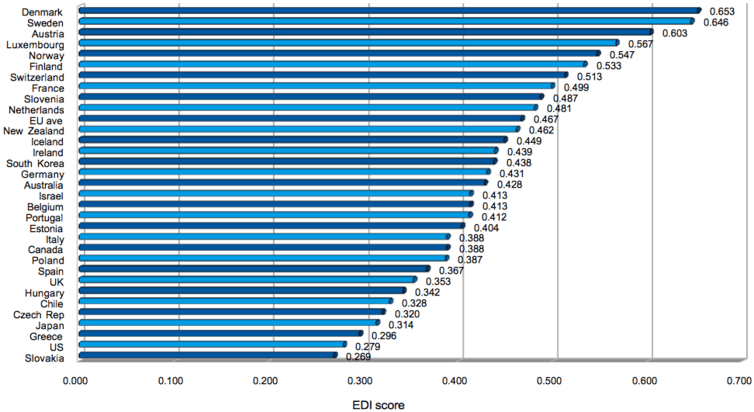
 Economic Democracy Index, figures from 2013. Andrew Cumbers
Economic Democracy Index, figures from 2013. Andrew Cumbers

Interestingly, France ranks relatively highly. This reflects its strong levels of job protection and employee involvement in corporate decision-making – the fact that the far right has been strong in France for a number of years indicates its popularity stems from race at least as much as economics.

Yet leading mainstream presidential candidates François Fillon and Emmanuel Macron are committed to reducing France’s protections. These are often blamed – without much real evidence – for the country’s sluggish job creation record. There is a clear danger both here and in the Netherlands that a continuing commitment to such neoliberal labour market policies might push working class voters further towards Le Pen and Wilders.

One other notable disparity in the index is between the scores of Austria and Germany, despite their relatively similar economic governance. Germany’s lower ranking reflects the growth of labour market insecurity and lower levels of job protection, particularly for part-time workers as part of the Hartz IV labour market reforms in the 1990s that followed reunification.

The index also highlights the comparatively poor levels of economic democracy in the “transition” economies of eastern Europe. The one very interesting exception is Slovenia, which merits further study. It might reflect both its relatively stable transition from communism and the civil war in the former Yugoslavia, and the continuing presence of active civil society elements in the trade union and cooperative movements. Southern European economies also tend to rank below northern European countries, as does Japan.

Poverty and inequality

The index provides strong evidence that xenophobic politics may be linked to changing levels of economic participation and empowerment – notwithstanding the French data. We found that the greater the poverty and inequality in a country, the lower the rates of economic democracy.

These findings suggest, for example, that the Anglo-American-led attack on trade unions and flexible labour policies may actually drive up poverty and inequality by cutting welfare benefits and driving up individual employment insecurity. While the OECD itself advocated these policies until recently, countries with high levels of economic democracy such as Norway, Denmark and Iceland have much lower levels of poverty than countries such as the US and UK.

 Far right activists in Budapest, Hungary, February 2016. EPA
Far right activists in Budapest, Hungary, February 2016. EPA

Far-right populism is on the march everywhere, including the Nordic countries. But Brexit, Trump and the more serious shift to the far right in Eastern Europe have been accompanied by diminishing economic security and rights at work, disenfranchised trade unions and cooperatives, and economic decision-making concentrated among financial, political and corporate elites.

We will monitor these scores in future to see what happens over time. It will be interesting to see how the correlations between economic democracy, poverty and voting patterns develop in the coming years. For those looking for answers to the crisis in liberal democracy, this may well be it.

ooOOoo

 I shall be writing to Professor Cumbers asking if my analysis of that relationship is supported by his research.

For if it is then we do have a very clear axiom that few would disagree with. That is the political consensus this world needs now.

Oh, and we will be back to dogs tomorrow! 😉
Blue Ridge Pet Food Recall

As released by Dog Food Advisor at 07:45 PST today.

Blue Ridge Beef of Eatonton, Georgia, has announced it is voluntarily recalling one lot of its raw frozen pet food due to its potential to be contaminated with Listeria monocytogenes bacteria.

To learn which products are affected, please visit the following link:

Blue Ridge Beef Pet Food Recall of January 2016

When one goes to that Blue Ridge web link this is what you will read:

ooOOoo

January 17, 2017 — Blue Ridge Beef of Eatonton, Georgia, has announced it is voluntarily recalling one lot of its Turkey with Bone raw frozen product due to its potential to be contaminated with Listeria monocytogenes.

What’s Being Recalled?

blue-ridge-beef-turkey-with-bone-recall-jan-2017The affected product is sold in 2 pound chubs and can be identified with the following manufacturing codes:

  • Blue Ridge Beef Turkey with Bone
  • Size: 2 pound chubs
  • UPC Code 854298001887
  • Lot #103 mfdga12716

About Listeria

Listeria can affect animals eating the product.

And there is a risk to humans from handling contaminated pet products, especially if they have not thoroughly washed their hands after having contact with the products or any surface exposed to these products.

Healthy people infected with Listeria monocytogenes should monitor themselves for some or all of the following symptoms: nausea, vomiting, diarrhea or bloody diarrhea, abdominal cramping and fever.

Consumers exhibiting these signs after having contact with this product should contact their healthcare provider.

Where Was It Distributed?

The affected products were distributed to retail stores in the following states:

  • Florida
  • Georgia
  • North Carolina
  • South Carolina

What Caused the Recall?

This recall was initiated as a result of an FDA inspection and sampling of the product. This recall is being made with the knowledge of the US Food and Drug Administration.

What to Do?

Consumers who have purchased the above lot of Blue Ridge Beef Turkey with Bone raw frozen product are urged to stop feeding the product and return it to the place of purchase for a full refund.

Or dispose of the affected product immediately.

Those with questions can email the company at blueridgebeefga@yahoo.com

U.S. citizens can report complaints about FDA-regulated pet food products by calling the consumer complaint coordinator in your area.

Or go to http://www.fda.gov/petfoodcomplaints.

Canadians can report any health or safety incidents related to the use of this product by filling out the Consumer Product Incident Report Form.

Get Dog Food Recall Alerts by Email

Get free dog food recall alerts sent to you by email. Subscribe to The Dog Food Advisor’s emergency recall notification system.

ooOOoo

As the email alert that came to me said; in closing:

Please be sure to share the news of this alert with other pet owners.

Mike Sagman, Editor
The Dog Food Advisor

Best wishes to you all.

Tensions abound in many societies.

Reader alert: This has nothing to do with dogs!

Then as soon as I started to write today’s post (as of yesterday afternoon) I realised the error in my sub-title. For one might argue that this does have a connection with how our dogs behave as a cohesive group. But I’m going to be ‘an arse’ (‘ass’ in American speak) and ask you to hold out until the end of today’s post to read the ‘doggie’ connection. (Note that today’s post is Part One. Part Two continues tomorrow.)

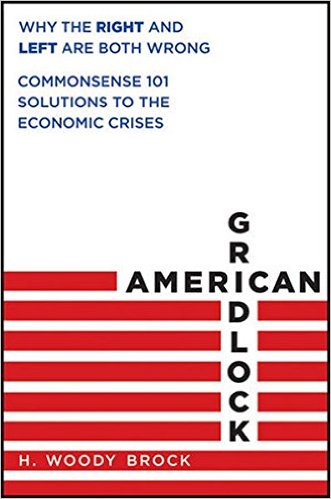
american-gridlock_0I am in the middle of reading American Gridlock written by H. Woody Brock and published in 2012. Here’s an extract of what the book is about, courtesy of Amazon:

A sensible solution to getting our economy back on track

Pessimism is ubiquitous throughout the Western World as the pressing issues of massive debt, high unemployment, and anemic economic growth divide the populace into warring political camps. Right-and Left-wing ideologues talk past each other, with neither side admitting the other has any good ideas. In American Gridlock, leading economist and political theorist H. Woody Brock bridges the Left/Right divide, illuminating a clear path out of our economic quagmire.

Arguing from first principles and with rigorous logic, Brock demonstrates that the choice before us is not between free market capitalism and a government-driven economy. Rather, the solution to our problems will require enactment of constructive policies that allow “true” capitalism to flourish even as they incorporate social policies that help those who truly need it.

Brock demonstrates how deductive logic (as opposed to ideologically driven data analysis) can transform the way we think about these problems and lead us to new and different solutions that cross the ideological divide. Drawing on new theories such as game theory and the economics of uncertainty that are based upon deductive logic, Brock reveals fresh ideas for tackling issues central to the 2012 U.S, Presidential election and to the nation’s long-run future:

It greatly influenced me and I sat down and wrote an essay. Mainly to clarify my own thinking ahead of a meeting last Saturday of our local Freethinkers Group where the topic was “Ideas for Improving our Democratic Processes”. The “our” being the US democratic process but just as valid for many other countries.

I first set out to see if there was a clear, unambiguous definition of what a democratic society is. Surprise, surprise there isn’t one. Very quickly I came up with three:

The first:

A democracy by definition is government through elected representatives. It is a form of society which favours equal rights, freedom of speech and a fair trial and tolerates the views of minorities. Civics and Citizenship website

The second:

A DEMOCRACY IS a society in which all adults have easily accessible, meaningful, and effective ways:

(a) to participate in the decision-making processes of every organization that makes decisions or takes actions that affect them, and;

(b) to hold other individuals, and those in these organizations who are responsible for making decisions and taking actions, fully accountable if their decisions or actions violate fundamental human rights, or are dishonest, unethical, unfair, secretive, inefficient, unrepresentative, unresponsive or irresponsible;

(c) so that all organizations in the society are citizen-owned, citizen-controlled, and citizen-driven, and all individuals and organizations are held accountable for wrongdoing. Democracy Watch website

And the third:

Better democracy, everywhere.

The Democratic Society (Demsoc) works for more and better democracy, where people and institutions have the desire, opportunity and confidence to participate together.

We work to create opportunities for people to become involved in the decisions that affect their lives and for them to have the skills to do this effectively. We support governments, parliaments and any organisation that wants to involve citizens in decision making to be transparent, open and welcoming of participation. We actively support spaces, places and processes to make this happen. Democratic Society website.

I went on to say in my essay:

Yes, there is some harmony between all three definitions but there are also significant differences in tone and language.

I am sure many of you are familiar with the book by H. Woody Brock American Gridlock. I started reading it a few days ago and cannot now put it down.

For the core message of the book is that we, as in society, must distinguish between inductive and deductive reasoning. Let me use the definitions as found on the Live Science website.

Deductive reasoning

Deductive reasoning is a basic form of valid reasoning. Deductive reasoning, or deduction, starts out with a general statement, or hypothesis, and examines the possibilities to reach a specific, logical conclusion, according to the University of California. The scientific method uses deduction to test hypotheses and theories. “In deductive inference, we hold a theory and based on it we make a prediction of its consequences. That is, we predict what the observations should be if the theory were correct. We go from the general — the theory — to the specific — the observations,” said Dr. Sylvia Wassertheil-Smoller, a researcher and professor emerita at Albert Einstein College of Medicine.

In deductive reasoning, if something is true of a class of things in general, it is also true for all members of that class. For example, “All men are mortal. Harold is a man. Therefore, Harold is mortal.” For deductive reasoning to be sound, the hypothesis must be correct. It is assumed that the premises, “All men are mortal” and “Harold is a man” are true. Therefore, the conclusion is logical and true.

That is, we predict what the observations should be if the theory were correct.

Let that really work it’s way through your consciousness. It’s an idea that is rooted in the great scientists and philosophers of many thousands of years ago. Think of Euclid, the Greek Socratic philosopher who founded the Megarian school of philosophy. He was a pupil of Socrates in the late 5th century BCE, and was present at his death. (I cheated and looked it up.)

It was Euclid who through Euclidian geometry came to understand the principles of angles and straight lines; as in the shortest distance between two points.

Moving on:

Inductive reasoning

Inductive reasoning is the opposite of deductive reasoning. Inductive reasoning makes broad generalizations from specific observations. “In inductive inference, we go from the specific to the general. We make many observations, discern a pattern, make a generalization, and infer an explanation or a theory,” Wassertheil-Smoller told Live Science. “In science there is a constant interplay between inductive inference (based on observations) and deductive inference (based on theory), until we get closer and closer to the ‘truth,’ which we can only approach but not ascertain with complete certainty.”

Even if all of the premises are true in a statement, inductive reasoning allows for the conclusion to be false. Here’s an example: “Harold is a grandfather. Harold is bald. Therefore, all grandfathers are bald.” The conclusion does not follow logically from the statements.

Inductive reasoning has its place in the scientific method. Scientists use it to form hypotheses and theories. Deductive reasoning allows them to apply the theories to specific situations.

Now for some of you this side trip into reasoning may have seen more like a complete departure. But the point is that, as American Gridlock makes so powerfully: There are two main problems to be solved if this nation is to get back on track. First, win-win policy solutions must be identified for the five real-world problems addressed in Chapters 2 through 6. Second, the Dialogue of the Deaf must come to an end, policy gridlock with it, and these solutions must be implemented. (Pages 7-8)

I closed my essay by setting out the following proposition:

Until we have a clear, universally acknowledged definition of what a democratic society is then it is impossible and utterly futile to debate the various processes including what is the best process for American society.

Is this relevant to the world outside the USA? You bet it is. For better or for worse, what the USA does today the rest of the world does soon thereafter.

And as you will see in Part Two that comes tomorrow democratising the economy is key.

For when we look at the way that dogs, and wolves, operate as a pack in the wild there are only three animals with status:

  • The alpha female who has first choice of the male dogs for mating purposes and makes the decision, as and when necessary, to move her pack to a new territory,
  • The beta dog, always a male, whose role is to keep the pack running smoothly as a cohesive group and not letting squabbles get out of hand, and,
  • The omega dog, that can be of either gender, whose role is to keep the pack happy.

All the other animals in the pack of around fifty are of equal status and work for the benefit of the pack. Now that is something we should learn from dogs!

The dangers of certain brands of peanut butter.

Please read this and share.

(This was first posted on December 8th, 2016. It is being republished because of the mention of peanut butter in the article presented in my post that came out an hour ago.)

ooOOoo

Keep peanut butter away from your dogs!

Because it could kill your beloved companion.

Fellow author Judi Holdeman sent me an email that contained a warning that had been in a recent health newsletter from Jeff Reagan. Here’s the essence of that warning (and my emphasis in parts):

If your dog is anything like my dog, they probably love a good scoop of peanut butter.

As I’m writing this, my pup Ellie is actually snuggled up next to my leg and going to town on her peanut butter filled Kong. She’s in heaven…

But I want to warn you about a NEW problem with dogs and peanut butter.

There’s been a number of reports lately of dogs who are winding up dead because of their beloved peanut butter.

How is this happening?

It has to do with a new ingredient being used in certain peanut butters.

That ingredient is xylitol.

Xylitol is an artificial sweetener that you’ll recognize from things like gum and candy.

And while it’s generally “safe” for humans to eat, it can be deadly for dogs. Just a small amount of it can cause severe liver damage and can even kill your dog.

From my research, I’ve found 5 brands of peanut butter that have recently added xylitol to their ingredients. I’m listing these brands below…

– Go Nuts Co

– Hank’s Protein Plus Peanut Butter

– Krush Nutrition

– Nuts N More

– P28

Now luckily most of these are NOT the most popular brands.

These brands are usually sold at specialty shops or health food stores.

But I still wanted to alert you to this…

Because if your dog is anything like mine, they probably love peanut butter.

So make sure you’re staying away from the brands I listed above.

And double-check the label on your peanut butter to make sure it doesn’t have xylitol in it.

Feel free to forward this email on to your friends or family that have dogs so they are aware of this…

– Jeff Reagan. Editor, Patriot Health Alliance

Please, good people, do share this as far and wide as possible.

When tensions rise.

For both humans and, in consequence, for those dogs close to us.

Effectively, the whole of the New Year has been a tad challenging here in Merlin, OR. For even before the snows arrived early on in January, leading to power outages and frozen pipes, the local weather service was warning of unusually severe storms. Indeed, more than once we have heard locals speaking of this looking like a one-hundred-year-storm.

So it was inevitable that there were some anxious periods. Plus the challenging weather may not be not fully behind us. For this is the current (Sunday 18:00 PST) weather warning:

HYDROLOGIC OUTLOOK
NATIONAL WEATHER SERVICE MEDFORD, OR
134 PM PST SUN JAN 15 2017

…Flood Potential Outlook for main stem river flooding, snow melt flooding, and quick rises on rivers and streams in the following counties…in California…Siskiyou…and in Oregon…Coos… Curry…Douglas…Jackson…Josephine…

A strong atmospheric river event is expected to arrive in Southern Oregon and Northern California by Wednesday. While models have trended towards a faster progression of the front, and therefore lesser rainfall amounts, this event may still produce high snow levels, periods of heavy rain, and significant melting of lower level snow-pack Wednesday and into Thursday. With the extensive snow-pack, saturated soils and high river levels, there is a potential for flooding and rapid rises along main stem rivers and small creeks and streams. Urban areas may also experience high water from blocked culverts and runoff.

Continue to monitor forecasts for any updates as this potentially hazardous situation develops.

Anyone who has a dog (or several) in their lives will know how our anxiety is so quickly picked up by our dogs. Ergo, looking after our dogs, as in keeping them relaxed, is really important.

Now read this article that was published over on the Care2 site. I am republishing here for all you good people.

ooOOoo

Eight Natural Remedies for Dog Anxiety

1279022-largeA Care2 favorite by Becky Striepe    About Becky

Picture Parade One Hundred and Seventy-Nine

I am indebted to neighbours Janet and Jim for sending these to me.

jggg2oooo

jggg1oooo

untitled-attachment-00094oooo

untitled-attachment-00097oooo

untitled-attachment-00139oooo

untitled-attachment-00106oooo

untitled-attachment-00079oooo

untitled-attachment-00109oooo

More of these next week.

Thanks Janet and Jim.

Contrasts!

It has been a bit of a week weather-wise!

During the heavy rains this last week we had an oak tree come down in front of the house. Luckily not doing any collateral damage.

But cutting it up into rounds and then splitting them ready for the wood tent took up most of yesterday (and Michael and Stanley many thanks for your help).

For today’s post I wanted to share two photographs with you. Two very different views of the world as seen from our property.

p1160860The first photograph above is of Bummer Creek that runs through our property. The view is upstream and the picture was taken last Sunday from our driveway bridge that crosses the creek. The flood waters were as high as we have ever seen them.

p1160867Please accept the slight fuzziness of the second photograph. But it is a shot of the full moon just as it appeared above the line of hills to the North-East. I dashed out to our deck and took the shot. Moments later the moon had been hidden by clouds. This was Thursday evening.

The picture doesn’t even get close to recording the magic of the dark night sky, stars shining so brightly, and the glorious full moon. Apparently a moon in orbit closer to planet Earth than is usual.

Nonetheless, the two photographs represent two very different and contrasting faces of our natural world.

You all have a very relaxing weekend.

Puppy Love!

Friday the 13th!

We are on course for a warm, sunny day. We were starting to wonder what they felt like!

But there’s never any question what the love of a dog feels like!

1070310989-222362-puppy_love_quotes___I am now going to follow this image up with a video made in England by Sophie Hannah Richardson recording her experience of welcoming to her home a new puppy.

Enjoy (and please read my footnote!).

Say hello to Luna the french bulldog everyone! How cute is she?!

We’ve had our little Luna just over a month now and we absolutely adore her. She’s playful, loving and very sociable! And she’s slowly learning to love the camera!

Follow Luna’s adventure right here: https://www.instagram.com/luna_thefrenchbulldog/


Footnote: In the last couple of days the number of good people who are following this blog has gone over 2,000. I am truly lost for words and will just leave it like this: Thank you from the bottom of my heart!

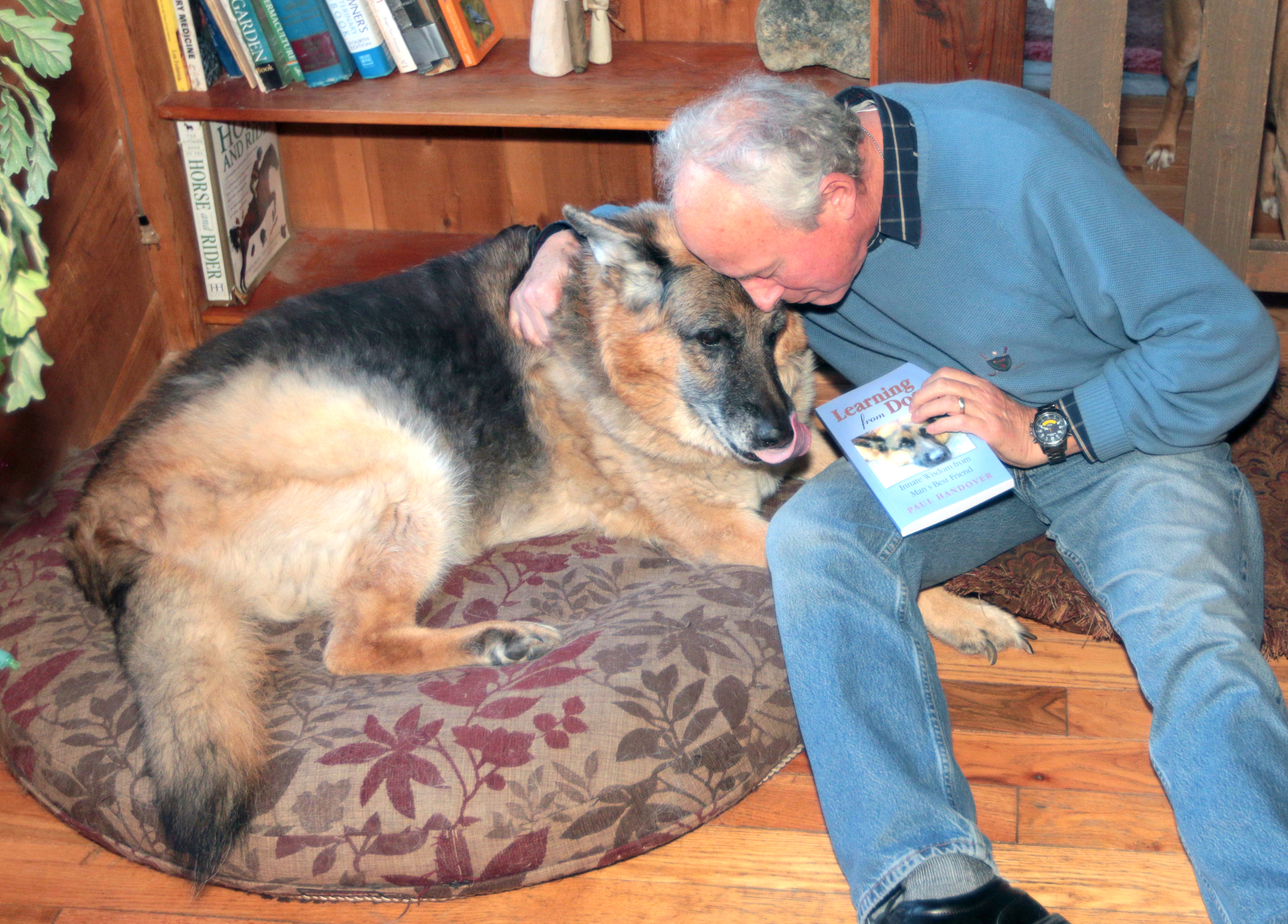
TIMOTHY BULLARD/Daily CourierPaul Handover with Pharaoh, a 12year-old German Shepard that he uses on the cover of his new book about man's best friend.
TIMOTHY BULLARD/Daily Courier Paul Handover with Pharaoh, a 12year-old German Shepard that he uses on the cover of his new book about man’s best friend.

Revisiting the language of love.

That is the language of love spoken by our beautiful dogs.

The present unreliability of our internet connection prompted me to think about re-posting whatever I had posted exactly a year ago. It only took me a minute to look it up and, bingo, what a perfect topic for these wintry days.

ooOOoo

As our dear dogs speak it.

You will recall that last Friday I featured an item under the title of Private First Class Lingo. The item had been brought to my attention by Constance Frankland.

Well here’s another really special story that Constance came across on a website called Arditor and I wanted to share it with you.

ooOOoo

The Language of Love

love8 Ways Your Dog is Saying I Love You

Although dogs don’t speak our language, they are constantly trying to tell us that they love us and always showing love through their actions. Unfortunately, many shrug their shoulders or get annoyed over their dogs’ love gestures.
Here are 8 ways your dog is saying “I love you”…

waggingTail Wagging

Similar to a cat, a dog’s tail is a communication tool. In fact it is sometimes more accurate in translating its emotions than barking. Held at different positions, a dog’s wag could communicate excitement, fear, threat or submission. If your dog’s tail is held in a relaxed position and wagging all together with its entire butt, it means it is very happy to see you.

lickingFace Licking

Warm, sticky, wet and stinky! We know this can get annoying but licking a person’s face is a love gesture from a dog. Dogs lick faces for a few reasons. Mainly, if your pet dog is licking your face, he is trying to groom you! Grooming is an intimate gesture only done after a strong connection is made between dogs (so now you know he sees you as one of his kind). On the other hand, if a stranger dog licks your face, it is simply trying to say that he is harmless and friendly.

following3Following You Wherever You Go

This is another behaviour that can get on your nerves, especially when your dog attempts to follow you to work! However, it is only a dog’s way to show his love, devotion and loyalty to you. Wherever you are, that is where your dog wants to be. Dogs are extreme social creatures and unlike humans, there is no need for solitude.

Sheltie sleeping with her ownerSleeping with You

Similar to wild wolve packs, wild dogs curl up together to sleep in the night. Rather than sleeping alone in his designated corner, your dog prefers to snuggle right next to you in your bed. If you catch your dog sneaking onto your bed or falling asleep next to you in your couch, it implies that you are his family.

smilingSmiling

It is no surprise when you see something like a smile on your dog. Dogs do smile too! Research has found that dogs can also show and use facial expressions similar to how humans do. A dog’s smile is another way of showing his love and joy to his owner. Having said that, most of us are guilty of not recognizing our dog’s smile.

crotchCrotch Sniffing

Argh, this is an embarrassing one and how we wished our dogs can quit going around sniffing crotches. But before you start screaming at your dog, try to understand it. This behaviour is in fact a dog’s perculiar way of greeting. More importantly, apart from a hello, it allows the dog to understand and remember you through your scent.

sickTaking Care of You When You are Sick

Does your dog stay by your bed and watch you the whole time while you are nursing a flu? This is its natural instinct to care for a sick or wounded family member, just as they would in the wild. A dog extends its love and care to its sick or injured owner by quietly and patiently watching over him/her. But make sure you hide any superficial wounds away from your dog! It might actually lick your wound as its form of first aid.

leaning2Leaning on You

Whether you are sitting or standing, your dog is leaning on you and wouldn’t budge. You can’t move and you can’t get on with your daily routine. While you are wondering what they are up to, your dog has already got what they needed: your attention. Getting your attention and giving you their attention by leaning on you is their way of showing affection. Next time this happens, stop what you are doing and reciprocate with some love.

oooooooo

This turned out to be more of a Sunday Picture Parade but it seemed too special to hold it from you until the weekend.

No, our dogs don’t speak a language that we humans would recognise as such but, nonetheless, our dogs communicate in ways that still are as magical and special as our human poetry.

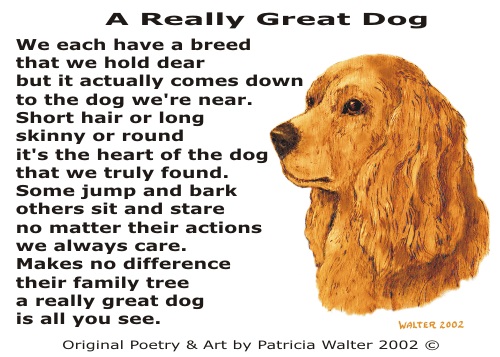
Speaking of poetry, let me close today’s post with this.

areallygreatdogooOOoo

Wherever you are in the world, with or without a dog in your life, please embrace the power of love.

Winter woes!

More heavy snow brought down electricity power lines resulting in us losing power around 8pm on Monday evening.

The power was restored a little before midnight. In other words just over 5 hours ago.

Be back up to speed later on today, assuming there are no further outages.

Footnote at 06:20.

Our internet connection is very slow and I am not confident it will stay up.