I’m breaking the pattern of publishing a new post at midnight, Pacific Time, (08:00 UTC) because it seemed like fun to publish Monday’s post at the moment of the Winter Solstice; namely Sunday, December 21 at 23:03 UTC (15:03 PST).
There is no doubt in my mind that everyone is familiar with the Winter Solstice being the moment when the planet has perfect opposites, in terms of light and darkness, as the following image shows so clearly.
Day and night sides of Earth at the instant of the December 2014 solstice (2014 December 21 at 23:03 Universal Time). Note that the north polar region of Earth must endure 24 hours of night, while the south polar region gets to bask in 24 hours of daylight. Image credit: Earth and Moon Viewer
What may not be so well-known is that it occurs within about two-and-a-half hours of the new moon.
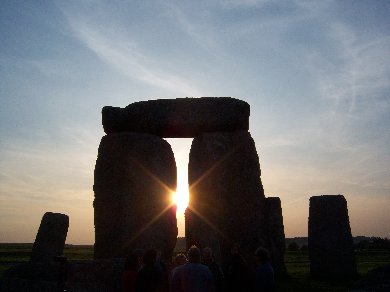
From times immemorial, early peoples on Earth knew much about the sun and the seasons, the length of daylight, and how the direction of the sunrise and sunset all shifted in a regular way throughout the year. As an Englishman, who in past times frequently drove the A303 road between London and Exeter, going past the ancient site of Stonehenge was always wonderful. Many are familiar with the sun rising during the Summer Solstice over the Heel Stone but far fewer realise that Stonehenge also marks the sun’s dawning the morning after the Winter Solstice.
The shortest day is behind us.
The English Heritage website Discover Stonehenge is brim full of facts and information so won’t ‘copy and paste’ from one to the other! Suffice to say that what we see today was completed about 3500 years ago.
However, it seems as though the ancient site is still delivering new surprises. I write this simply because just a few days ago, on the 19th December, 2014, the BBC reported:
Stonehenge dig finds 6,000-year-old encampment
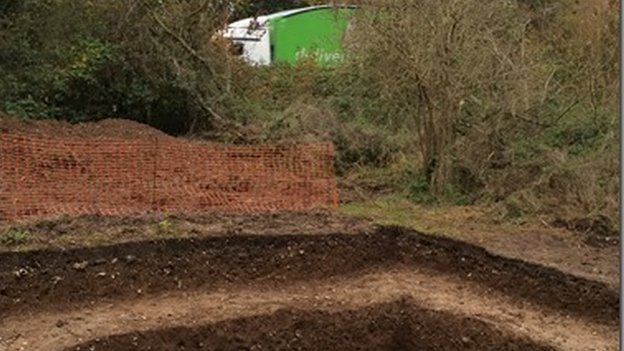
Archaeologists found the encampment during a dig at Blick Mead near Stonehenge
Archaeologists working on a site near Stonehenge say they have found an untouched 6,000-year-old encampment which “could rewrite British history”.
David Jacques, from the University of Buckingham, made the discovery at Blick Mead in October, and said the carbon dating results had just been confirmed.
But he also raised concerns about possible damage to the site over plans to build a road tunnel past Stonehenge.
The Department of Transport said it would “consult before any building”.
The Blick Mead site is about 1.5 miles (2.4km) from Stonehenge and archaeologists said “scientifically tested charcoal” dug up from the site had “revealed that it dated from around 4000 BC”.
The archaeologists found burnt flints, remains of animals and tools
David Jacques said the dig had also found “evidence of feasting” including burnt flints, tools and remains of giant cattle, known as aurochs, which were eaten by early hunter gatherers.
Mr Jacques said: “British pre-history may have to be rewritten. This is the latest dated Mesolithic encampment ever found in the UK.
“Blick Mead site connects the early hunter gatherer groups returning to Britain after the Ice Age to the Stonehenge area, all the way through to the Neolithic in the late 5th Millennium BC.
“But our only chance to find out about the earliest chapter of Britain’s history could be wrecked if the tunnel goes ahead.”
Archaeologists said the latest carbon date suggested it was continuously occupied between 7500-4000 BC
Andy Rhind-Tutt, a former mayor and current chairman of Amesbury Museum, which part-funded the dig, said the discovery could “provide what archaeologists have been searching for centuries – the answer to the story of the pre-history of Stonehenge.”
Earlier this month, the government announced funding for a 1.8-mile (2.9km) tunnel to remove congestion from the main road past Stonehenge.
A Department for Transport spokesman said: “As with any road scheme, we will consult with interested parties before any building begins on the A303.
“English Heritage and National Trust are supportive of our plans, and we will ensure sites of cultural or historical significance are safeguarded as we progress with the upgrade.”
The A303 past Stonehenge is a highly congested route.
So as the planet and the sun continue their dance to a rhythm, ancient beyond comprehension, let us reflect on the scale of the universe and our fortune to be alive this Winter Solstice, 2014.
“What may not be so well-known is that it occurs within about two-and-a-half hours of the new moon”
Paul explains this better to an earthling who has no idea about this sort of things. Does that mean that there is a new moon all 21 of December or does the day change? And how does this fit in with Sweden (and Italy) celebrating Sancta Lucia on the 13th of December… supposedly the shortest day?
Good evening, Per. All it means is that two-and-a-half hours after the moment of the Solstice, there is the New Moon. In other words, the New Moon was at 23:03 + 2.5 hours UTC, or 01:33 UTC on the 22nd, or the local equivalent. Not aware of what surrounds Sancta Lucia but it certainly is not the shortest day in the Northern Hemisphere.
Wikipedia (not authoritative, but often informative) suggests that “Saint Lucy’s Day is on 13 December […] once coincided with the Winter Solstice, the shortest day of the year before calendar reforms” which might answer your second question. Certainly, there is only a single solstice each year for our entire planet (winter on one side, summer on the other — as illustrated perfectly by that picture Paul’s provided above).
That link you offer to the Earth and Moon Viewer led me to the freeware software Home Planet, which I can vouch for being an awesome offering, well worth the trouble to download. I first found this in 2002… but I’d forgotten all about it. Thanks for pointing me at it again, Paul — version 3.3a is a great improvement on the version 3.1 I had!
I can confirm (FWIW) that Home Planet does work in 64-bit Windows 8.1, although the included help file cannot be used without first jumping through some other hoops:
Windows Help (WinHlp32.exe) is a Help program that has been included with Microsoft Windows versions starting with the Microsoft Windows 3.1 operating system. However, the Windows Help program has not had a major update for many releases and no longer meets Microsoft’s standards. Therefore, starting with the release of Windows Vista and continuing in Windows 8.1, the Windows Help program will not ship as a feature of Windows. If you want to view 32-bit .hlp files, you must download and install the program (WinHlp32.exe) from the Microsoft Download Center.
Whinge: Microsoft’s decision (years ago) to ditch the old ‘Windows Help’ format in favour of the more recent incarnation (which all too often just doesn’t help at all) is a great example of nonsensical upgrade-itis.
Note that there’s also a ‘Home Planet Screen Saver’ (separate download); I used to have this as my standard screensaver on Windows 98. I don’t know whether .SCR files work in Windows 8.1. A quick bit of research suggests that it may not be as straightforward as it once was, and if that’s true I’m not at all surprised, since homo fatuus brutus is currently busily pedalling harder and harder so as to go backwards…
PS How to install screensavers in Windows 8.1 64-bit
It took me longer than it should have (because Microsoft unhelpfully said only ‘use the installation process that came with the screensaver’ rather than actually telling me what I actually needed to know). It’s actually the same as it’s been for ages, but the location is different for 64-Bit Windows: put the .scr file into the C:\Windows\SysWOW64 directory.
That’s all you need to do to make a .scr available via Control Panel > Personalisation > Screen saver.
The HomePlanet screensaver shows a (real-time) image likethe one above. So it offers much the same kind of thing as Home Planet itself, as a screensaver. But it doesn’t have the cuckoo clock.



 Learning from Dogs
“What may not be so well-known is that it occurs within about two-and-a-half hours of the new moon”
Paul explains this better to an earthling who has no idea about this sort of things. Does that mean that there is a new moon all 21 of December or does the day change? And how does this fit in with Sweden (and Italy) celebrating Sancta Lucia on the 13th of December… supposedly the shortest day?
LikeLike
Good evening, Per. All it means is that two-and-a-half hours after the moment of the Solstice, there is the New Moon. In other words, the New Moon was at 23:03 + 2.5 hours UTC, or 01:33 UTC on the 22nd, or the local equivalent. Not aware of what surrounds Sancta Lucia but it certainly is not the shortest day in the Northern Hemisphere.
LikeLike
Wikipedia (not authoritative, but often informative) suggests that “Saint Lucy’s Day is on 13 December […] once coincided with the Winter Solstice, the shortest day of the year before calendar reforms” which might answer your second question. Certainly, there is only a single solstice each year for our entire planet (winter on one side, summer on the other — as illustrated perfectly by that picture Paul’s provided above).
LikeLike
That sounds like the explanation! Well done!
LikeLike
That link you offer to the Earth and Moon Viewer led me to the freeware software Home Planet, which I can vouch for being an awesome offering, well worth the trouble to download. I first found this in 2002… but I’d forgotten all about it. Thanks for pointing me at it again, Paul — version 3.3a is a great improvement on the version 3.1 I had!
I can confirm (FWIW) that Home Planet does work in 64-bit Windows 8.1, although the included help file cannot be used without first jumping through some other hoops:
Windows Help (WinHlp32.exe) is a Help program that has been included with Microsoft Windows versions starting with the Microsoft Windows 3.1 operating system. However, the Windows Help program has not had a major update for many releases and no longer meets Microsoft’s standards. Therefore, starting with the release of Windows Vista and continuing in Windows 8.1, the Windows Help program will not ship as a feature of Windows. If you want to view 32-bit .hlp files, you must download and install the program (WinHlp32.exe) from the Microsoft Download Center.
Whinge: Microsoft’s decision (years ago) to ditch the old ‘Windows Help’ format in favour of the more recent incarnation (which all too often just doesn’t help at all) is a great example of nonsensical upgrade-itis.
Note that there’s also a ‘Home Planet Screen Saver’ (separate download); I used to have this as my standard screensaver on Windows 98. I don’t know whether .SCR files work in Windows 8.1. A quick bit of research suggests that it may not be as straightforward as it once was, and if that’s true I’m not at all surprised, since homo fatuus brutus is currently busily pedalling harder and harder so as to go backwards…
LikeLike
Mr. P., thanks for that. We are just dashing out but will explore the Viewer later on in the day.
LikeLike
PS How to install screensavers in Windows 8.1 64-bit
It took me longer than it should have (because Microsoft unhelpfully said only ‘use the installation process that came with the screensaver’ rather than actually telling me what I actually needed to know). It’s actually the same as it’s been for ages, but the location is different for 64-Bit Windows: put the .scr file into the C:\Windows\SysWOW64 directory.
That’s all you need to do to make a .scr available via Control Panel > Personalisation > Screen saver.
The HomePlanet screensaver shows a (real-time) image likethe one above. So it offers much the same kind of thing as Home Planet itself, as a screensaver. But it doesn’t have the cuckoo clock.
LikeLike