First of all a Very Happy Summer Solstice wherever you are (in the Northern Hemisphere!)
Neighbour Larry sent me a link to a delightful story about solving the problem of a yacht, with a mainmast stretching 85 feet above the water level, passing under a bridge that had a clearance of 65 feet above that same water level.
Here’s a picture to whet your interest. (Notice I wrote ‘whet’ not ‘wet’!)
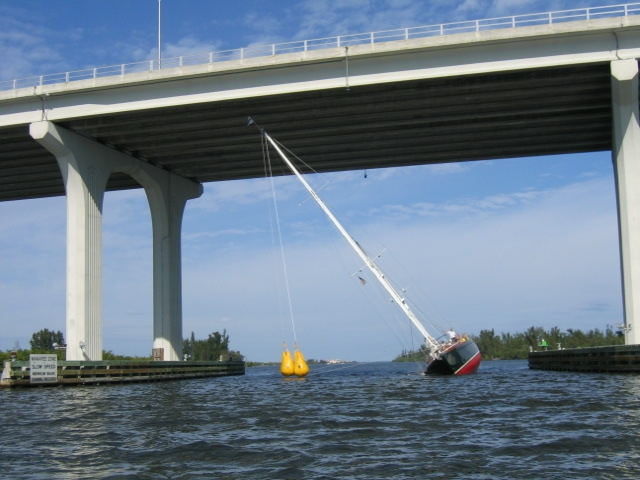
The story was reported in UK’s The Daily Mail newspaper nearly three years ago. So I shall take a chance and republish it for you.
Beats going the long way round! How sailors got their 80ft mast under 65ft bridge
By DAILY MAIL REPORTER
UPDATED: 11:04 EST, 20 September 2011It may not look like an entirely safe practice – but it sure beats going the long way round.
These sailors came up with an ingenious way to get their boat – complete with 80ft mast – under a 65ft bridge on the Intracoastal Waterway. A video posted on YouTube shows how the sailors keeled the boat over by dangling containers filled with two tons of water from the mast.
But it is not a solution for the faint hearted.
Any miscalculation with the weight has the potential to send the whole boat crashing into the water.
The sailor ‘hunterparrot’ who posted the video said he initiates the roll by fixing the containers to the mast and slowly turning to port. The severity of the roll is then controlled by letting the ropes affixed to the mast out gradually with a cockpit winch.
The intracoastal waterway is a 3000-mile network of waterways that run up the Gulf and Atlantic coasts of the U.S. It runs from New Jersey, around Florida to Texas.
Follow us: @MailOnline on Twitter | DailyMail on Facebook
The photographs in that Daily Mail article may be viewed here.
Then across on the forums of the Wooden Boat Magazine was this:
Really? If the bridge clearance is 65 feet and the mast height is 80 feet, then the cosine of the heel angle would be 65 / 80. This corresponds to a heel angle of about 36 degrees; the mast is 54 degrees above the horizontal. Still, a pretty impressive maneuver.
If the bags are full of water, then his setup is self-limiting. As the bags start to immerse, the pull on the halyard is reduced. This means he would be nearly unable to capsize unless he winches the bags WAY too high. I think he has done this trick before.
I think the reason he is sitting on the high side is twofold: He can see the masthead more easily and it is more comfortable
The weight of one person really doesn’t make much difference when you are trying to heel that big a boat that far.
If someone had to do this sort of trick a lot, would it be worth putting a small video camera on the top of the mainmast? This would make it easier to judge clearance.
God bless!
Wayne
The link to that forum discussion is here.
Finally, watch the video!
You all have a wonderful Mid-Summer’s Day and …. duck your head when passing under that low bridge! 😉
 Learning from Dogs
Disruptive innovation, a term of art coined by Clayton Christensen, describes a process by which a product or service takes root initially in simple applications at the bottom of a market and then relentlessly moves up market, eventually displacing established competitors.
As companies tend to innovate faster than their customers’ needs evolve, most organizations eventually end up producing products or services that are actually too sophisticated, too expensive, and too complicated for many customers in their market.
If you are interested by more information, you can read my article on Disruptive innovation you can read at: http://worldofinnovations.net/2014/06/21/what-is-a-disruptive-innovation/
LikeLike
Olivier, thanks for your comment and link and welcome to this place. Good to make the connection. Just been across to your article and found it interesting.
LikeLike
Thanks Paul. Don’t hesitate to read other articles on my site: http://www.worldofinnovations.net . It will be a pleasure for me if you have any comment. See you soon.
LikeLike
The ultimate disruptive innovation is science, nothing money can buy.
BTW, the trick has got to be well known, as it’s relatively safe, being self limiting.
LikeLike
Great picture and Vid, I had never seen this done before Paul so was quite intrigued by it.. 🙂
LikeLike
Delighted!
LikeLike
The Royal Navy would just have un-stepped the topgallant…
LikeLike
Marius, but then the bridge wouldn’t have been there!!
Lovely to see you in this place and hope there will be other times.
Best wishes.
LikeLike