A real pleasure and privilege to republish this article from Mr. Monbiot.
For some time now I have subscribed to the articles published by The Permaculture Research Institute of Australia. From time to time references have been made to PRI articles here on Learning from Dogs.
Recently, I read a PRI essay that had been penned by George Monbiot. It was called The Great Unmentionable. It blew me away. So I took a deep breath and dropped George M. an email asking if I might republish it here. George was very gracious in giving me such permission.

First some background to George Monbiot for those who are unfamiliar with his work and his writings. As his website explains:
I had an unhappy time at university, and I now regret having gone to Oxford, even though the zoology course I took – taught, among others, by Richard Dawkins, Bill Hamilton and John Krebs – was excellent. The culture did not suit me, and when I tried to join in I fell flat on my face, sometimes in a drunken stupor. I enjoyed the holidays more: I worked on farms and as a waterkeeper on the River Kennet. I spent much of the last two years planning my escape. There was only one job I wanted, and it did not yet exist: to make investigative environmental programmes for the BBC.
After hammering on its doors for a year, I received a phone call from the head of the BBC’s natural history unit during my final exams. He told me: “you’re so fucking persistent you’ve got the job.” They took me on, in 1985, as a radio producer, to make wildlife programmes. Thanks to a supportive boss, I was soon able to make the programmes I had wanted to produce. We broke some major stories. Our documentary on the sinking of a bulk carrier off the coast of Cork, uncovering evidence that suggested it had been deliberately scuppered, won a Sony award.
Anyway, to the article in question that was published on the Guardian Newspaper’s website, 12th April 2013.
oooOOOooo
The Great Unmentionable
April 12, 2013
We have offshored both our consumption and our perceptions
By George Monbiot
Every society has topics it does not discuss. These are the issues which challenge its comfortable assumptions. They are the ones that remind us of mortality, which threaten the continuity we anticipate, which expose our various beliefs as irreconcilable.
Among them are the facts which sink the cosy assertion, that (in David Cameron’s words) “there need not be a tension between green and growth.”
At a reception in London recently I met an extremely rich woman, who lives, as most people with similar levels of wealth do, in an almost comically unsustainable fashion: jetting between various homes and resorts in one long turbo-charged holiday. When I told her what I did, she responded, “oh I agree, the environment is so important. I’m crazy about recycling.” But the real problem, she explained, was “people breeding too much”.
I agreed that population is an element of the problem, but argued that consumption is rising much faster and – unlike the growth in the number of people – is showing no signs of levelling off. She found this notion deeply offensive: I mean the notion that human population growth is slowing. When I told her that birth rates are dropping almost everywhere, and that the world is undergoing a slow demographic transition, she disagreed violently: she has seen, on her endless travels, how many children “all those people have”.
As so many in her position do, she was using population as a means of disavowing her own impacts. The issue allowed her to transfer responsibility to other people: people at the opposite end of the economic spectrum. It allowed her to pretend that her shopping and flying and endless refurbishments of multiple homes are not a problem. Recycling and population: these are the amulets people clasp in order not to see the clash between protecting the environment and rising consumption.
In a similar way, we have managed, with the help of a misleading global accounting system, to overlook one of the gravest impacts of our consumption. This too has allowed us to blame foreigners – particularly poorer foreigners – for the problem.
When nations negotiate global cuts in greenhouse gas emissions, they are held responsible only for the gases produced within their own borders. Partly as a result of this convention, these tend to be the only ones that countries count. When these “territorial emissions” fall, they congratulate themselves on reducing their carbon footprints. But as markets of all kinds have been globalised, and as manufacturing migrates from rich nations to poorer ones, territorial accounting bears ever less relationship to our real impacts.
While this is an issue which affects all post-industrial countries, it is especially pertinent in the United Kingdom, where the difference between our domestic and international impacts is greater than that of any other major emitter. The last government boasted that this country cut greenhouse gas emissions by 19% between 1990 and 2008. It positioned itself (as the current government does) as a global leader, on course to meet its own targets, and as an example for other nations to follow.
But the cut the UK has celebrated is an artefact of accountancy. When the impact of the goods we buy from other nations is counted, our total greenhouse gases did not fall by 19% between 1990 and 2008. They rose by 20%. This is despite the replacement during that period of many of our coal-fired power stations with natural gas, which produces roughly half as much carbon dioxide for every unit of electricity. When our “consumption emissions”, rather than territorial emissions, are taken into account, our proud record turns into a story of dismal failure.
There are two further impacts of this false accounting. The first is that because many of the goods whose manufacture we commission are now produced in other countries, those places take the blame for our rising consumption. We use China just as we use the population issue: as a means of deflecting responsibility. What’s the point of cutting our own consumption, a thousand voices ask, when China is building a new power station every 10 seconds (or whatever the current rate happens to be)?
But, just as our position is flattered by the way greenhouse gases are counted, China’s is unfairly maligned. A graph published by the House of Commons Energy and Climate Change Committee shows that consumption accounting would reduce China’s emissions by roughly 45%. Many of those power stations and polluting factories have been built to supply our markets, feeding an apparently insatiable demand in the UK, the US and other rich nations for escalating quantities of stuff.
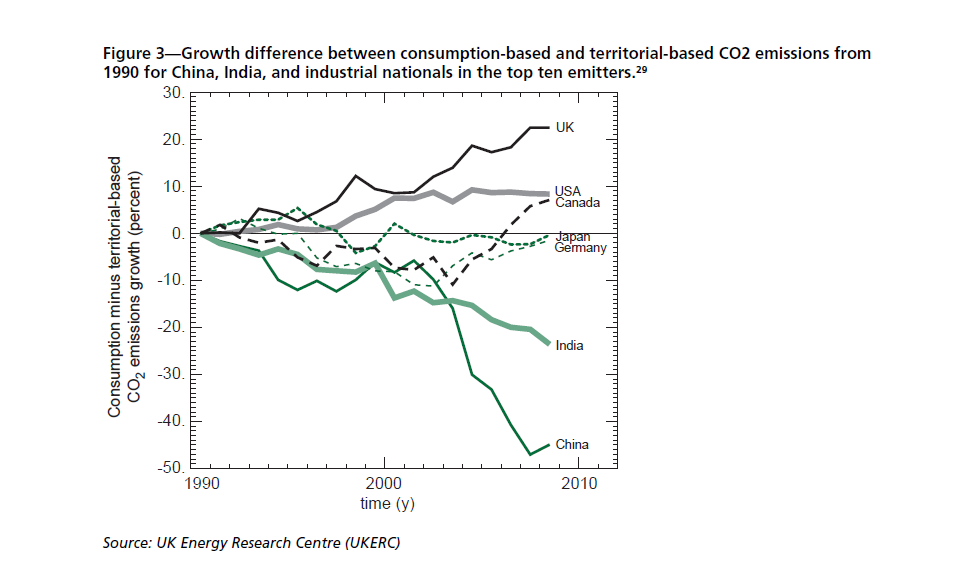
The second thing the accounting convention has hidden from us is consumerism’s contribution to global warming. Because we consider only our territorial emissions, we tend to emphasise the impact of services – heating, lighting and transport for example – while overlooking the impact of goods. Look at the whole picture, however, and you discover (using the Guardian’s carbon calculator) that manufacturing and consumption is responsible for a remarkable 57% of the greenhouse gas production caused by the UK.
Unsurprisingly, hardly anyone wants to talk about this, as the only meaningful response is a reduction in the volume of stuff we consume. And this is where even the most progressive governments’ climate policies collide with everything else they represent. As Mustapha Mond points out in Brave New World, “industrial civilization is only possible when there’s no self-denial. Self-indulgence up to the very limits imposed by hygiene and economics. Otherwise the wheels stop turning”.
The wheels of the current economic system – which depends on perpetual growth for its survival – certainly. The impossibility of sustaining this system of endless, pointless consumption without the continued erosion of the living planet and the future prospects of humankind, is the conversation we will not have.
By considering only our territorial emissions, we make the impacts of our escalating consumption disappear in a puff of black smoke: we have offshored the problem, and our perceptions of it.
But at least in a couple of places the conjuring trick is beginning to attract some attention.
On April 16th, the Carbon Omissions site will launch a brilliant animation by Leo Murray, neatly sketching out the problem*. The hope is that by explaining the issue simply and engagingly, his animation will reach a much bigger audience than articles like the one you are reading can achieve.
(*Declaration of interest (unpaid): I did the voiceover).
On April 24th, the Committee on Climate Change (a body that advises the UK government) will publish a report on how consumption emissions are likely to rise, and how government policy should respond to the issue.
I hope this is the beginning of a conversation we have been avoiding for much too long. How many of us are prepared fully to consider the implications?
oooOOOooo
So very difficult to pick out the sentence that carried the most power, for the essay is powerful from start to end. But this one did hit me in the face, “The impossibility of sustaining this system of endless, pointless consumption without the continued erosion of the living planet and the future prospects of humankind, is the conversation we will not have.“
Finally, I can’t resist reminding you, dear reader, of the point made by Prof. Guy McPherson in his book Walking Away from Empire, which I reviewed on March 6th. particularly in the first paragraph of the first chapter; Reason:
At this late juncture in the era of industry, it seems safe to assume we face one of two futures. If we continue to burn fossil fuels, we face imminent environmental collapse. If we cease burning fossil fuels, the industrial economy will collapse. Industrial humans express these futures as a choice between your money or your life, and tell you that, without money, life isn’t worth living. As should be clear by now, industrial humans — or at least our “leaders” — have chosen not door number one (environmental collapse) and not door number two (economic collapse), but both of the above.
Maybe this is why we seem unable to have the conversation because to do so means we have to look at ourselves in the mirror. Each one of us, you and me, has to address something so deeply personal. Back to Prof. McPherson and page 177 of his book (my emphasis):
It’s no longer just the living planet we should be concerned about. It’s us. The moral question, then: What are you going to do about it?
For my money, Mr. Monbiot is yet another voice of reason in the wilderness; another voice that deserves to be followed. I say this because by way of introduction to his philosophy, he opens thus:
My job is to tell people what they don’t want to hear. That is not what I set out to do. I wanted only to cover the subjects I thought were interesting and important. But wherever I turned, I met a brick wall of denial.
Denial is everywhere. I have come to believe that it’s an intrinsic component of our humanity, an essential survival strategy. Unlike other species, we know that we will die. This knowledge could destroy us, were we unable to blot it out. But, unlike other species, we also know how not to know. We employ this unique ability to suppress our knowledge not just of mortality, but of everything we find uncomfortable, until our survival strategy becomes a threat to our survival.
“… until our survival strategy becomes a threat to our survival.”
I sense the growing of this threat to the point where maybe within less than a year the vast majority of open-minded, thinking individuals know the truth of where we are all heading.
 Learning from Dogs
Consumption means products which are unwanted and low quality end up in landfill which produces methane, a greenhouse gas.
LikeLike
Excessive consumption really is the core of the problem. Thanks for your comment, Alex.
LikeLike
The real problem is: how do we control the plutocracy that control most people’s mind? Time for a revolution! But a political revolution has to be preceded by a revolution of critique. That’s what happened in France and Britain, starting with Henri IV’s “chicken in every pot”, then extending with the “Glorious Revolution”, then the entire “Enligthment” culminating with the Franco-American revolution.
Nowadays, though, we have only a few years to go through the whole thing.
BTW this Monbiot is very nice, makes for pleasant reading in well versed society. Yet, what about a solution?
I have long suggested a solution: WORLD WIDE CARBON & SOCIAL TAX.
What we call globalization is, all too much, just plutocratization. Time to remember that, when the USA was great, there were no tax havens and the top margin tax rate was 94%. yes; ninety-four percent.
They lied about austerity and debt. They are lying about austerity and debt.
I wrote several essay on the subject in the last ten years. The early essays had strictly no comments. Now, it turns out the most esteemed Harvard professors were lying..Including who was widely (widly?) acclaimed as the ‘most influentila economist in the world” (Times Magazine). Turns out, the lady is a crook paid by a billionaire (Pete Peterson).
(Some) documentation in my latest essay:
http://patriceayme.wordpress.com/2013/04/20/indebted-to-lies-plutocracy-is/
talking about climate is great. we all know about climate. Talking about why nothing is done about it is better. Talking about the neo-feudalism that is taking over, creating crises all over, is best.
It’s the difference between catching the rattlesnake behind the head, and tickling its rattling device. So I congratulate you, Paul, and encourage you to pursue this avenue. The avenue of causation.
PA
LikeLike
Patrice, just read your fulsome comment aloud to Jeannie. We both find your words and thoughts inspiring. You may find me creeping up to you requesting a guest post. 😉
LikeLike
Excellent juxtaposition with Alfred Bartlett’s presentation on ‘Arithmetic, Population and Energy’. In the context of what Monbiot has written here, Bartlett’s key point was that the biggest population problems are the modest rates of growth in the most wealthy countries – not the rapid growth in the poorest countries – because per-capita rates of consumption in one are 30 times that in the other. With regard to Monbiot, I would agree that the sentence you picked out was/is the most powerful.
LikeLike
Yes, Bartlett’s presentation is key and reading your post and, especially, the comments showed how truly frightening the numbers are.
Will link to your post as soon as I am in front of a real computer rather than this kindle. [Now done: 08:13 PDT]
LikeLike
George’s essay is a statement of facts- really quite simple ones but what is also quite evident is that MSM and mainstream thought is one in denial. Articles that point out the limits to growth are appearing in the pages of the Guardian and Huff post by these are behind front pages that show more concern about the lack of growth in the economy and lack of spending on health or the lack of income for working families.
I what I find more disturbing [and I am formulating an up coming post] is the rise of popularism- it is the notion of ‘common sense’ politics, of ‘well known facts’ and generally pernicious myths. Fox News or the Telegraph or any other ‘right wing’ outlet perpetuate such nonsense but they are appealing to a public who see in black and white rather than the many colours that make up our complicated world. If peak oil is difficult to accept then reject it and blame rising prices on ‘greens’ or big government or corporate greed.
Popularism leads to some pretty nasty form of politics- the Tea Party, the neo-fascism of Europe, Ukip – which are quickly brought into the fold of capitalism the moment that it looks like they will gain power [the Night of the Long Knives in 1930s Germany is worth researching]. But it is also easy for those who are green sympathisers to believe their own mythology that as long as they recycle and buy fairtrade and have eco-holidays in a rainforest somewhere that their car mileage is negated.
The political challenge ahead is not just about bringing transition but confronting a popular desire to believe that it is not their problem and if it is – that is someone else’s fault.
LikeLike
Just seen your long and comprehensive comment but won’t have time to read it properly until early tomorrow. Nonetheless, big thanks to you.
LikeLike
Jules, very pertinent comment. There is, indeed, a level of denial that is almost impossible to credit. We glibly rattle on about green this and recycle that but the degree of reduction in consumption needed, and needed now, is scary.
Jean and I were talking about this last night after watching a Nat. Geo. video on global ice melting. The odds are that we are locked into a lifestyle that voluntarily we couldn’t change. Like millions (billions?) of others.
LikeLike
Hi Paul,
This is such an excellent share, thank you for asking his permission to post his article on your blog. I am going to assume that reblogging your post with his article included is not a problem since he gave you permission to share it?
I truly appreciate how Mr. Monbiot helps burst the bubble of individual and national irresponsibility by attacking the lazy -often racialist- viewpoint that we in the post-industrial world shouldn’t stop what we are doing because the developing world is really the problem. And of course, how often have we seen how different forms of accounting can enable people and institutions to hide or showcase unconnected data fragments to paint a rosy, robust and more profitable picture?
What I like best about this is how humane his purpose is. We (I use “we” perhaps too generically here, I admit) should avoid blaming others and looking down our noses at countries and peoples trying to alleviate their own condition. We should also realize how our consumption is driving so much of the polluting behaviour we self-righteously decry and then wash our hands of. Consumption is definitely key.
LikeLike
Yes, you are spot on. When we view the world from the perspective of consumption, the picture is very different. A perspective that allows few of us to feel comfortable.
Thank you for that feedback.
LikeLike
Reblogged this on The Sand County and commented:
An excellent blog posting from a blog I admire. I highly recommend reading George Monbiot’s article “The Great Unmentionable” which Paul Handover got permission to share here. I think it is a must-read.
LikeLike
Thanks Jeremy.
LikeLike