Some of life’s lessons are easy to learn – once we have been taught!
Readers be warned! This is one of my more subjective posts written in the hope that many will ‘connect’ with the emotions expressed.

I want to explore the power of touch.
Not just in a direct manner such as a hug or an arm around the shoulder but also the way that love can reach out and ‘touch’ us from afar. I’m going to do that by recounting something that Jean and I have experienced over the last couple of weeks. Here we go!
A while after we had moved to Payson in February, 2010 both Jean and I noticed that I was getting forgetful. Initially we thought it was just a characteristic of the vestibular migraine that I was diagnosed with in 2009 but eventually it seemed a good idea to have a local doctor here in Payson check me out. That examination took place last April 24th., a little over two weeks ago. The doctor dropped a huge bombshell in our laps by saying that she thought that I was exhibiting signs of early-onset Alzheimer’s Disease!
To say that I was shocked was an understatement. Jean was beside herself with worry as her late American husband, who had died in 2005, had suffered badly from Alzheimer’s Disease for his last two years. We had 48-hours of wall-to-wall worry!
A few days later, I was getting very angry at the lack of gentleness in the way that the doctor had spoken to me. Jean had the brilliant idea of contacting a retired doctor friend. His response was loud and clear; he advised me to get a second opinion and continued by recommending a neurologist that he knew well. That appointment was held this last Tuesday, May 8th, down in Phoenix.
The neurologist asked me many questions, including such verbal tests as how many animals can you name in a minute, spell the word ‘world’ backwards, deduct 7 from 95 (and then keep deducting 7 from the resultant answer!!), and then undertook a physical examination including co-ordination skills, blood flow in the neck and other relevant aspects.
All of which lead him to the conclusion that I was not showing any signs of dementia. My forgetfulness was normal for someone of my age (67 last birthday) especially taking into account all the life changes of the past few years.
Then the neurologist went on to warn me about anxiety. He said it was a ‘killer’ of healthy bodies and healthy minds, especially as we got older. So my anxiety over my sister’s dementia, my half-sister living in Devon, England, whom I am very close to, is now badly affected by vascular dementia and got me thinking I might be following in her path, and my anxiety over thinking my life now was ‘too good to be true’, was getting in the way of me being a relaxed, ‘go with the flow’ individual.
Thus a couple of extremely stressful and worrying weeks came to a most wonderful conclusion; an outcome that couldn’t have been better. The degree of emotional and psychological disruption that Jean and I have been through was not however without some major lessons being learnt.
Being scared – I’ve always taken for granted that I would have good health throughout my life, aided and abetted by the fact that I have never been admitted to hospital and have avoided serious illnesses. The first doctor’s so-called diagnosis was one giant slap-in-the-face especially realising that the future in store could be a steady decline in my cognitive skills.
For the first time in my life I was truly scared and last Monday, the day before the visit to the neurologist, I broke down in Jean’s arms saying how scared I was. Revealing such vulnerability was not easy for me but being held by Jean under those circumstances was deep and pure bliss. As the saying goes, ‘If one doesn’t run the risk of being lost, then one can never be found.’
Love and friendship – The number of people that came up to Jean and me, gave us big hugs and said that they would be thinking of us during our trip down to Phoenix last Tuesday was indescribably beautiful. So many showed such a depth of feeling for what Jean and I were going through. Many others from distant places sent encouraging emails or telephoned. It all amounted to preventing us from feeling alone and reinforced our determination that whatever the medical outcome, we would find a way of handling it.
The power of the mind – my brother-in-law, in a recent telephone call, said that once the mind latches on to an idea, it does everything it can to reinforce that idea, however illogical it may be. Thus over the last couple of weeks, every time I dropped something, or forgot where I had put my glasses, or wasn’t clear which day of the week it was, and on and on, I used that as ‘proof’ that I was rapidly losing my mind. It should serve as a strong warning that we can literally think ourselves into a crisis!
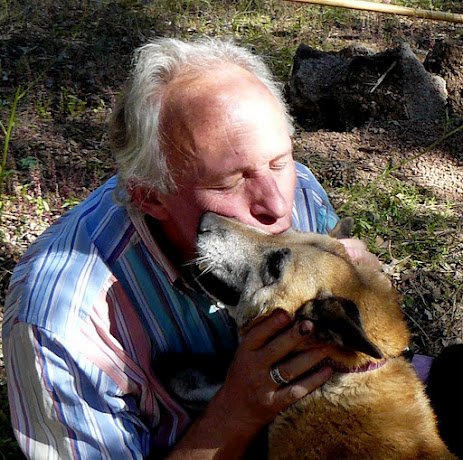
The love between a dog and a human – hugging a dog when one is feeling emotionally vulnerable is beyond measure. Dogs always sense when we humans are feeling fragile and they offer their uncomplicated hearts to us without any condition or need for return. That selfless love is an inspiring example of what we all need to learn to give one another.
Touch and social intimacy – we have so much to learn from dogs when it comes to touch and social intimacy. We are all needy for touch.
Which leads me providentially to a recent item from Terry Hershey. Terry came to Payson in March, 2011 and he was a most inspirational speaker. I have followed him ever since.
Last Monday’s Sabbath Moment included the following story, republished with Terry’s kind permission – the story is all about touch!
Caroline was very sad. Caroline was only six years old and her father had just died. In fact, her father had been assassinated.
Sitting in the back of big black limousine, Caroline Kennedy didn’t quite know what to do with her sadness. On the seat next to her sat her nanny, Maud Shaw, and next to Maud, Caroline’s younger brother John.
Through the windshield Caroline could see her mother, Jackie, and her uncles, Robert and Ted, walking in front of the limousine as it slowly made it’s way down the Boulevard to St. Matthew’s Cathedral. Looking out of her side of the car, Caroline recognized the friendly face of Secret Service agent, Robert Foster. She liked and trusted Robert Foster.
Not knowing what to do with her sadness, and on impulse, she rolled down the window and stuck out her six-year old hand. Agent Foster had a choice to make. Secret Service agents are not allowed to have their hands occupied, needing to be ready for any emergency. But Robert Foster didn’t even think twice. He held Caroline’s hand tightly the entire way to the cathedral.
Later, Agent Foster said it was all he could do to “fight back his own tears of sadness, for little Caroline Kennedy.” When asked about his kindness, he seemed surprised, “All I did was hold a hand,” he answered.
Terry then goes on to say,
We all know sadness. Life breaks for each one of us in different ways and in different places. And sometimes the sadness seems too much to carry.
It requires courage to roll down the window, to connect or ask or invite. For whatever reason, there is a knee-jerk need to deny any sadness, or dismiss it, or apologize for it. “I’m sorry,” people will say, wiping away their tears, as if their sadness is a violation of some tenet of propriety. Heaven forbid if any humanity is exposed.
So sometimes I am afraid to ask. Not sometimes; most times. I don’t want to appear weak. Asking for help is a hard pill to swallow.
I spent Saturday in Clearwater, Florida, with a group talking about intimacy and communication. (Yes, it is easier to talk about than to practice.) Here’s what I told the group.
If we don’t bring it with us, we’re not going to find it there. Which means intimacy–trust, vulnerability, authenticity, honesty–begins here.
With me. With this me.
I was raised in a religious environment that taught me to eradicate my messiness (to quash my sadness or grief or untidiness).
I now believe differently. I now know that we find and express acceptance, love and grace (the place where we can be fully human), in our messy, imperfect, and fully thorny selves. In other words: We can embrace this life–without any need to photoshop it.
To be human is to be vulnerable. I am capable of being wounded and cut and sad… which also means that I am capable of being kind and generous and present.
In such moments of heartache, I can have the courage to ask for a hand to hold.
In such moments of heartache, I can have the courage to hold a hand the needs to be held.
Robert Foster didn’t think twice about holding a hand that needed to be held. And he wasn’t posturing or amassing heavenly brownie points. He was doing what needed to be done.
Here’s the deal: we don’t need more remedies or advice. We need more touch. We become more human when we touch. Why? Because when we touch, we are seen. And when we are seen, we recognize that our value is not tied solely to our sorrow.
And we, you and I, will find no better lesson to learn from our beautiful canine friends, than this lesson of touch.
 Learning from Dogs
Dear Paul (and Jean),
The last two weeks have clearly been horrendous; and your honesty and openness in recounting the whole thing – and the lessons learnt – is truly humbling. I hope that doing all this proves to be the cathartic; it certainly deserves to be so.
With love and best wishes to you both (and the entire household),
Martin.
LikeLike
Martin,
Thank you for your kind and sympathetic thoughts. I should add that the dog in the lower picture is a Mexican rescue dog that Jean took in many years ago. Her name is Loopy in recognition of the great difficulty that Jean had in even getting sufficiently close to Loopy in order to stroke her; it took Jean 6 months before Loopy would allow Jean to touch her. It took me a year before Loopy fully trusted me. That shows the degree to which this soft, lovely dog was beaten up by unknown dregs of Mexican society!
Once again, thank you for your comment, Paul
LikeLike
I’m so glad you have had a positive outcome in your diagnosis — and as Martin says above , thank you for your openness in sharing this with us. I’ve read on numerous occasions that animal companions, especially dogs, provide measurable improvement in health and lifestyle as we age. Best wishes to you and Jean, Wen
LikeLike
Dear Wendy,
In so many ways we are all so interconnected. Ergo, me being able to share my thoughts is only made possible by the warmth of so many regular readers in this place. Paul
LikeLike