Technology is so much more than bits and bytes.
Recently had the opportunity to visit a factory belonging to Horst Engineering in the nearby town of Guaymas (pronounced whymas), Sonora, Mexico. The factor manager is an American, Andy Law, who, with his lovely wife, lives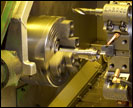 across the road.
It is simply ages since I have seen a precision engineering factory at work. Not only was I impressed but it took me on a long trip down memory lane, with a couple of strands: engineering tools and the British defence industry.
But before the reminisces, a word about the calibre of the young Mexicans working for Andy. Unlike so many of the locals who one comes across, these bright, young men and women are committed, self-motivated, multi-lingual (Sp/Eng) citizens. It was a treat to observe them and hear Andy speak so highly of them. Mexico sorely needs up-coming generations of highly capable people.
Anyway, off down the lane; are we sitting comfortably?
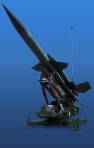
My first job at the tender age of sub-21 was as a Commercial Apprentice for the Guided Weapons Division of the British Aircraft Company at Stevenage, Hertfordshire, about an hour north of London. But all apprentices, commercial and engineering, had to spend a full year in the apprentice engineering workshop which was attached to the main shop floor. Through the windows we could see the manufacture of the Bloodhound Surface to Air missile and a wire-guided anti-tank missile, whose name I forget (Swingfire?).
That year was great. A group of about 20 young men who would skylark at the drop of a hat but steadily over that year learnt to use lathes, milling machines, cutters and grinders, surface harden, weld, braze, cast and much more.
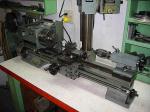
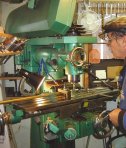
These pictures are approximately the sort of engineering machines that were around in the 1960s. They sprayed cutting fluid all over the place, shards of turned metal grew in piles and, so it seemed, most of the time was spent changing cutting tools and adjusting the material to be worked on. Any piece that had to be finished minus nothing/plus (say) 2 thou (thousanth’s of an inch) meant constant stopping the machine and careful measurement with a micrometer.
Now compare those to this:
(You don’t need to view all 3.5 minutes to get the point!)
The British Aircraft Company was a government inspired amalgamation of various, famous players in the aerospace industry in the hope that consolidation would further Britain’s defence interests. There were two divisions: Aircraft: Guided Weapons, the latter at Stevenage. One of the players was English Electric that made the Lightning supersonic jet fighter, an extraordinary aircraft that will be the subject of a further Post.
Anyway, one of our treats during our year as an apprentice was, from time to time, to be allowed on to the shop floor – always with the approval of the union shop steward! I still recall a stupid question of mine.
The Bloodhound missile had tiny generators (electric or hydraulic, I can’t remember). These were generators about two inches long and, say, an inch and a half in diameter and the impeller was spun by a tiny bleed of combustion gas from the main rocket engine. My memory is hazy but I recollect that these generators spun at high speeds: 50,000 RPM comes to mind.
So, temporarily forgetting that these generators were part of a missile, muggins pipes up and asks, “The bearings must be amazing to handle those sorts of rotational speeds.” To which came the reply, “They are not designed to last for very long!” Guess who bought the beers that evening!
Anyway, let me close by including a promotional video produced to promote Sonora, Mexico as a destination for aerospace manufacturers in which Andy Law of Horst Engineering appears a couple of times.
(Bet you didn’t read to the end of this one, Nigel!)
By Paul Handover


Paul,
What an interesting coincidence that you posted this piece on “Precision engineering” on the same day as your fulsome piece about me: I, like you, was once an apprentice.
In the last year or so of school, I was “disillusioned” and was only just persuaded to stay long enough to complete “A” (and “S”) levels. After messing about for a few months, to the concern of my parents, and fancying myself as a future sound engineer, I got a job with EMI in Hayes, Middlesex as an “electronics technician apprentice”. Now this was in the days when EMI was a great company, producing much more than records: there were also military and medical electronics divisions.
It was 1972, I was 17 and the pay was less than £10 per week, much of which was spent on digs. I was a bit different from the others, but had greasy hair down to my shoulders, so I fitted in quite well!
I thoroughly enjoyed it. We were in the “apprentice training school” for almost a year and learnt all the things that you listed as well as various electrical/electronic skills and engineering drawing. We also did a part-time (one day per week) ONC at a college in Southall … which I failed!
That video of the NC machine reminds of workshop japes involving the feeds on lathes. We would set it up so that the tool was being fed towards a shoulder and would dare one another to keep our hands in our lab coat pockets for as long as possible before whipping them out to disconnect the feed before it crashed into the shoulder (no easy task because it was not a lever, but a clutch operated by a knob which had to be turned by an indeterminate amount to disengage it)!
The training department were regularly asking me whether I would like to go to university, but I was having fun learning new skills: milling machines held a particular fascination for me for some reason. Eventually the training people started to make sense to me and in October 1973, I started a 4 year “thin sandwich” degree course in Applied Physics at Bath University, throughout which EMI sponsored me. And I went on to work in their Central Research Laboratories (an institution with a great track record) for more than another two years. So I worked for EMI for over 7 years in all.
Thanks for posting this. It brought back some great memories. There must be thousands of people who were trained as apprentices in similar companies during that era.
By the way, in reference to another topic that you mention, as an air cadet at school I spent a summer camp at RAF Wattisham, Suffolk, where there was a squadron of Lightnings. Those pilots believed that they had the best job in the world, bar none. (The only other pilot I have met with the same belief flew an F-18!)
Also, I now know a man who flew Lightnings; he expressed a similar feeling when he told me that the main problem in his career was that by the age of 27, he had done everything that he wanted to do! When I mentioned the type, without knowing that he had flown them, his wistful comment was: “ah, the last of the great sports cars!”, which must be one of greatest aviation understatements! He is also, I am told, the only person to have landed a Lightning with both engines out! Given the wing loading, I believe that that is akin to flying a brick: the “high key” is very high! He tells a very interesting story about that … and other incidents, of course.
Anyway, Paul, thanks for bringing back some great memories,
John
LikeLike
Hi John,
You know I had forgotten that caper about auto feeds on the lathes. We use to do that as well. I well recall the apprentice manager get really uptight when it was misjudged and the poor trainee was tasked, in his own time, of rebuilding the lathe!
Ditto re the milling machines – my favourite as well. There was something deeply satisfying to blue mark up a ‘high’ on a work piece, perhaps 0.5 thou high, and then set the mill to skim it off.
As you say, happy days!
Paul
LikeLike