Tag: Arizona

Meet the dogs – Paloma.

Too obvious an idea!

It was all Jean’s fault!  In that the other day I was talking to her about ideas for posts for Learning from Dogs and Jean suggested a series featuring each of the nine dogs that we have here in Oregon.  Considering that this blog is called what it is, for that idea to surface some 2,000 posts and over 4 years after the blog first started says something about yours truly that I’d rather not pursue!

Paloma

Here are a couple of photographs taken of Paloma just two days ago.

Paloma, Oregon, January 26th, 2014.

oooo

P1140263

oooo

Now, as it happens, some time ago there was a post about Paloma published here. Here it is republished some two years later.

ooOOoo

Preface.

Before I met Jean in December 2007, she had been rescuing feral dogs in the Mexican beach town of San Carlos for many, many years. Over those years, Jean must have rescued and found homes for 60 dogs or more.  In the month that I met Jean, she had 12 dogs and 6 cats at her home.  Ten months later, September 2008, I flew out to be permanently with Jean with my German Shepherd, Pharaoh – that’s him on the home page of Learning from Dogs – taking the total up to 13 dogs.

When we moved up to Payson, Arizona in February, 2010 we brought all 13 dogs and 6 cats with us, much to the amazement of the US Immigration officers at the US-Mexican border town of Nogales!  Indeed, our particular officer left his booth excitedly to explain to his colleagues that our dogs and cats represented a border crossing record!

oooo

Paloma, December 29th 2011

Paloma

The old white dog padded down the dusty pavement. Sway-backed and dull-eyed, her teats, heavy with milk, grazed the ground. An anonymous creature in a cruel world. The pavement sizzled in the afternoon Mexican summer sun blistering her tired feet, but she could not hurry. She had to conserve her energy. Her pups were soon coming and finding a safe place to give birth to them was her priority. The beach that had been her home was not a good place. .. needed cool shelter. She would find it.

She was alone among a sea of human legs in this scruffy Mexican beach town. No-one noticed her plight. No-one cared. She was used to it. She had long been adept at finding dried fish, discarded tortillas, sometimes a tasty morsel thrown by a tourist sunning in front of the big hotel.

This would be her eighth litter and she was very tired. As a puppy she belonged to a family with small children. There were plenty of leftovers. But when she became pregnant they drove her to the beach, threw her out and left her to fend for herself.

Her babies were always beautiful. She had Labrador in her genes donating a coat that was pure white. Humans always took her pups; she could only ever hope their fate was always a better one than hers.

Anonymity. She had perfected the art; never make eye contact, move low to the ground, escape the stray kick with a quick sideways leap.

She remembered at the very end of the long beach there was a house with a pool. Plenty of water. Onward she padded.

The lawn surrounding the pool was moist with sprinklers and the hibiscus hedge close to the house made a safe nest. Soon she had dug into the damp earth a big enough hole to curl into; it was cool under the canopy of red flowers.

A human voiced shouted, “Carlos, get that dog out of the hedge.” Then the long hose filling that tempting pool was turned on her and a burst of water hit her in the face. She uttered a low growl. Carlos, the gardener, backed away, “Señor, the dog, she is having babies.”

The owner of the house turned abruptly and went inside. He picked up his phone, made a call to the local English lady who over the years had acquired the nickname ‘Dog Lady’. He practically shouted down the phone, “I have a dog in my hedge having pups. You had better do something about it or I shall dispose of them, and I won’t be pretty about it!”

‘Dog Lady’ was used to this. Had been many years since she took on the practically impossible task of rescuing Mexican feral dogs and she was well-known for never turning a dog away. In less than 15 minutes, she had walked to the fine house overlooking the beach and quietly looked under the hedge. As anticipated, the dog was incapable of being moved, her focus entirely now on the safe birth of her pups. With appropriate feminine wiles, the white dog’s human saviour persuaded the disgruntled owner to allow the mother dog a stay of a few days. ‘Dog Lady’ promised that she would take them away as soon as possible.

“She’s a mean and wild dog, you’ll never tame her,” came the angry response from the house owner.

‘Dog Lady’ just smiled and said nothing.

But every day she took food to the white dog then sat quietly close by on the grass reading her book. The white dog had just the one pup, which ‘Dog Lady’ called Solovino, the Spanish for ‘comes alone’. The mother dog she called Paloma, Spanish for ‘Dove’. Many white dogs in Mexico were called Paloma and maybe years earlier that was what the children named her as the name did seem to resonate with this gentle dog.

Patiently, ‘Dog Lady’ moved closer and closer until Paloma would take meat from her hand, rapidly followed by allowing her ears to be caressed. Ten days later, while Paloma was eating, ‘Dog Lady’ picked up the little Solovino and put him into her car. Paloma’s response was immediate; she frantically ran to her child, her mothering instinct so great that she leapt without hesitation into this strange vehicle. Paloma and Solovino were safe.

The house owner graciously admitted that he had been taught a lesson in empathy and how sorry he was for being so rude and cruel.

Back at ‘Dog Lady’s’ home, a quiet sanctuary for so many dogs over the past years, Paloma and Solovino were quickly settled into a cool room. Paloma soon utterly trusted her ‘Dog Lady’ human companion and became the tame and loving dog she always wanted to be. Her shining eyes embraced her new world and she even regained her figure! Solovino grew quickly and found a wonderful family home in Tucson, Arizona.

Now some 6 years after ‘Dog Lady’ rescued Paloma from under that hedge, she is a beloved part of the Handover family. Indeed, she travelled in peace in February 2009 with her twelve dog friends from her sanctuary in San Carlos, Mexico to this dog paradise in the Arizonan forest just outside Payson.

Paloma will never want again.

ooOOoo

Now here we are in Southern Oregon some two years after that story was first published.  Paloma happy and contented.

So many of the dogs that have passed through Jean’s loving arms have stories to tell.  Next up will be the story of Lilly.

The book! Chapter Twenty-Two.

Learning from Dogs

Chapter Twenty-Two

Philip drove himself, as quietly as he could manage it, back up to Lisa and Don’s house. It was a little after 4am.  The night air was cold and as he slipped into his bed the inside of the bodega felt just as cold as outside. The hours of love-making with Molly had been a new experience for him. Of extraordinarily different dimensions from any previous experience. Like every other aspect of their relationship, because now it was most definitely a relationship, the ways that he and Molly were relating to each other, how each was getting to know the other, was a new journey for him.  As with all new journeys in life, both the real, external ones and the inner, subjective ones, new journeys came with new experiences, new vistas and new horizons every step of the way.

As he slept on that next morning, Lisa had telephoned Molly and had asked her what the hell was going on.  She seemed very upset in a way that Molly couldn’t fully understand.  After Lisa had calmed down a little, Molly told her that she and Philip were now lovers.

Five days later, 2007 bid farewell forever and in came the New Year of 2008. Philip and Molly endeavoured to be together as much as possible for his remaining ten days. He was now effectively living at her house.  In those ten days any lingering cautions in their minds about either of them being hurt just vaporised. For the very simple, yet gigantic, reason that he wanted to be with her and she with him.  There was no doubt whatsoever that he would leave Devon and come to San Carlos with Pharaoh just as soon as it could be arranged.  In the interim, Molly would come to Devon in the Spring to meet his family and friends.  Then the plan was that in the early Autumn, he and Pharaoh would make the one-way trip to Mexico, routing via California.

Thus it came to pass that early one morning in September, Philip arrived at London Airport with two suitcases and one beloved dog: Pharaoh. They were flying one-way with British Airways, London to Los Angeles.  He had been informed that Pharaoh would need to be checked-in at the World Cargo centre. Philip parked outside said cargo centre and walked Pharaoh on his leash to the animal check-in desk. Fifteen minutes later, with his face staring out at Philip through the grill of his travel cage, Pharaoh disappeared from sight without even a bark; without even a whimper.  It was as if he sensed the new life that was ahead of him. Philip had asked as to where in the aircraft’s hold Pharaoh’s cage would be situated and had reserved a cabin seat more or less above that spot.  He was of no doubt that Pharaoh would know that he was sitting as close to him as possible.

As is the way of long international, non-stop flights, it was over in some sort of time-warped way, before he could really grasp it.

Molly had driven up from San Carlos to meet him and Pharaoh when they flew in to Los Angeles.  First she welcomed Philip with the world’s sweetest and dearest hug then they repositioned to another part of the terminal building to await Pharaoh’s arrival. In what seemed like no time at all they were all heading out from the airport complex, Pharaoh sitting on his haunches on the rear seat of Molly’s car unable to take his eyes off the strange world outside yet at the same time eagerly eating a bowl of dog biscuits being held under his chin by Philip.

So, it’s time for this story to take a pause. Well, maybe not a pause, more a drawing back from the intricacy and detail of the previous pages. For in so many ways the story has now been told.

Philip and Molly’s lives together were all, and more, of what they could have ever imagined.

He had been living in Mexico with Molly for about eighteen months when they were clear that they wanted to marry and find a new home in America. Because Molly had US citizenship through her marriage to Ben, it seemed sensible for Philip to apply for a US Fiancée Visa.  So it was decided that they would find a home in Arizona and sell the beach-side house in San Carlos.  They quickly found a comfortable home in Payson, a city of fifteen-thousand persons located at five-thousand feet, eighty miles North-East of Phoenix, Arizona. The subsequent move from Mexico to Payson went off remarkably well. Especially if one reflects that the move included fourteen dogs, seven cats and all their belongings. Their latest dog being a beautiful, black, half-Rottweiler female dog that was dumped in the street just outside the house barely ten days before they departed Mexico.  She was still in milk, frantically tearing back and forth along the dusty street, presumably looking for her puppies, crying out the pain of her loss.  Molly enticed her into the house, gave her water, for she was very thirsty, and within minutes the dog was showing her love and gratitude to Molly. They named her Hazel.

Then it was time for Philip to apply for that fiancée visa. There was no delaying that because his entrance to the USA, when they moved up from San Carlos, was on the basis of a ninety-day tourist visa.

Applying for that fiancée visa could only be done at the US Embassy back in his home country; England.  In the end, it involved several trips back to the UK and strange, interminable processes convincing the US Embassy in London that he was a fit and proper person to be admitted as a resident to the United States of America.

Nevertheless, on November 4th, 2010, he boarded Virgin Atlantic’s flight VS007 from London Heathrow to Phoenix, the possessor of a United States visa permitting him to marry a US Citizen; in this case a very special one.  Sixteen days later, on Saturday, November 20th, he and Molly were married.

This is where the story should have ended.  Molly and Philip and their animals living very happily in a comfortable home in Payson, Arizona. But the story has a twist.

It had been a night in the middle of June in 2012; the night of the 20th June as he recalled.  There was nothing about the previous day that could have had any bearing on his mind, as in any trigger for the dream, not that, as dreams go, it was a dream of any meaning; well not outwardly. He dreamt he had gone to the bathroom in the middle of the night and turned on the cold-water tap and found no water flowing from it. That was the dream; no more or no less. Bizarre!

Yet when he awoke in the morning, the dream was vividly present in his mind.  He said to Molly that he had had the most strangest of dreams and recounted the experience. As it happened, they had a neighbour call by later that morning and the conversation lead Philip to mention his dream.  To which the neighbour had simply remarked that if he was worried about water then they should go to Oregon.

While their property was sufficiently far out from Payson to require their own well and, as wells go, it was a deep one of nearly three-hundred feet, the water level had stayed pretty constant around sixty-feet down.  On the other hand, this part of Arizona had been receiving below-average rains for the last twenty years.

Then, almost as though it had been pre-ordained, a short while thereafter Molly met a woman who said that she would be delighted to house sit and look after all the pets if Molly and Philip ever wanted to go on a vacation. Molly had mentioned that they were thinking of visiting Oregon.  All of which came together and saw Molly and Philip setting off on July 11th on the start of a three-day, twelve-hundred mile drive to Southern Oregon.

On their arrival in Grants Pass, Oregon, yet another set of coincidences found them being introduced to an independent real-estate agent, Donna. Donna said she was happy to show them some properties for sale in this part of Southern Oregon. The second property that Donna showed them was a few miles North of the small community of Merlin, itself some nine miles North-West of Grants Pass.

Donna stopped at the entrance to the driveway, turned round and looked back at them.

“I have to be honest and tell you that I know very little about this property. There are not even listing particulars. It was for sale a few years back, rumours had it at well over a million dollars; possibly even million and a third.  Then it was lost to the bank and, for whatever reason, nobody has gone for it.  It’s been empty for at least two years.”

Donna drove in.  The driveway was surrounded either side by tall forest trees; oaks, pines and firs. It initially sloped down from the roadway and then went across a bridge over a sparkling creek of crystal-clear water flowing from right-to-left.  Donna paused the car as Philip asked a question.

“Any details about the creek, Donna?”

“It’s called Bummer Creek and it flows all-year. Not sure, will need to check on it, but I thought I had heard there were formal water extraction rights for the owners of the property.”

The driveway then made a gently climb along the right-hand edge of a large, multi-acre, grass paddock.  In what must have been nearly a quarter-of-a-mile later, they drove up to a large, wooden-clad, single-story home surrounded by more wonderful tall pines and firs.  It was stupendous.  A four-bedroomed property in thirteen acres of fenced land with stables, a garage and other outbuildings, and what did turn out to be water extraction rights from Bummer Creek.

It took Molly and Philip less than an hour to make up their minds that at the right price this could be their home of a lifetime for them and all their animals.

Donna came up to them as they stood outside the front of the property.

“What do you think, guys?”

Philip answered, “It’s an incredible property and I don’t doubt that at some point it would have been an expensive property to purchase.  Do you know the asking price?’

Donna answered, “I’ve just been calling to find out more details.  The bank that originally foreclosed on the property then sold it a while back to a company called Gorilla Capital.  Gorilla are just trying to flip the place for cash but, as with the bank, have had trouble finding a buyer.  The company have told me they are looking for three-hundred-and-eighty-thousand dollars.  I have to say that’s quite a low price for all that’s here even in these depressed times.  My guess is that many people would find it a bit too much to take on in terms of the acres.   Otherwise, I can’t see why it hasn’t sold a long time ago. Especially for the money being asked.”

Philip and Molly took another walk around the house. They ended up standing together on the wooden deck overlooking some eight or nine acres of grassland, dense forest sweeping up the flanks of the slopes in the near distance, and the mighty Mount Sexton visible four or five miles off to the North-East.

“What do you think, Molly?” he asked, putting his arm around her waist.

“It’s gorgeous, I just can’t believe what an incredible home it is.  How about you? What do you think, sweetheart?”

His reply was unequivocal. “I think we should put in a silly offer.”

“Such as?” Molly wondered aloud.

“Come with me.”

He took her hand and lead her around to the front of the house, to where Donna was waiting.

“Donna, we want to make an offer.  Tell Gorilla that we can’t go anywhere near their asking price just now. But if they want a deal today, we will offer two-hundred-and-fifty-thousand dollars. Cash on the nail as we say in my old country.”

Donna walked away to be out of earshot and rang Gorilla.  She was back in a couple of minutes.

“They say that’s too low.  Say there really looking for something a bit higher.”

Fifteen minutes later, Gorilla and Philip and Molly had settled on the figure of two-hundred-and-seventy-one-thousand dollars.

As they walked towards Donna’s car she said to them, “You do know, don’t you, that even in today’s depressed housing market, that’s one hell of a deal.”

So it came to pass that on the following day, Sunday, 15th July, over at Donna’s office, Philip and Molly signed the purchase contract.

They left to return to Payson the following day.

Upon their return to Payson, without exception, all the people they shared their news with were astounded at what they had purchased for such a modest sum of money.  Now came the challenge of getting their Payson house ready for sale, packing up their things and transporting what was by now eleven dogs and five cats, the twelve-hundred miles to Oregon.

Nevertheless, as is the way of things, piece by piece, little by little, it all came together resulting in the day of the ‘big move’ arriving: Tuesday, October 23rd to be exact.  Philip’s Jeep was towing a large covered U-Haul trailer and Molly was driving a U-Haul rental van towing another trailer carrying her Dodge van packed to the roof. They were off to Oregon.

Within less than forty-eight hours of arriving at their new home in Merlin, as Molly and Philip saw how the dogs reacted to their acres of land, the trees, the hollows and the borders, they knew that all of them, in the fullest sense of the phrase, had come home.

2,387 words. Copyright © 2013 Paul Handover

Picture parade four.

Returning to Lew Levenson’s fabulous photographs.

My first foray into presenting you with stunning photographs came along on the 30th June.  As I wrote then,

Sit back and be amazed!

A friend from Payson, Arizona, Lew Levenson, recently sent across a set of 38 astounding photographs, all on the theme of perfectly timed shots.

Going on to publish the second set on the 7th July, the third set on the 14th July, and the fourth set on the 21st July.

So these are the last six from those photographs sent by Lew and, like the others, are simply wonderful.  (Captions from yours truly!)

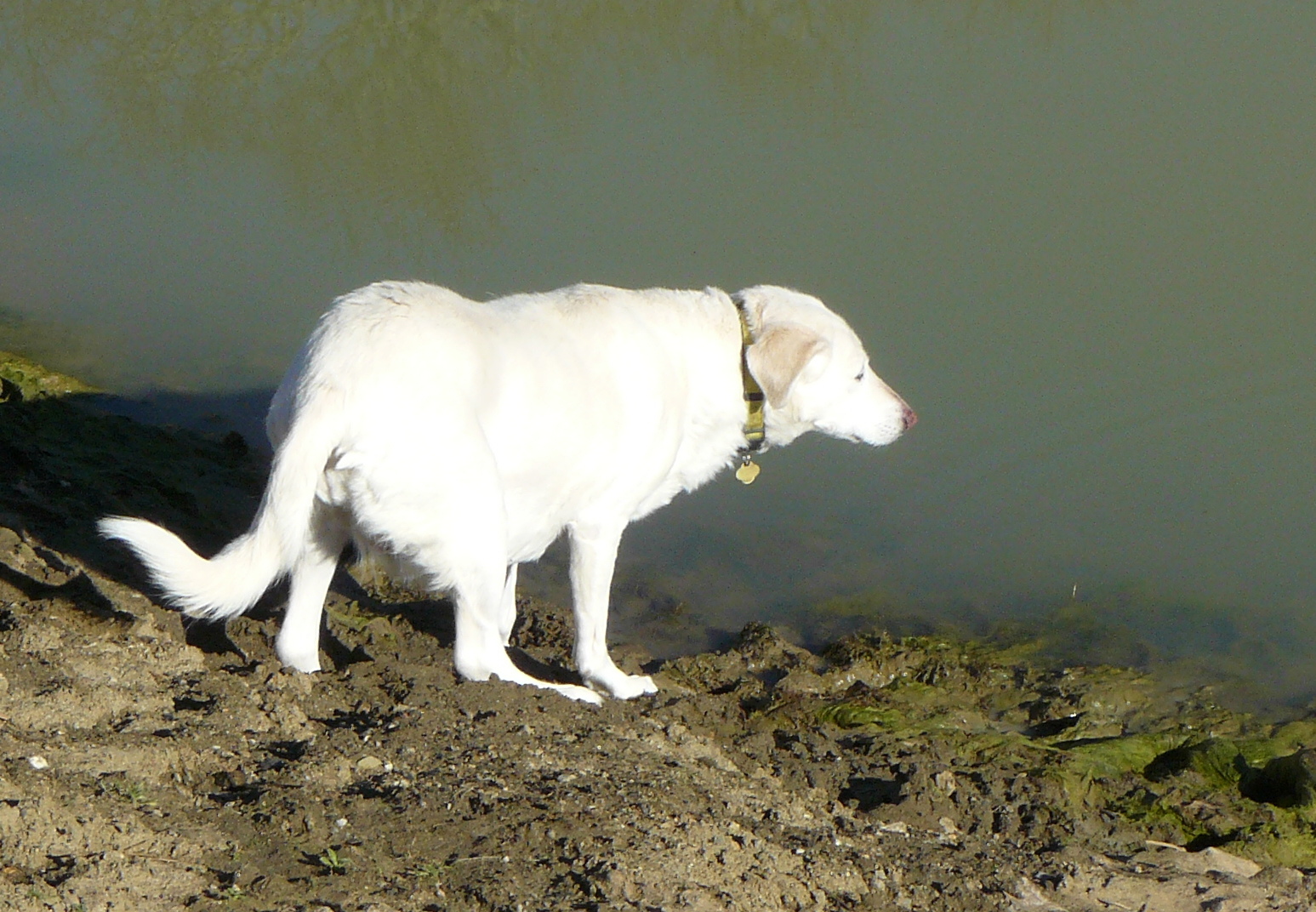
Don't even bother thinking of running away!
Don’t even bother thinking of running away!


oooo

Now that’s what I call a stare!


oooo

LL35
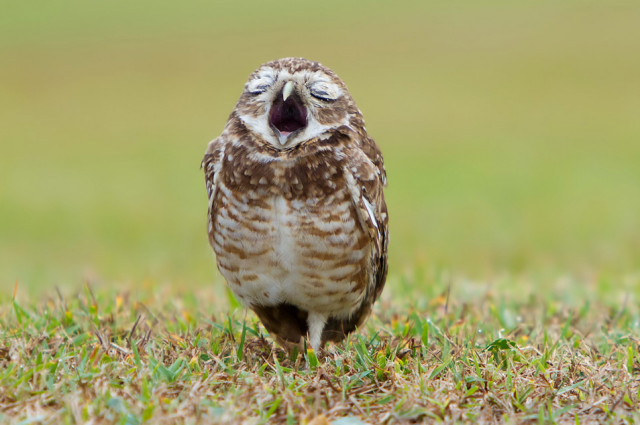
Excuse me! Been hunting too much at night these last few days!


oooo

LL36
The ‘front-line’ of man meets nature!


oooo

LL37
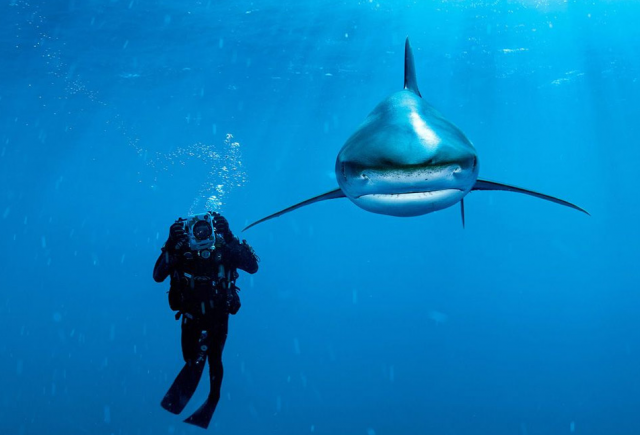
If it were me, I’d zoom out a little more!


oooo

LL38
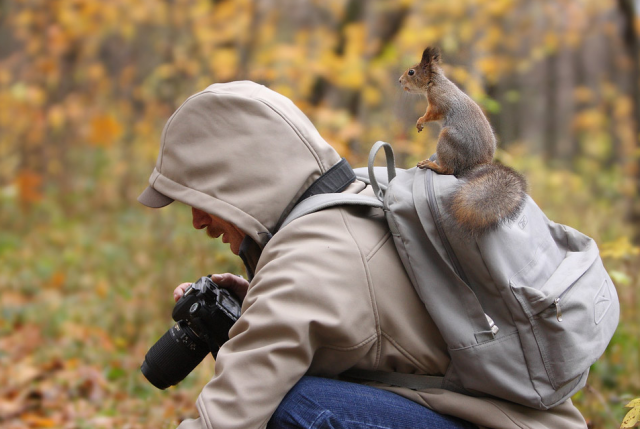
Heard about perfect co-ordination? Try this for size!


oooo

You all have a great week out there.

Just about Arizona water.

A more intimate look at the water of Arizona.

Yesterday, I published a recent Tomgram essay by William deBuys: Goodbye to All That (Water).  The essence of what William was presenting was that, “The crucial question for Phoenix, for the Colorado, and for the greater part of the American West is this: How long will the water hold out?

Also in yesterday’s Learning from Dogs post, I closed with the statement, “If readers will forgive me, I will continue the theme tomorrow with a rather more personal perspective.

I have decided to delay the ‘personal’ aspect to today’s post until the very end.  So back to Arizona’s water.

As an indication that this is not a new problem, I recently came across an article that was published  in The Arizona Republic by  Shaun McKinnon in August 2009.  It was called Unabated use of groundwater threatens Arizona’s future. Here’s how that article opened:

Thirty years after Arizona tried to stop cities and towns from using up their groundwater, the state still can’t shake its thirst for one of its most finite resources.

The steady drain on underground reserves grows out of two realities: Canals and pipelines don’t reach far enough to deliver surface water to everyone, and laws don’t reach far enough to stop people from drilling.

If the groundwater addiction continues unabated and under-regulated, the effects will be broad and potentially disastrous: Scarcer supplies could push rates higher and create uncertainty about water availability, discouraging new business and slowing economic growth. If wells start to run dry and aquifers collapse, the landscape could be dotted with fissures and sinkholes.

Lawmakers adopted some of the nation’s most progressive water-protection laws to avert such crises, but the laws excluded rural areas and allowed changes that let cities and subdivisions resume well-drilling, further depleting exhaustible aquifers.

Meanwhile, the renewable resource intended to replace groundwater – surface water fed by the annual runoff of mountain snow – can’t meet the demand of urban areas too far from the delivery canals.

The result is holes in the state’s water bucket that are spreading as fast as the holes in the ground.

Then good friend, Dan Gomez sent me this link: Arizona’s Water: Uses and Sources. I would like to cover some of the information contained on that website.

Arizona’s Water: Uses and Sources

One acre-foot of water.

A land’s carrying capacity has always been determined by its access to usable water. Humans use water primarily for irrigation, industry, drinking water, and sanitation. Millions of non-human species depend on water for life itself. Only 1% of the earth’s water is freshwater, to be shared among more than 7 billion people and all freshwater aquatic ecosystems in the world. It is perhaps the most precious resource on the planet.

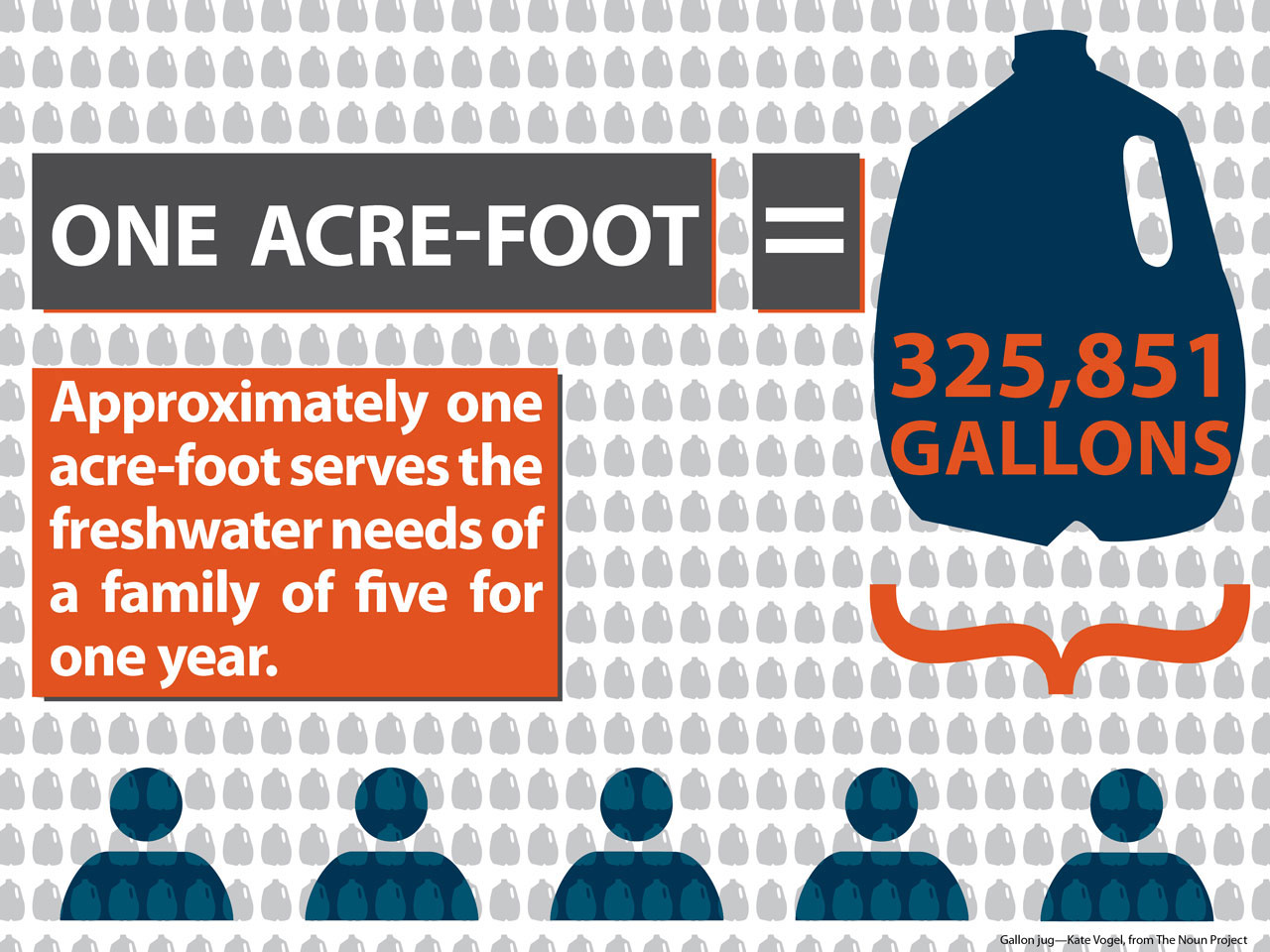
Large volumes of water are most commonly measured in acre-feet. One acre-foot is the amount of water required to cover one acre of area to the depth of one foot: 325,851 gallons. Approximately one acre-foot serves the needs of a family of five for one year. Arizona is one of the driest states in the U.S., and one of the fastest-growing. Arizona’s current population is over 6 million (2010 Census) and is projected to grow to as many as 9.5 million people by 2025. Encompassing four deserts, Arizona receives a statewide average of only 12.5 inches of rain per year. Our climate presents intense challenges in balancing our water needs between ourselves, our neighbors, and our riparian ecosystemsWater has defined our past and will determine our future.

“Water has defined our past and will determine our future”!

Let me skip a couple of paragraphs and continue, thus:

Water Budget: Usage and recharge

How much water do we ​use?

Based on Arizona Department of Water Resources (ADWR) data from 2001–2005, Arizona uses approximately 6.96 million acre-feet of water annually. A 2008 estimate by the University of Arizona Water Resources Research Center places that value as high as 8 million acre-feet. Collaborative estimates place the actual water used in Arizona at between 7.25 million and 7.75 million acre-feet annually. That’s about 2.4–2.5 trillion gallons a year.

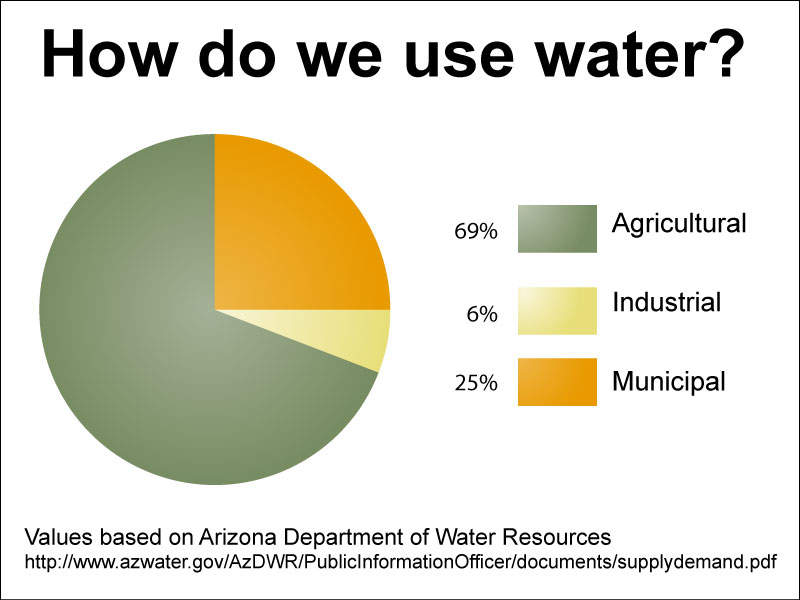
 How do we use water?

Water in Arizona is used for cultural purposes (for and by people) and for in-stream uses, such as for the support of fish and riparian ecosystems.

Arizona's cultural use of water. Values based on Arizona Department of Water Resources.
Arizona’s cultural use of water. Values based on Arizona Department of Water Resources.
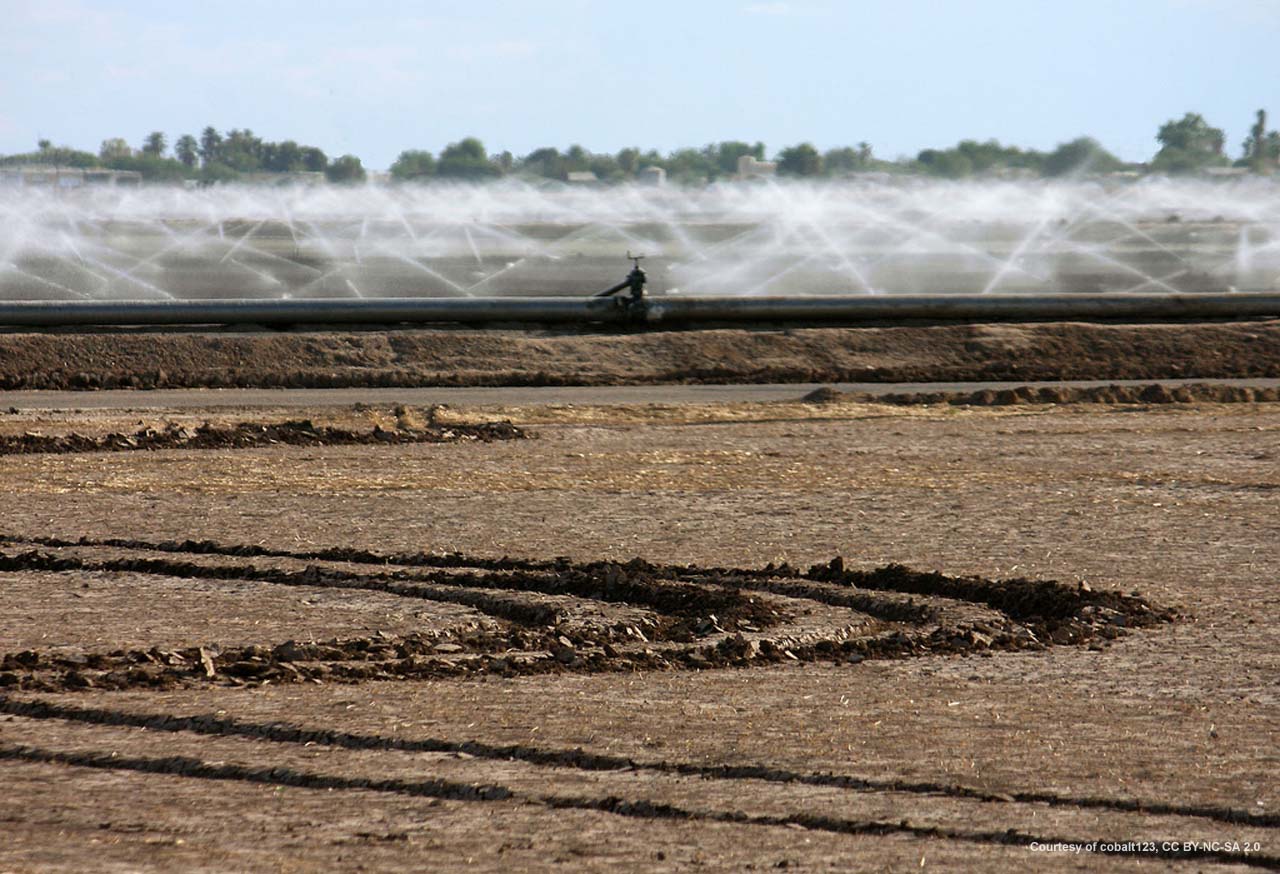
Approximately 69% of the available water supply in Arizona is used for agriculture.

Again, skipping forward.

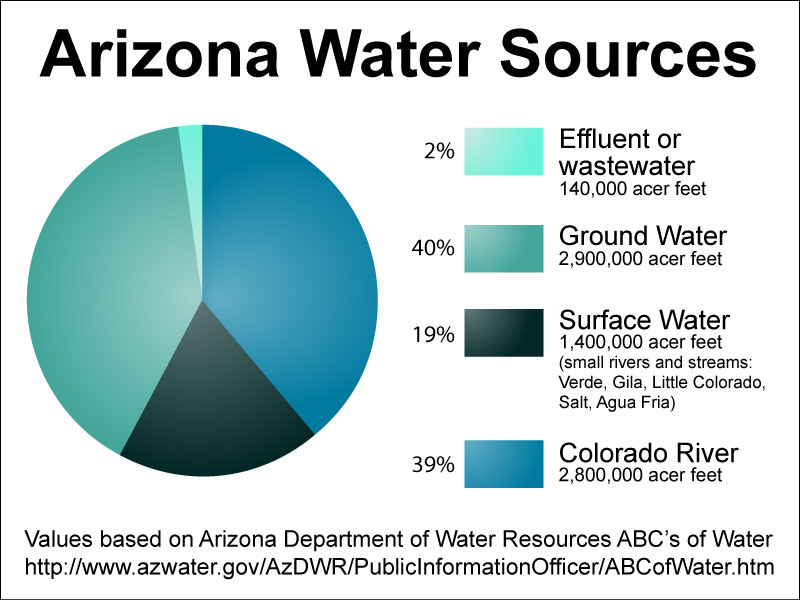
Values based on Arizona Department of Water Resources ABC’s of Water.

Water Sources

Arizona gets water from three major sources: surface water (which includes Colorado River water and water from other major rivers and streams), groundwater, and effluent or reclaimed water.

Groundwater

About 43% of the state’s water use comes from groundwater sources. Groundwater is found beneath the earth’s surface in natural reservoirs called aquifers. In most cases the aquifers that store water have been in place for millions of years. Throughout the 20th and 21st centuries, groundwater has been pumped out more rapidly than it has been replenished, creating a condition called overdraft. Though a large amount of water remains stored in Arizona’s aquifers, its availability is limited by location, depth and quality. By continuing to overdraft the state’s groundwater supplies, we challenge our ability to ensure a secure water supply for the future. In recognition of this threat, Arizona implemented the Groundwater Management Code in 1980. The Groundwater Code promotes water conservation and long-range planning of our water resources.

Colorado River Water

A separate category of surface water in Arizona is the water supplied through the Colorado River. The federal government constructed a system of reservoirs on the river to harness its supplies for use in several states. Arizona, California, Nevada, New Mexico, Utah, Colorado, Wyoming, and Mexico share the river’s resources. Rights to use Colorado River water are quantified by a string of legal authorities known as the “Law of the River.” Based on this body of law, Arizona has the right to use 2.8 million acre-feet annually of Colorado River water. Mohave, La Paz, and Yuma county water users rely on Colorado River as their principal water supply. When fully utilized, the Central Arizona Project (CAP) will deliver an annual average of 1.5 million acre-feet of Colorado River water to Maricopa, Pinal and Pima Counties.

Other Surface Water

Surface water from lakes, rivers, and streams is Arizona’s major renewable water resource. However, because of our desert climate, the amount of surface water available can vary dramatically from year to year, season to season, and place to place. In order to make the best use of the surface water when and where it is needed, storage reservoirs and delivery systems have been constructed throughout the state. Most notable are the major reservoir storage systems located on the Salt, Verde, Gila and Agua Fria rivers. Almost all of the natural surface water in Arizona has been developed.

Effluent

Reclaimed water, or effluent, is the one increasing water source in our state. As our population and water use grows, more treated wastewater will be available. Reclaimed water is treated to a quality that can be used for purposes such as agriculture, golf courses, parks, industrial cooling, or maintenance of wildlife areas.

Information made available by the Arizona Department of Water Resources and the University of Arizona Water Resources Research Center.

Since it is impossible to measure the exact values of water used across a state, some variance of values must be tolerated.

oooOOOooo

So take the message from yesterday’s post and then from above: “Throughout the 20th and 21st centuries, groundwater has been pumped out more rapidly than it has been replenished, creating a condition called overdraft. Though a large amount of water remains stored in Arizona’s aquifers, its availability is limited by location, depth and quality. By continuing to overdraft the state’s groundwater supplies, we challenge our ability to ensure a secure water supply for the future.“, and remember that 2 + 2 = 4!  I.e. the power of logic.

Now to close with that personal perspective.

When Jean and I were living in Payson, Arizona, we were close to town but not so close as to be on Payson City’s water supply.  Thus we had a well on our land.  If I recall, the depth of the drilled well was about 250 feet and the water level was about 80 feet below ground surface.  We had been told from the house survey that the ‘normal’ water level was about 35 feet down.  While we were there the water level slowly, but steadily, continued to drop.

We were both very happy in Payson; indeed it is where Jean and I were married.

However, one night, I would guess last June, 2012, I had this weird dream that I had gone to the bathroom during the night, turned on the cold-water tap and nothing had flowed out.  Bizarre dream, wouldn’t you say!  But even more bizarre was that the image of no water was in my mind when I awoke in the morning, and I couldn’t shrug off a distinct feeling of disquiet.  That all lead to us coming up to Oregon, finding this wonderful property with an all-year creek, Bummer Creek, running through our land, and moving in on October 25th, 2012.

Funny old world at times!

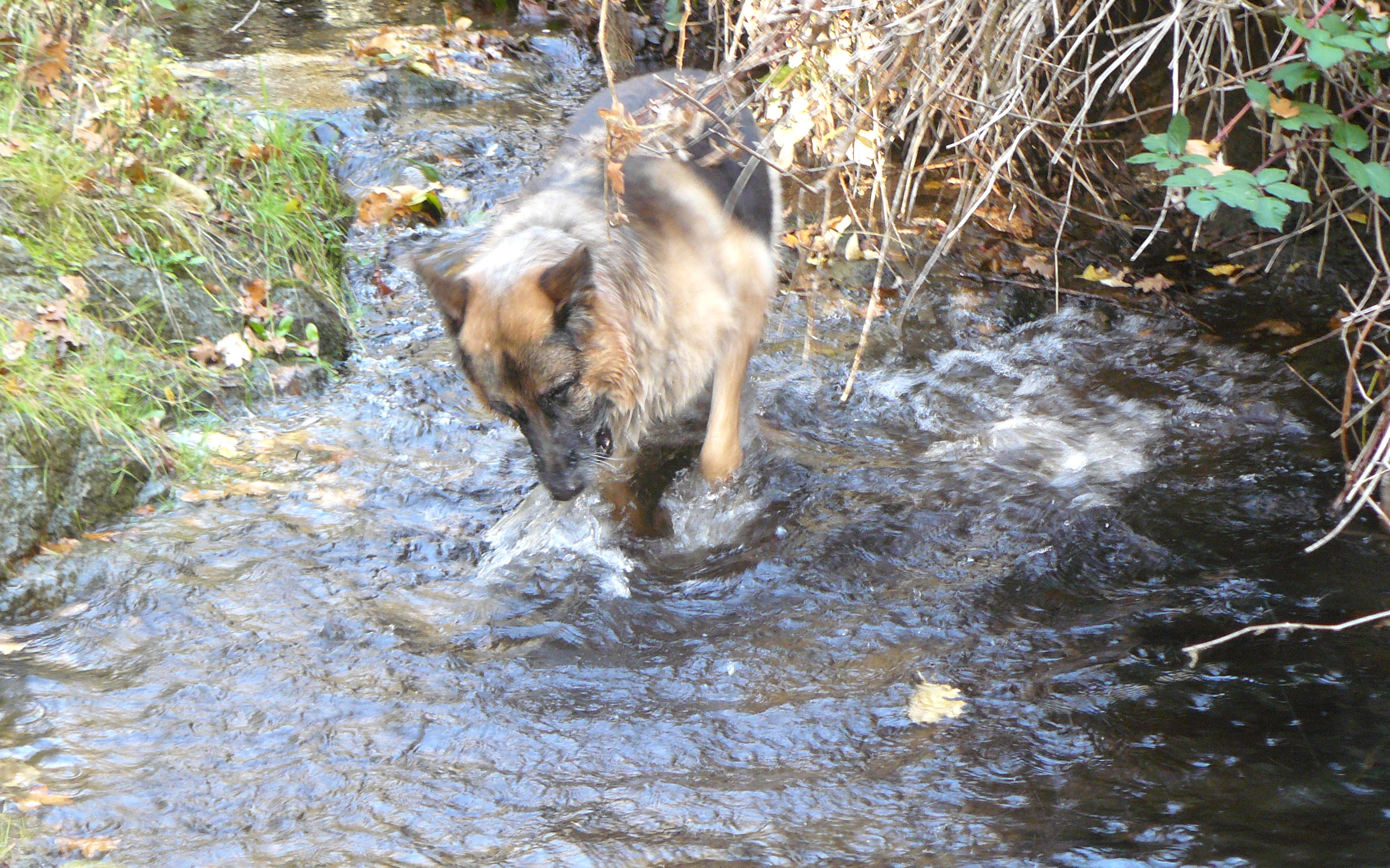
Pharaoh enjoying Bummer Creek.

Please don’t forget the wolves!

Time is not on the side of the wolves and for all those who care for them.

It’s unusual for me to publish a post at this time of the day. However, following my recent post I cry for the wolves I wanted to circulate two recent emails received from the Center for Biological Diversity.  Here they are in their original format.

Feel free to forward this post as far and wide as you would like to.

Thank you,

Paul and Jean.

oooOOOOoo

Center for Biological Diversity

Dear Paul,

Gray wolf

Last week the Obama administration issued a sweeping delisting plan to remove protections for wolves across the lower 48 states. The plan only maintains protections for the small population of Mexican gray wolves in Arizona and New Mexico.

If finalized this proposal will mean the premature end of decades of work to restore wolves to the American landscape — even though wolves currently occupy a mere 5 percent of their historic range.

The proposal also means that states will hold the reins of wolf management across most of the country. We’ve already seen what state management entails for wolves in the northern Rocky Mountains and Great Lakes, where protections were removed in the past two years — in short, aggressive trapping and hunting seasons designed to drastically reduce populations, resulting in at least 1,600 wolves killed.

Please take action now to halt this delisting plan before it’s too late: Tell the U.S. Fish and Wildlife Service not to turn its back on America’s wolves.

Click here to take action and get more information.

If you can’t open the link, go to http://action.biologicaldiversity.org/p/dia/action3/common/public/?action_KEY=13725.

oooOOOooo

Center for Biological Diversity

Dear Paul,


Donate Now

Help Save America's Wolves.

Wolves Stripped of Protection —
Don’t Let it Happen.

The future of America’s wolves is at stake right now: The Obama administration just announced its plans to strip Endangered Species Act protections from nearly all wolves in the lower 48 states.

We need your help. A generous member is matching all emergency gifts to our Wolf Defense Fund until tomorrow. Please give right now.

This announcement means the U.S. Fish and Wildlife Service is gutting 40 years of wolf conservation and recovery.

And when wolves lose federal protections, they die. Too often they’re hunted, trapped and ruthlessly persecuted with the same vicious attitude that nearly drove them extinct a century ago.

It also means that wolves — absent today from 95 percent of their historic habitat in the continental United States — are virtually guaranteed never to fully recover in places like the Northeast, California, and most of the Rocky Mountains and Pacific Northwest.

The Center for Biological Diversity’s expert legal team is already working to get into court right away to stop this terrible plan.

The Center has an amazing track record of saving wolves. We’ve overturned illegal wolf-killing decisions in Idaho, Montana, Wyoming, Minnesota and Wisconsin. Wolves in Oregon today are protected by a court injunction won by the Center. But this will be the biggest wolf case yet, and we need your help to win it.

The entire U.S. wolf recovery program hangs in the balance.

If this decision stands, wolves will never be reintroduced to California, the Northeast or the southern Rocky Mountains. Killing of the small population in Oregon and Washington will ramp up, preventing it from ever recovering. Make no mistake: Despite the government’s warm and fuzzy PR spin, this decision is about ending wolf recovery in the United States once and for all.

Our team of scientists, lawyers and activists has been preparing for this terrible decision, and now — with your help — they’ll begin the biggest legal battle of the decade.

If you’re as sickened as I am by the killing, please help us stop it. Donate to the Wolf Defense Fund today.

For the wolves,

Kierán Suckling
Kierán Suckling
Executive Director
Center for Biological Diversity

P.S. Because this is an emergency, one of our members will match every gift made by tomorrow, Sunday, June 16. Help us take advantage of this extraordinary offer by donating as much as you can to the Center’s Wolf Defense Fund and passing this appeal on to your friends and social media networks.

P.P.S. If you have problems with the links above, please cut and paste this into your browser: https://org.salsalabs.com/o/2167/p/salsa/donation/common/public/?donate_page_KEY=9994&track=E1305G2

oooOOOooo

Musings on love.

Dedicated to MaryAnne G.

A week ago I started the first of what became four day’s writings about passing the 400ppm CO2 level in the planet’s atmosphere.  As I said in the penultimate post, “In nearly four years of writing for Learning from Dogs, I can’t recall devoting three days of posts to a single subject.

Later that week, I had a wonderful telephone conversation with MaryAnne back in Payson. MaryAnne and husband Ed were among a group of people who did so much to ease our transition into our new home in Arizona.  As part of the process of obtaining my fiancee visa, I was to and fro between Payson and London which meant having to leave Jeannie alone for a number of weeks at a time. So for Jean having to get used to a change of country as well as home and for me wondering if I would ever get the magic piece of paper allowing me and Jean to be married and settle down, having so many loving friends around us was invaluable.

In last week’s telephone conversation MaryAnne spoke so easily about love that I promised her that I would dedicate a post on Learning from Dogs to her.

In fact, rather than one post, I’m setting myself the challenge of writing about love for the entire week, i.e. Monday to Friday.  I will readily admit that over and beyond today’s post, I don’t have more than the vaguest inkling of how the week will pan out.  You have been warned!

But how much better that ‘devoting three days to a single subject‘ should be about love rather than climate change.

oooOOOooo

Love across the species.

A week ago, we had friend Richard and his partner Julie from England staying with us.  Richard and I go back 40 years and have been wonderful buddies all that time.  Last Monday, I took Richard and Julie across to Wildlife Images just a few miles from the house here in Merlin, Oregon.  As their website explains,

Wildlife Images Rehabilitation and Education Center was founded as a non-profit corporation in 1981 by renowned wildlife rehabilitator J. David Siddon. The facility was created in order to provide for the care and treatment of sick, injured and orphaned wildlife.

and a little later,

The organization’s clinic, animal sanctuary, and education center are located on 24 acres of land adjacent to the wild and scenic section of Oregon’s famous Rogue River. Animals treated at Wildlife Images have included everything from baby squirrels and badgers to American bald eagles.

Wildlife Images release rate of intakes is near 50 percent each year – far above the national average of 33 percent. Animals with permanently disabling injuries that make them unable to live in the wild are integrated into one of Wildlife Images educational programs, either as educational ambassadors, or as permanent residents of the facility.

While we were looking at the animals, along the pathway came a couple of the volunteer staff walking a Grey Wolf (Canis Lupus).

An afternoon walk for Tundra.

I was utterly captivated by this beautiful animal.  Her story was that she was born in captivity and owned by an individual who soon decided he didn’t want her!  Not long thereafter Tundra, as she became named, was brought to the Sarvey Wildlife Center in Washington and thence to Wildlife Images when she was just 8 weeks old.

Tundra turned to look at me. I stood perfectly still and quiet.  Tundra seemed to want to come closer.  As one would with a strange dog, I got down on my knees and turned my eyes away from Tundra’s.  I sensed she was coming towards me so quickly held up my camera and took the picture below.

Wolf greets man.
Wolf greets man.

I kept my gaze averted as I felt the warm breath of this magnificent animal inches from my face.  Then the magic of love across the species!  Tundra licked my face!  The tears came to my eyes and were licked away.  I stroked her and became lost in thought.

Was this an echo of how thousands and thousands of years ago, a wolf and an early man came together out of trust and love and started the journey of the longest animal-human relationship, by far?

As I write elsewhere on this blog,

Dogs are part of the Canidae, a family including wolves, coyotes and foxes, thought to have evolved 60 million years ago.  There is no hard evidence about when dogs and man came together but dogs were certainly around when man developed speech and set out from Africa, about 50,000 years ago.

Let me close the first day of these musings by coming forward all those thousands of years to the year 2012.  To the 6th April, 2012.  To the day that we brought puppy Cleo back home.  That sweet little creature of less than ten weeks of age starting her own journey of love across the species.

10-week-old little Cleo experiencing Jeannie's love for her dogs.
Little Cleo being loved from the start.

Deckchairs on the RMS Titanic

A guest post from John Hurlburt.

The trouble with today’s post title is that while the analogy with the loss of the Titanic is accurate, indeed too bloody accurate, the phrase has dissolved into the depths of the barrel of smart, clever-dick sayings.  The brutal consequence of ‘fiddling while Rome burns‘, to use another ‘smart’ saying, is obscured.

So before you read this guest post from regular contributor, John Hurlburt, let me plead for something?

That is that you don’t treat this as just another anecdote in the affairs of man, but a symptom of the blindness of societies right across the world.  As my guest essay tomorrow reveals, waiting for leadership on this planet is a wait that you and I and millions of others just can’t afford.  Each and every one of us has to do something, however minute, to make a difference.  Even just sharing John’s words.

oooOOOooo

It seems that there’s no escaping politics in daily life.

I recently got together one evening with two friends at our local Elks Club.

They are a couple. Two old friends of about ten years who live across the street and around the corner from me during the summer season.  They’ve been together for more than half their lifetimes and spend the fall, winter and early spring in Yuma.

He is a frequent fishing buddy.  Sometimes wears a side arm when we fish the beautiful mountain lakes above Payson. Mountain lakes and related campgrounds that are maintained and supervised by the U.S. Forest Service.  Rather cheekily, I once asked if the plan was to hook trout or shoot them!

Anyhow, this was our first get together of the season.  It was noted that attendance and participation is down in Arizona for such fraternal organizations as the Elks and the Moose.  We had a discussion with club management about the nature of the problem.

Fraternal club management tends to be cautious and well paid. However, it seems that placing discomforting restrictions on people is not popular.  The case in point was a recent club smoking ban. The logic seemed reasonable enough.  Unfortunately, no realistic accommodation was made for the members who chose to smoke.  The reaction was emotional.

For many, it was apparently the last straw.  There were perhaps four other people at the Payson Elks club at 5:30 p.m. that Friday evening. An evening with a moderately priced dinner buffet on hand that had been advertised online, in a newsletter and by word of mouth.

There was a point when a comment seemed appropriate.  I offered the observation that the source of the problem might be political.  No one seemed to register the observation.

We talked a bit about aches and pains; the usual organ recital.  We spoke about what we’ve been doing.  I told them about church and transition town activities.  The conversation turned to our illusion of a stable economy.  An observation was made that the USA was leveraged over twenty-two times above any material foundation.  There was no disagreement.

Despite the clear New York Times warning that morning, climate change never entered the conversation.  A remedy was to note that so far Katrina has cost U.S. taxpayers over sixteen Billion dollars and climbing.   Sandy is expected to cost American taxpayers as much as sixty Billion dollars.

It was a pleasant evening and we plan to get together again soon.

Take care out there.

John.

oooOOOooo

The sound of scraping deckchairs is deafening!

More new tomorrows.

New world order goes to ramming speed!

We spent some enjoyable time with neighbours Dordie and Bill yesterday afternoon from where my sub-heading quote comes.  Perhaps, a tad tongue-in-cheek, but only a tad!

Yesterday, the bulk of my post The new tomorrows consisted of a powerful essay from William deBuys ‘Phoenix in the Climate Crosshairs‘, courtesy of TomDispatch.  It painted in very stark terms the impact of climate change on the metropolitan city of Phoenix in Arizona; a city of over 4 million people, indeed home to more than two-thirds of Arizona’s population.

So, today, I wanted to wander through some other aspects of this new world order.

Here’s a recent item on Climate Crocks examining the changes in March’s weather, 2013 vs 2012.  From which I quote:

Much Different March. Same Reason?

Dittohead reasoning: “So when it’s warm, you blame it on climate change. When its cold, you blame it on climate change. It can’t be both.”

Well, yeah, it can, kinda.

Meteo people weigh in.

7Weather Blog WHDH-TV:

I think we’ve passed the point of tolerance with these ceaseless storms. Gone are the days when viewers would flood our inboxes with pretty pictures of their pets and kids frolicing in the snow. Constant cleanup has made us snippy and short – even a few plow guys have hoisted the white flag. The holidays are long past, the winter is stale, and the people just want spring…

…and accountability.  Instead of pictures, I get questions in my inbox. “Why are we getting so much snow? Why did it turn on a dime? And when will it stop?”

Those are fair questions. But with the limits of the long range (10-14 day) forecasts, I’m not ready to answer the last question. We may sail out of this in April, but so far the first week of the month isn’t looking much different from the first week in March. The ultimate question is why.

The jetstream has taken on an odd path. [my emphasis]

Now just look at this:

Forecast sea level pressure departures from average from the GFS computer model. This shows the large area of unusually high atmospheric pressure over Greenland.Image from Weatherbell
Forecast sea level pressure departures from average from the GFS computer model. This shows the large area of unusually high atmospheric pressure over Greenland.
Image from Weatherbell

Later on that article says:

Recent research suggests that rapid Arctic climate change, namely the loss of sea ice cover, may be contributing to blocking patterns like we’re seeing right now. That rapid decline in Arctic sea ice since the beginning of the satellite record in 1979 may be altering weather patterns both in the Far North and across the U.S.. Some studies have shown that sea ice loss favors atmospheric blocking patterns such as the pattern currently in place, while others have not shown statistically significant changes in blocking patterns across the Northern Hemisphere, at least not yet. Arctic sea ice extent declined to a record low during the 2012 melt season.

The last Winter in North-West Europe has been ‘interesting’, to say the least!  A follow-up to that Climate Crock’s essay reports:

study published in 2012 showed that by changing the temperature balance between the Arctic and mid-latitudes, rapid Arctic warming is altering the course of the jet stream, which steers weather systems from west to east around the northern hemisphere. The Arctic has been warming about twice as fast as the rest of the Northern Hemisphere, due to a combination of human emissions of greenhouse gases and unique feedbacks built into the Arctic climate system. The jet stream, the study said, is becoming “wavier,” with steeper troughs and higher ridges.

A new study published in the journal Environmental Research Letters shows that reduced sea ice cover can favor colder and stormier winters in the northern midlatitudes

Did you fully take in that paragraph?  The one about “The Arctic has been warming about twice as fast as the rest of the Northern Hemisphere …“?

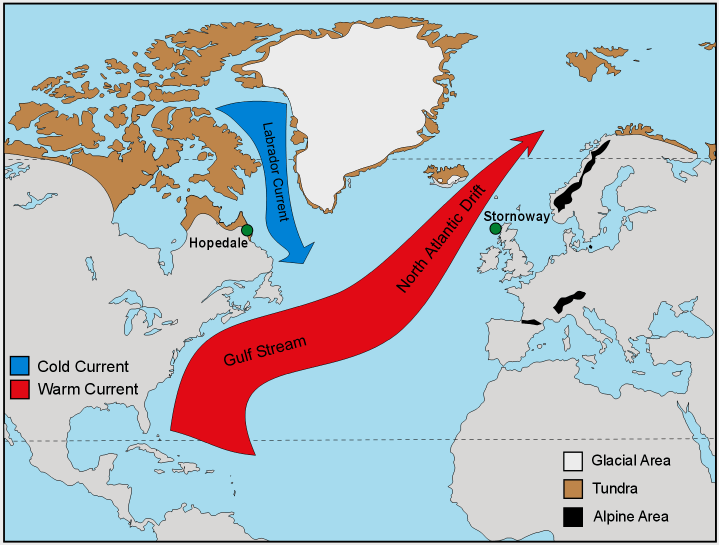
The other great ‘river’ in the North Atlantic is the thermohaline circulation or to put it in more familiar terms: The Gulf Stream.  Has that been changing?  You bet! In more ways than one might expect.

Here’s a snippet from an item from last October’s issue of Nature journal:

Recent changes to the Gulf Stream causing widespread gas hydrate destabilization

The Gulf Stream is an ocean current that modulates climate in the Northern Hemisphere by transporting warm waters from the Gulf of Mexico into the North Atlantic and Arctic oceans. A changing Gulf Stream has the potential to thaw and convert hundreds of gigatonnes of frozen methane hydrate trapped below the sea floor into methane gas, increasing the risk of slope failure and methane release.

How the Gulf Stream changes with time and what effect these changes have on methane hydrate stability is unclear. Here, using seismic data combined with thermal models, we show that recent changes in intermediate-depth ocean temperature associated with the Gulf Stream are rapidly destabilizing methane hydrate along a broad swathe of the North American margin.

As the diagram below shows all too clearly, the cold waters from above the Arctic circle directly affect the Gulf Stream.

gulfstream

From the website of the National Snow & Ice Data Center:

Average sea ice extent for February 2013 was 14.66 million square kilometers (5.66 million square miles). This is 980,000 square kilometers (378,000 square miles) below the 1979 to 2000 average for the month, and is the seventh-lowest February extent in the satellite record.

Less ice means more cold water. QED!

OK, moving on.

We met recently with Wayne over at Rogue Valley Firewood here in Merlin.  Not to buy more firewood but because Wayne has started into hugelkultur.  Jean and I hadn’t heard of the term before.  Come back to that in a moment.

In musing with Wayne about how rapidly life is changing for us all, he spoke of the consequence of rising fuel prices and the rising costs of putting petrol (OK, he used the word ‘gas’!) in one’s car.  Wayne pointed out the obvious.  That the inevitable effect of those rising costs would be to steadily reduce one’s range for ‘affordable’ car journeys.  Many people will no longer be able to afford to drive longer distances.

In other words, local will increasingly become more relevant to daily life.  Or to use a better word than local, community will return to the centre stage of our world.  And of all the things important to a community, none is more so than access to food.

Back to Hugelkultur. Watch this video:

Wayne is committed to seeing just what can be grown for the local community of Merlin using this form of raised garden bed.  You can read more here.

Is this just a piece of fun?  Most definitely not!

Here’s a recent item from Grist.

This sobering map shows you all of America’s food deserts

By Sarah Laskow

The USDA’s new Food Access Research Atlas is a map of all the places in the country where people live in food deserts — places where it’s difficult to access fresh food.

food-deserts1

More details here.

The message that hits me from that map is the consequence for millions of people, especially those in rural areas or unable to afford a car, when it comes to getting hold of fresh food.  Another reason why community food programs are going to be a feature of the new tomorrows.

Finally, take a look at a recent item on Paul Gilding’s blogsite.

paulgildingportrait
Paul Gilding

Paul is an independent writer, advisor and advocate for action on climate change and sustainability. He recently published Victory at Hand for the Climate Movement? From which I offer:

There are signs the climate movement could be on the verge of a remarkable and surprising victory. If we read the current context correctly, and if the movement can adjust its strategy to capture the opportunity presented, it could usher in the fastest and most dramatic economic transformation in history. This would include the removal of the oil, coal and gas industries from the economy in just a few decades and their replacement with new industries and, for the most part, entirely new companies. It would be the greatest transfer of wealth and power between industries and countries the world has ever seen.

To understand this incredible potential we first have to step back and understand the unique structure of this social change movement, which may rank among the most influential in history. It is simplistic to characterise it as an alliance of grass roots organisations and activists pitched against a rich and well connected adversary. While that is part of the story, it is more accurately understood as an idea whose tentacles reach into every tier of government, the world’s largest companies and financial institutions, and throughout the academic and science communities.

Because of this, it is winning the battle from within: Its core arguments and ideas are clearly right; being endorsed by the world’s top science bodies and any significant organisation that has examined them.

Read the full article here.

Strikes me that in one very important way, we will be reverting to how our ancient hunter-gatherer ancestors lived.  I mean reverting to living our lives as relatively small interdependent communities almost exclusively at the local level.

Guess what!  Yet another aspect of learning from dogs.  In the wild, dogs live in groups of about 50 animals with clear boundaries to their territory.  Just like the ancestors of the domesticated dog and the wild dog: The grey wolf Canis Lupus.

Grey wolf Canis Lupus

See you all tomorrow!

Beautiful photographs, part two.

Sent to me by long-term friend Dan Gomez. Enjoy.

This second set carries on from yesterday’s selection.  You will see from one of the comments from yesterday that blogger Pedantry noticed there was a problem with” the height description on the second through fifth images in this set“.  Feedback from others who had this problem would be helpful as I can pass the details back to WordPress.

oooOOOooo

Dan14

The Grand Canyon Skywalk

The Grand Canyon Skywalk is a transparent horseshoe-shaped cantilever bridge and tourist attraction in Arizona near the Colorado River on the edge of a side canyon west of the main canyon. USGS topographic maps show the elevation at the Skywalk’s location as 4,770 ft (1,450 m) and the elevation of the Colorado River in the base of the canyon as 1,160 ft (350 m).

In other words, the height of the vertical drop directly under the skywalk is between 500 ft (150 m) and 800 ft (240 m).

Commissioned and owned by the Hualapai Indian tribe, it was unveiled March 20, 2007, and opened to the general public on March 28, 2007.  It is accessed via the Grand Canyon West Airport terminal or a 120-mile (190 km) drive from Las Vegas, which includes a 10-mile (16 km) stretch of dirt road which is currently under development.

The Skywalk is east of Meadview and north of Peach Springs with Kingman being the closest major city.

Dan15

Palawan Underground River or St. Paul Subterranean River.

The longest navigable underground river in the world.

This is the most famous cave in the Philippines. The longest underground river was discovered a few years back in Mexico somewhere in the Yucatan.

The St. Paul underground river in Palawan, Philippines may not be the longest underground river in the world anymore, but it is still the world’s longest navigable underground river. The navigable part of the river inside the 4000-acre cave of the  St. Paul subterranean river stretches 15 kilometers in length (9.3 miles). St. Paul Cave is the third deepest cave in the country.

Dan16

The Seven Sisters waterfall in Norway.

Dan17

Plitvice Lakes National Park in the Lika region of Croatia.

Dan18

A hotel window view in the United Arab Emirates!

Dan19

Jasper Park Lodge, Jasper, Alberta, Canada

Dan20

Villas Vista Hermosa, Costa Rica

Dan21

Norway!

Dan22

Sea caves near Benagil Beach, Algarve, Portugal.

Dan23

Barcelona, Spain.

Dan24

The village of Hallstatt in Austria.

Dan25

Victoria Falls, in southern Africa on the Zambezi River at the border of Zambia and Zimbabwe.

Dan26

Beautiful display of nature’s balance: Predators and Prey.

oooOOOooo

The power of the bleedin’ obvious!

Musings for a Monday morning!

Let me start with this:

A self-affirmation

For today, I am in charge of my life.

Today, I choose my thoughts.

Today, I choose my attitudes.

Today, I choose my actions and behaviours.

With these, I create my life and my destiny

I hasten to add that I am not the author of these wonderful words; just been aware of them for many years.

OK, to the muse!

I subscribe to Christine’s excellent blog 350 or bust.  Last Friday, Christine published a post that she called: Despite Pleas In Doha, Our Governments Have Failed Us & Our Children.

In that post, Christine included this video,

The lead negotiator for the Philippines at the Climate Conference in Doha, Naderev Saño, could not keep back the tears as he made a passionate appeal for real action on climate change.

“I appeal to all, please, no more delays, no more excuses. Please, let Doha be remembered as the place where we found the political will to turn things around…

The outcome of our work is not about what our political masters want. It is about what is demanded of us by 7 billion people…

I ask of all of us here, if not us, then who? If not now, then when? If not here, then where?”

Christine also included a short video of 19-year-old Syrian-American student Munira Sibai addressing the delegates.

“So let me now speak beyond the negotiators in this room to the people who I represent. Your governments are failing you. They are afraid that offering visionary pathways to low-carbon economies will make them look foolish, that taking responsibility will make them look weak, that standing up to the money and power of polluters will cost them political support. Unchecked, this cowardice will cost lives. Here in the halls of the United Nations, the voices of global citizens are limited, regulated and relegated to these short, symbolic statements. Outside these walls, these walls, there is a global movement, growing up from the grassroots, calling for climate justice. Join us.”

So young Munira Sibai offered the answer to Naderev Saño’s plea, “I ask of all of us here, if not us, then who? If not now, then when? If not here, then where?”  That answer being so beautifully encompassed in the opening self-affirmation.  Stay with me a little longer.

Many of you readers know that a little over 5 weeks ago Jean and I and our 11 dogs and 5 cats moved from Payson in Arizona up to Merlin, Southern Oregon.  The reason I refer to Payson is that not long before we left, a group concerned about the environment and climate change decided to form Transition Town Payson.

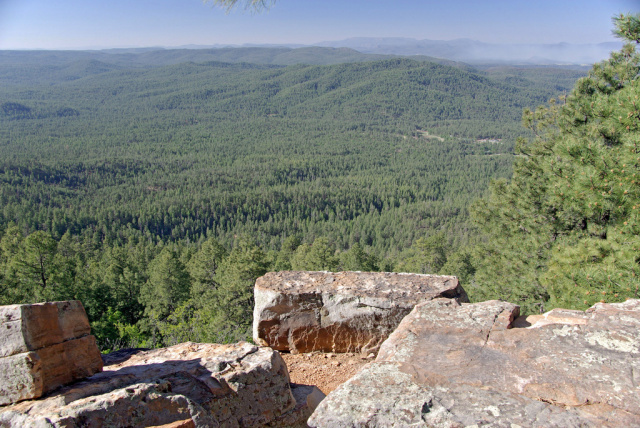
If you go to the ‘About‘ page of their website, you will see this beautiful photograph.

TTPvista

It’s a view from the Mogollon Rim Trail that would inspire anyone to want to care for our planet.  The trail passes close to Payson and is a very popular walking area.

Back to TTP.  If you go to their website and start browsing the articles and seeing what information is already there, you get a clear idea of what a group of people can do.  That key word ‘DO‘!

Last Thursday, I offered a reflection on Learning from Dogs about what feels like a new world order.  The penultimate paragraph offered this:

I sense that we, as in the peoples on this planet, are well into a period of such change that even by the end of 2013, a little over 50 weeks away, the precipice for humanity will be within sight.  I hold out zero hope that any time soon our leaders and politicians will stop ‘playing games’ and focus on doing what’s right.  The time for truth, for integrity, for sound debate is NOW!

However, all the truth, integrity and debate in the world comes to nothing without ACTION.

It really is the bleedin’ obvious!