There are countless tales of dogs, for a variety of reasons, getting a leg up, it you pardon the pun!
The Pit Bull breed is a very intelligent dog and yet their reputation often gets in the way. From Pit Bulls being used in dog fights some time ago. B’rrr!
But when the Pit Bull is given a chance to better himself they don’t need a second chance at all!
Take this story of a Pit Bull being adopted by some firemen.
ooOOoo
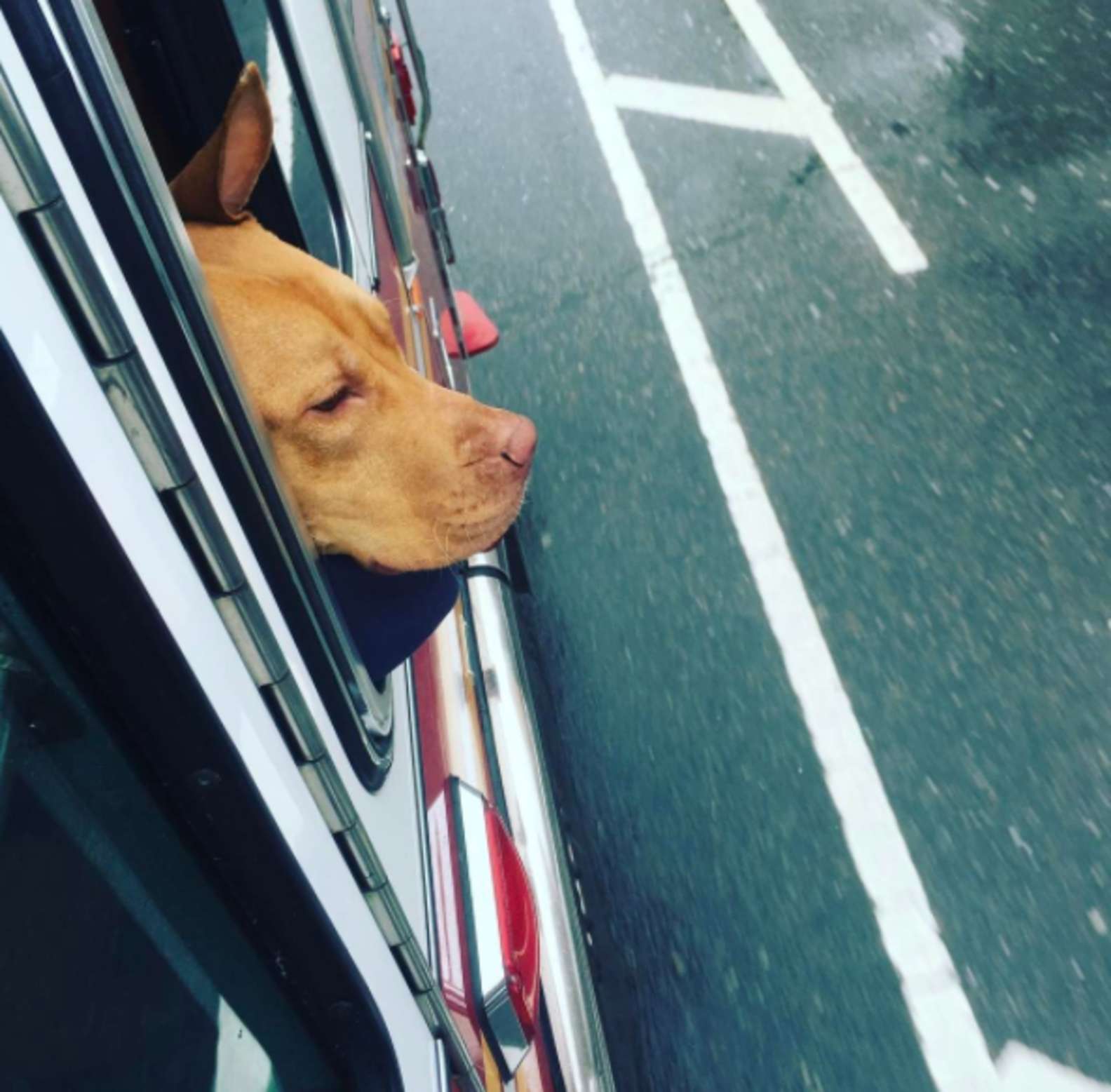
Dog Left Behind By Her Family Hangs Out With Firefighters All Day Now
“As soon as she walked into the firehouse, her tail was wagging, and she was licking and greeting everybody.”
The people who used to own Ashley hardly fed her, rarely took her outside and, in the end, they simply abandoned her.
Thankfully, Erica Mahnken, cofounder of No More Pain Rescue, and her fiance Michael Favor, rescued the 1-year-old pit bull in January of 2017.
Erica Mahnken, Ashley shortly after being rescued
“We got a phone call from somebody that there was a couple living in an abandoned house. They had no heat or electricity, and they had a dog there,” Mahnken told The Dodo shortly after the rescue.
When a snowstorm hit, the couple apparently left. “I guess they went to find somewhere warm to stay, and they had left the dog behind,” Mahnken said. “So as soon as we got the phone call, we ran and got her.”
Favor made Mahnken stay in the car while he ventured inside to find the dog. He’d later tell Mahnken how bad it was. “There was no electricity in the house — it was freezing,” Mahnken said. “No food, no water for her. The house was a disaster. The windows were broken, and there was feces all over the place.”
ERICA MAHNKEN
But Ashley was unharmed, and she looked like the most joyful dog when Favor walked her out.
“She came running down, super happy,” Mahnken said. “She jumped straight into my car.”
Ashley was thin and malnourished. “All you saw were her ribs — she was so skinny. And the vet later said she was 25 pounds underweight.”
Since No More Pain Rescue doesn’t have a physical shelter, Mahnken and Favor needed to get Ashley straight into a foster home. They had friends in the New York City Fire Department (FDNY), and knew there used to be a dog at the Fort Pitt station. So Mahnken and Favor asked if the firefighters would hold onto Ashley until they found her a proper home.
Ashley seemed just fine with this arrangement.
ERICA MAHNKEN
“As soon as she walked into the firehouse, her tail was wagging, and she was licking and greeting everybody,” Mahnken said. “She was super happy. From where she came from, you wouldn’t really expect that. You would think that she’d be a little skittish, but she wasn’t at all.”
@PROBYASH
Not all that surprisingly, the firefighting team called Mahnken a few days later, asking to keep Ashley.
ERICA MAHNKEN
“They said, ‘We’re going to adopt her. We just love her so much. She is at home here,'” Mahnken said. “So I was thrilled. And as soon as I walked her in there, I knew that that’s where she belonged.”
@PROBYASH
Ashley now lives at the firehouse full-time.
@PROBYASH
“She’s constantly on the go – she goes on smaller runs with them, she goes on the fire truck with them,” Mahnken said. “They walk her about 30 times a day. They bring her on the roof to play. She’s constantly in the kitchen watching them eat. She has endless supplies of treats. She has the life over there.”
@PROBYASH
Ashley even has her seat in the fire truck, according to Mahnken.
@PROBYASH
“I’m so glad we got her into a home that will show her nothing but love, and not make her into the pit bull that people love to hate so quickly,” Mahnken said. “It was an unbelievable feeling to know that that’s where she belonged.”
Four years later, Ashley is still loving her life at the firehouse — and the fire fighters love her.
ooOOoo
Just another example of what good loving people can do for a dog and the dog’s obvious pleasure at being loved.
This is one of the most important posts since I started blogging!
I was born in 1944 and that makes me 76. I am reasonably engaged in the issues facing us but, in a sense, protected from the realities of the modern world because I have a loving wife, two loving young people, as in my son Alex and my daughter Maija, and a special grandson, Morten.
We are also very lucky in that my wife, Jean, and I are both retired and we live on 13 rural acres in a beautiful part of Southern Oregon and enjoy immensely our six dogs, two horses, two parakeets and feeding the wild birds and deer.
But it can’t stay that way because of the encroaching elephant in the room.
I am speaking of climate change that if not dealt with in the near future, say in the next 10 years, will lead to an unimaginable state of affairs.
Now one could argue that you come to Learning from Dogs to get away from climate change and the like. But this is too important and, also, involves all of us including our gorgeous dogs.
First, I want to include an extract from a recent Scientists Warning newsletter (and please read this extract carefully).
Recently, one article on the climate emergency above all others has cut through – with over ONE MILLION views, “Climate scientists: concept of net zero is a dangerous trap” published in The Conversation is being talked about by many thousands, and led Greta Thunberg to tweet: “This is one of the most important and informative texts I have ever read on the climate- and ecological crises.”
So why is this article so very important?
In our latest interview, I talk with two of the authors – Dr. James Dyke, global systems scientist at the University of Exeter and Dr. Wolfgang Knorr, climate scientist at Lund University. And the conversation does not make for comfortable viewing. We discuss what led James, Wolfgang and Professor Bob Watson to write an article that they have described as being one of the hardest they have ever written. The article is *not* an attack on net zero, nor does it advocate a fatalistic position. Instead, as you will hear, the interview reveals the heartfelt concerns of two scientists who are profoundly worried about the failure of a climate policy system that suppresses the voice of science and is fundamentally flawed. A climate policy system that year after year has failed.
But it is not just the climate policy system that has failed. Academia has failed too, and continues to fail Greta and young people like her. And this *must* stop. Young people have become the adults in the room. We cannot place this burden on their shoulders. They have shown their courage and bravery. Now it’s time for academia to step up to the challenge and to critically examine why we are failing.
Secondly, I want to share that interview with you. This is a 36-minute interview. Please, please watch it. If it is not a convenient time just now then bookmark the post and watch it when you can sit down and be fully engaged. You will understand then and agree with me that this is one of the most important videos ever!
Lastly, I would like you to read the article published in The Conversation. I have included a link to it but I am also going to republish it on Friday.
Because we have to listen to the scientists without delay and press for change now.
Thank goodness for our younger generation. Because these young people are coming together to fight for change. May they have universal encouragement from those of us who will never see our younger days again!
There are so many kind people across the world and so many of those people are kind towards dogs.
Take this story for instance. It is about a Canadian woman who had placed dogs at the top of her care list and had been doing it for a number of years.
It was an article recently published in The Dodo and republished here.
ooOOoo
Woman Builds The Most Adorable Café For Her Neighborhood Dogs
“This is something they can do to bring a little joy to their day” ❤️️
Kaya Kristina lives right next door to High Park, one of Toronto’s most popular public gardens. Six years ago, the animal lover noticed that many of the pups in her neighborhood looked like they could use a little pick-me-up after running around outside.
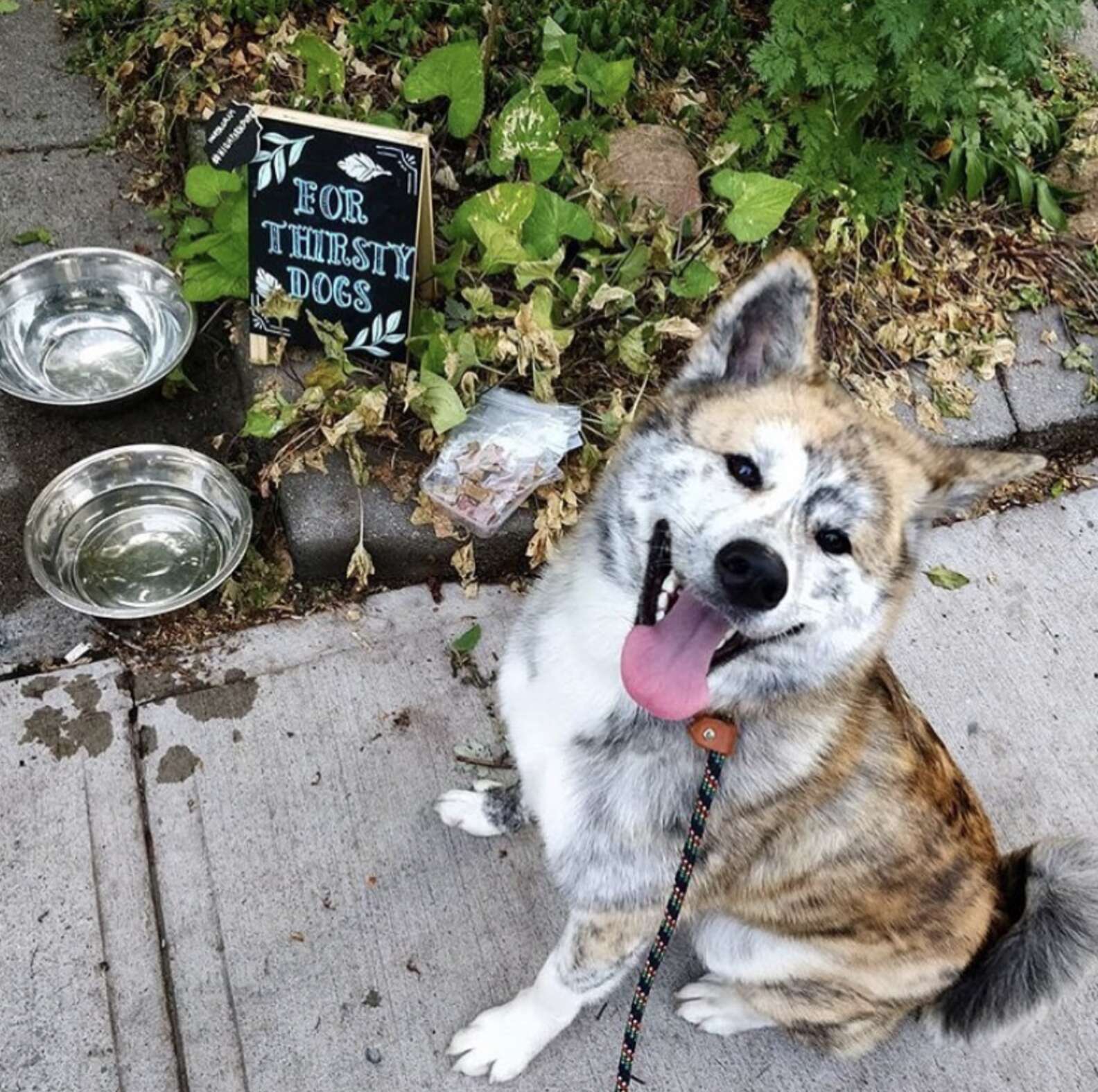
“On hot days, I noticed some of the dogs coming home from the park looked thirsty and tired,” Kristina told The Dodo. “I thought I should put out some water and a sign that said, ‘For thirsty dogs.’”
INSTAGRAM/HIGHPARKPUPS
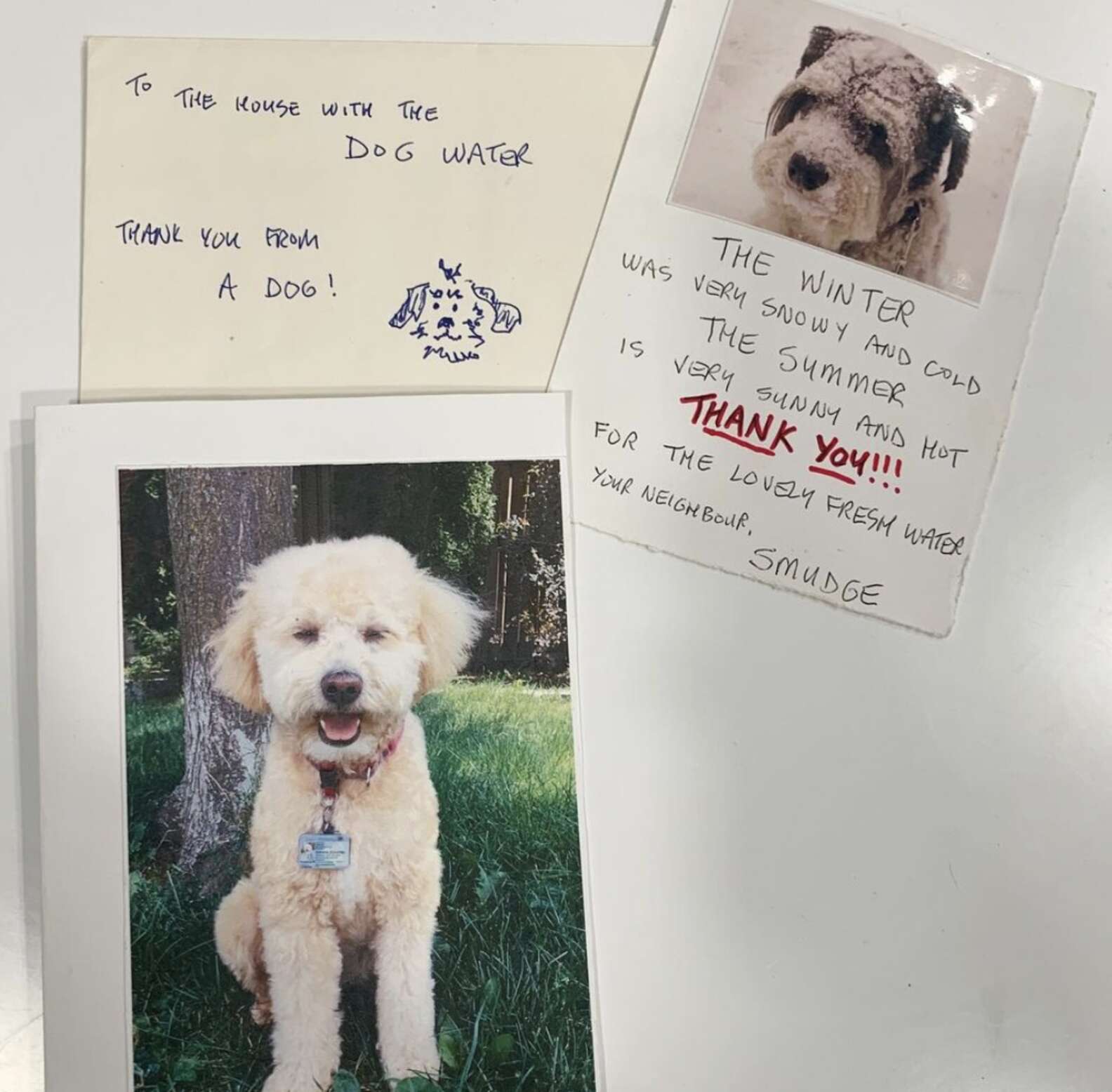
Her act of kindness didn’t go unnoticed for long. “One day, I got a card from someone in my mailbox,” Kristina said. “It had a pic of their dog on the front and it was written from the point of view of the dog saying thank you for the water. I put the pic up on my fridge and it made me really happy.”
INSTAGRAM/HIGHPARKPUPS
For years, Kristina continued to supply local dogs with water and she continued to receive little messages in return. Then, when the pandemic struck last year, Kristina decided to up her game. She decided to leave some treats on her front lawn for all her furry neighbors to safely enjoy during lockdown.
And StarPups Coffee was born.
INSTAGRAM/HIGHPARKPUPS
“I made a bunch of mini treat bags, made a little menu so people knew what they were giving their dog and put a little stand out with options,” Kristina said. “It was so cute seeing the dogs go by and pulling their owners to my house to go get a snack.”
Kristina provides water, Milk-Bones and specialty all-natural treats made in Canada. And the parade of dogs enjoying them has provided hours of entertainment for her while being cooped up inside.
INSTAGRAM/HIGHPARKPUPS
Regular visitors began swinging by the café every day, so Kristina started an Instagram account as a way to build a little community around the watering hole.
“I thought of all the people living alone during COVID and how their mental health was suffering,” Kristina said. “I thought, ‘Most people are complaining about their husbands and kids driving them nuts being home all together. But do they think about their single friends who only have pets?’ I wanted to give those people something to look forward to and make them feel special.”
INSTAGRAM/HIGHPARKPUPS
One day, Kristina went outside and found that her entire café setup was missing. Someone had stolen StarPups overnight, and Kristina was heartbroken. She posted about it on her Instagram — and, to her surprise, the community she had fostered over the months and years stepped up to help.
“That evening, when I got home, my mailbox was full of cards, notes, photos of people’s dogs, Pet Valu gift cards and even a sweet drawing of my dog,” Kristina said. “It turned out to be a good thing, because I had felt so isolated all year with COVID, and now I felt like I had an army of friends.”
INSTAGRAM/HIGHPARKPUPS
Encouraged by the show of support, Kristina built another StarPups Coffee for the neighborhood dogs to enjoy. And Kristina is currently working on building a more permanent setup on her lawn, which will be weatherproof so that no dogs will have to walk away disappointed when it rains or snows.
Now that Ontario has entered back into lockdown, the little front yard café is doing more business than ever before. “One of the few things that’s still allowed is walking your dog,” Kristina said. “So many people are struggling mentally and physically, so this is something they can do to bring a little joy to their day.”
ooOOoo
This is a very beautiful story and just goes to show that Kristina rose to the occasion with returns and rewards far beyond what she may have anticipated. I have said it many times before but nonetheless will say it again: Dogs are the most delightful of animals. They form bonds with us humans that is unmatched by any other animal. Let’s just let this story above sink into our deeper selves.
More than that, they bring out the very best in people!
We were out much of the day yesterday so I didn’t have huge time for the blog.
But nevertheless I could let the day go by without sharing this video with you.
Yes, it is an advertising video but so what. It is the most delightful combination of mountain biking and dogs. Alex is a great mountain biking enthusiast.
Time after time we read about the special bond between humans and dogs. And unlike us humans dogs seem to completely forget times in their past when they were treated cruelly.
Take this story of a dog that was an absolute hero.
ooOOoo
Dog Spots A Boy Being Swept Out To Sea And Rushes To Help Him
Max was never trained to be a hero, but when the moment called for it, the Staffordshire terrier/bulldog mix answered the call.
Before Jamie and Rob Osborn adopted Max, he was a neglected pup. He lived mostly outside and was never taken out for walks. But the love of his new parents quickly changed the wary dog.
FACEBOOK/ROBERT OSBORN
“When we got him, he was a bit antisocial,” Jamie Osborn told The Dodo. “If we were patting him too much, he’d get up and walk away. These days, Max is a completely different dog. He’s always happy! He’s really loving and gives us lots of love and affection.”
Max now lives inside as part of the family in Port Noarlunga, Australia. He loves sleeping in bed with his 11-year-old brother, Nev, and — most of all — splashing around in the water.
In the summer, Max spends most of his time at the beach with his family. “We have kayaks and he likes to swim along with us as we paddle, so we got him a life jacket so he wouldn’t get too worn out,” Osborn said. “Rob likes to surf and snorkel, so Max can often be seen at the beach hanging with the surfers waiting for a wave.”In January, Max was enjoying a quiet day at the beach with his dad and brother when something went wrong. A young boy got caught in the current and started to panic. Instead of swimming parallel to the shore to escape the current, he tried to swim against the current and quickly got stuck. Rob spotted the boy and called out to Max for help.
FACEBOOK/JAMIE OSBORN
“Max was just swimming around, wearing his life jacket, having a great time when the young boy got into trouble,” Osborn said. “Rob had the boy call Max over. Max was just doing what he loves best — swimming.” Max obediently swam over to the struggling boy and let him grab ahold of his life jacket. The pup fought the current and towed him back to the safety of the beach.
Later, Max acted as lifeguard yet again. “One of Nev’s friends also found it a bit tough, so he went back and got her, too,” Osborn wrote on Facebook.
Max was declared a hero — but he doesn’t know it. All he knows is that he’s getting a lot more pets and treats, and is happier than ever.
ooOOoo
Isn’t this a terrific story! Max is a real star and hero. But then so are many, many other dogs. All they need is love from us humans and then they bond with us for life.
But first we want to remember Prince Phillip. Dear Prince Phillip. Jeannie and I watched the whole of the funeral and it was very moving.
So in terms of the photographs already shown yesterday, we had done the Hog Creek landing and the next view point and we are now up to the bridge itself.
Except that I forgot to show you another photograph of the Canyon.
The sheer walls of Hellgate Canyon
The very dramatic scene with its incredibly steep flanks was just amazing!
Now to the viewpoint just before the bridge.
We had the very good fortune to take a shot of a fisherman just upstream of us.
A rock formation on the opposite bank.
All around us were spectacular sights.
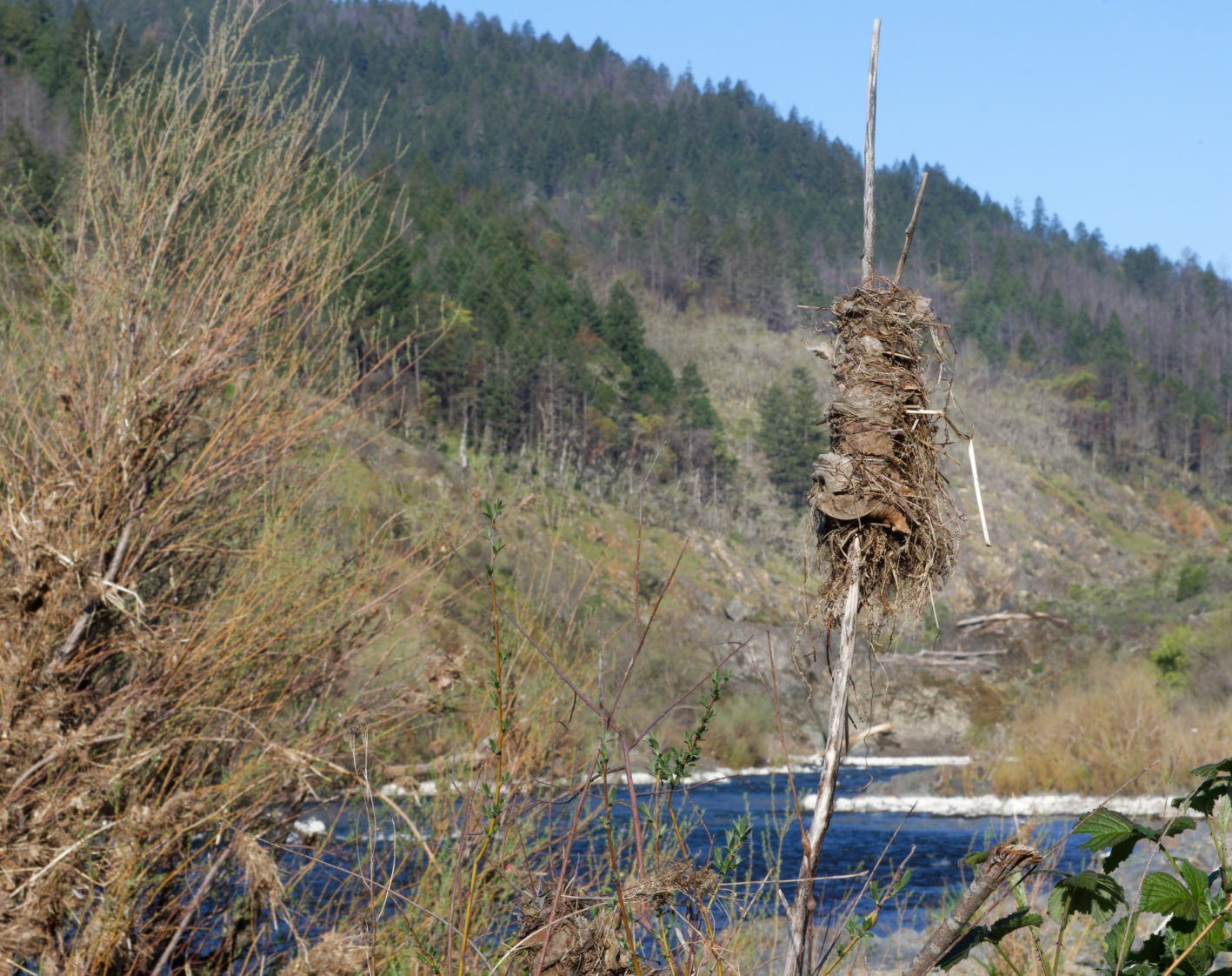
Take this shot of a bird approaching a tree standing stark on the top of a small ridge. That was just to the right of the road facing the bridge.
And the bridge itself!
It really is a very scenic place.
That is the end of my set of photographs. My eyes were truly opened.
A few days ago there was a conversation on the photography forum Ugly Hedgehog about the camera opening one’s eyes. It struck a note in me and Jeannie and I went out in the early morning, taking the camera, to shoot photographs of the Hellgate Canyon.
It is not the first time we have been there but it is the first time I have gone with my eyes wide open!
But first some history of the Rogue River. And thanks to WikiPedia for the following.
The Rogue River in southwestern Oregon in the United States flows about 215 miles (346 km) in a generally westward direction from the Cascade Range to the Pacific Ocean. Known for its salmon runs, whitewaterrafting, and rugged scenery, it was one of the original eight rivers named in the Wild and Scenic Rivers Act of 1968. Beginning near Crater Lake, which occupies the caldera left by the explosive volcanic eruption and collapse of Mount Mazama, the river flows through the geologically young High Cascades and the older Western Cascades, another volcanic province. Further west, the river passes through multiple exotic terranes of the more ancient Klamath Mountains. In the Kalmiopsis Wilderness section of the Rogue basin are some of the world’s best examples of rocks that form the Earth’s mantle.
Hellgate Canyon is just 8 miles from where we live on Hugo Road. But just before Hellgate is the Hog Creek parking area. We stopped there and then went down to the landing stage on the edge of the Rogue River. I took some photographs.
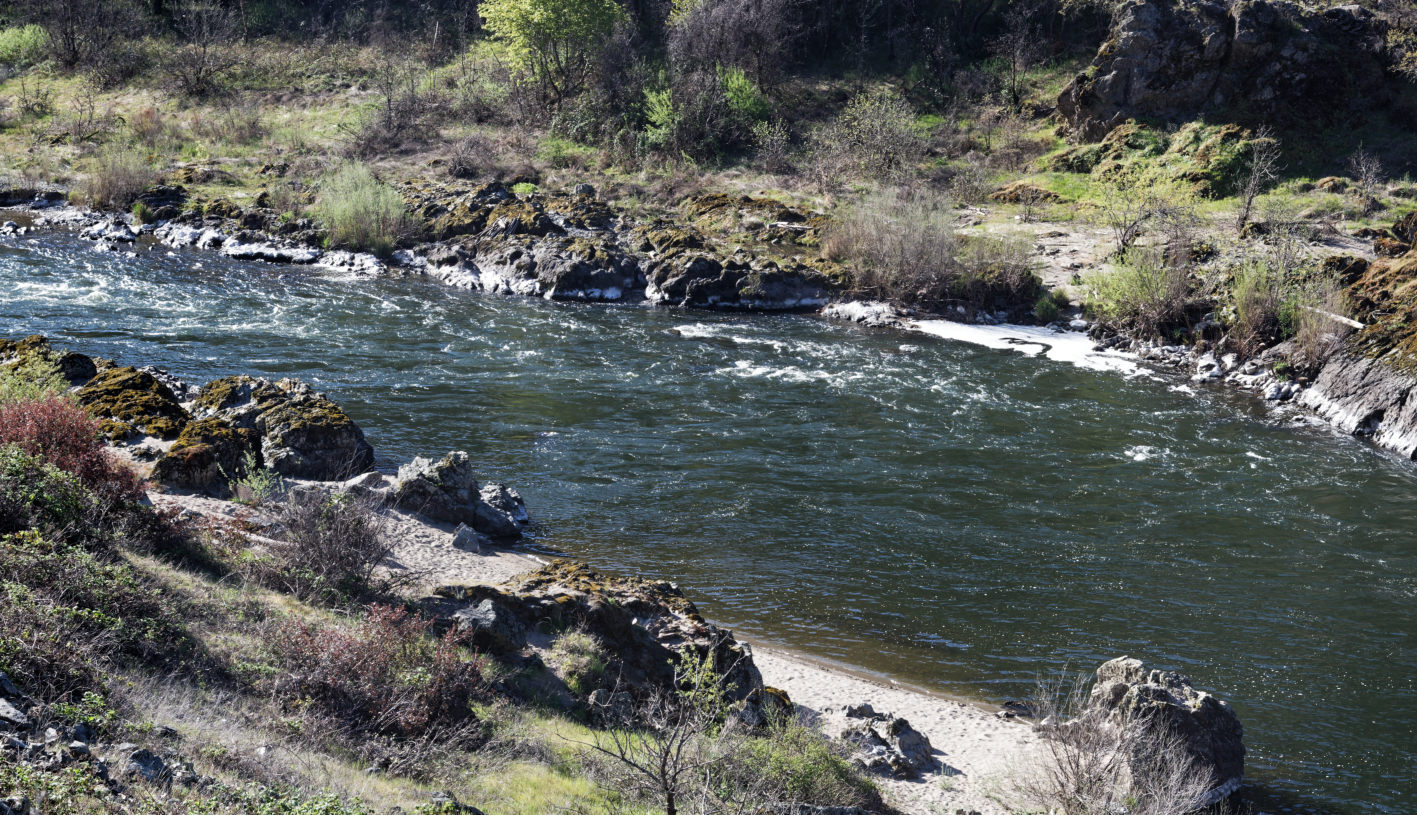
Looking downstream.
Sign of a previous high water.Just a close-up of a rock.The level of the river seems pretty low.
Then we motored the short distance further on to the view point above the canyon. Took more photographs.
A faint reflection of the rocks and trees on the bank behind the river.
Then onto the viewing spot just before the bridge.
I am going to pause this now and continue it on Sunday.
Yesterday we drove down to Phoenix, Oregon to deliver the Sun Tricycle to the new owners. Daniel and Cherie were a delightful couple, albeit more my age than younger. But they had been through one heck of a disaster. Because last year they were both asked to flee the fires with very little notice and only recently had they found a new home and were still settling in.
Daniel rides his trike and wanted to get one for Cherie. We were delighted with the sale and we hope we all will see each other in the near future.
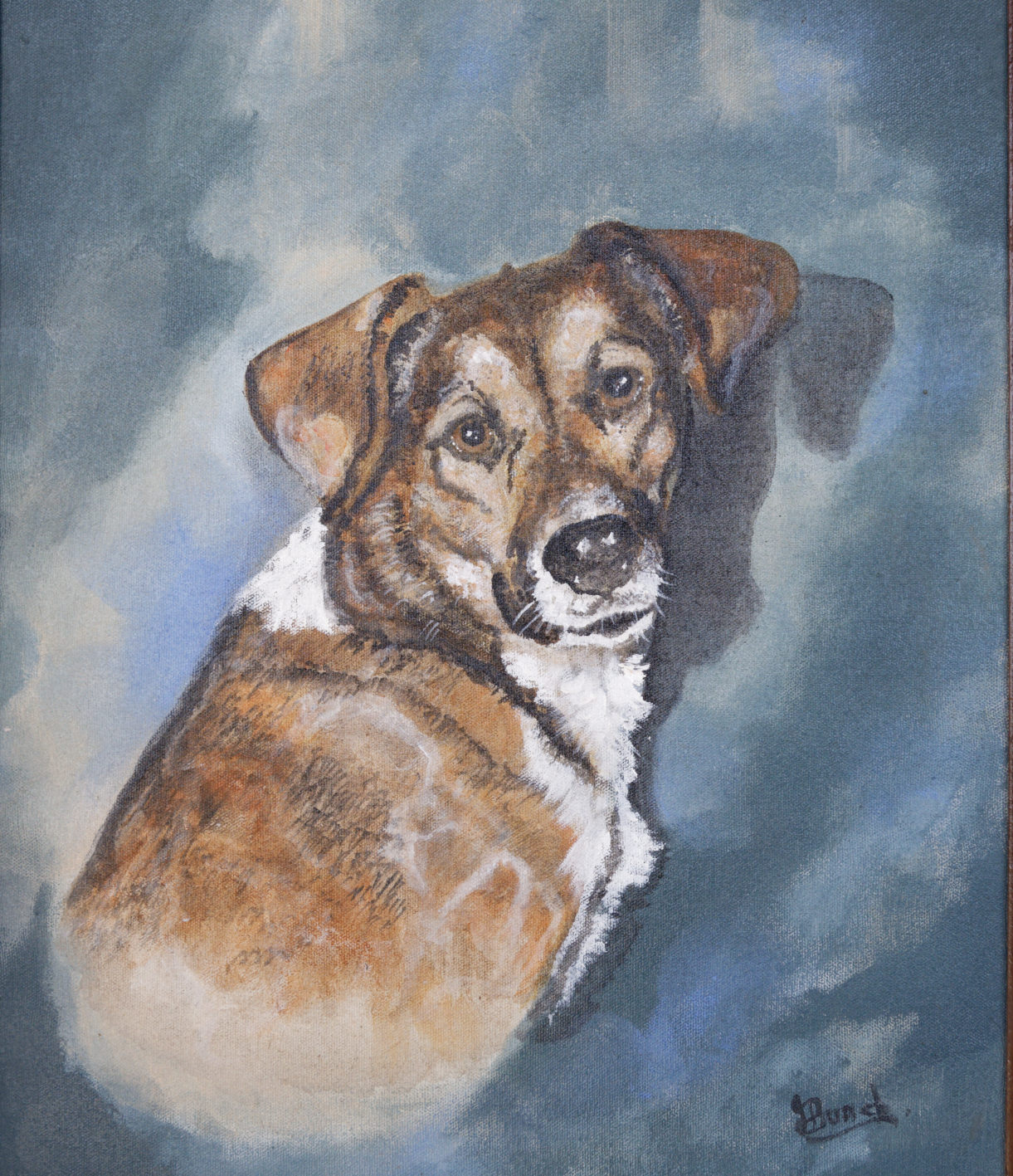
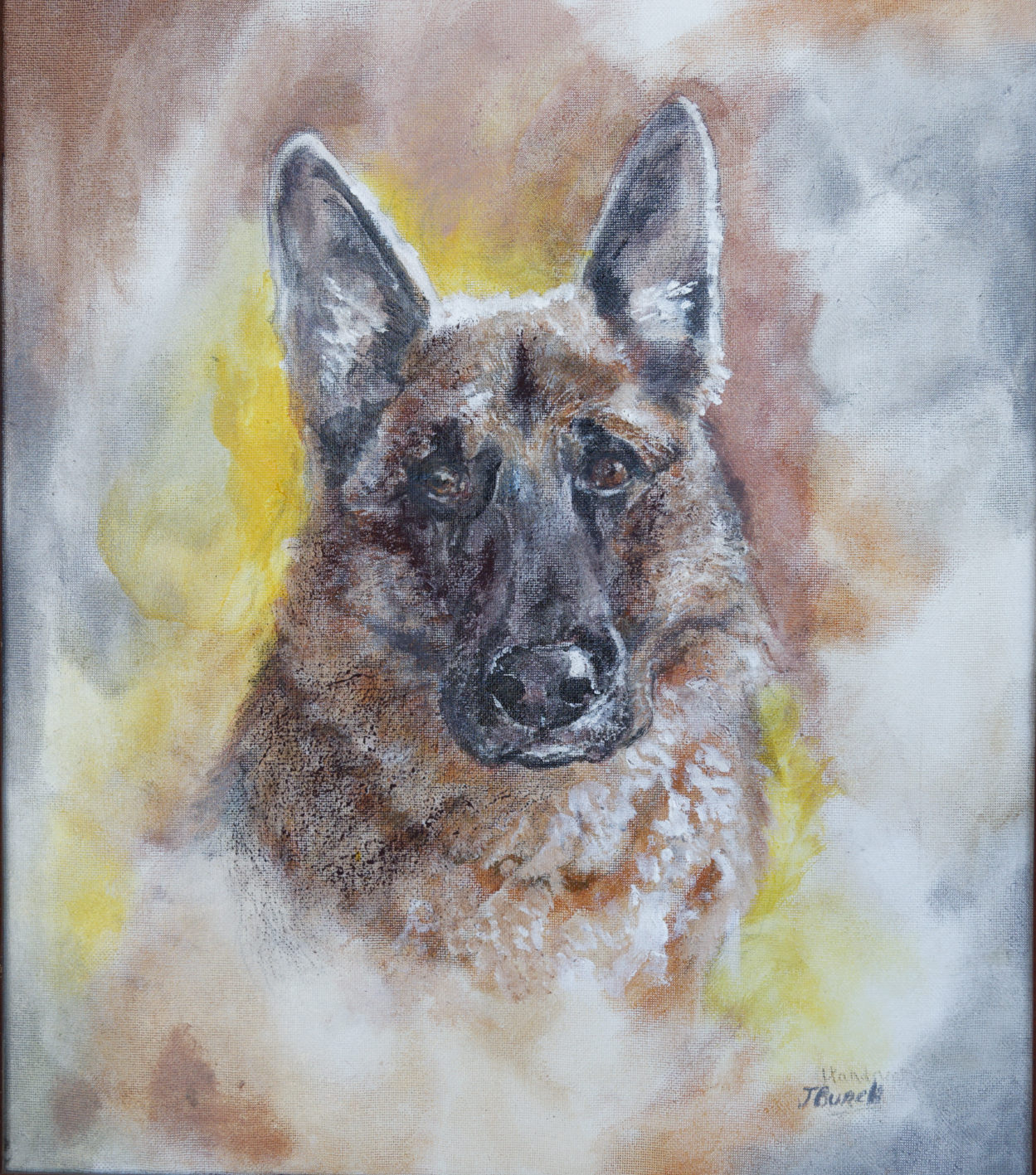
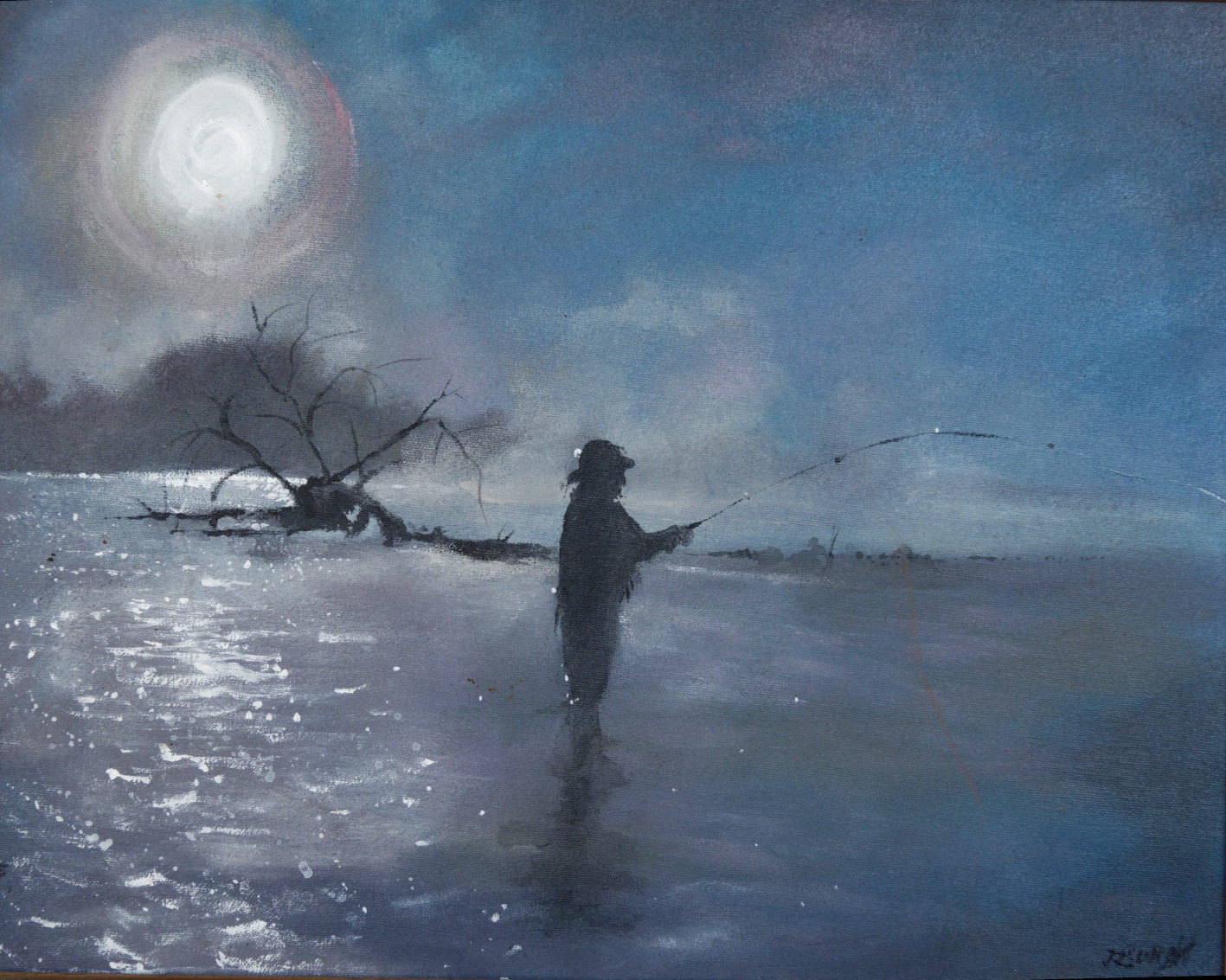
Anyway, Daniel is quite an artist and Jean mentioned she used to paint before the Parkinson’s tremor made it much more difficult. But Daniel insisted on photographs being taken of a few of Jean’s paintings and sent to them via email.
Nothing to do with dogs but everything to do with the future!
An item in The Conversation recently was not only interesting from a scientific point-of-view but also it had real lessons for the way that we humans are interfering with the planet.
As The Conversation introduced the article:
A mile below the surface of the Greenland ice sheet, an ancient Arctic ecosystem is preserved in the frozen soil. How scientists discovered its leaves, twigs and mosses is a story in itself. It starts with a secret military base built into the northern Greenland ice.
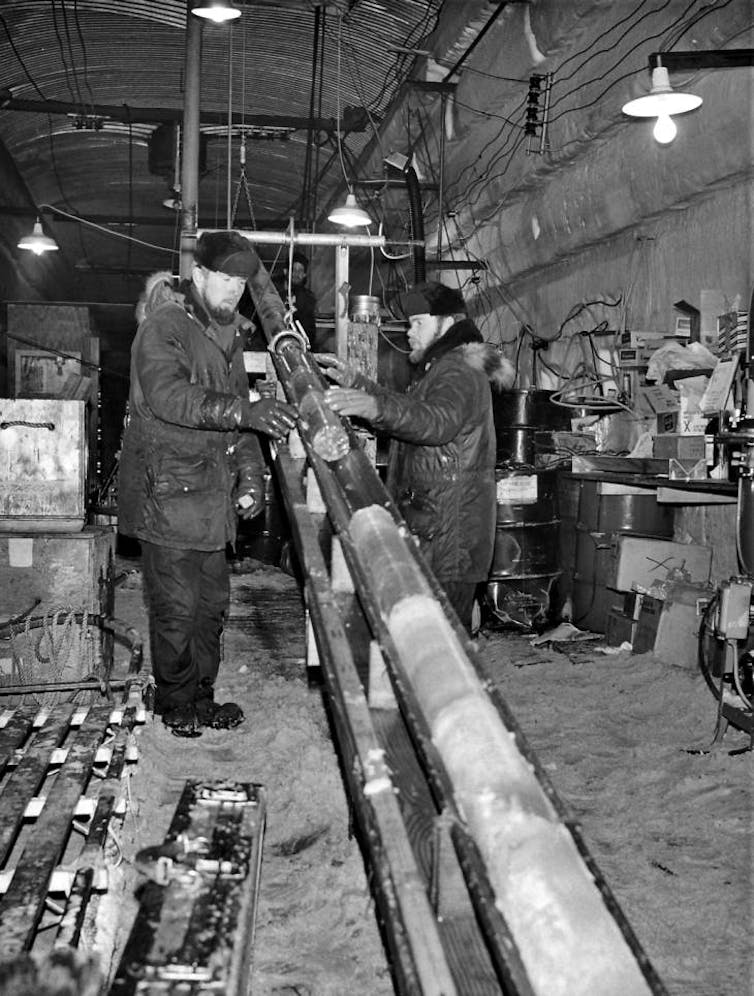
In 1963, inside a covert U.S. military base in northern Greenland, a team of scientists began drilling down through the Greenland ice sheet. Piece by piece, they extracted an ice core 4 inches across and nearly a mile long. At the very end, they pulled up something else – 12 feet of frozen soil.
The ice told a story of Earth’s climate history. The frozen soil was examined, set aside and then forgotten.
Half a century later, scientists rediscovered that soil in a Danish freezer. It is now revealing its secrets.
Using lab techniques unimaginable in the 1960s when the core was drilled, we and an international team of fellow scientists were able to show that Greenland’s massive ice sheet had melted to the ground there within the past million years. Radiocarbon dating shows that it would have happened more than 50,000 years ago. It most likely happened during times when the climate was warm and sea level was high, possibly 400,000 years ago.
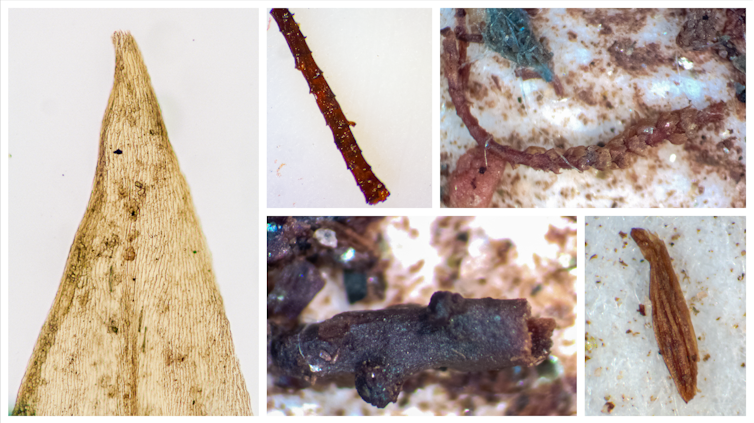
And there was more. As we explored the soil under a microscope, we were stunned to discover the remnants of a tundra ecosystem – twigs, leaves and moss. We were looking at northern Greenland as it existed the last time the region was ice-free. Our peer-reviewed study was published on March 15 in Proceedings of the National Academy of Sciences.
Engineers pull up a section of the 4,560-foot-long ice core at Camp Century in the 1960s. U.S. Army Corps of Engineers
Paul Bierman, a geomorphologist and geochemist, describes what he and his colleagues found in the soil.
With no ice sheet, sunlight would have warmed the soil enough for tundra vegetation to cover the landscape. The oceans around the globe would have been more than 10 feet higher, and maybe even 20 feet. The land on which Boston, London and Shanghai sit today would have been under the ocean waves.
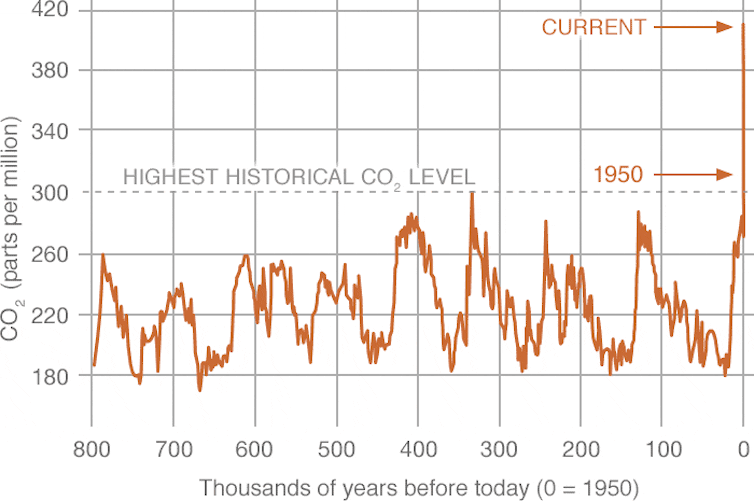
All of this happened before humans began warming the Earth’s climate. The atmosphere at that time contained far less carbon dioxide than it does today, and it wasn’t rising as quickly. The ice core and the soil below are something of a Rosetta Stone for understanding how durable the Greenland ice sheet has been during past warm periods – and how quickly it might melt again as the climate heats up.
Secret military bases and Danish freezers
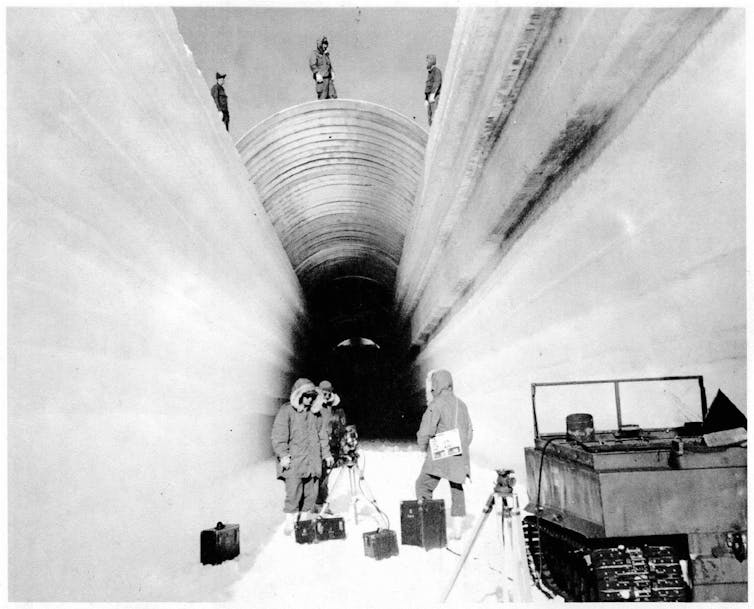
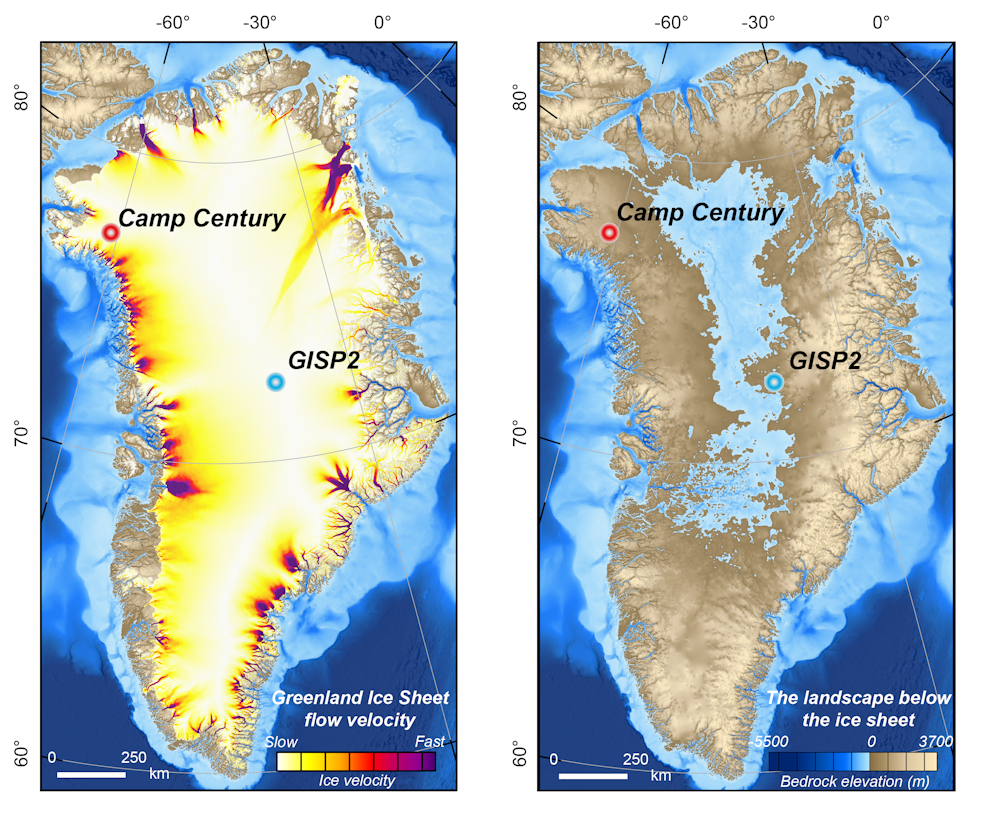
The story of the ice core begins during the Cold War with a military mission dubbed Project Iceworm. Starting around 1959, the U.S. Army hauled hundreds of soldiers, heavy equipment and even a nuclear reactor across the ice sheet in northwest Greenland and dug a base of tunnels inside the ice. They called it Camp Century.
It was part of a secret plan to hide nuclear weapons from the Soviets. The public knew it as an Arctic research laboratory. Walter Cronkite even paid a visit and filed a report.
Workers build the snow tunnels at the Camp Century research base in 1960. U.S. Army Corps of Engineers
Camp Century didn’t last long. The snow and ice began slowly crushing the buildings inside the tunnels below, forcing the military to abandon it in 1966. During its short life, however, scientists were able to extract the ice core and begin analyzing Greenland’s climate history. As ice builds up year by year, it captures layers of volcanic ash and changes in precipitation over time, and it traps air bubbles that reveal the past composition of the atmosphere.
One of the original scientists, glaciologist Chester Langway, kept the core and soil samples frozen at the University at Buffalo for years, then he shipped them to a Danish archive in the 1990s, where the soil was soon forgotten.
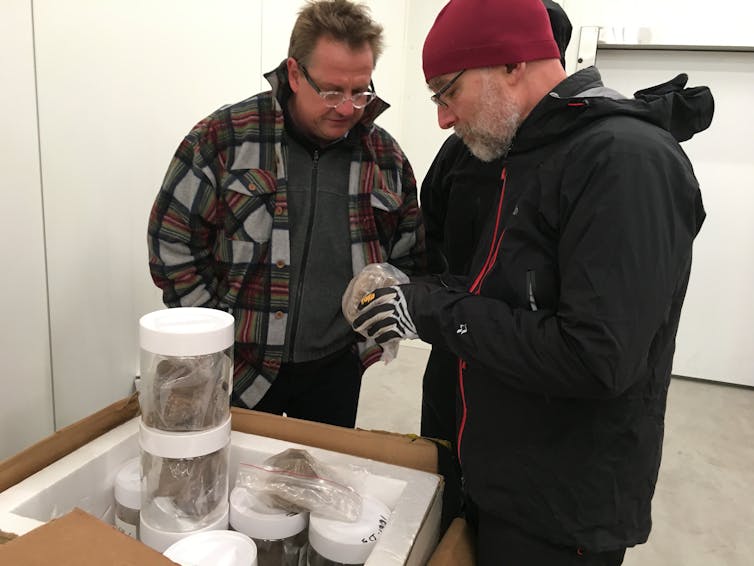
A few years ago, our Danish colleagues found the soil samples in a box of glass cookie jars with faded labels: “Camp Century Sub-Ice.”
Geomorphologist Paul Bierman (right) and geochemist Joerg Schaefer of Columbia University examine the jars holding Camp Century sediment for the first time. They were in a Danish freezer set at -17 F. Paul Bierman, CC BY-ND
A surprise under the microscope
On a hot July day in 2019, two samples of soil arrived at our lab at the University of Vermont frozen solid. We began the painstaking process of splitting the precious few ounces of frozen mud and sand for different analyses.
First, we photographed the layering in the soil before it was lost forever. Then we chiseled off small bits to examine under the microscope. We melted the rest and saved the ancient water.
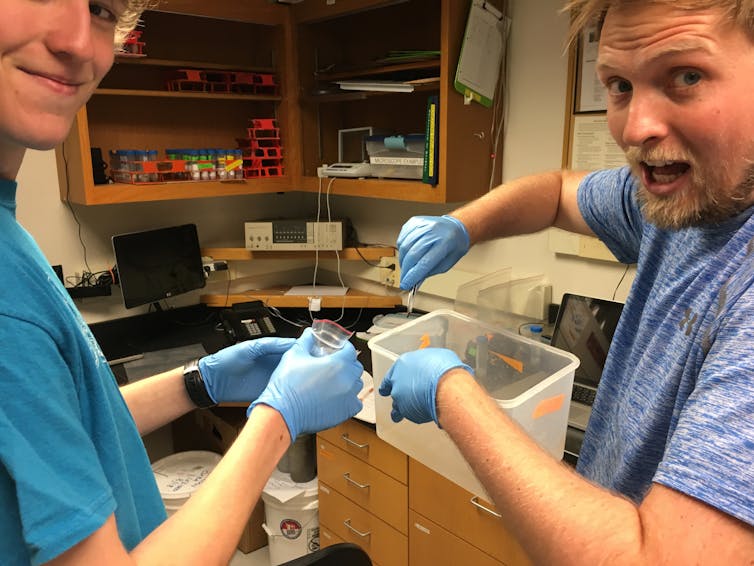
Then came the biggest surprise. While we were washing the soil, we spotted something floating in the rinse water. Paul grabbed a pipette and some filter paper, Drew grabbed tweezers and turned on the microscope. We were absolutely stunned as we looked down the eyepiece.
Staring back at us were leaves, twigs and mosses. This wasn’t just soil. This was an ancient ecosystem perfectly preserved in Greenland’s natural deep freeze.
Glacial geomorphologist Andrew Christ (right), with geology student Landon Williamson, holds up the first twig spotted as they washed a sediment sample from Camp Century. Paul Bierman, CC BY-ND
Dating million-year-old moss
How old were these plants?
Over the last million years, Earth’s climate was punctuated by relatively short warm periods, typically lasting about 10,000 years, called interglacials, when there was less ice at the poles and sea level was higher. The Greenland ice sheet survived through all of human history during the Holocene, the present interglacial period of the last 12,000 years, and most of the interglacials in the last million years.
But our research shows that at least one of these interglacial periods was warm enough for a long enough period of time to melt large portions of the Greenland ice sheet, allowing a tundra ecosystem to emerge in northwestern Greenland.
We used two techniques to determine the age of the soil and the plants. First, we used clean room chemistry and a particle accelerator to count atoms that form in rocks and sediment when exposed to natural radiation that bombards Earth. Then, a colleague used an ultra-sensitive method for measuring light emitted from grains of sand to determine the last time they were exposed to sunlight.
Maps of Greenland show the speed of the ice sheet as it flows (left) and the landscape hidden beneath it (right). BedMachine v3; Copernicus Climate Change Service (C3S), CC BY-ND
The concentration of carbon dioxide in the atmosphere today is well beyond past levels determined from ice cores. On March 14, 2021, the CO2 level was about 417 ppm. NASA Jet Propulsion Laboratory, CC BY-ND
Losing the Greenland ice sheet would be catastrophic to humanity today. The melted ice would raise sea level by more than 20 feet. That would redraw coastlines worldwide.
About 40% of the global population lives within 60 miles of a coast, and 600 million people live within 30 feet of sea level. If warming continues, ice melt from Greenland and Antarctica will pour more water into the oceans. Communities will be forced to relocate, climate refugees will become more common, and costly infrastructure will be abandoned. Already, sea level rise has amplified flooding from coastal storms, causing hundreds of billions of dollars of damage every year.
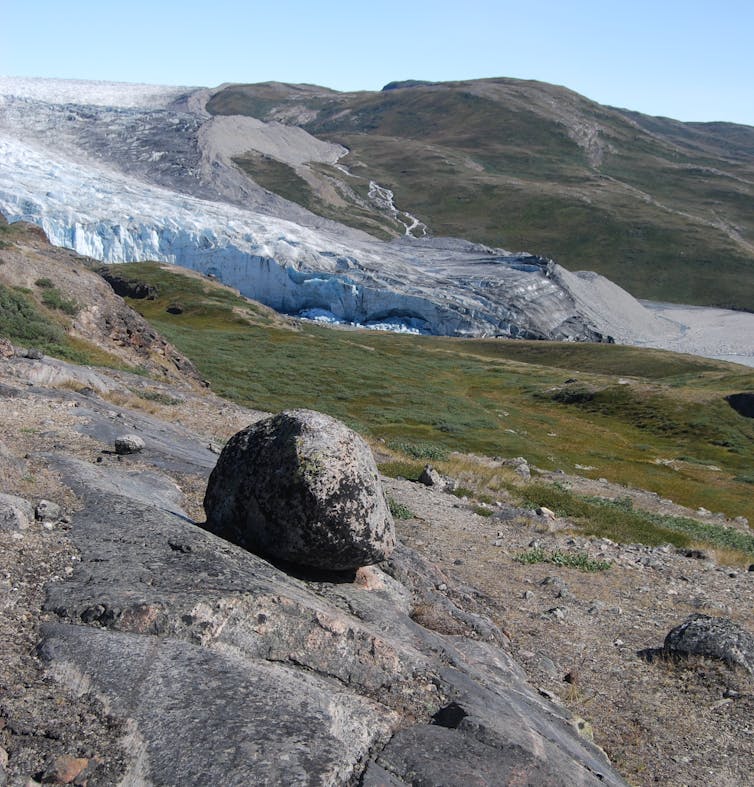
Tundra near the Greenland ice sheet today. Is this what Camp Century looked like before the ice came back sometime in the last million years? Paul Bierman, CC BY-ND
The story of Camp Century spans two critical moments in modern history. An Arctic military base built in response to the existential threat of nuclear war inadvertently led us to discover another threat from ice cores – the threat of sea level rise from human-caused climate change. Now, its legacy is helping scientists understand how the Earth responds to a changing climate.
The article is republished with the full permission of The Conversation.
I hope you read it because the way the climate is changing is affecting all of us now and sooner rather than later we have all got to amend our ways. Indeed, when I look at anyone who has potentially thirty or more years of life in them I ponder what their future is going to be like. And, of course, it won’t be a drastic change in thirty years it is already happening now albeit at times difficult to see.
But there is not one scintilla of doubt that we humans are the cause and we humans have to be the solution!

















 Learning from Dogs