Category: Technology

A wonderful Saturday Smile

Rakesh Shukla gives lost dogs a wonderful voice.

Last Monday, the BBC News website featured an item about Rakesh Shukla.

Rakesh runs a charity called The Voice of Stray Dogs (VoSD).The WikiPedia entry is a bit light on details but the UK arm of The Huffington Post makes up for that. Here’s an extract from the news item:

VoSD was founded by Mr Rakesh Shukla, affectionately known as the “Dog Father”. It was set up single-handedly after he felt obliged to do something about the plight of stray dogs in India. Well known for keeping dogs in his home [ the VoSD Sanctuary] and in his office, Rakesh has worked tirelessly to raise funds for the care of stray dogs [ with greater than 90% contributed by himself]. One visitor said ““Rakesh’s growing family of rescued dogs is a sight to behold. It is amazing how so many dogs together get on so well“.

He operates a system that has rescued more than 3000 dogs in 2 years with 400+ permanent dogs under his care. VoSD offers the highest standard of service and is equipped with the latest technology so that stray dogs get the best possible care.

Back to the BBC item that I am taking the liberty of republishing in full.

ooOOoo

The man who looks after 735 dogs

19 December 2016, India

_92945569_bbc-vsd-59Rakesh Shukla is a software engineer who’s found his life’s calling in looking after dogs that no-one wants, writes the BBC’s Geeta Pandey in Bangalore.

The car pulled up outside a dusty farmhouse near the capital of the southern Indian state of Karnataka and suddenly dogs were everywhere, yelping and barking, jumping with joy.

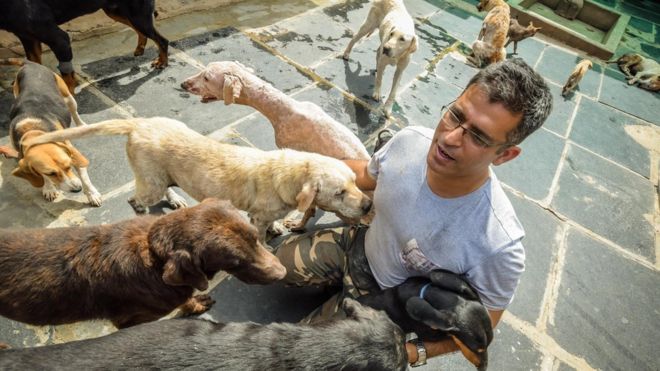
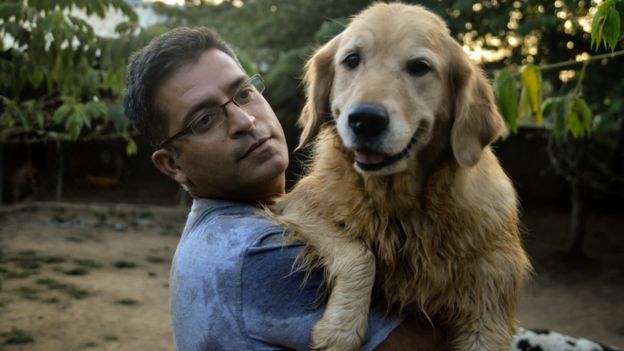
Within seconds, they were all over Rakesh Shukla, nuzzling him and licking him, and Mr Shukla was as delighted to see them. He spoke to them, patted some, scratched one behind the ears, and lofted another onto his shoulder.

Then he gave me a tour of his three and a half acre farm. At last count, Mr Shukla had 735 dogs.

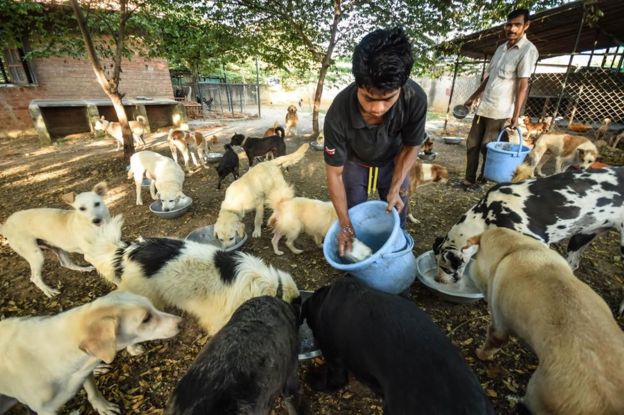
_92950543_bbc-vsd-114_92945567_bbc-vsd-41There are Labradors on the farm, there are Golden Retrievers, Great Danes, Beagles, Dachshunds, Rottweilers, Saint Bernards and even a pug. There are hundreds of mongrels too.

Most of the dogs are strays, the others have been abandoned by their owners. The latest arrivals was a group of 22 pedigreed dogs whose owner, a city businessman, was shot dead recently by criminals.

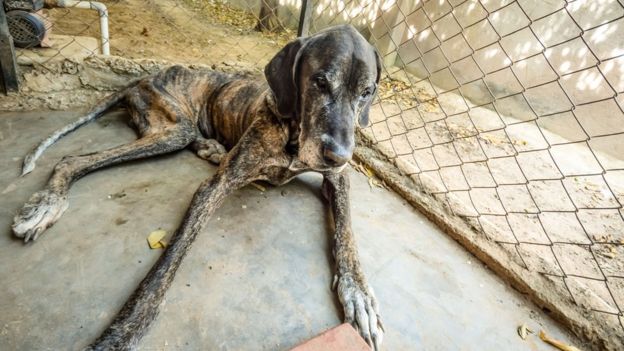
“I’m the last stop for these dogs. They are no longer cute and cuddly. Many are sick and no longer wanted,” said Mr Shukla, 45.

Affectionately known as the “Dog Father”, he calls the dogs his babies and him their “papa”.

_92945571_bbc-vsd-123_92950776_bbc-vsd-85Mr Shukla, who founded a software company along with his wife 10 years ago, spends three to four days every week on the farm, taking care of his canines.

“I had worked in Delhi, in the United States and then set up my own company in Bangalore,” he said. “Life was all about buying big cars and expensive watches and living a fancy life. I had travelled and seen the world many times over, but then I was not happy.”

Then Kavya came into his life: a beautiful 45-day-old Golden Retriever that he fell hopelessly in love with. It was in June 2009, and Mr Shukla remembers clearly the day he brought her home.

“When we got home, she went and hid in a corner. I got down to her level on the floor and I was calling out to her. She was looking at me, she was scared, but I could see she wanted to trust me,” he said.

“And that’s when the moment happened – it was a physical feeling, my hair was tingling, I could feel a warm glow. And I’ve never needed to ask myself that question – ‘why am I here?’ – again after that.”

_92950549_bbc-vsd-96_92961801_mediaitem92961800Mr Shukla’s second dog, Lucky, came to him three months later when he rescued her from the streets. “It had been raining for 12-13 days, she was wet and miserable, so I brought her home too,” he said.

Over the coming days and weeks, whenever he met a stray or abandoned dog, he brought it home. Initially he kept them there but when his wife protested, he moved some of them to the office, where the top floor was turned into a home for dogs.

In 2012, as the pack grew, Mr Shukla bought land in Doddballapur town and set up the farm – a haven for dogs that are old, ailing or simply unwanted.

_92950774_bbc-vsd-76_92950551_bbc-vsd-79The farm is designed for its canine residents, with lots of open spaces for them to run around and ponds to swim in, and there’s double fencing to keep them safe.

Every time we entered an enclosure, a cacophony of barks greeted us.

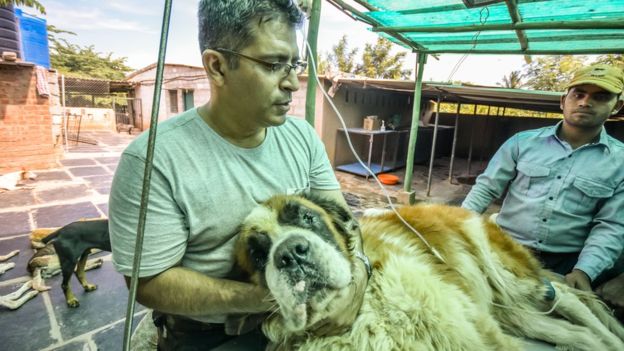
The farm employs about 10 people, including trained veterinary assistants, to look after the dogs, cook for them and feed them. The dogs are fed 200kg of chicken and another 200kg of rice daily and many of the sick ones need regular medicines and attention.

_92950778_bbc-vsd-49_92951835_bbc-vsd-20The daily cost of running the centre is 45,000 to 50,000 rupees ($663; £532 to $737; £592), according to Mr Shukla, who said he provided 93% of the funds.

In the past year though, he has run into problems with some animal activists, who have demanded that they be allowed onto the farm. He has also faced complaints that he is creating public unrest by keeping so many dogs. There have also been demands that he shut down the farm.

He has refused to concede.

“I’ve made a pact with my dogs,” he said. “We will part only when one of us kicks the bucket.”

ooOOoo

You know that there are many who are desperately worried about 2017 and beyond. The next few years, ten at most, will see the results of this great experiment that humanity is conducting.

Now, I’m happy to put my hand up as someone who does worry at what my generation is leaving for our grandchildren.

Then one comes across people like Rakesh and, somehow, the future doesn’t seem quite so grim.

What a wonderful man.

Published on Oct 8, 2014

Rakesh Shukla is the go-to guy for dog rescue in Bangalore. His privately-funded venture, ‘The Voice of Stray Dogs’ champions the cause of India’s stray/ street dogs with research, publication, litigation, veterinary and healthcare services for stray dogs.

 See you all on the other side of Christmas!
But promise me one thing: Never turn your back on a dog in need.

Possibly more harmful things!

Four household products that could be making you sick.

In yesterday’s post I republished an email sent by fellow author Judi Holdeman warning about some brands of peanut butter in terms of potential harm to our gorgeous dogs. Or to be more precise about the dangers of xylitol that is an ingredient in those named brands.

Today, I am delighted to publish a guest post from Charlotte Meier. Charlotte explained to me that she “Operates Home Safety Hub, a site which provides resources on preventing injury and property loss. Her mission is the same as Home Safety Hub’s, which is to help people keep their homes safe. ” Yes, keeping our homes safe includes keeping our dogs safe.

Here is that guest post.

ooOOoo

Four household products that could be making you sick.

charlotte We tend to believe that household products such as cleaners or kitchen utensils are good for us. Keeping your house bacteria-free surely can’t have a negative effect on your well-being, right? Unfortunately, as the world becomes more eco-friendly, studies are now showing that your favorite household products could be damaging both you and the planet.

It is critical that you do the research necessary to identify healthy and eco-friendly products. However, that may be easier said than done. Here are a few common household products that could be harmful to your health or the environment.

Nonstick Cookware

Nonstick cookware (such as pots, pans, and baking dishes) was initially celebrated and sought-after, seeming to make cooking simpler and cleanup easy. However, we now know that the nonstick surface is created using Teflon which releases toxic gasses. When you use this cookware at a high temperature, you are essentially poisoning yourself and placing yourself at risk for organ failure, cancer, and other health concerns.

A few healthy alternatives are cast iron, stainless steel, and ceramic coated cookware. Just be certain you do your research on the proper way to care for each type of cookware. For example, cast iron cannot be washed with soap and should be dried immediately after rinsing to avoid rust.

Air Fresheners

Keeping your home smelling fresh with wall plug-ins or sprays is very common. However, many of these products can have a detrimental impact on your health. Furthermore, aerosols are very bad for the environment.

If you want your home to smell wonderful, there are a number of ways you can do so in an eco-friendly and beneficial way. Scented soy candles can be highly effective as can boiling aromatic spices. Recipes for seasonal home scent blends can be found for essential oil diffusers as well.

Garden Insecticides

If you are using insecticides in your garden or on your landscaping, lawn, or potted plants, you are endangering your health and the well-being of the planet. Insecticides are extraordinarily harmful, affecting the nervous system and respiratory system in humans while carrying toxins to water supplies and culling bee populations.

If you have a pest problem, you need to either seek out a home remedy such as vinegar or purchase a genuinely eco-friendly insect control.

Anti-Bacterial Cleaners

Exposure to bacteria is how our immune systems learn and grow. In order do that, you must embrace bacteria in your home. Anti-bacterial products keep your home sterile, leaving your immune system to drop its guard and increase the likelihood of getting sick. When you clean your home, you certainly want to keep it clean, but you do not want it entirely sterile. Anti-bacterial products may do more harm than good.

If you want an eco-friendly cleaner, try utilizing the app ThinkDirty, which rates the safety of household products in terms of their impact on people and the planet. Seventh Generation is one of the best lines of household goods for those seeking eco-friendly options.

Knowing how to best keep yourself and the planet well can be very difficult. False or misleading advertising can trick you into using unhealthy products and knowing what is truthful is no easy feat. However, with a little time, effort, and research, you can make the right decisions with your household products.

Image via Pixabay by Taken

ooOOoo

There you are good people; another Friday come and gone.
But I do hope that you found value in what Charlotte wrote about. Indeed, I have no doubt that many of you did.
Let me close by sharing the email that Charlotte sent me a couple of weeks ago.

Hi!
Our homes are our safe havens. In fact, the term “homesick” refers to a longing for the comfort and love that we associate with home when we’re away from it.
But many Americans, today, are homesick in a different way. They (and often their pets as well) are suffering from respiratory illnesses, skin irritations, allergies, and in some cases, even cancer, due to factors found in their homes.

As part of my research for my new site, HomeSafetyHub.org, I’ve been studying ways our homes make us sick and what we can do about them. I’d love to share what I’ve learned with your readers in the form of a guest article.

The article will offer tips and advice on what factors to test for, suggestions for easy, environmentally-friendly DIY repairs to eliminate problems, what products or building materials to avoid, and more.

If you’re interested in receiving a guest article, please let me know. No payment necessary, of course, I’d just love the opportunity to share my original content on a great site.
Hope to hear from you soon!
All the best,
Charlotte

Breathtaking!

No other words required.

http://www.youtube.com/watch?v=e8iHJT-g7pE

And there’s another special moment regarding the moon coming up in a week’s time! (You’ll have to be patient for I’m not saying anything more just now!)

Water and the internet don’t mix!

Interesting run of weather just now!

At 9pm last night water running down the cable from the wireless internet antenna outside came into the house and caused the ‘power adapter’ unit to fail.

Amazingly between me and our supplier, Outreach Internet, service was resumed about an hour ago.

However, until the Outreach engineer can come to our property and do a proper clean-up job there’s no guarantee that we might not lose service again.

Just wanted all you good people to be aware of that.

(And as at this time of writing we are up to 4 in of rain since yesterday morning!)

Five years: Just like that!

How time flies!

I was outside working yesterday afternoon and came back into the house some thirty minutes before Jean and I were due to visit a neighbour. Ergo, I was looking for a shortcut in terms of putting together a post for all you good people.

The notion came to me that I would republish something that was on Learning from Dogs some fives years ago: October 8th, 2011 to be exact.

Here it is!

ooOOoo

Sit back and Smile

With thanks to Ellen M. for passing this across to Learning from Dogs.

ooOOoo

Then to prove how quickly time flies by, guess what! Dear Sue Dreamwalker left a message to that post back in 2011.

What a great story and video… 🙂 .. Love this guys last comment about his Best Friend being less expensive than a girl friend.. lol.. Dogs Rule..

Just as Sue is still doing and, I bet, will be leaving a wonderful response today!

The utterly incomprehensible

A journey of the mind and the soul.

NB: Regular readers will find that today’s post is rather different to my usual run of things. But I do hope that you end up sharing my feelings of mystery; sharing what seems to me utterly incomprehensible. I am speaking of The Infinite.

Let me start with this quotation:

The infinite has always stirred the emotions of mankind more deeply than any other question.

The infinite has stimulated and fertilised reason as few other ideas have. But also the infinite, more than another other notion, is in need of clarification.

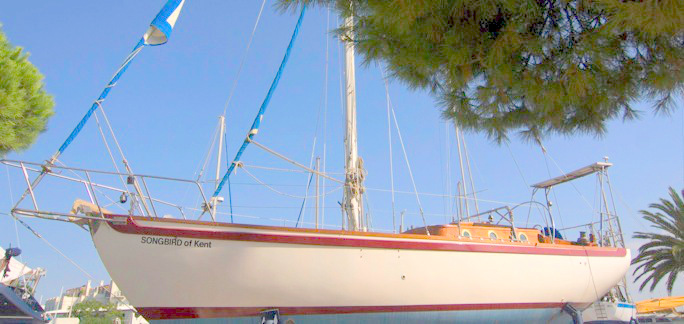
Let me now take you back many years, back to the Autumn of 1969 when I left Gibraltar bound for The Azores on my yacht Songbird of Kent. I was sailing solo.

My home for five years – Songbird of Kent; a Tradewind 33.

Despite me being very familiar with my boat, and with sailing in general, there was nonetheless a deep sense of trepidation as I headed out into a vast unfamiliar ocean.

On the third or fourth night, I forget which, when some four hundred miles into the Atlantic and therefore far from the light pollution from the land, I came on deck and was emotionally moved in a way that has never ever been surpassed.

For way up in the heavens above me was the Andromeda galaxy, clearly visible with the naked eye.

andromeda-galaxy-josh-blash-7-23-2014-e1473897834535
Josh Blash captured this image of the Andromeda galaxy.

That photograph above and the following are from the EarthSky site.

Although a couple of dozen minor galaxies lie closer to our Milky Way, the Andromeda galaxy is the closest major galaxy to ours. Excluding the Large and Small Magellanic Clouds, which can’t be seen from northerly latitudes, the Andromeda galaxy – also known as M31 – is the brightest galaxy in all the heavens. It’s the most distant thing you can see with your unaided eye, at 2.3 million light-years. To the eye, it appears as a smudge of light larger than a full moon.

Not only could I not take my mind off seeing the Andromeda galaxy, I couldn’t easily comprehend seeing the stars come all the way down to the horizon; all 360 degrees about me.  Right down to the edge of my ocean horizon; a swirling blackness out to where it kissed that glorious night sky.

That image of that dome of stars would be forever burnt into my memory. An image that both made no sense, yet made every sense

Fast forward forty-seven years to now!

Recently we have had some beautiful clear nights here in Southern Oregon. Just the other night, before the moon had risen, there up in the night sky just a short distance from the constellation Cassiopeia was Andromeda. Immediately, my memory of that dark night sky out in the Atlantic came rushing back at me

The Andromeda galaxy is 2.3 million light-years away. But how can one possibly comprehend the distance? The fact that light travels at 186,000 miles per second or 671 million miles per hour (the exact value is 299,792,458 metres per second (approximately 3.00×10⁸ m/s) has no meaning whatsoever. Think about it! Light is traveling at the equivalent speed of going around our planet 7.46 times every second!

But if you can’t fathom the distance to the Andromeda galaxy try this!

Back in March, 2016 a new galaxy that has been named GN-z11 was spotted by the Hubble space telescope 13.4 billion light years away. That’s approximately 5,830 times more distant than the Andromeda galaxy!

Now it is starting to become very difficult to comprehend.

Over the last couple of weeks BBC Radio 4 has been airing 10 talks given by Professor Adrian Moore under the heading of A History of the Infinite. They are freely available to be listened to and I so strongly recommend them.

But it was episode eight that made me lose my mind. Just like that night so many years ago on Songbird of Kent.

For that episode was called The Cosmos. You can listen to it here. Please, please do so! This is how that episode is presented:

Does space go on for ever? Are there infinitely many stars? These are some of the questions Adrian Moore explores in the eighth episode in his series about philosophical thought concerning the infinite.

With the help of the theories of the Ancient Greeks through to those of modern cosmologists, Adrian examines the central question of whether our universe is finite or infinite.

For most of us, looking up at the stars gives us a sense of infinity but, as Adrian discovers, there is a strong body of opinion which suggests that space is finite, albeit unbounded. This is a difficult idea to grasp, but by inviting us to think of ourselves as ants, astrophysics professor Jo Dunkley attempts to explain it.

Adrian also tackles the idea of the expanding universe and the logic that leads cosmologists to argue that it all started with a big bang, and may all end with a big crunch.

Finally, we discover from cosmologist John Barrow how the appearance of an infinity in scientists’ calculations sends them straight back to the drawing board. The infinite, which the Ancient Greeks found so troubling, has lost none of its power to disturb.

A Juniper production for BBC Radio 4.

If you find that episode compelling beyond belief then all the episodes are available on the BBC iPlayer and may be found here.

I started with a quotation that is the opening of the final episode. It is a quotation from the German mathematician David Hilbert. As Wikipedia explains, in part:

hilbertDavid Hilbert (German: [ˈdaːvɪt ˈhɪlbɐt]; 23 January 1862 – 14 February 1943) was a German mathematician. He is recognized as one of the most influential and universal mathematicians of the 19th and early 20th centuries.

I will return to that first sentence in Hilbert’s quotation:

The infinite has always stirred the emotions of mankind more deeply than any other question.

For me that sight of the Andromeda galaxy and the stars back in 1969 was in every meaning of the word a sight of the infinite and it has forever stirred my emotions very deeply indeed!

Listening furry ears!

Returning to the fascinating topic of how dogs understand us humans.

At the beginning of the month I published a post called Be Careful What You Say. It featured an item on BBC Radio Four regarding the science report from a team in Hungary seeking better to understand how dogs process human vocal sounds, as in speech. (The science report was rapidly featured in many other media outlets.)

Anyway, I am delighted to say that the Rights & Permissions Department of the AAAS pointed out that:

Virginia’s article is freely available on our open news website (http://www.sciencemag.org/news)  so rather than post, please link to it (http://www.sciencemag.org/news/2016/08/video-your-dog-understands-more-you-think). Your site visitors will encounter no barriers to viewing the article on our website.  We welcome hyperlinks to Science articles provided a plain text link is used and providing our content is not framed. We also ask that the text surrounding the hyperlink not imply any endorsement of your website, products or services by AAAS/Science.

The article, written by Virginia Morell, primarily features a video (see below) but I will just republish Virginia’s opening paragraphs.

Video: Your dog understands more than you think


It’s the eternal question for pet owners: Does your dog understand what you’re saying? Even if Fido doesn’t “get” your words, surely he gets your tone when you let loose about another accident on the carpet. But a new imaging study shows that dogs’ brains respond to actual words, not just the tone in which they’re said. The study will likely shake up research into the origins of language, scientists say, as well as gratify dog lovers.

“It’s an important study that shows that basic aspects of speech perception can be shared with quite distant relatives,” says Tecumseh Fitch, a cognitive biologist at the University of Vienna, who was not involved in the work.

It’s not a long article but for any dog lover it is a most interesting read.

So here’s that video.

Virginia concludes her article, thus:

The new results add to scientists’ knowledge of how canine brains process human speech. Dogs have brain areas dedicated to interpreting voices, distinguishing sounds (in the left hemisphere), and analyzing the sounds that convey emotions (in the right hemisphere).

The finding “doesn’t mean that dogs understand everything we say,” says Julie Hecht, who studies canine behavior and cognition at City University of New York in New York City and who was not involved in the study. “But our words and intonations are not meaningless to dogs.” Fitch hopes that similar studies will be done on other domestic animals and on human-raised wolves to see how much of this ability is hardwired in dogs and how much is due to growing up among talking humans.

What a wonderful relationship dogs and humans have with each other!

And Another Saturday Smile

Enjoy your weekend, and don’t miss the Harvest Moon!

Another fabulous reposting of an article that first was seen on the Care2 site.

ooOOoo

This Man May Wear a Hard Hat, But He Sure Has a Soft Spot for Dogs

3188741-largeBy: Laura S. September 11, 2016

Max Kahrimanovic lives in his hard hat. It’s covered in the dust of three continents where he programs wind turbines, often at a dangerous height. But some may say Max’s greatest accomplishments unfold in the far less intricate scenarios down on the ground where he feeds hungry, and often very thirsty, stray dogs. This is the story of how Max won the trust of one of those dogs and the remarkable new life she is now beginning.

my-work1
So close he could kiss the clouds, Max programs wind turbines internationally.

“I saw her the very first day I came to the construction site,” Max said of the shy sweetheart he encountered during his latest assignment in Turkey. “She was scared and wouldn’t approach no matter what. I would leave food and would have to walk away. Then, from the far, I would see her eating and drinking what I left for her. Slowly she started to trust me and one day she finally let me pet her on the head.”

From that day forward Karis (as Max named her) decided that she had adopted Max. She would keep watch outside his office door and she would be waiting for him when he arrived at work each morning.

Although she was once so afraid of human touch, Karis soon learned that Max was different than the others she’d encountered.

“She can be naughty at times,” Max laughs, thinking of the occasions Karis dumped over the trash cans. “She wasn’t hungry, I know that much. I was feeding her three times a day. But I guess the leftovers smelled delicious to her and she had to check it out.”

And one day, when Max arrived, Karis had a surprise for him. Overnight, she had delivered seven puppies.

“My first thought was devastation,” Max said candidly. “I know, you’ll think how can I be devastated seeing so much cuteness. But in all these years of traveling through Europe, Morocco, New Zealand, etc. I’ve seen so much misery involving these animals, that I couldn’t feel anything else at that moment.”

At this point, Max had already found a home for Karis in the U.S. and was making arrangements to transport her there. But with seven more lives to worry about, now what?

“How are we gonna manage 7 pups too?” Max wondered. “Knowing what will happen to them after I leave was devastating. I knew they will either die under car wheels, die of starvation, diseases or they will get killed by other bigger dogs that wander around there.”

So, despite the enormity of the costs and challenging logistics, Max and his wife Neli – back in Sweden – began making arrangements to transport the entire family of dogs to the U.S. for adoption. They turned to the Harmony Fund international animal rescue charity for help with the costs of the rescue.

The whole family will be coming to the U.S. soon, and Karis already has a permanent home with one of Max’s friends who has adopted internationally before. Max has no doubt that Karis will be very good to her pups during the transition as she has always been such an excellent mother.

Karis and her pups were moved to a safe location where they await travel to the U.S.

“When she had the puppies, I admired how she never went to eat their food that I gave them,” Max said. “She waited for me to get hers ready. One time I left 6 hard boiled eggs on the table for her lunch. I just stepped out to wash my hands and when I got back eggs were gone. She ate them like that, not peeled or anything.”

Max isn’t always admired for his devotion however. He said he’s known by management as “the guy who feeds strays” and that he has received warnings not to do so. But he simply can’t go against his own moral compass.

Max always makes time to offer food and water to strays like this one in Turkey.

“This is much stronger than me,” Max explains. “I can’t eat my lunch knowing there is a being, not far from me, starving and hasn’t had a piece of bread for days…. We usually work in small villages far from civilization or any bigger cities. If it is possible to buy it, then I always have one or two huge bags of dry food and some cans in the trunk of my car. And on my way from the site to my hotel, I stop and feed strays that I see. If it isn’t possible to buy dog food, then I improvise with our food by either taking extra breakfast from the hotel or just by buying extra food when I go shopping for myself. I know I can’t save them all. But for that day or that time when I meet that dog I can feed him at least and give him some water.”

joy-turkey1ooOOoo

I am so pleased to promote what Max Kahrimanovic is doing and to thank Laura for writing this up in the first place.

Max’s admission in that last paragraph uses words that I have heard Jean using when I first met her back in December, 2006 when she was living in Mexico and rescuing so many street dogs and finding loving homes for them in the USA.

Standing up for the future.

This is no sinecure – the future of mankind is at risk.

Very often I find a topic for Saturday that is easy on the mind. But I make no apologies for republishing, with Jennifer’s permission, a post that she published over on Transition Times yesterday. When you read it you will see clearly that promoting this today is right. For many readers may well be able to join thousands of others in showing their support for the Standing Rock Sioux tribe.

ooOOoo

World War III Has Begun: Which Side Are You On?

Although you wouldn’t know it from scanning the front pages of the mainstream media, a major battle in what Bill McKibben has called World War Three, the war to save the planet from human destruction, has been going down in Indian Country for the past six months.

Thousands of Native Americans, members of a whole host of tribes, have gathered at Standing Rock, North Dakota, to protest the North Dakota Access Pipeline (#NoDAPL), which was sited by the Army Corps of Engineers to run dangerously close to the Missouri River and the Standing Rock Reservation.

But as the protesters say, they are not just defending Indian country, they are defending everyone who relies on the Missouri for water—and not just humans but all life.

If there is anyone to look back at this turbulent period in human history on Earth—now coming to be known as the Anthropocene—they will surely wonder at the suicidal tendency of human civilization in the 20th and early 21st centuries.

Why, they will ask, would such an intelligent species willingly—even enthusiastically—engage in the poisoning of its waterways and underground water resources; the destruction of its forests; the chemical contamination of its soils and oceans; the overheating of its precious atmosphere by relentless burning of fossil fuels? Why would humans put so much of their intelligence and technological prowess into developing ever more lethal weapons of mass destruction, used to bludgeon each other? Why would they preside blithely over the extinction of millions of other species, the vicious ripping of the great ecological web of life on Earth?

Why indeed?

I know it’s hard for any of us to escape the clutter of our everyday lives, with the constant pressures and worries that beset us on the personal level. But this is precisely what is being asked of us now.

The courageous defenders out at Standing Rock dropped their ordinary lives to be part of the historic encampment protesting the stranglehold of the oil companies on our waterways and our lands. They are fighting in the courts, through the media, and most importantly with their physical presence, standing up to the bulldozers, the attack dogs and the pepper spray.

dakota
Image source: Democracy Now!

This is what McKibben’s World War Three looks like—it’s already begun. It will be fought locally, as communities and individuals wake up to the implications of the destruction and decide that hell no, they won’t take it any more.

pipeline_line_map
Oil and gas pipelines in the U.S. Image source: https://projects.propublica.org/pipelines/

In my own corner of the world, we are under assault from General Electric, wanting to create toxic waste dumps right in the middle of our small rural towns. We have a gas pipeline being constructed, despite vehement protests, through a pristine old-growth state forest. We have oil tanker trains running constantly right through our communities. Despite a thriving organic and biodynamic farm renaissance, we still have far too many pesticides, herbicides and fungicides being used locally, and too many trees being cut down.

I have been thinking and writing for some time now about how important it is to align the personal, political and planetary in our own lives and in the way we relate to the world around us. On all three of these levels, 21st century American life is way out of balance.

It is time to focus, each one of us, on using our brief lifetimes to create balance and harmony on Earth. Sometimes the way to harmony leads through protest and discord, as is happening now in Standing Rock. Sometimes it can be as simple as choosing to support local, low-impact agriculture rather than industrial agriculture. Leaning on our political representatives to move faster on policy that will shift our society to renewable energy is key.

Wind farm in Ireland. Source: http://www.iwea.com/_wind_information

There are so many ways to get involved in this War for the Planet, many of them quite peaceful. The important thing is to get off the sidelines. Get involved. Feel the potential of this moment—it’s literally a make or break period for the future of humanity on Earth, and many other living beings too.

The brave defenders at Standing Rock are reminding us that we are all “natives” of this Earth, and we all have a stake in protecting her. Which side are you on?

14184457_10154517767299394_1637715510123189394_nooOOoo

Yes, we are all natives of this world and that includes our dear animals and our wonderful animal companions.

Make a promise to yourself to make a difference; even one small difference. With that in mind, if you want to find an event close to you then the Sierra Club have a page where you can look up which event you would like to attend.

Make a difference!

Damn it! We’re British you know!

Only the Brits could do this!

(Another gem sent on by Dordie to brighten up the coming week!)

Can’t let things go to the dogs can we!

kw001001_1

That’s better!