Category: Strategy

Smoke and Mirrors

Let me start with a quotation:

I’m not a pessimist, even though I do think awful things are going to happen.

James Lovelock

The author of that quote is fellow Englishman, albeit a tad older than yours truly, Mr. James Lovelock. WikiPedia describes him, thus (in part):

James Ephraim Lovelock CHCBEFRS[2] (born 26 July 1919) is an independent scientist, environmentalist and futurist who lives in Devon, England. He is best known for proposing the Gaia hypothesis, which postulates that the Earth functions as a self-regulating system.[5]

Moving on.

These times in this fine country, The United States of America, are troubling as Rebecca Gordon set out so compellingly in yesterday’s post.

But what is so terrible about these times is the failure to put integrity at the heart of every pronouncement that comes from a Government. And it would be grossly unfair to pick on the present US Government as the only example of this failure.

Because just a few mouse clicks can inform millions of us as to the real issues. Such as the effect that Climate Change is having on our health, as this recent Grist article so aptly put it in the opening paragraphs:

Here are 4 ways climate change is messing with our brains — for the worse.

We might think of climate change as purely physical: wildfires blazing through forests, rising seas lapping at the doors of coastal homes.

But those brutal conditions also affect our mental health, changing how we think and act. Mental health professionals are paying attention to the link between climate change and emotional health — and health insurance companies are, too.

Or take the issue of the state of America’s water. Recently the subject of an important essay just presented by Naked Capitalism:

America’s Hidden Water Affordability Crisis

Yves here. Grist has been doing an admirable job of keeping on top of this important yet oddly still-under-the-radar story. In the US, the big driver of rising water costs is the need to invest in aging, neglected water works. But water is going to become an issue in many places for differing reasons. As we have been saying for years, the natural resource that is projected to come under pressure first is potable water. And please don’t push desalination as a magic bullet. That costs money (both the plants and new transportation infrastructure, uses energy, plus has the not-trivial problem of how to dispose of the salt residues.

By Ciara O’Rourke, a freelance writer and 2015-16 Ted Scripps Fellow in Environmental Journalism at the University of Colorado Boulder. Originally published by Fusion and reproduced at Grist as part of the Climate Desk collaboration

When Elizabeth Mack wondered about a future in which Americans wouldn’t be able to pay for water, a couple of colleagues waved her off. “Don’t be ridiculous,” they said. But the idea niggled at Mack, an assistant professor at the Department of Geography, Environment, and Spatial Sciences at Michigan State University. And in January, in an article published in the science journal PLOS ONE, she asked a new question: Is there a burgeoning water affordability crisis in the United States?

Mack, along with research assistant Sarah Wrase, determined that if water rates increase at projected amounts over the next five years, the percentage of households that can’t pay their water bills could triple from 11.9 percent to more than a third. Nearly 14 million households nationwide already struggle to afford water services. An additional 27.18 million — or 8.5 percent of the country’s population — could soon face the same challenges.

Yes, integrity in politics is more, so much more, than a nice idea from this silly old Brit now living in Oregon. Here’s a post I published some four years ago that says it as clearly as it needs to be said.

ooOOoo

Reflections on Integrity.

Going back to basics.

Many will know the origins of this blog; a chance comment by Jon Lavin back in England in early 2007 that dogs were integrous, (a score of 210 as defined by Dr David Hawkins).

Way back in 2009, I wrote this:

“There is nothing to fear except the persistent refusal to find out the truth, the persistent refusal to analyse the causes of happenings.” Dorothy Thompson.

When I started Learning from Dogs I was initially rather vague but knew that the Blog should reflect the growing need for greater integrity and mindfulness in our planetary civilisation. Here are some early musings,

Show that integrity delivers better results … integrity doesn’t require force … networking power of a group … demonstrate the power of intention … cut through the power of propaganda and media distortion …

Promulgate the idea that integrity is the glue that holds a just society together … urgent need as society under huge pressures …. want a decent world for my grandchildren … for all our grandchildren …. feels like the 11th hour….

But as the initial, rather hesitant, start to the Blog settled into a reliable, daily posting, and as the minuscule number of readers steadily grew to the present level of many hundreds each day, the clarity of the purpose of Learning from Dogs also improved.

Because, while it may sound a tad grandiose and pompous, if society doesn’t eschew the games, half-truths and selfish attitudes of the last, say, 30 years or more, then civilisation, as we know it, could be under threat.

Or, possibly, it’s more accurate to say that our civilisation is under threat and the time left to change our ways, to embrace those qualities of integrity, truth and consciousness for the very planet we all live on, is running out.

Time left to change our ways is running out.

So what’s rattled my cage, so to speak, that prompted today’s reflection? I’ll tell you! (You knew I was going to anyway, didn’t you!)

I’m drafting these thoughts around noon Pacific Standard Time on Sunday, 17th. At the same time, tens of thousands of ordinary good folk (40,000 plus at the latest estimate) are gathering by the Washington Monument ready to march past the White House demanding that President Obama block the Keystone XL pipeline and move forward toward climate action.

Do I trust the US Government to take this action? On balance, no! That hurts me terribly to write that. I really want to trust and believe what the President of my new home country says.
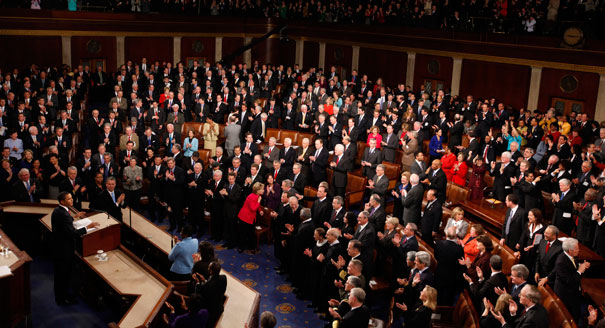
State of the Union speech 2013. AP photo.

Here’s a snippet of what the President did say in his State of the Union speech on February 12th.

Now, it’s true that no single event makes a trend. But the fact is, the 12 hottest years on record have all come in the last 15. Heat waves, droughts, wildfires, floods, all are now more frequent and more intense.

We can choose to believe that Superstorm Sandy, and the most severe drought in decades, and the worst wildfires some states have ever seen were all just a freak coincidence. Or we can choose to believe in the overwhelming judgment of science and act before it’s too late.

A frank admission that the climate is changing in dramatic ways; the overwhelming judgment of science – fantastic!

The evidence that burning carbon-based fuels (coal, oil, gas) is the primary cause of today’s high CO2 levels is overwhelming. As a recent BBC radio programme reveals (being featured tomorrow) huge climate changes going back millions of years are a natural part of Earth’s history. However, as one of the scientists explains at the end of that radio programme, the present CO2 level, 395.55 ppm as of January, is now way above the safe, stable limit for the majority of life species on the planet.

But say you are reading this and are not yet convinced?

Let me borrow an old pilot’s saying from the world of aviation: If there’s any doubt, there’s no doubt!

That embracing, cautious attitude is part of the reason why commercial air transport is among the most safest forms of transport. If you had the slightest doubt about the safety of a flight, you wouldn’t board the aircraft.

If you had the slightest doubt about the future for civilisation on this planet likewise you would do something! Remember, that dry word civilisation means family, children, grandchildren, friends and loved ones. The last thing you would do is to carry on as before!

Which is where my lack of trust of leaders comes from!

Back to that State of the Union speech. Just 210 words after the spoken words “act before it’s too late” (I counted them!) Pres. Obama says, “That’s why my administration will keep cutting red tape and speeding up new oil and gas permits.

Here’s the relevant section:

I will direct my cabinet to come up with executive actions we can take, now and in the future, to reduce pollution, prepare our communities for the consequences of climate change, and speed the transition to more sustainable sources of energy.

Now, four years ago, other countries dominated the clean-energy market and the jobs that came with it. And we’ve begun to change that. Last year, wind energy added nearly half of all new power capacity in America. So let’s generate even more. Solar energy gets cheaper by the year. Let’s drive down costs even further. As long as countries like China keep going all-in on clean energy, so must we.

Now, in the meantime, the natural gas boom has led to cleaner power and greater energy independence. We need to encourage that. That’s why my administration will keep cutting red tape and speeding up new oil and gas permits.

We don’t require any more oil to be used. We are already using a staggering amount of it. Let me refer you to an essay on Nature Bats Last called Math. The scary kind, not the fuzzy kind. Prof. McPherson wrote:

I performed a little rudimentary math last week. A little because even a little pushes my limit for math, these days. And rudimentary for the same reason. The outcome was staggering: We’re using oil at the rate of 5,500 cubic feet per second (cfs).

5,500 cubic feet per second” Don’t know about you but I have some trouble in visualising that flow rate. Try this from later in the essay:

Here’s another shot of perspective: We burn a cubic mile of crude oil every year. The Empire State Building, the world’s ninth-tallest building, towers above New York at 1,250 feet. The world’s tallest building, Taipei 101, is 1,667 feet from ground to tip.

Put those buildings together, end to end, and you have one side of a cube. Do it again, and you have the second side. Once more, but this time straight up, and you have one big cube. Filling that cube with oil takes nearly 200 billion gallons … which is about one-sixth the size of the cube of oil we’re burning every year.

Burning a cubic mile every year! Yes, Mr. President, more oil permits is a wonderful way of taking action before it’s too late!

cubic mile
Image taken from http://www.flashevap.com/bigthings.htm

So let’s see what transpires? Let’s see if integrity is given the highest political focus. As in “adherence to moral and ethical principles; soundness of moral character; honesty.” Because if there’s ever been a time when all of us, from every spectrum of society need honesty about what we are doing to the planet, it’s now!

As the tag on the home page of this blog says, “Dogs are integrous animals. We have much to learn from them.

ooOOoo

Going to close with two more quotations from Mr. Lovelock.

The first:

You never know with politicians what they are really saying. And I don’t say that in a negative way-they have an appalling job.

And the second one to close today’s post:

If you start any large theory, such as quantum mechanics, plate tectonics, evolution, it takes about 40 years for mainstream science to come around. Gaia has been going for only 30 years or so.

New growth required!

New trees offer a good metaphor!

As regular followers of this place know (and a huge thank-you to you all) much of last Friday was spent planting trees in a grassy meadow just to the East of our house.

P1150940
A part view of the area where the trees were planted: Kentucky Coffeetrees; Northern Catalpas; a Red Maple, Eastern Redcedars.

An hour before I sat down to write this post (now 13:30 PST yesterday) I didn’t have a clue as to what to write. Then I read Patrice Ayme’s latest essay and, wow, it punched me in the face. For it resonated so strongly with a few other recent readings.

Patrice’s essay was called Trump A Demagogue? So What? and it opened thus:

“We empowered a demagogue” laments the New York Times ostensibly bleeding heart liberal, the kind Mr. Kristof, in his false “Mea Culpa” editorial, “My Shared Shame: How The Media Made Trump”. By this, Mr. Kristof means that Mr. Trump is a bad person. However, Mr. Kristof’s choice of the word “demagogue” is revealing. (Actually it’s not really his choice: “demagogue” is not Mr. Kristof’s invention: he just repeats like a parrot the most prominent slogan of the worldwide campaign of insults against Trump).

Trump a demagogue? Is Mr. Sanders a “demagogue”, too? (As much of the financial and right-wing press has it: for The Economist and the Financial Times, Trump and Sanders are both “demagogues” and that’s their main flaw.)

To understand fully the word “demagogue” one has to understand a bit of Greek, and a bigger bit of Greek history.

Then later on in that essay, Patrice goes on to quote Andy Grove:

A hard day may be coming for global plutocrats ruling as they do thanks to their globalization tricks. And I am not exactly naive. Andy Grove, founder of Intel, shared the general opinion that much of globalization was just theft & destitution fostering an ominous future (the Hungarian immigrant to the USA who was one of the founders of Intel). He pointed out, an essay he wrote in 2010 that Silicon Valley was squandering its competitive edge in innovation by neglecting strong job growth in the United States.

Mr. Grove observed that: …”it was cheaper and thus more profitable for companies to hire workers and build factories in Asia than in the United States. But… lower Asian costs masked the high price of offshoring as measured by lost jobs and lost expertise. Silicon Valley misjudged the severity of those losses, he wrote, because of a “misplaced faith in the power of start-ups to create U.S. jobs.”

Silicon Valley makes its money from start-ups. However, that phase of a business is different from the scale-up phase, when technology goes from prototypes to mass production. Both phases are important. Only scale-up is an engine for mass job growth — and scale-up is vanishing in the United States (especially with jobs connected to Silicon Valley). “Without scaling,” Mr. Grove wrote, “we don’t just lose jobs — we lose our hold on new technologies” and “ultimately damage our capacity to innovate…

The underlying problem isn’t simply lower Asian costs. It’s our own misplaced faith in the power of startups to create U.S. jobs. Americans love the idea of the guys in the garage inventing something that changes the world. New York Times columnist Thomas L. Friedman recently encapsulated this view in a piece called “Start-Ups, Not Bailouts.” His argument: Let tired old companies that do commodity manufacturing die if they have to. If Washington really wants to create jobs, he wrote, it should back startups.

Friedman is wrong. Startups are a wonderful thing, but they cannot by themselves increase tech employment.”

Spot on! For in my previous life I was the founder of two businesses. First up was Dataview Ltd, based in Colchester, that was formed in the late 1970s and soon became the global distributor of the word processing software Wordcraft, written by Englishman Pete Dowson. Dataview also initiated the ‘dongle’, a software/hardware security device to protect Wordcraft.

The Wordcraft dongle.

The second company founded by me was Aviation Briefing Ltd ‘AvBrief’ that is still going today, albeit with me no longer involved!

So I can reinforce, with hundreds of hours of lost sleep and tears, that growing a company and increasing employment, especially the employment of great technical people, is a very different matter to the start-up phase.

Frankly, regarding Dataview, it was only the luck of meeting Sid Newman that saved my bacon. For within 12 months of starting trading I was already sinking under the load of trying to be the number one salesman (that I was good at) and being the company general manager (that I was total crap at). Sid had years of experience at general management and very quickly let me get on with what I really loved – opening up Wordcraft distributorships all over the world.

The analogy with planting trees is very apt. For any clown can plant the tree but parenting that young tree into a mature forty-foot high beauty takes professional management.

Clown work! (This is a Red Maple, by the way!)

Tomorrow I will return and offer a viewpoint as to how we, as in society, are currently bereft of professional managers.

Interconnections Two

Continuing the stark assessment of where we are today.

In yesterday’s post I covered the first five of the eleven facts about sea-level rise. Here are the rest of those facts.

ooOOoo


11 alarming facts about sea-level rise

Russell McLendon, February 26, 2016.

6. Sea levels could rise another 1.3 meters (4.3 feet) in the next 80 years.

sea-level rise mapThis map shows areas that would flood (marked in red) due to 1-meter sea-level rise. (Photo: NASA)

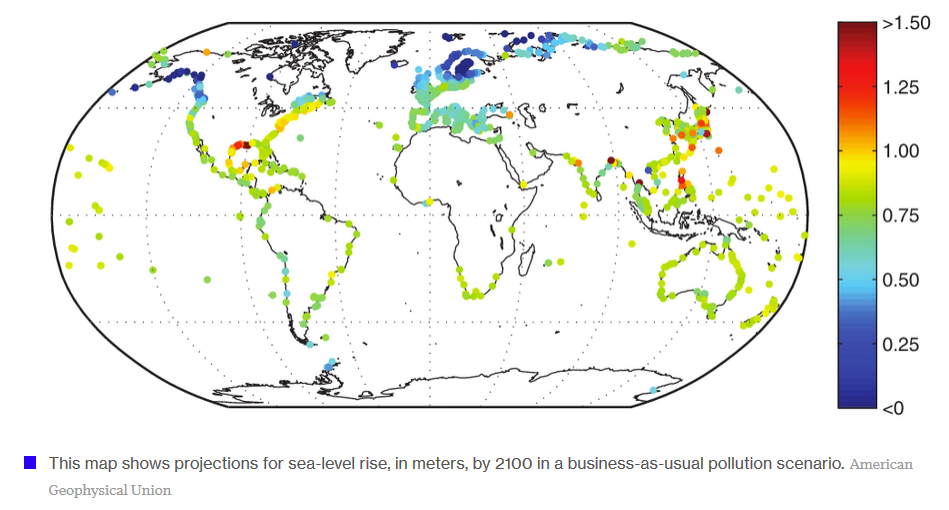
In another study published this month, scientists report that global sea levels will likely rise 0.5 to 1.3 meters (1.6 to 4.3 feet) by the end of this century if greenhouse gas emissions aren’t rapidly reduced. Even if last year’s Paris Agreement does spur ambitious climate policy, sea levels are still projected to rise 20 to 60 cm (7.8 to 23.6 inches) by 2100. Taken with the longer-term effects from melting ice sheets in Greenland and Antarctica, that means any strategy to endure sea-level rise must involve adaptation plans as well as efforts to slow the trend.

7. Up to 216 million people currently live on land that will be below sea level or regular flood levels by 2100.

coastal flooding in Typhoon FitowHigher sea levels can exacerbate storm surges, like this 2013 flood in Wenzhou, China. (Photo: STR/AFP/Getty Images)

Of the estimated 147 million to 216 million people in harm’s way, between 41 million and 63 million live in China. Twelve nations have more than 10 million people living on land at risk from sea-level rise, including China as well as India, Bangladesh, Vietnam, Indonesia and Japan. Bangladesh is especially vulnerable, identified by the U.N. as the country most in danger from rising seas. Once the ocean rises by 1.5 meters (4.9 feet) next century, it will affect 16 percent of Bangladesh’s land area and 15 percent of its population — that’s 22,000 km2 (8,500 mi2) and 17 million people.

The situation is also urgent for low-lying island nations like Kiribati, the Maldives, the Marshall Islands and the Solomon Islands, where land is already so close to sea level that a few inches make a world of difference. Some are even mulling mass relocations — the government of Kiribati, for one, has a web page outlining its strategy for “migration with dignity.” A town on Taro Island, the capital of Choiseul Province in the Solomon Islands, is also planning to move its entire population in response to rising seas. The small community of Newtok, Alaska, has already begun the difficult process of transplanting itself away from the encroaching coast.

8. Sea-level rise can contaminate water used for drinking and irrigation.

saltwater intrusionSea-level rise can aid saltwater intrusion of freshwater aquifers, as seen in this schematic illustration. (Image: NRC.gov)

In addition to surface flooding, sea-level rise can both push up the freshwater table and contaminate it with seawater, a phenomenon known as saltwater intrusion. Many coastal areas rely on aquifers for drinking water and irrigation, and once they’re tainted by saltwater they may be unsafe for humans as well as crops.

It is possible to remove salt from water, but the process is complex and costly. San Diego County recently opened the Western Hemisphere’s largest desalination plant, for example, and several other sites are proposed in the state. Yet that may not be practical for many coastal communities, especially in less wealthy nations.

9. It can also threaten coastal plant and animal life.

loggerhead sea turtle hatchlingFloods fueled by rising seas may harm baby sea turtles, like these South African loggerheads. (Photo: Jeroen Looyé/Flickr)

Humans aren’t the only ones who’ll suffer as sea levels rise. Any coastal plants or animals that can’t quickly move to new, less flood-prone habitats could face dire consequences. As one 2015 study noted, sea turtles have a long-established habit of laying eggs on beaches, which need to stay relatively dry for their babies to hatch.

Inundation for one to three hours reduced egg viability by less than 10 percent, the study’s authors found, but six hours underwater cut viability by about 30 percent. “All embryonic developmental stages were vulnerable to mortality from saltwater inundation,” the researchers write. Even for hatchlings that do survive, being starved of oxygen in the egg could lead to developmental problems later in life, they add.

Other beach life may also be at risk, including plants. A recent study found that some salt marshes can adapt, both by growing vertically and by moving inland, but not all flora will be so fortunate. “Trees have to work harder to pull water out of salty soil; as a result, their growth can be stunted — and if the soil is salty enough, they will die, a common sign of sea-level rise,” Climate Central explains. “Even trees that are especially suited to salty soil can’t survive repeated flooding by seawater.”

10. Global flood damage for large coastal cities could cost $1 trillion a year if cities don’t take steps to adapt.

sea-level rise in TokyoThis Google Earth simulation shows a Tokyo neighborhood with 1.3-meter sea-level rise. (Image: Google Earth)

The average global losses from flooding in 2005 were about $6 billion, but the World Bank estimates they’ll rise to $52 billion per year by 2050 based on socioeconomic changes alone. (That means things like increasing coastal populations and property value). If you add the effects of sea-level rise and sinking land — which is happening even faster in some places — the cost could surge to $1 trillion per year.

11. It’s too late to stop sea-level rise — but not too late to save lives from it.

iceberg off GreenlandA full moon shines over an iceberg that broke off Greenland’s Jakobshavn Glacier. If the entire Greenland ice sheet melted, sea levels would rise about 6 meters, or 20 feet. (Photo: Joe Raedle/Getty Images)

Unfortunately, CO2 emissions linger in the atmosphere for centuries, and today’s CO2 levels have already committed Earth to dangerous sea-level rise. About 99 percent of all freshwater ice resides in two ice sheets: one in Antarctica and one in Greenland. Both are expected to melt if humanity’s CO2 output isn’t curbed quickly, but the question is when — and how much damage we still have time to prevent.

The Greenland ice sheet is smaller and melting more quickly. If it completely melted, sea levels would rise by about 6 meters (20 feet). The Antarctic ice sheet has been more buffered from warming so far, but it’s hardly immune, and would raise the ocean by 60 meters (200 feet) if it melted. (Estimates vary widely on how long these ice sheets might survive — while most expect they’ll take centuries or millennia to melt, a controversial 2015 paper suggested it could happen much more quickly.)

Sea levels have naturally risen and receded for billions of years, but they’ve never risen this quickly in modern history — and they’ve never had so much human help. It’s unclear what effect they’ll have on our species, but what is clear is that our descendants will still be dealing with this problem long after we’re all gone. Giving them a head start on a solution is the least we can do.

“With all the greenhouse gases we already emitted, we cannot stop the seas from rising altogether, but we can substantially limit the rate of the rise by ending the use of fossil fuels,” says Anders Levermann, a climate scientist at Columbia University and co-author of the new study on future sea-level rise. “We try to give coastal planners what they need for adaptation planning, be it building dikes, designing insurance schemes for flooding or mapping long-term settlement retreat.”

As another recent study pointed out, any policy decisions made in the next few years and decades “will have profound impacts on global climate, ecosystems and human societies — not just for this century, but for the next ten millennia and beyond.”

ooOOoo

Tomorrow, in the final part of this three-part posting I will look at some positive things that we can all be doing now.

But let me leave you with a rather beautiful consequence of these changing times. As seen over on Grist:

ooOOoo

Incredible glacier art pays homage to our disappearing ice

Interconnections One.

The beat of a butterfly’s wings.

From Wikipedia:

The Butterfly Effect is a concept that small causes can have large effects. Initially, it was used with weather prediction but later the term became a metaphor used in and out of science.[1]

In chaos theory, the butterfly effect is the sensitive dependence on initial conditions in which a small change in one state of a deterministic nonlinear system can result in large differences in a later state. The name, coined by Edward Lorenz for the effect which had been known long before, is derived from the metaphorical example of the details of a hurricane (exact time of formation, exact path taken) being influenced by minor perturbations such as the flapping of the wings of a distant butterfly several weeks earlier. Lorenz discovered the effect when he observed that runs of his weather model with initial condition data that was rounded in a seemingly inconsequential manner would fail to reproduce the results of runs with the unrounded initial condition data. A very small change in initial conditions had created a significantly different outcome.

We all live in an interconnected world. Frankly, it’s such an obvious statement that one presumes that very few would not agree with the sentiment expressed within it.

But (and you knew there was a ‘but’ coming, didn’t you!) very few of us (and I include Jean and me to a very great extent) really understand, “A very small change in initial conditions had created a significantly different outcome.”

Take these few items; more or less randomly read over the last few days.

Such as this post over on Patrice Ayme’s blog.

Biblical Flood Starting Anew

Abstract: update on Sea Level Rise. The meat of the essay is at the end, in the section “THE SITUATION IS ACTUALLY CATACLYSMIC“.

Heard of The Flood? As in the Bible? Sea level rose 120 meters (400 feet), in the period centered around 10,000 years ago. The cause? More than half of Earth’s ice melted in a few millennia,  During the rest of the early Holocene, the rate of rise of the world’s ocean reached peaks as high as 60  millimeters (2.5 inches) per year. The melting of the ice happened because Earth’s positional and orbital parameters had made northern hemisphere’s summers too warm (most of the ice shields rested on the large continents of the north). Nowadays only two enormous ice shields are left: Greenland and Antarctica.

Those who enjoy catastrophes will love it: we have 75 meters of further sea rise to enjoy pretty soon, on our way to a Jurassic climate (the Jurassic was characterized by gigantic warm shallow seas on top of the continents). Here was the situation in the Miocene, when CO2 was at 500 ppm (where we will be at in ten years, see conclusion below).

Patrice said that the essence, the meat, of his essay was at the end. Here are his closing words:

Three scientific papers published in the last two months support my, admittedly drastic, point of view. One observed the collapse of a colossal glacier in northwest Greenland, eaten by a current at one degree C. It was a miniature reproduction of what to expect for entire ice shields. Two others observed the past, and that Antarctica was unstable at 500 ppm CO2. What they did not say is how dramatic the situation was. Indeed, sounding moderate is how they get funded by a benevolent, plutocratically ruled government (and by government, I also mean the corrupt Supreme Court, not just the latest elected buffoons). The scientists who evoked the 500 ppm of CO2 omitted two significant details, where the devil lurks. They claimed that it would take 30 years to get there. That’s not correct; at the present rate, we will add 100 ppm of CO2 within 25 years. But not just that: there are other man-made GreenHouse Gases (GHG): CH4, NOx, Fluorocarbons, etc. All these gases warm up the lower atmosphere much more than CO2. So the correct measurement is not CO2 ppm, but CO2 EQUIVALENT ppm.

We are right now ABOVE 450 ppm in EQUIVALENT CO2, and will be at 500 ppm within ten years. Let’s hope there will be more boats than on the Titanic.

Patrice Ayme’

P/S: If anything, the preceding is a conservative estimate. Indeed very serious scientists evaluated already the man-made greenhouse gases at 478 ppm in 2013. This means we will be above 500 ppm in CO2 equivalent within six years, in line with my previous analyses, such as “Ten Years To Catastrophe“. See:

http://oceans.mit.edu/news/featured-stories/5-questions-mits-ron-prinn-400-ppm-threshold

Now it’s not all ‘doom and gloom’ and there is much that each and every one of us can do. More of that in Interconnections Three on Thursday.

But to continue with this ‘wake up call’ I’m going to republish in full an item that was recently published over on Mother Nature Network: 11 alarming facts about sea-level rise. To stop today’s post being excessively long, I’m going to split that MNN article over today and tomorrow. Here are the first 5 alarming facts. (Don’t read them just before turning the light out when going to bed tonight!)

ooOOoo

11 alarming facts about sea-level rise

Russell McLendon,  February 26, 2016.
 Up to 216 million people currently live on land that will be below sea level or regular flood levels by 2100. (Photo: Shutterstock)
Up to 216 million people currently live on land that will be below sea level or regular flood levels by 2100. (Photo: Shutterstock)

The ocean is coming for us. Global sea levels are now rising by 3.4 millimeters per year, up from an average rate of 1.4 mm per year last century. In just 80 years, the ocean could be a full 1.3 meters (4.3 feet) taller than it is today.

That kind of planetary sea change can be hard to fathom — unless you live in a low-lying place like Miami, the Maldives or the Marshall Islands, where the effects of sea-level rise are already apparent. But within just a few decades, the problem will become unavoidable in major coastal cities around the world, from New Orleans, New York and Amsterdam to Calcutta, Bangkok and Tokyo.

We all know why this is happening. Rising seas are one of the most salient effects of man-made climate change, triggered by thermal expansion of seawater as well as the influx of melting glaciers. Yet many people still see it as a distant risk, failing to grasp how (relatively) quickly the sea is swallowing shores worldwide. And since half of all humans now live within 60 kilometers (37 miles) of a coast, this isn’t a niche issue.

To help put things in perspective, here’s a deeper look at the problem:

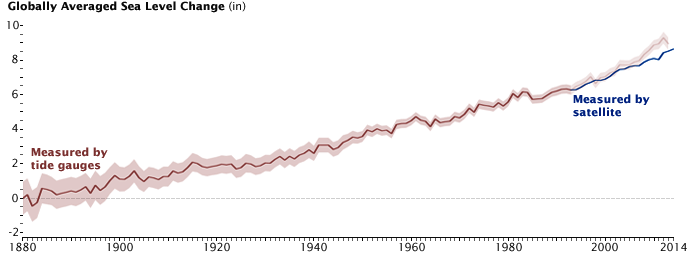
1. Global sea levels have already risen by 8 inches (200 mm) since 1880.

sea-level-rise-1880-2014

The chart above was produced by NASA’s Earth Observatory, based on data from the U.S. National Oceanic and Atmospheric Administration (NOAA) and Australia’s Commonwealth Scientific and Industrial Research Organization (CSIRO). Most of those historical data come from tide-gauge measurements, which are now complemented by satellite observations.

2. Not only are sea levels rising; the rate of their rise is rising.

Average global sea-level rise is now 3.41 mm per year, but the rate varies widely by location. (Image: NASA GSFC)

On average, sea levels rose by 1.4 mm from 1900 to 2000. The yearly pace had surpassed 3 mm by 2010, and now it’s up to 3.4 mm per year.

3. That’s the fastest sea-level rise Earth has experienced in 3,000 years.

Cb5MxZ4WIAAAW06If not for surging carbon dioxide in the atmosphere, sea levels should have only risen about an inch or two last century, and might have even fallen. Instead, thanks to the highest CO2 levels at any point in human history, global sea levels rose by 5.5 inches (14 cm) between 1900 and 2000. That’s the fastest oceanic advance in 27 centuries, according to a study published Feb. 22, and it’s still speeding up.

“The 20th century rise was extraordinary in the context of the last three millennia — and the rise over the last two decades has been even faster,” says lead author Robert Kopp, a climate scientist at Rutgers University, in a statement.

“Scenarios of future rise depend upon our understanding of the response of sea level to climate changes,” adds co-author Benjamin Horton. “Accurate estimates of sea-level variability during the past 3,000 years provide a context for such projections.”

4. Every vertical inch of sea-level rise moves the ocean 50 to 100 inches inland.

Miami coastal flooding
Rising seas worsen regular flooding — like this 2015 high tide in Miami Beach — for many coastal cities. Miami is in the midst of a five-year, $400 million effort to upgrade its stormwater pump program. (Photo: Joe Raedle/Getty Images)

5. That’s already causing flood problems in many big coastal cities.

CLICK HERE TO SEE THE EFFECT ON BIG COASTAL CITIES

As the ocean invades coastal cities, the first signs of trouble are often urban saltwater floods. These can also happen naturally, though, so to determine the influence of rising seas, a new report by Climate Central models “alternative histories simulating the absence of anthropogenic climate change” at 27 U.S. tide gauges.

Out of 8,726 days since 1950 when unaltered water levels exceeded the National Weather Service thresholds for local “nuisance” floods, 5,809 didn’t exceed those thresholds in the alternative histories. “In other words,” the report explains, “human-caused global sea level rise effectively tipped the balance, pushing high-water events over the threshold, for about two-thirds of the observed flood days.”

Coastal flooding days have more than doubled in the U.S. since the 1980s, according to the report, in places ranging from Miami, Virginia Beach and New York to San Francisco, Seattle and Honolulu. According to a 2014 report, at least 180 floods will strike Annapolis, Maryland, during high tides every year by 2030 — sometimes twice a day. The same will be true for about a dozen other U.S. cities by 2045, not to mention many other low-lying urban areas around the world.

ooOOoo

To be continued tomorrow.

We live in interesting times!

The impending ‘banquet of consequences’.

The Welcome page of this blog includes this:

Dogs ‘teaching’ man to be so successful a hunter enabled evolution, some 20,000 years later, to farming,  thence the long journey to modern man.  But in the last, say 100 years, that farming spirit has become corrupted to the point where we see the planet’s plant and mineral resources as infinite.  Mankind is close to the edge of extinction, literally and spiritually.

I continue that theme in Part Two of my book (Chapter 7: This Twenty-First Century)

Bad news sells! Bad news also causes stress and worry. In my previous explanation, I explained that the last thing you want is a catalogue of all the things that have that power to cause you stress and worry. However, I do see three fundamental aspects of this new century that have their roots in that loss of principles that I referred to in the previous chapter. They are

1. the global financial system,
2. the potential for social disorder, and
3. the process of government.

Because they are at the heart of how the coming years will pan out.

The first aspect, our global financial system, was selected because it underpins all our lives in so many ways. When I was living in southwest England I was a client of Kauders Portfolio Services[1]. The founder of the company, David Kauders, published[2] a book, The Greatest Crash, in 2011. It was an obvious read for me at that time and I still have the book on my shelves here in Oregon.
David explained that whether we like it or not, our lives are inextricably caught up in the twin dependencies of the global financial system: credit and debt. As he wrote in his opening chapter:

Households can barely afford their existing debts, let alone take on more. Since households now prefer not to borrow, indeed some even choose to pay back debt, it follows that those who have already borrowed, as a group, can no longer contribute to economic expansion.
People can be divided into borrowers and savers. With existing borrowers unable to afford or unwilling to take on extra debt, can new borrowers be found instead? Those who do not need to borrow are unlikely to volunteer. Except for the young wishing to buy houses, facing the reality that house prices are beyond their pockets, where are the new borrowers?
Businesses are also under pressure. There has been an inadequate recovery from recession, business prospects are poor as households cut back their spending. Lack of bank lending is a symptom rather than a cause, for if existing businesses were to be given more credit, they would probably be unlikely to find profitable growth opportunities in a world of austerity.

Later on in the book David describes this as “the financial system limit”. In other words, the period of growth and expansion, especially of financial and economic expansion, has come to an end in a structural sense. This was his perspective from 2011.

Recently, I chose to reread The Greatest Crash. What struck me forcibly, reading the book again some four years later on, was how visible this “system limit” appeared in the world today. Everywhere there are signs that the era of growth has come to an end. Many countries are now indebted to a point that reinforces the proposition of there being a financial system limit. The United States is greatly in debt[3] but the only thing mitigating that situation, for the time being anyway, is that the American dollar is the quasi dominant global currency.
The changing nature of the global population is also reinforcing the fact that this is the end of a long period of growth. Even without embracing the question of how much longer we can increase the number of people living on a finite planet, the demographics spell out a greater-than-even chance of a decline in consumption and economic activity. Simply because in all regions of the planet, except for India where there is still a growing youth element in the country, people are ageing. To state the obvious, ageing persons do not consume as much as middle-aged and younger persons.
Thus, the world’s economy that is just around the corner is certainly going to be very different to what it has been in the past. It is not being widely discussed. Worse than that, there is a widespread assumption adopted by many governments that a return to the “normal” economic growth of previous times is a given. Many do not share that assumption.

The second aspect that isn’t being spoken about is the potential for massive, widespread social disorder. All summed up in just three words: greed, inequality, and poverty. Just three words that metaphorically appear to me like a round, wooden lid hiding a very deep, dark well. That lifting this particular lid, the metaphorical one, exposes an almost endless drop into the depths of where our society appears to have fallen.
Even the slightest raising of awareness of where this modern global world is heading is scary. I have in mind the author Thomas Piketty who warned[4] that, “the inequality gap is toxic, dangerous.” Then there was the news in 2015[5] that, “Billionaires control the vast majority of the world’s wealth, 67 billionaires already own half the world’s assets; by 2100 we’ll have 11 trillionaires, while American worker income has stagnated for a generation.”

The third and final aspect that isn’t being widely discussed is the process of government. Not from the viewpoint of “left” or “right”, Labour or Conservative, Democratic or Republican (insert the labels appropriate to your own country), that is being discussed ad nauseum, but from the viewpoint of good government. It might be a terrible generalisation but it is still a fair criticism to say that many peoples of many countries have lost faith in their governments.
There appears to be a chronic absence of open debate about the need for good government, what that good government would look like, and how do societies bring it about.

If we were a dog pack, then our leader, our female mentor dog, would have moved us all to a new, pristine territory!


[1] My relationship was terminated when I became a resident of the United Staes in 2011.
[2] 2011, Sparkling Books.
[3] http://www.usgovernmentdebt.us offers on the 14th November, 2014 that the Federal Debt of the United States was about $18,006,100,032,000.
[4] In his book Capital in the Twenty-First Century (Belknap Press, 2014).
[5] http://www.marketwatch.com/story/capitalism-is-killing-americas-morals-our-future-2015-05-22.

Yes, these are indeed very interesting times!

So, dear reader, you can understand why a recent article over on Naked Capitalism spoke to me. It was penned by Satyajit Das, a former banker and the author of a number of books. Both Satyajit and Yves, of Naked Capitalism, were delighted to offer me permission to republish the full post.

ooOOoo

Satyajit Das: Age of Stagnation or Something Worse?

Yves here. If you’ve read Das regularly, one of the characteristics of his writing is wry detachment. The shift to a sense of foreboding is a big departure.

By Satyajit Das, a former banker and author whose latest book, The Age of Stagnation, is now available. The following is an edited excerpt from Age of Stagnation (published with the permission of Prometheus Books)

If you look for truth, you may find comfort in the end; if you look for comfort you will not get either comfort or truth, only . . . wishful thinking to begin, and in the end, despair. C.S. Lewis

The world is entering a period of stagnation, the new mediocre. The end of growth and fragile, volatile economic conditions are now the sometimes silent background to all social and political debates. For individuals, this is about the destruction of human hopes and dreams.

One Offs

For most of human history, as Thomas Hobbes recognised, life has been ‘solitary, poor, nasty, brutish, and short’. The fortunate coincidence of factors that drove the unprecedented improvement in living standards following the Industrial Revolution, and especially in the period after World War II, may have been unique, an historical aberration. Now, different influences threaten to halt further increases, and even reverse the gains.

Since the early 1980s, economic activity and growth have been increasingly driven by financialisation – the replacement of industrial activity with financial trading and increased levels of borrowing to finance consumption and investment. By 2007, US$5 of new debt was necessary to create an additional US$1 of American economic activity, a fivefold increase from the 1950s. Debt levels had risen beyond the repayment capacity of borrowers, triggering the 2008 crisis and the Great Recession that followed. But the world shows little sign of shaking off its addiction to borrowing. Ever-increasing amounts of debt now act as a brake on growth.

Growth in international trade and capital flows is slowing. Emerging markets that have benefited from and, in recent times, supported growth are slowing.

Rising inequality and economic exclusion also impacts negatively upon activity.

Financial problems are compounded by lower population growth and ageing populations; slower increases in productivity and innovation; looming shortages of critical resources, such as water, food and energy; and manmade climate change and extreme weather conditions.

The world requires an additional 64 billion cubic metres of water a year, equivalent to the annual water flow through Germany’s Rhine River. Agronomists estimate that production will need to increase by 60–100 percent by 2050 to feed the population of the world. While the world’s supply of energy will not be exhausted any time soon, the human race is on track to exhaust the energy content of hundreds of millions years’ worth of sunlight stored in the form of coal, oil and natural gas in a few hundred years. 10 tons of pre-historic buried plant and organic matter converted by pressure and heat over millennia was needed to create a single gallon (4.5 litres) of gasoline.

Europe is currently struggling to deal with a few million refugees fleeing conflicts in the Middle East. How will the world deal with hundreds of millions of people at risk of displacement as a resulting of rising sea levels?

Extend and Pretend

The official response to the 2008 crisis was a policy of ‘extend and pretend’, whereby authorities chose to ignore the underlying problem, cover it up, or devise deferral strategies to ‘kick the can down the road’. The assumption was that government spending, lower interest rates, and the supply of liquidity or cash to money markets would create growth. It would also increase inflation to help reduce the level of debt, by decreasing its value.

It was the grifter’s long con, a confidence trick with a potentially large payoff but difficult to pull off. Houses prices and stock markets have risen, but growth, employment, income and investment have barely recovered to pre-crisis levels in most advanced economies. Inflation for the most part remains stubbornly low.

In countries that have ‘recovered’, financial markets are, in many cases, at or above pre-crisis prices. But conditions in the real economy have not returned to normal. Must-have latest electronic gadgets cannot obscure the fact that living standards for most people are stagnant. Job insecurity has risen. Wages are static, where they are not falling. Accepted perquisites of life in developed countries, such as education, houses, health services, aged care, savings and retirement, are increasingly unattainable.

In more severely affected countries, conditions are worse. Despite talk of a return to growth, the Greek economy has shrunk by a quarter. Spending by Greeks has fallen by 40 percent, reflecting reduced wages and pensions. Reported unemployment is 26 percent of the labour force. Youth unemployment is over 50 percent. One commentator observed that the government could save money on education, as it was unnecessary to prepare people for jobs that did not exist.

Future generations may have fewer opportunities and lower living standards than their parents. A 2013 Pew Research Centre survey conducted in thirty-nine countries asked whether people believed that their children would enjoy better living standards: 33 percent of Americans believed so, as did 28 percent of Germans, 17 percent of British and 14 percent of Italians. Just 9 percent of French people thought their children would be better off than previous generations.

The Deadly Cure

Authorities have been increasingly forced to resort to untested policies including QE forever and negative interest rates. It was an attempt to buy time, to let economies achieve a self-sustaining recovery, as they had done before. Unfortunately the policies have not succeeded. The expensively purchased time has been wasted. The necessary changes have not been made.

There are toxic side effects. Global debt has increased, not decreased, in response to low rates and government spending. Banks, considered dangerously large after the events of 2008, have increased in size and market power since then. In the US the six largest banks now control nearly 70 percent of all the assets in the US financial system, having increased their share by around 40 percent.

Individual countries have sought to export their troubles, abandoning international cooperation for beggar-thy-neighbour strategies. Destructive retaliation, in the form of tit-for-tat interest rate cuts, currency wars, and restrictions on trade, limits the ability of any nation to gain a decisive advantage.

The policies have also set the stage for a new financial crisis. Easy money has artificially boosted prices of financial assets beyond their real value. A significant amount of this capital has flowed into and destabilised emerging markets. Addicted to government and central bank support, the world economy may not be able to survive without low rates and excessive liquidity.

Authorities increasingly find themselves trapped, with little room for manoeuvre and unable to discontinue support for the economy. Central bankers know, even if they are unwilling to publicly acknowledge it, that their tools are inadequate or exhausted, now possessing the potency of shamanic rain dances. More than two decades of trying similar measures in Japan highlight their ineffectiveness in avoiding stagnation.

Heart of the Matter

Conscious that the social compact requires growth and prosperity, politicians, irrespective of ideology, are unwilling to openly discuss the real issues. They claim crisis fatigue, arguing that the problems are too far into the future to require immediate action. Fearing electoral oblivion, they have succumbed to populist demands for faux certainty and placebo policies. But in so doing they are merely piling up the problems.

Policymakers interrogate their models and torture data, failing to grasp that ‘many of the things you can count don’t count [while] many of the things you can’t count really count’. The possibility of a historical shift does not inform current thinking.

It is not in the interest of bankers and financial advisers to tell their clients about the real outlook. Bad news is bad for business. The media and commentariat, for the most part, accentuate the positive. Facts, they argue, are too depressing. The priority is to maintain the appearance of normality, to engender confidence.

Ordinary people refuse to acknowledge that maybe you cannot have it all. But there is increasingly a visceral unease about the present and a fear of the future. Everyone senses that the ultimate cost of the inevitable adjustments will be large. It is not simply the threat of economic hardship; it is fear of a loss of dignity and pride. It is a pervasive sense of powerlessness.

For the moment, the world hopes for the best of times but is afraid of the worst. People everywhere resemble Dory, the Royal Blue Tang fish in the animated film Finding Nemo. Suffering from short-term memory loss, she just tells herself to keep on swimming. Her direction is entirely random and without purpose.

Reckoning Postponed

The world has postponed, indefinitely, dealing decisively with the challenges, choosing instead to risk stagnation or collapse. But reality cannot be deferred forever. Kicking the can down the road only shifts the responsibility for dealing with it onto others, especially future generations.

A slow, controlled correction of the financial, economic, resource and environmental excesses now would be serious but manageable. If changes are not made, then the forced correction will be dramatic and violent, with unknown consequences.

During the last half-century each successive economic crisis has increased in severity, requiring progressively larger measures to ameliorate its effects. Over time, the policies have distorted the economy. The effectiveness of instruments has diminished. With public finances weakened and interest rates at historic lows, there is now little room for manoeuvre. Geo-political risks have risen. Trust and faith in institutions and policy makers has weakened.

Economic problems are feeding social and political discontent, opening the way for extremism. In the Great Depression the fear and disaffection of ordinary people who had lost their jobs and savings gave rise to fascism. Writing of the period, historian A.J.P. Taylor noted: ‘[the] middle class, everywhere the pillar of stability and respectability . . . was now utterly destroyed . . . they became resentful . . . violent and irresponsible . . . ready to follow the first demagogic saviour . . .’

The new crisis that is now approaching or may already be with us will be like a virulent infection attacking a body whose immune system is already compromised.

As Robert Louis Stevenson knew, sooner or later we all have to sit down to a banquet of consequences.

ooOOoo

henrifredericamiel148210Very interesting times indeed!

Voting for hope.

Considered reflections to yesterday’s post.

Yesterday, I published Bitter Lake ripples, a post that, in turn, was my response to the fabulous comments left by readers of my earlier post Oil, money, banks, guns and blood.  The overall feeling I read in those comments was one of terrible uncertainty about these present times. Or in the words of Sue Dreamwalker in response to a comment left by Patrice Ayme.

I have to say Patrice.. I agree with your comment here… And yes people are not understanding the whole of what is going on.. The Truth of it would seem unbelievable..

Patrice, in a post published on Monday entitled Arm Ukraine, Disarm Bankers sent shivers down my spine with the suggestion, the strong suggestion, that Ukraine, if not handled properly by ‘the West’ could be a tipping point into another major war between Europe (and the USA?) and Russia.  Here’s an extract from Patrice’s post:

The way it was said, in conjunction with Putin’s recent admission that Russian “volunteers” were fighting in Ukraine, is basically a declaration of war. On top of this, the head of the Eastern Ukraine rebels declared that he was raising a 100,000 men army. This means he expect tens of thousands of Russian troops (Putin’s “volunteers”) to cross the border.

This is not contained. Putin is billowing out of control, all by himself. One has to see what the combination of Putin’s dictatorial powers, media control, psychology and sinking economy leads to. Let me spell it out.

Once Putin has conquered Ukraine, he will push for more: he is already partly occupying Moldavia, WEST of Ukraine. Putin is also messing up with Hungary: there were street demonstrations about this, just yesterday, in Budapest. Putin uses the fact that Hungary is extremely dependent upon Russia’s fossil fuels. Merkel, who desperately wants to avoid war with Putin, flew to Budapest in emergency, to sort the situation out.

Patrice continues the warning of possible terrible times ahead in a subsequent post: Mental Inertia, Evil’s Friend, published yesterday.

Just as it takes a long time to erect, or change a vast building, so it is with the brain. The brain has inertia. Thus psychological inertia.

This mental inertia is why human beings tend to go on with a task, or with an attitude, once they got launched into it (a Jihadist laden with explosives just flew by).

Once a force is applied to an object, for example a propaganda to a brain, it tends to gather momentum, and develop ever more inertia.

Putin of course creates his own propaganda, and then can listen to it, reinforcing his deviance, in a self-reflective way. It’s all the more efficient if others repeat his ideas, and he listens to them. Actually that’s not just a problem with Putin, but with all Great Leaders. (And that’s one reason why Great Leadership has to be discontinued, and replaced by Direct Democracy.)

This amplifies the inertia.

By not fiercely opposing Putin, one collaborates with him. It is not just a question of sanctions. Putin is a liar, and an aggressive one, he should be publicly called for what he is.

Thus in terms of my own personal ideas, I freely admit to struggling to see things clearly.  Simply because I find it very difficult to get to the heart of these international issues through not having access to clear, impartial commentators who know what they are speaking about. As Patrice infers much of the media is corrupted by self-serving agendas.

However, on balance, despite Patrice Ayme being a ‘nom-de-plume’ and me having no idea who the person behind the label really is, I do trust his (?) writings and believe that Patrice writes from a position of having very good access to the inner workings of the US Government. (I am not privy to anything to support my proposition; just my guess.)

The other commentator whose opinions and judgements are trusted by me in equal fashion is George Monbiot. Mr. Monbiot has been gracious to grant permission to me for his essays to be republished here on Learning from Dogs.

On the 28th January, Mr. Monbiot published an essay that in words better than I could write encapsulates my response to the comments left on my Bitter Lake ripples post. Here is that post from George Mobiot.

ooOOoo

The Lamps Are Coming On All Over Europe

28th January 2015

By George Monbiot, published in the Guardian 28th January 2015

Here is the first rule of politics: if you never vote for what you want, you never get it. We are told at every election to hold our noses, forget the deficiencies and betrayals and vote Labour yet again, for fear of something worse(1). And there will, of course, always be something worse. So at what point should we vote for what we want, rather than keep choosing between two versions of market fundamentalism? Sometime this century? Or in the next? Follow the advice of the noseholders and we will be lost forever in Labour’s Bermuda triangulation.

Perhaps there was a time when this counsel of despair made sense. No longer. The lamps are coming on all over Europe. As in South America, political shifts that seemed impossible a few years earlier are now shaking the continent. We knew that another world was possible. Now, it seems, another world is here: the sudden death of the neoliberal consensus. Any party that claims to belong to the left but does not grasp this is finished.

Syriza, Podemos, Sinn Fein, the SNP; now a bright light is shining in England too, as the Green party stokes the radical flame that Labour left to gutter. On Tuesday morning, its membership in England and Wales passed 50,000(2); a year ago it was less than 15,000. A survey by the website voteforpolicies.org.uk reports that in blind tests (the 500,000 people it has polled were unaware of which positions belong to which parties), the Green Party’s policies are more popular than those of any other. If people voted for what they want, the Greens would be the party of government.

There are many reasons for this surge, but one of them must be a sense of popular ownership. Green party policies are determined democratically. Emerging from debates led mostly by younger members(3), they feel made for their time, while those of the major parties appear trapped in the 1980s.

Let me give you a flavour of the political transformation the Green Party seeks. There would be no prime minister of the kind we have today, no secretaries of state. Instead, Parliament would elect policy committees which in turn appoint convenors(4). It would also elect a First Minister, to chair the convenors’ committee. Parliament, in other words, would be sovereign rather than subject to the royal prerogative prime ministers abuse, leaders would be elected by the whole body and its various parties would be obliged to work together, rather than engage in perennial willy-waving.

Local authorities would set the taxes they chose. Local currencies, which have proved elsewhere to have transformative effects in depressed areas (see Bernard Lietaer’s book The Future of Money(5)) would become legal tender(6). Private banks would no longer be permitted to create money(7) (at the moment they issue 97% of our money supply, in the form of debt). Workers in limited companies would have the legal right, following a successful ballot, to buy them out and create cooperatives(8), with funding from a national investment bank.

The hideously unfair council tax system would be replaced by land value taxation(9), through which everyone would benefit from the speculative gains now monopolised by a few. All citizens would receive, unconditionally, a basic income(10), putting an end to insecurity and fear and to the punitive conditions attached to benefits, which have reduced recipients almost to the status of slaves.

Compare this vision of hope to Labour’s politics of fear. Compare it to a party so mesmerised by the City and the Daily Mail that it has promised to sustain the Tory cuts for “decades ahead”(11) and to “finish that task on which [the Chancellor] has failed”: eradicating the deficit.

Far too late, a former Labour minister, Peter Hain, now recognises that, inasmuch as the books need balancing, it can be done through measures like a financial transaction tax and a reform of national insurance(12), rather than through endless cuts. These opportunities have been dangling in front of Labour’s nose since 2008(13), but because appeasing the banks and the corporate press was deemed more important than preventing pain and suffering for millions, they have not been taken. Hain appears belatedly to have realised that austerity is a con, a deliberate rewriting of the social contract to divert our common wealth to the elite. There’s no evidence that the frontbench is listening.

Whether it wins or loses the general election, Labour is probably finished. It would take a generation to replace the sycophants who let Blair and Brown rip their party’s values to shreds. By then it will be history. If Labour wins in May, it is likely to destroy itself faster and more surely than if it loses, through the continued implementation of austerity. That is the lesson from Europe.

Fearful voting shifts the whole polity to the right. Tony Blair’s obeisance to corporate power enabled the vicious and destructive policies the Coalition now pursues(14). The same legacy silences Labour in opposition, as it pioneered most of the policies it should oppose. It is because we held our noses before that there is a greater stink today. So do we keep voting for a diluted version of Tory politics, for fear of the concentrate? Or do we start to vote for what we want? Had the people of this nation heeded the noseholders a century ago, we would still be waiting for the Liberal Party to deliver universal healthcare and the welfare state.

Society moves from the margins, not the centre. Those who wish for change must think of themselves as the sacrificial margin: the pioneering movement that might not succeed immediately, but that will eventually deliver sweeping change. We cannot create a successful alternative to the parties that have betrayed us until we start voting for it. Do we start walking, or just keep talking about the journey we might one day take?

Power at the moment is lethal. Whichever major party wins this election, it is likely to destroy itself through the pursuit of policies that almost no one wants. Yes, it might mean five more years of pain, though I suspect in these fissiparous times it won’t last so long. And then it all opens up. This is what we must strive for; this is the process that begins in May by voting, regardless of tactical considerations, for parties offering a genuine alternative. Change arises from conviction. Stop voting in fear. Start voting for hope.

http://www.monbiot.com

References:

1. http://www.theguardian.com/commentisfree/2014/dec/09/labour-tories-vote-osborne

2. Green Party office, by email, 27th January 2015

3. http://bright-green.org/green-movement/how-the-green-party-changed-itself-to-make-the-greensurge-possible/

4. http://policy.greenparty.org.uk/pa.html

5. http://www.lietaer.com/writings/books/the-future-of-money/

6. http://policy.greenparty.org.uk/ec.html#EC678

7. http://policy.greenparty.org.uk/ec.html

8. http://policy.greenparty.org.uk/in.html

9. http://policy.greenparty.org.uk/ec.html

10. http://policy.greenparty.org.uk/ec.html

11. http://press.labour.org.uk/post/87284550049/long-termism-in-public-finance-speech-by-chris

12. http://www.theguardian.com/politics/2015/jan/22/labour-radical-counter-greens-peter-hain

13. I was not the first to propose these alternatives to austerity Peter Hain has just discovered, but even I had got there by 2011: http://www.theguardian.com/commentisfree/2011/mar/06/march-26-protest-aims-first-draft

14. http://www.monbiot.com/books/captive-state/

ooOOoo

I said that Mr. Monbiot’s words were much finer than my own. No better illustrated than by his closing three sentences:

“Change arises from conviction. Stop voting in fear. Start voting for hope.”

The book! Part Three: Materialism

Money has never made man happy, nor will it, there is nothing in its nature to produce happiness. The more of it one has the more one wants.” Thus, it is reputed, spoke Benjamin Franklin, one of the Founding Fathers of the United States and who in many ways could be regarded as “the First American”.

In my previous chapter on short-termism, I quoted from an article by Larry Elliot, Economics Editor of The Guardian newspaper. The closing paragraphs of that article read:

“The premise of the Global Commission on the Economy and Climate is that nothing will be done unless finance ministers are convinced of the need for action, especially given the damage caused by a deep recession and sluggish recovery.

Instead of preaching to the choir the plan is to show how to achieve key economic objectives – growth, investment, secure public finances, fairer distribution of income – while at the same time protecting the planet. The pitch to finance ministers will be that tackling climate change will require plenty of upfront investment that will boost growth rather than harm it.”

“ …. the plan is to show how to achieve key economic objectives ……. while at the same time protecting the planet.” [My italics]

That those two paragraphs and the phrase “key economic objectives” seem perfectly reasonable statements to me and, I don’t doubt, many, many others, illustrates how deeply we are entrenched in the money, or materialistic, world.

I have spent my whole life hearing the term ‘Gross Domestic Product’, or GDP as it is commonly described, and never ever stopped to wonder about the history of this well-known measure. Thus I was genuinely surprised to learn that the term is not yet one hundred years old, by some years. On the website Foreign Policy one finds a brief history of GDP: “One stat to rule them all.” It offers the following:

Out of the carnage of the Great Depression and World War II rose the idea of gross domestic product, or GDP: the ultimate measure of a country’s overall welfare, a window into an economy’s soul, the statistic to end all statistics. Its use spread rapidly, becoming the defining indicator of the last century. But in today’s globalized world, it’s increasingly apparent that this Nobel-winning metric is too narrow for these troubled economic times.

1937: Simon Kuznets, an economist at the National Bureau of Economic Research, presents the original formulation of gross domestic product in his report to the U.S. Congress, “National Income, 1929-35.” His idea is to capture all economic production by individuals, companies, and the government in a single measure, which should rise in good times and fall in bad. GDP is born.

1944: Following the Bretton Woods conference that established international financial institutions such as the World Bank and the International Monetary Fund, GDP becomes the standard tool for sizing up a country’s economy.

1959: Economist Moses Abramovitz becomes one of the first to question whether GDP accurately measures a society’s overall well-being. He cautions that “we must be highly skeptical of the view that long-term changes in the rate of growth of welfare can be gauged even roughly from changes in the rate of growth of output.”

1962: But GDP evangelists reign. Arthur Okun, staff economist for U.S. President John F. Kennedy’s Council of Economic Advisers, coins Okun’s Law, which holds that for every 3-point rise in GDP, unemployment will fall 1 percentage point. The theory informs monetary policy: Keep growing the economy, and everything will be just fine. [My italics]

Keep growing the economy and everything will be fine! Thank goodness we have unlimited resources on this planet! Please forgive my irony!

Management thinker Peter Drucker is often quoted as saying that “you can’t manage what you can’t measure” but my understanding was that the saying came from William Edwards Deming; October 1900- December 1993. Deming was fundamentally an American statistician although his bio reveals many other talents: engineer; professor; author; lecturer; and management consultant.

Irrespective of the origins of the saying, it misses one fundamental point! That is of being certain that what you wish to manage is being measured appropriately. Not measuring pears if you wish to manage apples!

Stay with this idea for a while longer.

There is an organisation known as the Social Progress Imperative. The organisation is described on their website, as follows:

THE IMPERATIVE
Numerous studies have found a high correlation between economic growth and a wide variety of social indicators, yet there is growing awareness that economic measures alone do not fully capture social progress.

The Social Progress Imperative’s mission is to improve the quality of lives of people around the world, particularly the least well off, by advancing global social progress. The Social Progress Index provides a robust, holistic and innovative measurement tool to guide countries’ choices to enable greater social progress and foster research and knowledge-sharing on the policies and investments that will best achieve that goal. Social progress is defined as the capacity of a society to meet the basic human needs of its citizens, establish the building blocks that allow citizens and communities to enhance and sustain the quality of their lives, and create the conditions for all individuals to reach their full potential.

The Social Progress Index is a tool that we hope will be widely used to inform and influence policies and institutions around the world. The Index is founded on the principle that what we measure guides the choices we make. By measuring the things that really matter to people — their basic needs, their food, shelter and security; their access to healthcare, education, and a healthy environment; their opportunity to improve their lives — the Social Progress Index is an attempt to reshape the debate about development.

…. what we measure guides the choices we make.” Pretty flippin’ obvious when you think about it! As is understanding the “things that really matter to people”!

Michael Green is the Chief Executive Office (CEO) of the Social Progress Imperative. He gave a TED Talk in November, 2014 that is introduced:

The term Gross Domestic Product is often talked about as if it were “handed down from god on tablets of stone.” But this concept was invented by an economist in the 1920s. We need a more effective measurement tool to match 21st century needs, says Michael Green: the Social Progress Index. With charm and wit, he shows how this tool measures societies across the three dimensions that actually matter. And reveals the dramatic reordering of nations that occurs when you use it.

As Michael Green said at the October, 2014 TED Global conference: “GDP is imperfect and incomplete: The world urgently needs a measurement revolution.”

If now writing about the BBC radio show, The Goon Show, suggests I have lost the plot, just hang in with me for a few more moments.

The Goon Show ran from 1951 to 1960 and was broadcast by what was then known as the BBC Home Service. It was hilariously funny and became a comedy legend. It starred Spike Milligan, Peter Sellers and Harry Secombe, not forgetting the wonderful narratives from Wallace Greenslade. The Goon Show was an integral part of my ‘education’ during my formative years; I was seven in November of 1951 and the radio was the source of news, current affairs, education, and humour. Spike Milligan was an outstanding actor in The Goon Show and became a comedy legend in his own right.

A quotation from dear, dear Spike seems a very fitting way to round off this chapter on materialism. Namely: “All I ask is the chance to prove that money can’t make me happy.

1,272 words. Copyright © 2014 Paul Handover

oooo

Now although it is not part of the book, I was so impressed by Michael Green’s TED Talk, that it now follows. You will love it!

Published on Nov 11, 2014
The term Gross Domestic Product is often talked about as if it were “handed down from god on tablets of stone.” But this concept was invented by an economist in the 1920s. We need a more effective measurement tool to match 21st century needs, says Michael Green: the Social Progress Index. With charm and wit, he shows how this tool measures societies across the three dimensions that actually matter. And reveals the dramatic reordering of nations that occurs when you use it.

Truth and integrity

“Honesty is the first chapter in the book of wisdom.”

Thus spoke Thomas Jefferson who died nearly 200 years ago (April 13th, 1743 – July 4th, 1826).

But some essays that have passed my eyes in the last few days have profoundly disturbed me.  Because they illustrate, well to me anyway, the parlous state of wisdom in today’s world.  Or better put, the parlous state of truth and integrity in today’s world.

The first essay was the latest one from Tom Engelhardt over at TomDispatch. Normally I republish TomDispatch essays in full, with permission I hasten to add, because they seem such a fine commentary of where we are as a ‘modern’ society.  I used the word ‘we’ in the context of a global ‘we’.

But the latest essay was so disheartening that I couldn’t bring myself to republish it in full.  Plus, if I am to be brutally honest (in line with the theme of today’s blog post!) I didn’t want to ‘make waves’ as a non-US citizen albeit a valid US resident (Green Card holder).  I want to live freely and openly in the USA for the rest of my natural days!

Then in the last twenty-four hours up popped the latest essay from George Monbiot and I was struck by the harmony, the terrible harmony, between Tom and George.

See if you agree with me.

Tom Engelhardt published on Tuesday a TomGram about American Intelligence.  It was called Failure Is Success – How American Intelligence Works in the Twenty-First Century.

Here’s a flavour of Tom’s essay.

What are the odds? You put about $68 billion annually into a maze of 17 major intelligence outfits. You build them glorious headquarters. You create a global surveillance state for the ages. You listen in on your citizenry and gather their communications in staggering quantities. Your employees even morph into avatars and enter video-game landscapes, lest any Americans betray a penchant for evil deeds while in entertainment mode. You collect information on visits to porn sites just in case, one day, blackmail might be useful. You pass around naked photos of them just for… well, the salacious hell of it. Your employees even use aspects of the system you’ve created to stalk former lovers and, within your arcane world, that act of “spycraft” gains its own name: LOVEINT.

You listen in on foreign leaders and politicians across the planet. You bring on board hundreds of thousands of crony corporate employees, creating the sinews of an intelligence-corporate complex of the first order. You break into the “backdoors” of the data centers of major Internet outfits to collect user accounts. You create new outfits within outfits, including an ever-expanding secret military and intelligence crew embedded inside the military itself (and not counted among those 17 agencies). Your leaders lie to Congress and the American people without, as far as we can tell, a flicker of self-doubt. Your acts are subject to secret courts, which only hear your versions of events and regularly rubberstamp them — and whose judgments and substantial body of lawmaking are far too secret for Americans to know about.

Then a few paragraphs later, Tom holds up his mirror:

Whatever the case, while taxpayer dollars flowed into your coffers, no one considered it a problem that the country lacked 17 overlapping outfits bent on preventing approximately 400,000 deaths by firearms in the same years; nor 17 interlocked agencies dedicated to safety on our roads, where more than 450,000 Americans have died since 9/11. (An American, it has been calculated, is 1,904 times more likely to die in a car accident than in a terrorist attack.) Almost all the money and effort have instead been focused on the microscopic number of terrorist plots — some spurred on by FBI plants — that have occurred on American soil in that period. On the conviction that Americans must be shielded from them above all else and on the fear that 9/11 bred in this country, you’ve built an intelligence structure unlike any other on the planet when it comes to size, reach, and labyrinthine complexity.

It’s quite an achievement, especially when you consider its one downside: it has a terrible record of getting anything right in a timely way. Never have so many had access to so much information about our world and yet been so unprepared for whatever happens in it.

Tough words indeed!

But it gets worse.

Let’s focus for a moment, however, on a case where more is known. I’m thinking of the development that only recently riveted the Obama administration and sent it tumbling into America’s third Iraq war, causing literal hysteria in Washington. Since June, the most successful terror group in history has emerged full blown in Syria and Iraq, amid a surge in jihadi recruitment across the Greater Middle East and Africa. The Islamic State (IS), an offshoot of al-Qaeda in Iraq, which sprang to life during the U.S. occupation of that country, has set up a mini-state, a “caliphate,” in the heart of the Middle East. Part of the territory it captured was, of course, in the very country the U.S. garrisoned and occupied for eight years, in which it had assumedly developed countless sources of information and recruited agents of all sorts. And yet, by all accounts, when IS’s militants suddenly swept across northern Iraq, the CIA in particular found itself high and dry.

The IC seems not to have predicted the group’s rapid growth or spread; nor, though there was at least some prior knowledge of the decline of the Iraqi army, did anyone imagine that such an American created, trained, and armed force would so summarily collapse. Unforeseen was the way its officers would desert their troops who would, in turn, shed their uniforms and flee Iraq’s major northern cities, abandoning all their American equipment to Islamic State militants.

Nor could the intelligence community even settle on a basic figure for how many of those militants there were. In fact, in part because IS assiduously uses couriers for its messaging instead of cell phones and emails, until a chance arrest of a key militant in June, the CIA and the rest of the IC evidently knew next to nothing about the group or its leadership, had no serious assessment of its strength and goals, nor any expectation that it would sweep through and take most of Sunni Iraq. And that should be passing strange. After all, it now turns out that much of the future leadership of IS had spent time together in the U.S. military’s Camp Bucca prison just years earlier.

All you have to do is follow the surprised comments of various top administration officials, including the president, as ISIS made its mark and declared its caliphate, to grasp just how ill-prepared 17 agencies and $68 billion can leave you when your world turns upside down.

Leaving Tom to offer the following sorry conclusions:

Clearly, having a labyrinth of 17 overlapping, paramilitarized, deeply secretive agencies doing versions of the same thing is the definition of counterproductive madness. Not surprisingly, the one thing the U.S. intelligence community has resembled in these years is the U.S. military, which since 9/11 has failed to win a war or accomplish more or less anything it set out to do.

On the other hand, all of the above assumes that the purpose of the IC is primarily to produce successful “intelligence” that leaves the White House a step ahead of the rest of the world. What if, however, it’s actually a system organized on the basis of failure? What if any work-product disaster is for the IC another kind of win.

Perhaps it’s worth thinking of those overlapping agencies as a fiendishly clever Rube Goldberg-style machine organized around the principle that failure is the greatest success of all. After all, in the system as it presently exists, every failure of intelligence is just another indication that more security, more secrecy, more surveillance, more spies, more drones are needed; only when you fail, that is, do you get more money for further expansion.

Keep in mind that the twenty-first-century version of intelligence began amid a catastrophic failure: much crucial information about the 9/11 hijackers and hijackings was ignored or simply lost in the labyrinth. That failure, of course, led to one of the great intelligence expansions, or even explosions, in history. (And mind you, no figure in authority in the national security world was axed, demoted, or penalized in any way for 9/11 and a number of them were later given awards and promoted.) However they may fail, when it comes to their budgets, their power, their reach, their secrecy, their careers, and their staying power, they have succeeded impressively.

You could, of course, say that the world is simply a hard place to know and the future, with its eternal surprises, is one territory that no country, no military, no set of intelligence agencies can occupy, no matter how much they invest in doing so. An inability to predict the lay of tomorrow’s land may, in a way, be par for the course. If so, however, remind me: Why exactly are we supporting 17 versions of intelligence gathering to the tune of at least $68 billion a year?

So over to George Monbiot. Yesterday, he published an essay in the UK’s Guardian newspaper entitled: Bomb Everyone. I am going to republish this in full, with the kind permission of George.

ooOOoo

Bomb Everyone

Humanitarian arguments, if consistently applied, could be used to flatten the entire Middle East

By George Monbiot, published in the Guardian 1st October 2014

Let’s bomb the Muslim world – all of it – to save the lives of its people. Surely this is the only consistent moral course? Why stop at blowing up Islamic State, when the Syrian government has murdered and tortured so many? This, after all, was last year’s moral imperative. What’s changed?

How about blasting the Shia militias in Iraq? One of them selected 40 people from the streets of Baghdad in June and murdered them for being Sunnis(1). Another massacred 68 people at a mosque in August(2). They now talk openly of “cleansing” and “erasure”(3), once Islamic State has been defeated. As a senior Shia politician warns, “we are in the process of creating Shia al-Qaida radical groups equal in their radicalisation to the Sunni Qaida.”(4)

What humanitarian principle instructs you to stop there? In Gaza this year, 2,100 Palestinians were massacred: including people taking shelter in schools and hospitals. Surely these atrocities demand an air war against Israel? And what’s the moral basis for refusing to liquidate Iran? Mohsen Amir-Aslani was hanged there last week for making “innovations in the religion” (suggesting that the story of Jonah in the Qu’ran was symbolic rather than literal)(5). Surely that should inspire humanitarian action from above? Pakistan is crying out for friendly bombs: an elderly British man, Mohammed Asghar, who suffers from paranoid schizophrenia, is, like other blasphemers, awaiting execution there after claiming to be a holy prophet(6). One of his prison guards has already shot him in the back.

Is there not an urgent duty to blow up Saudi Arabia? It has beheaded 59 people so far this year, for offences that include adultery, sorcery and witchcraft(7). It has long presented a far greater threat to the west than Isis now poses. In 2009 Hillary Clinton warned in a secret memo that “Saudi Arabia remains a critical financial support base for al-Qa’ida, the Taliban … and other terrorist groups.”(8) In July, the former head of MI6, Sir Richard Dearlove, revealed that Prince Bandar bin Sultan, until recently the head of Saudi intelligence, told him: “The time is not far off in the Middle East, Richard, when it will be literally ‘God help the Shia’. More than a billion Sunnis have simply had enough of them.”(9) Saudi support for extreme Sunni militias in Syria during Bandar’s tenure is widely blamed for the rapid rise of Isis(10,11). Why take out the subsidiary and spare the headquarters?

The humanitarian arguments aired in parliament last week(12), if consistently applied, could be used to flatten the entire Middle East and West Asia. By this means you could end all human suffering, liberating the people of these regions from the vale of tears in which they live.

Perhaps this is the plan: Barack Obama has now bombed seven largely-Muslim countries(13), in each case citing a moral imperative. The result, as you can see in Libya, Iraq, Pakistan, Afghanistan,Yemen, Somalia and Syria, has been the eradication of jihadi groups, of conflict, chaos, murder, oppression and torture. Evil has been driven from the face of the earth by the destroying angels of the west.

Now we have a new target, and a new reason to dispense mercy from the sky, with similar prospects of success. Yes, the agenda and practices of Isis are disgusting. It murders and tortures, terrorises and threatens. As Obama says, it is a “network of death”(14). But it’s one of many networks of death. Worse still, a western crusade appears to be exactly what it wants(15).

Already Obama’s bombings have brought Isis and Jabhat al-Nusra, a rival militia affiliated to Al Qaeda, together(16). More than 6,000 fighters have joined Isis since the bombardment began(17). They dangled the heads of their victims in front of the cameras as bait for war planes. And our governments were stupid enough to take it.

And if the bombing succeeds? If – and it’s a big if – it manages to tilt the balance against Isis, what then? Then we’ll start hearing once more about Shia death squads and the moral imperative to destroy them too – and any civilians who happen to get in the way. The targets change; the policy doesn’t. Never mind the question, the answer is bombs. In the name of peace and the preservation of life, our governments wage perpetual war.

While the bombs fall, our states befriend and defend other networks of death. The US government still refuses – despite Obama’s promise – to release the 28 redacted pages from the Joint Congressional Inquiry into 9/11, which document Saudi Arabian complicity in the attack on America(18). In the UK, in 2004 the Serious Fraud Office began investigating allegations of massive bribes paid by the British weapons company BAE to Saudi ministers and middlemen. Just as the crucial evidence was about to be released, Tony Blair intervened to stop the investigation(19). The biggest alleged beneficiary was Prince Bandar, mentioned above. The Serious Fraud Office was investigating a claim that, with the approval of the British government, he received £1bn in secret payments from BAE(20).

And still it goes on. Last week’s Private Eye, drawing on a dossier of recordings and emails, alleges that a British company has paid £300m in bribes to facilitate weapons sales to the Saudi National Guard(21). When a whistleblower in the company reported these payments to the British ministry of defence, instead of taking action it alerted his bosses. He had to flee the country to avoid being thrown into a Saudi jail. Smirking, lying, two-faced bastards – this scarcely begins to touch it.

There are no good solutions that military intervention by the UK or the US can engineer. There are political solutions in which our governments could play a minor role: supporting the development of effective states that don’t rely on murder and militias, building civic institutions that don’t depend on terror, helping to create safe passage and aid for people at risk. Oh, and ceasing to protect and sponsor and arm selected networks of death. Whenever our armed forces have bombed or invaded Muslims nations, they have made life worse for those who live there. The regions in which our governments have intervened most are those which suffer most from terrorism and war. That is neither coincidental nor surprising.

Yet our politicians affect to learn nothing. Insisting that more killing will magically resolve deep-rooted conflicts, they scatter bombs like fairy dust.

http://www.monbiot.com

References:

1. http://www.theguardian.com/guardianweekly/story/0,,1818778,00.html

2. http://www.theguardian.com/world/2014/aug/22/shia-attack-sunni-mosque-iraq

3. http://www.theguardian.com/world/2014/aug/24/iraq-frontline-shia-fighters-war-isis

4. http://www.theguardian.com/world/2014/aug/24/iraq-frontline-shia-fighters-war-isis

5. http://www.theguardian.com/world/2014/sep/29/iran-executes-man-heresy-mohsen-amir-aslani

6. http://www.theguardian.com/commentisfree/2014/sep/29/stand-up-for-blasphemers-like-mohammed-asghar-frankie-boyle

7. http://www.amnesty.se/upload/apps/webactions/urgentaction/2014/09/23/52302414.pdf

8. http://www.theguardian.com/world/us-embassy-cables-documents/242073

9. http://www.independent.co.uk/voices/comment/iraq-crisis-how-saudi-arabia-helped-isis-take-over-the-north-of-the-country-9602312.html

10. http://www.theatlantic.com/international/archive/2014/06/isis-saudi-arabia-iraq-syria-bandar/373181/

11. http://www.independent.co.uk/news/world/politics/islamic-state-us-failure-to-look-into-saudi-role-in-911-has-helped-isis-9731563.html

12. http://www.publications.parliament.uk/pa/cm201415/cmhansrd/cm140926/debtext/140926-0001.htm#1409266000001

13. https://firstlook.org/theintercept/2014/09/23/nobel-peace-prize-fact-day-syria-7th-country-bombed-obama/

14. http://www.publications.parliament.uk/pa/cm201415/cmhansrd/cm140926/debtext/140926-0001.htm#1409266000001

15. http://www.theguardian.com/commentisfree/2014/sep/26/west-isis-crusade-britain-iraq-syria

16. http://www.theguardian.com/world/2014/sep/28/isis-al-qaida-air-strikes-syria

17. http://www.haaretz.com/news/middle-east/1.616730

18. http://nypost.com/2013/12/15/inside-the-saudi-911-coverup/

19. http://www.theguardian.com/world/bae

20. http://www.theguardian.com/world/2010/feb/05/bae-saudi-yamamah-deal-background

21. Richard Brooks and Andrew Bousfield, 19th September 2014. Shady Arabia and the Desert Fix. Private Eye.

ooOOoo

Two journalists reporting from two very different countries separated by thousands of miles.

Yet together they illustrate the very low regard for truth, for truth and integrity I should add, held by two major western Governments.  That old saying of never underestimate the power of unintended consequences is hammering inside my head.

What very strange times we live in just now.

The sooner the concepts of truth and integrity are adopted by those with the power, money and influence, the sooner this world will turn away from what looks eminently like future self-destruction.

Let’s turn to dogs for some examples of beautiful ways of living.

Truth and integrity: It’s in those eyes!

More on using our minds.

Interesting sequel to yesterday’s post.

Yesterday,  I published a post under the title of Just to focus our minds.  It featured a chart that demonstrated how long Planet Earth would take to ‘recover’ if the human race disappeared today.

Why today’s post seemed a perfect companion was because it explores how we could think better.  For if the human race doesn’t quickly find a way to think better, then that aforementioned chart may not be such an academic abstract after all.

The post is more or less a copy of what appeared on the Big Think blogsite, a site I have been following for some time now.

ooOOoo

Want to Make a Difference in the World? Think Small

Stephen Dubner
Stephen Dubner

Ambition can work against you by leading you to set unrealistic and overwhelming goals. Want to make a difference in the world? Think small. It’s much less complicated, you’ll have easier access to the data that you’ll need. Most importantly, you will preserve one of your most precious resources: optimism.

Having the will to attack an issue at its root—from launching a socially conscious business to demanding more green spaces in your neighborhood—requires energy and enthusiasm to see the project through. By being less ambitious in your plans you’re more likely to stick with them and be successful.

Besides, when you first developed your problem-solving skills you were small—a child. Stephen Dubner, the co-author, with economist Steven Levitt, of Freakonomics and Think Like a Freak, wants you to go back to that way of thinking:

One of the most powerful pieces of thinking like a child that we argue is thinking small. So I realize that this runs exactly counter to the philosophy of the arena in which I’m appearing which is thinking big, Big Think, but our argument is this. Big problems are by their nature really hard to solve for a variety of reasons. One is they’re large and therefore they include a lot of people and therefore they include a lot of crossed and often mangled and perverse incentives. But also a big problem – when you think about a big problem like education reform. You’re dealing with an institution or set of institutions that have gotten to where they’ve gotten to this many, many years of calcification and also accidents of history. What I mean by that is things have gotten the way they’ve gotten because of a lot of things a few people did many, many years ago and traditions were carried on.

Want to break those traditions and build something new and forward-thinking? Then curb your ambition. Start to look at the world again with the eyes of a child.

 Stephen Dubner talks about [that YouTube link reveals the transcript of the talk. PH] the importance of thinking small in order to tackle some of the world’s biggest problems piece by piece. Dubner is the co-author of Think Like a Freak

ooOOoo

Stephen Dubner and economist Steven Levitt co-authored the book Freakonomics. If you are interested, the Freakonomics website is here.

Interesting approach.

Market forces.

A powerful essay from Paul Gilding.

Having our good friends, Andy and Trish, with us for a few days means, quite rightly, that time with them is top of our list; so to speak.

Thus I want to republish a recent post from Paul Gilding that seems to me to be right on the mark.

But first an apology.  About 10 minutes ago (07:40 US PDT yesterday) I pressed the ‘reblog’ key over on Paul Gilding’s posting in error.  Subscribers to Learning from Dogs will have been sent an email to that reblog and then discovered that I had deleted it, in favour of this approach!

Mr Paul Gilding.
Mr Paul Gilding.

ooOOoo

THE GLOBAL ENERGY MARKET’S MOMENT OF TRUTH

If you want to know what addressing climate change will really be like for business and investors, then take a look at today’s electricity and energy markets. Driven by climate policy, technology development, business innovation, NGO campaigns and investment risk analysis, creative destruction is inflicting itself upon the sector with a vengeance – and the process has just begun.

Value is being destroyed at an incredible scale with just one example being European utilities losing $750 billion in market cap in recent years. Another is the huge losses in value for coal companies and the cancellation of a large number of new coal mining projects around the world as the forecast growth in China and India evaporates. As I argued in my last Chronicle, Carbon Crash Solar Dawn, this is not a temporary market blip but a fundamental shift. Company strategies and business models that have been working for generations are collapsing. In parallel we see the creative side of the process, with new industries being built, entrepreneurs flourishing and massive wealth being created. Now the market is working, as it should, allocating capital to the places where risk and return are best aligned. It is at once a beautiful and brutal process to observe.

This is an important inflection point to acknowledge, with significant implications that should reframe our thinking about these issues.

For a start it means, climate policy and its economic consequences have now shifted from future forecasts to present reality. This reality, with all its brutality for existing businesses, give us important insights into what to expect as the world wakes up to climate change. Business is already waking up to what that means in a market economy – creative destruction unleashed to destroy slow responders.

This suggests that traditional corporate responsibility, which argued sustainability was good for all businesses, is outmoded and not helpful. We have moved into an era of win/lose rather than win/win, and with that, sustainability is shifting from ‘environmentalists vs business’ to ‘business vs business’ as I covered in this earlier Chronicle.

Taken together this means we need to change the way we talk and think about climate change and business. Sustainability is not good for many businesses – in fact it means they’ll have to go out of business. This is what sustainability at its core is all about – things that are unsustainable will stop.

While on the one hand this is blindingly obvious, it is a conversation many in business and politics don’t want to acknowledge. So when the previous Australian government brought in its carbon pricing scheme, it went to great lengths to argue that Australia would still have a healthy coal industry. And President Obama’s new regulations on CO2 emissions in the US power industry are likewise being positioned as being as much about health and air pollution as climate policy.

But as Michael Grunwald argues in this Time Magazine piece on “Obama’s War on Coal” – a phrase used by the coal industry to suggest this is unfair and unreasonable – it’s time to face up to the reality of climate action. It is a war on coal, pure and simple. Grunwald calls it the “just but undeclared war ”. But rather than “just” with its moral overtones, we could simply argue it is “necessary” based on any objective analysis of what’s good for the economy and for society. What is necessary is to move a range of companies out of the economy and replace them.

Coal is first in the firing line. As a major cause of CO2 emissions and with the lack of market support for Carbon Capture and Storage suggesting “clean coal” is either a delusion or at best an expensive PR campaign, coal simply has to go. That means coal companies will go out of business, and then oil companies and gas companies will follow them.

This is not a problem at all for the economy, as they will be replaced with new companies and new industries, which will create new jobs, new wealth and new innovations. But it is a major problem for the incumbents who will cease to exist and for their owners who will lose their money. Unless we have that conversation honestly and openly, we are setting ourselves up for pain and suffering we can easily avoid or at least minimise by thinking through the consequences and being better prepared for their departure.

Of course the best way to minimise the pain would be for fossil fuel companies to transition to new areas of business, to use the great wealth they have created to diversify into sustainable sources of profit. But most of them won’t. It’s not that they couldn’t – it’s just that they won’t. And it’s not just coal but also oil and gas who are, for the most part, in strong denial about what’s coming and so won’t be prepared, as well explained in this article by Giles Parkinson at RenewEconomy.

We shouldn’t be surprised. History shows how rare it is for companies to transform and survive major market and technology shifts. That’s why the average life expectancy of a successful multinational is only 40-50 years. And that’s why the financial markets – who act without ideology based on looking at the data – are rapidly responding. They are stripping value from fossil fuel exposed utilities and the resource companies that provide their fuel. They are also downgrading credit risk, with Barclays recently issuing a warning the investors should no longer see utilities as a “sturdy and defensive subset of the investment grade universe”. The report concluded: “We see near-term risks to credit from regulators and utilities falling behind the solar plus storage adoption curve.” No doubt Deutche Bank considered these risks when they recently announced they wouldn’t consider funding a major new coal port next to Australia’s Great Barrier Reef.

So while the idea of “war on coal” is in some ways an accurate summary of the momentous threats the industry faces from a range of forces that are consciously and deliberately coming after them, we could also just see this as how markets work.

Fossil fuels provide us with energy, but they also destroy value across the economy – by driving climate change, damaging health and increasing costs for taxpayers while imposing unmanageable risks on other companies who rely on a stable climate for their business success. So the market is simply doing its job, pricing in some of these costs using the proxies of regulatory, credit and technology risk.

The market is working …. and fossil fuels are losing.

ooOOoo

Hope you agree with me that it’s a great essay and, also, I hope you followed the links – they are all very interesting.

Those of you who are not familiar with Paul Gilding can find out more about him here.  Plus the following TED Talk by Paul is highly recommended viewing.