Category: Philosophy

Sometimes the meaning escapes us.

Much more than a house move.

Today, the 4th January, we have been at our new home in Oregon for exactly 72 days.  We knew there would be many differences between Payson, Arizona and Merlin, Oregon all of which could be described as objective, factual differences.   However, what was unexpected were the deep, complex emotions associated with moving to this rural part of Josephine County, Oregon.  We were utterly unprepared for that.

In fact, I have been staring at this screen for some time unable to put any structure or meaning to this post.  So I’m not going to try anymore, just offer some photographs and my reflections in the hope that you can sense where I am coming from.

P1120157

The Winter storm that came in on the 20th December was, according to locals, unprecedented.  We lost our power from the 20th until just before Christmas Eve.  It caught us unawares in terms of being ready for this type of winter event.  But then the sun came out one afternoon and I took this picture.

P1120274

It shows the flank of Mt. Sexton, the picture being taken from our deck in front of the house.  I found it impossible to describe the effect that this natural beauty had on me; being in awe just scratches the surface of my feelings.

Moving on.

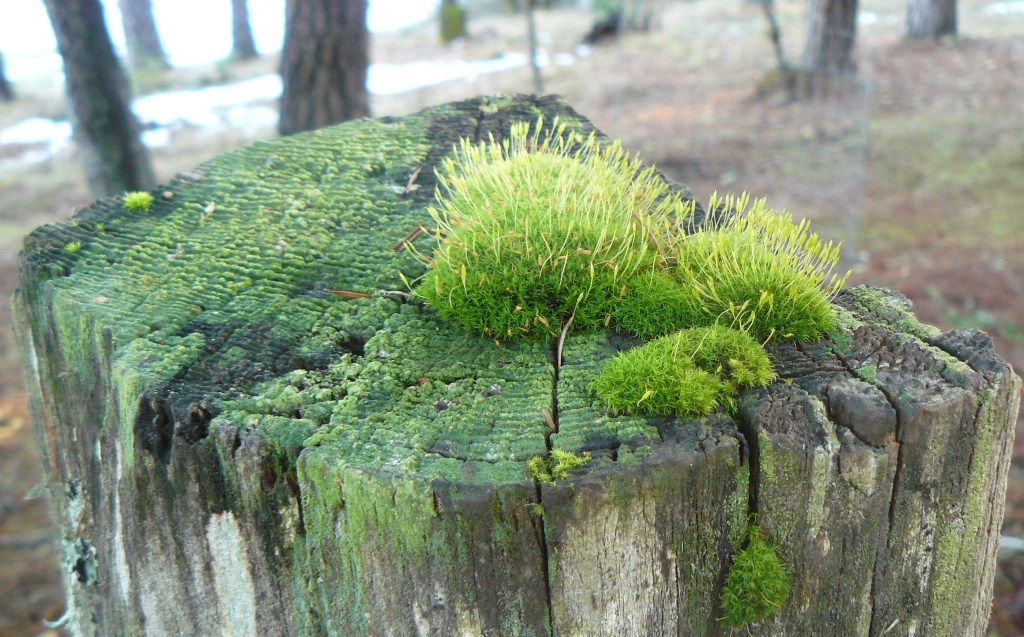
We have been working hard preparing stables in readiness for two miniature horses that we have purchased from our neighbours, Margo and Clarence.  Last Tuesday, we were busy at this when I saw another breathtakingly beautiful sight.

Just some growth on the top of an old fence post.  But the words utterly fail the image.  Here it is.

P1120292

Then about an hour ago (yesterday), while struggling to write this post, I heard the dogs barking in the bedroom next door.  Went into the room and they were ‘speaking’ to some wild deer grazing our pasture land.

P1120306

Wish I could wrap this all up with some profound view, some wise observations about life and the meaning of the universe!

But I can’t!  Can’t make any sense of it at all. How did we get here?  How did I meet Jeannie, this most precious woman, back in Christmas 2007? How did I sell up and walk away from Devon, England, with just Pharaoh by my side, to start this unbelievable new life with Jean and all the dogs?

Anyone know the answers?

P1110454-001
“The silly old sod does mutter on at times!”


Why?

“Why do you get out of bed in the morning, and why should anyone care?”

These words are spoken by Simon Sinek just before the three-minute mark in the video that follows.  As Wikipedia explains,

simono-sinek

Simon O. Sinek (born October 9, 1973) is an author best known for popularizing a concept of The Golden Circle.

He joined the RAND Corporation in 2010 as an adjunct staff member, where he advises on matters of military innovation and planning. His first TEDx Talk on “How Great Leaders Inspire Action” is the 7th most viewed video on TED.com.

His 2009 book on the same subject, Start With Why: How Great Leaders Inspire Everyone to Take Action (2009) delves into what he says is a naturally occurring pattern, grounded in the biology of human decision-making, that explains why we are inspired by some people, leaders, messages and organizations over others.

He has commented for The New York Times, Wall Street Journal, The Washington Post, Houston Chronicle, FastCompany, CMO Magazine, NPR and BusinessWeek, and is a regular contributor to The Huffington Post, BrandWeek, IncBizNet.

This new year that we are now in is going to require millions of us to think and do differently.  As Einstein so famously quoted, “Insanity: doing the same thing over and over again and expecting different results“.  More than ever before we need different results and that means thinking and doing differently.

Enjoy the video.

Change, as far as the eye can see.

Of the matters of man for the coming year.

Like countless others, when we look back 12 months and recall what we thought 2012 had in store, we now realise that we didn’t have a clue!  As the silly expression goes, “I can predict anything except those things that involve the future!

So repeating the process is stupid; I have no doubt that 2013 will be brim full of surprises.  At all levels: personal, local, national and global.  But ….. (You knew there was a ‘but’ coming, didn’t you!)

But a conversation that I had with Peter McCarthy on the 27th December resonated with me to such a degree that I felt the urge to pen some thoughts.  I worked with Peter some years ago at Clevedon Hall, we shared an interest in flying a TB20 and both of us studied for our CAA Instrument Rating.  We became good friends.

Clevedon Hall, Somerset, England.
Clevedon Hall, Somerset, England

So come with me today for a stroll around the grounds of change, possibly an epochal period of change.

Let’s start with what may be the biggest catalyst of change heading our way – our broken political system.

Christine of 350orbust fame published this yesterday.

it-is-not-a-just-society-quote

The view that many western societies are a very long way from being fair is growing.  If you want to dig a little deeper into the appalling statistics of the USA, for example, dip into a recent essay written by Charles Hugh Smith that appeared on Chris Martenson’s Peak Prosperity blog.

It’s a long essay packed full of powerful facts and statistics.  Try this one:

6.  The assets that generate unearned income are highly concentrated, and as a result so is the unearned income.  The top 1% owns twice as much stock-market wealth as the bottom 90%.  This income-producing wealth enables the top 1% to act as a financial aristocracy, buying influence and favors from equivalently concentrated political Elites.

stock market wealth

Let me go to Charles’ conclusion:

What few dare admit, much less state publicly, is that the Constitutional limits on the financial Aristocracy and the Tyranny of the Majority have failed.  This guarantees a future Constitutional crisis as each political class – the financial Aristocracy, the top 24% who pay most of the taxes, the dwindling middle class and the bottom 50% who depend on Federal transfers – will battle for control as the Status Quo collapses under the weight of its unsustainable promises.

H’mmm!

Back to the conversation with Peter.  He felt that there was a massive failure of the democratic process in the UK, and by implication in the USA.

Peter continued by saying that many elected politicians, especially at the level of local politics,  weren’t smart people.  Smart, innovative, entrepreneurial people chose not to go into politics.  Those that were elected had too much power and too many vested interests for the good of the societies that they were meant to represent.  In the USA the involvement of private money in politics is nothing short of corruption of the highest order; my personal opinion, no less and no more.

In moderation, Churchill’s saying comes to mind. “It has been said that democracy is the worst form of government except all the others that have been tried.

Let’s move on.

No-one can deny that in so many areas of our lives, the degree of change seems unprecedented.  Whether we are speaking of the huge social changes at work, enormous technological changes, such as the way that we communicate with each other, medical practises, and on and on.  Then add in the consequences of the change in the Earth’s climate, whether or not one sees this as the outcome of man’s activities and …. well, you get the idea!

Here’s a lovely perspective from Alex Jones who writes the blog, The Liberated Way.  Just a few days ago, Alex wrote this:

As hard and gloomy as some of my blog posts on the future of humanity have been, I thought it time to offer good news as to where we are heading.  I shall call this the global realignment.  Few will disagree that the current activities and ideas of humanity in relation to the environment are unsustainable and point to our self-destruction.  History also shows that whenever a crisis occurs traumatic events and the ideas of new thinkers causes a paradigm shift in attitudes and thinking.

Contrary to the fantasy of many people, there will be no celestial champion on a white horse riding forward to save humanity from itself.  The change will come from a series of traumatic events and individual thinkers which will plant the seeds of change, which will ripple forward as a tsunami of changes of ideas and attitudes on a global scale.

So much change.  So much uncertainty.  Such a feeling of being lost in unfamiliar lands.

Or have we been here before?

Have you heard of the Kondratieff Wave?

The Kondratieff Wave (Kondratiev Wave or K-wave) theory is proposing the existence of the extra-long, 50+ years long cycles of growth in the modern market (capitalist) economy. The theory was proposed in 1920s by Russian economist Nikolai Kondratiev.

Wikipedia has a good summary available here.  A Google search will find much more material, such as this chart:

kwave

The Wikipedia entry has a simpler diagram, see below, that shows the four stages of each cycle.

Kondratieff_Wave.svg

So how to draw this to a close?

In a sense, in a very real sense, there isn’t a close.  The future has always been uncertain and as history shows change is the only constant.

Peter concluded that a better society was ahead and hoped that he would live sufficiently long to witness it.  That gets my vote!

Happy New Year to you.

Thank you for taking an interest in Learning from Dogs.

Half empty, or half full?

Life has a habit of reflecting our own perceptions back to us.

Dear friend, Bob Derham, can always be counted on to forward something amusing or inspirational.  The Boxing Day smile was an example of the former.  Today is an example of the latter.

oooOOOooo

woman carrying water 2

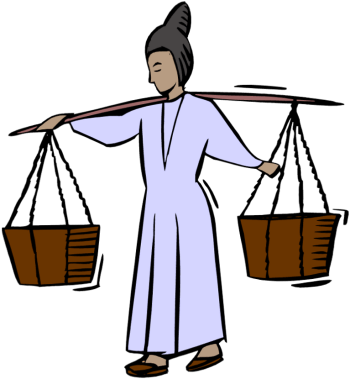
An elderly Chinese woman had two large pots, each hung on the ends of a pole which she carried across her neck.

One of the pots had a crack in it while the other pot was perfect and always delivered a full portion of water.

At the end of the long walks from the stream to the house, the cracked pot arrived only half full.

For a full two years this went on daily, with the woman bringing home only one and a half pots of water.

Of course, the perfect pot was proud of its accomplishments.

But the poor cracked pot was ashamed of its own imperfection, and miserable that it could only do half of what it had been made to do.

After two years of what it perceived to be bitter failure, it spoke to the woman one day by the stream.

‘I am ashamed of myself, because this crack in my side causes water to leak out all the way back to your house.’

The old woman smiled, ‘Did you notice that there are flowers on your side of the path, but not on the other pot’s side?’

”That’s because I have always known about your flaw, so I planted flower seeds on your side of the path, and every day while we walk back, you water them.’

For two years I have been able to pick these beautiful flowers to decorate the table.

Without you being just the way you are, there would not be this beauty to grace the house.’

Each of us has our own unique flaw.  But it’s the cracks and flaws we each have that make our lives together so very interesting and rewarding. You’ve just got to take each person for what they are and look for the good in them.

So, to all of my cracked pot friends, have a great day and remember to smell the flowers on your side of the path!

oooOOOooo

Nothing more one can add to that.  Well, sorry, there is one thing I can add.  That is that dogs love us with all our flaws and quirkiness.

Be that change!

A most beautiful message from Paul Chefurka This republication of a recent item on The Permaculture Research Institute website comes with the written permission of their editor, for which I am very grateful.  Nothing from me will add to this very personal essay, so with no more ado here it is.

oooOOOooo

Enough!

Society — by Paul Chefurka December 20, 2012

Meditation_on_rock

Whenever I contemplate the spectacular mischief that we humans have wreaked on our world, I am compelled to ask how this could have possibly happened. The despoilment of our planet seems to be the exact opposite of how I would expect a thinking, feeling, caring creature to treat their home. What could have driven us to this, and what perverse qualities could have allowed us to ignore the consequences of our actions for so very long?

At first blush, our problems seem decidedly physical. Dangerous gases drift in the air; acidity rises slowly in the ocean as the fish disappear from its depths; garbage and detritus of all kinds fouls the land where lush forests and grasslands once ruled. All these disturbances point back to human actions.

The proximate causes of this planet-wide distress include economics, politics, and personal and corporate greed – all facilitated by a technological cleverness that rests on a bed of dispassionate science.

I have spent over 50 years of my life trying in vain to understand our environmental problems as purely physical problems. When I viewed them in those terms, the fact that such problems even existed in a rational, scientific culture seemed nonsensical. However, when I recently began to understand them as consequences of a rupture in the human spirit they finally began to make sense to me. Yes, they are compounded by political and economic forces, but in my view even politics and economics are simply consequences of the same qualities of the human psyche.

Since the dawn of consciousness, human societies have been driven by a complex web of factors with their roots embedded deep in our evolved human nature. Power relationships and hierarchies, kinship and xenophobia, selfishness and altruism, competition and cooperation, curiosity and apathy, and countless other polarities mingle together to form the infinite variety of human dynamics.

Underneath it all, though, lurks our self-awareness. Human self-awareness is the root of our sense of separation from the natural world, and from each other for that matter. It’s the crowning paradox of the human condition – at once both our greatest glory and our fatal flaw. It is behind the dualism – the perceptual split into subject and object – that gave us science. It’s the source of our ability to see others as “different yet the same”, giving us the power to act altruistically. It’s also behind the sense of self and other that has allowed us to assume dominion over all we survey, whether animal, vegetable, mineral or human. Our sense of separation is the rupture of the human spirit that has allowed our current predicament to develop.

If this is the case, then no physical, political or economic remediation will heal the wound. The solution to our predicament is not – cannot be – material, political, economic, or simply philosophical. If a “solution” exists at all, it’s orthogonal to all those domains. Only by healing our belief in our separateness will we be able to finally and fully restore our balance with Nature.

When I began to view the situation like this, I was finally able to see that there are in fact solutions, where none had previously been visible. These new solutions don’t attack the predicament directly as a series of material, political, economic or technological problems. Instead, they seek to effect change from the center, by encouraging people to mature into an inter-connected adulthood and assume personal responsibility for their actions.

This approach follows Gandhi’s dictum, “Be the change you wish to see in the world.

The mischievous idea of science and technology as a post-modern “religion of salvation” with Ray Kurzweil’s transhuman singularity playing the role of the Rapture and an economist making a cameo appearance as the Devil (think infinite growth on a finite planet…) resonates very strongly with me.

But to be a little more precise, it’s not exactly science that has failed us. We have been undone by a toxic stew of classical economics, technological cleverness, love of progress, an attitude of Manifest Destiny and an unwillingness to accept any limits on our growth.

Technology lets us use scientific discoveries to satisfy human desires of all kinds. When we harness scientific knowledge to human ends, the outcomes we choose to implement are based on our wishes. If our wish is dominion over nature, we will use scientific principles to invent technology like mining machinery, continental energy grids, factory farming and the automobile.

Of course, each of those inventions is presented within our cultural narrative as an obvious, irrefutable boon. One of the points of having a cultural narrative is to put a positive spin on human activity. The spin is always in line with the narrative – or more precisely, in line with the wishes of those who create and sustain the narrative. The fact that these inventions, the technological expressions of science, have a subtext of dominion over nature is carefully camouflaged, and the idea that this might possibly be a bad idea is thoroughly discouraged.

None of this would have been so damaging if people didn’t have such a natural ability to delude themselves into believing that whatever they wish for hard enough is possible. It’s kind of like clapping for Tinkerbell. “The future is always going to be better than the past,” and “My kids will have better jobs, bigger houses and faster cars than I did,” are examples of such magical thinking at its finest.

Those two kinds of wishing – the wish to improve the human condition and the wish to see the human milieu keep growing forever – are not inherently different. I see them more as two points on a continuum. On one end is simple desire; on the other end is unreasonable desire. They are distinguished less by any intrinsic difference than by the attitude and realism of the one doing the wishing.

It can be very difficult to tell when the reasonable morphs into the unreasonable.”I wish to own a small piece of land” becomes “I wish to own an entire island” which inflates into “I wish to claim a continent for my King” and eventually becomes “I wish to rule the world.” The underlying desire is the same; it’s just the scale and reasonableness of the wish that changes.

Whether or not a wish is realistic or deluded depends very much on the one doing the wishing. There are people who wish for our (and by extension, their own) material wealth to continue growing forever. There is no shortage of economists who will tell them that such a strange thing is possible. Are the dreamers deluded? Are the economists deluded? What laws of nature would need to be violated for such a delusion to become reality? How is the worship of the Charging Bull of Wall Street materially different from worshiping the Golden Calf of the Bible, when both imply a violation of the laws of nature?

The world changes only when enough people have made a choice to change themselves. At what point will we each say, “Enough!” and choose a different path? Is anything keeping you from making that choice right now?

As you finish reading this article I invite you to say it quietly to yourself.

Enough!

If you listen closely with your heart, you may be able to hear the life that shares our planet say, “Thank you.

oooOOOooo

You can read more of Paul Chefurka’s writings on the PRI website here. Do, also, visit Paul’s website here.  You will not be disappointed.

Finally, let me do two things before closing.

The first is to highlight a sentence towards the end of this beautiful essay. This one. “The world changes only when enough people have made a choice to change themselves.

The second is to highlight on Paul’s website his Public Domain Notice statement: Any article on this web site may be reproduced by anyone, in whole or in part , in any manner and for any purpose whatsoever, with no restrictions.

Spread the word about you, me and all of us being the change the world needs – and needs now.  Thank you.
A few reflections on a new world order

Maybe the power of open communications is our only way forward.

A number of disparate ideas have flown into my ‘in-box’ and left me with these thoughts.

The first was the last essay on TomDispatch.  This one from the hands of Mr. Engelhardt himself.  I’m referring to Tomgram: Engelhardt, The Washington Straitjacket.  As many of you know, Tom has been generous in granting me blanket permission to republish his posts and I frequently so do;  as yesterday’s post written by Professor Michael Klare demonstrated.

Let me give you a idea of where Tom was coming from with this personal essay,

The Barack Obama Story (Updated) 
How a Community Organizer and Constitutional Law Professor Became a Robot President
By Tom Engelhardt

President Barack Obama
The White House
1600 Pennsylvania Avenue, NW
Washington, D.C. 20500

Dear President Obama,

Nothing you don’t know, but let me just say it: the world’s a weird place. In my younger years, I might have said “crazy,” but that was back when I thought being crazy was a cool thing and only regretted I wasn’t.

I mean, do you ever think about how you ended up where you are? And I’m not actually talking about the Oval Office, though that’s undoubtedly a weird enough story in its own right.

The next paragraph opens, thus:

After all, you were a community organizer and a constitutional law professor and now, if you stop to think about it, here’s where you’ve ended up: you’re using robots to assassinate people you personally pick as targets.

Then there’s a comprehensive description of all the outcomes that have taken place in the last few years as in this paragraph,

Still, who woulda thunk it?  Don’t these “accomplishments” of yours sometimes amaze you? Don’t you ever wake up in the middle of the night wondering just who you are? Don’t you, like me, open your eyes some mornings in a state of amazement about just how you ended up on this particular fast-morphing planet? Are you as stunned as I am by the fact that a tanker carrying liquid natural gas is now making a trip from Norway to Japan across the winter waters of the Arctic? Twenty days at sea lopped off an otherwise endless voyage via the Mediterranean Sea, and the Indian and Pacific Oceans. Did you ever think you’d live to see the opening of the Northeast Passage in winter? Don’t you find it ironic that fossil fuels, which helped burn that oceanic hole in the Arctic ice, were the first commercial products shipped through those open waters? Don’t you find it just a tad odd that you can kill someone in distant Yemen without the slightest obstacle and yet you’ve been able to do next to nothing when it comes to global warming? I mean, isn’t that world-championship weird, believe-it-or-not bizarre, and increasingly our everyday reality?

Tom’s essay comes to this conclusion,

And don’t you ever wonder whether a labyrinth of 17 (yes, 17!) major agencies and outfits in the U.S. “Intelligence Community” (and even more minor ones), spending at least $75 billion annually, really makes us either safe or smart? Mightn’t we be more “intelligent” and less paranoid about the world if we spent so much less and relied instead on readily available open-source material?

I mean, there are so many things to dream about. So many ghostly possibilities to conjure up. So many experimental acts that offer at least a chance at another planet of possibility. It would be such a waste if you only reverted to your community-organizer or constitutional-law self after you left office, once “retirement syndrome” kicked in, once those drones were taking off at the command of another president and it was too late to do a thing. You could still dream then, but what good would those dreams do us or anyone else?

It’s a very powerful analysis that I really encourage you to read.

Then thanks to a mailing from the WordPress team, I was drawn to a recent account of life by Ruth Rutherford.  In an essay from the 13th November, Ruth writes about living in the dark, as this sample evocatively describes,

Dating in the dark

Just got back from visiting my ol’ stomping grounds in New Jersey where I spent the weekend with my parents and grandparents, just talking, eating and enjoying good company. And all this was done in the dark. Yep, that’s right. Even nearly two weeks after Hurricane Sandy unleashed her fury, the Garden State is still struggling to recover. And let me tell you: Living without power for that long will quickly make you appreciate the little things.

Like walking into a dark room and then transforming it with just the flip of a switch. Or turning on a faucet and seeing water actually pour out. Or pulling into a gas station on any day you choose, not just the days you’re allowed to based on the numbers on your license plate. Or just using the bathroom without strategically planning your “number twos” based on how much water is in the tank. Or not having to wake up at two o’clock in the morning to wander outside in your pajamas to fill the generator with gas. (Okay, fine. My dad did that part. But still…)

When you’re without electricity for a while, your mind tends to do a lot of thinking. There are no reality shows to turn your brain into mush, no hair dryers to block out the noise of everyday life, and no steaming hot baths to drown your worries in. Basically, it’s you, alone, with a candle, a flashlight and your thoughts. So I spent the time brain blogging.

At the heart of this essay is the concept that ‘dating’ as in finding one’s life partner has become too complex.  This is how Ruth concludes her ideas.

Yep, I’m telling you to be shallow.

Forget the deep end, folks. Jump, cannonball style, into the shallow end and let the fun begin!

Shared interests. Favorite movies. Local hot spots. Interesting hobbies. Recent vacations. Current music playlists. Boring work stories. Embarrassing childhood memories. Stupid jokes. Mutual attraction. Sparks. Chemistry.

Because if you can’t relate on these basic levels, then who the heck cares if you both want two boys, one girl and a yellow Labrador named Minnie?

Start small. Start simple. Grab a lantern and meet during a power outage. It’s amazing what you’ll find out about your date in the dark. (With your clotheson, people! Get your minds out of the gutter.)

~Ruth

Finally, closer to home. Patrice Ayme and Martin Lack have been exchanging views in comments to my recent post Unintended Consequences.  Patrice ended a comment with this: ” If goodness is to win, it has to be smarter than the enemy.

So what’s this all coming to?  According to WordPress there are over 500,000 people blogging about the world as they see it.  The number of others who read all those words must be well into many, many millions.  Even humble old Learning from Dogs received over 45,000 viewings in November alone bringing the total viewings to over 785,000!

As the saying goes, “the only thing required for evil to win, is for good people to do nothing.”

Go and read the latest from Bill McKibben on 350.org.

The_New_York_Times

The article in The New York Times tells the story of students, faculty and alumni around the country who are demanding divestment from fossil fuels. On a few campuses, like Swarthmore, they’ve been at it for semesters — but all of a sudden, as the article says, they find themselves “at the vanguard of a national movement. In recent weeks, college students on dozens of campuses have demanded that university endowment funds rid themselves of coal, oil and gas stocks. The students see it as a tactic that could force climate change, barely discussed in the presidential campaign, back onto the national political agenda.”

The picture that accompanies the article comes from our Minneapolis roadshow last Friday night, and the article concisely lays out the demands and the strategy of the campaign. It’s precisely the boost we need. So please, go read it here: www.nyti.ms/SESrfr

We’re quickly getting traction, but we can get more if we have your help.

So, first things first: please email the article by clicking the “E-Mail” button on the New York Times website — if we can get it on the newspaper’s “most emailed list”, we can help make sure it goes as far as possible, as fast as possible.

For full instructions on how to email the article, click here: www.350.org/nyt

I sense that we, as in the peoples on this planet, are well into a period of such change that even by the end of 2013, a little over 50 weeks away, the precipice for humanity will be within sight.  I hold out zero hope that any time soon our leaders and politicians will stop ‘playing games’ and focus on doing what’s right.  The time for truth, for integrity, for sound debate is NOW!

The sharing of ideas, thoughts and emotions that this ‘virtual’ world of blogging offers (despite me regarding the word ‘blogging’ as ugly) is going to be the only tool, the only channel to carry sufficient weight and power for the wishes and desires of the ‘common man’ to live peacefully and safely to the end of this century and beyond!

Animals in love

The beautiful hidden depths of the consciousness of animals

Back in the Summer of 2011, I published a couple of posts on the subject of consciousness.  The first one was called Consciousness, science or God? and the second one about a month later continued the theme under the heading of And more on consciousness.

In that second article, I concluded with these words:

Finally, do you have a dog at home?  If you do, ponder on how their conscious world engages them.  If science can’t explain human consciousness then all we have is our own intuition with regard to animals.  Not sure about you but when one is feeling a little low and a dog comes up and lays a head across you I feel a very strong conscious connection.

Hazel and Pharaoh

The dog to the left of Pharaoh in the above picture is Hazel.  Shortly before we left San Carlos, Mexico to move up to Arizona in February, 2010, this dog was dumped outside Jean’s house.  She was still in milk and Jean explained that it was common practice for female dogs to be cast out shortly after they had had pups.  The pups would have been sold for a few pesos and the mother dog was no longer of any use or value and was ‘disposed’.

We took her in, of course, and she joined the other dozen dogs on our journey to our new Arizonan home.  Hazel has the sweetest of dispositions and frequently sleeps snuggled up against me at night.  As I write these words, Hazel is sleeping just to the left of my feet.  There are times when Hazel looks into my eyes with what I can’t lable as anything other than the look of a dog in love.

So with that in mind, let me introduce you to Kate and Pippin.  As their website proposes  Kate & Pippin is “An unlikely love story“.

THE STORY

Pippin, a helpless baby fawn was abandoned by her mother on the property of Isobel Springett. Isobel’s Great Dane, Kate, adopted Pippin immediately and they have been best friends ever since.

The story of Kate’s and Pippin’s loving relationship is charmingly chronicled in a handsome book featuring the beautiful photography of Isobel Springett.

Here’s Martin Springett, author of the book.

While there’s a small degree of overlap with the first video, you’ll still love to watch this.

A collection of photos from pips’s early days. She was just a few days old when she found us. Music is by my brother Martin Springett.

To close, here’s Pip at about two and a half months old. She’s just lost her spots and is looking like a teenager, all legs! She loves grapes and bananas after her bottle. (And the music is fabulous – Artist: Jelengue “Amar Mi Verdad”)

Reminds me of that great book from Jeffrey Masson, Dogs never lie about love!

Deeper insights into who we are.

Two fascinating perspectives.

1. A conversation with Charles Taylor – THE 2008 KYOTO PRIZE

Video Messages from Dr. Charles MargraveTaylor, the Laureate of 2008 KYOTO PRIZE, Arts and Philosophy. “Feelings on receiving the Kyoto Prize” “What philosophers can do for society” “Future interest and theme”(2008/11/11)

Wikipedia describes Charles Taylor thus,

Charles Margrave Taylor, CC GOQ FRSC (born November 5, 1931) is a Canadian philosopher from Montreal, Quebec best known for his contributions to political philosophy, the philosophy of social science, and intellectual history. This work has earned him the prestigious Kyoto Prize and the Templeton Prize, in addition to widespread esteem among philosophers. In 2007, Taylor served with Gérard Bouchard on the Bouchard-Taylor Commission on Reasonable Accommodation with regard to cultural differences in the province of Quebec. Taylor currently teaches at McGill University in the Department of Religious Studies. He is a practicing Roman Catholic.

There is also a fuller biography presented here.

2. How we see circumstances is so much more important – Rory Sutherland on Perspectives.

The circumstances of our lives may matter less than how we see them, says Rory Sutherland. At TEDxAthens, he makes a compelling case for how reframing is the key to happiness.

The TED profile of Rory Sutherland explains that:

From unlikely beginnings as a classics teacher to his current job as Vice Chairman of Ogilvy Group, Rory Sutherland has created his own brand of the Cinderella story. He joined Ogilvy & Mather’s planning department in 1988, and became a junior copywriter, working on Microsoft’s account in its pre-Windows days. An early fan of the Internet, he was among the first in the traditional ad world to see the potential in these relatively unknown technologies.

Adieu Payson

The end of a treasured time in Payson, Arizona.

Today, Jean and I together with our 11 dogs and 5 cats start the 1,200 mile journey to Merlin, Oregon.  While we have only lived in Payson since February, 2010, it has been a time of fantastic experiences.  I had to work through the long process of getting a fiancee visa from the American Embassy in London.  Until that was issued my ‘residence’ in Payson was that of a British tourist with me having to leave the USA every 90 days.

The visa was issued in October, 2010 and I flew immediately to Arizona.  On the 8th November, 2010 Jean and I were issued with a Marriage License Certificate and we were married on the 20th November at St. Paul’s Episcopal Church in Payson.

Fr. Dan Tantimonaco with the newly weds!

We have made many very dear friends here in Payson but Oregon feels like the start of our home in every sense of the word, not just because it is the first home that Jean and I have bought jointly.

One of those dear friends here in Payson has been John Hurlburt, a devoutly spiritual man.  A little over a week ago, he sent me a very thoughtful essay and I wanted to include it today as a guest post in recognition of the way that John and many, many others have embraced these couple of Brits over the last 32 months.  Thank you all.

oooOOOooo

Unity

Everything fits together

The species of animals we know as human beings is a part of everything that exists. We are a very young consciously-aware species that does not begin to know all the answers. What little we do know has a Natural pattern. It would seem that there’s a lamplighter and a navigator in all of us. The lamplighter is our fundamental awareness of being and provides nature’s guidance along life’s pathways.

Our natural navigator is designed for evolutionary competition. There’s a biological survival kit in our DNA. Extreme demand for limited resources generates deadly combat; both within and between species. As a result of competition taken to wretched excess, our global economy is leveraged 22 times beyond any earthly foundation. The unspoken intent to destroy each other over what remains of our planet is becoming increasingly evident.

The human species is engaged in a global war over money, ideals and disappearing finite resources. Ninety-seven percent of the world scientific community has confirmed that the natural effects of heat and discharges generated by human machines and related human activities are the primary cause of recent rapid climate change.

These dedicated scientists are opposed in the media by three percent of their corporate energy-financed peers. An oppressive worldwide network of often offensive politicians is similarly supported and managed accordingly. Nature couldn’t care less about politics, emotions or idealistic arguments.

Human squabbles mean very little in the totality of universal life. The drumbeat of local natural disasters increases steadily. There are no two ways about it. No amount of human ifs or buts can or will change reality. Our human species is in deep serious trouble.

It has been six million years since the first humanoids emerged and two million years since the rise of human civilization. What a sorrow it is to realize what we have done to the earth in just the past two hundred and fifty years. We’ve reached the moon and are exploring Mars. It’s well past time to clean house and re-grow our local garden.

As an old navigator, there’s a sense of urgency regarding the course life on earth has taken. For those who continue to care about facts, the prognosis is not encouraging. We have the know-how for an alternative. We can avoid the perfect storm of going over the edge of an economic cliff and the crush of an environmental crisis in the midst of a war-fuelled, profit-driven, global, corporate fight to the end. The alternative is that we have the know-how to transition rapidly to a reality-based economy and a way of living that’s gentle to the earth. The solution is global, it’s industrial, it’s natural and it’s our best hope. It may well be our only hope. It’s time to light some lamps.

Conscious human awareness emerges as we relax, contemplate, meditate, and communicate openly. These are levels of awareness beyond the limits of our daily human musings. The wisdom which flows from enlightened awareness embraces humility, experience, knowledge, understanding, and faith. Life has never been easy. We’re fragile biological beings. Our mutual growth is the result of sustained efforts over millions of years.

Yet despite attaining a higher level of conscious awareness our human culture continues to operate on a material basis rather than a moral basis. We have become confused by our own importance or the apparent lack thereof. We all too often retreat into a rut, furnish it and turn on the electronics.

By definition, natural processes support species growth in harmony with all natural life. Those natural processes are indistinguishable from the planetary support systems within which all life interacts. Human interaction is local. We spend much of our lives unaware that we are unaware; initially as infants and throughout our lives in deep sleep. When caught up in the pressures of our daily lives, it’s easy to be unaware of being unaware.

It’s time to wake up. Cosmology is an eternal spring from which the waters of the earth still flow. When we turn ourselves inside-out and achieve higher awareness, we discover who, what and where we really and truly are. In a trinity of spirituality, nature and science, we’re cosmically energized beings; spiritual beings sharing a transitory human existence.

Ninety-eight percent of the human population believes in a power beyond species and self. The simplest understanding of this belief is that we humans did not originally create ourselves. All human wisdom and understanding leads to the conclusion that human beings don’t own the earth. We’re caretakers and we’re only passing through. Given that we have a systemic crisis, what do we have to work with?

We have a species that’s squabbling over diminishing resources, an environment and an infrastructure which both desperately require attention, a sustaining objective of equitable global employment, a world economy that’s about to collapse for lack of any real foundation, a burgeoning population which further strains the system and the clear need for a unifying purpose.

Put it all together and what do we have? The navigator is our guide to growth. The navigator shares our wholeness. The lamplighter is our guide to unity. Everything fits together. Each of us is a part of the unity of life. Unity has a natural purpose. It’s time to build a life boat.

John Hurlburt is a former U.S. Navy aviator and successful corporate executive who presently serves as a senior Christian educator and a founding member of an international Transition Town in Payson, Arizona.

oooOOOooo

Don’t know about you, dear reader, but I find those incredibly powerful words.  Words that provide the truth. A truth the whole world needs.  John set out in a personal email to me the three simple fundamentals of our lives. Just a few more words to sum up the truth.

There’s an environmental crisis.  There’s an inevitable global economic abyss touching us all on a daily basis.  The need for a green economic transformation is obvious.

Thank you, John.

Creativity, John Cleese style

The art and magic of being creative.

I can’t recall who it was that mentioned this TED video which is a great shame as I really should pay credit to a wonderful examination of the business of being creative.

“Telling people how to be creative is easy – being creative is difficult.” John Marwood Cleese (born 27 October 1939) is an English actor, comedian, writer and film producer. He achieved success at the Edinburgh Festival Fringe and as a scriptwriter and performer on The Frost Report.

In the late 1960s he became a member of Monty Python, the comedy troupe responsible for the sketch show Monty Python’s Flying Circus and the four Monty Python films: And Now for Something Completely Different, The Holy Grail, Life of Brian and The Meaning of Life. In the mid 1970s, Cleese and his first wife, Connie Booth, co-wrote and starred in the British sitcom Fawlty Towers. Later, he co-starred with Kevin Kline, Jamie Lee Curtis and former Python colleague Michael Palin in A Fish Called Wanda and Fierce Creatures.

He also starred in Clockwise, and has appeared in many other films, including two James Bond films as Q, two Harry Potter films, and three Shrek films. With Yes Minister writer Antony Jay he co-founded Video Arts, a production company making entertaining training films. It was founded in 1972 by John Cleese, Sir Antony Jay, and a group of other television professionals. The videos feature well known British actors, and humorously explain business concepts. Productions include Meetings, Bloody Meetings and More Bloody Meetings, and have featured Cleese, Dawn French, Prunella Scales, Hugh Laurie, and Robert Hardy.

In December 1977, Cleese appeared as a guest star on The Muppet Show. Cleese was a fan of the show, and co-wrote much of the episode. He appears in a “Pigs in Space” segment as a pirate trying to hijack the spaceship Swinetrek, and also helps Gonzo restore his arms to “normal” size after Gonzo’s cannonball catching act goes wrong. During the show’s closing number, Cleese refuses to sing the famous show tune from Man of La Mancha, “The Impossible Dream”. Kermit the Frog apologises and the curtain re-opens with Cleese now costumed as a Viking trying some Wagnerian opera as part of a duet with Sweetums. Once again, Cleese protests to Kermit, and gives the frog one more chance. This time, he is costumed as a Mexican maraca soloist. He has finally had enough and protests that he is leaving the show, saying “You were supposed to be my host. How can you do this to me? Kermit — I am your guest!”. The cast joins in with their parody of “The Impossible Dream”, singing “This is your guest, to follow that star…”. During the crowd’s applause that follows the song, he pretends to strangle Kermit until he realises the crowd loves him and accepts the accolades. During the show’s finale, as Kermit thanks him, he shows up with a fictional album, his own new vocal record John Cleese: A Man & His Music, and encourages everyone to buy a copy. This would not be Cleese’s final appearance with the Muppets. In their 1981 film The Great Muppet Caper, Cleese does a cameo appearance as Neville, a local homeowner. As part of the appearance, Miss Piggy borrows his house as a way to impress Kermit the Frog. Cleese won the TV Times award for Funniest Man On TV — 1978-79.

Many people think you are either born with creativity or you aren’t. But John Cleese explains how to become creative and in the video, he talks about such thing as the unconscious mind.

John Cleese has his own website here.