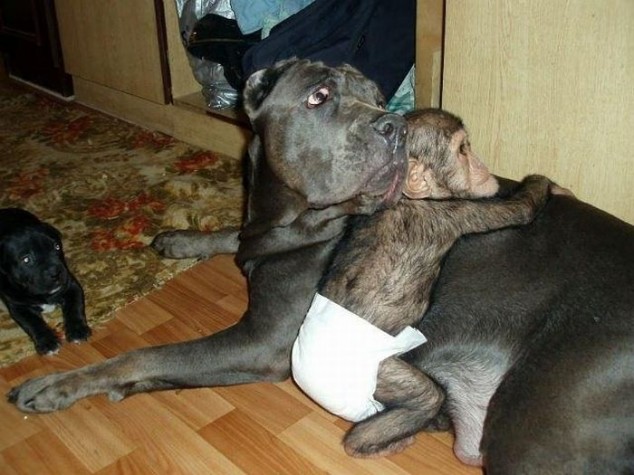
The widely reported story of a dog ‘adopting’ a baby chimpanzee.
(With big thanks to Chris Snuggs for sending me the pictures)
As a quick Google search finds:
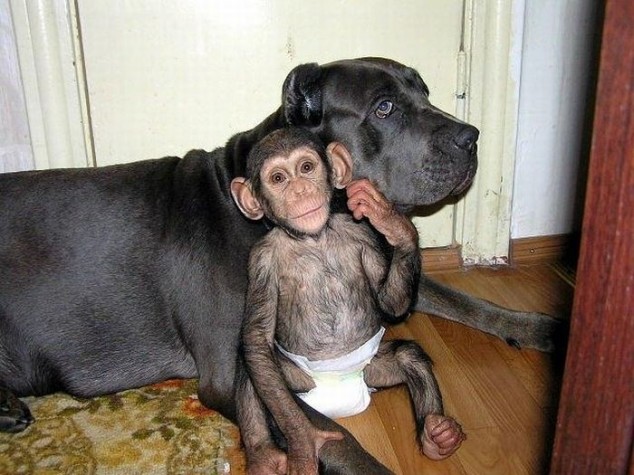
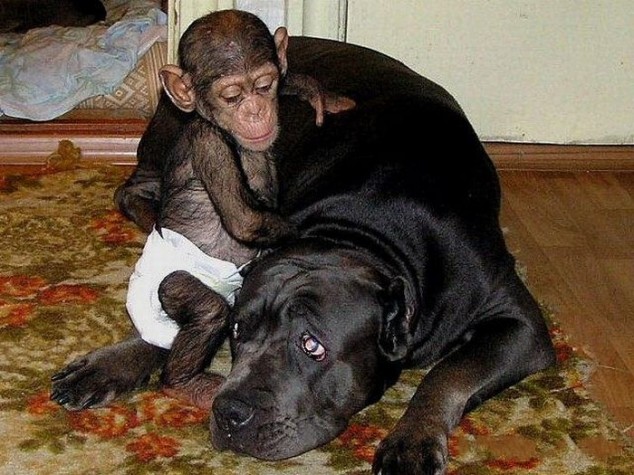
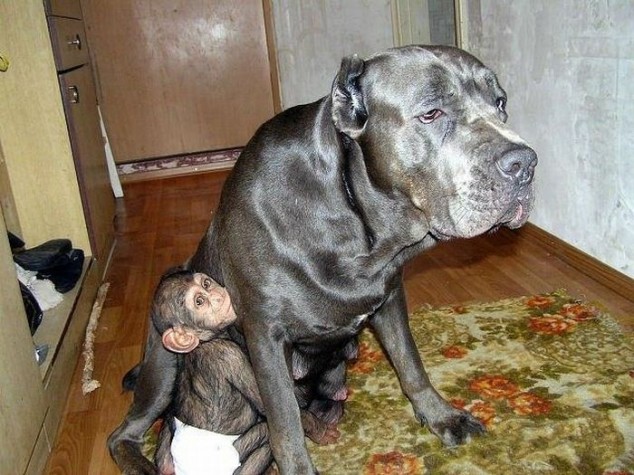
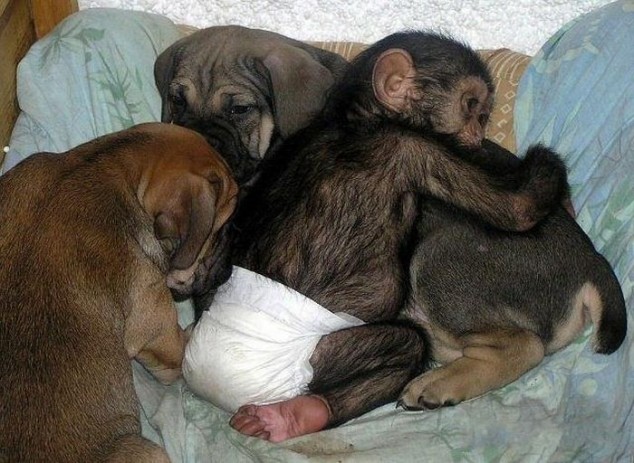
Two years ago in a Russian zoo a female chimpanzee for some reason repudiated and abandoned her baby chimpanzee. When one of the employees of the zoo took the little chimpanzee home it never crossed her mind that her dog, a mastiff, would become a mother for the orphaned chimpanzee and treat the baby as her own child.
Judging by the look on her face at times, she is not quite sure why this particular offspring has hands to grab her with!
The unconditional love of a dog.
Fascinating example of the power of upbringing.
What is so wonderful, and amazing, is how ‘mother’ accepts this strange looking and strange smelling creature as it’s own. Think how important smell is to dogs!
Words add nothing to the beauty of this photograph.
You can see the huge difference in body mass between these two. One swipe, one bite and the little chimp would be toast! The dog’s love for the chimp overrides all!
Just beautiful.
Mummy, what’s that on the wall?
Mummy, your feet are so big …. and not at all like mine!
oooOOOooo
Dear Chris, thank you so much for sending me these pictures. It’s a privilege to share them with LfD readers. It reminds us that in this difficult era, with so many challenges facing us, that there’s nothing that can’t be solved with love, compassion and understanding.
My writings of the previous three days have explored the nature of man. The many ways that we struggle to understand so many issues in our lives. In particular the biggest issue of them all since we abandoned the life of the hunter-gatherer. Our very survival.
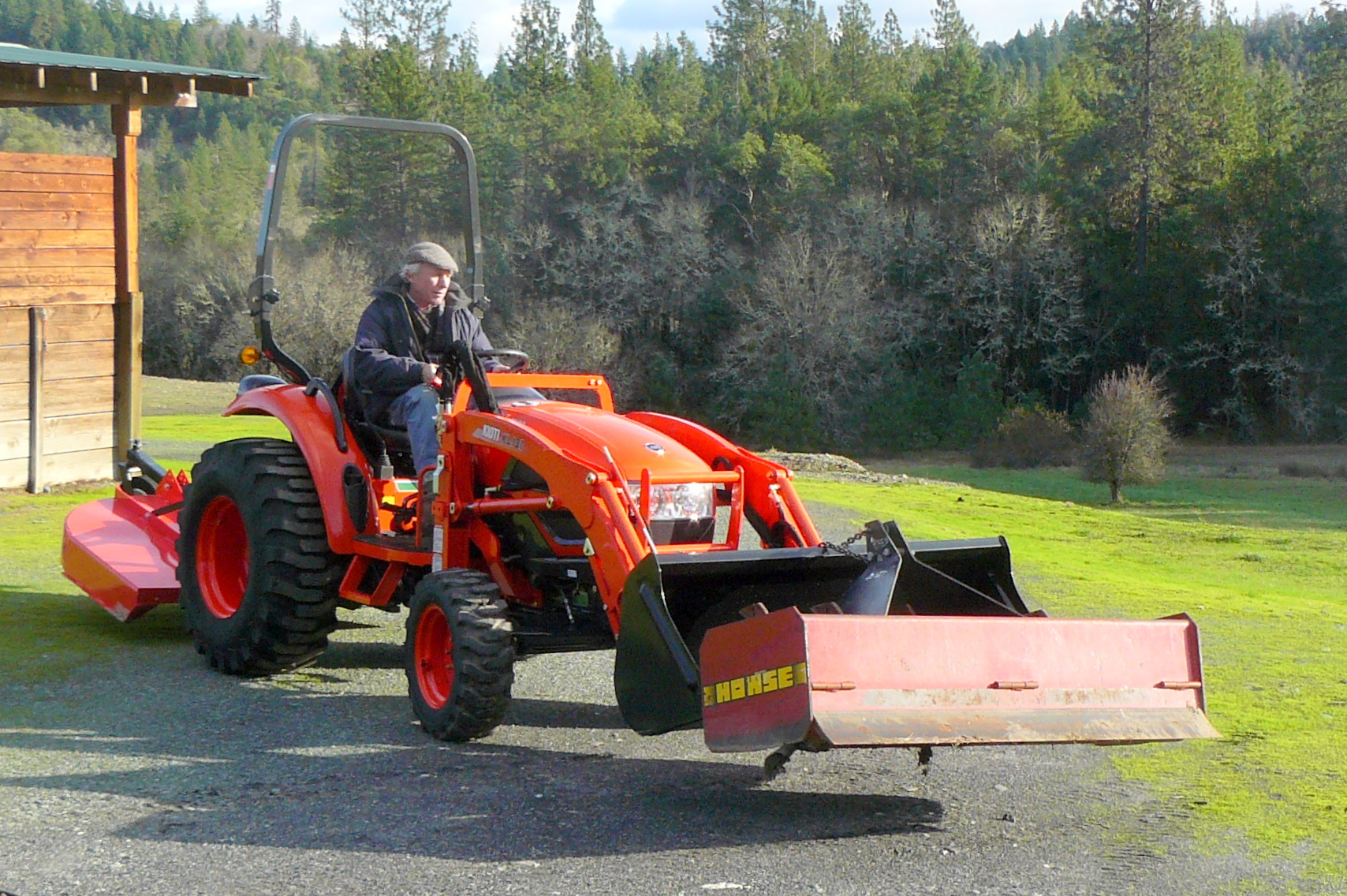
It would be so easy to beat oneself up. To stare in the mirror and despair at all the unfinished ideas that one has about being ‘sustainable’ shortly before jumping on one’s shiny new tractor, yet another symbol of our industrial civilisation. The hypocrisy, the double standards!
New tractor delivered last December.
But the mistake in any attempt at self-awareness is the assumption that you know who you are! Therein lays the problem.!
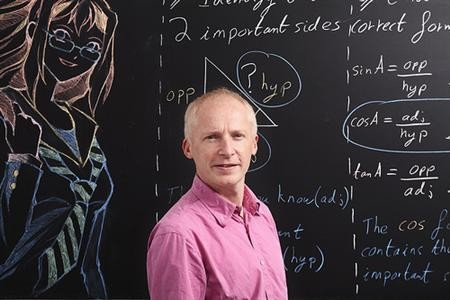
Marcus Peter Francis du Sautoy is a very smart person. This is how WikiPedia describes him.
Prof. Sautoy came to the realisation that the thoughts that make us feel as though we know ourselves are easy to experience. But where do those thoughts come from? Marcus Sautoy acknowledged that they are notoriously difficult to explain.
So, in order to find out where they come from Marcus subjects himself to a series of probing experiments. With the help of a hammer-wielding scientist, Jennifer Aniston and a general anaesthetic, Professor Marcus du Sautoy goes in search of answers to one of science’s greatest mysteries: how do we know who we are? ,
He learns at what age our self-awareness emerges and whether other species share this trait.
Next, he has his mind scrambled by a cutting-edge experiment in anaesthesia. Having survived that ordeal, Marcus is given an out-of-body experience in a bid to locate his true self. And in Hollywood, he learns how celebrities are helping scientists understand the microscopic activities of our brain.
Finally, he takes part in a mind-reading experiment that both helps explain and radically alters his understanding of who he is.
All of this is covered in a fabulously interesting episode from Horizon, the excellent and long-running BBC TV science and philosophy series. Thankfully, it made its way onto YouTube.
It is just under an hour long but I promise you it will capture you from the very first moment.
Enjoy. Even if you end up realising, as I did, what a strange person you are!
As Confucius reportedly wrote: Real knowledge is to know the extent of one’s ignorance.
In a way this stunningly beautiful photograph is a reflection of our long relationship. Over the 33 years that we have been friends you and I have enjoyed many calm moments and tried to make sense of this crazy world. Yes, we have often disagreed about many things but never fallen out; not even come close to it. No better illustrated than me wanting you as my Best Man when Jean and I were married November 20th, 2010.
Payson, Arizona, November 20th 2010 Bridesmaid Dianne and Best Man Dan with the happy couple!
Your email to me of the 4th February was a difficult one to embrace; the Controversy Continues one. The last thing I wanted to do was to react impulsively because I knew you would disregard such a thoughtless response. After all, we have known each other’s views on the matter of climate change for a very long time.
Thank goodness I did sit on my hands. It allowed a more reflective part of my aged brain to compose a blog post on Learning from Dogs. The post that came out on the 12th under the title of Doggedly seeking the truth.
But the plain fact of the matter is that I profoundly disagree with the idea, as expressed in your email heading, that there is any controversy over the question of global warming resulting from man’s behaviours. I know from our years of friendship that you are open to all sorts of ideas. Meaning you wouldn’t be closed-minded to the biggest issue facing Homo sapiens andall the species on this planet, the one of anthropogenic global warming (AGW).
So let me offer you some links that make it very clear as to the reality of what is happening to this planet.
Perhaps the reason that so many intelligent people ‘avoid’ the truth of what we are doing to this planet was voiced in a recent comment by Prof. Guy McPherson on Learning from Dogs, “Perhaps Upton Sinclair had it right, years ago: “It is difficult to get a man to understand something, when his salary depends on his not understanding it.”
Even though you and I are well past salary days it doesn’t alter the chilling realisation that comes from embracing the truth of climate change and global warming: The undermining of just about everything that we have embraced over our years. No wonder it’s so much easier to stay within familiar comfort zones! To remain hypocrites as Jean and I do!
Let me close with the words uttered by mother Dellarobia to son Preston in Barbara Kingsolver’s book Flight Behavior: “It won’t ever go back to how it was, Preston.”
“A delusion is something that people believe in despite a total lack of evidence.” Richard Dawkins.
Yesterday, I started down the road of determining how one gets to the truth of a complex issue. I called the post Doggedly seeking the truth. My proposition was effectively saying that just because a person believes in argument ‘a’ or argument ‘b’ that doesn’t of itself make ‘a’ or ‘b’ the truth.
Unwittingly, Martin Lack of the blog Lack of Environment reinforced that point in spades. He wrote in a comment to yesterday’s post:
The deliberate spreading of misinformation is a fundamental part of the industry-led movement to deny the reality of anthropogenic climate disruption. Alex Rawls is just part of this campaign and I therefore do wish that you would consult me before deciding to help publicise and/or lend credence to such nonsense.
Now I have every sympathy for Martin’s outpourings of feelings; his blog is based on the conviction of his own beliefs. A position of integrity.
But taken literally, Martin’s words, “consult me before deciding to help publicise” mean that he wishes to influence what I choose to write. Of course he didn’t mean to convey that.
Back to yesterday’s post. With Dan’s permission, I reproduced the personal email that he sent me with those two articles. Dan isn’t on the payroll of the Koch brothers or blindly following an “industry-led movement to deny the reality of anthropogenic climate disruption“, he is a thinking human who is yet to be convinced that AGW is as rational a process as, say, gravity!
Humans are not fundamentally rational; we are emotional beings who even in this 21st century have little real understanding of what a human being is. (Must be honest and say that this last sentence is a tickler for a mind-opening video on the nature of human consciousness coming out on Friday.)
So if Dan is not convinced about the effects that mankind is having on Planet Earth, then spare a moment to ponder about the millions of others around the world who are far less capable, even if they had the time and inclination, to adopt a rational, open-minded view of the complexity of AGW.
It gets even more convoluted. In Professor McPherson’s video that was presented yesterday, this gets said, “If we act as if it’s too late, then we becomes a self-fulfilling prophesy”. On the face of it, that’s obvious. But on Guy McPherson’s blog Nature Bats Last the video has it’s own post and includes a comment left by Daniel, from which I quote:
Guy,
There are so many insoluble dilemmas concerning industrial civilization, it’s almost impossible for anyone to attempt to propose a “solution”, or attempt to describe the work that now needs to be done, without becoming a hypocrite.
At this stage, hypocrisy is unavoidable. Beyond the point of overshoot, at least in our culture, all that’s required to be a hypocrite, is to be alive.
I have watched your presentation evolve over the last few months, and with this latest one, something struck me as peculiar. You’ve added this line:
“If we act as if it’s too late, then we becomes a self-fulfilling prophesy”.
Basically, implying that we shouldn’t accept that it’s too late. Yes?
The evidence that now exists, has established an immovable catastrophe, which is now, well outside human agency ( aside from the looming boondoggle of geo-engineering). This is what the evidence shows. We have effectively already become a self-fulfilling prophesy. The most dire warnings of the last three decades, have now become prophetic. What are eight non-reversible feedbacks if not a physical manifestation of a self-fulfilling prophesy?
To which Guy replies:
Daniel, you’re asking the same questions many others have been asking lately. I’ll try to respond with my next essay, which I’ll complete and post in a couple days.
Seems to reinforce the message. That we really shouldn’t be surprised at the delusions, games and power interplays going on, especially in the corridors of power, so to speak.
Right! Time for me to show my hand!
I am totally convinced that we humans are responsible for the rising levels of CO2 in the atmosphere and that this accounts for the majority of the abnormal weather events being experienced in so many parts of the planet.
I think I’m right. Therefore I give more weight to the evidence that supports my view that, guess what, reinforces me thinking I’m right.
Is that scientific? Of course not! Science is about producing reproducible outcomes. With, say gravity, that’s a piece of cake.
I’m not a scientist, far from it. Therefore the following statement may be unreliable. That the problem with producing an uncontroversial, hard-wired proof that man is screwing up (you see, I did say that I wasn’t a scientist) our planet is that we don’t have other planets with which to test the thesis. When it surely is an uncontroversial, hard-wired proof it will be too late!
Having said all that, tomorrow I will present the best evidence that I can find to support the notion that Dan’s beliefs are wrong.
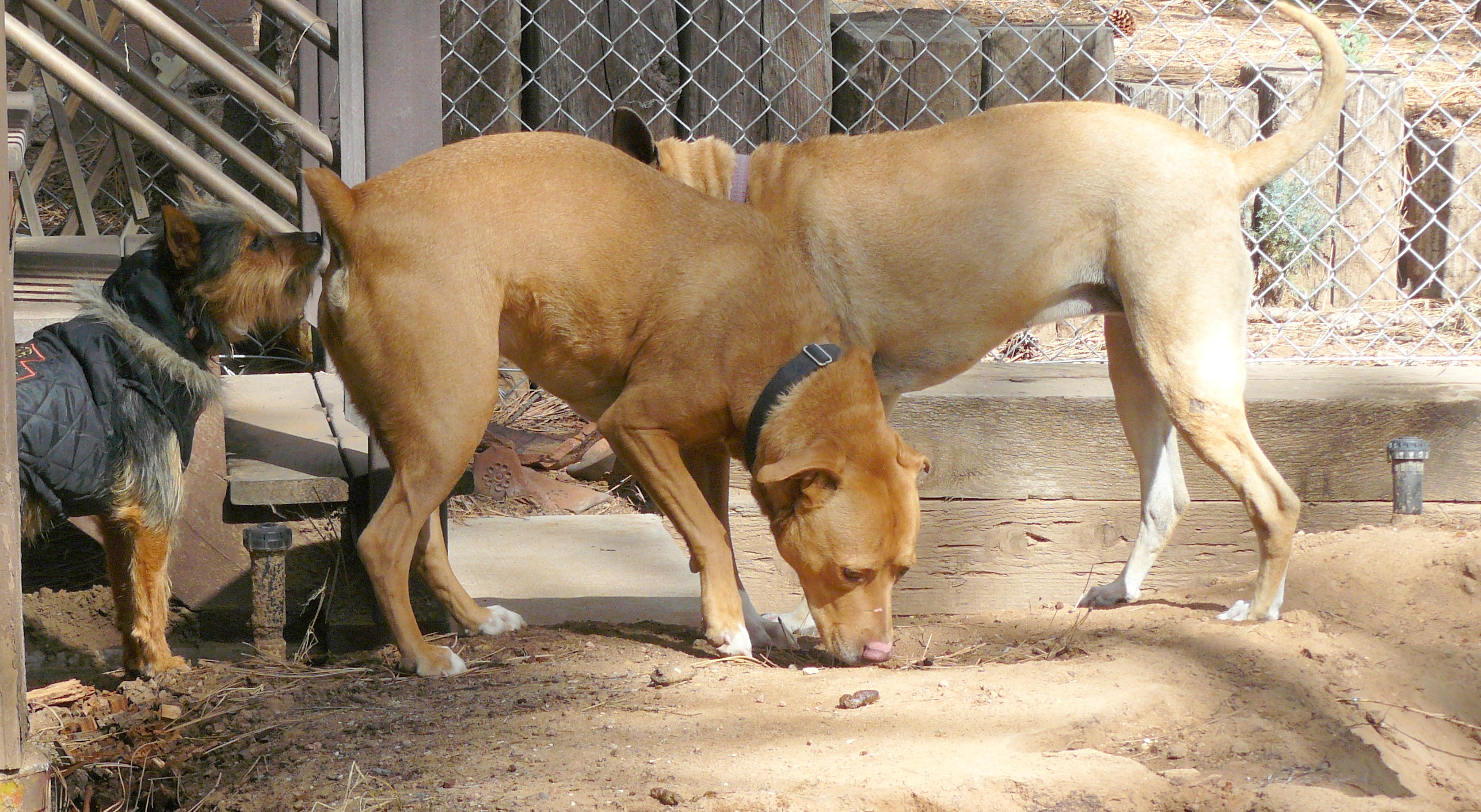
Back to Casey and that scent:
Now where’s that scent now? Sweeny, help me! Hang on, let me finish sniffing your bum! Ask Ruby to help, she’s just by the fence.
We can never be as rational as dogs. But maybe if we learnt to live more in the present, as dogs do so well, the world would be a much simpler and sustainable place.
On the road, there’s little possibility to develop a lasting relationship. I throw a Molotov cocktail into the conversation, and then I leave the area.
On the road, I describe how we live at the mud hut. I describe the importance of living for today.[my emphasis]
Through the wonderful world of web connections, I came to this topic by first reading Jeremy Nathan Mark’s blog The Sand County. Highly recommended.
Jeremy had written a post under the intriguing title of Blogging as Virtual Love-Making, And the Science Behind It. Blogging; Love-Making; have I really just read those words! In fact, Jeremy had reposted an article written by Deborah J. on her blog Living on the Edge of the Wild; another great find out there in this virtual world. So with Deborah’s kind permission here it is reposted on Learning from Dogs.
oooOOOooo
Blogging as Virtual Love-Making, And the Science Behind It
Often when I leave comments on a blog post that moved me, I write “I love this post” or “I love the way you do [this]” or “I love that quotation.” Lately I’ve been wondering if I’m overusing the word “love”.
Am I really feeling this strong emotional attachment, or am I just being lazy, unwilling to take the time to precisely articulate what strikes me about a particular piece?
After reading a recent article in The Atlantic on the science behind love, I’m inclined to believe that, more often than not, I use the word “love” because that’s what I’m actually feeling– a “micro-moment of positivity resonance.” That’s how Barbara Fredrickson defines love in her new book Love 2.0: How Our Supreme Emotion Affects Everything We Feel, Think, Do.
Fredrickson, a leading researcher of positive emotions at the University of North Carolina at Chapel Hill, presents scientific evidence to argue that love is not what we think it is. It is not a long-lasting, continually present emotion that sustains a marriage; it is not the yearning and passion that characterizes young love; and it is not the blood-tie of kinship.
Rather, it is what she calls a “micro-moment of positivity resonance.” She means that love is a connection, characterized by a flood of positive emotions, which you share with another person—any other person—whom you happen to connect with in the course of your day. You can experience these micro-moments with your romantic partner, child, or close friend. But you can also fall in love, however momentarily, with less likely candidates, like a stranger on the street, a colleague at work, or an attendant at a grocery store. Louis Armstrong put it best in “It’s a Wonderful World” when he sang, “I see friends shaking hands, sayin ’how do you do?’ / They’re really sayin’, ‘I love you.”
So when I say I “love” Louis Armstrong’s song, now I know why—because I feel such a strong positive connection to what he’s saying, as well as with how he says it, and the music he says it with, that I experience a triple love-whammy!
What I feel when reading things by fellow bloggers, or see the images they’ve created, is similar—a deeply-felt resonating connection, often on several levels.
Smith writes:
When you experience love, your brain mirrors the person’s you are connecting with in a special way,” and then she goes on to explain how “[t]he mutual understanding and shared emotions” between a story-teller and a listener “generated a micro-moment of love, which ‘is a single act, performed by two brains,’ as Fredrickson writes in her book.
This can happen between a writer and reader as well, or between an artist and viewer. In his book “Tao and Creativity” Chang Chung-yuan describes this connection between poet and reader as a “spiritual rhythm.” It is the means by which the reader participates in the inner experience of the poet. He writes:
In other words, the reader is carried into the rhythmic flux and is brought to the depth of original indeterminacy from which the poetic pattern emerges. The reader is directly confronted with the objective reality which the poet originally faced. The subjectivity of the reader and the objective reality of the poem interfuse . . . .
This is very interesting because Fredrickson discovers a similar phenomenon when she compares the brainwaves of a storyteller and listeners. Smith describes this in her article:
What they found was remarkable. In some cases, the brain patterns of the listener mirrored those of the storyteller after a short time gap. The listener needed time to process the story after all. In other cases, the brain activity was almost perfectly synchronized; there was no time lag at all between the speaker and the listener. But in some rare cases, if the listener was particularly tuned in to the story—if he was hanging on to every word of the story and really got it—his brain activity actually anticipated the story-teller’s in some cortical areas.
The mutual understanding and shared emotions, especially in that third category of listener, generated a micro-moment of love, which ‘is a single act, performed by two brains,’ as Fredrickson writes in her book.
Fredrickson also discovered that the capacity to experience these daily love connections in our lives can be increased through simple loving-kindness meditations, where, as Smith describes, “you sit in silence for a period of time and cultivate feelings of tenderness, warmth, and compassion for another person by repeating a series of phrases to yourself wishing them love, peace, strength, and general well-being.”
“Fredrickson likes to call love a nutrient,” Smith writes. “If you are getting enough of the nutrient, then the health benefits of love can dramatically alter your biochemistry in ways that perpetuate more micro-moments of love in your life, and which ultimately contribute to your health, well-being, and longevity.”
So remember, fellow readers, as you go meandering from one blog site to another like busy little bees, making those “micro-moment” connections with people whose work you admire, that you are engaged in a kind of virtual love-making. You are distributing a pollen-like “nutrient” that nurtures others, as well as yourself.
As Louis says, “what a wonderful world” we live in!
oooOOOooo
Deborah concludes with Louis Armstrong singing ‘What a Wonderful World’.
However, for me the song that really resonates with this fascinating article is Ella Fitzgerald’s rendition of What Is This Thing Called Love. Take it away Ella.
A big thank you to Jeremy and Deborah. Finally, to all those that enjoyed (loved?) this post, do go and read The Atlantic article in full; it’s fascinating.
I must share the feelings of millions of others across the world when I admit to going through periods of quiet despair about where ‘modern man’ has got himself. (I don’t intend to be gender specific!)
It goes way beyond the disbelief at some of the things happening today; way beyond the anger that is generated by so many examples of greed and corruption. It goes to a point where I just want to snuggle down with Jean, curl up with the dogs and kiss the rest of the world good-bye!
The expression that comes to mind is the one about the last person to leave the planet please switch the lights off!
(As if to demonstrate how sensitive dogs are to the feelings of us humans, Cleo just came into the room where I am writing this and laid her head across my left thigh. I stroked her head and then she wandered back to our bed next door – I then took the following photograph)
So what’s feeding my feelings?
Well, as many of you know yesterday and Sunday had posts about saving the Ecuadorian Jaguar and the African Lion. In the case of the former, it’s:
The president of Ecuador claims to stand for indigenous rights and the environment, but he has just come up with a new plan to bring oil speculators in to 4 million hectares of jungle. (That’s 9.9 million acres in old money!)
In the case of the African Lion, it’s:
In the past fifty years, the African lion population declined by as much as 90%. Many of the lion prides that do exist today are so genetically weak from being small and isolated by international borders that they can’t promise a future for African lions ….. two thirds of the African lions killed by trophy hunters end up in the U.S. That’s thousands of lions!
Last Friday I wrote about how community living for wolves and dogs had given those species “group survival and well-being“ that we humans couldn’t even dream about.
I attended a lecture at Essex University Colchester last Wednesday on the plight of indigenous indians in Canada, specifically those in Labrador. The Canadian government has embarked on a scheme to disenfranchise the indians of all their land, wipe out all their rights forever, and place them in perpetual bondage. Underlying this horror was what has happened to the indians themselves, a people tainted with mental illness, alcoholism and high suicide rates.
I asked the lecturer why it is that it appears all indigenous people across the globe share this common trait of high levels of abuse, mental illness, suicide and alcoholism. The answer given was that outsiders desired to force their alien world views upon these people destroying their sense of personal identity. For example many of these people see land as a shared resource, the capitalist ideas of land ownership is at odds with their world view. All Native American problem solving is through talking, and everyone has choice, whereas outsiders prefer to impose solutions and intellectualise with clever words.
Just read that last paragraph carefully again and note “outsiders desired to force their alien world views upon these people destroying their sense of personal identity.”
Back closer to home, the struggles of the North American Indians are well-known.
So no nice, neat solution to this place that I’m in just now other than to put down my pen and let the music from the following two videos wash over me.
If you read this far, thank you for suffering the ramblings of this silly old fart!
Dogs wouldn’t treat other members of their pack like this.
(I realise how the heading and the sub-heading don’t appear to have any correlation but stay with me please!)
It’s widely known, I’m sure, that the wolf, from which the wild dog and the domesticated dog evolved, lives in packs of around 50 animals. The size of the pack offers a cohesive, stable structure for the wolf, and other pack species, ensuring group survival and well-being. In a very real sense the way that wolves live is a fabulous example of the power of community.
My understanding of early hominids is pretty basic but if ‘Homo habilis‘ represents the evolution of modern man then our species goes back less than 3 million years.
The Dog linage began 37 million years ago in North America in predators that had distinctive pairs of shearing teeth and ran down prey. Early canids reached Europe seven million years ago.
Thirty-seven million years! Now that’s what I call an example of “group survival and well-being“. The power of community.
As stated elsewhere on this blog,
Dogs are part of the Canidae, a family including wolves, coyotes and foxes, thought to have evolved 60 million years ago. There is no hard evidence about when dogs and man came together but dogs were certainly around when man developed speech and set out from Africa, about 50,000 years ago. See an interesting article by Dr. George Johnson.
The ten dogs we have here at home are split into two groups of five. What we call the bedroom group: Pharaoh, Cleo, Sweeny, Hazel and Dhalia, and the kitchen group consisting of Lily, Casey, Ruby, Paloma and Loopy. Both groups are separated by wooden fences so are more than aware of each other.
Something that is clear is that whenever one of the dogs is hurt, all the other dogs take notice. Others in the same group will come up to their hurt ‘buddy’ and offer comfort in a variety of ways. Sadly, I can’t give you a better example than our poor Loopy who is suffering badly from the dog equivalent of dementia.
Here’s a picture taken of Loopy on Wednesday afternoon. You will notice the strange sleeping position that she frequently adopts. That’s an aspect of her dementia.
The other dogs in her group all give her special attention. Such as not grabbing her sleeping bed, not pushing or shoving near her, giving her a wide space in general. The other dogs sense there is something badly awry with Loopy and accommodate that.
So what on earth has this to do with yesterday’s post Who owns the World? Keep hanging in there!
A recent link in Naked Capitalism‘s daily news summary was to a story in the British Guardian newspaper. Written by the Guardian’s Kevin McKenna, it was about the likelihood of Scotland breaking away from the United Kingdom.
Scottish independence is fast becoming the only option
Even to a unionist like me, an Alex Salmond-led government is preferable to one that rewards greed and corruption
It’s an interesting article and I recommend you read it directly. But what jumped off the page at me were these paragraphs. Please focus deeply on the words and ponder on how foreign they are to the concept of community.
Yet we conveniently overlook the fact that London has already broken away from the United Kingdom and now exists as a world super-state governed by the greed of unhindered capitalism and recognisable as British only by its taxis and bad service. As the world’s most newly minted oligarchs continue to colonise the independent state of London, it becomes almost impossible for families on less than £250k to live decently there. Poor London families made homeless by the coalition benefit cuts are being evacuated as far north as Middlesbrough.
Last week, Goldman Sachs, one of the banks with its fingers in the till when global economic meltdown occurred, awarded an average bonus of £250,000 to each of its employees. The gap between the richest in our society and the poorest stretched a little more and we were reminded yet again that the UK government, despite its promises, allows greed, incompetence and corruption to be rewarded. (How many people do you think will go to jail for the Libor rate-fixing scandal?) Meanwhile, Westminster politicians are dividing the poor into categories marked “deserving” and “scum”.
Think a dog is just a cuddly animal that gives you a chance to do some dog-walking? Again, written elsewhere on Learning from Dogs.
value and cherish the ‘present’ in a way that humans can only dream of achieving
are, by eons of time, a more successful species than man.
Now compare that with the last sentence in Noam Chomsky’s essay from yesterday, “As long as the general population is passive, apathetic, diverted to consumerism or hatred of the vulnerable, then the powerful can do as they please, and those who survive will be left to contemplate the outcome.”
“Hatred of the vulnerable“; “those who survive will be left to contemplate the outcome” are not expressions that resonate with the values of loving communities. If we humans want “group survival and well-being” we had better learn from species lupus and canid. Pronto!
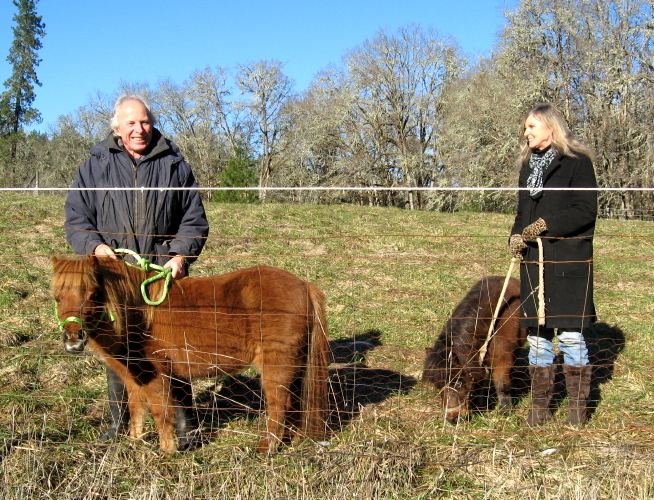
Today’s title came from a recent chat ‘across the garden fence’ with our neighbours, Dordie and Bill. At their request we had walked our two horses over to the fence-line between our two properties so Dordie and Bill could meet and fondle them. The warm afternoon sunshine was beautiful and while the horses munched the newly-found grass, we grown-ups talked about this and that and generally tried to put the world to rights!
Paul with Dancer; Jean with Grace.
We talked about the strangeness of present times. Not just in the USA but across the world. Bill thought 2013 would be the year of separation. I queried what he meant by that.
Bill replied, “I sense that by the end of the year, the vast majority of people will have decided if climate change is or is not a significant issue.” There would be few who remained neither unconcerned nor undecided.
That resonated with me and neatly put the framework to today’s post. Stay with me while I journey to the destination that this year will be the year of hope.
I am one of many who subscribe to the online magazine Grist. They describe themselves, thus:
Laugh now — or the planet gets it.
You know how some people make lemonade out of lemons? At Grist, we’re making lemonade out of looming climate apocalypse.
It’s more fun than it sounds, trust us!
Grist has been dishing out environmental news and commentary with a wry twist since 1999 — which, to be frank, was way before most people cared about such things. Now that green is in every headline and on every store shelf (bamboo hair gel, anyone?), Grist is the one site you can count on to help you make sense of it all.
The weekly Grist digest that arrived in my in-box that same day as when we were chatting with Dordie and Bill included a number of key stories.
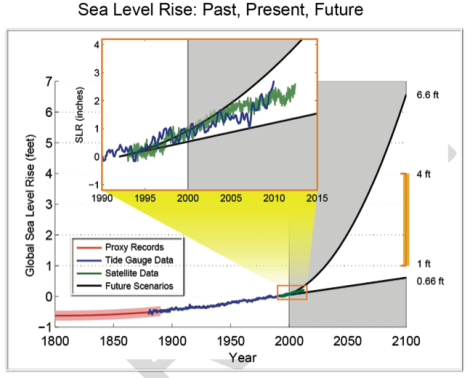
Now I’m not going to republish all 32 charts but will include just these two, because the message is clear.
It’s possible that sea levels could only rise eight inches. It is also possible that they could rise over six-and-a-half feet.
—-
Sea-level rise will affect different areas to different degrees — but note the map at lower right. On the Georgia coast, “hundred year” floods could happen annually.
OK, that first chart takes a while to absorb the full implications. The second one doesn’t!
The full range of charts is chilling. While they refer to the USA, the messages apply to the whole world.
Then in that same Grist weekly summary was this story.
If you aren’t alarmed about climate, you aren’t paying attention
There was recently another one of those (numbingly familiar) internet tizzies wherein someone trolls environmentalists for being “alarmist” and environmentalists get mad and the troll says “why are you being so defensive?” and everybody clicks, clicks, clicks.
I have no desire to dance that dismal do-si-do again. But it is worth noting that I find the notion of “alarmism” in regard to climate change almost surreal. I barely know what to make of it. So in the name of getting our bearings, let’s review a few things we know.
We know we’ve raised global average temperatures around 0.8 degrees C so far. We know that 2 degrees C is where most scientists predict catastrophic and irreversible impacts. And we know that we are currently on a trajectory that will push temperatures up 4 degrees or more by the end of the century.
David then works his way through those ‘things we know’ in a powerful manner. Do read the full article, please! This is his conclusion:
All this will add up to “large-scale displacement of populations and have adverse consequences for human security and economic and trade systems.” Given the uncertainties and long-tail risks involved, “there is no certainty that adaptation to a 4°C world is possible.” There’s a small but non-trivial chance of advanced civilization breaking down entirely.
Now ponder the fact that some scenarios show us going up to 6degrees by the end of the century, a level of devastation we have not studied and barely know how to conceive. Ponder the fact that somewhere along the line, though we don’t know exactly where, enough self-reinforcing feedback loops will be running to make climate change unstoppable and irreversible for centuries to come. That would mean handing our grandchildren and their grandchildren not only a burned, chaotic, denuded world, but a world that is inexorably more inhospitable with every passing decade.
Take all that in, sit with it for a while, and then tell me what it could mean to be an “alarmist” in this context. What level of alarm is adequate?
So am I stark staring mad for having hope in my mind? Stay with me for just a little longer. Then form your own judgment.
Recall the post that I published on Tuesday hitting out at the British newspaper The Daily Mail. Towards the end of that post, in discussing the recently released American National Climate Assessment, I wrote this:
That’s why this report is to be encouraged, nay embraced. Of all the nations in the world, the one that should be setting the lead is the United States of America. As the banner on that globalchange.gov website proclaims: Thirteen Agencies, One Vision: Empower the Nation with Global Change Science
So go and read the report. For your sake and all our sakes.
Because the more informed you and I are, the better the chances of real political leadership taking place in this fine nation.
Let’s just accept it: America’s current political and economic systems are incapable of responding adequately to climate change. As things stand, reducing carbon emissions — or more broadly, shifting to sustainability — is a kind of add-on, a second-tier consideration, bolted onto systems and institutions that were built for other purposes.
A little later, David writes:
So what would a new U.S. grand strategy built around sustainability look like? That’s the question tackled by “A New U.S. Grand Strategy,” a piece in Foreign Policy by Patrick Doherty, director of the Smart Strategy Initiative at the New America Foundation.
It’s a hugely ambitious and wide-ranging piece, far too much to even summarize adequately here. Bookmark it. Instapaper it. Pinterest it to your iCloud, or whatever kids do these days. But let’s take a quick look.
Doherty identifies four central challenges facing the U.S.:
Economic inclusion: People are swarming out of poverty around the world (especially in China). Over the next 20 years, the global middle class will welcome around 3 billion new members. That’s going to put intense stress on natural, economic, and political systems that are already showing signs of strain.
Ecosystem depletion: Pretty sure Grist readers are familiar with this one.
Contained depression: Rather than a recession, the U.S. faces a “constrained depression,” with the full effects of low aggregate demand and high debt being masked by policy. No amount of fiscal or economic stimulus will revive a system that has exhausted itself.
Resilience deficit: Our industrial supply lines and value chains are efficient, but lack redundancy; they are brittle. Our infrastructure is old and crumbling, $2.2 trillion in the hole, and that’s just for the aging Cold War stuff, never mind building water, power, and transportation systems suited to an era of climate disruption.
“These four challenges,” Doherty says, “are the four horsemen of the coming decades.” And they are inter-dependent. They must be solved together. It’s a rough situation.
With these in mind, Doherty proposes a new grand strategic concept: “The United States must lead the global transition to sustainability.“
What a vision for the United States of America. That this Nation will be the most wonderful example of how man can learn, adapt and change. David Roberts concludes:
Here are Doherty’s main suggestions for how to realign the U.S. economic engine:
Walkable communities: More and more Americans want to live in dense, walkable areas; get rid of regulations that hamper them and start building them.
Regenerative agriculture: Farmers can produce “up to three times the profits per acre and 30 percent higher yields during drought” with agricultural techniques that also clean water and restore soils. America must “adopt modern methods that will bring more land into cultivation, keep families on the land, and build regional food systems that keep more money circulating in local economies.”
Resource productivity: “Energy and resource intensity per person will have to drop dramatically.” That imperative can drive “innovation in material sciences, engineering, advanced manufacturing, and energy production, distribution, and consumption.”
Excess liquidity: Channel all the corporate cash that’s sitting around in funds into long-term investments in America by taxing waste and creating regional growth strategies.
Stranded hydrocarbon assets: Figure out how to devalue the immense amount of carbon that’s still sitting underneath the ground without unduly traumatizing the economy.
Obviously the devil is in the details on this stuff, but at a broad level, this is about as eloquent and forward-thinking as it gets. I love the idea of using sustainability in a muscular way, to revive regional economies and nurture the middle class. I recommend reading the whole thing.
I, too, recommend reading “A New U.S. Grand Strategy – Why walkable communities, sustainable economics, and multilateral diplomacy are the future of American power.” (NB: You will have to register with Foreign Policy before access to the report is possible, but it’s free.)
So, the wall-to-wall stream of information that is shouting out how quickly the planet is changing is the fuel that is going to feed the fires of hope.
Let me leave you with the most beautiful words of an ancient philosopher – Aristotle.
My reasoning was that the NCA report was such a stunning indictment of the madness, the myopic madness of mankind these last 100 years, that this appreciation of the wonder of dogs must act as a beacon for us all. I use the word ‘beacon’ because the qualities demonstrated by these nine dogs are just the qualities that we need to adopt.
Every living person on Planet Earth has to embrace the stark choice coming up on us like a runaway train. If we don’t change our values, our behaviours and our relationship with this one, finite planet, in the next ten years, at most, then the consequences will be beyond imagination; a world of unimaginable terror and chaos.
Forgive me if I repeat what the Home page of Learning from Dogs offers:
As man’s companion, protector and helper, history suggests that dogs were critically important in man achieving success as a hunter-gatherer. Dogs ‘teaching’ man to be so successful a hunter enabled evolution, some 20,000 years later, to farming, thence the long journey to modern man. But in the last, say 100 years, that farming spirit has become corrupted to the point where we see the planet’s plant and mineral resources as infinite. Mankind is close to the edge of extinction, literally and spiritually.
On the 30th December, 2012 The Week magazine published an item written by Editor Lauren Hansen. I ask Lauren if I might republish the article in full but that was denied. However, I was given permission to refer extensively to the piece. I will use it to underline just what we have to learn from dogs.
The 9 most newsworthy dogs of 2012
Dogs are the best. Here’s the proof… if you even need it
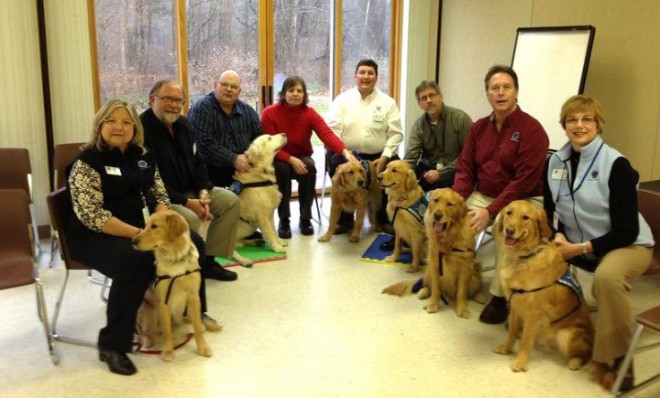
The K-9 Parish Comfort dogs (and their handlers) who helped the residents of Newtown, Conn., through their grief.
If you’re reading this, then you’re probably aware: Dogs rule. This year, a handful of canines rose above the rest, making headlines for their actions — whether facing imminent danger to save lives, enduring unimaginable physical hardships, or simply making us laugh. A look at nine of the year’s most newsworthy pups:
1. Chicago’s comfort dogs After the unimaginable events that befell Newtown, Conn., on Dec. 14 that left 27 people, including 20 children, dead at the hands of suspected gunman Adam Lanza, a team of golden retrievers was deployed from Chicago to the picturesque town. About 10 specially trained dogs, including Chewie, Ruthie, and Luther, made the 800-mile journey to sit with children and adults during masses and funerals. “Dogs are nonjudgmental. They are loving. They are accepting of anyone,” says one handler. “It creates the atmosphere for people to share.” The Chicago comfort dogs are notable not only for this caring venture but also for helping those who suffered through Hurricane Sandy and the tornado that hit Joplin, Mo., in 2011.
The next story was about the puppies that kept a lost boy warm.
That was followed by the hero dog that lost its snout saving two girls.
One dog’s heroism so disfigured her sweet little face that her photo is often preceded by a warning. This canine’s story started with a motorcycle careening through the streets of Zamboanga City, Philippines, earlier this year. Young cousins Dina Bunggal, 11, and Princess Diansing, 3, stepped unknowingly into its path. A mutt named Kabang came out of nowhere and jumped in front of the motorbike, stopping it in its tracks, and saving the little girls from serious injury. The driver and the girls emerged with superficial wounds, but Kabang wasn’t so lucky. Her head landed on the motorcycle’s front wheel and as the wheel rolled forward, Kabang’s upper snout was ripped right off. Her story quickly went viral and when local doctors could do no more to help her, specialty surgeons from the University of California, Davis, flew Kabang to their facilities, where she’ll endure six to eight weeks of treatment to repair her face. The cost of her surgeries, which could top $20,000, will be covered by her many supporters who have started an online fundraising campaign.
Vets at William R. Pritchard Veterinary Medical Teaching Hospital don’t plan to fullyy reconstruct Kabang’s snout, or fit her with a prosthetic. Instead, they are attempting to close the gaping wound on her face, preventing further infections.
Then my last dip into Lauren’s article is dog story eight.
8. The dog that saved its own life by calling the police
We’ve often heard the tale of the puppy that proves its “man’s best friend” status by saving its owner’s life. But this year, there was George, a 2-year-old basset hound in West Yorkshire, England, who reworked the well-worn script a bit, literally calling for help to save himself. Home alone, George had knocked the phone to the floor and was strangling himself with the handset’s cord when he apparently dialed 999 — England’s 911 equivalent — in a panic. The operator heard only frantic gasps and, assuming someone was desperately sick or reeling from an attack, sent police to the house. The dog was found and rescued from the cord. “Incredibly, you could see where his paw print was on the phone,” said the neighbor, “he literally saved his own life.”
Now, what fun-loving toddler can walk past a puddle without stopping for a little splash? Not this one!
Little Arthur was out for a stroll with his best mate, Watson the dog, when he noticed a tempting puddle. So he put down the leash and plunged straight in. And Watson? Well, he’s a more mature 12 years old, so he didn’t partake himself. But he was more than happy to wait while Arthur had his fun.
You know what this video is, don’t you? That’s right. Too. Cute. For. Words.
Here’s the video, seen over 4,800,000 times!
Finally, there’s the beautiful story of the dog befriending a Down’s Syndrome boy.
So what does this all add up to? That the qualities of the dog; integrity, unconditional love, patience, loyalty, and their ability to live in harmony with nature really do send us humans a message for the future.
This was sent to me by Dan Gomez. I take great pleasure in offering it to you, dear reader.
oooOOOooo
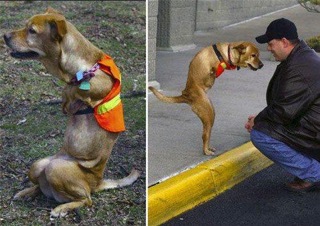
A dog named Faith.
This dog was born in 2002. He was born with 2 legs. He of course could not walk when he was born. Even his mother did not want him.
His first owner also did not think that he could survive and he was thinking of putting him to sleep. But then, his present owner, Jude Stringfellow, met him and wanted to take care of him.
She became determined to teach and train this little dog to walk by himself.
She named him ‘Faith’.
In the beginning, she put Faith on a surfboard to let him feel the movement. Later she used peanut butter on a spoon as a lure and reward for him for standing up and jumping around. Even the other dog at home encouraged him to walk.
Amazingly, only after 6 months, like a miracle, Faith learned to balance on his hind legs and to jump to move forward. After further training in the snow, he could now walk like a human being.
Faith loves to walk around now. No matter where he goes, he attracts people to him.
He is fast becoming famous on the international scene and has appeared on various newspapers and TV shows. There is now a book entitled ‘With a Little Faith‘ being published about him. He was even considered to appear in one of the Harry Potter movies.
His present owner Jude Stringfellew has given up her teaching post and plans to take him around the world to preach that even without a perfect body, one can have a perfect soul.
oooo
oooo
oooo
oooo
oooo
oooo
In life there are always undesirable things, so in order to feel better you just need to look at life from another direction. I hope this message will bring fresh new ways of thinking to everyone and that everyone will appreciate and be thankful for each beautiful day.
Faith is the continual demonstration of the strength and wonder of life.
A small request: All you are asked to do is keep this story circulating.


















 Learning from Dogs