Category: Philosophy

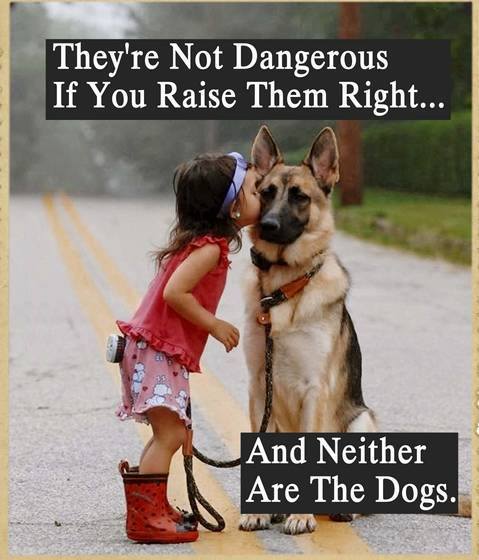
Hold this close!

As seen by Doranne Long over on Facebook.

Tommy Chong

This is just an interim post while I get my act together today (it’s 08:07am).

For yesterday morning, around 7am, we lost our internet service and it was only restored a couple of hours ago.

There’s an announcement from me coming out before the end of the day about my book and a way for anyone interested in reading a section to be able to download a few chapters.

More later!

Thanks Doranne for sharing that wonderful reminder.

What is Love?

Today’s post is inspired by something I read that is very special.

The last time I published a post headed What is love?, back in 2012, I included this:

I would imagine that there are almost as many ideas about the meaning of love as there are people on this planet.  Dictionary.com produces this in answer to the search on the word ‘love’.

love

[luhv]  noun, verb, loved, lov·ing.
noun

  1. a profoundly tender, passionate affection for another person.
  2. a feeling of warm personal attachment or deep affection, as for a parent, child, or friend.
  3. sexual passion or desire.
  4. a person toward whom love is felt; beloved person;sweetheart.
  5. (used in direct address as a term of endearment, affection,or the like): Would you like to see a movie, love?

But, I don’t know about you, those definitions leave something missing for me.  Here’s my take on what love is, and it’s only by having so many dogs in my life that I have found this clarity of thought.

Love is trust, love is pure openness, love is knowing that you offer yourself without any barriers.  Think how you dream of giving yourself outwardly in the total surrender of love.  Reflect on that surrender that you experience when deeply connecting, nay loving, with your dog.

One of the very special qualities of our dogs is their natural and instinctive ability to love, unconditionally, both us humans and other animals around them (with some notable exceptions; of course.)

Yet as much as we want to learn unconditional love from our dogs, there is something just too complex about us humans to manage that. Possibly rooted in our inability to really live in the present, another quality our dogs also demonstrate so perfectly.

In doing research for today’s post, I was amused by an article in The Guardian newspaper back in 2012, What is love? Five theories on the greatest emotion of all. Amused by there being just five theories!

That article opens:

“What is love” was the most searched phrase on Google in 2012, according to the company. In an attempt to get to the bottom of the question once and for all, the Guardian has gathered writers from the fields of science, psychotherapy, literature, religion and philosophy to give their definition of the much-pondered word.

So I sub-titled today’s post by saying that I was inspired by something.

Here it is, recently published over on The Conversation and republished within their terms. I think you are going to love it!

ooOOoo

The life-changing love of one of the 20th century’s greatest physicists

December 9, 2015

Author: Richard Underman, Chancellor’s Professor of Medicine, Liberal Arts, and Philanthropy, Indiana University

Love is for everyone. mawazeFL/Flickr, CC BY-NC

One of the great short stories of the 20th century is Nobel Laureate Isaac Bashevis Singer’s The Spinoza of Market Street. It tells of an aged scholar who has devoted his life to the study of Spinoza’s great work, Ethics. Protagonist Dr Fischelson has lost his library job and, like his hero, been expelled from his religious community for his heretical views. Looking down from his garret with disdain at the crowded street below him, he devotes his days to solitary scholarship. At night he gazes up through his telescope at the heavens, where he finds verification of his master’s wisdom.

Then one day Dr Fischelson falls ill. A neighbor, an uneducated “old maid,” nurses him back to health. Eventually, though the good doctor never understands exactly how or why, they are married. On the night of the wedding, after the unlikeliest of passionate consummations, the old man gazes up at the stars and murmurs, “Divine Spinoza, forgive me. I have become a fool.” He has learned that there is more to life than the theoretical speculations that have preoccupied him for decades.

The history of modern physics boasts its own version of Fischelson. His name was Paul Dirac. I first encountered Dirac in physics courses, but was moved to revisit his life and legacy through my service on the board of the Kinsey Institute for the Study of Human Sexuality and teaching an undergraduate course on sexuality and love.

A brilliant but very strange man

Born in Bristol, England, in 1902, Dirac became, after Einstein, the second most important theoretical physicist of the 20th century. He studied at Cambridge, where he wrote the first-ever dissertation on quantum mechanics. Shortly thereafter he produced one of physics’ most famous theories, the Dirac equation, which correctly predicted the existence of antimatter. Dirac did more than any other scientist to reconcile Einstein’s general theory of relativity to quantum mechanics. In 1933 he received the Nobel Prize in Physics, the youngest theoretical physicist ever to do so.

At the time Dirac received the Nobel Prize, he was leading a remarkably drab and, to most eyes,

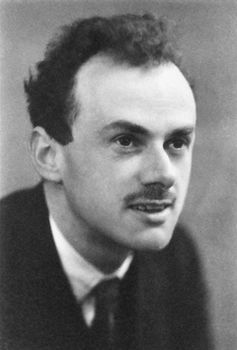
Paul Dirac in 1933. Nobel Foundation via Wikimedia Commons

unappealing existence. As detailed in Graham Farmelo’s wonderful biography, The Strangest Man: The Hidden Life of Paul Dirac, Mystic of the Atom, on which I rely heavily in this article, Dirac was an incredibly taciturn individual. Getting him to utter even a word could prove nearly impossible, leading his mischievous colleagues to introduce a new unit of measure for the rate of human speech, the Dirac, which amounted to one word per hour.

Dirac was the kind of man who would “never utter a word when no word would do.” Farmelo describes him as a human being completely absorbed in his work, with absolutely no interest in other people or their feelings, and utterly devoid of empathy. He attributes this in part to Dirac’s tyrannical upbringing. His father ruthlessly punished him for every error in speech, and the young Dirac adopted the strategy of saying as little as possible.

Dirac was socially awkward and showed no interest in the opposite sex. Some of his colleagues suspected that he might be utterly devoid of such feelings. Once, Farmelo recounts, Dirac found himself on a two-week cruise from California to Japan with the eminent physicist Werner Heisenberg. The gregarious Heisenberg made the most of the trip’s opportunities for fraternization with the opposite sex, dancing with the flapper girls. Dirac found Heisenberg’s conduct perplexing, asking him, “Why do you dance?” Heisenberg replied, “When there are nice girls, it is always a pleasure to dance.” Dirac pondered this for some minutes before responding, “But Heisenberg, how do you know beforehand that the girls are nice?”

Love finds the professor

Then one day, something remarkable entered Dirac’s life. Her name was Margit Wigner, the sister of a Hungarian physicist and recently divorced mother of two. She was visiting her brother at the Institute for Advanced Study in Princeton, New Jersey, where Dirac had just arrived.

Known to friends and family as “Manci,” one day she was dining with her brother when she observed a frail, lost-looking young man walk into the restaurant. “Who is that?” she asked. “Why that is Paul Dirac, one of last year’s Nobel laureates,” replied her brother. To which she replied, “Why don’t you ask him to join us?”

Thus began an acquaintance that eventually transformed Dirac’s life. Writes Farmelo:

His personality could scarcely have contrasted more with hers: to the same extent that he was reticent, measured, objective, and cold, she was talkative, impulsive, subjective, and passionate.

A self-described “scientific zero,” Manci embodied many things that were missing in Dirac’s life. After their first meeting, the two dined together occasionally, but Dirac, whose office was two doors down from Einstein, remained largely focused on his work.

After Manci returned to Europe, they maintained a lopsided correspondence. Manci wrote letters that ran to multiple pages every few days, to which Dirac responded with a few sentences every few weeks. But Manci was far more attuned than Dirac to a “universally acknowledged truth” best expressed by Jane Austen: “A single man in possession of a good fortune must be in want of a wife.”

She persisted despite stern warnings from Dirac:

I am afraid I cannot write such nice letters to you – perhaps because my feelings are so weak and my life is mainly concerned with facts and not feelings.

When she complained that many of her queries about his daily life and feelings were going unanswered, Dirac drew up a table, placing her questions in the left column, paired with his responses on the right. To her question, “Whom else should I love?” Dirac responded, “You should not expect me to answer this question. You would say I was cruel if I tried.” To her question, “Are there any feelings for me?” Dirac answered only, “Yes, some.”

Realizing that Dirac lacked the insight to see that many of her questions were rhetorical, she informed him that “most of them were not meant to be answered.” Eventually, exasperated by Dirac’s lack of feeling, Manci wrote to him that he should “get a second Nobel Prize in cruelty.” Dirac wrote back:

You should know that I am not in love with you. It would be wrong for me to pretend that I am, as I have never been in love I cannot understand fine feelings.

Yet with time, Dirac’s outlook began to change. After returning from a visit with her in Budapest, Dirac wrote, “I felt very sad leaving you and still feel that I miss you very much. I do not understand why this should be, as I do not usually miss people when I leave them.” The man whose mathematical brilliance had unlocked new truths about the fundamental nature of the universe was, through his relationship with Manci, discovering truths about human life that he had never before recognized.

Soon thereafter, when she returned for a visit, he asked her to marry him, and she accepted immediately. The couple went on two honeymoons little more than month apart. Later he wrote to her:

Manci, my darling, you are very dear to me. You have made a wonderful alteration in my life. You have made me human… I feel that life for me is worth living if I just make you happy and do nothing else.

A Soviet colleague of Dirac corroborated his friend’s self-assessment: “It is fun to see Dirac married, it makes him so much more human.”

In Dirac, a thoroughly theoretical existence acquired a surprisingly welcome practical dimension.

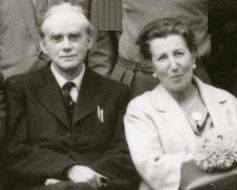
Paul and Manci in 1963. GFHund via Wikimedia Commons, CC BY

A man who had been thoroughly engrossed in the life of the mind discovered the life of the heart. And a human being whose greatest contributions had been guided by the pursuit of mathematical beauty discovered something beautiful in humanity whose existence he had never before suspected.

In short, a brilliant but lonely man found something new and wonderful that had been missing his entire life: love. As my students and I discover in the course on sexuality and love, science can reveal a great deal, but there are some aspects of reality – among them, love – that remain largely outside its ambit.

ooOOoo

Picking up on that last sentence, “there are some aspects of reality – among them, love – that remain largely outside its ambit.” all I can offer is to introduce dogs to the students!

I struggled for ages wondering how to close today’s post. In the end, decided on the following:

Why Am I Talking?

At first, this may seem like a rather bizarre question.

Before plunging in to today’s post, can I just explain, especially to those who are new to this place, why there has been a preponderance of republished articles from other sources in recent times. (And that’s not to say that these articles aren’t fascinating reads; by the way.)

While my book is now available, I am still just over a week away from a formal launch, both here on Learning from Dogs, and locally in the town of Grants Pass. However, the level of demands upon me in connection with the launch is building rapidly. For example, on Friday a team from the local Daily Courier are coming here in connection with a feature article that they want to write. On Saturday, Jean and I have a stand at a local craft fair. Next Tuesday I have my fingers crossed that there will be a radio broadcast from local KAJO about the book on their local community slot. (More details will be published here once the time and day has been confirmed.)

I’m sure you get the picture!

So with all that out of the way, here’s a wonderful sequel to my recent posts on Stillness and Happiness. It is a fascinating essay from Val Boyco under the heading of  W.A.I.T., republished with Val’s kind permission.

ooOOoo

W.A.I.T. ?

Posted on December 1, 2015 by Val Boyko

I love to work with people on becoming better communicators. The key, of course, is to learn to really listen – becoming engaged listeners and tuning into the other person, rather than letting our own thoughts take us away from the moment and distract us.

But before we even get to this step, there is one vital piece of wisdom to absorb.

When we are talking we are not listening.

1-2

So, the question to ask yourself is : Why Am I Talking?…

Have you ever considered why you are talking? It is usually more than sharing valuable information; that’s for sure!
Next time you notice you are talking, consider these questions:

  • Am I trying to release something that’s bottled up?
  • Am I trying to persuade someone to my point of view?
  • Is it a habit?
  • Am I trying to work through something out loud?
  • Do I have an unmet personal need that I am trying to get met? For example: a need for validation, attention, love, approval, recognition or to be right.
  • Do I find talking entertaining?
  • Am I uncomfortable with silence?
  • Do I believe that people really need all the information I am providing, that I am being helpful or teaching something?
  • To explore more, you may want to write W.A.I.T.? on a post-it note before your next meeting and notice what comes up for you.

When we become aware of our talking, we are in a better position to choose whether we want to continue or not. Enjoy tuning in to yourself this week.. and this video.

ooOOoo

Guess I have nothing more to say! 😉

These extraordinary minds of ours.

Serendipity at work.

Chapter 8 of my book is entitled: Behaviours and Relationships. It opens thus:

“It is all to do with relationships.”

I heard this many years before the idea of writing this book came to me. Heard it from J, who was referred to in the previous chapter. J was speaking of what makes for happy people in all walks of life. It’s one of those remarks that initially comes over as such an obvious statement, akin to water being wet or the night being dark, that it is easy to miss the incredible depth of meaning behind those seven words.

Humans are fascinating. Every aspect of who we are can be seen in our relationships. How we relate to people around us, whether it be a thirty-second exchange with a stranger or a long natter with friends whom we have known for decades, including our partners and family relations. The core relationship, of course, the relationship that drives so many of our behaviours is the relationship that we have with ourself. That being rooted in our relationship experiences with the adults around us when we were young people.

When one looks at the performance of successful companies one often sees, nay one always sees, people being valued. The directors and managers of those companies understand that if people are valued then a myriad of benefits flow from that approach to relationships. Moving out of the workplace, the relationships that people have are always stronger and happier if those individual persons know they are valued. Moving beyond people, our dogs, and many other animals, are always stronger and happier if they feel valued. It’s the difference between empathy and sympathy.

Recently over on Mother Nature Network there was an essay presented by Russell McLendon who is science editor for MNN. It is about happiness.

ooOOoo

Happiness is all in your head

Scientists say they’ve found where happiness happens in the brain. What does that mean?

By: Russell McLendon, November 24, 2015

Understanding how our brains generate happiness could help make it less elusive, researchers say. (Photo: Andrew Vargas/Flickr)

Everyone wants to be happy. Yet despite all our efforts in pursuit of this prized emotion, it can be a surprisingly nebulous goal. What is “happiness,” exactly?

That question has puzzled philosophers for thousands of years, and it’s still tricky for anyone to tackle. But recent advances in neuroscience have finally begun to shed light on it, and now a new study claims to have found an answer. Being told happiness is “all in your head” may seem both obvious and dismissive, but in this case the specifics are also empowering. The more we know about how (and where) happiness happens, the less helpless we’ll be to summon it when we need it.

By comparing magnetic resonance imaging (MRI) with questionnaires about emotional states, researchers from Kyoto University in Japan say they’ve traced the experience of happiness to a specific part of the human brain. Overall happiness, they conclude, occurs when positive emotions combine with a sense of life satisfaction in the precuneus, a region of the medial parietal lobe that’s linked to important brain tasks like episodic memory, self-reflection and consciousness.

Psychologists already distinguish between broad life satisfaction and “subjective well-being,” since happiness often seems to fade during bad moods without necessarily plunging us into deeper existential despair. But by revealing the neural mechanics of how these feelings combine to create overall happiness, the authors of the new study hope to make it easier to objectively quantify this mysterious and elusive emotion.

“Over history, many eminent scholars like Aristotle have contemplated what happiness is,” lead author Wataru Sato says in a press release. “I’m very happy that we now know more about what it means to be happy.”

Scientists used MRI brain scans to identify happiness in a brain region known as the precuneus. (Photo: Kyoto University)

To pinpoint the location of happiness, Sato and his colleagues first used MRI to scan the brains of their study subjects. Those participants then took a survey, which asked about their general sense of happiness, the intensity of their emotions and the degree of their overall life satisfaction.

After analyzing the data, the researchers discovered that those who scored higher on the happiness survey also had more gray matter mass in the precuneus. That means this brain region is larger in people who feel happiness more intensely, feel sadness less intensely and who are better able to find meaning in life.

“To our knowledge, our study is the first to show that the precuneus is associated with subjective happiness,” the researchers write in the journal Scientific Reports.

Complex phenomena like happiness rarely boil down to a single brain region, but other recent research also points to an outsized role for the precuneus. A study published this month links impaired connectivity in the precuneus to depression, for example, and a 2014 study suggests the region is a “distinct hub” in the brain’s default-mode network, which is active during self-reflection and daydreaming.

All this may seem like an esoteric quest for neuroscientists, but it’s about more than just academic curiosity. By knowing which parts of the human brain generate our sensation of happiness, we might develop more accurate ways to test methods of becoming happier, like travel, exercise or meditation.

“Several studies have shown that meditation increases grey matter mass in the precuneus,” Sato says. “This new insight on where happiness happens in the brain will be useful for developing happiness programs based on scientific research.”

ooOOoo

It’s an unscientific opinion from me but I truly believe that humans have a bias towards happiness. And if there’s one animal that we can learn happiness from, it’s the dog!

Photo: Kiuko/flickr.

More and more learning from dogs!

This was sent to me by neighbour Jim Goodbrod.

(Jim also wrote the foreword to my book!)

It comes from a post over on The Brandbuilder Blog: here is a link to the original article.

ooOOoo

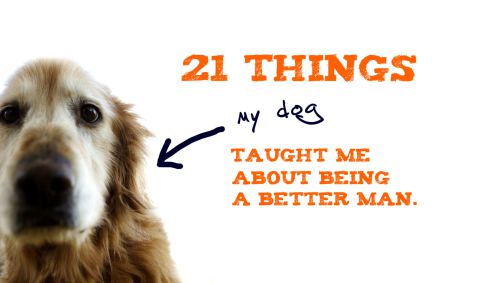
Twenty-one things my dog taught me about being a better man.

June 7, 2010 by Olivier Blanchard

sasha003

We had to put our golden retriever to sleep this weekend, our friend of fifteen years, our family’s faithful guardian and companion, and one of the kindest, most loyal and giving souls I have ever met. True to her breed, Sasha was courageous, tender and selfless until the end.

I was trying to figure out how to give her a worthy send-off here on The BrandBuilder blog, and settled on some of the things she taught me over the years. Or rather, the things I didn’t realize she had taught me until this past week, much of which I spent caring for her, as she could no longer take care of herself. She and I had some long chats, in our own way, and the old girl was much wiser than I gave her credit for.

Are there business lessons in this list? Yes. There are. But all are deeply human lessons at the core. If being human can make a business better, if it can fuel its soul (or even simply give it one), then yes, let these be business lessons. But don’t ever forget that what makes a business truly great isn’t technology or design or a fancy logo. Those are expressions of something deeper. Something more visceral and powerful and true. What makes a business great, what makes it special, worthy of a connection, worthy of trust and loyalty, admiration and respect, even love, always starts with a beating heart, not a beeping cash register. (One is the cause, and the other one of many effects. Don’t lose sight of that distinction. Horse before cart: Soul drives love. Love drives business.)

It’s so easy to lose sight of what’s important in our lives. And this isn’t me being overly sentimental because I just lost my dog. I mean, yes, sure, okay… But there’s also something to this: That sentimentality, that emotion, these things that make us connect with other souls is at the heart of EVERYTHING this blog has been about these last few years: Business, design, marketing, social media, communications, corporate responsibility, best practices… No company can ever be great unless it can tap into the very essence of what makes us want to connect with each other, and no executive or business manager or cashier can ever truly be great at their jobs unless they also tap into the very thing that makes genuine human connections possible. If ever there was a secret to successfully building a brand, a lovebrand, the kind that people will fight for and whose mark they will tattoo on their bodies, it is this. The rest is merely execution.

If you only walk away with one bit of wisdom from this post, let it be this: You cannot build a better business unless you first become a better human being. Everything that strips you of your humanity, of your empathy, of your ability to connect with others is bad for business. It’s bad practice. It is doomed to fail in the end.

As my good friend John Warner noted yesterday, “If more people were as loyal and loving as dogs the world would be a better place.” (source) And he’s right. How do you become a better human being then? Well, that’s up to you, but if you had asked Sasha, she might have given you a few pointers of her own. Granted, she was never a Fortune 500 C.M.O. She didn’t design the iPad. She didn’t invent the internet or write a book. She never presented at a conference. All she did was hang out with me and Chico. We went on car rides. She watched me work. She lived the simple life of a dog, uncluttered by Twitter followers and Hubspot rankings and the drive to publish and present case studies. She was a dog, and so her perspective is a little different from what you may be used to. At any rate, here are twenty-one she and I discussed at length last week. I hope they will be as valuable to you as they now are to me.

Twenty-one things my dog taught me about being a better man:

1. Be true to your own nature. There’s no point in faking it. A golden retriever isn’t a chihuahua or a pug or a greyhound, and for good reason. Being comfortable in your own skin is 90% of the trick to rocking out your life. Not everyone is meant to be Rintintin or a seeing-eye dog or an Iditarod racer. It’s okay. Find yourself and embrace your nature. That’s always a great place to start.

2. Be true to the ones you love. Your friends, your family, your tribe, your pack. A life lived for others is a life well-lived. Selfish pursuits aside, ambition often grows hollow when turned inwardly instead of outwardly. It’s one thing to want to be pack leader, but there is just as much value and honor in serving than in leading. When in doubt, see item number one.

3. Never say no to a chance to go on a car ride. When the days grow short, I guarantee you’ll wish you’d have gone on more car rides.

4. Leashes are the enemy. Avoid them at all cost.

5. People are strange. So much potential, yet here they are, doing everything they can to complicate rather than simplify their lives. It’s puzzling.

6. Belly scratches.

7. The end isn’t pretty, but if you can face it with dignity and grace, none of your body’s weaknesses will matter. Your heart, your courage, your spirit is what people will see and remember. This isn’t only applicable in your last days and weeks. It’s applicable every day of your life. Adversity happens. It’s how you deal with it that matters.

8. Forgiveness is easier for dogs than for humans, but humans have opposable thumbs and the ability to speak, so it all balances out in the end.

9. Your bark is your own. No one has one quite like yours. Own it. Love it. Project it.

10. Trust your instincts. They rarely steer you wrong. The feeling in your gut though, that’s probably just something you ate.

11. Just because you’re meant to live on land doesn’t mean you can’t feel at home in water. Play outside the safety zone. Swim in the deep end. Dive in. We’re all designed to do more than the obvious.

12. Play more. The game is irrelevant. Just play. Tip: Exploring is play. Having adventures is play. Finding out what’s behind the next hill is play.

13. Your body growing old doesn’t mean you can’t be a puppy at heart. Actually, the first should have no impact on the latter. If you find that it does, take a step back, regroup, and restart. Always be a puppy at heart.

14. Humans aren’t all bad. But they aren’t all good either. Choose yours wisely.

15. Always keep that 20% wolf in you. If you ever give it up, you’re done. A dog without a little wildness in the blood isn’t a dog. It’s a furry robot. The beauty of a great dog doesn’t lie in its obedience but in its loyalty. Loyalty is a choice. Dogs choose to be dogs and not wolves. That’s what makes them so special.

16. Running full bore across a field in the rain.

17. There are no mysteries. Take cats, for example: Half rat, half badger. Crap in a box. Eat rodents. Where’s the mystery in that? If you look hard enough, you can figure most things out for yourself. The world isn’t as complicated as it sometimes seems.

18. Sometimes, you have to back up your growl with a bite. Go with it. Some people like to test your bark-to-bite ratio. With those “inquisitive” types, a little education goes a long way. As much as it sucks to have to go there, it is sometimes necessary. (It’s what the fangs are for.) Your territory, your space, your safety… They’re worth defending. Make a show of it once, and chances are you’ll never have to teach anyone a lesson again.

19. Being alone is no way to go through life. We’re pack animals. Humans, dogs, same thing. We need others to make all of this worthwhile. As an aside, if we live through others, why not also live for others, even if only a little bit? It isn’t that much of a stretch.

20. When you chase the ball, CHASE the fucking ball. Two reasons: a) It’s a chase. You don’t half-ass a chase. You go all out. It’s what you do. It’s the point. b) You don’t want some other mutt to get to the ball before you and slobber it all up, do you?

21. In the end, you will revisit your adventures, your battles, your chases, your voyages and all the excitement of your life with bemused pride, but it’s the quiet moments with loved ones that your mind will settle on. The comfort of those days when all you did was spend lazy hours with them, your head on their lap, their’s on yours, taking in the afternoon sun and the hundreds of fleeting stories carried like whispers on the breeze, those are the memories that will stay with you to the end and beyond.

Never give up on your thirst for life, on the beauty subtle moments, and on chasing that ball as hard and fast as your legs and heart will carry you.

Godspeed, Sasha.

Sasha (1995 - 2010) R.I.P.
Sasha (1995 – 2010) R.I.P.

ooOOoo

Shortly after completing today’s post, I read the following. It seemed appropriate to include it today.

When you talk, you are only repeating what you know,

But if you listen, you may learn something new.

It is one of the Dalai Lama’s sayings.

You all take care out there.

Keeping up with yesterday!

Procrastination is the art of keeping up with yesterday.

Can’t claim credit for the sub-heading; it was taken from BrainyQuote.

donmarquis107414

However, the reason I went looking for a quotation on procrastinating was that I’m doing research for a fairly “heavy” post for tomorrow, and was looking for something quick and easy for today.

My blog folder came up with an essay from The Conversation website that is rather fun. It is republished here on Learning from Dogs within the terms of The Conversation.

ooOOoo

The psychological origins of procrastination – and how we can stop putting things off

October 7, 2015

Authors: Elliot Berkman, Assistant Professor, Psychology, University of Oregon, and Jordan Miller-Ziegler, PhD Candidate in Psychology, University of Oregon.

“I love deadlines,” English author Douglas Adams once wrote. “I love the whooshing noise they make as they go by.”

We’ve all had the experience of wanting to get a project done but putting it off for later. Sometimes we wait because we just don’t care enough about the project, but other times we care a lot – and still end up doing something else. I, for one, end up cleaning my house when I have a lot of papers to grade, even though I know I need to grade them.

So why do we procrastinate? Are we built to operate this way at some times? Or is there something wrong with the way we’re approaching work?

These questions are central to my research on goal pursuit, which could offer some clues from neuroscience about why we procrastinate – and how to overcome this tendency.

To do, or not to do

It all starts with a simple choice between working now on a given project and doing anything else: working on a different project, doing something fun or doing nothing at all.

The decision to work on something is driven by how much we value accomplishing the project in that moment – what psychologists call its subjective value. And procrastination, in psychological terms, is what happens when the value of doing something else outweighs the value of working now.

This way of thinking suggests a simple trick to defeat procrastination: find a way to boost the subjective value of working now, relative to the value of other things. You could increase the value of the project, decrease the value of the distraction, or some combination of the two.

For example, instead of cleaning my house, I might try to focus on why grading is personally important to me. Or I could think about how unpleasant cleaning can actually be – especially when sharing a house with a toddler.

It’s simple advice, but adhering to this strategy can be quite difficult, mainly because there are so many forces that diminish the value of working in the present.

The distant deadline

People are not entirely rational in the way they value things. For example, a dollar bill is worth exactly the same today as it is a week from now, but its subjective value – roughly how good it would feel to own a dollar – depends on other factors besides its face value, such as when we receive it.

The tendency for people to devalue money and other goods based on time is called delay discounting. For example, one study showed that, on average, receiving $100 three months from now is worth the same to people as receiving $83 right now. People would rather lose $17 than wait a few months to get a larger reward.

Other factors also influence subjective value, such as how much money someone has recently gained or lost. The key point is that there is not a perfect match between objective value and subjective value.

Delay discounting is a factor in procrastination because the completion of the project happens in the future. Getting something done is a delayed reward, so its value in the present is reduced: the further away the deadline is, the less attractive it seems to work on the project right now.

Studies have repeatedly shown that the tendency to procrastinate closely follows economic models of delay discounting. Furthermore, people who characterize themselves as procrastinators show an exaggerated effect. They discount the value of getting something done ahead of time even more than other people.

One way to increase the value of completing a task is to make the finish line seem closer. For example, vividly imagining a future reward reduces delay discounting.

No work is ‘effortless’

Not only can completing a project be devalued because it happens in the future, but working on a project can also be unattractive due to the simple fact that work takes effort.

New research supports the idea that mental effort is intrinsically costly; for this reason, people generally choose to work on an easier task rather than a harder task. Furthermore, there are greater subjective costs for work that feels harder (though these costs can be offset by experience with the task at hand).

This leads to the interesting prediction that people would procrastinate more the harder they expect the work to be. That’s because the more effort a task requires, the more someone stands to gain by putting the same amount of effort into something else (a phenomenon economists call opportunity costs). Opportunity costs make working on something that seems hard feels like a loss.

Sure enough, a group of studies shows that people procrastinate more on unpleasant tasks. These results suggest that reducing the pain of working on a project, for example by breaking it down into more familiar and manageable pieces, would be an effective way to reduce procrastination.

Your work, your identity

When we write that procrastination is a side effect of the way we value things, it frames task completion as a product of motivation, rather than ability.

In other words, you can be really good at something, whether it’s cooking a gourmet meal or writing a story, but if you don’t possess the motivation, or sense of importance, to complete the task, it’ll likely be put off.

It was for this reason that the writer Robert Hanks, in a recent essay for the London Review of Books, described procrastination as “a failure of appetites.”

The source of this “appetite” can be a bit tricky. But one could argue that, like our (real) appetite for food, it’s something that’s closely intertwined with our daily lives, our culture and our sense of who we are.

So how does one increase the subjective value of a project? A powerful way – one that my graduate students and I have written about in detail – is to connect the project to your self-concept. Our hypothesis is that projects seen as important to a person’s self-concept will hold more subjective value for that person.

It’s for this reason that Hanks also wrote that procrastination seems to stem from a failure to “identify sufficiently with your future self” – in other words, the self for whom the goal is most relevant.

Because people are motivated to maintain a positive self-concept, goals connected closely to one’s sense of self or identity take on much more value.

Connecting the project to more immediate sources of value, such as life goals or core values, can fill the deficit in subjective value that underlies procrastination.

ooOOoo

So there; glad that’s clear for us all.

Cosy-Lists-2

Mustn’t delay – I need to write down a list of all the things I’m not doing today!

Forgive the introspection: Part Two

A good philosophical “coating of thought”.

In yesterday’s Part One, I focused on the hugely damaging effects of inequality in society. Reinforced only last Monday by an article by Professor Adam Levitin, a Professor of Law at Georgetown Law School. (Who also recently served on the Consumer Financial Protection Bureau’s Consumer Advisory Board and was Special Counsel to the Congressional Oversight Panel for the Troubled Asset Relief Program.) Levitin’s article was published by Naked Capitalism and opened with this statement:

A lot of Americans — right and left — are frustrated with what has happened to the middle class. The gap between the superrich and the rest of the country has widened, and it seems like everyone is having to work harder just to stay in place: wages have been stagnant, two-incomes are nearly mandatory (creating a subsidiary child care issue), and millions have lost their home equity in foreclosures. While there are a lot of people who bemoan the fate of the middle class, and even some want to do something about it, they don’t or can’t do the heavy lifting necessary to figure out why the system is broken and who wants to ensure it remains that way.

(I strongly encourage you to read the rest of the article.)

Trust me, as a good middle class Brit (albeit now living in America), it’s not just Americans who are frustrated!

However, one happening in this modern world is wonderful. I’m speaking of the ways that ideas can circulate around the world.

Better than that, the wonderful way we can “listen in” on the reflections of others in a manner that would have been impossible twenty years ago.

A few days ago, Patrice Ayme (PA) published a post called Human Kind, Yet Evil Rule. As so frequently happens, it attracted a clutch of fascinating responses.  One of those responses came from a PA reader who writes under the name of EugenR. EugenR offered in his response a fascinating dialogue between a group of persons, and I saw that dialogue as promoting the value of philosophising about the more challenging aspects of present life.

Eugene explained, “It was edited from a conversation in the past. I found it to be a relevant response to the essay.” It matters not the names of the people described by the initials, what matters so much more is the value of an introspective “coating of thought”.

ooOOoo

EugenR: The worst rule the world, because they are the worst.

GD: Not for long

EugenR: For ever

GD: What about Non Violent Civil Disobedience ?

EugenR: At the end the “Non Violent Civil Disobedience” is a human organization, and as such it will either die out, or in worse case will have an organizational structure in which the worst bullies will be on the top. There is nothing new under the sun.

GD: At the end the truth, that at the age of internet is a simple finger click away, will win.

EugenR: At the end the truth wins, the question is when and at what price. In between the lie and cruelty celebrates. Just remember the last century events (Hitler, Stalin, Mao Zedong, Pol Pot, Mugabe i mean Dr Mugabe, etc.). All of them are gone (except the least evil Dr Mugabe). Did you know Pol Pot studied in Paris? Don’t be upset by history but learn from it. And now you have the Islam fundamentalism, that is all about cultural and religious non tolerance, racism (Sudan, Darfur, etc.), legitimization of enslavement of the non Muslims, intellectual degradation of women, death penalty for apostasy (Under current laws in Islamic countries, the actual punishment for the apostate (or murtadd مرتد) ranges from execution to prison terms. Islamic nations with sharia courts use civil code to void the Muslim apostate’s marriage and deny child custody rights, as well as his or her inheritance rights for apostasy. Twenty-three Muslim-majority countries, as of 2013, additionally covered apostasy in Islam through their criminal laws.), etc.

GD: The real question is do we have less fear because we have more access to knowledge? Or more fear because the media has portrayed fear as the new normal? I am not sure that mass herd mentality works in modern society anymore. And that is how dictators ruled. The new fear is forced acceptance. It is worse. Or should I say financially forced acceptance.

AH: I believe that unarmed truth and unconditional love will have the final word in reality. This is why right, temporarily defeated, is stronger than evil triumphant. Take the example of Martin Luther King, Jr.

EugenR: Yes, they were in history few good leaders who won. Martin Luther King is among them, others are N.Mandela, M. Gandhi, V. Havel all of them won, but at what personal price. Two of them murdered, two served years in jail. And anyway after them came some scoundrels destroyed anyway their achievements. Still the strife for self evident justice (that’s what these leaders were after) must go on. But who are the new Mendelas, Gandhis, Kings or Havels? In the best case those who came after them are at the best Obamas.

AH: It is a process. In the last 500 years from time of Galileo (who was threatened by his Church for telling the truth about the nature of the planets) to today there has been tremendous progress on a global scale. We with progressive values and committed to the path of love, must remember that darkness is also part of human nature (perhaps an essential part) and remain vigilant — and hopeful.

EugenR: I assume you never lived in a country where the government terrorizes its citizens. Try to express your truth in one of the terror countries, like Saudi Arabia, Iran, Afghanistan, Pakistan, etc. Try to say there, it is wrong not to let women to have education (about 50% of them are illiterate). Try to say something about freedom of faith. Communism was wiped out only 20 year ago, its leftovers are regimes like the one in N. Korea but also Cuba. You say, ……darkness is also part of human nature…. The question is not if darkness is part……..it definitely is and nobody can deny it, but how do you fight it. In most of the cases the fight is with even more darkness.

AH: I have never lived in a terrorizing country. I did have terrorizing parents and an entrenched belief in a terrorizing Pentecostal God. I am a racial minority in a world that devalues everything I do because of my skin colour. We all have our challenges. In the end, it is arrogant for me to think you can make (force) people do what I think they should do or feel what I think they should feel. This is exactly the mindset of the dictator and I reject that thinking completely. The best I can do is look at my inner signaling. I seek to elevate my own consciousness and change myself for the better. The next step is the social conversation. I share my thinking and values with others in the hope that they too will be inspired to change themselves for the better.

Darkness cannot drive out darkness: only light can do that.
Hate cannot drive out hate: only love can do that.
Martin Luther King, Jr.

EugenR: Sorry Alexi, this time M.L.King had it wrong. The Nazis were defeated by Stalin, just because his cruelty did not have limits, while the Nazis limited their cruelty only to the non Germans. Without Stalin the Western powers would never stand against the Nazis.

AH: If you think about it carefully, the darkness of Hitler was replaced by the darkness of Stalin. This was true for the USSR, East Germany, East Berlin and most of East Europe. So Stalin did not drive out darkness, he just replaced it with his own dark shadow.
Alexi: Stalin was in control by 1923, ten years before Hitler (Lenin tried to stop him at the end of his life).

PA: The French started the nuclear bomb program in 1938. Nobel Laureate Irene Curie was certain that a bomb could be made. The program went to Manhattan, in total secret to the Nazis, and total opening to Stalin. Hitler would have been nuclear bombed into submission.

EugenR: If we speak about destiny probably Hitler would survive even the nuclear bomb, as he survived about 30 assassination attempts. If to believe in God here you have him. God is against humanism and humanity, and mainly against his “chosen people”. As he misled His Own People, some Jewish rabies made a trial of God in some extermination camp, and their verdict was, Death penalty. But then after the verdict they went to the next ceremonial pray. The religion is not about morality (mostly in contrary), not about reality or evidence, not about belief in truth (I know many skeptic believers), not even about tribalism since there are religious newcomers, who did not grow in the tribal tradition.

It is all this about some false answers to questions of eternal life? It can be right for some, but not for everyone. So tell me, what it is all about? The faith in communism did not include even belief in eternal life, and still it has so many followers. It seems religion or faith is a need of the human spices to believe in some fundamental dogma, be it even an obvious lie, all it needs is enough followers, and supporters of a false idea. In a way to be a football club fun is also a religion.

ooOOoo

As I said, I found the dialogue a compelling example of thinking ideas through.

There’s nowt so queer as folk!

George Monbiot offers some surprising ideas.

The title to today’s post is an old British expression that harks back to the days when “queer” meant strange. This blog has published no shortage of posts giving many examples of how “queer” we humans can be at times.

So the latest essay from Mr Monbiot is rather refreshing. I’ll say no more, apart from confirming that Monbiot’s post is republished with his kind permission.

ooOOoo

Human Kind

14th October 2015

Fascinating new lines of research suggest that we are good people, tolerating bad things.

By George Monbiot, published in the Guardian 14th October 2015

Do you find yourself thrashing against the tide of human indifference and selfishness? Are you oppressed by the sense that while you care, others don’t? That because of humankind’s callousness, civilisation and the rest of life on earth are basically stuffed? If so, you are not alone. But neither are you right.

A study by the Common Cause Foundation, due to be published next month, reveals two transformative findings. The first is that a large majority of the 1000 people they surveyed – 74% – identify more strongly with unselfish values than with selfish values. This means that they are more interested in helpfulness, honesty, forgiveness and justice than in money, fame, status and power. The second is that a similar majority – 78% – believes others to be more selfish than they really are. In other words, we have made a terrible mistake about other people’s minds.

The revelation that humanity’s dominant characteristic is, er, humanity will come as no surprise to those who have followed recent developments in behavioural and social sciences. People, these findings suggest, are basically and inherently nice.

A review article in the journal Frontiers in Psychology points out that our behaviour towards unrelated members of our species is “spectacularly unusual when compared to other animals”. While chimpanzees might share food with members of their own group, though usually only after being plagued by aggressive begging, they tend to react violently towards strangers. Chimpanzees, the authors note, behave more like the Homo economicus of neoliberal mythology than people do.

Humans, by contrast, are ultra-social: possessed of an enhanced capacity for empathy, an unparalleled sensitivity to the needs of others, a unique level of concern about their welfare and an ability to create moral norms that generalise and enforce these tendencies.

Such traits emerge so early in our lives that they appear to be innate. In other words, it seems that we have evolved to be this way. By the age of 14 months, children begin to help each other, for example by handing over objects another child can’t reach. By the time they are two, they start sharing things they value. By the age of three, they start to protest against other people’s violation of moral norms.

A fascinating paper in the journal Infancy reveals that reward has nothing to do with it. Three to five-year-olds are less likely to help someone a second time if they have been rewarded for doing it the first time. In other words, extrinsic rewards appear to undermine the intrinsic desire to help. (Parents, economists and government ministers, please note). The study also discovered that children of this age are more inclined to help people if they perceive them to be suffering, and that they want to see someone helped whether or not they do it themselves. This suggests that they are motivated by a genuine concern for other people’s welfare, rather than by a desire to look good. And it seems to be baked in.

Why? How would the hard logic of evolution produce such outcomes? This is the subject of heated debate. One school of thought contends that altruism is a logical response to living in small groups of closely related people, and evolution has failed to catch up with the fact that we now live in large groups, mostly composed of strangers. Another argues that large groups containing high numbers of altruists will outcompete large groups which contain high numbers of selfish people. A third hypothesis insists that a tendency towards collaboration enhances your own survival, regardless of the group in which you might find yourself. Whatever the mechanism might be, the outcome should be a cause of celebration.

So why do we retain such a dim view of human nature? Partly, perhaps, for historical reasons. Philosophers from Hobbes to Rousseau, Malthus to Schopenhauer, whose understanding of human evolution was limited to the Book of Genesis, produced persuasive, influential and catastrophically mistaken accounts of “the state of nature” (our innate, ancestral characteristics). Their speculations on this subject should long ago have been parked on a high shelf marked “historical curiosities”. But somehow they still seem to exert a grip on our minds.

Another problem is that – almost by definition – many of those who dominate public life have a peculiar fixation on fame, money and power. Their extreme self-centredness places them in a small minority, but, because we see them everywhere, we assume that they are representative of humanity.

The media worships wealth and power, and sometimes launches furious attacks on people who behave altruistically. In the Daily Mail last month, Richard Littlejohn described Yvette Cooper’s decision to open her home to refugees as proof that “noisy emoting has replaced quiet intelligence” (quiet intelligence being one of his defining qualities). “It’s all about political opportunism and humanitarian posturing,” he theorised, before boasting that he doesn’t “give a damn” about the suffering of people fleeing Syria. I note with interest the platform given to people who speak and write as if they are psychopaths.

The consequences of an undue pessimism about human nature are momentous. As the Common Cause Foundation’s survey and interviews reveal, those who have the bleakest view of humanity are the least likely to vote. What’s the point, they reason, if everyone else votes only in their own selfish interests? Interestingly, and alarmingly for people of my political persuasion, it also discovered that liberals tend to possess a dimmer view of other people than conservatives do. Do you want to grow the electorate? Do you want progressive politics to flourish? Then spread the word that other people are broadly well-intentioned.

Misanthropy grants a free pass to the grasping, power-mad minority who tend to dominate our political systems. If only we knew how unusual they are, we might be more inclined to shun them and seek better leaders. It contributes to the real danger we confront: not a general selfishness, but a general passivity. Billions of decent people tut and shake their heads as the world burns, immobilised by the conviction that no one else cares.

You are not alone. The world is with you, even if it has not found its voice.

www.monbiot.com

ooOOoo

Speaking of nice, happy souls, there’s only one way to close off this post.

One happy, loving dog!

You all have a very happy, loving weekend.

Afraid of the light!

Back to learning from our wonderful dogs.

Last week, on the 9th to be exact, I published a post under the title of What a funny lot we all are! The thrust of that post was the republication of a recent Tom Dispatch essay by Michael Klare: Tipping Points and the Question of Civilizational Survival. Professor Michael T. Klare is professor of peace and world security studies at Hampshire College and the author, most recently, of The Race for What’s Left. Those who read his essay will have found it a gloomy report on the future of mankind on this planet.

Back to my sub-title.

One of the golden pieces of advice for all of us who succumb to a fear of the future is to live in the present. Living in the now, in the present, is what our dogs do so very well, and it is a fabulous example for us humans. Because there is such a volume of news about so many things going wrong in our world, that it is easy to become overly negative, possibly to the point of causing us ill health, for there is strong link between mind and body.

When circumstances actually do change then dogs are incredibly quick to adapt to those changed times. Dogs, however, do not worry about the future.

All of which is my preamble to an essay that was published under The Conversation header on Sunday. It was an essay by Melanie Randle, and the link goes to a page that offers:

Melanie is an Associate Professor of Marketing in the School of Management, Operations and Marketing in the Faculty of Business at the University of Wollongong. Her primary research areas are social and non-profit marketing, particularly in the areas of volunteering and foster care. Other research interests include marketing to children, obesity and gambling.

That profile doesn’t give much of a heads-up to the theme of her essay. That theme, to my way of thinking, is that right now change is underway. A change in the awareness of people that change has to take place.

Which is why I chose part of a saying attributed to Plato for the title to this post. The full saying being:

We can easily forgive a child who is afraid of the dark; the real tragedy of life is when men are afraid of the light.

So to Melanie’s essay.

ooOOoo

Many fear the worst for humanity, so how do we avoid surrendering to an apocalyptic fate?

Melanie Randle, October 11, 2015

A new, four-nation study has found people rate the risks of global threats to humanity surprisingly high. These perceptions are likely to be important, socially and politically, in shaping how humanity responds to the threats.

The study, of more than 2000 people in the US, UK, Canada and Australia, found:

  • 54% of people surveyed rated the risk of our way of life ending within the next 100 years at 50% or greater;
  • almost one in four (24%) rated the risk of humans being wiped out within a century at 50% or greater;
  • almost three in four (73%) believe there is a 30% or greater risk of our way of life ending (30% said that the risk is 70% or more); and
  • almost four in ten (39%) believe there is a 30% or greater danger of humanity being wiped out (10% said the risk is 70% or more).

Perceptions of risks to way of life and humanity by country

Percentage support for propositions that existing way of life and humanity have a 50% or more chance of ending in a century. University of Wollongong, Author provided

The study also asked people about different responses to the threats. These responses were categorised as nihilism (the loss of belief in a social or moral order; decadence rules), fundamentalism (the retreat to certain belief; dogma rules), or activism (the transformation of belief; hope rules). It found:

  • a large majority (78%) agreed “we need to transform our worldview and way of life if we are to create a better future for the world” (activism);
  • about one in two (48%) agreed that “the world’s future looks grim so we have to focus on looking after ourselves and those we love” (nihilism); and
  • more than one in three (36%) said “we are facing a final conflict between good and evil in the world” (fundamentalism).

Findings were similar across countries, age, sex and other demographic groups, although some interesting differences emerged. For example, more Americans (30%) believed the risk of humans being wiped out was high and that humanity faces a final conflict between good and evil (47%). This presumably reflects the strength in the US of Christian fundamentalism and its belief in the “end time”, a coming Apocalypse.

Perceptions of risk to way of life and humanity by generation

Percentage support for propositions that existing way of life and humanity have a 50% or more chance of ending in a century. University of Wollongong, Author provided

A world of threats coming to a head

There is mounting scientific evidence and concern that humanity faces a defining moment in history – a time when it must address growing adversities or suffer grave consequences. Reputable journals are canvassing the possibilities; the new study will be published in a special issue of Futures on “Confronting catastrophic threats to humanity”.

Most focus today is on climate change and its many, potentially catastrophic, impacts. Other threats include depletion and degradation of natural resources and ecosystems; continuing world population growth; disease pandemics; global economic collapse; nuclear and biological war and terrorism; and runaway technological change.

Many of these threats are not new. Scientists and other experts have warned of the dangers for decades. Nevertheless, the evidence is growing stronger, especially about climate change, and never before have actual events, including natural disasters and calamities, and their sustained and graphic media coverage so powerfully reinforced the possible impacts.

Not surprisingly, then, surveys reveal widespread public pessimism about the future of the world, at least in Western countries. This includes a common perception of declining quality of life, or that future generations will be worse off.

However, there appears to have been little research into people’s perceptions of how dire humanity’s predicament is, including the risk of collapse of civilisation or human extinction. These perceptions have a significant bearing on how societies, and humanity as a whole, deal with potentially catastrophic futures.

How does loss of faith in the future affect us?

People’s responses in our study do not necessarily represent considered assessments of the specific risks. Rather, they are likely to be an expression of a more general uncertainty and fear, a loss of faith in a future constructed around notions of material progress, economic growth and scientific and technological fixes to the challenges we face.

This loss of faith is important, yet hardly registers in current debate and discussion. We have yet to understand its full implications.

At best, the high perception of risk and the strong endorsement of an activist response could drive a much greater effort to confront global threats. At worst, with a loss of hope, fear of a catastrophic future erodes people’s faith in society, affecting their roles and responsibilities, and their relationship to social institutions, especially government.

It can deny us a social ideal to believe in – something to convince us to subordinate our own individual interests to a higher social purpose.

There is a deeply mythic dimension to this situation. Humans have always been susceptible to apocalyptic visions, especially in times of rapid change; we need utopian ideals to inspire us.

Our visions of the future are woven into the stories we create to make sense and meaning of our lives, to link us to a broader social or collective narrative. Historians and futurists have emphasised the importance of confidence and optimism to the health of civilisations and, conversely, the dangers of cynicism and disillusion.

Despite increasing political action on specific issues like climate change, globally the scale of our response falls far short of matching the magnitude of the threats. Closing this gap requires a deeper understanding of how people perceive the risks and how they might respond.

This article was co-authored by Richard Eckersley, founding director of Australia21.

ooOOoo

Now there’s nothing in the essay from Randle and Eckersley to say that these are not critically important times for all of humanity. Yet, I detect that among the many people one meets on a day-to-day basis there is a growing understanding that we can’t just lie down and let the future ride on over us. That living in the present and responding to the world around us here and now is the healthiest way to be, and the most effective. No more powerfully expressed than by Thich Nhat Hanh

“Fear keeps us focused on the past or worried about the future. If we can acknowledge our fear, we can realize that right now we are okay. Right now, today, we are still alive, and our bodies are working marvelously. Our eyes can still see the beautiful sky. Our ears can still hear the voices of our loved ones.”

Saturday serenity.

If you don’t care for yourself, then you can not care for others.

This beautiful Tao Wisdom was published over on Find Your Middle Ground, Val Boyko’s blogsite, and is republished here with Val’s very kind permission.

ooOOoo

night-and-day

Knowing the world is intelligent.
Knowing yourself is enlightenment.

Bending the world to your will takes force.
Willing yourself to bend is true strength.

Succeeding in the world yields riches.
Being content with what is yields wealth.

Apply Tao to the physical world and you will have a long life.
See past the physical world to the enduring presence of Tao and death will lose its meaning.

Lao Tzu*

This is one of my favorite passages from the Tao Te Ching.
May it enrich the whole of you and your day. ☯

*Braun Jr., John; Tzu, Lao; von Bargen, Julian; Warkentin, David (2012-12-02). Tao Te Ching (Kindle Locations 492-498). . Kindle Edition.

ooOOoo

May you, and all your friends and loved ones, including your beautiful animals, have a very contented weekend, extending forever more!