When it comes to animals it’s practically impossible to have one without the other.
Today’s post was inspired by a comment left on yesterday’s post The most beautiful bond of all by MargfromTassie. This is what she wrote (my emphasis):
Yes, these people are inspirational as are all the people who voluntarily give their time and efforts to animal welfare work, sometimes for years. For many, it can be emotionally traumatising as well as rewarding.
It didn’t take me long to agree that for most it will be emotionally traumatising. In fact, one of the great lessons that we learn from our dogs, and all the other animals that we love, is that unconditional love brings with it emotional trauma.
So much better expressed by Suzanne Clothier in her book Bones Would Rain from the Sky: Deepening Our Relationships with Dogs
There is a cycle of love and death that shapes the lives of those who choose to travel in the company of animals. It is a cycle unlike any other. To those who have never lived through its turnings or walked its rocky path, our willingness to give our hearts with full knowledge that they will be broken seems incomprehensible. Only we know how small a price we pay for what we receive; our grief, no matter how powerful it may be, is an insufficient measure of the joy we have been given.
Our grief is always an insufficient measure of the joy we receive!
Speaking of joy, when we pulled back the bedroom curtains this morning (Thursday) the nest was empty!
For the last too many weeks to remember a mother Canadian Goose has been sitting on her nest of eggs with Father Goose staying close. We like to think that the mother returned to this place after having been born here a year ago.
Overnight five young healthy goslings were born! 🙂
May their little lives be full of love with a total absence of trauma!
In case you’ve forgotten the section on the food web from high school biology, here’s a quick refresher.
Plants make up the base of every food chain of the food web (also called the food cycle). Plants use available sunlight to convert water from the soil and carbon dioxide from the air into glucose, which gives them the energy they need to live. Unlike plants, animals can’t synthesize their own food. They survive by eating plants or other animals.
Clearly, animals eat plants. What’s not so clear from this picture is that plants also eat animals. They thrive on them, in fact (just Google “fish emulsion”). In my new book, “A Critique of the Moral Defense of Vegetarianism,” I call it the transitivity of eating. And I argue that this means one can’t be a vegetarian.
Chew on this
I’ll pause to let the collective yowls of both biologists and (erstwhile) vegetarians subside.
A transitive property says that if one element in a sequence relates in a certain way to a second element, and the second element relates in the same way to a third, then the first and third elements relate in the same way as well.
Take the well-worn trope “you are what you eat.” Let’s say instead that we are “who” we eat. This makes the claim more personal and also implies that the beings who we make our food aren’t just things.
How our food lives and dies matters. If we are who we eat, our food is who our food eats, too. This means that we are who our food eats in equal measure.
Plants acquire nutrients from the soil, which is composed, among other things, of decayed plant and animal remains. So even those who assume they subsist solely on a plant-based diet actually eat animal remains as well.
This is why it’s impossible to be a vegetarian.
For the record, I’ve been a “vegetarian” for about 20 years and nearly “vegan” for six. I’m not opposed to these eating practices. That isn’t my point. But I do think that many “vegetarians” and “vegans” could stand to pay closer attention to the experiences of the beings who we make our food.
For example, many vegetarians cite the sentience of animals as a reason to abstain from eating them. But there’s good reason to believe that plants are sentient, too. In other words, they’re acutely aware of and responsive to their surroundings, and they respond, in kind, to both pleasant and unpleasant experiences.
Check out the work of plant scientists Anthony Trewavas, Stefano Mancuso, Daniel Chamowitz and František Baluška if you don’t believe me. They’ve shown that plants share our five senses – and have something like 20 more. They have a hormonal information-processing system that’s homologous to animals’ neural network. They exhibit clear signs of self-awareness and intentionality. And they can even learn and teach.
I suspect how some biologists may respond: first, plants don’t actually eat since eating involves the ingestion – via chewing and swallowing – of other life forms. Second, while it’s true that plants absorb nutrients from the soil and that these nutrients could have come from animals, they’re strictly inorganic: nitrogen, potassium, phosphorus and trace amounts of other elements. They’re the constituents of recycled minerals, devoid of any vestiges of animality.
As for the first concern, maybe it would help if I said that both plants and animals take in, consume or make use of, rather than using the word “eat.” I guess I’m just not picky about how I conceptualize what eating entails. The point is that plants ingest carbon dioxide, sunlight, water and minerals that are then used to build and sustain their bodies. Plants consume inasmuch as they produce, and they aren’t the least bit particular about the origins of the minerals they acquire.
With respect to the second concern, why should it matter that the nutrients drawn by plants from animals are inorganic? The point is that they once played in essential role in facilitating animals’ lives. Are we who we eat only if we take in organic matter from the beings who become our food? I confess that I don’t understand why this should be. Privileging organic matter strikes me as a biologist’s bias.
Then there’s the argument that mineral recycling cleanses the nutrients of their animality. This is a contentious claim, and I don’t think this is a fact of the matter. It goes to the core of the way we view our relationship with our food. You could say that there are spiritual issues at stake here, not just matters of biochemistry.
Changing how we view our food
Let’s view our relationship with our food in a different way: by taking into account the fact that we’re part of a community of living beings – plant and animal – who inhabit the place that we make our home.
We’re eaters, yes, and we’re also eaten. That’s right, we’re part of the food web, too! And the well-being of each is dependent on the well-being of all.
From this perspective, what the self-proclaimed “farmosopher” Glenn Albrecht calls sumbiotarianism (from the Greek word sumbioun, to live together) has clear advantages.
Sumbioculture is a form of permaculture, or sustainable agriculture. It’s an organic and biodynamic way of farming that’s consistent with the health of entire ecosystems.
Sumbiotarians eat in harmony with their ecosystem. So they embody, literally, the idea that the well-being of our food – hence, our own well-being – is a function of the health of the land.
In order for our needs to be met, the needs and interests of the land must come first. And in areas where it’s prohibitively difficult to acquire the essential fats that we need from pressed oils alone, this may include forms of animal use – for meat, manure and so forth.
Simply put, living sustainably in such an area – whether it’s New England or the Australian Outback – may well entail relying on animals for food, at least in a limited way.
All life is bound together in a complex web of interdependent relationships among individuals, species and entire ecosystems. Each of us borrows, uses and returns nutrients. This cycle is what permits life to continue. Rich, black soil is so fertile because it’s chock full of the composted remains of the dead along with the waste of the living.
Indeed, it’s not uncommon for indigenous peoples to identify veneration of their ancestors and of their ancestral land with the celebration of the life-giving character of the earth. Consider this from cultural ecologist and Indigenous scholar-activist Melissa Nelson:
The bones of our ancestors have become the soil, the soil grows our food, the food nourishes our bodies, and we become one, literally and metaphorically, with our homelands and territories.
You’re welcome to disagree with me, of course. But it’s worth noting that what I propose has conceptual roots that may be as old as humanity itself. It’s probably worth taking some time to digest this.
ooOOoo
In reflecting on how to close this post I couldn’t help thinking that “The bones of our ancestors have become the soil, ” presumably includes the bones of our dogs! Leading me to ponder that maybe our dogs from old are nourishing our bodies; I would like to think that is the case.
Today’s post was inspired by something yesterday I read, not for the first time, over on The People Workshop site. (As an aside, I know that many regulars of this place are familiar with the history of my friendship with Jon.) On the page that explains more of Jon Lavin’s approach to his work with clients, he writes:
“We can’t solve problems by using the same kind of thinking we used when we created them.”
Thus said Albert Einstein (1879-1955).
Intuitively, it strikes one as correct. However, reflect for a few moments on how you think and very quickly it becomes clear that how you think is based on deep-seated experiences and the learnings that flow from those experiences.
As it is for all of us.
Just as relevantly, perhaps more so, is that how we behave is based on those same deep-seated experiences and subsequent learnings. This offers a clue as to why bringing about lasting, behavioural change can often feel like pushing water uphill!
That prompted me to look up a previous time when I had written a post about feelings. It was last December when in a post called Feelings – Of Both Humans and Animals, I wrote this:
There couldn’t have been a better answer to that ponder than a recent video that was presented by TED Talks. It was a talk by Carl Safina about what is going on inside the brains of animals: What are animals thinking and feeling? Or in the fuller words of that TED Talk page:
What’s going on inside the brains of animals? Can we know what, or if, they’re thinking and feeling? Carl Safina thinks we can. Using discoveries and anecdotes that span ecology, biology and behavioral science, he weaves together stories of whales, wolves, elephants and albatrosses to argue that just as we think, feel, use tools and express emotions, so too do the other creatures – and minds – that share the Earth with us.
So back to what inspired today’s post. It was the challenge of really knowing why we behave the way we do, both humans and dogs. With dogs, however, we accept they cannot speak to us clearly. Or as Esme put it in a recent reply to an update on Hazel: “Well you’re getting there, half the battle is diagnosis with dogs because they can’t actually tell us how they feel.” (My emphasis.)
Back to humans. When Jon wrote on his site, “…. how you think …… is based on deep-seated experiences ….”, what I heard is that for us humans there are many times when we cannot actually tell ourselves what we are feeling. That is why we need the counselling of someone who has the professional training and experience to expose those deep emotional and psychological drivers within us; those drivers that are normally out of sight from us.
In my own case, how my father’s death was managed by my mother back in December, 1956 left an emotional wound that was totally out of sight from my conscious mind for 50 years. The emotional crisis that I went through back then was discovered by Jon to have its roots back in December, 1956. By a massive stroke of fortune Jon gave me the insight into that mental place of old and a year later I met Jean down in Mexico.
In other words, to return to Albert Einstein:
“We can’t solve problems by using the same kind of thinking we used when we created them.”
The challenge is having sufficient self-awareness to know when an aspect of our behaviour requires the support of the Jon Lavins of this world.
So what would we require from a counsellor, from a therapist, who was working with us to uncover those hidden aspects? In other words, in terms of assessing that therapist what’s the difference that would make the difference?
Naturally, I don’t have the skills to answer that question in any direct, professional manner. But if I look down at our dogs then a form of answer does ‘speak’ to me. Dogs are creatures of integrity, openness and trust. They relate to us humans and other known dogs around them through friendship and love; frequently unconditional love.
A therapist who embraces those values; nay, lives those values, would display that very quickly after meeting with the ‘client’. Any person seeing that in a therapist would be seeing the difference that makes the difference.
Good people, I’m not asking any of you who read this to divulge any personal stuff but, nonetheless, I would love to hear your thoughts on what I have written today!
Yesterday, a visitor to this place left a comment to a post published in September, 2012. Simply, he wrote, “Some food for thought midst all the drivel and crap.” The post was under the heading of The Charles Schulz Philosophy. I had forgotten about it. I thought it would be nice to republish it today (or rather the essence of that post).
ooOOoo
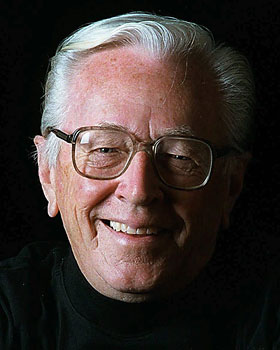
Charles Schulz
The following is the philosophy of Charles Schulz, the creator of the ‘Peanuts’ comic strip.
You don’t have to actually answer the questions. Just ponder on them. It will make very good sense!
Here’s A Little Quiz
You don’t have to actually answer the questions. Just read them straight through, ponder a tad, and you’ll get the point.
Name the five wealthiest people in the world.
Name the last five Heisman trophy winners.
Name the last five winners of the Miss America pageant.
Name ten people who have won the Nobel or Pulitzer Prize.
Name the last half dozen Academy Award winners for best actor and actress.
Name the last decade’s worth of World Series Winners.
How did you do?
The point is, none of us remember the headliners of yesterday. These are no second-rate achievers. They were the best in their fields.
But the applause dies. Awards tarnish over time. Achievements are forgotten and accolades and certificates are buried with their owners.
Here’s another quiz. See how you do on this one:
List a few teachers who aided your journey through school.
Name three friends who have helped you through a difficult time.
Name five people who have taught you something worthwhile.
Think of a few people who have made you feel appreciated and special!
Think of five people you enjoy spending time with.
Did you find that Easier? Of course you did!
So here’s the lesson!
The people who make a difference in your life are not the ones with the most credentials, or the most money…or the most awards…they simply are the ones who care the most.
My dear, sweet wife is struggling with a personal issue that I am not going to share with you dear readers; for obvious reasons. The issue is not to do with our relationship, not at all, but part of the journey of getting a little older day by day.
Yesterday morning, sitting up in bed after breakfast, accompanied by many of our dogs fast asleep around us, Jean had a bit of a weepy session. Today Jean and I are off to see a medical consultant to ascertain the nature of the issue. Not going to say any more than that.
So back to yesterday morning, me reflecting on Jean’s tears, and me musing about what to write for today’s post. There in my email inbox was an item in the latest Big Think newsletter that was perfect. It was called The Science behind Maintaining a Happy Long-Term Relationship and it was by Dr. Helen Fisher, senior research fellow at the Kinsey Institute.
Here is how that article by Dr. Fisher opens:
Plenty of people are pessimistic about the state of relationships in society. Dr. Helen Fisher, senior research fellow at the Kinsey Institute, isn’t one of them. She sees trends like extended periods of cohabitation before marriage and a persistent fear of divorce not only as interrelated, but also signs of a healthy change in attitude toward love. While marriage was once the start of a long-term relationship, she says, today it’s the finale. And that’s a good way to cope with a brain whose primitive regions are driven intensely toward short-term relationships. Dr. Fisher also explains how to maintain novelty, the fuel of romantic love, and how to be aware of the brain regions that affect satisfaction in a relationship.
Now I don’t have permission to republish the full transcript but I see that the video, that was included in the Big Think article, is on YouTube.
I count myself incredibly lucky to have met Jean back in December, 2007 and that out of that meeting came a loving relationship that is more beautiful than words. Well more beautiful than my words so I will let E. E. Cummings say it how it should be said.
Before moving on to the story, can I just say that the link to this report was emailed to me by a follower of Learning from Dogs. It underlines something that I had no idea about when I first started up this blog in July 2009. The wonderful sense of community that develops between a blogger and his or her readers and followers.
So many of you that interact with this place feel like long-established friends, and are treasured.
Dog Escapes Cage To Comfort Rescue Puppies During Their First Night In Kennel
“We’ve never really seen it before, where a dog sneaks out to some puppies and is so excited to see them.”
02/03/2016
Kimberly Yam, Associate Good News Editor, The Huffington Post
This concerned dog just wanted to make sure some young pups would be OK in a new place.
Maggie the dog was staying at the Barker’s Pet Motel and Grooming in Alberta, Canada, when she was caught on a surveillance camera sitting outside a kennel that held two 9-week-old rescue puppies named Hannah and Kari last week.
Barkers Pet Motel and Grooming last Saturday
The canine sneaked out of her own kennel to comfort them on their first night there, and after pet motel owner Sandy Aldred let Maggie into the pups’ cage, the older dog spent the entire night cuddling with the two new guys on the block, according to ABC News.
“We’ve never really seen it before, where a dog sneaks out to some puppies and is so excited to see them.” Aldred’s son, Alex, who also works at the pet motel, told ABC News.
Anna Cain, office manager at the pet motel, told The Huffington Post that Maggie, who is a former shelter dog herself, had been staying there while her owners were on vacation. The puppies were dropped off at the facility after they were rescued by Alberta Animal Rescue Crew Society.
Barkers Pet Motel and Grooming last Saturday
The thoughtful dog, who recently had puppies of her own that were adopted out by a humane society, likely heard Hannah and Kari crying, according to a Facebook post from the motel. So Maggie squeezed her way out of her kennel after pushing aside a water bowl built into her door. She then went right to the pups’ cage.
“She paid them a lot of attention and you could see her little tail wagging. And she’d do the little bow down to them and poke them through the chainlink gate of their room,” Aldred told CBC News. “She just decided that was where she was going to stay until we came to get her.”
When Aldred returned to the kennels and let Maggie into the puppies’ cage, she supervised to see if all the dogs would get along. And of course they did.
“They were just all so happy to be together,” Aldred told CBC. “She was nuzzling them really gently and nudging them, and then she laid down and let them cuddle with her.”
The trio stayed together and were even found snuggling the next morning, ABC News reported. While Maggie’s actions are sweet, it’s not uncommon for dogs who have had puppies, to act compassionately like she did.
“It’s innate in a lot of female dogs, especially if they’ve had a litter in the past. It’s just in their nature,” Deanna Thompson of AARCS told ABC News. “We’ve seen it in a lot of dogs even with male dogs, when they hear other puppies crying they want to console them and make sure they’re feeling safe.”
Maggie and the pups have parted ways unfortunately as her owners have returned from their trip. There are pending adoption applications for both puppies, but for the time being, the pair are in the motel, Cain said.
ooOOoo
Other readers who know and love dogs will endorse my claim that it is not just crying puppies that are consoled by adult dogs; we humans as well experience a fair degree of compassion from our dogs!
I’m seventy-one years old and aware that the ageing process is “alive and well” within me. It primarily is revealed by a degree of brain atrophy that is evidenced by very poor recall. There is no question that it worries Jean and, at times, worries me as well. Adding to the recognition that these are my “senior” years is the awareness that the people that one knows all tend to be a similar sort of age and, inevitably, you don’t have to go far to hear of someone who is very ill, or has recently died.
So the motivation is very strong to stay as fit and healthy; both in body and mind.
Thus a recent article over on the Care2 site about the world’s oldest dog seemed more than a tad relevant to yours truly and will hopefully connect with others who know they are never going to see twenty-one again!
It’s often said that happiness is the key to a long life, but is the same true in the lives of dogs?
Let’s take a look at the world’s oldest living dog. His name was Bluey and he lived to be an astounding 29 1/2 years old. As a puppy in 1910, Bluey joined the household of Les Hall in Victoria, Australia.
Every morning, Bluey went to work among the cattle and sheep. He enjoyed the great outdoors and had constant companionship. He ate a diet that largely consisted of wild kangaroo and emu (not unhealthy animals raised in factory farms). Retiring from his official ‘job’ several years before his death, Bluey remained valued and respected even though he was no longer “useful.”
Ask Yourself These Three Questions
So what about your dog? Are you providing the essential building blocks for a long life? It all boils down to these three questions. Answer honestly, and if you don’t like what you find, today may be the day to turn over a new “leash.”
1. Am I Listening to My Dog?
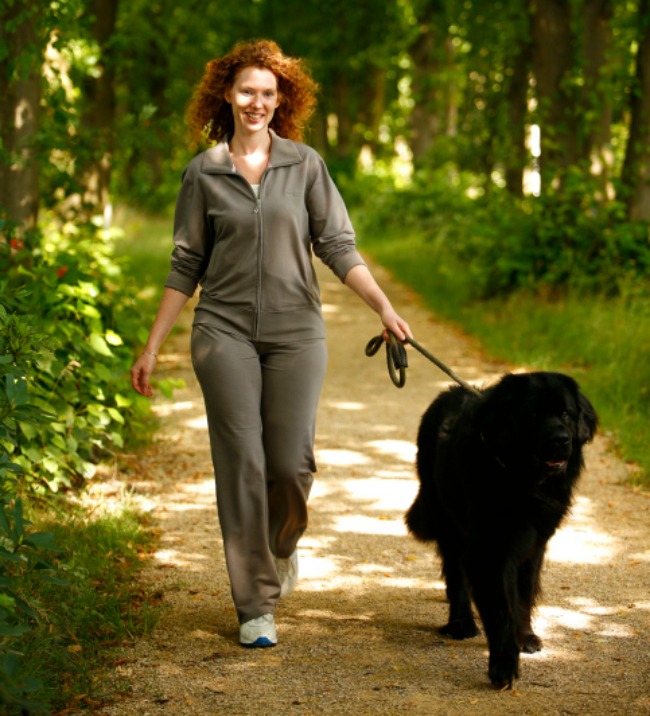
No, your dog can’t speak in full sentences but how hard is it to understand his needs? Chances are, it’s pretty easy. Is your dog full of anxiety because you’ve worked a 10 hour day leaving him alone in the house, or worse yet, locked in a cage? When your dog greets you with excitement at the door, do you take the time to grab the leash and go for a long walk or do you scold him for bothering you? Is your dog getting up very, very slowly from painful joints?
Try listening, really listening, to the things your dog is telling you over and over again. Try this exercise. Think of two memories of times when your dog was happiest. Chances are that you were being active outdoors together. Could you re-create those experiences, even on a small scale, each week?
2. Do I Break My Promises?
Are you guilty of breaking promises to yourself and to your dog? Do you procrastinate? Make a dedicated practice of fulfilling your promises to your dog, the same way as you would care for your own needs. It’s just like brushing your teeth. Schedule in items like these:
A 20 minute walk in the morning before you leave for work.
A neighbor to come and let your dog outside at lunchtime.
Adhering to a schedule of six month veterinary check-ups, especially for mature dogs.
Washing food and water bowls daily.
A long walk at the end of the day.
And most of all, doing those things you know your dog loves most.
3. Am I Putting My Stress Onto My Dog?
If you’ve had a bad day, do you let it spill over? Can you check your troubles at the front door or do you bring them with you and spread your grief? Although it is difficult, take a few deep breaths and remind yourself that your truest friend in the world is not the one you want to hurt today.
ooOOoo
This business of learning from our dogs just goes on and on!
The following beautiful example of the unconditional love of a dog was seen by my on the Care2 Petitions and Causes site. It just had to be shared with you, dear reader, because it is such a powerful reminder of what love and caring for others delivers. It was originally seen here and is republished within the terms of Care2.
ooOOoo
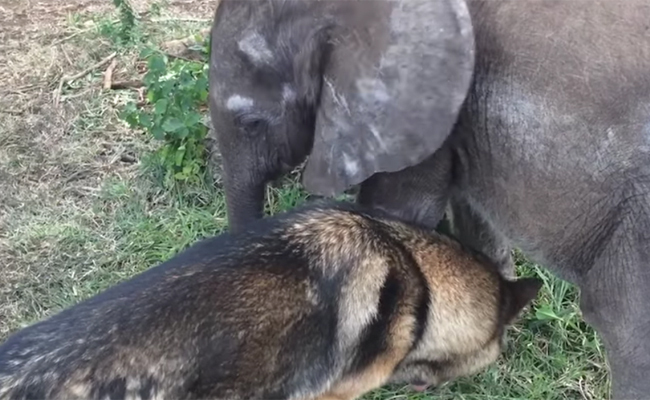
Baby Elephant, Rejected By His Herd, Finds Hope Again With German Shepherd
When Ellie arrived at the rhino orphanage he was critically ill with an umbilical hernia and had little chance of survival.
The game reserve usually rehabilitates baby rhinos, victims of South Africa’s poaching crisis, but is also home to other African wildlife like elephants, buffalo, leopards, giraffes, zebras, hyenas, and crocodiles.
So why is Ellie here? He was brought to the orphanage after he was rejected by his herd, in spite of numerous attempts to reunite him with his family.
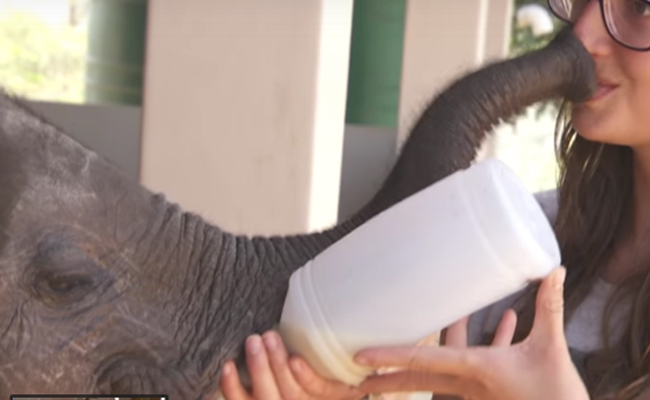
When Ellie the elephant first arrived, his rescuers didn’t think he would make it, but they nursed him day and night.
Photo Credit: Screenshot from Youtube video
As Maren Trendler, a rehabilitation and crisis response expert at the orphanage, explains, “He also had a huge umbilical hernia and abscess. … In about 99 percent of these cases an umbilical abscess of that nature is fatal. … Against all odds, this little elephant is still with us.”
Ellie had an intolerance to milk and nothing seemed to work. So the orphanage decided to make him a special milk formula, and he slowly started to stabilize.
Eventually Ellie’s physical health improved, but his mental health did not, because elephants are social animals and known to be hard to raise away from a herd. He was depressed and lethargic until Duma, the German shepherd hero, swooped in.
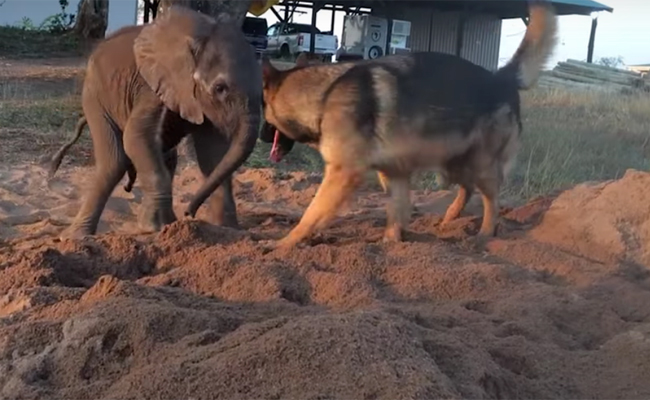
With the arrival of Duma, a former service and sniffer dog, things seemed to turn around for Ellie. The young elephant had been lethargic, not interested in anything, until the orphanage introduced the two at a sand pile. Immediately Ellie started being interested in life again. Duma and Ellie became friends, bonding in spite of their many differences.
Photo Credit: Screenshot from Youtube video
For the past few weeks, their relationship has been growing so much that the carers have a “hard time keeping Duma away from the elephant,” Trendler explains.
Ellie’s future is still uncertain, since elephants generally need to be part of a herd to develop and grow. But right now, Ellie and Duma are happy together.
Published on Jan 14, 2016
Everyone loves a canine companion, and this baby elephant is no exception! The tiny pachyderm arrived at the Thula Thula Rhino Orphanage in South Africa after being rejected by his herd. Critically ill, the youngster had very little chance of survival. But thanks to round-the-clock care from sanctuary staff, and a bit of help from a special canine companion, the baby elephant is on the road to a full recovery. http://www.earthorganization.org/proj… https://www.facebook.com/rhinoorphanage
ooOOoo
Time and time again, the world of dogs reminds us humans of what we need to learn, and to learn reasonably quickly, if we are to leave a sustainable, fair and equitable world for our grandchildren.
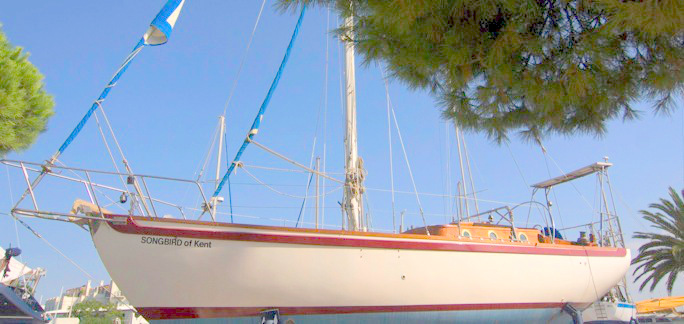
My sub-title comes from personal knowledge of what it feels like to set out on an ocean voyage into waters that one has not sailed before. In my case, leaving Gibraltar bound for The Azores on my yacht Songbird of Kent in the Autumn of 1969.
My home for five years – Tradewind 33: Songbird of Kent.
Despite me being very familiar with my boat, and with sailing in general, there was nonetheless a sense of trepidation as I headed out into a vast unfamiliar ocean.
Coming to matters closer to hand, there is a sense of trepidation felt by me and countless others as to what world we are heading into if we don’t take seriously the risks that are ‘tapping on our door’.
So hold that in your mind as you read a recent essay published by Patrice Ayme’; an essay that highlights very uncertain times ahead if we, as a global society, don’t get our act together pretty damn quick. Republished here on Learning from Dogs with Patrice’s kind permission.
ooOOoo
Record Heat 2015, Obama Cool
2014 was the warmest year ever recorded. 2015 was even warmer, and by far, by .16 degrees centigrade. The UK (Great Britain) meteorological office announced that the temperature rise is now a full degree C above the pre-industrial average. At this annual rate of increase, we will get to two degrees within six years (as I have predicted was a strong possibility).
What’s going on? Exponentiation. Just as wealth grows faster, the greater the wealth, mechanisms causing more heat are released, the greater the heat. Yes, it could go all the way to tsunamis caused by methane hydrates explosions. This happened in the North Atlantic during the Neolithic, leaving debris of enormous tsunamis all over Scotland.
2015: Not Only Record Heat, But Record Acceleration Of Heat
The Neolithic settlements over what is now the bottom of the North Sea and the Franco-English Channel (then a kind of garden of Eden), probably perished the hard way, under giant waves.
Explosions of methane hydrates have started on the land, in Siberia. No tsunami, so far. But it can, and will happen, any time. The recent North Easter on the East Coast of the USA was an example of the sort of events we will see ever more of: a huge warm, moist Atlantic born air mass, lifted up by a cold front.
Notice that, at the COP 21 in Paris all parties, 195 nations, agreed to try their best to limit warming to 1.5 degree Centigrade. At the present instantaneous rate, that’s less than 4 years away. Even with maximum switching out of fossil fuels, we are, at the minimum, on a three degrees centigrade target, pretty soon.
By the way, if all nations agree, how come the “climate deniers” are still heard of so loudly? Well, plutocrats control Main Stream Media. It’s not just that they want to burn more fossil fuels (as it brings them profit, they are the most established wealth). It’s also that they want to create debates about nothing significant, thus avoiding debates about significant things, such as how much the world is controlled by Dark Pools of money.
Meanwhile, dear Paul Krugman insists in “Bernie, Hillary, Barack, and Change“, that it would be pure evil to see him as a “corrupt crook“, because he believes everything Obama says about change and all that. Says Krugman: “President Obama, in his interview with Glenn Thrush of Politico, essentially supports the Hillary Clinton theory of change over the Bernie Sanders theory:
[Says Obama]: ‘I think that what Hillary presents is a recognition that translating values into governance and delivering the goods is ultimately the job of politics, making a real-life difference to people in their day-to-day lives.’”
This is all hogwash. We are not just in a civilization crisis. We are in a biosphere crisis, unequalled in 65 million years. “Real-life differences“, under Obama, have been going down in roughly all ways. His much vaunted “Obamacare” is a big nothing. All people in the know appraise that next year, it will turn to a much worse disaster than it already is (in spite of a few improvements, “co-pays” and other enormous “deductibles” make the ironically named, Affordable Care Act, ACA, unaffordable).
The climate crisis show that there is no more day-to-day routine. At Paris, the only administration which caused problem, at the last-minute, was Obama’s. How is that, for “change”? The USA is not just “leading from behind”, but pulling in the wrong direction. Really, sit down, and think about it: under France’s admirable guidance (!), 194 countries had agreed on a legally enforceable document. Saudi Arabia agreed. The Emirates agreed. Venezuela agreed. Nigeria agreed. Russia agreed. Byelorussia agreed. China, having just made a treaty with France about climate change, actually helped France pass the treaty. Brazil agreed. Zimbabwe agreed. Mongolia agreed. And so on. But, lo and behold, on the last day, Obama did not.
I know Obama’s excuses well; they are just that, excuses. Bill Clinton used exactly the exact same excuses, 20 years ago. Obama is all for Clinton, because, thanks to Clinton, he can just repeat like a parrot what Clinton said, twenty years ago. Who need thinkers, when we have parrots, and they screech?
I sent this (and, admirably, Krugman published it!):
“No doubt Obama wants to follow the Clintons in making a great fortune, 12 months from now. What is there, not to like?
Obama’s rather insignificant activities will just be viewed, in the future, as G. W. Bush third and fourth terms. A janitor cleaning the master’s mess. Complete with colored (“bronze”) apartheid health plan.
What Sanders’ supporters are asking is to break that spiral into ever greater plutocracy (as plutocrat Bloomberg just recognized).”
Several readers approved my sobering message, yet some troll made a comment, accusing me of “racist “slander”. Racist? Yes the “bronze” plan phraseology is racist. I did not make it up. And it is also racist to make a healthcare system which is explicitly dependent upon how much one can afford. Krugman is all for it, but he is not on a “bronze” plan. Introducing apartheid in healthcare? Obama’s signature achievement. So why should we consider Obama as the greatest authority on “progressive change”? Because we are gullible? Because we cannot learn, and we cannot see? Is not that similar to accepting that Hitler was a socialist, simply because he claimed to be one, it had got to be true, and that was proven because a few million deluded characters voted for him?
We are in extreme circumstances, unheard of in 65 million years, they require extreme solutions. They do not require, nor could they stand, Bill Clinton’s Third Term (or would that be G. W. Bush’s fifth term? The mind reels through the possibilities).
“Change we can believe in”: the new boss, same as the old boss, the same exponentiation towards inequality, global warming and catastrophe, the same warm rhetoric of feel-good lies.
As it is, there is a vicious circle of disinformation between the Main Stream Media, and no change in the trajectory towards Armageddon. Yes, Obama was no change. Yes, Obama was the mountain of rhetoric, who gave birth to a mouse. Yes, we need real change, and it requires to start somewhere. And that means, not by revisiting the past.
Patrice Ayme’
ooOOoo
Yes, we do need real change, and every day that we think that this change is the responsibility of someone else then that is another day lost forever. Or in the more proasic words of Mahatma Gandi, “You must be the change you wish to see in the world.”
Then the second is a video that was brought to my attention thanks to Neil in South Devon. As Neil so rightly said, “Leaving aside the captions it’s quite moving….”. (And, trust me, believers and non-believers alike, you are going to weep from start to finish, just as Jean and I did!)
In a world where so much is so utterly screwed up it is the most blissful miracle that we have our dogs!
 For the last too many weeks to remember a mother Canadian Goose has been sitting on her nest of eggs with Father Goose staying close. We like to think that the mother returned to this place after having been born here a year ago.
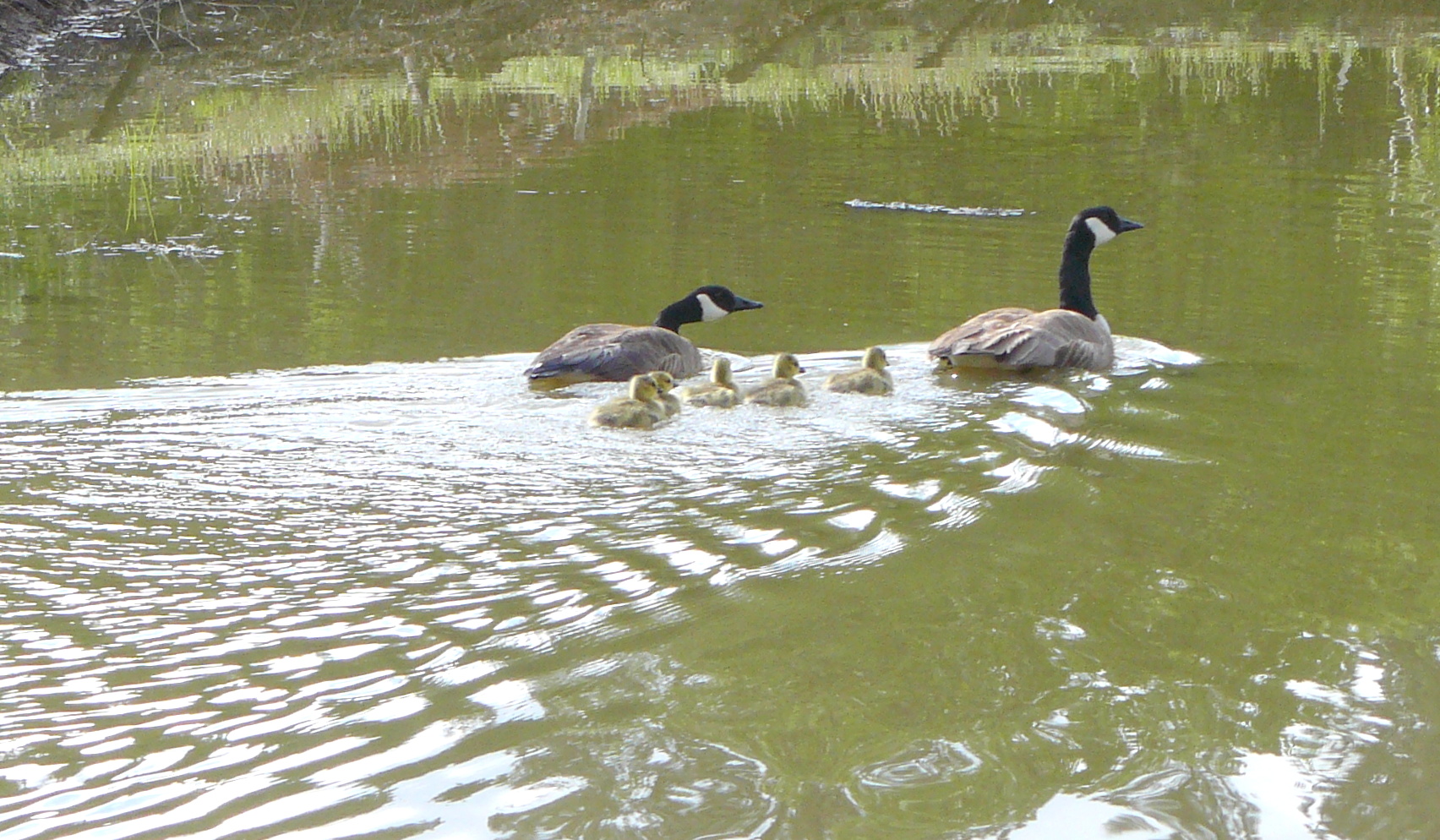 May their little lives be full of love with a total absence of trauma!





 Learning from Dogs