Category: People

The slippery food slope.

The second in this three-part focus on food; both for us and our dogs!

A republication, within the terms of The Conversation site, of an article that was originally published on June 26th, 2018.

ooOOoo

Why it’s time to curb widespread use of neonicotinoid pesticides

By  Associate Professor of Entomology and Extension Specialist, Pennsylvania State University

Planting season for corn and soybeans across the U.S. corn belt is drawing to a close. As they plant, farmers are participating in what is likely to be one of the largest deployments of insecticides in United States history.

Almost every field corn seed planted this year in the United States – approximately 90 million acres’ worth – will be coated with neonicotinoid insecticides, the most widely used class of insecticides in the world. The same is true for seeds in about half of U.S. soybeans – roughly 45 million acres and nearly all cotton – about 14 million acres. In total, by my estimate, these insecticides will be used across at least 150 million acres of cropland, an area about the size the Texas.

Neonicotinoids are very good at killing insects. In many cases they require only parts per billion, equivalent to a few drops of insecticide in a swimming pool of water.

In recent years, concerns have been raised about the influence of neonicotinoids on bee populations. As an applied insect ecologist and extension specialist who works with farmers on pest control, I believe the focus on bees has obscured larger concerns. In my view, U.S. farmers are using these pesticides far more heavily than necessary, with potential negative impacts on ecosystems that are poorly understood.

Pesticides on seeds 

Most neonicotinoids in the United States are used to coat field crop seeds. Their role is to protect against a relatively small suite of secondary insect pests – that is, not the main pests that tend to cause yield loss. National companies or seed suppliers apply these coatings, so that when farmers buy seed, they just have to plant it.

The percentage of corn and soybean acreage planted with neonicotinoid seed coatings has increased dramatically since 2004. By 2011, over 90 percent of field corn and 40 percent of soybeans planted were treated with a neonicotinoid. Between 2011 and 2014, the area treated crept toward 100 percent for corn and 50 percent for soybeans. And the mass of neonicotinoids deployed in each crop doubled, indicating that seed suppliers applied about twice as much insecticide per seed. Unfortunately, many farmers are unaware of what is coated on their seeds, while others like the peace of mind that comes from an apparently better protected seed.

Unlike most insecticides, neonicotinoids are water soluble. This means that when a seedling grows from a treated seed, its roots can absorb some of the insecticide that coated the seed. This can protect the seedling for a limited time from insects. But only a small fraction of the insecticide applied to seeds is actually taken up by seedlings. For example, corn seedlings only take up about 2 percent, and it only persists in the plant for two to three weeks. The critical question is where the rest goes.

Clothianidin is a neonicotinoid used almost exclusively as a coating on seed corn. Maps from USGS.

Pervading the environment

Because neonicotinoids are water soluble, the leftover insecticide not taken up by plants can easily wash into nearby waterways. Neonicotinoids from seed coatings are now routinely found polluting streams and rivers around the country.

Here it is likely that they are poisoning and killing off some of the aquatic insects that are vital food sources for fishes, birds and other wildlife. In the Netherlands, neonicotinoids in surface waters have been associated with widespread declines in insectivorous bird populations – a sign that concentrations of these insecticides are having strong effects on food webs.

Neonicotinoids also can strongly influence pest and predator populations in crop fields. My lab’s research has revealed that use of coated seeds can indirectly reduce crop yield by poisoning insect predators that usually kill slugs, which are important crop pests in mid-Atlantic corn and soybeans fields.

More broadly, planting coated seeds generally decreases populations of insect predators in crop fields by 15 to 20 percent. These predatory insects can eat insect pests, such as black cutworm and armyworm, that can reduce yield. Crop fields with fewer resident predators are more vulnerable to pest infestations.

Slugs, shown here on a soybean plant, are unaffected by neonicotinoids, but can transmit the insecticides to beetles that are important slug predators. Nick Sloff/Penn State University, CC BY-ND

An exaggerated need

Neonicotinoid advocates point to reports – often funded by industry – which argue that these products provide value to field crop agriculture and farmers. However, these sources typically assume that insecticides of some type are needed on every acre of corn and soybeans. Therefore, their value calculations rest on comparing neonicotinoid seed coatings to the cost of other available insecticides.

History shows that this assumption is clearly faulty. In the decade before neonicotinoid seed coatings entered the market, only about 35 percent of U.S. corn acres and 5 percent of soybean acres were treated with insecticides. In other words, pest populations did not cause economically significant harm very often.

Importantly, the pest complex attacking corn today is more or less the same as it was in the 1990s. This suggests that it is not necessary to treat hundreds of millions of acres of crops with neonicotinoid seed coatings.

Neonicotinoids can harm birds via multiple pathways, sometimes in very small quantities.

From overkill to moderation

Should the United States follow the European Union’s lead and pass a broad ban on neonicotinoids? In my view, action this drastic is not necessary. Neonicotinoids provide good value in controlling critical pest species, particularly in vegetable and fruit production. However, their use on field crops needs to be reined in.

In the Canadian province of Ontario, growers can only use neonicotinoid seed treatments on 20 percent of their acres. This seems like a good start, but does not accommodate farmers’ needs very well.

Integrated Pest Management (IPM), a control strategy based on using pesticides only when they are economically justified, offers valuable guidelines. It was introduced in the late 1950s in response to issues stemming from overuse of insecticides, including environmental damage and pest populations that had evolved resistance. Field-crop growers have a good history of using IPM, but current use of neonicotinoids ignores pest risk and conflicts with this approach.

To implement IPM in field crops with neonicotinoids, seed companies need to acknowledge that the current approach is overkill and poses serious environmental hazards. Extension entomologists will then need to provide growers with unbiased information on strengths and limitations of neonicotinoids, and help farmers identify crop acres that will benefit from their use. Finally, the agricultural industry needs to eliminate practices that encourage unnecessary use of seed coatings, such as bundling together various seed-based pest management products, and provide more uncoated seeds in their catalogs.

These steps could end the ongoing escalation of neonicotinoid use and change the goal from “wherever possible” to “just enough.”

ooOOoo

It’s enough to make one give up!!

Never jump to a quick (and incorrect) conclusion

Delighted to welcome another guest post from Colette Bytes.

Back on June 5th, I published the first of three parts of a guest post from Colette. It was called Spot and Me and was a gorgeous (true) account of how Colette trained little Spot when she was dog-sitting for a week. If you missed it then go no further than dropping across to the first part of Colette’s story.

It was beautifully written as well as offering real, solid advice as to how to train a dog that is being a tad challenging. You all loved it!

Well, speaking of beautifully written stories from Colette, here’s another one!

ooOOoo

Always Think Twice

by Colette Bytes, June 15th, 2018.

We all have the ability to make snap ‘first impressions.’
For instance, we say things like, ‘ I knew right from the moment I met him/her…

But are we correct?

Experience often makes us callous and judgemental. Let’s face it, we all have a tendency to think negatively in certain conditions.

Such is the case with Spain’s numerous beggars. They camp out where they are likely to encounter the most foot-traffic, so one can expect two or three of them outside most supermarket entrances. They are not allowed to harass people but they do often intimidate store visitors with looks, gestures, and often cardboard signs in English (to capture the attention and guilty consciences of tourists).

If I gave to every beggar that I see, (and I have occasionally been accosted physically in car-parking lots), I would feel duped by professionals run by the Mafia. There are such people. But once in a while, I do a double-take and think again.

Such was the case one morning. The beggar was an elderly gentleman, unshaved, unkempt and sitting with a young Italian Greyhound tied with a rope. Dogs are often present with beggars, some misused for the purpose.

As my husband and I drew level, the unkempt man said: “Good morning to you!” in a very eloquent manner, and in perfect English. I smiled and thanked him. My husband whispered as we went through the door, “Don’t encourage them!” But I felt different about the man and wanted to do something.

While my husband went in search of the items he wanted, I went to the pet aisle and chose a ring-pull opening tin of dog food and a packet of dental sticks. It amounted to about five euros. I put them in my husband’s shopping basket so he could pay for them as I had no money on me. “What are those for?” He said, (frowning because he already knew). “I’m going to give them to the man outside.” My hubby was angry, but didn’t argue, he knows that it was useless to try and intimidate me. “You are too soft,” he muttered to the air.

I took the doggy stuff out while my hubby packed up our groceries. I handed them over to the grateful man, who thanked me kindly. He opened up a bag next to him to put my gifts into it. The bag held a bowl (for the dog), a big bottle of water and other foodstuffs for them both as well as a towel. He closed it again saying, “I just fed her, so she can have these later!”

The dog sat quietly. I held out my hand and asked her name. She was still a puppy and bounced up to my hand, licking it and dancing around, tangling herself up in the rope the man was using to restrain her. “I have named her Bella. She’s still young; ’bout six months I think. I found her a few days ago on a building site – stray, like most of them. Very hungry.”

The dog was thin, thinner than even her breed dictated. She had the most gorgeous eyes. “She’s still learning how to behave with people, sorry!” His apology wasn’t necessary.

“How long have you been in Spain? ” I asked. “Forty years,” came his reply.
“Goodness, how did you end up here?” I was a bit shocked!

As he fussed the little dog, the man proceeded to tell me a sorry tale. He had lived here with his wife in a nice (if illegally built) house with a thriving business moving residents belongings between Spain and the UK. His business was doing so well that he took on a partner to manage the financial side, and travel and storage arrangements.

Unbeknownst to him, the partner funnelled all the assets to an offshore account, and then suddenly disappeared after a couple of months. The next thing he knew, debt collectors started pounding on his door, often with nasty threats. He lost everything, including his home. His wife borrowed money from her family to return to the UK. He was left here, relying on the kindness of friends to help him along.

“I volunteer a bit at a local dog shelter in return for food, and a bit of company from the other volunteers,” he said. He went on to say that he befriends stray dogs, keeps them for a little while so as to socialise them and then gives them to the dog shelter so that they can be adopted out to good homes.

“Gives me a bit of company, and well, we (he pats Bella on her head) can commiserate on our similar circumstances.” He winked.

As we talked, a few people offered food donations, with sincere thanks from the man that I now knew as ‘Nick.’

One woman approached and gave Nick a reproachful look. Ignoring him (and me) she held out her hand to Bella, who got up from her seated position. The hand opened and held a small pile of dry cat food. Bella sniffed it and then without further interaction, returned to her corner of safety looking wary. Nick explained. “Thank you, but she isn’t hungry. She had her breakfast only half an hour ago.” The woman scowled and dropped the pile of unappetising bits on the ground. Without a word, she walked off!

I smiled at Nick. ” Takes all sorts.” Nick shook his head. “Get a lot of that…” His voice trailed off.

“I’m sorry I don’t have any money to help, my husband has it all,” I said, a bit helplessly.
” Your donation is more than generous,” he said kindly. I always take the excess donations to the dog shelter…they give me some food in return. And little ladies like this one, get a new chance at life!”
I smiled.

“Your husband is waiting for you, I think.” Nick pointed behind me, where my husband was drumming the steering wheel of our car, rather impatiently.
“I better go, it was lovely chatting with you. I hope things work out!”
Nick smiled back and wished me a lovely day.

As I walked away, Nick was smiling, and saying a pleasant “Good Morning,” to a couple walking through the store entrance. They ignored him.

I waved goodbye as we drove away and Nick waved back, smiling!

I told my husband all about Nick, and his attitude changed a bit. But that judgemental side of him still took over… “He probably did everything illegally and that’s why he’s in a mess now.”

Whether Nick brought his circumstances on himself or not, is not really relevant. He was kind to me, and kind to Bella. And kindness always attracts kindness!

ooOOoo

Colette’s story didn’t come with a photograph. So I thought I would do a quick web search and find a picture that fitted Colette’s story well.

In fact, the article that included this photograph may be republished and I will be doing that tomorrow!

On plant-based diets!

Serendipity!

Last Friday I published a post under the title of On Veganism. Earlier that same day I opened up an email promoting the latest essay from George Monbiot. It had been published in The Guardian newspaper two days previously.

I am delighted to republish it here with George Monbiot’s kind permission.

ooOOoo

Butchery of the Planet

Defending the living world and its people requires a shift from meat to a plant-based diet

By George Monbiot, published in the Guardian 8th June 2018

Whether human beings survive this century and the next, whether other lifeforms can live alongside us: above all this depends on the way we eat. We can cut our consumption of everything else close to zero and still drive living systems to collapse, unless we change our diets.

All the evidence now points in one direction: the crucial shift is from an animal to a plant-based diet. A paper published last week in Science reveals that while some kinds of meat and dairy production are more damaging than others, all are more harmful to the living world than growing plant protein. It shows that animal farming takes up 83% of the world’s agricultural land, but delivers only 18% of our calories. A plant-based diet cuts the use of land by 76% and halves the greenhouse gases and other pollution caused by food production.

Part of the reason is the extreme inefficiency of feeding livestock on grain: most of its nutritional value is lost in conversion from plant protein to animal protein. This reinforces my contention that if you want to eat less soya, you should eat soya: most of the world’s production of this crop, and the accompanying destruction of forest, savannah and marshland, is driven by the wasteful practice of feeding animals on food that humans can eat.

More damaging still is free range meat: the environmental impacts of converting grass into flesh, the paper remarks, “are immense under any production method practiced today”. This is because so much land is required to produce every grass-fed steak or lamb chop. Though roughly twice as much land is used for grazing worldwide than for crop production, it provides just 1.2% of the protein we eat. While much of this pastureland cannot be used to grow crops, it can be used for rewilding: allowing the many rich ecosystems destroyed by livestock farming to recover, absorbing carbon from the atmosphere, protecting watersheds and halting the sixth great extinction in its tracks. The land that should be devoted to the preservation of human life and the rest of the living world is used instead to produce a tiny amount of meat.

Whenever I raise the crucial issue of yield per hectare, I receive a barrage of vituperation and abuse. But I’m not having a go at farmers, just pointing out that the figures don’t add up. We can neither feed the world’s growing population nor protect its living systems through animal farming. Meat and dairy are an extravagance we can no longer afford.

There is no way out of this. Those who claim that “regenerative” or “holistic” ranching mimics nature deceive themselves. It relies on fencing, while in nature wild herbivores roam freely, often across vast distances. It excludes or eradicates predators, crucial to the healthy functioning of all living systems. It tends to eliminate tree seedlings, ensuring that the complex mosaics of woody vegetation found in many natural systems – essential to support a wide range of wildlife – are absent.

The animal industry demands ever greater assaults on the living world. Witness the badger slaughter in the UK, now spreading across the country in response to the misguided requests of dairy farmers. People ask how I would justify the return of wolves, knowing that they will kill some sheep. I ask how they justify the eradication of wolves and a vast range of other wildlife to make way for sheep. The most important environmental action we can take is to reduce the amount of land used by farming.

Unless you can cook well – and many people have neither the skills nor the space – a plant-based diet can be either boring or expensive. We need better and cheaper vegan ready meals and quick and easy meat substitutes. The big shift will come with the mass production of cultured meat. There are three main objections. The first is that the idea of artificial meat is disgusting. If you feel this way, I invite you to look at how your sausages, burgers and chicken nuggets are currently raised, slaughtered and processed. Having worked on an intensive pig farm, I’m more aware than most of what disgusting looks like.

The second objection is that cultured meat undermines local food production. Perhaps those who make this claim are unaware of where animal feed comes from. Passing Argentinian soya through a nearby pig before it reaches you does not make it any more local than turning it directly into food for humans. The third objection has greater merit: cultured meat lends itself to corporate concentration. Again, the animal feed industry (and, increasingly, livestock production) has been captured by giant conglomerates. But we should fight to ensure that cultured meat does not go the same way: in this sector as in all others, we need strong anti-trust laws.

This could also be a chance to break our complete dependence on artificial nitrogen. Traditionally, animal and plant farming were integrated through the use of manure. Losses from this system led to a gradual decline in soil fertility. The development of industrial fertilisers saved us from starvation, but at a high environmental cost. Today, the link between livestock and crops has mostly been broken: crops are grown with industrial chemicals while animal slurry stacks up, unused, in stinking lagoons, wipes out rivers and creates dead zones at sea. When it is applied to the land, it threatens to accelerate antibiotic resistance.

In switching to a plant-based diet, we could make use of a neat synergy. Most protein crops – peas and beans – capture nitrogen from the air, fertilising themselves and raising nitrate levels in the soil that subsequent crops, such as cereals and oilseeds, can use. While the transition to plant protein is unlikely to eliminate the global system’s need for artificial fertiliser, the pioneering work of vegan organic growers, using only plant-based composts and importing as little fertility as possible from elsewhere, should be supported by research, that governments have so far conspicuously failed to fund.

Understandably, the livestock industry will resist all this, using the bucolic images and pastoral fantasies that have beguiled us for so long. But they can’t force us to eat meat. The shift is ours to make. It becomes easier every year.

http://www.monbiot.com

ooOOoo

Thus, along with the argument presented last Friday that a vegan diet is critically important for one’s health and long-term fitness, Mr. Monbiot presents another argument: “Whether human beings survive this century and the next, whether other lifeforms can live alongside us: above all this depends on the way we eat.

On veganism!

Just in case this reaches out to others concerned about their diet!

The one thing we know for sure about our fabulous dogs is that they are meat-eaters!

As the The Natural Doggie website offers (my italics):

Dogs have always been a part of our families, so much so that many dog owners even save a seat on their dining tables for their furry friends. While this is all good and well that we shower the canine members of our family with as much love and affection as we do the other members of our family, it’s important for us to remember that their digestive systems and dietary requirements differ from ours.

However, for us humans with our distinctly human dietary requirements, meat is far, far from being an essential food ingredient!

When I met Jeannie back in 2007 it quickly became clear that she was, and had been since the age of 14, a vegetarian. As soon as were living together I joined ‘the club’!

Then a few days ago we both watched a documentary that we saw on Netflix. The film was called What The Health! and, boy oh boy, did it open our eyes. Not just to the very real dangers of eating meat but also fish and chicken. We resolved to become vegans immediately.

There is a website for the film, as in What The Health Film. While the film is only available for Netflix subscribers or may be purchased in other forms, as that website explains, there is a trailer available on YouTube. (The text that follows that trailer is from the Vimeo website.)

What the Health is the groundbreaking follow-up film from the creators of the award winning documentary Cowspiracy. The film follows intrepid filmmaker Kip Andersen as he uncovers the secret to preventing and even reversing chronic diseases – and investigates why the nation’s leading health organizations don’t want us to know about it. With heart disease and cancer the leading causes of death in America, and diabetes at an all-time high, the film reveals possibly the largest health cover-up of our time.

With the help of medical doctors, researchers, and consumer advocates, What the Health exposes the collusion and corruption in government and big business that is costing us trillions of healthcare dollars, and keeping us sick.

Join Kip as he tracks down the leading and most trusted American health nonprofits to find out why these groups are staying silent, despite a growing body of evidence. Audiences will be shocked to learn the insidious roles played by pharmaceutical companies, agribusiness, and processed animal food companies in the nation’s health, especially in the most vulnerable communities, and will cheer at the transformation and recovery of those who took their lives into their own hands.

What The Health is a surprising, and at times hilarious, investigative documentary that will be an eye-opener for everyone concerned about our nation’s health and how big business influences it.

However, in fairness a quick web search comes up with other perspectives. Try this 27-minute interview with Dr. Neal Barnard.

You really should watch it even before you decide to watch What The Health. Please!

Or you may want to read the review that was published by TIME Magazine in August, 2017.

The recent pro-vegan Netflix documentary, What the Health, is under fire from nutrition experts. The film, which is co-directed by Kip Andersen and Keegan Kuhn—the creators of another Netflix documentary, Cowspiracy—and co-produced by actor Joaquin Phoenix, is being criticized by some health professionals for exaggerating weak data and misrepresenting science to promote a diet that avoids all animal foods.

TIME fact-checked the film. Here are four things that What the Health got wrong—and what it got right.

Ultimately, it all comes down to personal choices.

But for those that want to explore the pros and cons try the information on the American Vegan Society website. Or call into Vegsource.com.

Plus, on Monday I shall be republishing a recent article from George Monbiot that addresses the issue.

But I started with a reference to dogs and I shall close by doing the same thing. How many saw the item on the BBC News website about how “A dog that transformed a 104-year-old’s life“?

Image copyright Dona Tracy

Milt Lessner has “always had dogs” throughout his life – and he’s 104 years old, he tells writer Jen Reeder. So are dogs the secret to longevity?

“I’d like to think so,” he says.

“I enjoy the familiarity with them, and the pleasantness, and the bonding – especially the bonding.”

Do read the full news story here.

Have a great weekend all of you!

Reflections – Day Three

Last one from me but indebted nonetheless to Wibble

My second reflection was Never underestimate the power of unintended consequences!

Here’s my third. But first a story!!

Before I met my darling Jean I was living in the small South Devon village of Harberton. In an old converted stone barn known as Upper Barn.

Upper Barn, Harberton.

Harberton was located just three miles South-West of Totnes.

Despite the population of Harberton being just 300 persons the village had its own pub The Church House Inn located appropriately alongside the church!

Church House Inn, Harberton

I didn’t stroll the 200 yards from Upper Barn to the pub on a daily basis but certainly went there once or twice a week.

One Winter’s evening I went in to the pub for a quick pre-dinner pint. David, the landlord was behind the long bar counter, again shown to you below courtesy of the internet.

Beside me there was a single, elderly man sitting on one of the bar stools supping his pint.

I was standing next to him waiting for David to serve me and must have muttered something about the weather or about the latest local news or something inane; too long ago for me to remember.

However, I do remember so clearly what this delightful man said in response to whatever it was that I muttered.

All the world’s a little queer, save you and me, and I ha’ me doubts about thee!

I roared with laughter immediately upon hearing that wonderful reflection about the world. Added, I should say, spoken by him with a rich Devon dialect. At which point this wonderful gent spoke again and it is those next words that are my final reflection.

Now’t so queer as folk!

I never met that delightful old Devonian man again so, therefore, he will have had no idea at all at how his quotation has become part of me!

Same nominations as before:

(Finally do please note that the images in this post may be subject to copyrightLearn More)

Reflections – Day Two

Still following in the footsteps of Wibble.

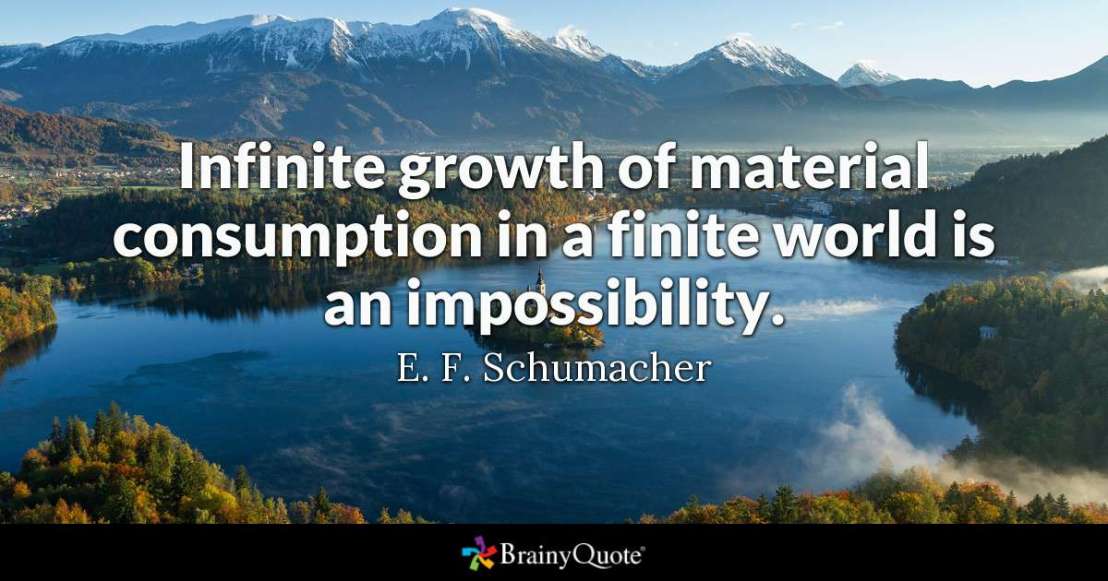
My choice of quotation last Monday was taken from E. F. Schumacher: “Infinite growth of material consumption in a finite world is an impossibility.

Deciding on what should be my second selection turned out to be more difficult. Simply because there were so many buzzing around my head.

In the end I chose this:

Never underestimate the power of unintended consequences!

Despite a web search, that brought up numerous articles concerning unintended consequences across many fields of the human experience, I was unable to find a source for the quote and therefore cannot attribute it to the original author.

Nevertheless, it strikes me as one of the core aspects of human behaviour!

As offered on Monday, here are my nominations for today:

Day Three of Reflections will be along next week!

Reflections – Day One!

Following in the footsteps of Wibble.

As in:

Now, on to the nominations:

The rules of this challenge are: post a quote on three days, each time nominating three other blogs to pick up the challenge. Or — in the spirit of wu wei — not, as you see fit 🙂

The above was taken from a post published by Colin on the 30th May.

So here’s my quote for today:

Just one of the many aspects of the life of man that underlines the madness that seems to inflict so many societies.

Here are my nominations for today and the other two days of quotes:

Day Two of Reflections will be along in a while!

Back in business!

Of trees and internet services!

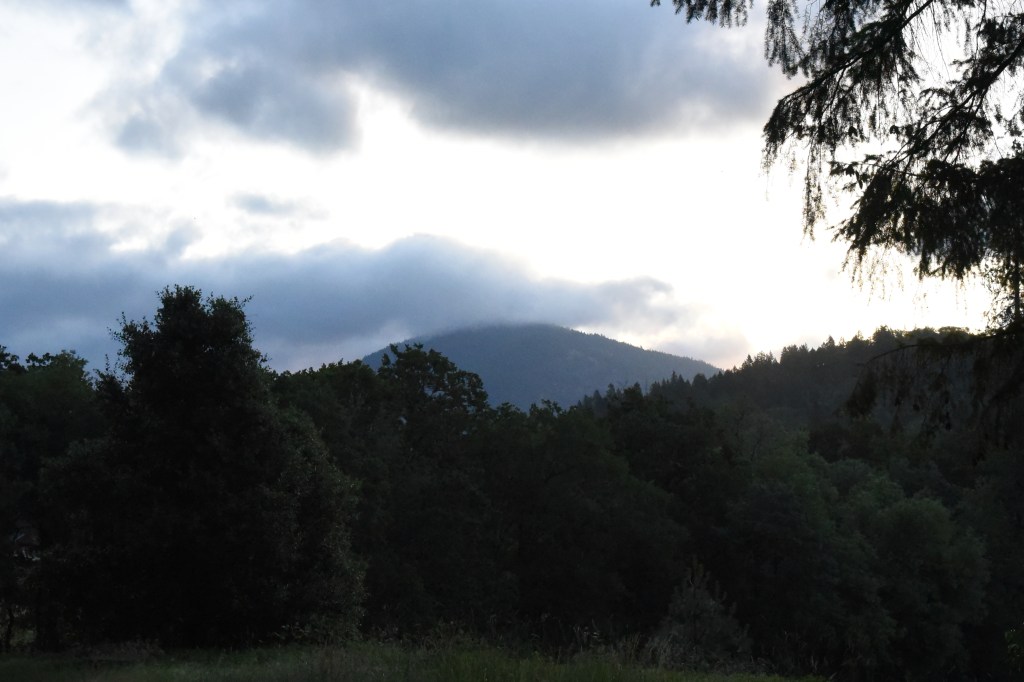
The weather at 6am didn’t bode well with a brisk wind blowing clouds across the summit of Mt. Sexton.

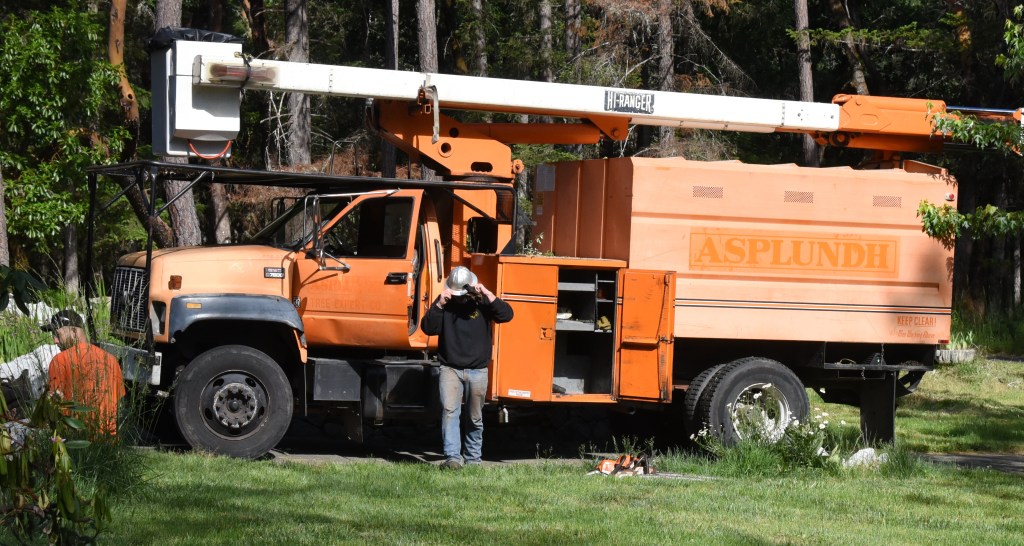
Lyman from Liberty Tree Enterprises arrived bright and early on Wednesday morning to set about felling the dead fir close to the North-East corner of our rear deck.

It was this dead fir, pictured to the left, that had had the wireless antenna installed on it soon after we moved in to Merlin, OR, back in 2012.

How the day would go was a bit of a guessing game: Would we need a new antenna because it would be broken when the tree hit the ground?; Would Outreach be out to see us reasonably soon after we called them to say that the tree was down?; Would there be complications that were unforeseen at this early stage of the ‘project’?

Well we wouldn’t have long to find out.

Lyman and his assistant were very careful in ensuring that the face of the cut, that would direct exactly where the tree fell, was aligned perfectly. I was very impressed with the care and attention put into this aspect of the felling process.

Then it was time to make the cut on the other side of the trunk and hammer in the wedges that would cause the tree to fall. At one point there was a gust of wind that had the tall trunk rocking on the base. We all held our breath.

But at 09:33 down it came!

Down it came perfectly. (Later I counted the rings to discover that the tree was 65 years old!)

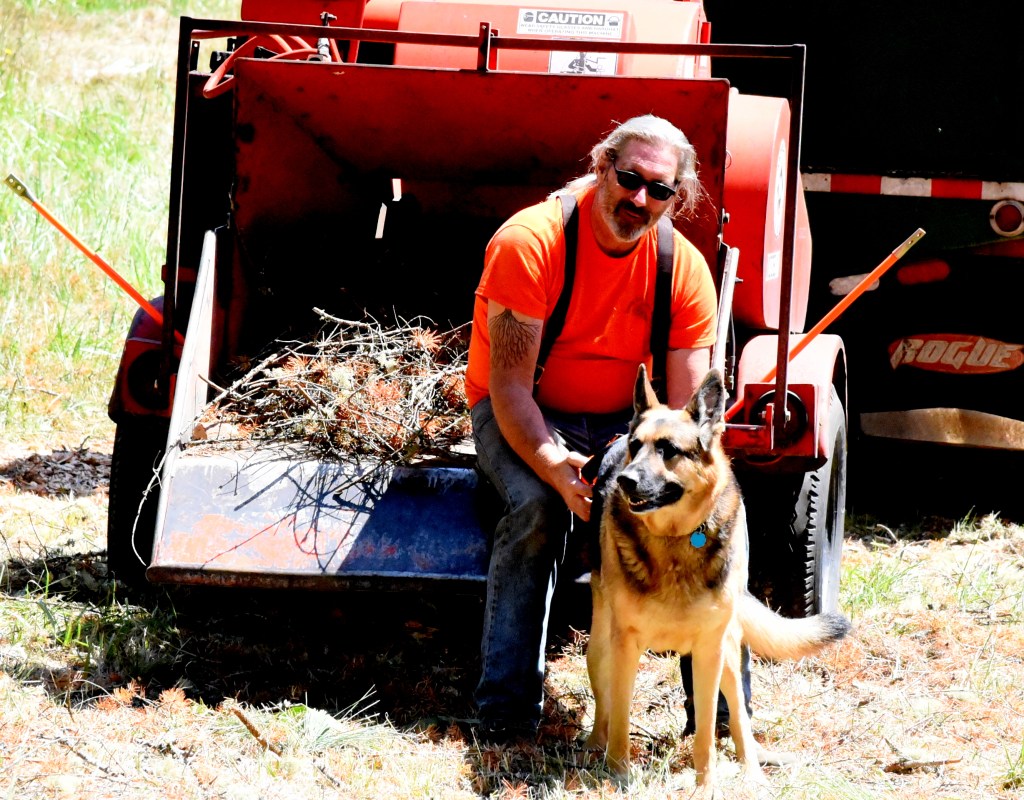
Then it was a case of cutting off all the limbs and shredding them up on site. Inevitably the dogs took an interest!

Here’s Cleo making friends with Lyman.

On to stage two.

Outreach had been called and to our great relief we were told that Doug and Jennifer, the Outreach rigging crew, should be along later in the afternoon.

The two of them arrived and quickly established that the existing antenna had survived the drop!

Therefore, it wasn’t long before Doug was climbing another fir also conveniently close to the deck.

Doug earning his living big time!

And within the hour it was time to power up the router, switch on my iMAC and test for a signal!

The old antenna installed in its new home!

Yes!

All was working and working well.

As you good people will understand it was too late in the day to sort out a post for yesterday.

Plus I needed a few hours to catch up on emails and stuff and then sort out the photographs that I had taken that day.

Then, yesterday afternoon, I sat down and ‘penned’ today’s post for you all.


Well done Liberty Tree and well done Outreach!

Living and Learning

I regret the need to refine my approach to accepting guest posts!

On May 18th, I published a guest post that had been sent to me by Susan Combs. Her article was called: Four Essential Tips to Make Your Dog Healthy and Active Round the Year.

What you won’t know is that there was a fair degree of re-writing required by me, primarily to correct grammatical errors. Something that I had not noticed in Susan’s previous submissions.

In addition, Susan had included links back to websites, one of which was a commercial site that sold Pet Meds and Supplies.

I overlooked including the links because of the time I had spent in getting the article ready for publication. Subsequently, I was ‘instructed’ to edit the post and include the links. I chose not to do so simply because I took the view that this is my blog and I will never accept a guest post on condition that it is an ‘advertisement’ for a supplier. Now sometimes that boundary is blurred but if the guest author wants to include a link and it is not a condition of acceptance then that’s fine.

Susan has now insisted that her guest article is removed from the blog, something that I have done, and my guess is that there will be no further guest articles from her.

But it has prompted me to refine the wording under my Get Involved link on the home page. It presently reads:

Want to submit a Post? – just email us the content directly to learningfromdogs@gmail.com Clearly, we reserve the right to edit your contribution or, perhaps, decide that the content is not appropriate to our Vision.

It has now been modified to read:

Want to submit a Post?– just email us the content directly to learningfromdogs@gmail.comClearly, we reserve the right to edit your contribution or, perhaps, decide that the content is not appropriate to our Vision. Please note that guest articles that link to a commercial supplier are likely not to be accepted. Simply because I do not wish to be seen to be favouring a particular supplier about whom I have no personal knowledge.

Let me remind one and all that this blog works very hard to observe and support The Vision. That, in part, proposes:

Our children require a world that understands the importance of faith, integrity and honesty

Learning from Dogs will  serve as a reminder of the values of life and the power of unconditional love – as so many, many dogs prove each and every day

Best wishes to all.

That new EU law regarding data compliance!

Sorry but I need to join the crowd!

That is the crowd of emails that you and I have been receiving regarding the new GDPR law. The new law that is effective from today.

As a recent BBC video explains:

What is GDPR? Technology explained

A new EU law that changes how companies use our personal information kicks in on 25 May.

The BBC’s Chris Foxx explains what GDPR is and how it will affect you.

Then there is this YouTube video:

Finally, here’s an extract from a recent Firefox blog post:

1. The General Data Protection Regulation gives the European Union the power to hold businesses and organizations accountable for how they collect and handle personal data — your data.

Businesses and organizations have had two years to get ready. This wasn’t a sneak attack by the European institutions. The GDPR went on the books in May 2016, giving anyone who collects customer data plenty of time to prepare.

2. Even though it’s driven out of Europe, the GDPR impacts the whole world.

If you live outside of Europe, you’re probably wondering what a European law has to do with you. Thanks to something called “territorial scope,” any organization that deals with data of EU residents must comply with the GDPR for those individuals, which impacts global organizations like Apple and Facebook. Even though they are not strictly required, some organizations are taking a principled (and perhaps easier) approach, providing the same set of controls and protections to non-EU residents.

3. It’s filling up in your inbox.

We’ve all been bombarded with emails about updated privacy policies and terms of service. It’s (mostly) not fallout from the Cambridge Analytica scandal, it’s because organizations are getting their policies and practices into GDPR compliance. Bonus points: All those emails are a hint to disconnect from services you’ve forgotten about.

Now this is where it gets complicated.

For while there is a WordPress plugin that is supposed to ensure that this WordPress blog conforms, whatever that implies, to the requirements of the new law I am not able to download it without upgrading the blog to Business Plan. As I am already paying to be a Premium WordPress user I object to shelling out more money just now.

So if there is any aspect of being a subscriber to Learning from Dogs that you do not like then please unsubscribe.

As I learn how other blog authors are dealing with the issue then I will let you know if there are any changes that I need to make.

Any advice or suggestions regarding this new law would be most welcome!