It was published on the Majestic Animals website and I hope republishing it is OK.
ooOOoo
Dog accidentally runs half-marathon after being let out for pee, finishes 7th
Sports are great for the health and running is the best way to keep you in a good shape. But I just can’t imagine to train hard for a 13 miles marathon, only to have a dog beat you. Well, that is exactly what happened with most of the Elkmont Trackless Train Half Marathon runners, in Alabama.
Ludivine, a 2 years old Bloodhound was out for a pee when she spotted all those guys running. And since there wasn’t any rule to say that only humans re allowed to participate, the quick thinker pup joined the marathon. Surprisingly, that wasn’t all as the doggy not just finished the run, but she even got a medal.
The adorable dog who finished seventh in the race, even had some pit stops!
She finished in just over an hour-and-a-half. Her owner April Hamlin said:
“All I did was open the door, and she ran the race on her own accord. My first reaction was that I was embarrassed and worried that she had possibly gotten in the way of the other runners. She’s laid back and friendly, so I can’t believe she ran the whole half marathon because she’s actually really lazy.”
Jim Clemens, who finished fourth in the half marathon said, “Every time I thought she had dropped off to go back home, I would hear her coming back up to me and she would race past me up to the two leaders. She would run off to romp through the streams and into yards to sniff around for a while.”
After the week I’ve had, I so needed this story! Check the video below!
I have written quite a few times about the eyes of dogs but never the wolf.
This was sent to me by Julie Thomas-Smith, the wife of my best friend, Richard Maugham, and it is just beautiful.
It comes from the Wolf Conservation Center and when one goes across to that website then one reads:
A wolf’s eyes have the power to speak a great language. Did you know that wolves possess certain ocular characteristics that allow them to communicate with other members of their species using their eyes alone? One can guess that this gives a new meaning to the common phrase “puppy-dog eyes!”
But all dog owners know that the odds of anxiety or depression if you have a dog or two around one are greatly reduced.
I’m chairing a discussion on depression at our local Humanists and Freethinkers group in eighteen days time; on January 18th, 2020. The core of my talk is a TED Talk given journalist Johann Hari in July of 2019.
This is how the talk is introduced.
In a moving talk, journalist Johann Hari shares fresh insights on the causes of depression and anxiety from experts around the world — as well as some exciting emerging solutions. “If you’re depressed or anxious, you’re not weak and you’re not crazy — you’re a human being with unmet needs,” Hari says.
There are sufficient numbers of people who follow this blog that it is likely that this talk will really engage a few of you. It’s twenty minutes long and very interesting!
Science has maybe found a clue to the ancestor of the dog and the wolf.
For an animal that means so much to us humans, the origins of the dog are still uncertain. Indeed, as this interesting article shows, the origins of the wolf are uncertain.
ooOOoo
Was This 18,000-Year-Old Puppy Frozen in Siberian Permafrost the Ancestor of Wolves, Dogs or Both?
DNA tests on the well-preserved remains can’t determine whether the little canine was wild or domestic
(Sergey Fedorov/NEFU)
By Jason Daley, smithsonianmag.com
Dec. 3, 2019, 10 a.m.”>December 3, 2019
Meet Dogor, an 18,000-year-old pup unearthed in Siberian permafrost whose name means “friend” in the Yakut language. The remains of the prehistoric pup are puzzling researchers because genetic testing shows it’s not a wolf or a dog, meaning it could be an elusive ancestor of both.
Locals found the remains in the summer of 2018 in a frozen lump of ground near the Indigirka River, according to the North-Eastern Federal University in Yakutsk. Parts of the animal are incredibly well-preserved, including its head, nose, whiskers, eyelashes and mouth, revealing that it still had its milk teeth when it died. Researchers suggest the animal was just two months old when it passed, though they do not know the cause of death.
The pup is so well-preserved that researchers at the Centre for Palaeogenetics in Sweden were able to sequence the animal’s DNA using a piece of rib bone. The results found that Dogor was male, but even after two rounds of analysis the team could not determine whether he was a dog or a wolf.
“It’s normally relatively easy to tell the difference between the two,” David Stanton, a Centre for Palaeogenetics research fellow, tells Amy Woodyatt at CNN. “We have a lot of data from it already, and with that amount of data, you’d expect to tell if it was one or the other. The fact that we can’t might suggest that it’s from a population that was ancestral to both—to dogs and wolves.”
The find is exciting, regardless of whether Dogor turns out to be a common canine ancestor, an early dog, or an early wolf. Hannah Knowles at The Washington Post reports that Dogor comes from an interesting time in canine evolution, when wolf species were dying out and early dogs were beginning to emerge.
“As you go back in time, as you get closer to the point that dogs and wolves converge, [it becomes] harder to tell between the two,” Stanton tells Knowles.
(Sergey Fedorov/NEFU)
The history of just how and when dogs split from wolves is unresolved. There’s a general agreement among scientists that modern gray wolves and dogs split from a common ancestor 15,000 to 40,000 years ago, explains Brian Handwerk previously for Smithsonian.com. How dogs became dogs, however, is contested. Some research suggests that dogs were domesticated by humans once, while other studies have found dogs were domesticated multiple times. Exactly where in the world wild canines became man’s best friend is also disputed. The origin of the human-animal bond has been traced to Mongolia, China and Europe.
Scientists disagree about how dogs ended up paired with people, too. Some suspect humans captured wolf pups and actively domesticated them. Others suggest that a strain of “friendly,” less aggressive wolves more or less domesticated themselves by hanging out near humans, gaining access to their leftover food.
Dorgor’s DNA could help unravel these mysteries. The team plans to do a third round of DNA testing that may help definitively place Dogor in the canine family tree, report Daria Litvinova and Roman Kutuko at the Associated Press.
ooOOoo
This is incredibly interesting, don’t you think?
Hopefully I will hear of that third round of DNA testing and, if so, will most definitely share it with you.
Posted by Deborah Byrd in Astronomy Essentials | Earth|December 15, 2019
December solstice 2019 arrives on December 22 at 4:19 UTC.
That’s December 21 for much of North America. High summer for the Southern Hemisphere. For the Northern Hemisphere, the return of more sunlight!
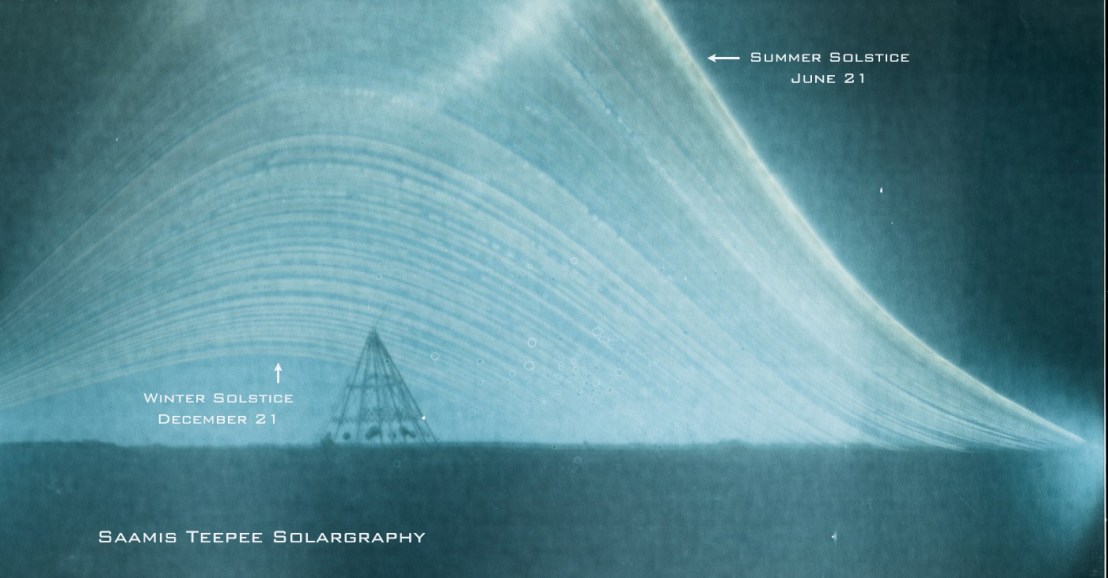
Ian Hennes in Medicine Hat, Alberta, Canada, created this solargraph between a June solstice and a December solstice. It shows the path of the sun during that time period.
Late dawn. Early sunset. Short day. Long night. For us in the Northern Hemisphere, the December solstice marks the longest night and shortest day of the year. Meanwhile, on the day of the December solstice, the Southern Hemisphere has its longest day and shortest night. The 2019 December solstice takes place on Sunday, December 22, at 04:19 UTC (That’s December 21 at 10:19 p.m. CST; translate UTC to your time).
No matter where you live on Earth’s globe, a solstice is your signal to celebrate.
When is the solstice? The solstice happens at the same instant for all of us, everywhere on Earth. In 2019, the December solstice comes on December 21 at 10:19 p.m. CST. That’s on December 22 at 04:19 Universal Time (UTC). It’s when the sun on our sky’s dome reaches its farthest southward point for the year. At this solstice, the Northern Hemisphere has its shortest day and longest night of the year.
Just remember: you’re translating from 04:19 UT on December 22. For example, if you live in Perth, Australia, you need to add 8 hours to Universal Time to find out that the solstice happens on Sunday, December 22, at 12:19 p.m. AWST (Australian Western Standard Time).
Day and night sides of Earth at the instant of the December 2019 solstice (December 22, 2019, at 04:19 UTC). Image via EarthView.
What is a solstice? The earliest people on Earth knew that the sun’s path across the sky, the length of daylight, and the location of the sunrise and sunset all shifted in a regular way throughout the year. They built monuments such as Stonehenge in England – or, for example, at Machu Picchu in Peru – to follow the sun’s yearly progress.
But we today see the solstice differently. We can picture it from the vantage point of space. Today, we know that the solstice is an astronomical event, caused by Earth’s tilt on its axis and its motion in orbit around the sun.
Because Earth doesn’t orbit upright, but is instead tilted on its axis by 23 1/2 degrees, Earth’s Northern and Southern Hemispheres trade places in receiving the sun’s light and warmth most directly. The tilt of the Earth – not our distance from the sun – is what causes winter and summer. At the December solstice, the Northern Hemisphere is leaning most away from the sun for the year.
At the December solstice, Earth is positioned in its orbit so that the sun stays below the North Pole horizon. As seen from 23 1/2 degrees south of the equator, at the imaginary line encircling the globe known as the Tropic of Capricorn, the sun shines directly overhead at noon. This is as far south as the sun ever gets. All locations south of the equator have day lengths greater than 12 hours at the December solstice. Meanwhile, all locations north of the equator have day lengths less than 12 hours.
For us on the northern part of Earth, the shortest day comes at the solstice. After the winter solstice, the days get longer, and the nights shorter. It’s a seasonal shift that nearly everyone notices.
Earth has seasons because our world is tilted on its axis with respect to our orbit around the sun. Image via NASA.
Where should I look to see signs of the solstice in nature? Everywhere.
For all of Earth’s creatures, nothing is so fundamental as the length of daylight. After all, the sun is the ultimate source of all light and warmth on Earth.
If you live in the Northern Hemisphere, you can notice the late dawns and early sunsets, and the low arc of the sun across the sky each day. You might notice how low the sun appears in the sky at local noon. And be sure to look at your noontime shadow. Around the time of the December solstice, it’s your longest noontime shadow of the year.
In the Southern Hemisphere, it’s opposite. Dawn comes early, and dusk comes late. The sun is high. It’s your shortest noontime shadow of the year.
Around the time of the winter solstice, watch for late dawns, early sunsets, and the low arc of the sun across the sky each day. Notice your noontime shadow, the longest of the year. Photo via Serge Arsenie on Flickr.Meanwhile, at the summer solstice, noontime shadows are short. Photo via the Slam Summer Beach Volleyball festival in Australia.
Why doesn’t the earliest sunset come on the shortest day? The December solstice marks the shortest day of the year in the Northern Hemisphere and longest day in the Southern Hemisphere. But the earliest sunset – or earliest sunrise if you’re south of the equator – happens before the December solstice. Many people notice this, and ask about it.
The key to understanding the earliest sunset is not to focus on the time of sunset or sunrise. The key is to focus on what is called true solar noon – the time of day that the sun reaches its highest point in its journey across your sky.
In early December, true solar noon comes nearly 10 minutes earlier by the clock than it does at the solstice around December 22. With true noon coming later on the solstice, so will the sunrise and sunset times.
It’s this discrepancy between clock time and sun time that causes the Northern Hemisphere’s earliest sunset and the Southern Hemisphere’s earliest sunrise to precede the December solstice.
The discrepancy occurs primarily because of the tilt of the Earth’s axis. A secondary but another contributing factor to this discrepancy between clock noon and sun noon comes from the Earth’s elliptical – oblong – orbit around the sun. The Earth’s orbit is not a perfect circle, and when we’re closest to the sun, our world moves fastest in orbit. Our closest point to the sun – or perihelion – comes in early January. So we are moving fastest in orbit around now, slightly faster than our average speed of about 18.5 miles per second (30 kilometers per second). The discrepancy between sun time and clock time is greater around the December solstice than the June solstice because we’re nearer the sun at this time of year.
Solstice sunsets, showing the sun’s position on the local horizon at December 2015 (left) and June 2016 (right) solstices from Mutare, Zimbabwe, via Peter Lowenstein.
The precise date of the earliest sunset depends on your latitude. At mid-northern latitudes, it comes in early December each year. At northern temperate latitudes farther north – such as in Canada and Alaska – the year’s earliest sunset comes around mid-December. Close to the Arctic Circle, the earliest sunset and the December solstice occur on or near the same day.
By the way, the latest sunrise doesn’t come on the solstice either. From mid-northern latitudes, the latest sunrise comes in early January.
The exact dates vary, but the sequence is always the same: earliest sunset in early December, shortest day on the solstice around December 22, latest sunrise in early January.
And so the cycle continues.
Solstice Pyrotechnics II by groovehouse on Flickr.
Bottom line: The 2019 December solstice takes place on Sunday, December 22, at 04:19 UTC (that’s December 21 at 10:19 p.m. CST; translate UTC to your time). It marks the Northern Hemisphere’s shortest day (first day of winter) and Southern Hemisphere’s longest day (first day of summer). Happy solstice, everyone!
ooOOoo
Well for many in the Northern Hemisphere the worst of the winter weather is yet to come.
“Susan Combs” has published this post for us, but I was wondering if we could have a new guest post and pay the fees for that post directly to you? We would ghostwrite this, so it would have to published under your name.
Do let me know what you think and what you would charge for this!<
David
I then replied:
David,
I write my blog purely for pleasure, there is no charge.
Having said that, I also try hard not to promote commercial concerns and I’m unsure whether or not this applies to your goodself, I suspect not.
Please give me some further details about your intended article plus some information about yourself.
Regards,
Paul
Well the article came through a couple of days ago and it is a commercial, profit-seeking, company. I’m also in the unknown as to whether there are others in the same vein out there.
But I decided to publish it anyway because, who knows, there may be some out there who are interested in the service.
ooOOoo
A company turns people and pet’s ashes and hair into diamonds
By Melodie Beattie, a motivational author.
These powerful words ring true for the staff at Heart in Diamond (HID), where they make the impossible happen by taking cremated ashes or hair from a loved one or pet and turning it into diamonds.
Heartache led Anita to work with Heart in Diamond to help others
In particular, there is one employee at Heart in Diamond that can personally attest to this quote, and that is Anita Bolton. In 2011, Anita suffered the loss of her beloved husband. She was completely devastated following his death and Central England Cooperative Funeral Care was there to help her make the necessary plans for a memorial service and cremation for him.
Not only did the organization take care of all the arrangements for her, but they also informed her about Heart in Diamond, which is a company that allows people to pay tribute to the deceased by having a diamond created from some of their cremated ashes or a lock of hair. Anita talks about her first introduction to HID:
“I went to collect the ashes and that was when I was given a Heart in Diamond leaflet. I thought it was a beautiful way for me to remember my husband. I had never heard of the process at all. I had a white diamond created and my young son had a blue diamond.”
Anita also said that the beautiful white diamond ring has filled her with love, happiness, and it has created an everlasting bond. She believes that clients who reach out to the company to have their very own cremation diamond made will look at it and be reminded of their eternal love and it will become a treasured keepsake for many generations to come.
The company made such a great impact on Anita, that she decided to work with Heart in Diamond and became the business operations manager. In this role, she actually works very closely with the good people at Central England Cooperative Funeral Care, who are the same ones who helped her in those very dark and dreary days in her life. When talking about the work she does for Heart in Diamond, Bolton says:
“I’m very proud that Heart in Diamond has given me the opportunity to share my experience in a product I truly believe in and work within a dedicated professional caring team.”
If you would like to learn more about Anita, feel free to visit her employee page at the Heart in Diamond website.
HID is committed to providing personalized service
With an incredible combination of genuine love for people and an unerring passion for doing a good job, the team of dedicated professionals at Heart in Diamond was formed in 2005 when it set out to provide an extraordinary experience to every client they serve. According to the company’s About Us page:
“We pride ourselves by offering a personal service for your commemorative diamond.”
All the individuals that make up the HID team share a common vision and passion to demonstrate real care and love, inherent in each and every diamond they create. Some of the guiding principles of the company include:
We treat all samples with respect
Every customer is an individual and not a number
We provide personal service to each customer
We are committed to delivering a product of the highest quality
We are committed to delivering the best price on the market
We are committed to providing the shortest production time
We guarantee a genuine product through our unique authentication program.
Creating everlasting bonds worldwide since 2005
Heart in Diamond is a UK-based company that is also recognized as a world-renowned manufacturer of laboratory diamonds. If you or a loved one is dealing with grief from the loss of a close friend, spouse, family member, or even a pet, Heart in Diamond can provide you with unique tribute gifts that last a lifetime.
Carbon is extracted from either the ashes or hair of pets or people. Then, it is exposed to a laboratory-controlled environment that mimics the natural processes deep within the earth in order to grow the sample into a diamond. Lab-grown diamonds from HID are identical to mined diamonds in terms of physical, chemical, and optical properties, but they cost 20 to 30 percent less on average and they are a more ethical choice than conflict diamonds.
When you buy a commemorative diamond from HID, you not only receive a high-quality gem, but your cremation jewelry also serves as a living memory you can pass on to generation after generation.
ooOOoo
I then went across to the website hoping to get some pictures to share with you but they are not clear enough to view here.
But there’s a great deal of information that you may want to consider.
And, to state the obvious, I did not receive any compensation for publishing this.
There’s something almost beyond the world of words, pictures and blogging. That’s when a dog goes missing and then is found. Especially if the lover of the dog is a young boy who fears the worst.
Dogs bring out so much that is good in us. Dogs cross gender, age, country and ethnic boundaries.
This is what struck me with some force I will admit when I read this article on the Daily Dodo yesterday. It is republished for your own delight!
The holidays aren’t about what’s under the tree; it’s who you’re with that matters. And no one understands that better than Carter Licata and his dog, Piper.
The 2-year-old pug loves everyone in her family, but her bond with her brother is special. “It was love at first sight for the two of them,” April Licata, Carter’s mom, told The Dodo.
But the family’s holiday season was nearly destroyed when the unthinkable happened — Piper went missing.
Photo Credit: April Licata
Last month, Licata let Piper and her other dog outside to use the bathroom. But when she opened the door to let them back in, Piper was nowhere to be seen.
The family searched everywhere, posted on social media, and reached out to neighbors and community groups. They prayed for Piper’s safe return, but as days turned to weeks, they feared that they would never see their pug again.
“We were all sick,” Licata said. “The older kids wanted nothing to do with decorating the Christmas tree and it was a very somber Thanksgiving for them.”
Then, Licata received a Facebook message from the Genesee County Animal Shelter. A dog matching Piper’s description had been dropped off at the shelter by a person who wanted to remain anonymous. “My husband and I were going out to dinner and honestly, there was an outcry of joy in the truck,” Licata said. “We were shocked and elated!”
Carter was out of town when they learned about Piper, so they decided to keep it a secret and surprise him with a special reunion when he returned. Piper, meanwhile, wandered around the house looking for her brother, until finally, their reunion day arrived.
Photo Credit: Facebook/April Licata
When Carter saw Piper in the front seat of the truck, decked out in bows, he immediately broke down in tears.
Piper’s tail went crazy at the sight of her brother and as soon as he stepped in the truck, she jumped in his arms, showering him with kisses.
The family couldn’t be happier to have Piper back again — and just in time for Christmas.
“My son loves his dog so much, was sick while she was gone, and tonight she’s sleeping next to him again,” Licata wrote on Facebook. “What a Christmas miracle for our family.”
You can see the heart-warming video below.
ooOOoo
I know that for the main part I just republish the work that others do. But that doesn’t mean that I’m not affected by the articles. This one in particular had me in tears.
Alex and Lisa have put together a remarkable video
Yesterday, in came an email from my son, Alex, about an amazing starling murmuration at the Royal Society for the Protection of Birds (RSPB).
Lisa took the video and together they uploaded it to YouTube.
Enjoy!
Having watched the amazing video I then did a little bit of research. I came quickly across the science of murmuration and have included it below.
Murmuration refers to the phenomenon that results when hundreds, sometimes thousands, of starlings fly in swooping, intricately coordinated patterns through the sky.
Maybe you’ve seen a murmuration video before. But this one is especially beautiful. It was shot earlier this month in Wales, at Cosmeston Lakes in the Vale of Glamorgan, and posted on Facebook by the BBC Cymru Wales. (It’s not included, Ed.)
It’s all about science. Just how do the starlings manage to fly in such an amazingly coordinated way?
A few years ago, George F. Young and his colleagues investigated starlings’ “remarkable ability to maintain cohesion as a group in highly uncertain environments and with limited, noisy information” — a nice description of what goes on in a murmuration.
Going in, Young et al. already knew that starlings pay attention to a fixed number of their neighbors in the flock, regardless of flock density — seven, to be exact. Their new contribution was to figure out that “when uncertainty in sensing is present, interacting with six or seven neighbors optimizes the balance between group cohesiveness and individual effort.”
Young et al. analyzed still shots from videos of starlings in flight (flock size ranging from 440 to 2,600), then used a highly mathematical approach and systems theory to reach their conclusion. Focusing on the birds’ ability to manage uncertainty while also maintaining consensus, they discovered that birds accomplish this (with the least effort) when each bird attends to seven neighbors.
Buddy and Merlyn behaved like a “tag team”, Pita Oates said
A runner who broke her leg on remote moorland was rescued after her dogs raised the alarm.
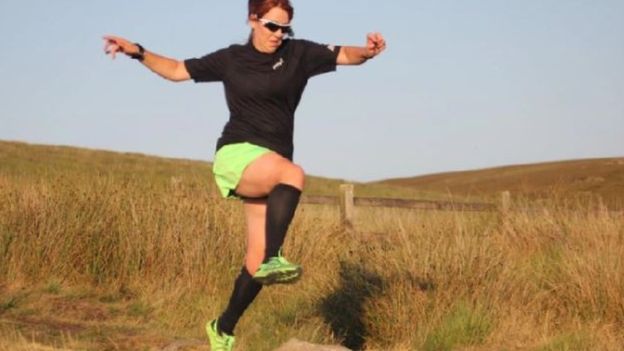
Pita Oates, 48, was left unable to stand after she fell on a three-mile run in Lancashire with her blue collies Buddy and Merlyn.
One of the dogs stayed with her as she inched down the hill, while the other ran around barking for help.
This attracted the attention of another dog walker who contacted emergency services.
Ms Oates, from Leyland, said: “They were like a tag team, Buddy never left me while Merlyn went for help.
“I would have died without a doubt, I wouldn’t have lasted the night.”
When help arrived Ms Oates, who had left her mobile phone in her camper van, was drifting in and out of consciousness and starting to suffer the effects of hypothermia.
She said: “It was the tail-end of Storm Gareth, it was freezing and I was soaking wet. The winds were horrendous.”
Ms Oates said she could have died on the moors without her dogs’ help
Ms Oates broke the femur behind her left knee and tore her anterior and cruciate ligaments on the run on Great Hill near Chorley on 12 March.
“I couldn’t stand up, I was having to bum-shuffle all the way down,” she said.
“Every time my leg touched the ground I was in pain so I rigged up a sling using the dog’s lead to keep my leg up.”
It took her 90 minutes to get down the hill by which time it had gone dark.
“Buddy never left me and Merlyn kept barking back at him – when this man came with his dog he knew something wasn’t right,” she said.
Paramedics and members of the Bowland Mountain Rescue Team, as well as two from Bolton Mountain Rescue, arrived to help rescue Ms Oates.
She spent eight days in hospital and had a titanium plate fitted but still needs another operation.
Pita Oates was on a three-mile run when she was injured
ooOOoo
Part of me is not surprised at the behaviour of Ms Oates’ dogs. Dogs show their care and attention in so many ways. But then again I was surprised because these two dogs knew exactly what to do. One to stay and one to seek help. Which is what they did.
It was a close-run thing (pardon the pun) as Pita was starting to fade away when help arrived.