One of the lovely things about writing a blog about dogs is that frequently people ‘pop up’ and offer a guest post. So it was with Eliza, or Eliza Gilbert to give to her her full name. This is a brief background that she sent me.
ooOOoo
NB: It’s the morning of Tuesday, the 11th February, 2020 and I have had to do something for the very first time. That is delete a guest post.
It turned out that Eliza was pushing me to include a link for her client and it was far from being a guest post, more like a commercial arrangement between Eliza and her client. I hope everyone understands.
ooOOoo
Hardly signs of anxiety! Thank goodness. Pedy on the left; Oliver on the right.
I have long been a subscriber to The Conversation. They seem to be politically neutral as well as giving permission for their essays to be republished elsewhere.
This particular essay chimed with me because for some time, one or two years sort of time-span, the number of people agreeing with the statement, “It’s a strange world“, has measurably grown. At first I thought it was a question of politics, both sides of The Atlantic, but I have recently come to the opinion that it is deeper than that.
This encapsulates the idea perfectly.
ooOOoo
How CEOs, experts and philosophers see the world’s biggest risks differently
We live in a world threatened by numerous existential risks that no country or organization can resolve alone, such as climate change, extreme weather and the coronavirus.
But in order to adequately address them, we need agreement on which are priorities – and which aren’t.
As it happens, the policymakers and business leaders who largely determine which risks become global priorities spent a week in January mingling in the mountainous resort of Davos for an annual meeting of the world’s elite.
I participated in a global risk assessment survey that informed those at the Davos summit on what they should be paying the most attention to. The results, drawn from experts in a broad range of disciplines including business, happen to be very different from what company CEOs specifically see as the biggest threats they face.
As a philosopher, I found the differences curious. They highlight two contrasting ways of seeing the world – with significant consequences for our ability to address societal risks.
Wildfires in Australia have destroyed more than 3,000 homes and razed more than 10.6 million hectares since September. AP Photo/Noah Berger
Two perspectives on the biggest risks
The World Economic Forum’s Global Risk Report consolidates the perceptions of about 800 experts in business, government and civil society to rank “the world’s most pressing challenges” for the coming year by likelihood and impact.
In 2020, extreme weather, a failure to act on climate change and natural disasters topped the list of risks in terms of likelihood of occurrence. In terms of impact, the top three were climate action failure, weapons of mass destruction and a loss of biodiversity.
The specific perspective of corporate leaders, however, is captured in another survey that highlights what they perceive as the biggest risks to their own businesses’ growth prospects. Conducted by consultancy PwC since 1998, it also holds sway in Davos. I’ve been involved in that report as well when I used to work for the organization.
In sharp contrast to the World Economic Forum’s risk report, the CEO survey found that the top three risks to business this year are overregulation, trade conflicts and uncertain economic growth.
President Trump’s trade war and other economic concerns tend to be the focus of corporate CEOs. AP Photo/Evan Vucci
Economic or ethical
What explains such a big difference in how these groups see the greatest threats?
I wanted to look at this question more deeply, beyond one year’s assessment, so I did a simple analysis of 14 years of data generated by the two reports. My findings are only inferences from publicly available data, and it should be noted that the two surveys have different methodologies and ask different questions that may shape respondents’ answers.
A key difference I observed is that business leaders tend to think in economic terms first and ethical terms second. That is, businesses, as you’d expect, tend to focus on their short-term economic situation, while civil society and other experts in the Global Risk Report focus on longer-term social and environmental consequences.
For example, year after year, CEOs have named a comparatively stable set of narrow concerns. Overregulation is among the main three threats in all but one of the years – and is frequently at the top of the list. Availability of talent, government fiscal concerns and the economy were also frequently mentioned over the past 14 years.
In contrast, the Global Risk Report tends to reflect a greater evolution in the types of risks the world faces, with concerns about the environment and existential threats growing increasingly prominent over the past five years, while economic and geopolitical risks have faded after dominating in the late 2000s.
A philosophical perspective
Risk surveys are useful tools for understanding what matters to CEOs and civil society. Philosophy is useful for considering why their priorities differ, and whose are likelier to be right.
Fundamentally, risks are about interests. Businesses want a minimum of regulations so they can make more money today. Experts representing constituencies beyond just business place a greater emphasis on the common good, now and in the future.
When interests are in tension, philosophy can help us sort between them. And while I’m sympathetic to CEOs’ desire to run their businesses without regulatory interference, I’m concerned that these short-term economic considerations often impede long-term ethical goals, such as looking after the well-being of the environment.
An uncertain world
Experts agree on at least one thing: The world faces dire risks.
This year’s Global Risk Report, titled, “An Unsettled World,” depicts on its cover a vulnerable earth in the shadow of a gigantic whirlpool.
The cover photograph of the Global CEO Survey, which reported the lowest CEO confidence in economic growth since the Great Recession, shows an incoming tide beneath looming dark clouds, with the words: “Navigating the Rising Tide of Uncertainty.”
Between the covers, however, the reports demonstrate a wide gap between two influential groups that need to be on the same page if we hope to resolve the world’s biggest threats.
Last century, in the same year that World War II drew to a close, Bertrand Russell proclaimed that
Bertrand Russell. Naci Yavuz/Shurterstock.com
the purpose of philosophy was to teach us “how to live without certainty, and yet without being paralyzed by hesitation.”
In the 21st century, philosophy can remind us of our unfortunate tendency to let economic priorities paralyze action on more pressing concerns.
Bertrand Russell was a great philosopher. Well he was that and much more. Wikipedia remind us that he “was a British philosopher, logician, mathematician, historian, writer, essayist, social critic, political activist, and Nobel laureate.”
He died at the age of 97 on the 2nd February, 1970; fifty years ago as of yesterday.
I’ll close with another quote from the great man:
“The whole problem with the world is that fools and fanatics are always so certain of themselves, and wiser people so full of doubts. …”
Another republication of the Spanish walk by Tom and Chica.
There was such a wonderful response to the post on the 28th January that I decided to republish another one. This time I have started at the beginning.
ooOOoo
The GR7
The road less travelled…..
If you tell someone you’re planning a long walk in Spain, they will mostly assume you’re talking about the Camino de Santiago pilgrim trail across northern Spain. Tom being a bit of a misanthrope said he’d rather go somewhere less crowded.
We are familiar with a part of the GR7 as it runs through the Serrania de Ronda where we have spent a few recent winters. After more research it was decided that this would be the most interesting.
The GR7 starts on the south coast at Tarifa, near Gibraltar, and then runs up through the Los Alcornocales, a beautiful forest of cork oaks, then into the Grazalema National Park before reaching the city of Ronda. Dramatically perched above a deep gorge, Ronda is our favourite city.
From there the route turns eastwards towards Antequera and passes through the Parque Natural del Torcal whose bizarre rocky outcrops form one of the most impressive karst landscapes in Europe.
Shortly beyond, the route splits and Tom and Chica will be taking the southern variation through many small villages into Las Alpajarras. Then it heads up into the Sierra Nevada and there it may get tricky depending on the snow level. Chica isn’t keen on being belly deep in snow!
As the route heads north inland from the east coast, it is all new territory for us. There should be a couple of visits to both our charities near Alicante and Valencia and then due north to the border with Andorra. The final stop for recuperation will be with good friend, Kate, in the Pyrenees.
At last, after a fair few hitches and glitches, Tom and Chica took their first steps on a journey that will take them right across Spain to Andorra on the GR7 route. The start is at the aptly (and purely coincidentally) named Playa Chica, which is the most southerly point of mainland Europe. From here, you have the Med to the east, the Atlantic to the west and Africa on the horizon. It’s an epic trip and one that only around five people complete every year. It should cover a variety of landscapes, starting today with the beautiful beaches of Tarifa and the surrounding area. As it’s a Saturday, with a good strong breeze, the kite surfers were out in force. It’s quite a sight!
Kite surfers at Valdavaqueros
Today was a short toddle, by comparison with what will follow – just 11k in about 2.5 hours. The route was almost entirely on the beach and Tom shed his shoes and walked barefoot. It might be the only time that will be possible.
Given that he is recovering from flu an easy start seemed a good plan – definitely so as it’s now raining! Chica, however, needs to understand that stopping to investigate every interesting smell would mean the walk would take several years.
We will be posting a blog every day of the walk, with information on the route, the scenery and the flora and fauna. Tom isn’t able to carry field guides – too much extra weight – so identification from any of our followers would be appreciated, starting with these shells found on the beach today. These pics will be posted on our instagram page too.
Shells found on the beach at Valdevaqueros
As well as posting our position, hopefully using Viewranger (we’re working on this) we will also give our position using What Three Words. Tonight’s are: tigress, asked, varies. This is fun and will be another way of ensuring that the back up team (me) can hook up with them.
Stay with us!
Just this far to go….
ooOOoo
This is an incredible journey and I’m so pleased that Tom is happy for me to share it with you.
Tom came to Learning from Dogs a short while ago and signed up to follow the blog. As is usual, I went across to his blog in order to leave a thank-you note. I was flabbergasted at what I saw. Tom and his two dogs were walking across Spain. He called his blog Chica’s Challenge and this is what he wrote on his home page.
First, Tom decided he wanted to do a long walk.
Then he thought Spain would be nice as it has to be in winter.
And he’d like to take Chica, our podenco.
As an afterthought, he said, “Maybe we could raise some money?”
“Who for?” I asked.
“Well, as I’m taking Chica and it’s in Spain, I guess for Spanish podencos.”
“Great idea! I’ll write the blog!”
I wanted to follow his posts and did so.
Then I wanted to republish a post and asked Tom if I had his permission to so do.
One dog and her man walking across Spain, raising money for their podenco friends.
Day 7: Jimena de la Frontera to Cerra de la Fantasia 20k
The last two days were non-walking days, one for bad weather and another to move base again. Now we have the luxury of being in a house for a while in Jimera de Libar, a village we know well.
So the day started with the drive back to Jimena and the weather looked reasonable. Again, Merlin refused to be left so the three of them set off up the path, climbing steadily for the first hour and a half.
Climbing pathSpanish Fir / Pinsapo (Abies Pinsapo) in the background
The path eventually levelled out and passed beneath the rocky outcrops of the Altos de Paneron and Cerro de Marin. After a bare rocky sections where the route was harder to determine, they went into dense forest of oak and Spanish fir (we love these and call them lollipop trees because of their shape). Both dogs in great form, but Tom was mean and moody :).
Dark clouds were gathering from all directions but the view to the coast was still impressive. However, it wasn’t long before the rain began and the temperature dropped.
Looking south – you can just see the sea
Fortunately the rest of the route was on a well-defined and signposted track, winding down through the cork oaks in the midst of the Los Alcornacales. It was here deep in the forest that I eventually picked them up. I had forgotten that smaller Spanish roads aren’t always roads as I know them and the last five and a half miles I was driving along a rough track with no mobile signal, not at all sure I was in the right place. Even though we have a 4×4, I made very slow progress and it was with considerable relief that I found them, damp but completely unconcerned.
ooOOoo
In the original some of the photographs were side-by-side but in copying them across I chose to enlarge them.
The start of Tom’s walk may be seen here and I thoroughly recommend that you read it in full.
I shall continue to follow Tom’s walk and may republish another post.
The serious consequence of exercising too much, too fast
Exercising too much, too hard can lead not only to burnout but sometimes to a serious condition that can harm the kidneys.
By Tamara Hew-Butler , Associate Professor of Exercise and Sports Science, Wayne State University, January 24th, 2020.
Every 365.25 days, when the Earth completes a full orbit around the Sun, we humans have the opportunity to hit the reset button and become fitter, finer versions of ourselves. As usual for January, social media is humming with advice on how to eat better, exercise regularly, lose weight and remain healthy. We feel particularly invincible at this time of year, armed with renewed vigor and motivation to purge ourselves from previous indulgences and our couch-potato ways.
The New Year is also the time when our overzealous, instant-gratification selves emerge, and we do too much exercise too soon to make up for lost time. Exhaustive muscular work, especially following a period of inactivity, can cause mechanical and chemical disruptions to muscle cell membranes which trigger the muscle cells to burst.
I am an exercise physiologist and sports medicine specialist who studies exercise-associated collapse. I am seeing and hearing of more incidents of skeletal muscle ruptures that are causing harm in other parts of the body.
This information is not designed to scare people back onto the couch. The key take-away from highlighting these cases is to remind athletes, coaches and mere mortals that the desired physiological response to a training stimulus requires both a gradual buildup period and period of recovery in between training sessions.
A cross-section of the human kidneys, which can be injured when muscle cells rupture and send toxic chemicals into the bloodstream. crystal light/Shutterstock.com
More than muscle injury
The medical term for skeletal muscle cell rupture is “rhabdomyolysis,” or “rhabdo” for short. When muscle cells rupture or explode, the intracellular contents are released into the bloodstream. These cellular contents include enzymes, such as creatine kinase; electrolytes, such as potassium; and proteins, such as myoglobin.
Myoglobin, in particular, is a big, red protein that can block the kidney filtration system, or renal tubules, that serve as kidney plumbing. It also can dissociate into toxic byproducts that injure kidneys. In rare cases, too much myoglobin in the bloodstream can stop kidney function altogether, as happened with a 27-year old marathon runner who died from kidney failure.
In a study we conducted on college swimmers, we saw a cluster of rhabdomyolysis, in which six out of 34 swimmers were hospitalized after participating in a 20-minute or so “arm competition” to see how many pull-ups, rows and bench presses they could complete. Cases of “symptomatic rhabdo,” or those needing medical treatment, appear to be increasing within collegiate sports teams at an alarming rate, with the characteristic appearance seen in football players returning to January practice after a season-ending holiday layoff.
To date, 17 cases of team rhabdo have occurred from doing “too much, too soon, too fast” and include a variety of sports such as football, swimming, lacrosse, soccer, track, basketball, softball, volleyball and golf.
Noncompetitive athletes affected too
So, what about us mere mortals trying to get back in shape? Any physical activity that is either new or excessive can cause symptomatic rhabdo. Excessive gardening, weightlifting, CrossFit type activities and even a routine Army physical fitness test have triggered symptomatic rhabdo with kidney injury.
Over 90 cases of rhabdo have been documented after spinning, while 119 high school students in Taiwan ended up in the emergency room after their teacher made them complete 120 push-ups within five minutes. Thus, harmful muscle cell rupture can occur after any degree five minutes to 36 hours of exuberant and/or unaccustomed physical activity.
In combination, gradual training and appropriate recovery allow beneficial muscular, cardiovascular and body composition adaptations to occur, such as building muscle, increasing fitness and losing body fat. Our research confirms that a two-week gradual introduction into training after a layoff is required for muscle cell membranes to fully adapt to training stress.
Subclinical rhabdo, or muscle breakdown without acute kidney injury or debilitating symptoms, is common and represents the typical response to training which does not require medical treatment. However, hard exercise, especially following a layoff, with the following signs or symptoms within one to two days requires an appropriate medical examination:
excruciating muscle pain that does not resolve over time
muscle swelling with limitations in movement
nausea or vomiting, or both
very dark (looks like Coca-Cola) or sparse urine.
There are risk factors which increase the likelihood of developing rhabdo following a workout. These risk factors include exercising in the heat, dehydration or overhydration, binge drinking, excessive coffee consumption, extreme dietary practices (vegetarian or high [protein] https://doi.org/10.1097/JSM.0000000000000310)) and possessing the sickle cell trait. Both men and women can develop symptomatic rhabdo, although we see more cases in men. Smaller arm muscles appear more susceptible to rupture after five to 30 minutes of exercise than bigger leg muscles for reasons that remain unclear.
Although symptomatic rhabdomyolysis is uncommon, this emergent complication of exercise should be on everyone’s radar since cases are on the rise. We coaches, trainers, scientists, practitioners and others encourage everyone to reap the joys and benefits of regular exercise training. However, we caution against exercising too much too soon. Self- (or coach-) inflicted skeletal muscle cell explosions are fully preventable with adherence to smart, physiologically sound approaches to training.
ooOOoo
Now there’s an element of me not really understanding this (and I haven’t yet watched the video) but that’s no reason not to share it with you.
What do you think? Wiser to share it or too much a case of worrying? Tamara Hew-Butler certainly knows all about this.
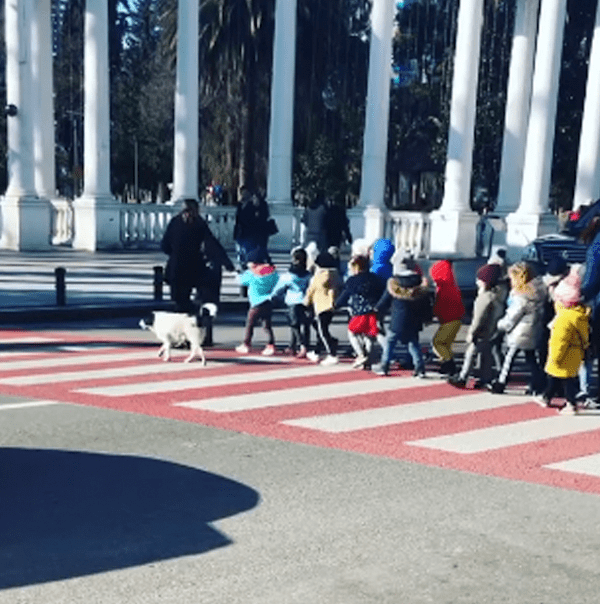
Unfortunately, there are still some drivers out there who apparently don’t know how to treat pedestrians with the respect that they deserve.
But this little dog is doing his best to set them straight.
The other day, Beqa Tsinadze happened upon a curious scene in the town of Batumi, Georgia. There, at a clearly marked crosswalk, a group of young kids were waiting for cars to yield so they could safely cross the road.
Photo Credit: Beqa Tsinadze
Regrettably, though, it seems that many drivers weren’t eager to extend that courtesy without being told to.
So, that’s exactly what this dog did — taking on the role of crossing guard on the kids’ behalf. The moment was captured on video.
The thoughtful dog tackled the situation like a pro. But apparently this wasn’t just a one-time thing.
Tsinadze shared another video of the same dog stopping traffic and escorting yet another group of kids across the street.
Photo Credit: Beqa Tsinadze
Though it’s unclear why the pup came to adopt the role of crossing guard, it may be as a way of saying thanks.
According to Georgian media, the dog arrived to the area as a helpless stray a few years back, and has since endeared himself to members of the community who have taken it upon themselves to care for him.
The report above states that the dog goes by several names among folks in the neighborhood who know him — but there’s no doubt that you’d be safe in calling him a very good boy.
ooOOoo
Another wonderful report.
I’m sorry, I ought to write more but I would only be waffling!
Interesting article about calculating a dog’s age.
It’s a well-known ‘calculation’ that a dog’s age is seven years for every human year. But it’s wrong; the scientific result is more complex.
But rather than me say it, I’ll hand it over to Christian Yates of the BBC who on the 6th January this year published an article on this subject.
ooOOoo
Your pet clearly ages faster than you do, but new research is giving us a much clearer idea of just how old your dog really might be.
By Christian Yates, January 6th, 2020
If your dog has been alive and kicking its paws about for a decade, the widely held belief is it has aged as much as a human would have done over 70 years. This conversion factor – each year of a dog’s life accounting for seven human years – comes from dividing human life expectancy of around 77 by the canine life expectancy of around 11.
The underlying assumption is that each calendar year a dog lives through is equivalent to seven human years at any stage of a dog’s life. But new research suggests that things aren’t so simple. And if we look at some basic developmental milestones, it’s clear why.
For example, most dog breeds reach sexual maturity between the ages of six and 12 months – the upper end of that range corresponding, by the traditional conversion, to a human age of seven. And at the other end of the spectrum, although unusual, some dogs have been known to live for over 20 years. Under the “factor-of-seven” conversion rule, this would equate to an unfathomable 140 human-equivalent years.
New insights into how dogs age suggest our pets move into middle age more rapidly than most owners might suspect (Credit: Getty Images)
To make matters more complicated, dogs’ life expectancy depends significantly on the breed. Smaller dogs tend to live significantly longer, suggesting that they age more slowly than bigger dogs.
All of this raises the question of what exactly we mean by age. The most obvious way to describe it is simply the length of time that has passed since birth. This is known as the chronological definition of age.
When it comes to comparing animal ages across species, the biological definitions of age are far more useful than their chronological counterparts
However, there are other descriptions. Biological age, for example, is a more subjective definition, which relies on assessing physiological indicators to identify an individual’s development. These include measures like the “frailty index” – surveys that take into account an individual’s disease status, cognitive impairments and levels of activity.
Rather than celebrating chronological age, looking at the levels of methylation on a dog’s DNA is a much more accurate measure of aging (Credit: Getty Images)
For example, if you’ve spent a lot of time eating junk food and smoking cigarettes instead of taking exercise and eating healthily, the chances are your biological age will exceed your chronological age. Or, you might be a 60-year-old with the body of a 40-year-old if you’ve looked after yourself well.
A dog’s life
When it comes to comparing animal ages across species, the biological definitions of age are far more useful than their chronological counterparts. Knowing a hamster is six weeks old doesn’t give you a good picture of that animal’s life stage, even if you know the life expectancy of a hamster is only three years. Learning that a hamster has reached an age where it can reproduce gives a much better picture of its level of maturity.
In their first year of life, puppies grow up so quickly that they age the equivalent of 31 human years (Credit: Getty Images)
In particular, “methylation” – the addition of methyl groups (a carbon atom bonded to three hydrogen atoms) to DNA – seems to be a good indicator of age. Many prominent physiological markers, such as the development of teeth, seem to occur at the same levels of methylation across different species. So by matching the levels of methylation in Labrador retrievers and humans, the researchers derived a formula to map dog age to its human equivalent.
That formula is: human equivalent age = 16 x ln(dog’s chronological age) + 31.
Here “ln” represents a mathematical function known as the natural logarithm. The logarithm function is well-known in the non-linear scales for energy released during earthquakes (Richter) or for measuring sound (decibels). It comes in useful for measuring quantities whose sizes vary over many orders of magnitude. It’s even possible that a logarithmic experience of the passing of time might explain why we perceive time speeding up as we get older.
A handy short cut is to remember that the first dog year counts for 31 human years
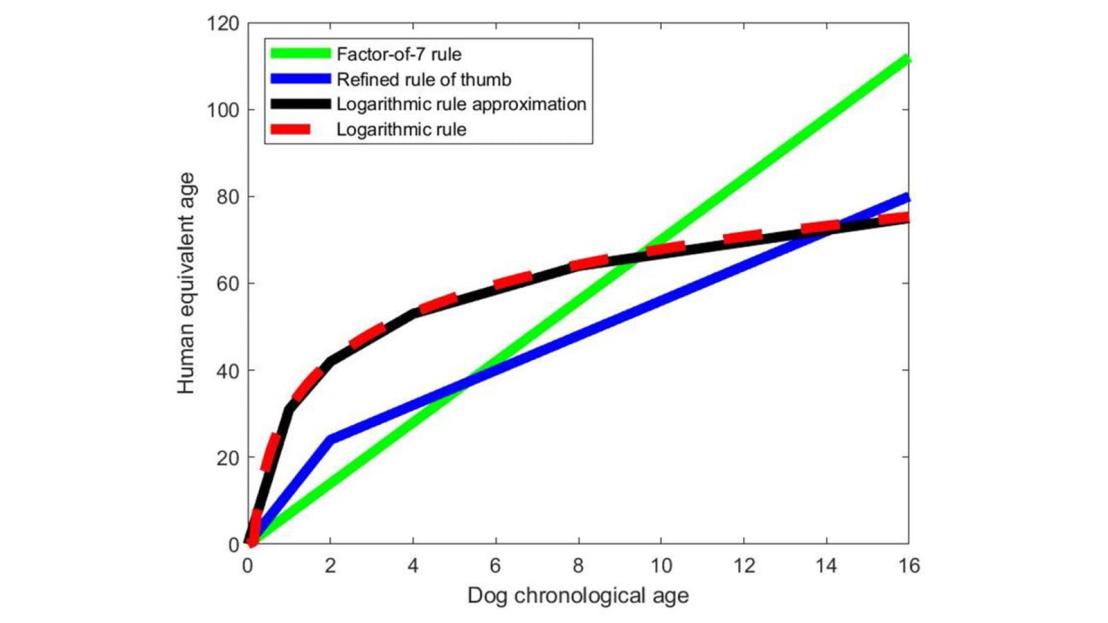
In the graph below, you can see how the natural logarithm works to convert the years a dog has lived (dog age) into the equivalent human age in the red dashed curve. The curve suggests that dogs mature extremely rapidly at first, but that their ageing then slows down, meaning that most of their lives are experienced as a form of protracted middle age.
A handy short cut is to remember that the first dog year counts for 31 human years. Then, after that, every time the dog’s chronological age doubles, the number of equivalent human years increases by 11. So eight calendar years represents three “doublings” (from one to two, two to four and then four to eight) giving a dog age equivalent of 64 (that’s 31 + 3×11).
This useful approximation is plotted as the black curve on the conversion figure below. The green line represents the discredited factor-of-seven rule that suggests unrealistic ages at the higher end of the dog age spectrum.
In eight calendar years a dog will approximately age the equivalent of 64 years (Credit: Christian Yates)
Most dog lovers will already have suspected that the human-to-dog age relationship is non-linear, having noticed that, initially, their pets mature much more quickly than the linear factor-of-seven rule suggests.
A more sophisticated refinement to the factor-of-seven rules has suggested that each of the dog’s first two years correspond to 12 human years while all subsequent years count for four human equivalents. The blue curve in the above figure, which represents this ad hoc rule, shows better agreement with the new logarithmic law.
In practice the new molecular insights into human-to-dog age conversion encapsulated by the logarithmic law suggest that dogs move into middle age even more rapidly than most dog-owners would have suspected. It’s worth bearing in mind, when you find that Rex is reluctant to chase the ball like he once did, that he’s probably got more miles on the clock than you’ve been giving him credit for.
Christian Yates is a senior lecturer in mathematical biology at the University of Bath. He is also the author of The Maths of Life and Death.
This articleoriginally appearedon The Conversation, and is republished under a Creative Commons licence.
ooOOoo
I don’t know about you but I found this article extremely interesting.
Playing a game of fetch with a dog means they are following a human social cue to recover the ball. But fetch isn’t just for dogs, wolf puppies are down to play too, which means they can also understand human communication cues, according to a new study.
Credit Wikipedia Commons
The findings, published in the journal iScience, were made after researchers put 13 8-week-old wolf puppies from three different litters through a series of tests usually used to assess dog-puppy behavior. Three of the pups were interested in playing fetch with a stranger, which included bringing a ball back when encouraged to.
The discovery was quite a surprise for the team as it was believed that the cognitive abilities necessary to understand communication cues given by a human were presented in dogs only after humans domesticated them 15,000 years ago. Dogs differ from wolves physically, genetically and behaviorally.
“When I saw the first wolf puppy retrieving the ball, I literally got goosebumps,” said Christina Hansen Wheat of Stockholm University in a press release. “I immediately knew that this meant that if variation in human-directed play behavior exists in wolves, this behavior could have been a potential target for early selective pressures exerted during dog domestication.”
Wanting to learn more about the effects of domestication on behavior, Hansen Wheat and her team raised wolf and dog puppies from the age of 10 days and put them through various behavioral tests. In one of them, the pup was thrown a ball by an unknown person, encouraging the wolf to get it and bring it back.
Expectations of the wolf pups catching on weren’t high, with the first two litters showing no interest in the balls, let alone of playing fetch. But everything changed with the third litter. A few of the puppies went for the ball and even responded to the social cues and brought it back.
“It was very surprising that we had wolves actually retrieving the ball,” said Hansen Wheat. “I did not expect that. I do not think any of us did. It was especially surprising that the wolves retrieved the ball for a person they had never met before.”
In the past, other research showed that domesticated and non-domesticated species will follow human gestures if a food reward is given, Hansen Wheat and her team said. But in those cases, the animals were previously trained to follow the cues or knew the person conducting the study.
While the new research has a limitation over the size of its sample, it could reassess our interpretation that understanding human social cues came from domestication. Instead, it could be possible that this behavior can be traced back to an ancestral population before wolves were domesticated into dogs.
ooOOoo
Despite this being the twenty-first century there are still things being discovered that cause us humans to be amazed.
Such as this story about the young wolves, way before they evolved into dogs.
The following was sent to me by Chris Gomez, brother of Dan, who I have known for nearly as long as Dan (and that’s a long time)!
The article appeared on ZME Science was published on the 15th January. It contains material that I, for one, didn’t know and I suspect I’m not the only one.
Have a read.
ooOOoo
Why do dogs have whiskers?
Whiskers allow dogs to “see” things that are literally under their noses.
Many mammals, including canines, have whiskers. Some dog owners think these whiskers are just longer unruly hairs that can be groomed and even snipped off entirely — but this would be a huge mistake. The whiskers, technically known as “vibrissae”, serve important specialized functions that help dogs sense the world around them and coordinate their movement.
Humans sense touch through millions of sensory receptors that line the skin and deeper tissue. Unlike humans, the follicles of the coarse hairs protruding from a dog’s muzzle, jaw and above its eyes are also packed with nerves that relay sensory information.
Essentially, these whiskers allow dogs to sense objects and the world around them as humans do with fingers.
What are a canine’s whiskers good for
Credit: Wikimedia Commons.
The tactile sensation is made possible thanks to Merkel cells, which are specialized skin receptors associated with nerve terminals. A dog’s mouth and snout are very rich in Merkel cells, according to a study published in the journal Veterinary Science.
According to researchers, these tactile hairs serve a variety of functions. For instance, the whiskers allow dogs to gather information from subtle changes in air currents about size, shape, and speed of nearby objects. Ultimately, this allows canines to see their surroundings better, even in dark. It’s well known that vision isn’t a dog’s strong point, so their vibrissae greatly assist them — especially when dealing with close objects (dogs are farsighted). Whiskers beneath the chin allow dogs to “see” objects obstructed by their snouts.
Whisker’s positioned immediately above the eyes are particularly important for vision. When an object or strong airflow causes these whiskers to flex, dogs will reflexively blink in order to protect their eyes.
It’s not clear whether dogs use their whiskers for food acquisition. However, if they’re anything like rats, seals, and walruses — all related species that have been shown to use their whiskers to find food — dogs might very well use their sensing hairs for this purpose, too.
A dog’s whiskers can also serve an important role in communication with other canines or other species. Like many other mammals, when a dog is threatened it will automatically flare its whiskers, pointing them in a forward direction. This signals to predators and other aggressive animals that the dog is ready to defend itself and respond with violence.
Dogs may use their whiskers to also disperse pheromones, keep their head upright when swimming, and monitor their environment.
About 40% of a canine’s visual cortex (the part of the brain responsible for processing vision) is devoted to mapping information from whiskers. They’re that important!
What you need to know about your dog’s whiskers
Credit: Pxfuel.
Although they might look similar, vibrissae are distinct from body hair. The main difference is that a dog’s whiskers are directed by the nervous system and contain nerves.
Unlike cats, which have four rows of whiskers on either side of a cat’s face, the placement of a dog’s whiskers is less predictable. Some have a multitude of vibrissae, others may have few or even none. You should find them above the eyes, on both sides of the muzzle, above the upper lip (pointing down) and beneath the dog’s chin.
According to scientists, there are no breed-specific differences in canine whiskers. An exception may involve hairless breeds, which have no whiskers at all.
That being said, you should never trim your dog’s whiskers. Some pet owners believe their dogs’ whiskers should be groomed and snip them for aesthetic purposes.
This practice won’t hurt the dog, because there are no pain receptors found in whiskers. However, given the multitude of functions they serve, a whisker-less dog will become confused, disorientated, and less able to navigate its spatial surroundings. If you cut your dog’s whiskers in the past out of ignorance, know at least that they will grow back naturally.
In summary, dogs use their whiskers as a sort of radar to detect objects that they cannot properly see with their own eyes.
ooOOoo
Apart from the fact that the photographs are gorgeous there is much material that is good to know. For instance, I never knew there were no breed-specific differences in canine whiskers. Just hadn’t thought about it before.
Yesterday and today are days where it’s my turn to do the neighborhood watch patrols. I left for the first patrol a little after 9am yesterday and when I was going up Livingston Drive there was a guy walking his Corgi. Now it’s the second time we have met and I stopped and let the sweet dog come up to my outstretched hand and sniff my fingers. John, not his real name, mentioned that he was slowly adapting to a life of love and affection in stark contrast to the beatings the dog received in his previous life. John was a real hero!
Here’s another example of goodness beyond description. Taken from The Dodo.
ooOOoo
Dog Found On Side Of Road Immediately Snuggles Her Rescuer
Photo Credit: Kris Lenker
Kris Lenker and her husband were driving home from work last week when they spotted something on the road ahead.
They assumed, being out in the country, that the small, tan animal was a baby deer — but as they got closer, they realized their mistake. “We slowed down and realized that it was a dog,” Lenker told The Dodo.
Lenker hopped out of the car and called to the dog, but the nervous pup took off down a pathway. Lenker followed close behind, tempted to turn around. “I couldn’t see her anymore and we almost left,” Lenker said. “I just had a feeling, though.”
Photo Credit: Kris Lenker
Lenker found the dog hiding behind a fence, and after a few minutes of gentle pets, the nervous dog decided to take a chance. “She wrapped her front paws around my neck and let me carry her back to the car,” Lenker said. “She was absolutely terrified, but I could tell she trusted me … It just felt like we were brought together for a reason.”
Shortly after the dog entered the car, her demeanor changed. It was as if she knew she was finally safe. “I just pet her and told her I had her,” Lenker said. “That is when she just collapsed into a ball in my lap. It’s like relief just hit her. She rode the rest of the way home in my lap like that.”
Photo Credit: Kris Lenker
While she decompresses and regains her strength, the dog, whom the couple has named Reba, is hanging out in a warm bathroom. When she’s up to it, she’ll get to meet her new dog siblings, who will show her the rules of the house.
And Reba is still just as affectionate as the first day they found her: “Belly rubs are her favorite, and she doesn’t hesitate to ask for them!” Lenker said. “She rolls on her back and paws at us until we give in.”
Reba was initially resistant to being rescued, but now she doesn’t want to leave — even to go outside for potty training. She demands that her mom carries her outside and back in every time.
Photo Credit: Kris Lenker
“I think she is still afraid she will be left out there,” Lenker said.
It’s only been a few days, but already Reba has been putting on weight and learning what it means to have a real family. “Her energy level is so much better and she is the biggest love bug,” Lenker said. “All she wants to do is snuggle us and give us kisses. It’s her favorite thing to do.”
Lenker believes they were truly meant to have Reba as part of their family. “She wouldn’t let anyone get near her, but she let us take her,” Lenker said. “She trusts us so much and we have fallen in love.”
ooOOoo
“She trusts us so much and we have fallen in love.” What a fabulous end result.
There are so many loving people out there that would do the same. It’s an honour to present this account.