The great thing about going away is the home-coming!
I’m speaking of coming back to one’s dogs. This theme of coming home to your dogs was prompted by something I read the other day on The Dodo newsletter. It was an article … well you read it rather than me explain it.
ooOOoo
Dogs Are So Excited When Mom Finally Comes Home From 8-Month Deployment
Photo Credit: Taryn Dennison
Bauer first met his mom when he was just a puppy, and ever since then they’ve been basically attached at the hip. Bauer follows his mom everywhere she goes and loves hanging out with her no matter what they’re doing.
“Bauer isn’t your typical husky, he doesn’t bark and he rarely howls,” Taryn Dennison, Bauer’s mom, told The Dodo. “He loves sleeping and when he’s awake he’s right next to you trying to get all the cuddles and pets he can or to get you to throw his toys.”
When Dennison found out she was going to be deployed, she knew it was going to be hard to leave Bauer behind. He stayed with her roommate and her roommate’s dog, Macie, and was cared for and loved so well, but everyone could tell that he missed his mom so much.
Photo Credit: Taryn Dennison
“Bauer didn’t understand why I was gone,” Dennison said. “I FaceTimed him a few times and he would run around my house trying to find me and then later he would end up laying down and falling asleep in front of my door.”
Finally, after eight long months apart, Dennison arrived home…and as soon as she walked in the door, Bauer completely lost it.
He was overwhelmed with joy and so thrilled that his mom was finally home, and couldn’t stop licking her and jumping all over her.
“I honestly thought he was going to pee on me because he was so excited,” Dennison said.
Photo Credit: Taryn Dennison
Even Macie was excited, especially when she saw how happy Bauer was, and both dogs jumped around Dennison as she sat on the floor with them. After so much time apart, she was so happy to finally be home with Bauer and the rest of her loved ones.
“Since I got home he’s been attached to my hip,” Dennison said. “I can’t even get up to go to the kitchen or the bathroom without him being right next to me. I wouldn’t change it for the world!”
Bauer missed his mom so much, but now that she’s home, he’s making sure he doesn’t take a single minute of being with her for granted.
ooOOoo
To keep up the theme for a little longer, here is a YouTube video of dogs and their returning owners.
I hope you enjoyed it.
Finally, Jean and I just need to go the shops in Grants Pass, about 20 minutes away, and when we return home, perhaps 1 or 2 hours later, we are greeted by all our dogs in a similar fashion. The vast majority of dogs offer unconditional, unbridled love! 😍
There was a recent post on The Conversation that was published for the kids among us. But I thought it would have an appeal far wider than just for our children, and it is republished here.
ooOOoo
Do dogs really see in just black and white?
By Nancy Dreschel
Associate Teaching Professor of Small Animal Science, Pennsylvania State University.
Do dogs really see in just black and white? – Oscar V., age 9, Somerville, Massachusetts
While most people see a full spectrum of colors from red to violet, dogs lack some of the light receptors in their eyes that allow human beings to see certain colors, particularly in the red and green range. But canines can still see yellow and blue.
Different wavelengths of light register as different colors in an animal’s visual system. Top is the human view; bottom is a dog’s eye view.
What you see as red or orange, to a dog may just be another shade of tan. To my dog, Sparky, a bright orange ball lying in the green grass may look like a tan ball in another shade of tan grass. But his bright blue ball will look similar to both of us. An online image processing tool lets you see for yourself what a particular picture looks like to your pet.
Animals can’t use spoken language to describe what they see, but researchers easily trained dogs to touch a lit-up color disc with their nose to get a treat. Then they trained the dogs to touch a disc that was a different color than some others. When the well-trained dogs couldn’t figure out which disc to press, the scientists knew that they couldn’t see the differences in color. These experiments showed that dogs could see only yellow and blue.
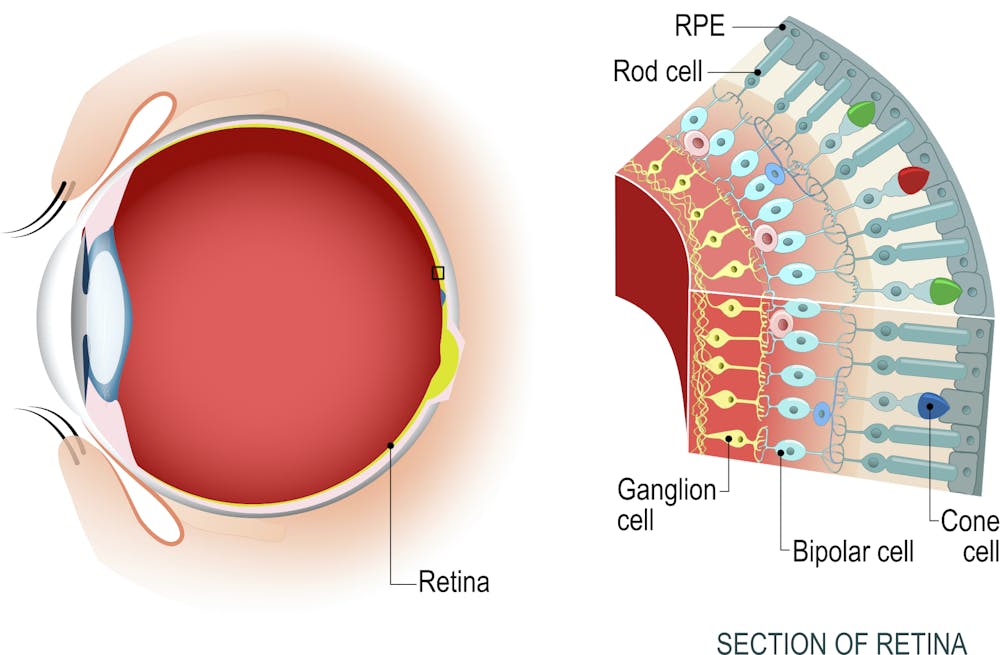
Light travels to the back of the eyeball, where it registers with rod and cone cells that send visual signals on to the brain.
Not only can dogs see fewer colors than we do, they probably don’t see as clearly as we do either. Tests show that both the structure and function of the dog eye leads them to see things at a distance as more blurry. While we think of perfect vision in humans as being 20/20, typical vision in dogs is probably closer to 20/75. This means that what a person with normal vision could see from 75 feet away, a dog would need to be just 20 feet away to see as clearly. Since dogs don’t read the newspaper, their visual acuity probably doesn’t interfere with their way of life.
There’s likely a lot of difference in visual ability between breeds. Over the years, breeders have selected sight-hunting dogs like greyhounds to have better vision than dogs like bulldogs.
But that’s not the end of the story. While people have a tough time seeing clearly in dim light, scientists believe dogs can probably see as well at dusk or dawn as they can in the bright middle of the day. This is because compared to humans’, dog retinas have a higher percentage and type of another kind of visual receptor. Called rod cells because of their shape, they function better in low light than cone cells do.
Dogs also have a reflective tissue layer at the back of their eyes that helps them see in less light. This mirror-like tapetum lucidum collects and concentrates the available light to help them see when it’s dark. The tapetum lucidum is what gives dogs and other mammals that glowing eye reflection when caught in your headlights at night or when you try to take a flash photo.
Dogs share their type of vision with many other animals, including catsand foxes. Scientists think it’s important for these hunters to be able to detect the motion of their nocturnal prey, and that’s why their vision evolved in this way. As many mammals developed the ability to forage and hunt in twilight or dark conditions, they gave up the ability to see the variety of colors that most birds, reptiles and primates have. People didn’t evolve to be active all night, so we kept the color vision and better visual acuity.
Even though Sparky might not be able to easily see that orange toy in the grass, he can certainly smell it and find it easily when he wants to.
ooOOoo
Trust me, the dog’s nose is “much more powerful”. Upwards of fifty million times more so, as I wrote about here.
Plus, living with so many dogs as we do, there are instances when all the dogs start barking, frequently when they are all in our bedroom getting ready for the night. Jean and I cannot hear a thing but the dogs can, and Jean and I don’t have a clue!
They are incredible creatures and humans are so lucky to have them around us.
In fact, I am ‘stealing’ the whole of Colin’s post, albeit with his permission, because recently he posted on his blog Wibble a poem written by Linda Ellis that is perfect. Indeed, it is more than perfect, it is a unique view of our lifetimes: yours; mine, everyone’s.
I learnt about ‘living your dash’ from Robby Robin’s Journey. ‘The dash’ is the one that goes between your dates of birth and death. Mine, for instance, is in “1960-” (because I’m not dead yet). Jane Fritz says:
This expression was popularized by Linda Ellis’s poem
The Dash; it provides a powerful metaphor for your life and helps us think about how our own dashes might be evaluated.
I went googling for the poem. It wasn’t hard to find it. However, reproducing it is subject to licence… which I applied for and was kindly granted. So here it is:
~~~~~~~~
The Dash
by Linda Ellis
I read of a man who stood to speak at the funeral of a friend.
He referred to the dates on the tombstone from the beginning… to the end.
He noted that first came the date of birth and spoke of the following date with tears, but he said what mattered most of all was the dash between those years.
For that dash represents all the time they spent alive on earth
and now only those who loved them know what that little line is worth.
For it matters not, how much we own, the cars… the house… the cash.
What matters is how we live and love and how we spend our dash.
So think about this long and hard; are there things you’d like to change?
For you never know how much time is left that still can be rearranged.
To be less quick to anger and show appreciation more
and love the people in our lives like we’ve never loved before.
If we treat each other with respect and more often wear a smile…
remembering that this special dash might only last a little while.
So when your eulogy is being read, with your life’s actions to rehash,
would you be proud of the things they say about how you lived your dash?
Maybe it is because I am in my mid-seventies. Maybe it is because I have never thought of it before; as in the dash! Maybe it is because I am looking for something that is beautifully clear; an antidote to the complicated world we appear to be living in.
I can’t fathom it out but that doesn’t matter in the slightest.
It is a very beautiful, inspiring poem that gets to the heart of living!
I can’t remember how long ago it was that I came across Alexandra Horowitz but the name stuck. For Alexandra is an author of many titles although many of them are about dogs.
But here’s a quote from someone who reviewed her book, On Looking: A Walker’s Guide to the Art of Observation.
“Horowitz writes like a poet, thinks like a scientist, and ventures like an explorer. Her book will have you looking in a new way at the world around you, and make you glad you did.” – Susan Orlean, author of Rin Tin Tin
If you haven’t already read some of her books then don’t delay!
Now I want to introduce a different side of Alexandra. That of her being a broadcaster, for want of a better description.
This is not a short video, it is 49 minutes long. But that’s a reason to sit down and thoroughly immerse oneself in her talk.
It is introduced thus:
To a dog, there is no such thing as “fresh air.” Every breath is full of information—in fact, what every dog knows about the world comes mostly through their nose. Dogs, when trained, can identify drugs of every type, underwater cadavers, cancer, illicit cell phones in prison, bed bugs, smuggled shark fins, dry rot, land-mines, termites, invasive knapweed, underground truffles, and dairy cows in estrous. But they also know about the upcoming weather, earthquakes before they happen, how “afternoon” smells, what you had for breakfast, and whether a cat touched your leg yesterday. And of course, they sniff their way home and know the distinctive odor of each spot of sidewalk as you travel there.
Alexandra Horowitz is a research scientist in the field of dog cognition and the New York Times bestselling author of “Inside of a Dog”. Her new book “BEING A DOG: Following the Dog into a World of Smell” explores in even greater depth what dogs know, delving into all of these remarkable abilities and revealing a whole world of experiences we miss every day. Alexandra visited Google Seattle to share her research and open eyes (and noses!) of pet parents everywhere.
Those were Jeannie’s words not mine. When you consider the number of dogs that Jean has introduced into her pack, especially down in Mexico, that is quite a statement!
Very soon after Renate coming round to our place at 10 am yesterday morning Sheena came into the house. I tried to take a few photographs in those early moments. They are not the best I have taken!
Sheena within minutes goes to her bed.
oooo
Little Pedi watching Sheena!
oooo
oooo
oooo
Sheena getting to know Oliver.
oooo
oooo
oooo
Now we have yet to go a full day (as this is being written on Friday for publication at midnight PDT tonight). But Jean and I have a good feeling about Sheena.
I follow Colin’s blog Wibble. It ranges across a myriad of thoughts and beliefs and it’s a good follow.
On June 9th, Colin published a post regarding The wolves within, a beautiful legend from the Cherokees. Colin readily and promptly gave me permission to share it with you.
The content isn’t mine, but of course it’s fine by me, Paul. You’re too polite by half! 😀
Here it is.
ooOOoo
The wolves within: a Cherokee legend
Posted on June 9, 2020
An old grandfather said to his grandson, who came to him with anger at a friend who had done him an injustice, “Let me tell you a story.
“I too, at times, have felt a great hate for those that have taken so much, with no sorrow for what they do.
“But hate wears you down, and does not hurt your enemy. It is like taking poison and wishing your enemy would die. I have struggled with these feelings many times.” He continued, “It is as if there are two wolves inside me. One is good and does no harm. He lives in harmony with all around him, and does not take offense when no offense was intended. He will only fight when it is right to do so, and in the right way.
“But the other wolf, ah! He is full of anger. The littlest thing will set him into a fit of temper. He fights everyone, all the time, for no reason. He cannot think because his anger and hate are so great. It is helpless anger, for his anger will change nothing.
“Sometimes, it is hard to live with these two wolves inside me, for both of them try to dominate my spirit.”
The boy looked intently into his grandfather’s eyes and asked, “Which one wins, grandfather?”
The grandfather smiled and quietly said, “The one I feed.”
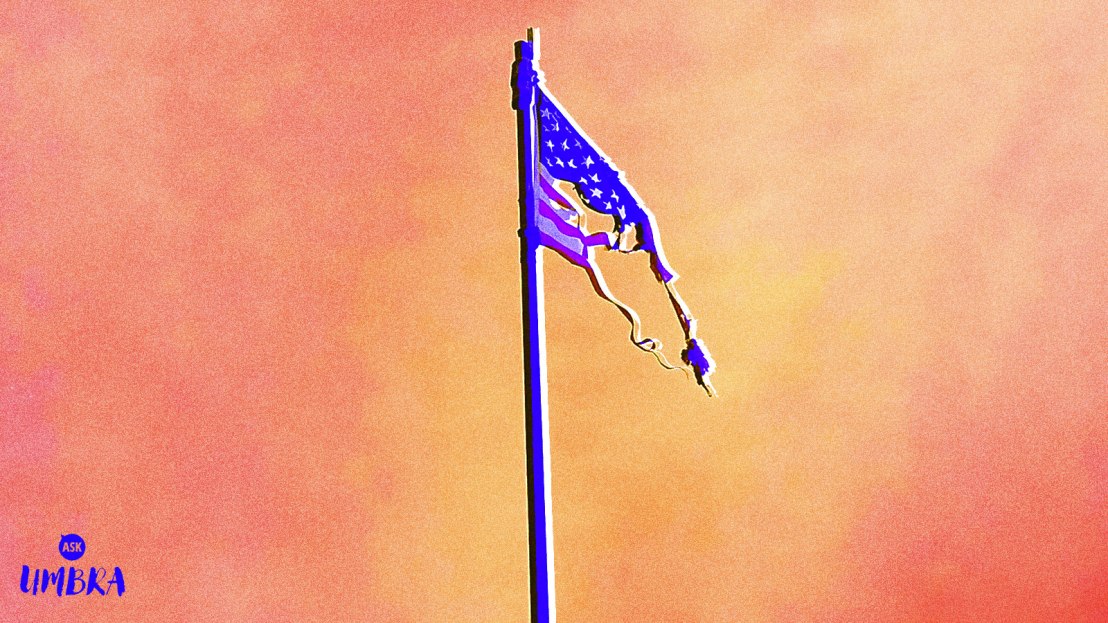
On June 4th this year Grist published an article written by Eve Andrews. It is not about dogs at all. Yet, it seems to me to ask a fundamental question about us humans. The article speaks of America but certainly it applies to my old country, the U.K., and it probably applies to most of the countries in the world.
I recently wrote to Annelise McGough, the Growth and Engagement Editor at Grist asking if I could republish the article. She kindly said yes!
Did any aspect of climate change cause the pandemic to happen this year (versus last year or next year)? Could pandemics happen more often?
— Which Oracle Read Rightly Imminent, Existential Doom?
A. Dear WORRIED,
2020: what a year so far! As anyone who witnessed the crowds of face mask-clad people show up in the middle of a deadly pandemic to protest police violence this weekend can attest, a lot seems to be terrible all at once. You’re asking, in a sense, why now? It almost seems like it must be a rhetorical question. But it’s not — by understanding how we got into this mess, we might presumably be able to find our way out.
This doesn’t just apply to the pandemic.
Let’s start by taking your question at face (mask) value: There are multiple factors that have contributed to the rise of zoonotic illnesses — those of animal origin — over recent years, as my very sharp colleague Shannon Osaka delineated in an article and video earlier in the spring. Scientists believe COVID-19, like several other SARS viruses, likely originated in a bat. It turns out many strains of coronavirus can be traced back to bats! Who knew those little guys were such harbingers of destruction?
It’s not really on the bats, of course. Warmer temperatures (an established feature of climate change) and environmental degradation (often attributed to climate change, industrialization, or other products of human development) have driven a lot of animals to migrate out of their normal habitats and into human ones. Those factors have also contributed to different species coming into close contact with each other, which makes viruses normally contained to one species more likely to “spill over,” or jump to a new type of animal.
So clearly, the lead-up to the novel coronavirus’s outbreak was a gradual one. But perhaps 2019 was just warm enough to kill off enough of the insect population that some COVID-19-carrying bat depended on for food, and that drove it out to wreak some (unintentional) havoc on humanity. The bat’s habitat could have been destroyed by a new coal mine development. It could have woken up one morning and thought: This is my time to fuck shit up! Revenge on those humans that messed up my home! (OK, there was also probably a pangolin involved, but let’s keep things simple.)
According to the Centers for Disease Control and Prevention, COVID-19 is the fourth major pandemic caused by a novel virus to hit the United States since the 1918 “Spanish flu” that killed 50 million people worldwide. And there are so many factors and variables that lead to the sprout of a pandemic that you could very well argue that, “Yes, of course it happened at this exact point in time” or “No, it could have happened at any point in time.” It’s impossible to know for sure. But climate change and habitat destruction are certainly working together to create circumstances more favorable to the spread of disease, and that means pandemics will likely become more common as the world grows warmer.
The thing is, highly contagious, devastating illnesses have always been a part of human life, even though a real pandemic is a few-times-per-century event. It’s a fact of sharing the Earth with other living things; it just happens. But humans are ostensibly equipped with the means to contain the spread of diseases and help heal those who become sick. At this moment, thanks to advances in medicine and information-sharing and communication, that’s more true than ever before!
And yet. The United States, an astonishingly wealthy nation with ostensibly the most advanced — certainly the most expensive! — medical system in the world, has lost around 100,000 people to COVID-19, with many more surely to come. That doesn’t even take into account the far-reaching hardship caused by an economic collapse as drastic, by some metrics, as the Great Depression. The current unemployment rate, for example, exceeds 20 percent.
The reality is that what some have referred to as “the lost spring” (and what could very well be “the lost year”) is not the product of a single infectious disease, but the boiling over of many long-standing crises, including structural forms of injustice. Like everything else in American society, the damage done by the coronavirus is unevenly distributed across race. The death rate of black Americans from COVID is three times that of whites, and 40 percent of black-owned businesses have shuttered due to social distancing measures. As of April, rates of black and Latino unemployment were 16.7 and 18.9 percent, respectively, compared to 14.2 percent for whites. These hardships continue to feed into the cycle of racial inequality in this country.
The devastation to American society that we are witnessing in real time, one could argue, could only have happened at the present moment. That’s due to the nightmarish confluence of horrific leadership, centuries of racial oppression, unprecedented wealth inequality, the erosion of the social safety net, privatization of medicine, a far-too-consolidated supply chain, politicization of science, a highly globalized economy, and one misguided or mischievous bat. Oh, and the climate change and environmental degradation that could have led to said bat’s misbehavior.
COVID-19 could have popped up at any time, as viruses do. The degree to which it’s ravaged American society, however, has little to do with the virus itself. Other countries such as New Zealand and South Korea, faced the same disease and came out the other side with far fewer deaths and less severe economic devastation. This is, to a significant degree, about governance and leadership.
It’s also a preview of what climate change can do. A very contagious respiratory virus is an unfortunate fact; it’s not going away, and it is a challenge to be dealt with. Climate change, just the same, is coming whether or not we pay attention to it. Communities, cities, and states are going to have to put measures into place to ensure that it doesn’t literally kill us all. That’s what adaptation means, and that’s why people talk about things like seawalls and tree cover and managed retreat.
But creating a climate-resilient society requires a lot more than just building or planting stuff! This is where I would normally tell you to vote for leaders who support all that building and planting and, more importantly, cutting carbon emissions in the first place. Yes, do that. And additionally, vote for leaders who will feed our starving public systems to make it so they actually support the people who need them. Vote for those who understand and want to change what non-white people experience, what poor people experience, what immigrants experience. Without all of these things, there cannot be a climate-resilient civilization.
If anything were made clear by the unique, mind-boggling suffering that the United States has seen in the past week, brought about by the collision of a viral pandemic and police brutality, it’s that voting is a necessary condition but it is not enough. You, WORRIED, wrote to me to ask why the pandemic happened right now, possibly because it seems like such a uniquely terrible moment for the country to have to deal with it. We not only have the worst possible leader, but also a general absence of leadership altogether.
Going back just a few months, I believe there was an opportunity for an alternate version of this moment in American history in which one incredibly dangerous virus did not kill as many people nor ruin as many lives. But even in that universe, it’s important to acknowledge that pre-pandemic life wasn’t so great for most people. Undoing this path and “restoring order” is a ridiculous hope, since the order that has existed for so long has created a society that is wholly unsustainable judging from almost any social, environmental, or economic perspective.
So what can we do with this knowledge? One, you should be angry. Be angry that leaders missed opportunities to fortify the nation beyond its military, to break down racist systems and promote equality, and to instate laws and policies designed to help prevent crises that, by all accounts, were utterly predictable.
Then I think you should show your anger, whether that’s through protesting, hurling money or your time or whatever you have at worthy organizations that will put it in the right hands, or just screaming and yelling, if you have to. And while voting might not feel like enough when so much feels so wrong, it’s a necessary condition for change — force people in power to know that they created that mess and that they are accountable for it.
Furiously,
Umbra
ooOOoo
Climate change or global warming is with us NOW. It is time to make fundamental changes to the way we live NOW. While many individuals are doing their bit we need international agreement, especially international support for the United Nations, for all the nations in the world NOW.
Thank you for reading this!
It breaks my heart.
Let me not stop with that. I want to hear from you. Are you worried? Or not quite as concerned as me and Umbra? Do you think it is in the hands of our leaders or is it an international problem?
The idea for today’s post came to me from Amanda down in Australia.
We go back years and years and have stayed in contact with each other over that time.
In her latest email she wrote (my italics):
I started some classes at the beginning of the year, a family history research one and a writing one, which had to stop a couple of weeks short courtesy of the virus. The family history class was essentially finished, but the writing class (How to Read/Write a Biography) is an ongoing thing, with the tutor being a published author. I signed up for term two of the writing class as the tutor decided to trial conducting it on-line via Zoom. Many people in the class are either writing a biography or just writing about their lives for their children or grandchildren, so the tutor encouraged us all to write a short piece about this COVID-19 outbreak; observations, feelings, how it’s affected us, or whatever we wanted. There are only six of us in the class, but it was fascinating to hear the resulting six pieces, so utterly different in tone and content, but all really interesting.
I wonder if you could invite something similar from your readers? Imagine the different perspectives and experiences of your readers in their different parts of the world! Just a thought anyway .
So how have you and your dogs been affected. Your feelings, your observations, how it has affected you, and any other thoughts.
And I will close with a photograph that Amanda sent me years ago.
Well it is to me and Jean and, I suspect, it will be to many other people.
I am an atheist. So is Jean. We have been all our lives. I think that many of you who follow this blog know that. The love that we have for our dogs, and all our animals, plus the beauty that is all around us in nature is enough. (Now I am not naive enough to realise that there are many, literally millions, that don’t have the same fortune in their lives.)
The Conversation recently republished an essay by David Weintraub that was first published in 2014. It is at the core of our existence and I am delighted to have the permission to republish it for you.
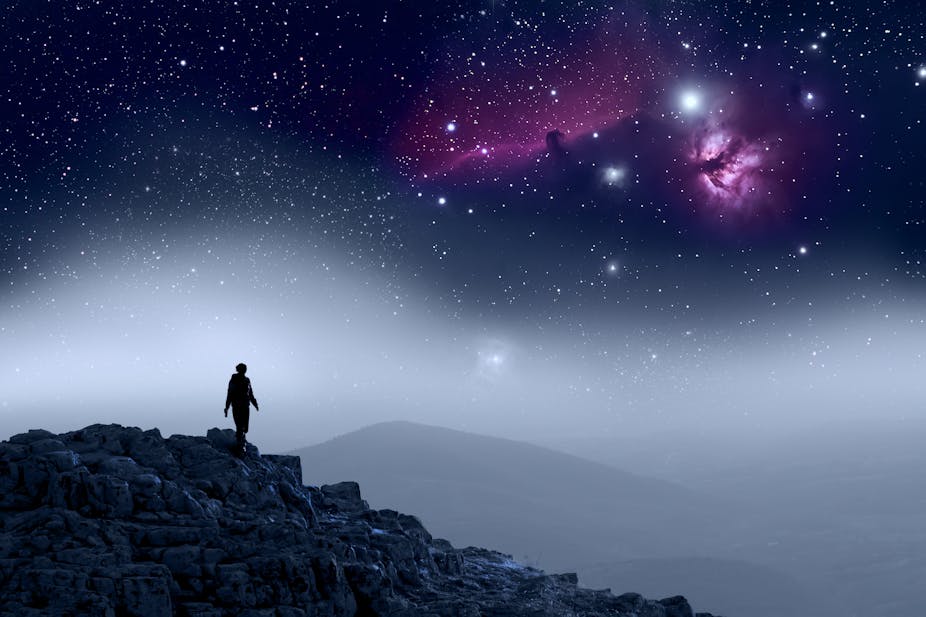
Square away your personal philosophy now; proof of life beyond earth is coming. Stargazing image via http://www.shutterstock.com
How will humankind react after astronomers hand over rock-solid scientific evidence for the existence of life beyond the Earth? No more speculating. No more wondering. The moment scientists announce this discovery, everything will change. Not least of all, our philosophies and religions will need to incorporate the new information.
Having already found the physical planets, astronomers are now searching for our biological neighbors. Over the next fifty years, they will begin the tantalizing, detailed study of millions of planets, looking for evidence of the presence of life on or below the surfaces or in the atmospheres of those planets.
And it’s very likely that astronomers will find it. Despite the fact that more than one-third of Americans surveyed believe that aliens have already visited Earth, the first evidence of life beyond our planet probably won’t be radio signals, little green men or flying saucers. Instead, a 21st century Galileo, using an enormous, 50-meter-diameter telescope, will collect light from the atmospheres of distant planets, looking for the signatures of biologically significant molecules.
Astronomers filter that light from far away through spectrometers – high-tech prisms that tease the light apart into its many distinct wavelengths. They’re looking for the telltale fingerprints of molecules that would not exist in abundance in these atmospheres in the absence of living things. The spectroscopic data will tell whether a planet’s environment has been altered in ways that point to biological processes at work.
With the discovery in a distant planet’s light spectrum of a chemical that could only be produced by living creatures, humankind will have the opportunity to read a new page in the book of knowledge. We will no longer be speculating about whether other beings exist in the universe. We will know that we not alone.
An affirmative answer to the question “Does life exist anywhere else in the universe beyond Earth?” would raise immediate and profoundly important cosmotheological questions about our place in the universe. If extraterrestrial others exist, then my religion and my religious beliefs and practices might not be universal. If my religion is not universally applicable to all extraterrestrial others, perhaps my religion need not be offered to, let alone forced on, all terrestrial others. Ultimately, we might learn some important lessons applicable here at home just from considering the possibility of life beyond our planet.
In my book, I investigated the sacred writings of the world’s most widely practiced religions, asking what each religion has to say about the uniqueness or non-uniqueness of life on Earth, and how, or if, a particular religion would work on other planets in distant parts of the universe.
Extrasolar sinners?
Let’s examine a seemingly simple yet exceedingly complex theological question: could extraterrestrials be Christians? If Jesus died in order to redeem humanity from the state of sin into which humans are born, does the death and resurrection of Jesus, on Earth, also redeem other sentient beings from a similar state of sin? If so, why are the extraterrestrials sinful? Is sin built into the very fabric of the space and time of the universe? Or can life exist in parts of the universe without being in a state of sin and therefore without the need of redemption and thus without the need for Christianity? Many different solutions to these puzzles involving Christian theology have been put forward. None of them yet satisfy all Christians.
Mormon worlds
Mormon scripture clearly teaches that other inhabited worlds exist and that “the inhabitants thereof are begotten sons and daughters unto God” (Doctrines and Covenants 76:24). The Earth, however, is a favored world in Mormonism, because Jesus, as understood by Mormons, lived and was resurrected only on Earth. In addition, Mormon so-called intelligences can only achieve their own spiritual goals during their lives on Earth, not during lifetimes on other worlds. Thus, for Mormons, the Earth might not be the physical center of the universe but it is the most favored place in the universe. Such a view implies that all other worlds are, somehow, lesser worlds than Earth.
Bahá’í without bias
Members of the Bahá’í Faith have a view of the universe that has no bias for or against the Earth as a special place or for against humans as a special sentient species. The principles of the Bahá’í Faith – unifying society, abandoning prejudice, equalizing opportunities for all people, eliminating poverty – are about humans on Earth. The Bahá’í faithful would expect any creatures anywhere in the universe to worship the same God as do humans, but to do so according to their own, world-specific ways.
Light years from Mecca
The pillars of the faith for Muslims require the faithful to pray five times every day while facing Mecca. Because determining the direction of Mecca correctly could be extremely difficult on a quickly spinning planet millions of light years from Earth, practicing the same faith on another world might not make any sense. Yet the words of the Qu’ran tell us that “Whatever beings there are in the heavens and the earth do prostrate themselves to Allah” (13:15). Can terrestrial Muslims accept that the prophetically revealed religion of Muhammad is intended only for humans on earth and that other worlds would have their own prophets?
Astronomers as paradigm-shatterers
Philosophers and scientists have forced worldviews to adapt in the past.
At certain moments throughout history, astronomers’ discoveries have exerted an outsized influence on human culture. Ancient Greek astronomers unflattened the Earth – though many then chose to forget this knowledge. Renaissance scholars Copernicus and Galileo put the Earth in motion around the Sun and moved humans away from the center of the universe. In the 20th century, Edwin Hubble eliminated the very idea that the universe has any center at all. He demonstrated that what the universe has is a beginning in time and that, bizarrely, the universe, the very fabric of three-dimensional space, is expanding.
Clearly, when astronomers offer the world bold new ideas, they don’t mess around. Another such paradigm-shattering new idea may be in the light arriving at our telescopes now.
No matter which (a)theistic background informs your theology, you may have to wrestle with the data astronomers will be bringing to houses of worship in the very near future. You will need to ask: Is my God the God of the entire universe? Is my religion a terrestrial or a universal religion? As people work to reconcile the discovery of extrasolar life with their theological and philosophical worldviews, adapting to the news of life beyond Earth will be discomfiting and perhaps even disruptive.
ooOOoo
Now I don’t really want to open up the subject of religion but I will say that WikiPedia have a great entry about the subject. My own view is that a few hundred years ago, when life was a lot more mysterious and uncertain, believing in life after death made some sense.
But we know a lot better now despite death still being a certainty.


 Nancy Dreschel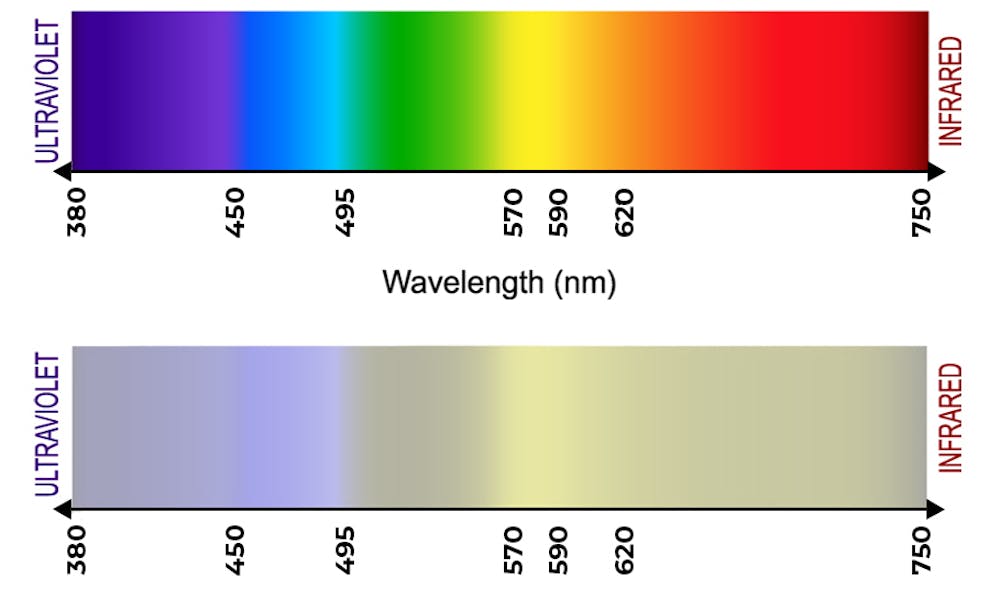
 I learnt about ‘living your dash’ from










 David Weintraub,