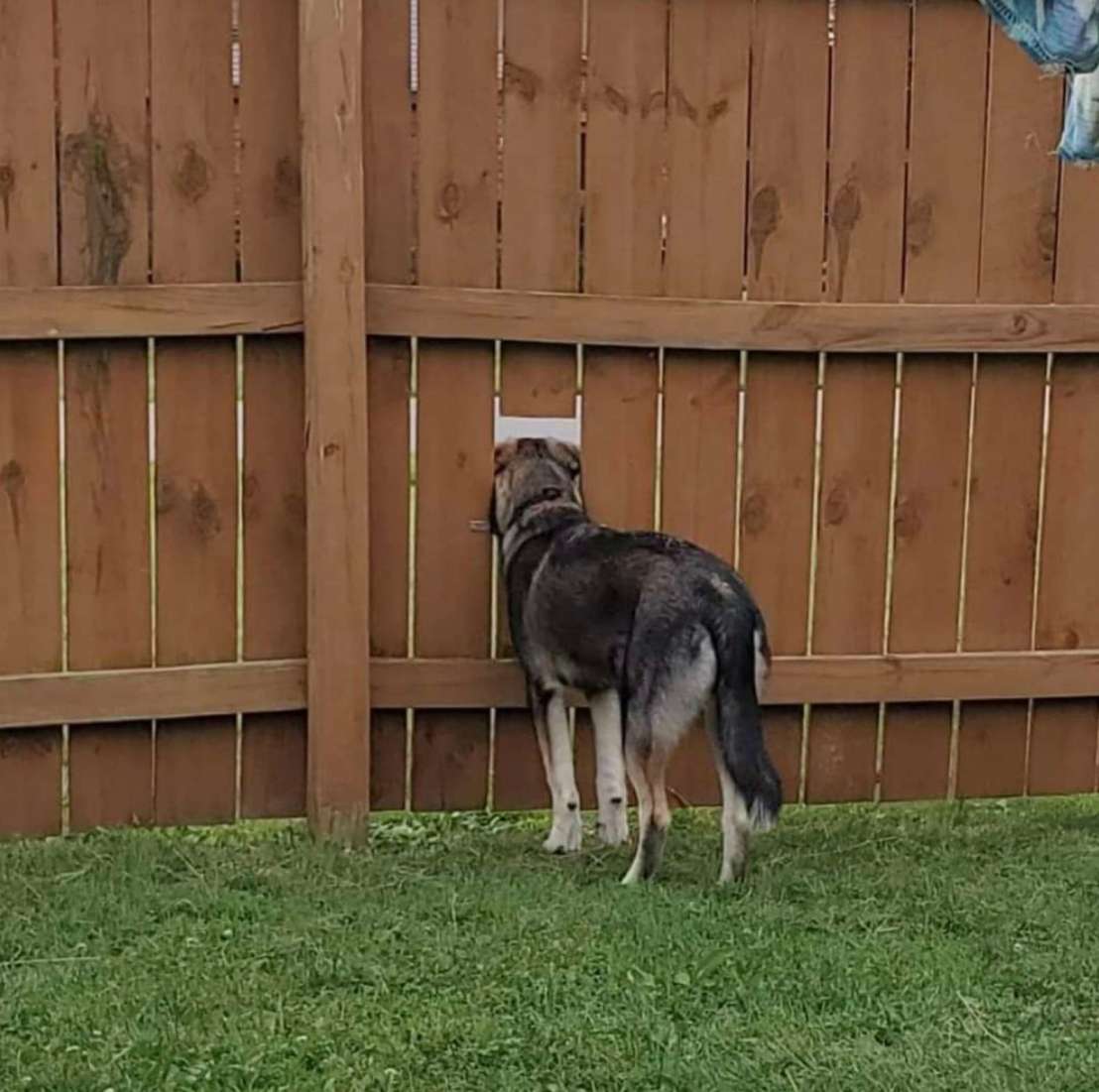
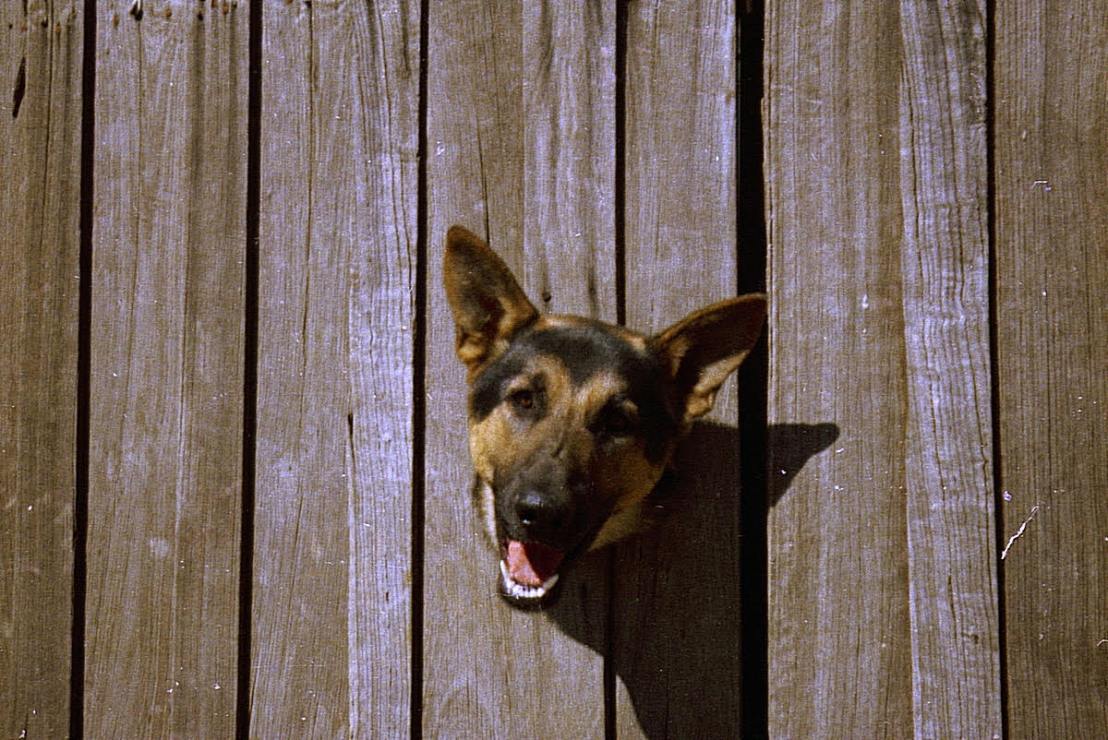
A few months after he was adopted last year, Burger started digging under his family’s fence. He wanted to be able to watch all the people going by, and after thinking about it for a while, his dad came up with the best idea.
He decided to cut a hole in the fence to make a little window for Burger so he could watch the world go by, and Burger instantly fell in love with it.
BRIAN STANLEY
“As soon as I was done, Burger had his head through it and immediately stopped digging,” Brian Stanley, Burger’s dad, told The Dodo. “Best decision ever!”
Now, every time he goes outside, Burger goes straight to his little window. He loves greeting people as they pass by, and he definitely brings a smile to all his neighbors whenever they see his little head peeking out through the window.
BRIAN STANLEY
When the coronavirus pandemic forced things to shut down in March, Stanley and his family noticed that there were suddenly a lot more people out and about walking past their fence than there had been before. The family hoped that seeing Burger would help bring a smile to everyone’s faces during such a hard time — and then Stanley had an idea to take it to the next level.
Brian Stanley
“At first it started as a joke with my wife that I was going to paint something on the street side of the fence around the dog window, but then the idea of painting an actual picture and hanging it up to frame the hole started to form in my mind,” Stanley said. “The shutdown brought an obvious black cloud along with it. Even though more people were out on the street walking or biking, we knew it was due to job loss and uncertain times. I first talked about it to my son who was 100% behind the idea of putting something up on the fence to hopefully bring a smile to people’s faces.”
BRIAN STANLEY
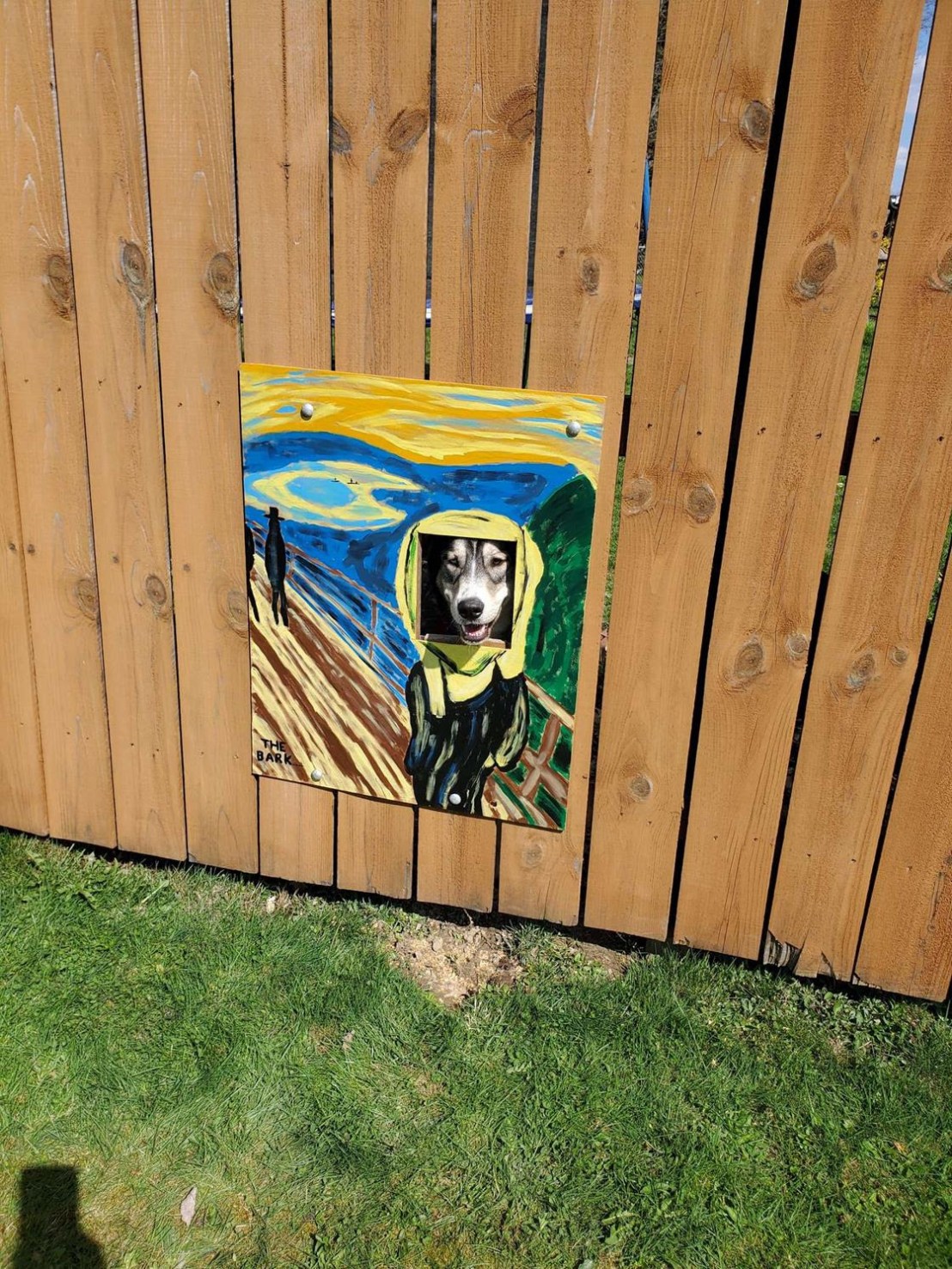
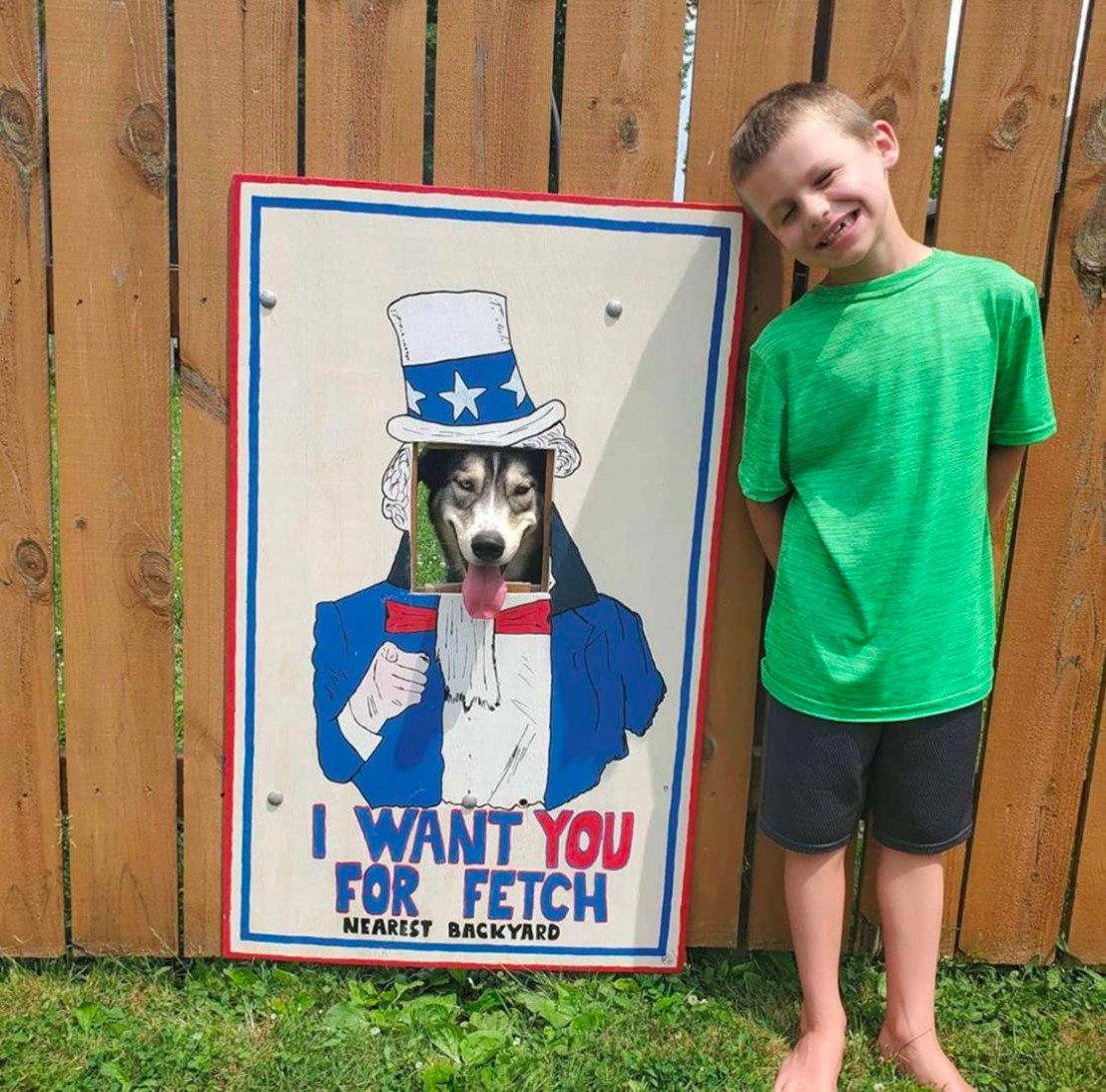
With the idea cemented in their minds, Stanley and his 7-year-old son Cameron got to work on their first painting. They decided to create a version of the famous painting “The Scream” and call it “The Bark.” They hung up the painting and admired their work. They hadn’t been planning on making any more paintings, but after the first one, the ideas just kept coming — and now the artwork framing Burger’s window is constantly changing.
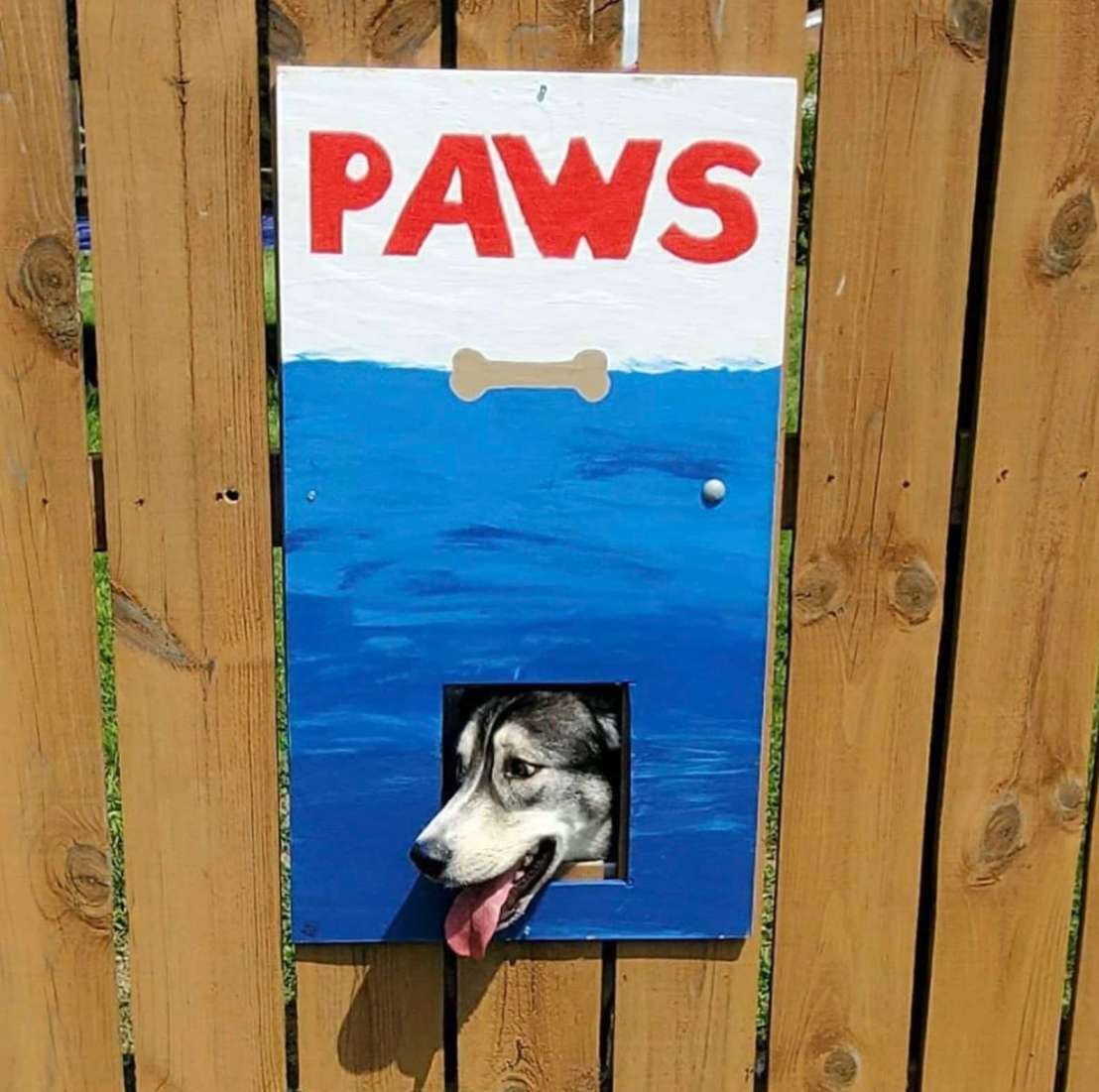
So far they’ve done “Paws” …
Brian Stanley
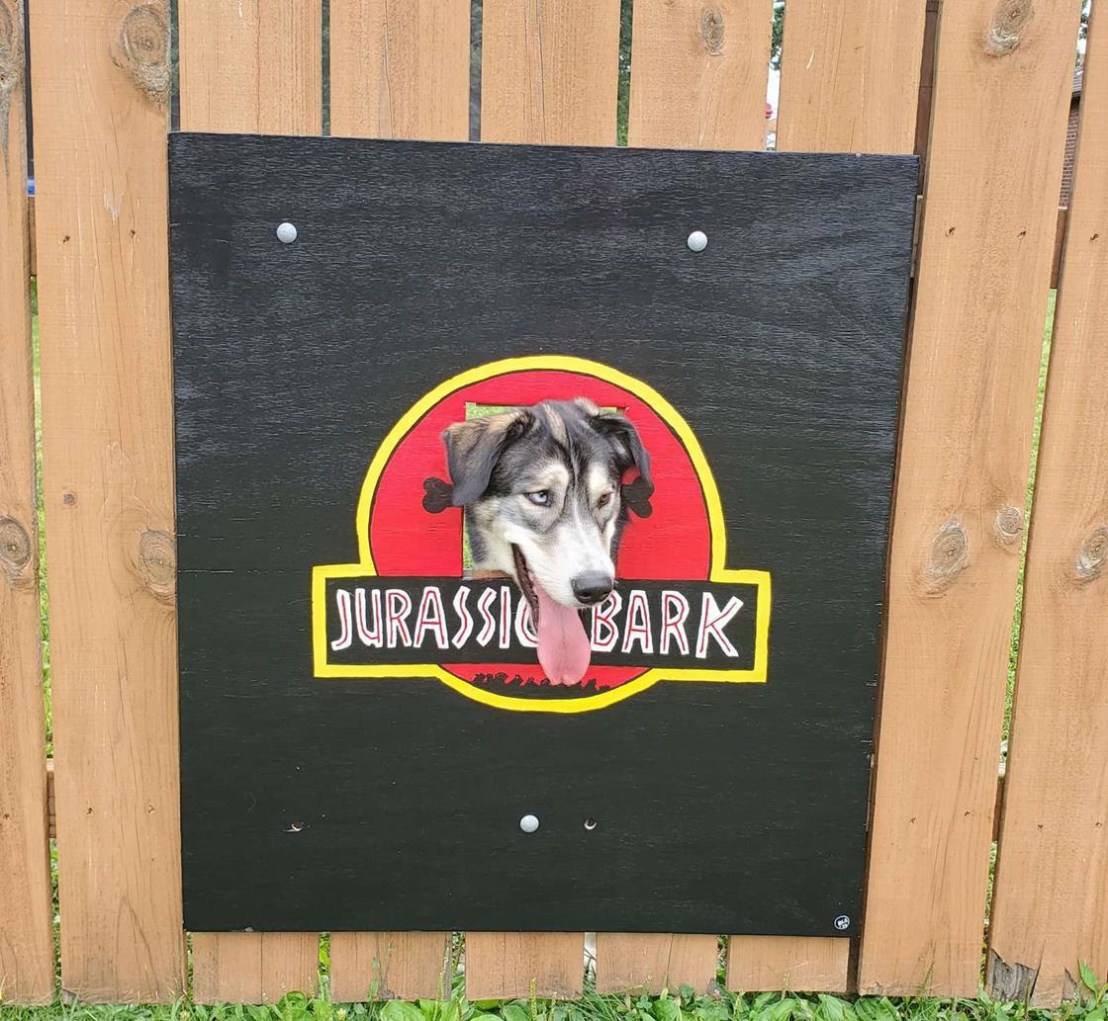
… “Jurassic Bark” …
BRIAN STANLEY
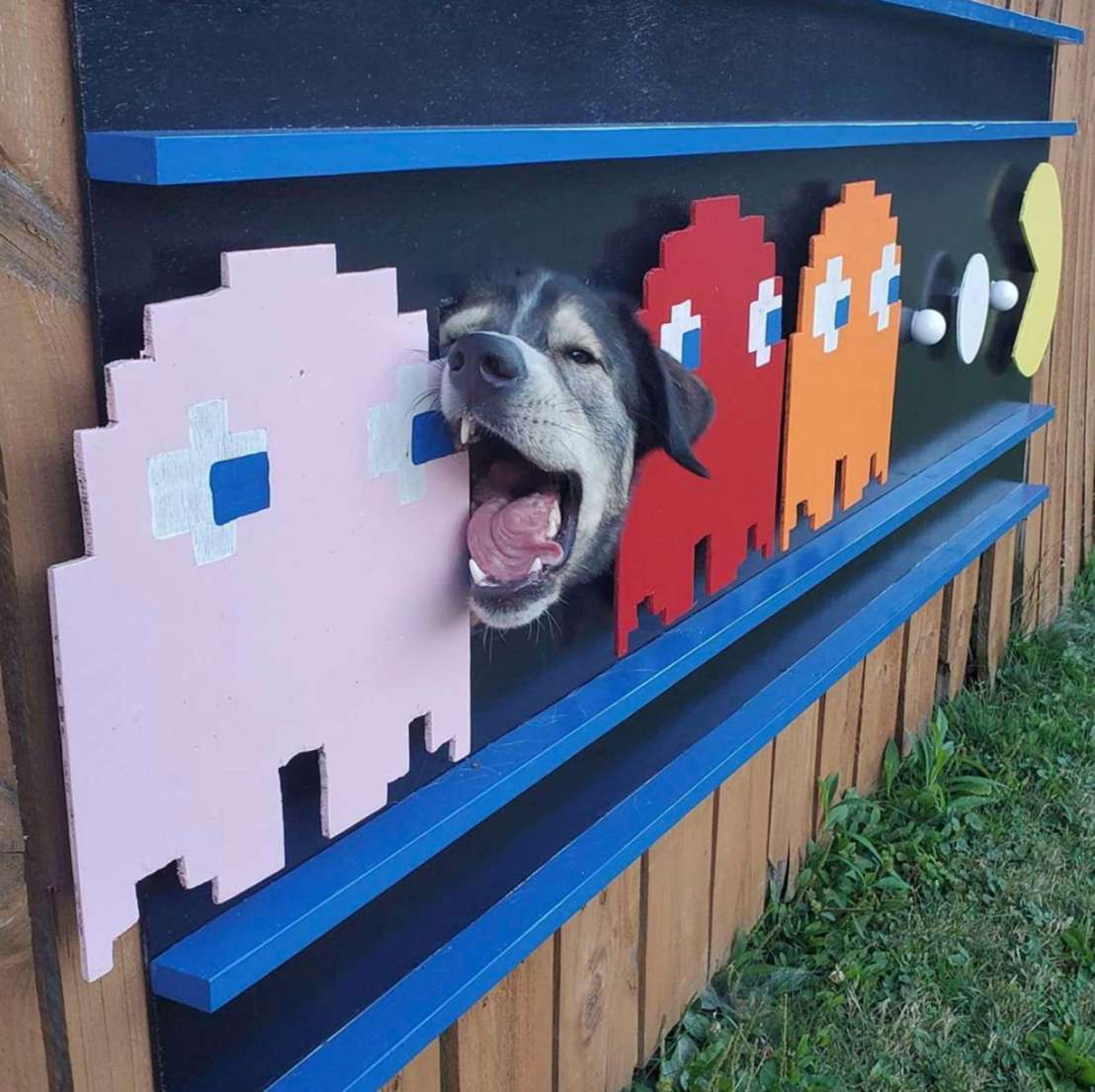
… and even a Pac-Man-themed painting.
BRIAN STANLEY
Every time his family puts up a new creation, Burger is always right there, and quickly sticks his head out of his window to admire their work.
Of course, the initial goal of the paintings was to help brighten people’s days, and so far that’s absolutely been achieved.
BRIAN STANLEY
“People have told us that they plan their walks and bike rides to go by our fence and some people will even alter their drives so it takes them past it,” Stanley said. “I have been outside on multiple days with the dogs and see people walk up and take selfies with the fence and Burger. People bring treats to him and he just soaks up the attention. Both my wife and I have been stopped by people when they see us outside so they can tell us how much they love what we are doing and that they hope we don’t stop.”
BRIAN STANLEY
Stanley and his family currently have new painting ideas planned all the way through January 2024. They’re so happy that their paintings and Burger are able to bring a little joy to their community. Of course, Burger probably loves the paintings most of all, because they’ve brought so many new people to his fence who he can watch and say hello to.
“All in all, it’s brought us closer to the community and the community closer to us while making everyone happy … it doesn’t get much better than that,” Stanley said.
ooOOoo
This post comes with a good number of fabulous photographs. Makes one really think of Burger as the dog next door. And it shows the ingenuity of Brian Stanley and his wife and son, Cameron; first class!
It is a very nice article. A’hh, that’s too tame. It’s a brilliant article! Much better.
Thought this would get your attention but read on:
There is no end to the love that so many people bestow on their dogs. I have said it before and there’s absolutely no doubt that I will say it again; many times!
One could go deeper into the human psychology to understand why, about the joy of having an animal who is sensitive to our moods but never rejects us. About the devotion and loyalty that dogs give us, well the vast majority of us, and who never expect anything in return other than a stroke or a cuddle.
I’m minded to be in this mood because today (ergo yesterday) I had to deal with an infestation of ants in the house. Luckily we had an unopened packet of Diatomaceous earth and, hopefully, that has put a stop to it. One of the issues of living in a rural part of the world.
So the following post spoke to me!
ooOOoo
Kids Hold A Wedding For Senior Dog So He Can Marry His Best Friend
Photo Credit: Jennifer Burke
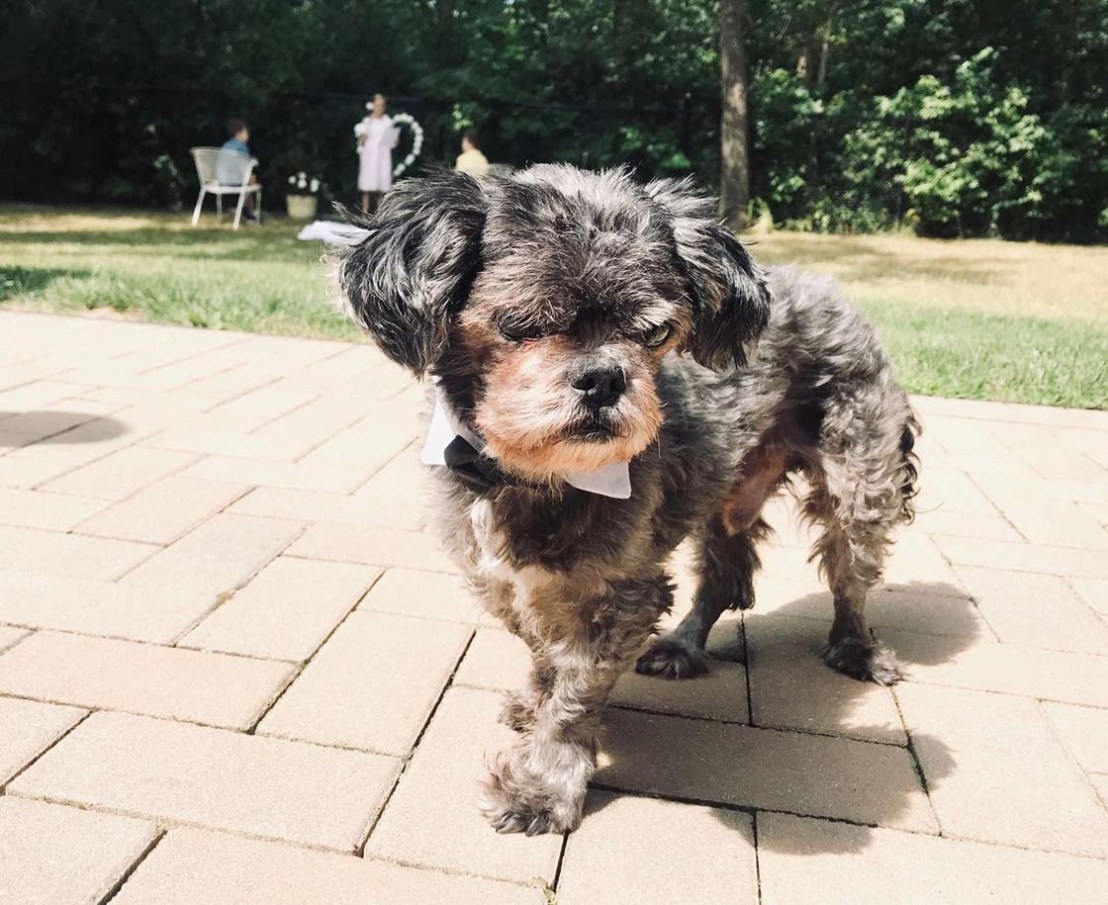
When Toby first arrived at Newman Nation: Senior Pets United, he needed a lot of help. He was 15 and had been severely neglected for most of his life. His fur was extremely matted. The rescue knew he would need a special family to foster him, and immediately thought of Jennifer Burke.
Burke and her family have experience with hospice animals, and were immediately on board to take in Toby.
“When Toby first joined our family, he was really scared and timid, in addition to being very sick,” Burke told The Dodo. “He was such a little pathetic mess and we fell in love with him immediately. Shortly after getting Toby, we discovered he was blind, and deaf, which was quite a surprise.”
They soon discovered that he had cancer, but the little dog recovered surprisingly well after treatment, and the family quickly decided he’d be staying with them forever.
Photo Credit: Jennifer Burke
Toby quickly fell in love with every member of his new family — especially Zoey.
Zoey was rescued from a puppy mill where she had been bred over and over again. She was never properly socialized so she’s often a little awkward around other dogs, but for some reason, she and Toby just work. Over the past two and a half years the two dogs have fallen completely in love with each other, and do absolutely everything together.
“It was really poignant to see two misfits start to figure out friendship and eventually fall in love,” Burke said. “They really are an awkward match made in heaven.”
Toby is now 17 years old, and his family recently discovered that he has cancer again. This time, he was only given a few months to live. His family knew this day would come eventually, but they were still so heartbroken — and then they had the best idea.
Photo Credit: Jennifer Burke
“After giving my kids the devastating news of his prognosis, my 8-year-old son, Dillon, said, ‘Well, I think Toby and Zoey should get married before Toby dies,’” Burke said. “Immediately, our family agreed. It was a perfect way to celebrate Toby and the really meaningful role he has played in our lives.”
All five family members began planning out the wedding together, as everyone wanted to be involved in making sure Toby and Zoey had the most perfect day.
“My daughter helped pick out Zoey’s wedding dress and she wrote the dogs’ vows,” Burke said. “My boys helped prep the backyard for the ceremony. My husband suggested throwing the wedding on the date of our 12-year anniversary, making the day even more special.”
Finally, everything was ready. The backyard was decorated, the cake was made and the entire family was dressed up and ready to celebrate the love of Toby and Zoey.
Photo Credit: Jennifer Burke
The wedding was absolutely perfect. While Toby and Zoey maybe weren’t as huge fans of getting dressed up and posing for pictures, they absolutely loved getting to kiss each other, eating cake and of course being together. That’s always been their most favorite thing of all.
Toby may not have a ton of time left, but his family is determined to make sure that what time he does have is filled with so much love. Toby has meant so much to his family over the past few years, especially to Zoey, and they’re so glad they were able to spend a day celebrating him and his best friend.
“Toby has enhanced our family so much in the last 2.5 years, but we had never realized the impact it could have on Zoey,” Burke said. “She is the one who has gained the most by having Toby in our lives. And I have no doubt that having Zoey in his life has enabled Toby to live so long. While I know Zoey will have a sad and difficult adjustment after Toby’s death, he has made her life so much fuller than we could have ever expected.”
ooOOoo
Just read that last paragraph again: “Toby has enhanced our family so much in the last 2.5 years, but we had never realized the impact it could have on Zoey,” That was said by Jennifer Burke. Then she said how beneficial Toby was on the life of fellow dog Zoey.
It is a very lovely story and, once again, we have to thank The Daily Dodo.
I was browsing the photographic forum Ugly Hedgehog the other day and saying thank you to some people who had said kind things about a few photographs I had shared. One person who had left a comment put in his signature block that he came from Adelaide, Australia. Part of my thank you was to inquire how things were in Adelaide.
Well blow me down when that person, Ron, came back to me and we then transferred to email and shared our backgrounds.
This is what Ron said in his first email:
Hi Paul,
You have had an interesting life over the years…
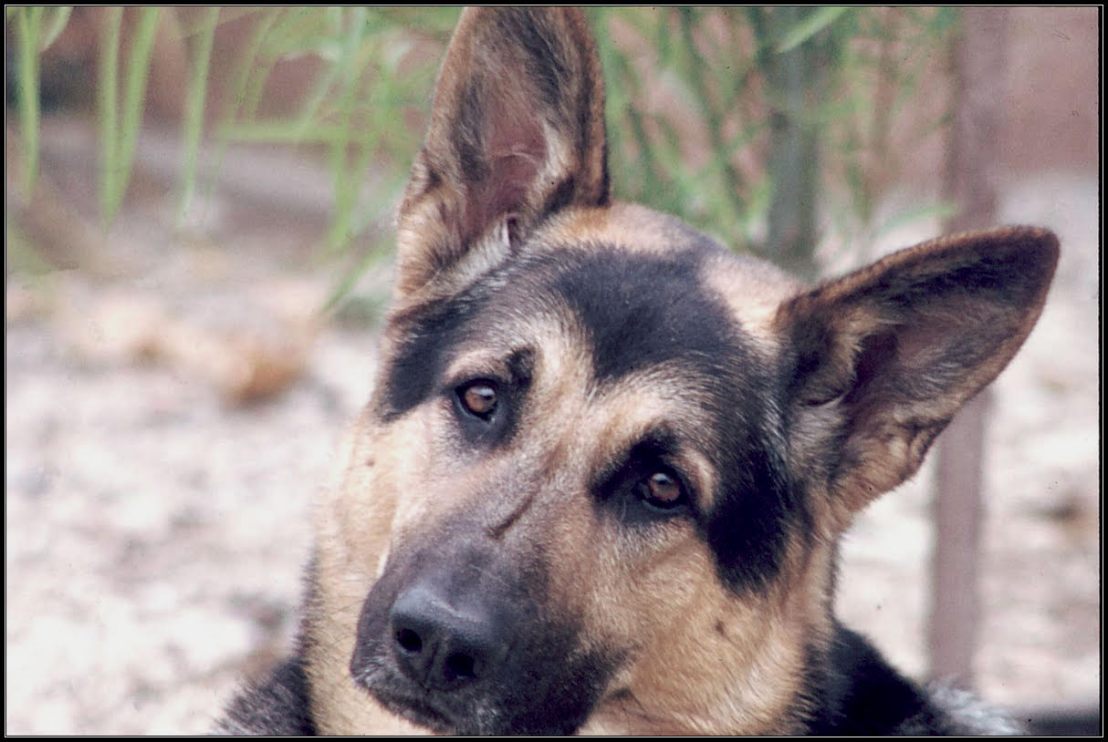
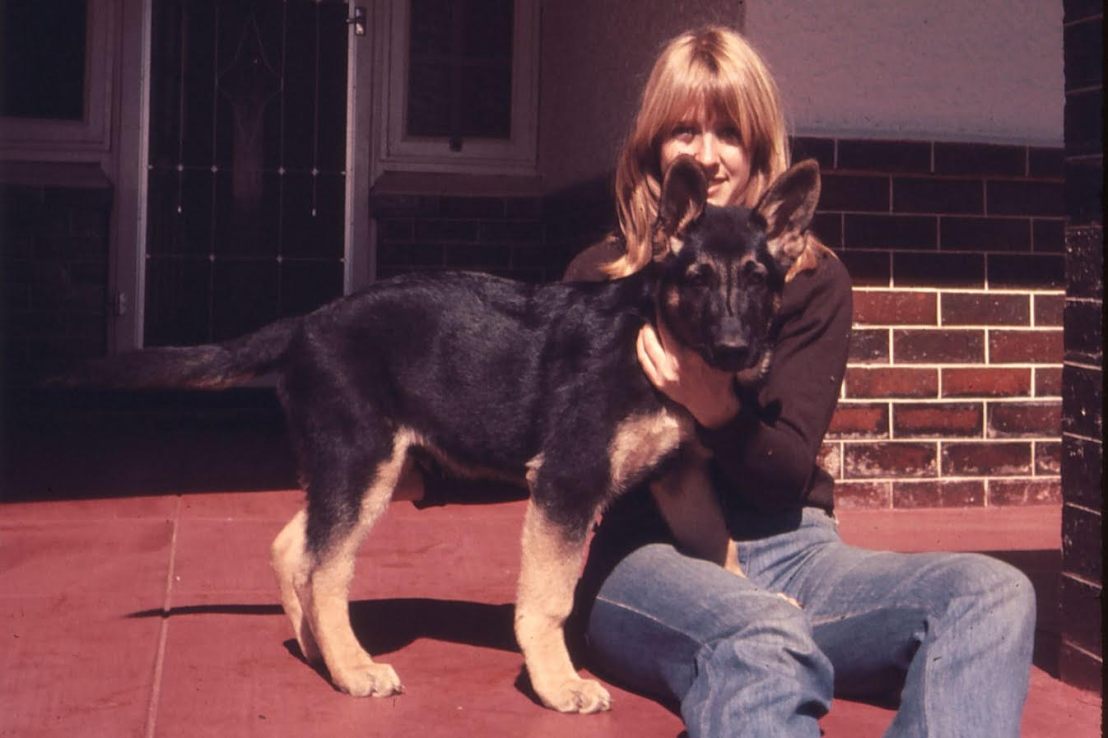
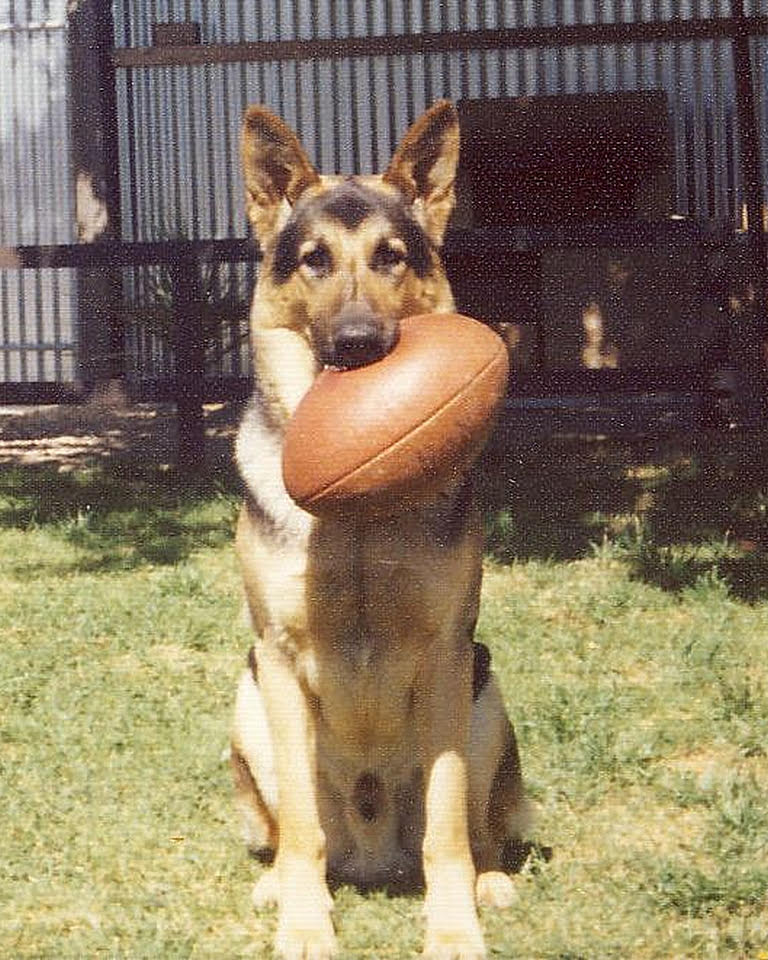
Love the Shepherd, we had one after we first got married..
Broke my heart so badly when he went I could never have another one.
I still think about him after all the years.
I retired at 55 years of age as I was with the government; I was a mechanical engineer with CSIRO designing new welding technologies along with many other projects over the years.
Sadly not the way I wanted to retire as my spinal injuries made it impossible to do the things I wanted to.
One of my biggest disappointments was having to give up my archery.
I’ve been doing photography for many and it has been a god send as it’s something I can still do.
We moved into a Lifestyle Village ( semi retirement) six and a half years ago as I was unable to look after the old house any more so I thought I’d let someone else worry about that..LOL
We try to get over to Sydney and Melbourne every year for a week or so but this year we missed out due to you know what.
Well, off to the shops now,
Cheers,
Ron.
And when I asked about the spinal injury, Ron added:
Hi Paul,
Hopefully you had no damage from your storm…
My spine, mostly my cervical spine, was damaged about 50 years ago in car stupidity.
I refuse to call it an accident.
I was sitting at a red light and a guy ran into my rear doing about 80-90 kilometers an hour without touching his brakes.
He was actually looking out of his side window!!
Over the years, and several operations and ongoing treatments, the pain got worse.
I’m now in pain all day every day.
At least the plates and screws keep things together.
Lorraine (wife) is my carer and when I get really bad, she gives me an injection of morphine mixed with some other “stuff”.
They discovered some years ago that my body doesn’t absorb oral meds very well.
My neurosurgeon then put me onto morphine.
Usually have one jab every two to three weeks.
At least I get one or two days of relief.
The rest of the time I just grin and bare it…LOL
I joined the Hog in 2012, November I think.
Sadly, my good friend, also a Hog, died earlier this year.
He lived in north NSW in a small coastal town called Maclean.
Say Hi to Jeannie for us.
Cheers,
Ron.
This is a photograph of Lorraine.
And this is a photograph of Harry.
And let me treat you with a few more photographs, some from “very old scanned film shots so not the best.”
oooo
oooo
oooo
oooo
But that’s a sharp reminder of the consequences of not paying attention to the road in front of you. All those years ago!
Dogs bring people together from all over the world!
We tend to watch many of the TED Talks that come our way.
But this one had me riveted to my seat. It’s a very powerful, nearly 9 minutes long, talk given by a person who doesn’t have legal citizenship.
Speaking on a personal basis, I was a person who went through the Citizenship test, successfully I might add, in March, 2019. So I watched this video with more than just academic interest.
See if you sense the feelings I had.
At age 16, journalist and filmmaker Jose Antonio Vargas found out he was in the United States illegally. Since then, he’s been thinking deeply about immigration and what it means to be a US citizen — whether it’s by birth, law or otherwise. In this powerful talk, Vargas calls for a shift in how we think about citizenship and encourages us all to reconsider our personal histories by answering three questions: Where did you come from? How did you get here? Who paid?
Jose Antonio Vargas, author of “Dear America: Notes of an Undocumented Citizen,” is the founder of Define American, a nonprofit organization that uses stories to shift the narrative on immigrants.
In the 10th July issue of Science magazine there was an Editorial written by Sudip Parikh, CEO of the American Association for the Advancement of Science (AAAS).
I am taking the liberty of republishing that Editorial here. For I think it needs to be widely shared.
I am a scientist. I am an American. And I am the product of special expert visas and chain migration—among the many types of legal immigration into the United States. On 22 June, President Trump issued a proclamation that temporarily restricts many types of legal immigration into the country, including that of scientists and students. This will make America neither greater nor safer—rather, it could make America less so.
The administration claims that these restrictions are necessitated by the coronavirus disease 2019 (COVID-19) outbreak to prevent threats to American workers. This reasoning is flawed for science and engineering, where immigrants are critical to achieving advances and harnessing the resulting economic opportunity for all Americans.
For decades, the United States has inspired both immigrants and nonimmigrants to make substantial contributions to science and technology that benefit everyone. Preventing highly skilled scientists and postdocs from entering the United States directly threatens this enterprise.
My uncle, a geologist, came to the United States in the 1960s to work at NASA. He then taught at Appalachian State University in North Carolina and later served as lead geochemist for the state of California. He sponsored my father to come to America in 1968. Leaving Mumbai, a city of millions, and arriving in Hickory, a town of thousands in North Carolina, my father came home to a place he had never been before. My parents worked in furniture factories and textile mills to put us though college and ensure we had opportunities. Today, my sister works at the U.S. Centers for Disease Control and Prevention, and I have the privilege of leading the American Association for the Advancement of Science (AAAS, the publisher of Science). We exist because of the Immigration and Nationality Act of 1965 and our parents’ belief in the vision of the United States as a shining city on a hill. My family’s story is repeated by thousands of American scientists.
These stories include uncertainty when an immigrant’s status in America is in question. This uncertainty causes stress and the possibility that immigrants will leave and take their skills, talents, and humanity elsewhere. For the successful, these stories culminate with relief, celebration, and the pride of becoming a naturalized citizen. As President Reagan said, the United States is the one place in the world where “anybody from any corner of the world can come…to live and become an American.” Naturalized citizens love the United States deeply because they chose to be American. They and other immigrants make huge contributions to science and engineering.
According to the National Science Foundation, more than 50% of postdocs and 28% of science and engineering faculty in the United States are immigrants. Of the Nobel Prizes in chemistry, medicine, and physics awarded to Americans since 2000, 38% were awarded to immigrants to the United States. I don’t know the number of prizes given to second-generation Americans but Steven Chu—current chair of the AAAS Board of Directors—is among them. The incredible achievements of the American scientific enterprise speak volumes about the vision and forethought of the American people who have worked to create a more perfect union.
Suspending legal immigration is self-defeating and breaks a model that is so successful that other nations are copying it. As Thomas Donohue, chief executive officer of the U.S. Chamber of Commerce, said regarding the administration’s proclamation, “Putting up a ‘not welcome’ sign for engineers, executives, IT experts, doctors, nurses, and other workers won’t help our country, it will hold us back. Restrictive changes to our nation’s immigration system will push investment and economic activity abroad, slow growth, and reduce job creation.”
To develop treatments and vaccines for COVID-19, cure cancers, go to Mars, understand the fundamental laws of the universe and human behavior, develop artificial intelligence, and build a better future, we need the brain power of the descendants of Native Americans, Pilgrims, Founding Mothers and Fathers, Enslaved People, Ellis Island arrivals, and immigrants from everywhere. The United States has thrived as a crossroads where people are joined together by ideas and contribute by choice to the freedom and opportunity provided by this wonderful, inspiring, and flawed country that is always striving to live up to its aspirations.
Scientists, look around your labs and offices. Think about your collaborations and friendships. We must ensure that this “temporary” restriction on legal immigration does not become permanent. Now is the time to speak up for your immigrant colleagues and for America.
I have written about the dog’s nose before. Or rather I have written about the dog’s sense of smell;
Dogs’ noses just got a bit more amazing. Not only are they up to 100 million times more sensitive than ours, they can sense weak thermal radiation—the body heat of mammalian prey, a new study reveals. The find helps explain how canines with impaired sight, hearing, or smell can still hunt successfully.
But I wanted to draw your attention to an article in 2017; June 26th to be precise. In an article called What a nose!
Here’s how that post opened.
Two items that recently caught my eye.
The power of a dog’s nose is incredible and it is something that has been written about in this place on more than one occasion.
But two recent news items reminded me once again of the way we humans can be helped by our wonderful canine partners.
The first was a report that appeared on the Care2 website about how dogs are being used to search for victims in the burnt out ruins following that terrible Grenfell Tower fire. That report opened, thus:
Wearing heat-proof booties to protect their feet, specially trained dogs have been dispatched in London’s Grenfell Tower to help locate victims and determine the cause of last week’s devastating fire that killed at least 79 people.
Because they’re smaller and weigh less than humans, urban search-and-rescue dogs with the London Fire Brigade (LFB) are able to access the more challenging areas of the charred 24-story building, especially the upper floors that sustained the most damage.
Because I read recently, on the EarthSky website, about dogs in Australia that are being trained to detect Covid-19 in humans.
ooOOoo
These dogs are trained to sniff out the coronavirus
Posted by Eleanor Imster in Human World, August 10, 2020
Scientists have been working with professional trainers in South Australia, Victoria and New South Wales to train dogs to sniff out Covid-19. Most of the dogs have a 100% success rate.
What does a pandemic smell like? If dogs could talk, they might be able to tell us.
We’re part of an international research team, led by Dominique Grandjean at France’s National Veterinary School of Alfort, that has been training detector dogs to sniff out traces of the novel coronavirus (SARS-CoV-2) since March.
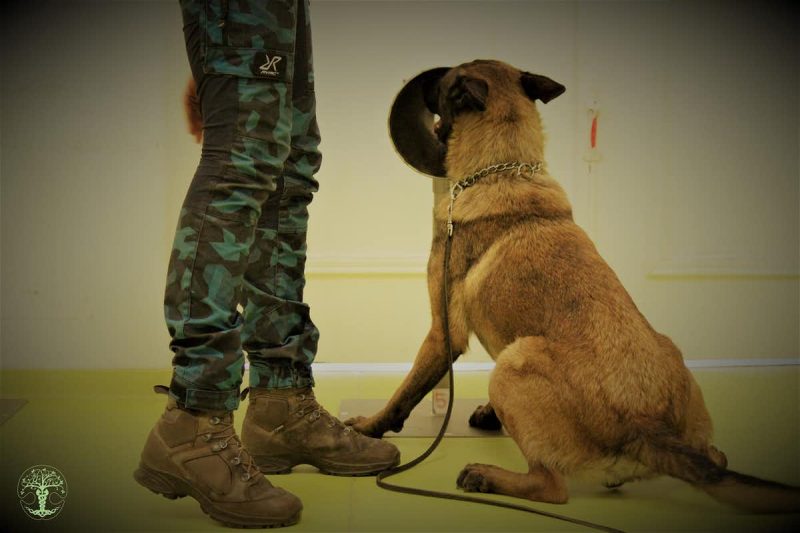
These detector dogs are trained using sweat samples from people infected with Covid-19. When introduced to a line of sweat samples, most dogs can detect a positive one from a line of negative ones with 100% accuracy.
Across the globe, coronavirus detector dogs are being trained in the United Arab Emirates (UAE), Chile, Argentina, Brazil and Belgium.
In the UAE, detector dogs – stationed at various airports – have already started helping efforts to control Covid-19’s spread. This is something we hope will soon be available in Australia too.
A keen nose
Our international colleagues found detector dogs were able to detect SARS-CoV-2 in infected people when they were still asymptomatic, before later testing positive.
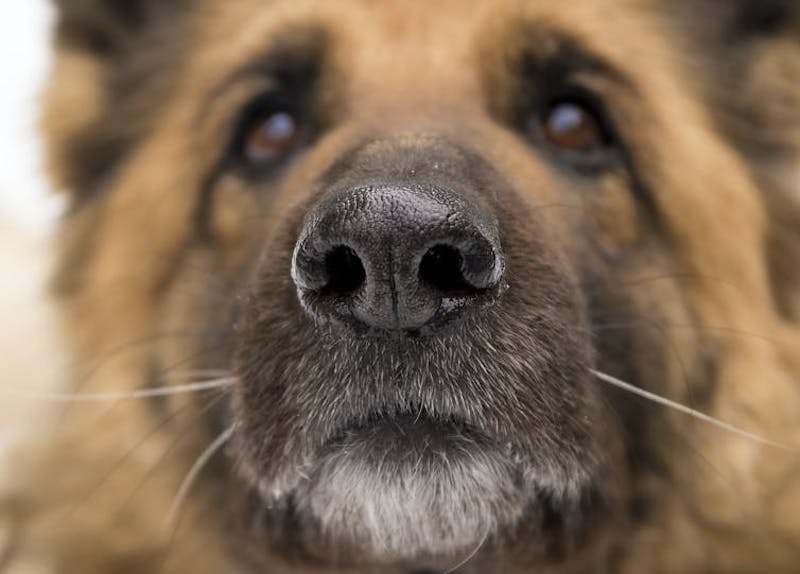
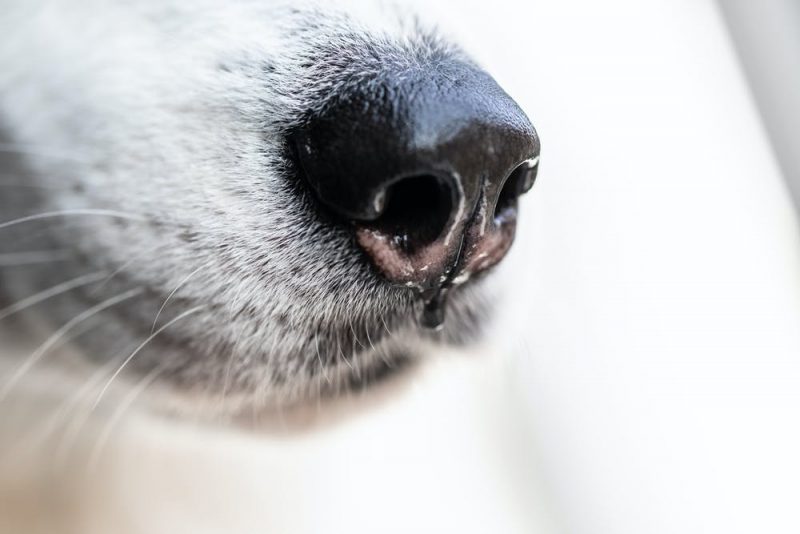
On average, dogs have about 220 million scent receptors. Image via Shutterstock/ The Conversation .
When it comes to SARS-CoV-2 detection, we don’t know for sure what the dogs are smelling.
The volatile organic compounds (VOCs) given off in the sweat samples are a complex mix. So it’s likely the dogs are detecting a particular profile rather than individual compounds.
Sweat is used for tests as it’s not considered infectious for Covid-19. This means it presents less risk when handling samples.
Covid-19 sniffing dogs in Australia
Here in Australia, we’re currently working with professional trainers of detector dogs in South Australia, Victoria and New South Wales. The most common breed used for this work so far has been the German shepherd, with various other breeds also involved.
We are also negotiating with health authorities to collect sweat samples from people who have tested positive for the virus, and from those who are negative. We hope to start collecting these within the next few months.
We will need to collect thousands of negative samples to make sure the dogs aren’t detecting other viral infections, such as the common cold or influenza. In other countries, they’ve passed this test with flying colors.
Once operational, detector dogs in Australia could be hugely valuable in many scenarios, such as screening people at airports and state borders, or monitoring staff working in aged care facilities and hospitals daily (so they don’t need repeat testing).
To properly train a dog to detect SARS-CoV-2, it takes:
– 6-8 weeks for a dog that is already trained to detect other scents, or
– 3-6 months for a dog that has never been trained.
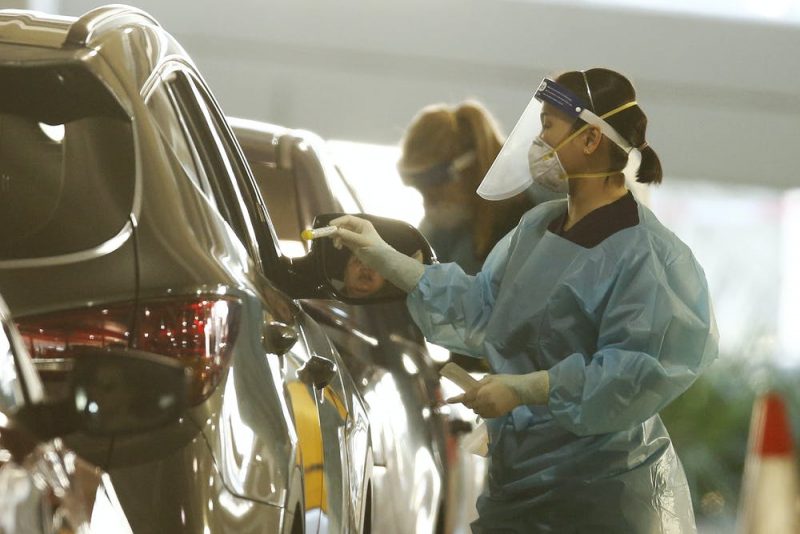
Coronavirus cases recently peaked in Victoria, Australia. Having trained sniffer dogs at hand could greatly help manage future waves of Covid-19. Image via Daniel Pockett/ AAP/ The Conversation.
Could the dogs spread the virus further?
Dogs in experimental studies have not been shown to be able to replicate the virus (within their body). Simply, they themselves are not a source of infection.
Currently, there are two case reports in the world of dogs being potentially contaminated with the Covid-19 virus by their owners. Those dogs didn’t become sick.
To further reduce any potential risk of transmission to both people and dogs, the apparatus used to train the dogs doesn’t allow any direct contact between the dog’s nose and the sweat sample.
The dog’s nose goes into a stainless steel cone, with the sweat sample in a receptacle behind. This allows free access to the volatile olfactory compounds but no physical contact.
Furthermore, all the dogs trained to detect Covid-19 are regularly checked by nasal swab tests, rectal swab tests and blood tests to identify antibodies. So far, none of the detector dogs has been found to be infected.
Dogs are not susceptible to the negative effects of the novel coronavirus. Image via Eyepix/ Sipa USA/ The Conversation.
Hurdles to jump
Now and in the future, it will be important for us to identify any instances where detector dogs may present false positives (signaling a sample is positive when it’s negative) or false negatives (signaling the sample is negative when it’s positive).
We’re also hoping our work can reveal exactly which volatile olfactory compound(s) is/are specific to Covid-19 infection.
This knowledge might help us understand the disease process resulting from Covid-19 infection – and in detecting other diseases using detector dogs.
This pandemic has been a huge challenge for everyone. Being able to find asymptomatic people infected with the coronavirus would be a game-changer – and that’s what we need right now.
A Covid-19 detector dog enrolled in the NOSAIS program led by professor Dominique Grandjean and Clothilde Julien from the Alfort Veterinary School (France). Image via The Conversation.
A friend to us (and science)
Perhaps we shouldn’t be surprised about dogs’ ability to detect Covid-19, as we already know their noses are amazing.
Their great potential in dealing with the current pandemic is just one of myriad examples of how dogs enrich our lives.
We acknowledge Professor Riad Sarkis from the Saint Joseph University (Beirut) and Clothilde Lecoq-Julien from the Alfort Veterinary School (France) for first conceiving the idea underpinning this work back in March.
Maybe because years ago he gave me blanket permission to republish his essays. Maybe because he and I are more or less the same age. Maybe because in my more quieter, introspective moments I wonder where the hell we are going. And Tom seems to agree.
Have a read of this.
ooOOoo
Tomgram: Engelhardt, The Unexpected Past, the Unknown Future
[Note for TomDispatch Readers:Even in this terrible moment, TD does its best to continue offering an alternate view of this increasingly strange planet of ours. And I can only do so because of the ongoing support of readers. (I just wish I could actually thank each of you individually!) If you have the urge to continue to lend a hand in keeping TomDispatch afloat, then do check out our donation page. For a donation of $100 ($125 if you live outside the U.S.), I usually offer a signed, personalized book from one of a number of TD authors listed on that page and you can certainly ask, but no guarantees in this pandemic moment. Still, you really do make all the difference and I can’t thank you enough for that! Tom]
It Could Have Been Different
My World and (Unfortunately) Welcome to It
By Tom Engelhardt
Let me be blunt. This wasn’t the world I imagined for my denouement. Not faintly. Of course, I can’t claim I ever really imagined such a place. Who, in their youth, considers their death and the world that might accompany it, the one you might leave behind for younger generations? I’m 76 now. True, if I were lucky (or perhaps unlucky), I could live another 20 years and see yet a newer world born. But for the moment at least, it seems logical enough to consider this pandemic nightmare of a place as the country of my old age, the one that I and my generation (including a guy named Donald J. Trump) will pass on to our children and grandchildren.
Back in 2001, after the 9/11 attacks, I knew it was going to be bad. I felt it deep in my gut almost immediately and, because of that, stumbled into creating TomDispatch.com, the website I still run. But did I ever think it would be this bad? Not a chance.
I focused back then on what already looked to me like a nightmarish American imperial adventure to come, the response to the 9/11 attacks that the administration of President George W. Bush quickly launched under the rubric of “the Global War on Terror.” And that name (though the word “global” would soon be dropped for the more anodyne “war on terror”) would prove anything but inaccurate. After all, in those first post-9/11 moments, the top officials of that administration were thinking as globally as possible when it came to war. At the damaged Pentagon, Secretary of Defense Donald Rumsfeld almost immediately turned to an aide and told him, “Go massive — sweep it all up, things related and not.” From then on, the emphasis would always be on the more the merrier.
Bush’s top officials were eager to take out not just Osama bin Laden’s al-Qaeda, whose 19 mostly Saudi hijackers had indeed attacked this country in the most provocative manner possible (at a cost of only $400,000-$500,000), but the Taliban, too, which then controlled much of Afghanistan. And an invasion of that country was seen as but the initial step in a larger, deeply desired project reportedly meant to target more than 60 countries! Above all, George W. Bush and his top officials dreamed of taking down Iraqi autocrat Saddam Hussein, occupying his oil-rich land, and making the United States, already the unipolar power of the twenty-first century, the overseer of the Greater Middle East and, in the end, perhaps even of a global Pax Americana. Such was the oil-fueled imperial dreamscape of George W. Bush, Dick Cheney, Donald Rumsfeld, and crew (including that charmer and now bestselling anti-Trump author John Bolton).
Who Woulda Guessed?
In the years that followed, I would post endless TomDispatch pieces, often by ex-military men, focused on the ongoing nightmare of our country’s soon-to-become forever wars (without a “pax” in sight) and the dangers such spreading conflicts posed to our world and even to us. Still, did I imagine those wars coming home in quite this way? Police forces in American cities and towns thoroughly militarized right down to bayonets, MRAPs, night-vision goggles, and helicopters, thanks to a Pentagon program delivering equipment to police departments nationwide more or less directly off the battlefields of Washington’s never-ending wars? Not for a moment.
Who doesn’t remember those 2014 photos of what looked like an occupying army on the streets of Ferguson, Missouri, after the police killing of a Black teenager and the protests that followed? And keep in mind that, to this day, the Republican Senate and the Trump administration have shown not the slightest desire to rein in that Pentagon program to militarize police departments nationwide. Such equipment (and the mentality that goes with it) showed up strikingly on the streets of American cities and towns during the recent Black Lives Matter protests.
Even in 2014, however, I couldn’t have imagined federal agents by the hundreds, dressed as if for a forever-war battlefield, flooding onto those same streets (at least in cities run by Democratic mayors), ready to treat protesters as if they were indeed al-Qaeda (“VIOLENT ANTIFA ANARCHISTS”), or that it would all be part of an election ploy by a needy president. Not a chance.
Or put another way, a president with his own “goon squad” or “stormtroopers” outfitted to look as if they were shipping out for Afghanistan or Iraq but heading for Portland, Albuquerque, Chicago, Seattle, and other American cities? Give me a break! How un-American could you get? A military surveillance drone overhead in at least one of those cities as if this were someone else’s war zone? Give me a break again. Never in my wildest dreams did I think I’d live to witness anything quite like it or a president — and we’ve had a few doozies — even faintly like the man a minority of deeply disgruntled Americans but a majority of electors put in the White House in 2016 to preside over a failing empire.
How about an American president in the year 2020 as a straightforward, no-punches-pulled racist, the sort of guy a newspaper could compare to former segregationist Alabama governor and presidential candidate George Wallace without even blinking? Admittedly, in itself, presidential racism has hardly been unique to this moment in America, despite Joe Biden’s initial claim to the contrary. That couldn’t be the case in the country in which Woodrow Wilson made D.W. Griffith’s Birth of a Nation, the infamous silent movie in which the Ku Klux Klan rides to the rescue, the first film ever to be shown in the White House; nor the one in which Richard Nixon used his “Southern strategy” — Republican presidential candidate Barry Goldwater had earlier labeled it even more redolently “Operation Dixie” — to appeal to the racist fears of Southern whites and so begin to turn that region from a Democratic stronghold into a Republican bastion; nor in the land where Ronald Reagan launched his election campaign of 1980 with a “states’ rights” speech (then still a code phrase for segregation) near Philadelphia, Mississippi, just miles from the earthen dam where three murdered civil rights workers had been found buried in 1964.
Still, an openly racist president (don’t take that knee!) as an autocrat-in-the-making (or at least in-the-dreaming), one who first descended that Trump Tower escalator in 2015 denouncing Mexican “rapists,” ran for president rabidly on a Muslim ban, and for whom Black lives, including John Lewis’s, have always been immaterial, a president now defending every Confederate monument and military base named after a slave-owning general in sight, while trying to launch a Nixon-style “law and (dis)order” campaign? I mean, who woulda thunk it?
And add to that the once unimaginable: a man without an ounce of empathy in the White House, a figure focused only on himself and his electoral and pecuniary fate (and perhaps those of his billionaire confederates); a man filling his hated “deep state” with congressionally unapproved lackies, flacks, and ass-kissers, many of them previously flacks (aka lobbyists) for major corporations. (Note, by the way, that while The Donald has a distinctly autocratic urge, I don’t describe him as an incipient fascist because, as far as I can see, his sole desire — as in those now-disappeared rallies of his — is to have fans, not lead an actual social movement of any sort. Think of him as Mussolini right down to the look and style with a “base” of cheering MAGA chumps but no urge for an actual fascist movement to lead.)
And who ever imagined that an American president might actually bring up the possibility of delaying an election he fears losing, while denouncing mail-in ballots (“the scandal of our time”) as electoral fraud and doing his damnedest to undermine the Post Office which would deliver them amid an economic downturn that rivals the Great Depression? Who, before this moment, ever imagined that a president might consider refusing to leave the White House even if he did lose his reelection bid? Tell me this doesn’t qualify as something new under the American sun. True, it wasn’t Donald Trump who turned this country’s elections into 1% affairs or made contributions by the staggeringly wealthy and corporations a matter of free speech (thank you, Supreme Court!), but it is Donald Trump who is threatening, in his own unique way, to make elections themselves a thing of the past. And that, believe me, I didn’t count on.
Nor did I conceive of an all-American world of inequality almost beyond imagining. A country in which only the truly wealthy (think tax cuts) and the national security state (think budgets eternally in the stratosphere) are assured of generous funding in the worst of times.
The World to Come?
Oh, and I haven’t even mentioned the pandemic yet, have I? The one that should bring to mind the Black Death of the fourteenth century and the devastating Spanish Flu of a century ago, the one that’s killing Americans in remarkable numbers daily and going wild in this country, aided and abetted in every imaginable way (and some previously unimaginable ones) by the federal government and the president. Who could have dreamed of such a disease running riot, month after month, in the wealthiest, most powerful country on the planet without a national plan for dealing with it? Who could have dreamed of the planet’s most exceptional, indispensable country (as its leaders once loved to call it) being unable to take even the most modest steps to rein in Covid-19, thanks to a president, Republican governors, and Republican congressional representatives who consider science the equivalent of alien DNA? Honestly, who ever imagined such an American world? Think of it not as The Decameron, that fourteenth century tale of 10 people in flight from a pandemic, but the Trumpcameron or perhaps simply Trumpmageddon.
And keep in mind, when assessing this world I’m going to leave behind to those I hold near and dear, that Covid-19 is hardly the worst of it. Behind that pandemic, possibly even linked to it in complex ways, is something so much worse. Yes, the coronavirus and the president’s response to it may seem like the worst of all news as American deaths crest 160,000 with no end in sight, but it isn’t. Not faintly on a planet that’s being heated to the boiling point and whose most powerful country is now run by a crew of pyromaniacs.
It’s hard even to fully conceptualize climate change since it operates on a time scale that’s anything but human. Still, one way to think of it is as a slow-burn planetary version of the atomic bombings of Hiroshima and Nagasaki. And by the way, if you’ll excuse a brief digression, in these years, our president and his men have been intent on ripping up every Cold War nuclear pact in sight, while the tensions between two nuclear-armed powers, the U.S. and China, only intensify and Washington invests staggering sums in “modernizing” its nuclear arsenal. (I mean, how exactly do you “modernize” the already-achieved ability to put an almost instant end to the world as we’ve known it?)
But to return to climate change, remember that 2020 is already threatening to be the warmest year in recorded history, while the five hottest years so far occurred from 2015 to 2019. That should tell you something, no?
The never-ending release of greenhouse gases into the atmosphere has been transforming this planet in ways that have now become obvious. My own hometown, New York City, for instance, has officially become part of the humid subtropical climate zone and that’s only a beginning. Everywhere temperatures are rising. They hit 100 degrees this June in, of all places, Siberia. (The Arctic is warming at twice the rate of much of the rest of the planet.) Sea ice is melting fast, while floods and mega-droughts intensify and forests burn in a previously unknown fashion.
And as a recent heat wave across the Middle East — Baghdad hit a record 125 degrees — showed, it’s only going to get hotter. Much hotter and, given how humanity has handled the latest pandemic, how will it handle the chaos that goes with rising sea levels drowning coastlines but also affecting inland populations, ever fiercer storms, and flooding (in recent weeks, the summer monsoon has, for instance, put one third of Bangladesh underwater), not to speak of the migration of refugees from the hardest-hit areas? The answer is likely to be: not well.
And I could go on, but you get the point. This is not the world I either imagined or would ever have dreamed of leaving to those far younger than me. That the men (and they are largely men) who are essentially promoting the pandemicizing and over-heating of this planet will be the greatest criminals in history matters little.
Let’s just hope that, when it comes to creating a better world out of such a god-awful mess, the generations that follow us prove better at it than mine did. If I were a religious man, those would be my prayers.
And here’s my odd hope. As should be obvious from this piece, the recent past, when still the future, was surprisingly unimaginable. There’s no reason to believe that the future — the coming decades — will prove any easier to imagine. No matter the bad news of this moment, who knows what our world might really look like 20 years from now? I only hope, for the sake of my children and grandchildren, that it surprises us all.
This is such a powerful essay written from the heart of a good man.
I, too, wonder and worry about the next twenty years. Indeed, there are the stirrings of a book in my head. How that younger generation are reacting to the present and, more importantly, how they will react and respond to the next few years?
I’m 75 and really hope to live for quite a few more years. Jean is just a few years younger.
But much more importantly I have a son, Alex, who is 49, and a daughter, Maija, who is 48, and a grandson, Morten, of my daughter and her husband, who is 9.
There was a story on the Daily Dodo yesterday that just says it all when it comes to us humans and our love for dogs. Now we don’t know the name of the Dad but so what! It’s a wonderful story nonetheless!
ooOOoo
Dad And The Dog He Didn’t Want Now Have The Sweetest Bedtime Routine
“He fell in love” ❤️
By Stephen Messenger, Published on 7/27/2020
Believe it or not, there was once a time when Alice Garrido Gallardo’s dad didn’t want another dog at all — but now he pretty much epitomizes what it means to be a proud pet parent.
He and his pup, named Jean Grey, have the sweetest bedtime routine to prove it.
Alice Garrido Gallardo
Jean Grey started out life as a stray and was rescued by Gallardo’s friend. When Gallardo suggested to her dad that they adopt her, he was opposed to the idea at first.
“We had lost our old dog and he didn’t want to have another one anytime soon,” Gallardo told The Dodo. “He was still grieving.”
Gallardo, however, wasn’t deterred. She decided to arrange an introduction between Jean Grey and her dad. And sure enough:
“He fell in love the day I brought her home,” Gallardo said.
Alice Garrido Gallardo
As time went on, his love for the dog he didn’t want only grew stronger — and he found the most wonderful way to show it.
“He began to put her to bed every night,” Gallardo said.
Photo Credit: TikTok/alicegrgl
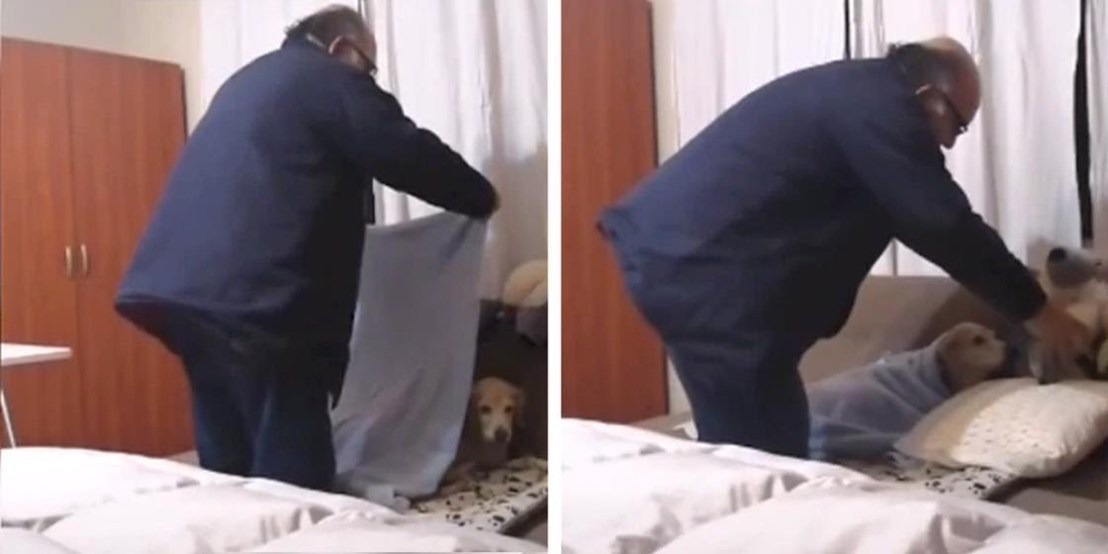
Each and every night now, Gallardo’s dad tucks Jean Grey into bed, placing a pillow under her head and toy close by.
“I love to see them, my dad being super loving and affectionate,” Gallardo said. “I love to see them and know that they love each other very much.”
ooOOoo
I used the sub-heading: “One can never turn off one’s heart to love.”
To give that statement slightly more detail I should have said: “One can never turn off one’s heart to the love of a dog!”
Not that long ago I was contacted by Gabriella Coppolecchia, or Gabby for short, about writing a guest post. Of course that was alright especially as Gabby comes from the U.K.. In fact, as her bio explains:
Gabriella Coppolecchia is a young dog trainer and dog walker in Chelmsford, Essex. During her studies she realised that there is a lot of misinformation around the world of dogs and she vowed to help people overcome the confusion. Her fiancé suggested she would write a blog since she can’t stop talking about dogs anyway. So along with her day business, she created Cinofilo.
So let’s welcome her to this world of blogging and her first guest post on Learning from Dogs. (And, hopefully, not her last!)
ooOOoo
HOW TO AVOID DOG THEFT
All-focus
Dog theft is a phenomenon always on the rise. Here in the UK, I’m seeing missing dog posts on Facebook everyday. Most people believe it’s confined to a bad neighbourhood but it’s not. It can happen anywhere and almost to anyone. There are a few dogs that are the perfect target for dog theft and these despicable people will steal your dog to make an easy buck.
Why Dogs get stolen
1. Purebred dogs
With the cost of purebred dogs on the rise and the creation of always new breeds (such as labradoodle and cockapoo), more and more people are attracted to this huge market. If not neutered or spayed, stolen dogs could end up in the hands of other dog breeders that will use them as the studs or the bitches that will produce the new generations. These people might also steal puppies and disguise themselves (or have someone else doing so) as hobby breeders with one last puppy left and sell these dogs again for half of their original value. Or they might claim to be someone that wants to sell their own pet because they can no longer take care of him. They will justify the dog’s price by saying that they don’t want to lose the money they have spent when they bought “their” dog. To unsuspecting and uninformed first time buyers these could all look like legitimate trades. These people might look like regular neighbours, with regular jobs and regular families.
2. Weak, young and small dogs
The illegal world of dog-fighting always requires some new dogs to sacrifice for training. This training needs to be pretty safe and easy for the dogs that will be enlisted in the matches. Weak, young and small dogs are considered the best choice because they have slim to none chances of survival against their opponent and because they will not be able to injure him. Bigger and strong dogs will sometimes be used but only with their mouth taped shut. This training is effective because winning all the fights during training will boost the winner’s confidence. In turn, when the real match happens, the dog will think that winning will be easy and he will not recognise the danger. Not even when it’s charging right at him, jaws open. The dogs for the training are often acquired by online ads of dogs that need re-homing and that are given away for free. But when this source starts to become scarce, these people will start stealing.
These dogs might also be stolen for the dog-fighting world. If not neutered or spayed these dogs could become breeders that will supply new champions. Or they end up being the ones that will be trained to fight for the entertainment of horrible people.
In general
There are also dogs that are not targeted for a specific feature. These dogs might be stolen because these thieves will wait for a large ransom to be put out and then will return the dog claiming to have found him. Another reason is to sell dogs to research, veterinary and medical facilities that need them for testing and experiments. These facilities will not do a thorough research on the animal’s past, especially because they often use a third party to get the dogs.This makes it easy for the thieves to sell stolen pets to them.
Once your dog is stolen, he will likely be quickly moved many miles away and it will become very difficult to trace the bad guy’s steps. So the best course of action is to try and prevent this from happening.
How targets get chosen
To steal your pet, there are a number of tactics that they can use. Simply put, anytime your dog is out of your sight, he can become a target. But there are a few everyday situations that often occur that might make things easier for these thieves.
1. shops
We have all done it. We need to pop in a shop for a second and we think it’s easier to leave our dog tied outside. We think it’s going to be fine. We’ll only take a minute and that moment it’s enough for a thief. Especially if we end up taking longer than expected or if we can’t really keep an eye on our dog from inside the shop.
2. back gardens
We might think that the fence of our back garden is high enough and we think that if we are home we will be able to keep an eye on our dog. But we are often wrong. These thieves will usually study their targets for a while. They will monitor the times your dogs spends outside and find the right time to strike.
3. car
A dog should never be left in a car unattended but this is not just for the risk of heatstroke. A car is not a secure place. The only thing in the way of those thieves is your car window and that’s pretty easy to break. Another problem is that when we leave our dog in a car, we feel like he is more safe than tied outside. Overestimating his safety means that we feel comfortable going farther and leaving him alone for longer.
4. off-leash walks
When on walks, your dog might be used to spend some time off leash. This often happens when you are in a park and you want to give your dog more freedom to explore in a car free space. While exploring it could be easy for a dog to go too far and out of sight for a while. This is often enough for a thief to snatch your dog right under your supervision.
How to keep them safe
There are a few things that you can do to help your pet be safer and keep your mind more at ease.
1. less information
It’s always nice, when people that we meet on a walk, stop us to compliment our dog. This can happen at every walk and often several times during the same walk. Although most people will only ask a couple of questions out of curiosity, you never know when you have a thief right in front of you. These people will often ask more information and you might start suddenly seeing them often, even when you never used to see them before. They will ask questions like your dog’s name, if he is friendly, if you can let him off, if you walk around the area around the same times, if you live close by. These are all informations that can help the bad guy see a pattern in your routine and that can uncover an opportunity for him to act. So if faced with all these questions try to remain very vague or lie about some details. You could say that you don’t always walk at the same times. Or maybe you can say that you like the area for walks but you live quite far and you actually have to drive there.
2. vary your routes
I’m sure you and your dog have a favourite route. Maybe you like the pond he can swim in or maybe you like the dogs you meet. But going to the same routes everyday might give the bad guys the opportunity to study you and gain information that they can use to put their plan into motion. Instead choose 3-4 different routes and try to alternate them in an unpredictable way.
3. keep a close eye
As I said, basically, every time you keep your eyes off your dog he could get stolen. So if you are out and you need to pop in a shop, try asking someone that works there if they can wait outside with your dog as you are shopping. This might not always be possible but it’s worth a shot. Moreover most people will happily take a break from work to pet your dog as they wait. If your dog, when off leash, tends to go so far he is often out of sight, you could try a different spot, such as a big clearing, where your dog will hardly ever be out of sight. If, instead, you are worried your dog might get stolen from your garden, try a higher fence and don’t take the habit of leaving your back door open at all times. Only let your dog out when he asks.
4. security system
Installing cameras and an alarm system around your house and your garden might be a real weapon against burglars and bad guys in general. As well as protecting your dog, they are optimal for keeping your family safe. These can be a powerful deterrent for anyone looking for an easy target, and can be an even more powerful source of information in case someone should still decide to break in.There are all sorts of pet friendly security systems that will not be accidentally activated from your dog.
5. identification
By law a dog should be microchipped and should be wearing a collar with name tag at all times. Thieves can easily remove the collar and it’s even possible for them to go to a vet and change the ownership to them, no questions asked. This is becoming more rare but it still can happen. If the vet checks the owner the dog is registered to and contacts the registered number, you could be contacted by the vets that will have your dog at that time. Something what could also happen is that your dog might be abandoned once the bad guys no longer need him. Someone could then find him and take him to a vet where he would be identified.
6. GPS tracking collars
This kind of technology is more useful for a lost pet than a stolen one, mostly because a thief can easily remove the collar and dump it somewhere. There are however collars that have an hidden GPS tracker. This can make it look like a regular collar and a thief might not feel the need to remove the collar until later. This can give an idea of where your pet is or has been and give an indication of who might be responsible. It might not be much but it can mean a higher chance of finding your beloved pet.
What to do if your dog gets stolen
If you believe your dog has been stolen there are a few things that you can do:
1. report
Report your dog missing to the microchip databases (petlog, PETtrack and Identibase). They can contact you if your dog’s microchip gets scanned and the guardianship details checked. Report to the police, making sure to give all the informations that come to mind. Even the ones that you don’t redeem relevant can help. Be sure to tell them when you last saw your pet and when and how you think he has been stolen. Tell them if you met someone suspicious during your walk or if you saw someone suspicious walking around your house. Tell them the routes you use during your walks and be sure to describe any special feature that your dog might have.
2. tell everyone
Put up posters in your local area. If your dog is still in town someone might see him. Post about your missing dog on social media and ask for help from the community. Register your pet on social media groups or on dedicated websites that help people reunite with missing dogs. Start locally but then widen your range.
Now that you have more information I hope you’ll start feeling safer. But if you are here because your pet has been stolen, here some links to websites that can help. There are a lot more but these are a start:
I think this is a terrific post and I’m delighted that Gabby contacted me and went on to post this. All over the world readers will be aware of the issue and Gabby has done a fine job in describing what one can do.
I wrote in my post of the 23rd: “In fact tomorrow I shall republish a post I wrote in 2015 about the origins of the dog!”
Well tomorrow wasn’t possible with the sad news of the loss of our cat.
But it is today! It was originally published on the 13th July, 2015 – my how 5 years have sped by!
So here it is again. I suspect many of you have not read it!
ooOOoo
The Origins of the Dog.
Dogs and humans go back even further than previously thought.
Humans and dogs were constant companions well before our ancestors settled in villages and started growing crops 10,000 years ago …
I have no doubt that thousands of dog owners all around the world must be enthralled by the way that dogs relate to us and, in turn, how we humans relate to dogs. More than once a day, one of our dogs will do something that has me and Jean marvelling at their way of living so close to us.
Then when one starts to reflect on how long dogs and humans have been together, perhaps it could be seen as the direct result of that length of relationship.
Now there’s nothing new in me writing this, after all the home page of Learning from Dogs states:
Yet they have been part of man’s world for an unimaginable time, at least 30,000 years. That makes the domesticated dog the longest animal companion to man, by far!
Back in May the website Livescience published an article that revealed more about the length of our relationship with dogs. This is how it opened:
Ancient Wolf DNA Could Solve Dog Origin Mystery
by Becky Oskin, Senior Writer
Humans and dogs were constant companions well before our ancestors settled in villages and started growing crops 10,000 years ago, a new study suggests.
Genetic evidence from an ancient wolf bone discovered lying on the tundra in Siberia’s Taimyr Peninsula reveals that wolves and dogs split from their common ancestor at least 27,000 years ago. “Although separation isn’t the same as domestication, this opens up the possibility that domestication occurred much earlier than we thought before,” said lead study author Pontus Skoglund, who studies ancient DNA at Harvard Medical School and the Broad Institute in Massachusetts. Previously, scientists had pegged the wolf-dog split at no earlier than 16,000 years ago.
The Livescience article referred to results that were published in the journal Current Biology on May 21st this year. One needs a subscription to read the full report but here is their summary:
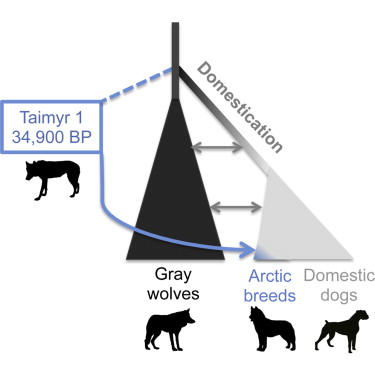
The origin of domestic dogs is poorly understood [ 1–15 ], with suggested evidence of dog-like features in fossils that predate the Last Glacial Maximum [ 6, 9, 10, 14, 16 ] conflicting with genetic estimates of a more recent divergence between dogs and worldwide wolf populations [ 13, 15, 17–19 ]. Here, we present a draft genome sequence from a 35,000-year-old wolf from the Taimyr Peninsula in northern Siberia. We find that this individual belonged to a population that diverged from the common ancestor of present-day wolves and dogs very close in time to the appearance of the domestic dog lineage. We use the directly dated ancient wolf genome to recalibrate the molecular timescale of wolves and dogs and find that the mutation rate is substantially slower than assumed by most previous studies, suggesting that the ancestors of dogs were separated from present-day wolves before the Last Glacial Maximum. We also find evidence of introgression from the archaic Taimyr wolf lineage into present-day dog breeds from northeast Siberia and Greenland, contributing between 1.4% and 27.3% of their ancestry. This demonstrates that the ancestry of present-day dogs is derived from multiple regional wolf populations.
That summary page also includes the following Graphical Abstract:
I don’t have permission to republish the Livescience article in full but would like to offer the closing paragraphs of this fascinating report.
“It is a very well-done paper,” Perry [George Perry, an expert in ancient DNA at Pennsylvania State University] told Live Science. “This topic is a critical one for our understanding of human evolution and human-environment interactions in the Paleolithic. Partnership with early dogs may have facilitated more efficient hunting strategies.”
If dogs first befriended hunter-gatherers, rather than farmers, then perhaps the animals helped with hunting or keeping other carnivores away. For instance, an author of a new book claims humans and dogs teamed up to drive Neanderthals to extinction. Skoglund also suggested the Siberian husky followed nomads across the Bering Land Bridge, picking up wolf DNA along the way.
“It might have been beneficial for them to absorb genes that were adapted to this high Arctic environment,” Skoglund said.
This is the first wolf genome from the Pleistocene, and more ancient DNA from prehistoric fossils could provide further insights into the relationship between wolves, dogs and humans, the researchers said.
Yes, our dogs have been part of man’s world for an unimaginable time – and Jean and I, as with tens of thousands of others, can’t imagine a world without dogs.
ooOOoo
They are our supreme companions. They don’t judge. They don’t lie. They are …. well let me repeat what I wrote right at the beginning of the blog.
Dogs are part of the Canidae, a family including wolves, coyotes and foxes, thought to have evolved 60 million years ago. There is no hard evidence about when dogs and man came together but dogs were certainly around when man developed speech and set out from Africa, about 50,000 years ago. See an interesting article by Dr. George Johnson.
Because of this closeness between dogs and man, we (as in man!) have the ability to observe the way they live. Now I’m sure that scientists would cringe with the idea that the way that a dog lives his life sets an example for us humans, well cringe in the scientific sense. But man seems to be at one of those defining stages in mankind’s evolution where the forces bearing down on the species homo sapiens have the potential to cause very great harm. If the example of dogs can provide a beacon of hope, an incentive to change at a deep cultural level, then the quicker we ‘get the message’, the better it will be.
In a world that is becoming madder by the day it’s good to read such stories!
The news from many quarters is increasingly alarming.
For example, I was reading in a recent issue of Science magazine about the Antarctic. From page 1331:
The Antarctic Ice Sheet is losing mass at an accelerating pace, and ice loss will likely continue over the coming decades and centuries. Some regions of the ice sheet may reach a tipping point, potentially leading to rates of sea level rise at least an order of magnitude larger than those observed now, owing to strong, positive feedbacks in the ice-climate system.
Melting ice on the coast of Adélie Land in East Antarctica. REUTERS/Pauline Askin
One can easily read many other stories of doom and gloom.
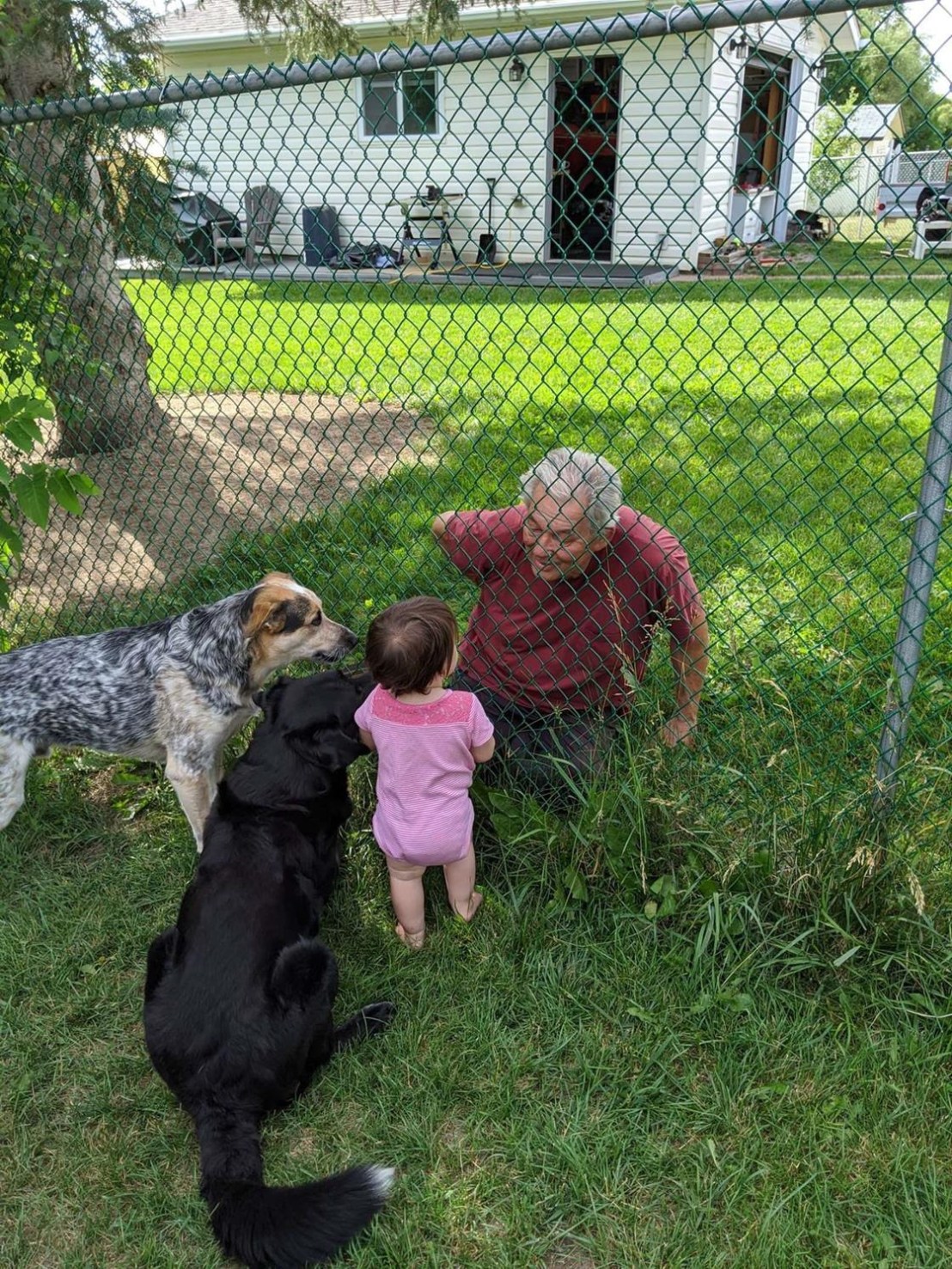
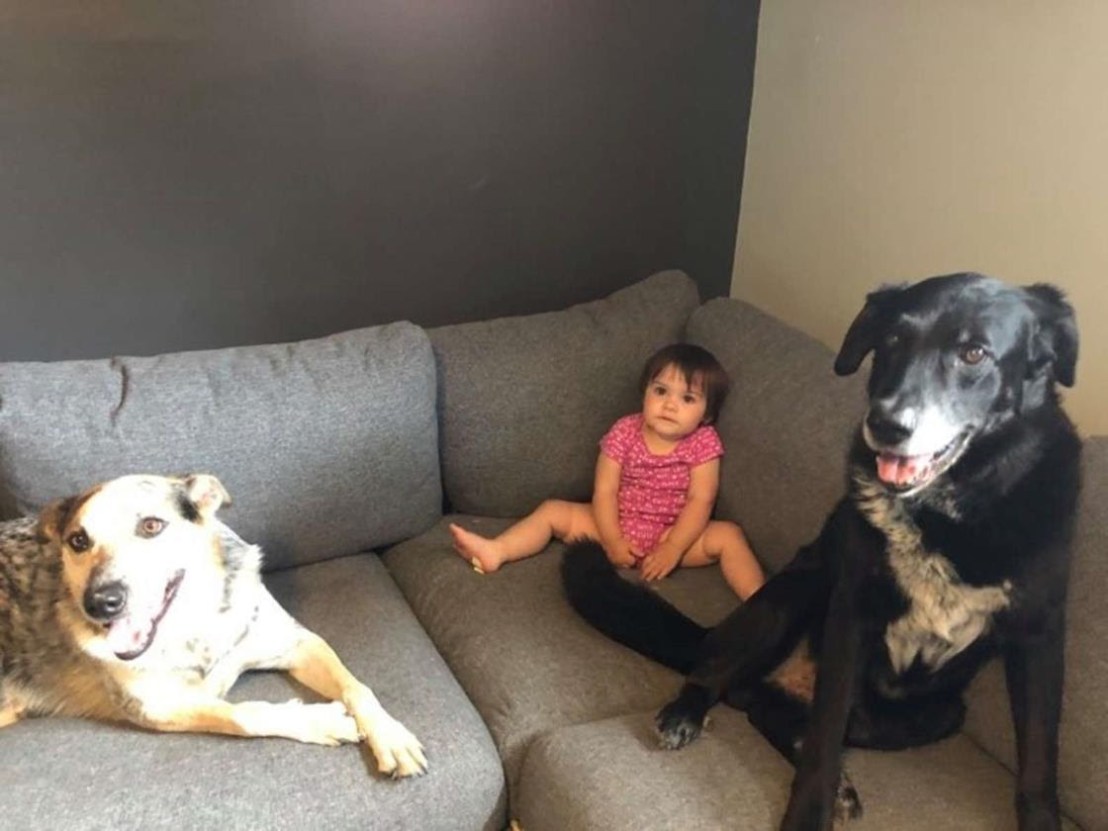
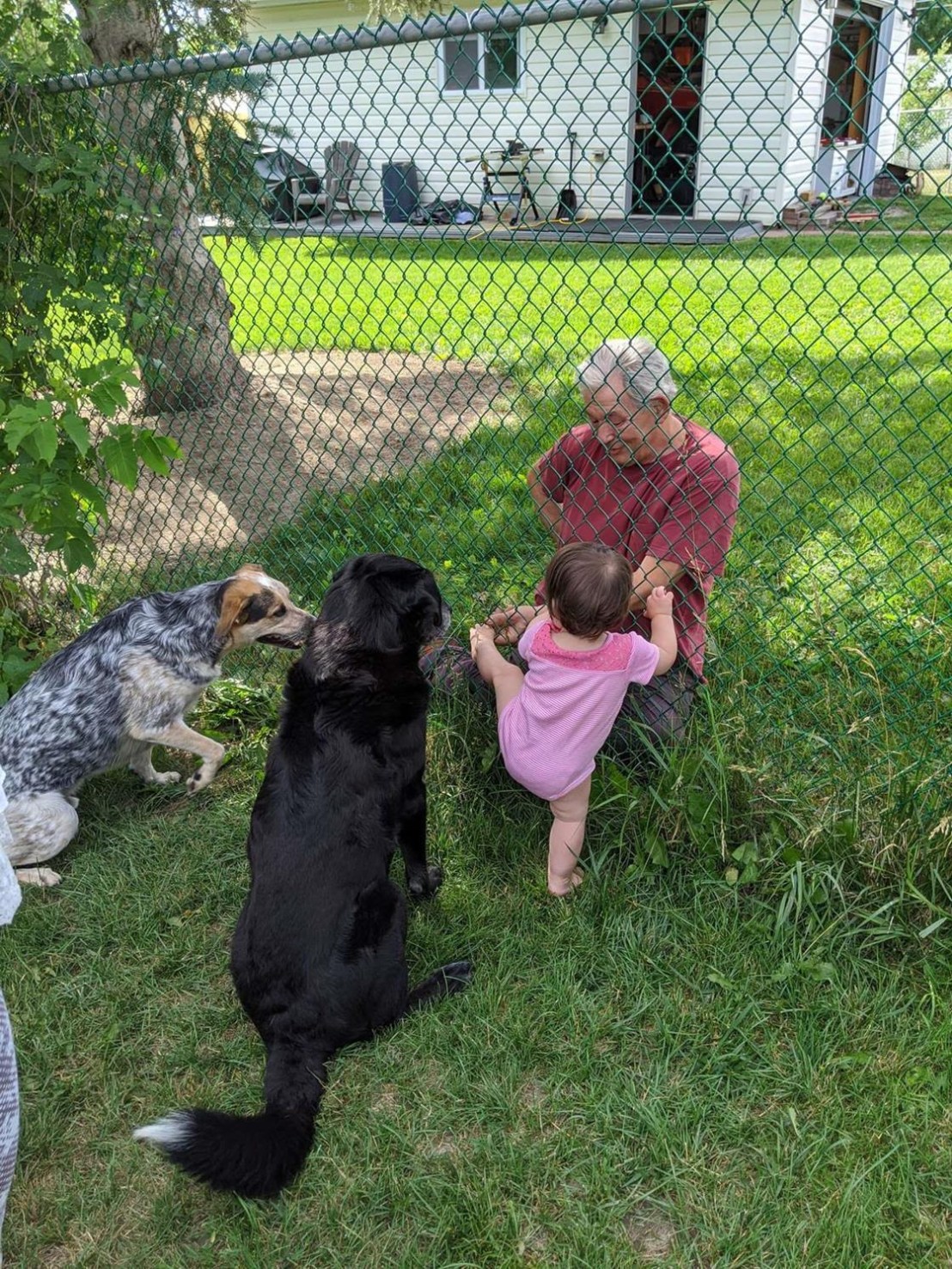
Sometimes you just want to be part of the pack. And the fact that Ramona is a toddler and her brothers Zeus and Blue are dogs makes no difference.
The pups are happy to include her and are always gentle and relaxed around her.
Ramona loves hanging out with them, though she hasn’t learned how to be gentle yet: “She loves her big puppies and is always trying to give them kisses,” Mike Whalley, Ramona’s dad, told The Dodo. “She also often finds them hilarious, frequently having giggle fits about something they’re doing like chasing their tail or jumping around for toys or snacks.”
Photo Credit: Mike Whalley
So when Ramona realized that her brothers were getting treats each day from their neighbor — she had to be involved.
“[Our] neighbor, Gary, originally shared a bologna sandwich with Zeus one afternoon. He asked us if it was all right and then he started buying boxes of dog treats to offer,” Whalley said. “At first, it was just Zeus, then we got Blue and he joined in.”
As soon as Ramona was able to eat solid foods, the neighbor offered her a freshly baked oatmeal cookie and Ramona quickly realized how good her dog brothers had it. “Now that she’s walking and mobile she just trots on over to the fence to line up with the dogs so she can get her ‘treats’ too,” Whalley said.
Photo Credit: Mike Whalley
Of course, their generous neighbor gives the dogs a few more treats each day than Ramona. “They get their breakfast treat, lunchtime, coffee break and their bedtime snack,” Whalley said. “For bedtime, they get their bigger bone to ‘brush their teeth.’”
“Ramona usually joins in for the afternoon treats and it’s usually a cookie or some Ritz crackers,” he added.
Zeus and Blue have Gary on a strict schedule, and if he misses their treat time they make sure to let him know. Now that Ramona is part of the pack, Gary never lets them down.
ooOOoo
It takes such stories as this one to keep us all on the straight and narrow, so to speak, and not to worry too much about the future.