Category: Morality

Other inhabited worlds, and the implications of finding one.

This is profoundly important.

Well it is to me and Jean and, I suspect, it will be to many other people.

I am an atheist. So is Jean. We have been all our lives. I think that many of you who follow this blog know that. The love that we have for our dogs, and all our animals, plus the beauty that is all around us in nature is enough. (Now I am not naive enough to realise that there are many, literally millions, that don’t have the same fortune in their lives.)

The Conversation recently republished an essay by David Weintraub that was first published in 2014. It is at the core of our existence and I am delighted to have the permission to republish it for you.

ooOOoo

Is your religion ready to meet ET

By
 Professor of Astronomy, Vanderbilt University

November 5th, 2014

Square away your personal philosophy now; proof of life beyond earth is coming. Stargazing image via http://www.shutterstock.com

How will humankind react after astronomers hand over rock-solid scientific evidence for the existence of life beyond the Earth? No more speculating. No more wondering. The moment scientists announce this discovery, everything will change. Not least of all, our philosophies and religions will need to incorporate the new information.

Searching for signs of life

Astronomers have now identified thousands of planets in orbit around other stars. At the current rate of discovery, millions more will be found this century.

Having already found the physical planets, astronomers are now searching for our biological neighbors. Over the next fifty years, they will begin the tantalizing, detailed study of millions of planets, looking for evidence of the presence of life on or below the surfaces or in the atmospheres of those planets.

And it’s very likely that astronomers will find it. Despite the fact that more than one-third of Americans surveyed believe that aliens have already visited Earth, the first evidence of life beyond our planet probably won’t be radio signals, little green men or flying saucers. Instead, a 21st century Galileo, using an enormous, 50-meter-diameter telescope, will collect light from the atmospheres of distant planets, looking for the signatures of biologically significant molecules.

Astronomers filter that light from far away through spectrometers – high-tech prisms that tease the light apart into its many distinct wavelengths. They’re looking for the telltale fingerprints of molecules that would not exist in abundance in these atmospheres in the absence of living things. The spectroscopic data will tell whether a planet’s environment has been altered in ways that point to biological processes at work.

What is our place in the universe? Woman image via http://www.shutterstock.com

If we aren’t alone, who are we?

With the discovery in a distant planet’s light spectrum of a chemical that could only be produced by living creatures, humankind will have the opportunity to read a new page in the book of knowledge. We will no longer be speculating about whether other beings exist in the universe. We will know that we not alone.

An affirmative answer to the question “Does life exist anywhere else in the universe beyond Earth?” would raise immediate and profoundly important cosmotheological questions about our place in the universe. If extraterrestrial others exist, then my religion and my religious beliefs and practices might not be universal. If my religion is not universally applicable to all extraterrestrial others, perhaps my religion need not be offered to, let alone forced on, all terrestrial others. Ultimately, we might learn some important lessons applicable here at home just from considering the possibility of life beyond our planet.

In my book, I investigated the sacred writings of the world’s most widely practiced religions, asking what each religion has to say about the uniqueness or non-uniqueness of life on Earth, and how, or if, a particular religion would work on other planets in distant parts of the universe.

Extrasolar sinners?

Let’s examine a seemingly simple yet exceedingly complex theological question: could extraterrestrials be Christians? If Jesus died in order to redeem humanity from the state of sin into which humans are born, does the death and resurrection of Jesus, on Earth, also redeem other sentient beings from a similar state of sin? If so, why are the extraterrestrials sinful? Is sin built into the very fabric of the space and time of the universe? Or can life exist in parts of the universe without being in a state of sin and therefore without the need of redemption and thus without the need for Christianity? Many different solutions to these puzzles involving Christian theology have been put forward. None of them yet satisfy all Christians.

Mormon worlds

Mormon scripture clearly teaches that other inhabited worlds exist and that “the inhabitants thereof are begotten sons and daughters unto God” (Doctrines and Covenants 76:24). The Earth, however, is a favored world in Mormonism, because Jesus, as understood by Mormons, lived and was resurrected only on Earth. In addition, Mormon so-called intelligences can only achieve their own spiritual goals during their lives on Earth, not during lifetimes on other worlds. Thus, for Mormons, the Earth might not be the physical center of the universe but it is the most favored place in the universe. Such a view implies that all other worlds are, somehow, lesser worlds than Earth.

Bahá’í without bias

Members of the Bahá’í Faith have a view of the universe that has no bias for or against the Earth as a special place or for against humans as a special sentient species. The principles of the Bahá’í Faith – unifying society, abandoning prejudice, equalizing opportunities for all people, eliminating poverty – are about humans on Earth. The Bahá’í faithful would expect any creatures anywhere in the universe to worship the same God as do humans, but to do so according to their own, world-specific ways.

Light years from Mecca

The pillars of the faith for Muslims require the faithful to pray five times every day while facing Mecca. Because determining the direction of Mecca correctly could be extremely difficult on a quickly spinning planet millions of light years from Earth, practicing the same faith on another world might not make any sense. Yet the words of the Qu’ran tell us that “Whatever beings there are in the heavens and the earth do prostrate themselves to Allah” (13:15). Can terrestrial Muslims accept that the prophetically revealed religion of Muhammad is intended only for humans on earth and that other worlds would have their own prophets?

Astronomers as paradigm-shatterers

Philosophers and scientists have forced worldviews to adapt in the past.

At certain moments throughout history, astronomers’ discoveries have exerted an outsized influence on human culture. Ancient Greek astronomers unflattened the Earth – though many then chose to forget this knowledge. Renaissance scholars Copernicus and Galileo put the Earth in motion around the Sun and moved humans away from the center of the universe. In the 20th century, Edwin Hubble eliminated the very idea that the universe has any center at all. He demonstrated that what the universe has is a beginning in time and that, bizarrely, the universe, the very fabric of three-dimensional space, is expanding.

Clearly, when astronomers offer the world bold new ideas, they don’t mess around. Another such paradigm-shattering new idea may be in the light arriving at our telescopes now.

No matter which (a)theistic background informs your theology, you may have to wrestle with the data astronomers will be bringing to houses of worship in the very near future. You will need to ask: Is my God the God of the entire universe? Is my religion a terrestrial or a universal religion? As people work to reconcile the discovery of extrasolar life with their theological and philosophical worldviews, adapting to the news of life beyond Earth will be discomfiting and perhaps even disruptive.

ooOOoo

Now I don’t really want to open up the subject of religion but I will say that WikiPedia have a great entry about the subject. My own view is that a few hundred years ago, when life was a lot more mysterious and uncertain, believing in life after death made some sense.

But we know a lot better now despite death still being a certainty.

Brandy!

Dogs don’t need religion!

Returning to a theme – May!

The years click by!

We are coming up to the month of May!

Then in a very short time it will be May 8th. Not only my half-birthday but considerably of more note the anniversary of the end of World War II.

I am certain that I am the only one who puts meaning into these dates. I can do no better than to re-post something that I published on May 1st, 2017.

ooOOoo

For all my life this has felt like a very special month.

And, dear friends, at the risk of repeating myself to many of you, this is why the month of May is special for me.

Simply that I was born in London during the closing months of the Second World War. Inevitably, I was unaware of the number of German bombs that were falling on London during those last few months. But there were thousands.

On May 8th. 1945, the day that WWII ended and six months to the day from when I was born, my mother looked down at me and said aloud to me: “You are going to live”. Despite the fact that I don’t recall my mother saying that, it was verified many times later when I was growing up.

Now here we are approaching May 8th. 2017 (now May, 2020) and in a very real sense it seems that we are in another war.

A war of consequence.

A war that we have been engaged in for many, many years.

A war where we are inadvertently fighting on a global battlefield.

A war where 99.99% of us don’t consciously identify the weapons we are using. Weapons that are incredibly effective. So much so that we are in sight of winning the last battle; winning the war.

Yet a war where winning is no win at all. Indeed, where winning this war, this global war, spells the end. The end of life for 99.99% of us humans (and much else besides).

Now what on earth has got me so fired up?

Two things have:

The first is that I am living in my 73rd year of life. (Now 75th.) I have no idea of when my life comes to an end. But that death is a guarantee. Indeed, if one takes note of the average life expectancy of a male today in the USA (75.6 years) , it may not be that far away.

The second thing is that before my death I truly want to know that humankind has laid down its weapons of war against our planet and that there really is an unstoppable mission, a united wave of passion, to live in peace on this planet. Perhaps better put to live in peace with this planet.

Or in the words of an organization that I now want to introduce:

A mission which will require the hard work and dedication of each and every one of us as we do everything in our power as individuals, but also as we galvanize businesses, entrepreneurs, innovators, city planners, communities, people and politicians—all those who share our purpose.

OK! Thank you if you are still reading this! (Someone give Fred in that soft arm-chair over there a nudge; I can hear his snores from here!)

In the last Smithsonian electronic newsletter that I was reading yesterday morning there was a reference to an organization that I hadn’t previously come across. Here is the link to that item on The Smithsonian website. I am republishing it in full in this place. As you read it you will understand why I am republishing it.

ooOOoo

Using a New Roadmap to Democratize Climate Change

A new tool aims to bypass governments and put the power of climate action in the people’s hands

By Anne Glusker Smithsonian.com April 28, 2017

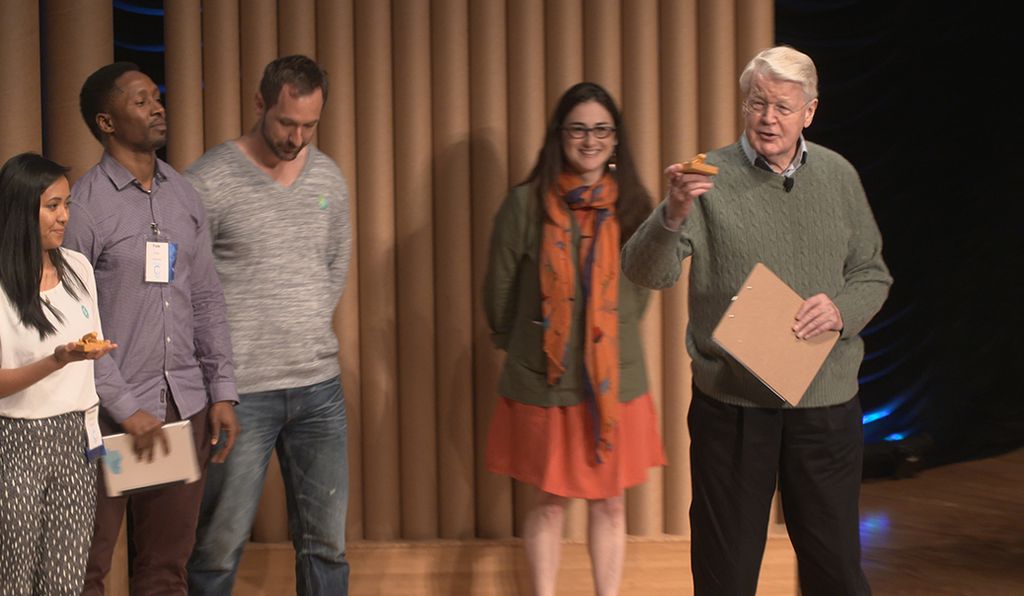
Olafur Grimsson, who was president of Iceland from 1996 to 2016 and saw his country through the worst economic crisis in its history, making headlines all over the world as banks collapsed and the country fell into a depression, is the very picture of an urbane statesman. Collected and poised, with a striking full head of white hair, as comfortable in English as in his native Icelandic, he seems an unlikely revolutionary, not the sort of person you’d look at and immediately find yourself thinking: “Power to the People.”

But Grimsson is one of the primary architects of a quietly radical new idea whose aim is to facilitate action on climate change without any of the usual suspects—governments, countries, international bodies, negotiating parties.

He and several other veterans of the historic 2015 Paris Agreement on climate change were in Washington, D.C., last year, just before COP22, the climate meeting held in Marrakesh in 2016. They were pondering next steps when the conversation took a new and interesting turn, Grimsson says, addressing the question: “Was it possible to have the success of Paris without governments necessarily being in the leading role?”

The group included movers and shakers such as Peter Seligmann, the chairman of Conservation International; Laurene Powell Jobs, president of the philanthropic organization the Emerson Collective; and Andy Karsner, an assistant energy secretary during the administration of George W. Bush. Galvanized by their own query, they decided to try to answer it—to set about creating a new tool to aid in achieving the goals of the Paris accord.

At the Smithsonian’s Earth Optimism Summit, a gathering this past weekend of conservation-minded citizens, scientists and activists, Grimsson explained: “You get governments that are opposed or even hostile to climate action. We decided to bring together in Marrakesh a gathering of thinkers and scientists and innovators and policymakers from different countries in order to discuss a new model of securing the success of the future of the climate movement.”

At the Smithsonian’s Earth Optimism Summit, the former president of Iceland Olafur Grimsson encouraged new solutions to climate change, awarding cash prizes to the winners of the “Make for the Planet” challenge. (The Roadmap)

Grimsson’s group felt that due to changes in information technology and social transformations, the large organizations and structures that used to be necessary to effect change were now not needed. And thus was born Roadmap, a new crowdsourcing tool for anyone and everyone interested in climate action. Still in its very early stages, Roadmap’s founders envision it as a platform for those working on climate issues—from scientist and policymaker to farmer and fisherman—to facilitate the sharing of knowledge and ideas, methods and techniques.

“A new political model is possible—where everyone can be a doer, where you no longer need big government or big enterprises to bring about success,” Grimsson says.

This new model for social change that skips the usual cumbersome channels and processes has been seen everywhere from public health, where the Bill & Melinda Gates Foundation has redefined the sector, to the hospitality industry, which is working to combat the human trafficking that plagues its businesses, to perhaps most famously the Arab Spring, where the role of social media in bringing about political change is still being debated today.

And this new model is complemented by technological changes. “The innovation in energy technology is such that we no longer have to wait for the big energy breakthrough,” Grimsson says. “We already have the available technologies. Every individual, home, village, community, town and region can execute change. The good news from the climate point of view is that, in addition to the information technology revolution, there has now also taken place an energy revolution. A house can be a power station: If the people who live in that house have extra energy, they can sell their energy through the smart grid. The notion that every house can be a power station is as revolutionary as saying that every mobile phone can be a media company.”

Grimsson admits that it may seem odd for someone in his position to be advocating that ordinary citizens take action apart from the conventional corridors of governmental power.

“For me to say that these traditional political organizations and positions are somewhat outdated is perhaps a strange statement: I was a professor of political science, I’ve been a member of parliament, I’ve been a minister of finance, I was president for 20 years,” he says.

It was during Iceland’s financial meltdown that he first experienced this new kind of social change: “I saw this very strongly through the financial crisis in my own country, which led to a big social economic uprising. All those activities were engineered by unknown people, people who were not part of a big organization, who used Facebook and the information media to bring thousands of people together in one day.”

Right now, Roadmap consists of a website and a lofty manifesto that speaks of raising the value of “moral currency” and creating a “best practices warehouse.” Visitors to the site can fill out a form if they want to become part of its community of “doers.” The practical part of the manifesto speaks of identifying the best methodologies and models; implementing a “real-time system of measurement” and a way to “gauge and understand what is working, what is not, and exactly what is being achieved.” As the platform develops, it will be interesting to see exactly what form these gauges, measurement systems, and warehouses take.

After the Paris Agreement, Grimsson says of himself and his Roadmap co-founders, “We were all optimistic, but we are all also realists.” It is his belief that if you “give people the tools, they can execute the transformation and the change—without governmental leadership.” Perhaps Roadmap will be one of those tools.

ooOOoo

Here’s a video that spells it out in ways that I find impossible to ignore.

Because in hundreds of years time I want others to look at the following picture of Troutbeck Valley in England and know how precious is this one and only planet we live on.

Or in the words of Sue Dreamwalker that I read yesterday evening:

We are witnessing more storms, more unseasonal weather patterns, and I just hope that we wake up soon to the damage we are doing to our beloved Mother that has held us in her eternal arms for so long..

Photo credit: Getty Images

Enjoy the month of May wherever you are in the world!

Closing by repeating a key pronouncement in that RoadMap video above:

Why We?

Who Else!

What on earth are we going to do?

A very powerful essay from George Monbiot.

Today and tomorrow I am posting essays that have nothing to do with dogs! Today, I am sharing George’s gloom about the future, tomorrow I am sharing our human capacity for incredible ingenuity and technology.

Because I sense we are a species of two extremes; the very mad and the very clever!

I don’t have an answer but I can share these two essays.

Today, I give you George Monbiot’s essay Suing For Survival.

ooOOoo

Suing For Survival

Our legal action against the government aims to shut down fossil fuels

By George Monbiot, published in the Guardian 4th March 2020

Our survival is not an afterthought. The defence of the living planet cannot be tacked retrospectively onto business as usual. Yet this is how almost all governments operate. They slap the word “sustainable” on damaging projects they have already approved, then insist this means they’ve gone green. If we are to survive and prosper, everything must change. Every decision should begin with the question of what the planet can withstand.

This means that any discussion about new infrastructure should begin with ecological constraints. The figures are stark. A paper published in Nature last year showed that existing energy infrastructure, if it is allowed to run to the end of its natural life, will produce around 660 gigatonnes of CO2. Yet, to stand a reasonable chance of preventing more than 1.5°C of global heating, we can afford to release, in total, no more than 580 gigatonnes. In other words, far from building new fossil power plants, the survival of a habitable planet means retiring the damaging projects that have already been built. Electricity plants burning coal and gas and oil will not secure our prosperity. They will destroy it.

But everywhere special interests dominate. Construction projects are driven, above all, by the lobbying of the construction industry, consultancies and financiers. Gigantic and destructive schemes, such as the Oxford-Cambridge Expressway, are invented by lobbyists for the purpose of generating contracts. Political support is drummed up, the project achieves its own momentum, then, belatedly, a feeble attempt is made to demonstrate that it can somehow become compatible with environmental promises. This is what destroys civilisations: a mismatch between the greed of economic elites and the needs of society.

But last week, something momentous happened. The decision to build a scheme with vast financial backing and terrible environmental impacts was struck down by the Court of Appeal. The judges decided that government policy, on which planning permission for a third runway at Heathrow was based, had failed to take account of the UK’s climate commitments, and was therefore unlawful. This is – or should be – the end of business as usual.

The Heathrow decision stands as a massive and crucial precedent. Now we must use it to insist that governments everywhere put our survival first, and the demands of corporate lobbyists last. To this end, with the Good Law Project and Dale Vince, the founder of Ecotricity, I’m pursuing a similar claim. In this case, we are challenging the UK government’s policy for approving new energy projects.

On Tuesday, we delivered a “letter before action” to the Treasury solicitor. We’ve given the government 21 days to accept our case and change its policy to reflect the climate commitments agreed by Parliament. If it fails to do so, we shall issue proceedings in the High Court to have the policy declared unlawful. We’ll need money, so we’ve launched a crowdfunding appeal to finance the action.

It’s hard to see how the government could resist our case. The Heathrow judgement hung on the government’s national policy statement on airports. This, the judges found, had not been updated to take account of the Paris climate agreement. New fossil fuel plants, such as the gas burners at Drax in Yorkshire the government approved last October, are enabled by something very similar: the national policy statements on energy infrastructure. These have not been updated since they were published in 2011. As a result, they take no account of the Paris agreement, of the government’s new climate target (net zero by 2050, as opposed to an 80% cut) or of Parliament’s declaration of a climate emergency. The main policy statement says that the European Emissions Trading System “forms the cornerstone of UK action to reduce greenhouse gas emissions from the power sector”. As we have left the EU, this, obviously, no longer holds. The planning act obliges the government to review its national policy statements when circumstances change. It has failed to do so. It is disregarding its own laws.

These outdated policy statements create a presumption in favour of new fossil fuel plants. Once a national policy statement has been published, there is little objectors can do to prevent damaging projects from going ahead. In approving the Drax plant, the secretary of state for business and energy at the time (Andrea Leadsom) insisted that the policy statement came first, regardless of the climate impacts. Catastrophic decisions like this will continue to be made until the statements change. They are incompatible with either the government’s new climate commitments or a habitable planet.

While we are challenging the government’s energy policies, another group – the Transport Action Network – is about to challenge its road building schemes on the same basis. It points out that the national policy statement on road networks is also outdated and incompatible with the UK’s climate commitments. The policy statement, astonishingly, insists that “any increase in carbon emissions is not a reason to refuse development consent“, unless the increase is so great that the road would prevent the government from meeting its national targets. No single road project can be disqualified on these grounds. But the cumulative effect of new road building ensures that the UK will inevitably bust its carbon targets. While carbon emissions are officially disregarded, minuscule time savings are used to justify massive and damaging projects.

Transport emissions have been rising for the past five years, partly because of road building. The government tries to justify its schemes by claiming that cars will use less fossil fuel. But because they are becoming bigger and heavier, new cars sold in the UK now produce more carbon dioxide per kilometre than older models.

The perverse and outdated national policy statement locks into place such damaging projects as the A303 works around Stonehenge, the A27 Arundel scheme, the Lower Thames crossing, the Port of Liverpool access road, the Silvertown tunnel in London and the Wensum Link road in Norfolk. A government seeking to protect the lives of current and future generations would immediately strike down the policy that supports these projects, and replace it with one that emphasised walking, cycling and public transport.

A third action has been launched by Chris Packham and the law firm Leigh Day, challenging HS2 on similar grounds. Its carbon emissions were not properly taken into account, and its environmental impacts were assessed before the government signed the Paris agreement.

Already, the Heathrow decision is resonating around the world. Now we need to drive its implications home, by suing for survival. If we can oblige governments to resist the demands of corporate lobbyists and put life before profit, humanity might just stand a chance.

http://www.monbiot.com

ooOOoo

Now this essay is about the situation in the U.K. but only a fool would think that it’s not relevant to the rest of the planet.

I beseech you to read it!

“Life before profit.” Now there’s a thought!

This man loves his dog a lot!

An item in The Dodo just had to be shared with you.

This is devotion with a capital ‘D’.

Straight into the article that, as I said, came from a recent Dodo newsletter.

ooOOoo

Man Makes A Cozy Wagon So His Paralyzed Dog Can Still Take Walks

He said that she would do the same for him ❤

By
Published On 01/07/2020

Photo Credit: Facebook/Bryan Thompson

Last month, on a chilly winter day in Nova Scotia, Canada, Bryan Thompson had a chance encounter he won’t soon forget.

While walking through a local park, Thompson saw this: a stranger making his way through the snow, pulling a cart containing the most precious cargo.

Inside, bundled up against the cold, was a cozy white pup.

Photo Credit: Facebook/Bryan Thompson

Speaking to the stranger, Thompson came to learn that the dog has amyotrophic lateral sclerosis (ALS), a spinal cord disorder which can lead to paralysis in dogs. Because of that, she’s unable to get around on her own — but that hasn’t stopped the pair from still taking walks.

The dedicated dog owner crafted the cart to ensure it never does.

In a post online, Thompson described his reaction to that scene.

“I told him he was a great person for doing that, because I know there are many who wouldn’t. He just said that she would do the same for him,” Thompson wrote. “It’s hard to type this without tearing up.”

Photo Credit: Facebook/Bryan Thompson

Afterward, the stranger and his happy dog continued on their way — slipping out of sight, but not out of mind.

Thompson’s account of that touching encounter has since gone viral, inspiring countless others with an example of true love at its finest.

ooOOoo

This stranger, who is not named, is just a miraculous person. Plus a caring and loving man. It’s no surprise that the encounter, as described above, has gone viral.

This is, after all, what matters!

This is a gorgeous story, and it’s true!

Piper lost and found!

There’s something almost beyond the world of words, pictures and blogging. That’s when a dog goes missing and then is found. Especially if the lover of the dog is a young boy who fears the worst.

Dogs bring out so much that is good in us. Dogs cross gender, age, country and ethnic boundaries.

This is what struck me with some force I will admit when I read this article on the Daily Dodo yesterday. It is republished for your own delight!

Oh, and welcome to Friday the 13th!

ooOOoo

Family Surprises Boy At School With His Lost Dog

So many happy tears 😭❤️️🐶

Photo Credit: Facebook/April Licata

The holidays aren’t about what’s under the tree; it’s who you’re with that matters. And no one understands that better than Carter Licata and his dog, Piper.

The 2-year-old pug loves everyone in her family, but her bond with her brother is special. “It was love at first sight for the two of them,” April Licata, Carter’s mom, told The Dodo.

But the family’s holiday season was nearly destroyed when the unthinkable happened — Piper went missing.

Photo Credit: April Licata

Last month, Licata let Piper and her other dog outside to use the bathroom. But when she opened the door to let them back in, Piper was nowhere to be seen.

The family searched everywhere, posted on social media, and reached out to neighbors and community groups. They prayed for Piper’s safe return, but as days turned to weeks, they feared that they would never see their pug again.

“We were all sick,” Licata said. “The older kids wanted nothing to do with decorating the Christmas tree and it was a very somber Thanksgiving for them.”

Then, Licata received a Facebook message from the Genesee County Animal Shelter. A dog matching Piper’s description had been dropped off at the shelter by a person who wanted to remain anonymous. “My husband and I were going out to dinner and honestly, there was an outcry of joy in the truck,” Licata said. “We were shocked and elated!”

Carter was out of town when they learned about Piper, so they decided to keep it a secret and surprise him with a special reunion when he returned. Piper, meanwhile, wandered around the house looking for her brother, until finally, their reunion day arrived.

Photo Credit: Facebook/April Licata

When Carter saw Piper in the front seat of the truck, decked out in bows, he immediately broke down in tears.

Piper’s tail went crazy at the sight of her brother and as soon as he stepped in the truck, she jumped in his arms, showering him with kisses.

The family couldn’t be happier to have Piper back again — and just in time for Christmas.

“My son loves his dog so much, was sick while she was gone, and tonight she’s sleeping next to him again,” Licata wrote on Facebook. “What a Christmas miracle for our family.”

You can see the heart-warming video below.

ooOOoo

I know that for the main part I just republish the work that others do. But that doesn’t mean that I’m not affected by the articles. This one in particular had me in tears.

Dogs mean so, so much to us!

Being ever so grateful for one’s lot.

There’s a science background to being healthy and happy.

Especially as one gets older.

It’s Jean’s birthday today and we are grateful for our lot. I’m 75 now and Jean is a few years younger. But more importantly we are so grateful to have met and, subsequently, fallen in love.

As well as Jean’s love in return we have our gorgeous dogs as well (not to count in addition the two horses, the two parakeets and the cat) and they reinforce the feelings of happiness that surround us.

All of which is an introduction to an article on The Conversation that caught my eye yesterday.

I’m afraid it doesn’t mention dogs but then again we dog owners know for sure how they benefit us humans.

ooOOoo

Are you as grateful as you deserve to be?

November 26, 2019
By
Chancellor’s Professor of Medicine, Liberal Arts, and Philanthropy, Indiana University

Gratitude is not only a great feeling but a healthy one. Aaron Amat/Shutterstock.com

As a physician, I have helped to care for many patients and families whose lives have been turned upside down by serious illnesses and injuries. In the throes of such catastrophes, it can be difficult to find cause for anything but lament. Yet Thanksgiving presents us with an opportunity to develop one of the healthiest, most life-affirming and convivial of all habits – that of counting and rejoicing in our blessings.

Gratitude’s benefits

Research shows that grateful people tend to be healthy and happy. They exhibit lower levels of stress and depression, cope better with adversity and sleep better. They tend to be happier and more satisfied with life. Even their partners tend to be more content with their relationships.

Perhaps when we are more focused on the good things we enjoy in life, we have more to live for and tend to take better care of ourselves and each other.

When researchers asked people to reflect on the past week and write about things that either irritated them or about which they felt grateful, those tasked with recalling good things were more optimistic, felt better about their lives and actually visited their physicians less.

It is no surprise that receiving thanks makes people happier, but so does expressing gratitude. An experiment that asked participants to write and deliver thank-you notes found large increases in reported levels of happiness, a benefit that lasted for an entire month.

Philosophical roots

Giving thanks is important for our psyches and our souls. Love You Stock/Shutterstock.com

One of the greatest minds in Western history, the Greek philosopher Aristotle, argued that we become what we habitually do. By changing our habits, we can become more thankful human beings.

If we spend our days ruminating on all that has gone poorly and how dark the prospects for the future appear, we can think ourselves into misery and resentment.

But we can also mold ourselves into the kind of people who seek out, recognize and celebrate all that we have to be grateful for.

This is not to say that anyone should become a Pollyanna, ceaselessly reciting the mantra from Voltaire’s “Candide,” “All is for the best in this, the best of all possible worlds.” There are injustices to be righted and wounds to be healed, and ignoring them would represent a lapse of moral responsibility.

But reasons to make the world a better place should never blind us to the many good things it already affords. How can we be compassionate and generous if we are fixated on deficiency? This explains why the great Roman statesman Cicero called gratitude not only the greatest of virtues but the “parent” of them all.

Religious roots

Gratitude is deeply embedded in many religious traditions. In Judaism, the first words of the morning prayer could be translated, “I thank you.” Another saying addresses the question, “Who is rich?” with this answer: “Those who rejoice in what they have.”

From a Christian perspective, too, gratitude and thanksgiving are vital. Before Jesus shares his last meal with his disciples, he gives thanks. So vital a part of Christian life is gratitude that author and critic G.K. Chesterton calls it “the highest form of thought.”

Gratitude also plays an essential role in Islam. The 55th chapter of the Quran enumerates all the things human beings have to be grateful for – the Sun, Moon, clouds, rain, air, grass, animals, plants, rivers and oceans – and then asks, “How can a sensible person be anything but thankful to God?”

Other traditions also stress the importance of thankfulness. Hindu festivals celebrate blessings and offer thanks for them. In Buddhism, gratitude develops patience and serves as an antidote to greed, the corrosive sense that we never have enough.

Roots even in suffering

In his 1994 book, “A Whole New Life,” the Duke University English professor Reynolds Price describes how his battle with a spinal cord tumor that left him partially paralyzed also taught him a great deal about what it means to really live.

After surgery, Price describes “a kind of stunned beatitude.” With time, though diminished in many ways by his tumor and its treatment, he learns to pay closer attention to the world around him and those who populate it.

Reflecting on the change in his writing, Price notes that his books differ in many ways from those he penned as a younger man. Even his handwriting, he says, “looks very little like that of the man he was at the time of his diagnosis.”

“Cranky as it is, it’s taller, more legible, and with more air and stride. And it comes down the arm of a grateful man.”

A brush with death can open our eyes. Some of us emerge with a deepened appreciation for the preciousness of each day, a clearer sense of our real priorities and a renewed commitment to celebrating life. In short, we can become more grateful, and more alive, than ever.

Practicing gratitude

Good conversation, good friends and connections – not material possessions – bring great joy. Jacob Lund/Shutterstock.com

When it comes to practicing gratitude, one trap to avoid is locating happiness in things that make us feel better off – or simply better – than others. In my view, such thinking can foster envy and jealousy.

There are marvelous respects in which we are equally blessed – the same Sun shines down upon each of us, we all begin each day with the same 24 hours, and each of us enjoys the free use of one of the most complex and powerful resources in the universe, the human brain.

Much in our culture seems aimed to cultivate an attitude of deficiency – for example, most ads aim to make us think that to find happiness we must buy something. Yet most of the best things in life – the beauty of nature, conversation and love – are free.

There are many ways to cultivate a disposition of thankfulness. One is to make a habit of giving thanks regularly – at the beginning of the day, at meals and the like, and at day’s end.

Likewise, holidays, weeks, seasons and years can be punctuated with thanks – grateful prayer or meditation, writing thank-you notes, keeping a gratitude journal and consciously seeking out the blessings in situations as they arise.

Gratitude can become a way of life, and by developing the simple habit of counting our blessings, we can enhance the degree to which we are truly blessed.

[ Thanks for reading! We can send you The Conversation’s stories every day in an informative email. Sign up today. ]

ooOOoo

That reference to Reynolds Price and his challenges make one think. I have been fortunate that nothing really dreadful has happened to me; apart from my father’s death when I had just turned 12. I’m getting a little hazy in terms of certain memories but that’s an old age thing rather than an illness. But to go through what he did; I just don’t know the person that I am, in terms of how I wold react to that.

But to the general tone of the article, I would hope that I can get better and better.

For it’s splendid to cultivate that disposition.

One is to make a habit of giving thanks regularly – at the beginning of the day, at meals and the like, and at day’s end.

Perfect!

It’s not all hugs and smiles.

A sobering article about the unacceptable face of dogs!

Jim Goodbrod recently sent me an email that included a copy of a recent article in the Washington Post.

Here’s what Jim wrote:

Hey Paul…..

I read this article in the Washington Post a couple weeks ago: it’s not something we want to hear or admit to, but I thought you’d find it interesting nonetheless.
Regards,  Jim

Jim got it in one when he said that it’s not something we want to admit to.

But it deserves sharing with you.

ooOOoo

The dog is one of the world’s most destructive mammals. Brazil proves it.

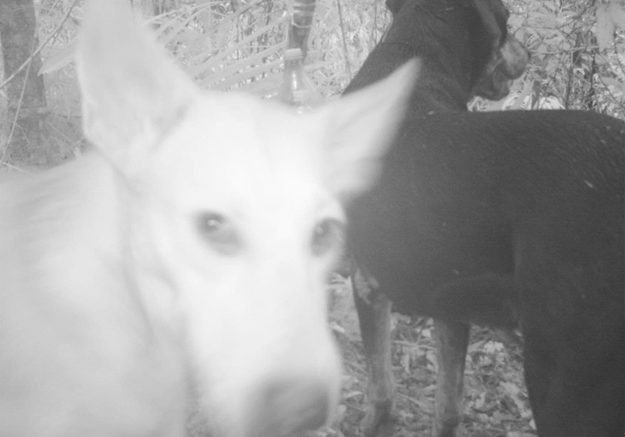
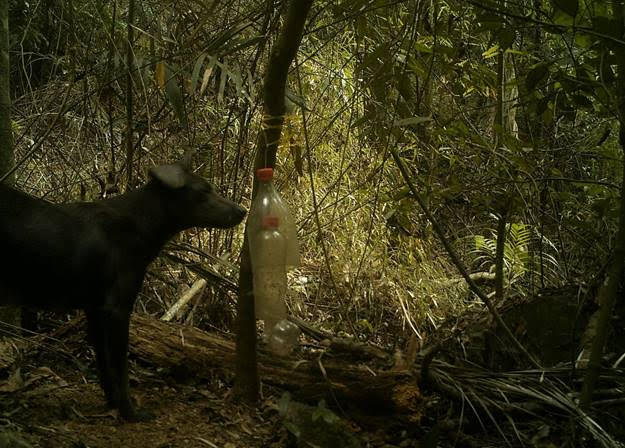
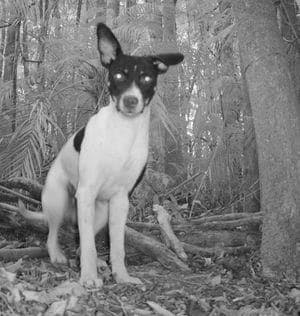
Surveillance cameras placed by researchers in Brazil’s Tijuca National Park capture a pair of dogs. (Courtesy of Katyucha Silva)

By Terrence McCoy

August 20

RIO DE JANEIRO — High above this Brazilian city, in a jungle blanketing a mountain, the turtles were out, and the scene was hopeful.

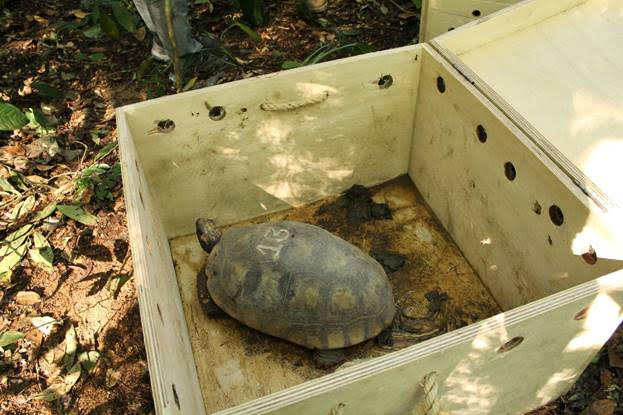
Scientists were reintroducing 15 mud-caked tortoises to this urban forest where they had once been plentiful. Children were running around. People were oohing and aahing. A stern-looking security guard appeared to briefly smile.

But not government biologist Katyucha Silva. She was thinking about dogs.

What would they do to these turtles? What were they doing to Brazil?

It’s a question more researchers are beginning to ask in a country where there are more dogs than children — and where dogs are quickly becoming the most destructive predator. They’re invading nature preserves and national parks. They’re forming packs, some 15 dogs strong, and are hunting wild prey. They’ve muscled out native predators such as foxes and big cats in nature preserves, outnumbering pumas 25 to 1 and ocelots 85 to 1.

Every year, they become still more plentiful, spreading diseases, disrupting natural environments, goosing scientists who set up elaborate camera systems to photograph wild animals, only to come away with pictures of curious canines.

“It’s a difficult thing for people to hear,” said Isadora Lessa, a Rio de Janeiro biologist who wrote her doctoral dissertation on domestic dogs causing environmental mayhem. “They love dogs too much.”

How the dog became one of the world’s most harmful invasive mammalian predators is as much a global story as a Brazilian one. Over the last century, as the human population exploded, so did the dog population, growing to an estimated 1 billion.

That has been great for people — and even better for dogs — but less so for nature, according to a growing body of academic research implicating canines, particularly the free-roaming ones, in environmental destruction.

“The global impacts of domestic dogs on wildlife are grossly underestimated,” researchers concluded in a 2017 study published in the journal Biological Conservation. The researchers, based in Australia, convicted dogs in the extinction of 11 species and declared them the third-most-damaging mammal, behind only cats and rodents.

The International Union for Conservation of Nature maintains a list of animals whose numbers dogs are culling. There are 191, and more than half are classified as either endangered or vulnerable. They range from lowly iguanas to the famed Tasmanian devil, from doves to monkeys, a diversity of animals with nothing in common beyond the fact that dogs enjoy killing them. In New Zealand, the organization reported, a single German shepherd once did in as many as 500 kiwis — and that was the conservative estimate.

“Unfortunately, we have a big problem,” said Piero Genovesi, chair of the agency’s invasive species unit. “There is a growing number of dogs.”

People all over the world are — begrudgingly — beginning to take note.

In Chile, stray dogs were the top concern among city dwellers surveyed this year, topping deteriorating sidewalks and theft. In New Zealand, some communities moved last year to restrict the movement of dogs in a gambit to save little blue penguins. In India, farmers are complaining about stray dogs killing their livestock, just as other predators once had.

And in Brazil, atop a mountain outside of Rio de Janeiro, 15 tortoises were nestling into the forest floor, oblivious to the danger of the forest’s leading predator.

‘A complex problem’

And in Brazil, atop a mountain outside of Rio de Janeiro, 15 tortoises were nestling into the forest floor, oblivious to the danger of the forest’s leading predator.

Researchers estimate there are more than 100 dogs in Tijuca National Park outside Rio de Janeiro, where they hunt and kill wild animals in packs. (Courtesy of Katyucha Silva)

Brazil is home to an estimated 52 million dogs, according to the most recent government statistics — more than anywhere in Latin America — but their lives vary widely. In a nation defined by inequality, where the rich fly in helicopters over the poor in the favelas below, the dog has become one more way of understanding the divide.

In wealthy cities, the dog is everywhere, strolling through fancy shopping malls, sitting in the laps of restaurant patrons, even riding paddle boards out on the surf. Some people wheel their dogs around in little strollers.

“The dog brings to Brazilians some things that Brazilians appreciate in themselves,” said Alexandre Rossi, a television personality more commonly known as Dr. Pet. “To be friendly, to want to socialize with everyone . . . and be there and be close to your family. These are perceived as very good Brazilian qualities.”

On the streets of trendy Ipanema one recent afternoon, few people could believe that a dog — or at least their dog — could be much of predator.

“The dog is a friend!” sputtered Philipe Soares, the furball Bobby at his feet. “No, I’ve never thought of him that way.”

“Difficult to imagine,” said Carlos Alberto Vicente, peering down at his own pooch.

“In her case,” said Flavio Vilela, a shirtless man striding through a park with a small mutt named Nicoli, “they’d hunt her.”

The problem, researchers say, isn’t these dogs, who lead the coddled lives of European or American pets.

The problem is the dogs in poorer and more rural communities, where the life of the dog is more frequently the life of hunger. They prowl the streets day and night with neither a collar nor an owner, looking for food wherever it can be found — in trash heaps, alongside roads, and in forests and fields, where they form packs to hunt and kill.

“It’s a very complex problem,” said Silva, the government biologist.

A stunning discovery

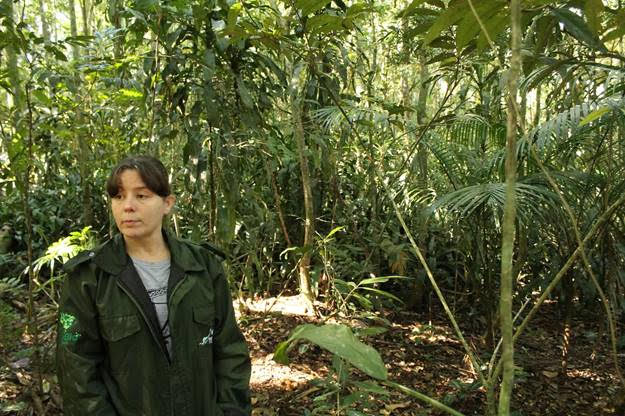
Katyucha Silva, a government researcher, has discovered dozens of dogs in Tijuca National Park. (Terrence McCoy/The Washington Post)

Ana Maria Paschoal, a researcher at the Federal University of Minas Gerais, remembers when she first started thinking about the dog differently. She was out in the Atlantic Forest in Southeast Brazil around a decade ago when she noticed there were an awful lot of them.

She wondered: How many dogs are using the protected areas? Are these feral or domestic dogs? Is their presence changing the occurrence of wild species?

So she set up cameras across 2,400 acres of forest to find out. What she discovered, published in 2012 in the scientific journal Mammalia, stunned her.

The dog wasn’t just the most-recorded carnivore; it was the most-recorded animal of the 17 mammals the cameras captured.

“The presence of the domestic dog is a threat,” Paschoal and her co-authors concluded.

The research, subsequently confirmed in a larger survey, laid the groundwork for a growing field of study here. One researcher linked Brazil’s dogs to the spread of diseases. Another accused the dogs in the National Park of Brasilia, where they hunted in massive packs, of scaring off natural predators. It was found that the closer humans lived to a nature preserve, the more likely dogs had penetrated it.

The International Union for Conservation of Nature has counted 191 species whose numbers dogs are culling. More than half are endangered or vulnerable. (Courtesy of Katyucha Silva)

But perhaps most striking? The dogs were neither feral nor domestic — but somewhere in between.

“All the dogs we detected had an ‘owner’ or a person that the animal has a bond with,” Paschoal said. “The species population increases following human populations, exacerbating their potential impact on wildlife.”

It was something Fernando Fernandez, an ecology professor at the Federal University of Rio de Janeiro, learned the hard way. For the last decade, he has been reintroducing native animals to the Tijuca forest, one of the world’s largest urban woodlands, which spills across Rio de Janeiro’s mountains.

First came the agouti, a squirrel-like rodent. Then followed a problem: “Dogs.”

They started killing the agouti, and not for food. It was just for fun.

Fernandez and Silva wanted to learn more. They set up cameras and discovered dozens of dogs in the forest. They estimated more than 100 dogs were in the park — not residents, it turned out, so much as frequent visitors, tracking in from nearby favelas.

“These are people who are very poor,” said Silva, who has six dogs at home. “They don’t have money to build walls. . . . When the owners leave for work, the dog leaves, too, and only returns when the owner comes back to the house from work.”

The owners often have no idea what their dogs are up to. Even if they were told, Rob Young said, they almost certainly wouldn’t believe it.

Young, chairman of wildlife conservation at the University of Salford in Britain, witnessed the psychology at work after seeing dogs kill flightless birds in the state of Minas Gerais.

“We’d do interviews with the farmers: ‘Have you seen these dogs?’

“And they’d say, ‘Yeah, but my dogs aren’t the problem; it’s my neighbor’s dogs.’

“Every farmer would say the same thing.”

These factors — inability to see aggression in dogs, in­trac­table inequality, the rapid expansion of humanity — left Silva feeling apprehensive as she watched the tortoises being reintroduced into the Tijuca forest.

In the long term, she didn’t know how the problem of dogs laying waste to the world’s environments would realistically improve.

And in the short term: Could dogs kill these tortoises, just as they’d dispatched a few agouti?

“Yes,” she said. “They could.”

Silva worries that tortoises reintroduced in the park could fall prey to dogs. (Terrence McCoy/The Washington Post)

ooOOoo

It’s a tough read and there doesn’t appear to be a solution, not in the short-term at least.

As was reported in the article it is as much a global problem with something of the order of a billion dogs roaming the planet.

Does anyone have any ideas for a solution?

A book about a terrible happening!

A massive cull of pet cats and dogs in the UK during WW11.

Out of the blue the other day Margaret from Tasmania sent me an email.

Hi Paul,
I happened to come across this rather sad but interesting story.
Thought you might like to read it.
Warm regards
– Margaret (from Tasmania)

The email contained a link to this very sad information.

ooOOoo

The little-told story of the massive WWII pet cull

By Alison Feeney-Hart
BBC News Magazine

12th October, 2013

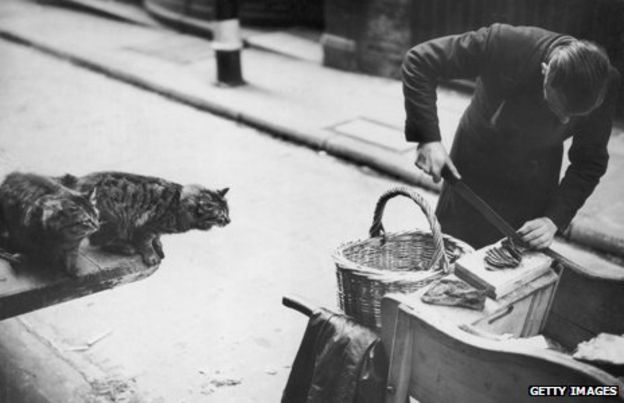
This dog was treated by a vet, but many were put down at the outbreak of WWII

At the beginning of World War II, a government pamphlet led to a massive cull of British pets. As many as 750,000 British pets were killed in just one week. This little-discussed moment of panic is explored in a new book.

The cull came as the result of a public information campaign that caused an extraordinary reaction among anxious Britons.

In the summer of 1939, just before the outbreak of war, the National Air Raid Precautions Animals Committee (NARPAC) was formed. It drafted a notice – Advice to Animal Owners.

The pamphlet said: “If at all possible, send or take your household animals into the country in advance of an emergency.” It concluded: “If you cannot place them in the care of neighbours, it really is kindest to have them destroyed.”

The advice was printed in almost every newspaper and announced on the BBC. It was “a national tragedy in the making”, says Clare Campbell, author of new book Bonzo’s War: Animals Under Fire 1939 -1945.

Campbell recalls a story about her uncle. “Shortly after the invasion of Poland, it was announced on the radio that there might be a shortage of food. My uncle announced that the family pet Paddy would have to be destroyed the next day.”

After war was declared on 3 September 1939, pet owners thronged to vets’ surgeries and animal homes.

An RAF serviceman delivers a stray to Battersea

“Animal charities, the PDSA, the RSPCA and vets were all opposed to the killing of pets and very concerned about people just dumping animals on their doorsteps at the start of the war,” says historian Hilda Kean.

Battersea Dogs and Cats Home opened its doors in 1860 and survived both wars. “Many people contacted us after the outbreak of war to ask us to euthanise their pets – either because they were going off to war, they were bombed, or they could no longer afford to keep them during rationing,” a spokesman says.

“Battersea actually advised against taking such drastic measures and our then manager Edward Healey-Tutt wrote to people asking them not to be too hasty.”

But Campbell cites an Arthur Moss of the RSPCA who, “gloomily pronounced that the primary task for them all would be the destruction of animals”.

In the first few days of war, PDSA hospitals and dispensaries were overwhelmed by owners bringing their pets for destruction. PDSA founder Maria Dickin reported: “Our technical officers called upon to perform this unhappy duty will never forget the tragedy of those days.”

In Memoriam notices started to appear in the press. “Happy memories of Iola, sweet faithful friend, given sleep September 4th 1939, to be saved suffering during the war. A short but happy life – 2 years, 12 weeks. Forgive us little pal,” said one in Tail-Wagger Magazine.

The first bombing of London in September 1940 prompted more pet owners to rush to have their pets destroyed.

Many people panicked, but others tried to restore calm. “Putting your pets to sleep is a very tragic decision. Do not take it before it is absolutely necessary,” urged Susan Day in the Daily Mirror.

But the government pamphlet had sowed a powerful seed.

“People were basically told to kill their pets and they did. They killed 750,000 of them in the space of a week – it was a real tragedy, a complete disaster,” says Christy Campbell, who helped write Bonzo’s War.

Historian Hilda Kean says that it was just another way of signifying that war had begun. “It was one of things people had to do when the news came – evacuate the children, put up the blackout curtains, kill the cat.”

It was the lack of food, not bombs, that posed the biggest threat to wartime pets. There was no food ration for cats and dogs.

As war approached, families increasingly worried about feeding their animals

But many owners were able to make do. Pauline Caton was just five years old at the time and lived in Dagenham. She remembers “queuing up with the family at Blacks Market in Barking to buy horsemeat to feed the family cat”.

And even though there were just four staff at Battersea, the home managed to feed and care for 145,000 dogs during the course of the war.

In the middle of the pet-culling mayhem, some people tried desperately to intervene. The Duchess of Hamilton – both wealthy and a cat lover – rushed from Scotland to London with her own statement to be broadcast on the BBC. “Homes in the country urgently required for those dogs and cats which must otherwise be left behind to starve to death or be shot.”

“Being a duchess she had a bit of money and established an animal sanctuary,” says historian Kean. The “sanctuary” was a heated aerodrome in Ferne. The duchess sent her staff out to rescue pets from the East End of London. Hundreds and hundreds of animals were taken back initially to her home in St John’s Wood. She apologised to the neighbours who complained about the barking.

But at a time of such uncertainty, many pet owners were swayed by the worst-case scenario.

“People were worried about the threat of bombing and food shortages, and felt it inappropriate to have the ‘luxury’ of a pet during wartime,” explains Pip Dodd, senior curator at the National Army Museum.

“The Royal Army Veterinary Corps and the RSPCA tried to stop this, particularly as dogs were needed for the war effort.”

Ultimately, given the unimaginable human suffering that followed over the six years of the war, it is perhaps understandable that the extraordinary cull of pets is not better known.

But the episode brought another sadness to people panicked and fearful at the start of hostilities.

The story is not more widely known because it was a difficult story to tell, says Kean.

“It isn’t well known that so many pets were killed because it isn’t a nice story, it doesn’t fit with this notion of us as a nation of animal lovers. People don’t like to remember that at the first sign of war we went out to kill the pussycat,” she says.

Follow @BBCNewsMagazine on Twitter and on Facebook

Bonzo’s War: Animals Under Fire 1939 -1945 is written by Clare Campbell with Christy Campbell.

ooOOoo

Now there’s a little bit more information on the Duchess of Hamilton, namely:

The Duchess of Hamilton, 1878-1951

  • Nina Mary Benita Douglas-Hamilton, notable animal rights campaigner
  • Established animal sanctuary in a heated aerodrome in Ferne during war
  • Founded Scottish Society for Prevention of Vivisection in 1911

The Duchess at the National Portrait Gallery

It’s very difficult to make one’s mind up. As was written there were no food ration cards for pets.

But at the same time this huge pet cull was too much, too soon.

As was written, “The story is not more widely known because it was a difficult story to tell, says (Hilda) Kean.

“It isn’t well known that so many pets were killed because it isn’t a nice story, it doesn’t fit with this notion of us as a nation of animal lovers. People don’t like to remember that at the first sign of war we went out to kill the pussycat,” she says.

It was a most interesting link albeit a very sad one.

It’s been hot here in recent days.

And not just here!

This story comes from Mexico, a country renowned for being a hot place. Even in Northern Mexico it can be flipping hot (and that’s putting it nicely). Let’s face it I met Jeannie in San Carlos, Mexico in 2007. San Carlos is in the county of Sonora, just along the coast from Guaymas and about 270 miles South from Nogales on the Arizona border.

Anyway, back to the story which comes from The Dodo.

ooOOoo

Nice Store Opens Its Doors To Homeless Dog During Heat Wave

“He came to us for help.”
BY

PUBLISHED ON THE 27th August, 2019.

Recently, on a scorching hot day in northern Mexico, Adolfo Pazzi Ahumada witnessed love in its purest form.

After noticing he was out of milk at home, Ahumada decided to brave the 104°F weather to make a quick stop at his local market. When he arrived, he saw sweet scene unfolding out front.

“A stray dog was being fed and getting water from the [store] clerk,” Ahumada told The Dodo. “Then I saw they let the dog inside.”

Google Maps

Once Ahumada entered the store, he decided to ask the clerk about the dog. Ahumada recounted that conversation to The Dodo: “He has been here the past [few] days. We suspect he was left behind by his owner. He came to us for help,” the clerk told Ahumada. “We could only provide him with food, water and some toys from the store that we paid with our money.”

But the shop’s kindness doesn’t end there.

“We let him inside because the temperature outside is really hell-like. We feel bad for him, but he looks happier around the store,” the clerk said.

Peeking down one of the aisles, Ahumada observed that firsthand:

Adolfo Pazzi Ahumada

The downtrodden dog had found people who cared.

In the time he’s been there, the dog has shown kindness to the clerks and customers in return. The store hopes perhaps a shopper will see fit to adopt him into their home.

Unable to be that person, Ahumada paid for his milk and bought a treat for the dog to enjoy after his nap — resting assured the pup was in safe and caring hands until that day comes.

Adolfo Pazzi Ahumada

“I felt bad for what the dog has passed through,” Ahumada said. “But he is now receiving the love he deserves.”

ooOOoo

 I find myself staggered at what this dog has endured yet at the same time how very quickly he settled in at the store. Well done to all the staff at the OXXO store. It would have been so easy to let the dog suffer and in all probability die in the heat.

Please, let the sweet dog find a loving home as soon as possible!

How dogs are so good for children.

A delightful guest post from Holli.

A short while ago I was emailed by Holli Burch who asked me if I was ready for another guest post. Was I! I love to receive guest posts. From regular contributors, such as Holli, and people who are new to Learning from Dogs.

There was a quick exchange of emails and then yesterday in came Holli’s latest. It’s brilliant!

ooOOoo

How Dogs are Good For Kids

By Holli Burch. 22nd August, 2019
Many kids dream of having a dog.

While we know that dogs teach kids loyalty and unconditional love, there are also many other reasons that dogs are good for kids! I feel so grateful to be able to have both human and canine kids at home. I have always had dogs around me as a child also. My dad had hunting dogs and my mom liked the smaller poodle terrier dog breeds.

According to an article in the Washington Post, a recent study found that children who had strong bonds with their dog also had more secure stronger bonds with their parents and with their (human) best friends. I find this so extremely important, especially in adolescent age when kids struggle the most!

They had another study regarding how dogs effect children’s emotions during stressful times. They found that when the children had their dog with them, they were much more calm. Suggesting that the contact they have with their dog enhances positive affect.
More reasons dogs are good for our kids…

  • Dogs can help kids with behavioral problems – A dog can calm a hyperactive child and have been shown to be especially beneficial to those with special needs. Having a therapy dog can help ease parent worries a little by knowing the dog will protect them and can be trained to react to certain behaviors, including wandering.
  • Dogs can help ease anxiety- Petting your dog or cuddling with them releases the “feel good” hormones in their body called oxytocin. This soothes the anxiety mind and helps to calm them down
  • Dogs teach kids responsibility- Dogs need to be fed, walked and given love daily. When a child gets a dog they learn to take care of something other than themselves. This also creates empathy and self confidence.
  • Dogs keep kids in better health- Dogs can help overweight children and help get kids active. Parents need to make sure both are getting daily exercise. A study from Psychology today found that children who walked their dogs were 50% less likely to become obese. Not only that but according to LiveScience, kids that grow up around dog dust have less chance of developing allergies and asthma! It helps them develop a strong immune system.
  • Protection- A dog will always protect those it feels are family. This can mean protecting your child from bullies or helping them to feel safe while home alone. Kids often feel more safe during scary events if they have their dog by their side.
  • Dogs are best friends- They are always willing to play with your child and lift their spirit. Dogs can help with loneliness and depression because they won’t go away, they give unconditional love no matter what, so kids feel wanted and loved. They don’t fight with them, hit or yell. Kids can share anything with them with no judgement. Dogs often can help kids recover from trauma because they can confide in them.

We rescued Tuffy (above) from a shelter, as a puppy, after my daughter lost her horse in a traumatic accident. It’s been a couple years now and Tuffy has also helped her through more. We are blessed to have her and she follows my daughter everywhere. I know she will always keep her safe. Their bond is so strong and if she is ever feeling down, Tuffy knows and is right there to lift her spirit.

Each of my children have one of our dogs that they call theirs, except my 5 year old. Although, he did just ask me the other day if he can get his own dog. He is good at helping me walk them everyday and loves to cuddle with them. When we recently lost Jesse in April, it was also a hard lesson for the kids on loss. We miss her everyday. That’s her below.
One last thing I want to mention is how important it is to teach your child to respect their dog. First few things to teach is to respect their boundaries, how dogs communicate and how to interact when the dog is new to the family.

I would love to hear your comments and stories about how your dogs have helped your kids!
Dog Bless!~ The Dog Connection

oooo

A little bit about Holli.

As a mother of 4 canines and 4 humans, I am here to help the connection between dogs and humans; mind, body & soul.  My purpose is providing inspiration and information to dog lovers on health, training and bonding.

Holli – The Dog Connection
Blog link: https://mysecretdog.blog

Dog Bless!❤🐾

ooOOoo

Time and time again we see a bonding between a human and a dog. It’s precious and the need to involve children from a young age is crucial. Young people growing up today will be facing a whole raft of issues, many of them extremely serious. All the more reason to have a young person bond with a dog, because that’s so important for that young person.