Category: Morality

That article

I said that I would publish the article before the end of the week.

So here it is:

ooOOoo

Climate scientists: concept of net zero is a dangerous trap
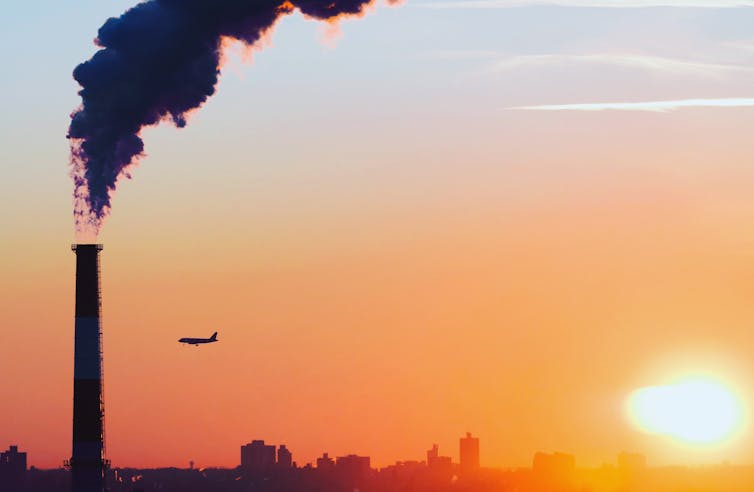
Thijs Stoop/Unsplash, FAL

James Dyke, University of Exeter; Robert Watson, University of East Anglia, and Wolfgang Knorr, Lund University

Sometimes realisation comes in a blinding flash. Blurred outlines snap into shape and suddenly it all makes sense. Underneath such revelations is typically a much slower-dawning process. Doubts at the back of the mind grow. The sense of confusion that things cannot be made to fit together increases until something clicks. Or perhaps snaps.

Collectively we three authors of this article must have spent more than 80 years thinking about climate change. Why has it taken us so long to speak out about the obvious dangers of the concept of net zero? In our defence, the premise of net zero is deceptively simple – and we admit that it deceived us.

The threats of climate change are the direct result of there being too much carbon dioxide in the atmosphere. So it follows that we must stop emitting more and even remove some of it. This idea is central to the world’s current plan to avoid catastrophe. In fact, there are many suggestions as to how to actually do this, from mass tree planting, to high tech direct air capture devices that suck out carbon dioxide from the air.


Read more: There aren’t enough trees in the world to offset society’s carbon emissions – and there never will be


The current consensus is that if we deploy these and other so-called “carbon dioxide removal” techniques at the same time as reducing our burning of fossil fuels, we can more rapidly halt global warming. Hopefully around the middle of this century we will achieve “net zero”. This is the point at which any residual emissions of greenhouse gases are balanced by technologies removing them from the atmosphere.

This is a great idea, in principle. Unfortunately, in practice it helps perpetuate a belief in technological salvation and diminishes the sense of urgency surrounding the need to curb emissions now.

We have arrived at the painful realisation that the idea of net zero has licensed a recklessly cavalier “burn now, pay later” approach which has seen carbon emissions continue to soar. It has also hastened the destruction of the natural world by increasing deforestation today, and greatly increases the risk of further devastation in the future.

To understand how this has happened, how humanity has gambled its civilisation on no more than promises of future solutions, we must return to the late 1980s, when climate change broke out onto the international stage.
Steps towards net zero

On June 22 1988, James Hansen was the administrator of Nasa’s Goddard Institute for Space Studies, a prestigious appointment but someone largely unknown outside of academia.

By the afternoon of the 23rd he was well on the way to becoming the world’s most famous climate scientist. This was as a direct result of his testimony to the US congress, when he forensically presented the evidence that the Earth’s climate was warming and that humans were the primary cause: “The greenhouse effect has been detected, and it is changing our climate now.”

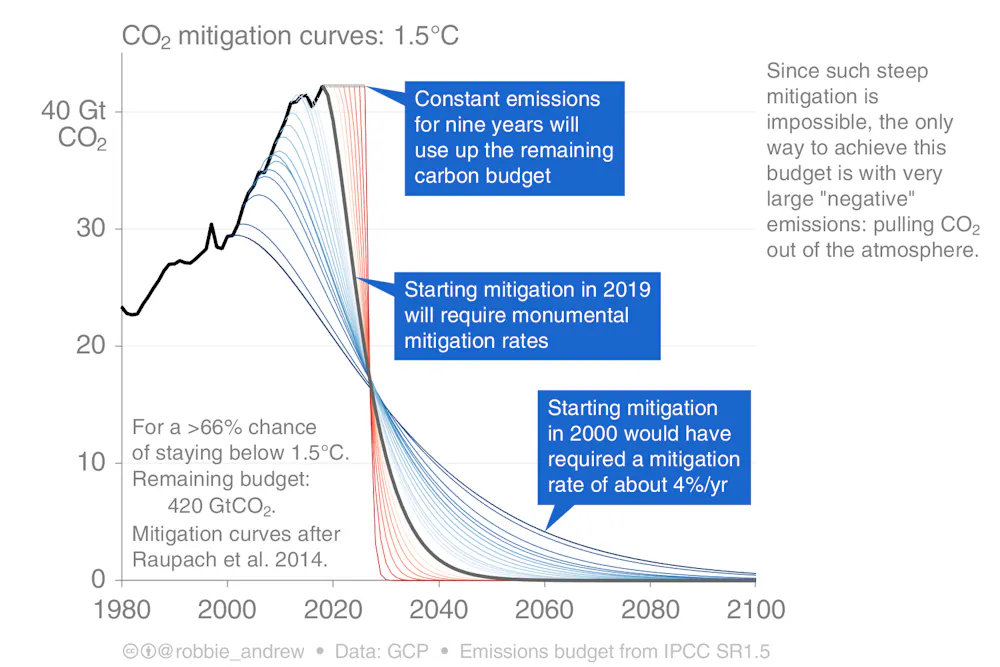
If we had acted on Hansen’s testimony at the time, we would have been able to decarbonise our societies at a rate of around 2% a year in order to give us about a two-in-three chance of limiting warming to no more than 1.5°C. It would have been a huge challenge, but the main task at that time would have been to simply stop the accelerating use of fossil fuels while fairly sharing out future emissions.
Alt text
Graph demonstrating how fast mitigation has to happen to keep to 1.5℃. © Robbie Andrew, CC BY

Four years later, there were glimmers of hope that this would be possible. During the 1992 Earth Summit in Rio, all nations agreed to stabilise concentrations of greenhouse gases to ensure that they did not produce dangerous interference with the climate. The 1997 Kyoto Summit attempted to start to put that goal into practice. But as the years passed, the initial task of keeping us safe became increasingly harder given the continual increase in fossil fuel use.

It was around that time that the first computer models linking greenhouse gas emissions to impacts on different sectors of the economy were developed. These hybrid climate-economic models are known as Integrated Assessment Models. They allowed modellers to link economic activity to the climate by, for example, exploring how changes in investments and technology could lead to changes in greenhouse gas emissions.

They seemed like a miracle: you could try out policies on a computer screen before implementing them, saving humanity costly experimentation. They rapidly emerged to become key guidance for climate policy. A primacy they maintain to this day.

Unfortunately, they also removed the need for deep critical thinking. Such models represent society as a web of idealised, emotionless buyers and sellers and thus ignore complex social and political realities, or even the impacts of climate change itself. Their implicit promise is that market-based approaches will always work. This meant that discussions about policies were limited to those most convenient to politicians: incremental changes to legislation and taxes.

Around the time they were first developed, efforts were being made to secure US action on the climate by allowing it to count carbon sinks of the country’s forests. The US argued that if it managed its forests well, it would be able to store a large amount of carbon in trees and soil which should be subtracted from its obligations to limit the burning of coal, oil and gas. In the end, the US largely got its way. Ironically, the concessions were all in vain, since the US senate never ratified the agreement.
Aerial view of autumn foliage.
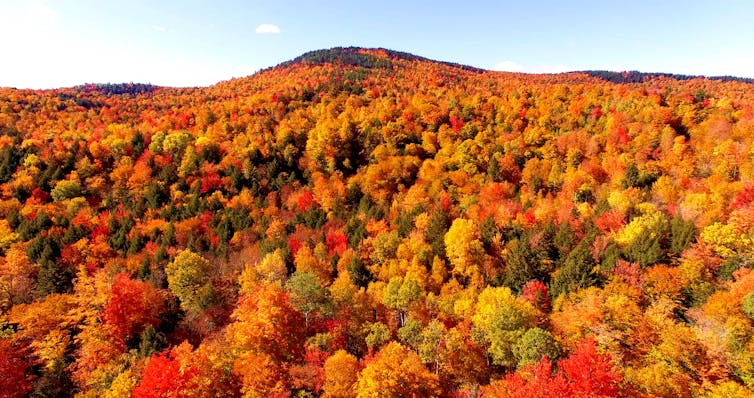
Forests such as this one in Maine, US, were suddenly counted in the carbon budget as an incentive for the US to join the Kyoto Agreement. Inbound Horizons/Shutterstock

Postulating a future with more trees could in effect offset the burning of coal, oil and gas now. As models could easily churn out numbers that saw atmospheric carbon dioxide go as low as one wanted, ever more sophisticated scenarios could be explored which reduced the perceived urgency to reduce fossil fuel use. By including carbon sinks in climate-economic models, a Pandora’s box had been opened.

It’s here we find the genesis of today’s net zero policies.
That said, most attention in the mid-1990s was focused on increasing energy efficiency and energy switching (such as the UK’s move from coal to gas) and the potential of nuclear energy to deliver large amounts of carbon-free electricity. The hope was that such innovations would quickly reverse increases in fossil fuel emissions.

But by around the turn of the new millennium it was clear that such hopes were unfounded. Given their core assumption of incremental change, it was becoming more and more difficult for economic-climate models to find viable pathways to avoid dangerous climate change. In response, the models began to include more and more examples of carbon capture and storage, a technology that could remove the carbon dioxide from coal-fired power stations and then store the captured carbon deep underground indefinitely.
Metal pipes and stacks at a factory site under grey sky.
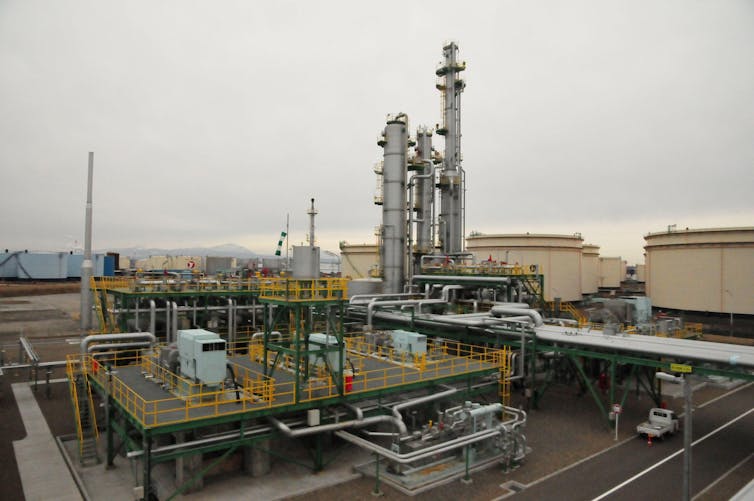
The Tomakomai carbon, capture and storage test site, Hokkaido, Japan, March 2018. Over its three-year lifetime, it’s hoped that this demonstrator project will capture an amount of carbon approximately 1/100,000 of current global annual emissions. The captured carbon will be piped into geological deposits deep under the sea bed where it will need to remain for centuries. REUTERS/Aaron Sheldrick

This had been shown to be possible in principle: compressed carbon dioxide had been separated from fossil gas and then injected underground in a number of projects since the 1970s. These Enhanced Oil Recovery schemes were designed to force gases into oil wells in order to push oil towards drilling rigs and so allow more to be recovered – oil that would later be burnt, releasing even more carbon dioxide into the atmosphere.

Carbon capture and storage offered the twist that instead of using the carbon dioxide to extract more oil, the gas would instead be left underground and removed from the atmosphere. This promised breakthrough technology would allow climate friendly coal and so the continued use of this fossil fuel. But long before the world would witness any such schemes, the hypothetical process had been included in climate-economic models. In the end, the mere prospect of carbon capture and storage gave policy makers a way out of making the much needed cuts to greenhouse gas emissions.

The rise of net zero

When the international climate change community convened in Copenhagen in 2009 it was clear that carbon capture and storage was not going to be sufficient for two reasons.

First, it still did not exist. There were no carbon capture and storage facilities in operation on any coal fired power station and no prospect the technology was going to have any impact on rising emissions from increased coal use in the foreseeable future.

The biggest barrier to implementation was essentially cost. The motivation to burn vast amounts of coal is to generate relatively cheap electricity. Retrofitting carbon scrubbers on existing power stations, building the infrastructure to pipe captured carbon, and developing suitable geological storage sites required huge sums of money. Consequently the only application of carbon capture in actual operation then – and now – is to use the trapped gas in enhanced oil recovery schemes. Beyond a single demonstrator, there has never been any capture of carbon dioxide from a coal fired power station chimney with that captured carbon then being stored underground.

Just as important, by 2009 it was becoming increasingly clear that it would not be possible to make even the gradual reductions that policy makers demanded. That was the case even if carbon capture and storage was up and running. The amount of carbon dioxide that was being pumped into the air each year meant humanity was rapidly running out of time.

With hopes for a solution to the climate crisis fading again, another magic bullet was required. A technology was needed not only to slow down the increasing concentrations of carbon dioxide in the atmosphere, but actually reverse it. In response, the climate-economic modelling community – already able to include plant-based carbon sinks and geological carbon storage in their models – increasingly adopted the “solution” of combining the two.

So it was that Bioenergy Carbon Capture and Storage, or BECCS, rapidly emerged as the new saviour technology. By burning “replaceable” biomass such as wood, crops, and agricultural waste instead of coal in power stations, and then capturing the carbon dioxide from the power station chimney and storing it underground, BECCS could produce electricity at the same time as removing carbon dioxide from the atmosphere. That’s because as biomass such as trees grow, they suck in carbon dioxide from the atmosphere. By planting trees and other bioenergy crops and storing carbon dioxide released when they are burnt, more carbon could be removed from the atmosphere.

With this new solution in hand the international community regrouped from repeated failures to mount another attempt at reining in our dangerous interference with the climate. The scene was set for the crucial 2015 climate conference in Paris.

A Parisian false dawn

As its general secretary brought the 21st United Nations conference on climate change to an end, a great roar issued from the crowd. People leaped to their feet, strangers embraced, tears welled up in eyes bloodshot from lack of sleep.

The emotions on display on December 13, 2015 were not just for the cameras. After weeks of gruelling high-level negotiations in Paris a breakthrough had finally been achieved. Against all expectations, after decades of false starts and failures, the international community had finally agreed to do what it took to limit global warming to well below 2°C, preferably to 1.5°C, compared to pre-industrial levels.

But dig a little deeper and you could find another emotion lurking within delegates on December 13. Doubt. We struggle to name any climate scientist who at that time thought the Paris Agreement was feasible. We have since been told by some scientists that the Paris Agreement was “of course important for climate justice but unworkable” and “a complete shock, no one thought limiting to 1.5°C was possible”. Rather than being able to limit warming to 1.5°C, a senior academic involved in the IPCC concluded we were heading beyond 3°C by the end of this century.

Instead of confront our doubts, we scientists decided to construct ever more elaborate fantasy worlds in which we would be safe. The price to pay for our cowardice: having to keep our mouths shut about the ever growing absurdity of the required planetary-scale carbon dioxide removal.
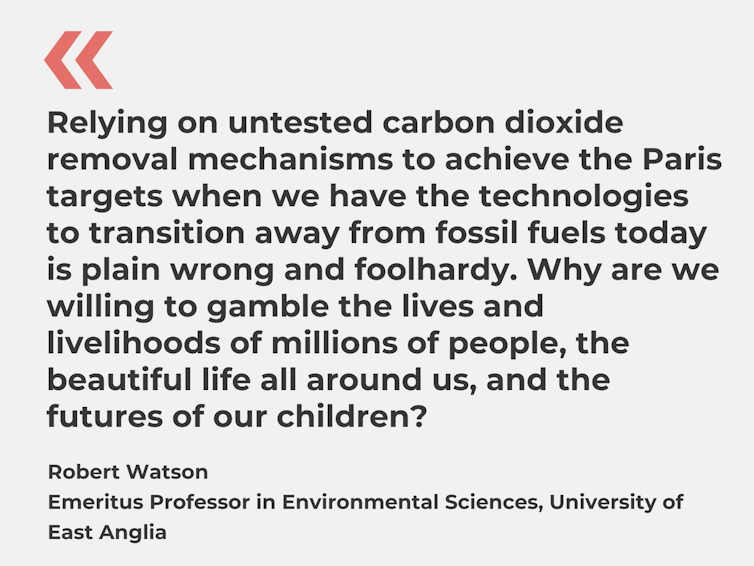
Taking centre stage was BECCS because at the time this was the only way climate-economic models could find scenarios that would be consistent with the Paris Agreement. Rather than stabilise, global emissions of carbon dioxide had increased some 60% since 1992.

Alas, BECCS, just like all the previous solutions, was too good to be true.

Across the scenarios produced by the Intergovernmental Panel on Climate Change (IPCC) with a 66% or better chance of limiting temperature increase to 1.5°C, BECCS would need to remove 12 billion tonnes of carbon dioxide each year. BECCS at this scale would require massive planting schemes for trees and bioenergy crops.

The Earth certainly needs more trees. Humanity has cut down some three trillion since we first started farming some 13,000 years ago. But rather than allow ecosystems to recover from human impacts and forests to regrow, BECCS generally refers to dedicated industrial-scale plantations regularly harvested for bioenergy rather than carbon stored away in forest trunks, roots and soils.

Currently, the two most efficient biofuels are sugarcane for bioethanol and palm oil for biodiesel – both grown in the tropics. Endless rows of such fast growing monoculture trees or other bioenergy crops harvested at frequent intervals devastate biodiversity.

It has been estimated that BECCS would demand between 0.4 and 1.2 billion hectares of land. That’s 25% to 80% of all the land currently under cultivation. How will that be achieved at the same time as feeding 8-10 billion people around the middle of the century or without destroying native vegetation and biodiversity?


Read more: Carbon capture on power stations burning woodchips is not the green gamechanger many think it is


Growing billions of trees would consume vast amounts of water – in some places where people are already thirsty. Increasing forest cover in higher latitudes can have an overall warming effect because replacing grassland or fields with forests means the land surface becomes darker. This darker land absorbs more energy from the Sun and so temperatures rise. Focusing on developing vast plantations in poorer tropical nations comes with real risks of people being driven off their lands.

And it is often forgotten that trees and the land in general already soak up and store away vast amounts of carbon through what is called the natural terrestrial carbon sink. Interfering with it could both disrupt the sink and lead to double accounting.
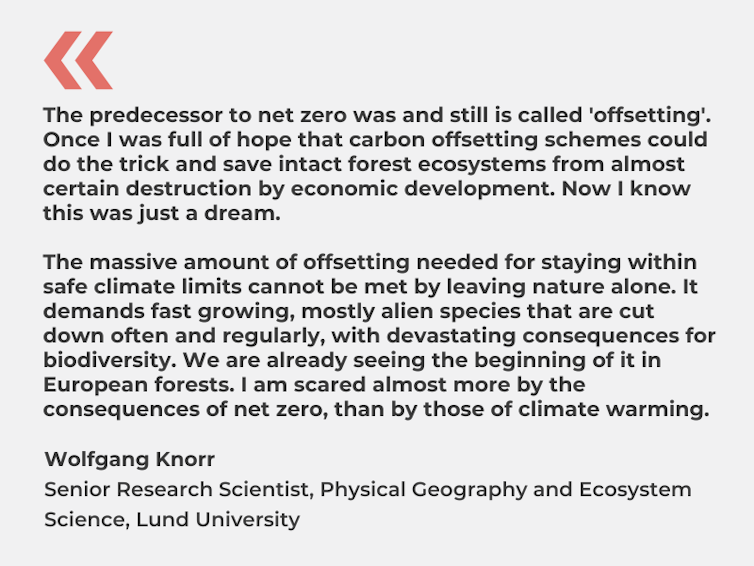
As these impacts are becoming better understood, the sense of optimism around BECCS has diminished.

Pipe dreams

Given the dawning realisation of how difficult Paris would be in the light of ever rising emissions and limited potential of BECCS, a new buzzword emerged in policy circles: the “overshoot scenario”. Temperatures would be allowed to go beyond 1.5°C in the near term, but then be brought down with a range of carbon dioxide removal by the end of the century. This means that net zero actually means carbon negative. Within a few decades, we will need to transform our civilisation from one that currently pumps out 40 billion tons of carbon dioxide into the atmosphere each year, to one that produces a net removal of tens of billions.

Mass tree planting, for bioenergy or as an attempt at offsetting, had been the latest attempt to stall cuts in fossil fuel use. But the ever-increasing need for carbon removal was calling for more. This is why the idea of direct air capture, now being touted by some as the most promising technology out there, has taken hold. It is generally more benign to ecosystems because it requires significantly less land to operate than BECCS, including the land needed to power them using wind or solar panels.

Unfortunately, it is widely believed that direct air capture, because of its exorbitant costs and energy demand, if it ever becomes feasible to be deployed at scale, will not be able to compete with BECCS with its voracious appetite for prime agricultural land.

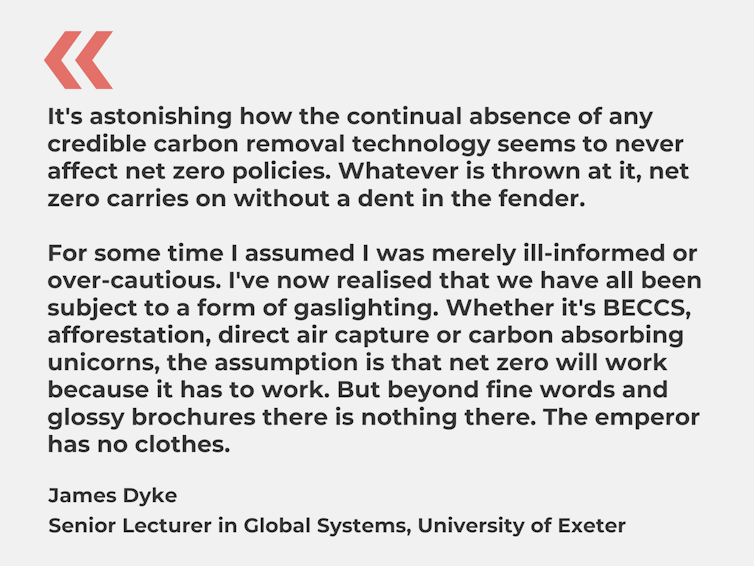
It should now be getting clear where the journey is heading. As the mirage of each magical technical solution disappears, another equally unworkable alternative pops up to take its place. The next is already on the horizon – and it’s even more ghastly. Once we realise net zero will not happen in time or even at all, geoengineering – the deliberate and large scale intervention in the Earth’s climate system – will probably be invoked as the solution to limit temperature increases.

One of the most researched geoengineering ideas is solar radiation management – the injection of millions of tons of sulphuric acid into the stratosphere that will reflect some of the Sun’s energy away from the Earth. It is a wild idea, but some academics and politicians are deadly serious, despite significant risks. The US National Academies of Sciences, for example, has recommended allocating up to US$200 million over the next five years to explore how geoengineering could be deployed and regulated. Funding and research in this area is sure to significantly increase.
Difficult truths

In principle there is nothing wrong or dangerous about carbon dioxide removal proposals. In fact developing ways of reducing concentrations of carbon dioxide can feel tremendously exciting. You are using science and engineering to save humanity from disaster. What you are doing is important. There is also the realisation that carbon removal will be needed to mop up some of the emissions from sectors such as aviation and cement production. So there will be some small role for a number of different carbon dioxide removal approaches.

The problems come when it is assumed that these can be deployed at vast scale. This effectively serves as a blank cheque for the continued burning of fossil fuels and the acceleration of habitat destruction.

Carbon reduction technologies and geoengineering should be seen as a sort of ejector seat that could propel humanity away from rapid and catastrophic environmental change. Just like an ejector seat in a jet aircraft, it should only be used as the very last resort. However, policymakers and businesses appear to be entirely serious about deploying highly speculative technologies as a way to land our civilisation at a sustainable destination. In fact, these are no more than fairy tales.
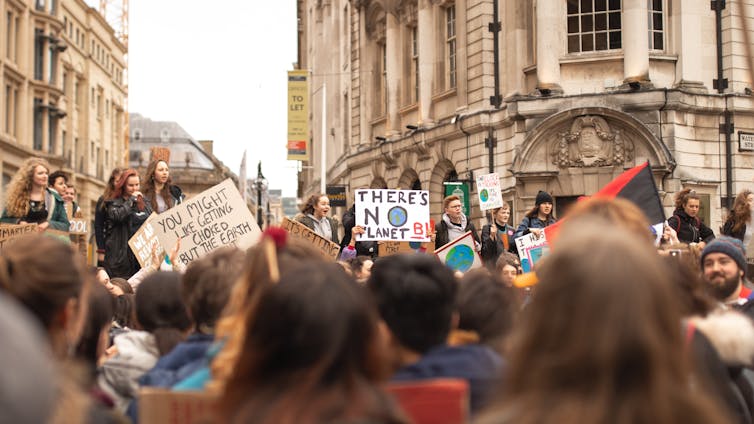
Crowds of young people hold placards.
‘There is no Planet B’: children in Birmingham, UK, protest against the climate crisis. Callum Shaw/Unsplash, FAL

The only way to keep humanity safe is the immediate and sustained radical cuts to greenhouse gas emissions in a socially just way.

Academics typically see themselves as servants to society. Indeed, many are employed as civil servants. Those working at the climate science and policy interface desperately wrestle with an increasingly difficult problem. Similarly, those that champion net zero as a way of breaking through barriers holding back effective action on the climate also work with the very best of intentions.

The tragedy is that their collective efforts were never able to mount an effective challenge to a climate policy process that would only allow a narrow range of scenarios to be explored.

Most academics feel distinctly uncomfortable stepping over the invisible line that separates their day job from wider social and political concerns. There are genuine fears that being seen as advocates for or against particular issues could threaten their perceived independence. Scientists are one of the most trusted professions. Trust is very hard to build and easy to destroy.
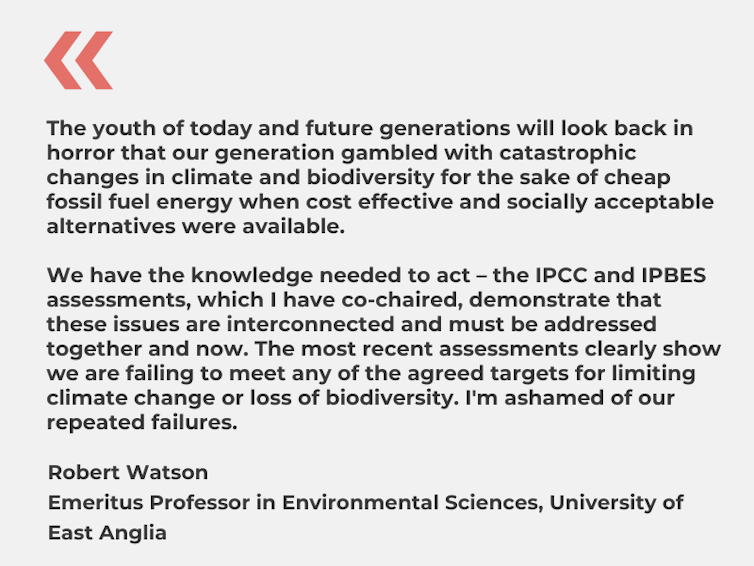
But there is another invisible line, the one that separates maintaining academic integrity and self-censorship. As scientists, we are taught to be sceptical, to subject hypotheses to rigorous tests and interrogation. But when it comes to perhaps the greatest challenge humanity faces, we often show a dangerous lack of critical analysis.

In private, scientists express significant scepticism about the Paris Agreement, BECCS, offsetting, geoengineering and net zero. Apart from some notable exceptions, in public we quietly go about our work, apply for funding, publish papers and teach. The path to disastrous climate change is paved with feasibility studies and impact assessments.

Rather than acknowledge the seriousness of our situation, we instead continue to participate in the fantasy of net zero. What will we do when reality bites? What will we say to our friends and loved ones about our failure to speak out now?

The time has come to voice our fears and be honest with wider society. Current net zero policies will not keep warming to within 1.5°C because they were never intended to. They were and still are driven by a need to protect business as usual, not the climate. If we want to keep people safe then large and sustained cuts to carbon emissions need to happen now. That is the very simple acid test that must be applied to all climate policies. The time for wishful thinking is over.


For you: more from our Insights series:

To hear about new Insights articles, join the hundreds of thousands of people who value The Conversation’s evidence-based news. Subscribe to our newsletter.

James Dyke, Senior Lecturer in Global Systems, University of Exeter; Robert Watson, Emeritus Professor in Environmental Sciences, University of East Anglia, and Wolfgang Knorr, Senior Research Scientist, Physical Geography and Ecosystem Science, Lund University

This article is republished from The Conversation under a Creative Commons license. Read the original article.

ooOOoo

I can’t add anything to this article because it is written by scientists and that is one thing that I know I am not!

But I can comment as a very concerned adult and really can do more that repeat what I said in yesterday’s post:

Thank goodness for our younger generation. Because these young people are coming together to fight for change. May they have universal encouragement from those of us who will never see our younger days again!
The Elephant in the Room

This is one of the most important posts since I started blogging!

I was born in 1944 and that makes me 76. I am reasonably engaged in the issues facing us but, in a sense, protected from the realities of the modern world because I have a loving wife, two loving young people, as in my son Alex and my daughter Maija, and a special grandson, Morten.

We are also very lucky in that my wife, Jean, and I are both retired and we live on 13 rural acres in a beautiful part of Southern Oregon and enjoy immensely our six dogs, two horses, two parakeets and feeding the wild birds and deer.

But it can’t stay that way because of the encroaching elephant in the room.

I am speaking of climate change that if not dealt with in the near future, say in the next 10 years, will lead to an unimaginable state of affairs.

Now one could argue that you come to Learning from Dogs to get away from climate change and the like. But this is too important and, also, involves all of us including our gorgeous dogs.

First, I want to include an extract from a recent Scientists Warning newsletter (and please read this extract carefully).

Recently, one article on the climate emergency above all others has cut through – with over ONE MILLION views, “Climate scientists: concept of net zero is a dangerous trap”  published in The Conversation is being talked about by many thousands, and led Greta Thunberg to tweet:  “This is one of the most important and informative texts I have ever read on the climate- and ecological crises.” 
So why is this article so very important?

In our latest interview, I talk with two of the authors – Dr.  James Dyke, global systems scientist at the University of Exeter and Dr. Wolfgang Knorr, climate scientist at Lund University. And the conversation does not make for comfortable viewing.  We discuss what led James, Wolfgang and Professor Bob Watson to write an article that they have described as being one of the hardest they have ever written. The article is *not* an attack on net zero, nor does it advocate a fatalistic position. Instead, as you will hear, the interview reveals the heartfelt concerns of two scientists who are profoundly worried about the failure of a climate policy system that suppresses the  voice of science and is fundamentally flawed. A climate policy system that year after year has failed.

But  it is not just the climate policy system that has failed. Academia has failed too, and continues to fail Greta and young people like her. And this *must* stop. Young people have become the adults in the room. We cannot place this burden on their shoulders. They have shown their courage and bravery. Now it’s time for academia to step up to the challenge and to critically examine why we are failing. 

Secondly, I want to share that interview with you. This is a 36-minute interview. Please, please watch it. If it is not a convenient time just now then bookmark the post and watch it when you can sit down and be fully engaged. You will understand then and agree with me that this is one of the most important videos ever!

Lastly, I would like you to read the article published in The Conversation. I have included a link to it but I am also going to republish it on Friday.

Because we have to listen to the scientists without delay and press for change now.

Thank goodness for our younger generation. Because these young people are coming together to fight for change. May they have universal encouragement from those of us who will never see our younger days again!

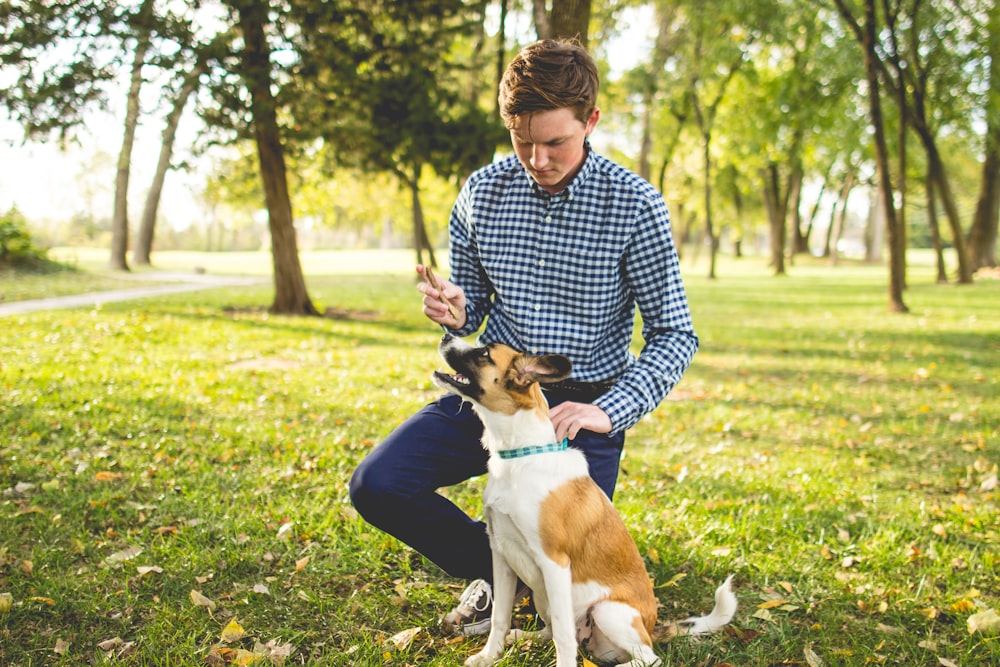
men's white and blue gingham dress shirt
Photograph by Zach Lucero

Time to end puppy mills

I am republishing a recent email that came to me.

Puppy Mills are disgraceful. Worse than that they are a scar on the face of mankind.

Yesterday I received an email that came in from the Humane Society Legislative Fund. I am sure many of you also received it.

I am going to republish it. Please help if you can.

ooOOoo

Tell the USDA to protect puppies

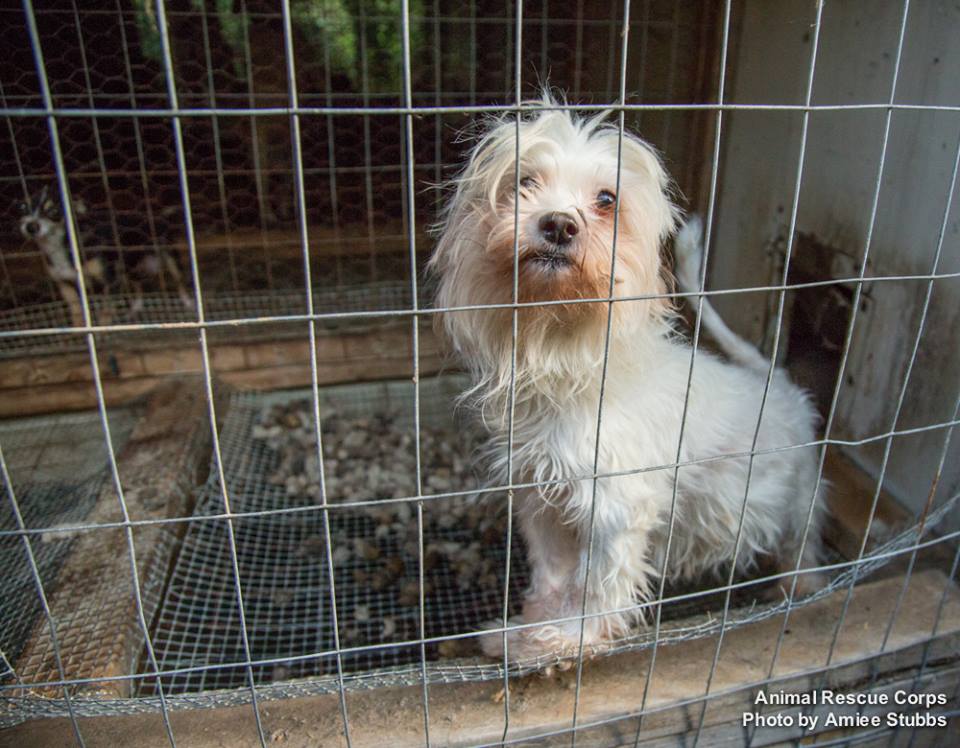
Dogs suffer horribly in puppy mills. What’s worse is that over the last four years, The U.S. Department of Agriculture, which is charged with monitoring, citing and revoking licenses of these breeding facilities if they sell to pet stores, brokers or online, stopped taking their job of puppy mill enforcement seriously and the agency did not take all the necessary steps to make sure that standards of care are improved to ensure that puppy mill facilities meet the basic needs of happy and healthy dogs.

Enforcement has plummeted at USDA since 2017 and citations for violations are down more than 65%. But we have a new Administration leading the United States Department of Agriculture, one that has already promised that they are going to take animal care seriously. Now is our chance to send a message loud and clear: you must protect dogs and puppies and take puppy mill enforcement seriously, and you must ensure that standards of care are improved in puppy mills to meet the needs of the thousands of dogs living in those facilities.

TAKE ACTION
Please send a brief, polite message to the USDA using the form provided.

ooOOoo

The form is available here!

I am going to leave you with a photograph, one of many I am afraid. This one was taken from the Animal Rescue Corps.

Very sad!

This is just beautiful

Just a short post!

One can’t imagine what it was like for this poor dog that was placed in a garbage can. But then along comes a perfect Princess and rescues the poor animal.

And so the dog found in the trash learns how to walk again with the help of her foster family — now she runs on the beach!

Dear, sweet Billie and what a terrific job this lady did. From a family of dogs, of course!

Beyond the Call of Duty

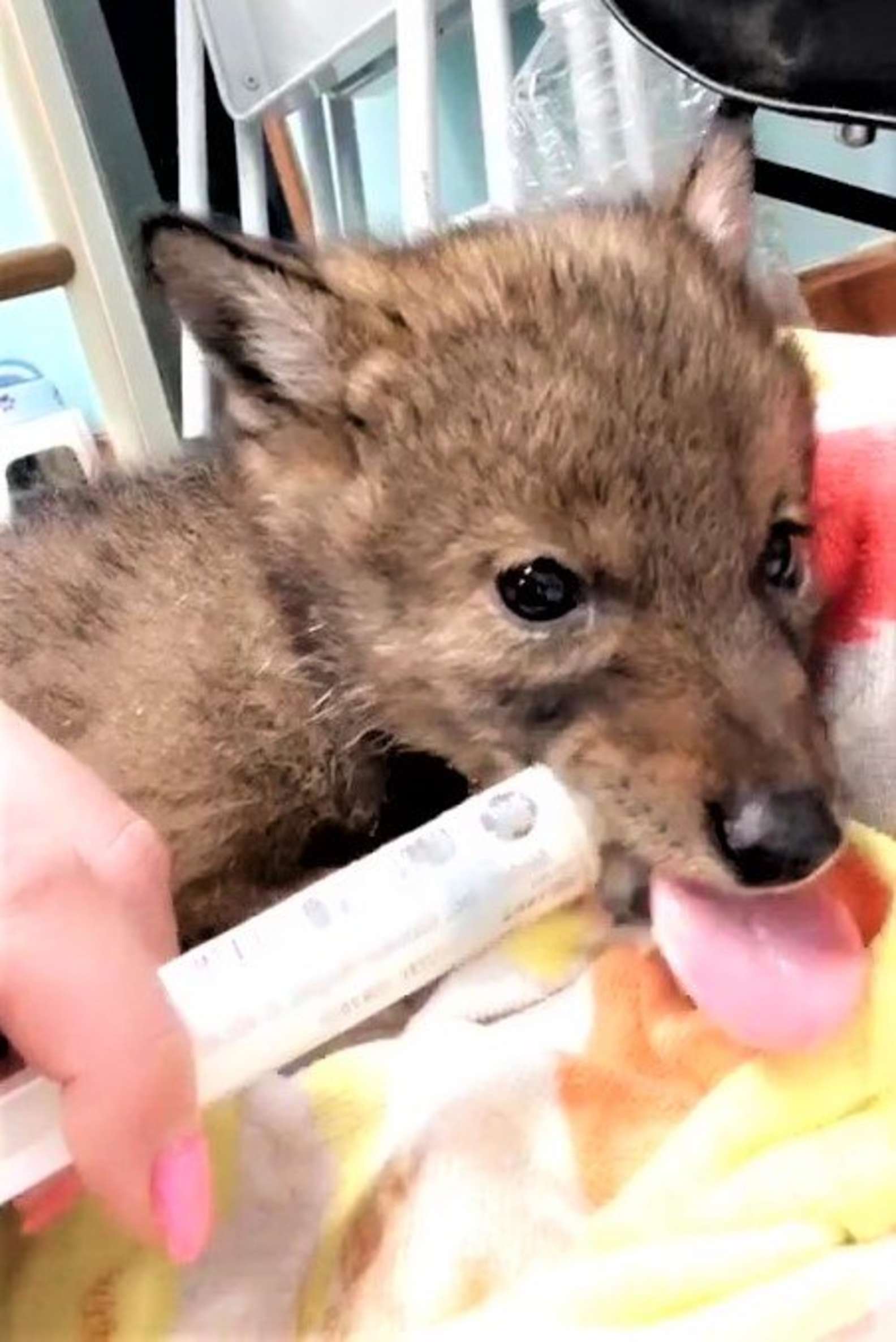
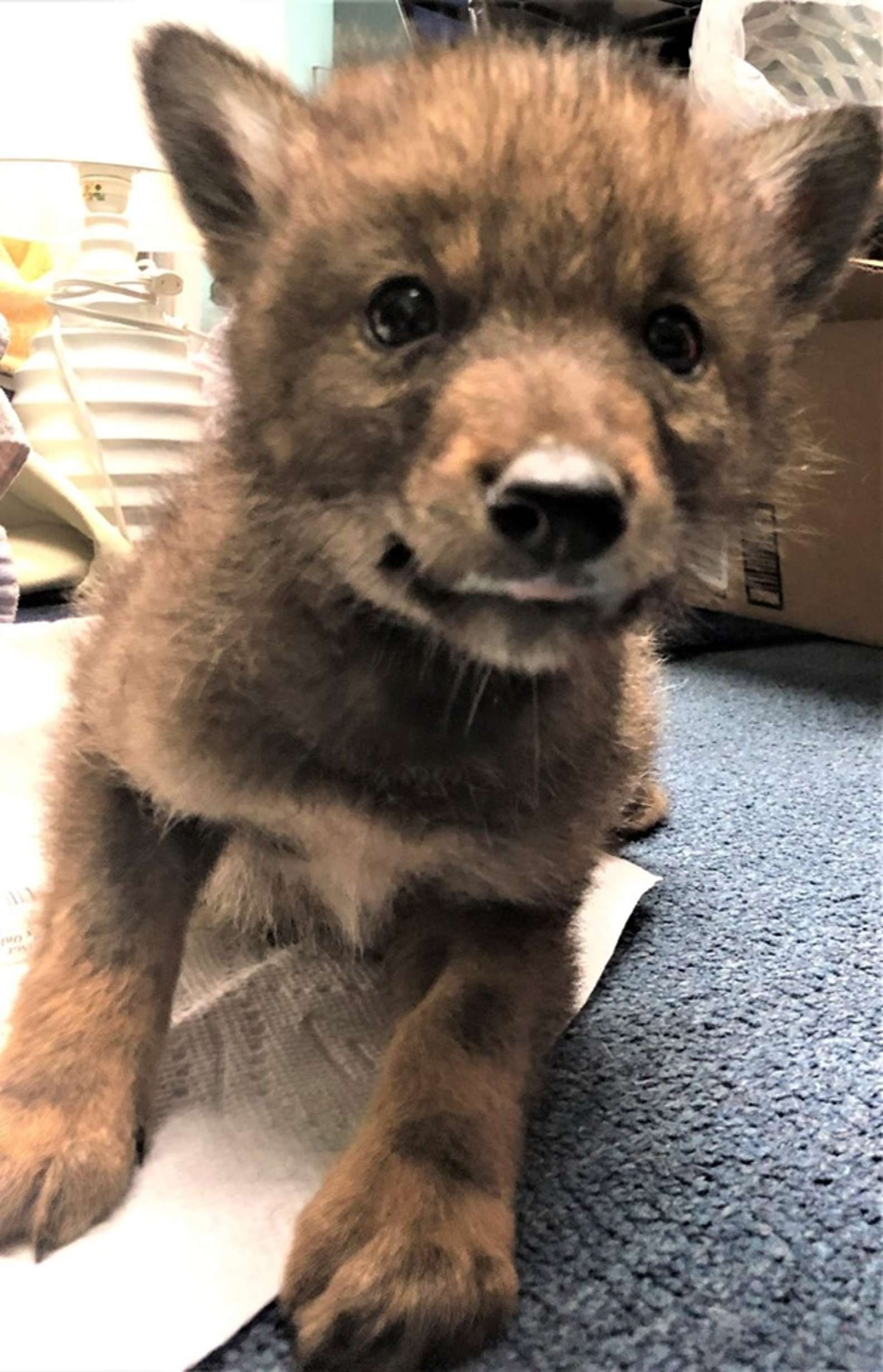
A little coyote pup is rescued by a policeman.

I am republishing a post from The Dodo. It is dated May, 2019 but the actions, feelings and results are timeless.

Have a read of it yourself.

ooOOoo

Kind Cop Goes Above And Beyond For A Lonely Little Coyote Pup

He found a friend when he needed it most ❤

By Stephen Messenger

Published on 5/9/2019

Stop in the name of the awww.

This week, a Massachusetts State Police trooper did just that — coming to the aid of a helpless young coyote pup who’d been found stranded all alone along a busy roadway.

MASSACHUSETTS STATE POLICE

Seeing that the pup’s mother was nowhere in sight, trooper Carlo Mastromattei contacted Lisa Cutting, owner of Ocean View Kennels, for help in safely removing the animal from that perilous spot.

The pup was now out of immediate danger, but Mastromattei’s kindhearted actions didn’t end there.

MASSACHUSETTS STATE POLICE

At that late hour, all nearby wildlife rehab facilities were apparently closed. So, the trooper then decided to go above and beyond his call of duty in order to keep the little coyote safe until morning.

Mastromattei brought the pup home, where he and his girlfriend kept him cozy and fed through the night.

MASSACHUSETTS STATE POLICE

The next day, Mastromattei brought the coyote to the Tufts Wildlife Clinic for a checkup. Fortunately, he was found to be in good health — thanks in no small part to the trooper having rescued him in time.

MASSACHUSETTS STATE POLICE

According to the Massachusetts State Police, the young coyote has since been placed under the care of a wildlife rehabilitator. With any luck, he’ll continue gaining his strength until he’s old enough to be released back into the wild to live life as nature intended.

For their efforts, those involved in the pup’s rescue are getting some much-deserved praise from police officials, who wrote in a post:

“The Department offers its sincere thanks to Trooper Mastromattei, his girlfriend, Ocean View Kennels, and Tufts for their compassionate care for this beautiful little creature.”

ooOOoo

I would like to bet that Carlo Mastromattei has a dog at home. For this compassion shown by Carlo Mastromattei is surely brought about by having a dog or two in his life.

I guess we will never know but my bet stands.

The pain of letting go.

Dogs ought to live far longer!

I have spoken before of the bond that we humans make with our dogs, and vice versa, and the love that flows from such a bond.

But they don’t live long enough! And the end of their lives is a very difficult period for us.

Doug Goodman writes a blog. He is also an accomplished author.

Recently Doug wrote about the most difficult decision he had to make. Doug kindly gave me permission to republish his article.

ooOOoo

The Difficult Decision to Euthanize Ryder.

By Doug Goodman, April 20th, 2021

Unfortunately, all dogs die. There’s no easy way to do this, but it’s a fact of life as a pet owner. For me, the key decision was when is the right time to do it? I don’t want to wait too long so that Ryder suffers, but I’d feel guilty putting Ryder down too early.

We’ve talked about this many times, in fact. Often on walks or long rides in the car, my wife and I go through the bullets, like a checklist of emotional redemption. There are many “easy” decisions when owning a dog: which food? That bag of Purina over there. When do you pick up after the dog? At least twice a week in the spring and summer, sometimes every other day. Should you pet the dog? Well, it’s a German Shepherd, so if it wants to be petted, you better do it now because it may not want to be petted the rest of the day.

Deciding to euthanize is nothing so simple.

Years ago when we went through end-of-life with Mojo, a veterinarian recommended as a litmus test to pick the three things the dog enjoys most in life. When the dog can no longer do one or especially two of those things, it’s time to euthanize.

But that litmus test doesn’t apply to all dogs, and certainly not to Ryder. She’s always been a peculiar dog. She likes her backyard and playing with Koda, and she likes to eat*. She still does those things. For me, it is a pain factor based on arthritis and lack of mobility. People will talk about the dignity of life for a dog, and I think there is some truth to that. I remember laying in bed one day and Mojo walking in and telling me he was ready. A few months later, he again looked at me, and his eyes were full of truth. He wasn’t happy, he didn’t like this anymore. He was ready. Sometimes Ryder gives me that look, but I’m not sure. She’s always had a pained, scared-of-the-world emotion in her eyes.

But there is “pained” and there is “pain.” Ryder can’t put in words her suffering, so it’s up to me to observe her closely. Over the past few months, and certainly over the past year, my family and I have noticed changes to her behavior, physicality, and mental state:

-She had urination problems. She was diagnosed as a UTI and corrected. Alone, this is not a sign that she is close to dying, but I believe it may be a sign of the severity of her back arthritis. She’s not cleaning herself. This is especially troubling considering…

-She has problems holding in poop. Sometimes she’s sitting there, laying in it, and she doesn’t realize she’s pooped herself. Often, she can’t make it through the night without releasing her bowels in the house. If she isn’t able to clean herself, and she isn’t aware that she is going to the bathroom, this can lead to discomfort and additional UTIs.

-She stopped climbing the stairs. This was a subtle one because our dogs aren’t allowed upstairs. But last week we had a major thunderstorm, and as anyone who owns German Shepherds can attest, GSDs only want to be right next to you when the thunder booms and the lightning crashes. Koda busted down the dog gate and ran upstairs for solace. Ryder, who is usually the first one to bump against the bedroom door until we wake up, stayed downstairs and didn’t attempt coming to us. At least, I didn’t see her attempt it. She may have tried, failed, and gone back downstairs. That’s a first in her lifetime, and she wouldn’t have stayed down there if she didn’t absolutely have to remain on the first floor.

-She is stumbling. She often stumbles in the house, especially walking inside and out. She has fallen doing little playful jumps at my daughter. I’ve seen her fall to the floor and not be able to stand for thirty seconds or more.

-This will sound weird, but she sits a lot, and not on purpose. One of the things she does is get in the way of her people (helloooo, herding dog). She backs out when she realizes I want to get through. Now, she backs out, and her butt falls down, and she stares at me like “That wasn’t supposed to happen. What do I do now? Sorry!” until she can get back up.

-She is whining and yelping. This is the big one. My dogs don’t whine or yelp for no reason. They aren’t talkative dogs. For the past year, though Ryder will yelp when roughhousing with Koda. She wants to jump on him, but she’s incapable. Lately, she’s really reduced her roughhousing. Additionally, Koda is being a son of a bitch about this. A few days ago I noticed they were playing their favorite game of “I’ve got a thing and you don’t.” I posted about this when during one of these games, Ryder knocked the poop out of Koda. That old chestnut. But this last time when Koda wanted the random stick, he bumped her rear with his chest so that she went down. I scolded him, he didn’t understand, and eventually Ryder dropped the stick and guarded it with strong play-snaps. Koda wasn’t going to take any further action to take the prized random stick, but the fact that he knows to exploit this indicates to me that one day we could find out he’s hurt her, perhaps broken her back from bumping her, and now you have to put down Ryder immediately in your backyard. Nobody wants that. 

So we have elected to euthanize Ryder. 

Damn, there’s a lot of finality in that statement. She is a family member, and we lover her very much. I picked her up from the tiny town of Buda, Texas and drove her three or four hours back to Houston. She never liked car rides after that. We have a lot of memories with that dog, some I’m sure I will share in the coming weeks, but for now, I want to focus on the decision.

We are reaching out to companies that can euthanize at home. With all of Ryder’s fears, it seems like the best option. Of course, home euthanasias are the popular choice in the pandemic. Earlier in 2020, some of the vets we looked to wouldn’t allow owners to be present for euthanasias. So we will see if we can make the home euthanasia happen.

In the meantime, I give her half an aspirin to help with the pain, and my daughter purchased some CBD-infused peanut butter, too. We’ve had her on joint vitamins, but that only goes so far. We do as much as we can to keep Ryder comfortable, but it’s clear that she’s in near-constant pain and that her hips/back have greatly reduced function. She is an eleven and a half year old GSD, old for one. So as difficult as it is to decide to euthanize, I know that it is a necessary part of ownership. If I’m willing to own a dog, I must be willing to take care of it throughout it’s life, not just the happy puppy parts, but all of it, including her last days. 

*Ryder only eats infrequently over the past few weeks. It is one of her three joys: play, eating, and protection/perimeter walking, and I would argue that food is her highest joy, so not eating is a big clue that her time is soon.

ooOOoo

I met Jean in 2007 in Mexico. Jean was rescuing street dogs, looking after them for a while, and then finding homes for them in the USA; primarily Arizona. I was then living in Devon, England together with my German Shepherd, Pharaoh. Jean loves all dogs irrespective of size. I moved out to Mexico, with Pharaoh, permanently in 2008. Living with so many dogs around the home quickly brought an awareness of the integrity of dogs, of their ability to love unconditionally, and I started this blog in 2009.

Now Jean and I live in Southern Oregon. Indeed we have been here since 2012. We are down to six dogs: Cleo; Brandy; Sheena; Oliver; Pedi and Sweeny. That means we have had many dogs die in the past. I still miss Pharaoh who died in 2017. Or rather it should be said that the decision to euthanise him was in June, 2017.

In the end we have to make that final decision for our beloved dogs. It is, frankly, so much better than leaving dogs to die because the last few weeks or days can be very brutal.

So we know only too well what Doug is going through. Our thoughts are with Doug and Ryder.

The range of human attitudes to dogs.

What a strange species we are!

Two days ago, just 3 miles down the road, someone reported seeing two dogs dumped in a yard and the culprit driving off at high speed. It was on the corner of Hugo Rd and Barker Rd, and Barker I know well because when I ride my bike I do an extra mile along Barker. (And we live on Hugo Rd.)

Then there’s the attitude adopted by the person who took puppies to a shelter. “… the breeder told her the coyotes can always use a meal.” As seen on the website Treehugger. Have a read.

ooOOoo

Rescued Blind and Deaf Puppies Are Incredibly Joyful

Breeder had threatened to feed them to coyotes.

By Mary Jo DiLonardo Updated April 9th, 2021

Mary Jo DiLonardo

Trudy is fearless when she runs. Fred Strobel Photography

As I write this, it sounds like there are hyenas battling it out in my basement. Yelps and screams and torturous cries are storming up the stairs along with a few barks and high-pitched squeals.

It’s just another day in fostering some rambunctious blind and deaf puppies who happen to play very, very loudly.

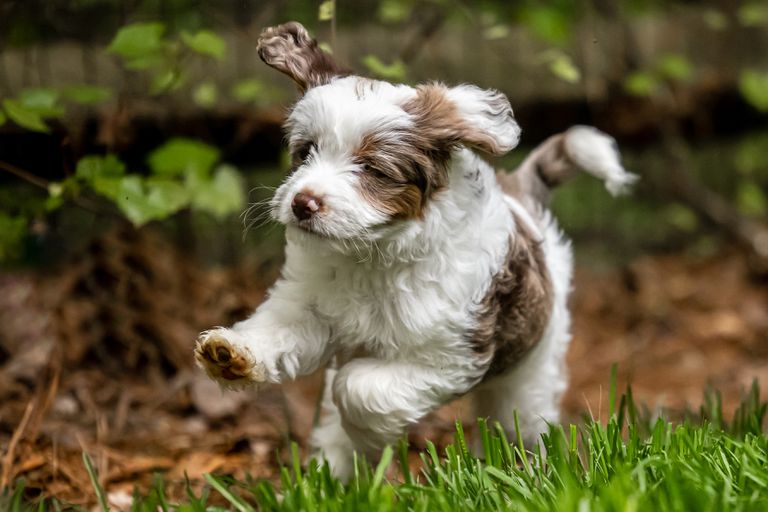
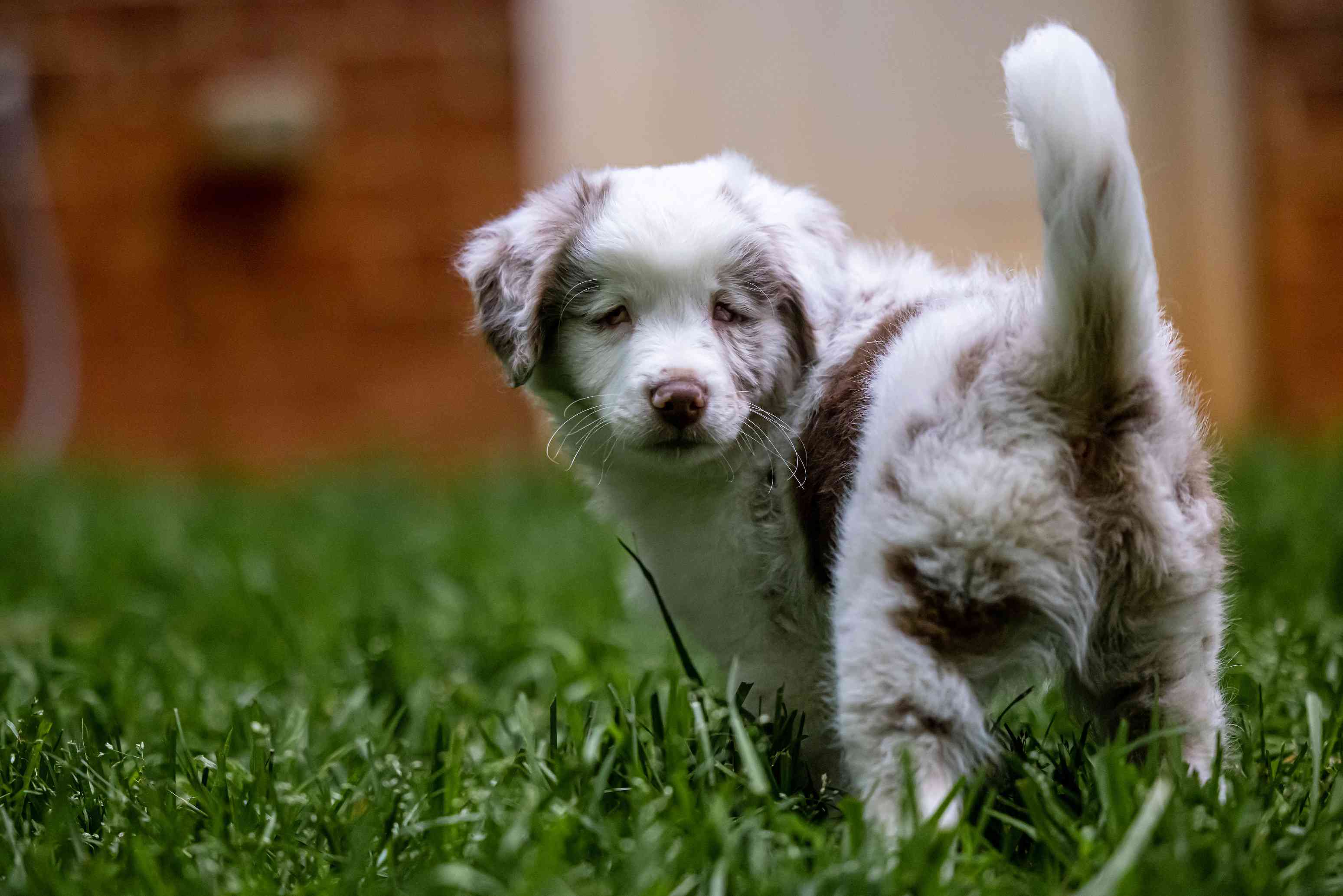
Trudy and Zane are 9-week-old Australian shepherd mixes, maybe Aussiedoodles. They were dropped off at a rural shelter somewhere in Illinois by a breeder. When the beleaguered shelter worker asked what would happen to the puppies if she couldn’t take them, the breeder told her the coyotes can always use a meal. She couldn’t believe it.

The shelter, of course, took them. And Speak! St. Louis, the rescue I volunteer with, of course, stepped up. And somehow the puppies ended up here in Atlanta, playing “WWF Smackdown” in my basement.

Trudy and Zane are double merles like the Treehugger puppies. Merle is a swirly pattern in a dog’s coat that is very lovely and highly prized by breeders and people who want a pretty dog. When two dogs with the merle gene are bred together, there’s a 25% chance that their puppies will be blind, deaf, or both.

Sometimes this happens by accident, but it seems that it happens too often on purpose. In any case, there sure are plenty of puppies that end up needing homes. At least those are the ones that rescue groups hear about. Others just quietly disappear.

I’m pretty sure that Zane and Trudy weren’t handled much by their owner when they got here. They were awfully squirmy and bitey and didn’t want to be held or touched. They wouldn’t eat unless they were touching each other.

So I’ve been working on it. Hold one for a few seconds and put them down before they fidget. Pet them all over a little at a time. Feed them just a little farther apart at each meal.

In just a couple of weeks, they’ve learned that people are pretty cool.

Navigating the World

Zane in a quiet moment.Fred Strobel Photography

I’ve fostered a blind puppy, several deaf puppies, and two blind and deaf puppies including the famous Whibble Magoo, who is now competing in agility contests and is smarter than most people I know.

It’s just amazing to watch how they navigate the world. They quickly map out their area, learning where the walls, bushes, and furniture are. Sure, they bounce off a few things at first but puppy heads are pretty hard. They do a little bit of a cartoon-like head shake where the world, no doubt, spins a little bit inside their heads. Then they jump up and go back to exploring and running and being happy. 

And, boy, are they happy.

People often say they feel sorry when they see blind or deaf puppies. They talk about how awful it must be for them.

But this is the only life they know and they are so joyful! When they go outside, they bounce in the grass like it is the best, most wonderful place in the world. When they play with a toy, it’s the coolest toy ever. When they find my dog, their tails wag so hard because they are ecstatic to be around him.

And when they find a person, they are elated because people are amazing, fun, and they give snuggles and treats.

They’ve come a long way from being just a step away from coyote dinner. Now they’ve learned to sit with two taps on their bottom and they are learning “down” is a tap on the front foot.

They are getting ready to look for their forever homes where their new people will appreciate that they aren’t just deaf and blind puppies. Instead, they are brilliant, silly, playful, gorgeous puppies with wonderful loving, sweet personalities. 

They just happen to play and live with the volume turned up loud.

ooOOoo

Regarding that dog dump in Barker Road, I managed to find out which house it was and later on in the day went for a bike ride that took me that way. There was no sign of anything unusual.

But to get to the matter of today’s post that is all about puppies that are blind or deaf. As I am sure you are aware, dogs are very different to us humans when it comes to their senses. I have written before about the great power of their sense of smell. This is many ways is their leading sense and I have no doubt that in the case of dogs that are blind or deaf their smell allows them to function pretty well.

There are many, many good people in the world. Some are outstanding. But I regret that there are quite a few low lights. Shame but there it is.

Beware of dog theft

Yet another scary story.

This time via Facebook from Sally McCarthy in England.

ooOOoo

Greenland Chocolate Labradors

February 7th, 2021

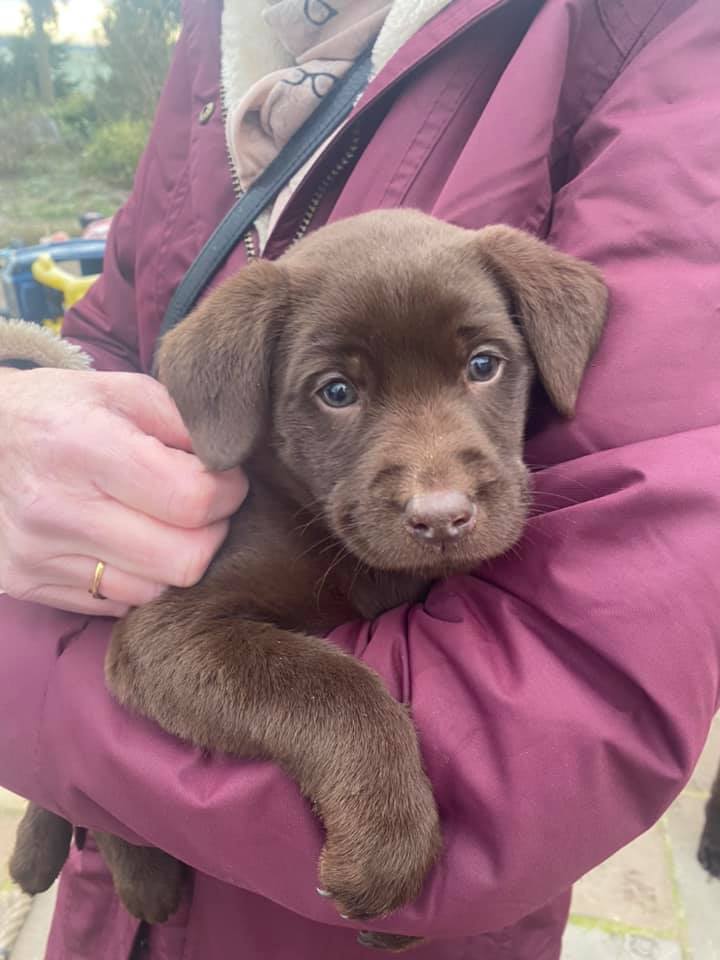
We wanted to share this sad and scary experience one of our puppy owners had after collecting their puppy. Picture for reference, not puppy in question. Sharing to hopefully help others.

I had quite an unsettling experience yesterday on my way home with our puppy yesterday. I stopped at a service station to give her a cuddle and a break out of her crate and while I was standing at the back of my car with the boot open with the puppy in my arms a van with Polish numberplates pulled up really close behind me. The man leaned out of his window and said in a tone of voice that came across as really threatening “what a nice little doggy” then “can I ask some advice?

At that point I thought I heard the passenger door of the van open (I couldn’t see the passenger side because of how he had parked). I put puppy back in her travelling crate, slammed my boot and locked my car as fast as I could, and walked to the driver’s side. At that point I realised I couldn’t get into the car, where my phone was, without unlocking the car so had a standoff with the man obviously waiting for me to unlock the car, which I was not willing to do in case he opened my boot.

After what felt like forever, especially as I was parked at the back of the car park away from any other cars, he gave up and sped off through the car park towards the exit with his phone in his hand. I didn’t want to wait around to see if he had called anyone to come so got in my car to drive off only to find him waiting for me at the exit and he started following me.

Fortunately within about 10 minutes the weather was awful so with the reduced visibility on my side I managed to lose him although my heartbeat and breathing didn’t return to normal for quite a while afterwards! As he hadn’t actually managed to take the puppy I wasn’t sure whether to report it to the police however I did submit an online report this morning as I am in no doubt that was his intention and that had I allowed him to distract me it would have given his accomplice enough time to corner me.

I just wanted to share as I have heard the stories of dog nappings and a friend of mine had a dog stolen 2 years ago during a walk but I am really shocked that anyone would consider attempting it in a public place that was hopefully covered with CCTV.

I have had dogs all of my life and have never worried about dog nappers before but now I have come face to face with them I just wanted to let you know that it does appear to be as bad as the media are saying so please keep your little ones close when they are allowed out for walks. I am going to buy a rape alarm to carry with me on dog walks from now on and my sons, who quite often walk our older dog alone, have been told the dog walks have to be done in pairs now and will be carrying an alarm too.x

ooOOoo

What a frightening experience for Sally.

But at least she had the sense in writing this up and I am republishing the event so as to inform the maximum of people.

Please share this!

There’s no substitute to rescuing a dog!

Meet the family that has many dogs!

The joy that comes from rescuing a dog from a shelter, especially a shelter that can’t guarantee a no-kill policy, is beyond measure.

This post by Shelley Blount covers that in spades!

ooOOoo

Woman Goes To Adopt One Dog From Shelter — And Comes Out With Three

Group freedom ride 👏🤗💕

By Caitlin Jill Anders
Published on 10/31/2019.

When Shelly Blount saw a post online last week about a dog who was about to be put down in North Carolina, she called the shelter immediately. To her relief, they told her the dog had just been adopted, but it got her thinking about the other dogs who might be in danger. She asked if there were other dogs scheduled to be put down and they told her a dog named Caleb was next on the list — so Blount got in her car.

Accompanied by a friend, Blount drove four hours from Virginia to the shelter, determined to rescue Caleb. When she arrived, she realized two other dogs were about to be put down as well. Despite having three other rescue dogs already at home, Blount suddenly knew what she had to do.

Shelley Blount

“I asked the limit on how many you could adopt,” Blount told The Dodo. “They said there wasn’t one. So I decided to get all three.”

Blount had arrived at the shelter that day expecting to leave with just Caleb — and instead she left with Caleb, Charisma and Bella.

Shelley Blount

As they began the long drive home, all three dogs were so excited and couldn’t contain their happiness, and Blount knew she had absolutely done the right thing.

Shelley Blount

“Caleb was sooo excited — kept giving kisses from the back seat, and his tail was wagging so fast,” Blount said. “Bella was so content being held so she sat in my friend’s lap and literally didn’t move. Charisma, my sweet little angel, was literally hugging me and slept the entire ride.”

Shelley Blount

When Blount decided to adopt all three dogs, she hadn’t really had a plan. She knew she couldn’t leave them at the shelter to be put down, but she also didn’t have room for three more dogs at home — but luckily, within days, she’d already found the best new homes for both Caleb and Bella.

Shelley Blount

“Caleb is super happy in his new home with a friend of mine,” Blount said. “She has another Lab who he loves. Bella went to my boyfriend and let’s just say they are inseparable.”

Shelley Blount

Blount is likely going to keep Charisma, as the pair have bonded quite a bit in the days since the rescue. Either way, Charisma would need to stay with Blount for a while — because after a vet visit, she realized the sweet little dog was pregnant.

Shelley Blount

No one at the shelter had told Blount that Charisma was pregnant with five to six puppies, and later said they hadn’t known. Not only did Blount save Charisma that day, but she also saved the lives of her puppies, and for that Charisma is continuously grateful.

“My Charisma girl is very attached to me and we take lots of cat naps because she’s so sleepy,” Blount said.

Shelley Blount

Charisma is due to give birth within the next week, and her new family is so excited for her. In the meantime, she’s enjoying spending lots of time cuddling with her new mom and best friend, thanking her every day for saving her life.

ooOOoo

Shelley is a real star and, indeed, so are all the other people that rescue dogs.

At the risk of blowing our own trumpet, and I don’t intend to, here’s a photograph from home to finish today’s post.

Brandy, to the left, and Pedi. Two ex-rescue dogs that are now so happy.

The above photograph was taken in 2019!

Where is your dog coming from?

Bringing a dog into the USA.

Jean and I had the radio on, BBC Radio 4, yesterday morning and were listening to You and Yours. They had an item on puppies and the fact that at this time of the year, and especially this year, the number of puppies being brought in was very high.

Here is the background to the piece:

Instagram puppies; Gambling Act; Student Stress

You and Yours

There’s been a surge in puppies coming into the UK from oversees and animal welfare charities are worried about it. The Eurotunnel has put limits on the amount of dogs that can come through in one vehicle. We look at how puppies are advertised on social media and bred in countries like Russia and the Ukraine.

The former boss of Skybet, Richard Flint, reacts to the government announcement of a review of gambling laws. What can online betting companies do to make gambling fairer and safer?

We’ve been hearing how students have been struggling with their courses and accomodation in the pandemic – we hear from a father worried about his daughter in her first year, and she joins us too.

And, the number of house sales falling through because mortgage companies have downgraded valuations is rising. Are buyers just offering too much in the housing market boom?

Presenter: Peter White
Producer: Lydia Thomas

So turning to the USA here are the rules and regulations for importing dogs.  From the Centers for Disease Control & Prevention.

ooOOoo

Where is Your Dog Coming From?

The rules for bringing your dog into the United States depend on where you are coming from. Written or oral statements and any documents must be in English or have an English translation.

Different types of rabies exist in many mammals, but CDC focuses on importing dog rabies into the United States from certain high-risk countries. CDC experts collect and analyze rabies information around the world to determine a country’s risk for rabies.

Dog rabies was eliminated in the United States in 2007 and is under control in some other countries. However, many others do not have it controlled, and dogs coming from these countries can import this disease into the United States.

Dogs coming from a high-risk country will need a rabies vaccine certificate. High-risk countries have the greatest chance of importing dog rabies into the United States.

Photo credit: Audilis Sánchez, CDC

  • Example: Your adult dog lived in the United States (no-known–risk country) and visited Ghana (high-risk country) for any period of time. Before returning to the United States, your dog must have a valid rabies vaccine certificate. Be sure to get your dog vaccinated before you travel and take the papers with you.
  • Example: You are purchasing a puppy from Russia (high-risk country) on the Internet. Before entering the United States, your puppy must have a valid rabies vaccine certificate.

Dogs coming from a low-risk or no-known rabies risk (free of dog rabies) are NOT required to have a rabies vaccination certificate to enter the United States. However, when you enter the United States, you must provide written or oral statements that the dogs lived in a country with low or no risk for at least 6 months or since birth.

Photo credit: Michelle Decenteceo, CDC

  • Example: Your adult dog lived in the United States (no-known–risk country) and visited Mexico (low-risk country). This dog does NOT require a rabies certificate, because Mexico is low risk for dog rabies.
  • Example: Your puppy has lived in Germany since birth and is coming to the United States. This dog does NOT require a rabies certificate, because Germany has no-known risk for dog rabies.

In addition to CDC regulations, you must comply with US Department of Agriculture (USDA) and your destination state’s regulation, which are often more strict than federal regulations. Please be aware that dogs imported for commercial (resale or adoption) purposes have additional requirements from USDA.

ooOOoo

Going back to that item on BBC Radio there was reference to a YouTube video of an illegal import from Russia.

Here it is:

Last week Love Island’s Molly Mae and Tommy Fury posted photos of their new pomeranian puppy from Russia, Mr Chai. But just a few days later they announced the devastating news that Mr Chai had died following health complications and it’s an all too common problem, when dogs from puppy farms are sold to unsuspecting families. Vet Dr Scott Miller joins us to make sure you know how to spot the signs of a reputable breeder if you’re thinking of getting a pet, alongside Sadee Slater – the victim of an irresponsible breeder.

Staying safe is more than luck; it requires research and care, and a whole lot more!