It takes so little good news to uplift one’s heart!
For reasons I can’t readily put my finger on it’s been feeling like a bit of a struggle recently. But that’s enough of that! For our gorgeous dogs have yet another lesson for me: How little it takes for a dog to wag it’s tail!
I so frequently share stuff that I read over on the Care 2 site and why not because as the home page declares:
40,107,687 members: the world’s largest community for good
Just three days ago there was a wonderful article shared on the Care 2 site about some dogs being rescued from a so-called backyard breeder. Better than that, it highlighted the wonderful consequence of a donation from George and Amal Clooney.
Here’s the story.
ooOOoo
9 Dogs Successfully Rescued From Backyard Breeder Thanks to George and Amal Clooney
Nine lucky dogs have just had their world turned upside down in the best way possible.
Camp Cocker Rescue, based in California, just took in the “Mojave 9″ who were being kept by a backyard breeder. They’ll be getting all the love and veterinary care they desperately need thanks to a generous donation made by George and Amal Clooney.
The nine dogs have had little human contact, and are all in need of extensive veterinary treatment for health issues ranging from mammary tumors and dental disease to skin and ear infections to ingrown toenails. The organization relies on donations, and expenses for this rescue operation were quickly rising.
“We literally didn’t know how we were even going to begin to start paying for all of these new dogs that we took in on the same day,” Camp Cocker’s founder Cathy Stanley told PEOPLE.
Now, the organization is celebrating a generous and unexpected donation of $10,000 made by George and Amal Clooney, who are parents to two adopted cocker spaniels from Camp Cocker — Einstein and Louie.
Their donation is going to help cover the cost of care for these dogs, who have never been to a vet. The Clooney’s will also be matching donations up to $10,000 for the rest of May.
“After we all did happy dances and cried with happiness for this unbelievable matching donation offer – we then asked the donors if (and only if they gave us their permission) . . . if we could reveal their names to our supporters in order to help us reach our big goal this month. They were so very gracious to give us permission to reveal their names,” Camp Cocker wrote in an update.
While this was a huge boost for them, Camp Cocker is quick to point out that no donation is too small to help.
“We have a philosophy where we want to be very inclusive of all of our supporters and it’s important to us that no matter how small of a donation, every person feels like their donation is meaningful and that we appreciate them,” Stanley added.
Hopefully news about the Mojave 9 and the attention it’s getting will help raise awareness about rescue and inspire more people to get involved … and will help find each of these precious dogs their perfect forever home.
For more on how to help, and info on how to adopt one of these dogs, check out Camp Cocker Rescue and follow updates on Facebook.
I chose the title for today’s post deliberately. Wanting it to act as a metaphor for our senior years, as the dear Americans like to put it, or leaning on my English roots, preferring the metaphor of the sinking sun for the Autumnal years of our lives.
We live in a part of the world where “The median age was 47.3 years.”
Josephine County, Oregon
As of the 2010 United States Census, there were 82,713 people, 34,646 households, and 22,498 families residing in the county.[20] The population density was 50.4 inhabitants per square mile (19.5/km2). There were 38,001 housing units at an average density of 23.2 per square mile (9.0/km2).[21] The racial makeup of the county was 92.4% white, 1.4% American Indian, 0.8% Asian, 0.4% black or African American, 0.2% Pacific islander, 1.5% from other races, and 3.2% from two or more races. Those of Hispanic or Latino origin made up 6.3% of the population.[20] In terms of ancestry, 26.3% were German, 15.6% were Irish, 15.5% were English, 5.5% were Italian, and 5.5% were American.[22]
Of the 34,646 households, 25.5% had children under the age of 18 living with them, 49.2% were married couples living together, 11.0% had a female householder with no husband present, 35.1% were non-families, and 28.3% of all households were made up of individuals. The average household size was 2.34 and the average family size was 2.82. The median age was 47.3 years.[20]
Yet in the rural areas of this County one does see a fair number of people who, as with Jean and me, are the wrong side of 65!!
But one very frequent observation of those ‘senior’ people is that they have a dog in their lives.
On April 10th, I posted a guest article written by Jessica Brody. It was very well received and I closed that post by saying: “I know many will agree with me when I say that it would be good to receive some more articles from Jessica.”
Our wishes have been granted. Here is Jessica’s second guest article.
ooOOoo
The Wonderful Benefits of Pet Ownership for Seniors
It’s no mystery that pet ownership can bring joy to people’s lives, but it turns out that having a pet may benefit seniors in ways that reach far beyond the pleasures of companionship. For elderly people who live alone or in senior care facilities, owning a pet can improve mental and physical health, paving the way for longer, healthier, and happier lives. Here are five ways that having a critter companion can benefit senior health. Pets Improve Senior Mental Health
One of the greatest benefits of pet ownership for people of any age is the unconditional friendship and love that a pet provides. This support is especially important for elderly people, who are prone to loneliness and isolation as they leave the workforce, children move away, and friends and loved ones begin to pass on. Isolation is one of the biggest risks to senior health; isolation can cause depression (and related issues), cognitive decline, and even early death. The company of a beloved pet can help seniors stave off loneliness and preserve their mental health. Caring for a pet can also give seniors something to focus on other than negative thoughts about grief, physical ailments, and aging, thereby reducing their overall stress levels.
Pets Keep Seniors Social
Pets do more than provide a social outlet for seniors — they can actually lead the elderly to be more social with their peers as well. People are naturally drawn to dogs, and a senior who is out walking a pet is more likely to meet new people than if walking alone. Pets can help bring people together in senior living facilities, too. Dogs, cats, and other animals give people a common interest over which they can come together, share stories, and develop friendships.
Pets Reduce Heart Attack Risk
Companion animals like dogs, cats, birds, and even fish can improve heart health by lowering blood pressure. One study showed that being in the presence of your dog can even have a greater impact on your blood pressure than some medications. And by lowering blood pressure, pets can reduce heart attack risk in seniors. Pets Keep Seniors Active
The daily routine of caring for a pet helps seniors maintain functional mobility. Giving food and water, cleaning a litter box, and letting the dog outside makes a sedentary senior get up and get moving. These simple activities can support an elderly person’s ability to complete the activities of daily living like bending, preparing meals, bathing, and dressing. Older people who own dogs are also more likely to stay active into their later years. Not only do they get out to walk the dog, but they’re also more likely to be involved in other active hobbies like gardening. Pets Improve Senior Personal Care
A senior who has a daily pet care routine is more likely to adhere to a daily personal care routine. Having a routine gives structure to a senior’s days, making it easier to adhere to medication schedules, meal times, and personal care. Maintaining a daily routine can even help seniors sleep better.
Seniors can be saviors to pets, too. When older people adopt adult or senior pets, they provide a loving, stable home to an animal that may not have found a home otherwise. Dogs and cats aged seven and older are adopted at staggeringly low rates, even though they still have years of love to give. Many shelters and rescues even offer discounts for seniors adopting senior pets, so be sure to ask if you might be able to adopt your new friend at a reduced rate.
Recently Jean was sent a link to an item on Mother Nature Network by Trish, a close friend living down in Tucson, AZ. It shows the strength of character of one particular dog but easily serves as a reminder of the power of love, commitment, endurance and loyalty that thousands of dogs exhibit so many times. Qualities that we humans may so easily overlook because our dogs fit so comfortably into the relationship with us.
The article, on Mother Nature Network, was originally published in 2014 and, as the Editor explains:
Editor’s note: This story has been updated since it was originally published in November 2014.
The article is also presented with the enclosed video at the end of the text. But when Jean and I watched the video last night we were so taken by it that I am making an ‘executive’ decision to present the article slightly differently.
In that I think that watching this beautiful, incredible, video first is better.
A stray dog named Arthur made an amazing trek with his new companions. (Photo: TrendingVideos/YouTube)
The Adventure Racing World Series might be the most fraught and challenging sports event in the world. It usually involves teams of four navigating through a vast wilderness terrain while utilizing adventure skills from a range of disciplines including trekking, adventure running, mountain biking, paddling and climbing.
During the 2014 competition, for the first time ever, an exception was made so that one team could finish the race with five members instead of four. That fifth member? A stray dog, named Arthur by his adopted companions, who decided to follow one team for 430 harrowing miles through the Amazon jungle, according to the Daily Mail. If this story doesn’t warm your heart, you don’t have one.
Team Peak Performance, hailing from Sweden, happened upon Arthur while sharing a meal in advance of a 20-mile race stage through rough terrain in Ecuador. Mikael Lindnord, one of the team’s members, felt sorry for the scruffy, lonely stray, and decided to share a meatball with him. It was an innocent gesture — Lindnord had no intention but to lift the poor pooch’s spirits — but it was a gesture that would earn him a friend for life.
As the team got up to continue their race, Arthur tagged along. The team suspected he would eventually turn back around, but Arthur kept following them. He trailed them through muddy jungle, across vast distances of the Amazon river, all the way to the finish line.
The sport of adventure racing is not for the faint of heart — no more for dogs than for humans. During the most harrowing stages of the race, the team tried to shrug off their canine companion over concerns for his safety, but Arthur would have none of it. He was determined to stick with his adopted companions.
For instance, one crucial stage of the race requires the team to kayak along the coast for 36 miles. Understandably, the team was required to leave Arthur behind on the shore. But as they paddled away, Arthur broke free and leaped into the water and began swimming after the team. Realizing that the dog was willing to drown in order to stay with his friends, the team lifted Arthur onto the kayak so the dog could complete the race with them, to sounds of ovation from bystanders watching from the shore.
Arthur’s loyalty paid off in the end; Lindnord was able to adopt him and bring him back to his home in Sweden, where the dog is currently living, healthy and happy.
“I almost cried in front of the computer, when receiving the decision from Jordbruksverket (Board of Agriculture) in Sweden!” reported Lindnord when he first heard that his request to adopt Arthur was granted. “I came to Ecuador to win the World Championship. Instead, I got a new friend.”
For all my life this has felt like a very special month.
And, dear friends, at the risk of repeating myself to many of you, this is why the month of May is special for me.
Simply that I was born in London during the closing months of the Second World War. Inevitably, I was unaware of the number of German bombs that were falling on London during those last few months. But there were thousands.
On May 8th. 1945, the day that WWII ended and six months to the day from when I was born, my mother looked down at me and said aloud to me: “You are going to live”. Despite the fact that I don’t recall my mother saying that, it was verified many times later when I was growing up.
Now here we are approaching May 8th. 2017 and in a very real sense it seems that we are in another war.
A war of consequence.
A war that we have been engaged in for many, many years.
A war where we are inadvertently fighting on a global battlefield.
A war where 99.99% of us don’t consciously identify the weapons we are using. Weapons that are incredibly effective. So much so that we are in sight of winning the last battle; winning the war.
Yet a war where winning is no win at all. Indeed, where winning this war, this global war, spells the end. The end of life for 99.99% of us humans (and much else besides).
Now what on earth has got me so fired up?
Two things have:
The first is that I am living in my 73rd year of life. I have no idea of when my life comes to an end. But that death is a guarantee. Indeed, if one takes note of the average life expectancy of a male today in the USA (75.6 years) , it may not be that far away.
The second thing is that before my death I truly want to know that humankind has laid down its weapons of war against our planet and that there really is an unstoppable mission, a united wave of passion, to live in peace on this planet. Perhaps better put to live in peace with this planet.
Or in the words of an organization that I now want to introduce:
A mission which will require the hard work and dedication of each and every one of us as we do everything in our power as individuals, but also as we galvanize businesses, entrepreneurs, innovators, city planners, communities, people and politicians—all those who share our purpose.
OK! Thank you if you are still reading this! (Someone give Fred in that soft arm-chair over there a nudge; I can hear his snores from here!)
In the last Smithsonian electronic newsletter that I was reading yesterday morning there was a reference to an organization that I hadn’t previously come across. Here is the link to that item on The Smithsonian website. I am republishing it in full in this place. As you read it you will understand why I am republishing it.
ooOOoo
Using a New Roadmap to Democratize Climate Change
A new tool aims to bypass governments and put the power of climate action in the people’s hands
Olafur Grimsson, who was president of Iceland from 1996 to 2016 and saw his country through the worst economic crisis in its history, making headlines all over the world as banks collapsed and the country fell into a depression, is the very picture of an urbane statesman. Collected and poised, with a striking full head of white hair, as comfortable in English as in his native Icelandic, he seems an unlikely revolutionary, not the sort of person you’d look at and immediately find yourself thinking: “Power to the People.”
But Grimsson is one of the primary architects of a quietly radical new idea whose aim is to facilitate action on climate change without any of the usual suspects—governments, countries, international bodies, negotiating parties.
He and several other veterans of the historic 2015 Paris Agreement on climate change were in Washington, D.C., last year, just before COP22, the climate meeting held in Marrakesh in 2016. They were pondering next steps when the conversation took a new and interesting turn, Grimsson says, addressing the question: “Was it possible to have the success of Paris without governments necessarily being in the leading role?”
The group included movers and shakers such as Peter Seligmann, the chairman of Conservation International; Laurene Powell Jobs, president of the philanthropic organization the Emerson Collective; and Andy Karsner, an assistant energy secretary during the administration of George W. Bush. Galvanized by their own query, they decided to try to answer it—to set about creating a new tool to aid in achieving the goals of the Paris accord.
At the Smithsonian’s Earth Optimism Summit, a gathering this past weekend of conservation-minded citizens, scientists and activists, Grimsson explained: “You get governments that are opposed or even hostile to climate action. We decided to bring together in Marrakesh a gathering of thinkers and scientists and innovators and policymakers from different countries in order to discuss a new model of securing the success of the future of the climate movement.”
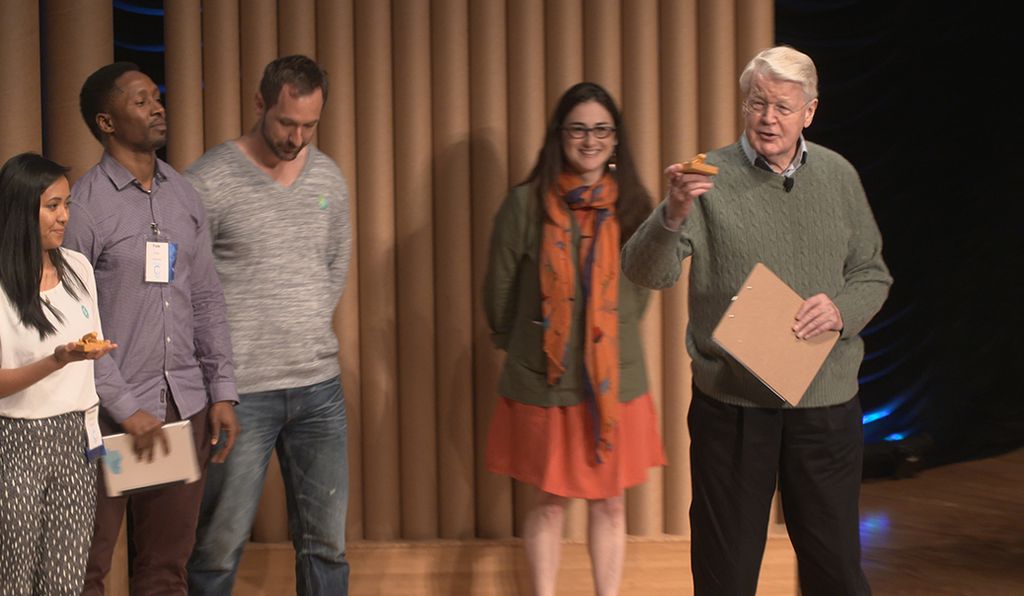
At the Smithsonian’s Earth Optimism Summit, the former president of Iceland Olafur Grimsson encouraged new solutions to climate change, awarding cash prizes to the winners of the “Make for the Planet” challenge. (The Roadmap)
Grimsson’s group felt that due to changes in information technology and social transformations, the large organizations and structures that used to be necessary to effect change were now not needed. And thus was born Roadmap, a new crowdsourcing tool for anyone and everyone interested in climate action. Still in its very early stages, Roadmap’s founders envision it as a platform for those working on climate issues—from scientist and policymaker to farmer and fisherman—to facilitate the sharing of knowledge and ideas, methods and techniques.
“A new political model is possible—where everyone can be a doer, where you no longer need big government or big enterprises to bring about success,” Grimsson says.
This new model for social change that skips the usual cumbersome channels and processes has been seen everywhere from public health, where the Bill & Melinda Gates Foundation has redefined the sector, to the hospitality industry, which is working to combat the human trafficking that plagues its businesses, to perhaps most famously the Arab Spring, where the role of social media in bringing about political change is still being debated today.
And this new model is complemented by technological changes. “The innovation in energy technology is such that we no longer have to wait for the big energy breakthrough,” Grimsson says. “We already have the available technologies. Every individual, home, village, community, town and region can execute change. The good news from the climate point of view is that, in addition to the information technology revolution, there has now also taken place an energy revolution. A house can be a power station: If the people who live in that house have extra energy, they can sell their energy through the smart grid. The notion that every house can be a power station is as revolutionary as saying that every mobile phone can be a media company.”
Grimsson admits that it may seem odd for someone in his position to be advocating that ordinary citizens take action apart from the conventional corridors of governmental power.
“For me to say that these traditional political organizations and positions are somewhat outdated is perhaps a strange statement: I was a professor of political science, I’ve been a member of parliament, I’ve been a minister of finance, I was president for 20 years,” he says.
It was during Iceland’s financial meltdown that he first experienced this new kind of social change: “I saw this very strongly through the financial crisis in my own country, which led to a big social economic uprising. All those activities were engineered by unknown people, people who were not part of a big organization, who used Facebook and the information media to bring thousands of people together in one day.”
Right now, Roadmap consists of a website and a lofty manifesto that speaks of raising the value of “moral currency” and creating a “best practices warehouse.” Visitors to the site can fill out a form if they want to become part of its community of “doers.” The practical part of the manifesto speaks of identifying the best methodologies and models; implementing a “real-time system of measurement” and a way to “gauge and understand what is working, what is not, and exactly what is being achieved.” As the platform develops, it will be interesting to see exactly what form these gauges, measurement systems, and warehouses take.
After the Paris Agreement, Grimsson says of himself and his Roadmap co-founders, “We were all optimistic, but we are all also realists.” It is his belief that if you “give people the tools, they can execute the transformation and the change—without governmental leadership.” Perhaps Roadmap will be one of those tools.
ooOOoo
Here’s a video that spells it out in ways that I find impossible to ignore. (And, yes, I signed up, as in joining, yesterday afternoon.)
Because in hundreds of years time I want others to look at the following picture of Troutbeck Valley in England and know how precious is this one and only planet we live on.
We are witnessing more storms, more unseasonal weather patterns, and I just hope that we wake up soon to the damage we are doing to our beloved Mother that has held us in her eternal arms for so long..
Photo credit: Getty Images
Enjoy the month of May wherever you are in the world!
Closing by repeating a key pronouncement in that RoadMap video above:
Recognize Rescued Shelter Dogs as Oregon’s State Dog
A couple of hours ago I received an email from Scott Beckstead. Scott is the Senior Oregon Director and the Rural Outreach Director for The Humane Society of the United States (HSUS).
Scott and his wife are two people that Jeannie and I have met and they know that we are committed to supporting the HSUS. Scott was asking in his email that we promote his plea, on behalf of HSUS’s great work in Oregon, for all Oregon residents to support a proposal that comes with the catchy title of Proposal H.C.R. 16.
Because of the immediacy of this campaign, tomorrow is the deadline, I was pleased to publish what Scott sent me without delay.
ooOOoo
In Support of H.C.R. 16
Recognize Rescued Shelter Dogs as Oregon’s State Dog
Dogs are man’s best friend, providing many benefits to their families such as love, loyalty and an improved sense of well-being. Yet many people are surprised to learn that nationwide, millions of healthy, adoptable dogs are euthanized in shelters annually due to a lack of critical resources and public awareness.
The number of euthanized dogs could be reduced dramatically if more people adopted pets instead of buying them. When families choose to adopt, they save a loving animal by making them part of their family and open up shelter space for another animal who might desperately need it. If more families looking for a pet dog this year would adopt their new furry friend from a shelter, we could put an end to this tragedy.
Animal shelters and rescue groups are brimming with happy, healthy dogs of every breed, shape, size, age, and color, just waiting for someone to take them home. With the help of legislation like H.C.R. 16, we can spread the word about the benefits of adoption and work to end the senseless euthanasia of homeless dogs nationwide.
Shelter dogs make great pets. Please pass this legislation to emphasize the importance of animal adoption with the support of state and national animal sheltering leaders.
oooo
MY TESTIMONY IN SUPPORT OF H.C.R. 16
From: SCOTT BECKSTEAD, SENIOR OREGON DIRECTOR, RURAL OUTREACH DIRECTOR
THE HUMANE SOCIETY OF THE UNITED STATES
This Testimony presented to the HOUSE COMMITTEE ON RULES, APRIL 27, 2017
Chair Williamson, Co-Chairs Rayfield and McLane, and Members of the Committee:
Thank you for the opportunity to comment on H.C.R. 16, the bill to designate the rescued shelter dog as the official state dog of Oregon. The Humane Society of the United States strongly supports this legislation and urges you to vote YES.
First it is important to recognize this bill is not intended to denigrate reputable breeders of purebred dogs. Rather, it celebrates dogs of all stripes, be they purebred or mutt- and encourages Oregon citizens to consider adopting a dog in need of a home.
With regard to the claim that many Oregon shelter dogs originated in other parts of the country, transporting dogs from areas of over-population into areas where the population of adoptable dogs does not meet the demand is an activity that has been taking place for many years, and has saved countless lives, and created many happy families across the state. The Society of Animal Welfare Administrators (SAWA) has produced best practice guidelines for transport programs to ensure that both sending and receiving shelters are adhering to the highest standards of animal welfare and health considerations, including but not limited appropriate health certificates and veterinary inspection.
Shelters across Oregon adhere to industry best practices and appropriate oversight. Contrary to scare-mongering from the National Animal Interest Alliance, there is no data to show that dogs within the Oregon shelter system have higher incidences of temperament issues, health concerns, or that dogs from out of state are displacing Oregon dogs in need.
When a prospective owner buys a dog from a pet store, online seller or flea market, they’re almost certainly getting a dog from a puppy mill. Puppy mills are factory-style breeding facilities that put profit above the welfare of dogs. Animals from puppy mills are housed in shockingly poor conditions with improper medical care, and are often very sick and behaviorally troubled as a result. The mothers of these puppies are kept in cages to be bred over and over for years, without human companionship and with little hope of ever joining a family. And after they’re no longer profitable, breeding dogs are simply discarded—either killed, abandoned or sold at auction.
These puppy mills continue to stay in business through deceptive tactics — their customers are unsuspecting consumers who shop in pet stores, over the Internet or through classified ads. Puppy mills will continue to operate until people stop supporting them. But by visiting your local shelter or rescue and adopting a homeless pet, you can be certain you aren’t giving them a dime.
Dogs and cats share the homes of 65% of U.S. households, providing many benefits to their families such as love, loyalty and an improved sense of well-being. Yet many people are surprised to learn that nationwide, millions of healthy, adoptable dogs are euthanized in shelters annually due to a lack of critical resources and public awareness.
The number of euthanized animals could be reduced dramatically if more people adopted pets instead of buying them. When families choose to adopt, they save a loving animal by making them part of their family and open up shelter space for another animal who might desperately need it.
Animal shelters and rescue groups are brimming with happy, healthy pets just waiting for someone to take them home. With the help of legislation like HCR 16, we can spread the word about the benefits of adoption and work to end the senseless euthanasia of homeless pets nationwide.
Usually when you adopt a pet, the cost of spay/neuter, first vaccinations (and sometimes even microchipping!) is included in the adoption price, which can save you some of the up-front costs of adding a new member to your family. Furthermore, pets are screened for good health and behavior.
Not only do animals give you unconditional love, but they have been shown to be psychologically, emotionally and physically beneficial to their companions. Caring for a pet can provide a sense of purpose and fulfillment and lessen feelings of loneliness. And when you adopt instead of buying a pet, you can also feel proud about helping an animal in need!
Thank you for considering our position, and for your service to the people and animals of Oregon.
ooOOoo
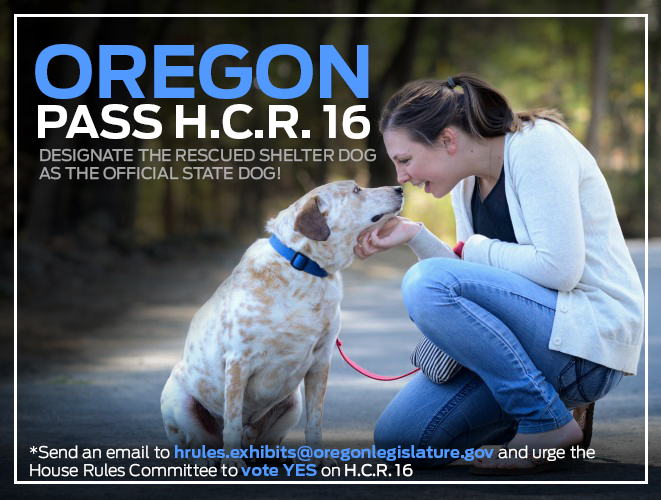
Let me close with this graphic that Scott also sent me.
Please, please, if you wish to support this proposed measure then, without delay, send an email now to hrules.exhibits@oregonlegislature.gov asking for a YES vote on H.C.R. 16
Jean and I have just done so.
Chair Williamson, Co-Chairs Rayfield and McLane, and Members of the Committee,
I write to you all on behalf of myself and my wife.
When we moved to Oregon in 2012 we came with 12 dogs many of which were rescue dogs and from animal shelters. We still have 7 dogs.
Shelter dogs make wonderful pets and they always know when they have been rescued from a shelter. They offer such love and gratitude to their loving owners.
Please, Jean and I ask for this measure, Measure H.C.R. 16, to be supported.
Thank you.
Paul & Jean Handover
4000 Hugo Road, Merlin, OR 97532
Last week, under the post title of Group Goodness, I put out a plea for anyone who felt so minded to make a donation to this fund. That donate page for this fund being here.
Now it’s very fair to say that there wasn’t a rush of donations. It would be more accurate to say that there were no donations for several days. In fact it is only in the last twenty-four hours that the amount donated has gone from 216 to 244 Australian dollars. (The fund will be transferring those Aussie dollars across to assist John Zande and his lovely wife soon. The currency being used is because it is the sister of John’s wife who is raising the money and she lives in Australia.)
Now it would be very wrong of me to seek the reasons why not a single follower or reader of this place chose not to make a donation. But I will offer this perspective. In that Jean and I wanted to make a second donation and it has taken several days to figure out why our gift wasn’t being processed; the reason being a rather cautious (our) bank attitude to debit card payments being made overseas. So if anyone else has tried to make a donation and the system has got in the way then please do find a solution.
Here’s why!
Because John and his wife, Dionete, are totally immersed in doing their best to help the homeless and abandoned dogs in Sao Paulo, Brazil.
Here are copies of recent emails that John and Dionete have sent me over the last few days.
20th. April
Morning Paul, I took a camera this morning just to show you the new boy I’m helping. Gorgeous fellow, and young. It never stops. They never stop showing up… which is something I’m sure Jean understands all too well from her work in Mexico.
Again, thank you for your help and posting the campaign.
I queried if this new boy had a name?
No name yet. Can you think of one? I found him on the corner of a street where I feed two (sometimes 3) cats every morning. G’s mum and dad used to live in that street and her dad would feed them. He loved cats, and after he died (and G’s mum moved closer to us) I’ve kept going back. It’s been over a year now that I go there every day, and despite every effort to capture them, I’ve failed. They’re quite feral, but I can’t bring myself to letting them to fend for themselves.
And these are those photos.
oooo
John then continued that same day:
Anyway, the boy showed up about 9 days ago, so on my daily run I feed and water him. G put his pictures on Facebook this morning and a girl (Luiza) responded saying she knows of another lady who’s also feeding him. I saw food there once, on day 2 I think, but none since, so I’m not sure what that’s all about. The girl who actually responded is a part of this loose Vista Verde group. I’ve never met her, but I know of her. We’re helping her as she took in a dog a few months ago that had been hit by a car and is paralysed, but, to her credit, she’s refused to give in and has him in physio (including water treadmills), which is actually showing some positive signs. That’s sort of how it all works. Here’s some pictures and video of that case. Gorgeous dog.
The boy is relatively safe where he is. He has shelter, and doesn’t appear to be in any mood to move on, which is good. If he stays put we can help. Finding a home for him is not easy, but after we can find some place as a temporary shelter we’ll get him into the vet, neutered, treated for whatever, then settled. The huge problem is, there simply aren’t any shelters we can just take him to, so we can’t get him off the street and into the vet immediately. Every shelter is over-full, and that makes rescues just that much harder. It’s not the case of simply finding a dog (or cat) and getting them to safety… which is heartbreaking. You just have to hope they stay put. A few times I’ve put a dog in the car and taken them from danger (like near a main road) and brought them up to our area where there are parks and plenty of shelter and people to help. It’s a safe place, and if they stay put we often have successes… But that takes time. But, as I said, he doesn’t seem to want to move on, and he’s starting to put on weight. He was desperately thin, but 500g of mince and a big bowl of dry food every day seems to be doing the trick.
Here’s hoping to a good ending for him.
In speaking with Jeannie about this poor dog she very quickly suggested the name of Socks. John happily went with Jean’s suggestion.
21st April
Hi Paul, just a quick update on socks. Luiza (the girl I mentioned yesterday) has found temporary shelter for Socks for one month. It’s not long, but will give us the chance to neuter him and do all necessary blood work. Finding him a home is the next hill, but I spent time with him this morning, just sitting with him, and he’s really a lovely, gentle fellow, so here’s hoping.
24th April
Socks update: His shelter home is ready today, we’ve been told. That, however, might now not be needed. Sunday I saw he now has a huge dog house on the footpath, with blankets, food and water. He wasn’t interested in the mince I brought him, so I just left some chewing treats. Same thing this morning (I’ve just gotten back). So, we’ll go back later today just to speak (again) to the people in the street (we don’t know who exactly put the dog house there), and it might be the case that he just goes straight to the vet for neutering, maybe a few days in the shelter for recovery, then back to his house while (if still needed) we look for a permanent home/family.
April 25th.
Hello Paul – I can see you’ve been playing “email tennis” with the gofundme staff – good to read they (finally) managed to sort it out.
We saw Socks today. Apparently a bunch of neighbours got together to feed and take care of him, albeit on the street (he was given a 2nd-hand doghouse & doona (oops, duvet)). One of the guys has been thinking of taking him to his country house; an acquaintance of mine knows of somebody who might adopt him. Yes, everything’s still in the air, but he has it much much better than other dogs we’ve found and helped.
Now we can book his neutering/vaccine.
As for me, I don’t have enough words to thank you & Jean. Truth to be told it feels a bit weird to be the beneficiary of a campaign. We’ve always helped others and suddenly seeing ourselves in this position is a tad uncomfortable, actually – which doesn’t mean this money is not welcome, considering all the cases we’ve had so far this year.
Fingers crossed it all works out for Socks. We’ll keep you posted.
So, good people, this is why I beseech you to please support what John, Dionete and his close group are doing on behalf of those dogs down in Brazil. Please make a donation!
(And, please, make a note of my final remark at the end of today’s post.)
Those who are regular visitors to this place will know that John Zande, who lives in Brazil, is a good friend, and, for that matter, I try to be a good friend of his place. (If you didn’t read my recent review of John’s latest book On The Problem of Good then it is here.)
So when a couple of days ago I received the following email from John you can imagine my positive response to his request.
Paul, hi, I have a favour to ask.
My wife’s sister, Dee (who lives in Australia) has started a gofundme campaign to help cover a rash of vet surgery bills we’ve had recently. These past few months (most of summer, really) has been appalling with the number of dumped animals in our area.
Together with a few other people in our loose group we rescued about ten and got them adopted out to good homes. Plus, we have three in temporary shelters as we nurse them back to health. We took one into our house, Nina, thus making eleven here now, who had her tail amputated last Tuesday. We were fortunate in that our vet worked for free (a 3hr operation) and only charged us for the anesthetist.
We’re lucky to have these wonderful people around, but we’re a tad snowed under right now with the accumulated surgeries and medicines, which is why Dee started this little campaign.
Now there was no question that Jean and I wanted to help. Not only by making a modest donation ourselves but by promoting Dee’s campaign. I emailed a reply to John saying just that.
John then responded with more details, including some photographs:
Dee is married to a very good friend of mine from Uni. She started this campaign to help Dionete, my wife, and I (and if possible a few other Vista Verde folk who’re in our rescue network) here in Brazil. Dee was here just before Christmas and saw the problem first hand. She actually helped us rescue a wonderful little fellow, Terrorista, who now lives a few streets away with a wonderful family.
I didn’t know, but Dionete was chatting to her a week or two ago and it came up just how many vet/surgery/medicine expenses we’d accumulated over the summer. Without either of us knowing, she, Dee, then started this gofundme campaign to lend a hand and help clear the vet bills. We’re not an NGO (we actually help four here in Sao Jose dos Campos, two in Sao Paulo, and Sandra’s Maxmello in another city south of Sao Paulo). Because we’re not an NGO we’ve never thought about doing a campaign ourselves, so was surprised when Dee started this one. It’s quite modest, $1,000 Australian dollars (the goal) converted to Brazilian Reis will make a sizable dent in our backlog of vet surgery bills. Our bills are tiny compared to a guy we know who does have an NGO and owes his network of vets 90,000. He’s a wonderful fellow and I’m actually working with him to try and get a mobile neutering unit started here in Sao Jose dos Campos. But that’s another story. So, to be clear, the campaign is for us here in Vista Verde, which is sadly a dumping ground for animals. Surrounding districts seem to think we’re all wealthy here and therefore they can dump their animals. It’s infuriating, and the animals never stop coming.
I am sure that Jean and I aren’t the only ones that want to help.
And John could offer no better reason for seeking some financial support from the wider world. Here’s some of his later email:
My apologies if there was some confusion. I’m actually heading out right now to feed a new fellow I found a few days ago and is sleeping outside a house in another district. When I get back I’ll send some more photos, OK.
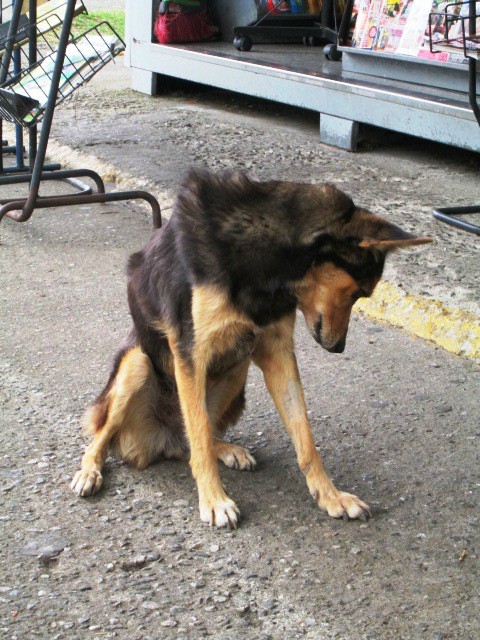
Let me close with some more photos of dogs that have been helped by John, Dionete and the rest of the great band of the Vista Verde Fund.
oooo
oooo
oooo
Finally!
Please offer whatever you can to help. Even the smallest amount makes a real difference.
Humanity’s safe and viable future depends on seeing things very differently.
Next Tuesday is the 62nd anniversary of the death of Albert Einstein, the famous German theoretical physicist who died on the 18th April, 1955. He delivered many innovative ways of seeing our world way beyond his theory of relativity, one of the two pillars of modern physics (alongside quantum mechanics) (Ref: Wikipedia)
Why do I introduce today’s post with that reference to Mr. Einstein?
Because I wanted to share with you a recent essay from George Monbiot and an Einstein quotation seemed so apt an introduction.
We shall require a substantially new manner of thinking if mankind is to survive.
That essay from George Monbiot was published yesterday and is shared with you all with Mr. Monbiot’s full permission.
It is an essay that deserves being read slowly and carefully. Please take time aside to so do because it really does offer a new manner of thinking.
ooOOoo
Circle of Life
13th April 2017
By reframing the economy, Kate Raworth’s Doughnut Economics changes our view of who we are and where we stand.
By George Monbiot, published in the Guardian 12th April 2017
So what are we going to do about it? This is the only question worth asking. But the answers appear elusive. Faced with a multifaceted crisis – the capture of governments by billionaires and their lobbyists, extreme inequality, the rise of demagogues, above all the collapse of the living world – those to whom we look for leadership appear stunned, voiceless, clueless. Even if they had the courage to act, they have no idea what to do.
The most they tend to offer is more economic growth: the fairy dust supposed to make all the bad stuff disappear. Never mind that it drives ecological destruction, that it has failed to relieve structural unemployment or soaring inequality, that, in some recent years, almost all the increment in incomes has been harvested by the top 1%. As values, principles and moral purpose are lost, the promise of growth is all that’s left.
You can see the effects in a leaked memo from the UK’s foreign office: “Trade and growth are now priorities for all posts … work like climate change and illegal wildlife trade will be scaled down.” All that counts is the rate at which we turn natural wealth into cash. If this destroys our prosperity and the wonders that surround us, who cares?
We cannot hope to address our predicament without a new worldview. We cannot use the models that caused our crises to solve them. We need to reframe the problem. This is what the most inspiring book published so far this year has done.
In Doughnut Economics: seven ways to think like a 21st-century economist, Kate Raworth reminds us that economic growth was not, at first, intended as a measurement of well-being. Simon Kuznets, who standardised the measurement of growth, warned: “the welfare of a nation can scarcely be inferred from a measure of national income.” Economic growth, he pointed out, measures only annual flow, rather than stocks of wealth and their distribution.
Raworth points out that economics in the 20th Century “lost the desire to articulate its goals.” It aspired to be a science of human behaviour: a science based on a deeply flawed portrait of humanity. The dominant model – “rational economic man”, self-interested, isolated, calculating – says more about the nature of economists than it does about other humans. The loss of an explicit objective allowed the discipline to be captured by a proxy goal: endless growth.
The aim of economic activity, she argues, should be “meeting the needs of all within the means of the planet.” Instead of economies that need to grow, whether or not they make us thrive, we need economies that “make us thrive, whether or not they grow.” This means changing our picture of what the economy is and how it works.
The central image in mainstream economics is the circular flow diagram. It depicts a closed flow of income cycling between households, businesses, banks, government and trade, operating in a social and ecological vacuum. Energy, materials, the natural world, human society, power, the wealth we hold in common: all are missing from the model. The unpaid work of carers – principally women – is ignored, though no economy could function without them. Like rational economic man, this representation of economic activity bears little relationship to reality.
So Raworth begins by redrawing the economy. She embeds it in the Earth’s systems and in society, showing how it depends on the flow of materials and energy, and reminding us that we are more than just workers, consumers and owners of capital.
The Embedded Economy. Graphic by Kate Raworth and Marcia Mihotich
This recognition of inconvenient realities then leads to her breakthrough: a graphic representation of the world we want to create. Like all the best ideas, her Doughnut model seems so simple and obvious that you wonder why you didn’t think of it yourself. But achieving this clarity and concision requires years of thought: a great decluttering of the myths and misrepresentations in which we have been schooled.
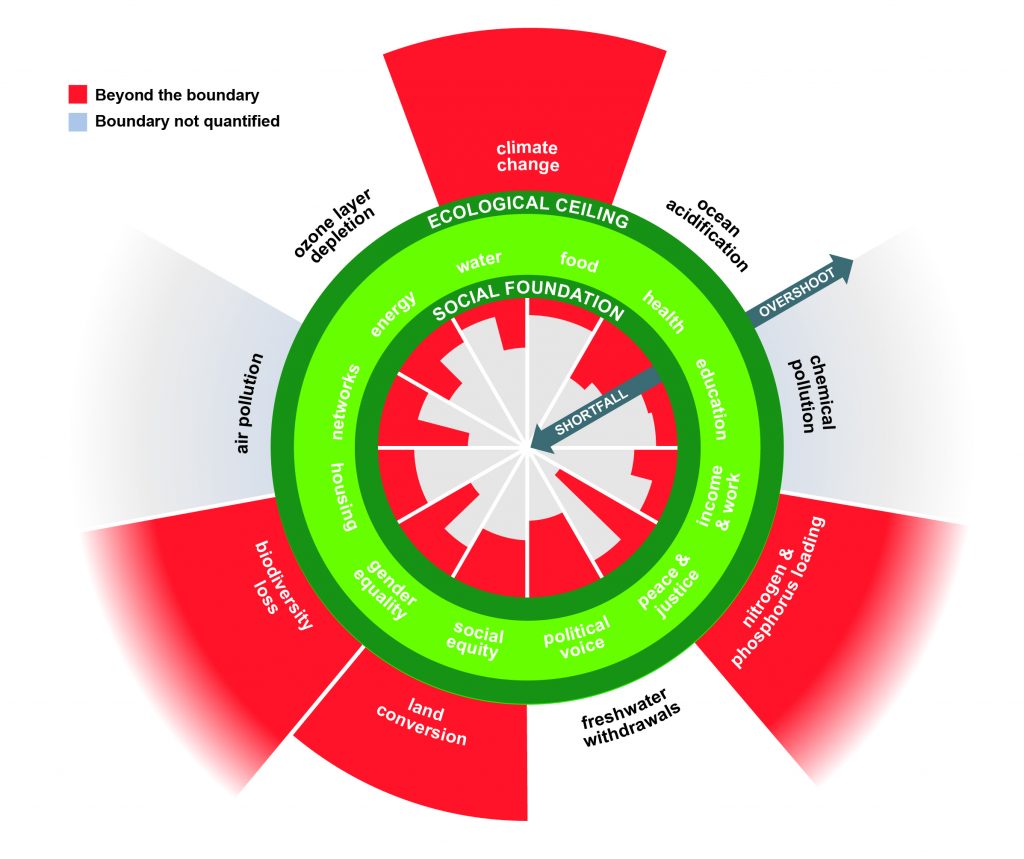
The diagram consists of two rings. The inner ring of the doughnut represents a sufficiency of the resources we need to lead a good life: food, clean water, housing, sanitation, energy, education, healthcare, democracy … . Anyone living below that line, in the hole in the middle of the doughnut, is in a state of deprivation.
The Doughnut. Graphic by Kate Raworth and Christian Guthier/The Lancet Planetary Health
The outer ring of the doughnut consists of the Earth’s environmental limits, beyond which we inflict dangerous levels of climate change, ozone depletion, water pollution, loss of species and other assaults on the living world. The area between the two rings – the doughnut – is the “ecologically safe and socially just space” in which humanity should strive to live. The purpose of economics should be to help us enter that space and stay there.
As well as describing a better world, the doughnut model allows us to see, in immediate and comprehensible terms, the state in which we now find ourselves. At the moment we transgress both lines. Billions of people still live in the hole in the middle. We have breached the outer boundary in several places.
Where we are now. Graphic by Kate Raworth and Christian Guthier/The Lancet Planetary Health
An economics that helps us to live within the doughnut would seek to reduce inequalities in wealth and income. Wealth arising from the gifts of nature would be widely shared. Money, markets, taxation and public investment would be designed to conserve and regenerate resources rather than squander them. State-owned banks would invest in projects that transform our relationship with the living world, such as zero-carbon public transport and community energy schemes. New metrics would measure genuine prosperity, rather than the speed with which we degrade our long-term prospects.
Such proposals are familiar, but without a new framework of thought, piecemeal solutions are unlikely to succeed. By rethinking economics from first principles, Raworth allows us to integrate our specific propositions into a coherent programme, and then to measure the extent to which it is realised. I see her as the John Maynard Keynes of the 21st-Century: by reframing the economy, she allows us to change our view of who we are, where we stand, and what we want to be.
Now we need to turn her ideas into policy. Read her book, then demand that those who wield power start working towards its objectives: human prosperity within a thriving living world.
Yet another wonderful saving of a dog from a frozen lake!
One of the ‘generalist’ blogs that I follow is Mother Nature Network (MNN) and yesterday MNN published the account of a dog in Canada being rescued from icy cold water.
Winter hasn’t let go of some parts of North America just yet, including St. Albert, Alberta, in Canada. Cold temperatures keep the lakes frigid and icy, as a local man and his dog discovered recently.
A French bulldog named Cosmo plunged into a lake in a park in St. Albert — it was a leash-free area of the park — and was struggling to pull himself out of the thin ice that covered the lake. Cosmo’s owner, Duncan McIver, jumped in to save his pup.
McIver was able to push Cosmo onto the ice and then, while carrying Cosmo, slowly walked across the ice, but not without plunging into the freezing cold water once more.
In a bit of serendipity, a CTV news crew was already at the park, filming a report on ice safety, and caught the whole episode on camera.
“As soon as the ice broke, I just went right in,” McIver told CTV Edmonton, “I think most people would do the same for their dog.”
The saying goes that a dog is man’s best friend, but we think moments like this prove the feeling is mutual.
ooOOoo
Yes, picking up on that remark by Duncan McIver, most people really would do what Duncan did!
Stories like this make my toes curl with pleasure!
Less than two weeks ago I shared an item that I had read about the firefighters of Santa Monica, CA, saving the life of a ten-year-old dog.
When Santa Monica firefighters were called to a burning apartment, they found the lifeless body of a tiny dog overcome by the heat and smoke on the floor of a bedroom. They pulled out the dog, named Nalu, but he wasn’t breathing and didn’t have a pulse.
Then two days ago, courtesy of the Care2 Causes blogsite, along comes another fabulous example of the care, love and generosity shown by firefighters.
ooOOoo
Firefighters Rescue Golden Retriever From Icy Pond
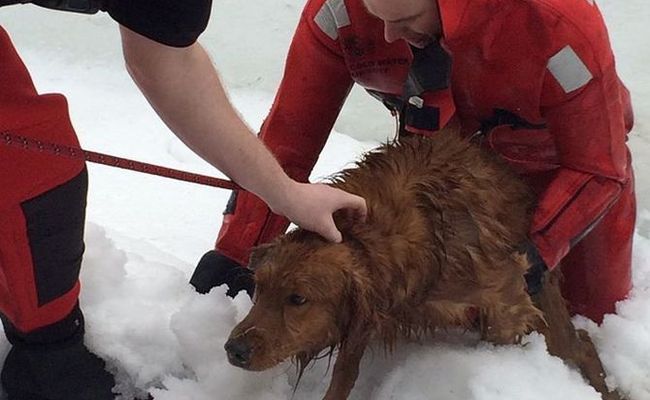
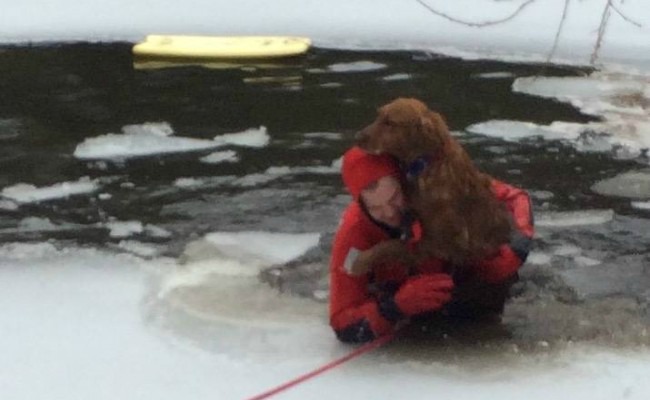
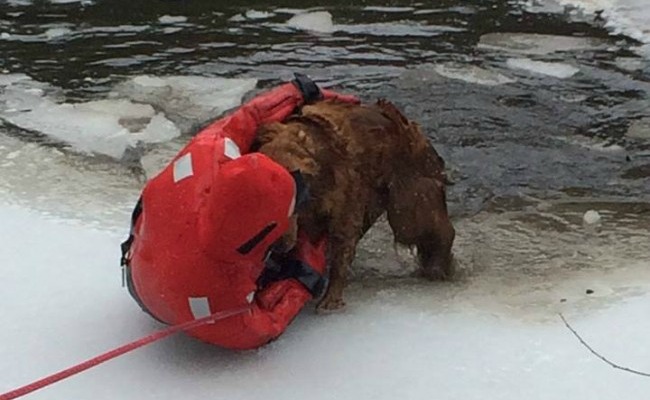
With perhaps just seconds to spare, North Hampton firefighter Will Taber barreled toward a dog who was barely clinging to thin ice last week in New Hampshire.
Photo Credit: North Hampton Professional Fire Fighters
Three-year-old Emmett ran out onto his family’s frozen backyard pond, suddenly falling through the ice. Although homeowner Kacey Eddinger started into the pond to rescue him, she had to turn back when she realized the water was simply too cold. Eddinger and her toddler son waited anxiously for help to arrive.
Photo Credit: North Hampton Professional Fire Fighters
The family isn’t certain exactly how long their golden retriever was in the water before they realized he’d fallen through, but by the time firefighters arrived, Emmett was exhausted and close to drowning.
In thermal ice rescue gear, firefighter Taber held a tethered line as he crossed the ice and entered the water. Once he reached Emmett, the other firefighters pulled the pair back to shore.
Photo Credit: North Hampton Professional Fire Fighters
“The canine was exhausted and scared and minutes from going completely under water and carried by the current under the ice,” the Fire Department posted on Facebook. “The rescue was made just in time where he was then immediately warmed, carried to a police cruiser and transported to North Hampton Animal Hospital.”
Though spring has officially arrived, ice rescues have escalated due to the thin ice that remains on some bodies of water.
Again and again, I find myself rating actions such as these from the North Hampton Fire Fighters (and not forgetting the Santa Monica Fighters) so gloriously uplifting. Again and again, they serve as a reminder that real people all around the world are so very often wonderful, generous and loving real people!
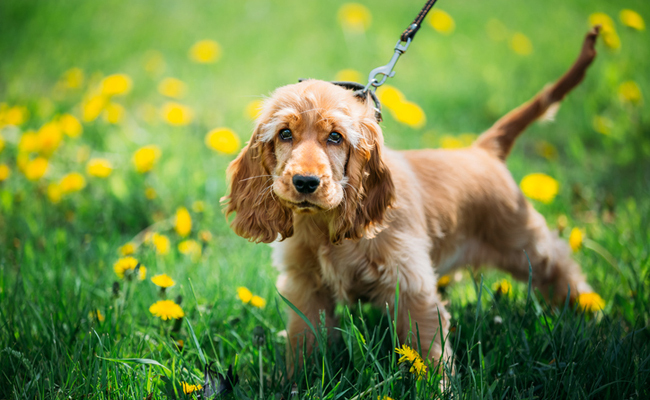

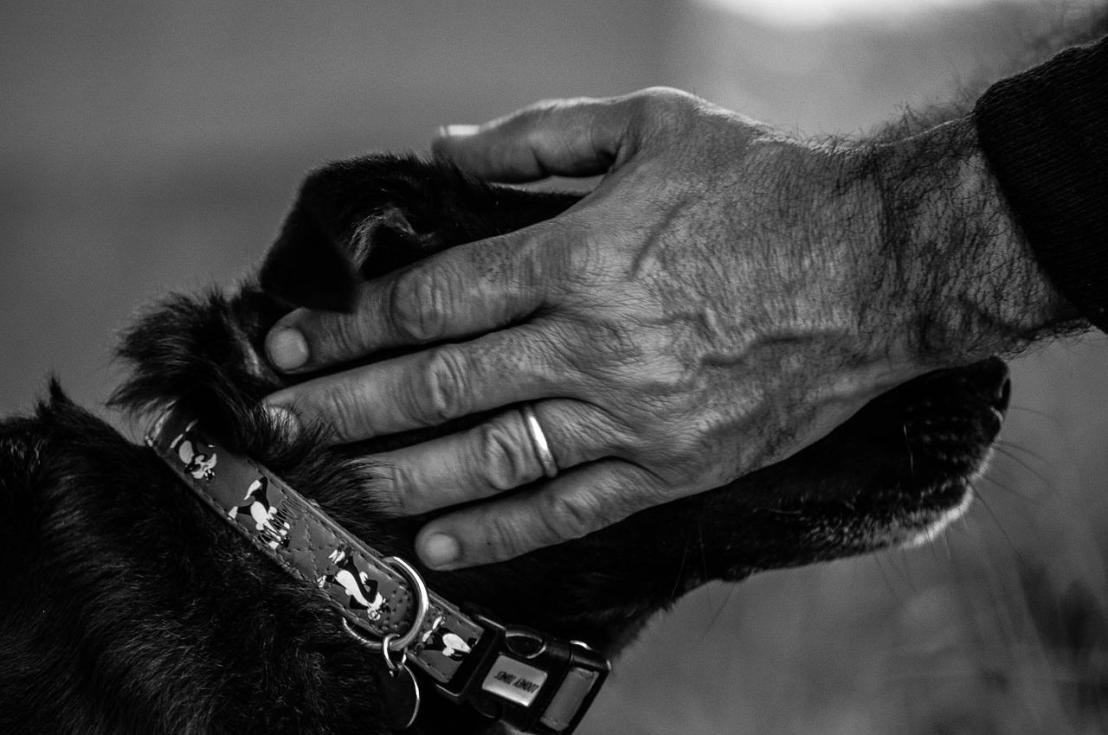




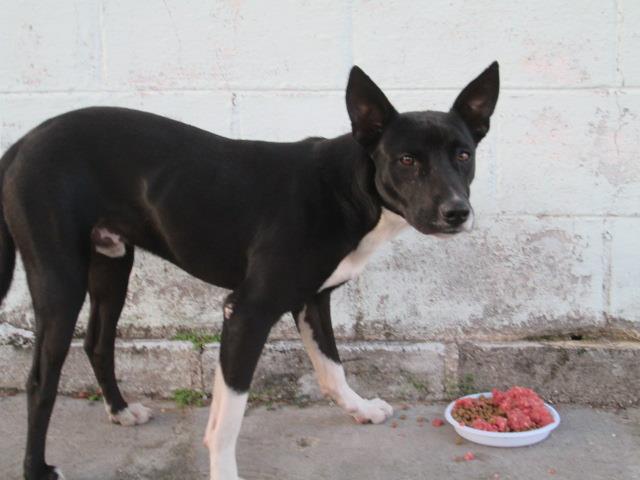

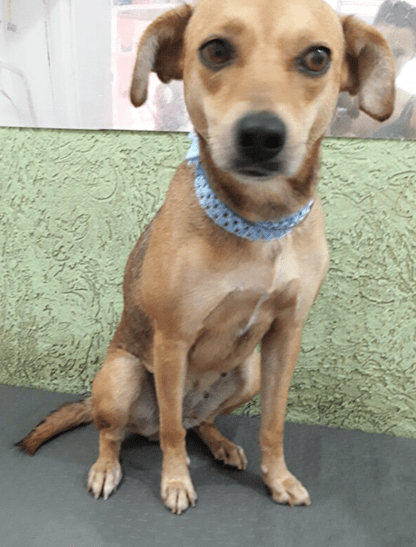
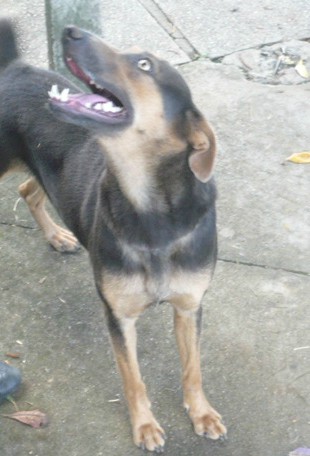
 Let me close with some more photos of dogs that have been helped by John, Dionete and the rest of the great band of the Vista Verde Fund.




 Learning from Dogs