Category: History

The Book! Part Five: Adaptability.

Thanks to the wonders of the modern dictionary, I am able to understand that about two-hundred years ago, sometime around 1790 to 1800, the word ‘able’ that I just used was added to the word ‘adapt’ to make the word ‘adaptable’. I read that the word is an adjective and that from that comes a related word, a noun: adaptability. That same dictionary informs me that the meaning of adaptability is: “capable of being adapted” or “able to adjust oneself readily to different conditions: an adaptable person.”

Now I would be the first to accept that the history of man, the long history of man, reveals a species, namely us, that is incredibly adaptable. Yet, (and you knew there was a ‘yet’ coming!) my sense of how adaptable any one person might be is inextricably wound up with change, and change is often a bitter fruit to taste.

You may recall that I closed the chapter on The process of change, in Part Four, with a snippet quotation from the film Interstellar: “We all want to protect the world, but we don’t want to change.”

That sentiment could be applied to so many aspects of our lives, especially to any form of change that heralded perceived uncertainty, or potential vulnerability; indeed anything that might be regarded as taking us outside our ‘comfort zone’. Granted not everyone, all of the time, yet not no-one at any one time.

Dogs, just like us humans, love routines. However, what strikes me from having lived for a number of years with a great many dogs in the home, variously from sixteen to the nine we have at present[1], is how amazingly easily a dog will adapt to new circumstances, both temporary and long-term changed circumstances.

Somewhere in my research, and I regret not being able to quote the reference, I came across a review of the author Jean Donaldson[2], in connection with her book Culture Clash. This book has shaped modern thinking about the behaviour of dogs and the relationship between dogs and humans.

The reviewer, in discussing the adaptability of dogs, proposes, “Maybe it’s the simple way they view their world. Each thing in their lives seems to fall neatly into its place in their world view. Things to seek out, things to avoid, things to keep, and things to leave behind.”

Then a couple of sentences later, the reviewer adding: “I would guess that scavengers need that kind of mind set. Take it as it comes, deal with it, and move on. Dogs seem to have developed a sense of adaptation. They see what needs to be done and simply find a way to do it no matter what the impediments might be.”

That last sentence describes an attitude towards adaptability that, in my opinion, would be very rare to find in a person.

I am going to devote the balance of this chapter to a true story. The true story about an Akita breed of dog that lived with its owner in Tokyo back in the first quarter of the 20th century. I included this account, despite the main theme of the story being about the extreme loyalty of the dog, because the dog’s ability to adapt is equally as impressive.

In 1924, Hidesaburō Ueno, a professor in the agriculture department at the University of Tokyo took in an Akita breed of dog as a pet and named him Hachikō. During his owner’s life, Hachikō not only saw Professor Ueno come out from the front door each morning but quickly learned to greet him at the end of the day by going to the nearby Shibuya Station. Hachikō continued this daily routine of going to the station until a day in May 1925, when that evening Professor Ueno did not return on his usual train. The reason being that the professor had suffered a cerebral haemorrhage at the university that day, had died and, therefore, never returned to the train station where his doggy friend was waiting.

Kind persons found Hachikō another home after his master’s death but he routinely escaped, showing up again and again at his old home. Eventually, Hachikō in some doggie manner realised that his master, Professor Ueno, clearly no longer lived at the house. So Hachikō went to look for his master at the train station, where he had accompanied him so many times before. Each day, Hachikō waited for Professor Ueno to return. And each day he did not see his friend among the commuters leaving the station.

Now almost a permanent fixture at the train station, Hachikō inevitably attracted the attention of other commuters. Many of the people who frequented the Shibuya train station had seen Hachikō and Professor Ueno together each day. They now brought Hachikō treats and food to nourish him during his long wait – Hachikō waiting at the train station at the end of every single day.

That same year, it happened that another of Ueno’s faithful students, who had become something of an expert on the Akita breed, saw the dog at the station and followed him when he went back to the home of the former gardener of Professor Ueno: Kikuzaboro Kobayashi. There the student learned the history of Hachikō’s life. Shortly after this meeting with Kikuzaboro, the former student published a documented census of Akitas in Japan. His research found only 30 purebred Akitas remaining, including Hachikō from Shibuya Station.

Professor Ueno’s former student returned frequently to visit the dog and over the years published several articles about Hachikō’s remarkable loyalty. In 1932, one of these articles, published in Tokyo’s largest newspaper, threw the dog into the national spotlight. Hachikō became a national sensation. His faithfulness to the memory of his master impressed the people of Japan as a spirit of family loyalty that all should strive to achieve. Teachers and parents used Hachikō’s vigil as an example for children to follow. A well-known Japanese artist rendered a sculpture of the dog, and throughout the country a new awareness of the Akita breed grew.

Hachikō was so loyal that every day for the next nine years he waited, sitting there amongst the town’s folk, appearing precisely when the train was due at the station.

Hachikō died on March 8, 1935. He was found on a street in Shibuya. His heart was infected with filarial worms and 3-4 yakitori sticks were found in his stomach. His stuffed and mounted remains are kept at the National Science Museum of Japan in Ueno, Tokyo. Hachiko’s legendary faithfulness became a national symbol of loyalty. There is a memorial statue of Hachikō in front of Shibuya Station.

This tale of Hachikō is an astounding tribute to the adaptability of the dog.

1,123 words. Copyright © 2014 Paul Handover

[1] December, 2014
[2] http://www.jeandonaldson.com

Rivers in the sky!

California’s recent rain storm.

The recent rain storm that has affected much of the Western seaboard of the USA; albeit primarily California.  The BBC News reported online that:

Storm pounds northern California

Streets were heavily flooded in the town of Healdsburg, California.

More than 220,000 people are without power after heavy rains and high winds slammed northern California.

The storm brought rainfall of more than an inch an hour in San Francisco and winds gusts of 140mph (225km/h) in the Sierra Nevada mountains.

Flooding has already closed two major motorways in the area, delayed public transport, cancelled 240 flights and shut ferry services.

The rain is much needed in the drought-hit state but mudslides are a concern.

Power cuts were widespread, from the suburban area south of San Francisco to Humboldt, near the Oregon border.

Thus the morning afterwards, it was wonderful to receive an email from Dan Gomez that put not only this last storm into context but also a long history of very significant deluges.  Bet you will be as surprised as I was when you read it!

ooOOoo

What Is This “Atmospheric River” That Is Flooding California?

By Mark Fischetti | December 11, 2014

The views expressed are those of the author and are not necessarily those of Scientific American.

——————-

SA1The San Francisco Bay Area is getting flooded with relentless rain and strong winds, just like it did a week ago, and fears of rising water are now becoming very serious. Major news stations, weather channels, Web outlets and social media are all suddenly talking about the “atmospheric river” that is bringing deluge after deluge to California, as well as the coast of Washington. What is this thing? How rare is it? And how big of a threat could it be? Here are some answers. And see our graphics, below, taken from a brilliant and prescient feature article written by Michael Dettinger and Lynn Ingram in Scientific Americanin January 2013.

Not interested? In 1861 an atmospheric river that brought storms for 43 days turned California’s Central Valley into an inland sea 300 miles long and 20 miles wide. Thousands of people died, 800,000 cattle drowned and the state went bankrupt. A similar disaster today would be much more devastating, because the region is much more populated and it is the single largest food producer in the U.S.

So maybe 1861 was an oddity. Not really. Geologic core samples show that extreme floods like the one in 1861 have happened in California about every 200 years, since the year 200 A.D. So the next disaster could be coming around the bend. The West Coast has actually been slowly constructing large, specialized, meteorological observatories that can sense atmospheric rivers as they develop, so forecasters can give early warnings.

An atmospheric river is a conveyor belt of vapor that extends thousands of miles from out at sea, carrying as much water as 15 Mississippi Rivers. It strikes as a series of storms that arrive for days or weeks on end. Each storm can dump inches of rain or feet of snow. Meteorologists sometimes call small occurrences “pineapple expresses,” because they tend to flow in a straight line from around Hawaii toward the U.S. West Coast. The graphic below explains the details.

SA2

Several regions of central California have been frequent targets in the past two millennia. Here’s the record from core samples showing that every 200 years or so a catastrophic atmospheric river many times greater than any pineapple express occurs.

SA3

The flow pattern of the atmospheric river now battering the West Coast is classic. The University of Wisconsin at Madison maintains a terrific Web site that shows the flows in real time, updated every five minutes. A snapshot from last night is below. The dark red swath across the equator is the tropical rain band that is usually present; the atmospheric river is the sweeping jet of water vapor (blue in the image) that shoots off towards the U.S.

SA4

If you want to know more about these monster storms, check out the feature articleby Dettinger and Ingram. Dettinger will also be speaking at the American Geophysical Union annual conference in San Francisco next week. I’ll be there, too—with 22,000 scientists, right in the thick of the storms, should they continue.

Top image courtesy of the University of Wisconsin at Madison

ooOOoo

Maybe those fluffy white clouds aren’t quite as innocent looking as one might imagine! Oh, and a cubic metre of water is one tonne! A 1,000 kgs! (Just a little short of a ton in old money.)

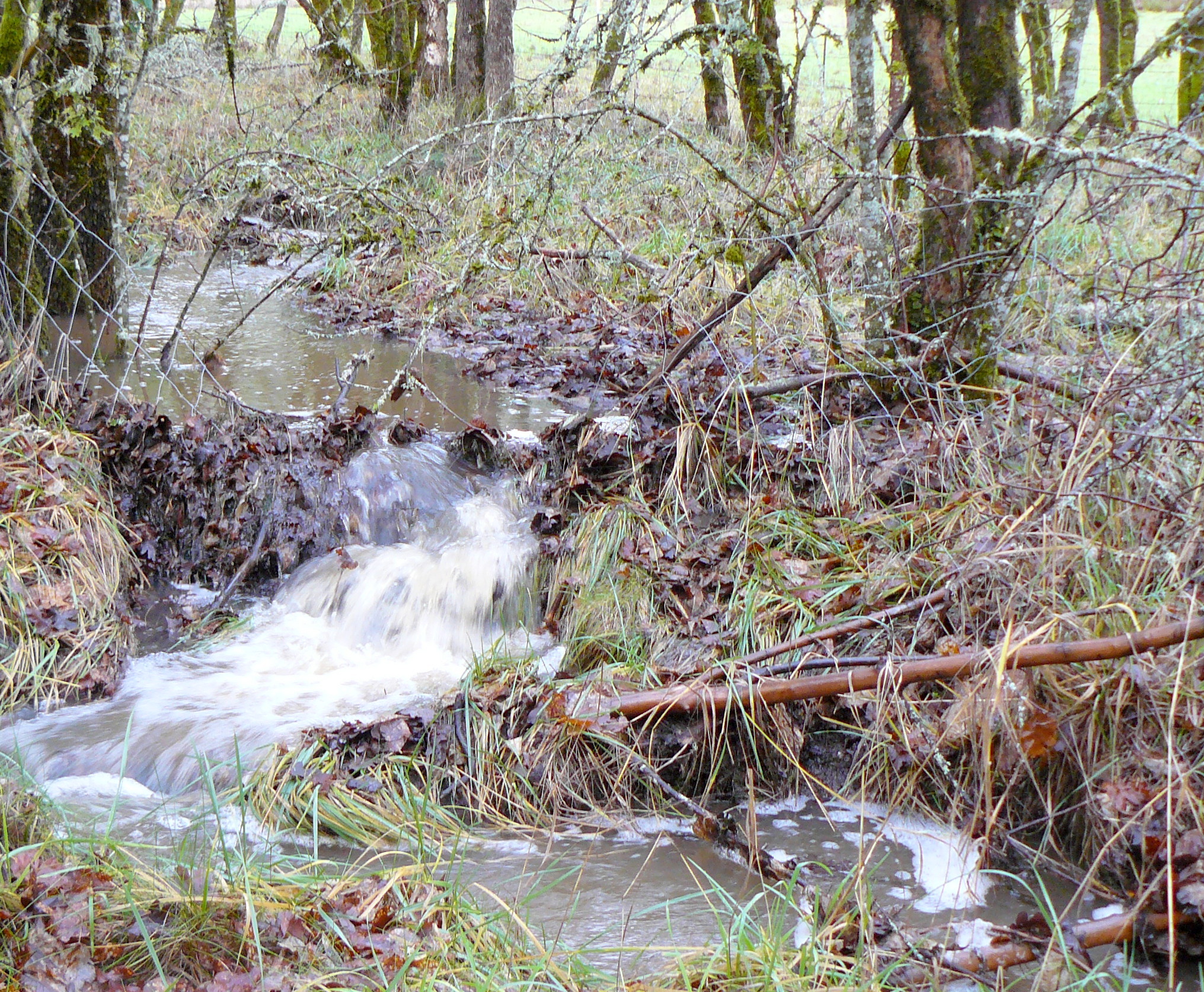
Finally, here in rural Southern Oregon, we received 1.70 inches of rain on Thursday and were grateful that it wasn’t more.  Nonetheless, it had the creek levels raised, as the following pictures reveal.

A small creek that only flows during periods of heavy rain. The creek is on the boundary between our property and our neighbour's to the North.
A small creek that only flows during periods of heavy rain. The creek is on the boundary between our property and our neighbour’s to the North.

oooo

This the raised water flowing over the irrigation dam on Bummer Creek, that flows North-South through the woods on the Eastern part of our land.
The raised water flowing over the irrigation dam on Bummer Creek, that flows North-South through the woods on the Eastern part of our land. Bummer Creek flows year-round.

A breath of common-sense.

George Monbiot perfectly spells it out.

Regular readers of this place will know that it is a rare couple of weeks without a republication of a George Monbiot essay.  His voice seems so often to be a ray of common-sense shining into a dark cave of present-day madness. None more obvious than this essay that was published last Monday under the title of There Is An Alternative.

It’s a huge honour to be able to share this with you, dear readers.

ooOOoo

There Is An Alternative

December 8, 2014

The great political question of our age is what to do about corporate power. It’s time we answered it.
By George Monbiot, published in the Guardian 8th December 2014

Does this sometimes feel like a country under enemy occupation? Do you wonder why the demands of so much of the electorate seldom translate into policy? Why the Labour Party, like other former parties of the left, seems incapable of offering effective opposition to market fundamentalism, let alone proposing coherent alternatives? Do you wonder why those who want a kind and decent and just world, in which both human beings and other living creatures are protected, so often appear to find themselves confronting the entire political establishment?

If so, you have already encountered corporate power. It is the corrupting influence that prevents parties from connecting with the public, distorts spending and tax decisions and limits the scope of democracy. It helps to explain the otherwise inexplicable: the creeping privatisation of health and education, hated by almost all voters; the private finance initiative, which has left public services with unpayable debts(1,2); the replacement of the civil service with companies distinguished only by their incompetence(3); the failure to re-regulate the banks and to collect tax; the war on the natural world; the scrapping of the safeguards that protect us from exploitation; above all the severe limitation of political choice in a nation crying out for alternatives.

There are many ways in which it operates, but perhaps the most obvious is through our unreformed political funding system, which permits big business and multimillionaires effectively to buy political parties. Once a party is obliged to them, it needs little reminder of where its interests lie. Fear and favour rule.

And if they fail? Well, there are other means. Before the last election, a radical firebrand said this about the lobbying industry(4): “It is the next big scandal waiting to happen … an issue that exposes the far-too-cosy relationship between politics, government, business and money. … secret corporate lobbying, like the expenses scandal, goes to the heart of why people are so fed up with politics.” That, of course, was David Cameron, and he’s since ensured that the scandal continues. His lobbying act restricts the activities of charities and trade unions, but imposes no meaningful restraint on corporations(5).

Ministers and civil servants know that if they keep faith with corporations while in office they will be assured of lucrative directorships in retirement. Dave Hartnett, who, as head of the government’s tax collection agency HMRC, oversaw some highly controversial deals with companies like Vodafone and Goldman Sachs(6,7), apparently excusing them from much of the tax they seemed to owe, now works for Deloitte, which advises companies like Vodafone on their tax affairs(8). As head of HMRC he met one Deloitte partner 48 times(9).

Corporations have also been empowered by the globalisation of decision-making. As powers but not representation shift to the global level, multinational business and its lobbyists fill the political gap. When everything has been globalised except our consent, we are vulnerable to decisions made outside the democratic sphere.

The key political question of our age, by which you can judge the intent of all political parties, is what to do about corporate power. This is the question, perennially neglected within both politics and the media, that this week’s series of articles will attempt to address. I think there are some obvious first steps.

A sound political funding system would be based on membership fees. Each party would be able to charge the same fixed fee for annual membership (perhaps £30 or £50). It would receive matching funding from the state as a multiple of its membership receipts. No other sources of income would be permitted. As well as getting the dirty money out of politics, this would force political parties to reconnect with the people, to raise their membership. It will cost less than the money wasted on corporate welfare every day.

All lobbying should be transparent. Any meeting between those who are paid to influence opinion (this could include political commentators like myself) and ministers, advisers or civil servants in government should be recorded, and the transcript made publicly available. The corporate lobby groups that pose as thinktanks should be obliged to reveal who funds them before appearing on the broadcast media(10,11), and if the identity of one of their funders is relevant to the issue they are discussing, it should be mentioned on air.

Any company supplying public services would be subject to freedom of information laws (there would be an exception for matters deemed commercially confidential by the information commissioner). Gagging contracts would be made illegal, in the private as well as the public sector (with the same exemption for commercial confidentiality). Ministers and top officials should be forbidden from taking jobs in the sectors they were charged with regulating.

But we should also think of digging deeper. Is it not time we reviewed the remarkable gift we have granted to companies in the form of limited liability? It socialises the risks which would otherwise be carried by a company’s owners and directors, exempting them from the costs of the debts they incur or the disasters they cause, and encouraging them to engage in the kind of reckless behaviour that caused the financial crisis. Should the wealthy authors of the crisis, like Fred Goodwin or Matt Ridley, not have incurred a financial penalty of their own?

We should look at how we might democratise the undemocratic institutions of global governance, as I outlined in my book The Age of Consent(12). This could involve the dismantling of the World Bank and the IMF, which are governed without a semblance of democracy, and cause more crises than they solve, and their replacement with a body rather like the international clearing union designed by John Maynard Keynes in the 1940s, whose purpose was to prevent excessive trade surpluses and deficits from forming, and therefore international debt from accumulating.

Instead of treaties brokered in opaque meetings between diplomats and transnational capital (of the kind now working towards a Transatlantic Trade and Investment partnership), which threaten democracy, the sovereignty of parliaments and the principle of equality before the law, we should demand a set of global fair trade rules, to which multinational companies would be subject, losing their licence to trade if they break them. Above all perhaps, we need a directly elected world parliament, whose purpose would be to hold other global bodies to account. In other words, instead of only responding to an agenda set by corporations, we must propose an agenda of our own.

This is not only about politicians, it is also about us. Corporate power has shut down our imagination, persuading us that there is no alternative to market fundamentalism, and that “market” is a reasonable description of a state-endorsed corporate oligarchy. We have been persuaded that we have power only as consumers, that citizenship is an anachronism, that changing the world is either impossible or best effected by buying a different brand of biscuits.

Corporate power now lives within us. Confronting it means shaking off the manacles it has imposed on our minds.

www.monbiot.com

References:

1. http://www.dropnhsdebt.org.uk/

2. http://www.monbiot.com/2010/11/22/the-uks-odious-debts/

3. http://www.monbiot.com/2014/05/05/land-of-impunity-2/

4. https://tompride.wordpress.com/2014/10/13/lobbying-camerons-deleted-speech-and-his-jaw-dropping-hypocrisy/

5. http://www.lobbyingtransparency.org/

6. http://www.theguardian.com/commentisfree/2010/oct/22/vodafone-tax-case-leaves-sour-taste

7. http://www.theguardian.com/business/2011/oct/11/goldman-sachs-interest-tax-avoidance

8. http://www.theguardian.com/business/2013/may/27/deloitte-appoints-dave-hartnett-tax

9. http://www.theguardian.com/business/2013/may/27/deloitte-appoints-dave-hartnett-tax

10. http://www.monbiot.com/2013/11/29/hidden-interests/

11. http://www.monbiot.com/2011/10/17/show-me-the-money/

12. http://www.monbiot.com/books/the-age-of-consent/

Towards a new world.

A republication of a fascinating essay.

When I posted yesterday about a ‘growing’ awareness, I had no idea that earlier this morning, Oregon time, I would read an essay over on Rob Hopkin’s Transition Network blog that just had to be shared with you. But such is the wonder of our wired-up world.  The essay is called From dismal science to language of beauty – Towards a new story of economics and is authored by Inex Aponte and is republished in full. (The emboldening is mine.)

ooOOoo

Inez Aponte: From dismal science to language of beauty – Towards a new story of economics

Humans are storytelling beings. In fact one could argue that it is impossible to make sense of the world without story. Storytelling is how we piece together kite1-620x260facts, beliefs, feelings and history to form something of a coherent whole connecting us to our individual and collective past, present and future. The stories that help make meaning of our lives inform how we shape and re-shape our environment. This re-created world, through its felt presence in structures and systems as well as its cultural expressions, in turn tells us its story.

We live in a time of powerful globalised narratives. We no longer (or rarely) sit and listen to tales that were born of places we know intimately and told by people deeply connected to these places. Ours is a world saturated with information from every corner of the planet, voiced by ‘storytellers’ on television, radio, the internet, mobile phones, newspapers, billboards, books and magazines. It would appear that we now have access to a multitude of perspectives and, with that, more understanding of the different options open to human beings to live fulfilling lives. In reality however, the majority of us have to conform to a narrow set of rules not of our own making: the rules of economics.

The way in which our lives have become dominated by the pursuit of financial gain is full of contradictions. We may not be driven by the ‘love of money’ but we still have to ‘make a living’. The fluctuations in the economy have a profound effect on our everyday lives, but very few of us understand how it works, let alone feel we have the power to influence it. This lack of agency fills most of us with a degree of ‘background anxiety’ that drives many of our decisions, consciously or unconsciously. The economic story is possibly the most powerful story being told at this very moment.

So how is this story being told (and sold) to us? How is it being framed?

1- The work/life balance

This term has become so ubiquitous that it is often used in its English form even in non-English speaking countries. It seems to be a concept that needs no translation; it can easily be swallowed whole. But hidden inside this seemingly innocuous phrase are some powerful assumptions.

On one side of the scales we place work, not just any work, but paid labour. On the other side we place life. By life we don’t mean the actual fact of being alive, but our aliveness, our joy, our pleasures. Placing work and life on opposite sides of the balance we are tacitly agreeing that paid work is worth sacrificing our aliveness for, that it is ok to be a little bit ‘dead’ in your job. If you are lucky enough to have a job you love the concept may seem irrelevant, but for people whose work is tedious, soul-destroying or even dangerous this is the perfect frame to diffuse any discontent: ‘We agree that having a degree of aliveness is important, but you cannot have all of it. You have to sacrifice some of your aliveness just to stay alive.’ The framing of paid work as a necessity for ‘earning’ one’s existence remains unquestioned.

2- The economy must grow

Having determined the necessity of jobs it’s no surprise to hear world leaders repeating the growth mantra over and over. The story goes like this: we need growth so we can create jobs so we can pay people money to buy stuff that creates more jobs. Nobody questions whether the jobs that are created are worth giving up their aliveness for or even whether what is being produced or provided adds any further joy or satisfaction to society. The frame of ‘employment for all’ is so sacred that anyone pointing out how many of the businesses providing these jobs destroy the planet we depend upon for our survival is presented with another false dichotomy: people against nature.

When George Bush sr, at the time of the Kyoto protocol, told Americans “I am the one that is burdened with finding the balance between sound environmental practice on the one hand and jobs for American families on the other.” he was setting up a frame that continues to be echoed by world leaders today. Even if in our heart of hearts we know we need the earth more than we need the artificial constructs of jobs and money, by now we have become so dependent on money to stay alive that this kind of language stifles our capacity to imagine a different solution. Fearing for the survival and safety of our loved ones we accept the war declared on nature in our name.

3- Humans are selfish

This experience of fearing for our survival dovetails neatly with our third and perhaps most powerful economic frame: the rational, utility maximising individual – Homo Economicus. This story tells us that given the choice humans will seek to get the most for themselves with the least amount of effort. It’s simply a ‘dog eat dog’ world.

Funnily enough it looks like the people who most fit the stereotype of the selfish utility maximiser are economists themselves. Various studies have repeatedly shown that non-economists are not as selfish or rational as economic theory would have us believe and that economists, or students of economics, consistently score higher on selfishness than ‘ordinary’ people. Despite these insights, the story that humans are by nature selfish and competitive persists.

But are any of these frames telling us the truth about ourselves and the world? Do we have to accept work as a necessary burden? Do we have no choice but to destroy the planet in order to survive? Are we really as selfish as economic textbooks suggest?

Perhaps the first thing we need to ask is: Is any of this about true economics in the first place?

To answer this question we need to travel back to ancient Greece where Aristotle was musing on two distinct practices: Oikonomia and Khrematistika. Oikonomia is where we get the word economics from and is described as ‘the management of the household so as to increase its use value to all members over the long term’. Khrematistika on the other hand (from khrema, meaning money) refers to ‘the branch of political economy relating to the manipulation of property and wealth so as to maximize short-term monetary exchange value to the owner’.

In their book ‘For the Common Good’ economist Herman Daly and theologian John Cobb, Jr distinguish between the two as follows:

“Oikonomia differs from chrematistics in three ways. First, it takes the long-run rather than the short-run view. Second, it considers costs and benefits to the whole community, not just to the parties to the transaction. Third, it focuses on concrete use value and the limited accumulation thereof, rather than on an abstract exchange value and its impetus towards unlimited accumulation…. For oikonomia, there is such a thing as enough. For chrematistics, more is always better… “

By now you might recognise our current economic system in this description of chrematistics. No wonder we are confused. We believe we are practising economics when we are in fact practising chrematistics. This has far reaching consequences for both the practice of economics and its perception. By allowing chrematistics to masquerade as economics the owning classes have perpetuated the illusion that increasing their financial wealth will be good for all of us and we, in our own misunderstanding of the proper function of an economy, have accepted chrematistics as the dominant form of resource management.

But what if there was another way of thinking and speaking about the economy, one that was in line with the true meaning of the word: the ability to manage the home for all, the art of living? What if we were able to redeem the language of economics so that it might liberate our imaginations and creativity and tell a beautiful story that expresses what we truly value?

Human Scale Development

In the 1970s, after many years of researching poverty in Latin America, Chilean economist Manfred Max-Neef came to the conclusion that conventional economics, in practising chrematistics, did not have the tools to adequately address the experience of poverty and could not serve to alleviate it. What was needed was a language that allowed poverty and wealth to be understood in much broader terms. Together with his colleagues he developed what is now commonly known as Human Scale Development (HSD) or ‘barefoot economics’.

HSD proposes that there are nine fundamental human needs which are universal across time and place (as opposed to wants which are subject to cultural and historical trends). These fundamental needs are: Subsistence, Protection, Identity, Understanding, Participation, Creation, Freedom, Affection and Idleness.

Needs are not the same as the strategies or satisfiers we use to meet those needs. Needs are finite; satisfiers are culturally determined and infinite. In HSD each satisfier is valuated according to its impact on the rest of our own needs, the needs of others and, most importantly, on the conditions for life itself: a living thriving planet.

In this model of economics, you are wealthy when your needs are satisfied and if one or more of your needs are not met you are poor. Whereas our current model has conventionally defined wealth as how much money you possess and poverty as a lack of money – expressed as a poverty of subsistence – in HSD you may suffer from any number of poverties if one or more of your needs are not adequately satisfied. So you may have a full belly and suffer from poverties of affection, understanding or identity. Or you may feel safe and protected by having a secure well-paid job, but work so much you suffer from poverties of creation, participation and idleness. When enough members of a community suffer a particular poverty for prolonged periods it develops into a pathology. It becomes a sickness that is often hard to recognise because it has been normalised. We may ask whether our tendencies towards addictive behaviours, whether they be addictions to work, alcohol, gaming or sex, are expressions of such pathologies.

In HSD the key to living well, and therefore the purpose of a true economy, is to adequately satisfy our fundamental human needs within the Earth’s natural limits. Our role within such an economy is not only to seek to get our needs met, but to use our gifts to meet the needs of others.

This is good news, because here the time you spend playing with your child and meeting their need for creation, affection and participation creates a positive balance in the economy. As does the meal you made for your elderly neighbour, (meeting the needs of subsistence, affection, understanding, and protection) as does joining a community garden, learning a new skill, lying in the grass watching the clouds go by. Framing economics in this manner tells us that we are economic participants regardless of whether we are making financial gains. Other skills, gifts or abilities become our ‘currency’. In fact most things that the conventional (chrematistic) economy ignores create wealth in a Human Scale Economy.

The reverse is also true. Actions that are now considered beneficial for the chrematistic economy – for example, cutting down forests to build roads – soon appear uneconomical through an HSD lens. The destruction of the natural world also destroys opportunities to meet many of our fundamental needs: for idleness (going for walks in nature) identity (these places hold meaning that stretches back over centuries) participation and creation (it is where the community gathers, connects, plays) and understanding (the opportunity to connect with and learn from the more-than-human world).

Economies are created by the people

Economies, large or small, local or global, are created by the people. They depend on our collective efforts, labour and entrepreneurship as well as our songs, our dances, our poetry, our joy, our curiosity, our dreams. The macro economy must be reformed from the inside out, it must start with an understanding of who we are, what is dear to our hearts and from that place radiate our values outwards in order to truly meet our needs. A ‘barefoot’ economy is an economy where people – liberated from wage slavery, and with access to the means by which they can satisfy their fundamental needs – are able to choose adequate satisfiers suitable to their region and culture. It is one where we acknowledge and respect our dependence on a thriving earth. It is a place where we have once again understood the meaning of ‘enough’.

“If we are looking for insurance against want and oppression, we will find it only in our neighbors’ prosperity and goodwill and, beyond that, in the good health of our worldly places, our homelands. If we were sincerely looking for a place of safety, (…) then we would begin to turn to our communities – and not the communities simply of our human neighbors but also of the water, earth, and air, the plants and animals, all the creatures with whom our local life is shared.”

“The Earth is what we all have in common.” (Wendell Berry)

I look forward to a time when students of economics are required to study the work of artists, poets and makers. When economic text books, as well as addressing how we manage the earth to provide food, homes, clothing and jobs, also speak of the need for beauty, intimacy, community and love.

The Art of Economics (and may it one day become an art) needs a new story and a new language that doesn’t require us to choose between self and others, work and aliveness, our own lives and the lives of fellow humans or the health of the planet. A language that has the potential to re-frame the story, re-educate our thinking and get us back on the side of community, on the side of the earth and on the side of life.

Inez Aponte is a facilitator, storyteller and activist, and co-founder of the Well & Good Project. You can contact her about talks and workshops on HSD and the Fundamental Human Needs framework at inez_aponte@hotmail.com.

www.somesmallholding.wordpress.com
www.wellandgoodproject.wordpress.com

——————————————-

This article was written based on a talk given in Bonn within a series of REconomy-Events organised by the Bonn Transition-Town Initiative “Bonn-im-Wandel” and supported by the Heinrich Böll Foundation, and was originally published on the website of the recent Degrowth conference in Leipzig.

 ooOOoo

 Don’t know about you but I found this both fascinating and very informative.

The book! Part Five: Community

Dogs offer many beautiful examples of the benefits of community. For the powerful reason that their genes, from the days of wild dogs, still guide their behaviours. When dogs lived in the wild, their natural pack size was around fifty animals. As was explained in more detail in the chapter Understanding the dog’s world, only three dogs held positions of status. The leader of the pack, the female alpha dog, the ‘second-in-command’, the male beta or teaching dog, and the ‘omega’ dog, a dog of either gender whose role was to be the clown dog, keeping the pack happy and playful. It should be added that all three dogs of status were born into their respective roles. Their position in the pack was instinctive.

All the other dogs in that natural grouping would be equal participants with no ambitions to be anything else. There was no such thing as competition for a role, as how a dog fitted into his or her pack was a product of birth.

When we see how dogs are as the domesticated animals we humans know and love, we still come across, from time to time, a dog that is an alpha, beta or omega role dog. At the time of writing this, we have nine dogs in the house. Of those nine, two have an instinctive status. Lilly, a very old female dog, was born an alpha dog, and Pharaoh, was born a beta dog.

Let me explain more about Pharaoh and him being a beta or teaching dog.

In my early days of having Pharaoh in my life, I wondered if Pharaoh was an aggressive dog. My uncertainty with regard to Pharaoh followed a number of occasions when walking him in a public area, with other dogs around, and he had been very threatening, both in voice and posture, towards some of those other dogs.

I was put in contact with an Angela Stockdale who for years had helped owners with aggressive dogs. Helped them by retraining their dogs. This is what she arranged. I took Pharaoh up to her place at Wheddon Cross, near Minehead in Somerset. When we arrived, Angela was standing just by a gate that led into a fenced paddock, maybe a half-acre in size. In the far corner of the paddock were two dogs.

Angela asked me to bring Pharaoh to the gate and let him off the leash. It was clear that the intention was to let Pharaoh into the paddock. I cautioned that Pharaoh could be quite a handful with other dogs and, perhaps, it would be better that I walked him into the area still on his lead. Angela replied that it wouldn’t be necessary. So, as she held the gate open sufficient for Pharaoh to enter the paddock, I unclipped the lead from his neck chain and backed away, as requested.

Pharaoh had hardly taken two or three paces into the grassy paddock when Angela called out, “Paul, there’s nothing wrong with him!”

I was astounded and stammered, “Er, er, how can you tell so quickly?”

“Because my two dogs haven’t taken any notice!”, came Angela’s immediate reply.

As we both watched the interaction taking place, Angela explained that in the paddock were her female Alpha dog, Leda, and her male Beta dog, whose name now escapes me. In other words, these two dogs were number one and two in terms of status, so far as dogs see other dogs.

In fact, Pharaoh was utterly subservient to these dogs, in a way that I had never witnessed before. Later on, as Pharaoh relaxed and started playing, Angela said that she thought that Pharaoh was a Beta dog and later was able to confirm that.

Anyone who has the privilege of owning a group of dogs will know without doubt that they develop a community strength that is an incredible model for us humans.

So now to turn to how we can learn from this aspect of dogs.

Many people think more and more that nations, governments, call it what you will, are less and less effective at understanding the needs of their people. I’m not even going to go down the road of the corruption of our leaders, both big ‘C’ and little ‘c’, in terms of power and money. No, I’m thinking of the top echelons in many societies being very disconnected from the needs and aspirations of their people. The widespread sense that representative democracy, as a process, is broken. As a quick aside, I must add an amusing comment that came from a neighbour: If one can bank online, we can certainly vote online! Does make one think about new ways of governing ourselves in this online world of ours.

Yet it would be very wrong to imagine that mankind has no experience of community living. Erik D. Kennedy wrote an essay: On the Social Lives of Cavemen[1]. Under the sub-heading of The Tribe, he offers:

Human beings are no strangers to group living. Call it a family trait. Our closest animal relatives spend a good bulk of their time eating bugs off their friends’ backs. While I’m overjoyed we’re not social in that manner, I’m less pleased that we’re not social more to that degree. In study after study, having and spending time with close friends is consistently correlated with happiness and well-being. And yet, the last few decades in America have seen a remarkable decline in many things associated with being in a tight-knit social circle — things like family and household size, club participation, and number of close friends. Conversely, we’ve seen an increase in things associated with being alone — TV, commutes, and the internet, for example.

This trend is quite unhealthy. It’s no surprise that humans are social animals — but it may be surprising that we’re such social animals that merely joining a club halves your chance of death in the next year — or that living in a close-knit town of three-generation homes can almost singlehandedly keep you safe from heart disease.

Thus, a sharing, community life is not just some cosy idea, it could be core to the sort of healthy society we need to return to. Erik’s essay continues to expand this idea by quoting the particular case of Roseto in Pennsylvania[2]:

In 1950’s Roseto, the incidence of heart disease in men over sixty-five was half the national average (and suicide, alcoholism, drug addiction, and serious crime were also basically unheard of [ii[3]]). Bewildered doctors searched for solutions in genetics, diet, exercise, and geography, but finding nothing, reached the conclusion that it was the close-knit social life of the community that kept its residents so healthy. Dinners with grandma, friendly chats between neighbors, and a precocious level of civic involvement were the driving factors in the health of a town that nothing but old age could kill.

The circumstances behind the remarkable and uncharacteristic happiness and health for the residents of Roseto came down to one fact: “The whole reason Roseto was an outlier is because it was a town whose inhabitants more or less collectively moved from rural Italy to the middle of Pennsylvania over a few decades.”

That, essentially, Roseto became “an Italian village in the American countryside.”

One doesn’t need to reflect for very long before the obvious question arises: If fifty dogs is the optimum number for a pack of dogs, is there a limit to the number of people we can have in the human equivalent of our pack?

Well, says anthropologist Robin Dunbar, that number is about 150 persons. Robin Dunbar achieved fame by drawing a graph that plotted primates’ social group size as a function of their brain sizes. He inputted the average human brain size into his model, and up came the number 150. Beyond that number is past the upper bounds for both hunter-gatherer tribes and Palaeolithic farming villages. More than that, it appears that everything from startup employee counts to online social networks show this number as a fairly consistent maximum for the number of close social ties.

Back to Erik Kennedy:

Regardless of the specific implementation, the point is this: we stand to gain a lot from living in larger, closer groups. That’s how we were kicking it in the monkey days; that’s how we should be kicking it now. I say that not because of a romantic attachment to our Palaeolithic forbearers, but because of the fact that a good deal of health and happiness is ripe for our picking.

Erik Kennedy offers advice as to how to translate that into practical actions. Such as watch less television, live in a bigger group, for example, dine with the same people more often, and always resolve any disputes that you have with close friends. Also, have your children spend more time with trusted adults and, in turn, spend time with the kids of adults who trust you. Not forgetting to mix up age groups and stay close to your parents and grand-parents.

In essence, adopting such a lifestyle is not without precedent; paleo-social lives are common all over the world. In fact, paleo-social lives may not only be common but an age-old wisdom in many other parts of the globe. However, in many parts of the ‘Western’ world chances are good that we have seen very few people living in anything vaguely resembling a tribe; to use the more common vernacular for the term paleo-social.

For one thing is clear: isolation and loneliness is taxing on our mental health. Humans are not designed to be alone.

Just another important way of living to learn from our dogs: the power of sharing, of living a local community life, may just possibly be the difference between failure and survival of us humans.

1,642 words Copyright © 2014 Paul Handover

[1] http://www.erikdkennedy.com/essays/social-lives-cavemen.php
[2] Referred to by Malcolm Gladwell in his book Outliers.
[3] I believe one of the surest signs that your lifestyle is aligned with your physiology in some way is that the benefits come in clumps.  Just as the paleo diet helps people with weight, energy levels, digestion, complexion, resistance to illness, and other areas of health, it’s no surprise that a proper paleo social life would be a holistic boon to health.

One clever man and his dog!

A reposting of a fascinating item regarding Ra Paulette.

As is the way of our interconnected world, I clicked on a link in a recent post over on Sue Dreamwalker’s blog that then took me to an item on a new blog site from Vision Keeper called World Metamorphosis. The item was about an American, Ra Paulette, who …

The American artist Ra Paulette has spent the last 10 years carving wondrous creations in the walls of a cave located in Northern New Mexico. For many years now, Paulette has walked to work into the hot desert, with only his faithful dog by his side. After much hard work, Paulette has finally allowed the public to view the incredible masterpiece he has been working on all of this time.

It all began with a mile long walk into the wilderness where Paulette discovered the cave. He has since transformed the everyday limestone walls into gorgeous hallways and spaces that are surprisingly full of light. Learn more about the man behind the carvings and check out the magnificent cave artwork here! (Source: Phoenix is Risen)

Caves1


Then it was a ‘hop, skip and a jump’ to go across to Ra Paulette’s website, where one reads such glorious details as:

Process

Process

Manual labor is the foundation of my self expression. To do it well, to do it beautifully, is a “whole-person” activity, engaging mental and emotional strengths as well as physical strength.

When digging and excavating the caves I break down all the movements into their simplest parts and reassemble them into the most efficient patterns and strategies that will accomplish the task while maintaining bodily ease. Like a dancer, I “feel” the body and its movement in a conscious way.

I’m fond of calling this “the dance of digging”, and it is the secret of how this old man can get so much done.

Then words that are more poem than anything else:

The Present

LUMINOUS CAVES
the world within the earth and ourselves

My final and most ambitious project is both an environmental and social art project that uses solitude and the beauty of the natural world to create an experience that fosters spiritual renewal and personal well being. It is a culmination of everything I have learned and dreamed of in creating caves.

A mile walk in the wilderness becomes a pilgrimage journey to a hand dug, elaborately sculpted cave complex illuminated by the sun through multiple tunneled windows. The cave is both a shared ecumenical shrine and an otherworldly venue for presentations and performances designed to address issues of social welfare and the art of well being.

In social art, creating the work of art is not the objective in itself, as in an exhibit, but is a means to bring about social change. The response to the artwork is not merely left to its audience as an endpoint in the process but is an element in a larger encompassing creative process. In the analogy of art being one of the colors on the social artist’s palette, the canvas would be society itself, its social conditions in a particular location. In using the aesthetic to address societal suffering, social art is not content with merely decorating the world; its intent is to change it.

Changing the world is a tall order. Art doesn’t attempt to force change through direct action but to catalyze it by affecting the emotional basis from which change can occur.

Begging the question, “How can we change what we do before we change how we feel?” Its underlying premise is that when through wonder and the sense of beauty we move from the emotional realm of our desires and fears to the more expansive and deeper feelings of thanksgiving and appreciation of life with a sense of its sacredness, our actions will automatically be modified, creating a better world – ‘like magic’.

This is the magic of art, music, theatre, and of the beauty of the natural world. We need for that magic to play a more direct role in our lives.

Please, please read the rest of these wonderful thoughts and ideas

Will close with another photograph of Ra working inside the caves.

Cave2

Breaking the silence

The second essay this week from George Monbiot

Part of me feels that I am being sucked in to too much ‘doom and gloom’ with the republication of this recent essay from George Monbiot.  I guess it’s a fine balance between spreading the word about the reality of life, in this case in the United Kingdom, or living in sweet innocence of the current state of affairs of ‘man’. But I found George Monbiot’s essay so shocking, in terms of the terrible inequality in British life, that it really did deserve the widest promulgation.

All I can offer in mitigation is that in thirty minutes time, I publish the next chapter of my book: How humans view dogs However, because this chapter is nothing more than setting the scene for the main chapters in Part Five, thirty minutes later comes leading chapter, specifically on Love, under the overall theme of Part Five: What we need to learn.

Your feedback, as always, would be wonderful.

ooOOoo

Breaking the Silence

December 2, 2014

It’s time to bring the Highland Spring south, and, like Scotland, introduce democracy to this quasi-feudal nation.

By George Monbiot, published in the Guardian 3rd December 2014

Bring out the violins. The land reform programme announced by the Scottish government is the end of civilised life on earth, if you believe the corporate press. In a country where 432 people own half the private rural land(1), all change is Stalinism. The Telegraph has published a string of dire warnings, insisting, for example, that deer stalking and grouse shooting could come to an end if business rates are introduced for sporting estates(2). Moved to tears yet?

Yes, sporting estates – where the richest people in Britain, or oil sheikhs and oligarchs from elsewhere, shoot grouse and stags – are exempt from business rates: a present from John Major’s government in 1994(3). David Cameron has been just as generous with our money: as he cuts essential services for the poor, he has almost doubled the public subsidy for English grouse moors(4), and frozen the price of shotgun licences(5), at a public cost of £17m a year.

But this is small change. Let’s talk about the real money. The Westminster government claims to champion an entrepreneurial society, of wealth creators and hard-working families, but the real rewards and incentives are for rent. The power and majesty of the state protects the patrimonial class. A looped and windowed democratic cloak barely covers the corrupt old body of the nation. Here peaceful protestors can still be arrested under the 1361 Justices of the Peace Act. Here, the Royal Mines Act 1424 gives the Crown the right to all the gold and silver in Scotland(6). Here the Remembrancer of the City of London sits behind the Speaker’s chair in the House of Commons(7), to protect the entitlements of a Corporation that pre-dates the Norman conquest. This is an essentially feudal nation.

It’s no coincidence that the two most regressive forms of taxation in the UK – council tax banding and the payment of farm subsidies – both favour major owners of property. The capping of council tax bands ensures that the owners of £100 million flats in London pay less than the owners of £200,000 houses in Blackburn(8,9). Farm subsidies, which remain limitless as a result of the Westminster government’s lobbying(10), ensure that every household in Britain hands £245 a year to the richest people in the land(11). The single farm payment system – under which landowners are paid by the hectare – is a reinstatement of a mediaeval levy called feudal aid(12): a tax the vassals had to pay to their lords.

If this is the government of enterprise, not rent, ask yourself why capital gains tax (at 28%) is lower than the top rate of income tax. Ask yourself why principal residences, though their value may rise by millions, are altogether exempt(13). Ask yourself why rural landowners are typically excused capital gains tax, inheritance tax and the first five years of income tax(14). The enterprise society? It’s a con, designed to create an illusion of social mobility.

The Scottish programme for government(15) is the first serious attempt to address the nature of landholding in Britain since David Lloyd George’s budget of 1909. Some of its aims hardly sound radical until you understand the context. For example it will seek to discover who owns the land. Big deal. Yes, in fact, it is. At the moment the owners of only 26% of the land in Scotland have been identified(16).

Walk into any mairie in France or ayuntamiento in Spain and you will be shown the cadastral registers on request, on which all the land and its owners are named. When The Land magazine tried to do the same in Britain(17), it found that there was a full cadastral map available at the local library, which could be photocopied for 70p. But it was made in 1840. Even with expert help, it took the magazine several weeks of fighting official obstruction and obfuscation and cost nearly £1000(18) to find out who owns the 1.4 km2 around its offices in Dorset. It discovered that the old registers had been closed and removed from public view, at the behest of a landed class that wishes to remain as exempt from public scrutiny as it is from taxes. (The landowners are rather more forthcoming when applying for subsidies from the rural payments agency, which possesses a full, though unobtainable, register of their agricultural holdings). What sort of nation is this, in which you cannot discover who owns the ground beneath your feet?

The Scottish government will consider breaking up large land holdings when they impede the prospects of local people(19). It will provide further help to communities to buy the land that surrounds them. Compare its promise of “a fairer, wider and more equitable distribution of land” to the Westminster government’s vision of “greater competitiveness, including by consolidation”(20): which means a continued increase in the size of land holdings. The number of holdings in England is now falling by 2% a year(21), which is possibly the fastest concentration of ownership since the acts of enclosure.

Consider Scotland’s determination to open up the question of property taxes, which might lead to the only system that is fair and comprehensive: land value taxation(22). Compare it to the fleabite of a mansion tax proposed by Ed Miliband, which, though it recoups only a tiny percentage of the unearned income of the richest owners, has so outraged the proprietorial class that some of them (yes Griff Rhys Jones, I’m thinking of you(23)) have threatened to leave the country. Good riddance.

The Scottish government might address the speculative chaos which mangles the countryside while failing to build the houses people need. It might challenge a system in which terrible homes are built at great expense, partly because the price of land has risen from 2% of the cost of a house in the 1930s to 70% today(24). It might take land into public ownership to ensure that new developments are built by and for those who will live there, rather than for the benefit of volume housebuilders. It might prevent mountains from being burnt and overgrazed(25) by a landowning class that cares only about the numbers of deer and grouse it can bag and the bragging rights this earns in London clubs. As Scotland, where feudalism was not legally abolished until 2000(26), becomes a progressive, modern nation, it leaves England stuck in the pre-democratic past.

Scotland is rudely interrupting the constructed silences that stifle political thought in the United Kingdom. This is why the oligarchs who own the media hate everything that is happening there: their interests are being exposed in a way that is currently impossible south of the border.

For centuries, Britain has been a welfare state for patrimonial capital. It’s time we broke it open, and broke the culture of deference that keeps us in our place. Let’s bring the Highland Spring south, and start discussing some dangerous subjects.

http://www.monbiot.com

References:

1. http://bit.ly/1vi0kuK

2. http://www.telegraph.co.uk/news/uknews/scotland/11262856/Future-bleak-for-grouse-shooting-and-deer-stalking.html

3. http://www.andywightman.com/?p=3975

4. Defra has tried to pass this off as payments for “moorland farmers”, but all owners of grazed or managed moorlands, of which grouse moors are a major component, are eligible. https://www.gov.uk/government/news/cap-boost-for-moorland

5. http://www.theguardian.com/uk-news/2014/apr/22/cameron-blasted-battle-shotgun-licence-fees

6. The Land Reform Review Group, 2014. The Land of Scotland and the Common Good.
http://www.scotland.gov.uk/About/Review/land-reform/events/FinalReport23May2014

7. http://www.monbiot.com/2011/10/31/wealth-destroyers/

8. http://www.theguardian.com/commentisfree/2014/mar/29/why-do-we-pay-more-council-tax-than-knightsbridge-oligarchs

9. This assumes that a house in Blackburn valued at £69,000 in 1991 would cost around £200,000 today. http://www.blackburn.gov.uk/Pages/Council-tax-charges.aspx

10. http://www.monbiot.com/2014/03/03/the-benefits-claimants-the-goverment-loves/

11. Defra, 31st August 2011, by email.

12. http://en.wikipedia.org/wiki/Feudal_aid

13. http://www.theguardian.com/business/2014/sep/22/charge-capital-gains-tax-main-residencies-says-housing-expert

14. http://www.ft.com/cms/s/2/99ae5756-1d89-11df-a893-00144feab49a.html#ixzz3Kexs2dL2

15. http://www.scotland.gov.uk/Publications/2014/11/6336

16. http://www.andywightman.com/?p=3816

17. http://www.thelandmagazine.org.uk/issue/land-issue-14-summer-2013

18. http://www.thelandmagazine.org.uk/issue/land-issue-14-summer-2013

19. http://www.scotland.gov.uk/Publications/2014/11/6336

20. http://archive.defra.gov.uk/foodfarm/policy/capreform/documents/110128-uk-cap-response.pdf

21. Compare the figures, Agriculture in the United Kingdom 2013: http://bit.ly/1vLQSi4
to the figures in the 2011 version: https://www.gov.uk/government/statistics/agriculture-in-the-united-kingdom-2011

22. http://www.theguardian.com/commentisfree/2013/jan/21/i-agree-with-churchill-shirkers-tax

23. http://www.theguardian.com/commentisfree/2014/nov/04/griff-rhys-jones-mansion-tax-soft-option

24. The Land Reform Review Group, 2014. The Land of Scotland and the Common Good. http://www.scotland.gov.uk/About/Review/land-reform/events/FinalReport23May2014

25. http://www.theguardian.com/commentisfree/2014/may/19/vote-yes-rid-scotland-of-feudal-landowners-highlands

26. http://www.scotland.gov.uk/Topics/Justice/law/17975/Abolition

The book! Part Four: What do we mean by integrity?

Integrity.

Just another of those words, like hope, that we use so often yet so rarely stop and reflect on the fullest meaning of the word; its deepest meaning. In the strictest sense, as in the definition of the word, it has much to do with moral and ethical principles. Sound ones, I hasten to add! (I am, of course, not including the meaning of integrity as one of physical soundness; as in the soundness of a ship’s hull.)

Yet, and I hesitate to write this, terms such as moral and ethical principles don’t slap me around the face with any force. One person’s ethical principles may not necessarily match another person’s ethical principles.

So more digging around the web, looking for some personal clarity of the meaning of the word. I came across this view of integrity: Integrity starts with the soul. Now that did engage me immediately and felt like that metaphorical slap on the face. Then a few moments later, my web search turned up a Zen Buddhist quote: “Be master of mind rather than mastered by mind.”

That stirred some ancient part of the old memory cells and I turned to a notebook that I have long used to jot down things that warranted being remembered. Yes, there it was: “Faith is to believe what we do not see; and the reward of this faith is to see what we believe.”

Thus drawing together these separate strands leads me to see integrity as a key foundation of change. Not exclusively, but equally vital a foundation of change as hope and goodness. Perhaps, foundation of change isn’t the most apt mental image. Foundation is too static an idea. Better, perhaps, is Professor Kaufman’s use of the term, and image, of vehicles. As in my previous chapter on The importance of hope: “Important psychological studies show that ability is important, but it’s the vehicles that actually get people where they want to go.”

In other words, our change in thoughts, our own internal deliberations to be the change that we need to be, sit on hope, goodness and integrity. We all remember that old saying about not being able to give away what one doesn’t own!

Now is this some cosy, self-indulgent line of introspection? No! Emphatically no!

I say this from a belief that the lifting of the importance of integrity is key to our survival. I am going to open up that bold statement by turning to my blog, that carries the same name as this book: Learning from Dogs. The blog was started on July 15th, 2009.

When I started Learning from Dogs I was initially rather vague about the purpose of the blog yet knew that the blog should reflect the growing need for greater integrity and mindfulness in our planetary civilisation. Some of my early musings indicate where I was coming from: “Show that integrity delivers better results … integrity doesn’t require force … the networking power of a group … demonstrate the power of intention … cut through the power of propaganda and media distortion …”

Then further reflections on the purpose of the blog: “Promulgate the idea that integrity is the glue that holds a just society together … urgent need as society under huge pressures …. want a decent world for my grandchildren … for all our grandchildren …. feels like the 11th hour….”

Because, while it may sound a tad grandiose and pompous, if society doesn’t eschew the games, the half-truths and selfish attitudes of the last, say, 30 years or more, then civilisation, as we know it, could be under threat.

Or, possibly, it’s more accurate to say that our civilisation is under threat and the time left to change our ways, to embrace those qualities of integrity, truth and consciousness for the very planet we all live on, is fast running out.

That’s why the concept of integrity is so critically vital. So vital that there is a return to integrity.

I going to enlarge this chapter, from the strict investigation into what we mean by the word integrity and its relevance to this present time, to a more philosophical view, and I am going to do so by returning to my blog.

For in September, 2013 I published a post under the title of Our broken ways. I wrote about climate change, the way our forests across the world were being fragmented and the impact on wild life in terms of increasing rates of the extinction of mammals; concluding with my criticism of money and power.
There was a comment left by Alex Jones, himself an active blogger with a blog called The Liberated Way. His words in his comment cannot be bettered by me and, consequently, here they are in full:

Hi Paul, what you highlight are examples of disconnection between humanity and nature and with each other. I have on my own blog highlighted a concept of Ubuntu – “I am because we are” – which is only possible when the self realises that they are part of an inter-connected network of life. Your example of islands of fragmented forest where disconnected wildlife are dying out is how it is with disconnected humanity, we are doomed to destruction because we are cut off from the life-giving connection to nature.

All the problems you highlight are symptoms of the disease of disconnection, and until there is reconnection to nature none of these symptoms can be successfully addressed.

War is an integral part of nature, when people seek to dismiss this then they add to the disconnection from nature. I was stung in the face by a drunken wasp a few days ago, this is how it is with nature; it is beautiful but also brutal. Peace and balance are illusions; one might say that life is in a becoming because of unbalance and strife. I advocate harmony, like a downhill skier we do not seek to control our surroundings, but instead act in harmony by moving around the obstacles such as the rocks and trees.

Disconnection can be as large as destroying whole forests by ignorant energy policies to those idiots who kicked a puffball to pieces before I could harvest it, or the new owners of my former home who have taken a chainsaw to all the trees and bushes in the garden. People who are disconnected do not consider how their actions impact nature or impact people, contrary to the philosophy of Ubuntu.

The only way for species man to survive on this planet is for every element of man’s existence on this planet to be rethought of in terms of the natural order. The integrity of the natural order.

“I am because we are!” Each and every one of us is where we are today, for good or ill, because of what we are: part of Nature. It’s so incredibly obvious – we are a natural species – yet who reading this wouldn’t admit at times to behaving “as though we are a species utterly divorced from Nature.”

Millions of us have pets that we love. Yet we still miss the key truth of our relationship with our pets. That we, just as much as our pets, are a part of Nature and subject to Natural order. We have so much to learn from our animals.

A close friend, John, wrote in a recent email to me that, “We are spiritual bankrupt. We spend too much of our time thinking about ourselves and what we want and too little of our time thinking about other people and what we all need.” Continuing in that email to add, “this spiritually bankruptcy had preceded our moral and economical bankruptcy.”

John closed his email by emphasising that the solution to our moral and financial problems, as well as our salvation as individuals, and as a species, is spiritual. “We simply need to love the Nature of God, the earth and each other regardless of what we may believe God to be.”

Now whether you are a religious soul, or a heathen, or somewhere in the middle, it matters not. For if we continue to defy Nature and the natural laws of this planet we are going to be dust before the end of this century.

We have been blessed by an evolution that has allowed mankind to achieve remarkable things. Even to the point of leaving the confines of our planet and setting foot on the Moon, sending probes from out of our Solar System, and even landing on a comet. There’s a sense, a distinctly tangible sense, that man has conquered all; that we have broken the link from being part of Nature; from being of Nature.

And now Mother Earth is reminding all of her species, every single one of them including species man, that everything is bound by her Natural Laws.

Thus rests my argument for not only what do we mean by integrity per se but how it is intimately and irrevocably a function of our relationship with Nature.

Indeed, understanding the power that comes from leading truthful lives and how an individual’s power and level of consciousness can be enhanced through greater integrity, understanding, and compassion could be the most remarkable discovery that any one person could ever make.

“There is nothing to fear except the persistent refusal to find out the truth, the persistent refusal to analyse the causes of happenings.” Dorothy Thompson.

1565 words. Copyright © 2014 Paul Handover

The book! Part Four: Of change in thoughts and deeds

Setting the scene

Well done for getting through Part Three: Mankind in the 21st century, and a number of the challenges of our present times! I don’t mean that to come over in a flippant manner but it must have been tough reading; it certainly was tough writing for this scribe! Then again, from way back yonder from my days of selling during the 70s and 80s, comes that old saw about not being able to embrace a new idea if one doesn’t really understand the issues, as in the strengths and weaknesses, of the existing situation.

Change is a fascinating subject and one that even the briefest trawl through the internet reveals a wealth of material. But the theme of change here in Part Four is about change at an individual level and not anything to do with organisations; let alone countries. And as such, in terms of how we understand the need for change as individuals, it seemed pertinent to offer this personal anecdote as a way of setting the scene.

You will recall that in Part One – Man and Dog, there was a chapter headed Unsettled times. In that chapter I wrote about learning that my previous wife informed me that she was having an affair with another man, this revelation taking place on December 20th, 2006, fifty years to the day of my father’s death on December 20th, 1956.
I also mentioned that earlier on in 2006 I had started mentoring a Jon Lavin as he was going through a major transition in his counselling practice. Jon was living a few miles from where I was living in South Devon and was, and still is, a psychotherapist, or to put it more accurately, a UKCP accredited therapist and NLP Practitioner.

Thus in a state of some emotional turmoil, I rang Jon early on in 2007 and asked if I might be his client! Jon was initially reluctant to agree to that, simply because he and I had started developing a relationship in another context, within a completely different perspective, as in me coaching him in the ways of developing his own business. As Jon made clear, he was worried that our existing relationship might get in the way of a very different relationship; one where I was trying to understand the catastrophe that had just taken place in my private life.

I was pretty insistent on wanting, needing, to see Jon; as you might imagine. Thankfully, Jon did agree after giving it some thought but on the strict understanding that if he was concerned about how the counselling relationship was progressing that I had to agree, agree before we started our sessions, that he had the right to terminate the relationship. Of course, I agreed. Without a moment’s hesitation.

Thus Jon and I started my personal counselling relationship soon after.

Naturally, Jon wanted to learn more about my emotional background and gently, when it felt right, asked me to explain the circumstances of my father’s death back in 1956. That was easy for me for the memories of that time had never dimmed.

That I had turned twelve back in November, 1956 and had started that previous September at my new secondary school; Preston Manor Grammar School. At the time of my birthday in November, 1956, I was only vaguely conscious of my father having been ill for a while. Not ill for months and months but bedridden for a few weeks. My father was fifty-five years old and had always been a gentle, caring father to me and my younger sister, Elizabeth.

Then just a few weeks further on, on the evening of the 19th December, when I was tucked up in bed, next door to my parent’s bedroom, my mother came into my bedroom to say goodnight to me; a perfectly ordinary and routine event. But on this particular evening, there was an unmistakeable sadness about her and rather than promptly coming up to me and kissing me goodnight, she sat down on the edge of my bed, just where my knees were under the sheet and bedspread.

I could still recall so clearly Mum giving a deep sigh, a sigh that seemed to confirm what I feared and, somehow, knew in my heart: that his illness might be serious. Mum turning and reaching out with her right hand so that she could hold my right arm that lay on top of the bedspread. “Paul, you do know that your father is not very well, not very well at all. I’m sorry to tell you that he may not live for very much longer.” Words that have never left me.

Mum then leaning forward, kissing me goodnight, and leaving my bedroom, turning the light out as she closed the door. Me falling asleep within moments of the closing of that bedroom door.

My father died that same night: my mother calling the doctor who attended, confirmed the death, issued the death certificate and arranged for my father’s body to be removed from our home.

It all taking place before daybreak. It all taking place as I slept on.

In the morning, my father was no longer part of my life.

As one could easily imagine, the following days were surreal, yet all of my life I have had no recollection of any emotions at all.

Going back to the death of my father, it was thought that my father’s funeral, a cremation, would be too upsetting for me and my sister so we didn’t attend the funeral.

The only other recollection from those times was being teased and bullied at my new school, the one that I had started a few months previously, because I was prone to bouts of crying. I also recall that one day in the playground, surrounded by a group of jeering and taunting boys, I had snapped and gone for the ring leader in a wild frenzied physical attack. Both he and I receive the cane from the headmaster but at least the teasing was brought to an end.

So all of this was spoken of to Jon in those early days of 2007!

Jon gently explored my feelings, wondering what were my emotional echoes from over fifty years ago. I’m not sure I voiced anything particularly revealing.

Then, in a change of tack, he asked me how my own son might have felt if he, my son, had endured the same tragedy at the same age and experienced the death of me, his father, in a similar fashion, and, in addition, not been able to go to the funeral.

It was a straightforward question but one that had me disappearing into my own inner thoughts for some time, Jon sitting quietly in his armchair just next to me, me only half aware that time seemed to have come to a halt. As if for the first time in my life since that dreadful day in 1956 I had the courage to listen to my deep inner voice, to sense my most inner feelings.

I stuttered, “My son would be angry, angry that one of the key events in the life of any person, the death of a parent, no more than that, the death of a son’s father, no that’s still not right; the death of his father, had been denied him.”

Jon looked at me, in a way that seemed to connect with me very strongly. Then he quietly asked, “What other feelings might you expect your son possibly to have?”

Again, another long silence, and then I said, feeling strongly that something very important was about to happen: “He would feel left out. Overlooked. Denied the experience of something irreplaceably important. He would feel emotional rejection; in spades!”

As those last words, quietly and clearly, left my lips, the most incredible sensation overtook me, both without and within me, encompassing me totally, the awareness that for the first time in my life, with me now sixty-three-years old, something that had been emotionally and psychologically hidden from me for fifty-one years, was now out in the open.

The clear knowledge that the circumstances surrounding my father’s death and my subsequent decline in my school performance had left me with a long-term psychological ‘dysfunction’; a certainty that I had been emotionally rejected way back in the Winter of 1956-57. A certainty, for sure, yet an understanding of myself that, hitherto, had been out of sight of my conscious mind, hidden deep inside of me, until this moment, this precious moment, in time.

Jon remained still and quiet as I continued to turn over in my mind this inner discovery. The realisation that, incredibly, for fifty years, my emotional response to my father’s death had remained totally out of my consciousness yet, nonetheless, had influenced me in very real and tangible ways; ways both negatively and positively that came to me almost immediately.

That the negative influence was that I was drawn to any woman who offered me love and affection and, therefore, I was emotionally unable to understand, to judge as it were, whether she had the potential to be a match as a life-long partner, however good a person she might be. I was doing anything to avoid emotional rejection!

The positive influence was that I tried very hard to please others (still do) so as to avoid their rejection, and had successful careers in selling for IBM UK, later starting and building a successful business in the early days of personal computing and, then, when my company was sold in 1986 becoming a freelance journalist and business coach.

So it took a chance association with Jon in those early weeks of 2007 to make me understand a fundamental lesson, one that had its roots fifty years previously, back in those early weeks of 1957. The lesson that we may only fully embrace change when we fully know just who we are. In other words, if there’s the tiniest voice inside you telling you that there may be some hidden nooks and crannies within you, psychologically and emotionally speaking, then some time spent with the appropriate ‘mentor’ will be the best investment you ever made.

There was a second reward from that self-awareness that arose in 2007. Namely, that in the December of that year, while the guest of dear Californian friends, enjoying a Christmas vacation in their holiday home in San Carlos, Mexico, I met Jean. Jean had been married to an American, Ben, for many years, latterly the two of them living permanently in San Carlos. Ben had died in 2005. Jean was born an Englishwoman, born in Dagenham in Essex. I had been born in Acton, North London. As the crow flies, the distance from Dagenham to Acton is twenty-three miles.

Jean and I met on December 15th, 2007. I was now emotionally unencumbered and able to give my full love to her and receive her full love for me. Jean and I were married in Payson, Arizona on November 20th, 2010. Now we live in a rural part of Oregon with our dogs and horses. It is a life together that is everything that any man could ever dream of.

The power of change!

1877 words Copyright © 2014 Paul Handover

oooo

It is only right for me to mention that the above is entirely my own work and while it is my best recollection of a series of true events, the chapter has not been previously seen or endorsed by Jon.

The book! Part Three: Greed, inequality and poverty

Note:

I read this out aloud to Jeannie last night, as I do with every post that is published, and found this chapter really didn’t flow.  I’m making the mistake of including too many words of direct quotations, many of which are not easy to follow.

So just wanted to let you know that if this strikes you the same way, you are not alone! 😉

It is, of course, just the first draft, but nonetheless …. wanted you to read this first.

oooo

Greed, inequality and poverty

Just three words: greed; inequality; poverty.

Just three words that metaphorically come to me like a closed, round, wooden lid hiding a very deep, dark well. That lifting this particular lid, the metaphorical one, exposes an almost endless drop into the vastness of where our society appears to have fallen.

That this dark well, to stay with the metaphor, is lined with example after example of greed, inequality and poverty is a given.

One might conclude that examining any of those examples is pointless, not in terms of the reality of our world, but in terms of influencing the views of a reader. If you are a reader who is uncertain about the current levels of greed, inequality and poverty then it’s unlikely that a few examples, or a few hundred examples, are going to change minds. (One might argue that you wouldn’t be reading this book in the first place!)

Thus when I was digging around, looking for insight into how and why we, as in society, are in such times, I was looking for core evidence. Very quickly, it struck me that the chapter title really should simply have been: Inequality. Because inequality, by implication, is the result of greed and results in poverty.

In November, 2014, at the time I was drafting this book, a new report was issued by the Center of Economic Policy Research (CEPR) on the latest (American) Survey of Consumer Finances. It painted a picture very familiar to many: the rich becoming richer while those with less wealth are falling further and further behind.

David Rosnick of the CEPR, and one of the report co-authors, made this important observation:

The decline in the position of typical households is even worse than the Consumer Finances survey indicates. In 1989, many workers had pensions. Far fewer do now. The value of pensions isn’t included in these surveys due to the difficulty of determining what they are worth on a current basis. But they clearly are significant assets that relatively few working age people have now.

Sharmini Peries, of The Real News Network, in an interview with David Rosnick, asked:

PERIES: David, just quickly explain to us what is the Consumer Finance Survey. I know it’s an important survey for economists, but why is it important to ordinary people? Why is it important to us?

ROSNICK: So, every three years, the Federal Reserve interviews a number of households to get an idea of what their finances are like, do they have a lot of wealth, how much are their house’s worth, how much they owe on their mortgages, how much they have in the bank account, how much stocks do wealthy people own. This gives us an idea of their situations, whether they’re going to be prepared for retirement. And we can see things like the effect of the housing and stock bubbles on people’s wealth, whether they’ve been preparing for eventual downfalls, how they’ve reacted to various economic circumstances, how they’re looking to the long term. So it’s a very useful survey in terms of finding out how households are prepared and what the distribution of wealth is like.

PERIES: So your report is an analysis of the report. And what are your key findings?

ROSNICK: So, largely over the last 24 years there’s been a considerable increase in wealth on average, but it’s been very maldistributed. Households in the bottom half of the distribution have actually seen their wealth fall, but the people at the very top have actually done very well. And so that means that a lot of people who are nearing retirement at this point in time are actually not well prepared at all for retirement and are going to be very dependent on Social Security in order to make it through their retirement years.

PERIES: So, David, address the gap. You said there’s a great gap between those that are very wealthy and those that are not. Has this gap widened over this period?

ROSNICK: It absolutely has. As, say, the top 5 percent in wealth, the average wealth for people in the top 5 percent is about 66 percent higher in 2013, the last survey that was completed, compared to 1989. By comparison, for the bottom 20 percent, their wealth has actually fallen 420 percent. They basically had very little to start with, and now they have less than little.

PERIES: So the poorer is getting poorer and the richer is getting extremely richer.

ROSNICK: Very much so.

To my way of thinking, if in the period 1989 through to 2013 “the average wealth for (American) people in the top 5 percent is about 66 percent higher” and “for the bottom 20 percent, their wealth has actually fallen 420 percent” it’s very difficult not to see the hands of greed at work and a consequential devastating increase in inequality.

In other words, the previous few paragraphs seemed to present, and present clearly, the widening gap between the ‘haves’ and the ‘have-nots’, comparatively speaking, and that it was now time for society to understand the trends, to reflect on where this is taking us, if left unchallenged, and to push back as hard as we can both politically and socially.

I wrote that shortly before another item appeared in my email ‘in-box’ in the middle of November (2014), a further report about inequality that, frankly, emotionally speaking, just smacked me in the face. It seemed a critical addition to the picture I was endeavouring to present.

Namely, on the 13th October, 2014, the US edition of The Guardian newspaper published a story entitled: US wealth inequality – top 0.1% worth as much as the bottom 90%. The sub-heading enlarged the headline: Not since the Great Depression has wealth inequality in the US been so acute, new in-depth study finds.

The study referred to was a paper released by the National Bureau of Economic Research, Cambridge, MA, based on research conducted by Emmanuel Saez and Gabriel Zucman. The paper’s bland title belied the reality of the research findings: Wealth Inequality in the United States since 1913.

As the Guardian reported:

Wealth inequality in the US is at near record levels according to a new study by academics. Over the past three decades, the share of household wealth owned by the top 0.1% has increased from 7% to 22%. For the bottom 90% of families, a combination of rising debt, the collapse of the value of their assets during the financial crisis, and stagnant real wages have led to the erosion of wealth. The share of wealth owned by the top 0.1% is almost the same as the bottom 90%.

The picture actually improved in the aftermath of the 1930s Great Depression, with wealth inequality falling through to the late 1970s. It then started to rise again, with the share of total household wealth owned by the top 0.1% rising to 22% in 2012 from 7% in the late 1970s. The top 0.1% includes 160,000 families with total net assets of more than $20m (£13m) in 2012.

In contrast, the share of total US wealth owned by the bottom 90% of families fell from a peak of 36% in the mid-1980s, to 23% in 2012 – just one percentage point above the top 0.1%.

The report was not exclusively about the USA. As the closing paragraphs in The Guardian’s article illustrated:

Among the nine G20 countries with sufficient data, the richest 1% of people (by income) have increased their income share significantly since 1980, according to Oxfam. In Australia, for example, the top 1% earned 4.8% of the country’s income in 1980. That had risen to more than 9% by 2010.

Oxfam says that in the time that Australia has held the G20 presidency (between 2013 and 2014) the total wealth in the G20 increased by $17tn but the richest 1% of people in the G20 captured $6.2tn of this wealth – 36% of the total increase.

I find it incredibly difficult to have any rational response to those figures. I am just aware that there is a flurry of mixed emotions inside me and, perhaps, that’s how I should leave it. Nonetheless, there’s one thing that I can’t keep to myself and that this isn’t the first time that such inequality has arisen, the period leading up the the Great Depression of the 1930s comes immediately to mind, and I doubt very much that it will be the last.

Unless!

Unless the growing catalogue of unsustainable aspects of this 21st century, a few of which have been the focus of this Part Three, brings about, perhaps in many different ways, a force for change that is unstoppable.

But before that is explored in Part Four, there is the one final element of the greed, inequality and poverty theme of this chapter that must be aired; the issue of poverty.

Contrary to my anticipation, the figures for poverty trends can be read in many ways and don’t give a clear-cut uniform picture. Nevertheless, it does’t take a genius to work out that the future, especially for young people, could be alarming.

Today, the poor people are the young. Today, the young are heading into a future that has many frightening aspects.

Take the present population numbers, the mind-boggling scale of the use of energy in these times, not to mention the levels of debt across so many countries (on the 14th November, 2014, the Federal Debt of the USA was about $18,006,100,032,000), possible unsustainable global climate change trends, and is it any wonder that those born in the period 1928 to 1945 (I was born in 1944), the generation that has been called the Silent Generation, must be wondering what the future holds for their children and grandchildren and what they or anyone can do today and tomorrow, to prevent these future generations sinking into oblivion.

I came across a quotation from Simon Caulkin, the award winning management writer: “It’s all the product of human conduct!”

Yes, Simon is right. Only human conduct will find that sustainable, balanced relationship with each other and, critically, with the planet upon which all our futures depend. Yet, something nags at me; a half-conscious doubt that starts with the word ‘but!’ Not that it doesn’t all come down to human conduct; not a moment’s hesitation on that one. But there’s still that half-conscious doubt. A doubt that starts to take shape on the back of that wonderful quotation from Einstein: “Insanity: doing the same thing over and over again and expecting different results.”

Then from that half-conscious place in one’s head comes another word. The word: Faith. Faith in us, as in faith in humanity. Faith that not only can we change our relationship with ourselves, with our communities and, above all, with our planet, but that we will. Faith that we, as in mankind, will embrace the many beautiful qualities of the animal that is so special to so many millions of us: our dogs. Not just embrace but pin our future on the premise that adopting the qualities of love, trust, honesty, openness and more, qualities that we see daily in our closest animal companions, is our potential salvation.

Thus comes the end of this set of depressing aspects of our 21st century. Time to move on in this story of learning from dogs and envelope ‘Of change in thoughts and deeds’; the title of the next section of this book. For we truly need a change to a better future.

1923 words Copyright © 2014 Paul Handover