Because in a very real sense it is the measure of how many live on this planet and how much energy is used for our own purposes that brings into stark consideration the fundamental, inviolate rule: that we cannot sustain an existence that isn’t in balance with what our planet can provide for us. ‘Us’ of course meaning every living thing on the planet.
The story of our energy use is scary to the extreme. By using the term ‘our energy use’ I am offering it as a label, so to speak, for the number of people multiplied by the energy each person is using.
So, first let us start with global population.
The world did not reach a population of one billion until 1800. One hundred and twenty-three years later, in 1927, that global population figure passed two billion persons. That, in itself, isn’t remarkable. But what was remarkable was the continuing growth.
Thirty-three years later, in 1960, the global population reached three billion.
Twenty-four years later, in 1974, the population reached four billion.
Thirteen years later, in 1987, the world population is up to five billion.
Twelve years on, in 1999, up to six billion persons in the world.
Then just another thirteen years on for the population to reach, in 2012, seven billion.
Now that is not a cast-iron guarantee that the growth will continue on and on in a similar fashion. Recall that old saying, “I can predict anything except those matters involving the future!”
Indeed, the UN’s Economic & Social Affairs Department, in a report issued in 2013, under the title of World Population Prospects – 2012 Revision, offered in Figure 1. Population of the world, 1950-2100 (Page XV of the summary.), four possible outcomes, “according to different projections and variants.” Those being Medium; High; Low and Constant-fertility. Just to pick the extremes projected, a Constant-fertility growth would bring the global population in 2100 to twenty-eight billion persons, and a Low growth future delivering more or less today’s global population of seven billion persons.
What is the maximum carrying capacity of the planet? A number of estimates of the carrying capacity have been made with a wide range of population numbers. A 2001 UN report said that two-thirds of the estimates fall in the range of 4 billion to 16 billion (with unspecified standard errors), with a median of about 10 billion. More recent estimates are much lower, particularly if resource depletion and increased consumption are considered.
Now if seven billion people might be (and I do stress ‘might be’) more than Planet Earth can sustain today, then don’t even start to go to future population levels of the order of sixteen billion (High) or twenty-eight billion (Constant-fertility)!
However, this is a chapter on population and energy, not just population per se. Population growth is only one part of a complex energy nightmare. A huge nightmare. We must look at the other factor: our energy use. It is both a cause and a consequence of the population numbers.
The energy used by each person, measured in kilowatts on an annual basis, remained pretty constant right up to the middle of the Industrial revolution. For example, in 1800, the energy use per person was less than two kilowatts (A kilowatt is a thousand watts) of power a year. Today, that low figure from 1800 is almost beyond imagination in terms of the energy used today!
The Industrial revolution changed everything; irrevocably. By the end of that century, 1900, while the energy use per person was slightly up, the global population was steadily increasing; as explained a few paragraphs back. Thus the total energy being used in 1900 was the sum of energy used per person times the number of persons worldwide.
As it logically is the same total calculation used coming forward to the year 2000; where the energy use per person is up to three or four kilowatts a year (the chart being used was difficult to read precisely) and the population is now around seven billion! Seven billion people using three to four kilowatts of power produces a global use of energy of fifteen terawatts (The terawatt is equal to one trillion watts!) That’s fifteen trillion watts of energy!
Once more, looking into the future is challenging; to say the least. The awareness and uptake of solar electricity panels is expanding; the idea of cars being powered by other means than petroleum fuels is becoming a reality but the broader picture of total energy used across the world reveals an intense dependency of energy for some time. Indeed, we can use the UN’s forecast of population growth out to 2050 to construct a prediction of future energy needs, again on an energy per person energy equivalent.
This shows total global energy use peaking about now (2015), to the tune of 80 gigajoules per year (The equivalent of 22 megawatt-hours per year), of which 80 percent is from the use of fossil fuels, then slowly declining by 2050 to 30 gigajoules per year, of which nearly 70 percent would be from the use of non-fossil fuels.
Indeed, you may have heard about recent declines in energy consumption in both Europe and the US, but these declines have been more than offset by increases in energy consumption in China, India, and the rest of the “developing” world.
To put this into some form of historical perspective, using the assumptions chosen, the world per capita energy consumption in 2050 would be about equal to what the world per capita energy consumption was back in 1905.
Assuming we haven’t trashed the planet before then!
That quote is from the film Interstellar. Last Thursday, Jean and me, with our neighbours Dordie and Bill, went into Grants Pass to watch the film. Speaking for myself, even after three days have passed, I still haven’t settled on a clear opinion of the film. Don’t get me wrong, it was a magnificent production and held one’s attention for every minute of the three-hour performance.
All of which is a preamble for an insightful essay from George Monbiot published on November 11th and republished here with George’s kind permission.
ooOOoo
Better Dead Than Different
Our visions of the future are defined, like the film Interstellar, by technological optimism and political defeatism.
By George Monbiot, published in the Guardian 12th November 2014
“It’s like we’ve forgotten who we are,” the hero of Interstellar complains. “Explorers, pioneers, not caretakers … We’re not meant to save the world. We’re meant to leave it.” It could be the epigraph of our age.
Don’t get me wrong. Interstellar is a magnificent film, true to the richest traditions of science fiction, visually and auditorally astounding. See past the necessary silliness and you will find a moving exploration of parenthood, separation and ageing. It is also a classic exposition of two of the great themes of our age: technological optimism and political defeatism.
The Earth and its inhabitants are facing planetary catastrophe, caused by “six billion people, and every one of them trying to have it all”, which weirdly translates into a succession of blights, trashing the world’s crops and sucking the oxygen out of the atmosphere. (When your major receipts are in the US, you can’t afford to earn the hatred of the broadcast media by mentioning climate change. The blight, an obvious substitute, has probably averted millions of dollars of lost takings).
The civilisational collapse at the start of the film is intercut with interviews with veterans of the Dust Bowl of the 1930s. Their worn faces prefigure the themes of ageing and loss. But they also remind us inadvertently of a world of political agency. Great follies were committed but big, brave things were done to put them right: think of the New Deal and the Civilian Conservation Corps (1). That world is almost as different from our own as the planets visited by Interstellar’s astronauts.
They leave the Earth to find a place to which humans can escape or, if that fails, one in which a cargo of frozen embryos can be deposited. It takes an effort, when you emerge, to remember that such fantasies are taken seriously by millions of adults, who consider them a realistic alternative to addressing the problems we face on Earth.
NASA runs a website devoted to the idea (2). It claims that gigantic spaceships, “could be wonderful places to live; about the size of a California beach town and endowed with weightless recreation, fantastic views, freedom, elbow-room in spades, and great wealth.” Of course, no one could leave, except to enter another spaceship, and the slightest malfunction would cause instant annihilation. But “settlements in earth orbit will have one of the most stunning views in our solar system – the living, ever-changing Earth.” We can look back and remember how beautiful it was.
And then there’s the money to be made. “Space colonization is, at its core, a real estate business. … Those that colonize space will control vast lands, enormous amounts of electrical power, and nearly unlimited material resources. [This] will create wealth beyond our wildest imagination and wield power – hopefully for good rather than for ill.”(3) In other words, we would leave not only the Earth behind but also ourselves.
That’s a common characteristic of such fantasies: their lack of imagination. Wild flights of technological fancy are accompanied by a stolid incapacity to picture the inner life of those who might inhabit such systems. People who would consider the idea of living in the Gobi Desert intolerable – where, an estate agent might point out, there is oxygen, radiation-screening, atmospheric pressure and 1g of gravity – rhapsodise about living on Mars. People who imagine that human life on Earth will end because of power and greed and oppression imagine we will escape these forces in pressure vessels controlled by technicians, in which we would be trapped like tadpoles in a jamjar.
If space colonisation is impossible today, when Richard Branson, for all his billions, cannot even propel people safely past the atmosphere(4), how will it look in a world that has fallen so far into disaster that leaving it for a lifeless, airless lump of rock would be perceived as a good option? We’d be lucky in these circumstances to possess the wherewithal to make bricks.
Only by understanding this as a religious impulse can we avoid the conclusion that those who gleefully await this future are insane. Just as it is easier to pray for life after death than it is to confront oppression, this fantasy permits us to escape the complexities of life on Earth for a starlit wonderland beyond politics. In Interstellar, as in many other versions of the story, space is heaven, overseen by a benign Technology, peopled by delivering angels with oxygen tanks.
Space colonisation is an extreme version of a common belief: that it is easier to adapt to our problems than to solve them. Earlier this year, the economist Andrew Lilico argued in the Telegraph(5) that we can’t afford to prevent escalating climate change, so instead we must learn to live with it. He was challenged on Twitter to explain how people in the tropics might adapt to a world in which four degrees of global warming had taken place. He replied: “I imagine tropics adapt to 4C world by being wastelands with few folk living in them. Why’s that not an option?”(6)
Re-reading his article in the light of this comment, I realised that it hinged on the word “we”. When the headline maintained that “We have failed to prevent global warming, so we must adapt to it” (7), the “we” referred in these instances to different people. We in the rich world can brook no taxation to encourage green energy, or regulation to discourage the consumption of fossil fuels. We cannot adapt even to an extra penny of tax. But the other “we”, which turns out to mean “they” – the people of the tropics – can and must adapt to the loss of their homes, their land and their lives, as entire regions become wastelands. Why is that not an option?
The lives of the poor appear unimaginable to people in his position, like the lives of those who might move to another planet or a space station. So reducing the amount of energy we consume and replacing fossil fuels with other sources, simple and cheap as these are by comparison to all other options, is inconceivable and outrageous, while the mass abandonment of much of the inhabited surface of the world is a realistic and reasonable request. “It is not contrary to reason to prefer the destruction of the whole world to the scratching of my finger”, David Hume noted (8), and here we see his contemplation reified.
But at least Andrew Lilico could explain what he meant, by contrast to most of those who talk breezily about adapting to climate breakdown. Relocating cities to higher ground? Moving roads and railways, diverting rivers, depopulating nations, leaving the planet? Never mind the details. Technology, our interstellar god, will sort it out, some day, somehow.
George: this is a formula for the deferment of hard choices to an ever-receding neverland of life after planetary death.
“Money has never made man happy, nor will it, there is nothing in its nature to produce happiness. The more of it one has the more one wants.” Thus, it is reputed, spoke Benjamin Franklin, one of the Founding Fathers of the United States and who in many ways could be regarded as “the First American”.
In my previous chapter on short-termism, I quoted from an article by Larry Elliot, Economics Editor of The Guardian newspaper. The closing paragraphs of that article read:
“The premise of the Global Commission on the Economy and Climate is that nothing will be done unless finance ministers are convinced of the need for action, especially given the damage caused by a deep recession and sluggish recovery.
Instead of preaching to the choir the plan is to show how to achieve key economic objectives – growth, investment, secure public finances, fairer distribution of income – while at the same time protecting the planet. The pitch to finance ministers will be that tackling climate change will require plenty of upfront investment that will boost growth rather than harm it.”
“ …. the plan is to show how to achieve key economic objectives ……. while at the same time protecting the planet.” [My italics]
That those two paragraphs and the phrase “key economic objectives” seem perfectly reasonable statements to me and, I don’t doubt, many, many others, illustrates how deeply we are entrenched in the money, or materialistic, world.
I have spent my whole life hearing the term ‘Gross Domestic Product’, or GDP as it is commonly described, and never ever stopped to wonder about the history of this well-known measure. Thus I was genuinely surprised to learn that the term is not yet one hundred years old, by some years. On the website Foreign Policy one finds a brief history of GDP: “One stat to rule them all.” It offers the following:
Out of the carnage of the Great Depression and World War II rose the idea of gross domestic product, or GDP: the ultimate measure of a country’s overall welfare, a window into an economy’s soul, the statistic to end all statistics. Its use spread rapidly, becoming the defining indicator of the last century. But in today’s globalized world, it’s increasingly apparent that this Nobel-winning metric is too narrow for these troubled economic times.
1937: Simon Kuznets, an economist at the National Bureau of Economic Research, presents the original formulation of gross domestic product in his report to the U.S. Congress, “National Income, 1929-35.” His idea is to capture all economic production by individuals, companies, and the government in a single measure, which should rise in good times and fall in bad. GDP is born.
1944: Following the Bretton Woods conference that established international financial institutions such as the World Bank and the International Monetary Fund, GDP becomes the standard tool for sizing up a country’s economy.
1959: Economist Moses Abramovitz becomes one of the first to question whether GDP accurately measures a society’s overall well-being. He cautions that “we must be highly skeptical of the view that long-term changes in the rate of growth of welfare can be gauged even roughly from changes in the rate of growth of output.”
1962: But GDP evangelists reign. Arthur Okun, staff economist for U.S. President John F. Kennedy’s Council of Economic Advisers, coins Okun’s Law, which holds that for every 3-point rise in GDP, unemployment will fall 1 percentage point. The theory informs monetary policy: Keep growing the economy, and everything will be just fine. [My italics]
Keep growing the economy and everything will be fine! Thank goodness we have unlimited resources on this planet! Please forgive my irony!
Management thinker Peter Drucker is often quoted as saying that “you can’t manage what you can’t measure” but my understanding was that the saying came from William Edwards Deming; October 1900- December 1993. Deming was fundamentally an American statistician although his bio reveals many other talents: engineer; professor; author; lecturer; and management consultant.
Irrespective of the origins of the saying, it misses one fundamental point! That is of being certain that what you wish to manage is being measured appropriately. Not measuring pears if you wish to manage apples!
Stay with this idea for a while longer.
There is an organisation known as the Social Progress Imperative. The organisation is described on their website, as follows:
THE IMPERATIVE
Numerous studies have found a high correlation between economic growth and a wide variety of social indicators, yet there is growing awareness that economic measures alone do not fully capture social progress.
The Social Progress Imperative’s mission is to improve the quality of lives of people around the world, particularly the least well off, by advancing global social progress. The Social Progress Index provides a robust, holistic and innovative measurement tool to guide countries’ choices to enable greater social progress and foster research and knowledge-sharing on the policies and investments that will best achieve that goal. Social progress is defined as the capacity of a society to meet the basic human needs of its citizens, establish the building blocks that allow citizens and communities to enhance and sustain the quality of their lives, and create the conditions for all individuals to reach their full potential.
The Social Progress Index is a tool that we hope will be widely used to inform and influence policies and institutions around the world. The Index is founded on the principle that what we measure guides the choices we make. By measuring the things that really matter to people — their basic needs, their food, shelter and security; their access to healthcare, education, and a healthy environment; their opportunity to improve their lives — the Social Progress Index is an attempt to reshape the debate about development.
“…. what we measure guides the choices we make.” Pretty flippin’ obvious when you think about it! As is understanding the “things that really matter to people”!
Michael Green is the Chief Executive Office (CEO) of the Social Progress Imperative. He gave a TED Talk in November, 2014 that is introduced:
The term Gross Domestic Product is often talked about as if it were “handed down from god on tablets of stone.” But this concept was invented by an economist in the 1920s. We need a more effective measurement tool to match 21st century needs, says Michael Green: the Social Progress Index. With charm and wit, he shows how this tool measures societies across the three dimensions that actually matter. And reveals the dramatic reordering of nations that occurs when you use it.
As Michael Green said at the October, 2014 TED Global conference: “GDP is imperfect and incomplete: The world urgently needs a measurement revolution.”
If now writing about the BBC radio show, The Goon Show, suggests I have lost the plot, just hang in with me for a few more moments.
The Goon Show ran from 1951 to 1960 and was broadcast by what was then known as the BBC Home Service. It was hilariously funny and became a comedy legend. It starred Spike Milligan, Peter Sellers and Harry Secombe, not forgetting the wonderful narratives from Wallace Greenslade. The Goon Show was an integral part of my ‘education’ during my formative years; I was seven in November of 1951 and the radio was the source of news, current affairs, education, and humour. Spike Milligan was an outstanding actor in The Goon Show and became a comedy legend in his own right.
A quotation from dear, dear Spike seems a very fitting way to round off this chapter on materialism. Namely: “All I ask is the chance to prove that money can’t make me happy.“
Now although it is not part of the book, I was so impressed by Michael Green’s TED Talk, that it now follows. You will love it!
Published on Nov 11, 2014
The term Gross Domestic Product is often talked about as if it were “handed down from god on tablets of stone.” But this concept was invented by an economist in the 1920s. We need a more effective measurement tool to match 21st century needs, says Michael Green: the Social Progress Index. With charm and wit, he shows how this tool measures societies across the three dimensions that actually matter. And reveals the dramatic reordering of nations that occurs when you use it.
We live in an era that is addicted to short-termism. Largely, I’m bound to say, brought on by the financial services industry. Yet the influence of that same industry is enormous and percolates its way through most levels of most societies in most cultures and, without question, through the societies of most European and North American countries. One only needs to reflect on the critical importance of gaining and maintaining financial solvency for individuals. From having the creditworthiness to finance, and eventually pay off, a mortgage on a private dwelling, to accumulating a pension to provide some level of comfort in the ‘senior’ years and along the way managing to bring up children, have the odd vacation or two, and enjoy a small luxury or impulse purchase. So for the great majority of us it is practically impossible to live a life that doesn’t interact with banks, savings plans, building societies, pension providers, and often many other financial and investment companies.
Thus the financial services industry is an intimate part of the majority of the lives of private citizens in the ‘Western world’. Yet, ironically, my sense is that the majority of those same private individuals run their lives quite differently. I have in mind what might be called planning horizons.
Clearly buying a home is the most obvious example of long-term planning. But there’s a myriad of other involvements that we sign up to that require, nay demand, a long-term perspective. Having a family, studying for a degree or a post-graduate academic qualification, becoming an apprentice, driver’s licence, heavy goods vehicle (HGV) licence, saving for a pension, for a vacation, working in a company, or similar, with an eye on longer-term promotion and career advancement. I’ll stop there for I’m sure my point is clear!
In my trawl across the internet looking for supportive examples, I came across a paper published by the Aspen Institute called “Short-termism and US Capital Markets”. This institute declares on their website (in part) that “The Aspen Institute is an educational and policy studies organization based in Washington, DC. Its mission is to foster leadership based on enduring values and to provide a nonpartisan venue for dealing with critical issues.”
This US-based institute published the paper on short-termism in view of “the serious consequences they see for both investors and society at large.” The report refers to research by JP Morgan that is highly critical of the present-day love affair with short-term results: “[the research] indicating that a focus on quarterly earnings in US companies in order to show short-term profits is leading public companies to defer spending on marketing research, product design and prototype development and this reduction in investment is causing problems.”
If there’s one relatively recent event (I use the word “recent” in relation to the period when writing this book) that shows, dramatically shows, the madness of short-termism then it has to be the financial crisis of 2008. (As an aside, the term financial crisis seems an inadequate phrase when one considers the full range of negative consequences that blasted into the faces of millions of people in 2008.)
The Boston College Law School held a symposium in 2011 that led to a paper being published by Kent Greenfield, Professor and Law School Research Fund Scholar at Boston. That paper is available to read online. It carries the title: The Puzzle of Short-Termism. I think a few quotations from that paper will underline the madness that came to light post-2008 and that appears to still be with us. The paper opens, thus:
INTRODUCTION
When pondering the question of the “sustainable corporation,” as we did in this symposium, one of the intractable problems is the nature of the corporation to produce externalities. By noting this characteristic, I am not making a moral point but an economic one. The nature of the firm is to create financial wealth by producing goods and services for profit; without regulatory or contractual limits, the firm has every incentive to externalize costs onto those whose interests are not included in the firm’s current financial calculus.
Not much further on, Prof. Greenfield writes:
The more difficult kind of externality to address—especially if our focus is on the sustainability of the corporation—is the future externality. What I mean here is the kind of cost that a corporation’s management can externalize to the future. From management’s perspective, the future is a much more attractive place to push off costs. Stakeholders who must bear such future costs will be less aware of those costs than current costs, and even if they do learn of such future costs, they will be less able to gain the attention of regulators.
Then he offers this stark analysis:
If one is worried about the sustainability of corporations from an environmental, social, or political perspective, the problem of “short-termism” has to be a central worry. This is because, at least according to many who have thought seriously about the topic, in the long run the interests of corporations conflate with those of society as a whole. (For the sake of this Essay I will assume this to be the case, though I have stated some disagreement elsewhere.) Short-termism is a problem whether we focus our attention on the sustainability of the corporation or the ethics of its management.
Short-termism is also costly economically, since the economy as a whole benefits when companies have a long-term strategy. The economy is a summation of the fortunes of the millions of companies and individuals that make it up; if most companies make decisions that prioritize the short-term at the expense of the long-term, we all suffer. A nation’s wealth grows more over time when companies invest for the future and maintain their viability as a going concern.
Just one more extract from the paper, that without the preceding extracts would not have carried the weight and gravity that struck me, and I hope strikes you, dear reader when you read the following:
The financial crisis of 2008 brought into sharp relief the economic costs of short-term management. Among the competing theories on the cause of the financial collapse—the over-dependence on derivatives, the overuse of leverage, the culture of greed and entitlement in the finance industry, just to name a few—a focus on the short term is an omnipresent narrative thread. If managers and financiers had taken a more long-term view of the health of their own companies and the fortunes of their investors, we might not have seen the myriad other problems come to such a head. The addiction to leverage, derivatives, and greed that caused the market to become a casino would only have been possible in a business culture where short-term gains are prioritized over long-term costs. What might have been assumed to be costs that would be suffered some time in the distant future are being absorbed now. John Maynard Keynes was wrong on this point: in the long run, we are not all dead.
So despite some naysayers, the problem of short-termism is very real. Shareholders hold their stocks, on average, for less than a year, and even less for small companies. Institutional investors have been said to be particularly bad on this front, acting “more as traders, seeking short-term gain.” Managers admit that they make decisions that harm the company in the long-term in order to meet short-term earnings expectations. In 2006, both the Conference Board and the Business Roundtable, two of the nation’s most prominent business organizations, issued reports “decrying the short-term focus of the stock market and its dominance over American business behavior.” And, let’s remember, that was two years before the collapse.
The paper really needs to be read in full, especially for any individual trying to understand the pros and cons of a wide range of personal investment decisions. If only, to use Prof. Greenfield’s words, “This is because, at least according to many who have thought seriously about the topic, in the long run the interests of corporations conflate with those of society as a whole.”
I sense readers might be on the verge of giving up with this book because it ain’t nothing to do with dogs! There was a large part of me that agonised over what to include and what to leave out, not only with this chapter but with all the chapters in this section. Perhaps I might be forgiven for making another ‘sales pitch’ for this whole section! That is that if good, honest folk aren’t as fully aware of the major characteristics of this new century, as this author wasn’t before the research, we cannot develop the passion and zeal for saying and promoting, as far and wide as we can, that ‘enough is enough’!
One more quotation to round off the chapter.
The Guardian newspaper published an article in October 2013 written by Larry Elliott, the newspaper’s economics editor. It was entitled: Saving the planet from short-termism will take man-on-the-moon commitment.
We choose to go to the moon. So said John F Kennedy in September 1962 as he pledged a manned lunar landing by the end of the decade.
The US president knew that his country’s space programme would be expensive. He knew it would have its critics, but he took the long-term view. Warming to his theme in Houston that day, JFK went on: “We choose to go to the moon in this decade and do the other things, not because they are easy but because they are hard, because that goal will serve to organise and measure the best of our energies and skills, because that challenge is one that we are willing to accept, one we are unwilling to postpone, and one which we intend to win, and the others too.”
That was the world’s richest country at the apogee of its power in an age where both Democrats and Republicans were prepared to invest in the future. Kennedy’s predecessor, Dwight Eisenhower, took a plan for a system of interstate highways and made sure it happened.
Contrast that with today’s America, which looks less like the leader of the free world than a banana republic with a reserve currency. Planning for the long term now involves last-ditch deals on Capitol Hill to ensure the federal government can remain open until January and debts can be paid at least until February.
The US is not the only country with advanced short-termism. It merely provides the most egregious example of the disease. This is a world of fast food and short attention spans, of politicians so dominated by a 24/7 news agenda that they have lost the habit of planning for the long term.
Tough stuff!
That doesn’t get any easier to read and take in as one continues.
Politics, technology and human nature all militate in favour of kicking the can down the road. The most severe financial and economic crisis in more than half a century has further discouraged policymakers from raising their eyes from the present to the distant horizon.
Clearly, though, the world faces long-term challenges that will only become more acute through prevarication. These include coping with a bigger and ageing global population, ensuring growth is sustainable and equitable, providing resources to pay for modern transport and energy infrastructure, and reshaping international institutions so they represent the world as it is in the early 21st century rather than as it was in 1945.
Or possibly for society to really grasp? Larry Elliot’s closing words:
Another conclave of the global great and good is looking at what should be done in the much trickier area of climate change. The premise of the Global Commission on the Economy and Climate is that nothing will be done unless finance ministers are convinced of the need for action, especially given the damage caused by a deep recession and sluggish recovery.
Instead of preaching to the choir the plan is to show how to achieve key economic objectives – growth, investment, secure public finances, fairer distribution of income – while at the same time protecting the planet. The pitch to finance ministers will be that tackling climate change will require plenty of upfront investment that will boost growth rather than harm it.
Will this approach work? Well, maybe. But it will require business to see the long-term benefits of greening the economy as well as the short-term costs, because that would lead to the burst of technological innovation needed to accelerate progress. And it will require the same sort of commitment it took to win a world war or put a man on the moon.
Despite Mr. Elliot’s powerful plea, there might be a school of opinion, a growing school of opinion, that would argue fundamentally with the words of that plea. I’m referring to: “… the plan is to show how to achieve key economic objectives – growth, investment, secure public finances, fairer distribution of income – while at the same time protecting the planet.”
The next chapter on Materialism explains why “key economic objectives” may be the last type of measurement our world now demands.
1944 to 2014 in what seems like the blink of an eye.
At 7:30am UTC on November 8th, 1944 in the antenatal ward of Hampstead Heath General Hospital, North-West London, yours truly took his first lung-full of air.
It would be impossible to list all the memorable things that have happened in these last seventy years and, anyway, it would bore your pants off!
So all I want to reflect upon were those first six months, despite me not remembering any moment of them.
For on May 8th, 1945 World War II ended.
Here’s the historic announcement by Sir Winston Churchill.
The Allies accepted the unconditional surrender of the defeated Third Reich on May 8, 1945. This brought an end to the Second World War in Europe after 2074 days.
My mother, still very much alive at the age of 94, recalls that on hearing that announcement from Churchill she looked down at me and knew her young baby boy wasn’t going to be killed by a German bomb.
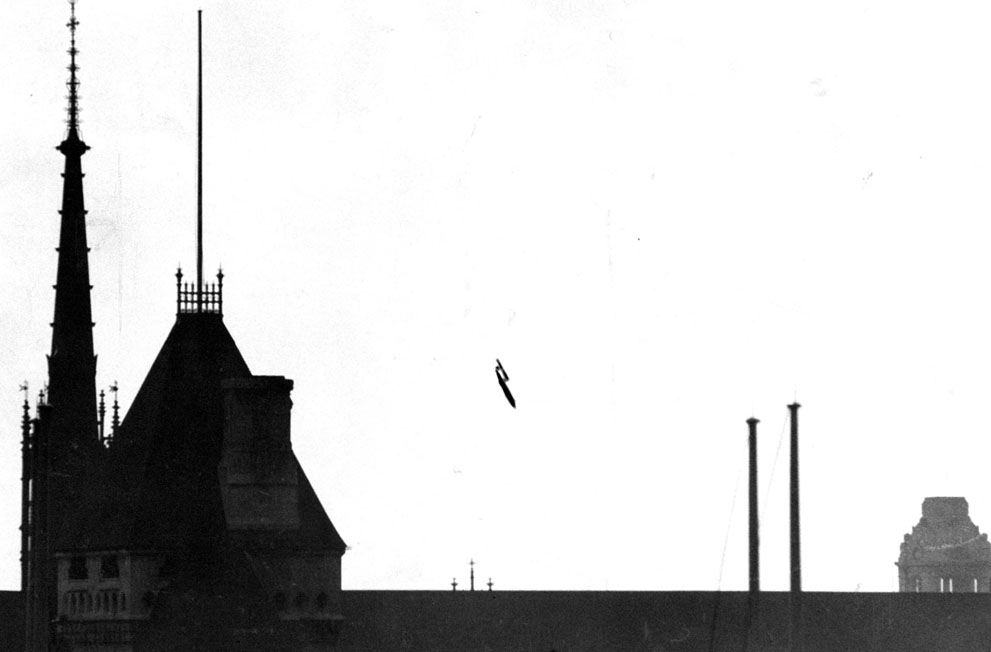
By no means was this a theoretical concern of hers. For in much of the preceding months the Germans had been hammering London with their V-1 “Buzz Bombs”. As this historic photograph shows.
A V-1, “buzz bomb”, plunging toward central London, 1945.
This bomb landed on a side road off Drury Lane blasted several buildings, including the office of the Daily Herald. Known as the Flying bomb, Buzz bomb or Doodlebug, V-1 was the first modern guided missile used in wartime and the forerunner of today’s cruise missile. The V-1 (and later V-2 ) added a new terror to an already terrible war – robot missiles. Once launched, these weapons flew without human intervention to strike distant targets.
Circumstances meant that my mother was living in North-West London when I was born and that’s where I was brought up for the first two years of my life. Still remember the address: 17 Burnside Crescent, Alperton, North-West London.
Burnside Crescent was close to factories that were being targeted by the Germans. That meant that at night my mother and I slept in what was called a Morrison shelter.
An indoor Morrison shelter.
As if to underscore the hazards of early-1945 London, the photograph below is of a young boy, Toni Frisell, the sole family survivor from a V-1 bombing in 1945.
Toni Frissell – wonder where he is now?
So here I am still a living being and still loving my life.
How to close?
By coming all the way forward to modern times and the incredible technology that enables so much. Not just the world of blogging but such things as NASA’s Scientific Visualization Studio from where this compelling video was taken.
I wrote about my first six months that were not remembered one jot!
This quote, therefore, seems an apt statement for the end of today’s post.
Yesterday, on my blog post about the dog’s ancestor, the wolf, a kind reader commented, “So beautiful and such interesting information! Thanks so much for sharing your research! 🙂 ”
Mark Derr
That was very motivational for me because Part Two of my book, being driven along by NaNoWriMo!, is much tougher and requires significant research. Research to a much greater extent than I have been used to. Thus it was that my research wanderings brought me to the magazine The Bark and thence to an article written by Mark Derr back in 2006. I had previously heard of neither.
It was such a fantastic article, of such relevance to what I was writing about, that I took a deep breath and emailed Mark asking if I might have his permission to republish; both in the book and here on Learning from Dogs. Promptly, Mark replied in the affirmative. 🙂
I’m still deliberating how it will be included in the book but have no hesitation in publishing it here for your enjoyment.
That the dog is descended from the wolf—or more precisely, the wolf who stayed—is by now an accepted fact of evolution and history. But that fact is about all that is agreed to among the people who attempt to answer fundamental questions about the origins of the dog—specifically, the who, where, when, how and why of domestication.
Dates range from the dog’s earliest appearance in the archaeological record around 14,000 years ago to the earliest estimated time for its genetic sidestep from wolves around 135,000 years ago. Did the dog emerge in Central Europe, as the archaeological record suggests, or in East Asia, where the genetic evidence points? Were they tame wolves whose offspring over time became homebodies, or scavenging wolves whose love of human waste made them increasingly tame and submissive enough to insinuate themselves into human hearts? Or did humans learn to follow, herd and hunt big game from wolves and in so doing, enter into a complex dance of co-evolution?
Despite the adamancy of adherents to specific positions, the data are too incomplete, too subject to wildly different interpretations; some of the theories themselves too vague; and the physical evidence too sparse to say with certainty what happened. Nonetheless, some models—and not necessarily the most popular and current ones—more clearly fit what is known about dogs and wolves and humans than others. It is a field in high flux, due in no small measure to the full sequencing of the dog genome. But were I a bettor, I would wager that the winning view, the more-or-less historically correct one, shows that the dog is the result of the interaction of wolves and ancient humans rather than a self-invention by wolves or a “conquest” by humans.
Our views of the dog are integrally bound to the answers to these questions, and, for better or worse, those views help shape the way we approach our own and other dogs. It is difficult, for example, to treat as a valued companion a “social parasite” or, literally, a “shit-eater.” To argue that different breeds or types of dogs represent arrested stages of wolf development both physically and behaviorally is not only to confuse, biologically, description with prescription but also to overlook the dog’s unique behavioral adaptations to life with humans. Thus, according to some studies, the dog has developed barking, a little-used wolf talent, into a fairly sophisticated form of communication, but a person who finds barking the noise of a neotenic wolf is unlikely to hear what is being conveyed. “The dog is everywhere what society makes him,” Charles Dudley Warner wrote in Harper’s New Monthly Magazine in 1896. His words still hold true.
Since the dog is both a cultural and a biological creation, it is worth noting here that these opposing views of the dog’s origin echo the old theory that the sniveling, slinking pariah dogs and their like—“southern breeds”—derived from jackals, while “northern breeds”—Spitz-like dogs and Huskies—descended directly from the wolf. Darwin thought as much, so did the pioneering ethologist Konrad Lorenz until late in his life, when he accepted that the wolf was the sole progenitor of the dog. In the theories of Raymond Coppinger and others—and I think this transference is unconscious—the scavenging jackal becomes a camp-following, offal-eating, self-domesticating weenie of a tame wolf. In turn, those wolves become the ur-dog, still manifest in the pariahs of India and Asia, from which the dog we know is said to have emerged. It’s a tidy, convenient, unprovable story that has an element of truth—dogs are accomplished scavengers—but beyond that, it is the jackal theory with a tattered new coat. In dropping humans from the process, the scavenging, self-domesticating wolf theory ignores the archaeological record and other crucial facts that undercut it.
Fossils found at Zhoukoudian, China, have suggested to archaeologists such as Stanley Olsen, author of Origins of the Domestic Dog, that wolves and Homo erectus were at least working the same terrain as early as 500,000 years ago. The remains of wolves and Homo erectus dating to around 300,000 years ago have also been found in association with each other at Boxgrove in Kent, England, and from 150,000 years ago at Lauzerte in the south of France. It seems more likely that this omnivorous biped, with its tools and weapons, lived and hunted in proximity to that consummate social hunter, the wolf, through much of Eurasia, than that their bones simply fell into select caves together. Who scavenged from whom, we cannot say.
Wolves were far more numerous then than now, and they adapted to a wide range of habitats and prey. On the Eurasian steppes, wolves learned to follow herds of ungulates—in effect, to herd them. Meriwether Lewis observed the same behavior during his journey across North America in the opening years of the 19th century; he referred to wolves that watched over herds of bison on the Plains as the bisons’ “shepherds.” Of course, those “shepherds” liked it when human hunters attacked a herd because they killed many more animals than the wolves, and although the humans carried off the prime cuts, they left plenty behind.
Ethologists Wolfgang M. Schleidt and Michael D. Shalter refer to wolves as the first pastoralists in “Co-evolution of Humans and Canids,” their 2003 paper in the journal Cognition and Evolution. Early humans, they argue, learned to hunt and herd big game from those wolves; thus, the dog emerged from mutual cooperation between wolves and early humans, possibly including Neanderthal. There is no evidence yet of Neanderthal having tame wolves, much less dogs, but the larger point is that when modern humans arrived on the scene, they found wolves already tending their herds, and they immediately began to learn from them. That was long before humans began, in some parts of the world, to settle into more permanent villages, some 12,000 to 20,000 or 25,000 years ago.
Schleidt and Shalter based their model on wolf behavior and on genetic studies that have consistently shown that dogs and wolves diverged between 40,000 and 135,000 years ago. The first of those studies emerged from the lab of Robert K. Wayne, an evolutionary biologist at the University of California at Los Angeles who had already made headlines by showing definitively that the dog descended from the wolf alone. In a paper appearing in the June 13, 1997, issue of Science, Wayne and his collaborators said that dogs could have originated around 135,000 years ago in as many as four different places. They also argued that genetic exchanges between wolves and dogs continued—as they do to this day, albeit in an age during which dogs have become ubiquitous and wolves imperiled.
Since that paper appeared, the dog genome has been fully sequenced and provides a time frame for domestication of 9,000 generations, which the authors of a paper on the sequencing in the December 8, 2005, issue of Nature pegged at 27,000 years. But except for that, subsequent studies of mitochondrial DNA, which is most commonly used to date species divergence, have pointed to a time frame of 40,000 to 135,000, with 40,000 to 50,000 years ago looking like the consensus date.
Most of this work has been conducted in Wayne’s lab; in the Uppsala University lab of Carles Vilà, his former student and the lead researcher on the 1997 paper; and in the lab of Peter Savolainen of the Royal Institute of Technology, Stockholm, another collaborator on the original paper.
A signal problem with the early date is that it doesn’t appear to match the archaeological record. The dog is not only behaviorally but also morphologically different from the wolf, and such an animal first appears in the fossil record around 14,000 years ago in Bonn-Oberkassel, Germany. Archaeologists nearly universally peg the origin of the dog to that time.
Wayne, Vilà and their supporters have suggested from the start that behavioral change could predate morphological change, which would have occurred when humans began to create permanent settlements, thereby cutting—or at least reducing—their wolf-dogs’ contact with wild wolves. People might also have begun attempting to influence the appearance of their dogs at this point.
But those Germans get in the way again. Bonn-Oberkassel, site of the consensus first fossil dog, is not a permanent settlement.
Trying to square genetic and archaeological dates, Peter Savolainen resurveyed the mitochondrial DNA of dogs and wolves, recalibrated the molecular clock and proposed in a paper in Science, November 22, 2002, that the dog originated in East Asia 15,000 to 40,000 years ago. It was a good try, but now it appears that his “40,000 years ago” date was more accurate. Also, the earliest known dog appears in Germany, not East Asia, a region to which other genetic evidence points as well.
In many ways, the dispute over dates and places is just a precursor for the debate over how that happened. Archaeologists and evolutionary biologists who want the first dogs to look like dogs have tended to argue that the transition is a result of a biological phenomenon called “paedomorphosis.” That basically means that the animal’s physical development is delayed relative to its sexual maturation. It produces dogs with more domed heads; shorter, broader muzzles; and overall reduced size and slighter build than a wolf. Accelerated physical development relative to sexual maturation (hypermorphosis), on the other hand, produces dogs larger than the progenitor wolf.
When maturation is stopped early enough, the resulting animal is said to resemble a “neotenic,” or perpetually juvenilized, wolf. Coppinger and others have carried the argument further to argue that behaviorally, the dog resembles a neotenic wolf, with some breeds being more immature or less developed than others. There is general agreement that, beginning in the late 19th century when the dog began to move into the city as a pet, breeders sought to soften and humanize the appearance of some breeds to make them look like perpetual puppies. But beyond that, it is more correct to view the dog as an entity different from the wolf.
Currently, many researchers like to invoke an experiment in domestication launched in 1959 at the Institute of Cytology and Genetics in Novosibirsk, Siberia, by Dmitry Belyaev and continued after his death by Lyudmila Trut and her colleagues. Belyaev selectively bred foxes for “tameness” alone, defined as their level of friendliness toward people. He ended up with foxes that resembled dogs. A number of them had floppy ears, piebald coats, curly tails and a habit of submissively seeking attention from their human handlers with whines, whimpers and licks. (I wouldn’t want such a dog.)
Anthropologist Brian Hare tested the tame foxes in 2004 and found that they, like dogs, had the capacity to follow a human’s gaze, something wolves and wild foxes, not to mention chimpanzees, won’t do.
A number of researchers have embraced these tame foxes as a template for dog domestication. While they doubtless cast insight on the problem, I doubt that they will answer all questions. Arguments by analogy are suspect science and should be even more so in this case, since the selection criteria for these foxes were also against aggression—hardly the case for dogs—and foxes clearly are not wolves.
That said, the experiment does appear to confirm that selective breeding for behavior alone can also produce morphological changes similar to what the wolf experienced in becoming a dog.
Coppinger has invoked the fox experiment to support his theory that wolves that became dogs self-domesticated. As humans in some areas moved into permanent settlements, their refuse heaps became feeding grounds for wolves who were tame enough—or least-frightened enough—to feed near humans. Subsequent generations became more tame, and people began to allow them to wander their camps, eating feces, hunting rodents. From that group, people took some animals for food. Then, when the animals were thoroughly self-tamed, people began to train them to more wolfish behaviors, like hunting.
What he and others overlook in citing the fox experiment is that those animals were subjected to intense artificial selection by people. They also ignore the fact that the first dog appears in a seasonal camp, not a permanent settlement.
In their book, Dogs, Coppinger and his wife, Lorna, argue that these early protodogs would have resembled the ownerless dogs of Pemba Island, a remote part of the Zanzibar archipelago. As a model, Pemba suffers numerous problems, as does Coppinger’s theory. It is an Islamic island, and Islam has scarce place for dogs, believing them filthy, largely because they scavenge and eat excrement.
Beyond that, Pemba was a wealthy island in the 18th and 19th centuries due to its clove plantations, which were worked by African slaves and overseen by Arabs. The plantations have long since fallen into disrepair, on an island populated by the descendants of free slaves, where poverty is the rule. Attempting to read the past by looking at the present is a well recognized form of historical fallacy. It can’t be done, especially in a place where there is no strong cultural tradition.
Elsewhere in the developing world, free-ranging dogs are often more than scavengers or food. Some are fed; they protect territories or vendors’ carts. A few might be taken in, but, again, these dogs must be studied and understood in their current context and then placed in a broader historical context, if possible.
Moreover, Coppinger ignores the entire tradition of dogs and people in Europe, Japan and Korea—wherever dogs were employed from an apparently early date for a purpose, including companionship and ritual. Archaeologist Darcy F. Morey clearly demonstrated in the February 2006 issue of The Journal of Archaeological Science that people have been burying dogs and treating them with reverence and respect from the beginning, hardly the fate of scavengers.
People will argue, but I think the question of whether the dog is a juvenilized wolf is best answered with this observation: The dog follows human gaze, according to Hare, and is so attentive to people that it can imitate them, according to Vilmos Csányi, and it does so from an early age. No wolf of any age can replicate that basic behavior. It is far better to look at the dog as a differently developed wolf than as a developmentally retarded wolf.
Similarly, until shown otherwise, it seems more accurate to view domestication as a dynamic process involving wolves and people. At a time when the boundaries between human and wild were much more porous than now, people doubtless took in animals, especially young animals of all kinds, especially wolf pups, since in many places, they were hunting the same game and perhaps scavenging from each other.
As those pups matured, they returned to the wild to breed, with the naturally tamest among them denning close to the camp where they had been raised and, yes, could scavenge. Over the past year, researchers have shown that the area of the brain known as the amygdala is quite active when “fear of the other” begins to develop. In 2004, a team of researchers from Uppsala University, including Vilà, reported in the journal Molecular Brain Research on changes they had found in gene expression in the frontal lobe, hypothalamus and amygdala of wolves, coyotes and dogs. More than 40 years ago, J.P. Scott and John L. Fuller showed that the dog pup had a lengthened socialization period before fear of the other set in, compared with the wolf pup.
No one knows how fast the change happened, but in some places, tame wolves—dogs—resulted from this process. They provided territorial defense, helped with hunting (which they do well), scavenged, and were valued for companionship and utility. Some could be trained to carry packs. That early dog probably remained nearly indistinguishable from the wolf except in places where their gene pool became limited by virtue of some isolating event. The smaller gene pool forced inbreeding that, along with changing environmental conditions, somehow “destabilized” the genome.
Vilà and two colleagues suggested in an article published online on June 29, 2006, in Genome Research, that domestication relaxed “selective constraint” on the dog’s mitochondrial genome, and if that relaxation extended to the whole genome, as it appeared to, “it could have facilitated the generation of novel functional genetic diversity.”
European and North American breeders have taken full advantage of that or some other mechanism to create the most morphologically diverse mammal around. But other cultures did not follow that path.
There are other theories afloat in what is an exciting time for people who study dogs. But the one that succeeds will reflect the dynamic relationship between human and dog.
This article first appeared in The Bark, Issue 38: Sep/Oct 2006
Mark Derr is the author of A Dog’s History of America, Dog’s Best Friend, The Frontiersman: The Real Life and Many Legends of Davy Crockett, Some Kind of Paradise, and numerous articles on science, environment and transportation.
ooOOoo
Thank you, Mark.
Time and time again, I marvel at how this modern, wired world creates such beautiful connections.
It is said that the first casualty in war is truth!
In yesterday’s post Vested interests, perhaps, I featured an article brought to my attention by dear friend, Dan Gomez. Namely an article featured in the UK’s Daily Mail newspaper that was headlined: ‘There is NO climate crisis’: Man-made global warming is a lie and not backed up by science, claims leading meteorologist.
Dan’s strong belief is that labelling the natural change in the world’s climate as anthropogenic global warming (AGW) serves governments and many large institutions incredibly well because it offers greater leverage to raise taxes. In other words, Dan has no doubt that the climate is changing, but as a result of natural forces that go back long before the days of man. In other words, it is being ‘sold’ as the direct result of man’s activities because it makes it easier to apply taxes and levies for purposes not related to climate matters.
As John Coleman was reported as saying:
John Coleman, who co-founded the Weather Channel, claims that the belief humans are causing climate change is not backed up by science.
In an open letter attacking the UN, the 80-year-old from San Diego, said that what ‘little evidence’ there is for global warming points to natural cycles in temperature.
‘There is no climate crisis,’ he wrote. ‘The ocean is not rising significantly. The polar ice is increasing, not melting away. Polar bears are increasing in number. ‘Heat waves have actually diminished, not increased. There is not an uptick in the number or strength of storms.
‘I have studied this topic seriously for years. It has become a political and environment agenda item, but the science is not valid.’
Now I am as sceptical about the workings of governments as the next man. But I find it incredibly difficult to believe that AGW is a myth, hoax or conspiracy. There is a wall of science to say that we, as in man, are dangerously close to going over the edge, going beyond ‘tipping points’ from which there is no returning.
A quick dip into Wikipedia tells us [my emphasis]:
Scientific understanding of the cause of global warming has been increasing. In its fourth assessment (AR4 2007) of the relevant scientific literature, the Intergovernmental Panel on Climate Change (IPCC) reported that scientists were more than 90% certain that most of global warming was being caused by increasing concentrations of greenhouse gases produced by human activities. In 2010 that finding was recognized by the national science academies of all major industrialized nations.
Affirming these findings in 2013, the IPCC stated that the largest driver of global warming is carbon dioxide (CO2) emissions from fossil fuel combustion, cement production, and land use changes such as deforestation.
Only last Wednesday there was an item on Naked Capitalism that opened [again, my emphasis]:
J.D. Alt: Have We Passed the Tipping Point of Biological Collapse?
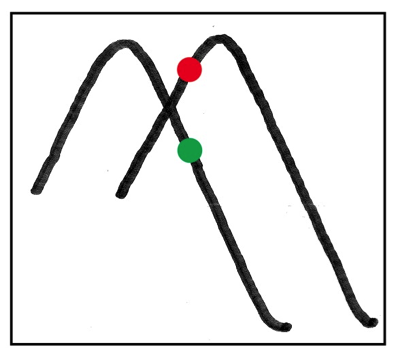
The squiggle illustrated here may look like the Ebola virus, but it isn’t. The resemblance is just an eerie coincidence. It’s actually a graphical snapshot of the classic “Predator-Prey Model.” This mathematical exercise, first developed in the 1920s, serves as the introductory basis for a more recent NASA funded effort which produced—amidst a brief flurry of news and commentary last spring—the startling conclusion that a complete collapse of modern civilization may now be “irreversible.”
The NASA study involved the creation and running of a more elaborate model—HANDY (Human and Nature Dynamics)—which simulates the human consumption of naturally replenishing systems, as well as (intriguingly, given today’s news cycle) wealth and income inequality between two classes of citizens: “Elites” and “Commoners.” Now a new study, just released by the World Wildlife Fund, reports a grim statistic suggesting the abstract mathematics of the HANDY Model may be more than just a theoretical exercise. According to the WWF, in the last forty years—from 1970 to 2010—the Earth has lost over HALF (52%) of its wildlife population.
There are yards and yards of solid information all over the internet about our changing climate. The loss of wildlife, the destruction of forests and wild lands is beyond argument, and those aspects of this ‘modern’ world are most certainly the direct result of man’s activities! Our inability to stop growing as a global population is insane. Our inability to stop seeing continual economic and material growth as a ‘good thing’ is insane. We need massive change – now!
Therein lays the problem. Because, whether or not there is an approaching climate catastrophe as a result of man’s activities is, in a very real sense, irrelevant. If that seems a bizarre thing to write, I mean it is irrelevant in terms of what you and I, ordinary people trying to lead civilised lives, can do to make a difference.
Patrice Ayme recently published a post under the title of Total Plutocracy covering the death of Christophe de Margerie when his jet hit a snow plough on a Moscow runway at midnight, flipped on its back, caught fire, and skidded across. All four on board died.
Now the accidental death of any person is a tragedy, make no mistake, but as Patrice revealed in his post, this particular accident did raise some interesting aspects. Here’s a little of what Patrice wrote:
With 200 billion Euros in revenue, TOTAL SA is not far behind the French government budget. TOTAL’s profits are 14 billion Euros (“Soyons serieux!” laughed Margerie). It pays nearly no tax in France, having concentrated there its money losing refineries.
Other countries get nearly all their fuel from French refineries; TOTAL has also a green light to frack in Britain. So this is not just a French situation. TOTAL is one of the five great oil companies concentrating the fossil fuel firepower. Those companies have the best technology. Some of TOTAL’s specialties are very deep water drilling, and using steam to extract tar oil in Canada.
What was de Margerie doing at midnight? Flying back to France, after meeting with Putin and Medvedev, late at night.
That’s how these guys are: great fun. Putin was recently invited to Milan for a big time European meeting. He arrived several hours late to visit with Merkel, who was not amused. After keeping her up past midnight, he motored to Berlusconi’s mansion, and the two plutocrats reveled together until 4 am. (We don’t know how many female teenagers were in attendance to further their studies.)
The next European meeting was at 8am, and Putin showed up.
Supposedly Margerie had just told Medvedev and Putin to cool it with Ukraine. At least that’s the massaging message Margerie’s minions floated after his death.
Why was Margerie so important to the Russian dictators? Because the six “supermajor” oil companies have the advanced technology. After all, they recruit from the best universities in the world (that’s paid by taxpayers). TOTAL SA was the spearhead of high tech development for hydrocarbon production in Russia. Among other things, it’s helping to build a gas liquefaction plant in the far north, to load special ships with methane (something TOTAL does with Qatar, in the world’s largest such installation).
Once a ship is fully loaded, it has several times the explosive power deployed at Hiroshima (such a catastrophic accident has not happened yet, but it’s just a matter of time).
When citizen Lambda dies, Mr. Anybody, nobody official cares. When a major plutocrat dies, our leaders, even our socialist leaders, weep, and present the accident as a national, even international tragedy.
Is the death of a plutocrat worth that much more, that all this public weeping has to occur?
And, by the way, who and what has authorized Mr. Margerie to lead his own foreign policy? Who authorized him to make nice with thermonuclear dictators? To the point of allowing their survival?
I recommend that you read it in full for it says so much about what is wrong with these present times: so much inequality and so many abuses of power.
Just the other day the Guardian newspaper published an article under the title of: Richest 1% of people own nearly half of global wealth, says report.
The richest 1% of the world’s population are getting wealthier, owning more than 48% of global wealth, according to a report published on Tuesday which warned growing inequality could be a trigger for recession.
According to the Credit Suisse global wealth report (pdf), a person needs just $3,650 – including the value of equity in their home – to be among the wealthiest half of world citizens. However, more than $77,000 is required to be a member of the top 10% of global wealth holders, and $798,000 to belong to the top 1%.
“Taken together, the bottom half of the global population own less than 1% of total wealth. In sharp contrast, the richest decile hold 87% of the world’s wealth, and the top percentile alone account for 48.2% of global assets,” said the annual report, now in its fifth year.
On October 8th, George Monbiot published an essay in The Guardian newspaper under the title of The Toll-Booth Economy. The opening lines set the theme.
Corporate power is the real enemy within, but none of the major parties will confront it.
The more power you possess, the more insecure you feel. The paranoia of power drives people towards absolutism. But far from curing them of the conviction that they are threatened and beleaguered, it becomes only stronger.
On Friday, the Chancellor of the Exchequer, George Osborne, claimed that business is under political attack on a scale it has not faced since the fall of the Berlin wall. He was speaking at the Institute of Directors, where he was introduced with the claim that “we are in a generational struggle to defend the principles of the free market against people who want to undermine it or strip it away.” A few days before, while introducing Osborne at the Conservative party conference, Digby Jones, formerly the head of the Confederation of British Industry, warned that companies are at risk of being killed by “regulation from Big Government” and of drowning “in the mire of anti-business mood music encouraged by vote-seekers.” Where is that government and who are these vote-seekers? They are a figment of his imagination.
Indeed, I will. Go on with just one more reference. From the Smithsonian. An article that started, as follows:
Five Conflicts and Collapses That May Have Been Spurred by Climate Change
Earth’s changing climate has been a spectre in centuries of civil conflict and, at times, the collapse of whole civilizations
By Natasha Geiling
smithsonian.com
October 20, 2014
Is climate change a matter of national security? In a warming world, sea-level rise, drought and soil degradation are putting basic human needs such as food and shelter at risk. In March, the U.S. Department of Defense called climate change a “threat multiplier,” saying that competition for resources “will aggravate stressors abroad such as poverty, environmental degradation, political instability and social tensions—conditions that can enable terrorist activity and other forms of violence.”
Connecting climate change to a global increase in violence is tricky, and attempts to make such a link receive a fair amount of criticism. A hotter planet doesn’t automatically become a more conflict-ridden one. The 2000s, for instance, saw some of the highest global temperatures in recorded history—and some of the lowest rates of civil conflict since the 1970s.
But there are historical examples of civilizations that did not fare well when faced with drastic environmental change, and those examples may offer a window into the future—and even help prevent catastrophe. “We can never know with 100-percent certainty that the climate was the decisive factor [in a conflict],” says Solomon Hsiang, assistant professor of public policy at the University of California, Berkeley. “But there’s a lot of cases where things look pretty conspicuous.”
Earlier on I ventured the idea that whether or not an approaching climate catastrophe was a result of man’s activities was, in a very real sense, irrelevant. Because of the lack of individual power to make a real difference, especially a political difference.
What is relevant is improving the way we govern ourselves. The abuses of money and power are too widespread to be ignored. We need to start with strong local democracies and thence building a system of global governance that really is of the people by the people for the people.
I’m being very brave and stepping into the climate change cauldron!
Learning from Dogs has been posting a wide range of items for well over five years. Indeed, today’s post is number 2,238!
Over those five years, my position regarding climate change or global warming has been pretty clear: a belief in the proposition that man’s behaviours are changing the very climate of our planet. For instance, a little over a year ago I posted under the title Sceptical about global warming? It opened:
Learning from Dogs is not a blogsite about climate change!
Why, you may ask, do I start today’s post with that sub-heading? Because, I am conscious that many of my posts do touch on this subject. For example, just two days ago there was Breaking news. Then there was the piece about the climate implications for Phoenix, Arizona. Followed the next day by the changes in the flow of the jet stream across the North Atlantic with all the weather implications for North-West Europe.
Indeed, as the heading to today’s post makes clear, this is also about the changes going on to our planet.
Learning from Dogs is about a different way of living and behaving. A campaign, if one wants to call it that, to show that the way that modern man is living is corrupt. Not with a big ‘C’ but still in the sense of living a dishonest life. Learning from Dogs attempts to show that our wonderful dogs, a source of so much love and pleasure for so many millions, offer us an example of a life in and of this planet.
If there was ever a time in the history of man when we needed being reminded of our frailty and vulnerability, it is now. As the following so starkly illustrates.
A new study of ocean warming has just been published in Geophysical Research Letters by Balmaseda, Trenberth, and Källén (2013). There are several important conclusions which can be drawn from this paper.
Completely contrary to the popular contrarian myth, global warming has accelerated, with more overall global warming in the past 15 years than the prior 15 years. This is because about 90% of overall global warming goes into heating the oceans, and the oceans have been warming dramatically.
Then last week-end, Dan Gomez, friend for over 40 years, sent me the following:
Weather Channel Founder: Global Warming Science ‘Not Valid’
Meteorologist John Coleman, who co-founded The Weather Channel, says the claim that human activity is leading to global warming is no longer scientifically credible.
Instead, the “little evidence” there is for rising global temperatures points to a “natural phenomenon,” Coleman asserts.
In an open letter to the United Nations’ Intergovernmental Panel on Climate Change (IPCC), he wrote: “There is no climate crisis. The ocean is not rising significantly. The polar ice is increasing, not melting away. Polar bears are increasing in number.
“Heat waves have actually diminished, not increased. There is not an uptick in the number or strength of storms.
“I have studied this topic seriously for years. It has become a political and environmental agenda item, but the science is not valid.”
Coleman says he based his views on the findings of the Nongovernmental International Panel on Climate Change (not to be confused with the U.N. panel), a body of scientists and scholars who assess the science of global warming.
“There is no significant man-made global warming at this time. There has been none in the past and there is no reason to fear any in the future,” says Coleman, who was the original meteorologist on “Good Morning America.”
“Efforts to prove the theory that carbon dioxide is a significant greenhouse gas and pollutant causing significant warming or weather effects have failed.
“There has been no warming over 18 years.”
The U.N.’s IPCC argues that their research shows man-made global warming will lead to extreme weather events becoming more frequent and unpredictable, the Express in Britain reported.
Climate expert William Happer, a professor at Princeton University, expressed support for Coleman’s claims.
“No chemical compound in the atmosphere has a worse reputation than CO2, thanks to the single-minded demonization of this natural and essential atmospheric gas by advocates of government control [of] energy production,” Happer said.
“The incredible list of supposed horrors that increasing carbon dioxide will bring the world is pure belief disguised as science.”
What Dan had seen was an article in the UK Daily Mail that, in turn, was echoed on the US WesternJournalism blogsite. Here’s how that Daily Mail story opens:
Climate change has been proven to be a lie, according to a leading meteorologist.
John Coleman, who co-founded the Weather Channel, claims that the belief humans are causing climate change is not backed up by science.
In an open letter attacking the UN, the 80-year-old from San Diego, said that what ‘little evidence’ there is for global warming points to natural cycles in temperature.
‘There is no climate crisis,’ he wrote. ‘The ocean is not rising significantly. The polar ice is increasing, not melting away. Polar bears are increasing in number. ‘Heat waves have actually diminished, not increased. There is not an uptick in the number or strength of storms.
‘I have studied this topic seriously for years. It has become a political and environment agenda item, but the science is not valid.’
John Coleman, the original meteorologist for ABC’s Good Morning America and the founder of The Weather Channel, which launched in 1982, wrote an open letter to the UCLA’s Hammer Forum urging them “to re-examine their plan” for their forum, scheduled for this past Thursday, after they announced their experts, both of whom believe in climate change science.
Coleman has made his position against climate change science clear in the past.
“There is no significant man-made global warming at this time, there has been none in the past and there is no reason to fear any in the future. Efforts to prove the theory that carbon dioxide is a significant ‘greenhouse’ gas and pollutant causing significant warming or weather effects have failed. There has been no warming over 18 years.”
The Weather Channel founder cites professors from Princeton University, Massachusetts Institute of Technology (MIT), Harvard Smithsonian Observatory, and the University of Alabama, along with “9,000 Ph.D scientists” who agree with him.
“Yet at your October 23 Hammer Forum on Climate Change you have scheduled as your only speakers two people who continue to present failed science as though it is the final and complete story on global warming/climate change. This is a major mistake.”
Coleman urged the UCLA group to reconsider, noting he is not a “flat Earther,” or a “paid shill of the Koch Brothers.”
In a discussion yesterday with Dan, he was of the clear mind that, yes, the climate is changing, as it always has over eons of time, but that the degree of change that is directly attributed to man’s affairs is minute. Then all around me I see sign after sign, read article after article, that we, as in mankind, are relentlessly ‘fouling our own nest’ and the time left for us to learn how to live sustainably on this planet is fast running out.
Can we get to the truth? The topic will be continued tomorrow!
Yesterday, the central theme of my post was the essay from Tom Engelhardt where he interviews Laura Poitras on the back of the recent release of her film Citizenfour. You will recall that I closed the post as follows:
On first reading the TomGram I found myself nodding vigorously, metaphorically speaking, with the whole thrust of the essay.
Then what appeared to be small uncertainties started appearing in my mind.
Those will be the subject of tomorrow’s post.
To set the background to what follows, you need to know a little about my own military experiences; which is not saying very much!
I was born in London six months to the day before WWII ended; at least the European side of things. When I got to the age of being vulnerable to a call-up if circumstances so dictated, I thought I would influence things by volunteering to join the United Kingdom’s Royal Naval Reserve or the RNR. The world in the early 60’s especially in Europe was far from stable. Thus, I signed up with London Division, RNR that was headquartered on HMS President, moored on the River Thames in the centre of London.
HMS President.
I served as a Radio Operator in the RNR from 1963 to 1968. Inevitably, as a radio operator I was security cleared and, in time, as I was promoted up the ranks, allowed to handle traffic up to but not including “Top Secret: Captain’s Eyes Only”.
In 1968 I decided to emigrate to Australia and resigned from the RNR. The parting advice was that the knowledge I had acquired prevented me, for my own safety, from entering any country hostile to NATO for a period of a further 5 years. Including the Soviet Union; naturally.
At the end of 1970, living and working in Sydney, I was planning to attend Expo70 in Japan and then travel on to Helsinki, Finland. One look at the atlas made it clear that a wonderful way of travelling westwards was via the Russian Trans-Siberian express.
So off I trotted to the British Embassy in Sydney to seek advice about entering Russia in this fashion. One of the military guys, on hearing about my concerns, laughed his head off and said, “The Russians will know more about you than we do!” Then, becoming more serious, he added: “My friend, if you ever find yourself in a difficult corner anywhere in a country hostile to the West, just find a way of transmitting your RNR Service Number to us and we’ll take care of things”. To this day, well over 40 years later, I still remember my service number.
Returning to the subject of the American security ‘apparatus’, Laura Poitras answered a question from Tom Engelhardt that seems very pertinent.
TE: To ask the same question another way, what would the world be like without Edward Snowden? After all, it seems to me that, in some sense, we are now in the Snowden era.
LP: I agree that Snowden has presented us with choices on how we want to move forward into the future. We’re at a crossroads and we still don’t quite know which path we’re going to take. Without Snowden, just about everyone would still be in the dark about the amount of information the government is collecting. I think that Snowden has changed consciousness about the dangers of surveillance. We see lawyers who take their phones out of meetings now. People are starting to understand that the devices we carry with us reveal our location, who we’re talking to, and all kinds of other information. So you have a genuine shift of consciousness post the Snowden revelations.
What struck me was the point about a changed consciousness. That is healthy. Without doubt.
The technology available to the governments of countries with regard to the gathering of all sorts of data represents a place where we haven’t been before. Inevitably, learning how best to govern that data, with both a small ‘g’ and a large ‘G’, is going to be a traveled road where some wrong turnings are made from time to time.
If the Edward Snowden affair has accelerated that learning process, then that seems nothing but good.
If all I knew about Edward Snowden were his portrait in Laura Poitras’ documentary, Citizenfour, I’d probably regard him as a conscientious, brave young man, maybe an American hero. But Poitras, a very talented filmmaker who flipped from journalist to collaborator in this story long ago, has chosen to leave a lot out.
Snowden’s claim as a whistleblower, exposing the National Security Agency’s violations of civil liberties, rests on some of the documents that he leaked, which reveal that the NSA’s domestic surveillance was far more extensive than anyone had imagined—and, in a few instances, conducted in defiance of orders from the Foreign Intelligence Surveillance Court.
However, many other documents—which he downloaded at the NSA facility in Hawaii and turned over to Poitras and the Guardian’s Glenn Greenwald in Hong Kong—go far beyond exposures of spying on Americans.
Judging from Snowden-derived stories in the Guardian and the Washington Post, some of these documents also detail NSA intercepts of email and cellphone conversations by Taliban fighters in Pakistan; assessments of CIA assets in several foreign countries; and surveillance of cellphone calls “worldwide” that (in the Post’s words) allows the NSA “to look for unknown associates of known intelligence targets by tracking people whose movements intersect.” In Snowden’s first interview abroad, with the South China Morning Post, he disclosed that the NSA routinely hacks into hundreds of computers in Hong Kong and China. Just last week a story co-authored by Poitras in Greenwald’s new publication, the Intercept, revealed—again, based on Snowden-supplied documents—that the NSA has undercover operatives in Germany and China.
Whatever you think about foreign intelligence operations, the NSA’s core mission is to intercept communications of foreign governments and agents. If Snowden and company wanted to take down an intelligence agency, they should say so. But that has nothing to do with whistleblowing or constitutional rights.
The National Security Agency/Central Security Service (NSA/CSS) leads the U.S. Government in cryptology that encompasses both Signals Intelligence (SIGINT) and Information Assurance (IA) products and services, and enables Computer Network Operations (CNO) in order to gain a decision advantage for the Nation and our allies under all circumstances.
The Information Assurance mission confronts the formidable challenge of preventing foreign adversaries from gaining access to sensitive or classified national security information. The Signals Intelligence mission collects, processes, and disseminates intelligence information from foreign signals for intelligence and counterintelligence purposes and to support military operations. This Agency also enables Network Warfare operations to defeat terrorists and their organizations at home and abroad, consistent with U.S. laws and the protection of privacy and civil liberties.
I read, “to gain a decision advantage for the Nation and our allies under all circumstances” as meaning maintaining a positive security for the Nation. My home nation as it happens.
While the scale may be beyond comparison, the principle of maintaining a secure nation or home strikes me as no different as locking the doors of our house when we go off somewhere. And that’s even with nine dogs in the house!
Given that what any ex-head of GCHQ might say, the recent words from Sir Iain Lobban, as reported by the BBC, were not extreme; far from it.
Sir Iain Lobban.
A dimly lit bunker beneath Whitehall – perhaps a suitable venue for a man to say farewell to a 31-year career in what had been one of the most secret parts of the British state.
Sir Iain Lobban was joined by an assortment of spies and securocrats including former heads of GCHQ and the current chief of MI6. It was a venue not chosen by chance.
As he leaves his position as director of GCHQ, Sir Iain used his speech to try to connect the work of today’s GCHQ with its predecessor at Bletchley Park which supplied vital information to Sir Winston Churchill who, from the same bunker, directed Britain’s wartime efforts.
Then, the mission was intercepting and breaking the Enigma code used by the German military to communicate. Dealing with today’s threats, Sir Iain argued, involved going online.
“Those who would do us harm don’t want to be found. They choose certain routers or applications to hide in the darkest places of the internet. We have to enter that labyrinth to find them. We work to crack their defences,” he told the audience.
Sir Iain took aim at those who saw spy agencies polluting a free internet. “We all now know that the beautiful dream of the internet as a totally ungoverned space was just that – a beautiful dream.
“Like all utopian visions, it was flawed because it failed to account for the persistence of the worst aspects of human nature.
“Alongside the blessings – the comprehensive information, the communities of interest, the commercial opportunities and efficiencies – there are the plotters, the proliferators and the paedophiles.”
Being reported later on as saying:
“The people who work at GCHQ would sooner walk out the door than be involved in anything remotely resembling ‘mass surveillance’.” he asserted.
“Secret does not have to equal sinister,” he went on to say, blaming the idea partly on the portrayal of intelligence in popular culture.
Poitras hopes the documentary will allow audiences to reach their own conclusions about Snowden, who is wanted in the United States on charges brought under the Espionage Act and is viewed as either a traitor or a hero.
Only time will tell if the USA is overdoing the ‘mass’ aspect of surveillance, or if it’s right for this age in the affairs of man.
That nothing can be constructed perfectly the first time around is a truism for life at all scales. Thank goodness I’m living in a country where I feel able to offer these thoughts.
Maybe an open debate is the most important aspect of this important topic – the one about national security.
I am frequently a republisher of essays that are presented over on TomDispatch, as regulars of this place know well. As the TD ‘About’ page explains, in part and my emphasis,:
In December 2002, it gained its name, became a project of The Nation Institute, and went online as “a regular antidote to the mainstream media.“
No bad thing as the ‘media’ is a vast machine and it’s long been difficult, nay impossible, to separate fact from fiction. Perhaps, better expressed as impossible to separate fact from agenda!
TD’s ‘About’ page goes on to add, and again my emphasis:
Tomdispatch is intended to introduce readers to voices and perspectives from elsewhere (even when the elsewhere is here). Its mission is to connect some of the global dots regularly left unconnected by the mainstream media and to offer a clearer sense of how this imperial globe of ours actually works.
Stay with that last thought, the one about having a clearer sense of how this imperial globe works, and I am assuming Tom Engelhardt has in mind the USA when he uses the word “imperial”, for both today and tomorrow. Why? Because in this particular instance I’m not sure that I have ended up with a clearer sense about how the security apparatus works across the USA and much of the rest of the ‘Western world’. I want to explore this very important topic over two days.
Back to TomDispatch.
On the 19th October, Tom published a joint essay, or TomGram as he calls it, with Laura Poitras about her film Citizenfour. This film is about Edward Snowden. The TomGram was called: Laura Poitras and Tom Engelhardt, The Snowden Reboot.
Here is the trailer to the film.
Next to the TomGram. But first a note about hyperlinks. There are many links in the TomGram, many of which offer great insight into the background to the essay. However, there are too many to carry across to my republication so, please, do go across to TomDispatch if you wish to pursue a link or two.
Finally, a thank you to both Tom and Laura for giving me permission to republish.
ooOOoo
Tomgram: Laura Poitras and Tom Engelhardt, The Snowden Reboot
[Note for TomDispatch Readers: Call me moved. I recently went to the premiere of Citizenfour, Laura Poitras’s engrossing new film on Edward Snowden, at the New York Film Festival. The breaking news at film’s end: as speculation had it this summer, there is indeed at least one new, post-Snowden whistleblower who has come forward from somewhere inside the U.S. intelligence world with information about a watchlist (that includes Poitras) with “more than 1.2 million names” on it and on the American drone assassination program.
Here’s what moved me, however. My new book, Shadow Government: Surveillance, Secret Wars, and a Global Security State in a Single-Superpower World, ends with a “Letter to an Unknown Whistleblower,” whose first lines are: “I don’t know who you are or what you do or how old you may be. I just know that you exist somewhere in our future as surely as does tomorrow or next year… And how exactly do I know this? Because despite our striking inability to predict the future, it’s a no-brainer that the national security state is already building you into its labyrinthine systems.” And now, of course, such a whistleblower is officially here and no matter how fiercely the government may set out after whistleblowers, there will be more. It’s unstoppable, in part thanks to figures like Poitras, who is the subject of today’s TomDispatch interview. Tom]
Edward Snowden and the Golden Age of Spying
A TomDispatch Interview With Laura Poitras
Here’s a Ripley’s Believe It or Not! stat from our new age of national security. How many Americans have security clearances? The answer: 5.1 million, a figure that reflects the explosive growth of the national security state in the post-9/11 era. Imagine the kind of system needed just to vet that many people for access to our secret world (to the tune of billions of dollars). We’re talking here about the total population of Norway and significantly more people than you can find in Costa Rica, Ireland, or New Zealand. And yet it’s only about 1.6% of the American population, while on ever more matters, the unvetted 98.4% of us are meant to be left in the dark.
For our own safety, of course. That goes without saying.
All of this offers a new definition of democracy in which we, the people, are to know only what the national security state cares to tell us. Under this system, ignorance is the necessary, legally enforced prerequisite for feeling protected. In this sense, it is telling that the only crime for which those inside the national security state can be held accountable in post-9/11 Washington is not potential perjury before Congress, or the destruction of evidence of a crime, or torture, or kidnapping, or assassination, or the deaths of prisoners in an extralegal prison system, but whistleblowing; that is, telling the American people something about what their government is actually doing. And that crime, and only that crime, has been prosecuted to the full extent of the law (and beyond) with a vigor unmatched in American history. To offer a single example, the only American to go to jail for the CIA’s Bush-era torture program was John Kiriakou, a CIA whistleblower who revealed the name of an agent involved in the program to a reporter.
In these years, as power drained from Congress, an increasingly imperial White House has launched various wars (redefined by its lawyers as anything but), as well as a global assassination campaign in which the White House has its own “kill list” and the president himself decides on global hits. Then, without regard for national sovereignty or the fact that someone is an American citizen (and upon the secret invocation of legal mumbo-jumbo), the drones are sent off to do the necessary killing.
And yet that doesn’t mean that we, the people, know nothing. Against increasing odds, there has been some fine reporting in the mainstream media by the likes of James Risen and Barton Gellman on the security state’s post-legal activities and above all, despite the Obama administration’s regular use of the World War I era Espionage Act, whistleblowers have stepped forward from within the government to offer us sometimes staggering amounts of information about the system that has been set up in our name but without our knowledge.
Among them, one young man, whose name is now known worldwide, stands out. In June of last year, thanks to journalist Glenn Greenwald and filmmaker Laura Poitras, Edward Snowden, a contractor for the NSA and previously the CIA, stepped into our lives from a hotel room in Hong Kong. With a treasure trove of documents that are still being released, he changed the way just about all of us view our world. He has been charged under the Espionage Act. If indeed he was a “spy,” then the spying he did was for us, for the American people and for the world. What he revealed to a stunned planet was a global surveillance state whose reach and ambitions were unique, a system based on a single premise: that privacy was no more and that no one was, in theory (and to a remarkable extent in practice), unsurveillable.
Its builders imagined only one exemption: themselves. This was undoubtedly at least part of the reason why, when Snowden let us peek in on them, they reacted with such over-the-top venom. Whatever they felt at a policy level, it’s clear that they also felt violated, something that, as far as we can tell, left them with no empathy whatsoever for the rest of us. One thing that Snowden proved, however, was that the system they built was ready-made for blowback.
Sixteen months after his NSA documents began to be released by the Guardian and the Washington Post, I think it may be possible to speak of the Snowden Era. And now, a remarkable new film, Citizenfour, which had its premiere at the New York Film Festival on October 10th and will open in select theaters nationwide on October 24th, offers us a window into just how it all happened. It is already being mentioned as a possible Oscar winner.
Director Laura Poitras, like reporter Glenn Greenwald, is now known almost as widely as Snowden himself, for helping facilitate his entry into the world. Her new film, the last in a trilogy she’s completed (the previous two being My Country, My Country on the Iraq War and The Oath on Guantanamo), takes you back to June 2013 and locks you in that Hong Kong hotel room with Snowden, Greenwald, Ewen MacAskill of the Guardian, and Poitras herself for eight days that changed the world. It’s a riveting, surprisingly unclaustrophic, and unforgettable experience.
Before that moment, we were quite literally in the dark. After it, we have a better sense, at least, of the nature of the darkness that envelops us. Having seen her film in a packed house at the New York Film Festival, I sat down with Poitras in a tiny conference room at the Loews Regency Hotel in New York City to discuss just how our world has changed and her part in it.
Tom Engelhardt: Could you start by laying out briefly what you think we’ve learned from Edward Snowden about how our world really works?
Laura Poitras: The most striking thing Snowden has revealed is the depth of what the NSA and the Five Eyes countries [Australia, Canada, New Zealand, Great Britain, and the U.S.] are doing, their hunger for all data, for total bulk dragnet surveillance where they try to collect all communications and do it all sorts of different ways. Their ethos is “collect it all.” I worked on a story with Jim Risen of the New York Times about a document — a four-year plan for signals intelligence — in which they describe the era as being “the golden age of signals intelligence.” For them, that’s what the Internet is: the basis for a golden age to spy on everyone.
This focus on bulk, dragnet, suspicionless surveillance of the planet is certainly what’s most staggering. There were many programs that did that. In addition, you have both the NSA and the GCHQ [British intelligence] doing things like targeting engineers at telecoms. There was an article published at The Intercept that cited an NSA document Snowden provided, part of which was titled “I Hunt Sysadmins” [systems administrators]. They try to find the custodians of information, the people who are the gateway to customer data, and target them. So there’s this passive collection of everything, and then things that they can’t get that way, they go after in other ways.
I think one of the most shocking things is how little our elected officials knew about what the NSA was doing. Congress is learning from the reporting and that’s staggering. Snowden and [former NSA employee] William Binney, who’s also in the film as a whistleblower from a different generation, are technical people who understand the dangers. We laypeople may have some understanding of these technologies, but they really grasp the dangers of how they can be used. One of the most frightening things, I think, is the capacity for retroactive searching, so you can go back in time and trace who someone is in contact with and where they’ve been. Certainly, when it comes to my profession as a journalist, that allows the government to trace what you’re reporting, who you’re talking to, and where you’ve been. So no matter whether or not I have a commitment to protect my sources, the government may still have information that might allow them to identify whom I’m talking to.
TE: To ask the same question another way, what would the world be like without Edward Snowden? After all, it seems to me that, in some sense, we are now in the Snowden era.
LP: I agree that Snowden has presented us with choices on how we want to move forward into the future. We’re at a crossroads and we still don’t quite know which path we’re going to take. Without Snowden, just about everyone would still be in the dark about the amount of information the government is collecting. I think that Snowden has changed consciousness about the dangers of surveillance. We see lawyers who take their phones out of meetings now. People are starting to understand that the devices we carry with us reveal our location, who we’re talking to, and all kinds of other information. So you have a genuine shift of consciousness post the Snowden revelations.
TE: There’s clearly been no evidence of a shift in governmental consciousness, though.
LP: Those who are experts in the fields of surveillance, privacy, and technology say that there need to be two tracks: a policy track and a technology track. The technology track is encryption. It works and if you want privacy, then you should use it. We’ve already seen shifts happening in some of the big companies — Google, Apple — that now understand how vulnerable their customer data is, and that if it’s vulnerable, then their business is, too, and so you see a beefing up of encryption technologies. At the same time, no programs have been dismantled at the governmental level, despite international pressure.
TE: In Citizenfour, we spend what must be an hour essentially locked in a room in a Hong Kong hotel with Snowden, Glenn Greenwald, Ewan MacAskill, and you, and it’s riveting. Snowden is almost preternaturally prepossessing and self-possessed. I think of a novelist whose dream character just walks into his or her head. It must have been like that with you and Snowden. But what if he’d been a graying guy with the same documents and far less intelligent things to say about them? In other words, how exactly did who he was make your movie and remake our world?
LP: Those are two questions. One is: What was my initial experience? The other: How do I think it impacted the movie? We’ve been editing it and showing it to small groups, and I had no doubt that he’s articulate and genuine on screen. But to see him in a full room [at the New York Film Festival premiere on the night of October 10th], I’m like, wow! He really commands the screen! And I experienced the film in a new way with a packed house.
TE: But how did you experience him the first time yourself? I mean you didn’t know who you were going to meet, right?
LP: So I was in correspondence with an anonymous source for about five months and in the process of developing a dialogue you build ideas, of course, about who that person might be. My idea was that he was in his late forties, early fifties. I figured he must be Internet generation because he was super tech-savvy, but I thought that, given the level of access and information he was able to discuss, he had to be older. And so my first experience was that I had to do a reboot of my expectations. Like fantastic, great, he’s young and charismatic and I was like wow, this is so disorienting, I have to reboot. In retrospect, I can see that it’s really powerful that somebody so smart, so young, and with so much to lose risked so much.
He was so at peace with the choice he had made and knowing that the consequences could mean the end of his life and that this was still the right decision. He believed in it, and whatever the consequences, he was willing to accept them. To meet somebody who has made those kinds of decisions is extraordinary. And to be able to document that and also how Glenn [Greenwald] stepped in and pushed for this reporting to happen in an aggressive way changed the narrative. Because Glenn and I come at it from an outsider’s perspective, the narrative unfolded in a way that nobody quite knew how to respond to. That’s why I think the government was initially on its heels. You know, it’s not everyday that a whistleblower is actually willing to be identified.
TE: My guess is that Snowden has given us the feeling that we now grasp the nature of the global surveillance state that is watching us, but I always think to myself, well, he was just one guy coming out of one of 17 interlocked intelligence outfits. Given the remarkable way your film ends — the punch line, you might say — with another source or sources coming forward from somewhere inside that world to reveal, among other things, information about the enormous watchlist that you yourself are on, I’m curious: What do you think is still to be known? I suspect that if whistleblowers were to emerge from the top five or six agencies, the CIA, the DIA, the National Geospatial Intelligence Agency, and so on, with similar documentation to Snowden’s, we would simply be staggered by the system that’s been created in our name.
LP: I can’t speculate on what we don’t know, but I think you’re right in terms of the scale and scope of things and the need for that information to be made public. I mean, just consider the CIA and its effort to suppress the Senate’s review of its torture program. Take in the fact that we live in a country that a) legalized torture and b) where no one was ever held to account for it, and now the government’s internal look at what happened is being suppressed by the CIA. That’s a frightening landscape to be in.
In terms of sources coming forward, I really reject this idea of talking about one, two, three sources. There are many sources that have informed the reporting we’ve done and I think that Americans owe them a debt of gratitude for taking the risk they do. From a personal perspective, because I’m on a watchlist and went through years of trying to find out why, of having the government refuse to confirm or deny the very existence of such a list, it’s so meaningful to have its existence brought into the open so that the public knows there is a watchlist, and so that the courts can now address the legality of it. I mean, the person who revealed this has done a huge public service and I’m personally thankful.
TE: You’re referring to the unknown leaker who’s mentioned visually and elliptically at the end of your movie and who revealed that the major watchlist you’re on has more than 1.2 million names on it. In that context, what’s it like to travel as Laura Poitras today? How do you embody the new national security state?
LP: In 2012, I was ready to edit and I chose to leave the U.S. because I didn’t feel I could protect my source footage when I crossed the U.S. border. The decision was based on six years of being stopped and questioned every time I returned to the United States. And I just did the math and realized that the risks were too high to edit in the U.S., so I started working in Berlin in 2012. And then, in January 2013, I got the first email from Snowden.
TE: So you were protecting…
LP: …other footage. I had been filming with NSA whistleblower William Binney, with Julian Assange, with Jacob Appelbaum of the Tor Project, people who have also been targeted by the U.S., and I felt that this material I had was not safe. I was put on a watchlist in 2006. I was detained and questioned at the border returning to the U.S. probably around 40 times. If I counted domestic stops and every time I was stopped at European transit points, you’re probably getting closer to 80 to 100 times. It became a regular thing, being asked where I’d been and who I’d met with. I found myself caught up in a system you can’t ever seem to get out of, this Kafkaesque watchlist that the U.S. doesn’t even acknowledge.
TE: Were you stopped this time coming in?
LP: I was not. The detentions stopped in 2012 after a pretty extraordinary incident.
I was coming back in through Newark Airport and I was stopped. I took out my notebook because I always take notes on what time I’m stopped and who the agents are and stuff like that. This time, they threatened to handcuff me for taking notes. They said, “Put the pen down!” They claimed my pen could be a weapon and hurt someone.
“Put the pen down! The pen is dangerous!” And I’m like, you’re not… you’ve got to be crazy. Several people yelled at me every time I moved my pen down to take notes as if it were a knife. After that, I decided this has gotten crazy, I’d better do something and I called Glenn. He wrote a piece about my experiences. In response to his article, they actually backed off.
TE: Snowden has told us a lot about the global surveillance structure that’s been built. We know a lot less about what they are doing with all this information. I’m struck at how poorly they’ve been able to use such information in, for example, their war on terror. I mean, they always seem to be a step behind in the Middle East — not just behind events but behind what I think someone using purely open source information could tell them. This I find startling. What sense do you have of what they’re doing with the reams, the yottabytes, of data they’re pulling in?
LP: Snowden and many other people, including Bill Binney, have said that this mentality — of trying to suck up everything they can — has left them drowning in information and so they miss what would be considered more obvious leads. In the end, the system they’ve created doesn’t lead to what they describe as their goal, which is security, because they have too much information to process.
I don’t quite know how to fully understand it. I think about this a lot because I made a film about the Iraq War and one about Guantanamo. From my perspective, in response to the 9/11 attacks, the U.S. took a small, very radical group of terrorists and engaged in activities that have created two generations of anti-American sentiment motivated by things like Guantanamo and Abu Ghraib. Instead of figuring out a way to respond to a small group of people, we’ve created generations of people who are really angry and hate us. And then I think, if the goal is security, how do these two things align, because there are more people who hate the United States right now, more people intent on doing us harm? So either the goal that they proclaim is not the goal or they’re just unable to come to terms with the fact that we’ve made huge mistakes in how we’ve responded.
TE: I’m struck by the fact that failure has, in its own way, been a launching pad for success. I mean, the building of an unparallelled intelligence apparatus and the greatest explosion of intelligence gathering in history came out of the 9/11 failure. Nobody was held accountable, nobody was punished, nobody was demoted or anything, and every similar failure, including the one on the White House lawn recently, simply leads to the bolstering of the system.
LP: So how do you understand that?
TE: I don’t think that these are people who are thinking: we need to fail to succeed. I’m not conspiratorial in that way, but I do think that, strangely, failure has built the system and I find that odd. More than that I don’t know.
LP: I don’t disagree. The fact that the CIA knew that two of the 9/11 hijackers were entering the United States and didn’t notify the FBI and that nobody lost their job is shocking. Instead, we occupied Iraq, which had nothing to do with 9/11. I mean, how did those choices get made?
Laura Poitras is a documentary filmmaker, journalist, and artist. She has just finished Citizenfour, the third in a trilogy of films about post-9/11 America that includes My Country, My Country, nominated for an Academy Award, and The Oath, which received two Emmy nominations. In June 2013, she traveled to Hong Kong with Glenn Greenwald to interview Edward Snowden and made history. She has reported on Snowden’s disclosures about the NSA for a variety of news outlets, including the Guardian, Der Spiegel, and the New York Times. Her NSA reporting received a George Polk award for National Security Reporting and the Henri Nannen Prize for Services to Press Freedom.
Tom Engelhardt is a co-founder of the American Empire Project and the author of The United States of Fear as well as a history of the Cold War, The End of Victory Culture. He runs the Nation Institute’s TomDispatch.com. His new book, Shadow Government: Surveillance, Secret Wars, and a Global Security State in a Single-Superpower World (Haymarket Books), has just been published.
Follow TomDispatch on Twitter and join us on Facebook. Check out the newest Dispatch Book, Rebecca Solnit’s Men Explain Things to Me.
Copyright 2014 Laura Poitras and Tom Engelhardt.
ooOOoo
On first reading the TomGram I found myself nodding vigorously, metaphorically speaking, with the whole thrust of the essay.
Then what appeared to be small uncertainties started appearing in my mind.