Category: History

To England and France, Part Three

Refreshing dear connections from the past!

So on Friday the 13th of April daughter Maija ran Jean and me to the railway station at Haywards Heath to catch a train into London, specifically to Victoria Station.

Then we boarded the London Underground to get ourselves from Victoria Station to Bounds Green tube station on the Picadilly Line. It was a bit of a culture shock for both Jean and me; to say the least. But we managed it somehow and once at Bounds Green there was my sister Eleanor to greet us. Eleanor lives in Johannesburg in South Africa (long story) but needed to come to England and made arrangements that meant she could meet with us for this one afternoon and evening. For Eleanor had pre-booked a bed and breakfast in Coniston Road, London N10.

Eleanor is twelve years my younger sister and it was only later on in life that both of us realised what a precious age gap that was. For as Eleanor was growing up in her early years I was at the age of wanting to be the big brother to her and it became, and still is, a very close bond.
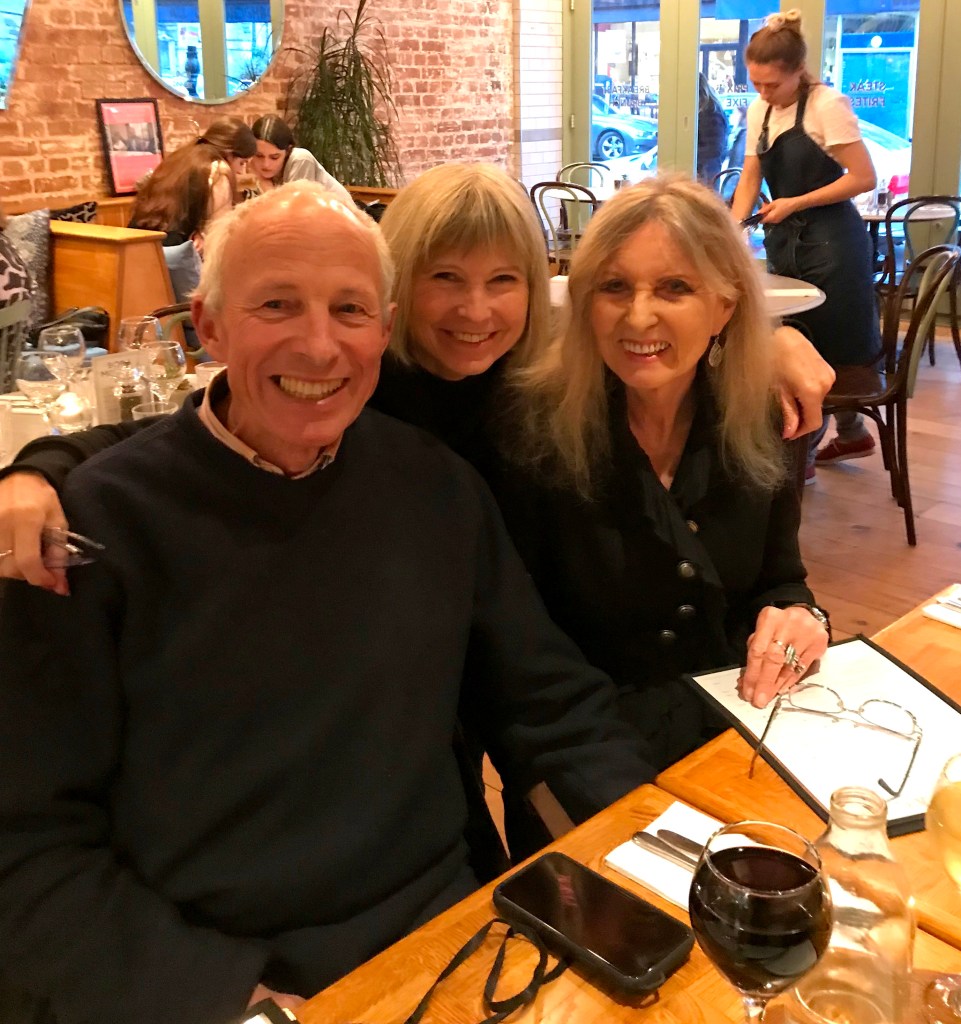
Eleanor holding her arms around Jean and me!

Immediately upon meeting we found a nearby cafe to grab some lunch and do a bit of catching up!

The afternoon and evening went by far too quickly and fairly smartly on the Saturday morning, the 14th, we said our ‘goodbyes’ and Jean and I struggled for the second time in twenty-four hours with the Underground! This time making our way from Bounds Green to Paddington Station, the main line station that serves Bristol and places in between, as in the Great Western Railway, as well as down to the South-West including Exeter and then on to Plymouth and into Cornwall.

Our train journey was from Paddington to Swindon Station to be met by Richard and Julie.

Richard is my longest, closest and dearest male friend.

He and I go back very many years, for we met not long after I had left IBM in 1978, where I had been an Office Products salesman, and then started my own company. Richard had, in turn, recently left Olivetti where he, too, had been an Office Products salesman.

We hit it off immediately and over the intervening years, as in the thick end of 40 years, there’s not a lot that we haven’t shared in terms of fun and frolics, and especially a great many flying exploits in my group-owned Piper Super Cub!

Piper Cub R151

When Jean and I got together in 2008 as you might imagine she quickly became close friends with Richard and Jules, as Richard calls Julie.

Plus Jean and Richard share a rather ironic, if that’s the right term, event. For both of them were diagnosed in December, 2015 with the early stages of Parkinson’s Disease!

As with seeing Eleanor, the time with Richard and Jules was far too short but, nonetheless, very
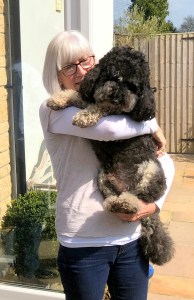
Murphy being cuddled by Jules

precious. Plus, dear Murphy gave Jean and me a much-needed dog fix!

Thus on the morning of the 15th, Richard and Jules ran us across to Bristol which is where my son, Alex, is living with Lisa, his partner.

The plan was to spend from Sunday, the 15th, through to Wednesday, the 18th, with Alex and Lisa. Alex had booked time off work for those days but Lisa unfortunately was working during the weekdays.

Yet another meeting of dear friends, as in Richard and Jules catching up with Alex.

Alex had arranged for Jean and me to go down to South Devon on Monday, 16th, to meet with John Joiner, my dear brother-in-law.

Let me explain some family background. My father had had two daughters with a previous wife to my mother. Their names were Rhona and Corinne and when they were alive they both lived in South Devon. In the years that followed my father’s death in December, 1956, both Rhona and Corinne, and their respective husbands, Reider and John, made me feel very special and very deeply loved by both of them. (Indeed, it was because of wanting to be close to Rhona and Corinne’s families that I settled in South Devon when I returned from Cyprus in 1991.)

Corinne died in June, 2013. John, who is now well into his 80s, lives in a small apartment in the village of South Brent just a few miles from Totnes in South Devon. I make a point of calling him from Oregon at least once a week but to be able to see John again after so many years was another big highlight of the vacation.
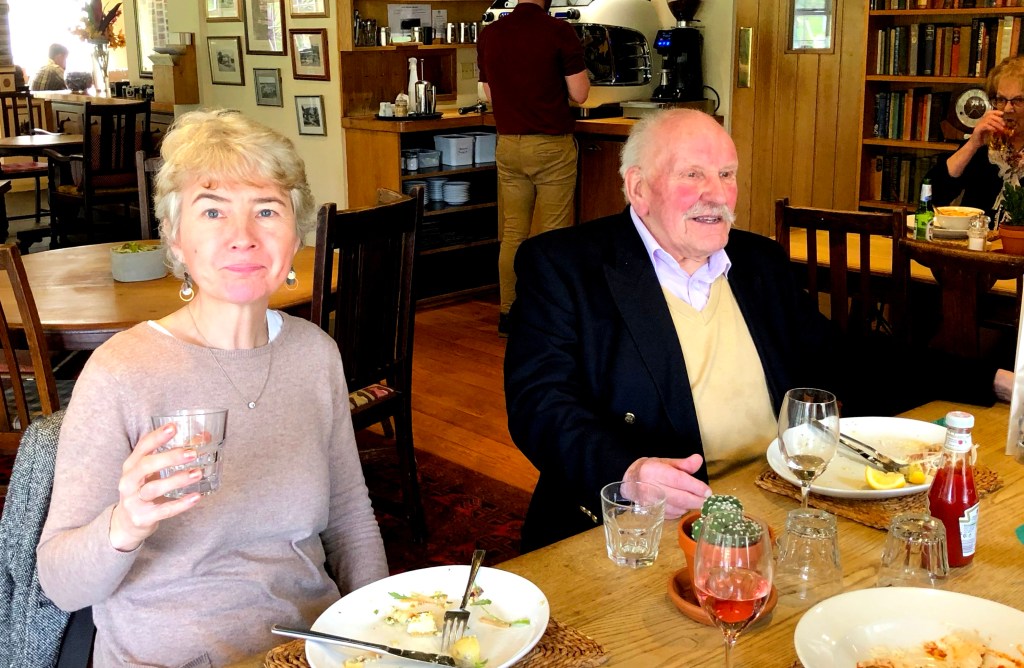
Inevitably, along came another lunch and in the photograph above you can see John on the right-hand side and sitting next to him, as in the left of the photo, is Greta, my cousin as in Rhona’s daughter, who spends a great deal of her spare time looking after John. Dear Greta!

After the pub lunch we returned to John’s apartment for tea and carried on sharing many special memories.

Indeed, one of those special memories was Benji the wonderful dog that Corinne and John had for many years. On one of John’s walls was this wonderful painting of Benji.

The other fact about John is his incredible use of the English language. Both in terms of his vocabulary and his diction. John’s legacy to me is, and will be for the rest of my days, the value of speaking well.

Another wonderful connection with past times.

The truth is that the odds are that I may never see John again. That made this day with John so incredibly special. Huge thanks to Alex and Greta. What a fabulous day!

The next day, Tuesday, the 17th, was Lisa’s birthday and yet another wonderful evening out.

Then came the 18th and the last few hours of being with Alex. At 12:50 that day we were due to fly from Bristol down to Nice in Southern France to spend six nights with Reggie, Jean’s brother.

Those beautiful days will be the topic of tomorrow’s post. See you then!

But before I turn away from today’s description of our days in England, let me address a question that John Zande raised yesterday. Namely: “Have to ask, do you miss the English village life? It’s so beautiful.

Here’s my answer:

John, yes there was no question that there were stirrings of great familiarity when down with John near Totnes. In my mind’s eye, I could still walk up Totnes High Street and name many of the stores that I used to visit on an almost weekly basis when living in Harberton.

But at the same time I was shocked and disappointed by the huge growth in new housing, someone said an additional 500 homes built in the area in the last 5 years, and all the traffic and crowded lanes that go with that expansion. Many of the lanes were so crowded with parked cars that they were effectively single-lane carriageways.

The relatively sparse housing in the part of Oregon where we now live, the way that the natural world seems untouched by us humans here on Hugo Road, felt very beautiful in comparison. We looked forward to being back in Merlin.
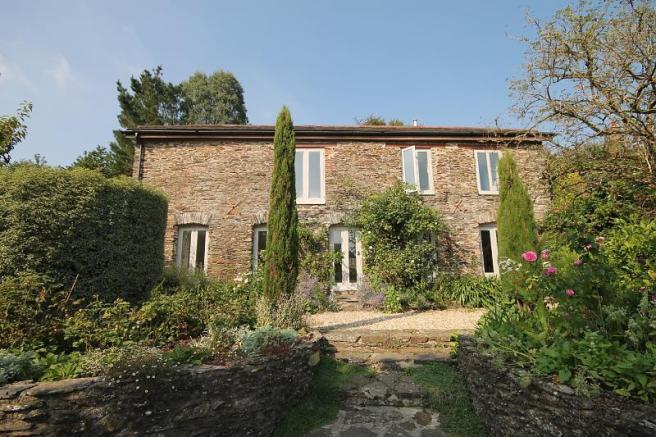
Upper Barn, Harberton, where I used to live before meeting my Jeannie!

To England and France, Part Two.

Fun days with my daughter’s family!

We had arrived in England, via Gatwick airport, yesterday, as in Monday the 9th April, and were staying with Maija and family until Friday when Jean and I travelled up to London to meet my sister Eleanor.

So these three days were to be spent doing as many fun things as we could; it being the Easter school holiday week so Morten was at home each day.

Thus today’s post is a fairly quick run through of all the things that we did.

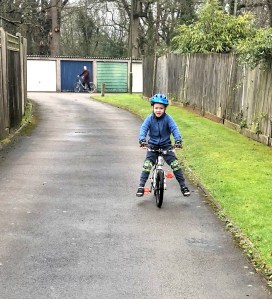
First thing on Tuesday morning was to see how adept young Morten was in riding his bike.

Thankfully it was dry but still overcast. The forecast was for the weather to improve over the coming days. But whatever the weather we were not going to let it get in the way.

Maija mentioned that Wakehurst, part of Kew Royal Botanical Gardens was close by and we readily agreed to go there. As the Kew website explains:

Our wild botanic garden on the High Weald of West Sussex has over 500 acres of beautiful ornamental gardens, woodlands and a nature reserve. Wakehurst is also home to the Millennium Seed Bank, the largest wild seed conservation project in the world.

Morten got it into his head to ‘dress up’!

He is a very lively young man!

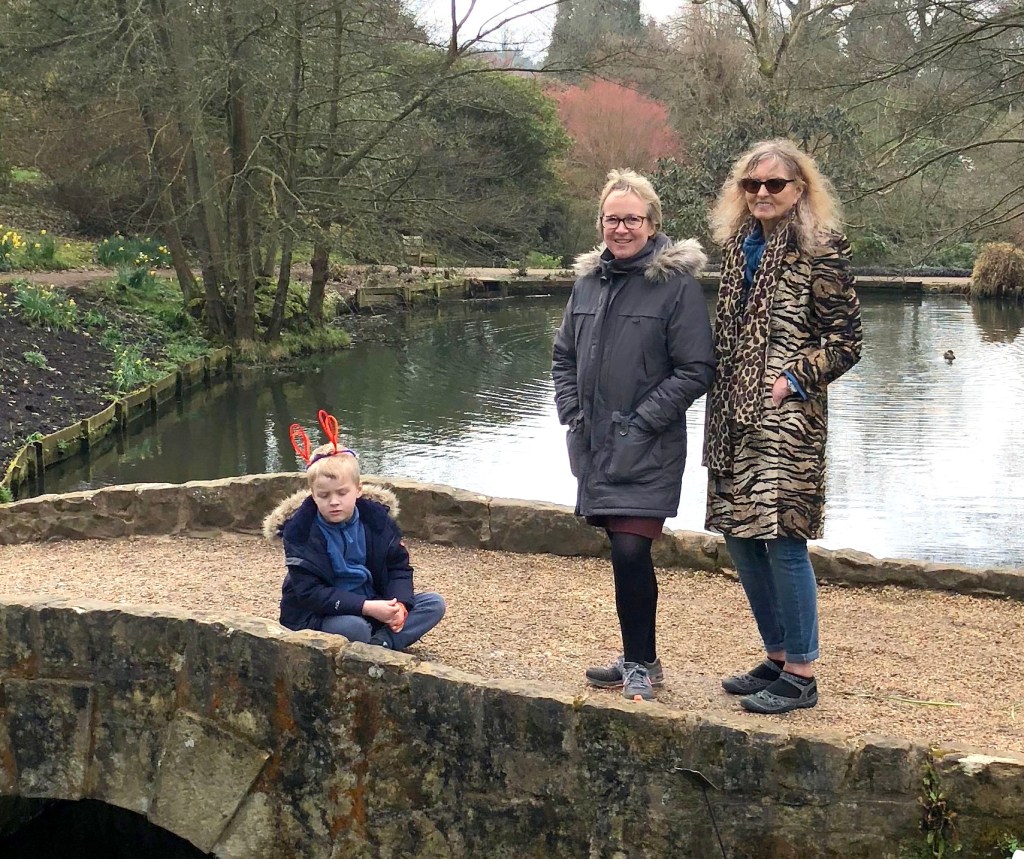
Wakehurst was a very tranquil place.


As well as the beautiful grounds it was possible to buy plants.

Slowly the weather improved.

In the blink of an eye it was Wednesday and the plan that day was a visit to the Bluebell Railway. As the website offers:

The volunteer-run Bluebell Line was the UK’s first preserved standard gauge passenger railway, re-opening part of the Lewes to East Grinstead line of the old London Brighton & South Coast Railway in 1960. Since then it has developed into one of the largest tourist attractions in Sussex, yet it still remains true to its objectives of the preservation for posterity of a country branch line, its steam locomotives, coaches and goods stock, signalling systems, stations and operating practices.

One’s never too old to go on a steam railway!

Sheffield Park Station, East Sussex

As the above photograph shows it was another day of intermittent rain and low clouds.

But did that stop four people having a fun time???

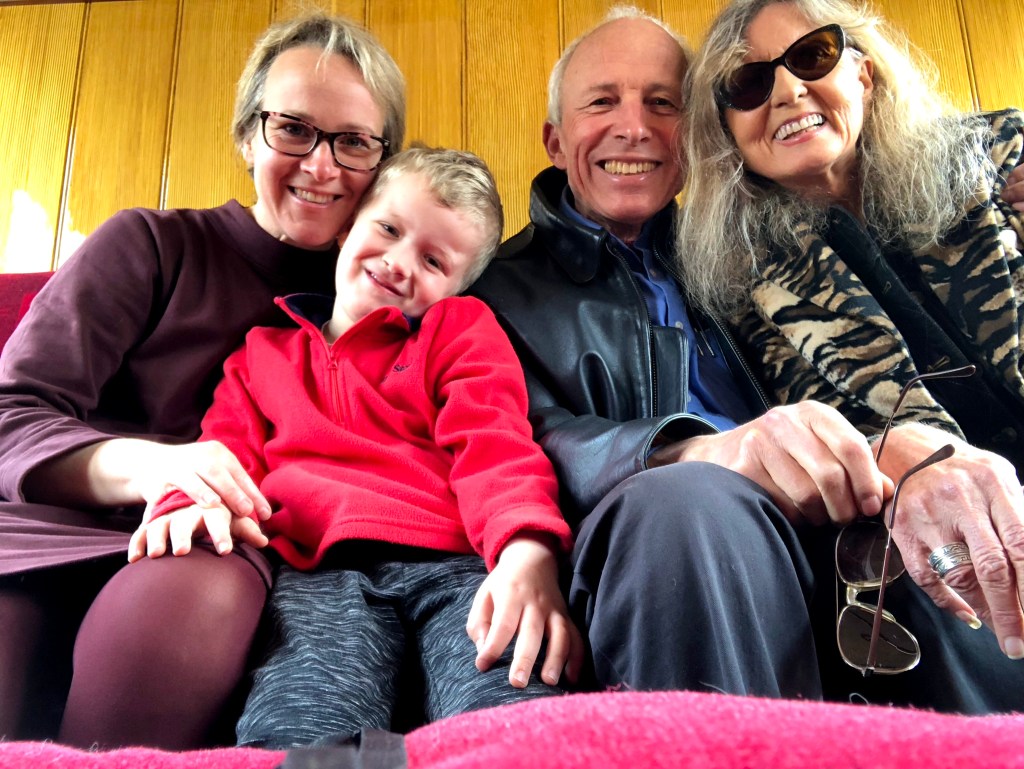
A ‘self-pic’ of four happy faces aboard the Bluebell train.

On the Thursday, the 12th, Maija had an engagement in London in connection with her company, SOUND UK, and Jeannie and I were in charge of Morten for the day.

Well I think that was the arrangement although Morten woke up with very clear ideas as to how the day was to be spent. Primarily walking into Lindfield village so he could show Jean and me all the places of note!

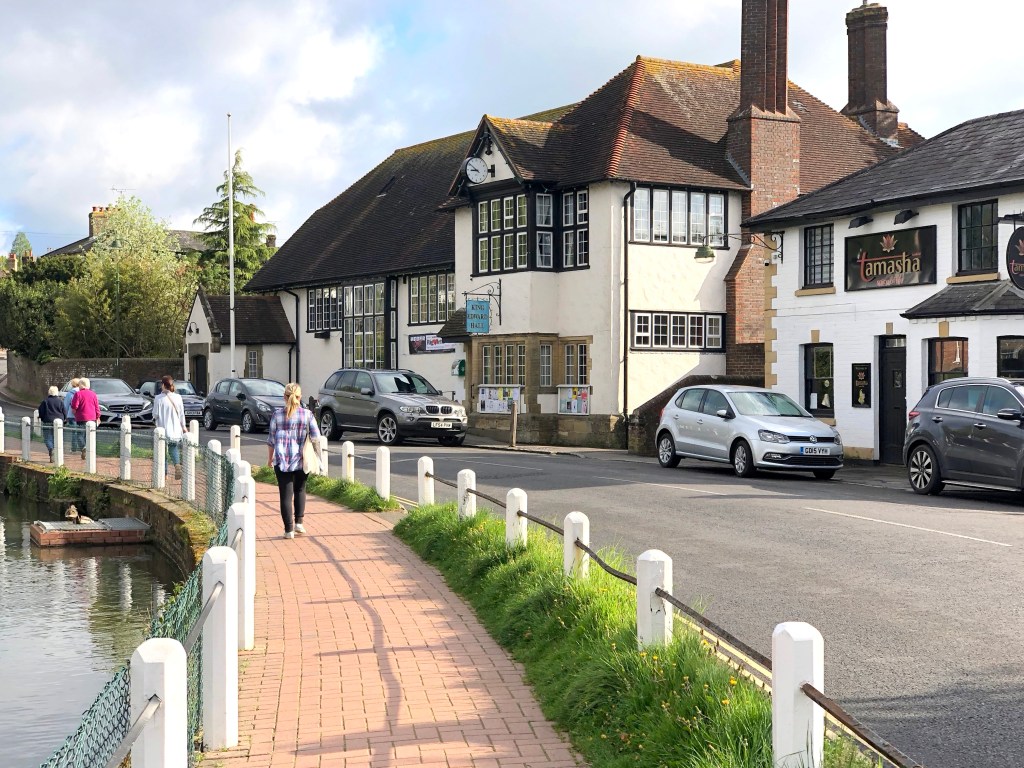
Lindfield is the classic English village complete with cricket field, village pond and a pub or two. As Wikipedia offers:

The village stands on high ground above the upper reaches of the River Ouse. It is situated close to both the natural beauty of the High Weald and to Haywards Heath with its amenities and station on the main London-Brighton railway line.

Lindfield has a rich historic and architectural heritage. The ancient High Street, lined with lime trees, has over forty medieval and post medieval timber-framed houses, with many individual shops. At the bottom of the High Street is a natural spring-fed pond with fish, ducks, and herons. Beyond lies the Common which, over the centuries, has witnessed many events – fairs, festivals, bonfire celebrations and sporting activities; cricket has been played there since 1747. Today, it is still central to village celebrations and leisure activities. In addition to the Common there is Pickers’ Green, providing pitches for cricket, football, stoolball and a children’s play area.

History

The High Street follows an ancient north-south track that has existed for thousands of years, long before the Romans built a major road, the London to Brighton Way, a mile to the west of the village.

Lindfield first appeared as Lindefeldia, ‘open land with lime trees’, in a Saxon charter of 765 AD, in which King Ealdwulf granted lands for the building of a Minster church. When the Domesday Book was compiled the lands were held by the Archbishop of Canterbury.[4]

King Edward III recognised the importance of medieval Lindfield and in 1343 granted the town a royal charter to hold a market every Thursday and two annual eight-day fairs. For centuries the fairs continued each April and August with the summer fair becoming one of the largest sheep sales in Sussex.[5]

Lindfield was once part of the thriving Wealden iron industry. As early as 1539, William Levett of Buxted, a county curate with a thriving sideline in iron and armaments, was recorded as extracting iron ore at Lindfield. Later the Henslowe family of Lindfield were actively engaged in the iron milling business in association with Ralph Hogge, parson Levett’s former servant and later a major ironmaster in his own right.

In 1841 the London-Brighton railway opened, passing to the west of the parish with a ‘Station for Cuckfield and Lindfield Towns’ on open land that was to become the town of Haywards Heath. The construction of the Ouse Valley branch line reached Lindfield in 1866 with a proposed station to the north of All Saints’ Church but the line was abandoned for financial reasons.

Charles Eamer Kempe, a leading church stained glass designer and manufacturer lived at Lindfield until his death in 1907. Kempe renovated and redecorated an Elizabethan manor house near the village which he renamed Old Place,[6] from where he entertained clients and professional partners. Internally the house was appointed to the highest standard of Victorian splendour. After his death in the 1930s, the house was partitioned into six individual residences, with the main reception rooms forming part of the new “East Wing”.[7]

Lindfield also had a children’s play area which is where I snapped this photograph of Morten on that Thursday.

Then before we knew it the morning of Friday, 13th was upon us and it was time to catch the train up to London.

However these days with Morten had put in place a precious bond that was one of the primary reasons for us coming to England.

In tomorrow’s post I offer the experiences of meeting Eleanor, Richard and my son Alex.

Picture Parade Two Hundred and Thirty-Eight

The pictures that were mentioned in Dan’s item last Tuesday.

oooo

oooo

oooo

oooo

oooo

The second set of these compelling photographs in a week’s time.

You all take care out there!

The Sound of Sadness!

Why is is that some things so profoundly affect one?

In working my way through magazines and other stuff that I wanted to read following being away for nearly three weeks, I came across a report published by the University of Exeter, back in England, about the effect of climate change on the Great Barrier Reef.

Deteriorating Great Barrier Reef hushed: young fish no longer hear their way home

Degraded coral reefs are far quieter than five years ago, and no longer sound like a suitable habitat to young fish searching for a place to live and breed, according to research published today in Proceedings of the National Academy of Sciences USA.

Baby fish looking for a home can use noisy coral reef sounds including snapping shrimp clicks, damselfish chirps, and clownfish chattering to locate and select suitable habitat. But that “coral reef orchestra” has been quietened following recent cyclone and coral-bleaching damage on the Great Barrier Reef, raising fears that young fish may no longer hear their way home.

An international team of scientists, led by the University of Exeter, carried out field experiments on the Northern Great Barrier Reef and found that reefs sound much quieter and less acoustically diverse than they did before three years of cyclones and coral bleaching.

The soundscapes of these recently-degraded reefs are less attractive to juvenile fishes attracting 40% fewer fish compared to the sound of previous healthy reefs.

Lead author Tim Gordon, a marine biologist at the University of Exeter, said: “It’s heart-breaking to hear. The usual pops, chirps, snaps and chatters of countless fish and invertebrates have disappeared. The symphony of the sea is being silenced.”

This loss of attractiveness of reef sounds to fish in the sea could have devastating consequences for reefs.

I know I am far from being alone in feeling great sadness at this aspect of our changing planet.

So before I republish the rest of that University of Exeter paper take a few minutes and watch this YouTube video about the Australian Barrier Reef

Then listen to this mp3 file that is a recording of the sounds of a healthy reef.

This is the balance of that news item published by the University.

Fish communities are instrumental to maintaining healthy reefs by removing algae, facilitating coral growth, contributing to nutrient cycles and keeping food webs in balance. Damaged reefs with healthy fish populations recover faster than reefs that have lost their fish.

Harry Harding, co-author from the University of Bristol, explains: “If fish aren’t hearing their way home anymore, that could be bad news for the recovery prospects of reefs. Fish play critical roles on coral reefs, grazing away harmful algae and allowing coral to grow. A reef without fish is a reef that’s in trouble.”

Coral reef animals produce a dazzling array of sounds to communicate with each other while hunting, to warn each other about the approach of predators and to impress each other during courtship. Together, these sounds combine to form a soundscape that can be heard for miles around. This soundscape provides a valuable cue for young fish to locate and select habitat after a period of early development in the open ocean.

Gordon said: “Being able to hear the difference really drives home the fact that our coral reefs are being decimated. Some of the most beautiful places on Earth are dying due to human activity, and it is up to us to fix it.”

The scientists from the University of Exeter, University of Bristol, Cefas (Centre for Environment, Fisheries and Aquaculture Science), Duke University (USA), the Australian Institute of Marine Science and James Cook University (Australia) built experimental reefs from coral rubble on sand flats, then used underwater loudspeakers to broadcast healthy coral reef sounds or degraded coral reef sounds, to see which sounds attracted more young fish.

Senior author Steve Simpson, Associate Professor in Marine Biology & Global Change at the University of Exeter, said: “Over the last 15 years my research group have discovered how important sound can be for fish to locate and select specific reefs. We have marvelled at the remarkable diversity and complexity of coral reef soundscapes. But in the last few years the reefs we know and love have died before our eyes. And the deserted and crumbling rubble fields have turned eerily quiet.”

Professor Simpson added: “If the reefs have gone quiet, then the chances of the next generation of fish recolonising the reefs are much reduced. Without fish, the reefs can’t recover.”

Warming seas increase the frequency and severity of coral bleaching events worldwide, as higher temperatures cause a breakdown in the relationship between corals and the zooxanthellae that they host in their tissue, providing their energy through photosynthesis.

This bleaching recently killed up to 80% of corals in some areas of the Great Barrier Reef, and bleaching events of this nature are happening worldwide four times more frequently than they used to.

Reductions in carbon emissions are needed to reduce this damage, as Gordon explains: “The damage we’ve done to reefs worldwide is horrific, but the fight isn’t over yet. If we can fulfil our international commitments to dramatically reduce carbon emissions, it’s still possible to protect some of the reefs that are left. The time for action is now.”

Date: 30 April 2018

Dear people, the time for action is now!

Wolves and Rivers

Connections!

Just a few days ago, on May 1st to be precise, I published the post Dogs and Humans.

Colin Reynolds, he of the blog Wibble, left the following comment:

Good to see you back, glad to hear you had an enjoyable trip.
Those goslings are really cute 🙂
At risk of self-promotion: I was thinking of you when I wrote my latest blog post. Granted, wolves aren’t dogs, but they almost are… 🙂

I went across to Colin’s latest blog post and immediately wanted to share it with you all in this place.

It also seemed appropriate to ask Colin for his introduction. But here’s what he offered: “When Paul asked me if I would be willing to turn this post into a guest post for Learning from Dogs, I was more puzzled than anything else. The only words here that aren’t my own are those where I explain that all I did was transcribe George Monbiot’s words from the video.” I’m bound to say that the transcription was a grand job!

Anyway, here is Colin’s post.

ooOOoo

How Wolves Change Rivers

by Colin Reynolds

When we try to pick out anything by itself, we find it hitched to everything else in the Universe.” — John Muir

When wolves were reintroduced to Yellowstone National Park in the United States after being absent for nearly 70 years, the most remarkable ‘trophic cascade‘ occurred. In this short film, George Monbiot explains what a trophic cascade is, and how wolves do actually change rivers.

I found this so remarkable that I took the time to transcribe George’s words:

One of the most exciting scientific findings of the past half century has been the discovery of widespread ‘trophic cascades’. A trophic cascade is an ecological process which starts at the top of the food chain and tumbles all the way down to the bottom, and the classic example is what happened in the Yellowstone National Park in the United States when wolves were reintroduced in 1995. Now, we all know that wolves kill various species of animals, but perhaps we’re slightly less aware that they give life to many others.

Before the wolves turned up, they’d been absent for seventy years, but the numbers of deer — because there’d been nothing to hunt them — had built up and built up in the Yellowstone Park and despite the efforts by humans to control them, they’d reduced much of the vegetation there to almost nothing; they’d just grazed it away. But as soon as the wolves arrived, even though they were few in number, they started to have the most remarkable effects.

First, of course, they killed some of the deer. But that wasn’t the major thing: much more significantly, they radically changed the behaviour of the deer. The deer started avoiding certain parts of the park: the places where they could be trapped most easily, particularly the valleys and the gorges — and immediately, those places started to regenerate. In some areas, the height of the trees quintupled in just six years; bare valley sides quickly became forests of aspen, and willow, and cottonwood.

And as soon as that happened, the birds started moving in. The number of songbirds and migratory birds started to increase greatly. The number of beavers started to increase because beavers liked to eat the trees; and beavers, like wolves, are ecosystem engineers, they create niches for other species. And the dams they built in the rivers provided habitats for otters and musk-rats and ducks and fish and reptiles and amphibians.

The wolves killed coyotes, and as a result of that, the number of rabbits and mice began to rise, which meant more hawks, more weasels, more foxes, more badgers. Ravens and bald eagles came down to feed on the carrion that the wolves had left. Bears fed on it too, and their population began to rise as well, partly also because there were more berries growing on the regenerating shrubs. And the bears reinforced the impact of the wolves by killing some of the calves of the deer.

But here’s where it gets really interesting: the wolves changed the behaviour of the rivers. They began to meander less, there was less erosion, the channels narrowed, more pools formed, more riffle sections, all of which was great for wildlife habitats. The rivers changed in response to the wolves. And the reason was that the regenerating forests stabilised the banks so that they collapsed less often, so that the rivers became more fixed in their course. Similarly, by driving the deer out of some places and the vegetation recovering on the valley sides there was less soil erosion, because the vegetation stabilised that as well.

So the wolves, small in number, transformed not just the ecosystem of the Yellowstone National Park, this huge area of land, but also its physical geography.

Note from the video’s publisher (Sustainable Human): “There are ‘elk’ pictured in this video when the narrator is referring to ‘deer.’ This is because the narrator is British and the British word for ‘elk’ is ‘red deer’, or ‘deer’ for short. The scientific report this is based on refers to elk so we wanted to be accurate with the truth of the story.”

ooOOoo

As that quote from John Muir infers, we are all connected. No better illustrated by a very sad piece of research news that will be the topic for tomorrow’s post.

The Time Machine

Time!

When you read this post, assuming you will be reading it on Sunday 8th April, you may be wondering why there is no Picture Parade today.

Indeed, there are not going to be Picture Parades until the first Sunday in May.

Actually, to be completely honest, there are going to be no posts at all from tomorrow all the way through to May; the next post being a guest post on Tuesday, 1st May. Nor will I be popping into this place to acknowledge comments and replies! Sorry!

Why?

Simply because Jean and I are taking a little vacation. Will explain more when we return.

Jana Stewart will be living here at home caring for all the dogs, cats, horses, ponies, chickens and parakeets! Oh, nearly forgot! And putting out feed for the wild deer!

So this post is to share with you the aptly named The Time Machine album by Alan Parsons

Also, I wanted to specifically share with you three of the tracks from that album!


Can’t imagine you haven’t come across Alan Parsons before but in that unlikely event his website is here.

Plus, I will close with a copy of the opening WikiPedia information on Alan Parsons.

Alan Parsons (born 20 December 1948)[1] is an English audio engineer, songwriter, musician, and record producer. He was involved with the production of several significant albums, including the BeatlesAbbey Road and Let It Be, and the art rock band Ambrosia‘s debut album Ambrosia as well as Pink Floyd‘s The Dark Side of the Moon for which Pink Floyd credit him as an important contributor. Parsons’ own group, the Alan Parsons Project, as well as his subsequent solo recordings, have also been successful commercially.

Yes, I know I’m showing my age!!

What glorious country!

Revelling in the beauty of Crater Lake!

Over the weekend Jean and I went up to Klamath Falls to spend two nights in the company of good friends, Trish and Andy, who live in Tucson, Az.

Last Sunday we all jumped into our car, a GMC Canyon with 4WD, and drove the 60-odd miles from Klamath Falls to the Rim Village Visitor Center.

Talk about impressive!

Here are three photographs that I took that are presented untouched, as in no post processing, that I wanted to share with you.

More details coming along, plus more photos for the next Picture Parade.

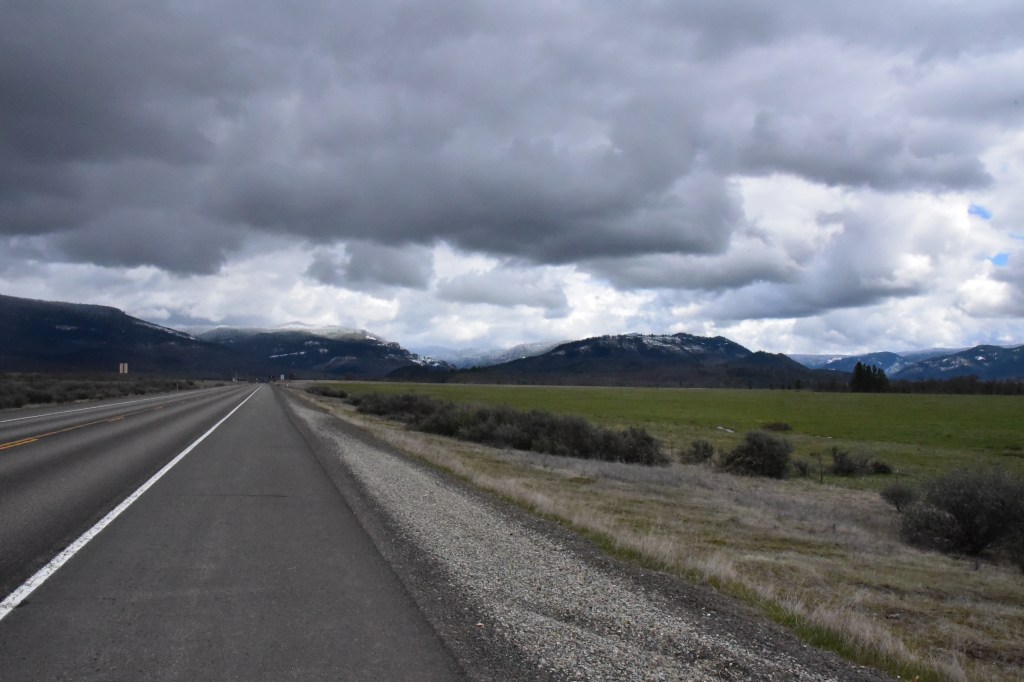
The first was taken during Saturday afternoon when Jean and I were on our way to Klamath Falls.

On the road to the high country!

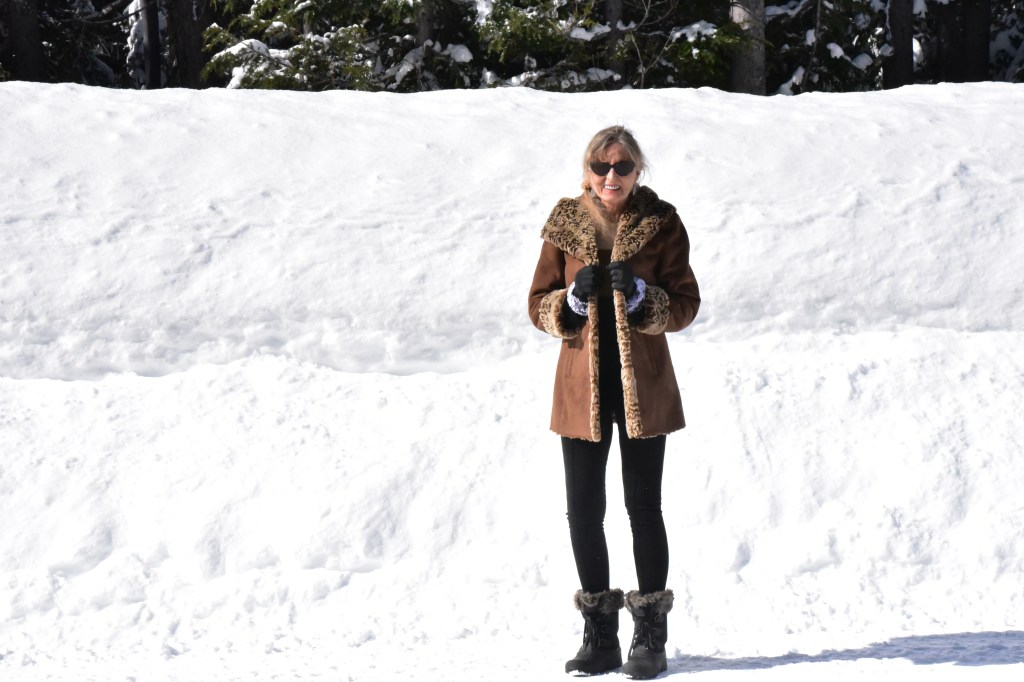
The next photograph was taken when we stopped in one of the many ‘turnouts’ along the highway going up to Crater Lake. In fairness, the high snow bank was more a result of the snow blowers than falling snow … but still!

Rumour has it that it had snowed in these parts!

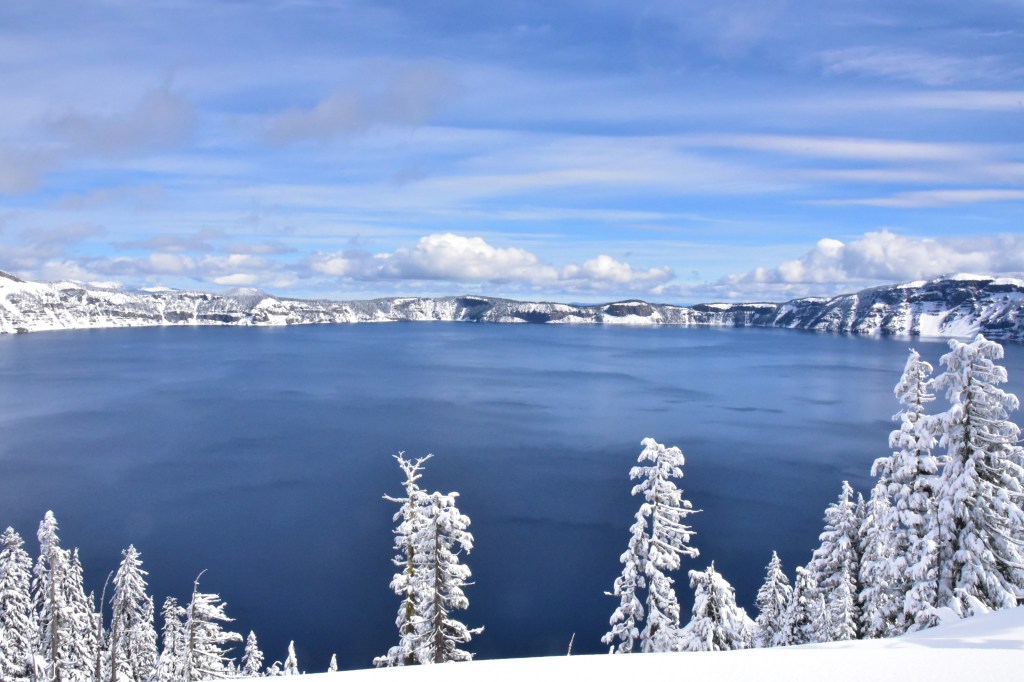
This last photograph, for today anyway, is the sight of Crater Lake!

What an incredible landscape!

P.S. Happy Birthday, dear Morten!

What a great man he was!

I am, of course, referring to the recent death of Stephen Hawking.

There’s no way that I can add anything to the widespread reporting of the very sad death of the theoretical physicist, cosmologist and author Professor Stephen Hawking.

Except, possibly, this interesting quirk of fate.

For this great man died yesterday: March 14th.

The very same day that another very famous man, the German-born Albert Einstein, was born. As in March 14th. Albeit, Stephen Hawking’s death being 139 years after the birth of the 1921 winner of the Nobel Prize in Physics.

Did you also know that Professor Hawking was a great dog lover!

I was very pleased that The Conversation blog site released a wonderful tribute to Stephen Hawking. The item opens, thus:

ooOOoo

Acclaimed British theoretical physicist, cosmologist and author Stephen Hawking has died aged 76. Hawking is best known for his work on black holes, which revolutionised our understanding of the universe.

Hawking passed away today peacefully at his home in Cambridge, his family confirmed in a statement:

We are deeply saddened that our beloved father passed away today. He was a great scientist and an extraordinary man whose work and legacy will live on for many years.

His courage and persistence with his brilliance and humour inspired people across the world. He once said, “It would not be much of a universe if it wasn’t home to the people you love.” We will miss him forever.


Read more: A timeline of Stephen Hawking’s remarkable life


Hawking was born on January 8, 1942, in Oxford, England. In 1963 he was diagnosed with ALS, a form of Motor Neurone Disease, and later confined to a wheelchair and forced to communicate via a computerised voice. But he continued his theoretical work and was outspoken on many things over much of his life.

Tributes have been pouring in on social media for the scientist, who made complex science accessible to everyone in his 1988 bestselling book A Brief History of Time.

ooOOoo

Do read the rest of that article. I will take the tribute from Alice Gorman that closes The Conversation article to close today’s post.

ooOOoo

Alice Gorman, Senior Lecturer in archaeology and space studies, Flinders University

There are few scientists who reach as far into popular culture as Stephen Hawking did. His research tackled the biggest of big questions – the nature of time, space and the universe we live in.

Sometimes it feels like science is losing ground in the modern world, but people still look to the stars for answers about who we are and how we come to be here.

Hawking’s bestselling A Brief History of Time made cosmology accessible to people and brought black holes out of the shadows and into the public imagination.

Personally I’ll miss his appearances on The Big Bang Theory, where he could out-nerd the nerds, and also provide some often necessary common sense. It was always great to see a world-class scientist just having fun.

ooOOoo

What a very great man he was!

The Great Backyard Bird Count

Wherever you are in the world, are you able to participate in this?

As first seen on the EarthSky site.

ooOOoo

Great Backyard Bird Count February 16–19

By Deanna Conners in EARTH | HUMAN WORLD February 9, 2018

Scientists need your help counting birds for the 21st annual Great Backyard Bird Count. It is free and easy to participate. Find out how here.

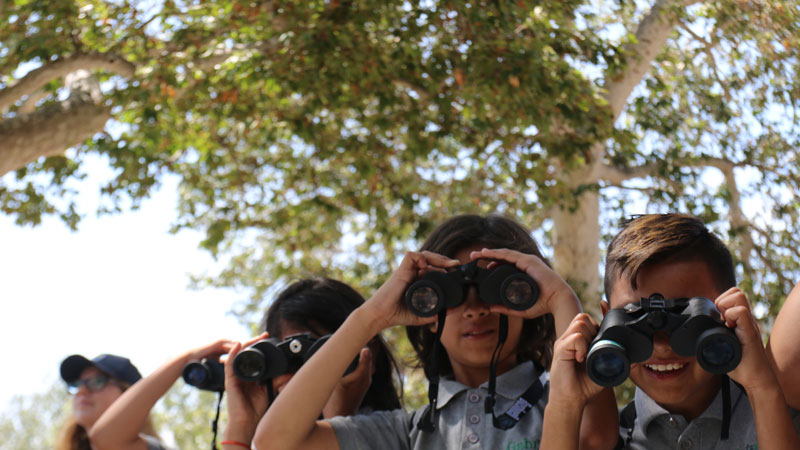
Bird watching in the Santa Monica Mountains National Recreation Area. Image via National Park Service.

The annual Great Backyard Bird Count, now in its 21st year, is set to take place February 16 to 19, 2018. During this popular citizen science event, people from all over the world head outdoors to count birds and the data are used by scientists to track the health of bird populations.

Gary Langham, Chief Scientist at the National Audubon Society, commented on the Great Backyard Bird Count on Audubon’s website. He said:

This count is so fun because anyone can take part—we all learn and watch birds together—whether you are an expert, novice, or feeder watcher. I like to invite new birders to join me and share the experience. Get involved, invite your friends, and see how your favorite spot stacks up.

The 2017 count was a huge success. Over 200,000 people participated from around the world, and they submitted a record number of checklists. A total of 6,259 bird species were spotted during the event, which was the highest number ever recorded over the 20-year history of the count. This number represents more than half of all known bird species on Earth!

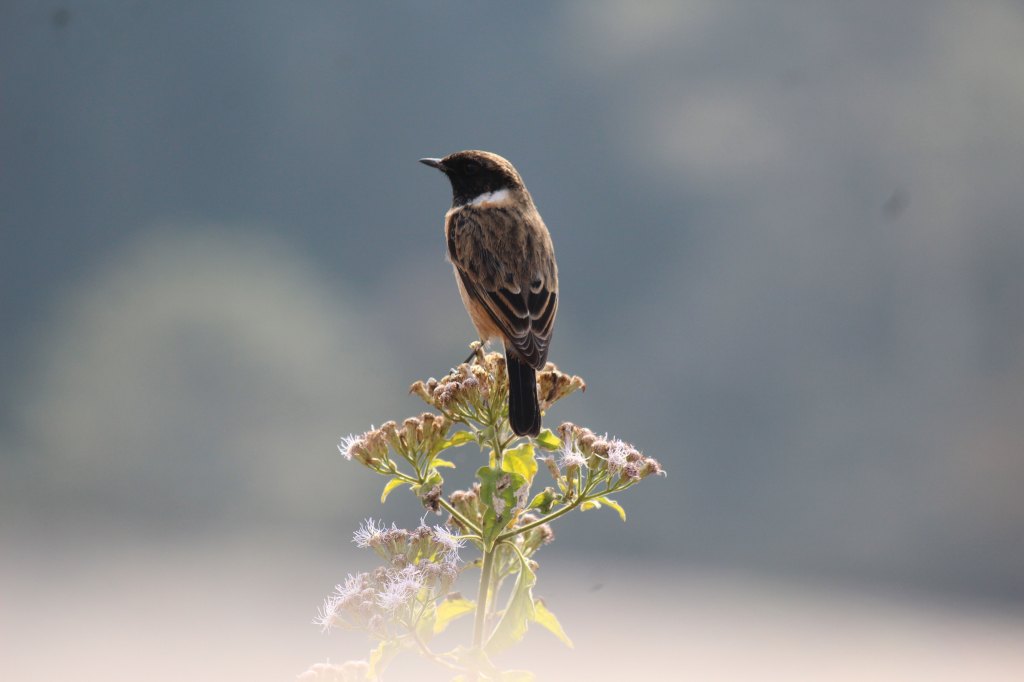
Siberian stonechat photographed in Zhemgang, Bhutan, during the 2017 Great Backyard Bird Count. Image via Sancha Rai.

Participating in the 2018 Great Backyard Bird Count involves three easy steps.

First, register with your name on the event’s website at the link here. Registration is free. This website has a ton of useful information about birds and the upcoming bird count.

Second, spend some time counting birds on the weekend of the event at the location of your choice, such as your backyard or a local park. The minimum amount of time required is 15 minutes, but you can count for longer if you wish. During your count, simply record the start and end time, location, and number and types of birds that you see. You can perform counts in multiple locations too. Just be sure to submit separate checklists for each location.

Not to worry if you can’t identify the birds you see at first. Just take good notes about their prominent features, for example, size, shape, color, and unusual markings, or you can try to snap a close-up picture. Then, you can use a bird guide to look them up later. All About Birds and What Bird are two good online bird identification guides that are free and easy to use. Additionally, the free Merlin Bird ID App can be downloaded to your smartphone and used offline. Merlin will ask you five simple questions about the bird you are trying to identify and suggest matches for you—you can even upload a picture to Merlin and let the app try to identify it.

The third and last step involves uploading your data to the event’s website. This step usually only takes a few minutes to complete. While you’re visiting the website, check out the live map that displays dots in the various locations where people have uploaded a checklist. It’s fun to watch the data pour in from all over the world.

As an added bonus, there is a photo contest for those who want to submit pictures of the birds that they see during the event. You can even submit photos of yourself watching the birds. Hence, don’t forget your binoculars. If you do shoot some good photos, please share them with EarthSky too. We love birding photos!

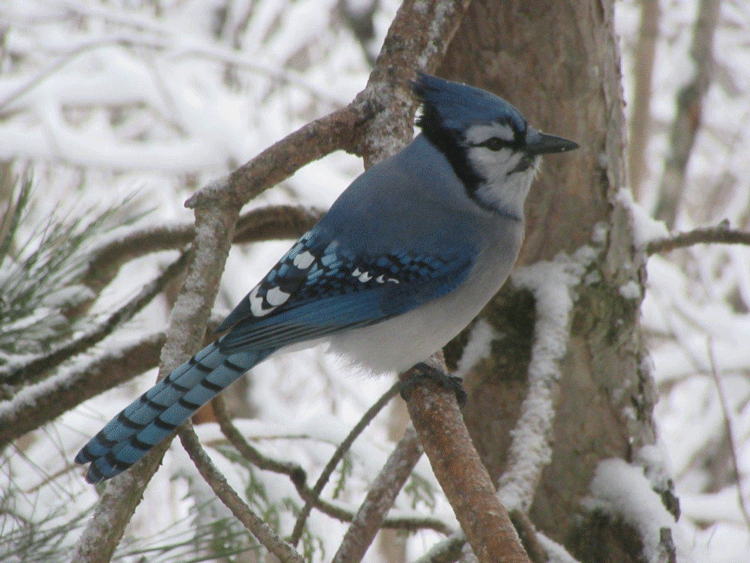
Bluejay photographed in Sioux Lookout, Ontario, Canada, during the 2017 Great Backyard Bird Count. Image via Rose Pogoda.

Use the hashtag #GBBC to follow Great Backyard Bird Count conversations on Twitter and Facebook.
The first annual Great Backyard Bird Count was held in 1998, and the event has continued to grow year after year. Hopefully, 2018 will be another record breaker.
The Great Backyard Bird Count is a collaborative project of the Cornell Lab of Ornithology, National Audubon Society, and Bird Studies Canada.
Bottom line: The annual Great Backyard Bird Count runs from February 16 to 19, 2018. This popular citizen science project helps scientists keep track of the health of bird populations. Participating is free and easy, so why not give it a try?

ooOOoo

So, once again, the Bird Count starts on this coming Friday, the 16th, and runs through to the end of next Monday, the 19th.

Do please join Jean and me and many thousands of others in this very important survey.

Food for Thought! A Fascinating Documentary!

Looking again into diet and nutrition.

While this post doesn’t specifically look at what we feed our dogs, there’s no question in my mind that good nutrition is just as important for our dogs as it is for ourselves.

Moving on!

You will know that quite a few of my recent posts have been on the back of me being made aware of how a strict diet plus taking many vitamins and supplements had had the effect of putting Colin Potter’s Parkinson’s Disease (PD) into remission.  All of which was summarised in an post last week called Food Truly Does Matter.

But then a good friend who lives locally, and has a solid medical background, spoke to me and said what you are writing can’t possibly be correct because if diet and supplements really did put PD patients into remission then “everyone would be doing it“. It was difficult to argue that.

So I thought the best people to call would be the American Parkinson Disease Association. I was put through to the director of the North-West Chapter of the APDA, located in Seattle, WA., and she agreed that there was no magic bullet in terms of diet and PD remission.

But the director went on to say that diet and lifestyle were nonetheless incredibly important and that there was no question that the correct decisions in terms of lifestyle were vital for anyone with PD; whatever the stage of the disease .

Dr. Laurie Mischley

The director also went on to say that without a doubt we should make contact with Seattle Integrative Medicine also, as the title suggests, in Seattle.

In particular, make contact with Dr. Laurie Mischley for the director said that Dr. Mischley’s clinical speciality is Parkinson’s Disease.

Plus we were advised to watch a talk that Dr. Mischley gave in British Columbia towards the end of 2016.

The talk is 49 minutes long and should be watched by everyone!

Reason?

Because in the talk there is much evidence, as in factual evidence, that shows the link between our lifestyle choices and what helps or hinders those with PD.

But even more critical to my way of thinking is that the evidence presented in the talk offers solid reasons why all of us as we approach middle-age and beyond should be careful about what we eat.

Food for Thought: Diet & Nutrition in PD – Dr. Laurie Mischley, ND, PhD, MPH from Parkinson Society BC on Vimeo.

This is a recorded presentation from Parkinson Society British Columbia’s Victoria Regional Conference featuring Laurie Mischley. Dr. Mischley studied naturopathic medicine (ND) at Bastyr University and epidemiology (MPH) and nutritional sciences (PhD) at the University of Washington. Her work is focused on identifying the nutritional requirements unique to individuals with neurodegenerative diseases. She has published articles on coenzyme Q10, lithium and glutathione deficiency in Parkinson’s disease (PD). Dr. Mischley maintains a small clinical practice at Seattle Integrative Medicine focused on nutrition and neurological health.

So, my dear reader, here is a little plea from Paul.

Whether or not you have PD, watch the talk and have all the people you love and care for watch it as well.

Oh, and give your dog a cuddle from Jean and me!


Please understand that I do not offer advice and nothing on any website, including the blog site Learning from Dogs, email or any other communication is intended to treat, diagnose, prevent or cure any disease. It is not a substitute for consulting your doctor. You should consult a doctor for diagnosis of conditions, before beginning any diet, exercise or supplementation or if you suspect you have any healh issue. You should not stop medication without consulting your doctor.