Category: Health

Meet Molly.

A most heart-warming story! Beats the heck out of murders, politics and terrorists!

This was sent in by John Hurlburt for Jean who has been a bit of a ‘horse lady’ in her times and is devoted to the two miniature horses we have here in Oregon.

oooOOOooo

Meet Molly

molly1

Molly is a gray speckled pony who was abandoned by her owners when Hurricane Katrina hit southern Louisiana . She spent weeks on her own before finally being rescued and taken to a farm where abandoned animals were stockpiled. While there, she was attacked by a dog and almost died.  Her gnawed right front leg became infected and her vet went to Louisiana State University (LSU) for help.

However, LSU were overwhelmed and Molly became a ‘welfare’ case. You know where that goes, don’t you!

Then surgeon Rustin Moore met Molly and changed his mind. He saw how Molly was careful to lie down on different sides so she didn’t seem to get sores.  He saw how Molly allowed people to handle her. She protected her injured leg. She constantly shifted her weight and didn’t overload her good leg. She was a smart pony with a serious survival ethic.

Surgeon Moore agreed to remove her leg below the knee and a temporary artificial limb was built. Molly walked out of the clinic and, in a very real sense, that’s where her story really begins.

This was the right horse and the right owner!” Moore insisted.

Molly happened to be a one-in-a-million patient. She’s tough as nails, but sweet, and she was willing to cope with pain. She made it obvious she understood that she was in trouble. The other important factor, according to Moore , is having a truly committed and compliant owner who is dedicated to providing the daily care required over the lifetime of the horse.

Molly’s story turns into a parable for life in Post-Katrina Louisiana.  The little pony gained weight and her mane finally felt a comb.  Then, amazingly, a prosthesis designer built her a leg.

The prosthetic has given Molly a whole new life, Allison Barca DVM, Molly’s regular vet, reports:

And she asks for it. She will put her little limb out and come to you and let you know that she wants you to put it on. Sometimes she wants you to take it off too. And sometimes, Molly gets away from Barca. “It can be pretty bad when you can’t catch a three-legged horse,” she laughs.

Most important of all, Molly has a job now. Kay, the rescue farm owner, started taking Molly to shelters, hospitals, nursing homes, and rehabilitation centers. Anywhere she thought that people needed hope. Wherever Molly went, she showed people her pluck. She inspired people, and she had a good time doing it.

It’s obvious to me that Molly had a bigger role to play in life,” Kay said. “She survived the hurricane, she survived a horrible injury, and now she is giving hope to others.

Allison Barca concluded, “She’s not back to normal, but she’s going to be better. To me, she could be a symbol for New Orleans itself.”

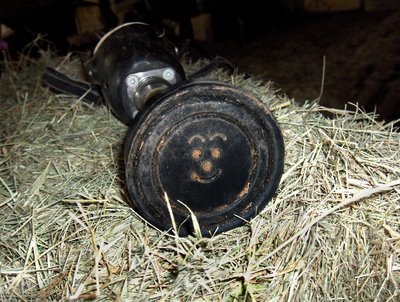
This is Molly's most recent prosthesis.
This is Molly’s most recent prosthesis.

Wherever Molly goes, she leaves a smiley hoof print behind.  Literally as well as metaphorically.

The photo shows the ground surface that she stands on has a smiley face embossed in it!
The photo shows that the bottom flat surface of the prosthesis has a smiley face embossed in it!

Leave you with that wonderful feeling of love for Molly?  Feel free to share it with all the animal lovers that you know.

Lust, laughter and loyalty!


Something else we really can learn from dogs.

I’m not sure that I should admit that my dearest Jeannie is my 4th wife!  Long story that goes back to when I had just turned 12 years-old, back in 1956. I suffered an event that I interpreted as emotional rejection and promptly buried that deep into my subconscious where it stayed for over 50 years.

Then brought to the surface in 2007 (thanks Jon) after the failure of marriage number 3.  I met Jean some 6 months later, in December 2007, and we were married in Payson, AZ in November, 2010.  Being with Jean has been the happiest days of my life!

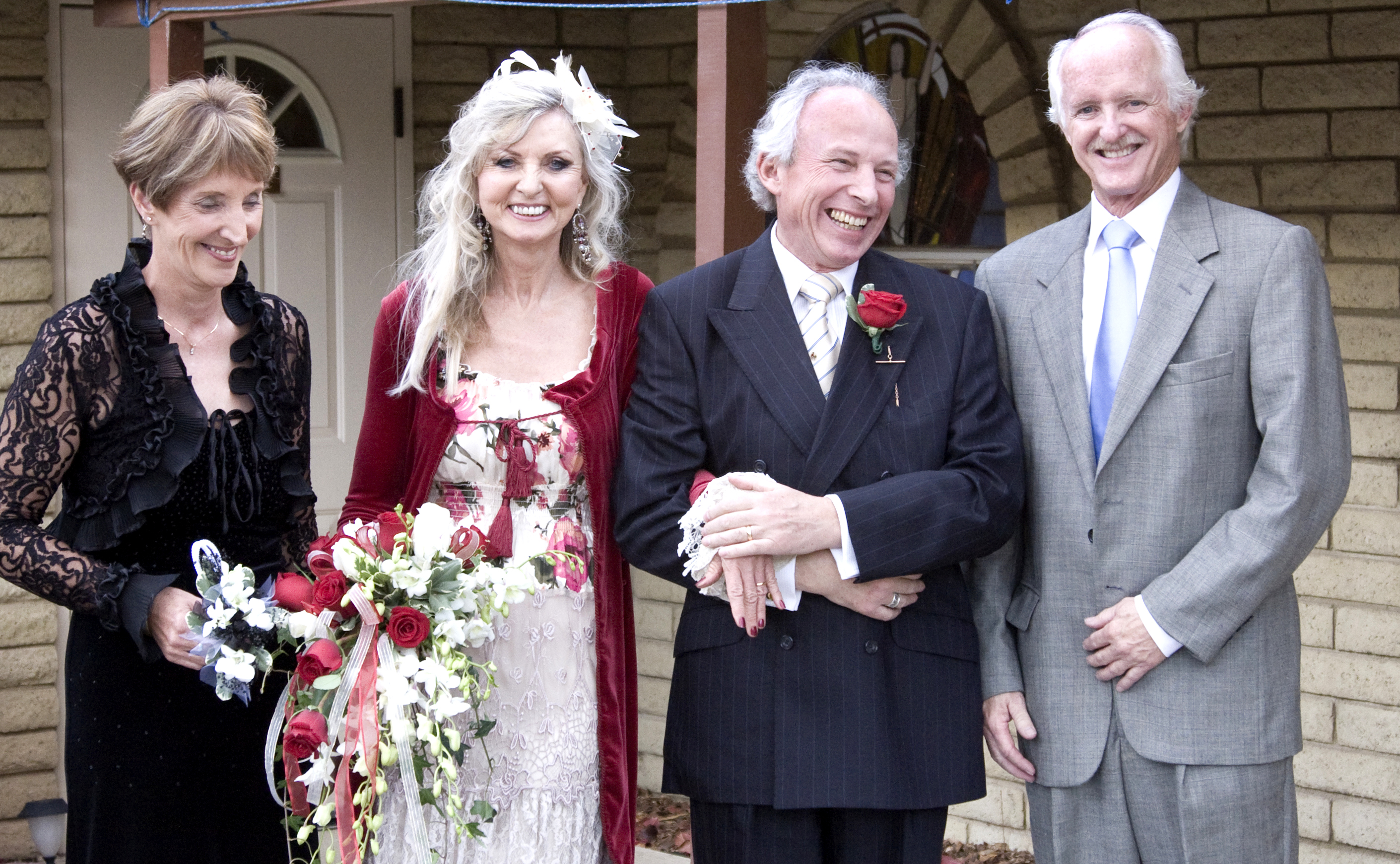
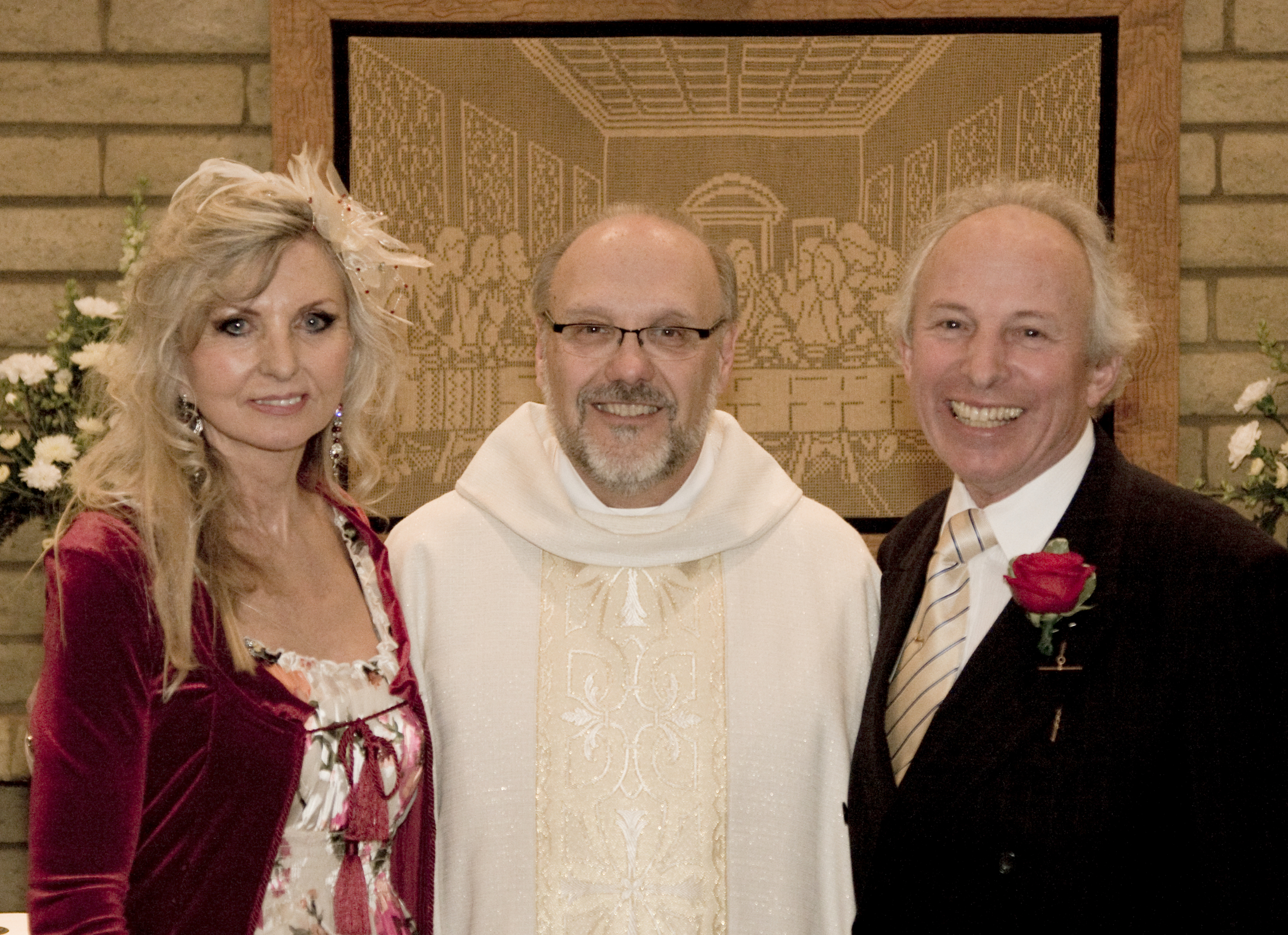
Jean, Father Dan and yours truly. St Paul's Episcopal Church, Payson, AZ. November 20th, 2010.
Jean, Father Dan and yours truly. St Paul’s Episcopal Church, Payson, AZ. November 20th, 2010.

Inevitably, while being married to Jean seems such a natural relationship, one is curious about what makes for a happy, lifelong relationship. Let’s face it, divorce is not uncommon.  In fact, the Divorce Rate website reveals that in 2012, the divorce rate was 3.4 couples per 1,000 population in the USA; the sixth highest in the world.

So it was fascinating to listen to a recent radio programme broadcast under the BBC’s Point of View series.  Just 10 minutes long, this particular programme was a talk by Adam Gopnik: The secret of a happy marriage 29th March 2013.  (Adam Gopnik is an American commentator and writes for The New Yorker.)

You should be able to listen to the programme by going here.  Or you can download the programme by going here, and following the instructions.  (Not sure how long the programme will be available to listen/download, so don’t delay.)

The programme was also featured on the BBC News Magazine Website. From which I quote:

A Point of View: Is there a secret to a happy marriage?

Nobody can explain the secret to a happy marriage, says Adam Gopnik, but it doesn’t stop people trying.

Anyone who tells you their rules for a happy marriage doesn’t have one. There’s a truth universally acknowledged, or one that ought to be anyway.

Just as the people who write books about good sex are never people you would want to sleep with, and the academics who write articles about the disappearance of civility always sound ferociously angry, the people who write about the way to sustain a good marriage are usually on their third.

Nonetheless (you knew there was a nonetheless on its way) although I don’t have rules, I do have an observation after many years of marriage (I’ve promised not to say exactly how many, though the name “Jimmy Carter” might hold a clue).

Later, Adam Gopnik speaks about Charles Darwin whose marriage to Emma he describes “as something close to an ideal marriage.

So what is it we learn from dogs?

So, marriages are made of lust, laughter and loyalty – but the three have to be kept in constant passage, transitively, back and forth, so that as one subsides for a time, the others rise.

Now Adam writes about the special form of loyalty that dogs offer us:

Be lit by lust, enlightened by laughter, settle into loyalty, and if loyalty seems too mired, return to lust by way of laughter.

I have had this formula worked out – and repeated it, waggishly, to friends, producing for some reason an ever more one-sided smile on the face of my beautiful wife.

Until, not long ago, I realised that there was a flaw in this idea. And that was that I had underestimated the reason that loyalty had such magnetic power, drawing all else towards it.

For I had been describing loyalty in marriage as though it were a neutral passive state – a kind of rest state, a final, fixed state at the end of the road of life.

And then, against our better wishes, and our own inner version of our marriage vows, at our daughter’s insistence we got a dog. And this is what changed my view.

“The expense and anxiety of children” indeed. Our daughter’s small Havanese dog, Butterscotch, has instructed us on many things, but above all on the energy that being loyal really implies.

Dogs teach us many things – but above all they teach us how frisky a state loyalty can be.

Dogs, after all – particularly spayed city dogs that have been denied their lusts – have loyalty as an overriding emotion. Ours will wait for hours for one of its family, and then patiently sit right alongside while there is work to be done.

Loyalty is what a dog provides. The ancient joke-name for a dog, Fido, is in truth the most perfect of all dog names – I am faithful. I am loyal. I remain.

Dogs are there to remind us that loyalty is a jumpy, fizzy emotion. Loyalty leaps up at the door and barks with joy at your return – and then immediately goes to sleep at your side. Simple fidelity is the youngest emotion we possess.

The loyalty of a dog. No more to be said.

The love and loyalty of Hazel.

Can you give a dog a home?

Please take two minutes to read this now.

Back over two years ago, when Jean and I were living in Payson, Arizona, I wrote a post called Tara’s Babies.  Here’s a flavour of that post:

oooOOOooo

Many who follow this Blog will know that my beautiful wife, Jean, is totally devoted to dogs, especially rescue dogs.  Over the years that she and her previous husband Ben lived in Mexico, Jean must have rescued at least 70 dogs.  Even today, we have 11 ex-rescue dogs enjoying a fabulous life in our mountain home here in Payson, Arizona.

So it was a big surprise to come across a dog rescue organisation called Tara’s Babies and find that their sanctuary is in our neighbourhood.

Photo by Wib Middleton

Here’s a description of the organisation taken from the local newspaper from September 9th, 2009.

By Alan R. Hudson
Gazette/Connection Correspondent
It has been nearly five years since Tara’s Babies Animal Welfare began rescuing animals displaced by Hurricane Katrina. Tara’s Babies operates a no-kill animal rescue and sanctuary “off the grid” at the Ellinwood Ranch, near Young.

oooOOOooo

Anyway, Alan Hudson left a comment a few minutes ago to the effect that Tara’s Babies is closing.  Confirmed by going to their website.

The reason why this post is being published straightaway is because of the urgent need to find homes for 24 dogs.  Take a look at those dogs; please!

I’m republishing what you can read on the Tara’s Babies website – please share this news as far and wide as you can.  These dogs need good homes.

oooOOOooo

Tara’s Babies Animal Welfare

No Kill Animal Rescue and Sanctuary

Practice kindness, save a life…change the world

Tara’s Babies began in 2005 as a desperate cry from New Orleans after Hurricane Katrina left thousands of dogs and cats, homeless and suffering. Our founder sent a crew of volunteers to search the flooded buildings for animals in need. We rescued 17 dogs and a kitten. and thus began Tara’s Babies Animal Welfare (TBAW).

While down there, we paired with Best Friends and arranged an airlift to bring 150 dogs and cats from Tylertown, MS to Phoenix, AZ. Waiting at the airport when we arrived was a cattle transporter, volunteers and SUV’s to take the animals to Dakini Valley, AZ.

Our sanctuary at Dakini Valley is located on 157 acres in the remote Hell’s Gate Wilderness. Here the dogs and cats were cared for with love and attention three full-time volunteers until every one of the Katrina dogs were re-homed or found forever homes, with the exception of 15 dogs who were non-adoptable needing lifetime sanctuary. As the original Katrina animals were placed, we found our true mission evolve into saving animals from death row.

Since then we have worked tirelessly networking with other rescues, shelters, and sanctuaries to continuously save dogs from death row. Connections were made as far as Taiwan! Pipi, a Taiwanese dog, was brought to our sanctuary through this connection.

We have had as many as 71 dogs at once at the sanctuary. Even those dogs considered non-adoptable, who are human or dog aggressive, have benefited from the peaceful surroundings of the land and our love. These dogs have demonstrated good behavior with their caretakers and some have even been paired with a companion dog.

Due to unforeseen medical and other issues we lost our director and several volunteers bringing the number of volunteers down to only one. Out of concern for the safety of the dogs coupled with ongoing financial difficulties, the Tara’s Babie’s board made the difficult and heartbreaking decision to close our doors.

We will continue to lovingly care for each of the dogs until ALL are placed.

Please help the remaining dogs at the sanctuary. Click HERE to see them!. If you can help us with adoptions or placement in another sanctuary please contact us at  wggnrclr@yahoo.com or call 928-301-1392. You can also visit our Facebook page for photos and stories.

oooOOOooo

(Tara’s Babies sanctuary is located outside Payson, Arizona. Most administrative and support operations are in Sedona Arizona. The telephone number is 928-301-1392. Leave a message.)

Once again, if there is anything you can do, please be in direct contact with Tara’s Babies.  Feel free to leave any comments or news here.

Thank you so much.

More new tomorrows.

New world order goes to ramming speed!

We spent some enjoyable time with neighbours Dordie and Bill yesterday afternoon from where my sub-heading quote comes.  Perhaps, a tad tongue-in-cheek, but only a tad!

Yesterday, the bulk of my post The new tomorrows consisted of a powerful essay from William deBuys ‘Phoenix in the Climate Crosshairs‘, courtesy of TomDispatch.  It painted in very stark terms the impact of climate change on the metropolitan city of Phoenix in Arizona; a city of over 4 million people, indeed home to more than two-thirds of Arizona’s population.

So, today, I wanted to wander through some other aspects of this new world order.

Here’s a recent item on Climate Crocks examining the changes in March’s weather, 2013 vs 2012.  From which I quote:

Much Different March. Same Reason?

Dittohead reasoning: “So when it’s warm, you blame it on climate change. When its cold, you blame it on climate change. It can’t be both.”

Well, yeah, it can, kinda.

Meteo people weigh in.

7Weather Blog WHDH-TV:

I think we’ve passed the point of tolerance with these ceaseless storms. Gone are the days when viewers would flood our inboxes with pretty pictures of their pets and kids frolicing in the snow. Constant cleanup has made us snippy and short – even a few plow guys have hoisted the white flag. The holidays are long past, the winter is stale, and the people just want spring…

…and accountability.  Instead of pictures, I get questions in my inbox. “Why are we getting so much snow? Why did it turn on a dime? And when will it stop?”

Those are fair questions. But with the limits of the long range (10-14 day) forecasts, I’m not ready to answer the last question. We may sail out of this in April, but so far the first week of the month isn’t looking much different from the first week in March. The ultimate question is why.

The jetstream has taken on an odd path. [my emphasis]

Now just look at this:

Forecast sea level pressure departures from average from the GFS computer model. This shows the large area of unusually high atmospheric pressure over Greenland.Image from Weatherbell
Forecast sea level pressure departures from average from the GFS computer model. This shows the large area of unusually high atmospheric pressure over Greenland.
Image from Weatherbell

Later on that article says:

Recent research suggests that rapid Arctic climate change, namely the loss of sea ice cover, may be contributing to blocking patterns like we’re seeing right now. That rapid decline in Arctic sea ice since the beginning of the satellite record in 1979 may be altering weather patterns both in the Far North and across the U.S.. Some studies have shown that sea ice loss favors atmospheric blocking patterns such as the pattern currently in place, while others have not shown statistically significant changes in blocking patterns across the Northern Hemisphere, at least not yet. Arctic sea ice extent declined to a record low during the 2012 melt season.

The last Winter in North-West Europe has been ‘interesting’, to say the least!  A follow-up to that Climate Crock’s essay reports:

study published in 2012 showed that by changing the temperature balance between the Arctic and mid-latitudes, rapid Arctic warming is altering the course of the jet stream, which steers weather systems from west to east around the northern hemisphere. The Arctic has been warming about twice as fast as the rest of the Northern Hemisphere, due to a combination of human emissions of greenhouse gases and unique feedbacks built into the Arctic climate system. The jet stream, the study said, is becoming “wavier,” with steeper troughs and higher ridges.

A new study published in the journal Environmental Research Letters shows that reduced sea ice cover can favor colder and stormier winters in the northern midlatitudes

Did you fully take in that paragraph?  The one about “The Arctic has been warming about twice as fast as the rest of the Northern Hemisphere …“?

The other great ‘river’ in the North Atlantic is the thermohaline circulation or to put it in more familiar terms: The Gulf Stream.  Has that been changing?  You bet! In more ways than one might expect.

Here’s a snippet from an item from last October’s issue of Nature journal:

Recent changes to the Gulf Stream causing widespread gas hydrate destabilization

The Gulf Stream is an ocean current that modulates climate in the Northern Hemisphere by transporting warm waters from the Gulf of Mexico into the North Atlantic and Arctic oceans. A changing Gulf Stream has the potential to thaw and convert hundreds of gigatonnes of frozen methane hydrate trapped below the sea floor into methane gas, increasing the risk of slope failure and methane release.

How the Gulf Stream changes with time and what effect these changes have on methane hydrate stability is unclear. Here, using seismic data combined with thermal models, we show that recent changes in intermediate-depth ocean temperature associated with the Gulf Stream are rapidly destabilizing methane hydrate along a broad swathe of the North American margin.

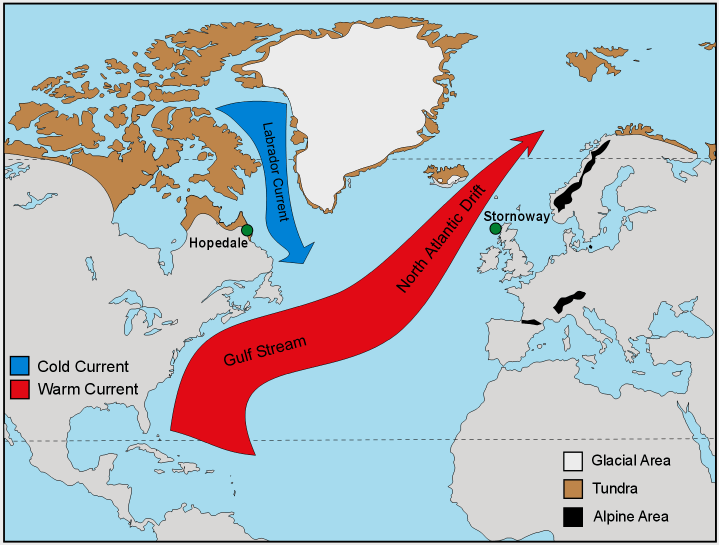
As the diagram below shows all too clearly, the cold waters from above the Arctic circle directly affect the Gulf Stream.

gulfstream

From the website of the National Snow & Ice Data Center:

Average sea ice extent for February 2013 was 14.66 million square kilometers (5.66 million square miles). This is 980,000 square kilometers (378,000 square miles) below the 1979 to 2000 average for the month, and is the seventh-lowest February extent in the satellite record.

Less ice means more cold water. QED!

OK, moving on.

We met recently with Wayne over at Rogue Valley Firewood here in Merlin.  Not to buy more firewood but because Wayne has started into hugelkultur.  Jean and I hadn’t heard of the term before.  Come back to that in a moment.

In musing with Wayne about how rapidly life is changing for us all, he spoke of the consequence of rising fuel prices and the rising costs of putting petrol (OK, he used the word ‘gas’!) in one’s car.  Wayne pointed out the obvious.  That the inevitable effect of those rising costs would be to steadily reduce one’s range for ‘affordable’ car journeys.  Many people will no longer be able to afford to drive longer distances.

In other words, local will increasingly become more relevant to daily life.  Or to use a better word than local, community will return to the centre stage of our world.  And of all the things important to a community, none is more so than access to food.

Back to Hugelkultur. Watch this video:

Wayne is committed to seeing just what can be grown for the local community of Merlin using this form of raised garden bed.  You can read more here.

Is this just a piece of fun?  Most definitely not!

Here’s a recent item from Grist.

This sobering map shows you all of America’s food deserts

By Sarah Laskow

The USDA’s new Food Access Research Atlas is a map of all the places in the country where people live in food deserts — places where it’s difficult to access fresh food.

food-deserts1

More details here.

The message that hits me from that map is the consequence for millions of people, especially those in rural areas or unable to afford a car, when it comes to getting hold of fresh food.  Another reason why community food programs are going to be a feature of the new tomorrows.

Finally, take a look at a recent item on Paul Gilding’s blogsite.

paulgildingportrait
Paul Gilding

Paul is an independent writer, advisor and advocate for action on climate change and sustainability. He recently published Victory at Hand for the Climate Movement? From which I offer:

There are signs the climate movement could be on the verge of a remarkable and surprising victory. If we read the current context correctly, and if the movement can adjust its strategy to capture the opportunity presented, it could usher in the fastest and most dramatic economic transformation in history. This would include the removal of the oil, coal and gas industries from the economy in just a few decades and their replacement with new industries and, for the most part, entirely new companies. It would be the greatest transfer of wealth and power between industries and countries the world has ever seen.

To understand this incredible potential we first have to step back and understand the unique structure of this social change movement, which may rank among the most influential in history. It is simplistic to characterise it as an alliance of grass roots organisations and activists pitched against a rich and well connected adversary. While that is part of the story, it is more accurately understood as an idea whose tentacles reach into every tier of government, the world’s largest companies and financial institutions, and throughout the academic and science communities.

Because of this, it is winning the battle from within: Its core arguments and ideas are clearly right; being endorsed by the world’s top science bodies and any significant organisation that has examined them.

Read the full article here.

Strikes me that in one very important way, we will be reverting to how our ancient hunter-gatherer ancestors lived.  I mean reverting to living our lives as relatively small interdependent communities almost exclusively at the local level.

Guess what!  Yet another aspect of learning from dogs.  In the wild, dogs live in groups of about 50 animals with clear boundaries to their territory.  Just like the ancestors of the domesticated dog and the wild dog: The grey wolf Canis Lupus.

Grey wolf Canis Lupus

See you all tomorrow!

The ‘food’ we eat!

Food miles: Another tragic aspect of modern life.

Last week I had to travel from Merlin in Southern Oregon up to Portland, a round-trip distance of 480 miles.  The vast majority of the journey was along Highway I5, most of which is a 2-lane highway, significantly harder driving than a 3 or more laned highway.

It was the first time I had driven North along I5 since Jean and I moved to Merlin last October.  What staggered me were the huge number of trucks on the highway, many of them food trucks from California and beyond.  Also noticed at regular intervals were very large industrial buildings that were described as food distribution centres.

Kingsolverbook

Another connection to today’s reflections is that I am about 50 pages into Barbara Kingsolver’s book Animal, Vegetable, Miracle.  The book is the account of Barbara’s family spending a year deliberately eating home-grown and local food. The book’s subtitle is ‘A Year of Food Life‘ and, inevitably, the book has a website here.

So the book and the journey to Portland got me thinking about food miles and the huge transport distances of so much of what we eat today.

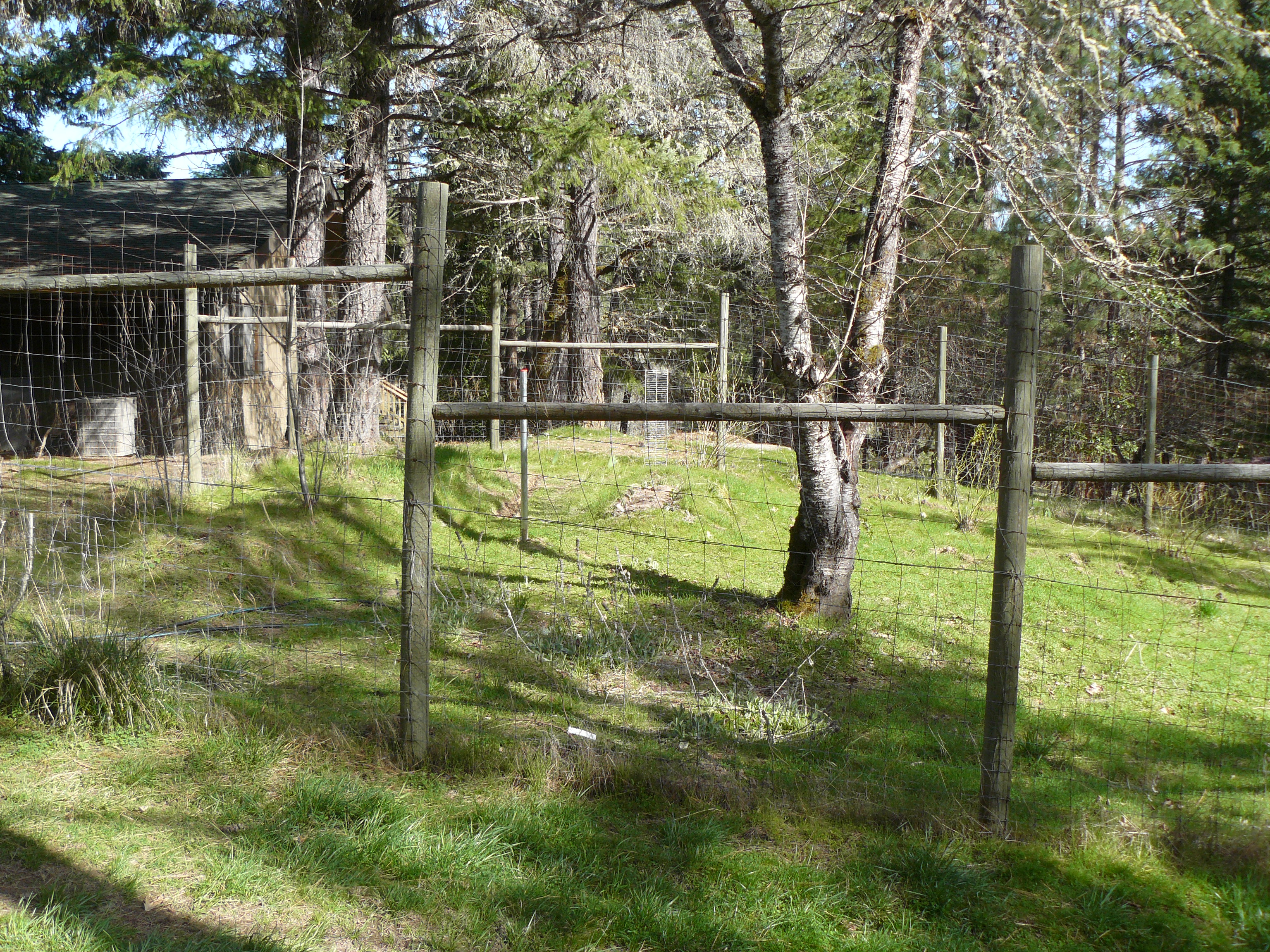
Jean and I were incredibly lucky when we bought this property last year to discover that it had a mature vegetable garden surrounded by a deer-proof fence, as the following photograph partially shows.

P1120667


So even before considering the food miles we are saving from ‘grow-your-own’, we were enthusiastically planting a whole variety of vegetables.  Here’s a rhubarb plant that went in last Saturday.

P1120665


Anyway, I’m rather meandering along – anyone still awake!

The whole point of this long introduction is to highlight a fabulous film that we have watched over the weekend.  Called Edible City: Grow The Revolution we came across it on Top Documentary Films, great source of films by the way if you don’t know it.

Luckily it is on YouTube as well.

Here’s the full film:

It’s an inspiring account of what it means for a community to take control of their food, ergo a strong recommendation to watch it in full.

If you want a taste of the film (pardon the pun!), here are two trailers.

and

plus much more information from the film’s website.

So why don’t you join the millions of people already buying from their local Farmers’ Market.  For the USA you can find your nearest market using this website and for the United Kingdom try the Local Foods website.

Not only will it give you access to much healthier food, it is a very practical way of reducing our use of energy.

Welcome Home

Sharing the truth of who each of us really is!

I subscribe to Christine’s blog 350 or bust.  As the home page declares, Christine is “a mother, an educator, and a former registered nurse, concerned about climate change.”

Being a follower of Christine’s blog I automatically received an email on Tuesday about her latest post.  This is what that email said,

It’s TED Talk Tuesday on 350orbust. Here’s a fascinating TEDx talk by South African trainer and speaker Bruce Muzik whose “passion is having people experience unprecedented freedom and happiness, through being Authentic.

To be perfectly honest, it didn’t strike me as something that I would watch anytime soon.  However, fate decided to intervene!

Because yesterday, Wednesday, I went up to Portland for an interview today to convince the authorities that I was safe to have my US Residency renewed (aka Green Card).  So last Tuesday, when I was writing these words, I thought I would just grab something quickly for today’s post.  Christine’s TED talk seemed an easy answer.

I started to watch the video and within just a few minutes was overwhelmed with Bruce Muzik’s story.  At the 7 minute mark I paused the video and wrote these words.  The title of today’s post comes from the video just a moment after the 7 minute point.

While the video is about Bruce confronting his inner fears over his racial prejudices, and is no less moving for doing that, there was another message surfacing in parallel in my consciousness.

As I wrote not so long ago under the title of Going beyond the self, “the human psyche lives in a bubble of delusion.”  In the same way that Bruce had to cast aside his delusions and embrace the reality of black people, we have to cast aside our delusions about the way the world is heading.  Which is why Christine’s title How Our Secrets Steal Our Lives was just perfect.

So without further ado, here is that speech by Bruce Muzik. Twenty minutes of pure, gorgeous inspiration.

Want more? Bruce has a blog here.

Love in the Present Tense

And now for something completely different!

Sweeny playing in our creek.

Jean and I were looking for something to watch on Wednesday evening and, as is our want, took a browse through the latest films on Top Documentary Films.

There was an intriguing title under the recently added list – People in Motion.

This was how the film was described.

We were hunters and foragers. The frontier was everywhere. We were bounded only by the earth, the ocean and the sky.

Today we go about our business, unencumbered by the frontier. Society guides us, it gives us permission to drive on roads, to stop at red lights, and go on green.

But something is not right.

It often feels as if something is missing. As if the life society has allowed isn’t quite enough.  We spend so much time planning for the future it seems we’re forgetting how to live in the moment. How to feel deep and profound satisfaction with life.

It was this feeling that led us to watch people in cities, trying to understand what drives them. They typically did the same three things: walk, sit and shop.

People in Motion is a film showcasing the potential people have to move through time and space. The film is shot in true slow motion edited using a composite technique which illustrates stretches of time in an instant.

Now before you watch the film, and I really hope you do, just reflect on our closest animal companion; dogs.  As is stated on the home page of Learning from Dogs,

Dogs live in the present – they just are!  Dogs make the best of each moment uncluttered by the sorts of complex fears and feelings that we humans have.

One of the many wonderful ways that dogs enjoy the present is through play.

Rain had raised the flow of water in our creek and earlier on that Wednesday we had given the dogs a run in the rain.  Of course, they went immediately to the creek to play in the rushing waters.  The top picture shows Sweeny doing just that, Pharaoh equally having fun as below.

The simple joy of playing in the water.

Play is so important for humans as well as dogs.

Now watch the film and be amazed – the music is pretty cool as well.

Published on Dec 31, 2012

Music by…
* Lindsey Stirling:
** songs: Crystallize, Transcendence

* Niklas Aman:
** songs: Stirred Up, Momentum, Up A Storm

* Michael Marantz:
** song: Earth – The Pale Blue Dot

Directed by: Cedric Dahl
Produced by: Bennett Hoffman
Staring: Paul Whitecotton, Brian Orosco, David Agajanian, Lonnie Tisdale, Jacob Siel

Finally, after you have watched the film you will enjoy this interview with film director Cedric Dahl.  But watch the film first!!

Nature is in charge!

It really is an obvious statement!

I am indebted to my son for dropping me an email with a link to a recent BBC Radio programme.  It was from the long-running programme series In Our Time, presented by the consummate broadcasting professional Melvyn Bragg.

Melvyn Bragg
Melvyn Bragg

The WikiPedia entry details, The Rt. Honourable The Lord Bragg no less,

Melvyn Bragg, Baron BraggFRSFBAFRSAFRSLFRTS (born 6 October 1939), is an English broadcaster and author, best known for his work with the BBC and for ITV presenting the The South Bank Show (1978–2010). Since 1998 he has presented over 550 weekly episodes of the BBC Radio discussion programme In Our Time.

Bragg was born on 6 October 1939 in Carlisle, the son of Mary Ethel (née Park), a tailor, and Stanley Bragg, a stock keeper turned mechanic.[3]He attended the Nelson Thomlinson School in Wigton and read Modern History at Wadham College, Oxford in the late 1950s and early 1960s.

This particular episode was called Ice Ages; the link will take you to the programme page which includes the ability to listen to the 43 minutes long episode.  (Alternatively, you can go straight to the recording via the BBC iPlayer.)  The programme page explains:

ICE AGES

Jane Francis, Richard Corfield and Carrie Lear join Melvyn Bragg to discuss ice ages, periods when a reduction in the surface temperature of the Earth has resulted in ice sheets at the Poles. Although the term ‘ice age’ is commonly associated with prehistoric eras when much of northern Europe was covered in ice, we are in fact currently in an ice age which began up to 40 million years ago. Geological evidence indicates that there have been several in the Earth’s history, although their precise cause is not known. Ice ages have had profound effects on the geography and biology of our planet.

With:

Jane Francis
Professor of Paleoclimatology at the University of Leeds

Richard Corfield
Visiting Research Fellow in the Department of Earth Sciences at Oxford University

Carrie Lear
Senior Lecturer in Palaeoceanography at Cardiff University.

Producer: Thomas Morris

LINKS AND FURTHER READING

Dr Richard Corfield

Professor Jane Francis at the University of Leeds

Dr Caroline Lear at Cardiff University

Climate: Long range Investigation, Mapping, and Prediction – Wikipedia

Ice age – Wikipedia

Descent into the Icehouse

Now the programme requires careful listening as the conversation ranges rapidly about the number of ice ages, the intervening greenhouse periods and where we are at present.  It would be easy to end up thinking that we are in a cooling phase (we are not) or that it’s only a matter of time before we are back in the next ice age (in geological terms, yes).

Go to the programme blog and read this from Melvyn:

Hello

It was a close call. After the programme Jane Francis and Carrie Lear continued to talk about the climbing count of CO2 which was pumping up global warming, in their opinion, which would lead most dramatically to mass flooding. On the programme Richard Corfield did not join in very enthusiastically, pointing out that the CO2 count had been at least twice as high quite recently (geologically speaking) and even higher than that a bit before recently. The situation was beginning to develop into a relevant, contemporary conversation about climate change and the final bell was a merciful release. There was no thought of the ingenuity of men and women combating what would be a gradual increase (if it happens) of rising sea levels – we could have looked at the Dutch in the sixteenth century onwards. But I strayed from my task.

The grim conclusion of Jane Francis was never to buy or rent a house on a flood plain, always to buy or rent a house on a hill, or take a tent, or anything, as long as it’s on a hill and, I think Richard Corfield added, fortify it. Well, well. [my italics]

As I wrote yesterday, either Jane or Carrie, don’t recall whom, said on air just at the end that a CO2 level of nearly 400 ppm (January 2013: 395.55 ppm) is way above the range of levels where the Earth’s atmosphere has traditionally behaved in a stable manner.

In the end it really doesn’t matter geologically.

Our planet is approximately 4,540,000,000 years old.   As WikiPedia explains,

There have been five known ice ages in the Earth’s history, with the Earth experiencing the Quaternary Ice Age during the present time. Within ice ages, there exist periods of more severe glacial conditions and more temperate referred to as glacial periods and interglacial periods, respectively. The Earth is currently in an interglacial period of the Quaternary Ice Age, with the last glacial period of the Quaternary having ended approximately 10,000 years ago with the start of the Holocene epoch.

This graph shows the history of ice ages and the fact that we are close to turning upwards towards a hotter geological period.

Phanerozoic_Climate_Change

So we live on a planet that is 4.5 billion years old, towards the end of the current ice age that started 2.58 million years ago.

Contrast that with the age of homo sapiens.

Homo sapiens originated in Africa, where it reached anatomical modernity about 200,000 years ago and began to exhibit full behavioral modernity around 50,000 years ago.

Early man evolved from hunting and gathering into the domestication of plants and animals, in other words farming, about 10,000 years ago.  In these short years, from a geological perspective, we have lost total sight of the intimate relationship we had with the planet when our very survival depended on hunting and gathering.

In so little time!

Just reflect on the last 100 years of so-called modern agriculture.  It has been characterised by enhanced productivity, the replacement of human labour by synthetic fertilizers and pesticides, selective breeding, and mechanisation. It has been closely tied to political issues such as water pollution, biofuels, genetically modified organisms, tariffs, and farm subsidies. All of which explains the backlash against the external environmental effects of mechanised agriculture, and increasing support for the organic movement and sustainable agriculture.

One might say that we have been farming the planet in the most broadest of senses; as if the planet is nothing more than a bottomless pool of resources.

chief forgot name

Chief Jackie Thomas at the recent Forward-On-Climate rally talked about the toll that tar sands are already taking on her neighbors in Alberta, and promised that First Nations communities and their allies in Canada will never allow a pipeline to be built west to the Pacific.

Such peoples still in tune with their ancient heritage understand that humanity is first and foremost in and of the land.

But do you know what?

Nature doesn’t care!

The love of a dog

The widely reported story of a dog ‘adopting’ a baby chimpanzee.

(With big thanks to Chris Snuggs for sending me the pictures)

As a quick Google search finds:

Two years ago in a Russian zoo a female chimpanzee for some reason repudiated and abandoned her baby chimpanzee. When one of the employees of the zoo took the little chimpanzee home it never crossed her mind that her dog, a mastiff, would become a mother for the orphaned chimpanzee and treat the baby as her own child.

chris1

Judging by the look on her face at times, she is not quite sure why this particular offspring has hands to grab her with!

chris2

The unconditional love of a dog.

chris3

Fascinating example of the power of upbringing.

chris4

What is so wonderful, and amazing, is how ‘mother’ accepts this strange looking and strange smelling creature as it’s own.  Think how important smell is to dogs!

chris5

Words add nothing to the beauty of this photograph.

chris6

You can see the huge difference in body mass between these two.  One swipe, one bite and the little chimp would be toast!  The dog’s love for the chimp overrides all!

chris7

Just beautiful.

chris8

Mummy, what’s that on the wall?

chris9

Mummy, your feet are so big …. and not at all like mine!

oooOOOooo

Dear Chris, thank you so much for sending me these pictures.  It’s a privilege to share them with LfD readers.  It reminds us that in this difficult era, with so many challenges facing us, that there’s nothing that can’t be solved with love, compassion and understanding.

Do you or I really know who we are?

The strangeness of this species Homo sapiens.

My writings of the previous three days have explored the nature of man.  The many ways that we struggle to understand so many issues in our lives. In particular the biggest issue of them all since we abandoned the life of the hunter-gatherer.  Our very survival.

It would be so easy to beat oneself up.  To stare in the mirror and despair at all the unfinished ideas that one has about being ‘sustainable’ shortly before jumping on one’s shiny new tractor, yet another symbol of our industrial civilisation.  The hypocrisy, the double standards!

New tractor being delivered last December.
New tractor delivered last December.

But the mistake in any attempt at self-awareness is the assumption that you know who you are!  Therein lays the problem.!

Marcus Peter Francis du Sautoy is a very smart person.  This is how WikiPedia describes him.

sautoy
Prof. Marcus Sautoy

Marcus Peter Francis du SautoyOBE (born in London, 26 August 1965)[3] is the Simonyi Professor for the Public Understanding of Science and a Professor of Mathematics at the University of Oxford. Formerly a Fellow of All Souls College, and Wadham College, he is now a Fellow of New College. He is President of the Mathematical Association.

Prof. Sautoy came to the realisation that the thoughts that make us feel as though we know ourselves are easy to experience.  But where do those thoughts come from? Marcus Sautoy acknowledged that they are notoriously difficult to explain.

So, in order to find out where they come from Marcus subjects himself to a series of probing experiments.  With the help of a hammer-wielding scientist, Jennifer Aniston and a general anaesthetic, Professor Marcus du Sautoy goes in search of answers to one of science’s greatest mysteries: how do we know who we are? ,

He learns at what age our self-awareness emerges and whether other species share this trait.

Next, he has his mind scrambled by a cutting-edge experiment in anaesthesia. Having survived that ordeal, Marcus is given an out-of-body experience in a bid to locate his true self. And in Hollywood, he learns how celebrities are helping scientists understand the microscopic activities of our brain.

Finally, he takes part in a mind-reading experiment that both helps explain and radically alters his understanding of who he is.

All of this is covered in a fabulously interesting episode from Horizon, the excellent and long-running  BBC TV science and philosophy series.  Thankfully, it made its way onto YouTube.

It is just under an hour long but I promise you it will capture you from the very first moment.

Enjoy.  Even if you end up realising, as I did, what a strange person you are!

As Confucius reportedly wrote: Real knowledge is to know the extent of one’s ignorance.