For someone born on May 8th, 1926 he, perhaps, should be slowing down. But none of it. He is passionate about how we are endangering our planet. And having a public profile he is the right position to do something about it, albeit a warning statement.
Plus, he is not the only one doing something about it. For Extinction Rebellion are protesting in the London streets.
Sir David’s new programme lays out the science behind climate change, the impact it is having right now and the steps that can be taken to fight it.
“In the 20 years since I first started talking about the impact of climate change on our world, conditions have changed far faster than I ever imagined,” Sir David states in the film.
“It may sound frightening, but the scientific evidence is that if we have not taken dramatic action within the next decade, we could face irreversible damage to the natural world and the collapse of our societies.”
Speaking to a range of scientists, the programme highlights that temperatures are rising quickly, with the world now around 1C warmer than before the industrial revolution.
“There are dips and troughs and there are some years that are not as warm as other years,” says Dr Peter Stott from the Met Office.
“But what we have seen is the steady and unremitting temperature trend. Twenty of the warmest years on record have all occurred in the last 22 years.”
The programme shows dramatic scenes of people escaping from wildfires in the US, as a father and son narrowly escape with their lives when they drive into an inferno.
Scientists say that the dry conditions that make wildfires so deadly are increasing as the planet heats up.
Greenland is losing ice five times as fast as it was 25 years ago – Getty Images.
Some of the other impacts highlighted by scientists are irreversible.
“In the last year we’ve had a global assessment of ice losses from Antarctica and Greenland and they tell us that things are worse than we’d expected,” says Prof Andrew Shepherd from the University of Leeds.
“The Greenland ice sheet is melting, it’s lost four trillion tonnes of ice and it’s losing five times as much ice today as it was 25 years ago.”
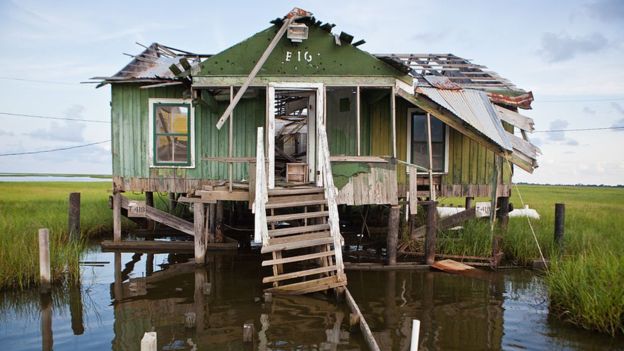
These losses are driving up sea levels around the world. The programme highlights the threat posed by rising waters to people living on the Isle de Jean Charles in Louisiana, forcing them from their homes.
“In the US, Louisiana is on the front line of this climate crisis. It’s losing land at one of the fastest rates on the planet – at the rate of of a football field every 45 minutes,” says Colette Pichon Battle, a director of the Gulf Coast Center for Law & Policy.
People are moving from parts of Louisiana in the US as a result of rising waters. – Julie Dermansky
“The impact on families is going to be something I don’t think we could ever prepare for.”
Hope rising
Sir David’s concern over the impacts of climate change has become a major focus for the naturalist in recent years.
This has also been a theme of his One Planet series on Netflix.
His new BBC programme has a strong emphasis on hope.
Sir David argues that if dramatic action is taken over the next decade then the world can keep temperatures from rising more than 1.5C this century. This would limit the scale of the damage.
“We are running out of time, but there is still hope,” says Sir David.
“I believe that if we better understand the threat we face the more likely it is we can avoid such a catastrophic future.”
The programme says that rapid progress is being made in renewable energy, with wind now as cheap as fossil fuels in many cases. It shows how technologies to remove and bury carbon dioxide under the ground are now becoming more viable.
But politicians will need to act decisively and rapidly.
“This is the brave political decision that needs to be taken,” says Chris Stark from the UK’s Committee on Climate Change.
Teenage campaigner Greta Thunberg has helped spark school strikes all over the world. – Getty Images.
“Do we incur a small but not insignificant cost now, or do we wait and see the need to adapt. The economics are really clear on this, the costs of action are dwarfed by the costs of inaction.”
The programme also highlights the rising generation of young people who are deeply concerned about what’s happening to the planet.
Swedish teenager Greta Thunberg explains that things can change quickly, despite the scale of the challenge on climate change.
“The first day I sat all alone,” she says, speaking of her decision to go on strike from school and sit outside the Swedish parliament to highlight the climate crisis.
“But on the second day, people started joining me… I wouldn’t have imagined in my wildest dreams that this would have happened so fast.”
Because you signed up on our website and asked to be notified, I’m sending you this special recall alert. If you no longer wish to receive these emails, please click the “unsubscribe” link at the bottom of this message.
Hill’s Pet Nutrition is expanding its recall of specific lots of its Prescription Diet and Science Diet dog foods due to elevated levels of vitamin D.
Very high levels of vitamin D can lead to serious health issues in dogs, including kidney dysfunction.
To learn which products are affected, please visit the following link:
Vitamin D, when consumed at very high levels, can lead to serious health issues in dogs including kidney dysfunction.
What’s Recalled?
The following products and lot numbers are affected by the recall.
Items marked in blue are new SKUs that were added to the list on March 20, 2019.
About Excessive Levels of Vitamin D
While vitamin D is an essential nutrient for dogs, ingestion of elevated levels can lead to potential health issues depending on the level of vitamin D and the length of exposure.
Dogs may exhibit symptoms such as vomiting, loss of appetite, increased thirst, increased urination, excessive drooling, and weight loss.
Pet parents with dogs who have consumed any of the products listed and are exhibiting any of these signs should contact their veterinarian.
In most cases, complete recovery is expected after discontinuation of feeding.
What to Do?
If your SKU, Date and Lot codes are found in the list above, you have an affected product.
You should stop feeding it and should return to the place of purchase for a full refund.
If you have questions, you may contact Hill’s Consumer Affairs at 800-445-5777.
U.S. citizens can report complaints about FDA-regulated pet food products by calling the consumer complaint coordinator in your area.
‘Brain tumour’ dog in Beauly had 7cm needle in neck
Toby the Yorkshire terrier had seizure symptoms before owners knew he had a needle lodged in his neck.
A dog that showed signs of a brain tumour was found to have a 7cm (3in) needle lodged in its neck.
Toby, a 13-year-old Yorkshire terrier, was taken to a vet in Nairn in the Highlands after he suffered neck pain, struggled to walk and showed seizure symptoms.
X-rays later showed the needle had pierced his spinal cord.
But surgeons in Edinburgh were able to extract it and Toby went on to make a full recovery.
X-rays revealed the 7cm metal sewing needle piercing Toby’s spinal cord
Owner Alexander Jamieson, from Beauly, near Inverness, said: “We feel that without the help of the experts in Edinburgh, Toby would not be here today.
“The care and attention he got was out of this world and we are delighted to see him back to his old self.”
Toby was referred to the specialist surgical clinic at the University of Edinburgh’s Hospital for Small Animals at the Royal (Dick) School for Veterinary Studies where vets performed a CT scan to assess any major damage to his spinal cord in August 2018.
They found that the sewing needle – which still had thread attached – was dangerously close to his brain.
Toby has now recovered to the point where he is able to walk and run normally.
Vets are delighted with Toby’s recovery
It is not known how the needle ended up in Toby’s neck but vets suspect that he could have eaten it or laid his head on it.
Samantha Woods, senior lecturer, and Jessica McCarthy, senior clinical training scholar in small animal surgery, said they were delighted with Toby’s progress.
Ms Woods added: “We are really pleased to see Toby back to full health, thanks to the combined efforts of his vets and our specialist teams here in Edinburgh.”
ooOOoo
That was fantastic! All kudos to the whole team that swung into action.
I am indebted to Margaret K. for including a number of videos in her long comment to my post The End Of Ice. They are being watched.
On Monday morning we watched one of them Deep Adaptation. It was a stark message.
It is included below. It’s 39 minutes long.
Please watch it!
Then if you are so minded their website is here. It’s free to join and you will be left with the feeling that you are doing something important. From that website:
The Union of Concerned Citizens of Earth
At some point we realize that humanity has strayed down a rabbit hole from which it cannot seem to emerge. This quagmire is the belief in the idea of Consumerism, with its cast of advertising executives, bankers and economists, corporate CEOs, politicians, etc. We have evolved a defective ‘operating system’ that insists on infinite, accelerating economic growth despite the ecological costs – namely the destruction of Nature. Those who have signed or endorsed the Scientists’ Warning through this website have displayed a clear understanding of what is wrong and how we must head to avoid the worst of ecological destabilization that we have inflicted on Mother Earth. We are all therefore de facto members of what we are calling the Union of Concerned Citizens of Earth.
“The world will have to start listening to the good scientists and not the ones paid to justify dodgy developments.”
– Greer Hart
On January 21st this year I republished a post by Tom Engelhardt and called it The song this planet needs to hear. His post was essentially a piece written for Tom by Dahr Jamail. It was called A Planet in Crisis and it included reference to a recently published book The End of Ice.
Subsequently, I decided to order the book by Dahr Jamail, it arrived a week ago and I ended up finishing it last Saturday.
I was minded to publish a review of the book, and here it is:
The End of Ice by Dahr Jamail
This is a book that I wished I had not read.
Yet, this is a book that once started I wanted to finish, and finish quickly.
It’s a brilliant book. Very impressive and very readable. But I speak of it from a technical point-of-view.
Now that I have finished it life will never be quite the same again. Nor, for that matter, for anyone else who chooses to read it.
Dahr Jamail has a background as a reporter, with some other books under his belt. But his reporting skills really come to the fore with The End Of Ice. For he has travelled the world speaking to experts in their own field and listening to what they say about the future prognosis of the planet that you and I, and everyone else lives on.
Earth has not seen current atmospheric CO2 levels since the Pliocene, some 3 million years ago. Three-quarters of that CO2 will still be here in five hundred years. Given that it takes a decade to experience the full warming effects of CO2 emissions, we are still that far away from experiencing the impact of all the CO2 that we are currently emitting. (p.5)
And if you are below the age of 60 or thereabouts you are going to experience this changing world head on. To be honest, whatever age you are things are starting to change.
Take this:
We are already facing mass extinction. There is no removing the heat we have introduced into our oceans, nor the 40 billion tons of carbon dioxide we pump into the atmosphere every single year. There may be no changing what is happening, and far worse things are coming. (p.218)
It really is a grim read. A grim but necessary read.
The eight chapters in the book spell out what is already happening. The diminishing glaciers and rising snow levels, the loss of coral, the rise in sea level and the loss of vast tracts of land as a consequence. Then there is the future of forests around the world. As I said, it is a grim read but a necessary one.
Towards the end of the book Dahr Jamail quotes author and storyteller Stephen Jenkinson:
“Grief requires us to know the time we’re in,” Jenkinson continues. “The great enemy of grief is hope. Hope is a four-letter word for people who are willing to know things for what they are. Our time requires us to be hope-free. To burn through the false choice of being hopeful and hopeless. They are the two sides of the same con job. Grief is required to proceed.” (p. 218)
Upon finishing this superb book, that you really do need to read, the one emotion that I was left with was grief. For what we have done to this planet. For what we are doing to this one and only home of ours.
Grief.
P.S. Dogs would not have done this to our beautiful planet.
I am going to publish a TomDispatch essay. Or rather, I am going to republish a piece written for Tom Engelhardt by Dahr Jamail. It doesn’t make for comfortable reading.
For a few days I agonised whether or not to republish it.
Then Tom wrote in an email to me: “Here’s what I think… or have, at least, thought these last 17 years… It’s better to plug on and do what you know should be done, say what you know should be said, no matter the state of the world, no matter whether anyone’s listening. That’s their problem, not ours. Better to do your best and hope that just one person notices and maybe just once that will be the person who makes all the difference.”
Dahr Jamail, a TomDispatch regular, reported strikingly from Iraq in the years after the 2003 American invasion of that country. Since then, he’s refocused the skills he learned as a war reporter on covering a fossil-fuelized war against the planet (and humanity itself). It goes by the mild name of climate change or global warming and, while a Trump tirade about the border or just about anything else gets staggering attention, the true crisis this planet faces, the one that our children and grandchildren will have to grimly deal with, remains distinctly a secondary matter not just in the news but in American consciousness. Yes, opinions are slowly changing on the subject, but not nearly fast enough. Something about the time scale of this developing crisis — no less that it could, in the end, take out human civilization and so much else — makes it hard to absorb. It’s increasingly evident that we are already living on a climate-changed planet whose weather is grimly intensifying. If you doubt this, just ask the inhabitants of Puerto Rico, Houston, or Paradise (California, that is). Its most devastating consequences will, however, be left to a future that still seems remarkably hard to absorb in an era of the endless Trump Twitch and in a time when we’re becoming ever more oriented to the social media moment.
In 2013, as Dahr Jamail mentions in his piece today, he penned a dispatch for this website on climate change. In my introduction to it, I wrote, “Still, despite ever more powerful weather disruptions — what the news now likes to call ‘extreme weather’ events, including monster typhoons, hurricanes, and winter storms, wildfires, heat waves, drought, and global temperature records — disaster has still seemed far enough off. Despite a drumbeat of news about startling environmental changes — massive ice melts in Arctic waters, glaciers shrinking worldwide, the Greenland ice shield beginning to melt, as well as the growing acidification of ocean waters — none of this, not even Superstorm Sandy smashing into that iconic global capital, New York, and drowning part of its subway system, has broken through as a climate change 9/11. Not in the United States anyway. We’ve gone, that is, from no motion to slow motion to a kind of denial of motion.”
Sadly, with different and more severe examples of every one of the phenomena mentioned above — four of the years since have, for instance, set new heat highs — that paragraph could stand essentially unchanged. In those same years, however, Jamail did anything but stand still. He traveled the planet, producing a remarkable new book, The End of Ice, which is being published today. It holds within its pages the most dramatic (and well-reported) of stories about what both the present and future will mean for us in climate-change terms. If it were up to him, we would all feel the desperate immediacy of our situation as we face the single greatest crisis since that ancestor of ours, Lucy, walked the edge of a lake in Ethiopia so many millions of years ago. I only hope that the passion in his piece today (and in the book it describes) carries a few of us into the new world we now inhabit, whether we care to know about it or not. Tom
I’m standing atop Rush Hill on Alaska’s remote St. Paul Island. While only 665 feet high, it provides a 360-degree view of this tundra-covered, 13-mile-long, seven-mile-wide part of the Pribilof Islands. While the hood of my rain jacket flaps in the cold wind, I gaze in wonder at the silvery waters of the Bering Sea. The ever-present wind whips the surface into a chaos of whitecaps, scudding mist, and foam.
The ancient cinder cone I’m perched on reminds me that St. Paul, was, oh so long ago, one of the last places woolly mammoths could be found in North America. I’m here doing research for my book The End of Ice. And that, in turn, brings me back to the new reality in these far northern waters: as cold as they still are, human-caused climate disruption is warming them enough to threaten a possible collapse of the food web that sustains this island’s Unangan, its Aleut inhabitants, also known as “the people of the seal.” Given how deeply their culture is tied to a subsistence lifestyle coupled with the new reality that the numbers of fur seals, seabirds, and other marine life they hunt or fish are dwindling, how could this crisis not be affecting them?
While on St. Paul, I spoke with many tribal elders who told me stories about fewer fish and sea birds, harsher storms and warming temperatures, but what struck me most deeply were their accounts of plummeting fur seal populations. Seal mothers, they said, had to swim so much farther to find food for their pups that the babies were starving to death before they could make it back.
And the plight of those dramatically declining fur seals could well become the plight of the Unangan themselves, which in the decades to come, as climate turbulence increases, could very well become the plight of all of us.
During breeding season, three-quarters of the Northern Fur Seal population can be found on the Pribilof Islands. They can dive to depths of 600 feet searching for small fish and squid. (Photo: Dahr Jamail)
Just before flying to St. Paul, I met with Bruce Wright in Anchorage, Alaska. He’s a senior scientist with the Aleutian Pribilof Islands Association, has worked for the National Marine Fisheries Service, and was a section chief for the National Oceanic and Atmospheric Administration for 11 years. “We’re not going to stop this train wreck,” he assures me grimly. “We are not even trying to slow down the production of CO2 [carbon dioxide], and there is already enough CO2 in the atmosphere.”
While describing the warming, ever more acidic waters around Alaska and the harm being caused to the marine food web, he recalled a moment approximately 250 million years ago when the oceans underwent similar changes and the planet experienced mass extinction events “driven by ocean acidity. The Permian mass extinction where 90% of the species were wiped out, that is what we are looking at now.”
I wrap up the interview with a heavy heart, place my laptop in my satchel, put on my jacket, and shake his hand. Knowing I’m about to fly to St. Paul, Wright has one final thing to tell me as he walks me out: “The Pribilofs were the last place mammoths survived because there weren’t any people out there to hunt them. We’ve never experienced this, where we are headed. Maybe the islands will become a refuge for a population of humans.”
The Loss Upon Us
For at least two decades, I’ve found my solace in the mountains. I lived in Alaska from 1996 to 2006 and more than a year of my life has been spent climbing on the glaciers of Denali and other peaks in the Alaska Range. Yet that was a bittersweet time for me as the dramatic impacts of climate change were quickly becoming apparent, including quickly receding glaciers and warmer winter temperatures.
After years of war and then climate-change reporting, I regularly withdrew to the mountains to catch my breath. As I filled my lungs with alpine air, my heart would settle down and I could feel myself root back into the Earth.
The Gulkana Glacier in the Alaska Range, like most glaciers globally, is losing mass rapidly. Some experts predict that every alpine glacier in the world will be gone by 2100. (Photo: Dahr Jamail)
Later, my book research would take me back onto Denali’s fast-shrinking glaciers and also to Glacier National Park in Montana. There I met Dr. Dan Fagre, a U.S. Geological Survey research ecologist and director of the Climate Change in Mountain Ecosystems Project. “This is an explosion,” he assured me, “a nuclear explosion of geologic change. This… exceeds the ability for normal adaptation. We’ve shoved it into overdrive and taken our hands off the wheel.” Despite its name, the park he studies is essentially guaranteed not to have any active glaciers by 2030, only 11 years from now.
My research also took me to the University of Miami, Coral Gables, where I met the chair of the Department of Geological Science, Harold Wanless, an expert in sea-level rise.
I asked him what he would say to people who think we still have time to mitigate the impacts of runaway climate change. “We can’t undo this,” he replied. “How are you going to cool down the ocean? We’re already there.”
As if to underscore the point, Wanless told me that, in the past, carbon dioxide had varied from roughly 180 to 280 parts per million (ppm) in the atmosphere as the Earth shifted from glacial to interglacial periods. Linked to this 100-ppm fluctuation was about a 100-foot change in sea level. “Every 100-ppm CO2 increase in the atmosphere gives us 100 feet of sea level rise,” he told me. “This happened when we went in and out of the Ice Age.”
As I knew, since the industrial revolution began, atmospheric CO2 has already increased from 280 to 410 ppm. “That’s 130 ppm in just the last 200 years,” I pointed out to him. “That’s 130 feet of sea level rise that’s already baked into Earth’s climate system.”
He looked at me and nodded grimly. I couldn’t help thinking of that as a nod goodbye to coastal cities from Miami to Shanghai.
In July 2017, I traveled to Camp 41 in the heart of the Brazilian Amazon rainforest, part of a project founded four decades ago by Thomas Lovejoy, known to many as the “godfather of biodiversity.” While visiting him, I also met Vitek Jirinec, an ornithologist from the Czech Republic who had held 11 different wildlife positions from Alaska to Jamaica. In the process, he became all too well acquainted with the signs of biological collapse among the birds he was studying. He’d watched as some Amazon populations like that of the black-tailed leaftosser declined by 95%; he’d observed how mosquitoes in Hawaii were killing off native bird populations; he’d explored how saltwater intrusion into Alaska’s permafrost was changing bird habitats there.
Orinthologist Vitek Jirinec at Camp 41. Some bird species in the Amazon have already declined by 95% since the 1980s. (Photo: Dahr Jamail)
His tone turned somber as we discussed his research and a note of anger slowly crept into his voice. “The problem of animal and plant populations left marooned within various fragments [of their habitat] under circumstances that are untenable for the long term has begun showing up all over the land surface of the planet. The familiar questions recur: How many mountain gorillas inhabit the forested slopes of the Virunga volcanoes, along the shared borders of the Democratic Republic of the Congo, Uganda, and Rwanda? How many tigers live in the Sariska Tiger Reserve of northwestern India? How many are left? How long can they survive?”
As he continued, the anger in his voice became palpable, especially when he began discussing how “island biogeography” had come to the mainland and what was happening to animal populations marooned by human development on fragments of land in places like the Amazon. “How many grizzly bears occupy the North Cascades ecosystem, a discrete patch of mountain forest along the northern border of the state of Washington? Not enough. How many European brown bears are there in Italy’s Abruzzo National Park? Not enough. How many Florida panthers in Big Cypress Swamp? Not enough. How many Asiatic lions in the Forest of Gir? Not enough… The world is broken in pieces now.”
“A Terrifying 12 Years”
In October 2018, 15 months after Jirinec’s words brought me to tears in the Amazon, the world’s leading climate scientists authored a report for the U.N. Intergovernmental Panel on Climate Change (IPCC) warning us that we have just a dozen years left to limit the catastrophic impacts of climate change. The gist of it is this: we’ve already warmed the planet one degree Celsius. If we fail to limit that warming process to 1.5 degrees, even a half-degree more than that will significantly worsen extreme heat, flooding, widespread droughts, and sea level increases, among other grim phenomena. The report has become a key talking point of political progressives in the U.S., who, likejournalist and activist Naomi Klein, are now speaking of “a terrifying 12 years” left in which to cut fossil fuel emissions.
There is, however, a problem with even this approach. It assumes that the scientific conclusions in the IPCC report are completely sound. It’s well known, however, that there’s been a political element built into the IPCC’s scientific process, based on the urge to get as many countries as possible on board the Paris climate agreement and other attempts to rein in climate change. To do that, such reports tend to use the lowest common denominatorin their projections, which makes their science overly conservative (that is, overly optimistic).
In addition, new data suggest that the possibility of political will coalescing across the planet to shift the global economy completely off fossil fuels in the reasonably near future is essentially a fantasy. And that’s even if we could remove enough of the hundreds of billions of tons of CO2 already in our overburdened atmosphere to make a difference (not to speak of the heat similarly already lodged in the oceans).
“It’s extraordinarily challenging to get to the 1.5 degree Celsius target and we are nowhere near on track to doing that,” Drew Shindell, a Duke University climate scientist and a co-author of the IPCC report, told the Guardian just weeks before it was released. “While it’s technically possible, it’s extremely improbable, absent a real sea change in the way we evaluate risk. We are nowhere near that.”
In fact, even best-case scenarios show us heading for at least a three-degree warming and, realistically speaking, we are undoubtedly on track for far worse than that by 2100, if not much sooner. Perhaps that’s why Shindell was so pessimistic.
For example, a study published in Nature magazine, also released in October, showed that over the last quarter-century, the oceans have absorbed 60% more heat annually than estimated in the 2014 IPCC report. The study underscored that the globe’s oceans have, in fact, already absorbed 93% of all the heat humans have added to the atmosphere, that the climate system’s sensitivity to greenhouse gases is far higher than thought and that planetary warming is far more advanced than had previously been grasped.
To give you an idea of how much heat the oceans have absorbed: if that heat had instead gone into the atmosphere, the global temperature would be 97 degrees Fahrenheit hotter than it is today. For those who think that there are still 12 years left to change things, the question posed by Wanless seems painfully apt: How do we remove all the heat that’s already been absorbed by the oceans?
Two weeks after that Nature article came out, a study in Scientific Reportswarned that the extinction of animal and plant species thanks to climate change could lead to a “domino effect” that might, in the end, annihilate life on the planet. It suggested that organisms will die out at increasingly rapid rates because they depend on other species that are also on their way out. It’s a process the study calls “co-extinction.” According to its authors, a five to six degree Celsius rise in average global temperatures might be enough to annihilate most of Earth’s living creatures.
To put this in perspective: just a two degree rise will leave dozens of the world’s coastal mega-cities flooded, thanks primarily to melting ice sheets in Greenland and Antarctica, as well as the thermal expansion of the oceans as they warm. There will be 32 times as many heat waves in India and nearly half a billion more people will suffer water scarcity. At three degrees, southern Europe will be in permanent drought and the area burned annually by wildfires in the U.S. will sextuple. These impacts, it’s worth noting, may already be baked into the system, even if every country that signed the Paris climate accord were to fully honor its commitments, which most of them arenot currently doing.
At four degrees, global grain yields could drop by half, most likely resulting in annual worldwide food crises (along with far more war, general conflict, and migration than at present).
The International Energy Agency has already shown that maintaining our current fossil-fueled economic system would virtually guarantee a six-degreerise in the Earth’s temperature before 2050. To add insult to injury, a 2017 analysis from oil giants BP and Shell indicated that they expected the planet to be five degrees warmer by mid-century.
In late 2013, I wrote a piece for TomDispatch titled “Are We Falling Off the Climate Precipice?” Even then, it was already clear enough that we were indeed heading off that cliff. More than five years later, a sober reading of the latest climate change science indicates that we are now genuinely in free fall.
The question is no longer whether or not we are going to fail, but how are we going to comport ourselves in the era of failure?
Listening While Saying Goodbye
It’s been estimated that between 150 and 200 plant, insect, bird, and mammal species are already going extinct every day. In other words, during the two and a half years I worked on my book 136,800 species may have gone extinct.
We have a finite amount of time left to coexist with significant parts of the biosphere, including glaciers, coral, and thousands of species of plants, animals, and insects. We’re going to have to learn how to say goodbye to them, part of which should involve doing everything we humanly can to save whatever is left, even knowing that the odds are stacked against us.
For me, my goodbyes will involve spending as much time as I can on the glaciers in Washington State’s Olympic National Park and North Cascades National Park near where I live, or far more modestly taking in the trees around my home on a daily basis. It’s unclear, after all, how much longer such forest areas are likely to remain fully intact. I often visit a small natural altar I’ve created amid a circle of cedar trees growing around a decomposing mother tree. In this magical spot, I grieve and express my gratitude for the life that is still here. I also go to listen.
Where do you go to listen? And what are you hearing?
For me, these days, it all begins and ends with doing my best to listen to the Earth, with trying my hardest to understand how best to serve, how to devote myself to doing everything possible for the planet, no matter the increasingly bleak prognosis for this time in human history.
Perhaps if we listen deeply enough and regularly enough, we ourselves will become the song this planet needs to hear.
——–
Dahr Jamail, a TomDispatch regular, is a recipient of numerous honors, including the Martha Gellhorn Award forJournalism for his work in Iraq and the Izzy Award for Outstanding Achievement in Independent Media in 2018. His newest book,The End of Ice: Bearing Witness and Finding Meaning in the Path of Climate Disruption(The New Press), has just been published. He is also the author of Beyond the Green Zone and The Will to Resist. He is a staff reporter for Truthout.
[Note: This piece was co-published with Truthout.org.]
I’m still too close to it to gauge my own reactions. So I will close with this:
TomDispatch author and naturalist William DeBuys has this to say about it: “In a sane world The End of Ice would be the end of lame excuses that climate change is too abstract to get worked up about. From the Arctic to the Amazon, from doomed Miami to the Great Barrier Reef, Dahr Jamail brings every frontier in our ongoing calamity into close focus. The losses are tangible. And so is the grief. This is more than a good book. It is a wise one.”
Californian law change means pet shops can sell only rescued animals
December 30th, 2018.
It is hoped the law will encourage pet adoptions.
California is set to become the first state in the US to ban the sale of non-rescue animals in pet shops.
The new law, known as AB 485, takes effect on 1 January. Any businesses violating it face a $500 (£400) fine.
The change means cats, dogs and rabbits sold by retailers cannot be sourced from breeders, only from animal shelters.
Animal rights groups have heralded it as a step forward against so-called “kitten factories” and “puppy mills”.
They say the current “high-volume” industries, where pets are bred for profit, can lead to inhumane treatment and long-term emotional and physical health problems in some animals.
The new state-wide law, approved in late 2017, will now require shops to maintain sufficient records of where they sourced each animal, for periodic checks by authorities.
It does not, however, affect sales from private breeders or owner-to-owner sales.
Some Californian shop owners have raised concern the law could put them out of business. The measure has also seen resistance from the American Kennel Club, which said it limits pet owners.
It is estimated that more than than 860,000 cats are euthanised in the US every year
The California assembly member who introduced the legislation, Patrick O’Donnell, has insisted the legislation is not just “a big win” for “four-legged friends”, but for California taxpayers too, as they spend hundreds of millions on sheltering animals across the state.
“It takes the emphasis off the profit of animals and puts the emphasis back on caring for and getting these cats and dogs a good home,” prospective owner Mitch Kentdotson said.
AB 485 is the first state-wide law of its kind, although other places have enacted similar regulations on pet sales on a local level.
January 14, 2019 — The U.S. Food and Drug Administration is warning pet owners not to feed one specific lot of A+ Answers Straight Beef Formula for Dogs after the Nebraska Department of Agriculture discovered Salmonella in the food.
Which Products?
The following product is affected:
A+ Answers Straight Beef Formula for Dogs
Lot # 2018 20/08 20
Why FDA Issuing This Warning
The FDA is issuing this warning because the affected product represents a serious threat to human and animal health and is adulterated under the Federal Food, Drug, and Cosmetic Act.
Lystn LLC (doing business as Answers Pet Food) recalled the affected product from distribution and retail locations in the state of Nebraska on December 20, 2018, but has not yet recalled the product nationwide.
The FDA is still working with Lystn to gather comprehensive distribution information and is issuing this warning to alert consumers about this public health risk.
About Salmonella
Salmonella is a bacterium that can cause illness and death in humans and animals, especially those who are very young, very old, or have weak immune systems.
People infected with Salmonella can develop diarrhea, fever and abdominal cramps.
Most people recover without treatment, but in some people, the diarrhea may be so severe that they need to be hospitalized.
In these patients, the Salmonella infection may spread from the intestines to the blood stream and then to other body sites unless the person is treated promptly with antibiotics.
Consult your health care provider if you have symptoms of Salmonella infection.
Pets do not always display symptoms when infected with Salmonella, but signs can include vomiting, diarrhea (which may be bloody), fever, loss of appetite and/or decreased activity level.
If your pet has these symptoms, consult a veterinarian promptly.
Why FDA Concerned About Salmonella in Pet Food
Pet foods contaminated with pathogens such as Salmonella are of particular public health importance because they can affect both human and animal health.
Pets can get sick from Salmonella, and may also be carriers of the bacteria and pass it onto their human companions without appearing to be ill.
Once Salmonella gets established in the pet’s gastrointestinal tract, the animal can shed the bacteria when it has a bowel movement, and the contamination will continue to spread.
Because animals can shed the bacteria when they have bowel movements, it’s particularly important to clean up the animal’s feces in yards or parks where people or other animals may become exposed, in addition to cleaning items in the home.
Federal law requires all pet food to be free of pathogens, including Salmonella.
Pet food manufacturers must effectively manage sourcing of ingredients, processing and packing to control pathogens.
Without an effective control, such as cooking, raw pet food is more likely than other types of pet food to contain pathogens such as Salmonella.
Pet owners who choose to feed raw pet food should be aware of the risks associated with these products.
What to Do?
Pet owners who have this lot of A+ Answers Straight Beef Formula for Dogs should discard it in a secure container where other animals, including wildlife, cannot access it.
Consumers who have had this product in their homes should clean refrigerators/freezers where the food was stored and clean and disinfect all bowls, utensils, food prep surfaces, pet bedding, toys, floors, and any other surfaces that the food or pet may have had contact with.
Clean up the pet’s feces in yards or parks where people or other animals may become exposed.
U.S. citizens can report complaints about FDA-regulated pet food products by calling the consumer complaint coordinator in your area.
On the back of yesterday’s article about dogs obtaining protein from eating soldier ants comes another piece from the BBC about fibre. It has much information some of which I hadn’t come across before.
So it’s another share with you.
ooOOoo
The lifesaving food 90% aren’t eating enough of.
By James Gallagher, Health and science correspondent, BBC News
January 11th, 2019.
Is there something in your cupboard that could extend your life?
If I offered you a superfood that would make you live longer, would you be interested?
Naturally it reduces the chances of debilitating heart attacks and strokes as well as life-long diseases such as type-2 diabetes.
And it helps keep your weight, blood pressure and cholesterol levels down.
I should mention it’s cheap and widely available in the supermarket.
What is it?
Fibre – it’s not the sexiest thing in the world but a major study has been investigating how much fibre we really need to be eating and found there are huge health benefits.
“The evidence is now overwhelming and this is a game-changer that people have to start doing something about it,” one of the researchers, Prof John Cummings, tells BBC News.
It’s well known for stopping constipation – but its health benefits are much broader than that.
How much fibre do we need?
The researchers, at the University of Otago, in New Zealand, and the University of Dundee say people should be eating a minimum of 25g of fibre per day.
But they call this an “adequate” amount for improving health and say there are benefits for pushing past 30g (1oz).
Is that all?
Well, a banana on its own weighs about 120g but that’s not pure fibre. Strip out everything else including all the natural sugars and water, and you’re left with only about 3g of fibre.
Most people around the world are eating less than 20g of fibre a day.
And in the UK, fewer than one in 10 adults eats 30g of fibre daily.
On average, women consume about 17g, and men 21g, a day.
Fibre is present in fruit, vegetables, wholegrain bread, pasta and lentils
What other foods have more fibre in them?
You find it in fruit and vegetables, some breakfast cereals, breads and pasta that use whole-grains, pulses such as beans, lentils and chickpeas, as well as nuts and seeds.
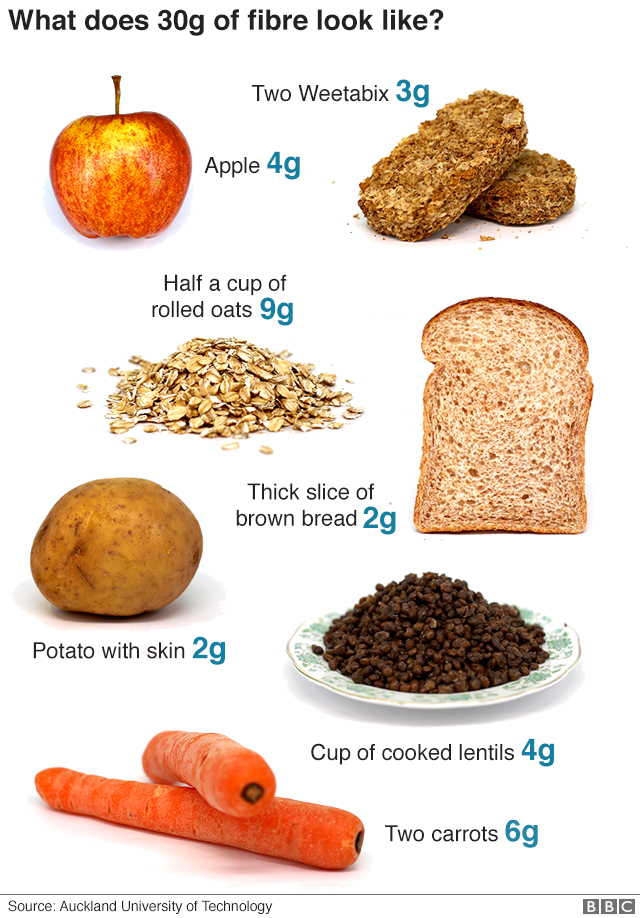
Elaine Rush, a professor of nutrition at Auckland University of Technology, has put together this example for getting into the 25-30g camp:
half a cup of rolled oats – 9g fibre | two Weetabix – 3g fibre | a thick slice of brown bread – 2g fibre | a cup of cooked lentils – 4g fibre | a potato cooked with the skin on – 2g fibre | half a cup of chard (or silverbeet in New Zealand) – 1g fibre | a carrot – 3g fibre | an apple with the skin on – 4g fibre
But she says: “It is not easy to increase fibre in the diet.”
Prof Cummings agrees. “It’s a big change for people,” he says. “It’s quite a challenge.”
cooking potatoes with the skin on | swapping white bread, pasta and rice for wholemeal versions | choosing high-fibre breakfast cereals such as porridge oats | chucking some chickpeas, beans or lentils in a curry or over a salad| having nuts or fresh fruit for snacks or dessert | consuming at least five portions of fruit or vegetables each day
Well, after analysing 185 studies and 58 clinical trials, the results are in and have been published in the Lancet medical journal.
It suggests if you shifted 1,000 people from a low fibre diet (less than 15g) to a high-fibre one (25-29g), then it would prevent 13 deaths and six cases of heart disease.
That’s during the course of these studies, which tended to follow people for one to two decades.
It also showed lower levels of type-2 diabetes and bowel cancer as well as lower weight, blood pressure and cholesterol levels.
And the more fibre people ate, the better.
What is fibre doing in the body?
There used to be a view that fibre didn’t do much at all – that the human body could not digest it and it just sailed through.
But fibre makes us feel full and affects the way fat is absorbed in the small intestine – and things really become interesting in the large intestines, when your gut bacteria get to have their dinner.
The large intestines are home to billions of bacteria – and fibre is their food.
It’s a bit like a brewery down there, admittedly one you wouldn’t want a pint from, where bacteria are fermenting fibre to make a whole load of chemicals.
This includes short-chain fatty acids, which are absorbed and have effects throughout the body.
“We have this organ set up to digest fibre, which a lot of people just don’t use very much,” says Prof Cummings.
Why is this relevant now?
The fact fibre and whole-grains and fruit and vegetables are healthy should not come as a surprise.
But there is concern people are turning their back on fibre, with the popularity of low-carb diets.
Prof Nita Forouhi, from the University of Cambridge, says: “We need to take serious note of this study.
“Its findings do imply that, though increasingly popular in the community at large, any dietary regimes that recommend very low-carbohydrate diets should consider the opportunity cost of missing out on fibre from whole-grains.
“This research confirms that fibre and whole-grain intakes are clearly important for longer term health.”
The study has been done to help the World Health Organization come up with official guidelines for how much fibre people should be eating to boost health and they are expected next year.
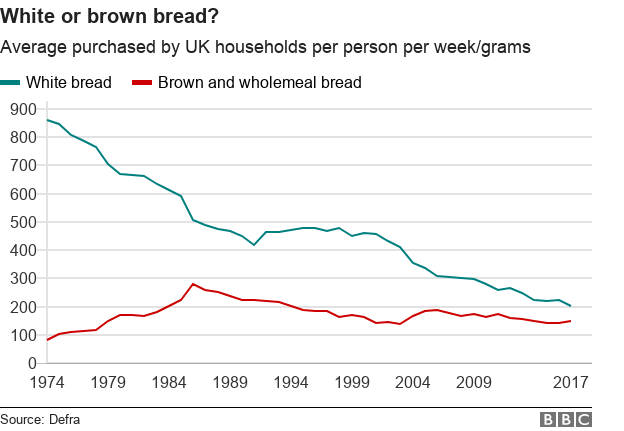
One of the suggested ways of boosting the amount of fibre in your diet is to switch from white bread to brown or wholemeal.
This is what has been happening to sales of those products, based on a succession of government surveys of household spending since 1974.
From the mid-seventies to the mid-eighties, white bread fell while brown and wholemeal rose.
Since then, white bread sales have continued to fall, but brown and wholemeal bread sales have been falling for most of that period, although at a slower rate.
So it looks as if while overall demand for bread has been falling, a higher proportion of bread sold has been higher fibre.
Whole wheat pasta has made less of an impact on sales than higher fibre breads, with a survey for the British Journal of Nutrition finding that pasta accounted for less than 1% of the occasions on which people were consuming whole grains.
ooOOoo
Well nothing much more to be said other than going vegan.






 While describing the warming, ever more acidic waters around Alaska and the harm being caused to the marine food web, he recalled a moment approximately 250 million years ago when the oceans underwent similar changes and the planet experienced mass extinction events “driven by ocean acidity. The Permian mass extinction where 90% of the species were wiped out, that is what we are looking at now.”