Category: Government

Consuming the living planet.

The eating habits of us humans have to change!

Funny how things go!

For just two days ago I published a post under the heading of Meat is Heat. It featured an essay by Michael Greger. He of the website NutritionFacts.org. That essay promoted the message:

What we eat may have more of an impact on global warming than what we drive.

Just cutting out animal protein intake one day of the week could have a powerful effect. Meatless Mondays alone could beat out a whole week of working from home and not commuting.

Many of you read that post.

On the same day that I published that post, George Monbiot published an article in The Guardian newspaper that offered the same message, albeit coming at it from a different place but nonetheless just as critically important.

Here it is republished with Mr. Monbiot’s very kind permission.

ooOOoo

We Can’t Keep Eating Like This

This is the question everyone should be attending to – where is the food going to come from?

By George Monbiot, published in the Guardian 11th December 2017

Brexit; the crushing of democracy by billionaires; the next financial crash; a rogue US president: none of them keeps me awake at night. This is not because I don’t care – I care very much. It’s only because I have a bigger question on my mind. Where is the food going to come from?

By mid-century there will be two or three billion more people on Earth. Any one of the issues I am about to list could help precipitate mass starvation. And this is before you consider how they might interact.

The trouble begins where everything begins: with soil. The UN’s famous projection that, at current rates of soil loss, the world has 60 years of harvests left, appears to be supported by a new set of figures. Partly as a result of soil degradation, yields are already declining on 20% of the world’s croplands.

Now consider water loss. In places such as the North China Plain, the central United States, California and north-western India – among the world’s critical growing regions – levels of the groundwater used to irrigate crops are already reaching crisis point. Water in the Upper Ganges aquifer, for example, is being withdrawn at 50 times its recharge rate. But, to keep pace with food demand, farmers in South Asia expect to use between 80 and 200% more water by 2050. Where will it come from?

The next constraint is temperature. One study suggests that, all else being equal, with each degree Celsius of warming the global yield of rice drops by 3%, wheat by 6% and maize by 7%. This could be optimistic. Research published in the journal Agricultural & Environmental Letters finds that 4°C of warming in the US Corn Belt could reduce maize yields by between 84 and 100%.

The reason is that high temperatures at night disrupt the pollination process. But this describes just one component of the likely pollination crisis. Insectageddon, caused by the global deployment of scarcely-tested pesticides, will account for the rest. Already, in some parts of the world, workers are now pollinating plants by hand. But that’s viable only for the most expensive crops.

Then there are the structural factors. Because they tend to use more labour, grow a wider range of crops and work the land more carefully, small farmers, as a rule, grow more food per hectare than large ones. In the poorer regions of the world, people with less than 5 hectares own 30% of the farmland but produce 70% of the food. Since 2000, an area of fertile ground roughly twice the size of the United Kingdom has been seized by land grabbers and consolidated into large farms, generally growing crops for export rather than the food needed by the poor.

While these multiple disasters unfold on land, the seas are being sieved of everything but plastic. Despite a massive increase in effort (bigger boats, bigger engines, more gear), the worldwide fish catch is declining by roughly 1% a year, as populations collapse. The global land grab is mirrored by a global seagrab: small fishers are displaced by big corporations, exporting fish to those who need it less but pay more. Around 3 billion people depend to a large extent on fish and shellfish protein. Where will it come from?

All this would be hard enough. But as people’s incomes increase, their diet tends to shift from plant protein to animal protein. World meat production has quadrupled in 50 years, but global average consumption is still only half that of the UK – where we eat roughly our bodyweight in meat every year – and just over a third of the US level. Because of the way we eat, the UK’s farmland footprint (the land required to meet our demand) is 2.4 times the size of its agricultural area. If everyone aspires to this diet, how do we accommodate it?

The profligacy of livestock farming is astonishing. Already, 36% of the calories grown in the form of grain and pulses – and 53% of the protein – are used to feed farm animals. Two-thirds of this food is lost in conversion from plant to animal. A graph produced last week by Our World in Data suggests that, on average, you need 0.01m2 of land to produce a gram of protein from beans or peas, but 1m2 to produce it from beef cattle or sheep: a difference of 100-fold.

It’s true that much of the grazing land occupied by cattle and sheep cannot be used to grow crops. But it would otherwise have sustained wildlife and ecosystems. Instead, marshes are drained, trees are felled and their seedlings grazed out, predators are exterminated, wild herbivores fenced out and other lifeforms gradually erased as grazing systems intensify. Astonishing places – such as the rainforests of Madagascar and Brazil – are laid waste to make room for yet more cattle.

Because there is not enough land to meet both need and greed, a global transition to eating animals means snatching food from the mouths of the poor. It also means the ecological cleansing of almost every corner of the planet.

The shift in diets would be impossible to sustain even if there were no growth in the human population. But the greater the number of people, the greater the hunger meat eating will cause. From a baseline of 2010, the UN expects meat consumption to rise by 70% by 2030 (this is three times the rate of human population growth). Partly as a result, the global demand for crops could double (from the 2005 baseline) by 2050. The land required to grow them does not exist.

When I say this keeps me up at night, I mean it. I am plagued by visions of starving people seeking to escape from grey wastes, being beaten back by armed police. I see the last rich ecosystems snuffed out, the last of the global megafauna – lions, elephants, whales and tuna – vanishing. And when I wake, I cannot assure myself that it was just a nightmare.

Other people have different dreams: the fantasy of a feeding frenzy that need never end, the fairytale of reconciling continued economic growth with a living world. If humankind spirals into societal collapse, these dreams will be the cause.

There are no easy answers, but the crucial change is a shift from an animal to a plant-based diet. All else being equal, stopping both meat production and the use of farmland to grow biofuels could provide enough calories for another 4 billion people and double the protein available for human consumption. Artificial meat will help: one paper suggests it reduces water use by at least 82% and land use by 99%.

The next Green Revolution will not be like the last one. It will rely not on flogging the land to death, but on reconsidering how we use it and why. Can we do this, or do we – the richer people now consuming the living planet – find mass death easier to contemplate than changing our diet?

http://www.monbiot.com

ooOOoo

As many of you know Jeannie and I changed our diet to a vegan diet some four weeks ago. It was done more for personal health reasons than from an awareness of the difference that it made to the future of the planet. But over the last few weeks we have had our eyes opened to the broader benefits of not eating meat. George Monbiot spells out the urgency of change for all of us, especially the richer people in the richer countries.

Am I hopeful that there will be a mass awareness of the need to change? I truly just don’t know. I will close be repeating Mr. Monbiot’s closing sentence.

Can we do this, or do we – the richer people now consuming the living planet – find mass death easier to contemplate than changing our diet?

Interesting times!

And more care required

Yet another dog food alert.

Reminds me of that wonderful quip about London buses. The one about waiting for ages for a bus and then two come more-or-less together!

For it was just twelve days ago that I republished a dog food alert concerning bone treats; or as the FDA described it:

The FDA reports it has received about 68 reports of pet illnesses related to “bone treats”.

Bone treats differ from regular uncooked butcher-type bones because they’re processed and packaged for sale as “dog treats”.

Then just early last Saturday there was an email that warned:

Darwin’s Natural Pet Products of Tukwila, Washington, has notified its customers that it is recalling 2 lots of its Natural Selections raw dog food products because they have the potential to be contaminated with Salmonella bacteria.

To learn which products are affected, please visit the following link:

Darwin’s Dog Food Recall of December 2017

Please be sure to share the news of this alert with other pet owners.

Mike Sagman, Editor
The Dog Food Advisor

Here are the full details of that alert.

ooOOoo

Darwin’s Dog Food Recall of December 2017

December 8, 2017 — Darwin’s Natural Pet Products of Tukwila, Washington, has notified distributors that it is recalling select lots of its Darwin’s Natural Selections dog food due to possible contamination with Salmonella bacteria.

What’s Recalled?

The product was shipped to distributors between September and early October 2017.

The affected product includes the following:

  • Natural Selections Turkey Meals for Dogs
    Net wt 2 lbs
    Lot #39937
    Manufacture date 08/24/17
  • Natural Selections Duck Meals for Dogs
    Net wt 2 lbs
    Lot #40487
    Manufacture date 09/29/17

Why Is It Recalled?

Through testing, the company determined that the products listed above, have the potential to be contaminated with Salmonella.

About Salmonella

Salmonella is a bacterial organism that can cause serious and sometimes life-threatening infections in people, particularly young children, frail or elderly people, and those with weakened immune systems.

There is risk to humans from handling contaminated products, especially if they have not thoroughly washed their hands after having contact with the product or any surfaces exposed to these products.

Some healthy individuals who are infected may experience fever, diarrhea, nausea, vomiting and abdominal pain.

In rare circumstances, infections can result in the organism getting into the bloodstream and producing more severe or chronic illness.

According to the FDA, it is uncommon for healthy dogs to become sick from Salmonella.

However, dogs with weakened immune systems (such as puppies or older dogs) have a higher risk of becoming sick.

Pets with infections may be lethargic and have diarrhea or bloody diarrhea, fever, and vomiting.

Some pets will have only decreased appetite, fever and abdominal pain.

Further information about Salmonella can be found on the Food and Drug Administration website.

Message from the Company

In an email message to distributors, Darwin’s president, Gary Tashjian writes…

We have not received any reports from customers regarding these meals, and are taking these steps out of an abundance of caution.

However, if your pet has consumed the recalled product and has any of the above symptoms, please contact your veterinarian if they persist.

We are recommending that you inspect your inventory of Darwin’s meals to determine if you have any left from the lot listed above.

If any of the above product is still in your inventory, please take the following steps:

Write down the lot number, date/time of manufacture and quantity of any product from the above lot remaining in your inventory.

Dispose of the product by placing it in a plastic bag, then placing the bag in the trash in a secure manner.

Contact us at productsafety@darwinspet.com to confirm that you have taken the above steps and to arrange for replacement of any unused product.

Please note the following:

Your name and address (or customer number)

The date and time of manufacture and quantity of food from this lot that you have remaining in your inventory

Confirmation that you have disposed of it.

We anticipate that some of our customers will have questions or concerns regarding this matter.

We welcome the opportunity to talk with you about it.

Toward that end, we have set up a special toll-free number for you to call: 866-832-8319 (Monday through Friday from 6 AM to 6 PM and Saturday 7 AM to 3 PM Pacific Time).

Please note that we may not be able to talk with each of you at once, so we do ask that you be patient, particularly if your issue is not of an urgent nature.

We regret any concern and/or inconvenience that this causes you.

We are taking steps to reduce the opportunity for this to occur again.

What to Do

U.S. citizens can report complaints about FDA-regulated pet food products by calling the consumer complaint coordinator in your area.

Or go to http://www.fda.gov/petfoodcomplaints.

Canadians can report any health or safety incidents related to the use of this product by filling out the Consumer Product Incident Report Form.

Get Dog Food Recall Alerts by Email

Get free dog food recall alerts sent to you by email. Subscribe to The Dog Food Advisor’s emergency recall notification system.FDA

ooOOoo

As always, please share this with other dog lovers.

Be careful!

Take notice regarding buying bones for your beloved dog!

The Dog Food Advisor service released this news yesterday:

The United States Food and Drug Administration has issued an important  warning regarding store-bought bone treats for dogs.

The associated treats have already caused numerous illnesses and even death in at least 15 dogs.

To learn which products are affected, please visit the following link:

FDA Warning: Store-Bought Bone Treats Could Kill Your Dog

Please be sure to share the news of this important recall event with other pet owners.

Mike Sagman, Editor
The Dog Food Advisor

If you go to that link you will read the following.

ooOOoo

FDA Warning: Store-Bought ‘Bone Treats’ Could Kill Your Dog

November 28, 2017 — The U.S. Food and Drug Administration has issued a warning regarding the purchase and use of store-bought “bone treats”. The FDA claims the danger goes beyond the risk of regular bones.

What’s a ‘Bone Treat’?

The FDA reports it has received about 68 reports of pet illnesses related to “bone treats”.

Bone treats differ from regular uncooked butcher-type bones because they’re processed and packaged for sale as “dog treats”.

Which Products?

A variety of commercially-available bone treats for dogs were listed in the reports including items described as:

  • “Ham Bones”
  • “Pork Femur Bones”
  • “Rib Bones”
  • “Smokey Knuckle Bones”

No specific brands are mentioned in the FDA bulletin.

The processed products may be dried through a smoking process or by baking. They may also contain other ingredients such as:

  • Preservatives
  • Seasonings
  • Smoke flavorings

According to Dr. Carmela Stamper, a veterinarian in the Center for Veterinary Medicine at the FDA…

“Giving your dog a bone treat might lead to an unexpected trip to your veterinarian, a possible emergency surgery, or even death for your pet.”

So, if you’re planning to give your dog a stocking full of bone treats this holiday season, you may want to reconsider.

Illnesses Reported

Illnesses reported to FDA by owners and veterinarians in dogs that have eaten bone treats have included:

  • Gastrointestinal obstruction (blockage in the digestive tract)
  • Choking
  • Cuts and wounds in the mouth or on the tonsils
  • Vomiting
  • Diarrhea
  • Bleeding from the rectum
  • Death

According to FDA, approximately 15 dogs have reportedly died after eating a bone treat.

How Widespread Is the Problem?

To date, reports submitted by pet owners and veterinarians have included about 90 dogs. Some reports included more than one dog.

In addition, FDA has received 7 reports of product problemssuch as…

  • Moldy-appearing bones
  • Treats splintering when chewed by the pet

How to Keep Your Dog Safe

FDA has included the following tips to help keep your dog safe:

  1. Chicken bones and other bones from the kitchen table can cause injury when chewed by pets, too. So be careful to keep platters out of reach when you’re cooking or the family is eating.
  2. Be careful what you put in the trash can. Dogs are notorious for helping themselves to the turkey carcass or steak bones disposed of there.
  3. Talk with your veterinarian about other toys or treats that are most appropriate for your dog. There are many available products made with different materials for dogs to chew on.

What to Do?

Dr. Stamper adds the following advice…

“We recommend supervising your dog with any chew toy or treat, especially one she hasn’t had before. And if she ‘just isn’t acting right,’ call your veterinarian right away!”

U.S. citizens can report complaints about FDA-regulated pet food products by calling the consumer complaint coordinator in your area.

Or go to http://www.fda.gov/petfoodcomplaints.

Canadians can report any health or safety incidents related to the use of this product by filling out the Consumer Product Incident Report Form.

Get Dog Food Recall Alerts by Email

Get free dog food recall alerts sent to you by email. Subscribe to The Dog Food Advisor’s emergency recall notification system.

ooOOoo

Please share this with other dog owners and carers who might not have seen the original announcement.

We must do everything we can to keep our dogs from harm!

Our beautiful planet.

It is the only lovely planet that we all have.

That ‘we’ being all the animals, plants, insects and humans there are.

I’m not saying anything new and not making this plea for the first time in this place.

But just take a few minutes out of your busy day to reflect that for you, for me, for everyone wherever they are in the world, physically and culturally, doing nothing is not an option.

More of that in a minute.

First I want to share with you a few autumnal photographs of our home here in Oregon.

Below was taken at 9am on October 24th showing the  mountain mist right down to the tops of our trees that mark the edge of our driveway from the house to our Hugo Road entrance.

Next, a sunrise photograph with the camera pointing to the East. The tree line follows the ridge of some hills the other side of Hugo Road. The picture taken on the 19th October at 07:20.
Now a close-up of the remains of a very old tree trunk with the trees that border Bummer Creek, that runs through our land, just showing through the morning mist. Taken on the 24th October at 09:05.

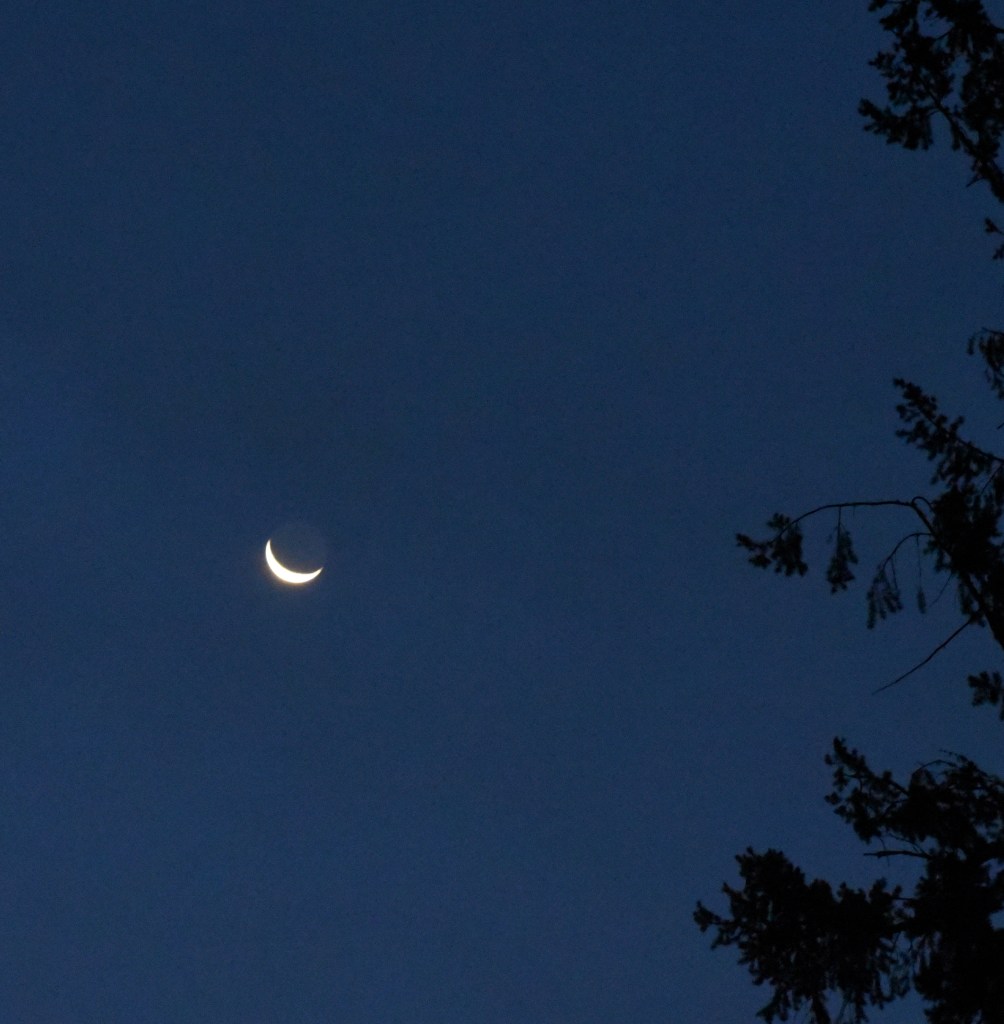
Final photograph I wanted to share with you is this beautiful sight of the moon taken from our property at 16:05 on the 25th. October.

Regular readers will know that Jean and I are not believers in any religion; we are atheists. But to my way of thinking that puts even more pressure on me and Jean to try to make a difference. We do all that we can but there’s no doubt that we can do more.

Yesterday, I referred to Bill Ripple, or to give him his full signature: William J. Ripple, Distinguished Professor of Ecology, Department of Forest Ecosystems and Society, Oregon State University, Corvallis, Oregon.

I sent Bill an email:

Dear Bill (and forgive the over familiarity if that offends),
I am a Brit, just turned 73, living with my beautiful wife, Jean, London-born as I was, down in Merlin, Oregon.

We live on 13 wonderful acres of rural property with 6 dogs (down from 12 when we moved here 5 years ago) and 4 horses, the majority of whom are ex-rescues.

I am the author of the blog Learning from Dogs and want to publish a post highlighting that viewpoint article. Because I believe with every neuron left in my ageing brain that the political changes that this world so urgently needs can only come when 99.9% of the public are screaming out “enough is enough”!

But there’s another saying that comes to mind, the one about being the change you want to see or something like that.

Is there information anywhere online that spells out, almost in words of one syllable, what lifestyle changes each of us can and need to commit to today? Changes that are as appropriate for elderly authors living in the country as young people seeking their first job or those up to their necks in working and raising families?

For that is what I want to publish on my blog!

If it would be easier for me to make an appointment to call you and take notes over the phone then I am just as happy to do that.

Sincerely,

Paul Handover
Hugo Road, Merlin,

Bill promptly replied:

Hi Paul, how long of a list of lifestyle changes do you want to make? Would three or four be enough? Bill

then followed that up with another email:

Paul, Consider suggesting that if people want to help, they could have fewer children, reduce energy consumption such as driving autos and flying, avoid meat and eat mostly plant-based foods and avoid wasting food. Below are quotes from our paper. Bill

“It is also time to re-examine and change our individual behaviors, including limiting our own reproduction (ideally to replacement level at most) and drastically diminishing our per capita consumption of fossil fuels, meat, and other resources ….

… reducing food waste through education and better infrastructure; promoting dietary shifts towards mostly plant-based foods

Now watch this video

I will close this post by listing out all the things that you and I can do now!

  • Set a target for reducing your car mileage next year compared to 2017,
  • If you are a regular aircraft passenger, then set a target for flying fewer hours in 2018 compared to 2017,
  • reduce or stop eating meat,
  • do not waste food,
  • reduce the use of heating and cooling in your home/s for next year,
  • commit to a dietary change away from meats and processed foods to a plant-based diet.

Then for younger couples who want a family around them, limit the number of children to a “replacement level” at most. Adopt??

A plea for this planet!

I feel compelled to ‘bang the drum’!

The recent news that many scientists have signed an open letter warning about how soon it will be too late to “save Earth” has been widely broadcast; not that this stops me from republishing the version of the news story that I read on the EarthSky blog site.

Here it is.

oooooh

Scientists warn: Soon it will be too late to save Earth

By Eleanor Imster in EARTH | HUMAN WORLD | November 16, 2017
More than 15,000 scientists in 184 countries have signed a letter urging the world to address major environmental concerns. “Soon it will be too late to shift course away from our failing trajectory, and time is running out.”

A letter to all of us, signed by more than 15,000 scientists (and counting) in 184 countries, warns that human well-being will be severely jeopardized by continuing trends in environmental harm, including our changing climate, deforestation, loss of access to fresh water, species extinctions and human population growth.

Entitled World Scientists’ Warning to Humanity: A Second Notice, it was published in the international journal Bioscience on November 13, 2017.

In 1992, more than 1,700 scientists signed a World Scientists’ Warning to Humanity published by the Union of Concerned Scientists. But global trends have worsened since 1992, the authors wrote in the new letter. In the last 25 years, trends in nine environmental issues suggest that humanity is continuing to risk its future.

Read the letter here.

The scientists wrote:

Soon it will be too late to shift course away from our failing trajectory, and time is running out. We must recognize, in our day-to-day lives and in our governing institutions, that Earth with all its life is our only home.

The letter also says …

By failing to adequately limit population growth, reassess the role of an economy rooted in growth, reduce greenhouse gases, incentivize renewable energy, protect habitat, restore ecosystems, curb pollution, halt defaunation, and constrain invasive alien species, humanity is not taking the urgent steps needed to safeguard our imperiled biosphere.

The article was written by an international team led by William Ripple of Oregon State University led the international team of scientists who created the letter. Ripple said in a statement:

Some people might be tempted to dismiss this evidence and think we are just being alarmist. Scientists are in the business of analyzing data and looking at the long-term consequences. Those who signed this second warning aren’t just raising a false alarm. They are acknowledging the obvious signs that we are heading down an unsustainable path. We are hoping that our paper will ignite a wide-spread public debate about the global environment and climate.

Progress in some areas — such as a reduction in ozone-depleting chemicals and an increase in energy generated from renewable sources — shows that positive changes can be made, the authors wrote. There has been a rapid decline in fertility rates in some regions, which can be attributed to investments in education for women, they added. The rate of deforestation in some regions has also slowed.

The warning came with steps that can be taken to reverse negative trends, but the authors suggested that it may take a groundswell of public pressure to convince political leaders to take the right corrective actions. Such activities could include establishing more terrestrial and marine reserves, strengthening enforcement of anti-poaching laws and restraints on wildlife trade, expanding family planning and educational programs for women, promoting a dietary shift toward plant-based foods and massively adopting renewable energy and other “green” technologies.

Scientists who did not sign the warning prior to publication can endorse the published warning here.

Bottom line: A letter entitled World Scientists’ Warning to Humanity: A Second Notice, urging the world to address major environmental concerns. was signed by more than 15,000 scientists in 184 countries.

Read more from Oregon State University

ooOOoo

As is the way with this modern inter-connected world it was but a moment to track down said William Ripple, find his email address and ask him what he recommended as the top things that you and I should be doing now.

Not just for you and me but for all the animals as well on this very beautiful planet.

Bill’s reply is part of tomorrow’ post. See you then!

Are we awake!

Returning to Earth with a bang!

My posts of the last few days have been in the ‘cuddly, cosy’ vein of life and, as many would say, a long way from the reality of this 21st century.

The reality is tough and scary and many, including me, favour running away from scary places. I’m sure that the urge to flee and hide is a survival behaviour from long time ago. BUT!! But the only hope for us humans is to face the facts full on.

Take, for example, the Ganges River. We have all heard of this famous river (my emphasis below):

The Ganges  is a trans-boundary river of Asia which flows through the nations of India and Bangladesh. The 2,525 km (1,569 mi) river rises in the eastern Himalayas in the Indian state of Uttarakhand, and flows south and east through the Gangetic Plain of North India into Bangladesh, where it empties into the Bay of Bengal. It is the third largest river in the world by discharge.

The source of the Ganges is the Gangotri glacier. Here it is:

Gaumukh, snout of the Gangotri glacier,surrounded by the Bhagirathi peaks of Garhwal Himalayas, at an altitude of over 4,000 metres. Photo: Vidya Venkat.

The photograph was taken from this article; from which I offer:

Scientists say dwindling snowfall affects volume of water fed to the Bhagirathi, the main source of the Ganga

After a four-hour-long trek from Bhojwasa, the final camping spot in Gangotri, when a brown, fractured pile of rocks finally came into view it was hard to believe that this was the mouth of the glacier from which the ‘holy’ Ganga emerged.

Gaumukh, the snout of the Gangotri glacier, named after its shape like the mouth of a cow, has retreated by over 3 kilometres since 1817, says glaciologist Milap Chand Sharma of Jawaharlal Nehru University.

It was nearly two centuries ago that the retreat of the glacier was first documented by John Hodgson, a Survey of India geologist.

With 10 Indian States reeling under drought and the country facing a severe water crisis after two weak monsoons, the story of retreating freshwater sources such as the Himalayan glaciers is worrying. And though a three-kilometre retreat over a period of two centuries might seem insignificant at first glance, data shows that the rate of retreat has increased sharply since 1971. The rate of retreat is 22 metres per year.

Twenty-two metres or seventy-two feet a year!

Wringing our hands is no good. All of us who care for our Living Planet have to shout out just what is going on. As George Monbiot continues to do. Take his latest essay, for example, that is republished here in full with GM’s very kind permission.

ooOOoo

Insectageddon

The scale and speed of environmental collapse is beyond imagination.

By George Monbiot, published in the Guardian 20th October 2017

Which of these would you name as the world’s most pressing environmental issue? Climate breakdown, air pollution, water loss, plastic waste or urban expansion? My answer is none of the above. Almost incredibly, I believe that climate breakdown takes third place, behind two issues that receive only a fraction of the attention.

This is not to downgrade the danger presented by global heating – on the contrary, it presents an existential threat. It is simply that I have come to realise that two other issues have such huge and immediate impacts that they push even this great predicament into third place.

One is industrial fishing, which, all over the blue planet, is now causing systemic ecological collapse. The other is the erasure of non-human life from the land by farming.

And perhaps not only non-human life. According to the UN Food and Agriculture Organisation, at current rates of soil loss, driven largely by poor farming practice, we have just 60 years of harvests left. And this is before the Global Land Outlook report, published in September, found that productivity is already declining on 20% of the world’s cropland.

The impact on wildlife of changes in farming practice (and the expansion of the farmed area) is so rapid and severe that it is hard to get your head round the scale of what is happening. A study published this week in the journal Plos One reveals that flying insects surveyed on nature reserves in Germany have declined by 76% in 27 years. The most likely cause of this Insectageddon is that the land surrounding those reserves has become hostile to them: the volume of pesticides and the destruction of habitat have turned farmland into a wildlife desert.

It is remarkable that we need to rely on a study in Germany to see what is likely to have been happening worldwide: long-term surveys of this kind simply do not exist elsewhere. This failure reflects distorted priorities in the funding of science. There is no end of grants for research on how to kill insects, but hardly any money for discovering what the impacts of this killing might be. Instead, the work has been left – as in the German case – to recordings by amateur naturalists.

But anyone of my generation (ie in the second bloom of youth) can see and feel the change. We remember the “moth snowstorm” that filled the headlight beams of our parents’ cars on summer nights (memorialised in Michael McCarthy’s lovely book of that name). Every year I collected dozens of species of caterpillars and watched them grow and pupate and hatch. This year I tried to find some caterpillars for my children to raise. I spent the whole summer looking and, aside from the cabbage whites on our broccoli plants, found nothing in the wild but one garden tiger larva. Yes, one caterpillar in one year. I could scarcely believe what I was seeing – or rather, not seeing.

Insects, of course, are critical to the survival of the rest of the living world. Knowing what we now know, there is nothing surprising about the calamitous decline of insect-eating birds. Those flying insects – not just bees and hoverflies but species of many different families – are the pollinators without which a vast tract of the plant kingdom, both wild and cultivated, cannot survive. The wonders of the living planet are vanishing before our eyes.

Well, I hear you say, we have to feed the world. Yes, but not this way. As a UN report published in March explained, the notion that pesticide use is essential for feeding a growing population is a myth. A recent study in Nature Plants reveals that most farms would increase production if they cut their use of pesticides. A study in the journal Arthropod-Plant Interactions shows that the more neonicotinoid pesticides were used to treat rapeseed crops, the more their yield declines. Why? Because the pesticides harm or kill the pollinators on which the crop depends.

Farmers and governments have been comprehensively conned by the global pesticide industry. It has ensured its products should not be properly regulated or even, in real-world conditions, properly assessed. A massive media onslaught by this industry has bamboozled us all about its utility and its impacts on the health of both human beings and the natural world.

The profits of these companies depend on ecocide. Do we allow them to hold the world to ransom, or do we acknowledge that the survival of the living world is more important than returns to their shareholders? At the moment, shareholder value comes first. And it will count for nothing when we have lost the living systems on which our survival depends.

To save ourselves and the rest of the living world, here’s what we need to do:

  1. We need a global treaty to regulate pesticides, and put the manufacturers back in their box.
  2. We need environmental impact assessments for the farming and fishing industries. It is amazing that, while these sectors present the greatest threats to the living world, they are, uniquely in many nations, not subject to such oversight.
  3. We need firm rules based on the outcomes of these assessments, obliging those who use the land to protect and restore the ecosystems on which we all depend.
  4. We need to reduce the amount of land used by farming, while sustaining the production of food. The most obvious way is greatly to reduce our use of livestock: many of the crops we grow and all of the grazing land we use are deployed to feed them. One study in Britain suggests that, if we stopped using animal products, everyone in Britain could be fed on just 3m of our 18.5m hectares of current farmland (or on 7m hectares if all our farming were organic). This would allow us to create huge wildlife and soil refuges: an investment against a terrifying future.
  5. We should stop using land that should be growing food for people to grow maize for biogas and fuel for cars.

Then, at least, nature and people would have some respite from the global onslaught. And, I hope, a chance of getting through the century.

http://www.monbiot.com

ooOOoo

Please do share this as widely as you can. Please do inform others. Please do make whatever changes, however small, you can within your own lives.

Bhagirathi Peaks from the Gangotri Glacier

And, please, please, listen to our Living Planet that is screaming out to us that this cannot go on!

A life on the commons.

The message of common land.

I am far from certain but I have this notion in my head that ‘Common Land’ is an English thing. Here’s a Wikipedia extract:

Common land is land owned collectively by a number of persons, or by one person, but over which other people have certain traditional rights, such as to allow their livestock to graze upon it, to collect firewood, or to cut turf for fuel.[1]

A person who has a right in, or over, common land jointly with another or others is called a commoner.[2]

This article deals mainly with common land in England, Wales and Scotland. Although the extent is much reduced due to enclosure of common land from the millions of acres that existed until the 17th century, a considerable amount of common land still exists, particularly in upland areas, and there are over 7,000 registered commons in England alone.[3][4]

Common land or former common land is usually referred to as a common; for instance, Clapham Common or Mungrisdale Common.

Despite the idea of common land having an English ‘ring’ to it common land is also found in the USA. Back to that Wikipedia reference:

Common land, an English development, was used in many former British colonies, for example in Ireland and the United States. The North American colonies adopted the English laws in establishing their own commons. A famous example is the New Haven Green in New Haven, Connecticut.

When I was living in Devon it was not unusual to take a walk with Pharaoh on some very famous open access land: Dartmoor.

Dartmoor: English countryside at its best.

So where the devil am I going with today’s post?

Last Thursday week, the 12th, I published my review of George Monbiot’s valuable book Out Of The Wreckage.

This book struck me as the most important book I have ever read in my lifetime. Why? Because it gets to the heart of what is happening today. But it offers even more than that. For instead of a shrug of the shoulders or eyes turned skywards from a friend when one mutters about the fact that we are living in ‘interesting times’, George Monbiot offers hope and guidance.

The day after I published my review George Monbiot published an article in The Guardian newspaper that threw more light on the commons philosophy and why, as in his book, he “offers hope and guidance”.

It is republished here with Mr. Monbiot’s generous permission. Yes, the focus is on British politics but GM’s core message applies equally to the USA and other countries.

ooOOoo

Labouratory

13th October 2017

We should use the political space being opened by the Labour resurgence to develop a new, participatory economy

By George Monbiot, published in the Guardian 11th October 2017

We are still living in the long 20th Century. We are stuck with its redundant technologies: the internal combustion engine; thermal power plants; factory farms. We are stuck with its redundant politics: unfair electoral systems; their capture by funders and lobbyists; the failure to temper representation with real participation.

And we are stuck with its redundant economics: neoliberalism, and the Keynesianism still proposed by its opponents. While the latter system worked very well for 30 years or more, it is hard to see how it can take us through this century, not least because the growth it seeks to sustain smacks headlong into the environmental crisis.

Sustained economic growth on a planet that is not growing means crashing through environmental limits: this is what we are witnessing, worldwide, today. A recent paper in Nature puts our current chances of keeping global heating to less than 1.5°C of at just 1%, and less than 2° at only 5%. Why? Because while the carbon intensity of economic activity is expected to decline by 1.9% a year, global per capita GDP is expected to grow by 1.8%. Almost all investment in renewables and efficiency is cancelled out. GDP, the index that was supposed to measure our prosperity, instead measures our progress towards ruin.

But the great rupture that began in 2008 offers a chance to change all this. The challenge now is to ensure that the new political movements threatening established power in Britain and elsewhere create the space not for old ideas (such as 20th Century Keynesianism) but for a new politics, built on new economic and social foundations.

There may be a case for one last hurrah for the old model: a technological shift that resembles the Second World War’s military Keynesianism. In 1941, the US turned the entire civilian economy around on a dime: within months, car manufacturers were producing planes, tanks and ammunition. A determined government could do something similar in response to climate breakdown: a sudden transformation, replacing our fossil economy. But having effected such a conversion, it should, I believe, then begin the switch to a different economic model.

The new approach could start with the idea of private sufficiency and public luxury. There is not enough physical or environmental space for everyone to enjoy private luxury: if everyone in London acquired a tennis court, a swimming pool, a garden and a private art collection, the city would cover England. Private luxury shuts down space, creating deprivation. But magnificent public amenities – wonderful parks and playgrounds, public sports centres and swimming pools, galleries, allotments and public transport networks – create more space for everyone, at a fraction of the cost.

Wherever possible, I believe such assets should be owned and managed by neither state nor market, but by communities, in the form of commons. A commons in its true form is a non-capitalist system, in which a resource is controlled in perpetuity by a community, for the shared and equal benefit of its members. A possible model is the commons transition plan commissioned by the Flemish city of Ghent.

Land value taxation also has transformative potential. It can keep the income currently siphoned out of our pockets in the form of rent – then out of the country and into tax havens – within our hands. It can reduce land values, bringing down house prices. While local and national government should use some of the money to fund public services, the residue can be returned to communities.

Couple this with a community right to buy, enabling communities to use this money to acquire their own land, with local commons trusts that possess powers to assemble building sites, and with a new right for prospective buyers and tenants to plan their own estates, and exciting things begin to happen. This could be a formula for meeting housing need, delivering public luxury and greatly enhancing the sense of community, self-reliance and taking back control. It helps to create what I call the Politics of Belonging.

But it doesn’t stop there. The rents accruing to commons trusts could be used to create a local version of the citizens’ wealth funds (modelled on the sovereign wealth funds in Alaska and Norway) proposed by Angela Cummine and Stewart Lansley. The gain from such funds could be distributed in the form of a local basic income.

And the money the government still invests? To the greatest extent possible, I believe it should be controlled by participatory budgeting. In the Brazilian city of Porto Allegre, the infrastructure budget is allocated by the people: around 50,000 citizens typically participate. The results – better water, sanitation, health, schools and nurseries – have been so spectacular that large numbers of people now lobby the city council to raise their taxes. When you control the budget, you can see the point of public investment.

In countries like the UK, we could not only adopt this model, but extend it beyond the local infrastructure budget to other forms of local and even national spending. The principle of subsidiarity – devolving powers to the smallest political unit that can reasonably discharge them – makes such wider democratic control more feasible.

All this would be framed within a system such as Kate Raworth’s doughnut economics which, instead of seeking to maximise growth, sets a lower bound of wellbeing below which no one should fall, and an upper bound of environmental limits, that economic life should not transgress. A participatory economics could be accompanied by participatory politics, involving radical devolution and a fine-grained democratic control over the decisions affecting our lives – but I will leave that for another column.

Who could lead this global shift? It could be the UK Labour Party. It is actively seeking new ideas. It knows that the bigger the change it offers, the greater the commitment of the volunteers on which its insurgency relies: the Big Organising model that transformed Labour’s fortunes at the last election requires a big political offer. (This is why Ed Miliband’s attempts to create a grassroots uprising failed).

Could Labour be the party that brings the long 20th Century to an end? I believe, despite its Keynesian heritage, it could. Now, more than at any other time in the past few decades, it has a chance to change the world.

http://www.monbiot.com

ooOOoo

Muddy rambles by Dartmoor Cross on Dartmoor.

The above photo was first seen on the South Downs Walking website.

All of you and all of your dogs have a wonderful weekend.

Out Of The Wreckage: A Review

This is one powerful book!

(Please note that I am letting this post run until Sunday, 15th Oct.)

For many years I have both read George Monbiot’s writings, especially those published by The Guardian newspaper, and deeply respected his insight, intelligence and analysis of the world in which we now live.

So when I heard of his latest book, published by Verso Books both sides of the ‘pond’, it was ordered immediately. It was a book I badly wanted to read. I was not disappointed.

So what is Mr. Monbiot’s message?

To answer that question let me lean on a forthcoming talk being given by him in Edinburgh in eight days time. For he is speaking at a Scottish Green Party event on October 20th.
Here’s the thrust of what is to be covered at that meeting:

What does the good life—and the good society—look like in the twenty-first century?

A toxic ideology rules the world – of extreme competition and individualism. It misrepresents human nature, destroying hope and common purpose. Only a positive vision can replace it, a new story that re-engages people in politics and lights a path to a better world.

Join us for an evening of discussion with George Monbiot as he talks about his new book: ‘Out of the wreckage: a new politics in an age of crisis‘. New findings in psychology, neuroscience and evolutionary biology cast human nature in a radically different light: as the supreme altruists and cooperators. George argues that we can build on these findings to create a new politics: a ‘politics of belonging’.

So what does this mean for social and environmental justice campaigning in Edinburgh? How do we create a politics of belongings here in Scotland? There will be plenty of opportunity for George Monbiot and the audience to share their insights.

Doors open: 6pm

George Monbiot will speak from 7-7.30pm and there will then be a Q&A, plus a chance buy books, mingle and browse stalls.

This event is jointly hosted by Global Justice Now and the Scottish Green party.

To my mind, this book not only addresses, full on, the madness (my word) of these present times but also offers strong, positive recommendations as to how we, as in the societies of all the major nations, can turn it around and offer a decent future for future generations. That’s why I am so strongly recommending it.

Take this extract from the review of George Monbiot’s book published by the Guardian newspaper on the 14th September this year:

For George Monbiot, neoliberalism should best be understood as a “story”, one that was conveniently on offer at precisely the moment when the previous “story” – namely Keynesianism – fell to pieces in the mid-1970s. The power of stories is overwhelming, as they are “the means by which we navigate the world. They allow us to interpret its complex and contradictory signals”. The particular story of neoliberalism “defines us as competitors, guided above all other impulses by the urge to get ahead of our fellows”.

Or this extract from the review published by The New Statesman:

It should be said at once that we are desperately in need of new ideas for a society and a democracy where trust in all established institutions is at a record low and even a Tory prime minister admits the country doesn’t work for everyone. Monbiot’s ideas are clear, well-reasoned and sometimes compelling. Many will mock his attempt at a “story of hope and restoration”; even some of his Guardian colleagues call him “George Moonshine”. Human beings, his critics will say, are inherently selfish and self-maximising. Give them the opportunity to freeload off others’ efforts and they will take it.

Such objections are easily dismissed. Yes, there’s a self-interested streak in all of us but, as Monbiot observes, we also have instincts for co-operation and sensitivity to others’ needs. Think of the hundreds who volunteer to run food banks and of the thousands more who donate to them. Think of those Europeans who, at great risk to themselves, sheltered Jews from the Nazis during the Second World War. The altruistic instinct can be kindled in almost anybody. It is suppressed, however, in a society that rewards the selfish but penalises – and brands as “mugs” – those who are more mindful of our needs, and the planet’s. That society has led to loneliness, high levels of mental illness and increasingly discordant political discourse. Shouldn’t we at least try developing a society that does more to nurture the better angels of our nature?

Better still, settle down with a cup of tea, put your feet up for fifteen minutes and listen to this:

This book struck me as the most important book I have ever read in my lifetime. Why? Because it gets to the heart of what is happening today. But it offers even more than that. For instead of a shrug of the shoulders or eyes turned skywards from a friend when one mutters about the fact that we are living in ‘interesting times’, George Monbiot offers hope and guidance.

Take the very last two paragraphs from the final chapter of his book.

Coming Home to Ourselves

Through restoring community, renewing civic life and claiming our place in the world, we build a society in which our extraordinary nature – our altruism, empathy and deep connection – is released.

When we emerge from the age of loneliness and alienation, from an obsession with competition and extreme individualism, from the worship of image and celebrity and power and wealth, we will find a person waiting for us. It is a person better than we might have imagined, whose real character has been suppressed. It is one who lives inside us, who has been there all along.

“- our altruism, empathy and deep connection -”

I see these persons every day of my life. Via the pages of this blog.

Yes, I am referring to all of you who wander in and out of this place, who demonstrate your compassion, your love and your dedication to the dogs and all the other animals of this world.

Read this book!

Dogs save us in many ways.

With the recent earthquakes in Mexico being a glorious example of that!

Nobody would have missed out on the news of the terrible catastrophe of the  recent earthquakes in Mexico.

As seen on the NBC news site.

Mexico Earthquake Death Toll Climbs as Dozens Sleep on Streets

JUCHITAN, Mexico — The death toll from one of the most powerful earthquakes ever recorded in Mexico rose to at least 61 early Saturday as workers scrambled to respond to the destruction just as Hurricane Katia struck its coastline.

The 8.1 quake off the southern Pacific coast just before midnight Thursday toppled hundreds of buildings in several states. Hardest-hit was Juchitan, Oaxaca, where 36 people died and a third of the city’s homes collapsed or were otherwise rendered uninhabitable, President Enrique Pena Nieto said late Friday in an interview with the Televisa news network.

It’s impossible to truly appreciate the terror of such an event unless one has had the misfortune of already living through such an earthquake. Likewise, almost as difficult to appreciate the terror of being trapped.

But thank goodness for dogs that are trained to sniff out those trapped persons. Such as Frida who saved so many lives down in Mexico. Here’s the account of Frida’s special deeds as carried on the Care2 site.

ooOOoo

Frida, the Heroic Rescue Dog, Saves Lives After Mexico’s Earthquake

By: Laura Goldman,   September 25, 2017

About Laura   Follow Laura at @lauragoldman

Photos and videos of a rescue dog named Frida have gone viral — complete with her cute-yet-necessary work uniform: doggie goggles, vest and four protective, Velco-strapped booties. She has become a four-legged symbol of hope during these dark times in Mexico.

Although, contrary to some early news reports, Frida didn’t really rescue 52 people after the devastating 7.1 earthquake struck Mexico Sept. 19, the 7-year-old yellow Labrador retriever has nonetheless become a media sensation.

What’s true is that prior to the earthquake, Frida (she’s named after the artist Frida Kahlo) had helped rescue 12 people and recover the bodies of 40 people during her career as a disaster rescue dog with the Mexican Navy’s (SEMAR) Canine Unit.

Working with 14 other dogs in the unit, she has located 12 victims of the Sept. 19 quake so far.

Frida’s first mission after the earthquake struck was to find survivors at the Enrique Rebsamen School in Mexico City. Eleven children were found alive by other emergency workers. Tragically, 19 children and six adults did not survive.

Frida suffered from exhaustion after searching the school Sept. 20, her handler, Israel Arauz Salinas, told the Los Angeles Times. After napping and drinking plenty of water with electrolytes, she was in better spirits the following day and ready to go back to work.

Frida has two colleagues in the Canine Unit, Evil and Echo, who are both one-year-old Belgian Malinois dogs. Because Frida is getting on in years, Evil and Echo enter collapsed buildings before she does. If they find someone, Frida enters and spends no longer than 20 minutes inside the building.

The disaster rescue dogs can reach areas that are inaccessible to human responders, including spaces that are less than 20 inches high. When they find a victim who’s alive, the dogs bark. Otherwise they stop and slowly approach the body. “They act afraid,” Salinas told the L.A. Times. “That indicates to us that there is a cadaver.”

Like the other dogs in the Canine Unit, Frida began training when she was just two months old. The skills the dogs show in training determine whether they will go on to detect people, narcotics or explosives.

To train dogs to find people, they are first taught to fetch toys and balls. Once they learn how to do that, their trainers run with the toy or ball in their hands. The dogs learn to associate the smell of the person with the reward of the ball, Salinas told the L.A. Times. Before they’re ready to be dispatched to disaster areas, the dogs train for about three hours a day for a year.

Just two weeks before the Sept. 19 earthquake, Frida helped locate the body of a policeman after a massive 8.1 quake struck Juchitan. She also worked in Ecuador after an earthquake there in April last year.

Before Frida won the hearts of the rest of the world, even the president of Mexico, Enrique Pena Nieto, was a fan of hers (or at least the person in charge of his official Twitter account was).

“She is @Frida, belongs to the #SEMAR_mx and has helped save 52 lives in various natural disasters at the national and international levels,” says a @PresidenciaMX tweet on Sept. 13.

ooOOoo

I’m going to finish off today’s post with a recent video aired by Quebec News. (Actually, a series of still photographs.)

Quebec NEWS Published on Sep 21, 2017

Thousands of emergency services, military, and civilians are currently searching through rubble across the country for survivors. Among them are Frida, a rescue dog who has saved 52 people throughout her career, according to the office of Mexico’s President. Frida’s adorable outfit has a purpose. The goggles are to protect her eyes from smoke and debris, while the boots protect her feet from rough terrain. A massive 7.1 earthquake rocked Mexico earlier this week,It was the second major earthquake to hit Mexico in two weeks


Ghosts.

An emotional post that is potentially upsetting to readers. Especially English readers.

Yesterday, September 14th, saw the opening of the inquiry into the Grenfell Tower fire that happened on June 14th. As the BBC News reported:

The inquiry into the Grenfell Tower fire has opened, with its chairman promising it will provide answers to how the disaster could have happened in 21st century London.

Sir Martin Moore-Bick said he would not shrink away from making recommendations that could lead to prosecutions.

Yesterday morning, I woke at 5am PDT (1pm UK time) and picked up my tablet that has a BBC Radio 4 app installed. I lay there in the dark, Jeannie still fast asleep alongside me, and listened to the World at One: Forty-five minutes of news, analysis and comment, with Martha Kearney. Naturally the opening stages of the inquiry were one of the main items covered.

I was born in London. At the maternity ward at the hospital in Park Royal, West London. Some 5 miles from Grenfell Tower. I was brought up in Wembley, London again some 5 miles straight line distance from the tower.

For much of my early life as a young adult I was in and around that part of London. So while I was not personally familiar with Grenfell Tower itself, the news coverage of the disaster at the time relayed sights of a part of London that seemed like an old friend from the past.

A ghost of my life from over 50 years ago.

Yesterday on the World at One Martha Kearney interviewed Kareem Dennis better known as the rapper Lowkey:

Lowkey: A song for Grenfell, a call for justice

Hip Hop artist Lowkey lives opposite Grenfell tower. He has written a song called Ghosts of Grenfell, featuring people from the local community, which demands justice for those who died.

Lowkey told the World at One about his song and the night of the fire.

(Photo: Lowkey. Credit: BBC)

The interview included snippets of Lowkey’s song.

After I had finished listening to the World at One I did a web search to learn more about the poor animals that lost their lives in the inferno. It broke my heart reading the stories.

Then I started watching the full video of Lowkey’s song: Ghosts of Grenfell. Sixty seconds into the song I could hold my emotions no longer and burst into deep sobs.

Here is Lowkey’s song.

For those that want to stay with this, then here are the lyrics to Ghosts of Grenfell.

ooOOoo

Ghosts of Grenfell

Lowkey
Featuring Mai Khalil

Produced by Jo Caleb and Quincy Tones

[Intro: Lowkey]
The night our eyes changed
Rooms where, love was made and un-made in a flash of the night
Rooms where, memories drowned in fumes of poison
Rooms where, futures were planned and the imagination of children built castles in the sky
Rooms where, both the extraordinary and the mundane were lived
Become forever tortured graves of ash
Oh you political class, so serve out to corporate power

[Chorus: Mai Khalil & Lowkey]
Did they die, or us?
Did they die, for us?
Ghosts of Grenfell still calling for justice
Now hear ’em, now hear ’em scream
Did they die, or us?
Did they die, for us?
This corporate manslaughter will haunt you
Now hear ’em scream
[Verse 1: Lowkey]
Words can not express
Please allow me to begin though
1:30am heard the shouting from my window
People crying in the street
Watchin’ the burning of their kinfolk
Grenfell Tower, now historically a symbol
People reaching, from their windows
Screaming, for their lives
Pleading, with the cries
Tryna reason with the skies
Dale youth birthed champions
Comparison is clear though
That every single person in the building was a hero
So don’t judge our tired eyes in these trying times
‘Cause we be breathing in cyanide, the entire night
They say Yasin saw the fire and he ran inside
Who’d thought that would be the site where he and his family died
The street is like a graveyard, tombstones lurching over us
Those shouting out to their windows, now wish they never woke them up
Wouldn’t hope your worst enemy to go in this position
Now it’s flowers for the dead and printed posters for the missing, come home
[Chorus: Mai Khalil & Lowkey]
Did they die, or us?
Did they die, for us?
Ghosts of Grenfell still calling for justice
Now hear ’em, now hear ’em scream
Did they die, or us?
Did they die, for us?
This corporate manslaughter will haunt you
Now hear ’em scream

[Verse 2: Lowkey]
I see trauma in the faces of all those that witnessed this
Innocence in the faces of all those on the missing list
See hopes unfulfilled
Ambitions never achieved
No I’m not the only one that sees the dead in my dreams
Strive for the bravery of Yasin, artistic gift of Khadija
Every person, a unique blessing to never be repeated
Strive for the loyalty of siblings that stayed behind with their parents
Pray that every loved one lost can somehow make an appearance
We are, calling like the last conversations with their dearest
Until we face, what they face we will never know what fear is
We are, calling for survivors rehoused in the best place
Not to be left sleeping in the West Way for 10 days
We’re, calling for arrests made and debts paid
In true numbers known for the families that kept faith
We’re, calling for safety in homes of love
They are immortalised forever, the only ghosts are us
I wonder
[Chorus: Mai Khalil & Lowkey]
Did they die, or us?
Did they die, for us?
Ghosts of Grenfell still calling for justice
Now hear ’em, now hear ’em scream
Did they die, or us?
Did they die, for us?
This corporate manslaughter will haunt you
Now hear ’em scream

[Bridge: Mai Khalil (Arabic)]
Olooli win arooh
Nas a’am tehtere’a fe sa’at sahoor
Ahess ennee be alam tanee
Olooli win arooh
Nas a’am tehtere’a fe sa’at sahoor
Ahess ennee be alam tanee

[Speech: Lowkey & Various Voices]
To whom it may concern, at the Queen’s royal borough of Kensington in Chelsea. Where is Yasin El-Wahabi? Where is his brother Mehdi? Where is his sister Nur Huda? Where is their mother and where is their father? Where is Nura Jamal and her husband Hashim? Where is their children, Yahya, Firdaus and Yaqoob? Where is Nadia Loureda? Where is Steve Power? Where is Dennis Murphy? Where is Marco Gottardi? Where is Gloria Trevisian? Where is Amal and her daughter Amaya? Where is Mohammed Neda? Where is Ali Yawar Jafari? Where is Khadija Saye? Where is Mary Mendy? Where is Mariem Elgwahry? Where is her mother Suhar?

Tell us, where is Rania Ibrahim and her two daughters? Where is Jessica Urbano Remierez? Where is Deborah Lamprell? Where is Mohammed Alhajali? Where is Nadia? Where is her husband Bassem? Where are her daughters, Mirna, Fatima, Zaina and their grandmother? Where is Zainab Dean and her son Jeremiah? Where is Ligaya Moore? Where is Sheila Smith? Where is Mohammednour Tuccu? Where is Tony Disson? Where is Maria Burton? Where is Fathaya Alsanousi? Where is her son Abu Feras and her daughter Esra Ibrahim? Where is Lucas James? Where is Farah Hamdan? Where is Omar Belkadi? Where is their daughter Leena? Where is Hamid Kani? Where is Esham Rahman? Where is Raymond Bernard? Where is Isaac Paulos? Where is Marjorie Vital? Where’s her son Ernie? Where is Komru Miah? Where is his wife Razia? Where are their children Abdul Hanif, Abdul Hamid, Hosna? Where are Sakineh and Fatima Afraseiabi? Where is Berkti Haftom and her son Biruk?

Tells us, where is Stefan Anthony Mills? Where is Abdul Salam? Where is Khadija Khalloufi? Where is Karen Bernard? Where are these people? Where are these people? Where is Gary Maunders? Where is Rohima Ali? Where is her six year old daughter Maryam, her five year old daughter Hafizah and her three year old son Mohammed? God bless you all! Where are all these people?

[Outro]
Where are all these people?
The blood is on your hands
There will be ashes on your graves
Like a Phoenix we will rise
The blood is on your hands
There will be ashes on your graves
Like a Phoenix we will rise

ooOOoo