The last day of our experience of rafting downstream the Rogue River.
We are into the section of the Rogue River where it narrows and ‘white water’ appears. (In case you wondering why there are no photographs of real white-water it’s because I had to hang on with both hands and the iPhone stayed in my pocket!)
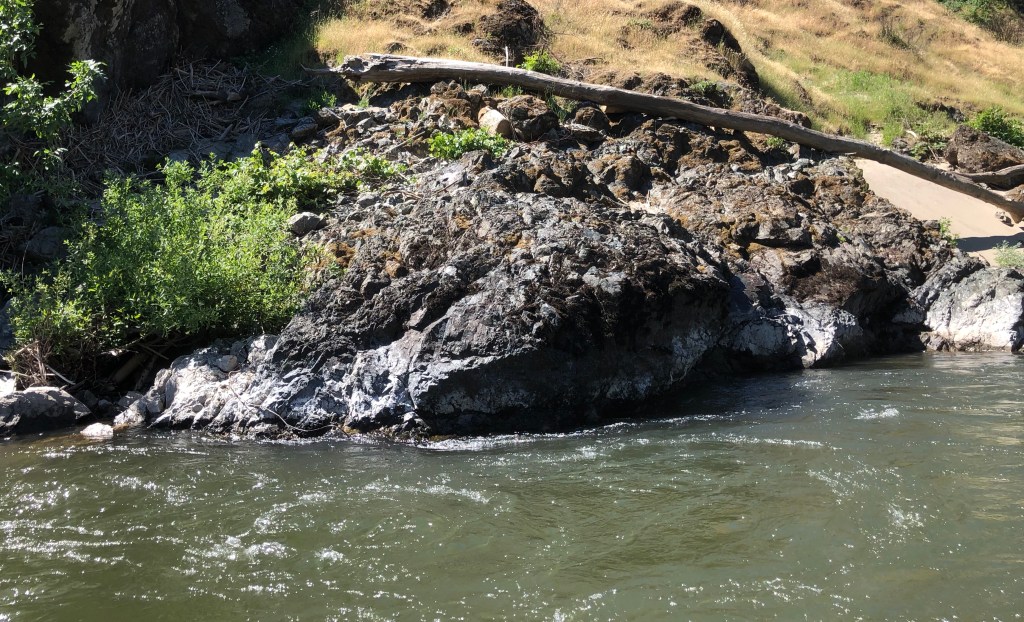
And there are times when we are being carried down by the flow very close to the rocks.
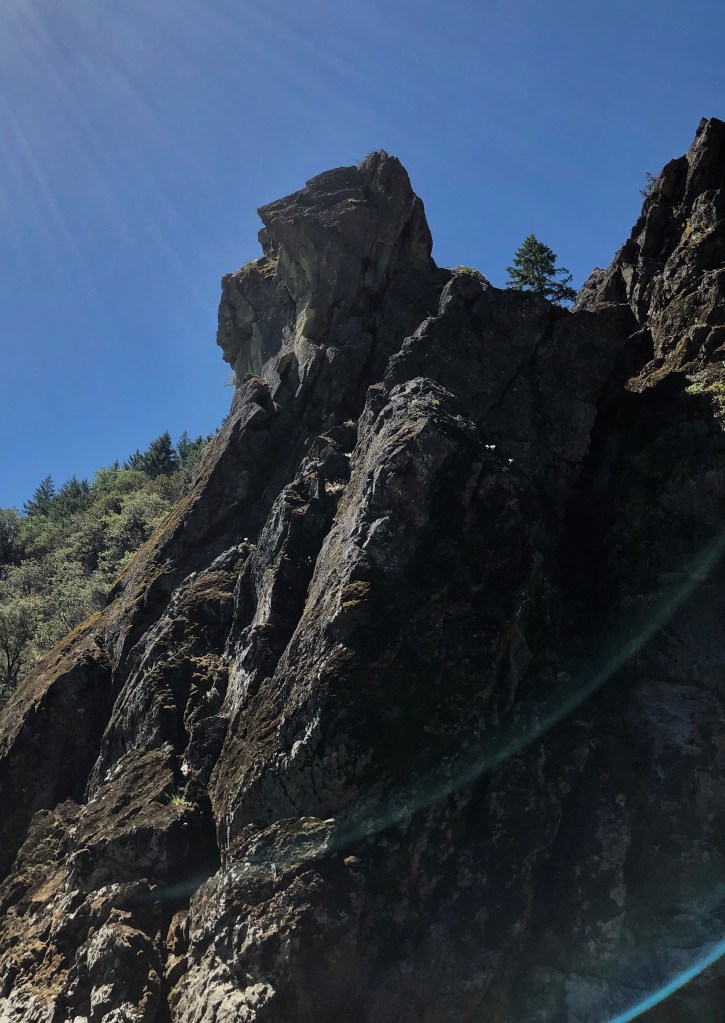
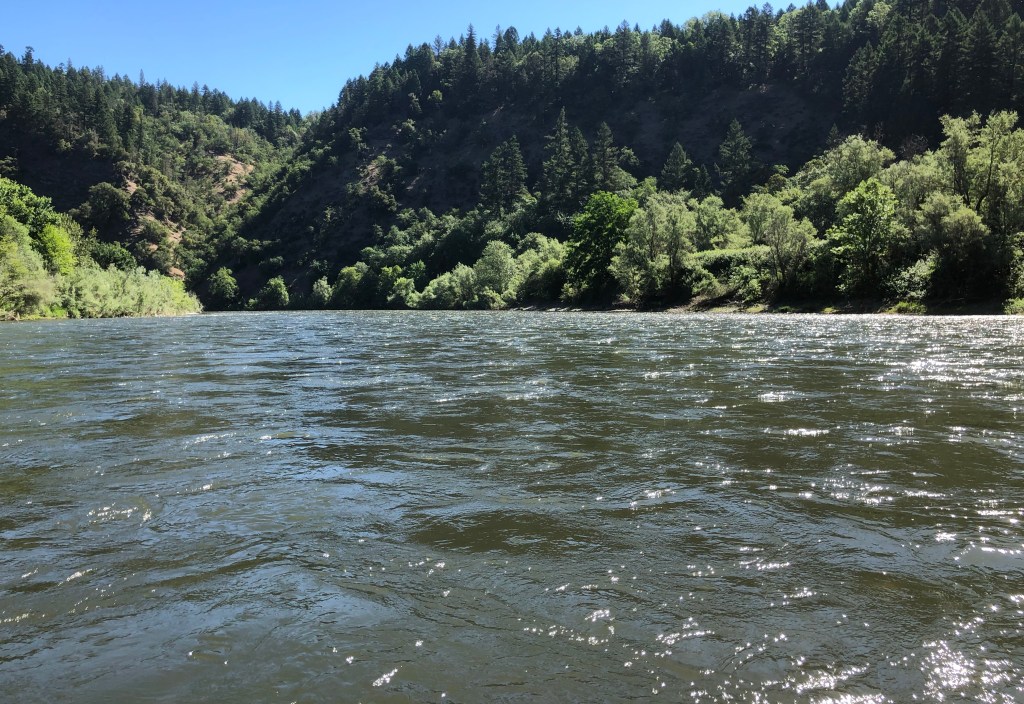
Some of the scenery is dramatic; ergo this rock towering over the edge of the river.
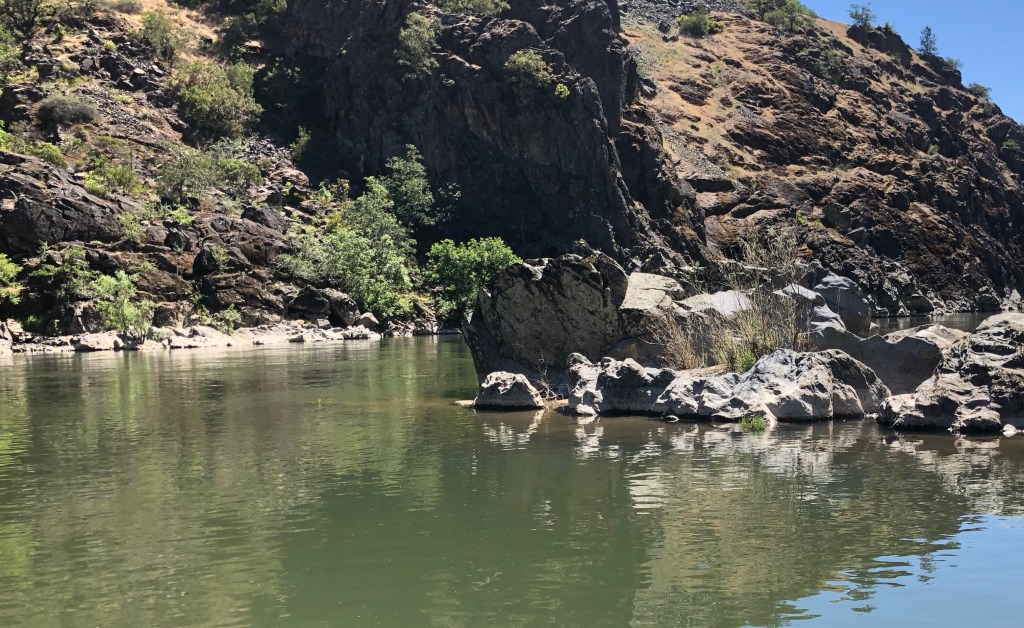
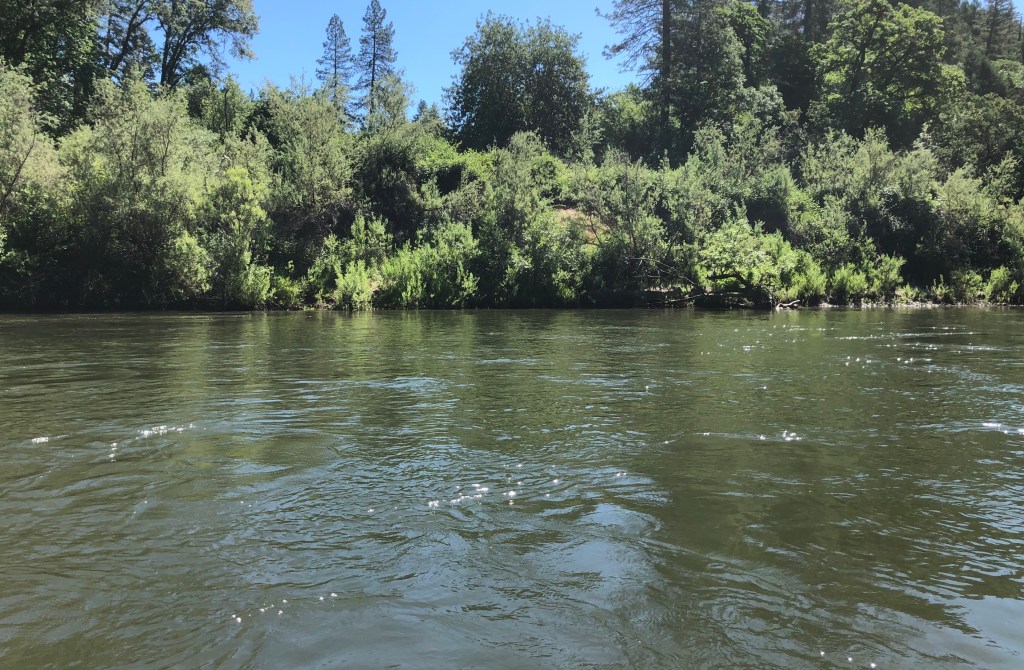
Another detail of the shoreline.
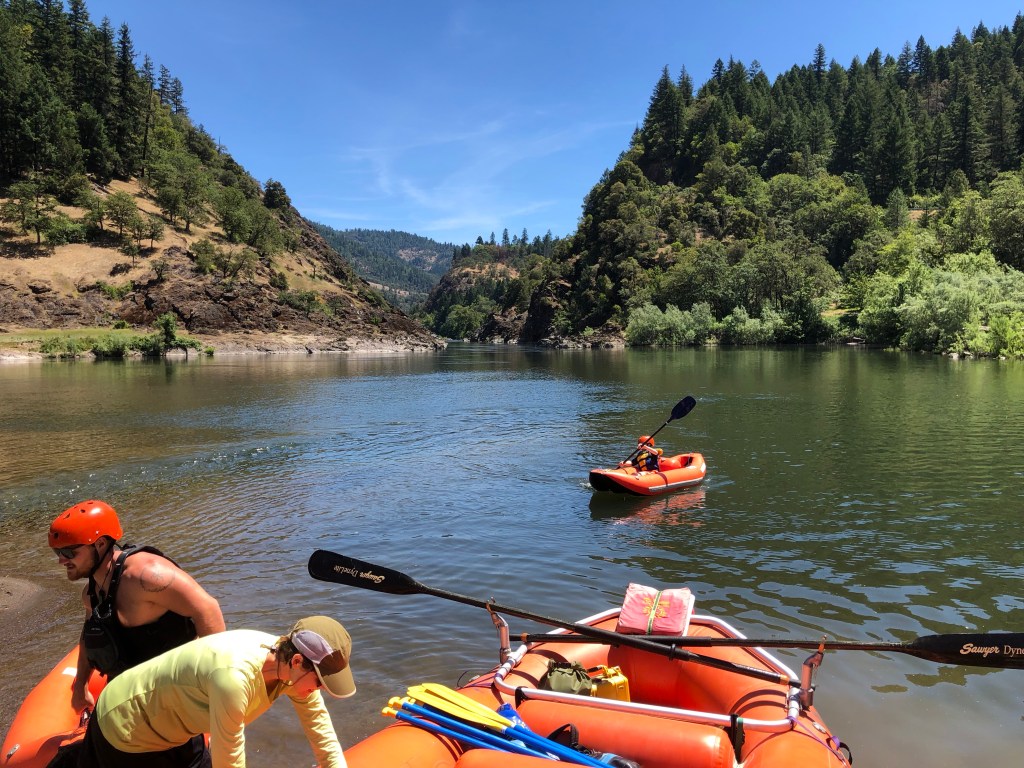
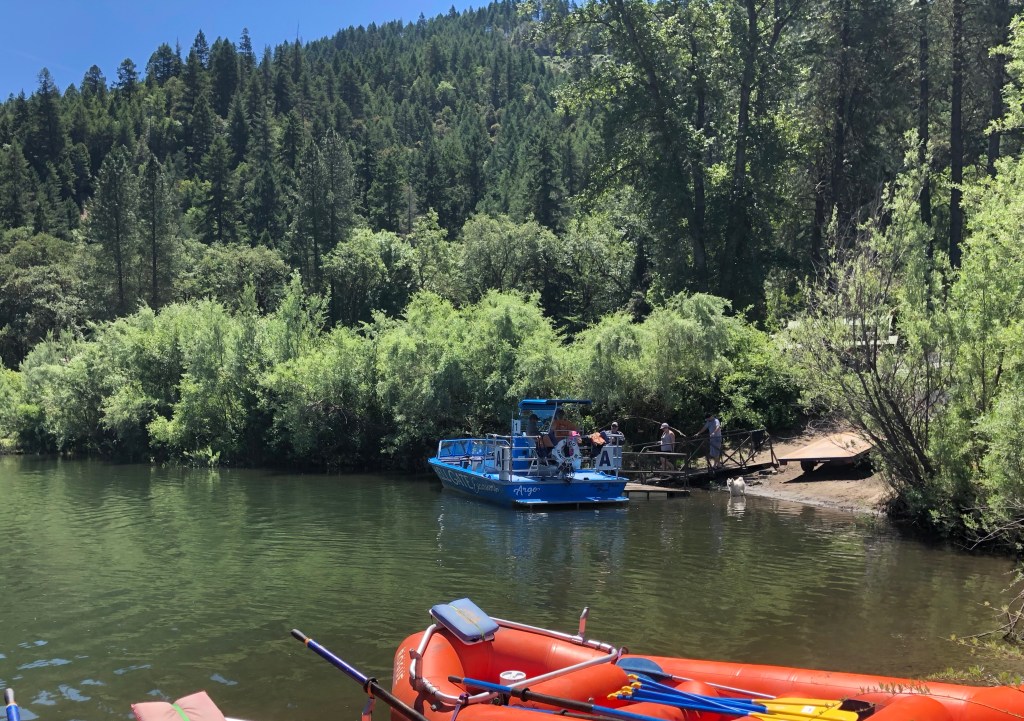
Then it was time for another to enter the kayak. We nudged the dinghy into a quiet edge of the river.
It was a 12-year-old girl who wanted to have a go in the kayak. She was excellent!
Once again, we moved out from the ‘resting’ area to join the main river.
And before we know it we had arrived at our destination.
We are at Morrisons Rogue River Lodge where there is a stop for lunch while Jean and I are to return by coach back to Grants Pass. We have only drifted 9 miles!
But it has been a wonderful 9 miles!
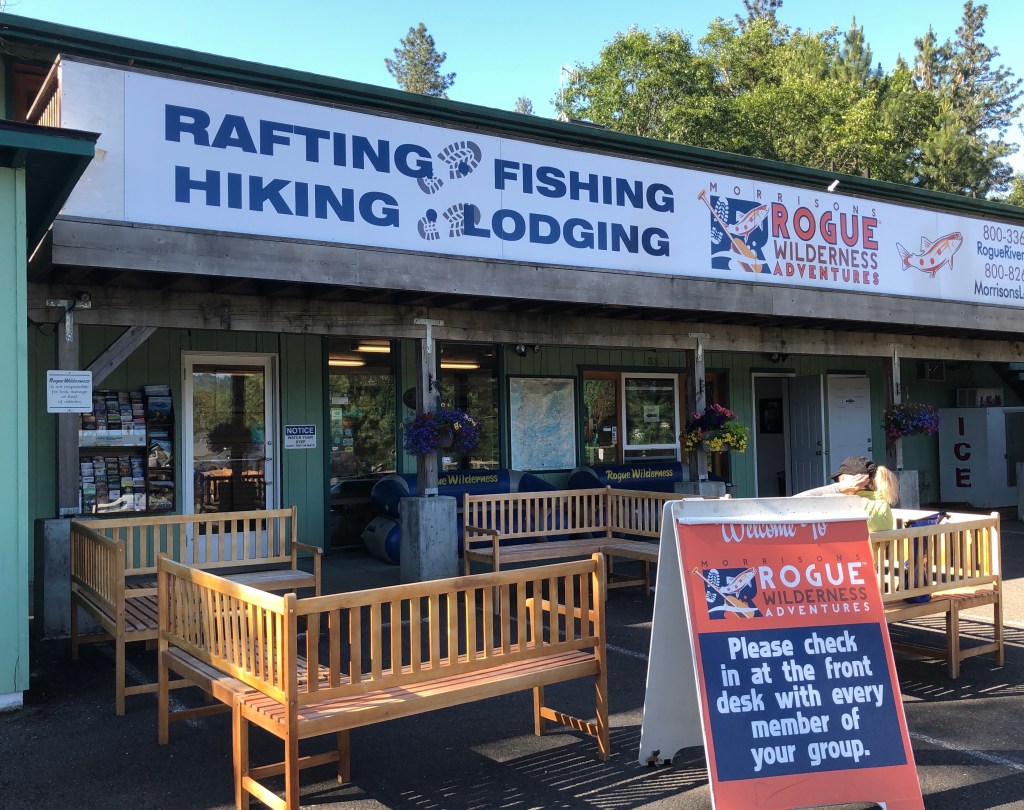
And for the close a picture of Morrisons Rogue River Lodge halt from the Morrisons website.
P.S. There is an interesting article on the total Rogue River in Wikipedia that is worth reading. It starts:
The Rogue River (Tolowa: yan-shuu-chit’ taa-ghii~-li~’,[7]Takelma: tak-elam[8]) in southwestern Oregon in the United States flows about 215 miles (346 km) in a generally westward direction from the Cascade Range to the Pacific Ocean. Known for its salmon runs, whitewaterrafting, and rugged scenery, it was one of the original eight rivers named in the Wild and Scenic Rivers Act of 1968. Beginning near Crater Lake, which occupies the caldera left by the explosive volcanic eruption of Mount Mazama, the river flows through the geologically young High Cascades and the older Western Cascades, another volcanic province. Further west, the river passes through multiple exotic terranes of the more ancient Klamath Mountains. In the Kalmiopsis Wilderness section of the Rogue basin are some of the world’s best examples of rocks that form the Earth’s mantle. Near the mouth of the river, the only dinosaur fragments ever discovered in Oregon were found in the Otter Point Formation, along the coast of Curry County.
Continuing our journey downstream the Rogue River.
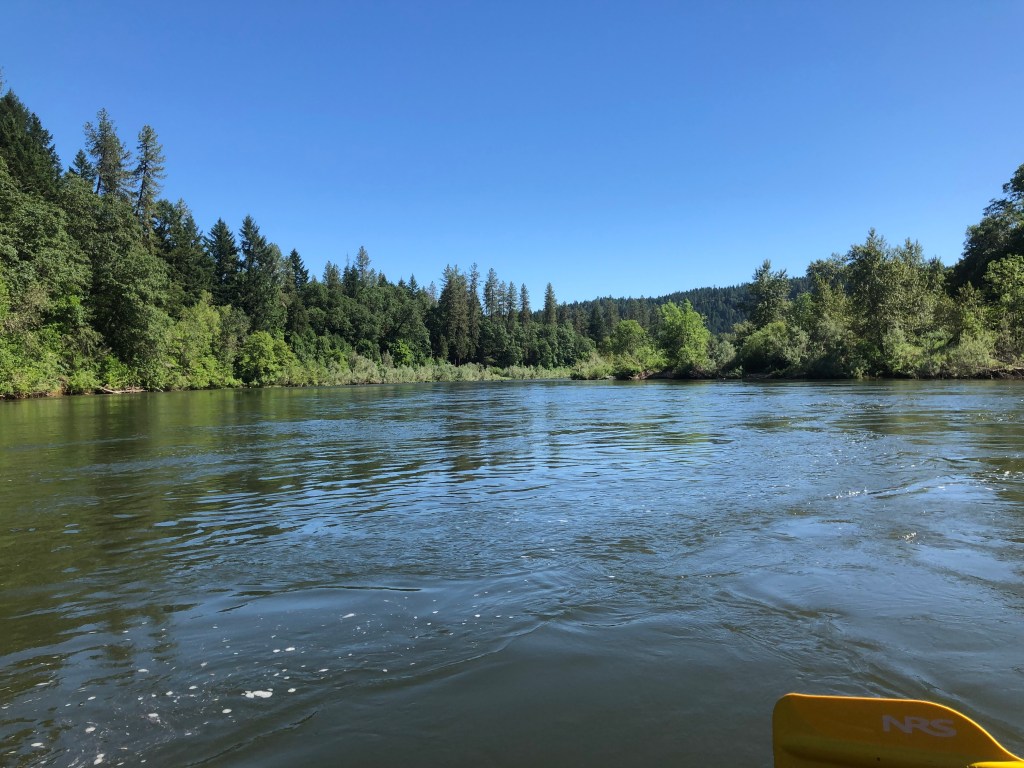
Now we are rafting!
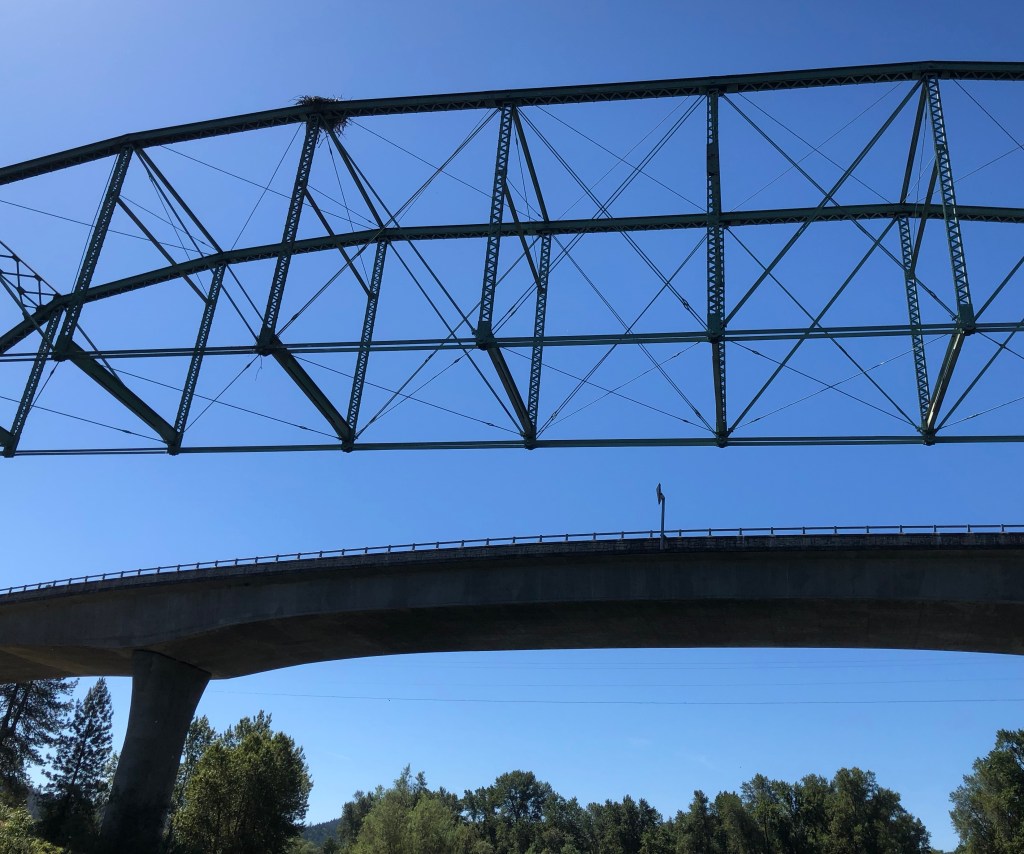
Fairly quickly we pass under Robertson Bridge.
In fact there are two bridges; the old metal one and the modern concrete one.
But way on top of the metal bridge is an osprey’s nest.
We continue.
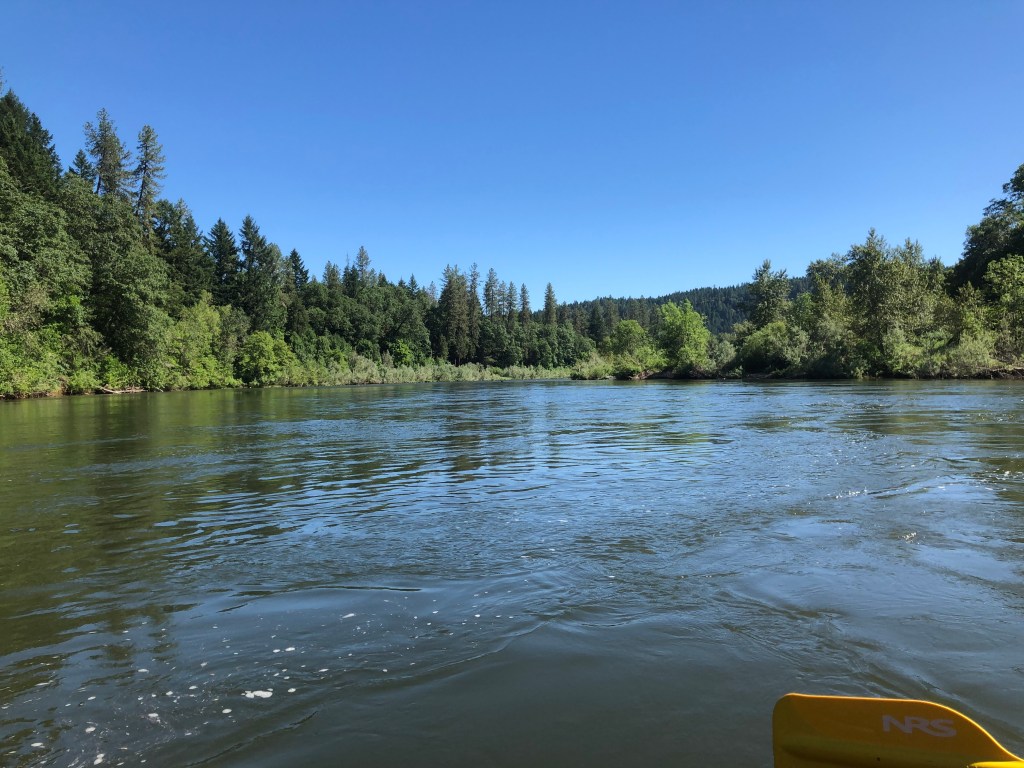
The river, flowing at 2,800 cubic feet per second we are told, flows into the gorge.
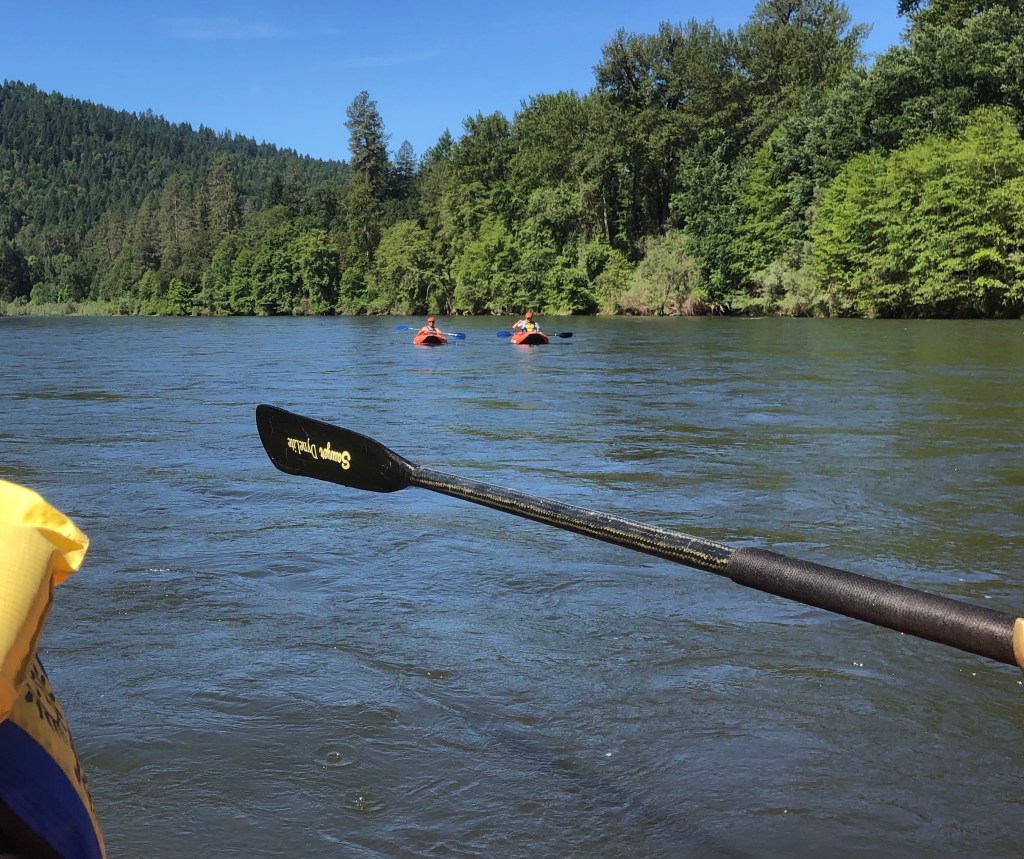
Behind us are the two kayaks. The one on the left is permanently manned by Christian, one of the guides, and the other one is available for anyone who wants to have a go.
Deeper into the gorge we go.
It is wild country.
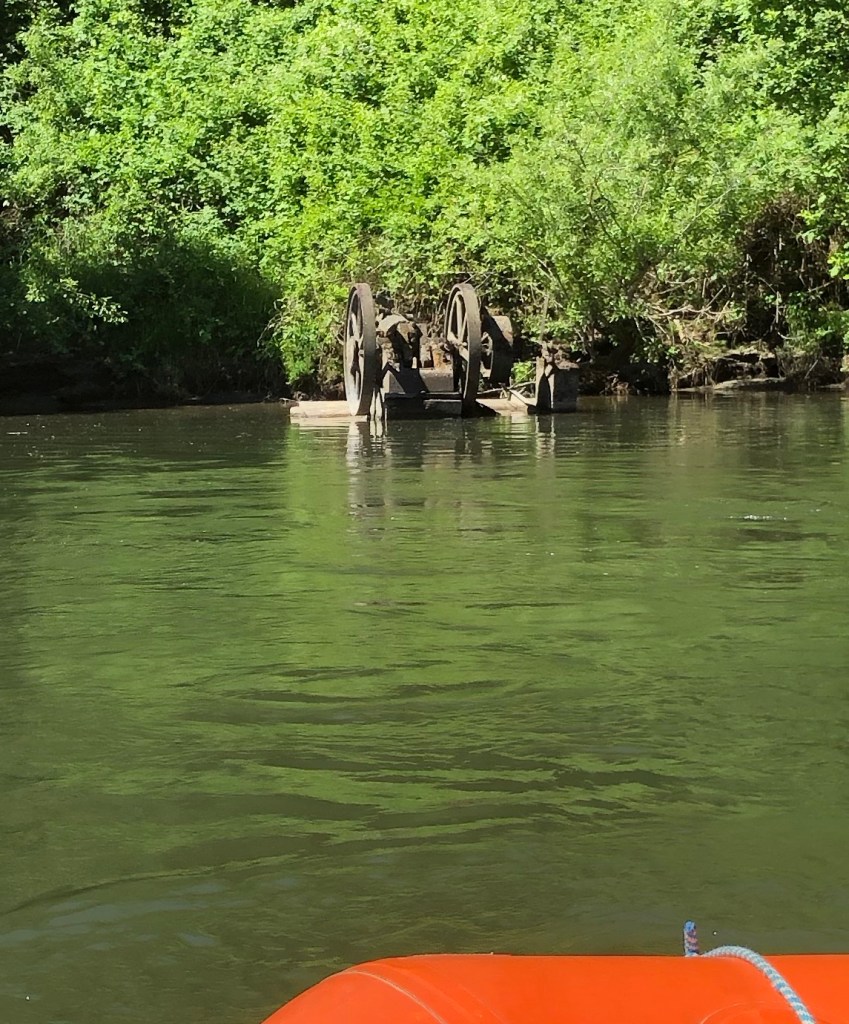
We pass an old pump that some years ago was displaced by a flooding Rogue!
And as the gorge narrows the flow of the river becomes more agitated and the start of the white-water section beckons.
The experience of rafting downstream the Rogue River.
It is Tuesday, 4th June. It is 08:45.
We are early because we are excited and because the location that we have to go to is just four miles from home.
Morrisons Rafting
Neither of us have done anything like this before. But we decided to book just a half-day trip because a) the weather was warm but not roasting, and b) it was a local event and we would be back home by lunchtime to let the dogs out.
Inevitably we are early so I can’t resist wandering around the back to where the guides were loading up the truck.
Then it is time to check in.
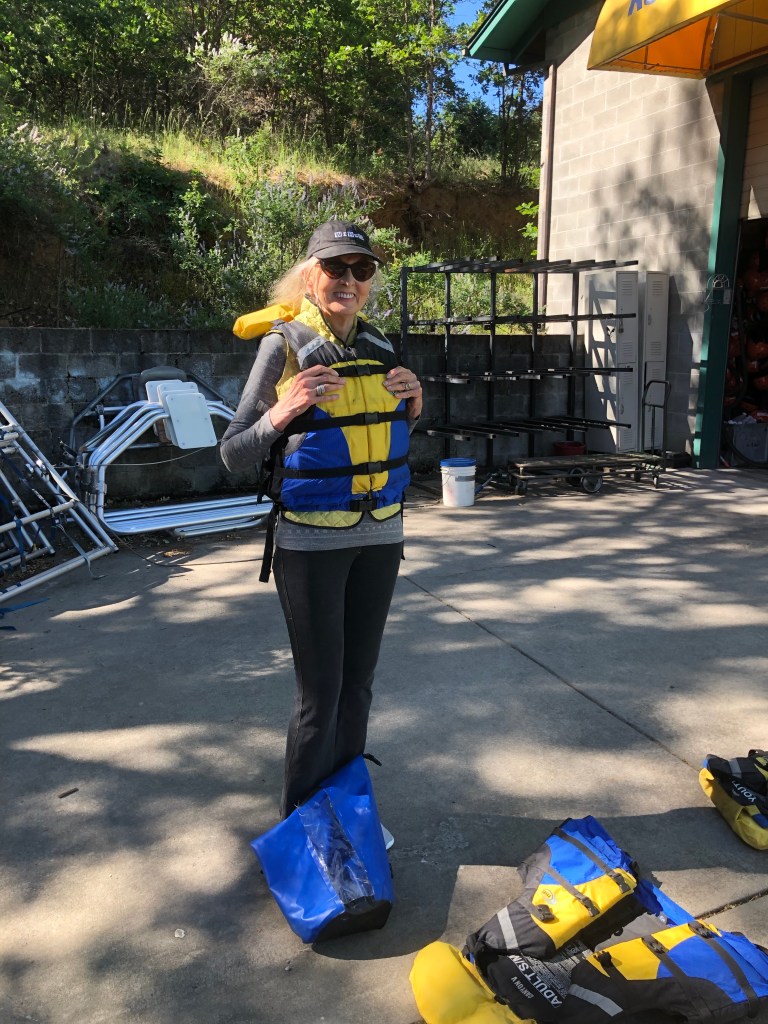
Almost immediately we are fitted with the appropriately sized personal buoyancy protector.
Jean is ready to go!
At first we thought we were the only people going on the 9:30 trip but then a family booked in but they were going for an all-day rafting trip. But all of us on the same first raft.
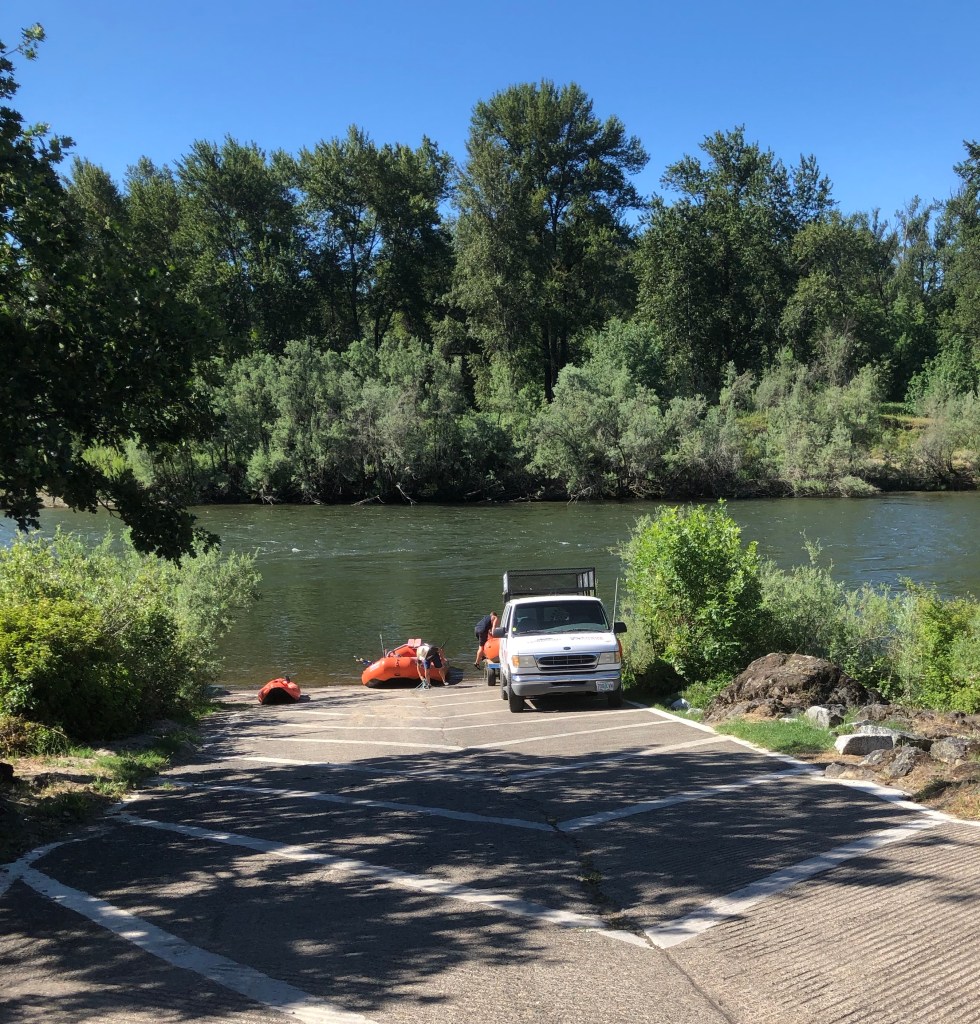
The coach towing the dinghies and kayaks, and carrying all of us, left Merlin and in about 15 minutes time came down to Robertson Bridge boat jetty where we all stepped out and assembled at the head of the ramp while the crew unshipped the dinghies and kayaks and got them ready for boarding.
oooo
We were all going in a single dinghy and the other one was, I guess, a spare. It was put to one side. But the two kayaks were coming.
This was read quickly towards the end of the day, as in yesterday, but I thought it well worthwhile rescheduling my doggie article until Saturday and putting this in for today.
Later on yesterday it was read more thoroughly and it is full of fascinating information such as the weight of meteorites that fall onto Planet Earth each day. I wasn’t aware of that.
Anyway, hope you too find it of interest.
ooOOoo
The tell-tale clue to how meteorites were made, at the birth of the solar system
Assistant Professor of Earth and Environmental Sciences, Wesleyan University
June 6th, 2019.
April 26, 1803 was an unusual day in the small town of L’Aigle in Normandy, France – it rained rocks.
Over 3,000 of them fell out of the sky. Fortunately no one was injured. The French Academy of Sciences investigated and proclaimed, based on many eyewitness stories and the unusual look of the rocks, that they had come from space.
The Earth is pummeled with rocks incessantly as it orbits the Sun, adding around 50 tons to our planet’s mass every day. Meteorites, as these rocks are called, are easy to find in deserts and on the ice plains of Antarctica, where they stick out like a sore thumb. They can even land in backyards, treasures hidden among ordinary terrestrial rocks. Amateurs and professionals collect meteorites, and the more interesting ones make it to museums and laboratories around the world for display and study. They are also bought and sold on eBay.
Despite decades of intense study by thousands of scientists, there is no general consensus on how most meteorites formed. As an astronomer and a geologist, we have recently developed a new theory of what happened during the formation of the solar system to create these valuable relics of our past. Since planets form out of collisions of these first rocks, this is an important part of the history of the Earth.
This meteor crater in Arizona was created 50,000 years ago when an iron meteorite struck the Earth. It is about one mile across. W. Herbst, CC BY-SA
The mysterious chondrules
Drew Barringer (left), owner of Arizona meteor crater, his wife, Clare Schneider, and author William Herbst in the Van Vleck Observatory Library of Wesleyan University, where an iron meteorite from the crater is on display. W. Herbst
About 10% of meteorites are pure iron. These form through a multi-step process in which a large molten asteroid has enough gravity to cause iron to sink to its center. This builds an iron core just like the Earth’s. After this asteroid solidifies, it can be shattered into meteorites by collisions with other objects. Iron meteorites are as old as the solar system itself, proving that large asteroids formed quickly and fully molten ones were once abundant.
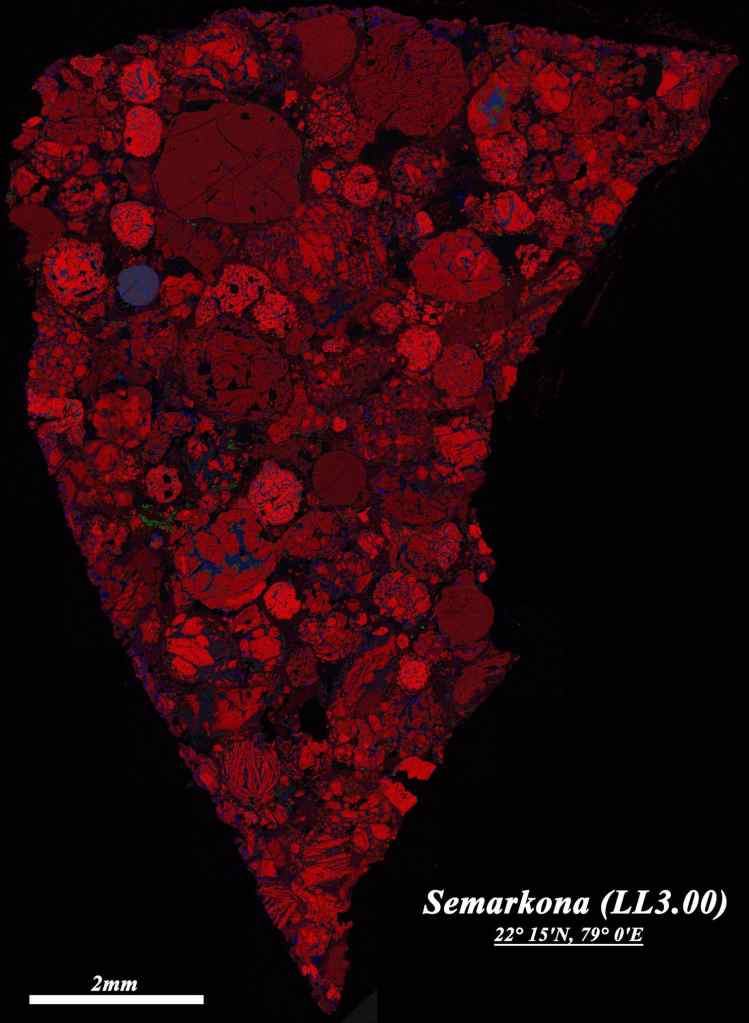
The other 90% of meteorites are called “chondrites” because they are full of mysterious, tiny spheres of rock known as “chondrules.” No terrestrial rock has anything like a chondrule inside it. It is clear that chondrules formed in space during a brief period of intense heating when temperatures reached the melting point of rock, around 3,000 degrees Fahrenheit, for less than an hour. What could possibly account for that?
A closeup of the Semarkona meteorite showing dozens of chondrules. Kenichi Abe
Researchers have come up with many hypotheses through the last 40 years. But no consensus has been reached on how this brief flash of heating happened.
The chondrule problem is so famously difficult and contentious that when we announced to colleagues a few years ago that we were working on it, their reaction was to smile, shake their heads and offer their condolences. Now that we have proposed a solution we are preparing for a more critical response, which is fine, because that’s the way science advances.
The flyby model
Our idea is quite simple. Radioactive dating of hundreds of chondrules shows that they formed between 1.8 and 4 million years after the beginning of the solar system – some 4.6 billion years ago. During this time, fully molten asteroids, the parent bodies of the iron meteorites, were abundant. Volcanic eruptions on these asteroids released tremendous amounts of heat into the space around them. Any smaller objects passing by during an eruption would experience a short, intense blast of heat.
To test our hypothesis, we split up the challenge. The astronomer, Herbst, crunched the numbers to determine how much heating was necessary and for how long to create chondrules. Then the geologist, Greenwood, used a furnace in our lab at Wesleyan to recreate the predicted conditions and see if we could make our own chondrules.
Laboratory technician Jim Zareski (top) loads a programmable furnace as co-author Jim Greenwood looks on, in his laboratory at Wesleyan University. This is where the synthetic chondrules are made. W. Herbst
The experiments turned out to be quite successful.
We put some fine dust from Earth rocks with compositions resembling space dust into a small capsule, placed it in our furnace and cycled the temperature through the predicted range. Out came a nice-looking synthetic chondrule. Case closed? Not so fast.
Two problems emerged with our model. In the first place, we had ignored the bigger issue of how chondrules came to be part of the whole meteorite. What is their relationship to the stuff between chondrules – called matrix? In addition, our model seemed a bit too chancy to us. Only a small fraction of primitive matter will be heated in the way we proposed. Would it be enough to account for all those chondrule-packed meteorites hitting the Earth?
A comparison of a synthetic chondrule (left) made in the Wesleyan lab with a heating curve from the flyby model, with an actual chondrule (right) from the Semarkona meteorite. The crystal structure is quite similar, as shown in the enlargements (bottom row). J. Greenwood
Making whole meteorites
To address these issues, we extended our initial model to consider flyby heating of a larger object, up to a few miles across. As this material approaches a hot asteroid, parts of it will vaporize like a comet, resulting in an atmosphere rich in oxygen and other volatile elements. This turns out to be just the kind of atmosphere in which chondrules form, based on previous detailed chemical studies.
We also expect the heat and gas pressure to harden the flyby object into a whole meteorite through a process known as hot isostatic pressing, which is used commercially to make metal alloys. As the chondrules melt into little spheres, they will release gas to the matrix, which traps those elements as the meteorite hardens. If chondrules and chondrites form together in this manner, we expect the matrix to be enhanced in exactly the same elements that the chondrules are depleted. This phenomenon, known as complementarity, has, in fact, been observed for decades, and our model provides a plausible explanation for it.
The authors’ model for forming chondrules. A small piece of rock (right) — a few miles across or less — swings close to a large hot asteroid erupting lava at its surface. Infrared radiation from the hot lava briefly raises the temperature on the small piece of rock high enough to form chondrules and harden part of that object into a meteorite. W. Herbst/Icarus
Perhaps the most novel feature of our model is that it links chondrule formation directly to the hardening of meteorites. Since only well-hardened objects from space can make it through the Earth’s atmosphere, we would expect the meteorites in our museums to be full of chondrules, as they are. But hardened meteorites full of chondrules would be the exception, not the rule, in space, since they form by a relatively chancy process – the hot flyby. We should know soon enough if this idea holds water, since it predicts that chondrules will be rare on asteroids. Both Japan and the United States have ongoing missions to nearby asteroids that will return samples over the next few years.
If those asteroids are full of chondrules, like the hardened meteorites that make it to the Earth’s surface, then our model can be discarded and the search for a solution to the famous chondrule problem can go on. If, on the other hand, chondrules are rare on asteroids, then the flyby model will have passed an important test.
We took a rafting trip down the Rogue River yesterday (the 4th) and when I have finished transferring the photographs from my iPhone to my computer I will write a post on the journey.
But for today’s post I want to republish an item that appeared also yesterday in EarthSky.
“Mud ball” meteorites – full of clays, organics and water – are unique among space rocks. And a lot of them fell in April 2019 on a small town in Costa Rica, much to the delight of scientists.
This meteorite from the fall at Aguas Zarcas, Costa Rica, in April hit a doghouse. Luckily, the dog – Rocky – was unharmed. Image via Michael Farmer/ASU.
Meteorite falls on Earth are fairly common, but not all meteorites are the same. Some of them are “mud balls,” rich in clays, organic compounds and water-bearing minerals, called carbonaceous chondrites. They are of great interest to scientists, due to their unique composition, and now a bunch more prime specimens have been found, which rained down after a large fireball was seen over Aguas Zarcas, a small town in Costa Rica, on April 23, 2019.
The fireball was a meteor, or space rock, entering the Earth’s atmosphere that broke apart into hundreds of smaller pieces. When the pieces of this rock hit the ground, their name changed to meteorite. One meteorite fragment weighed about two pounds and smashed through the roof of a house, destroying the owner’s dining table. Another one crashed through the roof of a dog house, narrowly missing a sleeping dog. Close calls!
The doghouse with the hole in its roof from the April 2019 meteorite in Costa Rica. The dog, Rocky, was sleeping in the doghouse at the time; he was unharmed, but probably surprised! Image via Michael Farmer/ASU.
Several of the meteorites were collected and sent to Arizona State University (ASU) for study, donated by meteorite collector Michael Farmer. ASU will also be able to purchase additional meteorites from the fall, thanks to a private donor. This is the first time in 50 years that the university has had a chance to analyze such pristine samples of extraterrestrial mud balls. As Laurence Garvie, a research professor at ASU and a curator for its Center for Meteorite Studies, said:
Many carbonaceous chondrites are mud balls that are between 80 and 95 percent clay. Clays are important because water is an integral part of their structure. These had to be collected quickly and before they got rained on. Because they are mostly clay, as soon as these types of meteorites get wet, they fall apart.
Luckily, the researchers were able to collect their samples before it rained again, and they got a nice little haul, too, about 55 pounds (25 kilograms) of the precious space rocks.
A composite element map from one of the meteorites showing the distribution of different minerals. Orange-yellow colors show tochilinite, deep-blue colors represent olivine, and red colors are pentlandite and pyrrhotite. Image via ASU.
Analysis of the meteorites was carried out at ASU’s campus in Tempe, Arizona. According to Garvie:
I was in the lab by 5 a.m. the next morning after picking up the samples to get them ready for the initial analyses. Classification of new meteorites can be like a race with other institutions, and I needed ASU to be first so that we’ll have the recognition of being the collection that holds and curates the type specimen material.
Air-sensitive meteorites like these are kept in special nitrogen cabinets. The nitrogen gas helps to preserve the meteorites, which can degrade easily due to their composition. As Garvie explained:
If you left this carbonaceous chondrite in the air, it would lose some of its extraterrestrial affinities. These meteorites have to be curated in a way that they can be used for current and future research, and we have that ability here at ASU.
This mud ball meteorite fragment from April’s meteorite fall in Aguas Zarcas, Costa Rica, looks a bit like an arrowhead. Image via ASU.
The classification of these meteorites is part of a broader international classification effort. Garvie is also working with Karen Ziegler from the Institute of Meteoritics at the University of New Mexico. They studied the oxygen isotopes of the meteorites, to determine how similar they are to other carbonaceous chondrites.
Sandra Pizzarello, an organic chemist from ASU’s School of Molecular Sciences, is also involved in the studies, focusing on the organic content of the meteorites. These kinds of organics could have provided the material needed for life to begin on Earth.
Additional scientific analysis will follow later, but first the meteorites need to be approved, classified and named by The Meteoritical Society‘s nomenclature committee. This group of 12 scientists is responsible for approving all meteorite samples for study.
These new meteorite samples are currently on display at ASU’s Tempe campus in the Center for Meteorite Studies collection.
So, why are mud ball carbonaceous chondrite meteorites so significant?
They are thought to originate from asteroids that are leftovers from early planetesimals, planets that started to form in the early solar system billions of years ago but now no longer exist. Those planets had organic materials and water, making them places where the chemical precursors to life could have started. In the case of the asteroid that these new meteorites originated from, Garvie said:
It formed in an environment free of life, then was preserved in the cold and vacuum of space for 4.56 billion years, and then dropped in Costa Rica last week.
Carbonaceous chondrites are relatively rare among meteorites but are some of the most sought-after by researchers because they contain the best-preserved clues to the origin of the solar system. This new meteorite represents one of the most scientifically significant additions to our wonderful collection in recent years.
Because these meteorites contain so much mineral-bound water, they could also be useful in learning how water can be extracted from asteroids, a great resource for future astronauts. According to Garvie:
Having this meteorite in our lab gives us the ability, with further analysis, to ultimately develop technologies to extract water from asteroids in space.
Location of Aguas Zarcas in Costa Rica. Image via Google Maps.
The last time a carbonaceous chondrite meteorite fall similar to this one occurred was in 1969 near Murchison, Australia. Those meteorites were curated by another ASU professor and founding director of ASU’s Center for Meteorite Studies, Carleton Moore.
The meteorites in Aguas Zarcas have also been found to be similar in composition to asteroid Bennu, now being explored by NASA’s OSIRIS-REx spacecraft. Bennu is thought to be a remnant carbonaceous chondrite planetesimal. OSIRIS-REx is carrying ASU’s Phil Christensen-designed Thermal Emissions Spectrometer (OTES) instrument, which is being used to make mineral and temperature maps of the asteroid.
Garvie and other scientists will be studying these mud ball meteorites for years to come, unlocking more secrets as to how our solar system formed and evolved, and how the ingredients of life originated and were spread throughout the solar system, including to Earth.
Bottom line: This new meteorite fall in Costa Rica has provided scientists with a great opportunity to study multiple mud ball meteorites, one of the most unusual kinds of meteorites known to exist, and one that could help answer the question of how life started on Earth.
I don’t know about you but I found this very interesting indeed. I guess I hadn’t looked at meteorites as different entities, depending on the source, before.
Fascinating!
Must repeat that closing paragraph again: “Garvie and other scientists will be studying these mud ball meteorites for years to come, unlocking more secrets as to how our solar system formed and evolved, and how the ingredients of life originated and were spread throughout the solar system, including to Earth.”
A delightful story of one man’s bravery for another – dog!
This was published on The Daily Dodo a week ago and really does need retelling.
It shows how much we love our dogs.
ooOOoo
Man Jumps Into An NYC River To Save A Drowning Dog
Photo Credit: Erin O’Donnell
Ever since she was adopted from North Shore Animal League in March 2017, Harper has been absolutely head over heels for her mom, Erin O’Donnell, but is definitely a little nervous in new situations and can take some time to warm up to new people.
“She is a sweetheart but very anxious outside and around strangers,” O’Donnell told The Dodo.
On Saturday, O’Donnell was performing with the Brooklyn Irish Dance Company in Manhattan and left Harper in Brooklyn with friends and a trusted dog walker. Harper and her dog walker were out taking a stroll when a cab recklessly ran a stop sign and hit both the dog walker and Harper.
Both were OK and only sustained minor injuries, but poor Harper was so scared and shaken up that she ran and ran and ran — until she reached the East River, and jumped right in.
Still in a panic, Harper swam with determination and ferocity, and while at first onlookers thought she was just a dog with an owner nearby going for a swim, they soon realized that wasn’t the case at all.
“I was at the Brooklyn Barge celebrating my B’day when we saw a dog ‘going for a swim,’” Gabe Castellanos wrote in a post on Instagram. “The day grew hot and we all figured a nice swim could do us all a service. We assumed the owner was on shore keeping a watchful eye until a patron ran up to the north side of the Barge with a panicked voice saying that the dog, Harper, had run away.”
Photo Credit: Lorenzo Fonda
It was around that time that everyone began to notice Harper losing speed. The river was incredibly cold, and with the amount of energy Harper was exerting in her panicked state, it was likely that she wouldn’t be able to keep herself afloat for very much longer. This fact settled in for Castellanos, and he immediately knew he had to do something about it.
Castellanos happens to be a graduate of SUNY Maritime College and has extensive water survival skills knowledge — and so he decided he was going in.
“Since there was no sign of her making an attempt to swim back to shore, I knew something had to be done,” Castellanos told The Dodo. “I looked on the barge for any type of floating device to use if I were to jump from the end, but then I noticed there was a life vest, so I grabbed it.”
At this point, a crowd of about 300 people had gathered, invested in Harper and her well-being, and as soon as everyone realized what Castellanos was about to do, they all broke out into cheers of encouragement. Lorenzo Fonda, a Brooklyn-based filmmaker and artist, was hanging out at the Brooklyn Barge when he suddenly realized what was happening, and quickly began recording the entire ordeal.
Photo Credit: Lorenzo Fonda
Knowing the water was going to be cold and the conditions less than ideal, Castellanos strategized quickly with those around him as he prepared to jump into the water. He stripped down to his underwear, climbed over the rails, and then lowered himself as close to the water as he possibly could before letting go and diving in.
“There was a grand cheer when I entered the water,” Castellanos said. “After that, I was no longer focused on the crowds and my surroundings but focused on my breathing and swimming over to Harper. The crowds went mute during my swim. I’m sure they were still cheering, but I could not hear anything other than the water.”
Harper was still swimming at a steady pace, and Castellanos had to work hard to catch up with her. As soon as she realized someone was swimming towards her, she became even more panicked and tried as hard as she could to swim away from him.
Castellanos was persistent, though, and even though Harper struggled and lashed out a bit out of fear when he finally reached her, he stayed calm and determined and was finally able to secure her.
Cheers erupted from all over when Castellanos finally had Harper safely in his arms, and the pair quickly returned to shore. Both were exhausted and needed medical attention to make sure everything was OK, but luckily they were both completely fine, and are now recovering at their respective homes.
Photo Credit: Lorenzo Fonda
O’Donnell was in the middle of a performance when all of this occurred, and didn’t find out until later about Harper’s river adventure and the man who saved her life.
“Her paws are in rough shape, so she will need some trendy boots for a few weeks, but otherwise she’s in great spirits,” O’Donnell said. “It is definitely so refreshing to see the positive responses from people at the Brooklyn Barge and on social media expressing their sympathy for Harper and praising Gabe, who definitely saved the day.”
As an innocent onlooker that day, Castellanos didn’t have to do anything to help. He could have just sat by and watched and let someone else handle it, but instead he took a leap of faith and ended up saving Harper’s life, making him a true hero.
ooOOoo
I take my hat off to Gabe Castellanos. It’s something that 99.9% of us wouldn’t do yet Gabe didn’t think twice. OK, he had specific training but still there was a degree of risk. But he took it!
A week ago I was casually reading a copy of our local newspaper, the Grants Pass Daily Courier, and inside was a piece by Kathleen Parker, a syndicated columnist, entitled It’s the end of everything – or not.
I found it particularly interesting especially a quotation in her piece by Robert Watson, a British chemist who served as the chair of the panel of the Intergovernmental Science-Policy Platform on Biodiversity and Ecosystem Services (IPBES). The IPBES had recently published the results of the three-year study by 145 authors from 50 countries.
So I wrote to Kathleen Parker asking if I might have permission to quote that excerpt and, in turn, received her permission to so do.
Here it is:
Robert Watson wrote in a statement that:
“the health of ecosystems on which we and all species depend is deteriorating more rapidly than ever. We are eroding the very foundation of our economies, livelihoods, food security, health and quality of life worldwide.”
But, Watson also said, it’s not too late to repair and sustain nature – if we act now in transformative ways.
It is time to change our habits both at an individual level and the level of countries working together.
Moreover we haven’t got decades. We have got to do it now!
It’s sort of alright when the person needs to hunt to stay alive. But in the Western world the incidence of that is pretty remote.
So when author Jim wrote about coyotes and hunting I had to share it with you (and, for the record, both Jean and I are atheists). Published with Jim’s permission.
ooOOoo
The Incredible Coyote and Western Morality
How killing for fun is not only a Christian Right, but a value
By Jim, August 5th 2018.
Christian vulgarity has reigned it’s bullets down on the North American coyote for over 100 years. The longest standing extermination order in history has killed millions of coyotes and continues its bounty program in most states. Competitive hunts sponsored throughout the nation each year with cash prizes and trophies instill to our kids the right obligation to kill for fun.
“One morning in the late 1930s, the biologist Adolph Murie stood near a game trail in Yellowstone National Park and watched a passing coyote joyously toss a sprig of sagebrush in the air with its mouth, adroitly catch it, and repeat the act every few yards. At the time, Mr. Murie was conducting a federal study intended to prove, definitively, that the coyote was “the archpredator of our time.” But Mr. Murie, whose work ultimately exonerated the animals, was more impressed by that sprig-tossing — proof, he believed, of the joy a wild coyote took in being alive in the world” (1)
The majority of politicians have failed to address this with any passion, and being the good, high moral standard western value Christians that they are, continue the killing spree. A useless torture that drives the coyote without mercy and without effect. “Under persecution, the biologists argued, evolved colonizing mechanisms kicked in for coyotes. They have larger litters. If alpha females die, beta females breed. Pressured, they engage an adaptation called fission-fusion, with packs breaking up and pairs and individuals scattering to the winds and colonizing new areas. In full colonization mode, the scientists found, coyotes could withstand as much as a 70 percent yearly kill rate without suffering any decline in their total population”.
Hunters have their ultimate victim to hunt—one that can outbreed the continued onslaught. How fun is it? While the coyote is hunted for sport, they die in earnest. Leave them to experience their joy, and populations will mitigate in their own necessary way.
Christian values and morals once again are superior delayed in common decency and way off the mark—unless your talking killing for sport.
ooOOoo
I want to add a couple of comments that were left on the post:
Not many christians are bothered by this. Why should they, when you hear them quote from their holy book, that god commanded them to subdue the earth.
It is for this very reason that many christians are nonchalant when we talk about climate change
oooo
The price paid for pointlessly killing predators is a dear one. Moreover, all needless killing of animals is wrong, says the immoral, convinced atheist.
oooo
(to which Jim replied)
Part of the doctrine is to subdue and have dominion. To hell with inferior, soulless life. The ripple effect of what was once naturally flowing is tragic and painful.























 Learning from Dogs